 "Peter replied, 'Master, to whom would we go? You have the words of real life, eternal life. We’ve already committed ourselves, confident that you are the Holy One of God.'"(John 6:68-69)
Thursday of the First week in Ordinary Time
Feast of the Day:
Saint of the Day:
SAINT PAUL
The First Hermit
(c. 230-342)
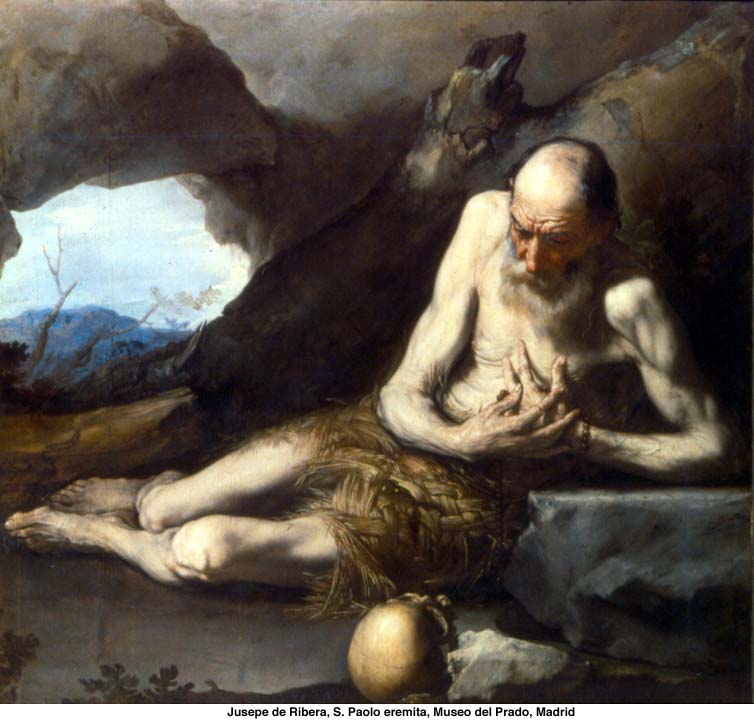 St. Paul was born in Upper Egypt, about the year 230, and became an orphan at the age of fifteen. He was very rich and highly educated. Fearing lest the tortures of a terrible persecution might endanger his Christian perseverance, he retired into a remote village. But his pagan brother-in-law denounced him, and St. Paul, rather than remain where his faith was in danger, entered the barren desert, trusting that God would supply his wants. And his confidence was rewarded; for on the spot to which Providence led him he found the fruit of the palm-tree for food, and its leaves for clothing, and the water of a spring for drink. His first design was to return to the world when the persecution was over; but, tasting great delights in prayer and penance, he remained the rest of his life, ninety years, in penance, prayer, and contemplation.
God revealed his existence to St. Antony, who sought him for three days. Seeing a thirsty she-wolf run through an opening in the rocks, Antony followed her to look for water, and found Paul. They knew each other at once, and praised God together. When St. Antony visited him, a raven brought him a loaf, and St. Paul said, "See how good God is! For sixty years this bird has brought me half a loaf every day; now thou art come, Christ has doubled the provision for His servants." Having passed the night in prayer, at dawn of day Paul told Antony that he was about to die, and asked to be buried in the cloak given to Antony by St. Athanasius. Antony hastened to fetch it, and on his way back saw Paul rise to heaven in glory. He found his dead body kneeling as if in prayer, and two lions came and dug his grave.
Paul died in his one hundred and thirteenth year.
Lives of the Saints, by Alban Butler, Benziger Bros. ed. [1894]
SAINT REMIGIUS
Archbishop
(438-533)
 Remigius, or Remi, was born of noble and pious parents. At the age of twenty-two, in spite of the canons and of his own reluctance, he was acclaimed Archbishop of Rheims. He was unusually tall, his face impressed with blended majesty and serenity, his bearing gentle, humble, and retiring. He was learned and eloquent, and had the gift of miracles. His pity and charity were boundless, and in toil he knew no weariness. His body was the outward expression of a noble and holy soul, breathing the spirit of meekness and compunction.
For so choice a workman God had fitting work. The South of France was in the hands of Arians, and the pagan Franks were wresting the North from the Romans. St. Remigius confronted Clovis, their king, and converted and baptized him at Christmas, in 496. With him he gained the whole Frank nation. He threw down the idol altars, built churches, and appointed bishops. He withstood and silenced the Arians, and converted so many that he left France a Catholic kingdom, its king the oldest and at the time the only crowned son of the Church.
He died in 533, after an episcopate of seventy-four years, the longest on record.
Lives of the Saints, by Alban Butler, Benziger Bros. ed. [1894]
Thursday of the First week in Ordinary Time
Letter to the Hebrews 3: A Rest for God’s People
7 It is just as the Holy Spirit says,
“If you hear God’s voice today,
8 don’t be stubborn!
Don’t rebel like those people
who were tested
in the desert.
9 For forty years your ancestors
tested God
and saw
the things he did.
10 “Then God got tired of them
and said,
‘You people never
show good sense,
and you don’t understand
what I want you to do.'
11 God became angry
and told the people,
‘You will never enter
my place of rest!’”
12 My friends, watch out! Don’t let evil thoughts or doubts make any of you turn from the living God. 13 You must encourage one another each day. And you must keep on while there is still a time that can be called “today.” If you don’t, then sin may fool some of you and make you stubborn. 14 We were sure about Christ when we first became his people. So let’s hold tightly to our faith until the end.
Psalms 95:6 Bow down and worship
the Lord our Creator!
7 The Lord is our God,
and we are his people,
the sheep he takes care of
in his own pasture.
Listen to God’s voice today!
8 Don’t be stubborn and rebel
as your ancestors did
at Meribah and Massah[a]
out in the desert.
9 For forty years
they tested God
and saw
the things he did.
10 Then God got tired of them
and said,
“You never show good sense,
and you don’t understand
what I want you to do.”
11 In his anger, God told them,
“You people will never enter
my place of rest.”[Footnotes:
95.8 Meribah and Massah: See the note at 81.7.]
Holy Gospel of Jesus Christ according to Saint Mark 1: Jesus Heals a Man
40 A man with leprosy[a] came to Jesus and knelt down.[b] He begged, “You have the power to make me well, if only you wanted to.”
41 Jesus felt sorry for[c] the man. So he put his hand on him and said, “I want to! Now you are well.” 42 At once the man’s leprosy disappeared, and he was well.
43 After Jesus strictly warned the man, he sent him on his way. 44 He said, “Don’t tell anyone about this. Just go and show the priest that you are well. Then take a gift to the temple as Moses commanded, and everyone will know that you have been healed.”[d]
45 The man talked about it so much and told so many people, that Jesus could no longer go openly into a town. He had to stay away from the towns, but people still came to him from everywhere.[Footnotes:
1.40 leprosy: In biblical times the word “leprosy” was used for many different kinds of skin diseases.
1.40 and knelt down: These words are not in some manuscripts.
1.41 felt sorry for: Some manuscripts have “was angry with.”
1.44 everyone will know that you have been healed: People with leprosy had to be examined by a priest and told that they were well (that is, “clean”) before they could once again live a normal life in the Jewish community. The gift that Moses commanded was the sacrifice of some lambs together with flour mixed with olive oil.]
Thursday of the First week in Ordinary Time
Commentary of the Day:
Rabanus Maurus (c.784-856), Benedictine abbot and Bishop
Three books dedicated to Bonosus, Bk 3, 4 ; PL 112, 1306
"You can make me clean"
You must never fail to trust in God nor despair of his mercy; I should not like you to doubt or despair of becoming better. For even if the devil were able to throw you down from the heights of virtue to the depths of wickedness, how much more can God recall you to the summit of goodness. And not just bring you back to the state you were in before your fall, but he can make you much happier than you seemed to be before. Don’t lose heart, I beg you, and don’t close your eyes to the hope of good for fear that what happens to people who don’t love God should happen to you. For it is not the great number of one’s sins that leads the soul to despair but disdain for God. As the Wise man says: “It is the characteristic of the impious to despair of salvation and hold it in contempt since they have fallen into the pit of sin” (cf. Prv 18,3 Vg).
Therefore every thought that takes our hope away follows on from a lack of faith: like a heavy stone around our neck, it forces us to be always looking downwards to the earth and doesn’t allow us to raise our eyes to the Lord. But those with a brave heart and enlightened mind know how to release their necks from this horrid weight. “Behold, as the eyes of servants are on the hand of their masters, as the eyes of a maid are on the hands of her mistress, so our eyes are on the Lord our God till he have pity on us” (Ps 123,2).
____________________________

No comments:
Post a Comment