 "Peter replied, 'Master, to whom would we go? You have the words of real life, eternal life. We’ve already committed ourselves, confident that you are the Holy One of God.'"(John 6:68-69)
Wednesday of the First week in Ordinary Time
Feast of the Day:
Saint of the Day:
SAINT SAVA
Abbot and Patron of Serbia
(+ 1255)
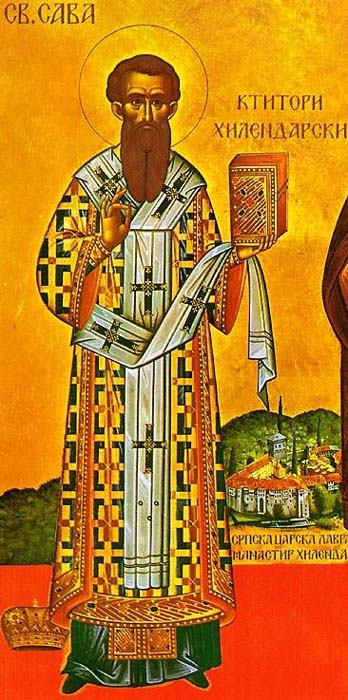 Sava was the son of Stephen I, founder of the Nemanydes dynasty, and also known as Sabas. He became a monk on Mount Athos in Greece when he was seventeen. With his father, who abdicated in 1196, he founded Khilandrai Monastery on Mount Athos for Serbian monks and became Abbot.
He returned home in 1207 when his brothers, Stephen II and Vulkan, began to quarrel, and civil war broke out. Sava brought many of his monks with him, and from the headquarters he established at Studenitsa Monastery, he founded several monasteries and began the reformation and education of the country, where religion and education had fallen to a low estate.
He was named metropolitan of a new Serbian hierarchy by Emperor Theodore II Laskaris at Nicaea; was consecrated, though for political reasons unwillingly, by Patriarch Manuel I in 1219; returned home bringing more monks from Mount Athos; and in 1222 crowned his brother Stephen II King of Serbia.
Through his efforts, he finished the uniting of his people that had been begun by his father, translated religious works into Serbian, and gave his people a native clergy and hierarchy.
He made a pilgrimage to the Holy Land, was later sent on a second visit there on an ecclesiastical mission, and died on the way back at Tirnovo, Bulgaria, on January 14.
He is the patron of Serbia.
http://www.catholic.org/
Blessed Peter Donders
Priest
(1809-1887)
 Peter Donders was born in Tilburg (Holland), on October 27, 1809. From his youth he felt himself called to the priesthood, but, because of the poverty of his family, his schooling was cut short. However, at the age of 22, with the help of his parish priest, he entered the minor seminary of St. Michael-Gestel as a seminarian.
He was ordained a priest on June 5, 1841. He was thus able to follow his missionary vocation, setting out for Surinam, which was then a Dutch colony. He arrived in Paramaribo, the principal city of the colony, on September 16, 1842 and applied himself at once to the pastoral works that were to occupy him until his death. His letters express his indignation at the harsh treatment of the African peoples forced to work on the plantations.
In 1856 he was sent to the leper station of Batavia; and this was to be, with very few interruptions, the scene of his labors for the rest of his life.
When the Redemptorists arrived in 1866 to take charge of the mission of Surinam, Peter Donders applied for admission into the Congregation. He professed his vows on June 24, 1867. Religious profession, in associating him with a missionary congregation, gave him a more vivid sense of the apostolic life in community, allowing him to leave Batavia more often to give himself to the conversion of the native Indians and negroes. But the name of Donders remained bound to the leprosarium of Batavia.
He died among his lepers, poor among the poor, on January 14, 1887, mourned as their benefactor and invoked as a saint.
He was beatified by Pope John Paul II on 23rd May 1982.
Saint Felix of Nola
Feastday: January 14
Patron of Nola, Italy
 Felix was the son of Hermias, a Syrian who had been a Roman soldier. He was born on his father's estate at Nola near Naples, Italy. On the death of his father, Felix distributed his inheritance to the poor, was ordained by Bishop St. Maximus of Nola, and became his assistant. When Maximus fled to the desert at the beginning of Decius' persecution of the Christians in 250, Felix was seized in his stead and imprisoned. He was reputedly released from prison by an angel, who directed him to the ailing Maximus, whom he brought back to Nola. Even after Decius' death in 251, Felix was a hunted man but kept well hidden until the persecution ended. When Maximus died, the people unanimously selected Felix as their Bishop, but he declined the honor in favor of Quintus, a senior priest. Felix spent the rest of his life on a small piece of land sharing what he had with the poor, and died there on January 14. His tomb soon became famous for the miracles reported there, and when St. Paulinus became bishop of Nola almost a century later (410), he wrote about his predecessor, the source of our information about him, adding legendary material that had grown up about Felix in the intervening century. His feast day is January 14th.
Wednesday of the First week in Ordinary Time
Letter to the Hebrews 2:14 We are people of flesh and blood. That is why Jesus became one of us. He died to destroy the devil, who had power over death. 15 But he also died to rescue all of us who live each day in fear of dying. 16 Jesus clearly did not come to help angels, but he did come to help Abraham’s descendants. 17 He had to be one of us, so that he could serve God as our merciful and faithful high priest and sacrifice himself for the forgiveness of our sins. 18 And now that Jesus has suffered and was tempted, he can help anyone else who is tempted.
Psalm 105: The Lord Can Be Trusted
1 Praise the Lord
and pray in his name!
Tell everyone
what he has done.
2 Sing praises to the Lord!
Tell about his miracles.
3 Celebrate and worship
his holy name
with all your heart.
4 Trust the Lord
and his mighty power.
6 You belong to the family
of Abraham, his servant;
you are his chosen ones,
the descendants of Jacob.
7 The Lord is our God,
bringing justice
everywhere on earth.
8 He will never forget
his agreement or his promises,
not in thousands of years.
9 God made an eternal promise
Holy Gospel of Jesus Christ according to Saint Mark 1: Jesus Heals Many People
29 As soon as Jesus left the meeting place with James and John, they went home with Simon and Andrew. 30 When they got there, Jesus was told that Simon’s mother-in-law was sick in bed with fever. 31 Jesus went to her. He took hold of her hand and helped her up. The fever left her, and she served them a meal.
32 That evening after sunset,[a] all who were sick or had demons in them were brought to Jesus. 33 In fact, the whole town gathered around the door of the house. 34 Jesus healed all kinds of terrible diseases and forced out a lot of demons. But the demons knew who he was, and he did not let them speak.
35 Very early the next morning, Jesus got up and went to a place where he could be alone and pray. 36 Simon and the others started looking for him. 37 And when they found him, they said, “Everyone is looking for you!”
38 Jesus replied, “We must go to the nearby towns, so that I can tell the good news to those people. This is why I have come.” 39 Then Jesus went to Jewish meeting places everywhere in Galilee, where he preached and forced out demons.[Footnotes:
1.32 after sunset: The Sabbath was over, and a new day began at sunset.]
Wednesday of the First week in Ordinary Time
Commentary of the Day:
Saint Peter Chrysologus (c.406-450), Bishop of Ravenna, Doctor of the Church
Sermon 18, 1-3 ; CCL 24,107-108 (trans. ©Friends of Henry Ashworth)
"Jesus approached and grasped her hand"
Those who have listened attentively to today's gospel will have learnt why the Lord of heaven, by whom all creation was renewed, entered the house of his servant on earth. Nor should it surprise us that he so courteously adapted himself to every situation, since his motive in coming among us was to bring mercy and help to all. “As soon as Jesus crossed the threshold, he saw Peter’s mother-in-law lying ill in bed with a fever” (Mt 8,14). You can easily see what drew Christ to Peter's house on this particular occasion; it was no desire to sit down and rest himself, but compassion for a woman stricken down by sickness. He was prompted not by the need to eat but by the opportunity to heal, his immediate preoccupation being the performance of a work which only his divine power could carry out, rather than the enjoyment of human company at table. In Peter's house that day it was not wine that flowed, but tears…
Consequently Christ did not enter to obtain sustenance for himself, but to restore vitality to another. God wants human beings, not human goods. He desires to bestow what is heavenly not to acquire anything earthly. Christ came to seek not our possessions but ourselves.
____________________________

No comments:
Post a Comment