
Editorial Note: The previous version of this week's Weekly contained incorrect links to Dan Hotchkiss' column, "Board-Staff Collaboration." Our apologies.
"Board-Staff Collaboration" by Dan Hotchkiss
A key annual event is the board's planning retreat. The senior clergy leader always participates, and depending on the planning focus in a given year, the board invites others to participate as well. The retreat agenda includes devotions and socializing; time for thoughtful and expansive conversation; and also time for practical work, like orienting newcomers and divvying up tasks and roles.
As always with retreats, the ideal is to meet away from usual haunts -- somewhere where, if the phone rings, it's not for you. For the same reason, a clear agreement to limit cell-phone use is a good idea. Staying overnight helps separate the retreat from daily work and fosters flexibility of thinking. These benefits are hard to imagine ahead of time, but they make a big difference. As a retreat facilitator, I have often heard board members say, "I voted against spending the money to meet off-site. But I was wrong. This retreat will pay for itself many times over."
At the retreat, the board creates two major products: a set of open questions about the congregation's future and an annual vision of ministry. Both are official actions of the board. Both take the form of lists -- a list of future-oriented questions and a list of goals for the coming year or so. Both lists are short -- ideally, no more than three items apiece.
Why so short? Because congregations suffer from attention deficit disorder; two or three questions are the most they can hold in their collective sights at once. And the list of priorities in the annual vision of ministry has to be short because, when a list of priorities gets long, it is no longer a list of priorities!
Responsibility for work on open questions belongs to the board, and responsibility for accomplishing the annual vision is owned by the staff, but neither works in isolation.
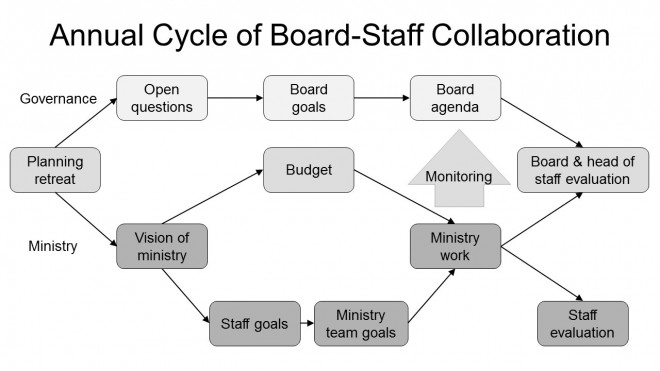
This diagram highlights four key points of connection between governance and ministry: the annual retreat, the budget process, board monitoring of staff activity, and the annual evaluation of the board and head of staff. These are not, of course, the only moments when the board and staff connect; there are many others. To take a few obvious examples, the clergy leader normally attends board meetings, and sometimes other staff do so as well. Board members participate as volunteers in ministry activities. And as the board adopts, reviews, and modifies its policies on staff activity, board members seek assistance from the staff members who are most familiar with specific pieces of the work.
Each congregation adapts the cycle of board-staff collaboration to accommodate its fiscal year, meeting and election dates, holidays, and other givens. Sequence is more important than exact dates. A congregation with a fiscal year that starts July 1 might hold its planning retreat in February, so the results can influence the budget and staff planning for a program year that gears up in September. The board and head of staff might do their annual evaluation at a short retreat in August. It is not necessary -- or possible, usually -- to schedule everything to dovetail logically. What is most important is that high-level planning work precede the budgeting and goal-setting it is meant to influence and that evaluation follows both.
-------
Monday, January 25, 2016
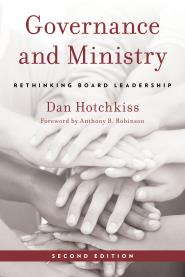
"Governance and Ministry" by Dan Hotchkiss, Second edition
This book has proven to be an indispensable guide for leaders and clergy on how to work together to lead congregations. In this second edition, veteran congregational consultant and minister Dan Hotchkiss updates the book to reflect today's church and synagogue landscape and shares practical insights based on his work with readers of the first edition.
Buy the book »
---------------------


More from Dan Hotchkiss
Each congregation adapts the cycle of board-staff collaboration to accommodate its fiscal year, meeting and election dates, holidays, and other givens. Sequence is more important than exact dates. A congregation with a fiscal year that starts July 1 might hold its planning retreat in February, so the results can influence the budget and staff planning for a program year that gears up in September. The board and head of staff might do their annual evaluation at a short retreat in August. It is not necessary -- or possible, usually -- to schedule everything to dovetail logically. What is most important is that high-level planning work precede the budgeting and goal-setting it is meant to influence and that evaluation follows both.
-------
Adapted from Governance and Ministry: Rethinking Board Leadership, revised edition, by Dan Hotchkiss. Copyright 2016 by Rowman & Littlefield. Used by arrangement with the publisher. All rights reserved. No part of this excerpt
---------------------
may be reproduced or printed without permission in writing from the publisher.
Monday, January 25, 2016
"Governance and Ministry" by Dan Hotchkiss, Second edition
This book has proven to be an indispensable guide for leaders and clergy on how to work together to lead congregations. In this second edition, veteran congregational consultant and minister Dan Hotchkiss updates the book to reflect today's church and synagogue landscape and shares practical insights based on his work with readers of the first edition.
Buy the book »
---------------------
More from Dan Hotchkiss
"Life after Governance Change"
An anthropologist from Pluto might be forgiven for misclassifying board and committee meetings among the sacred rites of Earth religion. Meetings, with their arid liturgy of motions, seconds, minutes, and reports, give comfort and security to some, while driving others crazy --particularly those who like results better than extended conversations about pros and cons of possible approaches to activities that may or may not one day issue in results.
It is not actually meetings that drive people nuts -- most leaders expect, even enjoy productive meetings -- it is the perpetual unclarity in many congregations about who makes what decision. Lay leaders burn out like old brake pads from the start-and-stop decision-making tempo. People who, at work, carry assigned projects from start to finish find it hard to understand why relatively small decisions require long discussion, often at not one but several meeting tables.
Leaders burn out and disappear, but do not necessarily complain. Goodhearted folk, leaders excuse or even justify tedious decision-making methods, calling them "congregational" or "presbyterian," "Jewish" or "episcopal." In many congregations, it is more comfortable to raise doubts about religious doctrine than to question the committee system.
Read more »
"Life after Governance Change"
An anthropologist from Pluto might be forgiven for misclassifying board and committee meetings among the sacred rites of Earth religion. Meetings, with their arid liturgy of motions, seconds, minutes, and reports, give comfort and security to some, while driving others crazy—particularly those who like results better than extended conversations about pros and cons of possible approaches to activities that may or may not one day issue in results.An anthropologist from Pluto might be forgiven for misclassifying board and committee meetings among the sacred rites of Earth religion. Meetings, with their arid liturgy of motions, seconds, minutes, and reports, give comfort and security to some, while driving others crazy --particularly those who like results better than extended conversations about pros and cons of possible approaches to activities that may or may not one day issue in results.
It is not actually meetings that drive people nuts -- most leaders expect, even enjoy productive meetings -- it is the perpetual unclarity in many congregations about who makes what decision. Lay leaders burn out like old brake pads from the start-and-stop decision-making tempo. People who, at work, carry assigned projects from start to finish find it hard to understand why relatively small decisions require long discussion, often at not one but several meeting tables.
Leaders burn out and disappear, but do not necessarily complain. Goodhearted folk, leaders excuse or even justify tedious decision-making methods, calling them "congregational" or "presbyterian," "Jewish" or "episcopal." In many congregations, it is more comfortable to raise doubts about religious doctrine than to question the committee system.
Read more »
"Life after Governance Change"
It is not actually meetings that drive people nuts—most leaders expect, even enjoy productive meetings—it is the perpetual unclarity in many congregations about who makes what decision. Lay leaders burn out like old brake pads from the start-and-stop decision-making tempo. People who, at work, carry assigned projects from start to finish find it hard to understand why relatively small decisions require long discussion, often at not one but several meeting tables.
Leaders burn out and disappear, but do not necessarily complain. Goodhearted folk, leaders excuse or even justify tedious decision-making methods, calling them “congregational” or “presbyterian,” “Jewish” or “episcopal.” In many congregations, it is more comfortable to raise doubts about religious doctrine than to question the committee system.
Questioning the Unquestionable This is gradually changing. For a variety of reasons, leaders in congregations of all kinds have begun to question the unquestionable. Sometimes the departure of too many governing board members triggers the rethinking. Sometimes a strategic planning process launches an imaginative plan that quickly founders in the sandy shoals of governance. Sometimes an exceptionally vital, growing congregation notices that its most innovative programs have emerged only when someone, in despair of working though the formal structure, worked around it.
For whatever reason, growing numbers of churches and synagogues are considering alternatives to their traditional ways of governing themselves. Since 2009, when Alban published my book Governance and Ministry: Rethinking Board Leadership, I have enjoyed consulting, coaching, and cheerleading congregations using it to engage in a deliberate governance change process.
It is not easy work. Institutions naturally resist change—not because the people in them are especially conservative, but because conserving is what institutions do. They codify and repeat patterns of behavior—building trust by repetition, growing in proficiency by practice, building a clear “brand” through consistent and predictable performance.
All institutions resist change communities of faith resist it for a special reason: almost anything they do regularly quickly becomes part of somebody’s religion. The oddest things turn sacred—furniture and flower arrangements, calendars of fundraising events, organization charts. People cling to such symbolic objects, not because they love them, but because they love the congregation and the good they have experienced from its influence, and worry that if surface symbols change too much, they might lose the reality beneath.
Ron Heifetz and Martin Linksy write, “People do not resist change, per se. People resist loss.” Resisting change can be a good thing when it helps people to hang on to what is truly precious. A congregation with no change-resistance worships on a different day and in a different place each week. That makes it difficult to find it or know whether to support it; in constant motion, it stands nowhere.
Sometimes only innovation—which requires letting go of symbols—lets us hold on to what we truly value. Congregations have begun to realize that comfortable ways no longer produce comfortable outcomes. Change, no longer a threat, becomes our best hope for avoiding deeper loss. When old modes of governance threaten to strangle what is precious in the congregation’s life, governance change becomes more thinkable.
Means for the Sake of the Ends Lyle Schaller once observed that liberal churches, which are so often ready to tell the world how it should change, especially resist changes to their own internal workings. Liberals, so this thinking goes, are so open-minded they are not always quite sure what they believe or where they are headed, and so they come to treat “the way we do things here” as if it were the end-all of the church. By contrast, a church with a clear, focused purpose like “bring souls to Christ” will try new worship styles, change its committee structure, or rebalance its staff—whatever works—because the end is more important than the means.
Many of my governance-change clients are comparatively liberal congregations, and I must say that they belie this generalization. If some liberal congregations have been slower to reform their structures of decision-making, one reason may be that they care so much about what Luther called the priesthood of all believers, which makes governance a more complex challenge than it is for congregation that more easily hand power to one person. Building a structure that is serious both about congregational participation in decision-making and enlisting every person in discerning God’s will for the congregation makes governance a complicated business. I’m glad congregations of all stripes are now thinking more creatively about their own decision-making practices.
No structure guarantees success or promises a life free of problems. “T.S. Eliot warned against “dreaming of systems so perfect that no one will need to be good.” Luckily congregations are full of people who are good already. The work of governance change can be simply a matter of enabling the congregation to be as good as they are.
Comments welcome on the Alban Roundtable blog
___________________________________________
Adapted from the Summer 2011 Congregations article, “Life After Governance Change,”copyright © 2011 by the Alban Institute. All rights reserved.
---------------------
Continue Your Learning and Support the Formation of Others

Continue Your Learning and Support the Formation of Others
June 14-20, 2016
Durham, North Carolina
The Duke Youth Academy for Christian Formation (DYA) empowers the young people of your church to think theologically and practice the Christian faith with playfulness, creativity, and longevity. High school students attend a week-long residency on the campus of Duke University and participate in a year of mentorship, learning, and leading a Christian practice in their church.
Learn more »
---------------------

The Duke Youth Academy for Christian Formation (DYA) empowers the young people of your church to think theologically and practice the Christian faith with playfulness, creativity, and longevity. High school students attend a week-long residency on the campus of Duke University and participate in a year of mentorship, learning, and leading a Christian practice in their church.
Learn more »
---------------------
The Church Network e-Learning Lab
The Church Network's e-learning lab is designed to provide "just in time" learning for all areas of church management. From pastors, lay leaders, executive pastors, church administrators, to general church staff, the association's lab is focused on answers that build professional competences.
Browse The Church Network's catalog on e-courses »
---------------------
Visit Alban.org
STAY CONNECTED


Alban
The Church Network's e-learning lab is designed to provide "just in time" learning for all areas of church management. From pastors, lay leaders, executive pastors, church administrators, to general church staff, the association's lab is focused on answers that build professional competences.
Browse The Church Network's catalog on e-courses »
---------------------
Visit Alban.org
STAY CONNECTED
Alban
312 Blackwell Street, Suite 101
Durham, North Carolina 27701, United States
---------------------
---------------------

No comments:
Post a Comment