democracynow.org
Stories:

Muslim Woman & Jewish Man Booted from Trump Rally for Silent Protest Against Islamophobia
Image Credit: KTLA
A Muslim woman and a Jewish man were kicked out of a Donald Trump rally on Friday after silently protesting the Republican front-runner’s Islamophobic views. Rose Hamid, a flight attendant, and Marty Rosenbluth, an attorney, wore yellow badges with the word "Muslim"—an intentional reference to the yellow star badges Jews were forced to wear under the Nazis. Rose Hamid was also wearing a hijab and a T-shirt that read "Salam, I come in peace." Friday’s incident comes a month after Trump called for banning Muslims from entering the United States following the attack in San Bernardino. Anti-Muslim incidents have increased around the country in the weeks since. Hamid and Rosenbluth join us to discuss their action.
TRANSCRIPT
This is a rush transcript. Copy may not be in its final form.
AMY GOODMAN: A Muslim woman and a Jewish man were kicked out of a Donald Trump rally Friday after silently protesting the Republican front-runner’s Islamophobic views. Speaking in Rock Hill, South Carolina, Trump began repeating his call to ban Muslims from entering the U.S., and said Syrian refugees are "probably" tied to the Islamic State. At that point, Rose Hamid, a flight attendant, and Marty Rosenbluth, an attorney, stood up in silent protest. Both wore yellow badges with the word "Muslim"—an intentional reference to the yellow star badges Jews were forced to wear under the Nazis. Rose Hamid was also wearing a hijab, and a T-shirt that said "Salam, I come in peace." Hamid and Rosenbluth were escorted out of the room as thousands of people cheered. Trump then resumed his speech.
DONALD TRUMP: We have a problem, huh? We have a problem, and it’s going to be solved, but we have to understand the problem. We have to know the problem. And before we do anything, and before we do anything stupid, we have to know what we’re doing. So, we do have a real problem. We do have a real problem. There is such a level of hatred that you can’t even believe it. There’s a hatred, a deep-seated hatred. We have to find out: Where is it coming from, and what can we do about it? And people have to help us.
AMY GOODMAN: Friday’s incident comes a month after Trump called for banning Muslims from entering the United States following the attack in San Bernardino. Anti-Muslim incidents have increased around the country in the weeks since. It recently emerged the Somali al-Qaeda affiliate, al-Shabab, has featured Trump’s comments in a recruiting video.
In response to the ejection of Rose Hamid and Marty Rosenbluth, the Council on American-Islamic Relations has called on Donald Trump to apologize and, quote, "make a clear statement that American Muslims are welcome as fellow citizens and as participants in the nation’s political process," unquote.
Writing on Facebook, former U.S. Labor Secretary Robert Reich urged people to follow Hamid and Rosenbluth’s lead and attend Trump rallies wearing hijabs or Stars of David. Reich said, quote, "All of us have the right in this free country to stand up in silent protest against the closest we’ve come in America to a fascist candidate for president, fueling hatred and spouting lies, who is now leading in the Republican polls," unquote.
Well, for more, we’re joined by Rose Hamid and Marty Rosenbluth, the pair kicked out of Donald Trump’s rally on Friday in Rock Hill, South Carolina.
Rose Hamid, thanks so much for joining us from Charlotte. Can you describe the scene on Friday? Where were you sitting? Describe who the people were who you were sitting around, and then what happened.
ROSE HAMID: I was sitting directly behind Trump, several rows up. And I was sitting—when I originally got there, we were sitting—I was sitting in one row with some of the other folks who had planned to protest. And then, later on, there were some seats that opened up in the—further down, so I moved on down, and Marty joined me there.
The people that I had had a chance to talk with, before the people who had planned to protest were there, were nice people. They were—they’re Trump supporters. But one of my goals in going there was recognizing that, as a Muslim woman, I’d probably be the only—and very visibly Muslim woman—I’d probably—it was a possibility that I was going to be the only Muslim that people who support Trump had ever met. So, I wanted to go there with a purposeful attempt to try to connect with some of the people that were there before we started the protest. And my belief is that people are—when you talk to people one on one, they’re decent people, and people want to connect with others. I think that’s just how we’re wired. So it was a very pleasant little chitchat conversation that was happening with the Trump supporters who were around me.
AMY GOODMAN: And then what happened?
ROSE HAMID: Then, when Trump arrived, and there was—he was starting to talk about the Syrian refugees and such, then we put on the yellow badges. Marty gave me one of the badges to put on. So, we put on the badges at that point. And we were actually sitting for a while with the badges on. And then, when he started to ramp up his discussion, that’s when we started—or talking about the problem and "those people" and those kind of things, then we chose that time to stand up.
AMY GOODMAN: So, you stood up, you and Marty Rosenbluth.
ROSE HAMID: Mm-hmm.
AMY GOODMAN: Explain what happened next.
ROSE HAMID: Well, we were just kind of standing there for a while, and nothing really was happening. And then somebody from behind started yelling, "Trump! Trump! Trump!" And then everybody started to stand up. And I haven’t seen the full video, but people were standing, and I was kind of thinking, "No one’s going to notice us, because everyone’s standing." But then, all of a—then I noticed the security folks came up and told us that we had to leave. So that—then we—
AMY GOODMAN: What were the people saying around you? These are people you had been chatting with just a few minutes earlier, before the speech.
ROSE HAMID: The people around me had not—they did not say anything negative to me. As a matter of fact—and this is a point I really want to be made clear—there was a woman who was in front of me, who I had not had had a chance to talk earlier, but as we were being led out, she grabbed my hand, and she said, "I am so sorry for this." So that tells me that people who were close, when you get—when you’re close to someone, when you have an opportunity to connect with someone, those are the kind of connections that exist. And that’s what America is, as opposed to the people, as I was being led up the stairs, who were just shouting and jeering, and "Get out of here! We don’t want you here!" saying those kind of things.
AMY GOODMAN: Did someone say, "Do you have a bomb?" or "You have a bomb"?
ROSE HAMID: Yeah. Yeah, the guy—they guy you could see in the—with the white shirt on. He was a big guy. He could have played Santa Claus if he had a beard on. So, when he started yelling at me, saying, "Do you have a bomb? Do you have a bomb? Did you bring a bomb with you?" I said, "No, I didn’t. Did you bring a bomb with you?" And I was trying to make face contact. I was trying to make contact with those people, in the hopes of getting them to see that they were—they were yelling at a person, who was not demonstrating hate or animosity towards them. And then, as you—further up, there’s a man in a black cap who’s like going, "Boo! We don’t want you here! We don’t need you people here!" and those kind of things. And I looked him in the face, and I said, "You know, you don’t even know me. Why would you be saying things like this?" And then, there was other people—as we were going up, there was other people who were saying things, and I really couldn’t quite hear what a lot of them were saying, but a lot of it was "Boo! Get out of here!" and "We don’t want you here," those kind of things.
AMY GOODMAN: I wanted to turn to Marty Rosenbluth. Rose Hamid has gotten a lot of attention, a woman in a hijab with that T-shirt that said "Salam, I come in peace" being taken out. You, too, were standing next to her. Why did you decide to stand up in silent protest? And explain what happened to you.
MARTY ROSENBLUTH: Sure. Actually, there were eight of us altogether who were wearing the stars. And our message is really clear, that Trump’s type of hate speech is very, very dangerous, and the type of fear and anger and hostility that he’s stirring up needs to be addressed and needs to be stopped.
AMY GOODMAN: So, talk about the yellow star, the badge that you were wearing, and what it means.
MARTY ROSENBLUTH: Sure. We actually got the idea from a Muslim woman at a demonstration in London, who wore an eight-pointed star that simply said "Muslim" on it. And it immediately resonated with me, obviously, as a Jew, that these are really, really similar to the type of yellow stars and pink triangles and other things that the Nazis forced people to wear during the Holocaust. And when Trump called for Muslims to be put into a database, for Muslims to be identified, to ban all Muslims, he’s singling out an entire group of people based on the actions of a few individuals. So we came up with the idea of making these yellow stars, some of which say "Muslim," some of which say "human," some of which say "Stop Islamophobia," that, you know, people can print out and wear and use any way they want to, to protest against this type of hate speech.
AMY GOODMAN: It’s interesting, because the king of Denmark, who wasn’t Jewish, also wore the star in solidarity. I want to turn to more comments of Republican presidential hopeful Donald Trump, who called for a total and complete shutdown of the entry of Muslims into the United States last month.
DONALD TRUMP: Donald J. Trump is calling for a total and complete shutdown of Muslims entering the United States until our country’s representatives can figure out what the hell is going on. We have no choice. We have no choice.
AMY GOODMAN: Trump later doubled down on his call for a total and complete ban on Muslims entering the United States, despite condemnation from around the world and within his own party. In an interview with ABC’s George Stephanopoulos, Trump defended his proposal by comparing it to the detention of Japanese Americans, Germans and Italians under President Franklin Delano Roosevelt during World War II.
DONALD TRUMP: What I’m doing is no different than what FDR—FDR’s solution for Germans, Italians, Japanese, you know, many years ago.
GEORGE STEPHANOPOULOS: So you’re for internment camps?
DONALD TRUMP: This is a president who was highly respected by all. He did the same thing. If you look at what he was doing, it was far worse. I mean, he was talking about the Germans, because we were at war. We are now at war.
AMY GOODMAN: So, Marty Rosenbluth, you have Donald Trump saying that what he’s calling for is similar to the internment of Japanese Americans in World War II, which the U.S. government has apologized for and also paid reparations for.
MARTY ROSENBLUTH: Well, I mean, I think he’s correct, but it’s one of the blackest marks, you know, on U.S. history, where people who were United States citizens, just because they happened to be Japanese, were incarcerated. And the fact that he’s using this as a model and thinks it’s a good idea, I think is really indicative of the problem with what he’s saying.
The thing that shocked me the most, after being now in three Trump rallies, is the reaction of the crowd. And like Rose was saying, I mean, people seemed really nice, but the more he speaks and the more he goes on ranting and raving, you can actually see the hate and the fear grow in people’s eyes.
AMY GOODMAN: Marty, you’re joining us from Chapel Hill. Rose, you’re joining us from Charlotte, North Carolina. Next month marks the first anniversary of the Chapel Hill shootings, when three Muslim students were killed by a gunman who had posted anti-religious messages on Facebook. The victims were two sisters, 19-year-old Razan Mohammad Abu-Salha and 21-year-old Yusor, as well as Yusor’s husband, 23-year-old Deah Barakat. Police said the killings resulted from a dispute over a parking space. But Mohammad Abu-Salha, Razan and Yusor’s father, described the killings as a hate crime. He also accused the media of propagating anti-Muslim sentiment.
MOHAMMAD ABU-SALHA: They both, my daughters, wear the scarf. There is not a single week that our daughters don’t share with us their fear of walking down the street because of what the media is saying about us. Inflammatory media all the time. Inflammatory media all the time. They pick up the bad apples, and they magnify the picture, and they dwell on it day and night. ...
We’re sad. We’re distraught. We’re shocked. We’re angry. We’re—we feel we were treated unjustly. This is uncalled for. We heard from the media—not from the media, from the police folks that each one of these children had a bullet in the head. This was an execution style, this was a hate crime from a neighbor our children spoke about, they were uncomfortable with. He came to their apartment more than once, condescending, threatening and despising and talking down to them.
AMY GOODMAN: That’s Mohammad Abu-Salha, Razan and Yusor’s father, the two victims, a year ago. Rose Hamid, you knew this family, and your children did?
ROSE HAMID: My children knew them. I didn’t know them, but my children did. And so, they—when I told my daughter about it, she couldn’t—she couldn’t believe that such a thing had happened. And it’s this—it’s hate speech that does this kind of stuff. It’s stuff—it’s people in power who empower people to do things from their lowest base. It’s not how—it’s not how we are supposed—that’s not how God made us. That’s not how—God did not make us to be murderous, hateful people. He made us to be loving people. And when people in power give license to that devil-inspired behavior, then that makes people feel like, "Oh, well, you know, if so-and-so is saying that, then it must be OK for me to feel this way, and it must be OK for me to go on and do these things." So, hate speech is a really problematic thing. As a matter of fact, I was told that there’s a petition in England to prevent Bush—to prevent Trump from coming to the U.K., because there’s laws there against hate speech. So, I found that to be rather interesting. So this whole thing about hate speech is really the focus of the protest that we were there for.
AMY GOODMAN: After you and Marty were taken out, Donald Trump—and we just played this—said, "There is such a level of hatred [that] you can’t even believe it. There’s a ... deep-seated hatred. We have to find out: Where is it coming from, and what can we do about it? And people have to help us." He wasn’t talking about you being taken out. Has he apologized? CAIR, the Council on American-Islamic Relationships, has called for him to apologize. And are you calling for the same thing?
ROSE HAMID: I am not personally calling for an apology, because this is not about me. This is about him changing the way that he speaks. He has a responsibility. As somebody who is trying to be the president of this country, he has a responsibility to set the tone for how we are supposed to interact. And to rile the crowd up like that, and to have this—you know, before even going in, or before he came in, his organizers said, "Mr. Trump respects the First Amendment almost as much as he does the Second Amendment. And those who want to speak are free to speak outside." So, that kind of set the tone for the whole thing. It’s like it’s saying—
And here’s a really interesting fact of it. I’ve been interviewed by people, by agencies around the world. And people keep asking me, you know, "So, you know, Americans hate Muslims." I’m like, "No, no, no. No, no, no. Not all Americans. Not all Americans hate Muslims." So now I’m in the position of having to defend America and say, "No, what you saw on that video is not representative of what my America is. That’s not what it is." So, here I’d gone into the rally as an American, also being—knowing that I was going to be visible as a Muslim. So representing Muslims, I went in with that kind of representation and wanting to do the right thing and be as respectful as possible without causing a disturbance, and just also being—using my First Amendment right to freedom of speech by standing against this hateful rhetoric. Now, I find myself having to defend America against the things that people are—the video that is being shown around the world. So, I find that to be problematic as an American Muslim on both camps. So, it’s really something that needs to be addressed, as far as this concept.
AMY GOODMAN: And how did you—how did you come up with the idea of the T-shirt that said "Salam, I come in peace."
ROSE HAMID: My son has a T-shirt-printing business, and he—and we were talking about what—I assumed I would get like maybe one picture in a newspaper somewhere with the T-shirt on there. So I thought, whatever I wear, I need to make sure that I’m sending a message that is representative of my faith and representative of what—of my purpose for being there. And so, he helped me come up with that. We came up with that design, and it’s something that’s on his—it’s one of the T-shirts in his cool Muslim T-shirt business. So I wore that one in the hopes of giving the message out that that’s what—that’s what I came there for. I came there to be peaceful.
AMY GOODMAN: I want to thank you both for being with us. Rose Hamid and Marty Rosenbluth silently protested Donald Trump’s speech Friday in Rock Hill, South Carolina, and were kicked out. Marty Rosenbluth, speaking to us from Raleigh, North Carolina, and Rose Hamid, speaking to us from Charlotte.
This is Democracy Now! When we come back, a record settlement in New York between the ACLU and the New York City Police Department around surveillance of Muslims. Then we go out west to Seattle, Washington. Why are five activists going on trial, and what it has to do with climate change? Stay with us.
... Read More →
Historic Trial Lets Activists Who Blocked Oil Train Cite Climate Change Threat in Their Defense
Five climate justice activists go on trial in Washington state today for tying themselves to a 25-foot tripod structure to block a mile-long oil train. The protesters, members of the activist group Rising Tide Seattle, demanded a halt of shipments of fossil fuels through the Northwest following a string of derailments in the U.S. and Canada. In an unprecedented move, the presiding judge will allow the defendants to argue their actions were necessary because of the threat of climate change. We speak with Abby Brockway, one of the members of the Delta 5, and Tim DeChristopher, founder of the Climate Disobedience Center, who spent 21 months in federal custody for posing as a bidder in 2008 to prevent oil and gas drilling on thousands of acres of public land in his home state of Utah.
TRANSCRIPT
This is a rush transcript. Copy may not be in its final form.
AMY GOODMAN: We turn now to Washington state, where the trial in the case of five climate justice activists gets underway today. In September 2014, the group known as the Delta 5 tied themselves to a 25-foot tripod structure they had erected over railroad tracks in Everett, Washington, directly in front of a mile-long oil train. Abby Brockway, a Seattle resident and small business owner, sat near the top of the structure, 18 feet above the tracks, while the other four were locked to the legs of the tripod. This is Abby Brockway speaking on a cellphone during coverage of the action by the local Fox affiliate.
ABBY BROCKWAY: We’re ready to take more steps to get this done, because we’re running out of time. This is my state. I am so done. I have tried so hard. And so, this is just a second step. I don’t know what the third step is. I would like to talk to the governor. I would like political people that care, that are not with the fossil fuel but are with people, to come and meet us, because we are desperate, and we want to be heard. So this is our march.
AMY GOODMAN: The protesters, members of the activist group Rising Tide Seattle, demanded a halt of shipments of fossil fuels through the Northwest and called on Washington Governor Jay Inslee to reject permits for all new fossil fuel projects in the state, including proposed coal and oil terminals. The action shut down work at the rail yard, which is a staging ground for coal trains headed to Canadian export terminals and oil trains bound for Washington refineries.
For more, we go to Seattle, where we’re joined by Abby Brockway, one of the members of the Delta 5. She and four co-defendants go on trial today. In an unprecedented move, the presiding judge will allow the defendants to argue their actions were necessary because of the threat of climate change. We’re also joined by Tim DeChristopher, founder of the Climate Disobedience Center. He spent 21 months in federal custody for posing as a bidder in 2008 to prevent oil and gas drilling on thousands of acres of public land in his home state of Utah.
We welcome you both to Democracy Now! Abby, let’s begin with you. Talk about the significance of what’s happening today and the judge allowing you to enter a climate justice defense.
ABBY BROCKWAY: Yes, we are thrilled that we’re able to argue the necessity defense. We definitely found that it’s necessary to do this. This is our last chance to actually argue this. I mean, earlier on this week, we were denied the defense, and the judge made his decision reversed on Thursday. And so we’re going to move forward with a week-long trial and talk about why we had to be in the rail yard, trespassing on—in the rail yard—
AMY GOODMAN: So—
ABBY BROCKWAY: —because—
AMY GOODMAN: Abby, talk about what you did over a year ago, exactly what you and the four other defendants did, and why you chose this place as the site of your climate protest.
ABBY BROCKWAY: We erected a tripod, and I climbed to the top, like you said, and locked down. And we did this with petitions in hand, insisting that the governor take action. We have been addressing this fossil fuel corridor that’s developed in Washington state and all along the West Coast. And it’s time to—I actually—listening to that clip again of me talking, it just reminded me that after attending hearing after hearing with these 20 different proposed fossil fuel projects that keep being proposed for the last several years, we have these two-minute hearings where you get to talk, and I never felt heard in these hearings. You know, I, along with thousands of other people, are turning out to these hearings and producing great, quality comments. And the Department of Ecology should be saying, "I hear the people." The Department of Ecology is our agency. It’s the people’s agency. And they’re designed to protect the people. But they’re actually not doing their job. They’re feeling pressure to listen to industry and just rubber-stamp these fossil fuel projects.
AMY GOODMAN: The train—the train you were trying to stop was a mile long?
ABBY BROCKWAY: Yes. Yep, it was a unit train headed to a refinery.
AMY GOODMAN: Tim DeChristopher, talk about the significance of the necessity defense and why you’re involved with this, the Climate Disobedience Center that you just set up.
TIM DECHRISTOPHER: Yeah, well, the first reason that I and all the other founders of the Climate Disobedience Center are out here in Seattle this week is to support Abby and the rest of her co-defendants, because we very strongly believe that when activists put themselves on the line and take real risks on behalf of not only our whole movement, but everyone who’s facing the impacts of climate change, they deserve to be supported. So we’re here just to get their back, first and foremost, but also because we see this case as really significant in terms of the broader public narrative around climate change. This is the first time that defendants who have taken civil disobedience action will be able to present a full defense, including climate scientists and oil train explosion experts, as well as sharing all their own testimony about why they were driven to take this action, why the government’s response to climate change is not adequate, why citizens are called to take action in this way on their own—and have six random jurors, that are not climate activists, that are just regular people who are selected for jury duty, make their own decision of whether or not this kind of action is justified. And to me, that involvement of the jury is really critical, because a fully informed and empowered jury is the, really, only difference between actual justice and mere legalism.
AMY GOODMAN: Tim, can you talk about why this train is referred to as a "bomb train"?
TIM DECHRISTOPHER: Yeah. You know, there have been an increase of oil trains all over this country, particularly those that are carrying Bakken oil from North Dakota and Montana, which is more explosive than other kinds of oil. It has more methane in it, and so that’s why we’ve seen a lot more of the catastrophic disasters, particularly the Lac-Mégantic explosion, that I know motivated Abby and that she can speak to more on that.
AMY GOODMAN: Abby, in our last minute, talk about this and what you’re most concerned about, why you’re willing to go to jail.
ABBY BROCKWAY: Yeah, like Tim said, the Lac-Mégantic really struck me, that explosion and the dangers that happened in 2013. And then a year later, I heard about this whistleblower that was fired for not protecting—he was checking some brakes, and the brakes—he was fired for delaying that. And the third thing that happened was right by my daughter’s school, an oil tanker car derailed. And that was a mile from my daughter’s school, and that was the straw that broke my back. I couldn’t do it anymore, to be that close to danger, one mile from my daughter’s school.
AMY GOODMAN: Lac-Mégantic in Quebec, which killed, in 2013, 47 people when the train exploded and derailed?
ABBY BROCKWAY: Yes. And so, seeing this same situation happen so close to my daughter’s school was something that made me decide to go to Action—to sign up for Action Camp and learn to climb. And that’s where I met Patrick Mazza and Liz Spoerri. And the three of us decided that we were going to join with two others and erect a tripod to stop a train, because we absolutely felt that this was the literal thing we had to do—to put ourselves in front of a train to say, "We will not take this anymore."
AMY GOODMAN: I want to thank you both for being with us, Abby Brockway, co-defendant in the Delta 5 case, and Tim DeChristopher, founder of the Climate Disobedience Center. And we’ll post online an interview with Tim DeChristopher about the Oregon standoff.
... Read More →
Historic Settlement over NYPD's Anti-Muslim Spying Imposes Oversight & Bars Ethnic-Based Targeting
In a major legal victory, New York City will appoint an independent civilian monitor to oversee the New York Police Department’s counterterrorism activities. The announcement comes after two lawsuits challenged the NYPD’s programs of spying on Muslims and religious centers. The suits argued the NYPD violated the U.S. and New York state constitutions by singling out and stigmatizing entire communities based on their religion. The settlement restores some of the NYPD’s outside oversight, which was eliminated after the September 11 attacks. We are joined by Hina Shamsi, director of the American Civil Liberties Union’s National Security Project.
TRANSCRIPT
This is a rush transcript. Copy may not be in its final form.
AMY GOODMAN: We turn right now to a record settlement that has taken place in New York. Today we’re are going to talk to Hina Shamsi, director of the American Civil Liberties Union. In a major legal victory, New York will appoint an independent civilian monitor to oversee the New York Police Department’s counterterrorism activities. The announcement comes after two lawsuits challenged the NYPD’s programs of spying on Muslims and religious centers. The suits argued the NYPD violated the U.S. and New York state constitutions by singling out and stigmatizing entire communities based on their religion. The settlement restores some of the NYPD’s outside oversight, which was eliminated after the September 11th attacks.
In 2013, Democracy Now! interviewed Linda Sarsour, director of the Arab American Association of New York, about the NYPD’s efforts to infiltrate her organization.
LINDA SARSOUR: What the NYPD wanted to do to my organization—they clearly laid this out in a secret document—is they wanted to recruit a confidential informant to sit on my board. So not only were they creating listening posts and going into our restaurants, coming to our events, coming—acting as clients in our organizations, they wanted to actually have someone who would have—who would be a deciding figure on my board. They’d have access to donors, access to information, access to financial information. And I think that the—we keep learning that the program is just more outrageous.
And what it does is it creates psychological warfare in our community. How am I supposed to know if the NYPD was successful in that endeavor? That’s number one. Number two is, the community right now is in a position where, how do we even know the guy next to us that’s praying at the mosque or the guy at the restaurant that’s like trying to open a conversation with us about something that’s happening in Egypt, for example—and for those people who know Arabs, particularly, we love to talk about politics. And a lot of us and a lot of our families came to the United States so we could have a place to practice our religion freely, to have our own political views. And now that we know that the NYPD wants to hear what our sentiment is, that’s—people probably don’t want to share their sentiment.
And the most disturbing of all is our Muslim student associations, who are calling us to consult about how political should their events be. Now, when I was in college, I wanted my events to be as political as possible. And if they weren’t, I wanted to make the—I wanted to figure out how to make them controversial. And the fact that our students feel like they can’t do that because there are going to be NYPD informants, because they can be taken out of context, and because they think something like what happened to Fahad Hashmi is going to happen to them, I think is a valid concern for them to have.
AMY GOODMAN: That’s Linda Sarsour, director of the Arab American Association of New York, speaking in 2013.
Well, for more on the new NYPD settlement on spying, we’re joined by Hina Shamsi, director of the American Civil Liberties Union’s National Security Project.
Hina, welcome back to Democracy Now! Explain the significance of what you just worked out with the city.
HINA SHAMSI: Thank you for having me, Amy.
We think that this is a landmark settlement. It comes in two related lawsuits, which I’d like to explain just a little bit. But what it does is, for the first time, there are much-needed reforms that have been put in place to prevent discriminatory, unjustified surveillance of American Muslims. And this is a set of terms that is designed to do just that. It comes both in our lawsuit, which was a constitutional challenge based on equal protection and religious freedom grounds to the NYPD’s mapping of American Muslims, to infiltration, through the use of undercovers and informants, of religious houses of worship, student groups and such, as well as the devastating harm that resulted. Our lawsuit was motivated by the concerns of our clients, as well as communities and allies, about fear and stigma that was pervading the community.
There’s also a second, long-standing lawsuit called Handschu, which was filed back in 1971, that challenged, at that time, unconstitutional surveillance of political activists. And in 1985, the court in that case issued a consent decree, and there were a set of rules called the Handschu Guidelines that regulate how the NYPD may investigate or conduct surveillance of religious and political activities. And on Thursday, among the changes that we announced, new reforms strengthen safeguards in those guidelines, and the appointment of a civilian representative with the power and the obligation to ensure that the NYPD is following them.
AMY GOODMAN: So, explain what you feel are the most important changes.
HINA SHAMSI: For the first time, the NYPD is agreeing to a robust anti-discrimination policy. Investigations in which religion, race or ethnicity plays a substantial or motivating factor would be barred. There are now safeguards against some of the things that were most problematic for communities, which were the use of undercovers and informants and open-ended investigations. So now undercovers and informants may only be used if information cannot be obtained through less intrusive means, which is strong language that courts use in order to prevent harm from those kinds of techniques. Presumptively, there are time limits on investigations. Before, there were none. And now, the NYPD is also going to account for—would account for the impact on religious and political activities of these kinds of intrusive methods.
And I will add one more thing, which is that for what are called preliminary investigations, the NYPD needs to have an articulable and factual basis of the possibility of criminal activity—so no hunch or bias. And again, I think one of the key aspects of this is the civilian representative, and for a couple of different reasons. Strong language, strong safeguards are always necessary, but so is external oversight. So, in this context, the civilian representative is appointed by the mayor, not by the NYPD, which allows impacted communities, community members to be able to advocate with the mayor—we tried to build this in—to advocate with the mayor for the strongest possible candidate for this position. The position must continue for five years, and presumably should continue after. And to the extent that the mayor seeks to abolish this position, there must be 90 days’ notice. And again, at that point, impacted communities can advocate to see if they want to continue the position or not.
AMY GOODMAN: I want to turn to Imam Deen Shareef. He was speaking in 2012 after discovering his mosque was under NYPD surveillance.
IMAM DEEN SHAREEF: We are Muslims. We are Americans. And we go about our daily lives trying to establish the best kind of contribution that we can make to the American society. And for us to find out that we are now under suspicion with respect to some criminal activity, without any explanation as to what the provocation was, what the motivation is, what are the people that they’re looking for, it is very disturbing for us to find this out. And then to find out that the New York Police Department actually took photographs of our mothers, our children, and those individuals that come into our businesses has created an atmosphere where there is certainly an undue suspicion that has been cast upon the entire Muslim community.
AMY GOODMAN: So that’s Imam Deen Shareef in 2012.
HINA SHAMSI: And that, I think, reflects so much of what motivated this lawsuit. Our clients, community members that we spoke to describe religious leaders who are afraid of counseling their congregants for fear that those congregants might be informants; imams across the city, including our clients, recording their sermons for fear that what they say might be misconstrued by law enforcement; a disruption in the relationships between communities and the police to whom they should be able to look for protection, as community members described being fearful of engaging with the police on common, day-to-day issues like reporting crime or, worse, reporting domestic violence, for fear that that would result in additional scrutiny.
And I think much of this is also laid out in a report called "Mapping Muslims" by our co-counsel, the CLEAR project at CUNY Law School. But I think part of what was devastating to listen to was community leaders who would describe a generation of youth growing up fearful of their law enforcement, fearful of exercising their constitutionally protected rights to worship, to speak and to associate. And that’s not what our country is, and that’s not what our city is. And so, I think it is a very good thing that the NYPD has committed to reforms and safeguards that can start, if—once approved by the court, as we hope, to repair some of the damage and to help ensure that this does not happen again.
AMY GOODMAN: I wanted to turn to a piece by Aviva Stahl. She recently wrote it about what has happened at Brooklyn College. She said a New York Police Department officer, an NYPD officer, pretended to convert to Islam and assumed the role of a Brooklyn College student at the Islamic Society in New York City as part of a covert operation to spy on Muslims. The officer, who went by the name Mel, short for Melike, spent four years earning the trust of Muslim students at the college as part of an NYPD operation to spy on Muslims. Would that be stopped in this situation?
HINA SHAMSI: We think that there are now more constraints that have been placed on this. That situation came up; some of my co-counsel raised it. It was particularly raised in the context of, you know, was that justified? And I think there were aspects of that that were explained as being linked to ongoing investigations. And then there are obviously concerns about overuse or misuse of undercovers and informants. And so, there are a couple of aspects that I want to bring out with respect to our settlement, which is that all of the provisions need to be read together as a whole. Right? So, you look to see whether—or one hopes a civilian representative or expects a civilian representative would look to see whether the use of undercovers and informants in ongoing investigations, lengthy investigations, would be justified or would be prevented under the new guidelines going forward.
... Read More →
"The National Shame Continues": On Its 14th Anniversary, Will Guantánamo Ever Be Closed?
Today marks the 14th anniversary of the opening of the U.S. military prison at Guantánamo, where 107 prisoners are still being held. Hina Shamsi, director of the American Civil Liberties Union’s National Security Project, represented Mohamedou Ould Slahi, one of the men still being held. Last year a book collecting Slahi’s diary writings became a surprise best-seller. "This is a shame that threatens more than ever to mar President Obama’s legacy as he leaves office, and the potential that he leaves office without closing Guantánamo," Shamsi says. "There are many men unjustly continuing to be held at Guantánamo. My client’s story is symbolizing an aspect of it."
TRANSCRIPT
This is a rush transcript. Copy may not be in its final form.
AMY GOODMAN: Finally, I wanted to turn to another issue. Today marks the 14th anniversary of the opening of the U.S. military prison at Guantánamo—107 prisoners still there. Many have been cleared for over a decade to leave. One of your clients, Mohamedou Ould Slahi, is among the men being held. Last year, a book collecting his diary writings became a surprise best-seller. Your thoughts today? And what is happening to him?
HINA SHAMSI: The national shame of Guantánamo’s existence continues 14 years later. And this is a shame that threatens, more than ever, I think, to mar President Obama’s legacy as he leaves office, and the potential that he leaves office without closing Guantánamo.
I think my client—there are many, many men unjustly continuing to be held at Guantánamo. I think my client’s story is symbolizing an aspect of it. He was picked up after he voluntarily turned himself in to Mauritanian authorities. He has sought, at every opportunity that he could, to show that he is unjustly detained and should be released. And he’s done that in—through the courts, as well as by seeking what’s called a periodic review board, which could clear him by determining that his ongoing detention is unjustified.
We’re really at a point, Amy, where the president can and should direct the Department of Defense to stop putting up roadblocks. There are some very credible accounts of the roadblocks that Department of Defense has been putting up. It needs to stop putting up roadblocks. The Justice Department could choose not to contest cases in which detention authority is unjustified or no longer justified. And we can bring these numbers down this year. The president has already indicated that those numbers will be brought down this year.
And we need to move forward to close the place, because the existence of Guantánamo isn’t just about the place, it’s also about the principle that it represents, which is the principle of the United States continuing to hold people without charge or trial. Until that is put to an end, we’re not going to be able to return fully to the family of nations with the rule of law, as we proclaim it to be.
AMY GOODMAN: Hina Shamsi, I want to thank you for being with us, director of the American Civil Liberty Union’s National Security Project.
This is Democracy Now! When we come back from break, we head west to Seattle, Washington, to a trial of climate justice activists. Stay with us.
... Read More →Headlines:
Mexico Begins Process of Extraditing Drug Lord Chapo Guzmán
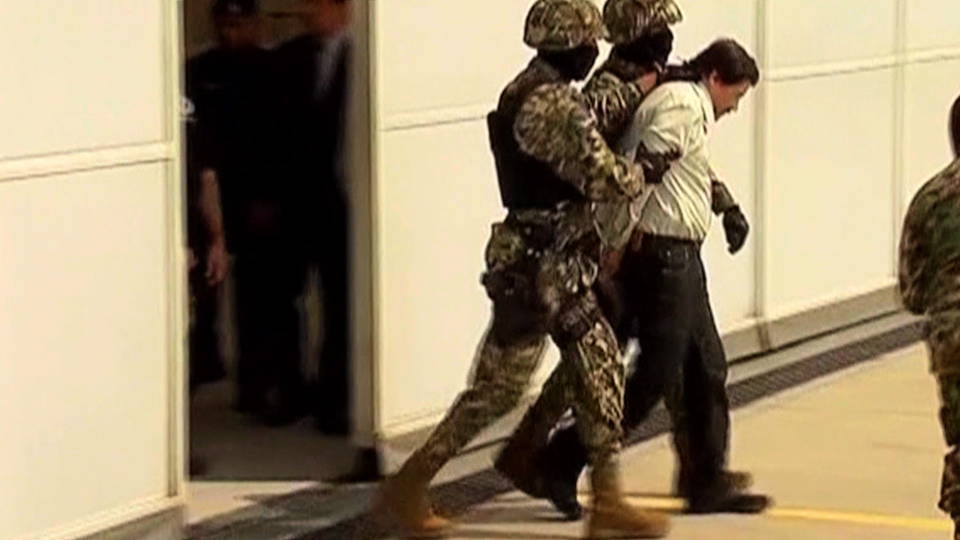
The Mexican government has begun the process of extraditing drug lord Joaquín "Chapo" Guzmán to the United States after he was recaptured in Mexico on Friday. Guzman managed to escape through drains and tunnels and steal a car before Mexican forces nabbed him in a raid on his safe house. Five suspects were killed in the operation. Guzmán is now held at the maximum-security Altiplano prison—the same prison he escaped from through a tunnel dug under his cell six months ago. He previously escaped from prison in a laundry cart in 2001. The United States had sought to extradite him before his most recent escape, but Mexico refused. Meanwhile, Mexican authorities say they were helped in their investigation of Guzmán by his communications from hiding—including with actor Sean Penn. In an interview published by Rolling Stone, Penn said he spent seven hours with Guzmán. In this excerpt, Guzmán responds to a question about the harms caused by drugs.
Chapo Guzmán: "Well, it’s a reality that drugs destroy. Unfortunately, as I said, where I grew up, there was no other way, and there still isn’t a way to survive, no way to work in our economy to be able to make a living."
Yemen: 5 Killed in Bombing of Doctors Without Borders Hospital
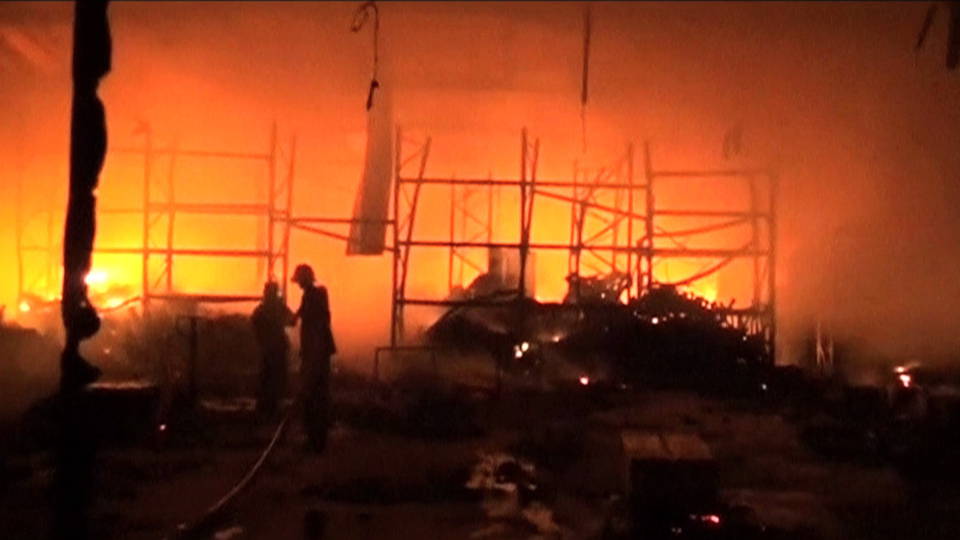
In Yemen, at least five people have been killed and 10 others wounded after a projectile hit a Doctors Without Borders hospital. The aid group says it cannot confirm the origin of the attack, but that planes were flying over the hospital at the time. Teresa Sancristóval of Doctors Without Borders spoke out after the attack.
Teresa Sancristóval: "For this hospital, this concrete hospital, it’s the third time that it’s attacked. And for MSF, it’s the third time that we are attacked, in general, as a medical facility. I would like to reiterate that we are not the only hospitals that they have been hit; there are those that—there are many other hospitals that have been hit. And this means a lot for the population. The population is deprived from medical assistance. The population is the main, main suffering on this war."
At least 70 Yemeni health clinics have been damaged or destroyed since the U.S.-backed, Saudi-led coalition began bombing Houthi rebels in March. Doctors Without Borders says it regularly provides all warring parties, including the Saudi coalition, with its hospitals’ GPS coordinates.
U.S. Flies B-52 Bomber over South Korea in Show of Force

The United States has sent a B-52 bomber on a low-level flight over South Korea in a show of force following last week’s nuclear test by North Korea. North Korea says it tested a hydrogen bomb, although U.S. and international experts have cast heavy doubt on that claim. North Korean leader Kim Jong-un said the test was launched in self-defense in response to the "danger of nuclear war caused by U.S.-led imperialists."
Catalonia Lawmakers Elect New Pro-Independence Leader
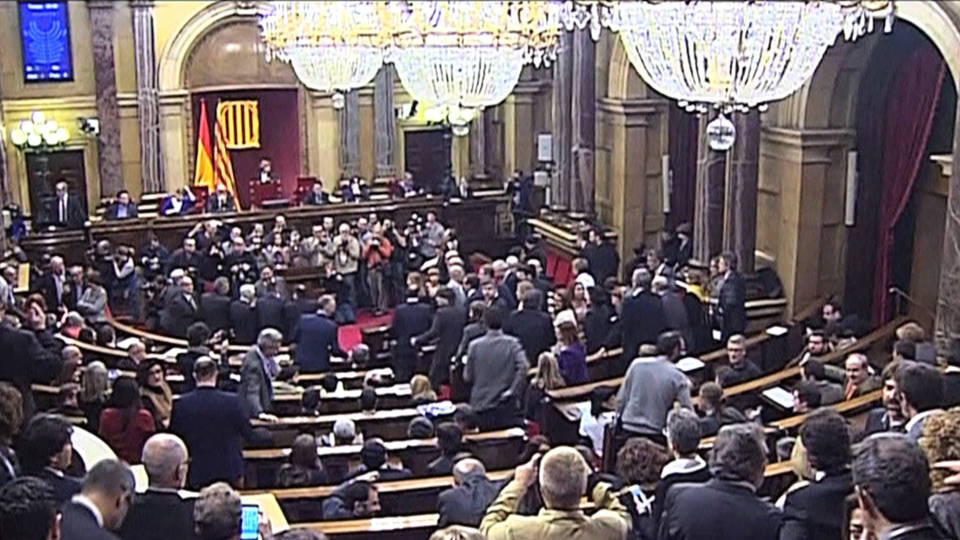
Catalonia’s Parliament has voted in a new pro-independence leader, restarting the push to secede from Spain over the next 18 months. The new leader, Carles Puigdemont, is expected to begin building an independent army, central bank and judiciary. The move comes after elections last month left Spain with a deeply divided Parliament. The renewed push toward independence in Catalonia could pressure the Socialist party to form a coalition with the conservative ruling People’s Party, potentially sidelining the leftist, anti-austerity Podemos party.
Israel: Arson Suspected in Fire at B'Tselem Human Rights Group
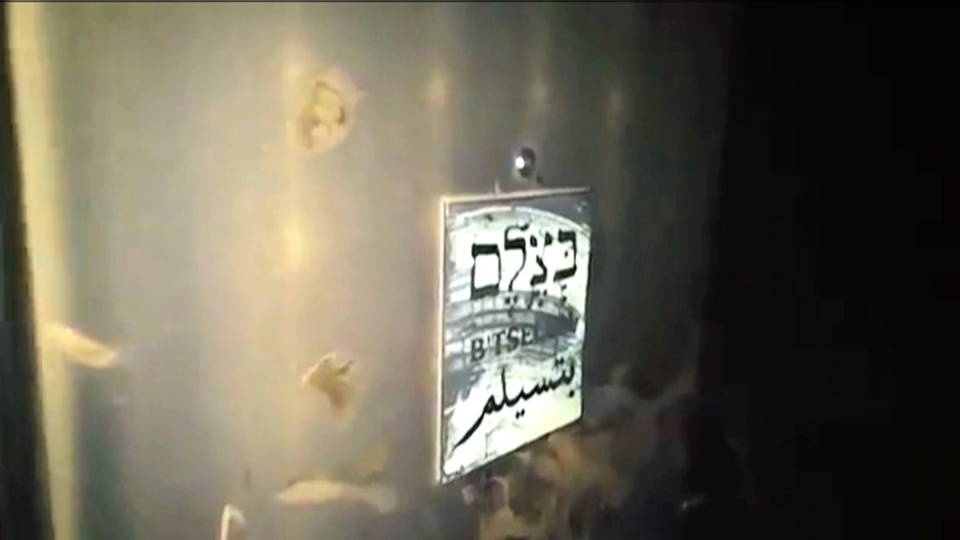
In Israel, authorities are investigating a fire at the human rights group B’Tselem for signs of arson. The NGO, which documents human rights abuses in the Israeli-occupied Palestinian territories, has been targeted in a recent Israeli government crackdown over funding sources abroad. In a statement, B’Tselem said "if it is discovered that this was an arson attack, it must be seen in the context of the wave of government incitement and smear campaigns against Israel’s human rights groups, and B’Tselem in particular." Meanwhile, Israeli police have killed an Arab citizen of Israel who was accused of fatally shooting three people in Tel Aviv earlier this month.
Turkey Says 32 Kurdish Militants Killed in Southeast; Journalists Protest Detentions
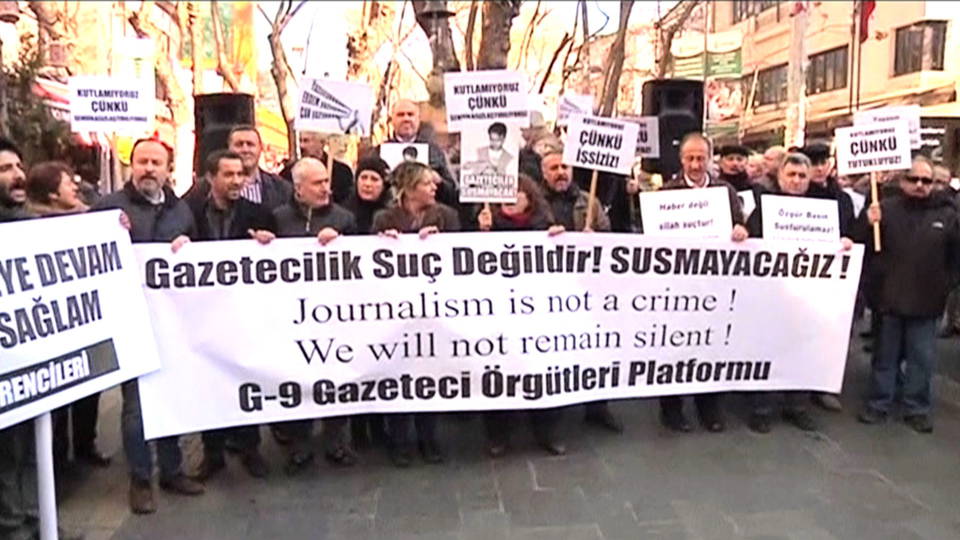
Turkish officials say they killed 32 Kurds they identified as militants in the southeast, marking one of the bloodiest weekends in months. The news comes as a Turkish human rights group says up to 162 civilians have been killed since August amid a government crackdown on Kurdish areas. Meanwhile, Turkish journalists marked Working Journalists’ Day Sunday by rallying to demand the release of jailed reporters and editors. Turkish journalist Ismet Demirdogen was among those who gathered in Ankara.
Ismet Demirdogen: "People’s right to learn the truth and make up their mind on current events is prevented. Unfortunately, Turkey goes through these dark days from time to time. I want to believe that we will rise above this ordeal again, as we did in the past, but more than 30 journalists are in jail after complaints, only because they wrote the truth. Therefore, I am very saddened today as we mark Working Journalists’ Day."
In NYT Op-Ed, Iranian Minister Says Saudis Fomenting Tension, Extremism
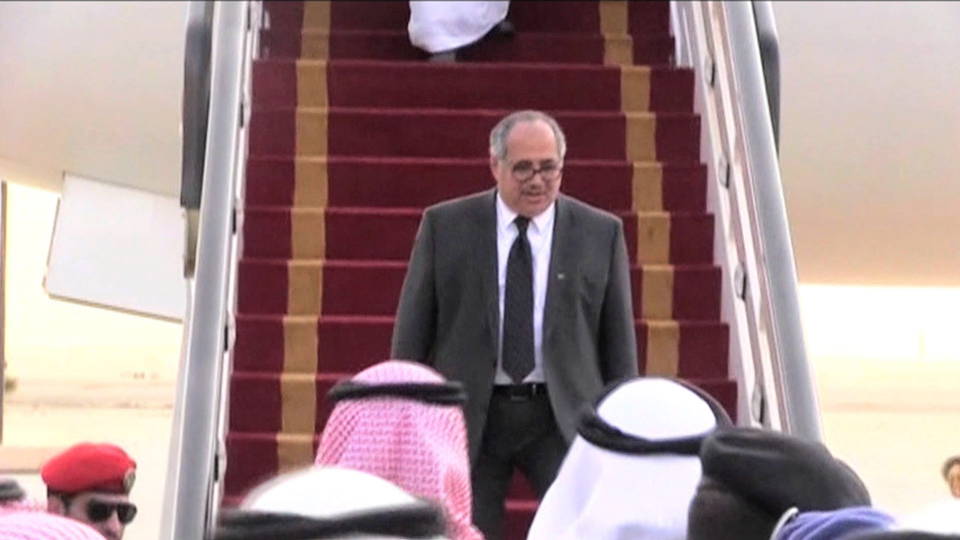
Iran’s foreign minister has published an op-ed in The New York Times accusing Saudi Arabia of attempting to derail Iran’s nuclear deal with world powers, promoting extremism and perpetuating tension in the Middle East. The move comes after Saudi Arabia beheaded a Shiite cleric as part of the mass execution of 47 people. In response, Iranian protesters torched part of the Saudi Embassy in Tehran, an act Iranian officials have condemned. After the burning, Saudi Arabia and its allies broke ties with Iran. In his op-ed, Iranian Foreign Minister Mohammad Javad Zarif writes: "The Saudi leadership must now make a choice: They can continue supporting extremists and promoting sectarian hatred; or they can opt to play a constructive role in promoting regional stability."
Poland: Thousands Rally Against New Law Curtailing Press Freedom

In Poland, thousands of people rallied across the country Saturday to protest a crackdown on press freedom. A new law in Poland allows the treasury minister to appoint and fire the heads of public television and radio broadcasters. In Warsaw, protest organizers said democracy is at stake.
Mateusz Kijowski: "We are meeting because media freedom is in danger, and so is democracy. Media is an important safety tool. If media can’t monitor those in power, public opinion will not know what they are doing. So we came here to show how important for us free media is."
Germany: 6 Pakistanis, 1 Syrian Attacked in Cologne Amid Fallout over Assaults on Women
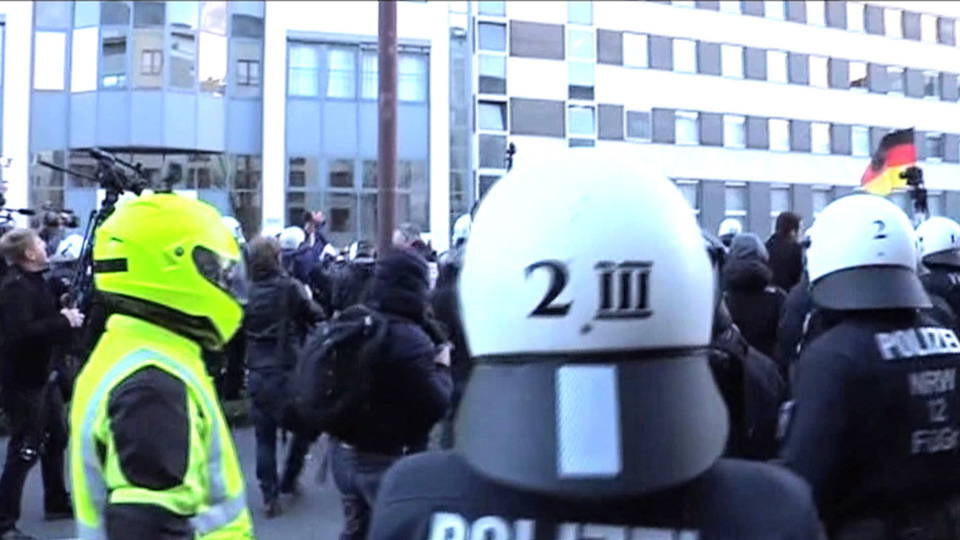
In the German city of Cologne, six Pakistanis and a Syrian have been violently attacked amid an anti-immigrant backlash over assaults on women on New Year’s Eve. German police say they have focused mainly on North African suspects after hundreds of women reported attacks, including theft and sexual assault. The assaults have stoked anti-refugee sentiment in Germany, which saw more than 1 million refugees enter the country last year. On Saturday, the far-right PEGIDAmovement threw bottles and firecrackers at police.
Report: Over 200 Members of Boys' Choir Run by Pope Benedict's Brother Were Abused
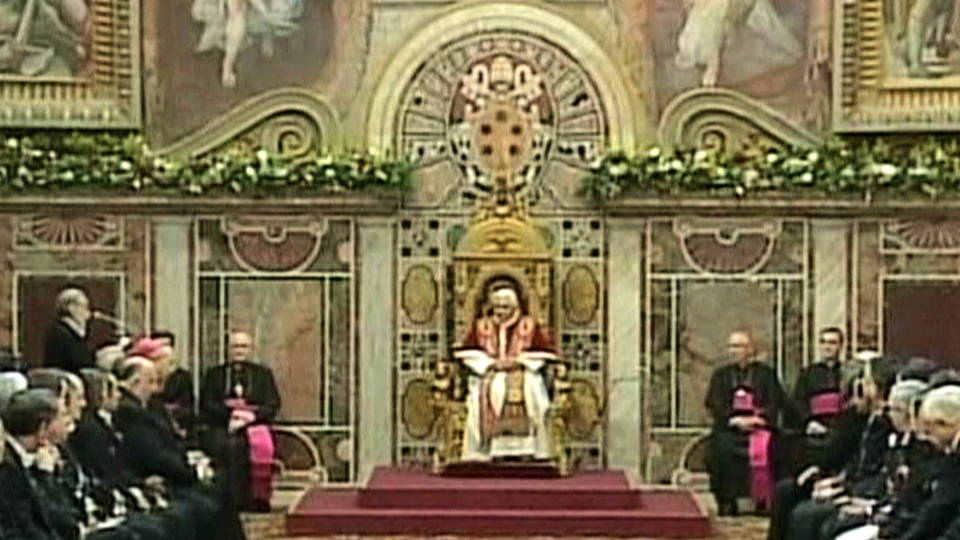
In other news from Germany, a new report finds more than 200 members of a German boys’ choir led by the brother of former Pope Benedict were abused over a period of four decades. Ulrich Weber, the attorney who conducted the report, said every third member of the choir and an affiliated school suffered some form of physical abuse, including at least 40 cases of sexual violence. Weber said he believes the pope’s brother, who directed the choir for 30 years, must have known of the abuse.
New York: 7 Arrested for Blocking Traffic to Protest Raids on Central Americans
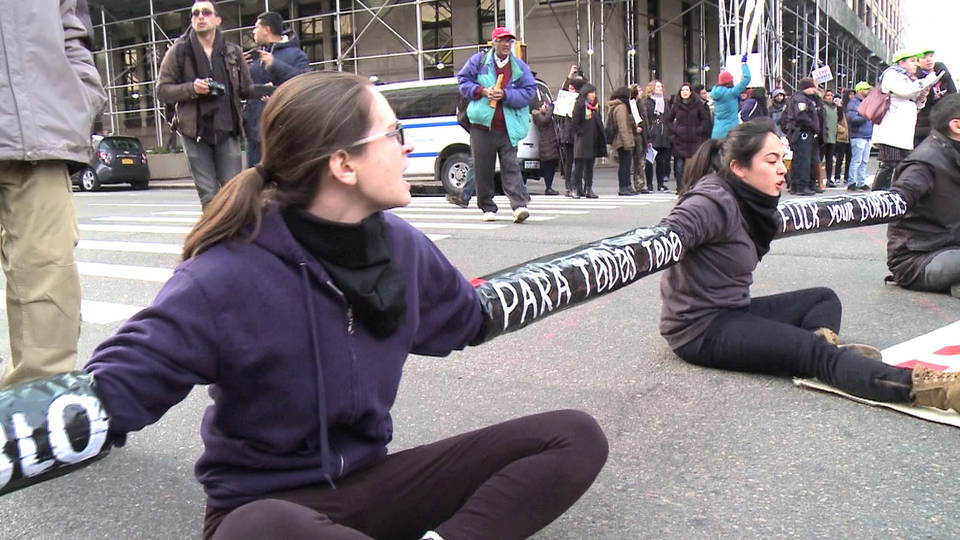
In New York City, seven people were arrested Friday after they disrupted traffic for more than an hour outside an Immigration and Customs Enforcement office. The action was held to protest the new round of raids against Central American families. The raids have targeted people who sought asylum in the United States after fleeing violence in their home countries. The activists locked themselves to each other usingPVC pipes to block traffic, forcing the police to cut them out of the pipes with electric saws. Undocumented activist Yajaira Saavedra spoke during the protest.
Yajaira Saavedra: "My name is Yajaira Saavedra. I’m undocumented. I’m from Mexico. I crossed the border when I was four years old. I’m here because I believe every child that crosses a border should get political asylum. They shouldn’t be in detention centers; they should be in school trying to get an education, being able to have a better future. I want there to be less military invasions. I want to seeNAFTA out of our community. The whole American military complex is what’s destroying countries like Mexico and causing people to flee across to the border, where all the resources are being brought."
South Carolina: Muslim Woman, Jewish Man Kicked Out of Trump Rally for Silent Protest
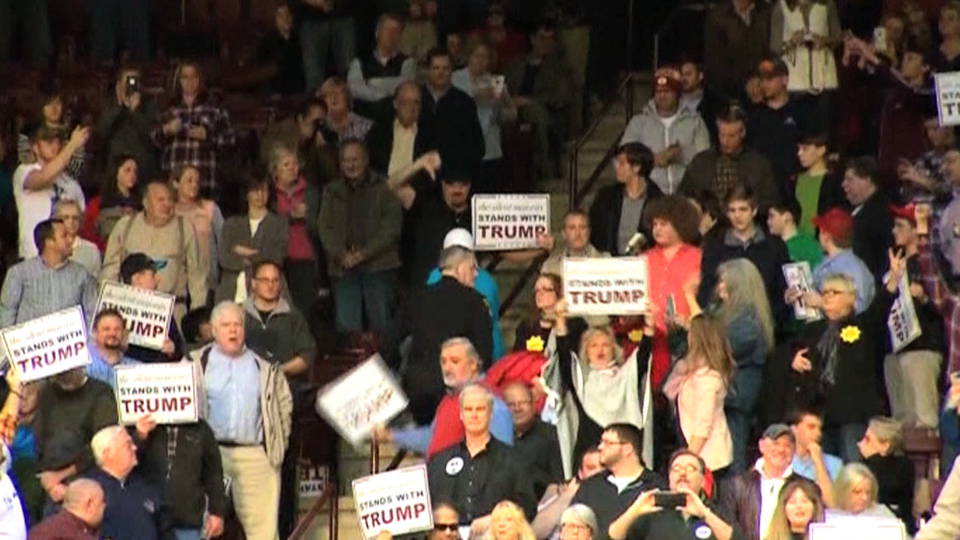
A Muslim woman and a Jewish man were kicked out of a Donald Trump rally on Friday after silently protesting the Republican front-runner’s Islamophobic views. Speaking in Rock Hill, South Carolina, Trump began repeating his call to ban Muslims from entering the U.S. and said Syrian refugees are "probably" tied to the Islamic State. At that point, Rose Hamid, a flight attendant, and Marty Rosenbluth, an attorney, stood up in silent protest. We’ll speak with Rose and Marty after headlines.
Washington: Activists to Cite Necessity Defense in Trial for Blocking Oil Train
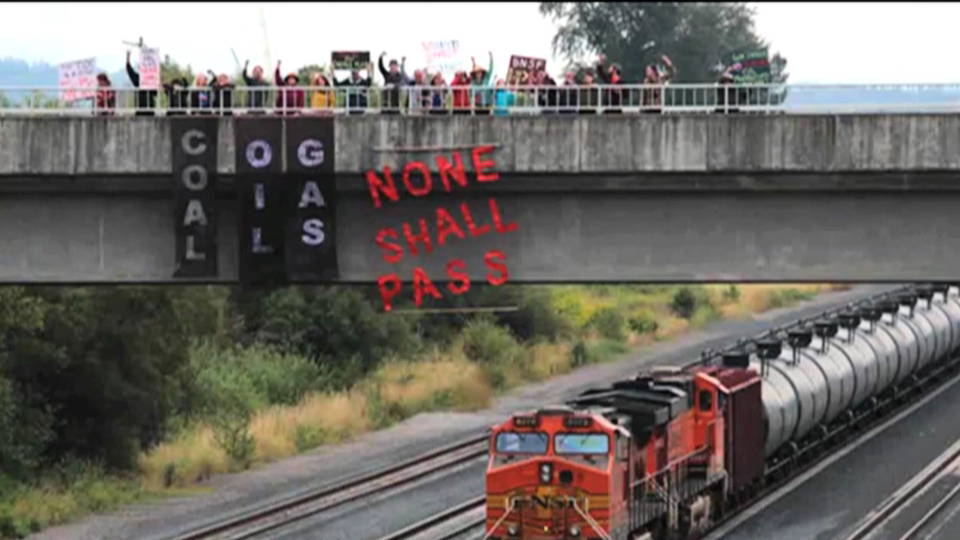
In Washington state, five climate justice activists go on trial today for tying themselves to a 25-foot tripod structure to block a mile-long oil train. The protesters, members of the activist group Rising Tide Seattle, demanded a halt of shipments of fossil fuels through the Northwest. In an unprecedented move, the presiding judge will allow the defendants to argue their actions were necessary because of the threat of climate change. We’ll have more on their case later in the broadcast.
Maryland: Jury Selection Begins for 2nd Officer in Freddie Gray Case

In Baltimore, Maryland, jury selection begins today for the second police officer to go on trial for the death of Freddie Gray. A family attorney says Gray’s spine was "80 percent severed at his neck" from fatal injuries in police custody in April. Officer Caesar Goodson, who drove the van in which Gray is believed to have suffered the fatal injuries, faces the most serious charges of any of the six indicted officers. The first officer tried for Gray’s death, William Porter, saw his case end in a mistrial last month; he faces a retrial in June.
New York: Sergeant Stripped of Gun, Badge for Death of Eric Garner
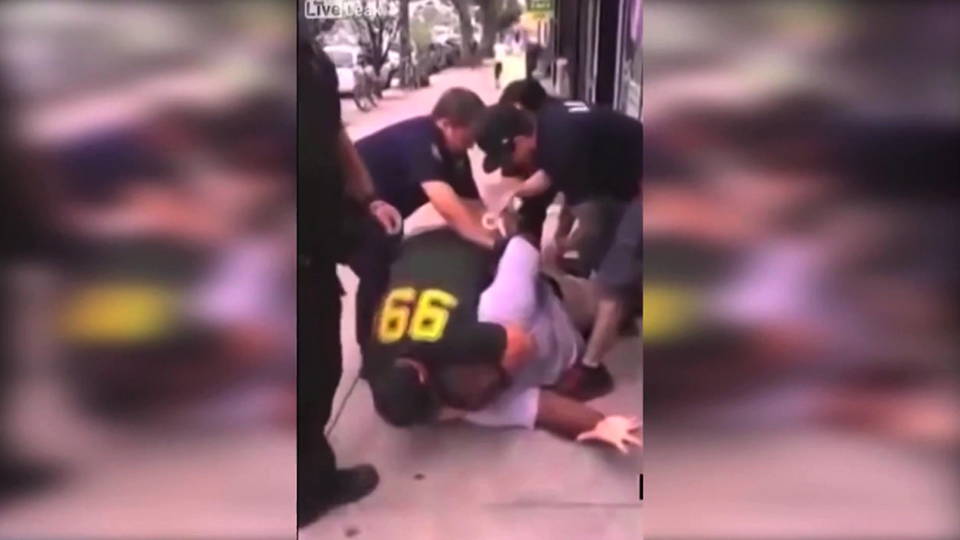
In New York City, a police sergeant has been hit with departmental disciplinary charges over the death of Eric Garner in 2014. Garner died after Officer Daniel Pantaleo pulled him to the ground in a chokehold. Officers then piled on top of Garner as he said "I can’t breathe" 11 times. Garner was accused of selling loose cigarettes. While a grand jury failed to indict Officer Pantaleo for the fatal chokehold, Sergeant Kizzy Adonis, who is African-American, has been stripped of her gun and badge for failing to supervise the officers involved in Garner’s death. Garner’s oldest daughter, Erica, responded to the news in a video posted online.
Erica Garner: "A year and a half later, the only people indicted in my dad’s case are people of color. A year and a half later, this is the only answer that New York has to offer the Garner family. Not one of the eight killer cops that was on my dad’s back was charged for anything. This underscores the fundamental problem in this country. This is why we can’t reform our way out of this. This is why we can’t train our way out of this. It doesn’t matter about more black police officers. It doesn’t matter about more black district attorneys. It doesn’t matter about black police chiefs. All the way up to the president, it still doesn’t matter."
Erica Garner is joining a rally today to coincide with a court date for Ramsey Orta, who filmed the fatal chokehold of Eric Garner. Orta has been arrested multiple times after he says police targeted him and his family for releasing the video. Erica Garner refers to Ramsey Orta as "the only man charged in my dad’s death."
Billionaire Investor Steven Cohen Spared Harsh Sanctions in Insider Trading Probes
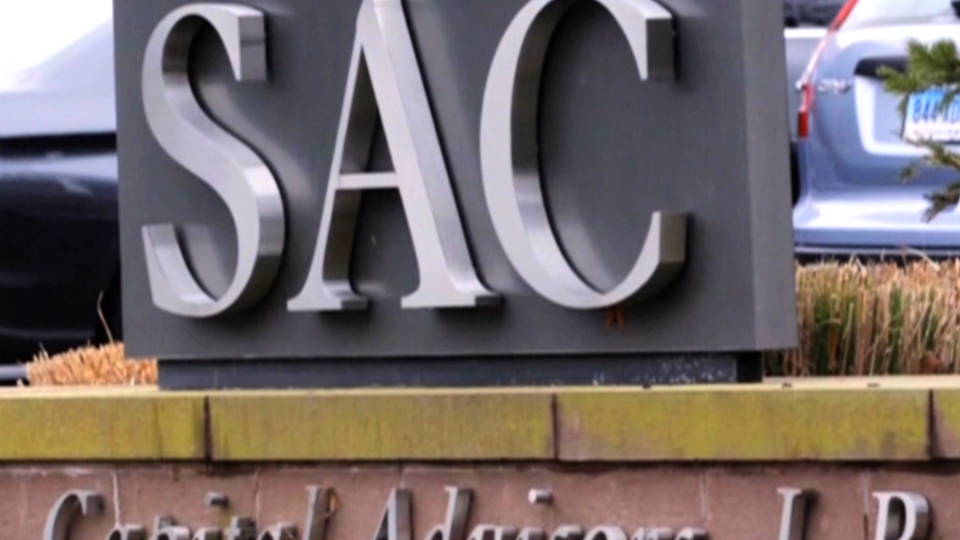
Billionaire hedge fund investor Steven Cohen has avoided paying any fines after nearly a decade of probes into widespread accusations of insider trading at his firm,SAC Capital. The Securities and Exchange Commission accused Cohen of ignoring clear signs that "should have caused a reasonable hedge fund manager to investigate" potential insider trading by his employee, Mathew Martoma. Martoma is serving a nine-year prison term after becoming the eighth employee of Cohen’s firm convicted of insider trading. But under the deal with regulators, Cohen himself is barred from managing investors’ money for just two years.
Pop Legend David Bowie Dies at Age 69
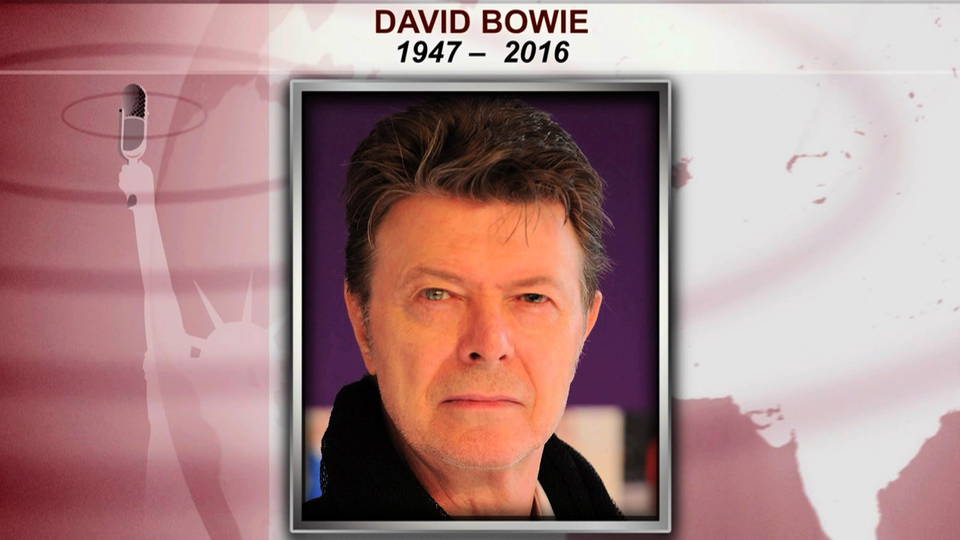
And the pop legend David Bowie has died at the age of 69. Known for his gender-bending style and hits including "Changes," "Let’s Dance," "Fame" and many more, Bowie died Sunday after a battle with cancer. His last album, "Blackstar," came out Friday, on his 69th birthday.
Donate today:
Follow:


WEB EXCLUSIVE


Director of Finance and Operations
Director of Development
---------------------
207 West 25th Street, 11th Floor
New York, New York 10001, United States
---------------------
---------------------

No comments:
Post a Comment