
Friday after Epiphany
Saints of the day: St. Apollinaris, the Apologist, Bishop (2nd century)
SAINT APOLLINARIS, THE APOLOGIST
Bishop
(2nd century)
Bishop
(2nd century)
Claudius Apollinaris, Bishop of Hierapolis in Phrygia, was one of the most illustrious prelates of the second age. Notwithstanding the great encomiums bestowed on him by Eusebius, St. Jerome, Theodoret, and ethers, but little is known of his actions; and his writings, which then were held in great esteem, seem now to be all lost.
He wrote many able treatises against the heretics, and pointed out, as St. Jerome testifies, from what philosophical sect each heresy derived its errors. Nothing rendered his name so illustrious, however, as his noble apology for the Christian religion which he addressed to the Emperor Marcus Aurelius, about the year 175, soon after the miraculous victory that prince had obtained over the Quadi by the prayers of the Christians.
St. Apollinaris reminded the emperor of the benefit he had received from God through the prayers of his Christian subjects, and implored protection for them against the persecution of the pagans. Marcus Aurelius published an edict in which he forbade any one, under pain of death, to accuse a Christian on account of his religion; by a strange inconsistency, he had not the courage to abolish the laws then in force against the Christians, and, as a consequence, many of them suffered martyrdom, though their accusers were also put to death.
The date of St. Apollinaris' death is not known; the Roman Martyrology mentions him on the 8th of January.[Lives of the Saints, by Alban Butler, Benziger Bros. ed. [1894]]
St. Severin, Abbot (410-482)
St. Thorfinn, Bishop († 1285)
Saint Thorfinn
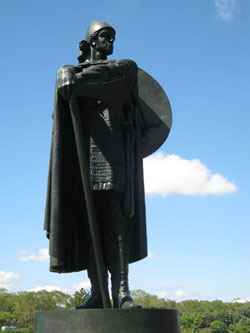 Feastday: January 8
In the year 1285, there died in the Cistercian monastery at TerDoest, near Bruges, a Norwegian bishopnamed Thorfinn. He had never attracted particular attention and was soon forgotten. But over fifty years later, in the course of some building operations, his tomb in the Church was opened and it was reported that the remains gave out a strong and pleasing spell. The Abbot made inquiries and found that one of his monks, and aged man named Walter de Muda, remembered Bishop Thorfinn staying in there monastery and the impression he had made of gentle goodness combined with strength. Father Walter had in fact, written a poem about him after his death and hung it up over his tomb. It was then found that the parchment was still there, none the worse for the passage of time. This was taken as a direction from on high that the Bishop's memory was to be perpetuated, and Father Walter was instructed to write down his recollections of him. For all that, there is little enough known about St. Thorfinn. He was a Trondhjem manand perhaps was a Canon of the Cathedral of Nidaros, since there was such a one named Thorfinn among those who witnessed the agreement of Tonsborg in 1277. This was an agreement between King Magnus VI and the Archbishop of Nidaros confirming certain privileges of the clergy, the freedom of episcopal elections and similar matters. Some years later, King Eric repudiated this agreement, and a fierce dispute between Church and state ensued. Eventually the King outlawed the Archbishop, John, and his two chief supporters, Bishop Andrew of Oslow and Bishop Thorfinn of Hamar. Bishop Thorfinn, after many hardships, including shipwreck, made his way to the Abbey of TerDoest in Flanders, which had a number of contacts with the Norwegian Church. It is possible that he had been there before, and there is some reason to suppose he was himself a Cistercian of the Abbey of Tautra, near Nidaros. After a visit toRome he went to TerDoest, in bad health. Indeed, though probably still a youngish man, he saw death approaching and so made his will; he had little to leave, but what there was, he divided between his mother, his brothers and sisters, and certain monasteries, churches and charities in his dioceses. He died shortly after on January 8, 1285. After his recall to the memory of man as mentioned in the opening paragraph of this notice, miracles were reported at his tomb and St. Thorfinn was venerated by theCistercians and around Bruges. In our own day, his memory has been revived among the few Catholics of Norway, and his feast is observed in his episcopal city of Hamar. The tradition of Thorfinn's holinessultimately rests on the poem of Walter de Muda, where he appeared as a kind, patient, generous man, whose mild exterior covered a firm will against whatever he esteemed to be evil and ungodly. His feast day is January 8th.
Friday after Epiphany
The First Epistle of John 5:5 Who does overcome the world if not the person who believes that Yeshua is the Son of God?
Friday after Epiphany
Commentary of the day:
Origen (c.185-253), priest and theologian
7th Homily on the Book of Numbers
The leprosy of malicious gossip
Aaron and Miriam spoke against Moses and for this reason were punished; Miriam was even struck by leprosy (Numbers 12:,1,10). A psalm says: “Whoever slanders his neighbor in secret, him will I destroy” (Psalm 100:1,5). With the help of the Holy Scripture that is “sharper than any two-edged sword” (Hebrews 4,12), let us remove this vice, let us avoid speaking ill of our brothers and sisters and offending the holy ones, for leprosy will strike the disparager and the slanderer...
St. Severin
Abbot
(410-482)
Abbot
(410-482)
Among the inhabitants of Noricum (now Austria), the abbot St. Severin who propagated the Gospel in that country, and is called its apostle.
By divine power his body was carried to Lucullano, near Naples, and thence transferred to the monastery of St. Severin.
The Roman MartyrologySt. Thorfinn, Bishop († 1285)
Saint Thorfinn
In the year 1285, there died in the Cistercian monastery at TerDoest, near Bruges, a Norwegian bishopnamed Thorfinn. He had never attracted particular attention and was soon forgotten. But over fifty years later, in the course of some building operations, his tomb in the Church was opened and it was reported that the remains gave out a strong and pleasing spell. The Abbot made inquiries and found that one of his monks, and aged man named Walter de Muda, remembered Bishop Thorfinn staying in there monastery and the impression he had made of gentle goodness combined with strength. Father Walter had in fact, written a poem about him after his death and hung it up over his tomb. It was then found that the parchment was still there, none the worse for the passage of time. This was taken as a direction from on high that the Bishop's memory was to be perpetuated, and Father Walter was instructed to write down his recollections of him. For all that, there is little enough known about St. Thorfinn. He was a Trondhjem manand perhaps was a Canon of the Cathedral of Nidaros, since there was such a one named Thorfinn among those who witnessed the agreement of Tonsborg in 1277. This was an agreement between King Magnus VI and the Archbishop of Nidaros confirming certain privileges of the clergy, the freedom of episcopal elections and similar matters. Some years later, King Eric repudiated this agreement, and a fierce dispute between Church and state ensued. Eventually the King outlawed the Archbishop, John, and his two chief supporters, Bishop Andrew of Oslow and Bishop Thorfinn of Hamar. Bishop Thorfinn, after many hardships, including shipwreck, made his way to the Abbey of TerDoest in Flanders, which had a number of contacts with the Norwegian Church. It is possible that he had been there before, and there is some reason to suppose he was himself a Cistercian of the Abbey of Tautra, near Nidaros. After a visit toRome he went to TerDoest, in bad health. Indeed, though probably still a youngish man, he saw death approaching and so made his will; he had little to leave, but what there was, he divided between his mother, his brothers and sisters, and certain monasteries, churches and charities in his dioceses. He died shortly after on January 8, 1285. After his recall to the memory of man as mentioned in the opening paragraph of this notice, miracles were reported at his tomb and St. Thorfinn was venerated by theCistercians and around Bruges. In our own day, his memory has been revived among the few Catholics of Norway, and his feast is observed in his episcopal city of Hamar. The tradition of Thorfinn's holinessultimately rests on the poem of Walter de Muda, where he appeared as a kind, patient, generous man, whose mild exterior covered a firm will against whatever he esteemed to be evil and ungodly. His feast day is January 8th.
Friday after Epiphany
The First Epistle of John 5:5 Who does overcome the world if not the person who believes that Yeshua is the Son of God?
6 He is the one who came by means of water and blood, Yeshua the Messiah — not with water only, but with the water and the blood. And the Spirit bears witness, because the Spirit is the truth. 7 There are three witnesses — 8 the Spirit, the water and the blood — and these three are in agreement. 9 If we accept human witness, God’s witness is stronger, because it is the witness which God has given about his Son. 10 Those who keep trusting in the Son of God have this witness in them. Those who do not keep trusting God have made him out to be a liar, because they have not trusted in the witness which God has given about his Son. 11 And this is the witness: God has given us eternal life, and this life is in his Son. 12 Those who have the Son have the life; those who do not have the Son of God do not have the life. 13 I have written you these things so that you may know that you have eternal life — you who keep trusting in the person and power of the Son of God.
Psalm 147:12 Glorify Adonai, Yerushalayim!
Praise your God, Tziyon!
13 For he strengthens the bars of your gates,
he blesses your children within you,
14 he brings peace within your borders,
he gives you your fill of the finest wheat.
15 He sends his word out over the earth,
his command runs swiftly.
19 He reveals his words to Ya‘akov,
his laws and rulings to Isra’el.
20 He has not done this for other nations;
they do not know his rulings.
Halleluyah!
The Holy Gospel of Yeshua the Messiah according to Saint Luke 5:12 Once, when Yeshua was in one of the towns, there came a man completely covered with tzara‘at. On seeing Yeshua, he fell on his face and begged him, “Sir, if you are willing, you can make me clean.” 13 Yeshua reached out his hand and touched him, saying, “I am willing! Be cleansed!” Immediately the tzara‘at left him. 14 Then Yeshua warned him not to tell anyone. “Instead, as a testimony to the people, go straight to the cohen and make an offering for your cleansing, as Moshe commanded.” 15 But the news about Yeshua kept spreading all the more, so that huge crowds would gather to listen and be healed of their sicknesses. 16 However, he made a practice of withdrawing to remote places in order to pray.Friday after Epiphany
Commentary of the day:
Origen (c.185-253), priest and theologian
7th Homily on the Book of Numbers
There are not only the Jews who have spoken against Moses; there are the heretics too, who do not accept the Law and the prophets. They are used to accusing him, to say that Moses was a murderer because he killed the Egyptian (Exodus 2:12), and to fling out many other blasphemes both against him and against the prophets. Because of these criticisms they all have leprosy in their soul; they are lepers deep down inside of them and for this reason are confined outside the camp (Leviticus 13:46). Therefore the heretics who offend Moses and the members of the Church who speak against their brothers and sisters and who speak ill of their fellow men, both have – there is no doubt – a leprous soul.
Thanks to the intervention of the high priest Aaron, Miriam's leper was healed the seventh day (Nm 12,15); but we, if we are affected by the leprosy of the soul because of malicious gossip, we will have to keep our leprosy and will remain unclean till the end of the week of this world, meaning till the Resurrection, unless we repent and correct ourselves before, and that we turn ourselves towards Jesus Christ, and beg him so that we may be cleaned through penance.
---------------------Thanks to the intervention of the high priest Aaron, Miriam's leper was healed the seventh day (Nm 12,15); but we, if we are affected by the leprosy of the soul because of malicious gossip, we will have to keep our leprosy and will remain unclean till the end of the week of this world, meaning till the Resurrection, unless we repent and correct ourselves before, and that we turn ourselves towards Jesus Christ, and beg him so that we may be cleaned through penance.

No comments:
Post a Comment