
"Lord, to whom shall we go? You have the words of eternal life."[John 6:68]
Saturday of the First week in Ordinary Time
Saints of the day: St. Honoratus, Archbishop (+ 429)

SAINT HONORATUS
Archbishop
(+ 429)
Archbishop
(+ 429)
St. Honoratus was of a consular Roman family settled in Gaul. In his youth he renounced the worship of idols, and gained his elder brother, Venantius, to Christ. Convinced of the hollowness of the things of this world, they wished to renounce it with all its pleasures, but a fond pagan father put continual obstacles in their way. At length, taking with them St. Caprais, a holy hermit, for their director, they sailed from Marseilles to Greece, with the intention to live there unknown in some desert.
Venantius soon died happily at Methone, and Honoratus, being also sick, was obliged to return with his conductor. He first led a hermitical life in the mountains near Frejus. Two small islands lie in the sea near that coast; on the smaller, now known as St. Honoré, our Saint settled, and, being followed by others, he there founded the famous monastery of Lerins, about the year 400. Some of his followers he appointed to live in community; others, who seemed more perfect, in separate cells as anchorets. His rule was chiefly borrowed from that of St. Pachomius.
Nothing can be more amiable than the description St. Hilary has given of the excellent virtues of this company of saints, especially of the charity, concord, humility, compunction, and devotion which reigned among them under the conduct of our holy abbot.
He was, by compulsion, consecrated Archbishop of Arles in 426, and died, exhausted with austerities and apostolical labors, in 429.[Lives of the Saints, by Alban Butler, Benziger Bros. ed. [1894]]
St. Marcellus, Pope and Martyr (+ 309)
Saint Fursey
https://youtu.be/5sS_lBfzZU0?list=PL58g24NgWPIzvBk2IQVES_xC4WTm6-CDI
Feastday: January 16
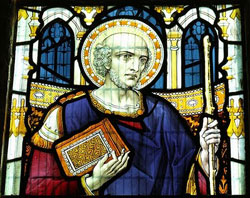 Death: 650
Irish monastic founder, the brother of Sts. Foillan and Ulan, praised by St. Bede. Fursey was born on the island of Inisguia en Lough Carri, Ireland, as a noble. He founded Rathmat Abbey, now probably Killursa. In 630 Fursey and his friends went to East Anglia, England, where he founded a monastery near Ugremouth on land donated by King Sigebert. In his later years, Fursey went to France to build a monastery at Lagny, near Paris, France. He was buried in Picardy. St. Bede and others wrote about Fursey's intense ecstasies.
Saturday of the First week in Ordinary Time
The First Book of Samuel 9:1 There was a man from Binyamin named Kish the son of Avi’el, the son of Tz’ror, the son of B’khorat, the son of Afiach, the son of a man from Binyamin. He was a man of substance and brave as well. 2 He had a son named Sha’ul who was young and good-looking; among the people of Isra’el there was no one better-looking than he; he stood head and shoulders taller than anyone else in Isra’el.

SAINT MARCELLUS I
St. Marcellus was elected Pope in 307, the last years of the persecution of the Church by Diocletian. He undertook the ecclesiastical reorganization of the Church and was most merciful to those who repented after having denied their Faith.Pope and Martyr (+309) In 309, under the tyrant Emperor Maxentius, he was banished from Rome and sent into exile where he died the same year. | |
https://youtu.be/5sS_lBfzZU0?list=PL58g24NgWPIzvBk2IQVES_xC4WTm6-CDI
Feastday: January 16
Irish monastic founder, the brother of Sts. Foillan and Ulan, praised by St. Bede. Fursey was born on the island of Inisguia en Lough Carri, Ireland, as a noble. He founded Rathmat Abbey, now probably Killursa. In 630 Fursey and his friends went to East Anglia, England, where he founded a monastery near Ugremouth on land donated by King Sigebert. In his later years, Fursey went to France to build a monastery at Lagny, near Paris, France. He was buried in Picardy. St. Bede and others wrote about Fursey's intense ecstasies.
Saturday of the First week in Ordinary Time
3 Once the donkeys belonging to Kish Sha’ul’s father got lost. Kish said to his son Sha’ul, “Please take one of the servants with you, go out, and look for the donkeys.” 4 He went through the hills of Efrayim and the territory of Shalishah, but they didn’t find them. Then they went through the territory of Sha‘alim, but they weren’t there. They went through the territory of Binyamin but didn’t find them there either.
17 When Sh’mu’el saw Sha’ul, Adonai said to him, “Here is the man I told you about, the one who is going to govern my people.”
18 Sha’ul approached Sh’mu’el in the gateway and said, “Please tell me where the seer’s house is.” 19 Sh’mu’el answered Sha’ul, “I’m the seer. Go up ahead of me to the high place, because you are going to dine with me today. In the morning, I will let you leave; and I will tell you everything that is on your heart.
10:1 Then Sh’mu’el took a flask of oil he had prepared and poured it on Sha’ul’s head. He kissed him and said, “Adonai has anointed you to be prince over his inheritance.
Psalm 21:2 (1) Adonai, the king finds joy in your strength;
what great joy he displays in your victory!
3 (2) You give him his heart’s desire;
you don’t refuse the prayer from his lips. (Selah)
4 (3) For you come to meet him with the best blessings,
you place a crown of fine gold on his head.
5 (4) He asks you for life; you give it to him,
years and years forever and ever.
6 (5) Your victory brings him great glory;
you confer on him splendor and honor.
7 (6) For you bestow on him everlasting blessings,
you make him glad with the joy of your presence.
The Holy Gospel of Yeshua the Messiah according to Saint Mark 2:13 Yeshua went out again by the lake. All the crowd came to him, and he began teaching them. 14 As he passed on from there, he saw Levi Ben-Halfai sitting in his tax-collection booth and said to him, “Follow me!” And he got up and followed him.
15 As Yeshua was in Levi’s house eating, many tax-collectors and sinners were sitting with Yeshua and his talmidim, for there were many of them among his followers. 16 When the Torah-teachers and the P’rushim saw that he was eating with sinners and tax-collectors, they said to his talmidim, “Why does he eat with tax-collectors and sinners?” 17 But, hearing the question, Yeshua answered them, “The ones who need a doctor aren’t the healthy but the sick. I didn’t come to call the ‘righteous’ but sinners!”
Saturday of the First week in Ordinary Time
Commentary of the day:
Saint Augustine (354-430), Bishop of Hippo (North Africa) and Doctor of the Church
Discourse on the Psalms, Psalm 58: 1, 7
“People who are healthy do not need a doctor; sick people do” (Mark 2:17)
---------------------Saint Augustine (354-430), Bishop of Hippo (North Africa) and Doctor of the Church
Discourse on the Psalms, Psalm 58: 1, 7
There are some strong men...who place their confidence in their own justice. They claim to be just by their own means, and since they considered themselves healthy people, they refused the remedy and killed the doctor himself. This is why, in fact, the Lord came to call not these strong men, but the weak...
Oh! You the strong, who do not need the doctor! Your strength does not come from health but from insanity...The Master of humility, who shared our weakness and who made us take part in his divinity, came down from heaven to show us the way and to be himself our way. Most of all, he wanted to leave us the example of his humility...to teach us to confess our sins, to humble ourselves and become strong, and to make ours the words of the apostle: “Therefore I am content with weakness...for when I am powerless, it is then that I am strong” (2 Corinthians 12:10)...
As for those who pride themselves on being strong, who, in other words, claim being just by their own virtue, “stumbled over the stumbling stone” (Romans 9:32)...It is these strong men who attacked Christ, as they boasted themselves on their justice...They had placed themselves above the crowd of weak people who hurried to the doctor. Why? Simply because they thought they were strong...They killed the doctor of all men. But he, by dying, prepared through his blood a remedy for all the sick.
Oh! You the strong, who do not need the doctor! Your strength does not come from health but from insanity...The Master of humility, who shared our weakness and who made us take part in his divinity, came down from heaven to show us the way and to be himself our way. Most of all, he wanted to leave us the example of his humility...to teach us to confess our sins, to humble ourselves and become strong, and to make ours the words of the apostle: “Therefore I am content with weakness...for when I am powerless, it is then that I am strong” (2 Corinthians 12:10)...
As for those who pride themselves on being strong, who, in other words, claim being just by their own virtue, “stumbled over the stumbling stone” (Romans 9:32)...It is these strong men who attacked Christ, as they boasted themselves on their justice...They had placed themselves above the crowd of weak people who hurried to the doctor. Why? Simply because they thought they were strong...They killed the doctor of all men. But he, by dying, prepared through his blood a remedy for all the sick.

No comments:
Post a Comment