
YLG2016: Connecting for God's Business from Brazil to India

Connecting is at the core of Lausanne’s identity, and of the Lausanne Younger Leaders Gathering to be held this August in Indonesia. Read this short story about how God brought two participants from Brazil and India together to talk about business as mission.
Paulo from Brazil says, 'Through new connections the Holy Spirit can guide you to put the pieces of the puzzle together and amplify your calling. We need to learn from others and also share the best we have with each other.'(Read More)
Connecting for God’s Business by Attila Nyári
‘“No distance too long”, goes an Indian ad caption. And it’s true, especially when God wants us to go to the ends of the world’, writes Carl Ebenezer, a participant in the Lausanne Younger Leaders Gathering from India.
Carl will be one of the thousand participants in the Lausanne Younger Leaders Gathering (YLG) to be held in August in Indonesia. Though unacquainted previously, he and another participant, Paulo Humaitá from Brazil, are starting to explore a significant ministry partnership, one of the already many fruits of the Holy Spirit’s work through YLG2016.
Connecting is at the core of Lausanne’s identity, and of the YLG. In October 2015, the YLG Planning Team launched the Connector, a website for participants to start connecting a year before the gathering, and challenged participants to get in touch with someone new.
‘I was looking on the Connector for someone to initiate a nice talk with. My search was specific; I was looking for someone with a business background and also interested in combining business and missions. I found Carl’s profile to be a perfect match, and we had an initial Skype conversation soon afterwards. We realized we had a lot in common, from our mission calling to personal life and also in how we got invited to YLG2016’, writes Paulo.
 Paulo Humaitá is an economist based in Sao Paulo, Brazil, who has been called to missions through business. After working five years for a global biotechnology leader, God led him to leave his job and start a business accelerator where Christian entrepreneurs are equipped to turn their startups into sustainable and powerful missionary projects. This is a pioneering project in the Brazilian context and has just launched in recent months.
 On the opposite site of the globe, Carl Ebenezer had been sensing a call to use for-profit organizations run on biblical principles to advance the kingdom particularly in areas of Asia, Africa, and South America in the 10/40 window. Together with the congregation he’s part of, Pearl City Church in Hyderabad, India, Carl is exploring ways to encourage missional businesses and to host India’s first Business for Blessing Strategy Summit in the near future.
It’s easy to see now what only God could see a few months back, that this divine appointment has great kingdom potential. ‘We need to talk a lot more’, both Paulo and Carl say. They’re planning to meet in person in India soon.
‘Through new connections the Holy Spirit can guide you to put pieces of the puzzle together and amplify your calling’, Paulo Humaitá says. About his generation, he adds, ‘We need to learn from others and also share the best we have with each other. We are a global generation, and we don’t have any reason to build up intelligence and just hold onto it. I believe God is raising an amazing team with business background for missions, and this generation will play a very strategic role within the Great Commission if we connect and join our efforts.”
This is one of the many stories of God’s gracious work in the countdown to YLG2016. Please continue to pray with us for many more such connections through the YLG for his kingdom.
Attila Nyári is the Chair of Communications for the 2016 Lausanne Younger Leaders Gathering. He also serves as the Media Relations & Online Engagement Manager for the Lausanne Movement.
SHARE:


Latest from the Lausanne Global Analysis
The Lausanne Global Analysis is now also being published in Spanish. Read in Spanish.
The State and Religious Persecution
Latest from the Lausanne Global Analysis
The Lausanne Global Analysis is now also being published in Spanish. Read in Spanish.
The State and Religious Persecution
Thomas Harvey
 According to the Pew Report on The Future of World Religions: Population Growth Projections, 2010-2050,1 North America and Western Europe are becoming increasingly secular with major declines in church attendance, even as Christianity and Islam rise in the Global South and East. With this intensification and polarisation of religions and irreligion globally has come political pressure upon governments to embrace a religious or secular national ideology.
Growing intolerance
 A second Pew report Latest Trends in Religious Restrictions and Hostilitiesdocuments a concomitant increase of official intolerance and restriction of minority religious faiths from 20% of governments putting in place ‘high or very high level restrictions on religion’ in 2007 to 27% in 2013.2 Although the 2015 report marked a slight decline from 2014, this slight dip does little to lessen the report’s conclusion that social hostility, abuse, and violence toward minority faiths are at unprecedented levels.3
The report notes that official intolerance, legal sanction, harassment, and outright persecution of minority religious communities are far more likely in countries where one religion or ideology dominates socially and politically. According to the three measures the Pew report used to identify social hostility to religious minorities, religious minorities in 120 countries (61% of all nations) suffered at least one of these hostilities: imposition of one religious or non-religious ideology; attempts to prevent minority faiths from worshipping; and actual attacks directed at persons, institutions, and places of worship perceived to threaten the majority religious faith or secular ideology.
Although the worst abuses of religious minorities take place in single-party states where one religion or political ideology dominates, the Pew report documents the growing intolerance of minority faiths in secular and purportedly liberal Europe. According to the report, Europe has witnessed the largest increase in median level government restriction on religion.4
Thus, religious and secular intolerance of minority religious expression are not limited to religious states, but are manifest in 39% of all nations, with some 5.5 billion people now living in countries with high or very high levels of restrictions upon religion—or 77% of the world’s population: up from 74% in 2011.5
Why is it happening?
The common denominator in official sanction of religious minorities is not simply a matter of religion per se. State discrimination, legal restriction, social hostility, and outright violence against religious minorities have risen in nations as ideologically and religiously diverse as China, Saudi Arabia, North Korea, Burma, Vietnam, Sudan, and Pakistan.
What appears to be the inner logic that justifies discrimination against, and outright abuse of, religious minorities has much to do with national identity and ideology, whether or not that is secular or religious. In states where religious or ideological exclusivity is enforced, questioning the prevailing religious or ideological identity is often seen as potentially subversive. The assumed superiority of the ruling belief system leads to a questioning of motives behind any alternative religious or ideological framework that puts into question the religious or ideological pillars of the state.
The fact that democratic regimes have proven far more tolerant of religious diversity than non-democratic regimes has much to do with their self-identification as nations which defend religious diversity, freedom of conscience, democratic political engagement, and freedom of speech. Thus government sanctions against religious minorities are a good indicator of whether governments are likely to restrict other human rights as well.
Why is it important?
With Christianity growing rapidly in the Global South and East, much of this growth is occurring in nations where Christianity is a distinct minority. This growth is being met with greater restrictions and growing hostility toward Christian mission and evangelism. As religious and ideological exclusivity grow, so will greater restrictions upon mission work as well as social hostility and even violence against missionaries and their converts.
India and Israel are representative of these trends:
India
Since the election of Narendra Modi of the Hindu Bharatiya Janata Party as prime minister in 2014, pressure has been building to amend the constitution to make India a Hindu state and calls have been growing for the re-conversion of Christians and Muslims back to Hinduism.6
Israel
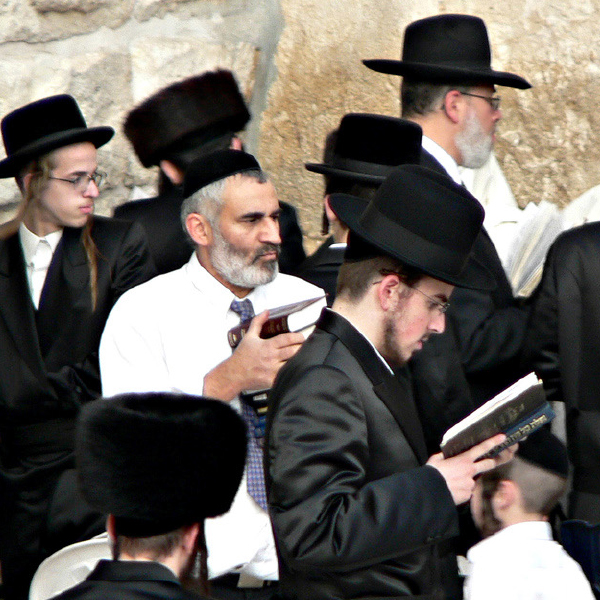 In modern secular Israel, recent demands by the ruling Likud and Orthodox Jewish parties that Israel be recognised as a ‘Jewish State’ as a condition for peace talks with Palestinians have raised serious concerns within Israel and internationally.
Indeed, emphasis upon religious national identity is viewed by non-Jewish citizens in Israel and non-Hindus in India as consignment to official second class status, thus putting in danger both nations’ democratic traditions and emphases upon human rights.7
United States
As Europe and North America grow increasingly secular, many evangelicals and Roman Catholics are increasingly concerned with anti-Christian rhetoric and enforcement of new restrictions on religious liberty. The court ruling last year affirming gay marriage in the US has produced a legal hornet’s nest as legal actions against Christian institutions that discriminate in hiring based on their understanding of marriage and sexual ethics begin to mount.8 Given that there is legal precedent to strip academic institutions of their tax-exempt status if they discriminate against protected classes of persons, many such institutions fear they may be forced to either close or abandon their current codes of conduct in deference to a ‘new morality’ imposed by the state.
 Moves to try to preserve the rights of Christian institutions are now currently making their way through the US Congress and state legislatures nationally, but their outcome is far from clear, given the power of the courts to rescind state law by judicial decision according to the legal precedent now in place.9 Although opposition to evangelical Christian perspectives in secular nations is couched in the language of tolerance and diversity, the result is increasing restriction upon evangelicals to order their lives and their institutions according to their traditions and conscience.
Longer-term outlook
In the long term, it appears that religious and ideological exclusivity, religious restrictions, social hostility, abuse, and even violence against Christianity around the globe will rise. Such restrictions, hostility, and abuse will reflect the differing religious and ideological frameworks that seek to marginalise the diverse perspectives that religious minorities represent.
Thus, it would not be surprising to see newly minted Christian majority nations without long histories of protecting the rights of minorities seeking to establish ‘Christian states’ that would restrict the rights of, and nurture social hostility against, religious minorities. For example, Angola, a Christian majority nation, has officially banned Islam and reportedly closed or destroyed some mosques in the country.10
The temptation legally to restrict minority religious and political competitors is great in all societies and within all religions. Nonetheless, such moves by religious and ideological majorities carry with them unintended consequences.
Because human rights are part of the complex web of rights that inform and strengthen civil society and democratic governance, restricting or showing hostility to one affects the others. Thus restricting the freedom of worship and assembly for minority faiths has a knock-on effect on other human rights such as freedom of speech, freedom of assembly, freedom of the press, and finally freedom of conscience.
Policy implications and suggested responses
For evangelical Christians, Christian institutions, and Christian missions, the rise of religious restriction, social hostility, and persecution of minority faiths is a matter of great concern.
Awareness of the tendency of restriction and some of the underlying causes of religious discrimination should serve to forewarn and forearm missions and ministry globally. An evangelical emphasis on nurturing societies that encourage openness, tolerance, and diversity of religious expression should be seen as a benefit to all citizens and beneficial to mission and ministry globally.
Hence it would be prudential for evangelicals to reach out to and establish strategic alliances with civil libertarians and groups advocating human rights—especially those arguing for freedom of religion and religious expression.
There has certainly been recognition of the role of vital Christian faith to the establishment of human rights. Nobel Prize winner, Liu Xiaobo, echoes the views of Alexander Solzhenitsyn and Vaclav Havel, in noting the link between the development of Christianity, vital spirituality, and the desire of people to ‘control their own souls’.11As Liu notes, this vital spirituality ‘demonstrates a popular recognition of the fact that if people do not take the initiative to fight for their legally guaranteed freedoms of speech, assembly, and belief, they have no escape from a life of terror’.12
 In turn and in the face of growing secularist hostility to evangelical Christian views, Os Guinness and other concerned evangelicals in 2012 drew up for endorsement ‘The Global Charter of Conscience’13 that seeks to address the two trends noted above: ‘the revitalization and growing political influence of religions with the danger of attempts to sustain the supremacy of one religion at the expense of others, and the spread of naturalistic worldviews, with the equal danger of excluding all religions from public life and thus favoring an exclusive form of non-religious worldview.’
Accordingly they express concern that ‘traditional settlements of religion and public life show signs of stress and need to be renegotiated.’14
Even more recently, evangelical leaders in 2015 established The Civilitas Group dedicated to promoting civility and fruitful dialogue across confessional and non-religious lines. Although only in embryonic form, such moves represent a new edge among evangelical leaders to reach out beyond the confines of the evangelical ghetto to promote civil society and greater understanding among people of different backgrounds and religious/political convictions.15
There are deep wells of Christian tradition that can be tapped in this endeavour. Historically, emphasis upon ‘freedom of conscience’ developed within Protestantism with its insistence that ‘God alone is Lord of the Conscience’ 16 —in other words what is necessary for human flourishing and wellbeing precedes laws drawn up by secular or religious officials. Accordingly, human conscience is ultimately subject to God and not to human or religious ideology of any stripe.
Nonetheless, such an appeal requires a commitment to acknowledge and affirm the need for tolerance and diversity even when Christians represent a large majority of any civil population. The question is whether evangelical Christians and their secular antagonists are willing to re-appropriate that tolerance in an age of increasing hostility to minority religious expression globally.
Endnotes
1 Pew Research Center, ‘The Future of World Religions: Population Growth Projections, 2010-2050: Why Muslims Are Rising Fastest and the Unaffiliated Are Shrinking as a Share of the World’s Population’, 2 April 2015,http://www.pewforum.org/2015/04/02/religious-projections-2010-2050/.
2 Pew Research Center, ‘Latest Trends in Religious Restrictions and Hostilities: Overall Decline in Social Hostilities in 2013, Though Harassment of Jews Worldwide Reached a Seven-Year High’, 26 February 2015, http://www.pewforum.org/2015/02/26/religious-hostilities/.
3 Editor’s Note: See article entitled ‘Persecution of Christians in the World Today’ by Charles Tieszen in the September 2013 issue of Lausanne Global Analysis.
4 Editor’s Note: See article entitled ‘The UK Campaign To End Religious Illiteracy’ by Jenny Taylor in the January 2015 issue of Lausanne Global Analysis.
5 Pew Research Center, ‘Latest Trends in Religious Restrictions and Hostilities’, 26 February 2015.
6 Rupam Jain Nair and Frank Jack Danie, ‘Special Report: Battling for India’s soul, state by state’, Reuters, 13 October 2015, http://in.reuters.com/article/india-rss-specialreport-idINKCN0S700420151013.
7 Jodi Rudoren, ‘Israel Struggles With Its Identity’, The New York Times, 8 December 2014,http://www.nytimes.com/2014/12/09/world/middleeast/israels-nationality-bill-stirs-debate-over-religious-and-democratic-identity.html. See also Victor Mallet, ‘Indian storm over minister’s comments on Muslims’, Financial Times, 16 October 2015, http://www.ft.com/intl/cms/s/0/6ddc8e78-73d6-11e5-a129-3fcc4f641d98.html#axzz42UEPTqKg.
8 Michelle Boorstein, ‘2015 clarified the right to gay marriage. It opened a world of questions for religious objectors’,Washington Post, 31 December 2015, https://www.washingtonpost.com/news/acts-of-faith/wp/2015/12/31/2015-clarified-the-right-to-gay-marriage-it-opened-a-world-of-questions-for-religious-objectors/.
9 Laurie Goodstein and Adam Liptak, ‘Schools Fear Gay Marriage Ruling Could End Tax Exemptions’, The New York Times, 24 June 2015, http://www.nytimes.com/2015/06/25/us/schools-fear-impact-of-gay-marriage-ruling-on-tax-status.html?_r=0.
10 Ari Yashar, ‘Angola Becomes “First Country to Ban Islam”: Southern African nation reportedly bans Islam and orders the demolition of mosques in the country’, Arutz Sheva: Israelnewsonline.com, 25 November 2013,http://www.israelnationalnews.com/News/News.aspx/174445#.Vofp3vFgn1F.
11 Liu Xiaobo, ‘The Rise of Civil Society in China’, Seeds of Change, Issue no 3, 2011,http://www.hrichina.org/sites/default/files/PDFs/CRF.3.2003/Liu_Xiaobo.pdf. See also Alexander Solzhenitsyn’s commencement address at Harvard University, ‘A World Split Apart’, 8 June 1978,http://www.americanrhetoric.com/speeches/alexandersolzhenitsynharvard.htm. Also see Vaclav Havel, ‘Vaclav Havel’s address to the US Congress, 21 February 1990’,http://everything2.com/title/Vaclav+Havel%2527s+address+to+the+US+Congress%252C+21+February+1990.
12 Liu, 18.
13 See http://www.osguinness.com/wp-content/uploads/2012/06/Charter-for-Religious-Freedom.pdf.
14 Editor’s Note: See article entitled ‘The Global Charter of Conscience’ by Os Guinness in the January 2013 issue ofLausanne Global Analysis.
15 See Richard Mouw’s address to The Civilitas Group at the Founders Dinner on 14 October 2015 based on his bookUncommon Decency: Christian Civility in an Uncivil World (Downers Grove: InterVarsity Press, 2010) online athttps://vimeo.com/146061022.
16 John Leith, Basic Christian Doctrine (Kentucky: Westminster John Knox Press, 1993), 205ff.

Thomas Harvey is Academic Dean of the Oxford Centre for Mission Studies, Oxford, UK. From 1997-2008 he served as Senior Lecturer of Systematic Theology at Trinity Theological College in Singapore.

The Restorative Economy Richard Gower
‘The creation waits in eager expectation for the children of God to be revealed’ (Rom 8:19)
At the end of September, world leaders met in New York to adopt ‘The Global Goals’ affirming their commitment to a better world: free from poverty, with a restored environment, peace, and equality.
However, few leaders appear prepared to face up to the scale of change required to meet these ambitious targets. As Christians, are we interested? And are we prepared to step into the breach?
Significant advances
Over the last 25 years, humanity has made huge progress. The number of people living in extreme poverty has fallen by half,1 the number of women dying in childbirth in key regions has fallen by two-thirds,2 and we have passed important milestones in the fight against measles, malaria, HIV, and a host of tropical diseases.3 The next generation now has vastly better prospects than in the past; for example, more children than ever have the chance to gain an education and girls in particular have seen steady improvements in access to schooling.4 5
Overall, we have made some very significant advances, unprecedented in history.
Looming crisis
At the end of September, world leaders met in New York to adopt ‘The Global Goals’ affirming their commitment to a better world: free from poverty, with a restored environment, peace, and equality.
However, few leaders appear prepared to face up to the scale of change required to meet these ambitious targets. As Christians, are we interested? And are we prepared to step into the breach?
Significant advances
Over the last 25 years, humanity has made huge progress. The number of people living in extreme poverty has fallen by half,1 the number of women dying in childbirth in key regions has fallen by two-thirds,2 and we have passed important milestones in the fight against measles, malaria, HIV, and a host of tropical diseases.3 The next generation now has vastly better prospects than in the past; for example, more children than ever have the chance to gain an education and girls in particular have seen steady improvements in access to schooling.4 5
Overall, we have made some very significant advances, unprecedented in history.
Looming crisis
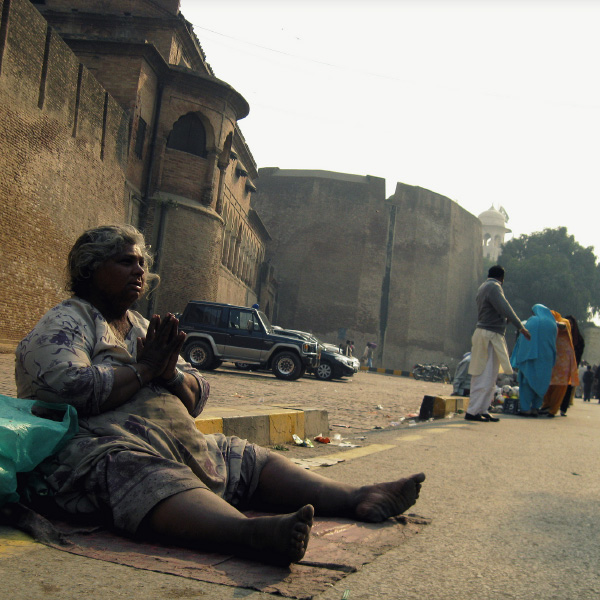 However, the job is not yet finished. A billion people, particularly women, remain mired in extreme poverty, many of them politically marginalised or found in the world’s conflict zones and failed states.Furthermore, those still struggling in poverty are most at-risk from further damage to planet Earth’s life support systems.
As humanity consumes more and more of the earth’s natural resources, we are placing ever greater stress on the ecosystems that support life. According to the Stockholm Resilience Centre, we have already crossed key risk thresholds in four areas essential to maintaining a safe environment (biosphere integrity, biogeochemical cycles, climate change, and land-system change).6
This dramatically increases the risk that ‘human activities could inadvertently drive the Earth System into a much less hospitable state, damaging efforts to reduce poverty and leading to a deterioration of human wellbeing in many parts of the world’.7 Already, more than a billion people live in water basins where water use exceeds sustainable limits, and many of the world’s best-known rivers, such as the Colorado, Indus, and Yellow Rivers, no longer reach the sea.8 As a result, churches and development practitioners around the world report that life is becoming harder for poor people, with for example, local reservoirs drying up in Brazil and increasingly erratic monsoon rains affecting farmers in Nepal.9
The 2012 Lausanne Consultation in Jamaica concluded that ‘we are faced with [an environmental] crisis that is pressing, urgent, and that must be resolved in our generation’.10 In a recent paper for Tearfund, Alex Evans and I used the words of Charles Dickens to describe our present age: ‘It was the best of times, it was the worst of times, it was the age of wisdom, it was the age of foolishness, it was the epoch of belief, it was the epoch of incredulity, it was the season of Light, it was the season of Darkness.’11
Despite all that has been achieved in recent decades, if we continue on our current broad path, we run the risk of a collapse in planet Earth’s life support systems, bringing increased conflict, the fragmentation of communities, and the reversal of all that has been gained.
How does our theology help us?
Scripture presents us with a holistic vision for the whole of creation. The hope of the gospel goes deeper than our personal expectation of salvation and restoration with God in heaven after death: it is a hope in the restoration of all things. We believe, as Tom Wright has said, that we are called to become co-workers with God (1 Cor 3:9) in the renewal and restoration of all things (Matt 19:28), of which we ourselves, having been saved and made new in Christ (2 Cor 5:17), are a foretaste of what God wants to do for the entire creation.12 We look forward to a time when a new heaven and a new earth are birthed out of the old (Rom 8; Rev 22), and in the meantime, we pray and live Your Kingdom Come.
As Chris Wright has said,
‘The Gospel is not just “me and my salvation”—a means by which I can go to heaven when I die . . . the Gospel is the whole story of what God has done to take the creation—which has been broken and fractured by sin and rebellion—and bring it into unity and wholeness and redemption in the Lord Jesus Christ.’13
In the beginning, we see a creation characterised by shalom, a word that means much more than peace, and incorporates ideas of wholeness, completeness, balance, healing, well-being, tranquillity, prosperity, security, and justice.14 Shalom is broken because of human sin and rebellion, and it is restored through Jesus’ death and resurrection, but not yet fully revealed in the world. It is this restoration of shalom that we hope for and now work towards. In the closing words of the ancient Nicene Creed, ‘We look for . . . the life of the world to come’.
What does this mean in economic terms?
Evans and I argue that the Old Testament Jubilee system offers a glimpse of what the outworking of shalom might look like in economic terms. We call this the Restorative Economy. This is an economic model in which all of us are empowered to participate as creative producers rather than simply passive consumers, where we work with the grain of nature, following the initial purpose of Adam ‘to work the Garden of Eden and take care of it’ (Gen 2:15), and above all where we respect the image of God in other human beings.
Such an economy would have three key features:
 It would keep within environmental limits. Chris Wright has said: ‘The Jubilee laws of Israel regulated the Israelites’ ownership and use of the land so that it was sustainable and so that shalom might exist in the community.’15 For example, every seventh year was a Sabbath year, a time of ‘solemn rest for the land’ (Lev 25:4) that allowed it to regain its fertility. Jubilees were about ‘sufficiency, recognition of limits, and the need for God’s creation to rest’.16
 It would safeguard everyone’s ability to meet their basic needs, including our central need for relationship. Weekly Sabbaths and one-in-seven Sabbath years, for example, ensured a nationally instituted rhythm of work and rest that allowed time for relationships and community.17 Furthermore, it was forbidden for Israelites to profit from those living in poverty by putting up prices for basic goods or lending at high rates of interest. Farmers were instructed: ‘Do not reap to the very edges of your field . . . leave them for the poor’ (Lev 19:9-10), and a portion of the tithe was also directed to ‘foreigners, the fatherless, and widows’ (Deut 14:28, 29). Above all, if these rules were followed correctly, Deuteronomy asserts that ‘there need be no poor people among you’ (Deut 15:4).18
 It would keep inequality within reasonable limits. Under the Jubilee system, land ownership was reset to its initial per capita distribution every 50 years.19 In the agrarian context of the time, land was also the main store of wealth, and the land reset therefore functioned as a wealth reboot more generally, preventing wealth inequalities from building up over generations. This provided equality of opportunity. Every 50 years, each family would have an opportunity to start afresh—free of debt and in possession of their own land.20
The Jubilee system offers a model for us today. While markets and trade are part of—and key to—reducing poverty, Jubilee principles ensure that human welfare and the wholeness of creation are not made subservient to these markets. We urgently need to find modern-day expressions of these principles in the way we operate as a society, and in the laws which govern our economy.
Change starts with us
How can we do this? Many of us already give money to organisations that are battling against poverty, or against environmental degradation, or inequality, and the abuse of power. However, overcoming these problems requires changes to our lifestyles as well as our money, and changes to the policies that our governments pursue.
The types of policy change required have been laid out clearly in a number of places.21However, the lesson of history is that convincing governments to make big systemic changes requires a broader shift in society’s values. In other words, change starts with us, and our lifestyles, and relies on the creation of a passionate movement for change, not just behind-the-scenes lobbying by professionals.
Faced with the scale of the challenges described above, our own individual actions can seem insignificant. However, the challenge we face today is little different from the challenge faced by those Christian campaigners who changed attitudes to slavery, civil rights, votes and education for women, debt forgiveness for poor countries, and many other issues.
Christians have excelled at making the moral case for change, because we have a rich set of values to draw on in Scripture. History teaches us that it is moral arguments that often persuade people to change their attitude. Slavery, child labour, debt forgiveness—all of these issues are now seen through a moral rather than economic lens.
So what can we do?
 We can use our power as voters, citizens, and consumers. Politicians will respond if ‘a critical mass is vocal and visible in demonstrating higher values’.22Similarly, our consumption and investment decisions can exemplify the moral argument for change.
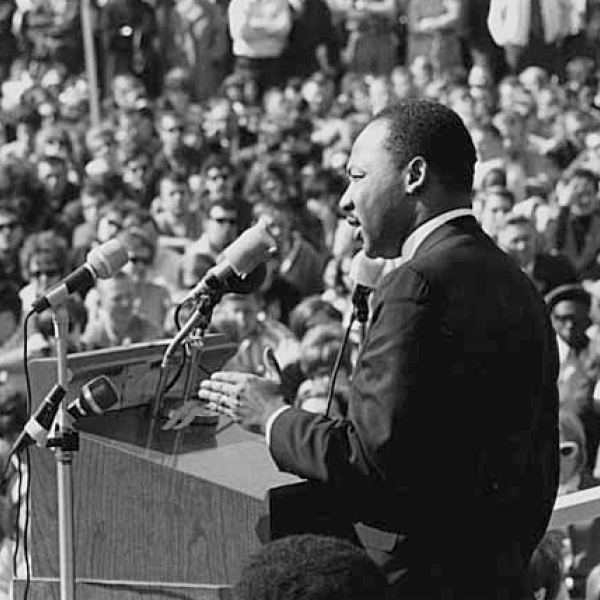
We can protest. In the past, Christians have been masters of prophetic protest and political theatre. In the US, Rev Martin Luther King and the civil rights movement had a bank of spectacular non-violent protest tactics such as sit-ins, boycotts, and freedom rides, anchored in the first point on members’ commitment cards: ‘meditate daily on the teachings and life of Jesus’.23
In 2000, the Jubilee campaign to cancel the unpayable debts of the world’s poorest countries used human chains surrounding G8 summits to symbolise chains of debt burdening poor communities. More cheekily, they rendered to Caesar what was Caesar’s by sending the UK Treasury £1 coins along with a message asking for debt cancellation, to help pay for cancelling the debt—causing consternation and a lot of work in the Treasury, followed by the debt cancellation they wanted.
We can change how we respond to poverty, brokenness, and environmental issues in our own lives. Thabo Makgoba notes that as long ago as 1978, the Anglican Communion’s Lambeth Conference issued a challenge to ‘renew [your] lifestyle and use of the world’s resources so that the service and wellbeing of the whole family comes before the enjoyment of over-indulgent forms of affluence.’ 24 In keeping with this, we can live more simply, staying within our fair share of the world’s resources, and we can respond to poverty with radical generosity.25 26
Finally, we can pray. Prayerful communities of disciples have throughout history had a much greater impact on society than they could have asked or imagined.
Today too, prayer, protest, and lifestyle change can accelerate change in government policy and give humanity a chance to meet the lofty ambitions of the Global Goals: ending global poverty, safeguarding our planet, and promoting peace and equality. This offers us a small glimpse of the ‘life of the world to come’ that we hope for.
If you want to find out more about Tearfund’s work helping make the Restorative Economy a reality, you can contact us at globalcampaign@tearfund.org.
Endnotes
1 World Bank, ‘Report Card: The World Bank Group Twin Goals & The Millennium Development Goals’, Global Monitoring Report 2014/2015, http://www.worldbank.org/content/dam/Worldbank/gmr/gmr2014/GMR_2014_Report_Card.pdf, 17-18, accessed 29 January 2016.
2 In Southern Asia, Eastern Asia, South East Asia, and North Africa. United Nations, Millennium Development Goals Report 2015, 38, accessed 26 August 2015.
3 Ibid, 44.
4 Ibid, 24, 27.
5 Editor’s Note: See article entitled ‘Micah Challenge International: A voice of evangelical advocacy’ by Joel Edwards and Geoff Tunnicliffe in the March 2015 issue of Lausanne Global Analysis.
6 Editor’s Note: See article entitled ‘Climate Change in Oceania: Ecomission and ecojustice’ by Mick Pope in the March 2015 issue of Lausanne Global Analysis.
7 Steffen, W, et al, Planetary Boundaries 2.0 – new and improved, http://www.stockholmresilience.org/21/research/research-news/1-15-2015-planetary-boundaries-2.0—new-and-improved.html, 2015.
8 National Geographic, 8 Mighty Rivers Run Dry from Overuse, https://environment.nationalgeographic.com/environment/photos/rivers-run-dry/#/freshwater-rivers-colorado-1_45140_600x450.jpg, accessed 6 August 2015.
9 Alex Evans and Richard Gower, The Restorative Economy: Completing Our Unfinished Millennium Jubilee, 2015, http://www.tearfund.org/en/about_you/campaign/report/, 12-13, accessed 6 August 2015.
10 Lausanne Global Consultation on Creation Care and the Gospel: Call to Actionhttp://www.lausanne.org/content/statement/creation-care-call-to-action (accessed 6/8/15)
11 Evans and Gower, The Restorative Economy, 11.
12 Tom Wright, Surprised by Hope (London: SPCK, 2007), 210, 212-23.
13 This quote by Dr Chris Wright of Langham Partnership International is transcribed from an interview by Tearfund, July 2014.
14 N Spencer and R White, Christianity, Climate Change and Sustainable Living (London: Jubilee Centre and Faraday Institute, 2007), 115-116.
15 Chris Wright, Mission of God’s People (Grand Rapids: Zondervan, 2010), 55.
16 Evans and Gower, The Restorative Economy, 7.
17 Michael Schluter and others have made a compelling case for the centrality of relationship to the Jubilee system. See http://www.jubilee-centre.org/relationism-pursuing-a-biblical-vision-for-society-by-michael-schluter/, accessed 6 August 2015.
18 We see a reflection of this in the early church community in Acts 2-4, where, mirroring Deuteronomy 15, there was ‘no needy person among them’ (Acts 4:34), offering a glimpse of shalom when Christ returns.
19 As Kim Tan explains, ‘When the Nation of Israel entered the Promised Land, the country was divided up in an equitable manner. The Territories were divided up in proportion to the size of the tribes.’ Kim Tan, The Jubilee Gospel, (United States: Authentic Media, 2009).
20 Ibid.
21 See chapter 4 for an introduction. Evans and Gower, The Restorative Economy.
22 Ibid, 8.
23 The Commitment Card, http://teachingamericanhistory.org/library/document/commitment-card/, accessed 26 August 2015.
24 Quoted in Thabo Makgoba, Hope and the Environment: A Perspective From the Majority World (Anvil, 2013), 58.
25 See for example S Rodin, ed, ‘Christ-Centered Generosity’ (Kingdom Life Publishing, 2015),https://kingdomlifepublishing.com/product/christ-centered-generosity/.
26 Editor’s Note: See article entitled ‘Christian Generosity Trends and the Future of Christian Giving’ by Sas Conradie in the March 2013 issue of Lausanne Global Analysis.

Richard Gower is Senior Associate for Economics and Policy at international development NGO Tearfund, and the Director of Foresight Economics, a consultancy specialising in work for the third sector. He has an MSc in Economics from University College London, and has spent time in the field as a development practitioner in Zimbabwe, designing conservation agriculture and community development programmes.

A Profile of North American Messianic Jews Andrew Barron
In a sense the converted Jew is the only normal human being in the world. To him, in the first instance, the promises were made, and he has availed himself of them. He calls Abraham his father by hereditary rights as well as by divine courtesy. He has taken the whole syllabus in order, as it was set; eaten the dinner according to the menu. Everyone else is, from one point of view, a special case dealt with under emergency regulations.1
What we continually press upon Jews is that we believe Jesus is the Son of Man and Son of God, not in spite of, but because we are Jews. We believe that Jesus is the King of our people, the sum and substance of our Scripture, the fulfiller of our law and Prophets, the embodiment of the promises of our covenant. Our Testimony is that of Jews to Jews.2
Survey
From June 1-December 1, 2013, I spearheaded a broad study of Messianic Jews in North America as a follow-up to a similar study done in 1983. The 2013 study involved a sample of 1,567 respondents and, like its predecessor, sought to give a picture of the evolving Messianic movement for the purpose of resourcing that community as well as the greater missions community. In addition, my hope was to stimulate strategies for outreach, fellowship, and edification.
The quantitative questions I posed to the participants covered age, family background, education, religious observance, and vocation. The qualitative questions covered experiences in personal journeys and the impact of their faith decisions in relation to friends, families, and communities of this group. Anthropological categories emerged from this study which have given meaning to these experiences in their modern social and cultural setting. Most Jewish people today continue to resist the message of Jesus. My qualitative research attempted to understand this resistance in relation to thehardening of Israel (Rom 11:25).
Hardening
Paul understands this phenomenon as a warning (verse 25a), a mystery (v 25b), partial (v 25c), and temporary (v 25d, 26a). Part of my research attempts to understandhardening as a genuine and current experience, and I was able to demonstrate thathardening is interlaced into what I call an Implied Social Contract (ISC). I first heard this term in 1983 from the founder of Jews for Jesus, Moishe Rosen.
This type of contract is an agreement among a group of people that is never explicitly articulated. In other words, certain behavior is implied as normative; yet there is no formal law governing such norms. My research showed how this ISC is a way to understand and frame contemporary reflections on Jewish culture and the ways in which the Jewish community has found unity in its resistance to the Gospel. Understanding the conversation of the ISC shows an unspoken norm within Jewish culture.
Survival
That ethnic Israel has survived seems to be related to this phenomenon. Hardening serves a bewildering purpose: not only does it keep my people away from the Gospel; it also assists as a protection and preservation mechanism. The full research has been published in the journal Mishkan.3
The Jewish philosopher Simon Rawidowicz argues that Jewish survival is always under threat. In his essay ‘Israel: The Ever Dying People’, he articulates that Jewish survival is so acute that the life of the Jewish people is a perpetual quest to control their future.4 This historical reality seems unparalleled in history. The Jewish people seemed destined to disappear. They have been exiled and exterminated in dozens of lands. Yet as Jewish people seem to be ever dying, they continue to live and prosper. Self-preservation, he argues, has become the prime value of Jewish culture. Hardening is related to this impulse.
Highlights of the quantitative analysis
Most people had heard the Gospel by the time they were 25.
The median age for first hearing the Gospel is 17 and for responding in faith is 22.
The most common way that respondents heard the Gospel was through personal conversation.
Those who respond find truth that is consistent and coherent with Scripture.
Most of our respondents sometimes feel like strangers inside the majority Jewish culture.
Respondents are still socially integrated into the wider cultures they live in.
The Messianic Jewish community in North America is more similar to the American Jewish community than to the general US population in demographics such as Jewish dispositions (ie the tendency to act in certain ways that are learned in the culture), education, and occupation.
Lifestyles, values, and identities of most of our respondents continue to show efforts to maintain a connection to Jewish tradition, on the one hand, and choice on the other. The results showed a broad consensus that reflected a commitment to Jewish character, culture, and continuity.
What we continually press upon Jews is that we believe Jesus is the Son of Man and Son of God, not in spite of, but because we are Jews. We believe that Jesus is the King of our people, the sum and substance of our Scripture, the fulfiller of our law and Prophets, the embodiment of the promises of our covenant. Our Testimony is that of Jews to Jews.2
Survey
From June 1-December 1, 2013, I spearheaded a broad study of Messianic Jews in North America as a follow-up to a similar study done in 1983. The 2013 study involved a sample of 1,567 respondents and, like its predecessor, sought to give a picture of the evolving Messianic movement for the purpose of resourcing that community as well as the greater missions community. In addition, my hope was to stimulate strategies for outreach, fellowship, and edification.
The quantitative questions I posed to the participants covered age, family background, education, religious observance, and vocation. The qualitative questions covered experiences in personal journeys and the impact of their faith decisions in relation to friends, families, and communities of this group. Anthropological categories emerged from this study which have given meaning to these experiences in their modern social and cultural setting. Most Jewish people today continue to resist the message of Jesus. My qualitative research attempted to understand this resistance in relation to thehardening of Israel (Rom 11:25).
Hardening
Paul understands this phenomenon as a warning (verse 25a), a mystery (v 25b), partial (v 25c), and temporary (v 25d, 26a). Part of my research attempts to understandhardening as a genuine and current experience, and I was able to demonstrate thathardening is interlaced into what I call an Implied Social Contract (ISC). I first heard this term in 1983 from the founder of Jews for Jesus, Moishe Rosen.
This type of contract is an agreement among a group of people that is never explicitly articulated. In other words, certain behavior is implied as normative; yet there is no formal law governing such norms. My research showed how this ISC is a way to understand and frame contemporary reflections on Jewish culture and the ways in which the Jewish community has found unity in its resistance to the Gospel. Understanding the conversation of the ISC shows an unspoken norm within Jewish culture.
Survival
That ethnic Israel has survived seems to be related to this phenomenon. Hardening serves a bewildering purpose: not only does it keep my people away from the Gospel; it also assists as a protection and preservation mechanism. The full research has been published in the journal Mishkan.3
The Jewish philosopher Simon Rawidowicz argues that Jewish survival is always under threat. In his essay ‘Israel: The Ever Dying People’, he articulates that Jewish survival is so acute that the life of the Jewish people is a perpetual quest to control their future.4 This historical reality seems unparalleled in history. The Jewish people seemed destined to disappear. They have been exiled and exterminated in dozens of lands. Yet as Jewish people seem to be ever dying, they continue to live and prosper. Self-preservation, he argues, has become the prime value of Jewish culture. Hardening is related to this impulse.
Highlights of the quantitative analysis
Most people had heard the Gospel by the time they were 25.
The median age for first hearing the Gospel is 17 and for responding in faith is 22.
The most common way that respondents heard the Gospel was through personal conversation.
Those who respond find truth that is consistent and coherent with Scripture.
Most of our respondents sometimes feel like strangers inside the majority Jewish culture.
Respondents are still socially integrated into the wider cultures they live in.
The Messianic Jewish community in North America is more similar to the American Jewish community than to the general US population in demographics such as Jewish dispositions (ie the tendency to act in certain ways that are learned in the culture), education, and occupation.
Lifestyles, values, and identities of most of our respondents continue to show efforts to maintain a connection to Jewish tradition, on the one hand, and choice on the other. The results showed a broad consensus that reflected a commitment to Jewish character, culture, and continuity.
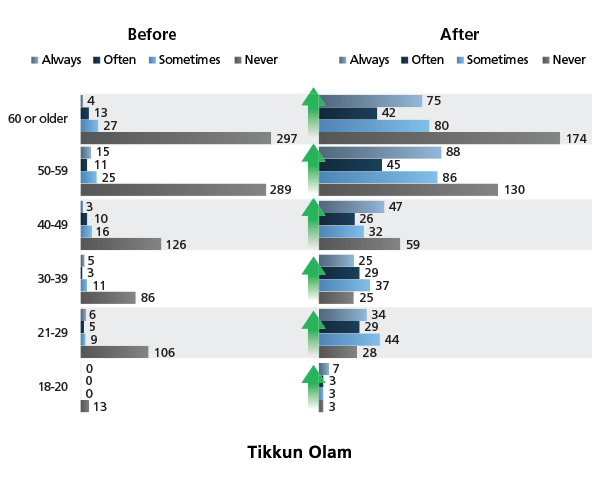 With regard to the Jewish value oftikkun olam (repair of the world) and without providing specifics, we see a very significant increase in orientation across age groups toward this practice after coming to faith. The increase here was the most notable among all the values examined. The chart below shows how these values play out. Of all the Jewish values examined, this showed the most startling renewal.
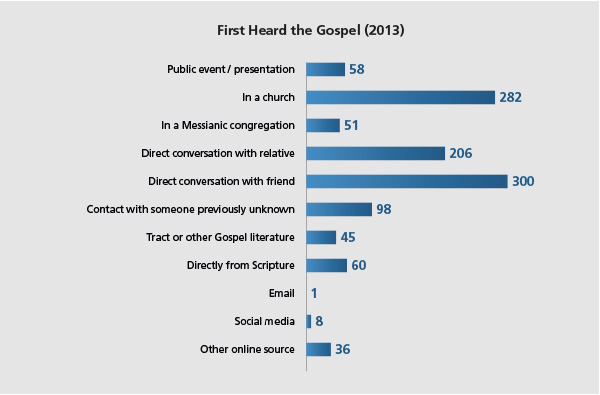
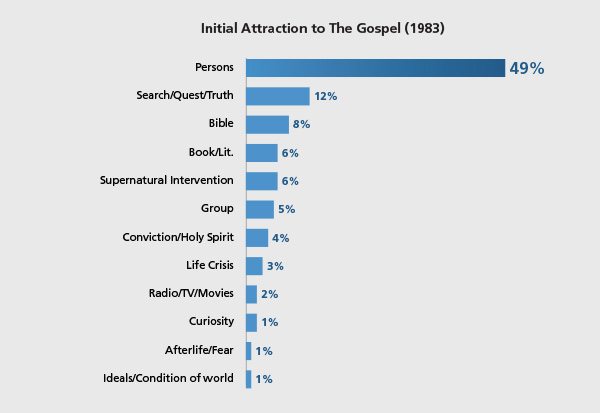
Other interesting results are illustrated below. I compare how Jewish people are hearing the Gospel in 1983 and 2013. The questions were framed differently, but the pattern suggests that most Jewish people are hearing the Gospel in the marketplace. There is an increasing influence of churches and Messianic congregations:
Qualitative highlights
In the September 2015 issue of Lausanne Global Analysis, my colleague Susan Perlman wrote about scaling adversity.5 My research here is related to this significant topic. My qualitative questions covered experiences in personal journeys and the impact of their faith decisions in relation to the friends, families, and communities of this group.
Many respondents experienced adversity. They called it many things: social control, guilt, shame, hardening, and loss of prestige. Today Jewish people in North America are continuing to experience adversity as they hear and respond to the Gospel.
Respondents were asked to characterize this adversity in their experience:
The major pressure points involved what it would mean for relationships in the Jewish community.
Infidelity to the Jewish community was especially a point of pressure for the 50+ group.
Pressure points, especially regarding community, factored less significantly among younger generations.
Below are two charts outlining the sources and types of pressure. We can see that the older groups experienced more adversity than the younger groups. The graphs represent those who noted that they experienced this kind of adversity in a particular age group.
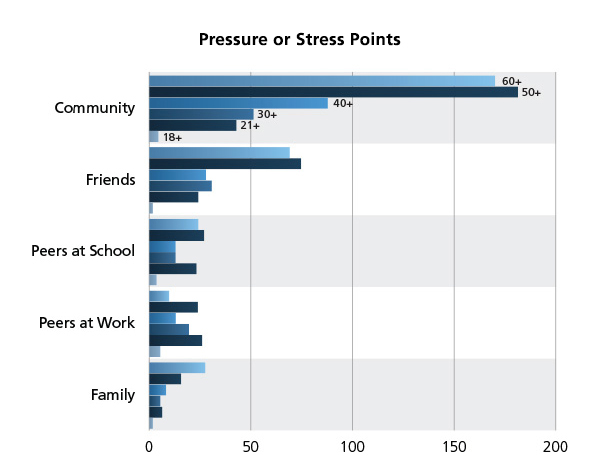
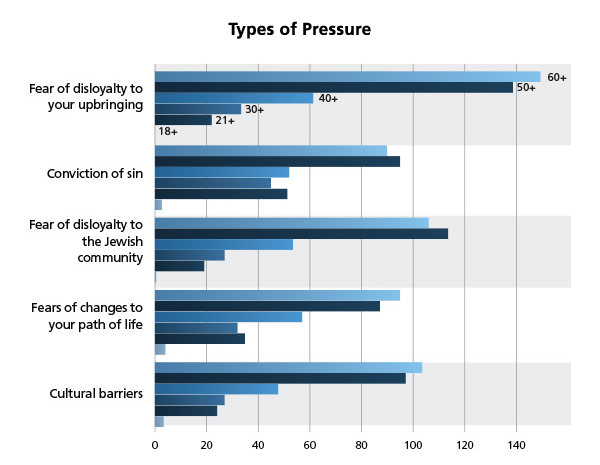
As I interviewed this group, several subjects manifested around social control, such as prestige, shame and guilt, and hardening.
I asked if they could articulate what hardening was or how it manifested itself in their experience. Common answers were ‘death’; ‘loss’; ‘apathy’; ‘identity separation’; ‘tribal’; ‘when I was in the synagogue I was the Christian. When I was in the church I was the Jew’; and ‘hardening is seen in both directions’.
Of the 24 people in the group, two were disowned; two experienced religious control; three lost job opportunities; three were uninvited to family/community events; and five experienced psychological control—‘You cause us pain. You are hurting your grandparents. You will not be able to marry a Jew. You are a Gentile.’
I was interested in fleshing out some of these categories. I asked the group to try and measure these various points of adversity with regard to the themes that were emerging. Below are the results of Shame and Guilt and Loss of Prestige.
I asked them to ‘measure’ on a scale of 1-10 the intensity of this kind of adversity. These were done in relation to friends, family, and community. The scatter graphs are below along with the trend analysis. You can see a diversity of experiences across age groups with similar trends across the age groups.
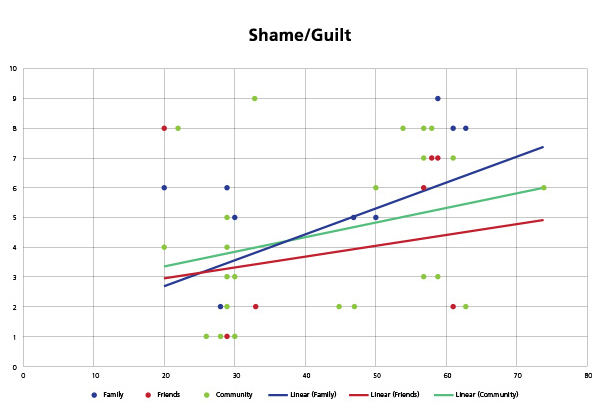
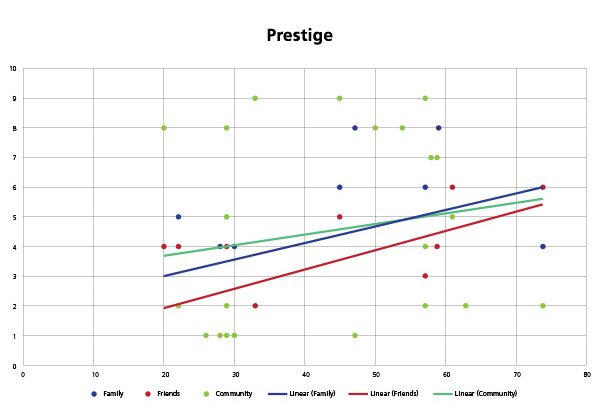
Next steps in this research will include improving the quality of the survey; asking new questions with regard to social media; and surveying all the Messianic communities outside of North America.
Broader global missiological concerns
Issues surrounding Cultural Guidelines and Social Control are familiar to anyone involved in cross-cultural missions. The particular issues I face in Jewish mission resemble common phenomena that vary from society to society. Loss of categories, secularism, and urbanization are changing the way younger generations are experiencing social control. I believe that the concerns which flow from my research are foundational to global mission concerns:
A vigorous ongoing conversation is needed about the extent to which we need to prophetically challenge people while remaining part of the communities in which we minister.
We must respect the influence of indigenous congregations.
We need to build relationships, make the Bible available, plan for, and address adversity.
We must talk to people we disagree with so that we can refine our positions.
We must challenge and be challenged by the status quo in communications and methodology. I believe that God enjoys human creativity and we should be open to all the new platforms that technology provides.
We must be honest in communicating failures to our donors. It is easy to hit the side of a barn door and draw a circle around it and tell the world that you made a bull’s-eye.
As we evaluate our current and potential platforms, we must avoid communication that is syrupy, far-fetched, and irrelevant. Meaning must be provided into the social context of those whom we intend to reach.
We must not assume that people will cross over social and cultural boundaries to listen to us.
We must apply appropriate speech and categories. I do not propose a new tactic, but an old tactic applied in a new way—receptor-oriented communication.
Furthermore, we must not be afraid to ask these questions:
Is our material relevant to the group receiving the message rather than those bringing it? Is our material bound by our culture or designed for the people and paradigms of the societies we are speaking to?
Are we talking to the people we should be talking to?
Do we have the courage to face hardship and opposition?
Are we willing to exercise critical judgment regarding material, methods, and projects used? Do they work now? Can we assess and/or measure?
Conclusion
Appropriate and relevant speech affirms the dignity of all people. Communication must be tied to the consciousness of the hearers. This principle is at the heart of contextual ministry.
Endnotes
1 C S Lewis, Introduction to Smoke on the Mountain: An Interpretation of the Ten Commandments by Joy Davidman (Philadelphia: Westminster Press, 1953), 7.
2 David Baron, The Ancient Scriptures and the Modern Jew (London: Hodder and Stoughton, 1900), 337.
3 Andrew Barron and Bev Jamison, ‘A Profile of North American Messianic Jews’, Mishkan 73 (Jerusalem: Caspari Center for Biblical and Jewish Studies, 2015).
4 Simon Rawidowicz, ‘Israel: The Ever Dying People’, Studies in Jewish Thought, N N Glatzer, ed, (Philadelphia: Jewish Publication Society, 1974), 210-214, 220.
5 Read the full article at https://www.lausanne.org/content/lga/2015-09/scaling-adversity.
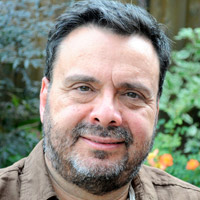
Andrew Barron is the Director of Jews for Jesus in Canada, and pioneered the work of Jews for Jesus in South Africa. He first heard the gospel in 1981 while helping to design and plan space shuttle missions for the United States Space Program. He can be reached at andrew.barron@jewsforjesus.ca.

Mission in Europe 25 Years After the Fall of the Berlin Wall Darrell Jackson
My teens spanned the 1970s, memorable for being a decade of economic recession, the emergence of neoliberal politics and economics, and the accelerating polarization of the world between the United States (and its NATO allies) and the Soviet Union. The decade ended with the election of British Prime Minister Margaret Thatcher and the Soviet invasion of Afghanistan.
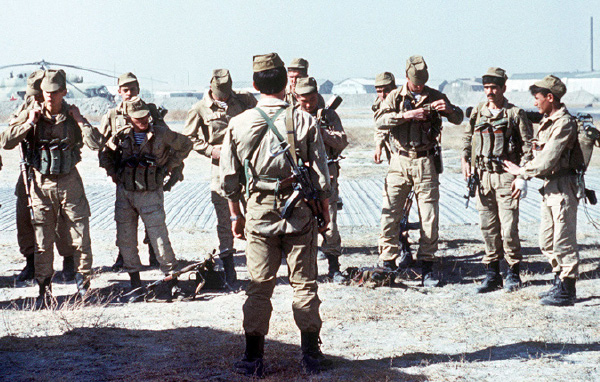 During the early 1980s I became more politically aware. It seemed then that European politics was dominated by the apparently impregnable wall separating East from West and of the vast Soviet empire whose ranks were massed behind it. Our home in the UK received, as did many other homes of the era, a booklet outlining what to do in the event of a nuclear attack. The perception and presentation of this kind of cold war ‘reality’ was further fuelled for a young evangelical by the atheism and godlessness to which the Soviet socialist states pledged their unwavering allegiance.
Iron curtain drawn back
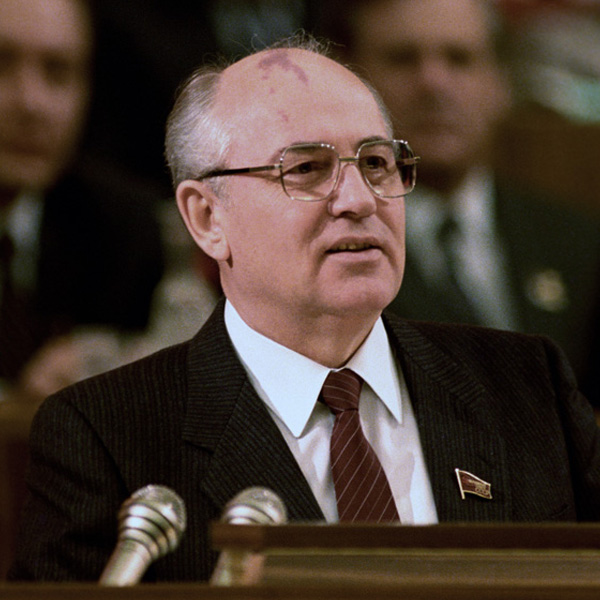 Mikhail Gorbachev became leader of the Soviet Union in 1985 and a succession of Western leaders engaged his attempts to decrease tensions with the West, accompanied by the introduction of domestic political and economic liberalisation. As communist governments crumbled during 1989, the reunification of Germany in 1990 became inevitable, along with the demise of cold-war political and geographical realities. The ‘iron curtain’ that had separated ‘Eastern’ Europe from the ‘West’ was finally drawn back.
I have now lived half of my lifetime in the wake of the political, economic, social, and religious changes that were ushered in by the events of the late 1980s and early 1990s. A mere 15 years after the political changes, I moved with my wife to take up a mission position based in Hungary, a relocation that would have been inconceivable in 1989. We were there to take advantage of the central location of Budapest in the geography of the new Europe.
Other mission agencies with a similar pan-European focus to ours found that Budapest was a useful base from which to gain rapid access to most of Europe. Budapest, as a capital city that had been formerly described as ‘Eastern Europe’ (implying that it was on the edge of modern and progressive Europe) had now become a central European capital with easy access to all parts of it.
This article attempts to capture, albeit impressionistically, something of the most significant developments of the last quarter of a century in Europe. Having done that I will then try to outline and review some of the main implications that these changes continue to pose to evangelical mission agencies and their related church communities.
Nationhood, independence, and ethnicity
For much of the post-war period through until the late 1980s, Europe’s internal conflicts were generally framed in a way that opposed the ‘East’ with the ‘West’. Of course, this obscured tensions and conflict internal to each of these two European regions, tensions that would later emerge with lethal consequences in the countries of the Balkans.
When the overly simplistic East-West account of European identity collapsed, a vacuum emerged in which it was possible for powerful and lethal tribalism to emerge around the notions of newly emerging nations.1 In most instances these contemporary forms of tribalism were built around identities that were taken to be ethnically homogenous and frequently shaped with reference to historical religious identities (Orthodox, Catholic, and Muslim) that had been suppressed by communist regimes.
In its most extreme and violent expression, armed conflict ravaged former Yugoslavia for the eight years between 1991 and 1999, resulting in approximately 140,000 deaths and massive damage to the infrastructure and economy of the region. Competing nationalist aspirations and ethnic tensions fed these wars. Although armed hostilities in the Balkans finally ceased with the ending of the Kosovo War in 1999, regional tensions remain and continue to hamper the access and activities of mission agencies working in these regions.
Of course the aspiration to nationhood and self-determination is not always malignant and, in the case of Slovakia and the Czech Republic, saw a separation of the former Czechoslovakia during the ‘Velvet Revolution’ into its constituent territories. As the countries of Hungary, the Czech Republic, Slovakia, and Slovenia, for example, addressed their self-identification, they quickly embraced the language of ‘Central Europe’. This served two purposes. Firstly, it allowed these and other countries to jettison the old socialist-era language of ‘the East’. Secondly, it enabled them to forge a common sense of regional identity and shared purpose.
As the European Union extended its borders with the accession of new member states in 2004, 2007, and 2013, citizens of all 28 EU countries gained the freedom to live and work across the entire EU community. In each EU country, with this new freedom to migrate, populations are beginning to experience new forms of internal ethnic and national diversity. In some instances, this factor has fuelled ethnic and nationalist tensions. These, in turn, drive Euro-sceptical movements and political parties, lend support to forms of political extremism targeted at ethnic minorities, and entrench resistance to particular groups of immigrants.
National governments of the former ‘West’ are also sensitive to internal tensions that may be regional and historic. In the case of Scotland, the political machinery gathered sufficient momentum towards a referendum on independence from the United Kingdom in 2014 which ultimately proved unsuccessful. Moreover, similar aspirations continue to stir the desire for independence in Catalonia and other regions of Spain—moves consistently resisted by the Spanish central government.
New forms of political alliance
Of course, the European Union, with 28 member states, is not the only institution that represents the joint interests of European nations. The older Council of Europe (established in 1949) represents 47 member states, including the former Soviet states that remain outside EU membership (with the notable exception of Belarus, the only outstanding dictatorship in Europe). However, as an effective instrument of joint policy-making, the EU is by far the more effective of the two bodies.
With the expansion of the EU in 2004, 2007, and 2013, the EU has grown from a membership of 15 to 28 countries. Eleven of these new EU member states were located within the Soviet bloc prior to 1989. The six-month presidency of the European Union has been held by each of the countries of the former Soviet bloc which are now members of the EU.
A further four countries are either formal candidates for the EU or have potential candidate status (Albania, Macedonia, Bosnia-Herzegovina, and Kosovo) and two (Montenegro and Serbia) are negotiating a roadmap towards accession.
The demise of the former Soviet Union paved the way for the emergence of the Commonwealth of Independent States (CIS). The CIS promotes the common interests of its members and, to an extent, one of its outcomes ensures the maintenance of closer ties among ethnic Russians or Russian-speaking passport holders in what Russia frequently refers to as its ‘near abroad’:
The presence of ethnic Russians in Ukraine and Georgia lent justification to Moscow’s claims of protecting Russians living in Ukrainian territory in Crimea and its control of former Georgian territory in South Ossetia and Abkhazia.
Moldova is also vulnerable in this regard, having its own ethnic Russian population in the Transnistria region, east of the Dniester River and bordering Ukraine.
While the three Baltic States also have ethnic Russian populations, they are afforded the relative protection of NATO membership. However, instances of air-space intrusions by Russian forces intensified throughout 2015 in developments that some interpret as Soviet-style provocations along borders that were formerly located wholly or partially within the Soviet Union.
Increasing cultural and religious diversity
For citizens of a majority of EU states, the Schengen Agreement has guaranteed the freedom of unrestricted passage across national borders that are internal to theSchengen Zone. EU citizens have the right to reside, work, and conduct business in any one of the EU’s member states. This has contributed to healthy patterns of cultural and religious diversity.
As the scale of non-EU migration into Europe accelerated across 2014-2015, several member states enacted unilateral measures intended to control the entry of migrants into their territory, including the erection of border fences. This has contributed to the pressure for Brussels-based European politicians to enact Article 26 of the Schengen Agreement which allowed for the temporary re-introduction of border checks if there were ‘persistent serious deficiencies’ at the external border. In late 2015 it was decided to allow the re-introduction of temporary border checks for a period of up to two years. This will also mean stricter external border controls.
The presence of immigrants in Europe has accelerated its cultural and religious diversity and prompted new policy and political responses. During the mid-years of the ‘noughties’ European politicians began to announce the demise of multiculturalism. Accompanying this was a new focus on ‘interculturalism’ that promoted a more intentional approach to the integration of migrants through policies supporting language acquisition, entry into education and the workforce, and the promotion of national or European values (assessed formally in some countries).2
With cultural diversity came religious diversity and an increasing European sensitivity towards Islam, particularly in the form of the more radical Muslim groups. The secular 1970s did not prepare Europe well for the religious vitality that would become all too apparent during the late 1990s and onwards.
Religious conviction was implicit in the various Balkans conflicts with, for example, Serbian Orthodox fighting against Bosnian Muslims and Croatian Catholics. The use of religious labels is unconvincing to most theologians or religious teachers. However, their adoption by various movements has been remarkable in creating and sustaining committed identity and purpose, especially where these are directed towards the pursuit of violence.
Church and mission in Europe
Over the last 25 years, there seems to have been a sober re-assessment of the evangelical euphoria that was apparent during the early 1990s in Central and Eastern Europe. Cynics at the time suggested that the call to conversion in the 1990s seemed to be ‘Repent, believe, be baptised, and take a truckload of Bibles and children’s clothes to an orphanage in Romania!’
Despite such objections, these early years saw an unprecedented openness to the Gospel, new religious freedoms, and a plethora of church planting ministries, Bible and literature distribution, social ministries, and evangelistic initiatives. This was bolstered by the arrival of large numbers of missionaries from the USA, Korea, and various western European mission agencies. Effective partnerships led to the establishing of many more local evangelical congregations in parts of Europe.
However, the presence of missionaries was not without its tensions. Their presence was resented almost unanimously by the traditional churches (Orthodox and Catholic) and not infrequently by existing evangelical churches which experienced the loss of formerly active members to non-indigenous churches that were well funded and resourced from the West.
The missionary activity of recent years has become more sensitive to the local context. Church planting from the West has lost the appeal of its novelty. Sustained and longer-term approaches are seen to be more appropriate. There are also, for example, innovative examples of evangelical co-operation with traditional churches, notably from among mission societies such as the British CMS or the German EMW and agencies such as World Vision.
In taking seriously their missionary commitment to Europe, there are also Christian churches and individuals who understand the need to engage their Christian worldview with the largely secular corridors of political, economic, cultural, social, and educational power.3 The European Union and its Commission are now required to serve and reflect the interests of 28 countries. Many of these are much more ‘non-secular’ than the pre-2004 ‘club of 15’. Engaging with European institutions will remain problematic for evangelicals and other people of faith but it does at least open up the possibility of another way of re-introducing the people of Europe to a convincing and compelling account of the Christian faith and the witness it gives to the Gospel of Jesus.
(Adapted and extended from an article originally published in Vista: Quarterly bulletin of research-based information on mission in Europe, No 19, October 2014.)
Endnotes
1 Editor’s Note: See article entitled ‘Nationalism and Evangelical Mission: Issues for evangelical leaders’ by Darrell Jackson in the May 2014 issue of Lausanne Global Analysis.
2 Editor’s Note: See article entitled ‘European Immigration Policy: Lessons and challenges for the church’ by Darrell Jackson in the January 2013 issue of Lausanne Global Analysis.
3 Editor’s Note: See article entitled ‘Europe: A most strategic mission field’ by Jeff Fountain in the November 2014 issue of Lausanne Global Analysis.

Darrell Jackson is the Senior Lecturer in Missiology at Morling College in New South Wales, Australia. He is a Baptist pastor, formerly from the UK, and served three years in Hungary with the Conference of European Churches. He is the Chair of the Lausanne International Researchers Network and serves the WEA Mission Commission.
March 2016 - Volume 5 / Issue 2
View Online Download Full Issue Download Executive Summary
View all issues
Updates and News

Grace of Giving / Glory of the Cross Published Julia Cameron, Director of PublishingLausanne has the privilege of collecting the best-of-the-best, and making it widely available to serve the Church around the world. We are honoured and humbled to publish some of the finest Bible teachers, and to offer their work in a growing number of languages. This month we launch new editions of two modern classics. (NB for some parts of the world, the launch will be 1st May)
View Online Download Full Issue Download Executive Summary
View all issues
Updates and News
Grace of Giving / Glory of the Cross Published Julia Cameron, Director of PublishingLausanne has the privilege of collecting the best-of-the-best, and making it widely available to serve the Church around the world. We are honoured and humbled to publish some of the finest Bible teachers, and to offer their work in a growing number of languages. This month we launch new editions of two modern classics. (NB for some parts of the world, the launch will be 1st May)
 The Grace of Giving: Money and the Gospel
by John Stott and Chris Wright (80pp)
As Chris Wright observes, the Apostle Paul gives more space in his epistles to money than to justification by faith. He and John Stott bring out the Apostle’s teaching on money in a new and fresh way. This short book covers the practical issues we face like deciding how much to give, and what to support. There may be times when it is right to decrease our giving. The amount we give is not the point; it is the spirit in which we give. Ou r giving, says John Stott, should be joyful and proportionate. This new edition also looks at handling money – from the planning of a special appeal onwards. Money is full of temptation and we need safeguards so it is handled well, and transparently. For church members and treasurers, and for treasurers and boards of charities. We know of no other book which does this job.
 The Glory of the Cross: Exploring the meaning of the death of Christ
by James Philip (64pp)
This is the most beautiful and perceptive handling of the meaning of the death of Christ I have ever read. Christ’s ‘fierce, costly love’ is brought home in a new way by the Scottish pastor-theologian, James Philip. The book starts at the Last Supper, set in a context of intrigue and betrayal. What, wonders the author, had Judas talked about with his fellow disciple when Christ had sent them out, two-by-two? We see the human Christ as well as the divine Christ. How much the memory of Mary’s love must have meant to him as he struggled in Gethsemane. The book closes with the death of Christ and the glory of the Cross, ’the great crescendo of the gospel’. As Sinclair Ferguson observes in the Foreword, ‘The fine quality of James Philip’s mind will immediately be obvious. But his writing is also full of pathos.’ With illustrations from Omar Khayyam and Ian McEwan, this little book has been used to give to thoughtful readers and thinkers in many cultures, Christians and unbelievers.
I commend these to you, as they have both helped me personally. I often carry copies of The Glory of the Cross to give away in conversation as I travel. If you have comments on anything we publish, which you would like to share, please write to me. And if you would like to commend a title, and had a moment to do so on Amazon or other retail sites, it would be really appreciated.

Introducing the Larnaca Statement Released Christopher WrightThe roots of the Lausanne Initiative for Reconciliation in Israel-Palestine (LIRIP)go back to the Third Lausanne Congress, Cape Town, 2010. The second day was devoted, through a range of plenary speakers and seminars, to one of the six major congress themes “Reconciliation: Building the peace of Christ in our divided and broken world.” The Cape Town Commitment has lengthy paragraphs on this issue (Part IIB), including the following aspiration:
“We long to see the worldwide church of Christ, those who have been reconciled to God, living out our reconciliation with one another and committed to the task and struggle of biblical peace-making in the name of Christ…We long for the day when the church will be the world’s most visibly shining model of ethnic reconciliation and its most active advocate for conflict resolution.”
LIRIP is one attempt to respond to that plea. We are all aware that the conflict between the state of Israel and the Palestinian people is one of the most bitter and difficult in the world. But within that context lies the unique challenge of the relationship between Messianic Jews (particularly those who are resident citizens in Israel) and Palestinian Christians (including those living in the West Bank and Palestinian Israeli citizens). Here are sisters and brothers who all claim to be disciples of Jesus the Messiah, and yet their relationship is fraught with radically divergent perceptions of history, understandings of the Bible, theological interpretations of their land, and political allegiances.
LIRIP was born out of the friendship of its two co-chairs, Richard Harvey and Munther Isaac, and their shared longing to encourage their communities to live out the truth and the demands of the gospel in the spirit of Romans 14:1 – 15:7, to “accept one another as God in Christ has accepted you,” and to “make every effort to do what leads to peace.” An initial small conference of a few invited participants from each community was held in complete confidentiality in January 2013. A steering committee was formed and the LIRIP project was accepted by the Lausanne Board of Directors in June 2013, with Grace Mathews and Chris Wright as facilitators. Two larger gatherings have been held in Cyprus in 2015 and 2016, co-chaired by Harvey and Isaac, and co-moderated by Chris Wright and Trevor Morrow (who has long experience of reconciliation efforts between Roman Catholics and Protestants in Ireland). The latter brought together 30 participants from both communities and produced The Larnaca Statement.
The meetings were intense, with honest sharing and straight talking on both sides. Passion and emotions were stirred, and disagreements were sharp at times. But the intention was not that we could all agree, but that we could all listen and learn and love. Each day was bathed in prayer and study of the Bible together, illuminated by personal testimony, and warmed by friendship-building conversation over meals and drinks together. The fact that the Larnaca Statement was composed in response to each day’s rigorous engagement, and then unanimously agreed by all the participants, without requiring anyone to compromise on deeply held convictions, felt like a miracle of God’s grace.
It is important to understand that we were not trying to come up with some compromise or agreed statement on Israel – Palestine, nor to favor one side or the other, nor to solve the complex theological and political controversies that abound. Our aim was simply to lay some biblical and ethical ground rules for how people who profess to be disciples of Yeshua / Jesus should conduct their disagreements. That is what the Larnaca Statement calls for, and what its signatories committed themselves to. While there have been several comments of appreciation and affirmation, sadly, but not surprisingly for those already familiar with this controversy, the LIRIP project itself has also been severely criticized by some commentators, while several of its participants, both Palestinian and Messianic, have been subjected to very hostile personal attack (which is nothing new for them). This varied response shows the importance of the ongoing conversation and how much the Larnaca Statement is needed.
Read the press release: Palestinian Christians and Messianic Jews issue Larnaca Statement
FOR IMMEDIATE RELEASE
25 February 2016 – Thirty Palestinian Christians and Messianic Jews met in Larnaca, Cyprus, January 25-28, 2016 for four days of prayer, fellowship and study. They issued a statement affirming their unity as believers in Jesus and calling on their communities to join them in reconciliation initiatives.
The Lausanne Initiative for Reconciliation in Israel/Palestine (LIRIP) hosted the conference. Its vision is “to promote reconciliation within the body of Christ and our wider communities in Israel and Palestine by creating a network that encourages, under the auspices of the Lausanne Movement, models of gospel-based, Christ-centered reconciliation that will have prophetic impact in relation to the Israeli-Palestinian conflict.”
The Larnaca Statement affirms the unity of Palestinian Christians and Messianic Jews as believers in Jesus, calling for mutual commitment to live out that unity in the midst of conflict and division. It recognizes areas of challenge and theological disagreement and identifies where further work needs to be done. It proposes practical actions that express hope for the future, especially amongst the next generation of believers in both communities. It calls for prayer and support from the wider family of believers.
The statement highlights the issues and challenges affecting reconciliation, noting:
“In times of tension and violent conflict, relationships suffer, while suspicion, accusation and mutual rejection thrive. At such times it is even more essential that we who affirm our unity in the Messiah must uphold ethical standards of life that are worthy of our calling, in all our attitudes, words and deeds.”
It recognizes that “we hold very different theological positions regarding the land, and also very different perspectives on the causes of the social, political and economic realities that impact the daily life of all who inhabit the land.”
Nevertheless, it calls for “a generous theological stance, which makes room for and respects the conscientious convictions of others that they sincerely derive from their reading of Scripture” and for “every effort to maintain our fellowship with each other as a witness to the unity of the body of the Messiah and to the boundless love of God for all people.”
Dr. Munther Isaac, Palestinian Christian co-chair of the Initiative, said: “Despite our different convictions on many issues, we are able to affirm together the need for reconciliation, and to seek unity among believers across our divided communities. Our shared faith calls us to listen, respect and even challenge one another in a Christ-like manner. It also compels us to be advocates for reconciliation and just peace.”
Dr. Richard Harvey, Messanic Jewish co-chair, added “It is important that a statement such as this is read and studied by Messianic Jews and Palestinian Christians, and all who pray for and work towards peace in the context of the Israel-Palestine conflict. Only by taking seriously the command of Yeshua (Jesus) to love our enemies can we begin to see the transforming power of His message of Good News in our lives and communities.”
The LIRIP Steering Committee, consisting of the two co-chairs and Mrs. Lisa Loden, Botrus Mansour, LLB, Grace Mathews, Vice-Chair of the Board of Directors of Lausanne Movement, the Very Rev. Dr Trevor W. J. Morrow, former Moderator of the Presbyterian General Assembly of Ireland, Dr. Salim Munayer and Rev. Dr. Christopher Wright, International Ministries Director of the Langham Partnership facilitated the conference. A further conference is planned for January 2017.
The LIRIP steering committee recognises the sensitive and challenging nature of the statement, and welcomes discussion, feedback and comment in the spirit of mutual respect and Christian courtesy and charity. The statement expresses the work and the commitments of those present at the conference, and while it does not claim to represent the views of all within the Lausanne movement and beyond, it is offered and commended for study, discussion, prayer and action.
For more information and details of future meetings, contact the Lausanne Movement. The Larnaca Statement
January 2016
Preamble
We met together as a combined group of thirty Messianic Jews and Palestinian Christians, in Larnaca, Cyprus, for the second consultation of the Lausanne Initiative for Reconciliation in Israel/Palestine, January 25-28, 2016. We worshipped, prayed and studied the Scriptures together. We formed and deepened friendships as we ate and drank and talked together in the fellowship of the gospel.
We unanimously adopted the following statement, along with the commitments it includes, and we commend it for study, prayer and action.
The statement affirms our unity as believers in Jesus (section 1), calls for mutual commitment to live out that unity in the midst of conflict and division (section 2), recognizes areas of challenge and theological disagreement and identifies where further work needs to be done (section 3), proposes practical actions that express hope for the future, especially amongst the next generation of believers in both communities (section 4), and calls for prayer and support for this initiative from the wider family of believers.
1. We affirm our unity in the body of Messiah
1.1 Our unity has an intrinsically missional purpose, since Jesus prayed that we should be one in order that the world will believe the truth about Him.
20“My prayer is not for them alone. I pray also for those who will believe in me through their message, 21 that all of them may be one, Father, just as you are in me and I am in you. May they also be in us so that the world may believe that you have sent me. 22 I have given them the glory that you gave me, that they may be one as we are one— 23 I in them and you in me—so that they may be brought to complete unity. Then the world will know that you sent me and have loved them even as you have loved me.” (John 17: 20-23)[1]
1.2 Our unity is created by God through the Holy Spirit and we are commanded to maintain it in humility, gentleness, patience and love.
1I therefore, a prisoner for the Lord, urge you to walk in a manner worthy of the calling to which you have been called, 2 with all humility and gentleness, with patience, bearing with one another in love, 3 eager to maintain the unity of the Spirit in the bond of peace. 4 There is one body and one Spirit—just as you were called to the one hope that belongs to your call— 5 one Lord, one faith, one baptism, 6 one God and Father of all, who is over all and through all and in all. (Ephesians 4:1-6)
1.3 Our unity embraces our diversity as Messianic Jews and Palestinian Christians within the one body.
12 Just as a body, though one, has many parts, but all its many parts form one body, so it is with Christ. 13 For we were all baptized byone Spirit so as to form one body—whether Jews or Gentiles, slave or free—and we were all given the one Spirit to drink. 14 Even so the body is not made up of one part but of many. (1 Cor. 12:12-14).
1.4 Our unity was accomplished by the cross of Christ, by which the enmity between us has been abolished while retaining our distinctive identities.
14 For he himself is our peace, who has made the two groups one and has destroyed the barrier, the dividing wall of hostility,15 by setting aside in his flesh the law with its commands and regulations. His purpose was to create in himself one new humanity out of the two, thus making peace, 16 and in one body to reconcile both of them to God through the cross, by which he put to death their hostility. (Ephesians 2:14-18)
1.5 Our unity is a condition of God’s blessing on our communities
1How good and pleasant it is
when God’s people live together in unity!
2It is like precious oil poured on the head,
running down on the beard,
running down on Aaron’s beard,
down on the collar of his robe.
3It is as if the dew of Hermon
were falling on Mount Zion.
For there the Lord bestows his blessing,
even life forevermore. (Psalm 133)
1.6 In the light of these and other Scriptures, we affirm the following paragraphs of the Cape Town Commitment: [2]
Love for one another in the family of God is not merely a desirable option but an inescapable command. Such love is the first evidence of obedience to the gospel, the necessary expression of our submission to Christ’s Lordship, and a potent engine of world mission. [3]We lament the dividedness and divisiveness of our churches and organizations. We deeply and urgently long for all followers of Jesus to cultivate a spirit of grace and to be obedient to Paul’s command to “make every effort to maintain the unity of the Spirit in the bond of peace.”
1.7 In the context of our conflicting perceptions and opinions, we nevertheless affirm our wholehearted assent to these convictions:
We are united in our faith in Jesus of Nazareth as Messiah, Saviour and Lord, and in the Good News of the Kingdom of God, which He preached, and for which He lived, died and rose again.
We are united in the Body of Christ as a result of His reconciling work on the cross, and in our diversity we are all, equally and together, members of the one household of God.
We belong together as one family;
we are committed to love and serve one another;
we need each other;
we share one another’s suffering as members of one body.
2. We commit ourselves to live out that unity in the midst of conflict and division, and we call on our communities to join us in this commitment
2.1 In times of tension and violent conflict, relationships suffer, while suspicion, accusation and mutual rejection thrive. At such times it is even more essential that we who affirm our unity in the Messiah must uphold ethical standards of life that are worthy of our calling, in all our attitudes, words and deeds.
2.2 We recognize that we hold very different theological positions regarding the land, and also very different perspectives on the causes of the social, political and economic realities that impact the daily life of all who inhabit the land. Those realities include a range of disputed issues (such as: security; the occupation of the West Bank; Gaza; equality of citizenship in Israel; refugees; acts of lethal violence; the search for justice and peace, etc.).
2.3 Nevertheless, we insist that, whatever our theology or our views of current realities, we are called to live by the commands of Scripture and the example of the Lord Jesus Christ, even when we legitimately challenge one another in these areas. Conversely, we deplore those ways of speaking and acting that are incompatible with obedience to our Lord, and for which we need to repent.
2.4 Accordingly, we make the following commitments:
2.4.1 We will accept one another as God in Christ has accepted us, in spite of theological differences and disputed matters (Rom. 15:7). We also accept the responsibility this entails:
to affirm and respect one another;
to treat one another as brothers and sisters in the body of the Messiah at all times and circumstances;
to seek to listen and understand even when we cannot agree;
to behave towards one another with love, gentleness and patience.
2.4.2 We will refuse to denounce, dehumanize, or demonise one another or our respective communities. We will not “bear false witness against our neighbours”, “spread false reports” or “follow the crowd in doing wrong” (Exodus 20:16; 23:1-2). We will refrain from spreading gossip, rumours, slander, unfounded allegations and lies – whether by word of mouth, in print, or by social media, blogs, etc.
2.4.3 We will obey the instructions of Jesus in Matthew 18 in circumstances of dispute between brothers and sisters in our respective communities. We will not go public with our grievances against a brother or sister, or the ministries or organizations they represent, until we have spoken to them personally, and prayerfully addressed the issues along with other mature disciples of Christ.
2.4.4 We will pray for one another, seeking to look to the best interests of others rather than our own, bearing one another’s burdens, actively encouraging one another’s ministries and missional outreach, developing friendships and networks, and exploring ways to work together in gospel fellowship wherever possible.
2.4.5 We will make every effort to maintain our fellowship with each other as a witness to the unity of the body of the Messiah and to the boundless love of God for all people.
2.4.6 When we engage in legitimate challenge of one another’s actions, positions or teachings, we will do so in a manner compatible with the commitments above.
3. We recognize the following areas of challenge and disagreement.
While there is a need for further theological reflection and collaborative action in all the following areas, nevertheless we believe that our unity in the household of God challenges us also to make some common affirmations and mutual commitments in relation to them.
3.1 Understanding our different narratives
As Messianic Jews and Palestinian Christians, we recognize that our historical narratives are often in conflict with each other and in many cases are mutually exclusive, particularly in relationship to the events of the past 100 years and the establishment of the state of Israel and the events leading up to it.
Many Messianic Jews see the return of the Jews to the land and the establishment of the state of Israel as a sign of God’s faithfulness to His people Israel. Many see Israel’s control over the territories as necessary to maintain security and prevent further escalation, and some see it as part of God’s promise to greater Israel, and view military service as a duty to their country.
Many Palestinian Christians see the presence of the Christian church in their land as a testimony to the faithfulness of God, and the establishment of the state of Israel as a catastrophe for their people. They see the Palestinian refugee problem, the lack of equality within Israel, the ongoing occupation, and the expansion of settlements on Palestinian land, as illegal and unjust. They perceive their survival and duty to involve resistance to these injustices by peaceful, legal and non-violent means.
In spite of our different views, we commit ourselves to listen to one another, to learn from and respectfully challenge the narrative of the other, to critically evaluate our own narrative and to work towards an inclusive, bridging narrative.
3.2 Recognizing our social identities
In the context of social and political conflict, we face the challenge of accepting and respecting each other’s identities. Our self-definition as Messianic Jews and Palestinian Christians should not prevent us from accepting the legitimacy of the other. We must recognize our mutual belonging within the body of the Messiah as we live in our divided societies.
3.3 Enlarging our theologies
3.3.1 We recognize that there are deeply held theological convictions on both sides, which, in the minds and hearts of those who hold them, are justified on the grounds of biblical exegesis and interpretation. All of us affirm that we submit to the authority of Scripture in both Testaments as a necessary dimension of our submission to Jesus as Messiah and Lord. All of us seek to understand and interpret Scripture as faithfully as we are able and to apply it to our context and the issues it raises. Yet we disagree at some fundamental points.
3.3.2 We intend to listen more carefully to one another, so as to understand deeply even when we disagree. We will refrain from dismissive labeling of views that differ from our own as an excuse to avoid engaging with them on the foundation of careful, respectful, and mutually critical biblical exegesis. We will recognize that what for either community is a theological axiom can become the cause of pain for the other community, in the denial of identity or rights.
3.3.3 Even though we are convinced of our own positions and wish to continue to dialogue with and challenge one another, we will not require others to change their position and accept ours as a pre-condition of our fellowship. Rather we call for a generous theological stance, which makes room for and respects the conscientious convictions of others that they sincerely derive from their reading of Scripture. We commit ourselves to clarify our positions in situations where they might be interpreted in a way that harms or excludes others. We are also entitled to require the same from others.
3.3.4 For example:
Some of us believe that the uncancelled covenant of God with Israel continues to include the promise of the land to the Jewish people as the descendants of Abraham, Isaac and Jacob, and that the return of Jews to the land and the establishment of the state of Israel constitute the fulfillment of biblical prophecies. We reject, however, the interpretation of this theological conviction that denies the identity, history and peoplehood of the Palestinians and their right to remain in the land of their ancestors. And we acknowledge and lament along with them the suffering, death and injustice caused by that denial.
Some of us believe that all God’s covenant promises, including the land, are fulfilled in the Messiah Jesus as the One who embodies the true sonship and inheritance of Israel, embracing the whole earth and all nations. All those from any nation who are united to Christ by faith share in the inheritance that is His and are the seed of Abraham and heirs according to God’s promise. We reject, however, the interpretation of this theological conviction that denies the right of Jews to a secure homeland and rejects the reality and legitimacy of the state of Israel. And we acknowledge and lament along with them the suffering and death caused by the hatred and violence of those who seek to destroy it.
Other theological issues need to be addressed and worked on in a comparable spirit.
4. As believers in Jesus, we renew our biblically-grounded hope for the future, we affirm our belief that the gospel can change people and situations, and we accept that we have a role to play in this process.
We commit ourselves to the following intentions and actions:
4.1 To be advocates for each other in our communities, especially during times of increased violence;
4.2 To create a safe and private platform to maintain communication between us.
4.3 To make our best efforts to meet in friendship;
4.4 To seek and receive information about the conflict from each other rather than relying only on our media;
4.5 To be aware of the major role that social media play in our conflict, and therefore to be sensitive, honest and open in our use of social media and to maintain communication with one another;
4.6 To remember and acknowledge the limitations and potential dangers of non-direct communication;
4.7 To consult with one another during our process of making decisions that could directly affect our brothers and sisters on the other side;
4.8 To discuss our role in reconciliation within our own communities, especially those of us who are emerging leaders of the present generation;
4.9 To invite and challenge our peers and leaders to engage in healthy dialogue and reconciliation;
4.10 To pray for ourselves, for our authorities and for each other the following prayer:
Lord, make me an instrument of Your peace. Where there is hatred, let me sow love; where there is injury, pardon; where there is doubt, faith; where there is despair, hope; where there is darkness, light; where there is sadness, joy.
O, Divine Master, grant that I may not so much seek to be consoled as to console; to be understood as to understand; to be loved as to love; For it is in giving that we receive; it is in pardoning that we are pardoned; it is in dying that we are born again to eternal life.
Prayer of Peace – Francis of Assisi
Conclusion
We invite both our communities in the land and outside it, along with the worldwide family of God, to join us in prayer, both that we may be faithful to the affirmations and commitments expressed here, and that the ongoing work of this initiative may bear fruit for the kingdom of God and His glory.
All of us who participated in the consultation agreed with and endorsed this Larnaca Statement. Some of us, due to the sensitivity of the context or for personal reasons, have preferred to withhold our names.
Steering Committee
Richard Harvey (co-chair)
Munther Isaac (co-chair)
Lisa Loden
Botrus Mansour
Salim Munayer
Other participants
Najed Azzam
Yoel Ben David
Jamie Cowen
Bishara Dib
Eli Dorfman
Danny Kopp
Neeman Melamed
Jack Munayer
Mazan Nasrawi
Toumeh Odeh
Rasha Saba
Rawan Sabbah
Albert Saliba
Shadia Qubti
Sharona Weiss
David Zadok
Saleem Anfous
Endnotes
[1] Bible quotations are from the NIV (2011).
`[2] The Cape Town Commitment is the statement of the Third Lausanne Congress on World Evangelization, held in Cape Town, South Africa in October 2010.
[3] 2 Thessalonians 2:13-14; 1 John 4:11; Ephesians 5:2; 1Thessalonians 1:3; 4:9-10; John 13:35

His master said to him, ‘Well done, good and faithful servant. You have been faithful over a little; I will set you over much. Enter into the joy of your master.’[Matthew 25:21]
Three years ago, when I started this exciting journey of leading the Lausanne Movement, a single word was on my heart as I prayed. Stewardship. I wanted to be a faithful steward of this calling from the Lord and a faithful steward of the legacy of the Lord’s work in and through the Lausanne Movement.
In pursuit of such faithful stewardship, I committed the first two years to listen to the voices of the Movement. This process included one-on-one interviews with more than 50 core present and past leaders; hours of input from Board members, Working Groups, regional and network leaders; and a survey that engaged more than 800 global leaders from the broader Movement.
The first fruits of this time of listening led to Lausanne’s four-fold vision statement and our mission statement ‘connecting influencers and ideas for global mission’.
We’ve continued the listening process in the year since our 40th anniversary celebration with an internal review of the Movement, to explore our strengths and weaknesses and to determine which structures need to be in place for Lausanne to best fulfill our ministry.
We are making changes based on three themes that emerged from the review process:
1) The need for closer collaboration within the Movement. For a Movement whose focus is on connections, we found that we also needed better internal communication and collaboration.This led us to identify and more closely connect the three core dimensions of the Movement: regions, ideas, and generations.
These include the work in our 12 geographical regions, 35 global issue networks, and the Younger Leaders Generation initiative. As a result, these three areas are becoming more globally interactive than before. They are also being led by a more global leadership than ever before, with a multi-fold increase in Majority World leadership in the past year.
2) The need for more effective stewardship of Lausanne content. We recently formed a ‘content team’ to develop strategies appropriate to communicate decades of rich Lausanne content in today’s digital and social media age.
The content team is focusing on a ‘book to byte’ strategy, with content that may include a substantial book in addition to shorter articles, blog posts, video clips, and dozens of 140-character tweets for a broader and deeper reach.
3) The need for clarity and connections of Lausanne leadership roles and titles.We are making critical changes to several leadership titles for closer alignment with our mission statement and to allow for stronger collaboration.To lead Lausanne’s three core dimensions of regions, ideas, and generations, we will have three Global Associate Directors—one for each dimension.
The 12 ‘International Deputy Directors’ are now ‘Regional Directors’. And ‘Senior Associates’ will now be known as ‘Lausanne Catalysts’ as they seek to help catalyze our global issue networks in their areas of expertise and passion.
By undergirding our newly articulated mission and vision with clearer structures and definitions, we are able to continue moving forward with greater unity, clarity, and momentum. Please pray with us that we may be found faithful stewards of all the Lord has entrusted to us.

Gifts from around the World Michael Oh, Global Executive Director/CEO
The last days of the year are always exciting. They’re a time to look back and look ahead; a time to rest from work; and a time to give thanks. I spent the last few days of the year, especially the last day of the year, and even the last hours of the year, watching in amazement the grace and power of our God.
Besides the tremendous blessing of receiving phone calls and kind encouragement from Loren Cunningham, the founder of YWAM, and Steve Douglass, the president of Cru, I watched as pledges for our 2015 year-end match came in from literally around the world.
Cameroon, Philippines, South Africa, Spain, Ghana, Latvia, UK, Mexico, Canada, Indonesia, Germany . . . Then Albania, India, Norway, Australia, Brazil, South Korea, Japan, Slovakia, Malaysia, and more! It was exhilarating to witness these blessings from around the world.
Throughout the entire matching gift opportunity, I’ve been humbled and amazed by the gifts coming in from individuals, churches of all sizes, foundations, and ministry organizations. Mark Anderson with Call2All with a gift of $10,000 from his ministry—one for which he also raises funds himself. $100 from an alumnus of the 2006 Lausanne Younger Leaders Gathering. A significant gift of $40 from a pastor in Mongolia. Joni and Friends giving $18,300 toward scholarships for the 2016 Younger Leaders Gathering, and Joni Eareckson Tada also sending a special note of encouragement. Each gift received was important and meaningful, and in the last day of 2015, by God’s grace we met and exceeded the $541,620 matching opportunity!
We are so grateful for all gifts of all amounts, as well as all the gracious prayers and advocacy that helped to make this possible. God has once again proven that he can do abundantly more than all we can ask or imagine.
As these gifts are used to start or strengthen significant initiatives in 2016, we trust in God’s continuing provision at each step. Please pray with me that the impact of these gifts from around the world will return in blessing to every nation on earth.
View all
Highlights from the Content Library
Notable highlights, both recent and past, from the Lausanne content library.

China's Conflicting Signals
Describes the uncertainties of the context in which tremendous initiatives like the Mission China 2030 vision are being birthed.
David Ro
Even the experts are baffled. Legally registered Three-Self Patriotic churches are under attack while the illegal house churches are invited into official dialogue. Is China heading for another Mao-era persecution or opening up to an era of religious freedom? With conflicting signals seen across a range of other social, economic, and political issues, times are confusing and nothing is certain. However, there is reason for optimism. The gospel is alive and something is about to happen.
Attacks and talks
Three years ago, when I started this exciting journey of leading the Lausanne Movement, a single word was on my heart as I prayed. Stewardship. I wanted to be a faithful steward of this calling from the Lord and a faithful steward of the legacy of the Lord’s work in and through the Lausanne Movement.
In pursuit of such faithful stewardship, I committed the first two years to listen to the voices of the Movement. This process included one-on-one interviews with more than 50 core present and past leaders; hours of input from Board members, Working Groups, regional and network leaders; and a survey that engaged more than 800 global leaders from the broader Movement.
The first fruits of this time of listening led to Lausanne’s four-fold vision statement and our mission statement ‘connecting influencers and ideas for global mission’.
We’ve continued the listening process in the year since our 40th anniversary celebration with an internal review of the Movement, to explore our strengths and weaknesses and to determine which structures need to be in place for Lausanne to best fulfill our ministry.
We are making changes based on three themes that emerged from the review process:
1) The need for closer collaboration within the Movement. For a Movement whose focus is on connections, we found that we also needed better internal communication and collaboration.This led us to identify and more closely connect the three core dimensions of the Movement: regions, ideas, and generations.
These include the work in our 12 geographical regions, 35 global issue networks, and the Younger Leaders Generation initiative. As a result, these three areas are becoming more globally interactive than before. They are also being led by a more global leadership than ever before, with a multi-fold increase in Majority World leadership in the past year.
2) The need for more effective stewardship of Lausanne content. We recently formed a ‘content team’ to develop strategies appropriate to communicate decades of rich Lausanne content in today’s digital and social media age.
The content team is focusing on a ‘book to byte’ strategy, with content that may include a substantial book in addition to shorter articles, blog posts, video clips, and dozens of 140-character tweets for a broader and deeper reach.
3) The need for clarity and connections of Lausanne leadership roles and titles.We are making critical changes to several leadership titles for closer alignment with our mission statement and to allow for stronger collaboration.To lead Lausanne’s three core dimensions of regions, ideas, and generations, we will have three Global Associate Directors—one for each dimension.
The 12 ‘International Deputy Directors’ are now ‘Regional Directors’. And ‘Senior Associates’ will now be known as ‘Lausanne Catalysts’ as they seek to help catalyze our global issue networks in their areas of expertise and passion.
By undergirding our newly articulated mission and vision with clearer structures and definitions, we are able to continue moving forward with greater unity, clarity, and momentum. Please pray with us that we may be found faithful stewards of all the Lord has entrusted to us.
Gifts from around the World Michael Oh, Global Executive Director/CEO
The last days of the year are always exciting. They’re a time to look back and look ahead; a time to rest from work; and a time to give thanks. I spent the last few days of the year, especially the last day of the year, and even the last hours of the year, watching in amazement the grace and power of our God.
Besides the tremendous blessing of receiving phone calls and kind encouragement from Loren Cunningham, the founder of YWAM, and Steve Douglass, the president of Cru, I watched as pledges for our 2015 year-end match came in from literally around the world.
Cameroon, Philippines, South Africa, Spain, Ghana, Latvia, UK, Mexico, Canada, Indonesia, Germany . . . Then Albania, India, Norway, Australia, Brazil, South Korea, Japan, Slovakia, Malaysia, and more! It was exhilarating to witness these blessings from around the world.
Throughout the entire matching gift opportunity, I’ve been humbled and amazed by the gifts coming in from individuals, churches of all sizes, foundations, and ministry organizations. Mark Anderson with Call2All with a gift of $10,000 from his ministry—one for which he also raises funds himself. $100 from an alumnus of the 2006 Lausanne Younger Leaders Gathering. A significant gift of $40 from a pastor in Mongolia. Joni and Friends giving $18,300 toward scholarships for the 2016 Younger Leaders Gathering, and Joni Eareckson Tada also sending a special note of encouragement. Each gift received was important and meaningful, and in the last day of 2015, by God’s grace we met and exceeded the $541,620 matching opportunity!
We are so grateful for all gifts of all amounts, as well as all the gracious prayers and advocacy that helped to make this possible. God has once again proven that he can do abundantly more than all we can ask or imagine.
As these gifts are used to start or strengthen significant initiatives in 2016, we trust in God’s continuing provision at each step. Please pray with me that the impact of these gifts from around the world will return in blessing to every nation on earth.
View all
Highlights from the Content Library
Notable highlights, both recent and past, from the Lausanne content library.
China's Conflicting Signals
Describes the uncertainties of the context in which tremendous initiatives like the Mission China 2030 vision are being birthed.
David Ro
Even the experts are baffled. Legally registered Three-Self Patriotic churches are under attack while the illegal house churches are invited into official dialogue. Is China heading for another Mao-era persecution or opening up to an era of religious freedom? With conflicting signals seen across a range of other social, economic, and political issues, times are confusing and nothing is certain. However, there is reason for optimism. The gospel is alive and something is about to happen.
Attacks and talks
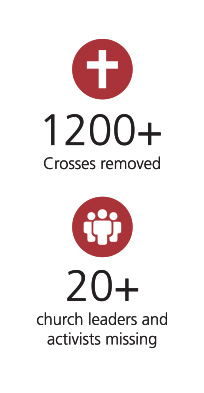 Starting with the demolition of San Jiang Church in April 2014, Communist party Secretary Xia Baolong of Zhejiang province began attacking primarily Three-Self Protestant and Catholic Patriotic churches. Over 1,200–1,500 crosses have been removed and dozens of churches demolished in Wenzhou city, called the ‘Jerusalem of the East’.1 Church attacks intensified in July 2015 with the burning of crosses on top of church buildings. Christian Lawyer Zhang Kai has been arrested and is missing along with 20 church leaders and activists.
As dark clouds surrounded Wenzhou, in June 2015 President Xi Jinping’s National Security Commission met a group of nationally recognized House church leaders in Beijing—the first such event in Communist China’s history. Officials asked for information on the size of the House church, differences with the Three-Self church, indigenous theology, House church revivals, the gospel heading westward, minority groups, cults, social responsibility, urbanization—and suggestions for house church legalization, bringing a glimmer of hope for the legal recognition of the House church.2
Why would Beijing allow attacks on the Three-Self churches?
One conjecture is that someone in the central government is testing the strength of the Three-Self church in the populous Christian Wenzhou region in preparation for anationwide campaign to ‘indigenize’ Christianity with Chinese characteristics.3 Three-Self churches with huge buildings and highly visible red crosses appear to resemble Western cathedrals, in contrast to the less visible ‘indigenous’ House church Christianity which some officials may feel is more appropriate for China.
Another plausible explanation is internal politics. Xi is reforming the government to purge it of corruption and inefficiencies. Allowing the attacks to continue provides the central government opportunities for the reorganization of the United Front, State Administration of Religious Affairs, and the Three-Self Patriotic Movement.
The simplest explanation is that China overall is moving toward conservative Neo-Maoist ideology. An emerging leftist movement with nostalgia for Mao and a renewed nationalism is resisting liberals who are perceived as holding anti-China views of democracy, pluralism, and a free society associated with a Western-dominated world order. Christians have appeared to align themselves with the liberals.4 With the popularity of Christianity growing, leftist forces in the central government are supporting a conservative provincial official in limiting the growth of Christianity.
Despite the attacks, the Three-Self church has in fact been strengthened by them. Stories of heroism among Three-Self believers strapping themselves to crosses as hundreds of police descend to attack have even moved House church believers. Several urban House church leaders signed a petition in support of the Three-Self church in Zhejiang. For the first time, House church leaders have crossed the divide to stand beside their former adversaries.
Why would Xi open a dialogue with House church Christians?
A convincing argument could be pragmatism: Xi needs to find a way to provide recognition for millions of Chinese citizens. Pessimists, on the other hand, would see Beijing luring House church leaders in order to bring them under government control. However, a key House church leader at the center of events views this recent dialogue in Beijing as representing a true change of heart within Xi’s administration:
‘From the receiving, communication, content, and signals given, the upper levels [of government] want to solve the problem . . . for the House church to truly have a legal status within Chinese society. This is our hope and prayer.’ This House church leader continues: ‘They have high hopes for the House church . . . they want the House church to be established based upon the Bible and eventually want to move toward a separation of church and state.’
Significance
If these statements truly reflect the views of the top leadership in the central government, then this recent dialogue can only be described as a spiritual breakthrough answering decades of faithful prayers for China.
The benefit is that for the first time, House church Christians, who have endured more than 60 years of persevering faith under extremely difficult conditions, would be legally recognized. This fulfills the vision of a Beijing pastor for the church in China to one day surface from being an underground movement to become a ‘City on a Hill, Light unto the World’ with a global mission force for the world.5
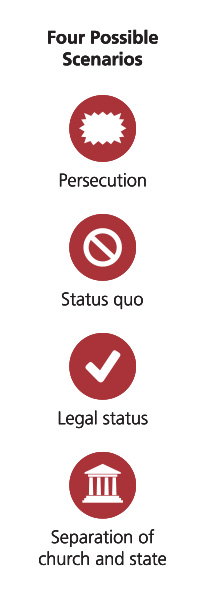 Outlook
There are four possible scenarios:
Persecution: Three-self and House churches come under attack in a national campaign.
Status quo: House church remains illegal and operates as usual under pressure.
Legal status: House church becomes legal within limits and with pressures.
Separation of church and state: Least likely and potential to be most dangerous for the church.
Even under the worst-case scenario #1, persecution would serve to strengthen and deepen the church, preparing for the church to surface another day.
A free scenario #4 would be wonderful, but could also be detrimental due to the challenges of materialism and consumerism.
Scenario #3 is the most likely as well as the most favorable for the church since freedom within limits provides enough operating space to expand, along with some pressure to keep the church sharp.
House church legalization would be hotly debated. While many urban churches and large rural networks would welcome this new openness, a good number of traditional House churches having experienced persecution would opt to remain hidden. Any involvement with the government is seen as compromising. Differences between the registered and unregistered House churches could divide the church for another generation.
Benefits of legalization
Many would caution against advocating toward moving to a freer society. The global church often idolizes the church in China as a model of Christianity flourishing under difficult circumstances, attributing the decline of the Western Christianity to too much freedom.
However, China would more likely follow another model, similar to South Korea in the 1970s to 1990s. Former persecution and sufferings produced a deep spirituality, preparing Korea for fast-paced church growth in a growing economy and a missions movement sending 26,766 missionaries abroad in 2014.
Legal status would have many benefits:
House churches could rent or purchase facilities with legal protection.
Underground seminaries would surface to train up future leaders.
Sunday schools, youth groups, student and young adult ministries, family, marriage and counseling ministries, and church publications could mature.
Christians could engage more openly in neighborhood community outreach, and in social concerns for the poor and elderly.
Local NGOs, orphanages, and poverty and disaster relief with Christian witness would have more legal space to develop.
One of the most significant benefits is China’s future involvement in global missions.6At the Mission China 2030 conference in Hong Kong in September 2015, 850 House church leaders and young people gathered around a visionary goal ‘to send 20,000 missionaries by the year 2030’.7 A legal environment increases the scope to develop effective sending structures for sending missionaries abroad.
The Three-Self and House church divide would slowly diminish and true reconciliation would begin. Another likely outcome could be the transformation of the Three-Self Patriotic Movement churches to become more like their House church counterparts: truly Three-Self in being self-governing, self-supporting, and self-propagating. A freer religious market would shut down Three-Self churches which have relied on government support and directives while healthy Three-Self churches would continue to grow.
Uncertainties
Many factors on the horizon could militate against Christianity in China. Xi’s battle with government corruption and the recent nerves over the slowdown to a new lower economic growth rate of 6.5% could cause domestic unrest or uneasiness for the foreseeable future. Nationalism and a desire for a stronger military continue to grow. Anti-American sentiment is also on the rise with the recent military frictions in the South China Sea. If Taiwan’s elections continue the country down a more independent path (as polls suggest) and Republicans win the White House in 2016, the United States and China could be heading toward a collision which could have a negative effect on the church.
Even with these uncertainties over the likelihood of a welcoming environment, a Beijing pastor is hopeful: ‘Whether persecution comes or not, the church will continue to fulfill its missions. The time is ripe for the vision of Mission China 2030 . . . to send 20,000 missionaries by the year 2030.’
How should we respond?
In preparation for the eventual legal status of the House church, we must remember some key points:
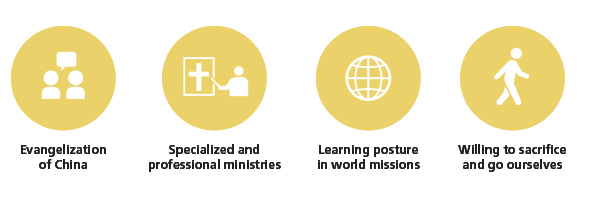
The evangelization of China should be the primary responsibility of the Chinese. Missions strategies should focus on seeking supporting roles in partnerships with indigenous churches. As House church leaders become legal, security concerns will be a lesser concern but any foreign involvement could be seen as meddling in domestic affairs.
Legal recognition of the House church opens the door for more specialized and professional ministries to flourish. Local churches will be developing their own specialized ministries along with para-church organizations.
China must adopt a learning posture in world missions. China must learn from the lessons and mistakes of the Western and Korean missions movements. The size of China’s influence alone could either greatly enhance or cause great damage to the gospel. In the area of overseas cross-cultural missions, the Chinese church needs the global church.
We must be willing to sacrifice and go ourselves. Chinese church leaders are watching to see who are sending missionaries. Chinese leaders have asked why mega-churches and ‘missional’ churches in the West8 are not sending any missionaries and wondered what can be learned from such shallow faith.
Conclusion
China’s complexities continue to confuse the global church. As the country apparently moves in a Neo-Maoist nationalistic direction, we can expect more bad news to come. Only time will tell, but hope is on the way. This is not because of pragmatism or signs of more favorable political conditions for the legal status of the House church.
God is answering the prayers of the global church for China and its leaders. Good news is on the horizon because a God-timed spiritual working appears to be taking place in the hearts of some of China’s top leaders. It does not make sense in this current political environment, but is God preparing China’s role in global missions?
Endnotes
1 Editor’s Note: See ‘China’s Churches: Growing influence and official wariness present twin challenges’ by Thomas Harvey, Paul Huoshui, and David Ro in the July 2014 issue of Lausanne Global Analysis.
2 The closed-door meetings between officials and House church leaders were held on 16-18 June 2015 at a Beijing hotel. Officials gave House church leaders permission to release this news publicly during President Xi’s visit to the US in September 2015.
3 The Three-self church nationwide is being pressured to become more Chinese pears to beIt’ government become more Chinese, holding conferences on ‘The Sinicization of Christianity’ (Zhongnan Seminary in Wuhan, 28-29 September 2015), ‘Christianity and The Chinese Way’ (CASS in Beijing 20 November 2015). become more Chinese pears to beIt’ government
4 China’s ideological rivals Neo-Maoist, Neo-Confucius, Liberals, and Christian academics came together to produce the ‘Oxford Consensus’ in August 2013. See ‘Christian Faith and Current Ideological Trends in China: The implications of the “Oxford Consensus”’ in the November 2013 issue of Lausanne Global Analysis.
5 Rev Tianming Jin, ‘City on a Hill’.
6 David Ro, ‘The Rising Missions Movement in China (the World’s New Number 1 Economy) and How to Support It’, Lausanne Global Analysis, May 2015, http://www.lausanne.org/content/lga/2015-05/the-rising-missions-movement-in-china-the-worlds-new-number-1-economy-and-how-to-support-it.
7 ‘Nine Hundred from Mainland China Participate in Inaugural Mission China 2030 Conference’, Lausanne Movement, 26 October 2015, http://www.lausanne.org/news-releases/inaugural-mission-china-2030-conference.
8 Ed Stetzer, ‘Five Reasons Missional Churches Don’t Do Global Missions’, Christianity Today, 24 September 2009, http://www.christianitytoday.com/edstetzer/2009/september/five-reasons-missional-churches-dont-do-global-missions.html.

David Ro serves as the Director for the Christy Wilson Center for World Missions at Gordon-Conwell Theological Seminary, and as Regional Director for the Lausanne Movement in East Asia. He holds master’s degrees from Gordon-Conwell Theological Seminary and Peking University, and is a PhD candidate at the Oxford Centre for Mission Studies.

State of the World
Impactful presentation from Bangalore 2013 tracing statistical changes within the church and world from 1960 to 2010. Gina Zurlo
The State of the World by Gina Bellofatto
<iframe width="560" height="315" src="https://www.youtube.com/embed/58VYpc0mGYE" frameborder="0" allowfullscreen></iframe>
In this quick-moving presentation, Gina Bellafatto identifies statistical changes in the global church, gospel witness, and the world from 1970 to 2010 and extrapolates them for the near future. She concludes with applications for ministry in an increasingly religious world.
Gina Bellafatto is a research associate at the Center for the Study of Global Christianity at Gordon-Conwell Theological Seminary.
This presentation was given at the Lausanne Global Leadership Forum in Bangalore, India, from 17-21 June 2013.
Lausanne Occasional Paper #4: The Glen Eyrie Report: Muslim Evangelization
With the critical Muslim refugee situation in Europe and elsewhere, Lausanne’s 1978 document on Muslim evangelization is particularly relevant.
LOP 4 – The Glen Eyrie Report: Muslim Evangelization
Lausanne Occasional Paper 4
The Glen Eyrie Report: Muslim Evangelization
Contents
Introduction: the Background
1. Pre-conference Preparation: The Ferment
2. Contrition and Repentance: The Essential
3. The Listening Process: Mutual Interdependence
4. The Planning Process: Utilizing all Resources
5. The Inescapable Reality: Caesar and the Powers
6. The Unfinished Agenda: Looking Ahead
Conclusion: Hope in God
Introduction: The Background
During mid-October 1978, a week-long consultation was convened at Glen Eyrie, Colorado, to explore the responsibilities of North American Christians toward the Muslim World. This was part of a continuum that began with the International Congress on World Evangelization at Lausanne 1974. At that time many were deeply stirred by what God was doing in their midst, but were moved to penitence by their flawed and limited commitment to the missionary task. At Lausanne they entered into solemn covenant with God and with each other to pray, to plan and to work together for the evangelization of the world. Their concern was: “Let the Earth Hear His Voice” and their focus was on “unreached people.” Of particular interest to many of the participants was the large bloc of unreached Muslims.
Two subsequent conferences heightened this concern to reach the unreached. The Pasadena Consultation 1977 celebrated the diversity of peoples and cultures making up the human race. Its participants made particular effort to relate this reality to the worldwide missionary task. They were in deep agreement that Scripture supports the Christian witness that seeks to preserve cultural diversity, for this will “honor God, respect man, enrich life and promote evangelization” (Par. 4).
Later, The Willowbank Consultation 1978 was convened to explore in depth the interrelation of the Gospel of Jesus Christ and culture. Upon this sequence the North American Conference on Muslim Evangelization was built to focus on reaching these unreached Muslim peoples and to explore the wide range of implications of the Gospel in their Islamic cultures.
The days at Glen Eyrie were very full, and session followed session in relentless sequence. When a pattern began to emerge that seemed to indicate the overruling Providence of God in our midst, we began to prepare this report. It is neither an official statement nor a declaration, much less a covenant; so none of us has signed it. But we send it out as reflecting the mood of the participants and indicating the highlights of what took place in our midst. We commend it to our fellow Christians throughout the world for study, and as a reminder that the Lord will truly meet with his people when they concern themselves with the unfinished task of evangelizing the Muslim world.
1. Pre-conference Preparation: The Ferment
Those invited to participate were drawn from a wide range of church traditions, missionary experience, specialized training and evangelical commitment. All were concerned with Muslim evangelization. They represented a variety of roles and disciplines: mission executives, field missionaries, mission professors, Islamicists, anthropologists, theologians and media experts. In addition the conveners invited a sizeable number of men and women from churches in the Middle East, Asia and Africa. They too represented different roles and disciplines: pastors, theologians, Islamicists and active laymen.
During the six months prior to the conference, forty foundation papers were prepared by selected authors—men and women—to alert the participants to the complexity of issues related to the task before them.
Ten papers were conceptual, in that they explored its major underlying postulates.
“The Gospel and Culture,” Paul G. Hiebert
“The Cross-Cultural Communication of the Gospel to Muslims,” Donald N. Larson
“The Incarnational Witness to the Muslim Heart,” Bashir Abdol Massih
“The Muslim Convert and His Culture,” Harvie M. Conn
“Dynamic Equivalence Churches in Muslim Society,” Charles H. Kraft
“Power Encounter in Conversion from Islam,” Arthur F. Glasser
‘Contextualization: Indigenization and/or Transformation,” Charles R. Taber
“New Theological Approaches in Muslim Evangelism,” Bruce J. Nicholls
“An ‘Engel Scale’ for Muslim Work?” David A. Fraser
“Resistance/Receptivity Analysis of Muslim Peoples, ” Don M. McCurry
Sixteen papers described key “givens” in the Christian encounter with Islam today.
“Islamic Theology: Limits and Bridges,” Kenneth Cragg
“Popular Islam: The Hunger of the Heart,” Bill Musk
“The Comparative Status of Christianity and Islam in the West,” R. Max Kershaw
“The Comparative Status of Christianity and Islam in Sub-Sahara Africa,” Gerald 0. Swank
“The Comparative Status of Christianity and Islam in North Africa,” Gregory M. Livingston
“The Comparative Status of Christianity and Islam in the Middle East,” Norman A. Horner
“The Comparative Status of Christianity and Islam in Turkey,” Mehmet Iskender
“The Comparative Status of Christianity and Islam in Iran,” David G. Cashin
“The Comparative Status of Christianity and Islam in the Sub-Continent,” Richard Bailey
“The Comparative Status of Christianity and Islam in Southeast Asia,” Frank Cooley, Peter Gowing, Alex Smith, Warren Meyers
“The Comparative Status of Christianity and Islam in Russia and China,” J. Robert Overbrook
“Current Status of Christian Literature for Muslims,” Raymond H. Joyce
“Current Status of Bible Translations in Muslim Languages,” William D. Reyburn
“Current Status of Radio Broadcasting to Muslim Peoples,” Fred D. “Bud” Acord
“An Overview of Missions to Muslims,” George M. Peters
“A Selective Bibliography for Christian Muslim Workers,” Warren W. Webster
The final fourteen papers defined concrete responses deemed essential to effective missionary service among Muslims.
“The Call to Spiritual Renewal,” J. Edwin Orr
“Development of New Tools to Aid Muslim Evangelization,” Donald R. Rickards
“Levels, Styles and Locations of Training Programs,” Vivienne Stacey
“Building the Network of Research Centers, ” Roland E. Miller
“The Value and Methodology of Planning Strategies,” Edward R. Dayton
“Tentmaking Ministries in Muslim Countries” J. Christy Wilson, Jr.
“The Need for a North American Nerve Center, ” Ralph D. Winter
“Dialogue: Relevancy to Evangelism,” Daniel Brewster
“North American Ties to Third World Missions to Muslims,” Waldron Scott
“The Need for a New Journal on Missions to Muslims,” C. George Fry
“Food and Health as Partners of Muslim Evangelism,” Robert Pickett and Rufino L. Macagba, Jr.
“The Role of Local Churches in God’s Redemptive Plan for the Muslim World,” Frank S. Khair-Ullah
“The Christian Approach to the Muslim Woman and Family,” Valerie Hoffman
“To Reach the Unreached,” the report to the Lausanne Committee for World Evangelization of its Strategy Working Group.
Uppermost in these foundation papers was the overriding concern that Jesus Christ be known, loved and served in the midst of each of the more than 3,500 separate peoples making up this massive religious community.
The conferees not only studied these papers beforehand; they were required to draft written responses to the ten conceptual papers. This generation of intellectual ferment and expansive dreaming was deemed essential to the success of the conference. All were greatly stimulated by this process, particularly the authors who were inevitably informed, enriched and balanced by the friendly counsel of those whose expertise differed from their own. In fact, this intense pre-conference interaction heightened the expectation with which all gathered at Glen Eyrie to study the Scriptures and to involve themselves in corporate reflection, discussion, planning and prayer.
2. Contrition and Repentance: The Essential
At the opening session of the conference, this mood of expectancy was overshadowed by a painful reality. The keynote address raised the question: “Why is not the Muslim world better evangelized?” The probing went deeper. Related questions were asked: “Why is it that barely two percent of North American Protestant missionaries are involved in this work? Why their limited understanding of Islam and Islamic culture? Why their long persistence in using inappropriate and ineffective methods to communicate the Gospel to Muslims?”
These questions were joined by others in the days that followed. Indeed, as the week progressed we became inwardly convinced that we first had to take the measure of what these questions implied. We came under the compulsion of a sense of sorrow, and experienced a renewed hunger for the forgiving grace and mighty working of God in our lives. The more we listened to one another, particularly to those God was manifestly using to reach Muslims for Christ, the more we felt we should give expression in this report to our sense of contrition.
In so many ways we North Americans have failed. And our personal failures are a reflection of the larger tragedy of the Christian Church. Over the centuries Christians in both the West and the East have all too readily cherished and cultivated an antipathy towards Muslims, and have expressed it by largely neglecting their obligation under God to share Jesus Christ with them.
We stand appalled that relatively few Muslims have entered into life through responding to his Gospel. And we grieve that at this late hour in the history of the Church there exist so few vital and outgoing congregations of Muslim believers in Jesus among this largely accessible people. And yet, it is our fault. We Christians have loved so little, and have put forth such little effort to regard Muslims as people like ourselves. They too bear the image and likeness of God. They, too, deserve the love and respect God would have his people accord all men. Although we know their inmost needs—like ours—can only be satisfied by Christ, we somehow draw back from sharing him with them. They deserve a Christian presence in their midst that is neither tentative nor timid—the sort that is imbued with vigorous faith and counts on “the God who only does wondrous things.” But this demands more of us than we have been willing to give. And our North American mission agencies continue to conduct the sort of culturally insensitive, unplanned missionary work in their midst that falls far short of the ideal of Christian presence in Muslim Society.
And we North American Christians also tend to be critical of Islamic culture. In our pride and ethnocentrism we have forgotten that our own culture is terribly flawed. True, it reflects the creativity of a pluralistic society, but it also expresses our fallenness. Since Christ judges all cultures and is seeking through the Gospel to infuse and transform them with his Presence, he would have us discern and appreciate the redeemable in Islamic culture.
An aspect of our concern should be the cultivation of a new awareness of the nature of the Islamic faith. It touches every aspect of the lives of Muslims. They are determined that God’s rule shall range publicly over every detail of the life of their nations.
In sharpest contrast, of course, Jesus Christ offers men a truly holistic Gospel. Indeed, his is the Gospel of the Kingdom. It embraces the totality of human existence. We North American Christians are only beginning to discover that all too often we have preached a Westernized, truncated message that does not do full justice to biblical revelation.
We are challenged when we stand before the world of Islam. But as Evangelicals, we refuse to confine our mission to the development of better Christian-Muslim relations or to involvement in social service on their behalf. Jesus Christ has defined our agenda, and because we love him we are constrained to embrace as well the mandate he has given the Church to evangelize the Muslim world.
3. The Listening Process: Mutual Interdependence
Early in the week we began to take the measure of the Muslim world: its extent, size, people diversity and many variations of religious faith and practice. Simultaneously, we began to implement the planning process the conveners deemed essential to the spiritual productivity of the conference. Indeed, their structuring of the day-to-day sequence was in response to the encouragement received from Christians worldwide. One group had drafted a statement with the buoyant exhortation: “Commit yourselves to work together in the unity of the Holy Spirit and in the bond of peace. Anticipate and plan for a great turning to Christ by millions of Muslims.”
All felt that we had to make a decisive break with the past. We were reminded of an earlier conference in Cairo in 1906 convened by that great American missionary statesman, Samuel M. Zwemer. It brought together more than 60 representatives of almost 30 missions and churches, and marked “the beginning of a new era in the Christian mission to Muslims.” This was followed by a similar conference he convened in Lucknow in 1911. And yet, such enormous changes have taken place in the Muslim world since, that all of us felt a new forward step was called for. The North American Church tolerates too limited a knowledge of Islam and Muslim peoples. Its mission involvement in the Muslim world is marginal at best. Moreover, it is dominated by a methodology that demands critical revision. New approaches are needed in North American missionary training programs. On and on. An entirely new pattern of interaction was needed between Western missionaries and their brothers and sisters in the Muslim world. Actually, it was precisely for this reason that so many Muslim converts and national church leaders from the Middle East, Africa and Asia had been invited to participate in every workshop and in every discussion and planning session. North Americans were encouraged to be “swift to hear” and discouraged from initiating any planning on their own.
These key evangelical men and women from the Middle East, Asia and Africa are themselves deeply and fruitfully involved in the task of Muslim evangelization. Hence, every effort was made to listen to their non-North American perspectives. They were given very specific assignments by the Western participants: “Help us in learning how to work together. Be patient with those of us who are slow learners. Pray for those of us who appear insensitive to your concerns. And above all, do help us to see God’s world through your uniquely different eyes.” Needless to say, they exceeded themselves in meeting the high demands of this task.
The witness of these consultants was wonderfully reinforced by a series of short addresses given by Western missionaries—men and women—likewise fruitful in their evangelistic work among Muslims. The note uniformly struck by each was that in the course of their service, however, they had to break with the “older” patterns in which they had been trained. They had to rethink before God what he would have them do. This impulse to review their ministry and alter it significantly came in every instance from their non-Western friends. This confirmed to all of us the essentiality of such collaboration. It exposed the folly of North Americans thinking they can go-it-alone. It underscored the exciting possibilities for new perspectives on mission to Muslims arising from the deliberate creation of patterns of mutual interdependence between Eastern and Western Christians. The implications are far-reaching.
One missionary in Lebanon had to receive from an Arab scholar insight into how he might escape the sterile apologetic pattern of the past and recast his entire evangelistic approach, via the Quran, as well as the Bible. A woman missionary in Pakistan, after struggling unsuccessfully for some years to interject her “Western” Jesus into Muslim culture, was brought lovingly inside that culture with the help of Muslim friends, and in time discovered an “Eastern” Jesus that was more than able to meet their needs. A team of two women deliberately turned from a barren, traditional approach to adopt step-by-step the unexpected thesis that “women are the key.” This resulted in the Gospel being deeply and widely planted in a previously unevangelized rural community in Pakistan. A highly trained missionary in India had to be pointedly counselled by a national church leader so that he might recast his approach from friendly manipulation to the sort of friendship evangelism that makes one love Muslims for what they are, and not for what we want them to become.
Several other reports were given in similar vein. All spoke of non-Western input. All described the sense of release and gratitude that came through this helpful counsel. All bore witness that a sovereign God is working significantly in Muslim hearts today. Our faith was challenged by the evidence, whether in Iran or Tunisia, in Israel or Egypt, in Syria and Bangladesh and Indonesia. As we listened we almost came to the conclusion that given half a chance, and provided the evangelists’ approach is more relational than cognitive, there is the possibility that any Muslim will come to love Jesus.
But there is a price to be paid. All who spoke shared in one way or another the fact that this listening to non-Western friends and responding, this re-thinking and changing one’s methodology and planning involved them in spiritual crisis. All knew pain and brokenness. Their testimonies endorsed what the early Franciscans gave to those who would serve Christ among Muslims. “Go out” they said: “…not as the Latins were wont to do—with weapons—but with words; not with force—but reason; not with hatred—but love, the kind of love that should exist between Christians and non-Christians, the same love with which the apostles approached the Gentiles, the love that God Himself had for those who did not serve Him.” (Abbot Peter of Cluny)
What did this mean to us? No easy triumphalism on our part, although we were convinced of the final triumph of God in history, when every knee shall bow to Jesus Christ. And no “gimmick” methodology either, for we must face the Cross and enter into the trauma of conflict with “the powers” while seeking to witness simply and lovingly to Jesus Christ. Only thereby shall we be used of God to turn Muslims “from the darkness to light and from the power of Satan to God” (Acts 26:18). If one would be God’s instrument to plant the Church in a Muslim society, he has no alternative but to follow the methodology of the Apostle Paul who wrote:
“It is now my happiness to suffer for you. This is my way of helping to complete, in my poor humanflesh, the full tale of Christ’s afflictions still to be endured, for the sake of his Body which is the Church” (Col. 1:24, NEB).
The more we listened to the testimonies of field missionaries and of non-Western consultants, the more aware we became of the heavy demands God would make of all who would serve him among Muslims. The keys to effective mission were defined and underscored again and again:
The cruciality of transparency before others.
The centrality of love in all our dealings.
The cultivation of a sensitive regard for truthfulness, about oneself and about the stark demands of the Gospel.
The inevitability that tears of compassion will flow
The demanding but encouraging possibilities of prayer and fasting.
The need for courage, patience and persistence.
The ability to absorb scorn and suffering.
The essentiality of unwavering faith and joyful praise: our God is the God of the impossible.
To conclude this section: effective Muslim evangelism can only be accomplished through humble respect for Islam cultures, and by seeking to master the use of these keys, and through deliberately adopting a pattern of intercommunication and conscious interdependence between national Christians and Western missionaries. And this pattern must be sustained by the interdependence of the structures to which they belong. Gone is the day when Western missionaries can regard themselves as sufficient for the task. it was at Glen Eyrie that we resolved, as never before, to make the most of the opportunities given to us by God—to develop a loving sense of responsibility to the whole household of faith, particularly to all Christians and churches in the Muslim world. From henceforth, we are determined to regard ourselves willingly accountable to one another, that together God might work through us to the achieving of his redemptive purpose for the Muslim world.
4. The Planning Process: Utilizing All Resources
A great concern of those who participated in the Lausanne Congress 1974 was that there be an end to the “sinful individualism and needless duplication” that all too often have marred the missionary service of evangelicals. They pledged themselves “to seek a deeper unity in truth, worship, holiness and mission” and urged “the development of regional and functional cooperation for the furtherance of the Church’s mission, for strategic planning, for mutual encouragement, and for the sharing of resources and experience” (Par. 7). However, the participants did not go much further in their deliberations than to note that “the development of strategies for world evangelization calls for imaginative pioneering methods.” In fact there was a certain drawing back from anything more specific because of the fear that “those activistic, pragmatic Americans” would somehow organize the Holy Spirit right out of the task of world evangelization!
Not a few of the addresses contained expressions of this concern. The desire was to submit to the Lordship of Jesus Christ and focus attention on his sovereignty. To follow him and to serve as he directs is the highest virtue. No small effort was put forth to support from Scripture this thesis that God alone has the initiative! And no plenary address was more heartily received than the one which included the following:
“Effective mission does not spring from human blueprints … I don’t believe the early Christians had much of a strategy … the Gospel spread out in an apparently haphazard way as men obeyed the leading of the Spirit, and went through the doors he opened (Report: pp. 166, 174).”
The participants at Glen Eyrie shared this concern. God must be God! His missionary servants must labor under his direction, and solely for his glory. They must resist the arrogance that boasts of having within themselves all that is needed to evangelize the Muslim world. No human being, no matter how able, dare affirm that he or she knows what to do and how to do it!
And yet, when the conveners sought direction from the Lord touching the inner structure of the conference, they felt that Lausanne 1974 gave them the mandate not only to pray, but to expect God’s guidance and surprise.. It also gave them the obligation to think strategically about the evangelization of the Muslim world. They were convinced that such an obligation was also biblically enjoined. Does not Scripture speak specifically? “We should make plans … counting on God to direct us … [and] the final outcome is in God’s hands” (Prov. 16:9,1, LB).
However, in order to bring the subject of planning into New Testament focus, it was decided that each day should begin with an exploration into relevant aspects of the strategies and patterns of the witness and service of the Apostolic Church. This resulted in the selection of the following themes and texts.
The long-range plan of the Apostle Paul to establish a missionary base at Rome from which to evangelize Spain (Rom. 1:1-17; 15:1-29).
The day-to-day movements of his missionary team in establishing a foothold in unevangelized Europe (Acts 16:1-34).
The apostolic conviction of the essentiality of cultural adaptation if one is to be effective in his cross-cultural witness to Jesus Christ (John 4:1-42; 1 Cor. 9:16-23).
The inescapable necessity of accepting suffering and self-denial if one is to be fruitful in his cross-cultural missionary service (Phil. 3:1-21).
The Jerusalem Church pattern for resolving “new convert” problems arising from cultural differences (Acts 15:1-29).
The possibilities for courageous and victorious witness in the face of civil and religious opposition (Acts 4:1-35).
But then followed a measure of agony. Large sections of three days were taken with the assignment to develop a method for strategic planning and then with the task of applying that method to a series of specific situations. This found many of us involved in a process that was largely unfamiliar. Some tended to dismiss the planning as an American aberration, only to fall vulnerable to the rebuke: “What a sham … Yes, how stupid to decide before knowing the facts” (Prov. 18:13, LB). But in the end the great majority felt the instructional experience had been most helpful. “It is pleasant to see plans develop…” (Prov. 13:19a, LB).
These good feelings developed when we became particularly involved in examining critically actual missionary situations in the Muslim world. It was then that we sensed in new ways the manner in which even the planning process was a vital exercise in partnership with God. We were agreed that from henceforth we should incorporate this larger experience of being “God’s fellow workers” into our future ministry among Muslims (1 Cor. 3:9-15).
As to the “planning sequence” that we finally adopted and which we commend to the wider Church, the following seemed essential:
State the philosophy, policies, assumptions and purpose of the mission: “Why has God brought our mission or parachurch agency into existence?”
Describe the actual field situation—the specific people to whom God has called us: “What are the dominant felt needs of the people we are to evangelize?”
Define the mission’s role in terms of its potential and its limitations: “What aspects of the need of this people does God want us to meet?”
Set measurable goals—a work plan—for the mission to carry out that express its faith in the working of God: “What is to be the schedule and sequence of our work?”
Detail the specific obstacles that in all probability will stand in the way of the goals being reached: “What problems should we anticipate and prepare for?
Specify the means and methods that conceivably might be blessed of God in reaching this people: “How are we to go about our assignments?”
Appraise the resources already available (people, funds, facilities, etc.) and determine the additional resources that will be needed to complete the task: “What do we have and what shall we need?”
Anticipate that from time to time there will be evaluation of the work and adjustment and modification of the plans as we remain in dynamic interaction with God: “What have we accomplished with the resources which God has given us?”
Needless to say, involvement in this process convinced us in a most telling fashion that there is no normative approach to Muslim evangelization. Every situation is unique and must be examined on its own. It is only when we ask these basic questions, however, that we become utterly convinced of the essentiality of the planning process. Only thereby can we avoid the “sinful individualism and needless duplication” that Lausanne 1974 deplored. But we also learned something else of tremendous significance. Every small group and workshop in our conference was so structured that each contained the sort of participant mix that inevitably brought enrichment and balance to our insights, but also brought tension. How could it be otherwise with theologians working alongside anthropologists, communicators trying to understand Islamicists, field missionaries interacting with national church leaders, and mission executives seeking to work harmoniously with mission professors? All were competent and the perspectives of one and all were valid. And the insight of each participant informed the rest. Here was interdisciplinary dialogue at its best. Suffice it to say that in these planning exercises the “listening process” came fully into its own. But, it was not easy for this diversity to come to productive agreement. The process took time and prayer, and the loving acceptance of one another. But when agreement was achieved, all knew that a planning process had been uncovered and experienced that must indeed precede all future evangelical activity on behalf of the Muslim world. “Plans go wrong with too few counselors … [but] many counselors bring success” (Prov. 15:22, LB).
5. The Inescapable Reality: Caesar and the Powers
Good planning is essential if we are to make use of the resources God has given us. On this we are agreed. But we also are aware of the spiritual struggle involved in carrying out even the best of God-given plans. No one is deceived at this point, for the participants in the conference are anything but novices in the service of God. Indeed, all those actively engaged in making Jesus Christ known, loved and obeyed throughout the Muslim world know that they are engaged in constant spiritual warfare with the principalities and powers of evil. And there is always Caesar, who is never the friend of Jesus Christ.
It was inevitable that whenever the subject of conflict and suffering was broached, there were those who quickly reminded us—and did so correctly—that for much of this Christians had only themselves to blame. Not all missionaries have been wise and holy, noble and loving. Some have tended to misrepresent and belittle the moral and religious stature of Muhammad and the Quran. All too many have been uncritically defensive of Christian missions in the Muslim world during the long years of Western political dominance. As a result, they have been largely indifferent to the task of reducing the mistrust and misunderstanding that accentuated past tensions and rivalries. And they have given the impression that they lack concern for the deterioration of Christian values in the Christian world while openly encouraging the process of secularization in the Muslim world.
It was humbling for us to be confronted by this evidence of cultural imperialism coupled with aggressive and insensitive proselytism. We were agreed that much within the modern missionary movement needs rectification. And yet, we were also reminded that this was not the whole story.
We had to consider the plight of those Christians scattered throughout the Muslim world who are limited in the exercise of their religious freedom. Many have either fled or withdrawn into ghetto communities, because they found it impossible to act as responsible citizens toward their nation. They have been denied the right to erect or acquire buildings for public worship, religious education and social activity. And these restrictions are contrary to Islamic law. Actually, however, this discrimination is but a part of a larger contemporary problem—Muslims and Christians are both being denied their human rights in various parts of the world. Both know insecurity. Both are under heavy and varied pressures to conform. Both need freedom to protect their human dignity, to exercise their particular religion and to propagate their faith. Whereas we would contend for “the full right to convince and be convinced” and would deplore all that stands in the way of this freedom, we are obliged to confess that we have all too often been unaware of the obligation to support our Muslim neighbors in their efforts to obtain their human rights.
This does not mean that we have forgotten the somber reality of the Law of Apostasy, and the particular problems and perils it poses for those who submit to the Lordship of Jesus Christ in Muslim lands. Even at this late hour in the long history of Muslim-Christian relations, reports are not infrequent of harsh discrimination, community hostility, violence against persons and buildings, and the suffering of the oppressed. We pray that Muslim leaders will sense anew their God-given obligation to promote justice and freedom. We pray that the conduct of Muslim states will increasingly approximate The Universal Declaration of Human Rights by which they agreed to respect
“…human rights and fundamental freedoms, including freedom of thought, conscience, religion or belief, for all without distinction as to race, sex, language or religion.”
Finally, there was deepest agreement that when the issue is Jesus Christ, and when persecution has broken out because of loving attempts to name his Name, no redress should be sought. In one workshop the question was asked: “How should the converts stand up to potential serious persecution which could expel them from their land and livelihood?” All sorts of suggestions came to the fore, but the conversation was abruptly terminated when a convert from Islam said, in effect, what the Apostle Paul advised long ago: “Let no one be moved by these afflictions for you yourselves know that this is to be our lot.” It is “through many tribulations that we enter the Kingdom of God” (I Thess. 3:3; Acts 14:22).
6. The Unfinished Agenda: Looking Ahead
It was inevitable that as the conference progressed workshops and discussion groups increasingly faced the future. When they did so, many issues surfaced that called for exploration and old questions arose that demanded new answers. In the process all of us became aware of the wide variety of tasks that will have to be undertaken if the Church seriously desires to evangelize the Muslim world. Fortunately, the conveners had anticipated this ferment and had planned the sequence of sessions to encourage this transition to practical matters.
More than a whole day was devoted to uncovering and defining the details of this “unfinished agenda.” And the more we became involved, the more we came to appreciate the significance of the planning process we had sought to master earlier in the week. How essential it became to all our final deliberations!
This work began when the decision was taken to divide the participants along the lines of their specialties. This meant that each group of participants met on its own—overseas consultants along with North Americans—whether theologians, missionaries, anthropologists, communication experts, mission professors, Islamicists or mission executives.
Each specialty group was commissioned to ask itself: “What specific contribution can and should we make to further the Muslim evangelization?” On the first time around, more than thirty major and relevant tasks were defined as needing urgent attention. And the momentum kept increasing.
The growing ground swell of suggestions demanded that task forces be formed to suggest the first steps in translating them into specific plans. The process then reached the stage where objectives were defined and goals set. Discussions swirled around such tangibles as means, methods, resources and timetables. In the end a lengthy plenary session heard the reports and provided the occasion for yet more input. In many ways, this final gathering was the most stimulating and fruitful session of the whole conference. All that followed was largely taken with inspiration, worship and summarization. All were agreed that the Lord had graciously welded us into a dynamic, creative oneness. When report after report was received, there seemed to be an almost apostolic dimension to our determination to lay all these matters before the whole Church and invite the participation of all likeminded Christians all over the world. “It seemed good to the Holy Spirit and to us” (Acts 15:28).
This brief report cannot detail the extensive output of the six task forces. What follows is but a summary of high points to encourage this participation. Indeed, an ever-widening circle of concerned Christians will be needed in the days ahead if the Church is to carry to completion the evangelization of the Muslim world.
A. Human Rights
Recognizing that both Muslim and non-Muslim governments, both Muslim and Christian religious organizations have violated human freedom by various forms of coercion, especially depriving people of the freedom to change or not to change their religion, we recognize the desirability of establishing an international Christian-Muslim office on human rights, to receive complaints, investigate them, and make recommendations for redress to the concerned parties.
B. Resource and Research Center
Recognizing the need for developing vital and continuous inter-communication among all those involved in Muslim evangelization, we purpose to establish a central resource and research center in the United States, to be followed as need arises by regional centers in all major segments of the Muslim world. This center shall be organized and directed by an experienced missionary scholar, supported by researchers from a variety of church traditions, trained in anthropology and Islamics. It shall also recruit consultants who can visit and serve the churches. It shall gather a wide range of pertinent information on the location, character and size of all Muslim people groups along with their psychographic and demographic characteristics. Its archival structure shall include a resource library containing all types of media communication.
Recognizing the need for an expanded body of information about unreached Muslim peoples, we purpose that this center shall establish a research consortium for the coordination of pertinent data. The director shall authorize that linkage be established with all major research agencies worldwide to develop working relationships with missions serving among Muslims, and to gather relevant information from those educational and research institutions currently doing mission-related research. The center shall also publish a monthly newsletter to channel data on available services to churches and missions throughout the Muslim world.
This research center shall encourage all theological and missionary training schools in North America to strengthen their course offerings in Islamics and to prepare suitable syllabi and textbooks for foundation courses on mission to Muslims.
C. Evangelism
Recognizing that the major untapped force for evangelism among Muslims is the Christian community scattered throughout the Muslim world, we shall seek to concentrate our attention on all existing churches, training and motivating both pastors and people to a new awareness of Islam. We shall seek with them to develop and refine new and more appropriate evangelistic methods for introducing the Gospel to Muslims. Particular attention will be given to the use of relevant Quranic themes in the initial stages of evangelistic encounter.
D. Communication Patterns
Recognizing the importance of communicating Christian truth in ways consonant with communication patterns already in use in Muslim societies, we propose that the research center shall stimulate the development of extensive research activities within strategic segments of the Muslim world with a view to developing appropriate methods and materials, along with teaching guides.
1. For Non-Literate People: to enable the poet, singer or chanter to communicate the Gospel and Bible stories in such a fashion that the way will be prepared for the teaching of reading.
2. For Women and Children: to study their varied roles at different levels in Muslim societies, respecting the code of modesty and sexual segregation where this prevails; to provide for more meaningful home-oriented women’s activities; to recognize the authority of men who are heads of households through seeking to witness to entire families; to work through those women who are recognized as religious or community leaders; and to present more winsomely the Christian alternative to the demonic influences which particularly assail women in Muslim societies.
E. Church Planting—Converts in Congregations
Recognizing that the evangelization of the Muslim world largely depends on the spiritual vitality and outgoing love of national churches in its midst, we purpose to pray that God will increasingly bring renewal to these privileged Christians. We anticipate that under his blessing those involved in evangelizing Muslims will be able to engage in more than seed-sowing. We believe that discipling and church planting will also take place.
This anticipated growth will possibly heighten the difficulty converts encounter in seeking a church home that receives them warmly and completely. We purpose through deliberately contrived study programs to make every effort to change the attitudes of Christians toward Muslim converts. Only those churches interested in winning Muslims to Christ will be interested in what happens to them after conversion.
However, where there is resistance or reluctance on the part of national Christians to involve themselves in this task, we shall seek to develop separate Muslim convert churches. These latter congregations shall be encouraged to develop culturally appropriate forms of worship that arise out of the natural expression of earlier worship patterns that will be true to biblical teaching and yet will neither deliberately flaunt our Christian liberty nor carelessly involve the believers in syncretistic belief or conduct.
F. Theological Research: Study Groups
Recognizing the need for extensive theological reflection on the contextualizing of the Gospel and the Church in Islamic culture, we purpose that the center shall stimulate the forming of a theological study group to undertake the systematic exploration of the many theological issues raised at this conference which bear on the task of evangelizing Muslims.
Because Islam and Christianity hold certain tenets in common, but differ markedly on others, we purpose that the study group shall seek to identify and explore the theological issues that are related to effective communication of the Gospel to Muslims. This group will be authorized to produce a comparative study of significant Christian-Islamic theological vocabulary and follow this with a manual of the actual bridges and blocks in Christian witness to Islam. The bridges would include such concepts as God, Creation, Prophets, Sacrifice, the Word of God, the Judgment, Satan, Heaven and Hell, the Virgin Birth, Healing Ministry, and Second Coming of Christ, the felt needs of men and women and the Lord’s Prayer. The blocks would include such controversial issues as man’s need of Redemption, the essentiality of the Cross, the Substitutionary Atonement, the Trinity, the Incarnation, religious terminology, the meaning of history and its relation to politics, the integrity of the Bible, Islamic family and social pressures and the reasons behind the all too frequent failure of the Church to express true Christian community. Since these studies will be greatly enriched if accompanied with an exploration of the reasons behind the variation in Muslim response to the Christian message, we encourage the center to undertake this research assignment. Particular attention shall be given to their relation to those significant points of contact with Popular Islam at the primary level of experience.
This group shall conduct a feasibility study to ascertain the type of publication needed to share its findings among Christians worldwide.
G. Muslims in North America
Recognizing the growing presence of Muslims throughout Canada and the United States, we propose that the center shall seek to create an in-depth demographic profile of their distribution and make a comprehensive study of what Christian work is being done among them. All this shall be undertaken with a view to planning strategies for their evangelization. Not only do we pray that convert churches shall emerge in Muslim communities, our concern is that American churches shall be so informed that they will increasingly take this responsibility on themselves in a meaningful and effective fashion, incorporating into their congregations those converts who desire to worship with them.
(NOTE: Many other practical suggestions were made during the closing hours of the conference. All were carefully recorded and are being referred to the continuation committee for attention. They range from missionary and lay leadership training to matters pertaining to the task of evangelism among Black Muslims, immigrants, and international students.)
Conclusion: Hope in God
At Glen Eyrie we sensed anew our individual and collective responsibility to devote heart, soul, conscience and resources to the task of making Jesus Christ known to the many diverse peoples of the Muslim world. Before we parted we gathered at his Table to worship and to receive grace for the many demands he will place upon us in the days ahead. We reaffirmed that he is both the Light of the world and the Hope of the world. He is Jesus Christ, the Lord over all, the One who makes all things new. It is he who encourages us to move forward with hope.
We hope in the forgiveness of God who is the Best of Forgivers. We know that he has put away our past failures through his suffering love in Jesus Christ. And it is in Christ, the One who has borne our infirmities, that we presume to make our new start.
We also have hope for the forgiveness of our Muslim friends and neighbors, that they will indeed not count our failures against us, but will give us their friendship and love.
And for the future we place all our hope in the Spirit and power of God. It is his salvation that he desires to communicate through us, and therefore it is he who will enable us: to witness powerfully and understandingly; to serve with compassion; to live neighborly; and in every way to share with Muslims the boundless grace of God.
We ask him to help us to be the true servants of his love throughout the Muslim world.
We cannot but supplement the dominant concern of Lausanne 1974 with the thrust of Glen Eyrie 1978:
“Let the earth hear his voice”
and
“May Muslims feel his touch”
Learn More about the Glen Eyrie Consultation which produced this Lausanne Occasional Paper.
View all
March 2016 Volume 5 / Issue 2
A Profile of North American Messianic Jews: Implications for global mission 11
Mission in Europe 25
Years After the Fall of the Berlin Wall 27
March 2016 Volume 5 / Issue 2
The Restorative Economy: Poverty, the future of the earth, and the role of the Christian 20
The global rise of secular and religious restriction and their impact on missions
The State and Religious Persecution Page 4
ISSUE OVERVIEW
Welcome to the March issue of Lausanne Global Analysis. We look forward to your feedback on it.
In this issue we focus on the global rise of secular and religious
restriction of minority faiths and their impact on missions; the implications for global mission of the findings of a recent survey of North American Messianic Jews; the ‘Restorative Economy’ and the role of the Christian in it; and mission in Europe 25 years after the fall of the Berlin Wall.
Recent Pew reports document an increase in official intolerance and restriction of minority religious faiths to unprecedented levels, noting that they are far more likely in countries where one religion or ideology dominates. ‘What appears to be the inner logic that justifies it has much to do with national identity and ideology, whether that is secular or religious’, writes Tom Harvey (Academic Dean of the Oxford Centre for Mission Studies). It
appears that religious and ideological discrimination against Christianity around the globe will rise. For evangelical Christians, awareness of this and some of the underlying causes should serve to forewarn and forearm. An evangelical emphasis on nurturing societies that encourage openness, tolerance, and diversity of religious expression would be beneficial to mission and ministry globally. ‘Hence it would be prudential for evangelicals reach out to and establish strategic alliances with civil libertarians and groups advocating human rights—especially those arguing for freedom of religion’, he concludes.
‘Most Jewish people today continue to resist the message of Jesus’, writes Andrew Barron (Director of Jews for Jesus in Canada). ‘My qualitative research attempted to understand this resistance in relation to the hardening of Israel (Rom 11:25).’ That ethnic Israel has survived seems to be related to this phenomenon. Responses to survey questions showed that Jewish people in North America are experiencing adversity as they hear and respond to the Gospel.
Issues surrounding cultural guidelines and social control are familiar to anyone involved in cross-cultural missions. The particular issues in Jewish mission resemble common phenomena
that vary from society to society. Loss of categories, secularism, and urbanization are changing the way younger generations are experiencing social control. ‘I believe that the concerns which
flow from my research are foundational to global mission concerns’, he concludes.
In September, world leaders in New York adopted ‘The Global Goals’ affirming their commitment to a better world: free from poverty, with a restored environment, peace, and equality. However, few appear prepared to face up to the scale of change required to meet
these ambitious targets. ‘As Christians, are we prepared to step into the breach?’ asks Richard Gower (Director of Foresight Economics). Scripture presents us with a holistic vision for the
whole of creation. The hope of the gospel is in the restoration of all things. The Old Testament Jubilee system offers a glimpse of the outworking of shalom in economic terms. The ‘Restorative Economy’ is an economic model in which all of us can participate as creative
producers rather than simply passive consumers. Convincing governments to make big systemic changes requires a broader shift in society’s values. ‘Change starts with us, and our lifestyles, and relies on the creation of a passionate movement for change’, he concludes.
‘Over the last 25 years, there seems to have been a sober re-assessment of the evangelical euphoria that was apparent during the early 1990s in Central and Eastern Europe’, writes Darrell Jackson (Senior Lecturer in Missiology at Morling College). These early years saw an unprecedented openness to the Gospel and a plethora of initiatives. The missionary activity of recent years has become more sensitive to the local context. In taking seriously their
missionary commitment to Europe, some Christian churches and individuals are also engaging their Christian worldview with the largely secular corridors of power. The European Union is now required to serve and reflect the interests of 28 countries, many of them much more ‘non-secular’ than the pre-2004 ‘club of 15’. ‘Engaging with European institutions will remain problematic for evangelicals and other people of faith but it does at least open up the possibility of another way of re-introducing the people of Europe to a convincing and compelling account of the Christian faith and the witness it gives to the Gospel of Jesus’, he concludes.
Whether you are planning to read the full articles or just the executive summaries, we hope that you find this issue stimulating and useful. Our aim is to deliver strategic and credible analysis, information, and insight so that as an influencer you will be better equipped for the task of global mission. It’s our desire that the analysis of current and future trends and developments will help you and your team make better decisions about the stewardship of all that God has entrusted to your care.
Please send any questions and comments about this issue to analysis@lausanne.org. The next issue of Lausanne Global Analysis will be released in May.
David Taylor, Editor
Lausanne Global Analysis
THOMAS HARVEY
LAUSANNE GLOBAL ANALYSIS
The global rise of secular and religious restriction and their impact on missions
THE STATE AND RELIGIOUS
PERSECUTION
5 LAUSANNE GLOBAL ANALYSIS
According to the Pew Report on The Future of World Religions: Population Growth Projections, 2010-2050,1 North America and Western Europe are becoming increasingly secular with major declines in church attendance, even as Christianity and Is lam rise in the Global South and East. With this intensification and polarisation of religions and irreligion globally has come political pressure upon governments to embrace a religious or secular national ideology.
Growing intolerance
A second Pew report Latest Trends in Religious Restrictions and Hostilities documents a concomitant increase of official intolerance and restriction of minority religious faiths from 20% of governments putting in place ‘high or very high level restrictions on religion’ in 2007 to 27% in 2013.2
Although the 2015 report marked a slight decline from 2014, this slight dip does little to lessen the report’s conclusion that social hostility, abuse, and violence toward minority faiths are at unprecedented levels.3
The report notes that official intolerance, legal sanction,
harassment, and outright persecution of minority religious communities are far more likely in countries where one religion or ideology dominates socially and politically. According to the three measures the Pew report used to identify social hostility to religious minorities, religious minorities in 120 countries (61% of all nations) suffered at least one of these hostilities: imposition of one religious or non-religious ideology; attempts to prevent minority faiths from worshipping; and actual attacks directed at persons, institutions, and places of worship perceived to threaten the majority religious faith or secular ideology.
Although the worst abuses of religious minorities take place in
single-party states where one religion or political ideology dominates, the Pew report documents the growing intolerance of minority faiths in secular and purportedly liberal Europe. According to the report, Europe has witnessed the largest increase in median level government restriction on religion.4
Thus, religious and secular intolerance of minority religious expression are not limited to religious states, but are manifest in 39% of all nations, with some 5.5 billion people now living in countries with high or very high levels of restrictions upon religion—or 77% of the world’s population: up from 74% in 2011.5
Why is it happening?
The common denominator in official sanction of religious minorities is not simply a matter of religion per se. State discrimination, legal restriction, social hostility, and outright violence against religious minorities have risen in nations as ideologically and religiously diverse as China, Saudi Arabia, North Korea, Burma, Vietnam, Sudan, and Pakistan.
What appears to be the inner logic that justifies discrimination against, and outright abuse of, religious minorities has much to do with national identity and ideology, whether or of governments putting in place 'high or very high level restrictions on religion'
living in countries with high levels of restriction upon religion
27% 5.5 Billion not that is secular or religious. In states where religious or ideological exclusivity is enforced, questioning the prevailing religious or ideological identity is often seen as potentially subversive. The assumed superiority of the ruling belief system leads to a questioning of motives behind any alternative religious or ideological framework that puts into question the
religious or ideological pillars of the state.
The fact that democratic regimes have proven far more tolerant of religious diversity than non-democratic regimes has much to do with their self-identification as nations which defend religious diversity, freedom of conscience, democratic political engagement,
and freedom of speech. Thus government sanctions against religious minorities are a good indicator of whether governments are likely to restrict other human rights as well.
Why is it important?
With Christianity growing rapidly in the Global South and East, much of this growth is occurring in nations where Christianity is a distinct minority. This growth is being met with greater restrictions and growing hostility toward Christian mission and evangelism. As religious and ideological exclusivity grow, so will greater restrictions upon mission work as well as social hostility and even violence against missionaries and their converts.
India and Israel are representative of these trends:
India
Since the election of Narendra Modi of the Hindu Bharatiya Janata Party as prime minister in 2014, pressure has been building
to amend the constitution to make India a Hindu state and calls have been growing for the re-conversion of Christians and Muslims back to Hinduism.6
Israel
In modern secular Israel, recent demands by the ruling Likud and Orthodox Jewish parties that Israel be recognised as a ‘Jewish State’ as a condition for peace talks with Palestinians have raised
serious concerns within Israel and internationally.
Indeed, emphasis upon religious national identity is viewed by non-Jewish citizens in Israel and non-Hindus in India as consignment to official second class status, thus putting in danger both nations’ democratic traditions and emphases upon human rights.7
Moves to try to preserve the rights of Christian institutions are now currently making their way through the US Congress and state legislatures nationally, but their outcome is far from clear, given the power of the courts to rescind state law by judicial decision according to the legal precedent now in place.9
Although opposition to evangelical Christian perspectives in secular nations is couched in the language of tolerance and diversity, the result is increasing restriction upon evangelicals to order their lives and their institutions according to their traditions and conscience.
Longer-term outlook
In the long term, it appears that religious and ideological exclusivity, religious restrictions, social hostility, abuse, and even violence against Christianity around the globe will rise. Such
restrictions, hostility, and abuse will reflect the differing religious and ideological frameworks that seek to marginalise the diverse perspectives that religious minorities represent.
United States
As Europe and North America grow increasingly secular, many evangelicals and Roman Catholics are increasingly concerned with anti-Christian rhetoric and enforcement of new restrictions on religious liberty. The court ruling last year affirming gay marriage in the US has produced a legal hornet’s nest as legal actions against Christian institutions that discriminate in hiring based on their understanding of marriage and sexual ethics begin to mount.8
Given that there is legal precedent to strip academic institutions of their tax-exempt status if they discriminate against protected classes of persons, many such institutions fear they may be forced to either close or abandon their current codes of conduct in deference to a ‘new morality’ imposed by the state.7
Thus, it would not be surprising to see newly minted Christian majority nations without long histories of protecting the rights of minorities seeking to establish ‘Christian states’ that would restrict the rights of, and nurture social hostility against, religious minorities.
For example, Angola, a Christian majority nation, has officially banned Islam and reportedly closed or destroyed some mosques in the country.10
The temptation legally to restrict minority religious and political competitors is great in all societies and within all religions. Nonetheless, such moves by religious and ideological majorities carry with them unintended consequences.
Because human rights are part of the complex web of rights that inform and strengthen civil society and democratic governance, restricting or showing hostility to one affects the others. Thus restricting the freedom of worship and assembly for minority faiths has a knock-on effect on other human rights such as freedom of speech, freedom of assembly, freedom of the press, and finally freedom of conscience.
Policy implications and suggested responses
For evangelical Christians, Christian institutions, and Christian missions, the rise of religious restriction, social hostility, and persecution of minority faiths is a matter of great concern.
Awareness of the tendency of restriction and some of the underlying causes of religious discrimination should serve to forewarn and forearm missions and ministry globally.
An evangelical emphasis on nurturing societies that encourage openness, tolerance, and diversity of religious expression should be seen as a benefit to all citizens and beneficial to mission and ministry globally.
Hence it would be prudential for evangelicals to reach out to and establish strategic alliances with civil libertarians and groups advocating human rights—especially those arguing for freedom of religion and religious expression.
There has certainly been recognition of the role of vital Christian faith to the establishment of human rights. Nobel Prize winner, Liu Xiaobo, echoes the views of Alexander Solzhenitsyn and Vaclav Havel, in noting the link between the development of Christianity, vital spirituality, and the desire of people to ‘control their own souls’.11 As Liu notes, this vital spirituality ‘demonstrates a popular recognition of the fact that if people do not take the initiative to fight for their legally guaranteed freedoms of speech, assembly, and belief, they have no escape from a life of terror’.12
In turn and in the face of growing secularist hostility to evangelical Christian views, Os Guinness and other concerned evangelicals in 2012 drew up for endorsement ‘The Global
It appears that religious and ideological exclusivity, religious restrictions, social hostility, abuse, and even violence against Christianity around the globe will rise.
Charter of Conscience’13 that seeks to address the two trends noted
above: ‘the revitalization and growing political influence of religions with the danger of attempts to sustain the supremacy of one religion at the expense of others, and the spread of naturalistic worldviews, with the equal danger of excluding all religions from public life and thus favoring an exclusive form of
non-religious worldview.’
Accordingly they express concern that ‘traditional settlements of
religion and public life show signs of stress and need to be renegotiated.’14
Even more recently, evangelical leaders in 2015 established The
Civilitas Group dedicated to promoting civility and fruitful dialogue across confessional and non-religious lines. Although only in embryonic form, such moves represent a new edge among evangelical leaders to reach out beyond the confines of the evangelical ghetto to promote civil society and greater understanding among people of different backgrounds and religious/political convictions.15
There are deep wells of Christian tradition that can be tapped in this endeavour.
Historically, emphasis upon ‘freedom of conscience’ developed within Protestantism with its insistence that ‘God alone is Lord of the Conscience’ 16 —in other words what is necessary for human flourishing and wellbeing precedes laws drawn up by secular or religious officials.
Accordingly, human conscience is ultimately subject to God and not to human or religious ideology of any stripe.
Nonetheless, such an appeal requires a commitment to acknowledge and affirm the need for tolerance and diversity even when Christians represent a large majority of any civil population. The question is whether evangelical Christians and their secular antagonists are
willing to re-appropriate that tolerance in an age of increasing hostility to minority religious expression globally.
Thomas Harvey is Academic Dean of the Oxford Centre for Mission Studies, Oxford, UK. From 1997-2008 he served as Senior Lecturer of Systematic Theology at Trinity Theological College in Singapore.
Endnotes
1. Pew Research Center, ‘The Future of World Religions: Population Growth Projections, 2010-2050: Why Muslims Are Rising Fastest and the Unaffiliated Are Shrinking as a Share of the World’s
Population’, 2 April 2015, http://www.pewforum.org/2015/04/02/religious-projections-2010-2050.
2. Pew Research Center, ‘Latest Trends in Religious Restrictions and Hostilities: Overall Decline in Social Hostilities in 2013, Though Harassment of Jews Worldwide Reached a Seven-Year High’, 26 February 2015, http://www.pewforum.org/2015/02/26/religious-hostilities/.
3. Editor’s Note: See article entitled ‘Persecution of Christians in the World Today’ by Charles Tieszen in the September 2013 issue of Lausanne Global Analysis.
4. Editor’s Note: See article entitled ‘The UK Campaign To End Religious Illiteracy’ by Jenny Taylor in the January 2015 issue of Lausanne Global Analysis.
5. Pew Research Center, ‘Latest Trends in Religious Restrictions and Hostilities’, 26 February 2015.
6. Rupam Jain Nair and Frank Jack Danie, ‘Special Report: Battling for India's soul, state by state’, Reuters, 13 October 2015, http://in.reuters.com/article/india-rss-specialreport-idINKCN0S700420151013.
7. Jodi Rudoren, ‘Israel Struggles With Its Identity’, The New York Times, 8 December 2014, http://www.nytimes.com/2014/12/09/world/middleeast/israels-nationality-bill-stirs-debate-over-religious-and-democraticidentity.html.
See also Victor Mallet, ‘Indian storm over minister’s comments on Muslims’, Financial Times, 16 October 2015, http://www.ft.com/cms/s/0/6ddc8e78-73d6-11e5-a129-3fcc4f641d98.html#axzz3w7AEgz4Z.
8. Michelle Boorstein, ‘2015 clarified the right to gay marriage. It opened a world of questions for religious objectors’, Washington Post, 31 December 2015, https://www.washingtonpost.com/news/acts-of-faith/wp/2015/12/31/2015-clarified-the-right-to-gay-marriage-it-opened-a-world-of-questions-for-religiousobjectors/.
9. Laurie Goodstein and Adam Liptak, ‘Schools Fear Gay Marriage Ruling Could End Tax Exemptions’, The New York Times, 24 June 2015, http://www.nytimes.com/2015/06/25/us/schools-fear-impact-of-gay-marriageruling-on-tax-status.html.
10. Ari Yashar, ‘Angola Becomes “First Country to Ban Islam”: Southern African nation reportedly bans Islam and orders the demolition of mosques in the country’, Arutz Sheva: Israelnewsonline.com, 25 November 2013, http://www.israelnationalnews.com/News/News.aspx/174445#.Vofp3vFgn1F.
11. Liu Xiaobo, ‘The Rise of Civil Society in China’, Seeds of Change, Issue no 3, 2011, http://www.
hrichina.org/sites/default/files/PDFs/CRF.3.2003/Liu_Xiaobo.pdf. See also Alexander Solzhenitsyn’s
commencement address at Harvard University, ‘A World Split Apart’, 8 June 1978, http://www.
americanrhetoric.com/speeches/alexandersolzhenitsynharvard.htm. Also see Vaclav Havel,
‘Vaclav Havel's address to the US Congress, 21 February 1990’, http://everything2.com/title/
Vaclav+Havel%2527s+address+to+the+US+Congress%252C+21+February+1990.
12. Liu, 18.
13. See http://www.osguinness.com/wp-content/uploads/2012/06/Charter-for-Religious-Freedom.pdf.
14. Editor’s Note: See article entitled ‘The Global Charter of Conscience’ by Os Guinness in the January 2013 issue of Lausanne Global Analysis.
15. See Richard Mouw’s address to The Civilitas Group at the Founders Dinner on 14 October 2015 based on his book Uncommon Decency: Christian Civility in an Uncivil World (Downers Grove: InterVarsity Press, 2010) online at https://vimeo.com/146061022.
16. John Leith, Basic Christian Doctrine (Kentucky: Westminster John Knox Press, 1993), 205ff.
Photo Credits
• Cover and page 4: Modified from ‘perseguição religiosa’ by Imagens Cristãs (CC BY-NC 2.0).
• Page 5: From cover of Pew Report ‘Latest Trends in Religious Restrictions and Hostilities’ PDF.
• Page 6 (left): From ‘Rishikesh | India’ by Mat McDermott (CC BY-NC-ND 2.0).
• Page 6 (right): From ‘Western Wall’ by premasagar (CC BY-NC 2.0).
• Page 7: From ‘173a.DecisionDay.MarriageEquality.USSC.WDC.26June2013’ by Elvert Barnes (CC BY-SA 2.0).
• Page 9: From cover of ‘The Global Charter of Conscience’ PDF.
ANDREW BARRON
LAUSANNE GLOBAL ANALYSIS
Implications for global mission
A Profile of North American Messianic Jews
In a sense the converted Jew is the only normal human being in the world. To him, in the first instance, the promises were made, and he has availed himself of them. He calls Abraham his father by hereditary rights as well as by divine courtesy. He has taken the whole syllabus in order, as it was set; eaten the dinner according to the menu. Everyone else is, from one point of view, a special case dealt with under emergency regulations.1
What we continually press upon Jews is that we believe Jesus is the Son of Man and Son of God, not in spite of, but because we are Jews. We believe that Jesus is the King of our people, the sum and
substance of our Scripture, the fulfiller of our law and Prophets, the embodiment of the promises of our covenant. Our Testimony is that of Jews to Jews.2
Survey
From June 1-December 1, 2013, I spearheaded a broad study of Messianic Jews in North America as a follow-up to a similar study done in 1983. The 2013 study involved a sample of 1,567 respondents and, like its predecessor, sought to give a picture of the evolving
Messianic movement for the purpose of resourcing that community as well as the greater missions community. In addition, my hope was to stimulate strategies for outreach, fellowship, and edification.
The quantitative questions I posed to the participants covered age, family background, education, religious observance, and vocation. The qualitative questions covered experiences in personal journeys and the impact of their faith decisions in relation to friends, families, and communities of this group. Anthropological categories emerged from this study which have given meaning to these experiences in their modern social and cultural setting.
Most Jewish people today continue to resist the message of Jesus. My qualitative research attempted to understand this resistance in relation to the hardening of Israel (Rom 11:25).
Hardening
Paul understands this phenomenon as a warning (verse 25a), a mystery (v 25b), partial (v 25c), and temporary (v 25d, 26a). Part of my research attempts to understand hardening as a genuine and current experience, and I was able to demonstrate that hardening is interlaced into what I call an Implied Social Contract (ISC). I first heard this term in 1983 from the founder of Jews for Jesus, Moishe Rosen.
This type of contract is an agreement among a group of people that is never explicitly articulated. In other words, certain behavior is implied as normative; yet there is no formal law governing such norms. My research showed how this ISC is a way to understand
and frame contemporary reflections on Jewish culture and the ways in which the Jewish community has found unity in its resistance to the Gospel. Understanding the conversation of the ISC shows an unspoken norm within Jewish culture.
Most Jewish people today continue to resist the message of Jesus.
Survival
That ethnic Israel has survived seems to be related to this phenomenon. Hardening serves a bewildering purpose: not only does it keep my people away from the Gospel; it also assists as a protection and preservation mechanism. The full research has been published in the journal Mishkan.3
The Jewish philosopher Simon Rawidowicz argues that Jewish survival is always under threat. In his essay ‘Israel: The Ever Dying People’, he articulates that Jewish survival is so acute that the life of the Jewish people is a perpetual quest to control their future.4
This historical reality seems unparalleled in history. The Jewish people seemed destined to disappear. They have been exiled and exterminated in dozens of lands. Yet as Jewish people seem to be ever dying, they continue to live and prosper. Self-preservation, he argues, has become the prime value of Jewish culture. Hardening is related to this impulse.
Highlights of the quantitative analysis
■ Most people had heard the Gospel by the time they were 25.
■ The median age for first hearing the Gospel is 17 and for responding in faith is 22.
■ The most common way that respondents heard the Gospel was through personal conversation.
■ Those who respond find truth that is consistent and coherent with Scripture.
■ Most of our respondents sometimes feel like strangers inside the majority Jewish culture.
■ Respondents are still socially integrated into the wider cultures they live in.
■ The Messianic Jewish community in North America is more similar to the American Jewish community than to the general US population in demographics such as Jewish dispositions (ie the tendency to act in certain ways that are learned in the culture), education, and occupation.
■ Lifestyles, values, and identities of most of our respondents continue to show efforts to maintain a connection to Jewish tradition, on the one hand, and choice on the other. The results showed a broad consensus that reflected a commitment to Jewish character, culture, and continuity.
■ With regard to the Jewish value of tikkun olam (repair of the world) and without providing specifics, we see a very significant increase in orientation across age groups toward this practice after coming to faith. The increase here was the most notable among all the values examined. The chart below shows how these values play out. Of all the Jewish values examined, this showed the most startling renewal. Jewish survival is so acute that the life of the Jewish people is a perpetual quest to control their future (Rawidowicz).
Other interesting results are illustrated below. I compare how Jewish people are hearing the Gospel in 1983 and 2013. The questions were framed differently, but the pattern suggests that most Jewish people are hearing the Gospel in the marketplace. There is an increasing influence of churches and Messianic congregations:
60 or older 174 80 42 75 297 27 13 4
50-59 130 86 45 88 289 25 11 15
40-49 59 32 26 47 126 16 10 3
30-39 25 37 29 25 86 11 3 5
21-29 28 44 29 34 106 9 5 6
18-20 3 3 3 7 13 0 0 0
Before Always Often Sometimes Never
After Always Often Sometimes Never
Tikkun Olam
Public event / presentation 58
In a church 282
In a Messianic congregation 51
Direct conversation with relative 206
Direct conversation with friend 300
Contact with someone previously unknown 98
Tract or other Gospel literature 45
Directly from Scripture 60
Email 1
Social media 8
Other online source 36
First Heard the Gospel (2013)
Qualitative highlights
In the September 2015 issue of Lausanne Global Analysis, my colleague Susan Perlman wrote about scaling adversity.5
My research here is related to this significant topic. My qualitative questions covered experiences in personal journeys and the impact of their faith decisions in relation to the friends, families, and communities of this group.
Many respondents experienced adversity. They called it many things: social control, guilt, shame, hardening, and loss of prestige. Today Jewish people in North America are continuing to experience adversity as they hear and respond to the Gospel.
Respondents were asked to characterize this adversity in their experience:
1. The major pressure points involved what it would mean for relationships in the Jewish community.
2. Infidelity to the Jewish community was especially a point of pressure for the 50+ group.
3. Pressure points, especially regarding community, factored less significantly among younger generations.
Below are two charts outlining the sources and types of pressure. We can see that the older groups experienced more adversity than the younger groups. The graphs represent those who noted that they experienced this kind of adversity in a particular age group.
Persons 49%
Search/Quest/Truth 12%
Bible 8%
Book/Lit. 6%
Supernatural Intervention 6%
Group 5%
Conviction/Holy Spirit 4%
Life Crisis 3%
Radio/TV/Movies 2%
Curiosity 1%
Afterlife/Fear 1%
Ideals/Condition of world 1%
Initial Attraction to The Gospel (1983)
As I interviewed this group, several subjects manifested around social control, such as prestige, shame and guilt, and hardening.
I asked if they could articulate what hardening was or how it manifested itself in their experience. Common answers were ‘death’; ‘loss’; ‘apathy’; ‘identity separation’; ‘tribal’; ‘when I was in the synagogue I was the Christian. When I was in the church I was the Jew’; and ‘hardening is seen in both directions’.
0 50 100 150 200
Community
60+ 50+ 40+ 30+ 21+ 18+
Friends Peers at School Peers at Work Family Pressure or Stress Points
0 20 40 60 80 100 120 140
Fear of disloyalty to your upbringing
60+ 50+ 40+ 30+ 21+ 18+
Conviction of sin Fear of disloyalty to the Jewish community
Fears of changes to your path of life
Cultural barriers
Types of Pressure
Of the 24 people in the group, two were disowned; two experienced religious control; three lost job opportunities; three were uninvited to family/community events; and five experienced psychological control—‘You cause us pain. You are hurting your grandparents. You will not be able to marry a Jew. You are a Gentile.’
I was interested in fleshing out some of these categories. I asked the group to try and measure these various points of adversity with regard to the themes that were emerging.
Below are the results of Shame and Guilt and Loss of Prestige.
I asked them to ‘measure’ on a scale of 1-10 the intensity of this kind of adversity. These were done in relation to friends, family, and community. The scatter graphs are below along with the trend analysis. You can see a diversity of experiences across age groups with similar trends across the age groups.
10 Prestige
9 8 7 6 5 4 3 2 1 0
0 10 20 30 40 50 60 70 80
Family Friends Community Linear (Family) Linear (Friends) Linear (Community)
10 Shame/Guilt
9 8 7 6 5 4 3 2 1 0
0 10 20 30 40 50 60 70 80
Family Friends Community Linear (Family) Linear (Friends) Linear (Community)
Next steps in this research will include improving the quality of the survey; asking new questions with regard to social media; and surveying all the Messianic communities outside of North America.
Broader global missiological concerns Issues surrounding Cultural Guidelines and Social Control are familiar to anyone involved in
cross-cultural missions. The particular issues I face in Jewish mission resemble common phenomena that vary from society to society. Loss of categories, secularism, and urbanization are changing the way younger generations are experiencing social control. I believe that the concerns which flow from my research are foundational to global mission concerns:
1. A vigorous ongoing conversation is needed about the extent to which we need to prophetically challenge people while remaining part of the communities in which we minister.
2. We must respect the influence of indigenous congregations.
3. We need to build relationships, make the Bible available, plan for, and address adversity.
4. We must talk to people we disagree with so that we can refine our positions.
5. We must challenge and be challenged by the status quo in communications and methodology. I believe that God enjoys human creativity and we should be open to all the new platforms that technology provides.
6. We must be honest in communicating failures to our donors. It is easy to hit the side of a barn door and draw a circle around it and tell the world that you made a bull’s-eye.
7. As we evaluate our current and potential platforms, we must avoid
communication that is syrupy, far-fetched, and irrelevant. Meaning must be provided into the social context of those whom we intend to reach.
8. We must not assume that people will cross over social and cultural boundaries to listen to us.
9. We must apply appropriate speech and categories. I do not propose a new tactic, but an old tactic applied in a new way—receptor-oriented communication.
Furthermore, we must not be afraid to ask these questions:
1. Is our material relevant to the group receiving the message rather than those bringing it? Is our material bound by our culture or designed for the people and paradigms of the societies we are speaking to?
2. Are we talking to the people we should be talking to?
3. Do we have the courage to face hardship and opposition?
4. Are we willing to exercise critical judgment regarding material, methods, and projects used? Do they work now? Can we assess and/or measure?
Endnotes
1. C S Lewis, Introduction to Smoke on the Mountain: An Interpretation of the Ten Commandments by Joy Davidman (Philadelphia: Westminster Press, 1953), 7.
2. David Baron, The Ancient Scriptures and the Modern Jew (London: Hodder and Stoughton, 1900), 337.
3. Andrew Barron and Bev Jamison, ‘A Profile of North American Messianic Jews’, Mishkan 73 (Jerusalem:
Caspari Center for Biblical and Jewish Studies, 2015).
4. Simon Rawidowicz, ‘Israel: The Ever Dying People’, Studies in Jewish Thought, N N Glatzer, ed, (Philadelphia:
Jewish Publication Society, 1974), 210-214, 220.
5. Read the full article at https://www.lausanne.org/content/lga/2015-09/scaling-adversity.
6. Editor’s Note: All graphs courtesy of the author.
Andrew Barron is the Director of Jews for Jesus in Canada, and pioneered the work of Jews for Jesus in South Africa. He first heard the gospel in 1981 while helping to design and plan space shuttle missions for the United States Space Program. He can be reached at andrew.barron@jewsforjesus.ca.
Conclusion
Appropriate and relevant speech affirms the dignity of all people. Communication must be tied to the consciousness of the hearers. This principle is at the heart of contextual ministry.
LAUSANNE GLOBAL ANALYSIS RESTORATIVE
The RICHARD GOWER ECONOMY
Poverty, the future of the earth, and the role of the Christian
At the end of September, world leaders met in New York to adopt ‘The Global Goals’ affirming their commitment to a better world: free from poverty, with a restored environment, peace, and equality.
However, few leaders appear prepared to face up to the scale of change required to meet these ambitious targets. As Christians, are we interested? And are we prepared to step into the breach?
Significant advances
Over the last 25 years, humanity has made huge progress. The number of people living in extreme poverty has fallen by half,1 the number of women dying in childbirth in key regions has fallen by two-thirds,2 and we have passed important milestones in the fight against measles, malaria, HIV, and a host of tropical diseases.3
The next generation now has vastly better prospects than in the past; for example, more children than ever have the chance to gain an education and girls in particular have seen steady improvements in access to schooling.4 5Overall, we have made some very significant advances, unprecedented in history. Looming crisis
However, the job is not yet finished. A billion people, particularly women, remain mired in extreme poverty, many of them politically marginalised or found in the world’s conflict zones and failed states. Furthermore, those still struggling in poverty are most at-risk from further damage to planet Earth’s life support systems.
As humanity consumes more and more of the earth’s natural resources, we are placing ever greater stress on the ecosystems that support life. According to the Stockholm Resilience Centre, we have already crossed key risk thresholds in four areas essential to maintaining a safe environment (biosphere integrity, biogeochemical cycles, climate change, and land-system change).6
This dramatically increases the risk that ‘human activities could inadvertently drive the Earth System into a much less hospitable state, damaging efforts to reduce poverty and leading to a deterioration of human wellbeing in many parts of the world’.7
Already, more than a billion people live in water basins where water use exceeds sustainable limits, and ‘THE CREATION WAITS IN EAGER EXPECTATION FOR THE CHILDREN OF GOD TO BE REVEALED’ (ROM 8:19)
A billion people, particularly women, remain mired in extreme
poverty, many of them politically marginalised or found in the
world’s conflict zones and failed states. many of the world’s best-known rivers, such as the Colorado, Indus, and Yellow Rivers, no
longer reach the sea.8
As a result, churches and development practitioners around the world
report that life is becoming harder for poor people, with for example, local reservoirs drying up in Brazil and increasingly erratic monsoon rains affecting farmers in Nepal.9
The 2012 Lausanne Consultation in Jamaica concluded that ‘we are faced with [an environmental] crisis that is pressing, urgent, and that must be resolved in our generation’.10 In a recent paper for Tearfund, Alex Evans and I used the words of Charles Dickens to describe our present age: ‘It was the best of times, it was the worst of times, it was the age of wisdom, it was the age of foolishness, it was the epoch of belief, it was the epoch of incredulity, it was the season of Light, it was the season of Darkness.’11
Despite all that has been achieved in recent decades, if we continue on our current broad path, we run the risk of a collapse in planet Earth’s life support systems, bringing increased conflict, the fragmentation of communities, and the reversal of all that has been gained.
How does our theology help us?
Scripture presents us with a holistic vision for the whole of creation. The hope of the gospel goes deeper than our personal expectation of salvation and restoration with God in heaven after death: it is a hope in the restoration of all things. We believe, as Tom Wright has said, that we are called to become co-workers with God (1 Cor 3:9) in the renewal and restoration of all things (Matt 19:28), of which we ourselves, having been saved and made new in Christ (2 Cor 5:17), are a foretaste of what God wants to do for the entire creation.12 We look forward to a time when a new heaven and a new earth are birthed out of the old (Rom 8; Rev 22), and in the meantime, we pray and live Your Kingdom Come.
As Chris Wright has said, ‘The Gospel is not just "me and my salvation"—a means by which I can go to heaven when I die . . . the Gospel is the whole story of what God has done to take the creation—which has been broken and fractured by sin and rebellion—and bring it into unity and wholeness and redemption in the Lord Jesus Christ.’13
In the beginning, we see a creation characterised by shalom, a word that means much more than peace, and incorporates ideas of wholeness, completeness, balance, healing, wellbeing, tranquillity, prosperity, security, and justice.14 Shalom is broken because of human sin and rebellion, and it is restored through Jesus' death and resurrection, but not yet fully revealed in the world. It is this restoration of shalom that we hope for and now work towards.
In the closing words of the ancient Nicene Creed, ‘We look for . . . the life of the world to come’.
What does this mean in economic terms?
Evans and I argue that the Old Testament Jubilee system offers a glimpse of what the outworking of shalom might look like in economic terms. We call this the Restorative Economy.
This is an economic model in which all of us are empowered to participate as creative producers rather than simply passive consumers, where we work with the grain of nature, following the initial purpose of Adam ‘to work the Garden of Eden and take care of it’ (Gen 2:15), and above all where we respect the image of God in other human beings.
Such an economy would have three key features:
1. It would keep within environmental limits. Chris Wright has said: ‘The Jubilee laws of Israel regulated the Israelites’ ownership and use of the land so that it was sustainable and so that shalom might exist in the community.’15 For example, every seventh year was a Sabbath year, a time of ‘solemn rest for the land’ (Lev 25:4) that allowed it to regain its fertility. Jubilees were about ‘sufficiency, recognition of limits, and the need for God’s creation to rest’.16
2. It would safeguard everyone’s ability to meet their basic needs, including our central need for relationship. Weekly Sabbaths and one-in-seven Sabbath years, for example, ensured a nationally instituted rhythm of work and rest that allowed time for relationships and community.17
Furthermore, it was forbidden for Israelites to profit from those living in poverty by putting up prices for basic goods or lending at high rates of interest.
Farmers were instructed: ‘Do not reap to the very edges of your field . . . leave them for the poor’ (Lev 19:9-10), and a portion of the tithe was also directed to ‘foreigners, the fatherless, and widows’ (Deut 14:28, 29). Above all, if these rules were followed correctly, Deuteronomy asserts that ‘there need be no poor people
among you’ (Deut 15:4).18
3. It would keep inequality within reasonable limits. Under the Jubilee system, land ownership was reset to its initial per capita distribution every 50 years.19 In the agrarian context of the time, land was also the main store of wealth, and the land reset therefore functioned as a wealth reboot more generally, preventing wealth inequalities from building up over generations. This provided equality of opportunity. Every 50 years, each family would have an opportunity to start afresh—free of debt and in possession of their own land.20
The Jubilee system offers a model for us today. While markets and trade are part of—and key to—reducing poverty, Jubilee principles ensure that human welfare and the wholeness of creation are not made subservient to these markets. We urgently need to find modern-day
expressions of these principles in the way we operate as a society, and in the laws which govern our economy.
Change starts with us How can we do this? Many of us already give money to organisations that are battling against poverty, or against environmental degradation, or inequality, and the abuse of power.
However, overcoming these problems requires changes to our lifestyles as well as our money, and changes to the policies that our governments pursue.
The types of policy change required have been laid out clearly in a number of places.21
However, the lesson of history is that convincing governments to make big systemic changes requires a broader shift in society’s values. In other words, change starts with us, and our lifestyles, and relies on the creation of a passionate movement for change, not just behindthe-scenes lobbying by professionals.
Faced with the scale of the challenges described above, our own individual actions can seem insignificant. However, the challenge we face today is little different from the challenge faced by those Christian campaigners who changed attitudes to slavery, civil rights, votes and education for women, debt forgiveness for poor countries, and many other issues.
Christians have excelled at making the moral case for change, because we have a rich set of values to draw on in Scripture. History teaches us that it is moral arguments that often persuade people to change their attitude. Slavery, child labour, debt forgiveness—all of these issues are now seen through a moral rather than economic lens.
So what can we do?
We can use our power as voters, citizens, and consumers. Politicians will respond if ‘a critical mass is vocal and visible in demonstrating higher values’.22 Similarly, our consumption and
investment decisions can exemplify the moral argument for change.
We can protest. In the past, Christians have been masters of prophetic protest and political theatre. In the US, Rev Martin Luther King and the civil rights movement had a bank of spectacular non-violent protest tactics such as sit-ins, boycotts, and freedom rides, anchored in the first point on members’ commitment cards: ‘meditate daily on the teachings and life of Jesus’.23
In 2000, the Jubilee campaign to cancel the unpayable debts of the world’s poorest countries used human chains surrounding G8 summits to symbolise chains of debt burdening poor communities. More cheekily, they rendered to Caesar what was Caesar’s by sending
the UK Treasury £1 coins along with a message asking for debt cancellation, to help pay for cancelling the debt—causing consternation and a lot of work in the Treasury, followed by the
debt cancellation they wanted.
We can change how we respond to poverty, brokenness, and environmental issues in our own lives. Thabo Makgoba notes that as long ago as 1978, the Anglican Communion’s Lambeth Conference issued a challenge to ‘renew [your] lifestyle and use of the world’s resources so that the service and wellbeing of the whole family comes before the enjoyment of over-indulgent forms of affluence.’
24 In keeping with this, we can live more simply, staying within our fair share of the world’s resources, and we can respond to poverty with radical generosity.25 26 ‘We are faced with [an environmental] crisis that is pressing, urgent, and that must be resolved in our generation.’
Richard Gower is Senior Associate for Economics and Policy at international development NGO Tearfund, and the Director of Foresight Economics, a consultancy specialising in work for the third sector. He has an MSc in Economics from University College London, and has spent time in the field as a development practitioner in Zimbabwe, designing conservation agriculture and community development programmes.
Finally, we can pray. Prayerful communities of disciples have throughout history had a much greater impact on society than they could have asked or imagined.
Today too, prayer, protest, and lifestyle change can accelerate change in government policy and give humanity a chance to meet the lofty ambitions of the Global Goals: ending global poverty, safeguarding our planet, and promoting peace and equality. This offers us a small glimpse of the ‘life of the world to come’ that we hope for.
If you want to find out more about Tearfund’s work helping make the Restorative Economy a reality, you can contact us at globalcampaign@tearfund.org.
Endnotes
1. World Bank, ‘Report Card: The World Bank Group Twin Goals & The Millennium Development Goals’, Global Monitoring Report 2014/2015, http://www.worldbank.org/content/dam/Worldbank/gmr/gmr2014/
GMR_2014_Report_Card.pdf, 17-18, accessed 29 January 2016.
2. In Southern Asia, Eastern Asia, South East Asia, and North Africa. United Nations, Millennium Development Goals Report 2015, http://www.un.org/millenniumgoals/2015_MDG_Report/pdf/MDG%202015%20rev%20 (July%201).pdf, 38, accessed 26 August 2015.
3. Ibid, 44.
4. Ibid, 24, 27.
5. Editor’s Note: See article entitled ‘Micah Challenge International: A voice of evangelical advocacy’ by Joel Edwards and Geoff Tunnicliffe in the March 2015 issue of Lausanne Global Analysis.
6. Editor’s Note: See article entitled ‘Climate Change in Oceania: Ecomission and ecojustice’ by Mick Pope in the March 2015 issue of Lausanne Global Analysis.
7. Steffen, W, et al, Planetary Boundaries 2.0 - new and improved, 2015, http://www.stockholmresilience.org/21/research/research-news/1-15-2015-planetary-boundaries-2.0---new-and-improved.html.
8. National Geographic, 8 Mighty Rivers Run Dry from Overuse, http://environment.nationalgeographic.com/environment/photos/rivers-run-dry/#/freshwater-rivers-colorado-1_45140_600x450.jpg, accessed 6 August 2015.
9. Alex Evans and Richard Gower, The Restorative Economy: Completing Our Unfinished Millennium Jubilee, 2015, http://www.tearfund.org/~/media/Files/Main%20Site/Campaigning/OrdinaryHeroes/Restorative%20 Economy%20long%20report%20HR%20singles.pdf, 12-13, accessed 6 August 2015.
10. Lausanne Global Consultation on Creation Care and the Gospel: Call to Action http://www.lausanne.org/content/statement/creation-care-call-to-action (accessed 6/8/15).
11. Evans and Gower, The Restorative Economy, 11.
12. Tom Wright, Surprised by Hope (London: SPCK, 2007), 210, 212-23.
13. This quote by Dr Chris Wright of Langham Partnership International is transcribed from an interview by Tearfund, July 2014.
14. N Spencer and R White, Christianity, Climate Change and Sustainable Living (London: Jubilee Centre and Faraday Institute, 2007), 115-116.
15. Chris Wright, Mission of God’s People (Grand Rapids: Zondervan, 2010), 55.
16. Evans and Gower, The Restorative Economy, 7.
17. Michael Schluter and others have made a compelling case for the centrality of relationship to the Jubilee system. See http://www.jubilee-centre.org/relationism-pursuing-a-biblical-vision-for-society-by-michaelschluter/, accessed 6 August 2015.
18. We see a reflection of this in the early church community in Acts 2-4, where, mirroring Deuteronomy 15, there was ‘no needy person among them’ (Acts 4:34), offering a glimpse of shalom when Christ returns.
19. As Kim Tan explains, ‘When the Nation of Israel entered the Promised Land, the country was divided up in an equitable manner. The Territories were divided up in proportion to the size of the tribes.’ Kim Tan, The Jubilee Gospel, (United States: Authentic Media, 2009).
20.Ibid.
21. See chapter 4 for an introduction. Evans and Gower, The Restorative Economy.
22.Ibid, 8.
23. The Commitment Card, http://teachingamericanhistory.org/library/document/commitment-card/, accessed 26 August 2015.
24. Quoted in Thabo Makgoba, Hope and the Environment: A Perspective From the Majority World (Anvil, 2013), 58.
25. See for example S Rodin, ed, ‘Christ-Centered Generosity’ (Kingdom Life Publishing, 2015), https://kingdomlifepublishing.com/product/christ-centered-generosity/.
26. Editor’s Note: See article entitled ‘Christian Generosity Trends and the Future of Christian Giving’ by Sas Conradie in the March 2013 issue of Lausanne Global Analysis.
Photo Credits
• Page 20 (bottom): From ‘Kibera Slum in Nairobi’ by khym54 (CC BY 2.0).
• Page 21: From ‘poverty (9)’ by Amir Farshad Ebrahimi (CC BY-SA 2.0).
• Page 22 (left): From ‘poverty’ by Anna Wolf (CC BY-NC-ND 2.0).
• Page 22 (middle): From ‘Prayer’ by Mr Fun (CC BY 2.0).
• Page 22 (right): From Untitled by AnaManzar08 (CC BY 2.0).
• Page 24: From ‘Dr. Martin Luther King speaking against war in Vietnam, St. Paul Campus, University of Minnesota’ by Minnesota Historical Society (CC BY-SA 2.0).
LAUSANNE GLOBAL ANALYSIS
DARRELL JACKSON
MISSION IN EUROPE 25 YEARS AFTER THE FALL OF
THE BERLIN WALL
My teens spanned the 1970s, memorable for being a decade of economic recession, the emergence of neoliberal politics and economics, and the accelerating polarization of the world between the United States (and its NATO allies) and the Soviet Union. The decade ended with the election of British Prime Minister Margaret Thatcher and the Soviet invasion of Afghanistan.
During the early 1980s I became more politically aware. It seemed then that European politics was dominated by the apparently impregnable wall separating East from West and of the vast Soviet empire whose ranks were massed behind it. Our home in the UK received, as did many other homes of the era, a booklet outlining
what to do in the event of a nuclear attack. The perception and
presentation of this kind of cold war ‘reality’ was further fuelled for a young evangelical by the atheism and godlessness to which the Soviet socialist states pledged their unwavering allegiance.
Iron curtain drawn back Mikhail Gorbachev became leader of the Soviet Union in 1985 and a succession of Western leaders engaged his attempts to decrease tensions with the West, accompanied by the
introduction of domestic political and economic liberalisation. As communist governments crumbled during 1989, the reunification of Germany in 1990 became inevitable, along with the demise of cold-war political and geographical realities.
The ‘iron curtain’ that had separated ‘Eastern’ Europe from the ‘West’ was finally drawn back.
I have now lived half of my lifetime in the wake of the political, economic, social, and religious changes that were ushered in by the events of the late 1980s and early 1990s. A mere 15 years after the political changes, I moved with my wife to take up a mission position based in Hungary, a relocation that would have been inconceivable in 1989.
We were there to take advantage of the central location of Budapest in the geography of the new Europe.
Other mission agencies with a similar pan-European focus to ours found that Budapest was a useful base from which to gain rapid access to most of Europe. Budapest, as a capital city that had been formerly described as ‘Eastern Europe’ (implying that it was on the edge of modern and progressive Europe) had now become a central European capital with easy access to all parts of it.
This article attempts to capture, albeit impressionistically, something of the most significant developments of the last quarter of a century in Europe. Having done that I will then try to outline and review some of the main implications that these changes continue to pose to evangelical mission agencies and their related church communities.
Nationhood, independence, and ethnicity
For much of the post-war period through until the late 1980s, Europe’s internal conflicts were generally framed in a way that opposed the ‘East’ with the ‘West’. Of course, this obscured tensions and conflict internal to each of these two European regions, tensions that would later emerge with lethal consequences in the countries of the Balkans.
When the overly simplistic East-West account of European identity collapsed, a vacuum emerged in which it was possible for powerful and lethal tribalism to emerge around the notions of newly emerging nations.1
In most instances these contemporary forms of tribalism were built around identities that were taken to be ethnically homogenous and frequently shaped with reference to historical religious identities (Orthodox, Catholic, and Muslim) that had been suppressed by
communist regimes.
In its most extreme and violent expression, armed conflict ravaged former Yugoslavia for the eight years between 1991 and 1999, resulting in approximately 140,000 deaths and massive damage to the infrastructure and economy of the region. Competing nationalist
aspirations and ethnic tensions fed these wars. Although armed hostilities in the Balkans finally ceased with the ending of the Kosovo War in 1999, regional tensions remain and continue to hamper the access and activities of mission agencies working in these regions.
Of course the aspiration to nationhood and self-determination is not always malignant and, in the case of Slovakia and the Czech Republic, saw a separation of the former When the overly simplistic
East-West account of European identity collapsed, a vacuum emerged in which it was possible for powerful and lethal tribalism to
emerge around the notions of newly emerging nations.
Czechoslovakia during the ‘Velvet Revolution’ into its constituent territories. As the countries of Hungary, the Czech Republic, Slovakia, and Slovenia, for example, addressed their self-identification, they quickly embraced the language of ‘Central Europe’. This served two purposes. Firstly, it allowed these and other countries to jettison the old socialist-era language of ‘the East’. Secondly, it enabled them to forge a common sense of regional
identity and shared purpose.
As the European Union extended its borders with the accession of new member states in 2004, 2007, and 2013, citizens of all 28 EU countries gained the freedom to live and work across the entire EU community. In each EU country, with this new freedom to migrate,
populations are beginning to experience new forms of internal ethnic and national diversity. In some instances, this factor has fuelled ethnic and nationalist tensions. These, in turn, drive Eurosceptical
movements and political parties, lend support to forms of political extremism targeted at ethnic minorities, and entrench resistance to
particular groups of immigrants.
National governments of the former ‘West’ are also sensitive to internal tensions that may be regional and historic. In the case of
Scotland, the political machinery gathered sufficient momentum towards a referendum on independence from the United Kingdom in 2014 which ultimately proved unsuccessful.
Moreover, similar aspirations continue to stir the desire for
independence in Catalonia and other regions of Spain—moves
consistently resisted by the Spanish central government.
New forms of political alliance
Of course, the European Union, with 28 member states, is not the only institution that represents the joint interests of European nations. The older Council of Europe (established in 1949) represents 47 member states, including the former Soviet states that remain outside EU membership (with the notable exception of Belarus, the only outstanding dictatorship in Europe). However, as an effective instrument of joint policymaking, the EU is by far the more effective of the two bodies.
With the expansion of the EU in 2004, 2007, and 2013, the EU has grown from a membership of 15 to 28 countries. Eleven of these new EU member states were located within the Soviet bloc prior to 1989. The six-month presidency of the European Union has been held by each of the countries of the former Soviet bloc which are now members of the EU.
A further four countries are either formal candidates for the EU or have potential candidate status (Albania, Macedonia, Bosnia-Herzegovina, and Kosovo) and two (Montenegro and Serbia) are negotiating a roadmap towards accession.
The demise of the former Soviet Union paved the way for the emergence of the Commonwealth of Independent States (CIS). The CIS promotes the common interests of its members and, to an extent, one of its outcomes ensures the maintenance of closer ties among ethnic Russians or Russian-speaking passport holders in what Russia frequently refers to as its ‘near abroad’:
In each EU country, with this new freedom to migrate, populations
are beginning to experience new forms of internal ethnic and
national diversity.
■ The presence of ethnic Russians in Ukraine and Georgia lent justification to Moscow’s claims of protecting Russians living in Ukrainian territory in Crimea and its control of former Georgian territory in South Ossetia and Abkhazia.
■ Moldova is also vulnerable in this regard, having its own ethnic Russian population in the Transnistria region, east of the Dniester River and bordering Ukraine.
■ While the three Baltic States also have ethnic Russian populations, they are afforded the relative protection of NATO membership. However, instances of air-space intrusions by Russian forces intensified throughout 2015 in developments that some interpret as Soviet-style provocations along borders that were
formerly located wholly or partially within the Soviet Union.
Increasing cultural and religious diversity
For citizens of a majority of EU states, the Schengen Agreement has guaranteed the freedom of unrestricted passage across national borders that are internal to the Schengen Zone. EU citizens have the right to reside, work, and conduct business in any one of the EU’s member states. This has contributed to healthy patterns of cultural and religious diversity.
As the scale of non-EU migration into Europe accelerated across 2014-2015, several member states enacted unilateral measures intended to control the entry of migrants into their territory, including the erection of border fences. This has contributed to the pressure for Brussels-based European politicians to enact Article 26 of the Schengen Agreement which allowed for the temporary re-introduction of border checks if there were ‘persistent serious
deficiencies’ at the external border. In late 2015 it was decided to allow the re-introduction of temporary border checks for a period of up to two years. This will also mean stricter external border controls.
The presence of immigrants in Europe has accelerated its cultural and religious diversity and prompted new policy and political responses. During the mid-years of the ‘noughties’ European politicians began to announce the demise of multiculturalism. Accompanying this was a new focus on ‘interculturalism’ that promoted a more intentional approach to the integration of migrants through policies supporting language acquisition, entry into
education and the workforce, and the promotion of national or European values (assessed formally in some countries).2
With cultural diversity came religious diversity and an increasing European sensitivity towards Islam, particularly in the form of the more radical Muslim groups. The secular 1970s did not prepare Europe well for the religious vitality that would become all too apparent
during the late 1990s and onwards.
Religious conviction was implicit in the various Balkans conflicts with, for example,
Serbian Orthodox fighting against Bosnian Muslims and Croatian Catholics. The use of religious labels is unconvincing to most theologians or religious teachers. However, their adoption by various movements has been remarkable in creating and sustaining committed identity and purpose, especially where these are directed towards the pursuit of violence.
With cultural diversity came religious diversity and an increasing
European sensitivity towards Islam, particularly in the form of the more radical Muslim groups.
Church and mission in Europe
Over the last 25 years, there seems to have been a sober re-assessment of the evangelical euphoria that was apparent during the early 1990s in Central and Eastern Europe. Cynics at the time suggested that the call to conversion in the 1990s seemed to be ‘Repent, believe, be baptised, and take a truckload of Bibles and children’s clothes to an orphanage in Romania!’
Despite such objections, these early years saw an unprecedented openness to the Gospel, new religious freedoms, and a plethora of church planting ministries, Bible and literature distribution, social ministries, and evangelistic initiatives. This was bolstered
by the arrival of large numbers of missionaries from the USA, Korea, and various western European mission agencies. Effective partnerships led to the establishing of many more local evangelical congregations in parts of Europe.
However, the presence of missionaries was not without its tensions. Their presence was resented almost unanimously by the traditional churches (Orthodox and Catholic) and not infrequently by existing evangelical churches which experienced the loss of formerly active
members to non-indigenous churches that were well funded and resourced from the West.
The missionary activity of recent years has become more sensitive to the local context.
Church planting from the West has lost the appeal of its novelty. Sustained and longerterm approaches are seen to be more appropriate. There are also, for example, innovative examples of evangelical co-operation with traditional churches, notably from among mission
societies such as the British CMS or the German EMW and agencies such as World Vision.
In taking seriously their missionary commitment to Europe, there are also Christian churches and individuals who understand the need to engage their Christian worldview with the largely secular corridors of political, economic, cultural, social, and educational power.3
The European Union and its Commission are now required to serve and reflect the interests of 28 countries. Many of these are much more ‘non-secular’ than the pre-2004 ‘club of 15’.
Engaging with European institutions will remain problematic for evangelicals and other people of faith but it does at least open up the possibility of another way of re-introducing the people of Europe to a convincing and compelling account of the Christian faith and the witness it gives to the Gospel of Jesus. (Adapted and extended from an article originally published in Vista: Quarterly bulletin of research-based information on mission in Europe, No 19, October 2014.)
Darrell Jackson is the Senior Lecturer in Missiology at Morling College in New South Wales, Australia. He is a Baptist pastor, formerly from the UK, and served three years in Hungary with the Conference of European Churches. He is the Chair of the Lausanne International Researchers Network and serves the WEA Mission Commission.
Endnotes
1. Editor’s Note: See article entitled ‘Nationalism and Evangelical Mission: Issues for evangelical leaders’ by Darrell Jackson in the May 2014 issue of Lausanne Global Analysis.
2. Editor’s Note: See article entitled ‘European Immigration Policy: Lessons and challenges for the church’ by Darrell Jackson in the January 2013 issue of Lausanne Global Analysis.
3. Editor’s Note: See article entitled ‘Europe: A most strategic mission field’ by Jeff Fountain in the November 2014 issue of Lausanne Global Analysis.
Photo Credits
• Page 27: From ‘Berlin Wall as It Appears Currently Northern Area of Berlin’ by Mike (CC BY-NC-ND 2.0).
• Page 28 (top): From ‘A Soviet Spetsnaz (special operations) group prepares for a mission in Afghanistan, 1988’ by Mikhail Evstafiev (CC BY-SA 2.5).
• Page 28 (middle): From ‘President Reagan giving a speech at the Berlin Wall, Brandenburg Gate, Federal Republic of Germany. June 12, 1987’ by Reagan White House Photographs (public domain).
• Page 28 (bottom): From ‘General Secretary of the CPSU CC M. Gorbachev’ (RIA Novosti archive, image #850809) by Vladimir Vyatkin (CC BY-SA 3.0).
• Page 29: Modified from ‘Berlin wall at Potsdamer Platz’ by Richard Ellis (CC BY-NC 2.0).
Naomi Frizzell, United States
visionSynergy
Member of Lausanne Communications
Working Group
Mila Gomides, Brazil
Sepal
Kwabena Asamoah Gyadu, Ghana
Trinity Theological Seminary
Cathy Hine, Middle East, Australia
Interserve
Darrell Jackson, UK, Australia
Morling College
Chair of the Lausanne International
Researchers’ Network
Paul Joshua, India
South Asia Institute of Advanced Christian Studies
Member of Lausanne Theology Working Group
Benrilo Kikon, India, UK
Samvada Centre for Research Resources
Atola Longkumer, India
South Asia Institute of Advanced Christian Studies
David Ro, China, United States
Regional Director for East Asia
Lausanne Movement
Kang San Tan, Malaysia
AsiaCMS
Lausanne Catalyst for Buddhism
Jennifer Taylor, UK
Lapido Media
Editors
Editor
David Taylor
International Affairs Analyst
Managing Editor
David Bennett
Lausanne Movement
Contributing Editors
Thomas Harvey
Oxford Centre for Mission Studies
Todd Johnson
Center for the Study of Global Christianity
Gordon-Conwell Theological Seminary
Publisher
Michael Young-Suk Oh
Executive Director/CEO
Lausanne Movement
Communications Team
John Ruffin
Creative Director
Andrew Brumme
Director of Communications
Sarah Chang
Coordinating Editor
Jay Hartwell
Website Manager
Editorial Advisory Board
Lausanne Global Analysis seeks to deliver strategic and credible information and insight from an
international network of evangelical analysts to equip influencers of global mission.
Editor’s Note: The Lausanne Movement connects influencers and ideas for global mission, with a vision of the gospel for every person, an evangelical church for every people, Christ-like leaders for every church, and kingdom impact in every sphere of society. Our three foundational documents are The Lausanne Covenant, The Manila Manifesto, and The Cape Town Commitment.
The Lausanne Movement is a global network of individuals and ministries from a wide range of denominations, nationalities, theologies, and strategic perspectives that shares an evangelical faith and commitment to global mission. Articles in the Lausanne Global Analysis represent a diversity of viewpoints within the bounds of our foundational documents. The views and opinions expressed in these articles are those of the authors and do not necessarily reflect the personal viewpoints of Lausanne Movement leaders or networks.
Articles use either American or British English conventions, according to the author’s preference.
Inquiries regarding Lausanne Global Analysis may be addressed to analysis@lausanne.org.
Further information about the Lausanne Movement may be found at www.lausanne.org.
Copyright © 2016 Lausanne Movement
---------------------

No comments:
Post a Comment