democracynow.org
Stories:

With Rousseff Out, Brazil's Interim President Installs Conservative All-White, All-Male Cabinet
Brazil’s former vice president, Michel Temer, assumed power as interim president Thursday after the country’s Senate voted to suspend President Dilma Rousseff and begin impeachment proceedings over accusations she tampered with accounts in order to hide a budget shortfall. Rousseff called the move a coup. Temer is a member of the opposition PMDB party and has been implicated in Brazil’s massive corruption scandal involving state-owned oil company Petrobras. He was sworn in Thursday along with a new Cabinet that is all white and all men, making this the first time since 1979 that no women have been in the Cabinet. We are joined from Rio de Janeiro by Andrew Fishman, researcher and reporter for The Intercept, who discusses the role of the United States in protests against Rousseff, and the background of Temer’s new Cabinet members.
TRANSCRIPT
This is a rush transcript. Copy may not be in its final form.
NERMEEN SHAIKH: We begin today’s show with the political turmoil engulfing Brazil. On Thursday, the country’s former vice president, Michel Temer, assumed power as interim president after the Senate voted to suspend President Dilma Rousseff and begin impeachment proceedings. She is accused of tampering with accounts in order to hide a budget shortfall. The 55-to-22 vote followed more than 20 hours of debate. One politician described it as, quote, "the saddest day for Brazil’s young democracy." Rousseff called it a coup. She gave a defiant speech before leaving the presidential palace, where she was greeted and hugged by former President Luiz Inácio Lula da Silva. She vowed to fight the impeachment.
PRESIDENT DILMA ROUSSEFF: [translated] It isn’t an impeachment; it’s a coup. I did not commit high crimes and misdemeanors. There is no justification for an impeachment charge. I don’t have bank accounts abroad. I never received bribes. I never condoned corruption. The trial against me is fragile, legally inconsistent, unjust, unleashed against an honest and innocent person. The greatest brutality that can be committed against any person is to punish them for a crime they did not commit. No injustice is more devastating than condemning an innocent. What is at stake is respect for the ballot box, the sovereign desires of the Brazilian people and the Constitution. What is at stake are the achievements of the last 13 years.
NERMEEN SHAIKH: President Dilma Rousseff has been suspended for up to 180 days or until her Senate trial is concluded. Attorney General José Eduardo Cardozo called the Senate vote a, quote, "historic injustice."
JOSÉ EDUARDO CARDOZO: [translated] An honest and innocent woman is, right at this moment, being condemned. A judicial pretense is being used to oust a legitimately elected president over acts which have been practiced by all previous governments. A historic injustice is being committed; an innocent person is being condemned.
NERMEEN SHAIKH: The new interim president is not part of Rousseff’s Workers’ Party, but a member of the opposition PMDB party. Temer has been implicated in Brazil’s massive corruption scandal involving state-owned oil company Petrobras. Several of his top advisers are also under investigation, and just last week he was ordered to pay a fine for violating campaign finance limits. After Thursday’s vote, he vowed to, quote, "restore respect" to Brazil’s government.
INTERIM PRESIDENT MICHEL TEMER: [translated] My first word to the Brazilian people is the word "trust"—trust in the values that form the character of our people, the vitality of our democracy; trust in the recuperation of our country’s economy, our country’s potential and its social and political institutions.
AMY GOODMAN: Michel Temer was sworn in Thursday along with a new Cabinet that is all white and all male, making this the first time since 1979 no women have been in the Cabinet. The New York Times reports Temer attempted to appoint a woman to oversee human rights policies, but faced blowback after it became clear she had voted in favor of legislation to make it difficult for women who are raped to get abortions. Temer also offered the Science Ministry to an evangelical pastor who does not believe in evolution, and, when he faced opposition, made him trade minister instead. On Thursday, dozens of women chained themselves to the gates of Brasília’s Planalto presidential palace to support suspended Brazilian President Dilma Rousseff.
FATIMA: [translated] The coup leaders in Brazil are trying to get President Dilma out and are usurping our democracy. They will only get us out of here by force, because we are defending democracy and the elected mandate for more than half of Brazilians.
AMY GOODMAN: All of this comes as Brazil is set to host the 2016 Summer Olympics in Rio de Janeiro in early August, and parts of the country are facing a Zika outbreak.
For more, we go directly to Rio de Janeiro, Brazil, where we’re joined by Andrew Fishman, a researcher and reporter for The Intercept, where he’s covered Brazil extensively along with his co-authors Glenn Greenwald and David Miranda.
Andrew Fishman, welcome back to Democracy Now! Talk about what’s happened.
ANDREW FISHMAN: Thank you.
AMY GOODMAN: The president, or I should say at this point the suspended president, Dilma Rousseff, has called what’s happening in Brazil a coup.
ANDREW FISHMAN: Yes, there’s been a concerted action to remove her from office by the leaders of the opposition in Congress and also by the media. The current interim president, Michel Temer, was, before, her vice president. They ran together twice. And he was, until very recently, her ally. And so, she’s had very strong words against him for being one of the leaders to remove her from power. The Workers’ Party was—has been in power. They’ve won four straight elections. They had—they have great popular support, or they had, at least until recently, once the economy started going sour. And as is the case in basically any country, once the economy goes south, so does the approval rating of the president.
The opposition, seeing a chance to finally take advantage of this moment and get into—get into a position of power, decided that this is the moment, and they started pushing this case for impeachment, which, even though a lot of the coverage that you’ve seen, and especially down here in Brazil, has been based on corruption, corruption, corruption, and the corruption case in Petrobras, the state oil company, this has nothing to do with her corruption—with her impeachment proceedings. She’s being impeached on a technicality of some financial accounting measures, where she used some state-sponsored banks to cover some short-term deficits, which were all paid back in the end. Basically, any jurist says that this is not—does not rise to the level of an impeachable offense, although the opposition has run with it. But in the discussion that they’ve had going forward, they’ve always focused on the impeachment angle—or, the corruption angle, because it’s much more powerful. And the Brazilian people are really fed up with corruption.
One thing that’s really noteworthy is that while the majority of the Brazilian population does support President Rousseff’s—or, former President Rousseff’s removal from office, the majority all support, in similar margin—want President Temer impeached, because they think that he’s also—that he is involved in corruption, unlike Dilma, where there’s no proof that she is. It’s very possible that she is involved and she knew about the schemes, but there’s no evidence to that nature, whereas there is much greater evidence that Temer and his allies are involved actively in corruption and illicit enrichment. Only 8 percent of the population wants Temer as president, which is shocking. In a most—in a recent poll, 2 percent of the population said that they would vote for him. If it weren’t for this impeachment, which they call a coup, it would have been impossible for someone like Michel Temer to become the president of Brazil.
NERMEEN SHAIKH: Andrew Fishman, you mentioned that what Dilma Rousseff is charged with is not in fact an impeachable offense, and many jurists agree on that. So how is it that she’s been impeached?
ANDREW FISHMAN: Yeah, and, of course, I mean, there are people—there are jurists aligned with the opposition that say that it certainly is, it certainly does rise to the level. But, you know, international observers far and wide, from international organizations to the press, to diplomats, to a Nobel Peace Prize winner in Argentina who fought against the military dictatorship there, have all agreed that this is not an impeachable offense, and therefore some call it a coup. Others say, at the very least, it is certainly an antidemocratic, undemocratic action to remove her from power.
AMY GOODMAN: On Thursday, Marcelo Ninio, from the Brazilian newspaper Folha de São Paulo, questioned U.S. State Department spokeswoman Elizabeth Trudeau about the situation in Brazil.
MARCELO NINIO: I wanted to ask about Brazil first. It’s—what the State Department and the U.S. government expect about the relationship with the interim government? And has there been any communication yet with the new government?
ELIZABETH TRUDEAU: Well, I can’t speak to our embassy communication there. You know, as you know, we maintain a strong bilateral relationship between our two countries. As the two largest democracies in the hemisphere, Brazil and the United States are committed partners. You know, we cooperate with Brazil on a number of issues—you know, trade, security, environment. We expect that’ll continue.
AMY GOODMAN: So that’s the U.S. State Department, Andrew Fishman. And Pravda, an article in Pravda, explained that over the last few years the BRICS nations—you know, that’s Brazil, Russia, India, China and South Africa—have become a significant geopolitical threat to the interests of the United States. And again, this is Pravda, the Russian paper, said it’s quite possible the CIA is involved in the plan to stage riots in Brazil nationwide, that U.S. intelligence agencies are involved with this coup. Is there any evidence of this?
ANDREW FISHMAN: I mean, there has been plenty of speculation about this. Obviously, the CIA operates in secrecy, so it’s difficult to say one way or another. Dilma herself has said that there’s absolutely no proof to that nature. I have not seen anything that convinces me that that’s the case. Again, who knows what the actual situation is?
NERMEEN SHAIKH: Well, Andrew Fishman, even though—
ANDREW FISHMAN: But also, the State Department spokesman also said that she’s not sure if the—if anyone from the United States has reached out to President Temer to congratulate him. They referred to the White House. Josh Earnest, the spokesperson for the White House, then said, "You should speak to the State Department." So it’s not clear that even any foreign leaders have gone out to congratulate President Temer, although the statement that the State Department spokesman made, saying that they believe that Brazil will continue to function within democratic means and the democratic systems and will be strengthened, it’s a tacit show of support. I mean, they haven’t come out strongly one way or another in public saying that they’re for or against impeachment, because really that’s—the implication of that would be so strong. It would be—if it were in fact that the United States wanted this, wanted the Temer administration above Dilma’s administration—and I believe that is the case, that they much prefer, as the foreign investors much prefer, having Temer—at least that’s what they’ve shown, based on his statements. Just making that statement that—reaffirming the democratic nature of this movement, which is clearly antidemocratic, that says a lot, even though it’s done quite in diplomatic terms.
NERMEEN SHAIKH: Well, Dilma Rousseff’s suspension is temporary, but some are saying that it seems all but certain that she’ll be permanently removed from office. Is that correct?
ANDREW FISHMAN: Yeah. It would take some sort of miracle or massive change in the political landscape for her not to be—for the vote to not go through. You need a two-thirds vote in the Senate for her to be impeached after the trial. They already had that number, and then a few more, voting for the—this initial vote the other day. So, I mean, unless something massive were to change, it seems quite clear.
And the—I mean, the only people that could really intervene right now would be the Supreme Court. They’ve shown that they also prefer the Temer presidency. They want this. They think that Temer is the quickest path to resolve the political crisis and to move forward from the chaos that’s currently going on. And they’ve said—they said so quite explicitly in some statements that they’ve given to the press, which, as an American coming from the U.S. context, where at least the Supreme Court in the United States tries to maintain the appearance of impartiality in maintaining pure judicial decisions, in this case they’ve made statements that show that they’re making very political calculations in their decisions, as has the prosecutor general.
AMY GOODMAN: I wanted to ask you, Andrew, about an article by Greg Grandin about who’s profiting from this coup, as Dilma Rousseff has called it. Grandin wrote in The Nation, a piece that was headlined, "A Slavers’ Coup in Brazil?: Among the many groups pushing for the impeachment of Dilma Rousseff, one is seldom discussed: companies that profit from slavery." In the article, Grandin notes Rousseff’s Workers’ Party creates a—created a "dirty list" of "hundreds of companies and individual employers who were investigated by labor prosecutors and found to be using slaves." Grandin goes on to write that one of the members of the opposition that’s pushed for Rousseff’s impeachment directly profits from slave labor. According to Grandin, Congressman Beto Mansur is, quote, "charged with keeping 46 workers at his soybean farms in Goiás State in conditions so deplorable that investigators say the laborers were treated like modern-day slaves." Andrew Fishman, what business interests have aligned themselves against Dilma Rousseff? And what about this congressman?
ANDREW FISHMAN: Yeah, and going one step further even, I mean, Greg’s article was about a week ago, and just yesterday, President Temer installed his Cabinet, his ministers. The agricultural minister is a massive soybean farmer who has huge tracts of land, they’ve—responsible for massive deforestation, and he’s been personally linked to slavery. His time in Congress, he actually introduced a bill to try and limit the definition of what slavery actually is, to try and help himself and his partners and his business interests. Slavery is a massive problem in Brazil. Brazil has plenty of social problems. This, slavery, is obviously one that should not exist in the modern world; however, it clearly does here and around the world. If you go out into the interior of the country, which is massive tracts of wilderness, it’s basically wild, wild West out there. There’s very little law. Journalists, activists, anyone who tries to push back against these massive corporate interests, who have benefited greatly under the PT government time in the last 10, 12 years, they are all—they’re all able to use this sort of slavery, because they have no—there’s basically no rule of law to stop them from doing so.
So, yeah, the massive agribusiness has aligned themselves against Dilma and have actually said that they want—wanted her to be impeached, as has big industrialist groups and as has the media, which is also a huge industry here, obviously. But all these groups benefited greatly under President Rousseff and President Lula da Silva. Just last year, they’ve had hundreds of millions of reais, you know, over the time—hundreds and billions of dollars in subsidies that have gone to these groups and these industries, and they’ve gotten really rich off of it, much more money than has gone to the social distribution programs, which President Temer has now indicated that he probably will be cutting or reducing. So, it’s an interesting moment. I think that they never really were entirely aligned with the PT, but it was a pact of political convenience: They saw a way to get a deal, a way to get their interests met. Now that the economy has gone down slightly and her popularity has gone down dramatically, it seemed like a good opportunity for them to push back with their more conventional allies, which are the PSDB and the PMDB.
AMY GOODMAN: Andrew Fishman, thanks for joining us, researcher, reporter for The Intercept, has covered Brazil extensively, along with Glenn Greenwald and David Miranda, speaking to us from Rio de Janeiro, Brazil.
This is Democracy Now! When we come back, we look at Syria. Stay with us. ... Read More →

Alabama Prison Strike Organizer Speaks from Behind Bars: We Are Engaged in a Struggle for Our Lives
We go behind bars to get an update on the end of a 10-day strike by Alabama prisoners to protest severe overcrowding, poor living conditions and the 13th Amendment of the U.S. Constitution, which bans slavery and servitude “except as a punishment for crime,” thus sanctioning the legality of forced, unpaid prison labor. "These strikes are our methods of challenging mass incarceration, as we understand the prison system is a continuation of the slave system, which is an economic system," says Kinetik Justice, who joins us by phone from solitary confinement in Holman Correctional Facility. He is co-founder of the Free Alabama Movement and one of the organizers of the strike. He says organizers tried petitioning their conditions via the courts and lawmakers, but when they were unsuccessful, "we understood our incarceration was pretty much about our labor and the money that was being generated from the prison system, therefore we began organizing around our labor and used it as a means and a method to bring about reform in the Alabama prison system."
TRANSCRIPT
This is a rush transcript. Copy may not be in its final form.
NERMEEN SHAIKH: We end today’s show in Alabama, where men at several prisons have ended a 10-day strike over unpaid labor and poor prison conditions. Their coordinated strike kicked off on May 1st, International Workers’ Day, when prisoners at the Holman and Elmore Correctional Facilities refused to report to their prison jobs, and later expanded to three other prisons. The strike focused on severe overcrowding, poor living conditions and the 13th Amendment of the U.S. Constitution, which bans slavery and servitude, quote, "except as a punishment for crime," thus sanctioning the legality of forced, unpaid prison labor. Alabama operates the country’s most crowded prison system, holding nearly twice as many people as it’s designed to contain.
AMY GOODMAN: Organizers with the Free Alabama Movement say—a network of prison activists—officials retaliated against prisoners who participated in the work stoppage by leaving dorms in filth, not taking out trash, leaving showers and soiled laundry unclean. Organizers also say officials punished them by serving meals that are significantly smaller than usual, a practice they’ve referred to as "bird feeding." Prison officials also responded by putting the facilities on lockdown, partially to allow guards to perform jobs normally carried out by prisoners.
For more, we go directly inside the bars to Kinetik Justice. He joins us by phone from solitary confinement in Holman Correctional Facility, co-founder of the Free Alabama Movement, one of the organizers of the strike, currently serving his 28th month in solitary for organizing a similar action in 2014.
Welcome to Democracy Now!, Kinetik. You are in solitary confinement. Can you talk about this strike that you helped organize, from May 1st, and why you engaged in it, and what’s happened as a result?
KINETIK JUSTICE: Yes. Good morning, good morning. These strikes are our method for challenging mass incarceration. As we understand it, the prison system is a continuation of the slave system, and which in all entities is an economical system. Therefore, for the reform and changes that we’ve been fighting for in Alabama, we’ve tried petitioning through the courts. We’ve tried to get in touch with our legislators and so forth. And we haven’t had any recourse. Therefore, we understood that our incarceration was pretty much about our labor and the money that was being generated through the prison system, therefore we began organizing around our labor and used it as a means and a method in order to bring about reform in the Alabama prison system.
NERMEEN SHAIKH: Well, Kinetik Justice, could you talk about the new legislation that went into effect in Alabama in February, Senate Bill 67? What is that supposed to do for the conditions in these prisons in Alabama?
KINETIK JUSTICE: Actually, Senate Bill 67 is a means to try to address overcrowding in a piecemeal fashion. They did a lot of legislation that helps on the front end of those coming into the prison system now, but does nothing for those who have been backlogged in the prison system for decades.
AMY GOODMAN: Can you talk about how it is, Kinetik Justice, that you are speaking to us from inside solitary confinement, sort of redefining "cellphone"?
KINETIK JUSTICE: Actually, we are engaged in a struggle for our life, a freedom struggle, with the conditions and so forth. And in all means, a war, you know, warfare, you use what tools are available to you. And in this struggle for freedom, justice and equality, we’re doing just that. We’re using every tool available to us to get the maximized effect.
AMY GOODMAN: And can you explain what bird feeding is and the retaliation you feel that the prisoners face for engaging in this mass protest?
KINETIK JUSTICE: Yes, well, nutrition-wise, by the dietary requirements, each meal is supposed to be in regards to 1,800 to 2,200 calories. For the last 10 days, we have been receiving well below a thousand calories per meal.
NERMEEN SHAIKH: And, Kinetik Justice, you have talked about—we’ve talked a little bit about the prisoners’ demands, but you have some of your own. What do you want to happen?
KINETIK JUSTICE: Basically, I want an overhaul of the Alabama prison system—well, not even just the prison system, the criminal justice system, as there have been several exonerations lately in the state of Alabama which have prompted legislators to create an inquiry—an Innocence Inquiry Commission. So we’re pushing for transparency in the courts and humanity in the prison system, where we will actually have educational rehabilitation and re-entry preparedness, as well as we need an overhaul of the parole board, as our parole board is an arbitrary group of three men who make decisions based on paperwork. Actually, they never actually talk to the person who’s up for parole. So we just need an overhaul completely, from the courts, transparency in the courts, humanity and educational rehabilitation in the prison system, as well as a parole board that sets the criteria that lets a person know what’s required of him in order to make parole, rather than being set up three and five years based on the feelings of a parole board that never, ever sees you.
AMY GOODMAN: I want to make very clear: We are speaking to Kinetik Justice in solitary confinement at Holman in Alabama, one of the most overcrowded prisons in the country. How did you wind up in solitary confinement, Kinetik?
KINETIK JUSTICE: Well, in January 2014, in response to inhumane treatment and unsanitary living conditions, as well as the lack of educational rehabilitation, me and a couple of my comrades came together and put together what is called the Free Alabama Movement, which is a movement for the freedom, justice and equality of the over 30,000 people incarcerated in the state of Alabama. On January of 2014 at Holman, we began a coordinated work strike that spread to three other institutions. And as a result of that, I was just labeled as the leader and targeted as the leader of the Free Alabama Movement and declared a threat to the security of the Alabama Department of Corrections and placed in solitary confinement indefinitely.
AMY GOODMAN: We’re going to have to break to end the show, but we’re going to continue with you, as well as Pastor Kenneth Glasgow, founder and national president of The Ordinary People’s Society, a faith-based organization. We’re going to speak to him in Montgomery, outside of the bars. So we’ll post that online at democracynow.org. I want to thank you so much for being with us. Kinetik Justice, please stay on the line if you can. Kinetik Justice is co-founder of Free Alabama Movement, currently serving his 28th month—more than two years—in solitary confinement at William C. Holman Correctional Facility in Alabama, speaking to us from solitary confinement in prison.
That does it for our broadcast. We have job openings in our video news production fellowship and our internship program. Go to democracynow.org.
I’m headed to Washington, D.C., part of our 100-city tour. I’ll be at the Plymouth Congregational Church in Washington, D.C., tonight at 6:30. Then, Saturday, it’s on to Portland, Maine, then in the evening in Bangor on Saturday. On Sunday, I’ll be at College of the Atlantic in Bar Harbor at 11:00 in the morning. And then we’re on to Chicago on Monday and Tuesday, and Toronto at the end of the week. Check democracynow.org for details. ... Read More →

Amid Ongoing Conflict in Syria, Activists Work to Keep Alive Revolutionary Spirit of 2011 Uprising
As the death toll in Syria’s five-year conflict reportedly reaches half a million people, we look at how Syrians are working at the local level to survive and organize in the midst of war—and to keep the revolutionary spirit of the 2011 Syrian uprising alive. We are joined by Yasser Munif, a Syrian scholar who specializes in grassroots movements in Syria, who describes the ongoing work of media activists, journalists, medical crews and rescue workers. "They don’t perceive the kind of work they are doing as humanitarian or relief work. They perceive it as the backbone of the revolution," Munif notes. "The revolution is still alive. It may be marginal, but if there is a ceasefire … it can come back. It is very much invisible and, for some, unthinkable." Munif is the co-founder of the Campaign for Global Solidarity with the Syrian Revolution.
TRANSCRIPT
This is a rush transcript. Copy may not be in its final form.
NERMEEN SHAIKH: We turn now to Syria, where renewed violence has erupted around the embattled city of Aleppo after a ceasefire between the Syrian regime and the opposition expired. A surge in fighting between rebels and the Syrian regime has killed about 300 people there over the past two weeks. At least three people were killed last week when a maternity hospital in a government-controlled section of the city was hit by rocket fire. Secretary of State John Kerry said the rockets appear to have come from a rebel area. The hospital attack came days after the Syrian regime destroyed a Doctors Without Borders-backed hospital, killing at least 14 patients and three doctors, including one of the last pediatricians in rebel-held East Aleppo.
Meanwhile outside Damascus, Syrian government officials turned back an aid convoy carrying the first humanitarian supplies to the rebel-held town of Darayya in more than three years. The Damascus suburb has been under siege by the Syrian regime since 2012. Residents who had gathered to await the aid faced a shelling attack blamed on the Syrian government. Two civilians were killed: a father and son. Opening up besieged areas to aid delivery has been a key demand of the opposition during the latest round of peace talks, as well as a key demand of international aid organizations.
Earlier this week, Secretary of State John Kerry said the United States and Russia have agreed to push for the revival of a nationwide ceasefire in Syria, amid hopes of restarting stalled peace talks. On Thursday, the United Nations Security Council expressed outrage over the ongoing violence, including recent attacks on hospitals. Egyptian Representative Amr Abdellatif Aboulatta, the council’s president for this month, issued the condemnation.
AMR ABDELLATIF ABOULATTA: The members of the Security Council expressed outrage at all recent attacks in Syria directed against civilians and civilian objects, including medical facilities, as well as all indiscriminate attacks, and stressed that these actions may amount to war crimes. They expressed their deep concern at violations of the cessation of hostilities endorsed by Security Council Resolution 2268.
AMY GOODMAN: According to a recent report by the Syrian Center for Policy Research, the death toll in the five-year conflict has reached close to half a million people, nearly twice the number counted by the United Nations a year and a half ago, when it stopped keeping track of the numbers killed because of the data’s unreliability. The ongoing conflict has displaced about half the prewar population, with more than 6 million Syrians displaced inside Syria and nearly 5 million Syrian refugees outside Syria’s borders.
But beyond the plight of refugees and the violence, there’s another story in Syria that receives far less attention, that of Syrians working at the local level to survive and organize in the midst of war and to keep the revolutionary spirit of the 2011 Syrian uprising alive. To talk more about these efforts, we’re joined by Yasser Munif, a Syrian scholar who specializes in grassroots movements in Syria. He’s made several trips to Syria in recent years, most recently in 2015, when he visited the Syrian-Turkish border. He’s a sociology professor at Emerson College in Boston and a co-founder of the Campaign for Global Solidarity with the Syrian Revolution.
Professor Yasser Munif, welcome to Democracy Now! Can you talk about what’s happening right now in Syria?
YASSER MUNIF: So, there are a number of different things happening, and there is—the spirit of the revolution is still there in Syria. Most recently, with the ceasefire that happened last month between the Russian and the U.S., and imposed on the Syrian regime and the opposition, there were massive protests in the liberated areas, in the Idlib and Aleppo areas, and they were demanding the fall of the Syrian regime, and they were chanting for the revolution of dignity and freedom and for democracy and so on.
And what’s interesting during, you know, those protests was that they were also protesting against al-Nusra. In those regions, there is a powerful presence of al-Nusra. And they were demanding the release of the prisoners that were held in al-Nusra prisons. And al-Nusra was trying to crush those protests. And they were happening for days and days, almost a month. And what happened in the end was that the Syrian regime bombed those cities. For example, Kafr Nabl and another city, it bombed the market there, and it killed 40 in one city and 10 in another city. And the message was very clear: The Syrian regime fears very much that type of peaceful protest, revolutionary spirit, and it wanted to crush it, despite its opposition to both sides, the Syrian regime and the jihadists in al-Nusra.
NERMEEN SHAIKH: Yasser Munif, you’ve spent several months in Syria since 2011. So could you tell us where you were in Syria, and also talk about some of the local groups you met there and how they’re organizing in the midst of this brutal war?
YASSER MUNIF: I’ve been several times to Syria since 2011. I’ve been to the suburbs of Damascus, but also to the liberated areas in northern Syria, in Aleppo, Raqqa and mostly Manbij, which is in the suburbs of Aleppo. And I spent several months there in 2013 and 2014, trying to see what’s happening and what people are doing. And what I’ve seen was really impressive, the kind of politics that people were reinventing and the kind of democracy that they were trying to build from the ground up and the institutions that they were trying to create to make their cities and their villages livable. And all that was taking place in a very challenging environment, with the violence of the Syrian regime and the incremental and gradual presence of the jihadists back then in 2013 and 2014. And yet, people were experimenting with new ideas, trying to create a new culture of resistance and dignity, and tried to also provide the basic needs for the population, without any kind of funding, without any kind of support and so on. And that’s the dimension of the Syrian conflict that is basically invisible or hidden for most in the West and beyond.
AMY GOODMAN: Can you talk about, Yasser Munif, where ISIS fits into this story?
YASSER MUNIF: So, ISIS, obviously, has different histories and genealogies. Obviously, we can’t understand the emergence of ISIS in Syria without going back to the history of the U.S. and Saudi Arabia in Afghanistan, and more recently in Iraq, and the push for that kind of radicalization. We should also understand that the Syrian regime fears very much the grassroots, civilian, peaceful resistance that was happening back in 2011. And what it did was the release of many jihadists in 2011 and 2012, thousands of them, many of whom became leaders in the main military jihadist groups, including Ahrar ash-Sham, Jaysh al-Islam, al-Nusra and ISIS. And also, the chemical attacks, the way that the entire world responded to the chemical attacks and what people saw with the chemical attacks radicalized part of the population. And some people basically went and started fighting with ISIS. Combined to a culture of racism in Europe, which is also pushing part of the Muslim population, and also non-Muslim population—there are some Jews and some Christians who convert to Islam and go fight in Iraq and Syria. And so, it’s a combination of all these forces, including Saudi Arabia and Turkey, who are also funding and backing ISIS for very narrow interests that are basically against the Syrian revolution. So I think it’s important to understand the emergence and the hegemony of ISIS in those different dimensions. It’s not simply a creation by the jihadists and the Salafi currents or discourses in Syria.
NERMEEN SHAIKH: Yasser Munif, you’ve just spoken of the xenophobia in Europe that has also led people from there to join ISIS. And I want to go to what presumptive Republican presidential nominee here in the U.S., Donald Trump, said about Syrian refugees coming to the U.S. He was speaking Saturday in Washington state.
DONALD TRUMP: We should build safe zones for Syrians. But we can’t bring them to Washington state. And you don’t even know where they’re going. You know, you saw what happened in Paris. You saw what happened at the World Trade Center. You saw what happened in California with the 14 people that they worked with—shot, killed, many people in the hospital, right now, many, many people in the hospital. These are people that nobody knows who they are, and they’re going to be in your community. You can’t do it.
AMY GOODMAN: That was Donald Trump speaking on Saturday. Yasser Munif, your response to what he said?
YASSER MUNIF: So, again, we can’t really understand the Syrian revolution or the Syrian conflict without understanding it in a more global and regional context. And that global context is one where there is a major economic crisis, high unemployment rates in Europe and beyond, creating resentments among white working classes and the marginalization, demonization, vilification of Muslims in Europe and beyond. And that’s also creating alienation among the Muslim population, that is reacting, part of it—we have to also point that this is really a small segment of the Muslim population, which is marginalized, and part of it think that going to Syria and fighting in Syria is a form of salvation, that Syria is heaven and that they could build what is referred to as the caliphate. And so, there is an environment of xenophobia that is very much—has a representation in Syria. For example, the far right also backs the Syrian regime. For example, David Duke and Alex Jones here in the U.S. or the BNP in the U.K. or the Le Pen National Front in France or even the white supremacists in Greece have backed the Syrian regime. And for some of them, they sent people to fight along with the Syrian troops, thinking that this is a war against Muslims and against jihadists and so on.
So, the Syrian conflict has many dimensions. And this is one of them. It’s also referred to as a civil war. It’s referred to as a sectarian conflict, as a proxy war, foreign intervention. But in all these narratives, what is really missing is the Syrian revolution. And for the most part, it’s been absent in any kind of discussion or talk about the Syrian revolution or the Syrian conflict.
And I think the left, the global left, has played a major role in that by dismissing what the Syrian people are doing, for a number of different reasons, in part because the Syrian regime imposed a media blackout and prevented journalists from going there. So there is very little reports from the ground that are in English and that people in the left and the progressive circles in the West and beyond understand. And for some people, they think that the Syrian regime is anti-imperialist, pro-Palestine, it’s allied to Iran and so on, and they have to side with the lesser evil, the lesser evil being the Syrian regime. For example, the—Seymour Hersh, as one example, has written four or five different narratives about the chemical attacks without ever really interviewing journalists or activists on the ground. And those narratives are really conflicting. For example, Robert Fisk, another journalist, who was very much against embedded journalism in Iraq, does only embedded journalism in Syria and has interviewed prisoners in torture chambers in Syria. Tariq Ali suggested that the only way to defeat ISIS is to side and back the Syrian regime. Some antiwar activists here in the U.S. and in Europe brought pictures of Assad in their demonstrations against foreign intervention. In many cases, leftists and progressives have organized conferences and panels about Syria, and oftentimes the Syrian voice was missing. And so, this has made the understanding of the Syrian revolution very much difficult, and marginalized and alienated part of the Syrian population, who think that leftists are against the revolution, that people don’t understand what is happening, that they are only perceived as Muslims and jihadists. And this revolutionary dimension is completely dismissed in those discourses.
AMY GOODMAN: I want to go to one of the journalists you just talked about, Seymour Hersh. Last month, I interviewed him, and he talked about Russia’s role in Syria.
SEYMOUR HERSH: Russian special forces are in the fight against ISIS with the Syrian army, with Hezbollah, with the Iranian army, the Quds Force. And the Russians have done an awful lot to improve the Syrian army in the past year—retrained them, reoutfitted them, etc., etc., etc. It’s a much better army since the Russians came in.
AMY GOODMAN: Yasser Munif, your response to Seymour Hersh?
YASSER MUNIF: So, Russia is a force of occupation in Syria. Like many others who are intervening in Syria—the U.S., Turkey, Saudi Arabia, Iran—the Russians are playing a very detrimental role. So, for example, in the recent intervention and the airstrikes that they have been conducting since a number of months now, more than 50 percent of the people who were killed are civilian. The Russian airplanes have also bombed bakeries. And that’s a strategies—one of the strategies of the Syrian regime, basically propagating and imposing their politics of despair on the Syrians who live in those liberated areas or besieged areas. And most people despise and really reject that Russian presence or colonization that has—that the Syrian regime has imposed on them. Most recently, the Russians have also organized trips for journalists. And more than a hundred journalists visited military camps and military bases, Russian bases in Syria, and celebrating the Russian presence, which is very detrimental for the Syrian. And it’s basically making the continuation of the conflict possible. It’s backing the Syrian regime and its violence and its vicious war. So I very much oppose what Seymour Hersh is trying to do and represents.
NERMEEN SHAIKH: Yasser Munif, just before we conclude, I think one of the issues that we have here is a lot of confusion about who constitutes the Syrian opposition today. There seems to be a conflation of the opposition now with groups like al-Nusra, al-Qaeda, ISIS, etc. So could you tell us how you would characterize the opposition now?
YASSER MUNIF: So we have to understand that the al-Nusra and ISIS and other jihadist groups are part of a counterrevolution. There are a number of different—or the counterrevolution have different dimensions, one of which is those jihadist groups. Obviously, there is the foreign intervention in its different dimensions, whether it’s Russian, Iranian or American and European and so on, or Saudi and Turkish. And there is also, obviously, the Syrian regime. But for the most part, most of the people who look at the Syrian revolt or the Syrian conflict think that the Syrian opposition, the official Syrian opposition, represent the entire revolutionary aspect or the Syrian opposition to Assad, which is far from truth. The official opposition represent a minority. Most people despise that Syrian opposition. And many of the activists, many of the revolutionaries who are on the ground, who continue the revolution, who are creating that and continuing that politics of dignity and freedom, don’t recognize themselves as part of that opposition. They are, for the most part, unaffiliated.
But the type of work that they are doing is tremendous. They are media activists, they are journalists, they are the medical crews, and they are the rescue workers. And they don’t perceive the kind of work they’re doing as part of humanitarian or relief work. They perceive it as, you know, the backbone of the revolution. And that’s, again, part of the confusion. And this is why I think that the revolution is still alive. It may be marginal, but if there is a ceasefire, as we have seen in the past month, it can come back. And it’s still present very much, but very much invisible and, for some, unthinkable.
AMY GOODMAN: Yasser Munif, I want to thank you for being with us, Syrian scholar who specializes in grassroots movements in Syria. Thank you so much for being with us. Yasser Munif teaches at Emerson College in Boston.
This is Democracy Now! When we come back, we go inside a prison where there’s been a work strike for the last 10 days. We go to Alabama. Stay with us. ... Read More →
Headlines:Brazil: Michel Temer Takes Power as President Rousseff Vows to Fight Impeachment

In Brazil, former Vice President Michel Temer has taken power as interim president, after the Senate removed President Dilma Rousseff and begins impeachment proceedings over accusations she tampered with accounts in order to hide a budget shortfall. Rousseff has called the move a coup and vowed to fight it. On Thursday, she said the impeachment trial is a threat to Brazil’s sovereignty and its Constitution.
President Dilma Rousseff: "This condition, the condition of a president who was elected by 54 million people, to whom I say now, right now, at this divisive moment for Brazilian democracy and for our future as a nation: What is in play in the impeachment process isn’t just my mandate; what is in play is the respect of the polls, the sovereign will of the Brazilian people and the Constitution."
The attempt to oust President Rousseff has sparked massive protests across Brazil. On Thursday, dozens of women chained themselves to the gates of Brasília’s Planalto Palace in support of Rousseff. Protester Fatima spoke out.
Fatima: "The coup leaders in Brazil are trying to get President Dilma out and are usurping our democracy. They will only get us out of here by force, because we are defending democracy and the elected mandate for more than half of Brazilians."
We’ll go to Rio de Janeiro to speak with The Intercept reporter Andrew Fishman after headlines.
TOPICS:
Brazil
Obama: Students Have Right to Use Bathroom That Corresponds to Gender Identity

The Obama administration is sending out letters to school districts across the country saying students have the right under federal law to use the bathroom that corresponds to their gender identity. The directive is not legally enforceable, although it does suggest school districts could face lawsuits or loss of funding if they fail to protect transgender students from discrimination and unequal access to facilities. This comes only days after the Justice Department sued North Carolina over its anti-transgender law, HB 2, which bars transgender people from using the bathroom that corresponds to their gender identity. It also invalidates local ordinances aimed at protecting LGBT people from discrimination.
TOPICS:
LGBT
North Carolina
Pope to Form Commission to Study Women Serving as Deacons
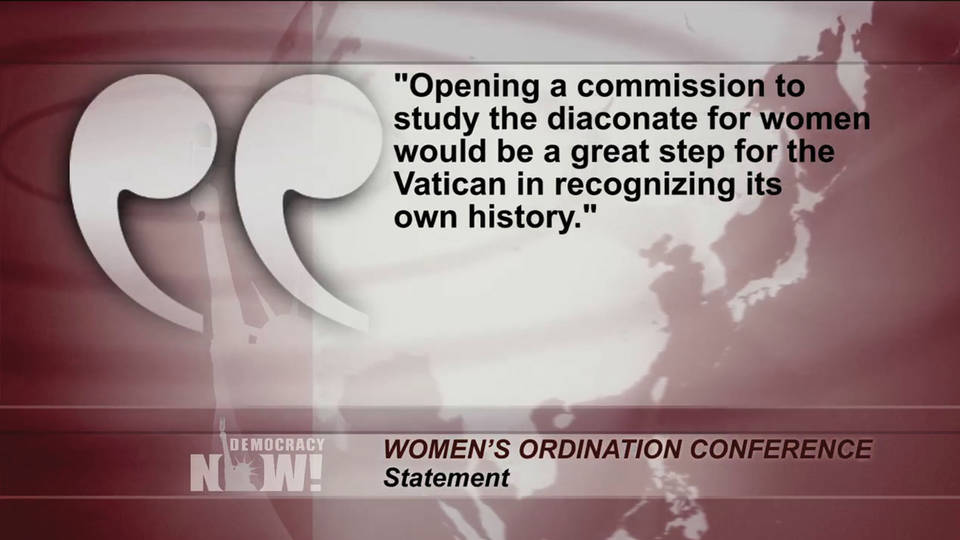
Pope Francis says he’ll establish a commission to study whether women could serve as deacons in the Roman Catholic Church. Research suggests women widely served as deacons in the church’s early history. In response to the pope, the Women’s Ordination Conference said, "Opening a commission to study the diaconate for women would be a great step for the Vatican in recognizing its own history."
TOPICS:
Pope Francis
Catholic Church
Speaker Paul Ryan Appears to Warm to Donald Trump as Nominee
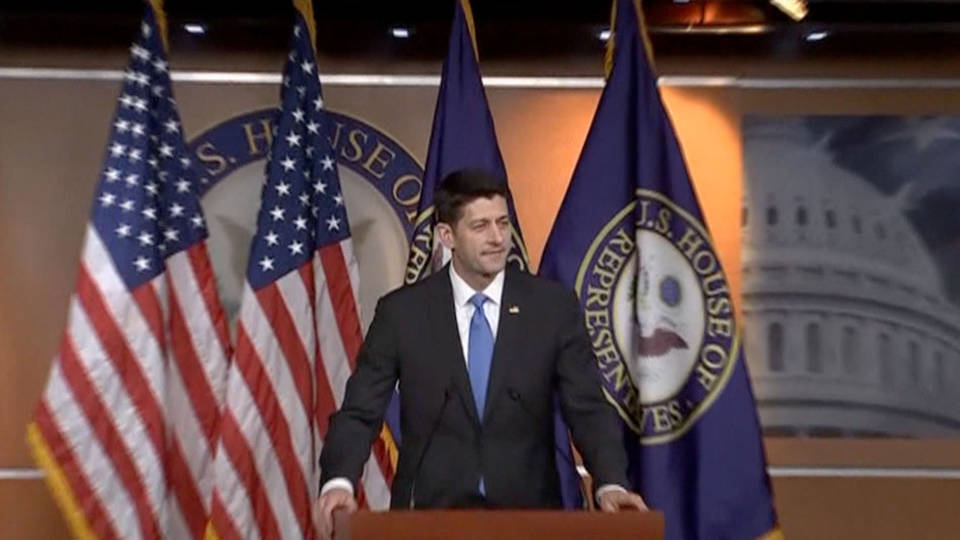
In Washington, D.C., House Speaker Paul Ryan’s opposition to presumptive Republican presidential nominee Donald Trump appears to be fading, after the two met on Capitol Hill Thursday. The two issued a joint statement saying, "While we were honest about our few differences, we recognize that there are also many important areas of common ground." This comes as an increasing number of Republican Party leaders are choosing to back Donald Trump, despite the candidate’s controversial proposals, which include deporting 11 million undocumented immigrants and building a wall across the entire length of the U.S.-Mexico border, which experts have said is not feasible.
TOPICS:
Donald Trump
Trump's Former Butler Called for President Obama to Be Hanged
Meanwhile, the Secret Service says it will investigate Donald Trump’s former butler over a Facebook post in which he referred to President Obama as a "Kenyan fraud" and called for him to be hanged. Anthony Senecal worked for Donald Trump for nearly 30 years. Trump’s campaign has said it disavows Senecal’s statements.
TOPICS:
Donald Trump
Iraq: ISIS Kills 20 Iraqi Soldiers and Tribal Fighters
In Iraq, ISIS militants have killed at least 20 Iraqi soldiers and tribal fighters in suicide attacks near Ramadi. Meanwhile, gunmen and suicide bombers killed 13 people when they stormed a coffee shop in a town north of Baghdad. No one has claimed responsibility for this attack. It comes on the heels of a wave of suicide attacks in the capital that killed at least 93 people on Wednesday.
TOPICS:
Iraq
Syria: Fighting Breaks Out in Aleppo as Ceasefire Expires
Meanwhile, in Syria, fighting has broken out in a suburb north of Aleppo, where a temporary ceasefire between the Assad regime and opposition groups has expired. Before the ceasefire took effect Monday, Aleppo had been the site of intense fighting this month, including an airstrike on an MSF-supported hospital that killed at least 14 patients and three doctors, including one of the city’s last pediatricians. On Thursday, Aleppo resident and mother Mayada Nazrian spoke out about finally deciding to leave the city.
Mayada Nazrian: "I have been in Aleppo since I was a little girl. I got married and had my kids here. We’ve suffered through this war for five years. We’ve been patient for a year, two years, three years. We’ve lost a lot. We lost a martyr. We lost our work. We lost everything we own because of this war."
We’ll have more on the ongoing conflict and how Syrians are organizing in the midst of the war with scholar Yasser Munif later in the broadcast.
TOPICS:
Syria
Somalia: U.S. Airstrike Kills 5
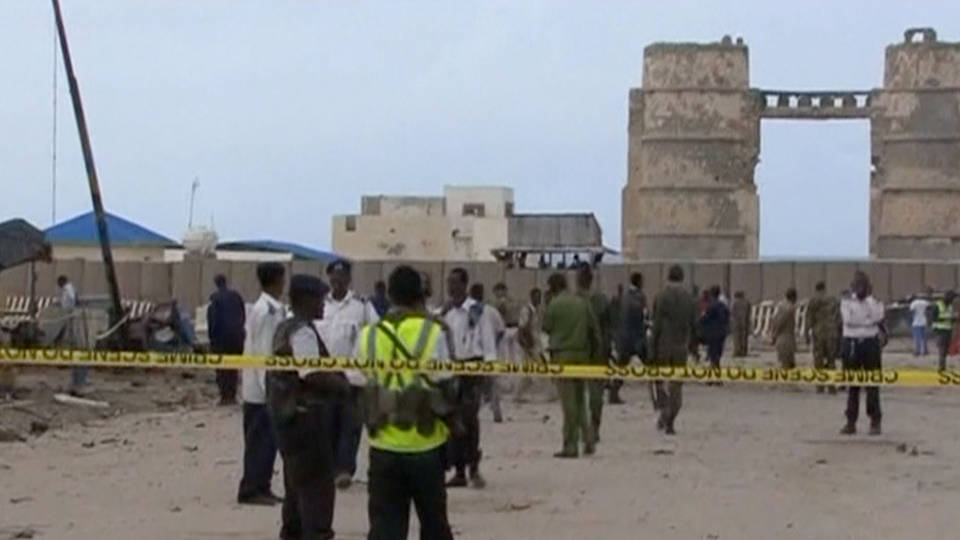
In Somalia, a U.S. airstrike killed five people on Thursday. The Pentagon says the five were militants with the extremist group al-Shabab. It’s the most recent U.S. airstrike inside Somalia, including a series of April drone strikes that killed at least eight people, and another in March that killed 150 people.
TOPICS:
Somalia
Pentagon: 25 U.S. Soldiers Stationed at 2 Outposts in Libya
Meanwhile, the Pentagon has admitted at least 25 U.S. soldiers have been stationed inside Libya at two separate outposts since late 2015. It’s the latest sign of U.S. military escalations in Libya.
TOPICS:
Libya
Former 9/11 Commission Member Calls for Obama to Declassify 28 Pages
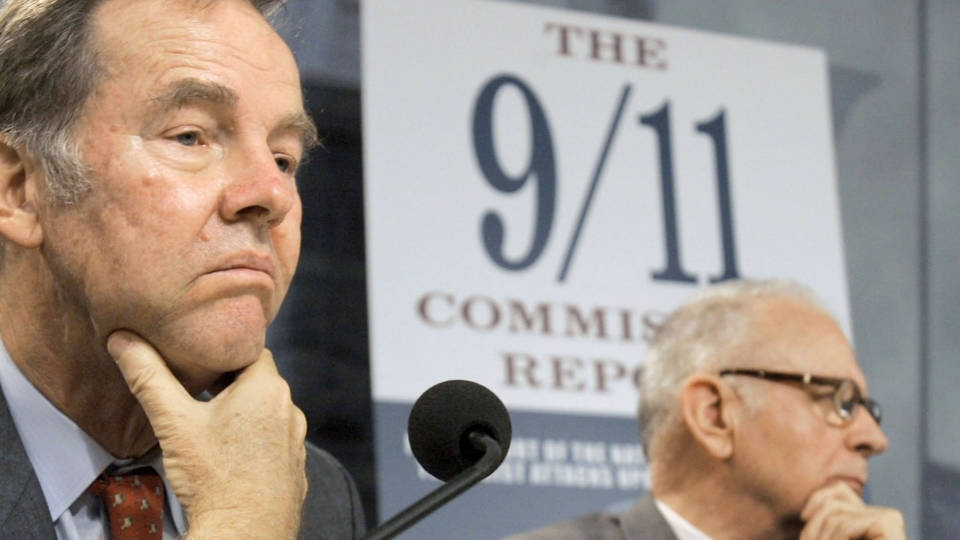
A former member of the 9/11 Commission is calling on the Obama administration to declassify 28 pages of the congressional report on Saudi ties to the 2001 terrorist attack. John Lehman, the Navy secretary in the Reagan administration, says he believes there’s evidence some Saudi government officials offered support to the 9/11 hijackers. Saudi Arabia was home to 15 of the 19 hijackers on 9/11.
TOPICS:
9/11
Judge Rules Against Portion of Obama Healthcare Law
A federal judge has ruled against a section of President Obama’s healthcare law, finding the administration overstepped its authority in subsidizing deductibles, co-pays and other "cost-sharing" measures. The suit was brought by House Republicans, who have unsuccessfully sought to repeal Obama’s healthcare law. The suit argues the subsidies were unconstitutional because Congress had already rejected a request for this funding in 2014. The Obama administration is expected to appeal.
TOPICS:
Healthcare
U.S. Supreme Court Halts Execution of Vernon Madison in Alabama
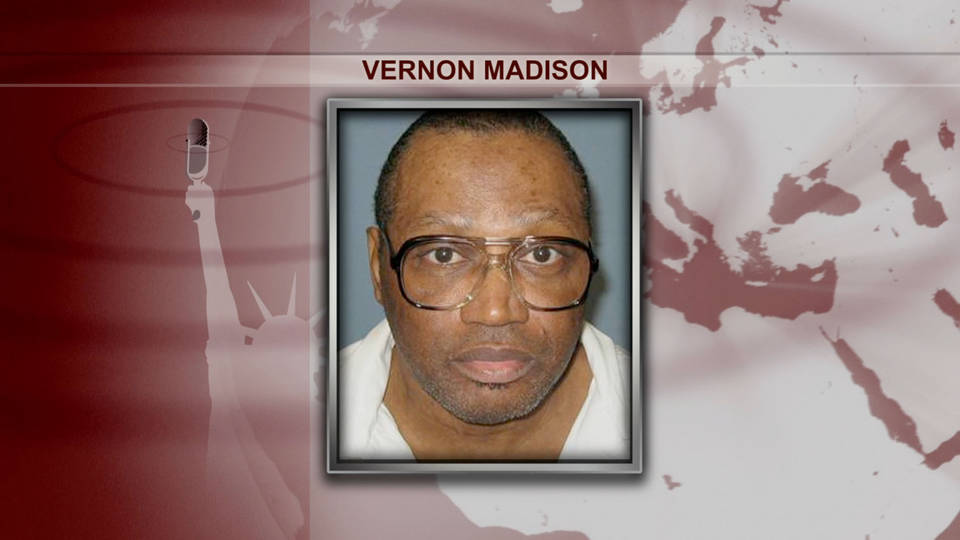
In Alabama, the execution of death row prisoner Vernon Madison has been halted after his attorneys argued dementia has left Madison unable to understand his death sentence. He was convicted of killing a police officer in 1985. In a 4-4 decision, the U.S. Supreme Court stayed the execution Thursday night, only hours before Madison was scheduled to die by lethal injection at the Holman Correctional Facility in Atmore. Later in the broadcast, we’ll go to the Holman Correctional Facility to cover another issue there: a 10-day work strike by prisoners protesting severe overcrowding, poor living conditions and the use of unpaid prison labor. We will go behind bars to speak with Kinetik Justice, a prisoner in solitary confinement who helped lead the strikes.
TOPICS:
Alabama
Alabama Governor Signs Law Banning Abortion Clinics Near Schools
Meanwhile, Alabama Governor Robert Bentley has signed into law a measure banning abortion clinics from operating within 2,000 feet of a K-8 public school. It’s the same rule applied to sex offenders in Alabama. The law will force at least two clinics in Alabama to close.
TOPICS:
Alabama
Abortion
ICE to Launch Raids Targeting Central American Mothers and Children

The Immigration and Customs Enforcement agency, known as ICE, is reportedly preparing to launch a month-long campaign of raids specifically aimed at rounding up and deporting undocumented Central American mothers and children. The effort contradicts the Obama administration’s 2014 pledge to focus deportations on "felons, not families." On Thursday, New York City Mayor Bill de Blasio wrote, "I am outraged to read reports of future ICE raids planned for May and June targeting Central American mothers and children. Many of these families have fled violence in their home countries and seek safety here, in the city of immigrants."
TOPICS:
Immigration
Google to Ban Advertising by Payday Lenders
Google has announced it will ban advertising by payday lenders from its site. It’s the company’s first global ban on a whole category of financial products. Advocates argue that payday lending is an exploitative industry that traps low-income people in cycles of debt.
TOPICS:
Economy
French Gov't Narrowly Survives No-Confidence Vote over Labor Reforms
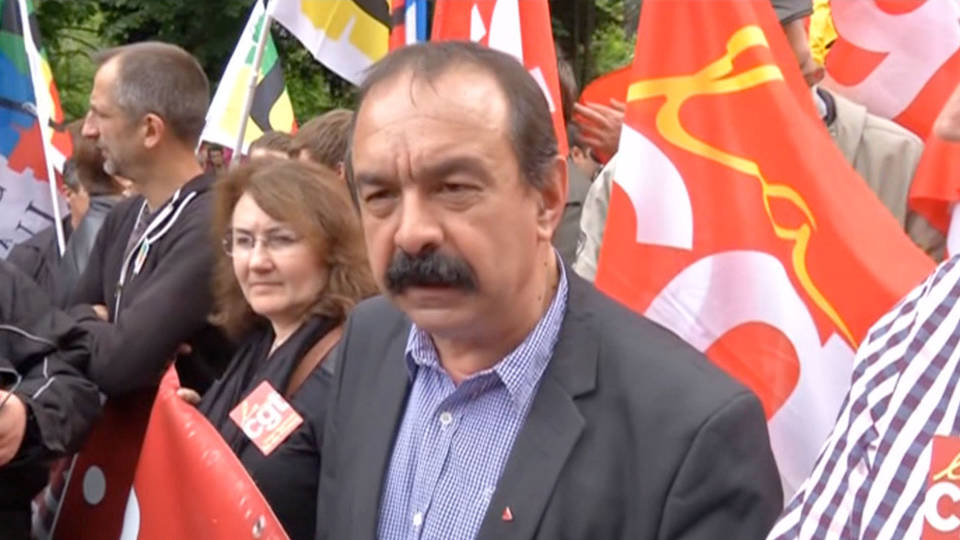
In France, more than 50,000 people took to the streets on Thursday, blockading roads and barricading schools, as the French government narrowly survived a vote of no-confidence in the National Assembly over President François Hollande’s controversial labor reforms. Opponents of the bill were about 40 votes shy of the 288 necessary to defeat the reforms. The controversial labor reforms were forced through two days ago using a little-used power. The proposals have sparked massive protests by students and unions across France. The movement has been dubbed "Nuit debout," or "Rise up at night." On Thursday, Philippe Martinez, general secretary of the CGT union, spoke out.
Philippe Martinez: "The most important thing is what the people are feeling. There hasn’t been any dialogue with the unions, because the bill was imposed on us, and democracy has once again been brushed aside at the National Assembly. I think that for a government that talks a lot about dialogue, about debate, well, they’re showing us what their idea of dialogue is: Let’s move by force, let’s try and scare workers and the young, the people. They should look at the polls, because over 70 percent of the people in this country are against this bill."
TOPICS:
France
Donate today:
Follow:


SPEAKING EVENTS

5/13 Washington, DC
5/14 Portland, ME
5/14 Bangor, ME
5/15 Bar Harbor, ME
5/17 Chicago, IL
5/18 Madison, WI
5/19 Toronto, ON
5/20 Toronto, ON
5/21 Troy, NY
5/22 New York, NY
5/23 Philadelphia, PA
more
NEW BOOK


Part 2: Alabama Prison Strike Organizer Joins with Pastor to Achieve Criminal Justice Reform
WORK WITH DN!

Video News Production Fellowship
Internships
WEB EXCLUSIVE

Web Exclusive: Reed Brody & Michael Smith Remember Michael Ratner (Part 2)
207 West 25th Street, 11th Floor
New York, New York 10001, United States
---------------------
---------------------

No comments:
Post a Comment