democracynow.org
Stories:

Will 712 Democratic Officials Decide 2016 Election? Uncovering the Secret History of Superdelegates
The relationship between the Bernie Sanders campaign and the Democratic Party leadership has been challenging from the start of the 2016 election campaign, when former Secretary of State Hillary Clinton began the primaries with a more than 400-delegate lead by securing support from superdelegates—the 712 congressmembers, senators, governors and other elected officials who often represent the Democratic Party elite. Now a new article from In These Times by Branko Marcetic uncovers "The Secret History of Superdelegates," which were established by the Hunt Commission in 1982. We are joined by Jessica Stites, executive editor of In These Times and editor of the site’s June cover story, and Rick Perlstein, the Chicago-based reporter and author of several books, including "Nixonland: The Rise of a President and the Fracturing of America."
TRANSCRIPT
This is a rush transcript. Copy may not be in its final form.
AMY GOODMAN: This is Democracy Now!, democracynow.org, The War and Peace Report. I’m Amy Goodman. And we are on the road in Chicago, broadcasting from WYCC PBS Chicago. It has been an—it has been an eventful few days for the Democratic Party, from the contested Nevada state Democratic convention Saturday to the split results Tuesday night in primaries Kentucky—in both Kentucky and Oregon. Former Secretary of State Hillary Clinton declared victory against Democratic presidential candidate Bernie Sanders in the primary on Tuesday in Kentucky, though it is razor-thin margin, while Sanders won a decisive victory in Oregon. Last night, Sanders spoke to about 12,000 supporters in Carson, California, directly addressing the Democratic Party leadership.
SEN. BERNIE SANDERS: In almost every case, whether it is a national poll or a state poll, we do much better against Trump than does Secretary Clinton. Just—poll just came out, I think it was yesterday, the state of Georgia, not a very good state for us: Trump was beating Secretary Clinton by four points; we were beating him by five points.
AUDIENCE: Bernie! Bernie! Bernie! Bernie! Bernie! Bernie! Bernie! Bernie!
SEN. BERNIE SANDERS: If the Democratic—if the Democratic Party wants to be certain that Donald Trump is defeated—and that, we must do—we, together, are the campaign to do that.
AMY GOODMAN: The relationship between the Sanders campaign and the Democratic Party leadership has been challenging from the start of the primary race, when former Secretary of State Hillary Clinton began with a more than 400-delegate lead by securing support from superdelegates—the 712 congressmen, senators, governors and other elected officials who often represent the Democratic Party elite.
Well, a new article from In These Times by Branko Marcetic uncovers "The Secret History of Superdelegates," which were established by the Hunt Commission in 1982. Jessica Stites is executive editor of In These Times and editor of the site’s June cover story. Still with us, Rick Perlstein, Chicago-based reporter and author of several books, including Nixonland: The Rise of a President and the Fracturing of America.
Let’s start with you, Jessica. Explain the superdelegates, which has really become such a critical issue right now, how they came into being.
JESSICA STITES: Sure, yeah. Our reporter, Branko Marcetic, actually went down to the National Archives and dug up the transcripts of this entire commission, that debated for months about Democratic Party rules reforms and came up with the superdelegates as their answer. And basically, what had prompted this were the losses of Carter and McGovern, and so this fear that the Democratic Party wasn’t nominating sort of electable, winnable candidates. And so, these sort of party insiders sat down and said, "What do we do?" And their instinct was, "Well, we need to take control. We need to take control of the nominating process. We’re worried that sort of if we let the people decide through primaries, they’re going to pick the wrong person." And so they instituted the superdelegate, who could act as a corrective, essentially, to the popular vote by, at the convention, casting votes for whomever they chose. And what really the sort of psychology you saw there—and this comes up a lot in the transcripts—is this fear of the activist or the outsider candidate that might disrupt the party, might not work with the Democrats the way they want once that person comes to the presidency, and so in this sort of sense that the elites kind of know best, and "we have a particular political acumen."
AMY GOODMAN: And again, this was in response to?
JESSICA STITES: Well, McGovern and Carter. So, interestingly, they didn’t see Carter as an insider, in a nutty way. They saw him as this sort of Southern outsider who was mostly drawing officials from his own local circles, and he wasn’t working with them in the ways they wanted to—him to, when he was in office. So they were afraid of someone like that. And then they were afraid of a leftist activist, a grassroots activist. So those were their two fears. And they—also they were reacting, in large part, to the spread of the primary system, which had really become much more central after some 1968 reforms that were put into place.
AMY GOODMAN: I want to turn to a quote from Geraldine Ferraro, member of Congress from New York, first female vice-presidential candidate, who was a member of the Hunt Commission. She said during a meeting of the commission in November 1981, quote, "No one knows those people better than a Member of Congress. No one is better able to represent them at the convention than a Member of Congress, and no one is better able to get them to support a candidate, if they really try." Explain, Jessica.
JESSICA STITES: Yes. So, that was the sort of tortured logic you kept seeing at the commission, where they said kind of the people who vote in primaries can’t represent the grassroots as well as congressmembers can, because congressmembers were originally elected. So, sort of this layer of representation is somehow going to help represent the grassroots, instead of letting people just vote for themselves. And it’s very odd and—
AMY GOODMAN: Interestingly, I mean, congressmembers aren’t elected by superdelegates.
JESSICA STITES: An excellent point. And at the time, to be fair, primary turnout was fairly low, and it’s still lower than a presidential election today, so that was their logic, as well: "We maybe got more votes than the primary."
AMY GOODMAN: Let me turn to a quote from Cleta Deatherage, one of the members of the Hunt Commission, as well. She expressed concern about the division that a system of superdelegates might create, saying, quote, "you raise the question of creating different castes of delegates potentially, delegates which are chosen essentially by voters’ decisions for candidates in primaries or caucuses, and a different caste of delegates who in fact are exempt from that process and in fact carry on their own by a different set of standards ... It gets you into a question of how those processes relate, and it gets to an essential question of legitimacy."
JESSICA STITES: Yeah, she was really prescient, because that is exactly the criticism of superdelegates today. And it’s—they’re very unpopular, and there really is a movement rising up to say, "Why should the Democratic Party have this sort of final deciding vote instead of listening to the will of the people?"
AMY GOODMAN: So, talk about superdelegates in relation now to Bernie Sanders and Hillary Clinton.
JESSICA STITES: Sure. Well, what’s so interesting—and we’re seeing this especially after the results this morning—is that neither of them are on track to a decisive victory based only on primaries and caucuses. So, they would need to get 2,383 pledged delegates coming out of that process in order to just be the nominee. And that means superdelegates will matter at the convention. They will be the ones who ultimately tip someone over the edge.
And what we’re seeing from Sanders is this kind of fascinating pivot. So he was initially very much against superdelegates, because they had given Hillary Clinton this incredible momentum starting out in the race, which I think is the main criticism of superdelegates, is they give someone a sort of unfair advantage by making it look like they’re already ahead before the race begins. But now Sanders is saying, "Well, you’ve got this class of people who are supposed to be making sure the Democratic Party has a winning candidate. That’s their reason for being." And that was very much what we saw in the transcripts, was, you know, if something should happen midstream and the candidate that is the front-runner in the primaries and caucuses looks like they can’t win—you know, maybe they have a scandal—we want to be able to correct that. And so, Sanders is saying, "Well, something unexpected happened: Donald Trump is the nominee of the Republican Party. Democrats need to react to that, and I am polling better than Hillary Clinton against Donald Trump in some key states." He was talking about, I think, Georgia in that clip, but he’s—that’s happening in Ohio, which is a really important, obviously, state. And so that’s his case to the superdelegates, is, "Well, if you have this weird system where you can trump the popular vote, isn’t this the time to use it?"
AMY GOODMAN: And the move to reform the superdelegate system? Do you see this all changing?
JESSICA STITES: You know, that—that’s a great question right now. So Sanders is no longer talking about that, because he’s trying to court the superdelegates. But I don’t think it’s off the table at all. We had an op-ed actually run along with our cover story, by Larry Cohen, who is the former president of the Communication Workers of America but also a senior adviser to the Sanders campaign. And he is calling very strongly for the—at the convention, for the Democrats to abolish or reform the superdelegate system. And I think there’s definitely a faction within the Sanders campaign that wants that.
AMY GOODMAN: Can you talk, Rick Perlstein, about how the Democrats and their process compares to the Republicans?
RICK PERLSTEIN: They’re similar. They—when the Democrats reformed their system, you know, between 1968 and 1972, it was kind of seen as this was the direction history was going: more democracy, you know, less smoke-filled rooms. So, a system in both parties that had been kind of mostly caucuses and conventions and some primaries became mostly primaries and then some caucuses and conventions.
AMY GOODMAN: What happened in Nevada? Can you, Jessica Stites, talk about what we just saw? I mean, there’s a police line in front of the stage?
JESSICA STITES: Yeah. I think that—
AMY GOODMAN: And, Rick, would you like to weigh in on that?
JESSICA STITES: Yeah.
RICK PERLSTEIN: Well, I mean, you know, we saw—we saw the footage. It was a very contested convention. The Clinton folks say the Sanders folks knew the rules in advance and then complained when the rules didn’t advantage them. The Sanders folks say that basically we have an establishment that’s trying to assert their powers. I think, when I look back historically, I see the attempts to exacerbate these divisions as possibly a strategy of Donald Trump and the Republicans. He has an ally named Roger Stone, who was part of Watergate. The whole strategy of Watergate all through 1972 was to create divisions that were based in real divisions, but to exacerbate them. So, like a Roger Stone-type figure would steal letterhead from one of the Democratic candidates, write a letter accusing another Democratic candidate of cheating, and then get that out to the media. Right? So, the idea is, if Democrats can’t get back together in the general election, then the Democrats can’t win. Now, these divisions are real, and the anger is real, but the exploitation of it is very similar to kind of what the FBI did in COINTELPRO. They take real divisions and try and turn them into divisions that make it impossible for people to work together. So we need to be careful about that.
AMY GOODMAN: Roger Stone is the source on so many of the National Enquirer stories against—
RICK PERLSTEIN: That’s right. That’s right. My next article is about how—
AMY GOODMAN: —against Ted Cruz.
RICK PERLSTEIN: Yeah, Donald Trump partakes of a reactionary tradition within gossip politics, something like the National Enquirer. I actually have a document in which Michael Deaver, Ronald Reagan’s longtime aide, tries to pitch Ronald Reagan as a columnist for the National Enquirer in 1975. So there’s a continuity there.
AMY GOODMAN: Back to Hunt Commission. Your final observations, Jessica Stites, as you dug into the documents and your reporter did? It was named after?
JESSICA STITES: Oh, Hunt, he was a former governor, I think, and he was chairing the—no, is that wrong, Rick? You’re making history faces.
RICK PERLSTEIN: No, I think so. No, no, I think it was a South Carolina maybe.
JESSICA STITES: I believe so. That sounds right.
RICK PERLSTEIN: But that was kind of it: He was a Southerner, right?
JESSICA STITES: Yes. He was chairing the commission. You know, I think superdelegates are not the only thing wrong with our electoral process. And one of the great things about kind of opening the door to questioning superdelegates, which are a pretty easy reform for the Democratic Party to make if they so choose, is, what else is wrong? Why are so few Americans voting in our general election?
AMY GOODMAN: I mean, we’re talking about less than 80 percent—no, more than 80 percent of people are not voting in the primaries and caucuses.
JESSICA STITES: Yeah, and that is a real problem. And there are things that can be done to address that. I mean, Rob Richie of FairVote has, I think, a great proposal, which is have one nationwide primary on one day—one person, one vote—and that will decide the Democratic candidate. So, there are things we can do, and it doesn’t—this is just a party process. This does not require changing the Constitution.
AMY GOODMAN: Well, I want to thank you both for being with us, Jessica Stites of In These Times, which is based here in Chicago, and Rick Perlstein, a Chicago-based reporter who reports for The Washington Spectator. And we’re going to link to all your reports at democracynow.org.
This is Democracy Now!, democracynow.org, The War and Peace Report. When we come back, we’re going to look at what’s been happening with police here in Chicago and the mayor, Rahm Emanuel. Stay with us. ... Read More →

Rekia Boyd's Killer Resigns as Activists Call for End to "Reign of Terror" by Chicago Police
As Democracy Now! broadcasts from Chicago, Illinois, we look at major developments in several high-profile cases of police shootings of unarmed African-American men and women, and how the independent media has played a key role in exposing police misconduct. On Tuesday, Dante Servin resigned from the Chicago Police Department just days before hearings were set to begin into whether he should be fired for shooting Rekia Boyd while he was off duty and she stood with a group of friends near his house. This comes as Chicago Mayor Rahm Emanuel announced this week that he plans to disband the city’s controversial police oversight agency that has been criticized for sluggish investigations that rarely resulted in disciplinary action. Mayor Emanuel is also facing calls to resign over a possible cover-up of the police killing of Laquan McDonald, who was shot 16 times in 2014. We are joined by Jamie Kalven, founder of the Invisible Institute and a freelance journalist who uncovered the autopsy report showing Laquan McDonald was shot 16 times and who first reported on the existence of the video of the shooting. In recent months, he has won a George Polk Award, an Izzy and the Ridenhour Courage Prize for his reporting on Chicago police misconduct. We also speak with Page May, a co-founder and organizer with Assata’s Daughters. She was also a member of the We Charge Genocide delegation to the U.N. Committee Against Torture.
TRANSCRIPT
This is a rush transcript. Copy may not be in its final form.
AMY GOODMAN: We are on the road in Chicago, Illinois. We’re broadcasting from WYCC Chicago PBS. Yes, Chicago, Illinois, where there’s been a major development in the police shooting of 22-year-old African-American woman Rekia Boyd. In 2012, off-duty Chicago Police Officer Dante Servin fired several shots over his shoulder into a group of people Boyd was standing with near his home, striking her in the back of her head. He was charged with involuntary manslaughter, but was acquitted in 2015 on a technicality. Well, on Tuesday, Servin resigned from the Chicago Police Department, just days before hearings were scheduled to begin into whether he should be fired. By resigning, he avoids testifying publicly about the shooting.
This comes as Chicago Mayor Rahm Emanuel announced this week he plans to disband the city’s controversial police oversight agency. The Independent Police Review Authority was tasked with addressing excessive force allegations and police shootings, but has long been criticized for sluggish investigations that rarely resulted in disciplinary action. Only 2 percent of claims against officers were reportedly ever upheld, and a large majority of complaints got stuck in a bureaucratic morass.
Mayor Emanuel’s announcement came after a task force he appointed found evidence of rampant racism within the Chicago Police Department. It said the police department’s own data, quote, "gives validity to the widely held belief the police have no regard for the sanctity of life when it comes to people of color," unquote.
Mayor Emanuel is also facing calls to resign over a possible cover-up of the police killing of Laquan McDonald, who was shot 16 times in 2014. Earlier this month, Emanuel spoke to the Chicago Tribune about the Laquan McDonald shooting.
MAYOR RAHM EMANUEL: Laquan McDonald is a wake-up call to all of us. It’s reminder that there’s a lot broken. And I’m determined to fix things that have been broken throughout the system. When I say that, you—it’s not just the criminal justice. It’s opportunity. It’s a promise. And when I say "opportunity," meaning the opportunity to get a job and get a skill set. It’s the opportunity through mentoring, to give young men a role model and a father figure they wouldn’t have. And I see of jobs more than just getting a résumé and more all that; it’s also to be able to prove something to yourself and to others of what your potential is. And I’m going to fix a breakdown of trust that exists in the criminal justice system.
AMY GOODMAN: For more, we’re joined now by two guests here in Chicago. Jamie Kalven, founder of the Invisible Institute and freelance journalist, who uncovered the autopsy report showing Laquan McDonald was shot 16 times and who first reported on the existence of the video of the shooting, in recent months he has won a George Polk Award, an Izzy and the Ridenhour Courage Prize for his reporting on Chicago police misconduct. And we’re joined by Page May, co-founder and organizer with Assata’s Daughters, who was also member of the We Charge Genocide delegation to the U.N. Committee Against Torture.
Jamie Kalven and Page May, welcome to Democracy Now!
JAMIE KALVEN: Good to be here.
PAGE MAY: Thank you.
AMY GOODMAN: So let’s talk about the latest on Laquan McDonald.
JAMIE KALVEN: So, the case has had amazing impact. I mean, in the wake of the Laquan McDonald revelations, as I think everybody knows, the entire political landscape in Chicago has changed. And we have an opportunity that we—I never expected to see, for really fundamental, enduring change. The question is how we create a path to get there.
So, there have been a number of recent developments. You mentioned the mayor’s task force, with this extraordinary language. I mean, this is a public body appointed by the mayor that came forth with a whole long list of recommendations, but, in a kind of prelude of findings, spoke to fundamental institutional racism entrenched in the police department and the history of the police department. So, we’re beginning, at least in that semantic realm, to have some diagnostic clarity about the nature of the problem.
AMY GOODMAN: Page May, you were arrested the night the video was released of Laquan McDonald being shot and killed by a police officer, Jason Van Dyke. Can you talk about, I mean, the fact that this video was released 400 days after Laquan McDonald was actually killed, and it was only on that day, 400 days later, that the police officer was charged with murder, the prosecutor ultimately taken down in an election as result of this?
PAGE MAY: Right. I mean, I think that reveals the reality of there is no justice in our justice system here, right? It’s one mass circus. It’s one mass cover-up. And it’s only when we have predominantly young black people shutting things down and taking it to the streets that we’re even getting noticed. And what I wonder a lot about is, you know: Was it that Laquan McDonald was killed, or was it that he was killed with 16 bullets? Would this still be happening if there were only one? And that’s a part of the problem, right? So I think part of why this is blowing up so much is because there was already a lot of anger, a lot of frustration, and this absolutely tapped into sort of the daily anger that young black people in the city experience, whether they’re shot 16 times or they’re stopped and searched 16 times in the course of a week.
AMY GOODMAN: And can you talk about the disbanding of the civilian complaint review board of Chicago?
PAGE MAY: Could—I knew this was coming, right? IPRA has been one big stage that is used to create an illusion of accountability, an illusion of process. And it’s going to be replaced with another similar illusion, if we don’t use this as a moment to build infrastructure that actually helps to hold people accountable. And I think what’s interesting is we’re in a moment of saying, "What does justice look like for Laquan?" You know, this was the first time where reporters were calling me, saying—the first question is—clearly, it’s not enough to arrest this one officer; something systematic has to change. And I think IPRA is one example of what that’s going to look like, but there’s a lot more work to do. The Chicago Police Department gets 40 percent of the budget, right? And that doesn’t include their guns or their bullets. They have to pay for them themselves. So every bullet that Van Dyke pumped into Laquan McDonald’s body, he paid for out of his own personal pocket. So, this is about the budget. This is way more than about a culture of policing and bad apples. This is about an institution that has never, in the centuries it’s existed, ever served to keep black people safe. So we have to reimagine what it means to keep people safe.
AMY GOODMAN: Can you talk about this database the Invisible Institute, your organization, has released of 56,000 misconduct complaint records against, what, 8,500 Chicago police, and what’s happened to this information?
JAMIE KALVEN: Right. And this is—so, what this—this is information from the city. This is the information that the task force referenced, you know, that you quoted before. And what it provides is—these are the disciplinary histories of those officers and the outcomes of investigations by IPRA, the Independent Police Review Authority. What it provides is a portrait of impunity. The odds of an officer being identified, vigorously investigated, receiving any kind of meaningful discipline are so small, so infinitesimal, that although, you know, officers with an abusive bent may not know the exact statistics, they know that they have—they have impunity. And people in the neighborhoods most affected by this kind of policing know, as well.
I mean, we have another project that we do called the Youth/Police Project. We do extensive interviews with black teenagers on the South Side about their experiences with the police and the day-to-day interactions—not the worst thing that happened, not Laquan McDonald, but the day-to-day. And they say, you know, "When we go do an encounter with the police, we know two things going in: They have all the power, and if something happens, if, you know, the encounter goes wrong, we will not be believed." That’s what the data shows. And that’s what’s really at stake here.
I mean, I think there’s a danger when we talk about police accountability. We use a kind of abstract language—impunity, accountability, transparency. These are useful words. They are, you know, for conceptual purposes. But the underlying reality every day in Chicago are particular blows from particular hands against particular bodies. And that’s really what the data is.
AMY GOODMAN: Do you have faith, Page May, in the electoral process? You were one of the—organized against—Bye Anita campaign, which was ousting Cook County State’s Attorney Anita Alvarez, the one who only brought the murder charges after the video was released, and also Rahm Emanuel.
PAGE MAY: Do I have faith in the electoral process? I have faith in our movement. I have faith in a movement that is—was able to kick out Anita Alvarez without endorsing another candidate, that was able to call into question the very usefulness or necessity of having a state’s attorney—right?—someone whose sole job is to prosecute people. And so, I believe in engaging things like the electoral process as a way of pushing people, right? But I believe in MLK’s quote—right?—that the only—the only way to raise the consciousness of the nation is through creative civil disobedience. And I think we have to be disobedient in all stages that we have access to, which includes things like the electoral process. We were out there—right?—disrupting not only Anita Alvarez, but also Donald Trump.
AMY GOODMAN: This latest story—I’m reading from the Chicago Sun-Times: "When a pair of Chicago Police officers try to make the case they were ostracized for reporting wrongdoing by fellow cops, city lawyers don’t want jurors to hear the words 'code of silence' uttered in the courtroom. Officers Shannon Spalding and Daniel Echeverria filed a whistleblower lawsuit against the department in 2012, well before Mayor [Rahm] Emanuel acknowledged the existence of a 'code of silence' in the department in a speech to the City Council [last year], after protests erupted." The significance of this?
JAMIE KALVEN: Oh, this is hugely significant, and this is the next big Chicago story. I’ve spent well over a year working on precisely that story with those officers. And, you know, it’s partially in view right now, the scope of it, but the account that they give of the actual operation of the code of silence, they’ve been subject to retaliation, you know, merciless, relentless retaliation within the department, for uncovering massive corruption and brutality within the now-disbanded public housing unit. So the most disenfranchised, marginalized population was under, essentially, a reign of terror by a group of officers. These officers uncovered it, undertook to investigate it undercover with the FBI and Internal Affairs, were outed within the department, and they have become the—you know, the focus of hostility within the department.
AMY GOODMAN: And Rahm Emanuel uses the words "thin blue line," "blue veil" and "code of silence," and he says, "You can’t use this in your trial."
JAMIE KALVEN: Use it in court, yeah. I mean, I don’t know what they’re thinking. I don’t—
AMY GOODMAN: We have five seconds.
JAMIE KALVEN: Yeah, yeah.
AMY GOODMAN: But what does it say that it was you, a totally independent reporter, who broke all these stories, not the corporate media in Chicago?
JAMIE KALVEN: I think—I think it says that the code of silence extends to the media and our broader political culture.
AMY GOODMAN: Well, we’re going to leave it there. I want to thank Page May, co-founder of Assata’s Daughters, and Jamie Kalven, founder of the Invisible Institute.
That does it for the broadcast. I’ll be speaking tonight around 7:00 in Madison, Wisconsin, at the Barrymore Theatre, then on to Toronto, Canada, Thursday and Friday, then on Saturday in Troy, New York, at the Sanctuary for Independent Media, then the Philadelphia Free Library on Monday. ... Read More →

How Donald Trump Risks Trade War, Crosses Lines on Racism, Wreaks Havoc on U.S. Conservatism
As Donald Trump moves closer to securing the Republican nomination, we begin today’s show looking at how he is changing the GOP. We are joined by Rick Perlstein, a Chicago-based reporter and author who has extensively researched the conservative movement. Perlstein’s books include "Nixonland: The Rise of a President and the Fracturing of America" and "The Invisible Bridge: The Fall of Nixon and the Rise of Reagan." His recent piece is, "Donald Trump’s avenging angels: How the orange-haired monster has rewritten the history of American conservatism."
TRANSCRIPT
This is a rush transcript. Copy may not be in its final form.
AMY GOODMAN: We’re on the road in Chicago, broadcasting from WYCC PBS Chicago. Donald Trump moved a step closer to securing enough delegates to win the Republican nomination. He is projected to have won 70 percent of the vote in Oregon Tuesday. Although Ted Cruz and John Kasich have suspended their campaigns, both of their names appeared on the Oregon ballot, each one about 16 percent of the vote. On Tuesday night, Fox aired a special with Trump being interviewed by Megyn Kelly.
DONALD TRUMP: Absolutely, I have regrets. I don’t think I want to discuss what the regrets are, but, absolutely, I could have done certain things differently. I could have maybe used different language in a couple of instances. But overall, you know, I have to be very happy with the outcome. And I think if I didn’t conduct myself in the way I’ve done it, I don’t think I would have been successful, actually, if I were soft, if I were, you know, presidential. OK, presidential, it’s—in a way, it’s a bad word, because—there’s nothing wrong with being presidential. But if I would not have fought back the way I fought back, I don’t think I would have been successful.
AMY GOODMAN: Donald Trump and Fox’s Megyn Kelly have been feuding since the first Republican debate last August, when Kelly questioned Trump about his history of describing some women as "dogs" and "fat pigs." Trump later said of Kelly’s tough questioning of him, quote, "There was blood coming out of her eyes, blood coming out of her—wherever." On Tuesday, the pro-Hillary Clinton super PAC, Priorities USA Action, aired a television ad targeting Trump. The ad shows voters lip-syncing some of Trump’s remarks about women as they wear T-shirts bearing his image.
DONALD TRUMP: You know, you could see there was blood coming out of her eyes, blood coming out of her—wherever. ... Does she have a good body? No. Does she have a fat ass? Absolutely. ... Do you like girls that are five-foot-one? They come up to you know where. ... If Ivanka weren’t my daughter, perhaps I’d be dating her. ... I view a person who is flat-chested—is very hard to be a 10. ... And you can tell them to go [bleep] themselves.
NARRATOR: Does Donald Trump really speak for you?
AMY GOODMAN: As Donald Trump moves closer to securing the Republican nomination, we begin today’s show looking at how Trump is changing the GOP. We’re joined by Rick Perlstein. He’s a Chicago-based reporter and author who has extensively researched the conservative movement. His books include Nixonland: The Rise of a President and the Fracturing of America, as well as The Invisible Bridge: The Fall of Nixon and the Rise of Reagan.
Welcome to Democracy Now! It’s great to have you with us, Rick. Well, talk about the ascendancy of Donald Trump and what he represents.
RICK PERLSTEIN: It’s a complicated thing for the Republicans. On the one hand, he represents a continuation and almost the apotheosis of a decades-long pattern of demagoguery, you know, playing to the reactionary rages of white middle-class and lower-middle-class Americans who feel dispossessed by changes in the society. But he turns that dog whistle into a bullhorn. But on the other hand, he represents a break from how the Republican Party has handled that, which has always been with a certain kind of delicacy. You know, you can think of George Bush visiting a mosque the week after 9/11. You know, Donald Trump isn’t going to do that. He’s going to go full bore.
But the other thing is, he really wreaks havoc about the way Republican elites think about economics. There’s a decades-long project of creating a global trading regime, you know, since Bretton Woods. And he’s willing to throw that out and risk a trade war, and that’s very scary for the masters of the universe in the Republican Party.
AMY GOODMAN: So what are they doing?
RICK PERLSTEIN: Well, they’re actually joining the bandwagon, mostly. I mean, they are riding a tiger, and they see him as the person who has achieved power in their party. And these are people who are students and followers of power, and I guess they think they can control him. But, you know, in the clip with Megyn Kelly, we heard that he equates the idea of being presidential with being soft, which of course is the greatest sin in his litany. So, I think that they might be in for a very dangerous year.
AMY GOODMAN: Speaking in March 2012, Republican presidential nominee, former Massachusetts Governor Mitt Romney delivered a scathing speech criticizing Donald Trump. He focused especially on Trump’s economic policies.
MITT ROMNEY: His proposed 35 percent tariff-like penalties would instigate a trade war. And that would raise prices for consumers, kill our export jobs, and lead entrepreneurs and businesses of all stripes to flee America. His tax plan, in combination with his refusal to reform entitlements and to honestly address spending, would balloon the deficit and the national debt. ... Successfully bringing jobs home requires serious policy and reforms that make America the place businesses want to come, want to plant and want to grow. You can’t punish business into doing what you want.
AMY GOODMAN: So, that was Mitt Romney. Your response, Rick Perlstein?
RICK PERLSTEIN: Such a revealing clip. Most of the things that Mitt Romney criticized Trump for in that speech, he himself had done in 2012. You know, he himself had baited Obama for maybe not being born in America. You know, he himself had, of course, played to those same kind of white resentments and grievances. But he really draws the distinction, very hard, at he’s not treating business in the proper way, with the popular obeisance. And Trump knows that, and, in fact, he’s just brought in Stephen Moore, of the Club for Growth and the Heritage Foundation, to be his tax adviser. And, you know, this is his attempt to mend fences with the traditional conservative Republican elite.
AMY GOODMAN: Sheldon Adelson at first was not going—
RICK PERLSTEIN: Right.
AMY GOODMAN: —to support Donald Trump. Now it looks like, what, $100 million?
RICK PERLSTEIN: Only $100 million, pocket change. Yeah, he—these people have decided that Trump is the guy. It’s Trump or nothing. It’s very much like in 1964 when the party elites realized that Barry Goldwater was on a glide path to the nomination, and tried to stop him, and it was far too late. In 1964, they had sort of the moral solidity to abandon Barry Goldwater, largely. In Trump’s case, who’s a much, much more dangerous figure, who basically boasts of his indifference to the Constitution, they’ve completely soiled themselves by jumping on the bandwagon.
AMY GOODMAN: During the campaign, Donald Trump has repeatedly come under fire for inciting his supporters to violence, and critics say that Trump himself is setting the tone. This is a sampling of what Donald Trump has said about protesters at some of his rallies.
DONALD TRUMP: So if you see somebody getting ready to throw a tomato, knock the crap out of them, would you? Seriously. OK, just knock th hell—I promise you, I will pay for the legal fees. I promise. ... Throw them the hell out of here. Am I allowed to rip that whistle out of the mouth? I’d rip that and just—should somebody do that? ... Ah, I love the old days, you know? You know what I hate? There’s a guy totally disruptive, throwing punches. We’re not allowed to punch back anymore. I love the old days. You know what they used to do to guys like that when they were in a place like this? They’d be carried out on a stretcher, folks. Ah, it’s true.
AMY GOODMAN: That was Donald Trump. Talk about what he’s doing here.
RICK PERLSTEIN: Right. I mean, this is absolutely horrifying stuff. Like I say, previous Republican elites understood that you tap into that kind of anger, but you kind of do so only to a certain point. You know, this is Barry Goldwater saying he’d drop out of the campaign if his supporters began exploiting riots on his behalf. But what’s even scarier than, you know, kind of setting his supporters against protesters is the idea of Donald Trump in charge of the levers of the American state and unleashing that attitude.
One of the striking things I found him saying that got no attention at all was that, you know, one of his litmus tests for a Supreme Court nominee—in fact, it was the first thing he mentioned—was—would be a willingness to go after Hillary Clinton on her emails. Now, whatever you think of Hillary Clinton and her emails, a presidential nominee saying his litmus test is prejudging a case and basically a pledge on behalf of that Supreme Court nominee to basically join his vendetta against a political rival is really beyond the pale. I mean, you’re not even supposed to, if you’re a presidential candidate, prejudice a criminal case—right?—on the local level. But here’s a guy absolutely traducing the Constitution’s guarantee that we have due process. And, you know, that’s worse than some guy beating up a protester, as awful as that is.
AMY GOODMAN: Talk about Donald Trump’s father, Fred Trump.
RICK PERLSTEIN: Fred Trump, of course, was a very successful real estate developer, but in Queens, you know, in Brooklyn, in the sort of the outer boroughs of New York. When I—when I learned about Donald Trump and Fred Trump a long time ago, I thought, "Oh, well, Fred Trump was kind of cool. He was developing kind of affordable housing for middle-class folks. And then Donald Trump, you know, became this kind of maniac who created luxury housing for the super rich."
But it turns out that Fred Trump was a very dangerous and frightening figure, too. In the 1920s, there was a Klan march in Queens, and police arrested people, all of them in Klan robes. And it was reported that Fred Trump was one of those arrestees. You know, Donald Trump has tried to squirrel out of that, but more and more evidence seems to point out that Fred was one of these guys. And the proof was in the pudding, right? We know about Woody Guthrie’s song about Fred Trump’s racism, and maybe we can get into that. But later—
AMY GOODMAN: So, the song—
RICK PERLSTEIN: Right.
AMY GOODMAN: The song from the ’50s—
RICK PERLSTEIN: Right.
AMY GOODMAN: —Woody Guthrie singing:
“I suppose
Old Man Trump knows
Just how much
Racial Hate
he stirred up
In the bloodpot of human hearts
When he drawed
That color line
Here at his
Eighteen hundred family project."
This is Woody Guthrie.
RICK PERLSTEIN: This would have been one of his big, you know, sort of middle-class housing developments out in Brooklyn or Queens. And, you know, this was obviously the case that this guy was—had a reputation as a racist. Right? But then, by the 1970s, the Justice Department goes after the Trump organization, by which time young Donald is kind of studying at his father’s knee, for gross violations of the 1968 Civil Rights Act, which, you know, guarantee open housing for African Americans and minorities. And they really built a very, very impressive case. It was covered very closely in The New York Times.
And the Trump organization, Fred Trump, hired none other than Roy Cohn as his lawyer, you know, the legendary gutbucket puncher who had been Joe McCarthy’s lawyer. And he came up with a sort of a defense and a talking point, and that was pretty extraordinary in itself. He said, "We are not trying to keep black people out of these apartments; we’re trying to keep welfare recipients out of this apartment." So this was—this was his defense. This was, you know, kind of the best-case scenario. And Donald Trump, by that time, was being interviewed, and he told The New York Times, I believe it was, that he’d never even heard of the 1968 Civil Rights Act, which is, of course, you know, the controlling legislation for anyone who wants to build housing. Quite a stunning performance, and really kind of sets the tone of a guy—and I’m talking about the son now—who sees African Americans as predators, basically, polluters.
AMY GOODMAN: So, in February, Donald Trump came under criticism for wavering on whether or not he would—he wanted the support of the former KKK leader David Duke. Speaking on CNN with Jake Tapper, Trump refused to disavow Duke’s support or the support of other white supremacists and the Klan.
DONALD TRUMP: Well, just so you understand, I don’t know anything about David Duke. OK? I don’t know anything about what you’re even talking about with white supremacy or white supremacists. So, I don’t know. I mean, I don’t know—did he endorse me, or what’s going on, because, you know, I know nothing about David Duke. I know nothing about white supremacists. And so, when you’re asking me a question, that I’m supposed to be talking about people that I know nothing about.
JAKE TAPPER: But I guess the question from the Anti-Defamation League is—even if you don’t know about their endorsement, there are these groups and individuals endorsing you. Would you just say, unequivocally, you condemn them, and you don’t want their support?
DONALD TRUMP: Well, I have to look at the group. I mean, I don’t know what group you’re talking about. You wouldn’t want me to condemn a group that I know nothing about. I’d have to look. If you would send me a list of the groups, I will do research on them, and certainly I would disavow if I thought there was something wrong.
JAKE TAPPER: The Ku Klux Klan?
DONALD TRUMP: But you may have groups in there that are totally fine, and it would be very unfair. So give me a list of the groups, and I’ll let you know.
JAKE TAPPER: OK, I mean, I’m just talking about David Duke and the Ku Klux Klan here, but...
DONALD TRUMP: I don’t know any—honestly, I don’t know David Duke. I don’t believe I’ve ever met him.
AMY GOODMAN: So that’s Donald Trump being interviewed by Jake Tapper on CNN. Rick Perlstein?
RICK PERLSTEIN: Yeah, that was a stone lie. You know, he had denounced David Duke when he was playing with becoming the Reform Party’s presidential candidate in, I believe, 2000. And that’s another indication that he’s kind of violating these bright lines that a party, again, that was perfectly willing to kind of play footsie with racism, had maintained in the past. Barry Goldwater, you know, when Ku Klux Klan members started endorsing him, was absolutely horrified, said he wanted to have nothing to do with it. Of course, Ronald Reagan kind of made the dog-whistle move, famously, of starting his campaign in Philadelphia, Mississippi, where the Klan had murdered civil rights workers in 1964.
But what Donald Trump is doing, I realized, was very different, when I read an article like last fall by Evan Osnos of The New Yorker. And Osnos happened to be doing an article about white nationalists, which is kind of the polite term for white supremacists. And he said—he was just kind of, you know, doing an article about them, independently of Trump, when Trump announced his candidacy, and he heard them saying all these warm things about them. And when I read that article, I said, "Wow! This is really like nothing I’ve seen before in studying the Republican right for 18, 19 years," because white supremacists have always kind of considered both parties Tweedledee and Tweedledum. And the idea that they would consider a major Republican Party figure one of them is—you know, it’s a discontinuity among white supremacists. And the idea that Donald Trump would not immediately disavow them, whatever that says about what Donald Trump believes or what previous Republican candidates believe, is just a very different practice than what we have seen before. It’s a watershed moment in the surrender of a major American political party to the most rank and base kind of racism that we’ve seen in this country.
AMY GOODMAN: And do you see comparisons between Donald Trump and Ronald Reagan?
RICK PERLSTEIN: There are some comparisons, but there are some discontinuities. I mean, there’s things that might seem at first superficial. Both of them were hosts of TV shows, right? Ronald Reagan would have been familiar at the beginning of his political career in the early 1960s to Americans as the host of General Electric Theater, right, which was one of the most popular TV shows at the time. And he played a character. He was the avuncular host, right? Donald Trump was the star of a TV show, of course, The Apprentice, not nearly as popular as Donald Trump claims it was, but certainly a lot more popular than Bill O’Reilly or CNN, right? So most Americans know him also as someone who played a character. And the character was this omniscient, superpowerful master of the universe, who had the answer to every question, before whom charismatic and powerful people groveled before. That was Donald Trump in the minds of millions of Americans by the time he entered politics this year.
AMY GOODMAN: We’re going to continue our discussion with you, Rick, but we’re also going to talk about superdelegates. Yes, Rick Perlstein is a Chicago-based reporter, author of several books, including Nixonland: The Rise of a President and the Fracturing of America, a national correspondent for The Washington Spectator, his recent piece headlined "Donald Trump’s avenging angels: How the orange-haired monster has rewritten the history of American conservatism." Stay with us. ... Read More →
Headlines:Sanders Wins Oregon Primary; Clinton Declares Victory in Tight Kentucky Race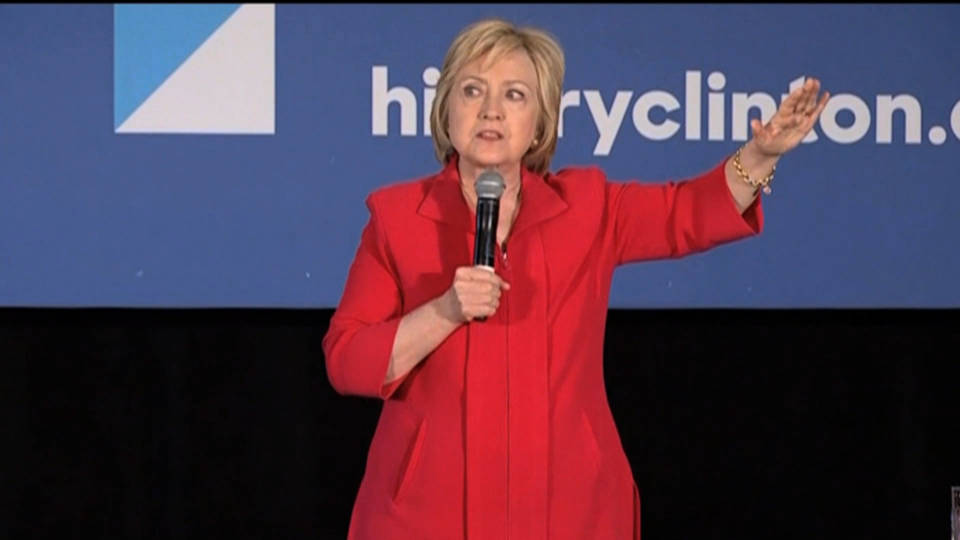
Vermont Senator Bernie Sanders has won the Democratic primary in Oregon, while Hillary Clinton has declared victory in Kentucky. With 99 percent of Kentucky precincts reporting, Clinton leads Sanders by 0.5 percent. Sanders thanked his supporters in both states.
Sen. Bernie Sanders: "Let me also take this opportunity to say a word of thanks to the people of Kentucky. In a closed primary, something I am not all that enthusiastic about, where independents are not allowed to vote, where Secretary Clinton defeated Barack Obama by 250,000 votes in 2008, it appears tonight that we’re going to end up with about half of the delegates from Kentucky."
TOPICS:
2016 Election
Bernie Sanders
Donald Trump Moves Closer to Nomination with Oregon Win
Meanwhile, Donald Trump has moved a step closer to cementing the Republican nomination. He is projected to have won 70 percent of the vote in Oregon, where Ted Cruz and John Kasich appeared on the ballot even though they have dropped out of the race. We’ll have more on Trump and the results later in the broadcast.
TOPICS:
Donald Trump
2016 Election
Sanders Criticizes Nevada Democratic Leadership After Disputed Convention
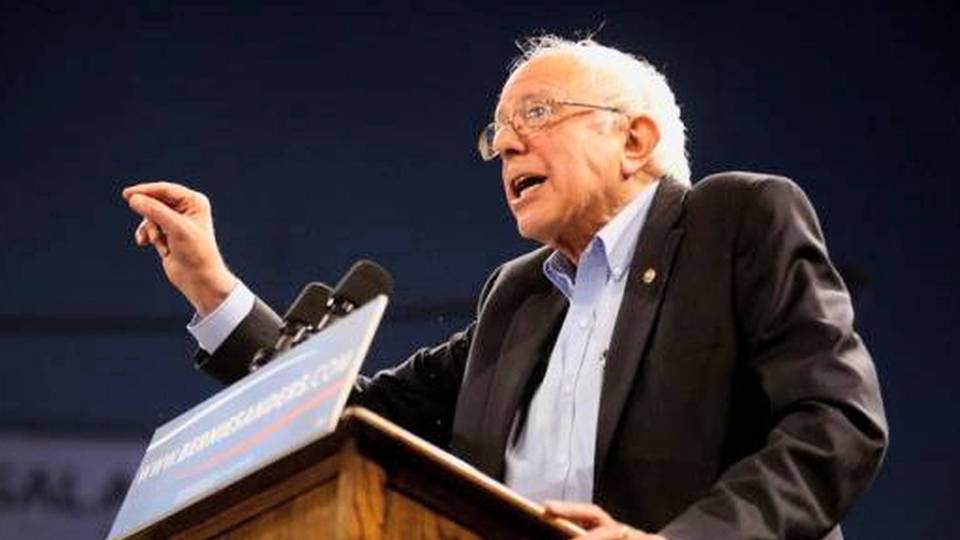
Bernie Sanders’ victory in Oregon comes amid tensions with the Democratic Party after Sanders supporters erupted into protest Saturday at the Nevada convention. They say rules were abruptly changed and 64 Sanders supporters were wrongly denied delegate status. Clinton ultimately won 20 pledged delegates to Sanders’ 15. The state party chair, Roberta Lange, said she received death threats, while state party headquarters were vandalized. Senate Minority Leader Harry Reid urged Sanders to condemn the behavior of some of his supporters, saying he faced a "test of leadership." In a statement, Sanders rejected violence, and noted that during the Nevada campaign, shots were fired into his campaign office in the state, and his staff’s housing complex was broken into and ransacked. He also accused Nevada Democratic leadership of "[using] its power to prevent a fair and transparent process" at the conventions on Saturday. We’ll have more on Sanders later in the broadcast.
TOPICS:
Bernie Sanders
Nevada
Iraq: At Least 70 Killed in Latest Wave of Baghdad Bombings

In the Iraqi capital Baghdad, a wave of violence has killed more than 200 people over the past week. On Tuesday, at least 70 people were killed in a series of bombings, including one that struck a marketplace in the mainly Shia district of al-Shaab. ISISclaimed responsibility for that attack.
TOPICS:
Iraq
Senate Passes Bill to Let 9/11 Families Sue Saudi Arabia
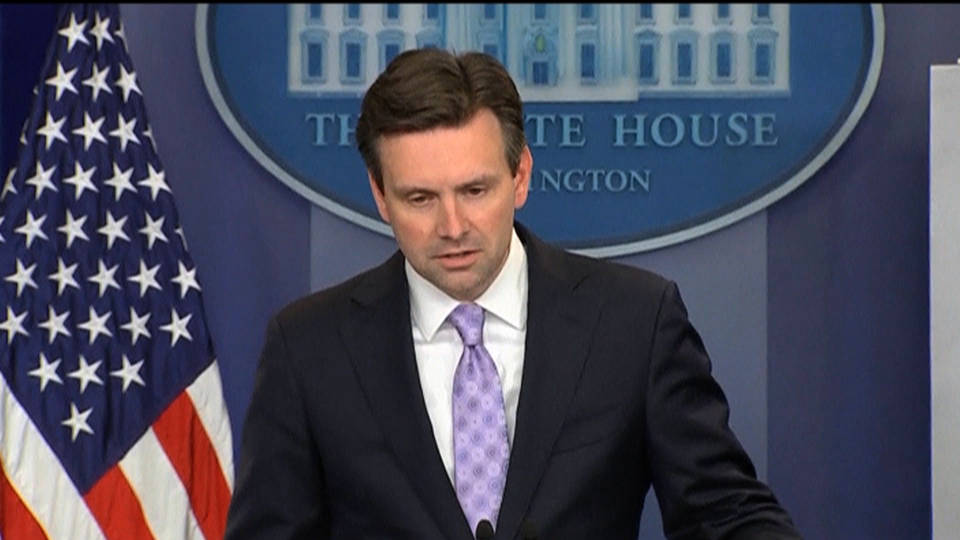
The Senate has passed a bill that would let the families of September 11 victims sue Saudi Arabia for any role it played in the attacks. This comes as the Obama administration faces renewed pressure to release 28 classified pages of the 9/11 report, which are said to contain details on the Saudi role. Saudi Arabia has threatened to sell off up to $750 billion in Treasury securities and other U.S. assets if the measure passes. White House spokesperson Josh Earnest opposed the bill.
Josh Earnest: "This legislation would change long-standing international law regarding sovereign immunity, and the president of the United States continues to harbor serious concerns that this legislation would make the United States vulnerable in other court systems around the world."
TOPICS:
Saudi Arabia
September 11
White House Threatens to Veto Draft of Military Spending Bill
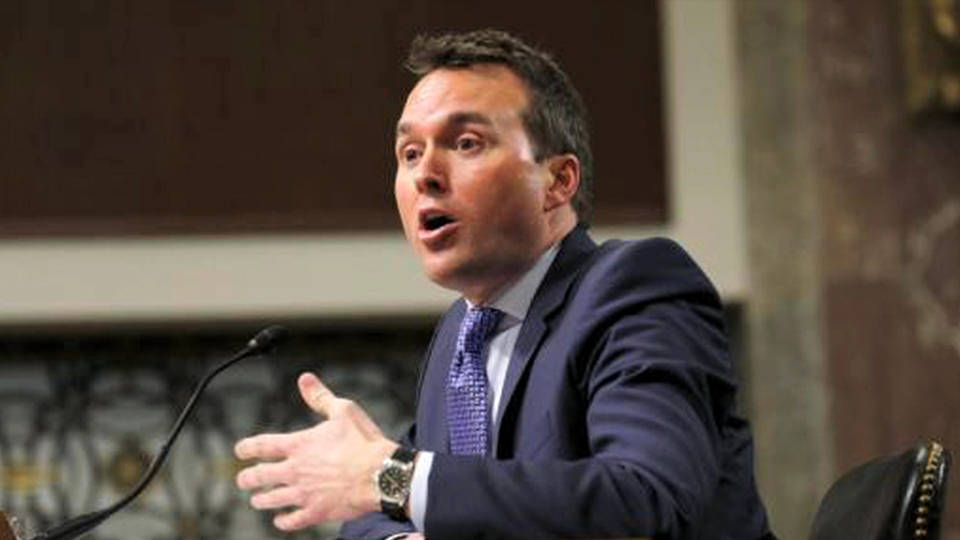
The White House has threatened to veto a military spending bill that protects the Pentagon from budget cuts. The House draft of the latest National Defense Authorization Act also includes barriers to closing the Guantánamo prison and measures the White House says enable discrimination against LGBT people. This comes as the Senate has confirmed Eric Fanning as Army secretary, making him the first openly gay leader of a U.S. military service.
TOPICS:
Military
LGBT
Mexican President Proposes Legalizing Same-Sex Marriage Nationwide
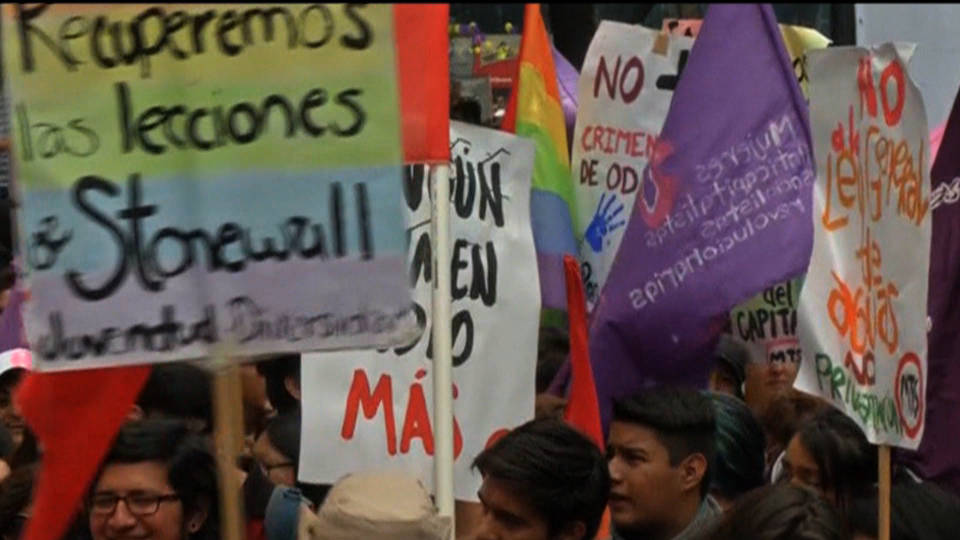
Mexican President Enrique Peña Nieto has proposed legalizing same-sex marriage nationwide. It’s currently legal only in certain states and Mexico City. He made the remarks on the International Day Against Homophobia.
President Enrique Peña Nieto: "To recognize as a human right that people can get married without any discrimination, that is to say that marriage will be allowed without discrimination, regardless of ethnicity, disability, social conditions, health conditions, religion, gender or sexual preference."
TOPICS:
LGBT
Mexico
In Emotional Plea, Father of Missing Student Calls for Rapporteur to Visit Mexico
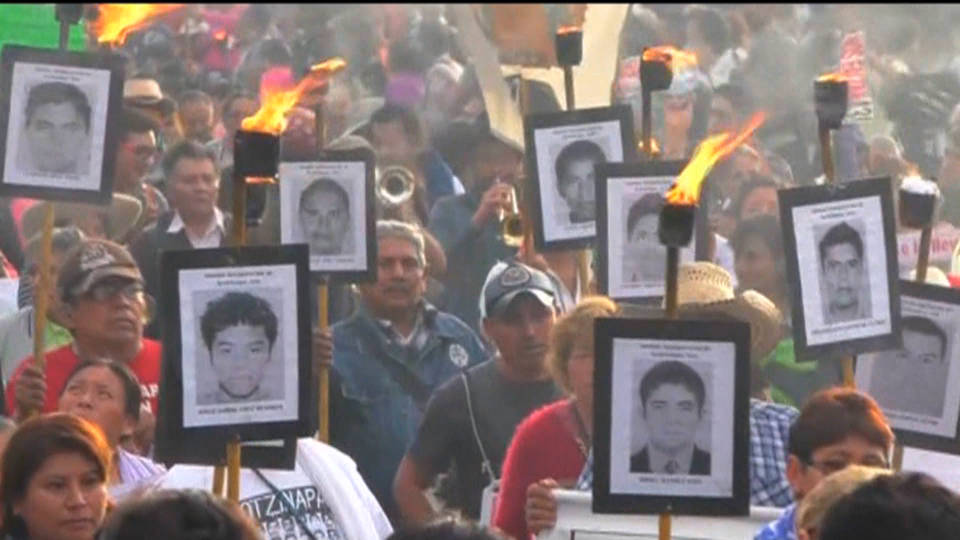
This comes as President Peña Nieto faces renewed pressure over the disappearance of 43 students in Mexico in September 2014. Multiple reports have pointed to a role by federal authorities and cast doubt on Mexico’s claim the students were killed by a drug gang. On Monday, Antonio Tizapa, father of one of the missing students, broke down in tears as he testified before the U.N. Permanent Forum on Indigenous Issues. He called for a U.N. special rapporteur to visit Mexico.
Antonio Tizapa: "Nineteen months demanding they be returned, alive, 19 months seeking justice, and we are awaiting a visit to Mexico by the United Nations special rapporteur on the rights of indigenous peoples, Victoria Tauli-Corpuz, to resolve the conflict of 43 families and to find peace, even though we know they are not just 43. They are thousands and thousands."
TOPICS:
Mexico
Nigeria: Union Representing Millions Launches General Strike

In Nigeria, a labor union representing millions of workers has launched a general strike. The Nigeria Labour Congress announced the strike over the government’s plan to raise gasoline prices.
TOPICS:
Nigeria
Unions
Labor
France: Scores Arrested as Up to 220,000 Protest Labor Reforms
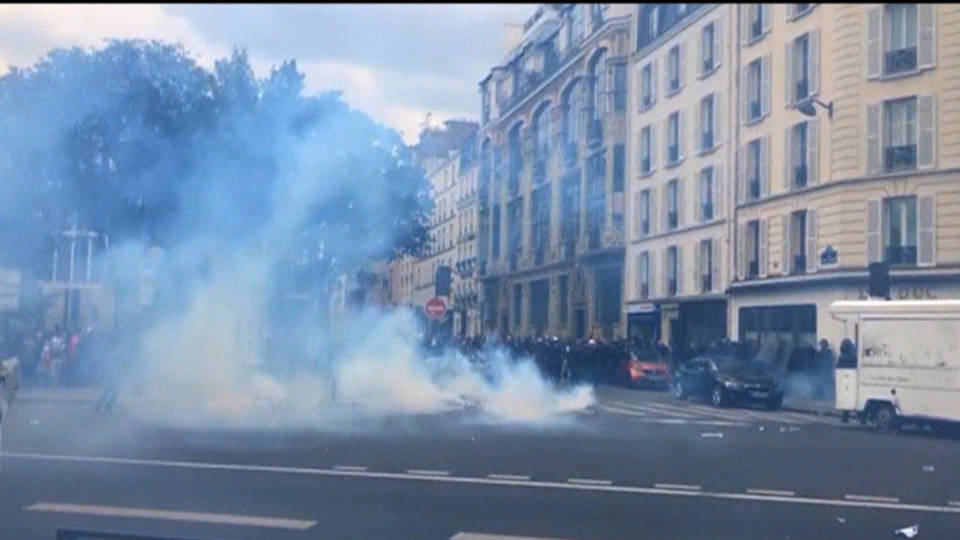
In France, as many as 220,000 people took to the streets across the country to protest labor reforms backed by President François Hollande. The measures would cut overtime pay for truck drivers and make it easier for companies to fire people. On Tuesday, truck drivers blockaded roads, police fired tear gas and water cannons, and 87 people were arrested. Arlette Perray joined the protests in Paris.
Arlette Perray: "It’s a disastrous law. We haven’t had anything like it for more than 70 years. It destroys all the rights of employees and retired people, and the future of young people. I am retired, and my place is here with the workers and the youth."
TOPICS:
France
Labor
Millions More U.S. Workers to Become Eligible for Overtime Pay
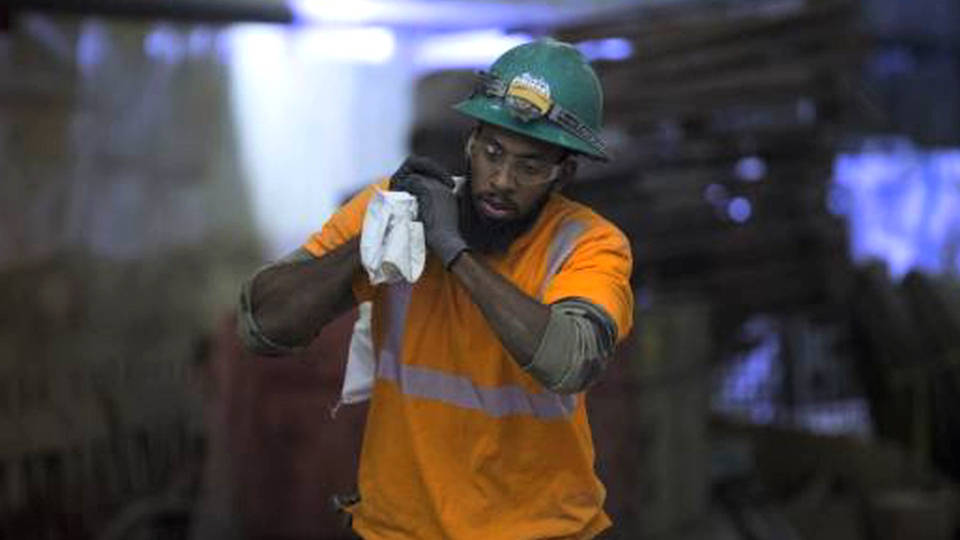
Here in the United States, millions more workers could become eligible for overtime pay under new regulations being unveiled by the Obama administration today. The rules allow full-time salaried employees to earn overtime if they make up to about $47,000 a year—that’s more than twice the current benchmark. About 35 percent of full-time salaried employees will be eligible to receive time and a half for extra hours, up from the 7 percent who qualify now.
TOPICS:
Labor
Chilean Court Asks U.S. to Extradite Former Pinochet Agents
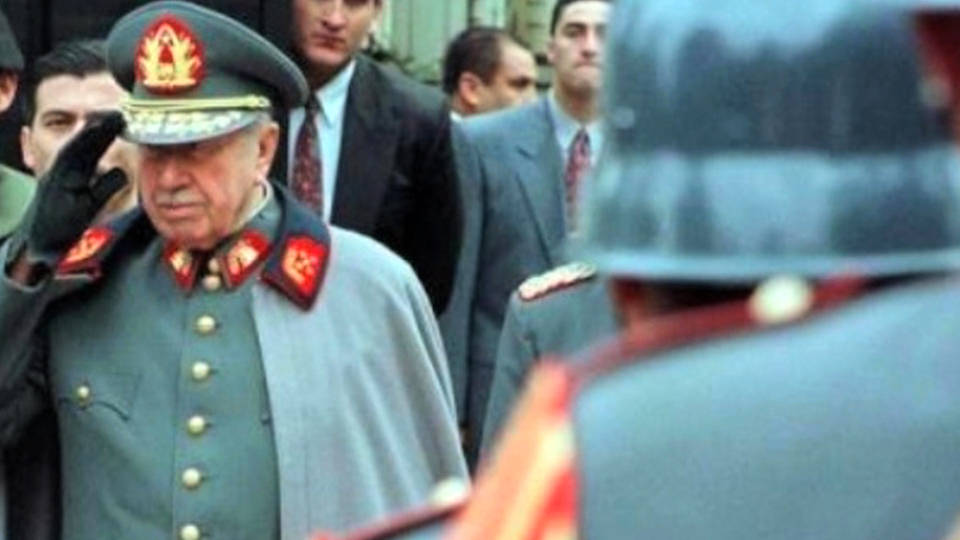
In Chile, the Supreme Court has asked the United States to extradite three former agents who worked for the military dictatorship of Augusto Pinochet. Pinochet rose to power in a U.S.-backed military coup, ousting democratically elected President Salvador Allende, in 1973. The three former agents are accused of a role in the detention, torture and killing of Spanish-Chilean U.N. diplomat Carmelo Soria in 1976.
TOPICS:
Chile
1973 Chilean Coup
Pipeline Company Indicted over California Oil Spill
And a company whose pipeline burst near Santa Barbara, California, last year, spilling up to 143,000 gallons of crude oil, has been indicted on dozens of criminal counts, including four felony charges. Plains All American Pipeline could face up to $2.8 million in fines, a tiny fraction of the $43 billion in revenue it reported the year before the leak. An employee of the company also faces three misdemeanor charges.
TOPICS:
Natural Gas & Oil Drilling
Environment
Donate today:
Follow:


SPEAKING EVENTS

5/18 Madison, WI
5/19 Toronto, ON
5/20 Toronto, ON
5/21 Troy, NY
5/22 New York, NY
5/23 Philadelphia, PA
5/24 Brooklyn, NY
7/29 Provincetown, MA
7/30 Martha's Vineyard, MA
more
NEW BOOK


WATCH: Amy Goodman on C-SPAN's Washington Journal
WEB EXCLUSIVE

Chomsky: Today's GOP is a Candidate for Most Dangerous Organization in Human History—Part 2
FEATURED INTERVIEW

Suing Dictators Around the World: A Look at How Michael Ratner Helped Reshape Human Rights Law
207 West 25th Street, 11th Floor
New York, New York 10001, United States
---------------------
---------------------

No comments:
Post a Comment