 World Jewish Congress News Update - UN in New York votes on ignoring Jewish ties to Temple Mount "News updates from the World Jewish Congress website" - Tuesday, 08 November 2016
 UN in New York votes on ignoring Jewish ties to Temple Mount - Jerusalem PostTen anti-Israel resolutions approved by member states.
United Nations General Assembly committees in New York voted Tuesday on at least nine anti-Israel resolutions, including two that ignore Jewish ties to the Temple Mount, and refer to the area solely by its Muslim name of al-Haram al-Sharif.
“We will continue to fight at all times and in all forums against those who deny the historical and religious ties that bind the Jewish people with Jerusalem,” said Danny Danon, Israel’s Ambassador to the UN.
“Even when the votes are stacked against us and resolutions that are completely divorced from reality succeed in passing UN bodies, it is important that moderate states stand up and make sure that their voices are heard to counter the lies disseminated by the Palestinians,” he said.
Danon added that, thanks to work done by his office, EU member states issued an “explanation of the vote” that clarifies that the site was significant to the world’s three monotheistic religions.
The votes come just one month after a United Nations Educational, Scientific and Cultural Organization (UNESCO) board and committee passed two resolutions with similar language.
Four of the resolutions deal with the issue of Palestinian refugees, including extending the mandate of the UN Relief and Works Agency to June 2020.
The resolutions took Israel to task for violations against Palestinians; called on it to end settlement activity; and demanded withdrawal immediately to pre-1967 lines.
Israeli Envoy to UNESCO throws Jerusalem resolution into the trash
(Israeli Envoy to UNESCO throws Jerusalem resolution into the trash)
Also, Israel was told by way of the resolutions to accept the application of the Fourth Geneva Convention to territory over the pre-1967 lines.
One decision spoke of UN Human Rights Council resolutions against companies doing business in or with the settlements and another condemned Israel for not returning the Golan Heights to Syria.
UN Watch executive director Hillel Neuer noted that only a small number of nations stood with Israel on the votes, citing as an example a vote to renew the mandate of a special committee to investigate Israeli practices, saying 86 voted yes, 71 abstained and seven opposed.
The US, Canada and Australia joined Israel, backed by the Marshall Islands, Micronesia and Palau. Those abstaining included EU members, as well as several from Africa and Latin America, including Argentina, Mexico and Costa Rica, UN Watch said.
“Even as Syrian President Bashar Assad is preparing for the final massacre of his own people in Aleppo, the UN is about to adopt a resolution – drafted and co-sponsored by Syria – which falsely condemns Israel for ‘repressive measures’ against Syrian citizens on the Golan Heights. It’s obscene,” said Neuer.
Separately, Prime Minister Benjamin Netanyahu decided to return Israel’s Ambassador to UNESCO, Carmel Shama-Hacohen, to Paris. Netanyahu had asked the envoy to return to Israel last month to protest the UNESCO Jerusalem votes.
 College students! Do you have a new approach for talking about Israel on campus? Pitch it to the World Jewish Congress
WJC and Israeli consulate in New York holding second annual Campus Pitch competition, aiming to bring fresh perspectives to conversations about Israel at colleges and get students more involved in Jewish affairs. Campus Pitch is open to undergraduate and graduate students of all backgrounds in selected states.
The World Jewish Congress Jewish Diplomatic Corps (JDCorps) and the Consulate General of Israel in New York are inviting students in New York, New Jersey, Pennsylvania, Ohio, and Delaware to pitch creative new approaches and strategies for advocating for Israel, fighting anti-Semitism, and building stronger interfaith relations.
The second annual Campus Pitch competition aims to bring fresh perspectives to conversations about Israel at colleges and get students more involved in Jewish affairs. Campus Pitch is open to undergraduate and graduate students of all backgrounds in selected states. Proposals may be submitted until 15 November 2015 at: http://studentproposals.wix.com/campuspitch.
Following the proposal stage, the top 10 student groups will be selected on December 1 for interviews with the World Jewish Congress. The final five proposals chosen will be pitched in-person to a panel of entrepreneurs, CEOs and global Jewish leaders in February 2017. The winning proposal will receive up to $5,000 to implement the idea on campus in the spring semester, along with resources provided by the the Consulate and World Jewish Congress.
Last year, Baruch College students Orr Izkovich and Amit Guten took the top prize, debuting their winning photograph exhibition “Faces of Israel” on campus on Israel’s Independence Day. The World Jewish Congress and the consulate still supporting their team, as it goes on to exhibit in different locations.
The Jewish Diplomatic Corps (JDCorps) is a flagship WJC program that supports a worldwide network of some 130 outstanding young Jewish professionals from more than 30 countries. WJC provides JDCorps members with opportunities to engage in diplomatic activities, meet with government officials and NGO representatives from around the globe, and participate in WJC events and activities.
 Mark Zuckerberg and other Facebook executives investigated by Germany over hate speech
Prosecutors in Munich are investigating Facebook CEO and other executives of the company following allegations that the company is breaking German laws against hate speech and sedition.
Prosecutors in Munich, Germany are investigating Facebook CEO and other executives of the company, following a complaint lodged by an attorney who alleges that the company is breaking German laws against hate speech and sedition and failed to remove racist postings in at least 438 cases.
German attorney Chan-jo Jun filed a complaint with prosecutors in the Bavarian city in September and demanded that Facebook executives be compelled to comply with strict German anti-hate speech laws by deleting racist or violent postings, including Holocaust denial, from its site.
Facebook's rules forbid bullying, harassment and threatening language, but critics say it does not do enough to enforce them and has failed to staunch a tide of racist and threatening posts on the social network during an influx of migrants into Europe.
Prosecutors in Hamburg earlier this year rejected a similar complaint by Jun on the grounds that the regional court lacked jurisdiction because Facebook's European operations are based in Ireland. "There is a different view in Bavaria," his firm Jun Lawyers said in a statement.
"Upon Jun's request, Bavarian Justice Minister Winfried Bausback said that Hamburg's view was wrong and German law does indeed apply to some of the offences," it said.
Jun's complaint named Facebook founder and chief executive Zuckerberg and nine other managers at the company, including Chief Operating Officer Sheryl Sandberg. Facebook said it had not violated German law and was working on fighting hate speech online.
"We are not commenting on the status of a possible investigation but we can say that the allegations lack merit and there has been no violation of German law by Facebook or its employees," a company spokesman said.
Jun has compiled a list of 438 postings that were flagged as inappropriate but not deleted over the past year. They include what some might consider merely angry political rants but also clear examples of racist hate speech and calls to violence laced with references to the Holocaust.
Following a public outcry and pressure from German politicians, Facebook this year hired Arvato, a business services unit of Bertelsmann, to monitor and delete racist posts.
Earlier this year, the World Jewish Congress called on Google's video service YouTube to delete hate videos glorifying the Nazi regime from its website.

 Israel’s World Cup soccer match in Albania moved over terror threat - JTA
08 Nov 2016 The potential attack was discovered by Albanian security forces, who were assisted by international security agencies, including the Mossad. READ MORE »
JERUSALEM (JTA) — Israel’s World Cup soccer qualifier match against Albania will be moved to a different stadium in the Muslim country after warnings of a possible terrorist attack.
The game scheduled for Saturday will now be played in Tirana, the country’s capital, after being scheduled for the northwestern town of Shkodra.
Several arrests have been made over the threat, according to reports. Albanian media reportedly said that those arrested were members of the Islamic State terrorist organization.
The potential attack was discovered by Albanian security forces, who were assisted by international security agencies, including the Mossad, Israel’s foreign intelligence and special operations organization.
Albanian security officials said it would be more difficult to protect the Israeli team in the small town than in the capital.
 In majority-Muslim Bosnia and Herzegovina, a small Jewish community still thrives - Deutsche Welle
08 Nov 2016 The small Jewish community in Sarajevo totals between 600 and 700 people, some 60 to 70 percent of the estimated 1,000 Jews in Bosnia and Herzegovina, a community that has existed there for 450 years. READ MORE »
By any measure you choose, anti-Semitism is on the rise in Europe. But in Europe’s only Muslim country, Jews say they couldn’t feel more at home, reports Maya Shwayder.
 The synagogue is tucked into the neighborhood in an unassuming way: wedged between a school on one side and an apartment complex on another, looking over a narrow street facing more gray concrete apartment buildings. It's not hard to see from the exterior that it is a synagogue - Stars of David adorn the windows and towers - but the simple yellow exterior and unassuming vestibule belie the ornate majesty of the interior worship hall. Stained glass windows are set in the doors opening into this colorfully decorated space. Green floral walls and an archway with gold Hebrew lettering direct attention to the inner sanctuary holding the ark where the Torahs are kept. The ark itself is of simple polished wood, and the Torahs are covered in elaborate beaded and hand-sewn mantles.
 The synagogue is sumptuously ornate
But for all the beauty, there are some drawbacks. The small Jewish community in Sarajevo totals between 600 and 700 people, some 60 to 70 percent of the estimated 1,000 Jews in Bosnia and Herzegovina, a community that has existed there for 450 years.
Around 30 of them showed up for the Yom Kippur services on the holiest day of the year. There weren't enough prayer books to go around; copies of the Hebrew-Turkish texts were shared between congregants. Being so small, the congregation has no rabbi - the one who lead the services for the High Holy Days in October was imported from Israel - and had to struggle to make sure it had the prescribed number of men to even hold a service (in religious Judaism, 10 men must be present for a religious service, with women not counting toward this number).
The challenge of size
The smallness of the community is actually one of the biggest challenges facing Jews in Bosnia and Herzegovina today. Between 2002 and 2012, there were 43 funerals and two newborn babies in the community, according to Eli Tauber, a senior member. Then, in 2014, 10 new babies were born. In 2015, 12 children joined the community, a veritable baby boom. Now the community is even considering whether it should open a kindergarten.
The people, few as they are, are welcoming and unassuming. In a city where one can see people wearing everything from skinny jeans and full-face makeup to full-face veils, a few women wearing long skirts don't stand out. The men tend to wear hats in public to keep their heads covered rather than yarmulkes, a common practice in societies where Jews want to blend in.
"We feel integrated but not assimilated," said Jakob Finci, the president of the Jewish community in BiH, and former ambassador to Switzerland. Integration is a mark of pride for any Jewish community, but assimilation is a bogeyman, connected with fears of losing Jews to intermarriage and secularism. "Some friends suggested to me that this doesn't mean they like us, and maybe it also means that they are too busy hating each other; they don't have time to hate the Jews."
 At Yom Kippur, Jews pray for forgiveness for the sins they have committed in the past year
No heavy security
The experience of Bosnia's Jews stands in stark contrast to the rest of Europe. In one week in July 2014, eight synagogues in a Paris suburb were firebombed. Jews were specifically targeted and killed in the kosher supermarket siege three days after the Charlie Hebdo attacks in Paris in 2015. That same year, attacks on Jews in Germany reached a five-year high representing the most in any EU state. In 2016, the Anti-Defamation League, a Jewish NGO based in the United States dedicated to combating anti-Semitism, has so far recorded more than 20 incidents of harassment, hate speech or outright attacks targeting Jews in Europe.
Many right-wing critics will say that rising numbers of Muslims entering Europe means they bring their anti-Semitic views with them. So it would follow, then, that in Europe's one and only Muslim country, Jews would be harassed daily, with all their facilities on lockdown 24/7, right?
"The door [to our synagogue] is always open, and we don't have any heavy guard," said Finci. Unlike most Jewish buildings in other parts of the world, there is no security guard, no metal detector, no pat-down and no intense questioning about who you are and why you are there. Walking into the Sarajevo Synagogue, it turns out, is as easy as knocking.
"If I count from 1995, we have never had any attack on the Jewish community," Finci told DW. "We feel safe with this openness. One day something will maybe happen and then it will prove that I am not right, but for time being, this is our way of living."
"In Belgrade and Zagreb, there are policemen and ID cards [involved] and people tracking who you are and where you are," said Tauber of the security measures Jewish communities in neighboring states must take. "We don't feel any kind of open anti-Semitism."
 The Siddur, or prayer book, is in Turkish and Hebrew in Sarajevo
Unusual reality
"People in Bosnia can distinguish between Israelis and Jews in a way that other people often don't," Finci said. "This is a country with more than 50 percent Muslims. A lot of the population are more on the side of the Palestinians. But this does not affect their attitude toward Jews or local Jews."
During a pro-Palestinian protest during the war in Gaza in the summer of 2014, Finci said, authorities acted immediately when someone marched with a sign that equated the Nazi swastika with the Star of David. The mistake has not been repeated, Tauber said.
It can be strange explaining to other European Jewish leaders that they live in a Muslim country, but that they nonetheless experience almost no anti-Semitism, Finci said.
"A lot of people hardly believe this, because knowing the situation back home for each of their countries - which are proud of their democracy and free society - it's strange to hear this from someone who is Bosnian," Finci said. "Maybe some of them think that this is just a bluff. But it is our reality."
 On wings of eagles: Operation to bring Yemenite Jews to Israel - Jerusalem Post
08 Nov 2016 On 8 November 1949, it was finally revealed that the Israeli government was airlifting to the Holy Land more than 40,000 Yemenite Jews in a clandestine operation. READ MORE »
Operation Wings of Eagles, also known as Operation Magic Carpet, began in December 1948 and lasted until December 1949, with minor waves of aliya taking place in the 1950s.
Yemenite Jews en route to Israel. (photo credit:Wikimedia Commons)
Share on Facebook Share on Twitter
On November 8, 1949, it was finally revealed that the Israeli government was airlifting to the Holy Land more than 40,000 Yemenite Jews in a clandestine operation.
Operation Wings of Eagles, also known as Operation Magic Carpet, began in December 1948 and lasted until December 1949, with minor waves of aliya taking place in the 1950s as well.
Beginning with the passing of the UN Partition Plan on November 29, 1947, to establish a Jewish state in British Mandatory Palestine, Arab countries turned hostile on their Jewish citizens, and Yemen’s Jews were no exception. Riots in Aden broke out a month following the declaration, and more than 70 Yemenite Jews were killed and the Jewish Quarter was looted and burned.
Yemenite Jews wanting to move Israel were hopeless, as the Egyptian government had blocked the main southern access points to the Holy Land – the Red Sea and the Suez Canal. Their only hope was the wings of an eagle.
Faced with a war and harsh economic conditions, Prime Minister David Ben-Gurion pleaded with his colleagues to do whatever they could to move all the Yemenite Jews into the safety of the State of Israel.
The American Jewish Joint Distribution Committee funded the airlift, and out of all the airlines to play a role in the operation, it was Alaska Airlines.
In a reenactment of Exodus 19:4 and Isaiah 40:31, the charter airline modified its planes so it could carry more passengers, replacing armchair seats with benches lining up extra fuel tanks down the rows. For almost a year and a half, the pilots worked 16-20 hour days, flying over hostile territory with aircraft that went way over their service requirements.
Journalist Ruth Gruber, who was invited to join one of the flights, published her experiences in the “New York Herald Tribune” on November 8, 1949, which led the Israeli censor to permit the publication of the operation.
According to Beverly G. Merrick of New Mexico State University Gruber described it as “an all-American airlift comprised of C-54 Skymasters, ‘some wearing boots from Texas,’ and transporting biblical figures with lovelocks wearing long robes, fringed hoods, and carrying holy books – ‘parting’ the corridor of the Red Sea in an eight-and-a-half-hour flight.”
One of the Alaska Airlines’ flight attendants recalled how one of the passengers believed that she was truly on the wings of an eagle.
“A little old lady came up to me and took the hem of my jacket and kissed it. She was giving me a blessing for getting them home. We were the wings of eagles,” Marian Metzger said.
In Tudor V. Parfitt’s “The Road to Redemption: The Jews of the Yemen 1900-1950,” however, he writes that most knew what a plane was, but it didn’t take away from the redemption that this unbelievable operation brought.
“In Israel it soon became axiomatic that the Yemenites literally believed the great iron birds to be the eagles of the prophecy,” he wrote. “Whereas this was not the case and most of them had seen planes flying over Yemen and knew more or less what was happening in Palestine, nonetheless, they could be excused for thinking, as they no doubt did, that this airlift was indeed the most remarkable fulfillment of prophecy and the safety of the camp compared with the dangers of the road and the institutionalized subjugation of their life in Yemen represented a very tangible form of redemption.”
In another sign of the operation’s Divine intervention, on the week that the operation was revealed, Jews across the world read the chapters of Isaiah 40-41 as the Haftara portion on that Sabbath.
To learn more about Jewish-Christian relations check us out at @christian_jpost, on Facebook.com/jpostchristianworld/ and see the best of the Holy Land in The Jerusalem Post - Christian Edition monthly magazine.
 Dutch workers discover Jewish graves thought relocated decades ago - JTA
08 Nov 2016 Construction workers in the Netherlands discovered 11 bodies at a former Jewish cemetery that was believed to have been relocated in its entirety decades ago. READ MORE »
Dutch Chief Rabbi Binyomin Jacobs supervising the removal of human remains from the former Jewish cemetery of Winchoten in the Netherlands, Nov. 6, 2016. (Courtesy/Rabbi Binyomin Jacobs)
(JTA) — Construction workers in the Netherlands discovered bodies at a former Jewish cemetery that were believed to have been relocated in their entirety decades ago.
The 11 bodies, which were buried sometime before 1828, were reburied Monday at a newer Jewish cemetery. They were found earlier this month during groundwork in Winschoten, a town in the northeast, Dutch Chief Rabbi Binyomin Jacobs said.
The Winschoten site, in the middle of town, functioned as a Jewish burial ground until 1969, when the bodies were moved elsewhere. It saw its last burial in 1828, before the passing of regulations that made its use as a cemetery impossible.
The rabbi said the bodies reburied Monday had been left behind during the moving of most other human remains in 1969.
“It is remarkable that the city authorities suspended the dig immediately,” said Jacobs, who oversaw the exhumation of the bodies for reburial at the Sint Vitusholt cemetery in Winschoten together with an archaeologist and a team of diggers.
 Mayor of Mexico City lays foundation stone of Jewish center - JTA
08 Nov 2016 The mayor of Mexico City, Miguel Angel Mancera, laid the foundation stone for the Jewish Documentation and Research Center of Mexico. READ MORE »
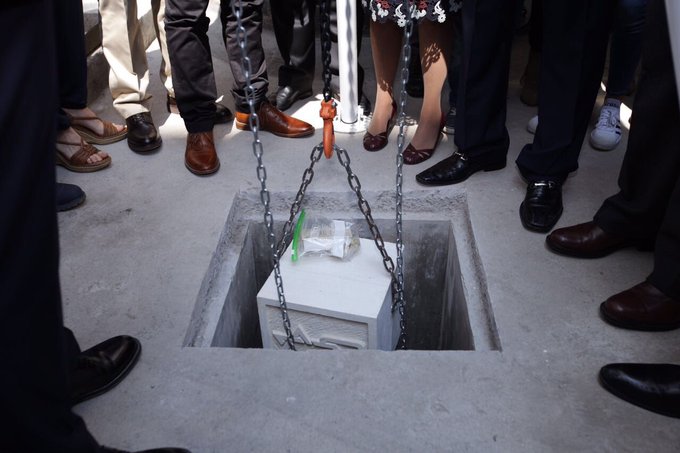
(JTA) — Mexico City Mayor Miguel Angel Mancera laid the foundation stone for the Jewish Documentation and Research Center of Mexico.
Several Mexican Jewish and non-Jewish officials attended Sunday’s ceremony to launch the new headquarters of the center. The building, located next to the historic Rodfe Sedek synagogue, is expected to open in one year.
“I was very attentive to the architectural project and saw how I could project from outside this double meaning: the history of a synagogue and the modern historical projection of a memory that will continue to call for all the Jewish people,” Mancera said, Televisa TV news channel reported.
The center will host an array of Jewish material, including general documents, photos and an audiovisual archive. In addition, it will have a library with over 20,000 books in several languages, a newspaper library, an auditorium for congresses and seminars, and classrooms, according to the Excelsior newspaper.
“According to the Jewish tradition, stone is an element that does not age, does not wither, so it is the symbol of conservation and survival, curiously the purpose of the institution that we are going to erect in this place is precisely that, a center of conservation, a center in which the history of our people survive without waning,” said Ruben Goldberg, the synagogue board’s president.
The president of the Central Committee of the Jewish Community in Mexico, Solomon Achar, and other Jewish officials stressed the importance of building the center side by side with the synagogue dating from 1931 in order to boost the concept of a Jewish meeting point that will also help preserve the history of the Jewish community in Mexico.
Mancera tweeted after the ceremony that it was an “honor” to join the Jewish community for the rite.



World Jewish Congress News Update - WJC welcomes Pennsylvania anti-BDS legislation as ‘productive and just response to counter-productive and unjust campaign’ "News updates from the World Jewish Congress website" - Monday, 07 November 2016
 WJC welcomes Pennsylvania anti-BDS legislation as ‘productive and just response to counter-productive and unjust campaign’ against Israel
New Pennsylvania law bans state-affiliated companies from boycotting Israel; the World Jewish Congress, American Section, had urged Governor Wolf to push for this legislation, and thanked him on Friday for his support.NEW YORK - World Jewish Congress President Ronald S. Lauder on Monday welcomed Pennsylvania Governor Tom Wolf’s decision to sign a bill requiring state-affiliated companies to certify that they do not boycott or discriminate against sovereign states, including Israel, calling it a “productive and just response to a counter-productive and unjust campaign against the Jewish state.”
“Governor Wolf’s diplomatic pledge to stand up against ‘economic punishment in place of peaceful solutions to challenging conflicts’ is a welcome move in the face of the discriminatory and damaging campaign being waged against Israel,” Lauder said. “Detractors of Israel single out the Jewish state for punishment, denying it of its right to sovereignty and self-defense, allowing history to be re-written rather than engaging in dialogue and a deeper understanding of the difficult situation that has faced the region for decades.”
“The World Jewish Congress thanks Pennsylvania and the other 14 US states who have taken the initiative to legislate a productive and just response to a counter-productive and unjust campaign against the Jewish state,” Lauder added. “We encourage more US states, and governments worldwide, to choose the path of peace, and cease supporting the boycott and demonization of Israel that prevent a peaceful solution to the Israeli-Palestinian conflict.”
The World Jewish Congress, American Section, had urged Governor Wolf to push for this legislation, and sent him a letter on Friday, saying, “We are heartened to see Pennsylvania affirm its support for the Jewish state – the only fully democratic country in the Middle East. As Israel’s right to exist is questioned, it is heartening to see its friends and allies rally behind it with full support.
“By not investing in those who seek to demonize Israel, we know you recognize not just Israel’s right to exist but the importance of the country’s contributions in medicine and technology and its leadership in fostering equality and opportunities for all. We appreciate your leadership in promoting the continuation of a strong relationship between the U.S. and its ally Israel," the letter concluded.
This bipartisan bill passed by an overwhelming majority of 181-9 in the Pennsylvania House of Representatives, and 47-1 in the Senate.
Alabama, Arizona, California, Colorado, Florida, Georgia, Illinois, Indiana, Iowa, New Jersey, Rhode Island, and South Carolina have passed similar resolutions, and the New York governor has issued an executive order not to engage in business with companies that boycott Israel.
 Israel asks France to cancel peace parley, calls for direct talks with PA - Jerusalem Post
07 Nov 2016 “Israel expects France not to advance an initiative or a process that is against the official stance of the state of Israel,” Netanyahu's envoys say, READ MORE »
“Israel expects France not to advance an initiative or a process that is against the official stance of the state of Israel,” Netanyahu's envoys say.
 MKs advance bill to bar BDS activists from entering Israel - Times of Israel
07 Nov 2016 Proposal that seeks to keep out individuals, groups supporting the boycott movement will now go to Knesset for vote. READ MORE »
Protesters shout slogans during a rally in Paris, France, Thursday, June 3, 2010, as they demonstrate against Israel's raid on a Gaza-bound aid ship; a man in the foreground wears a T-shirt calling for a boycott on Israel. (Jacques Brinon/ AP)
A bill seeking to bar activists from the Boycott, Divestment and Sanctions (BDS) movement from entering Israel passed a vote in the Knesset committee stage Monday, receiving the go-ahead to progress through the legislative process.
The proposal, which has received government support, would deny entry to individuals calling for a boycott of Israel or representing an NGO that does, but would allow the interior minister to make exceptions.
The Knesset Internal Affairs Committee passed the bill by 8-5 votes after a mainly even-tempered debate, interrupted only by Joint (Arab) List MK Jamal Zahalka who was ejected for shouting during the discussion. The outburst, ostensibly a protest over the lack of a clause specifically denoting Jewish activists as possible BDS supporters, appeared to be an attempt to grab headlines, coming just as television cameras entered the committee room.
Speaking during the committee session, Meretz MK Michal Rozin said the law was “completely unnecessary” and would, like other measures passed against left-wing NGOs, draw sharp criticism of Israel from abroad.
“The interior minister already has the ability to stop anti-Israel groups coming into the country. All this law does is take away his ability to make considered decisions,” she said. “It does nothing productive and will make us look bad.”
 Meretz MK Michal Rozin speaks during a committee meeting in the Knesset, December 14, 2015. (Yonatan Sindel/Flash90)
Under the current law, the interior minister already has the right to bar individuals from entering Israel. The proposed bill would entail creating a list of individuals and organizations deemed anti-Israel and would give the minister the ability to make exemptions to allow those listed into the country.
The Jewish Home party’s Bezalel Smotrich, a firebrand MK known for controversial statements against left-wing politicians and Arabs, hit back at the criticism, saying: “It’s a shame that you [opposition MKs] are always siding with the enemies of Israel.”
The proposal was first introduced by former Jewish Home MK Yinon Magal, and supported by the Ministerial Committee for Legislation on condition that the lawmakers wait for a government bill to be submitted to the Knesset on the matter. With Magal having quit the Knesset amid allegations of sexual harassment, fellow party lawmaker Smotrich — who also endorsed the bill — is leading the efforts to pass it.
It will now proceed to a first vote in the Knesset plenum after which, if it passes as expected, it will return to the committee for further deliberation.
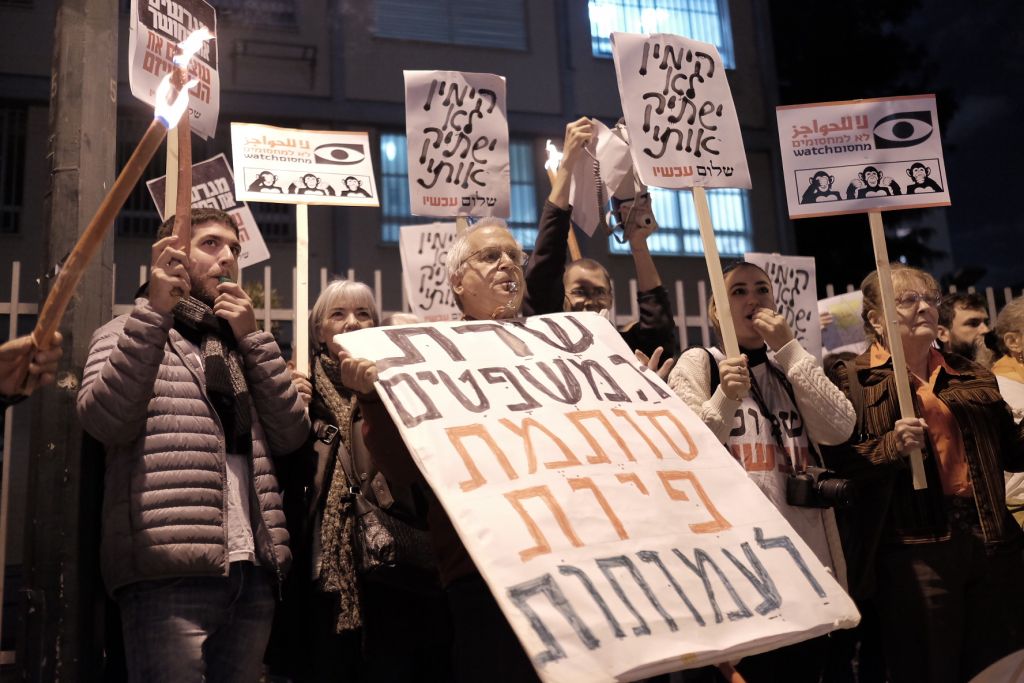
The bill follows the recent passing of the “NGO Law,” seen as targeting Israeli left-wing groups by obligating certain nonprofits to declare all their foreign funding.
 Peace Now activists protest an NGO funding bill proposed by Justice Minister Ayelet Shaked outside her residence in Tel Aviv, December 26, 2015. (Tomer Neuberg/Flash90)
That law — approved by Knesset in June — mandates that non-government organizations that receive more than half their funds from foreign governments or state agencies disclose that fact in any public reports, advocacy literature and interactions with government officials, or face a NIS 29,000 fine ($7,500).
The government has defended the NGO Law as a way to increase transparency of foreign government intervention in Israeli affairs, but it has been widely pilloried by critics in Israel and abroad who see it as targeting leftist groups and clamping down on free speech.
Supporters of the law, including one of its authors, Justice Minister Ayelet Shaked, said Monday that it was intended to create public awareness about large-scale foreign governmental intervention in Israel’s domestic politics. The law’s authors charge that advocacy groups funded by foreign governments “represent in Israel, in a non-transparent manner, the outside interests of foreign states.”
 Mexico’s Jewish envoy slammed by all sides after UNESCO vote drama - Forward
07 Nov 2016 October was a tough month for Andres Roemer, Mexico’s now former ambassador to UNESCO and a highly public, if controversial, member of Mexico’s Jewish community. READ MORE »
October was a tough month for Andres Roemer — Mexico’s now former ambassador to UNESCO and a highly public, if controversial, member of Mexico’s Jewish community.
Suddenly, last month, a rapid and complicated tangle of Middle East-related developments conspired to recast the 53-year-old star diplomat as a piñata, subject to severe whackings by both his government and his community.
The trouble began on October 13, when Mexico supported a resolution on Jerusalem at UNESCO’s executive board that Israeli and Jewish leaders decried as denying the Jewish people’s historic connection to the ancient city and to the Temple Mount, or Al-Haram Al-Sharif, as most Muslims refer to the site.
The site is revered as holy in Judaism, Christianity and Islam. But while the resolution’s introduction affirmed “the importance of the Old City of Jerusalem and its Walls for the three monotheistic religions,” the bulk of it lambasted Israel’s exercise of jurisdiction over the area as the “occupying power,” which is the status under international law that Israel has on the Temple Mount under international law in the view of most of the world community. Israel, the resolution declared, was undermining historic Muslim rights of control over Islamic holy sites there, and in the surrounding area, and demolishing ancient Arab structures of historic importance.
The resolution also referred to the site only by its Arabic name, Al-Haram Al-Sharif, which Israeli and Diaspora Jewish leaders said reflected a rejection of its role for Jews as the site of Judaism’s ancient Holy Temple.
In Mexico, Roemer was roundly criticized by many Mexican Jews for willingly casting Mexico’s vote in favor of this measure. Then, when it became clear he had actually played a more complex and ambiguous role, the government fired him.
The official reasons the government cited included, among other things, failing to communicate with superiors about the implications of the resolution, disclosing “official correspondence subject to secrecy” and “reporting to representatives of countries other than Mexico” about his vote — the last, an apparent reference to Israel.
For Mexico’s relatively small Jewish community it was an implication of dual loyalty that many took personally. But as more information came out about the circumstances surrounding the vote, and the government was perceived to be scapegoating Roemer, the community shifted and was provoked into raising its voice. The government responded, changing its vote on the resolution, after the fact, to an abstention — and even to trying, unsuccessfully, to get UNESCO’s executive board to hold a new vote on the resolution.
Now Roemer may be out of a government job, but he’s not out of work. In fact, for this ex-diplomat, his former day job might be seen as kind of a sideline. No ordinary simple government servant, Roemer is also a political analyst, an attorney, an economist, a think tank founder and the author of 16 books and two award-winning plays. In Mexico, he’s better known as a talk-show host on a major television network than as a diplomat. He’s also the founder of the City of Ideas, a TED-type festival that brings together “the best minds from around the world,” as the festival’s website declares. Hosted every year in the city of Puebla, it draws people from throughout Mexico and Central America. Director Oliver Stone, physician Deepak Chopra, anthropologist Jared Diamond and economist Paul Krugman are among the luminaries the festival has featured.
The role of ambassador to UNESCO has been historically assigned to personalities deemed fundamental in shaping Mexican culture. In this sense, Roemer’s case brings to light the rich history of individual Jews — businessmen, journalists, artists, writers — who have been actively engaged in the country’s public life. But this prominence needs also to be negotiated with the everyday insularity of Jewish communal life: More than 90% of Mexico’s 50,000 Jews attend Jewish schools, and more than 95% marry within the faith; in a country beset with crime, many of the community’s members live under tight home security and socialize largely with co-religionists under the protective roofs of communal institutions.
But when it comes to voicing its concerns, the community has an undoubted capacity to mobilize. The Central Committee, an organization whose main role is to act as a lobbying group and a protective umbrella for the community, issues press releases in times of crisis and has an ongoing and friendly relationship with the Mexican Government. Its leaders meet with the president of Mexico annually. There are also at least four Mexican Jewish news outlets that project a Jewish spin on national and international affairs. (One of them, Enlace Judío, has more followers on Facebook and Twitter than the Forward.)
It was this mixture of protection, insularity and empowerment that allowed Mexican Jews to feel safe in publicly targeting Roemer as a kind of communal Judas. They assumed he was the man on the scene at UNESCO headquarters in Geneva who played the decisive role in determining Mexico’s vote.
But on October 14, an email obtained by Enlace Judio, disclosed that Israel’s ambassador had praised Roemer for walking out of the room when the vote took place rather than cast it himself, leaving the task to a delegated underling. Still, some questioned why Roemer, given his public standing, had not just resigned as a matter of principle.
“The fact that he remained in his post and delegated the vote to his subaltern seems to me like an act of cowardliness or complicity,” wrote Alberto Mansur, a lawyer, whose comment was shared extensively on social media.
In fact, Mexico has supported Jerusalem resolutions of a similar nature that have regularly come before UNESCO for the past six years. Roemer, at the point of the most recent vote, had only been in the UNESCO post for two months. A second Enlace Judio article, published on October 17, showed that the order on how Mexico should vote came to Roemer directly from Mexico’s secretary of foreign affairs.
In the face of all this, communal consensus shifted. But in a blistering response on his Facebook page, Roemer’s son, Alejandro Roemer, said bluntly, “In these last days, the Mexican Jewish community has shown the anger and rage with which it can turn against itself.”
Saying he admired his father “now more than ever,” Alejandro Roemer went so far as to compare him to Alfred Dreyfus, the Jewish French Army captain falsely accused of spying in what became a late 19th-century cause célèbre.
“All proportions kept, I cannot help but notice the similarities with a community that now turns against one of its members and with a government [that] opportunistically sacrifices a quality public servant so as not to face its own diplomatic mishaps,” Alejandro Roemer wrote.
Meanwhile, to some in the Mexican media, the government’s sudden change of heart after the community’s outcry seemed yet more proof of the country’s lack of diplomatic tact — this, a month after Mexican President Enrique Peña Nieto’s controversial invitation to Republican Presidential nominee Donald Trump caused plenty of furor.
Julio Hernández López, a prominent columnist for the left-leaning newspaper La Jornada, called it a “dishonorable episode.” Roemer, he wrote, had come into conflict with the “very influential Jewish community,” which necessitated his departure. The columnist publicly rued the secretary of foreign affairs’ decision to then change Mexico’s vote to comport with “the Israeli position.” Hernández also repeatedly put Roemer’s title in quotation marks, suggesting that he was not representing the country for which he was working.
For all the commotion, the man at the center is already looking forward. According to sources, Roemer is back in Mexico preparing for the City of Ideas, which will take place later in November and include such guests as Adam Gopnik and comedian Maz Jobrani.
Roemer hasn’t granted any interviews, so the City of Ideas stage will be his first public appearance since the controversy erupted. But then, Roemer is never out of the spotlight for too long.
Contact Alan Grabinsky at feedback@forward.com
 German court jails far-right extremist for Auschwitz tattoo - Associated Press
07 Nov 2016 A German court sentenced a far-right politician to eight months in prison for displaying a Nazi-style tattoo, stiffening the suspended term he originally received after prosecutors appealed. READ MORE »
Tattoo on the back of far-right German politician Marcel Zech, depicting the Auschwitz death camp with the slogan from the Buchenwald concentration camp's gate, "Jedem das Seine" — "to each his own." (Screen capture: YouTube)
BERLIN — A German court has sentenced a far-right politician to eight months in prison for displaying a Nazi-style tattoo, stiffening the suspended term he originally received after prosecutors appealed.
The news agency dpa reported that the state court in Neuruppin, north of Berlin, on Monday upheld the defendant’s conviction for incitement.
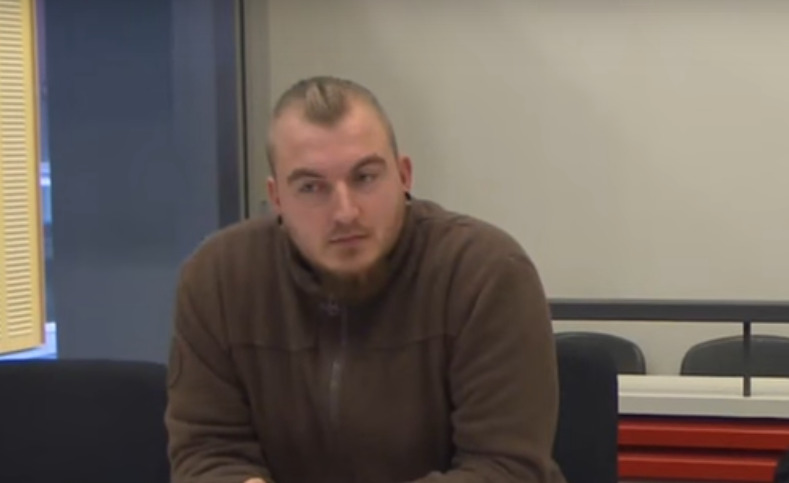
The case against Marcel Zech involves a tattoo that appeared to combine an image of the Auschwitz death camp with the slogan from the Buchenwald concentration camp’s gate, “Jedem das Seine” — “to each his own.”
The 28-year-old admitted displaying the tattoo while visiting a swimming pool. In December, a district court in Oranienburg gave him a six-month suspended sentence.
 Far-right German politician Marcel Zech sentenced to eight months in prison for adorning a tattoo of the Nazi death camp Auschwitz. (Screen capture: YouTube)
Zech, a member of the far-right National Democratic Party, also appealed that verdict and had sought an acquittal.
Copyright 2016 The Associated Press.
 Jews gather in Ukrainian city that honors alleged Holocaust perpetrators - JTA
07 Nov 2016 Nearly 1,000 people attended the largest Jewish gathering held in decades in the western Ukrainian city of Lviv, which has numerous monuments honoring Holocaust-era alleged war criminals. READ MORE »
Limmud FSU founder Chaim Chesler, right, Lviv Mayor Andriy Sadovyi, center, and Roman Kogan attending a Limmud event at the Lviv opera house, Nov. 6, 2016. (Boris Bukhman)
LVIV, Ukraine (JTA) — Nearly 1,000 people attended the largest Jewish gathering held in decades in the western Ukrainian city of Lviv, which has numerous monuments honoring alleged war criminals from the Holocaust era.
The mostly Jewish crowd of 900 on Saturday night filled the Lviv Theater of Opera and Ballet for a concert and ceremony celebrating a decade of activity by the Ukraine branch of Limmud FSU, a network of organizations responsible for holding Jewish learning conferences across the former Soviet Union and other countries with Jewish Russian speakers.
Many of the participants in the four-day event in Lviv belonged to the city’s Jewish population of 1,200, but most came from across Ukraine for the 10th anniversary event. Among those on hand was the city’s mayor, Andriy Sadovyi.
Lviv, whose pre-Holocaust Jewish population of 150,000 was virtually wiped out by the Nazis and their local collaborators, is widely seen as the cradle of the country’s nationalist revival.
In 2007, the city erected a statue for Stepan Bandera, a nationalist leader whose followers are believed to have killed thousands of Jews in the 1940s, when they briefly collaborated with Nazi Germany as members of the UPA militia. It also has a Bandera Street and since 2001, a museum commemorating Roman Shukhevych, another nationalist implicated in war crimes against Jewish Ukrainians.
The spread of official commemoration of such figures to the country’s capital, Kiev, and other cities has reignited the debate about them in Ukraine, which saw an explosion of nationalist sentiment following a revolution that in 2013 ended with the ousting of President Viktor Yanukovych, who critics said was a corrupt Kremlin stooge.
Earlier this year, more than 20 Ukrainian Jewish groups condemned the veneration of personalities connected to the murder of Jews.
The Limmud conference featured several lectures on the subject, including one by historian Oleksandr Denysenko about UPA members who saved Jews. While conceding that UPA members carried out atrocities, he noted: “Under communism, the UPA was demonized and these rescue stories were suppressed.”
In modern Ukraine, however, attempts to whitewash the UPA, including by state historians, mean that “a political narrative is once again at risk of interfering with the historical record,” he said.
The conference’s main theme, however, was neither the UPA nor the Holocaust but the centrality of the Lviv area in the establishment of Zionist youth movements in the 19th and 20thcenturies.
“Lviv has a grand Jewish history, which is also tragic and complicated,” said Chaim Chesler, the founder of Limmud FSU. “There are phenomena here which many Jews find unfortunate but the arrival here of so many Jews, and their warm reception by city authorities, send out a strong message: We are here, and our voice is heard loud and clear.”-------


For more information about the World Jewish Congress and its global efforts for world Jewry, we invite you to visit us at www.worldjewishcongress.org
This is a free service, however, if you would like to support our efforts to share this relevant and important information, you may do so with a contribution to the World Jewish Congress at www.worldjewishcongress.org/support.html
We welcome your questions and comments at: info@worldjewishcongress.org
--------
World Jewish Congress
501 Madison Avenue
New York, New York 10022, United States
-------

No comments:
Post a Comment