democracynow.org
Stories:
 U.S. Muslims Fear Hate Crimes & Overreaction by Law Enforcement in Wake of Chelsea Bombing
We host a roundtable discussion about the terrorist attacks, and the response to them, in New York, New Jersey and St. Cloud, Minnesota, where a man named Dahir Adan is accused of knifing 10 people. After police arrested 28-year-old Ahmad Khan Rahami, a suspect in Saturday’s bombings, concern has grown that the government may overreact with security measures and individuals may carry out hate crimes. "There is fear for our own personal security, especially for American Muslim women who identify as Muslim via wearing the hijab," says Debbie Almontaser, president of the Muslim Community Network. We also speak with Ramzi Kassem, professor of law at the City University of New York School of Law, where he directs the Immigrant & Non-Citizen Rights Clinic.
TRANSCRIPT
This is a rush transcript. Copy may not be in its final form.
AMY GOODMAN: On Monday, police arrested 28-year-old Ahmad Khan Rahami, a suspect in Saturday’s bombings in Manhattan and New Jersey, after a shootout in Linden, New Jersey. Rahami was injured during the shootout and taken to a hospital for surgery. He’s now been charged with five counts of attempted murder of a law enforcement officer, as well as weapons charges. Police say they identified Rahami from surveillance video.
We are broadcasting here in Chelsea, right between the two sites in the neighborhood, one on 23rd Street, which—where a bomb did explode, and four blocks away, on 27th Street, which did not explode. Police described the device on 27th Street as a pressure cooker bomb connected to a flip phone, packed with shrapnel and wired to detonate. According to law enforcement officials, his fingerprint was found on the pressure cooker bomb, along with a handwritten note that authorities say contained references to other attacks, including the Boston Marathon bombing. Authorities say Rahami may also be linked to a pipe bomb that exploded in a garbage can earlier Saturday morning in Seaside Park, New Jersey.
New details emerged about Rahami and his family throughout Monday. Rahami, born in Afghanistan, is a naturalized American citizen who was living in Elizabeth, New Jersey. He had traveled to Afghanistan, to Pakistan, and lived in Quetta for a time. He traveled several times over the last few years. During his return trips back to the United States, he went through secondary screenings at airports. On Monday, New York Mayor de Blasio called the bombings "an act of terror."
Meanwhile, in St. Cloud, Minnesota, another victim of Saturday’s stabbing attack has come forward, bringing the number of victims to 10. Authorities have not yet named the suspected attacker, who was killed by an off-duty police officer, but his family identified him as 22-year-old Dahir Adan, who was born in Kenya of Somali descent. He grew up in the United States. An ISIS website claimed responsibility, calling the assailant a "soldier of the Islamic State." Authorities say it’s being investigated as an attack of terrorism.
Well, today we’re hosting a roundtable discussion for the hour about the attacks and the response to them. We’ll go to break, and then we’ll be joined by people from Philadelphia, from St. Cloud, Minnesota, and from right here in New York. Stay with us.
[break]
AMY GOODMAN: "Almost Blue" by Chet Baker, here on Democracy Now!, democracynow.org, The War and Peace Report. I’m Amy Goodman. We’re broadcasting from the Chelsea neighborhood of New York. Police here in New York have arrested 28-year-old Ahmad Khan Rahami, the main suspect in Saturday’s bombings in Manhattan and New Jersey. Rahami was born in Afghanistan, is a naturalized American citizen. And we’re also going to be talking about the attack in St. Cloud, Minnesota, in a roundtable discussion about these attacks and the response to them.
Joining us from Minneapolis is Haji Yusuf, community director of #unitecloud, a St. Cloud group that promotes cultural understanding, who spoke Sunday at a news conference on behalf of the Somali-American community after the stabbing. In Philadelphia, we’re joined by Nazia Kazi, a professor of anthropology at Stockton University and author of the articlein The Chronicle of Higher Education headlined "Teaching Against Islamophobia in the Age of Terror." Here in New York, Dr. Debbie Almontaser joins us. She’s president of the Muslim Community Network. Back in 2007, she was forced out of her position as the founding principal of the Khalil Gibran International Academy. The Equal Employment Opportunity Commission later ruled that the New York City Department of Education discriminated against her based on her race, religion and national origin. Also joining us here in New York, Ramzi Kassem, professor of law at the City University of New York Law School, where he directs the CLEAR project, which stands for Creating Law Enforcement Accountability & Responsibility.
Well, we welcome you all to Democracy Now! We’re going to begin with Dr. Debbie Almontaser. Your response to what has happened this weekend?
DEBBIE ALMONTASER: Thank you, Amy, for having us. I have to say that this week has been really, really hard for me, as well as other American Muslims across the country, to see what is happening to our nation. And on two levels, there is, you know, fear for our own personal security, especially for American Muslim women who identify as Muslim via wearing the hijab, as well as for our city, our country. And so, it’s been a really, really hard week. But I have to say, in addition to that, there has been just a great deal of love and allyship from people across the country. I’ve received emails, I’ve received texts, just saying, "How are you? I hope everything is OK. If you need anything..." So it’s really wonderful to see our city, as well as our country, standing together united as we face these unbelievable attacks.
AMY GOODMAN: Ramzi Kassem?
RAMZI KASSEM: Yeah, I mean, we’re all—we’re all New Yorkers, of course, so no one—no one is unaffected by these events. No one is untouched. And, of course, you know, as a New Yorker, I’m thankful that no one was hurt seriously, no one was killed. So that’s really the primary thing, the first reaction that all of us as New Yorkers have. Of course, our mind then moves to, well, what happens next when these events take place. And typically, you know, what follows is usually an overreaction by policymakers, legislators, the people who implement policy, so law enforcement agencies on the ground tend to overreact. And that sets the stage for, you know, private acts of hatred, of which there have been many—and here in New York City alone, over this summer alone. And so, that’s my concern at this point, and I think it’s a concern that’s shared by many others who follow these issues and, obviously, many other American Muslims.
AMY GOODMAN: You know, from so many different people of all different ethnic groups, there is a kind of reaction when the people were being sought: Please, don’t let it be, you know, whoever they are. Your thoughts about that?
RAMZI KASSEM: Yeah, I think that’s a—that’s a natural reaction because, especially in the United States, when the backlash to incidents like this, when they have been perpetrated by Muslim-identified individuals, has so often swept far too broadly and included an overreaction by government and, obviously, acts of hate—private acts of hate by citizens, a minority of individuals who are driven to act on their prejudices and take it out, as Debbie mentioned, on women who visibly appear to be Muslim or others. I mean, in 2015, based on a recent study, anti-Islamic incidents went up by 78 percent. And this is a study that draws on official hate crime data from 20 states. So, a 78 percent increase in 2015 in anti-Islam incidents and a 219 percent jump in anti-Arab incidents targeting people who were Middle Eastern or appeared to be Middle Eastern. That’s troublesome. And that’s the thing that we’re most focused on right now.
AMY GOODMAN: Dr. Debbie Almontaser, I saw you last week, before all of this, at a public event, and you said to me how afraid you were. This was right after the woman, covered, wearing hijab, was set on fire here in New York. This is before the horror that took place this weekend in our community.
DEBBIE ALMONTASER: When I saw you last week and we had spoken, it’s quite chilling. You know, it’s quite chilling, Amy, to be on Saks Fifth Avenue shopping, window shopping, like any other, you know, person, enjoying the view, enjoying what’s out there to purchase, and standing there and having someone come from behind you and light your shirt is quite terrifying. And so, for me, as well as other American Muslim women that I have encountered and I speak to all the time, is I tell them to please be vigilant, know their surroundings, make sure that they’re traveling with other people, always be in public places where there are a lot of people, to stand in the middle of the subway platform.
And it’s not to say that we live in a dangerous city. You know, there are so many wonderful people. And just the other day, you know, yesterday, walking in the East Side of Manhattan and walking across from a woman who just looked at me and smiled. you know, that smile meant a lot to me, and it means a lot to other people. And so, there are people of good faith who are out there and who know and understand what it’s like to be an American Muslim during this political season. ... Read More →
 Professor Calls for Fighting Systemic Ignorance That Leads to Islamophobia in the Classroom
In the aftermath of several terrorist attacks over the weekend that involve Muslim suspects, we speak with professor Nazia Kazi of Stockton University about her latest article for The Chronicle of Higher Education, "Teaching Against Islamophobia in the Age of Terror." "The U.S. war on terror would not have been possible without a deep, public anti-intellectualism,” Kazi argues. “Many of my students have been fed these binaries about the free world and the unfree world, peace-loving people and terrorists.”
TRANSCRIPT
This is a rush transcript. Copy may not be in its final form.
AMY GOODMAN: I wanted to bring in Nazia Kazi, our fourth roundtable guest, professor of anthropology at Stockton University. Her latest article for The Chronicle of Higher Education, "Teaching Against Islamophobia in the Age of Terror." And as we have this discussion and all that took place this weekend in our neighborhood here in New York City in Chelsea, two bombs being placed here—one went off, 29 people injured. Then, in New Jersey, I think it was a backpack of some pipe bombs found outside an Elizabeth, New Jersey, train station. Actually, it was homeless men who found the backpack and told the police what they saw inside—wires and pipes. And also what happened in an area of New Jersey where there was going to be a race for Marine families, and the bomb went off in a trashcan, and it was only because the race was late that nobody got hurt. But, Nazia Kazi, your response?
NAZIA KAZI: Yeah, so, as an educator and someone who spends a lot of time in the university classroom, I get to see firsthand the ways in which a lot of our young people understand terror. You know, most of them have grown up in the so-called terror age, post-9/11. And the bad guys, to put it so simply, have been Osama bin Laden, ISIS, Saddam Hussein and al-Qaeda. And there is very little nuance, quite often, in their understanding of these global realities.
One of the things I find in the university classroom, and I talk about it in this piece, is the really puzzling coexistence of a deep hawkishness and a systemic ignorance. So, on the one hand, students will have very strong opinions about what the U.S. needs to do globally, but actually have very little knowledge about the histories of, say, Muslim-majority countries. And I take very seriously the fact that these things coexist. I think that the war against terrorism, the U.S. war on terror, would not have been possible without a deep, public anti-intellectualism. In other words, there’s kind of a systemic ignorance that the war on terror needs, it requires, in order to operate. Many of my students have been fed these binaries about the free world and the unfree world, you know, peace-loving people and terrorists, and have accepted these binaries wholesale. And the job for us as educators is to really—what I argue, is to insert critical thinking as a terrorism prevention tool, you know, a way of thinking past these simplistic binaries, and thinking geopolitically, historically and contextually, making connections between U.S. racism domestically and imperialism abroad.
AMY GOODMAN: We’re going to break and then come back to this discussion. Professor Nazia Kazi teaches anthropology at Stockton University. She’s speaking to us from Philadelphia. Dr. Debbie Almontaser is head of the Muslim Community Network. She’s the founding principal of the Khalil Gibran International [Academy]. Haji Yusuf is with us in Minnesota. He’s with #unitecloud in St. Cloud, Minnesota. And Ramzi Kassem is a CUNYSchool of Law professor. Stay with us. ... Read More → Could Cellphone Alerts Used to Search for New York Bombing Suspect Open Door for Attacks on Muslims?
Some New York City residents are concerned over the use of a "WANTED" alert message for the bombing suspect Ahmad Khan Rahami that was distributed automatically to millions of phones across the area Monday morning. It may be the first time in the United States that the nationwide Wireless Emergency Alerts system was used to transform residents into participants in a regionwide manhunt. It sparked widespread concerns that people, particularly Muslims and people of color, who were not Rahami could be mistaken for him and targeted. This comes as hate crimes against the Muslim community have surged nationwide, including in New York City, where just last week a Scottish tourist wearing traditional Muslim religious clothing was set on fire in the middle of 5th Avenue in broad daylight. "It really opens the door, potentially, to acts of vigilantism and to hate crimes," says lawyer Ramzi Kassem. "I was really alarmed that the authorities went ahead with this unprecedented move without really knowing what the consequences might be for individuals other than the person they were after."
TRANSCRIPT
This is a rush transcript. Copy may not be in its final form.
AMY GOODMAN: Professor Ramzi Kassem, I wanted to get your response to this alert that was issued yesterday morning. It was right before we walked into the studio, like 7:54 in the morning. It’s the "WANTED" alert message that was distributed automatically to millions of phones across New York City and New Jersey. And it said, when you look down—it was buzzing. It sounds like an alarm in every building, because everyone’s phone goes off at once. "WANTED: Ahmad Khan Rahami, 28-yr-old male. See media for pic. Call 9-1-1 if seen." It’s believed to be the first time in the U.S. that this nationwide Wireless Emergency Alerts system was used. Your response to what took place?
RAMZI KASSEM: Yeah, I mean, like you and, I think, like millions of New Yorkers, I was surprised to see that on my phone. I had never seen anything like that before. I mean, I’ve gotten the AMBER alerts in the past, and I’ve gotten similar warnings about, you know, flood alerts.
AMY GOODMAN: Right, used in—it’s believed to be the first time it was used in this way.
RAMZI KASSEM: And so, you know, I sort of did some digging and realized it was the first time it was used in this way. And my—and automatically, I started to think, "Well, what are the consequences of this?" I mean, it’s not something that they’ve studied. It’s not something that they’re doing in a deliberate way based on, you know, any research as to what the consequences might be. And on one level, I’m grateful that the individual was apprehended as quickly as he was apprehended, because we didn’t have the time to see the consequences of this sort of unprecedented alert play out, because my main concern was that it really opens the door, potentially, to acts of vigilantism and to hate crimes. And so, I was really alarmed that the authorities went ahead with this unprecedented move without really knowing what the consequences might be for individuals other than the person they were after.
AMY GOODMAN: It is not clear if this is what ultimately led to his being found in New Jersey, but that is the narrative that’s developing right now, that this went out, and a bar owner in Linden sees this guy sleeping in the alleyway, you know, a hoodie over his head. He calls police. Police come, recognize him. And as they wake him up, he immediately draws his gun, they said, and there was a shootout. He’s alive, they’re alive, and he’s now being operated on in the hospital.
RAMZI KASSEM: Yeah, I mean, but still, it is a drastic measure, and the end does not justify the means. I don’t think it’s a step that the authorities should take lightly without further study, without further consultation. And there—to my knowledge, there wasn’t much public discussion around the possibility of this sort of measure being taken in these kinds of cases. And so, where does one draw the line at this point? Who decides when this kind of measure can be taken? And again, my main concern is: Has there been enough thought dedicated to the possible unintended consequences of taking these kinds of measures in these types of cases? ...Read More → Calls to Treat Terror Suspects as "Enemy Combatants" Push U.S. Toward Totalitarianism
Republican presidential nominee Donald Trump responded to the weekend attacks by lashing out at Muslim immigrants and refugees, calling them a "cancer from within," while Democrat Hillary Clinton said Trump is helpingISIS to recruit more fighters. South Carolina Senator Lindsey Graham called for the New York bombing suspect, Ahmad Khan Rahami, to be treated as an "enemy combatant" rather than be treated as a civilian suspect. "The idea that they should all be collectively punished … is, frankly, racist. And that’s what we should call it," says lawyer Ramzi Kassem with clients held in Guantánamo. "The notion that we should generalize ... military detention, extrajudicial imprisonment is not only absurd and runs against U.S. and international law, but it is the practice of totalitarian regimes."
TRANSCRIPT
This is a rush transcript. Copy may not be in its final form.
AMY GOODMAN: We’re broadcasting from Chelsea, from New York City, that actually has just opened up in the last 12 hours on 23rd Street between Sixth and Seventh, where the bomb went off. The police, while there, have now opened the street, and TV crews and vans are all there continuing to film. We are having a roundtable discussion about the bombings in New York and the stabbing attack in Minnesota, the bombings in New Jersey, as well. And I want to return—to turn to the response of the major-party candidates, of Donald Trump, the Republican presidential nominee, who responded to the weekend attacks by lashing out at the Muslim immigrants and refugees, calling them "a cancer from within," suggested American security forces should follow Israel’s example in racial profiling. He said this during an interview on Fox News.
DONALD TRUMP: We’re going to have to hit them much harder over there, and we’re going to have to find out—you know, our police are amazing. Our local police, they know who a lot of these people are. They’re afraid to do anything about it, because they don’t want to be accused of profiling, and they don’t want to be accused of all sorts of things. You know, in Israel, they profile. They’ve done an unbelievable job, as good as you can do. We’re trying to be so politically correct in our country, and this is only going to get worse. This isn’t going to get better. And what I said is, you have to stop them from coming into the country.
AMY GOODMAN: So, let me play Donald Trump, a little more of what he had to say, and Hillary Clinton’s reaction.
DONALD TRUMP: These attacks and many others were made possible because of our extremely open immigration system. From 9/11 to San Bernardino, we have seen how failures to screen who is entering the United States puts all of our citizens—everyone in this room—at danger.
HILLARY CLINTON: We know that a lot of the rhetoric we’ve heard from Donald Trump has been seized on by terrorists—in particular, ISIS—because they are looking to make this into a war against Islam.
AMY GOODMAN: Hillary Clinton, Donald Trump. South Carolina Senator Lindsey Graham called for Ahmad Rahami to be treated as an "enemy combatant" and placed in indefinite military custody rather than be treated as a civilian suspect. It’s interesting. I heard a counterterrorism expert today on television saying that’s exactly what ISIS wants, to be treated as a military force—they have enemy combatants—and not to treat him simply as a criminal. Can you talk about this, Ramzi Kassem? What does this mean?
RAMZI KASSEM: Yeah, I mean, I think it’s really important to move past both sides of this conversation, as exemplified by Hillary Clinton and Donald Trump. Most of the conversation goes through the security lens, and so Donald Trump is arguing that Muslims are a threat to security, and Hillary Clinton is arguing that we shouldn’t discriminate against Muslims because that would endanger our security, as well. So, in other words, there’s this instrumental approach to Muslims, where we’re just a pawn in a larger security game, in a global security game. And so, I think we really have to move past that discourse. What we’re talking about are American Muslims, some who have been here for generations. Islam is not new to America. These people belong here. This is their home. The idea that they should all be collectively punished and Muslims in the future should be prevented from coming here because one Muslim happened to do something criminal is, frankly, racist. And that’s what we should call it, and it shouldn’t be debated as some kind of policy proposal. So I think that’s our starting point.
Then, when you move on to labels like enemy combatant and even the label of terrorism itself, these are labels that really impede understanding. They blind us to other possible understandings of these acts of violence, ranging from the personal to the political to the psychological. As long as we’re obsessing over who to call an enemy combatant, who to label a terrorist, we’re preventing ourselves from gaining a deeper understanding of whatever the phenomenon is. And actually, I should say "phenomena," plural, because whatever drove that young man, if he did do it, in Minnesota to whatever he did is going to be different from what drove the individual here in Chelsea to plant these bombs. And so—and so, I think, really, our understanding, going to, you know, what Nazia was saying, we have very real blinders on in this country that are preventing us from gaining a real and meaningful understanding of what is happening domestically and what is happening internationally. As someone who’s represented Guantánamo prisoners for over a decade, I can tell you that the notion that we should generalize that practice, generalize these legal practices—military detention, extrajudicial imprisonment—is not only absurd and runs against U.S. and international law, but it is the practice of totalitarian regimes.
AMY GOODMAN: Professor Nazia Kazi in Philadelphia at Stockton University, your response to what Donald Trump and Hillary Clinton had to say, and also on the point you’re making in your article "Teaching Against Islamophobia in the Age of Terror"?
NAZIA KAZI: Sure. So my response to both of these candidates responding to the events of this weekend, I mean, I think when we talk about immigration to the U.S., we need, in public discourse, a much wider conversation. I mean, if we’re talking about Somalis in Minnesota, we can’t fall back on these clichéd notions of immigrants coming here for a better life. We have to really ask about the conditions that lead to migration. And when we’re talking about Somalia, that means talking about U.S. military intervention, real political and economic policies that lead to this type of migration. So that’s absolutely critical.
And the other thing we need to be aware of in this moment is, any time things like this happen, we see this space opened up for Muslim Americans to represent themselves, to speak up. This roundtable might be an example of that. And usually what happens is one of two really tragic outcomes. One is that Muslims will repeatedly condemn ISIS. And two is that Muslim Americans will sort of wrap themselves in the American flag and position themselves as these quintessential patriots. And what happens when we engage in these type of conversations is a real diversion from the issues at hand, when we ought to be talking about the increasing role of militarization of daily life in the U.S. or the ramping up of our military apparatus abroad. And it is really the classroom that could become a space for this type of engagement.
AMY GOODMAN: Debbie Almontaser, you have been dealing in your own family with attacks on your family. You yourself aren’t now taking public transportation.
DEBBIE ALMONTASER: That’s been for the last couple of days, Amy, and it’s just, you know, being cautious, given that this attack took place right here in the city. And so, I made the decision, the conscious decision, not to travel in public transportation. But again, you know, yesterday, I was in the middle of the city in City—near City Hall. It was fine. Sometimes, you know, I have this sense to overreact, as well as others, and it’s justifiable and understandable. But we can’t live in fear. And this is something—this is something that I’m constantly telling members of my community, is that we can’t live in fear, that we’re part of this society, that we need to live our lives, and we need to be unapologetically Muslim and continue contributing to society, whether it’s in our professional field or in our communities, volunteering and doing things that we’ve been doing. And so, that’s one thing that’s really critical.
And I really appreciate what Nazia is talking about, because just today there was an op-edthat was published in the Gotham Gazette that I had actually written about using the classroom as a place for teachable moments and to make sure that we address racism and bigotry, and, given the number of hate crimes that have taken place locally and nationally, how important it is for teachers to establish a caring and nurturing environment where children could feel free to speak their minds and know that their fellow students are there to support them and that they’re allies and upstanders, versus being bystanders, when something happens in the school cafeteria or the schoolyard.
AMY GOODMAN: You know, it’s interesting, one of the things that have come out in the last 24 hours about Ahmad Khan Rahami is that years ago his sister filed a complaint with the police around domestic violence. And we’re finding this so much—now, she recanted that, but in a number of these cases—that the first signs are violence within the family, whether it’s Omar Mateen attacking his wife, who shot up the Pulse nightclub and led to so much pain and misery, that actually it is taking domestic violence seriously at the beginning that might be preventative.
DEBBIE ALMONTASER: It certainly is. And the thing that’s disturbing, Amy, is that what we see constantly is when we see that there are mental health issues that are brought up, immediately that narrative is changed. And so, for example, right here in New York City, I was very perturbed by the notion of some of our elected officials saying we’re not calling this a terrorist attack. Why aren’t we calling it a terrorist attack? It is a terrorist attack. When someone seeks to terrorize people by putting bombs anywhere, that is terrorism. And so, waiting and holding back on it, as if to say we’re waiting to see if it was a Muslim, therefore calling it a terrorist act, is really unfortunate, and it really puts American Muslims in a position that makes people wonder, "Is Islam inherent to violence and terrorism?" And that’s not the case. And it’s really important for us to work very hard in changing that narrative and changing the language. When something does happen, we have to call it what it is. Whether it’s a Christian, a Muslim, a Jew, anyone who does anything in the name of violence against people, we need to call it out.
AMY GOODMAN: I wanted to ask our guest in Philadelphia, Nazia Kazi, how you use the classroom to teach against Islamophobia.
NAZIA KAZI: Yes. This is kind of an evolving strategy as I develop ways to relate current events that are happening in real time to a classroom. And I think one of the things is to really regard these tragic events as teachable moments, as moments to really get our students to pause and deliberately reflect upon the nature of our—the world around us. A perfect example of this was last year when the Paris attacks happened. A really fruitful classroom conversation took place about why there was a Facebook solidarity filter with the French flag, but not one with the Lebanese flag. And that led to a really remarkable conversation about race and the value of white victims, really.
I also think that, as I said earlier, we need to inject critical thinking into the dialogue. We need to get away from sort of knee-jerk vengefulness—right?—and think very broadly about the U.S.’s role as an imperialist superpower. I mean, my students are surprised when they learn about, you know, everything from Iran-Contra to what you said at the top of the show about white phosphorus being supplied to Saudi Arabia. And these types of moments in the classroom really lead to a way more fruitful dialogue than just clichéd notions about Islam being a religion of peace or Muslims worshiping the same God as Christians and Jews. It leads to a far more fruitful conversation when we begin to think geopolitically.
AMY GOODMAN: Ramzi Kassem, final word?
RAMZI KASSEM: You know, my hope, again, in the coming week—and I’m sure my hope’s going to be dashed—is that this time lawmakers and policymakers won’t come out with harebrained proposals to reform our way our immigration laws are implemented and that this time law enforcement agencies like the FBI and the NYPD won’t descend on entire communities rather than conduct their work in a more targeted fashion. But again, I’m sure that my hope is going to be dashed. Time and again, every time something like this happens, be it in New York or overseas or elsewhere in the United States, there’s no shortage of people, dozens of people, who will come into our offices at CLEAR saying, for example, that they’re being approached for questioning by the FBI, even though they have no connection to what happened.
AMY GOODMAN: We have to leave it there. We’ll continue the conversation. I want to thank Ramzi Kassem, CUNY law professor; Nazia Kazi, who is at Stockton University; Debbie Almontaser, thanks so much for joining us. And I want to thank our guest in Philadelphia, Haji Yusuf. Thanks so much. ... Read More → Large Somali-American Community in St. Cloud Concerned About Backlash After Knife Attack
To discuss community and police response to the knife attack on 10 people in St. Cloud, we go to Minnesota to speak with Haji Yusuf, community director of #unitecloud, a St. Cloud group that promotes cultural understanding. Authorities say the attacker, 22-year-old Dahir Adan, was born in Kenya, is of Somali descent and grew up in the United States. An ISIS website has claimed responsibility, calling the assailant a "soldier of the Islamic State." Authorities say the attack is being investigated as terrorism. Yusuf says many members of the Somali community have called him to report harassment, and others are keeping their children out of school. "Even for me, I had to go pick up milk for my two-year-old because my wife was a little scared to go out that night."
TRANSCRIPT
This is a rush transcript. Copy may not be in its final form.
AMY GOODMAN: I want to go to Minnesota, where another attack took place this weekend. A man in St. Cloud walks into a local mall and, according to reports, knifed 10 people, and he’s shot dead by a security guard. I wanted to turn right now to Haji Yusuf, who is the community director of the #unitecloud, a St. Cloud group that promotes cultural understanding. On Sunday, you spoke at a news conference on behalf of the Somali-American community. Talk about who the man is, who’s believed to have knifed all these people, identified by his family. He has been killed.
HAJI YUSUF: Dahir Ahmed is an exceptional—Dahir Adan is an exceptional student, graduated high school at his local high school, went to college at St. Cloud State University. A very, very joyful young kid, happy, always smiling, very social, outgoing. And so, on that fateful day, from what I gathered from the family in the early morning after, is that he went out to buy a new iPhone 7. And when he left, he was really, really happy. And they had not any suspicion or anything that told them otherwise. He went out there, and they don’t know what happened after that. So that is the last moment that they saw their son go out to go to the mall to buy an iPhone.
AMY GOODMAN: What do you believe then took place?
HAJI YUSUF: As a community, you know, the whole community of St. Cloud, first of all, you know, we are with the victims, because they are victims. So, we still don’t know what happened. And so, we are with the victims, and we pray for the victims, and we stand with the victims in and around St. Cloud, and also in the state of Minnesota. You know, it’s a shocker. Everyone is shocked in the community, regardless what part of our community you are and who you are or whatever group you come from. Everyone is really shocked and surprised, and people are looking for answers.
And right now, at the moment, you know, what the family is requesting is—what we know right now so far is what the witnesses have said and what the law enforcement have also informed us, that there’s a security tape. And the family also is looking for answers, as well. They also want to see those security tapes and see what happened, really, so they can really understand. At least, you know, they can know what happened to their son.
AMY GOODMAN: Police have confirmed that his name is Dahir Ahmed Adan, and an ISISwebsite has claimed responsibility, calling the assailant a "soldier of the Islamic State." Authorities say that the attack is being investigated as a case of terrorism. Again, he was shot dead by an off-duty police officer. So talk about how the Somali community is dealing with this in the greater Minneapolis-St. Paul-St. Cloud area. Is this one of the largest populations of Somalis? I mean, the young man was born in Kenya but is of Somali descent. Is this one of the largest populations of Somalis in the United States?
HAJI YUSUF: Yes. I mean, we have a population of Somalis, Muslims, that live in the state of Minnesota. As you know, I think people have come together on this occasion, because they, the Somalis in the state of Minnesota, do care about the state of Minnesota. They love the state. They live here. This is their home. They don’t know—they don’t have any other home. They know that they have been welcomed, they have been greatly welcomed to the state of Minnesota. The state of Minnesota has opened its arm for a lot of other immigrants and many people of religious belief. There is also the historical part of, you know, a lot of groups coming to this country. And there’s a book, I say—there’s a book that is being written about the story of this country and the history of this country. And then—and the Somali story, Somali-American story, is part of that book that continues to be written about this country and how great this country is and has welcomed a lot of people to come to this country.
With that said, we have come together as a community with our allies, with different groups and different religious, faith-based groups and everyone, rallied behind this one issue. We also want to deal with this issue in a way that we are working with the law enforcement. We are working with other communities around the state of Minnesota and in central Minnesota. And once we get answers and we know what happened, then we want to respond together as a community, not as a group, but as a community, because we have all been affected by this incident.
And it’s not a definition of a community when one person or two people do this. It does not mean that the whole community is for that. It basically means, is—you know, as you know, sometimes there’s evil in every community. And evil walk among us all the time. And there is incidents of evil that has happened in central Minnesota a couple of weeks ago, when we had a man by the name of Dan Heinrich kidnapped Jacob Wetterling, and for 27 years Dan has been terrorizing the state of Minnesota. People are afraid for their kids. So, it’s one incident. And nobody went back and asked for—to explain why—nobody went back and said, "Is Danny a Christian? Is he—what faith group is he in? What group does he come? What part of central Minnesota he lived in?" So—and there was not a lot of international media. But this one incident has just put St. Cloud on the spot, has put the state of Minnesota on the spot, has put the Somali-American community on the spot. And we have to come out. And working with our state, working with our law enforcement, working with everyone involved, we need to find answers what really happened that day.
AMY GOODMAN: I mean, that’s a really significant point. When Timothy McVeigh, for example, blew up the Oklahoma City building, white Christian men were not rounded up around the country, or a whole questioning of what does this mean about white men who are Christian. It was dealt with as a crime.
HAJI YUSUF: Right.
AMY GOODMAN: Now, Jaylani Hussein, the executive director of the Minnesota chapter of the Council on American-Islamic Relations, CAIR, told The Wall Street Journal that he and other Muslims had received threats in the wake of the stabbing. He also said that a car flying a Confederate flag had been driving around Somali neighborhoods on Sunday night harassing residents. Do you know anything about this?
HAJI YUSUF: Oh, yeah, I tweeted that out, once I got—I get a lot of calls from the community and from everyone. As part of #unitecloud, you know, we work with everyone in our community. And we not only speak of—we don’t only speak for any one group; we speak for everyone. We speak on issues of homelessness. We speak on issues of feeding our neighborhood and taking care of our neighbors. And it’s two people that have started this organization. I’m a Muslim, a Somali American. Natalie Ringsmuth is a Christian, a conservative Christian, that was born and raised in St. Cloud. So, we have come together in saying that, too. So, when we get—we get a lot of information from the community in the tweet or our inbox, or we get a call. And we got a call that there were about eight vehicles driving around St. Cloud, downtown St. Cloud, and in, around Somali neighborhoods, Somali-American neighborhoods and other neighborhoods where Muslims live. And they were just honking, threatening, verbally abusing.
I’ve heard of incidents on Highway I-94 where a Somali-American girl and her family wearing hijab got harassed by two or three bikers. And so, we get these calls right now. Even as far as the next day, on Monday, there was a lot of Somali-American families that did not take their kids to school, did not want to go outside the house, because they were really afraid. They were really—kids were really scared. Everyone was really scared. So, it was a scary moment. Even for me, I had to go pick milk for my two-year-old, because my wife was a little bit scared to go outside that night. So, you have that going on.
And so—and the best way to do it is for us to rally behind other faith groups in central and St. Cloud and leadership, so that we can respond together, working with the police chief, working with the mayor, working with the leadership in St. Cloud, and also, generally, the law enforcement, because we really want to know, because that’s the only way we can really work this out. And we want to support all leadership involved to get to the bottom of this, to know the truth and really what happened. And that’s the only way we can go about this.
First of all, also, as a community, if indeed it’s proven, if indeed there are facts supporting that young Dahir Adan—first of all, this is his own individual action, so he does not represent myself or anybody that I know in the state of Minnesota who’s Somali-American. That’s one. Two, if indeed it’s proven that Mr. Dahir Ahmed Adan was behind this and that he had a connection to a nonterrorist organization from outside, then we have a problem in our community, and we need to admit that. And we need to find out ways and how to deal with that problem. We cannot keep on living—we cannot keep on living in denial that there’s problems, because we know, in any community, there are issues, and people need to deal with it and find, before it’s too late and we have more issues or something like this happening in a larger scale. So, we have to work with our neighbors. We have to work with our community. We have to work with our state. We have to work with law enforcement. We have to find solution together and respond together. I think that is important. Most of the time you have people who want to respond things in many different ways. It confuses people. People really don’t understand what is the motive of some other people, you know?
AMY GOODMAN: I wanted—
HAJI YUSUF: But at the end of the day is—go ahead. ...Read More →Headlines:
Details Emerge About Ahmad Rahami, Suspect in NY & NJ Bombings
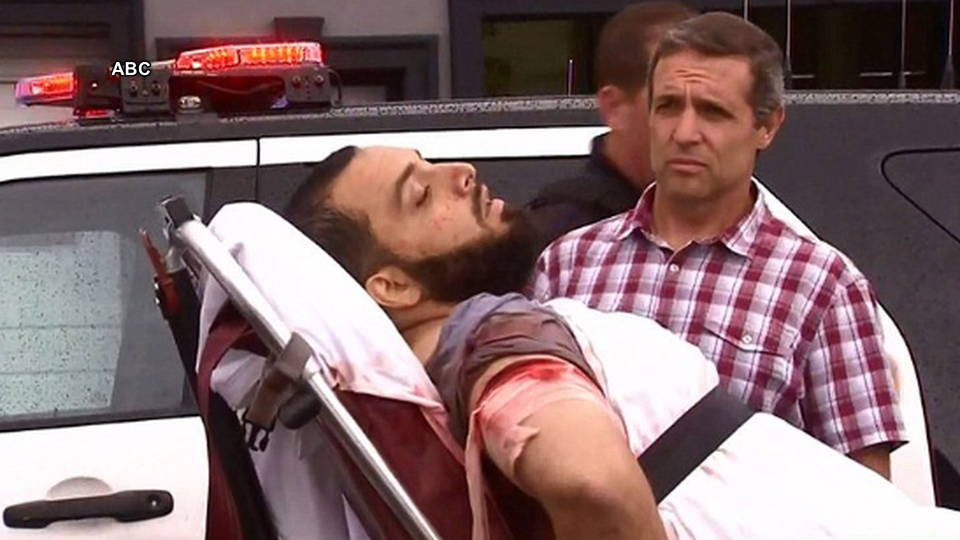 On Monday, police arrested 28-year-old Ahmad Khan Rahami, the main suspect in Saturday’s bombings in Manhattan and New Jersey, after a shootout in Linden, New Jersey. Rahami was injured during the shootout and taken to a hospital for surgery. Authorities say multiple police officers were also injured. He’s now been charged with five counts of attempted murder of a law enforcement officer, as well as weapons charges. Police say they identified Rahami from surveillance video which showed him at both sites in Manhattan where bombs were planted—on 23rd Street, where a bomb did explode, and four blocks away, on 27th Street, where a bomb did not explode. Police described that device as a pressure cooker bomb connected to a flip phone, packed with shrapnel and wired to detonate. According to law enforcement officials, his fingerprint was found on this pressure cooker bomb, along with a handwritten note that authorities say contained references to other attacks, including the Boston Marathon bombing. Authorities say Rahami may also be linked to a pipe bomb that exploded in a garbage can earlier Saturday morning in Seaside Park, New Jersey. New details emerged about Rahami and his family throughout Monday. Rahami was born in Afghanistan and is a naturalized American citizen who was living in Elizabeth, New Jersey. He had traveled to Afghanistan and Pakistan several times in recent years, and he lived in Quetta for a time. During his return trips back to the United States, he went through secondary screenings at airports. His family runs the restaurant First American Fried Chicken in Elizabeth, New Jersey. His family filed a lawsuit in 2011 against the city of Elizabeth after it forced the restaurant to stop operating 24 hours a day. In the lawsuit, the family said they’d been discriminated against and harassed by police officers, city representatives and a neighboring business owner, who they alleged said, "Muslims don’t belong here." Rahami’s family lost the lawsuit. Other details emerged Monday about a domestic abuse charge against Rahami, filed by his sister, who later recanted. New York Congressmember Peter King, who was briefed by the FBI, said Rahami once attempted to stab his sister. On Monday, New York Mayor Bill de Blasio called the bombings an "act of terror."
 In reaction to the weekend bombings, Republican presidential nominee Donald Trump lashed out at all Muslim immigrants and refugees, calling them a "cancer from within," and suggested that American security forces should follow Israel’s example in racial profiling, during an interview on Fox News.
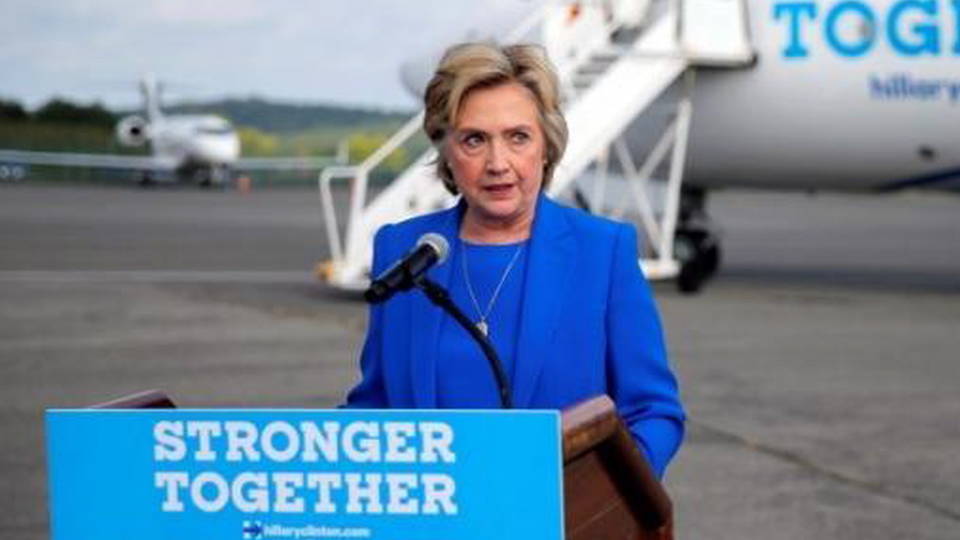 Democratic presidential candidate Hillary Clinton, meanwhile, took aim at Donald Trump, saying his rhetoric was helping non-state terrorist groups.
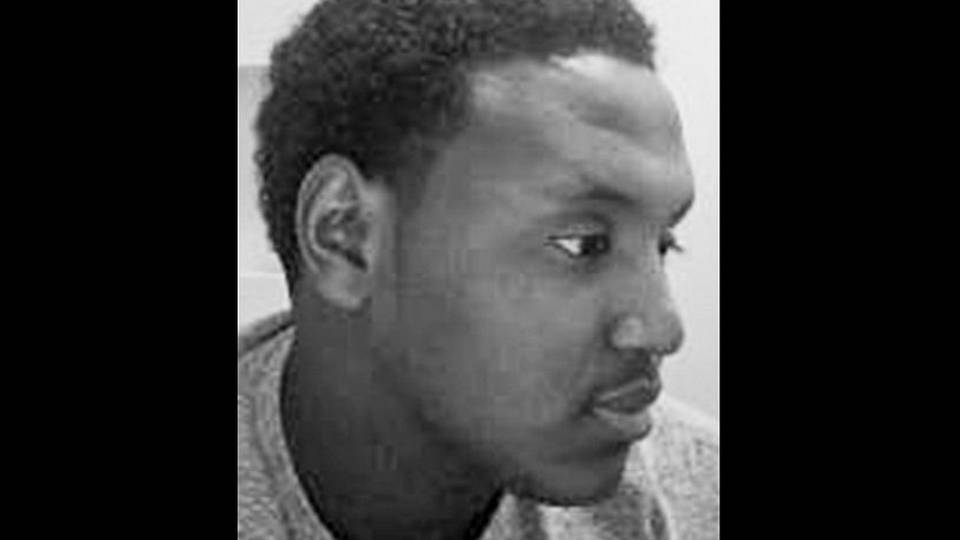 Meanwhile in St. Cloud, Minnesota, another victim of Saturday’s stabbing attack has come forward, bringing the number of victims to 10. Authorities this morning have confirmed his identity as 22-year-old Dahir Ahmed Adan, who was born in Kenya of Somali descent and who grew up in the United States. He was shot dead by an off-duty police officer on Saturday. An ISIS website claimed responsibility, calling the assailant a "soldier of the Islamic State." Authorities say it’s being investigated as terrorism.
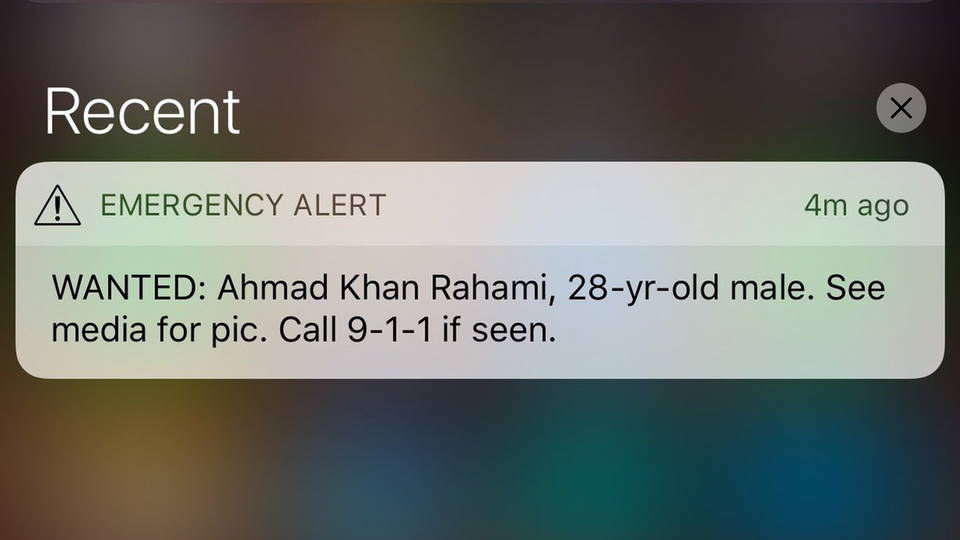 Meanwhile, back here in New York City, residents are expressing mixed reactions, with some expressing outrage and concern, over the use of a "WANTED" alert message that was distributed automatically to millions of phones across New York City and New Jersey Monday morning reading: "WANTED: Ahmad Khan Rahami, 28-yr-old male. See media for pic. Call 9-1-1 if seen." It’s believed to be the first time in the United States that the nationwide Wireless Emergency Alerts system was used to transform residents into participants in a regionwide manhunt. It sparked widespread concerns that people, particularly Muslims and people of color, who were not Rahami could be mistaken for him and targeted. This comes as hate crimes against the Muslim community have surged nationwide, including in New York City, where just last week a Scottish tourist wearing traditional Muslim religious clothing was set on fire in the middle of 5th Avenue in broad daylight. We’ll have more on this weekend’s bombings and the impact on the Muslim American community during a roundtable discussion for the hour with Haji Yusuf in St. Cloud, Nazia Kazi in Philadelphia, and Dr. Debbie Almontaser and Ramzi Kassem here in New York City.
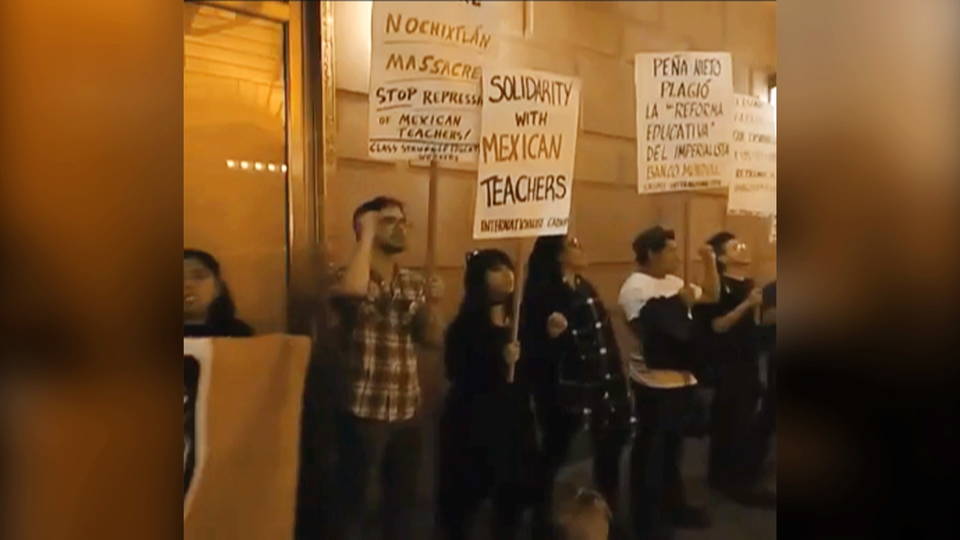 President Obama and other world leaders are in New York City for the annual United Nations General Assembly. On Monday night, Mexican President Enrique Peña Nieto faced protest from scores of activists outside the St. Regis Hotel in Manhattan, where he was speaking at a dinner hosted by the Foreign Policy Association. The activists condemned the Mexican government for attempting to cover up and derail the investigation into the disappearance of 43 students in the southern state of Guerrero. Monday will mark the second anniversary of the students’ disappearance. There are also protests planned against Israeli Prime Minister Benjamin Netanyahu over the Israeli occupation of the Palestinian territories, and against Zimbabwe President Robert Mugabe over police brutality and government corruption, later in the week.
 The global refugee crisis took center stage at the United Nations General Assembly Monday, when 193 member states met for the first-ever Summit for Refugees and Migrants. They signed a nonbinding declaration outlining a more coordinated and humane response to the biggest migration upheaval since World War II. This comes as several countries rejected an earlier draft of the summit’s declaration that urged them to resettle 10 percent of the refugee population each year. The United States also objected to language in the original draft that said children should never be detained. The agreement now says children should "seldom, if ever, be detained" and calls it a "measure of last resort." This comes as teenagers held at the Berks County Residential Center—an immigrant family jail in Pennsylvania—are protesting their indefinite detention. Some have been held for more than a year while they seek asylum with their mothers, who are also detained. This is 16-year-old Estefany Adriana Méndez from El Salvador responding to the U.S.’s insistence on changing the language of the summit’s declaration.
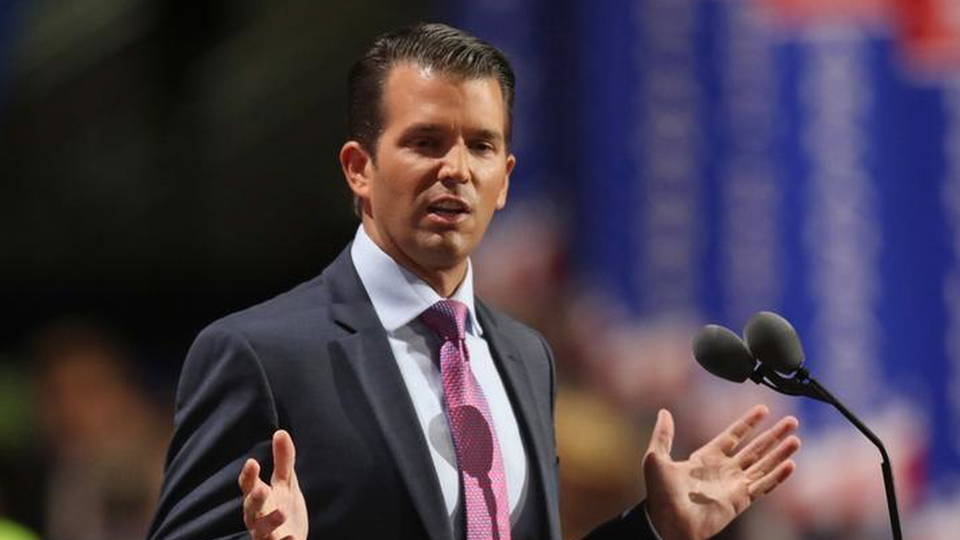 Donald Trump’s son, Donald Trump Jr., has sparked outrage after he tweeted a graphic, reading: "If I had a bowl of Skittles and I told you just three would kill you. Would you take a handful? That’s our Syrian refugee problem." Along with the graphic, he tweeted the words: "This image says it all." In response, Skittles’s parent company Wrigley Americas said in a statement: "Skittles are candy. Refugees are people. We don’t feel it’s an appropriate analogy. … We will respectfully refrain from further commentary as anything we say could be misinterpreted as marketing."
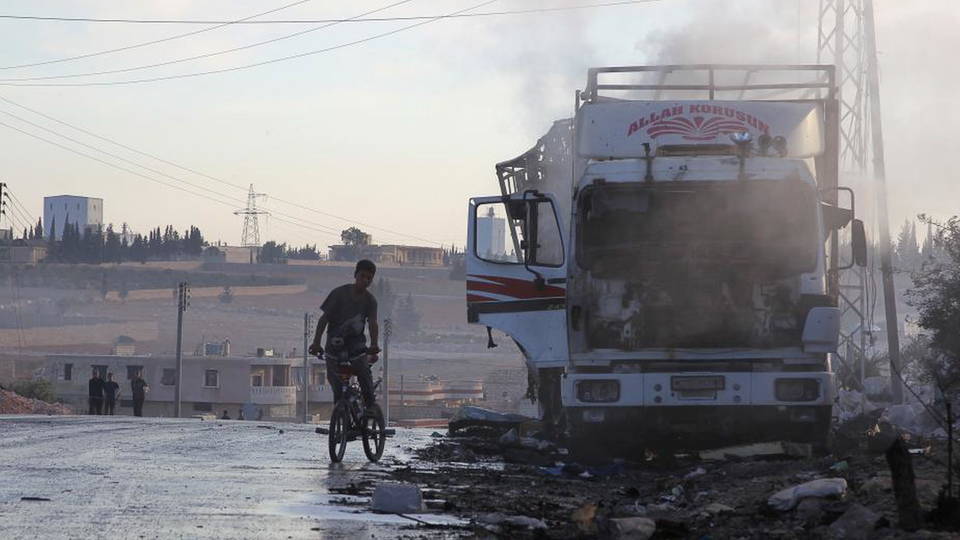 Meanwhile, in Syria, the United Nations has suspended all aid after its aid convoys were attacked by warplanes on Monday outside Aleppo. At least 18 of the convoys were destroyed in the attack, which came as aid workers were unloading food and other supplies at a Red Crescent warehouse. The Red Cross says 20 people were killed in the attack. The Red Cross condemned the attack as a "flagrant violation of international humanitarian law." The U.N. says it may amount to a war crime. It’s not known who carried out the attack. This comes as the ceasefire brokered between the U.S. and Russia aimed at decreasing the fighting in Syria and allowing for aid to reach besieged areas appears to have collapsed, after U.S.-led bombers attacked a Syrian military position on Saturday, killing scores of government soldiers and allowing ISIS fighters to overrun the survivors.
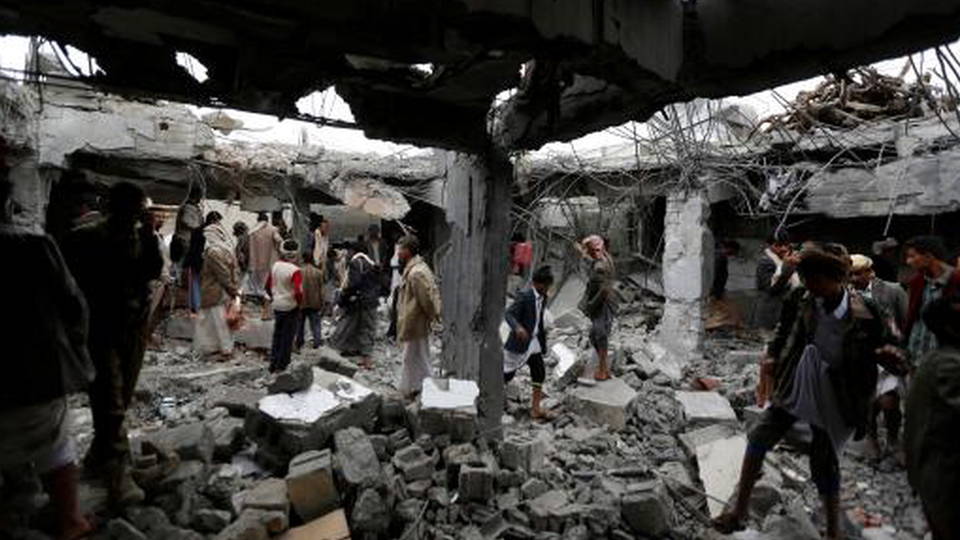 In news from Yemen, new reports suggest Saudi Arabia may be using U.S.-supplied white phosphorus in its ongoing bombing campaign. White phosphorus is a deadly munition that releases a thick smoke that is so powerful it can burn flesh to the bone. U.S. law says white phosphorus is only allowed to be used for signals and creating smoke screens when the U.S. sells it to other countries. But human rights activists are concerned the Saudis may be using it against civilians in Yemen, which would be illegal under U.S. law.
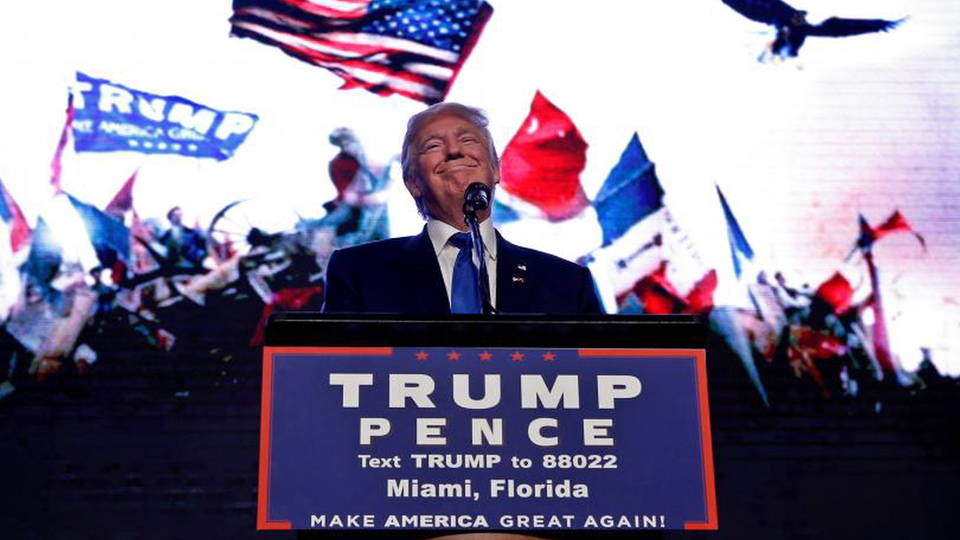 In news from the campaign trail, a new investigation of Donald Trump’s tax plan, which he unveiled last week at the New York Economic Club, finds it would create huge tax breaks for the rich, and only much smaller tax breaks for low- and middle-income families. The analysis was done by the D.C. think tank the Tax Foundation. It estimates that under Trump’s plan people earning $5 million could save a staggering $800,000 on their taxes each year. The foundation also found his plan to be enormously expensive, costing at least $10 trillion over a decade. This comes as a New York Times investigation has found that Donald Trump has received at least $885 million in New York City tax breaks for his real estate projects since 1980. The Times also reports Trump successfully sued three mayoral administrations when the city sought to deny him tax breaks for a pair of Trump skyscrapers.
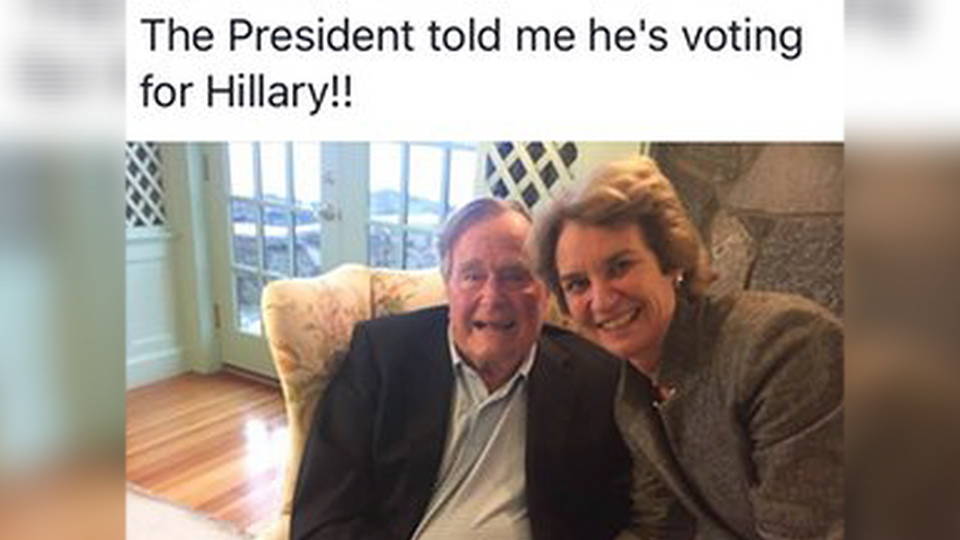 In more campaign news, former President George H.W. Bush may be voting for Hillary Clinton in the fall. The news comes from Kathleen Kennedy Townsend, who posted on Facebook a picture of herself with President Bush and the words: "The President told me he’s voting for Hillary!!”
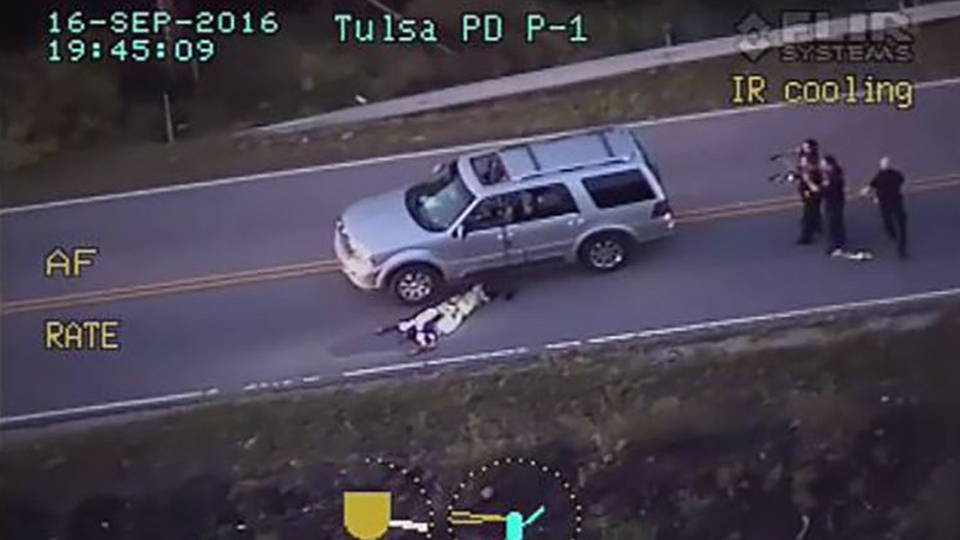 In Tulsa, Oklahoma, police have released a video showing a white police officer shooting and killing unarmed 40-year-old African American Terence Crutcher while his hands were in the air. Officer Betty Shelby shot Crutcher around 8 p.m. on Friday, after his car broke down. Some of the video released Monday came from police helicopter footage, in which one can hear the man in the helicopter saying about Crutcher, "That looks like a bad dude, too." Other footage from police dash cam video shows Crutcher walking away from officers with his hands in the air, then putting his hands on the side of his own car, as he’s surrounded by officers. The video captures a voice coming over the police radio saying, "He’s just been tasered," and then a woman’s voice yelling "Shots fired," as the video shows Crutcher’s arms falling to the pavement. The Justice Department says it’s investigating the shooting as a possible civil rights violation.
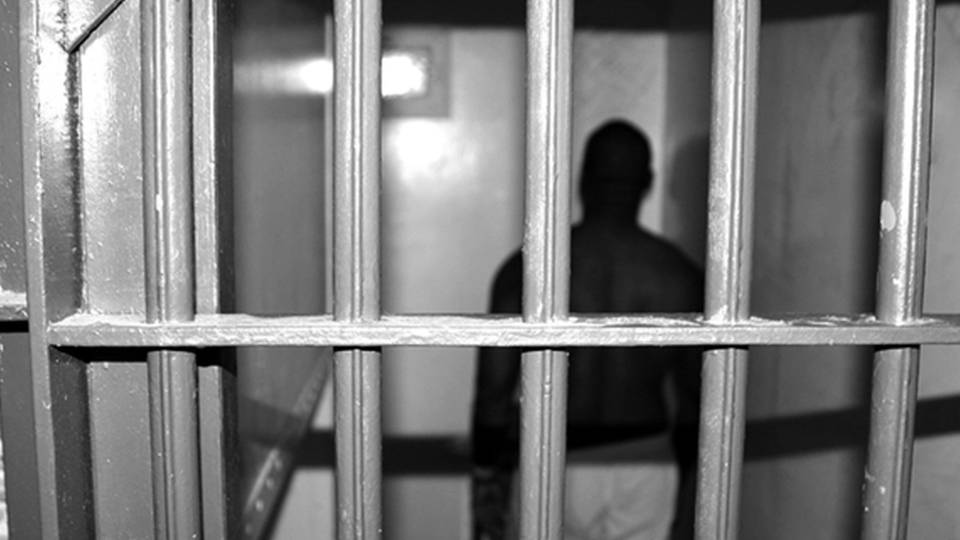 The largest prison work strike in U.S. history has entered its third week. The Intercept reports that as of last week at least 20 prisons in 11 states continued to protest, including in Alabama, California, Florida, Indiana, Louisiana, Michigan, New York, Ohio, South Carolina and Washington. The Incarcerated Workers Organizing Committee says at one point about 20,000 prisoners were on strike. With protest has come punishment. Several facilities were put on lockdown, with prisoners kept in their cells and denied phone access both before and during the strike. Organizers were also put in solitary confinement. Meanwhile, members of the Free Alabama Movement say a serious humanitarian crisis is developing at Holman prison, where guards have been walking off the job amid safety concerns and overcrowding. Prisoners say there are stabbings on a regular basis, and call the facility “the slaughterhouse.” A guard stabbed by a prisoner earlier this month died last week. The warden was stabbed in March.
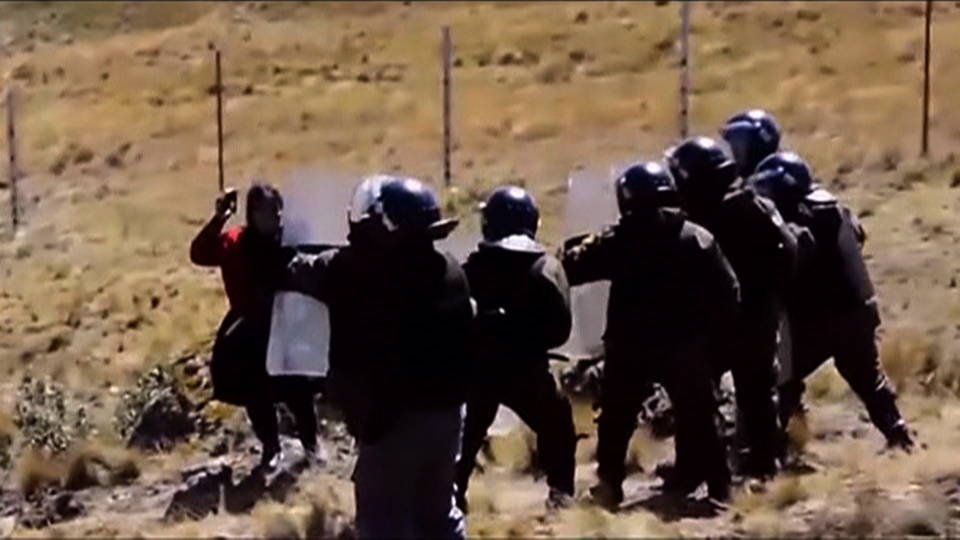 And in Peru, an activist who won this year’s prestigious Goldman Environmental Prize has been injured in a clash with security guards. The incident took place Sunday at a gold mine run by a subsidiary of the U.S.-based mining giant Newmont. Máxima Acuña has tried to block the company Yanacocha from constructing an open-pit gold mine in an agricultural area, where it could contaminate the water supply and cause water shortages for thousands of people. Supporters say Acuña and her partner were severely hurt after an attack by hit men allegedly hired by the mining company. This is her daughter, Ysidora Chaupe.
Donate today:
And in Peru, an activist who won this year’s prestigious Goldman Environmental Prize has been injured in a clash with security guards. The incident took place Sunday at a gold mine run by a subsidiary of the U.S.-based mining giant Newmont. Máxima Acuña has tried to block the company Yanacocha from constructing an open-pit gold mine in an agricultural area, where it could contaminate the water supply and cause water shortages for thousands of people. Supporters say Acuña and her partner were severely hurt after an attack by hit men allegedly hired by the mining company. This is her daughter, Ysidora Chaupe.
Donate today:
Follow:


DN! IN THE NEWS
On Monday, police arrested 28-year-old Ahmad Khan Rahami, the main suspect in Saturday’s bombings in Manhattan and New Jersey, after a shootout in Linden, New Jersey. Rahami was injured during the shootout and taken to a hospital for surgery. Authorities say multiple police officers were also injured. He’s now been charged with five counts of attempted murder of a law enforcement officer, as well as weapons charges. Police say they identified Rahami from surveillance video which showed him at both sites in Manhattan where bombs were planted—on 23rd Street, where a bomb did explode, and four blocks away, on 27th Street, where a bomb did not explode. Police described that device as a pressure cooker bomb connected to a flip phone, packed with shrapnel and wired to detonate. According to law enforcement officials, his fingerprint was found on this pressure cooker bomb, along with a handwritten note that authorities say contained references to other attacks, including the Boston Marathon bombing. Authorities say Rahami may also be linked to a pipe bomb that exploded in a garbage can earlier Saturday morning in Seaside Park, New Jersey. New details emerged about Rahami and his family throughout Monday. Rahami was born in Afghanistan and is a naturalized American citizen who was living in Elizabeth, New Jersey. He had traveled to Afghanistan and Pakistan several times in recent years, and he lived in Quetta for a time. During his return trips back to the United States, he went through secondary screenings at airports. His family runs the restaurant First American Fried Chicken in Elizabeth, New Jersey. His family filed a lawsuit in 2011 against the city of Elizabeth after it forced the restaurant to stop operating 24 hours a day. In the lawsuit, the family said they’d been discriminated against and harassed by police officers, city representatives and a neighboring business owner, who they alleged said, "Muslims don’t belong here." Rahami’s family lost the lawsuit. Other details emerged Monday about a domestic abuse charge against Rahami, filed by his sister, who later recanted. New York Congressmember Peter King, who was briefed by the FBI, said Rahami once attempted to stab his sister. On Monday, New York Mayor Bill de Blasio called the bombings an "act of terror."Mayor Bill de Blasio: "Based on the information we have now, we have every reason to believe this was an act of terror."
TOPICS:
After Bombings, Trump Calls Muslim Immigrants "Cancer from Within"
In reaction to the weekend bombings, Republican presidential nominee Donald Trump lashed out at all Muslim immigrants and refugees, calling them a "cancer from within," and suggested that American security forces should follow Israel’s example in racial profiling, during an interview on Fox News.Donald Trump: "We’re going to have to hit them much harder over there, and we’re going to have to find out—you know, our police are amazing. Our local police, they know who a lot of these people are. They’re afraid to do anything about it, because they don’t want to be accused of profiling, and they don’t want to be accused of all sorts of things. You know, in Israel, they profile. They’ve done an unbelievable job, as good as you can do. We’re trying to be so politically correct in our country, and this is only going to get worse. This isn’t going to get better. And what I said is, you have to stop them from coming into the country."
Hillary Clinton Says Donald Trump's Rhetoric Is Aiding ISIS
Democratic presidential candidate Hillary Clinton, meanwhile, took aim at Donald Trump, saying his rhetoric was helping non-state terrorist groups.Hillary Clinton: "We know that a lot of the rhetoric we’ve heard from Donald Trump has been seized on by terrorists—in particular, ISIS—because they are looking to make this into a war against Islam, rather than a war against jihadists, violent terrorists, people who number in the maybe tens of thousands, not the tens of millions. They want to use that to recruit more fighters to their cause by turning it into a religious conflict."
South Carolina Senator Lindsey Graham called for Rahami to be treated as an "enemy combatant" and placed in indefinite military custody rather than be treated as a civilian suspect.
St. Cloud: Authorities Name Stabbing Suspect as Dahir Ahmed Adan
Meanwhile in St. Cloud, Minnesota, another victim of Saturday’s stabbing attack has come forward, bringing the number of victims to 10. Authorities this morning have confirmed his identity as 22-year-old Dahir Ahmed Adan, who was born in Kenya of Somali descent and who grew up in the United States. He was shot dead by an off-duty police officer on Saturday. An ISIS website claimed responsibility, calling the assailant a "soldier of the Islamic State." Authorities say it’s being investigated as terrorism.TOPICS:
New Yorkers Express Concern over Use of Mass WANTED Alert
Meanwhile, back here in New York City, residents are expressing mixed reactions, with some expressing outrage and concern, over the use of a "WANTED" alert message that was distributed automatically to millions of phones across New York City and New Jersey Monday morning reading: "WANTED: Ahmad Khan Rahami, 28-yr-old male. See media for pic. Call 9-1-1 if seen." It’s believed to be the first time in the United States that the nationwide Wireless Emergency Alerts system was used to transform residents into participants in a regionwide manhunt. It sparked widespread concerns that people, particularly Muslims and people of color, who were not Rahami could be mistaken for him and targeted. This comes as hate crimes against the Muslim community have surged nationwide, including in New York City, where just last week a Scottish tourist wearing traditional Muslim religious clothing was set on fire in the middle of 5th Avenue in broad daylight. We’ll have more on this weekend’s bombings and the impact on the Muslim American community during a roundtable discussion for the hour with Haji Yusuf in St. Cloud, Nazia Kazi in Philadelphia, and Dr. Debbie Almontaser and Ramzi Kassem here in New York City.TOPICS:
Mexican President Peña Nieto Faces Protesters in NYC over 43 Missing Students
President Obama and other world leaders are in New York City for the annual United Nations General Assembly. On Monday night, Mexican President Enrique Peña Nieto faced protest from scores of activists outside the St. Regis Hotel in Manhattan, where he was speaking at a dinner hosted by the Foreign Policy Association. The activists condemned the Mexican government for attempting to cover up and derail the investigation into the disappearance of 43 students in the southern state of Guerrero. Monday will mark the second anniversary of the students’ disappearance. There are also protests planned against Israeli Prime Minister Benjamin Netanyahu over the Israeli occupation of the Palestinian territories, and against Zimbabwe President Robert Mugabe over police brutality and government corruption, later in the week.TOPICS:
U.S. Rejected Language Calling for End of Child Detention Ahead of UNGA Refugee Summit
The global refugee crisis took center stage at the United Nations General Assembly Monday, when 193 member states met for the first-ever Summit for Refugees and Migrants. They signed a nonbinding declaration outlining a more coordinated and humane response to the biggest migration upheaval since World War II. This comes as several countries rejected an earlier draft of the summit’s declaration that urged them to resettle 10 percent of the refugee population each year. The United States also objected to language in the original draft that said children should never be detained. The agreement now says children should "seldom, if ever, be detained" and calls it a "measure of last resort." This comes as teenagers held at the Berks County Residential Center—an immigrant family jail in Pennsylvania—are protesting their indefinite detention. Some have been held for more than a year while they seek asylum with their mothers, who are also detained. This is 16-year-old Estefany Adriana Méndez from El Salvador responding to the U.S.’s insistence on changing the language of the summit’s declaration.Estefany Adriana Méndez: "They had said before they rejected it completely, but now they are saying it is an alternative measure. And I think it should not be that way, because the truth for all of us here, the children who are here, and the mothers, this is a horrible experience to be in detention, because more than a year of incarceration for a child is not just, without having committed any crime. The majority of us who are here, almost all of us—really, all of us—have family. We have family here to receive us. I have family in Maryland, in Los Angeles, in Florida. My father is in Texas waiting for us. I am 16 years old. I am from El Salvador, and I entered the 20th of August in 2015. I arrived at Dilley, Texas, the 26th of August, and I was in that place for two months. There, my birthday passed; I turned 16. Then, on the 28th of October, we arrived at Berks and have been here for 11 months in this place. In total, I have 393 days in detention, and soon it will be my birthday. Truthfully, I hope not to turn 17 here, again, while incarcerated."
At a follow-up summit today, President Obama will call on 45 U.N. member nations to join with corporate donors to increase humanitarian aid for refugees.
TOPICS:
Donald Trump Jr. Sparks Outrage by Comparing Syrian Refugees to Poisoned Skittles
Donald Trump’s son, Donald Trump Jr., has sparked outrage after he tweeted a graphic, reading: "If I had a bowl of Skittles and I told you just three would kill you. Would you take a handful? That’s our Syrian refugee problem." Along with the graphic, he tweeted the words: "This image says it all." In response, Skittles’s parent company Wrigley Americas said in a statement: "Skittles are candy. Refugees are people. We don’t feel it’s an appropriate analogy. … We will respectfully refrain from further commentary as anything we say could be misinterpreted as marketing."TOPICS:
Syria: U.N. Suspends Aid After Its Convoys Attacked by War Planes
Meanwhile, in Syria, the United Nations has suspended all aid after its aid convoys were attacked by warplanes on Monday outside Aleppo. At least 18 of the convoys were destroyed in the attack, which came as aid workers were unloading food and other supplies at a Red Crescent warehouse. The Red Cross says 20 people were killed in the attack. The Red Cross condemned the attack as a "flagrant violation of international humanitarian law." The U.N. says it may amount to a war crime. It’s not known who carried out the attack. This comes as the ceasefire brokered between the U.S. and Russia aimed at decreasing the fighting in Syria and allowing for aid to reach besieged areas appears to have collapsed, after U.S.-led bombers attacked a Syrian military position on Saturday, killing scores of government soldiers and allowing ISIS fighters to overrun the survivors.TOPICS:
Report: Saudis May Be Using U.S.-Supplied White Phosphorus in Yemen
In news from Yemen, new reports suggest Saudi Arabia may be using U.S.-supplied white phosphorus in its ongoing bombing campaign. White phosphorus is a deadly munition that releases a thick smoke that is so powerful it can burn flesh to the bone. U.S. law says white phosphorus is only allowed to be used for signals and creating smoke screens when the U.S. sells it to other countries. But human rights activists are concerned the Saudis may be using it against civilians in Yemen, which would be illegal under U.S. law.TOPICS:
Report: Trump Tax Plan Would Benefit Rich Most
In news from the campaign trail, a new investigation of Donald Trump’s tax plan, which he unveiled last week at the New York Economic Club, finds it would create huge tax breaks for the rich, and only much smaller tax breaks for low- and middle-income families. The analysis was done by the D.C. think tank the Tax Foundation. It estimates that under Trump’s plan people earning $5 million could save a staggering $800,000 on their taxes each year. The foundation also found his plan to be enormously expensive, costing at least $10 trillion over a decade. This comes as a New York Times investigation has found that Donald Trump has received at least $885 million in New York City tax breaks for his real estate projects since 1980. The Times also reports Trump successfully sued three mayoral administrations when the city sought to deny him tax breaks for a pair of Trump skyscrapers.TOPICS:
George H.W. Bush Reportedly Voting for Hillary Clinton
In more campaign news, former President George H.W. Bush may be voting for Hillary Clinton in the fall. The news comes from Kathleen Kennedy Townsend, who posted on Facebook a picture of herself with President Bush and the words: "The President told me he’s voting for Hillary!!”TOPICS:
Oklahoma: Police Release Video of Cop Fatally Shooting Black Man with Hands in the Air
In Tulsa, Oklahoma, police have released a video showing a white police officer shooting and killing unarmed 40-year-old African American Terence Crutcher while his hands were in the air. Officer Betty Shelby shot Crutcher around 8 p.m. on Friday, after his car broke down. Some of the video released Monday came from police helicopter footage, in which one can hear the man in the helicopter saying about Crutcher, "That looks like a bad dude, too." Other footage from police dash cam video shows Crutcher walking away from officers with his hands in the air, then putting his hands on the side of his own car, as he’s surrounded by officers. The video captures a voice coming over the police radio saying, "He’s just been tasered," and then a woman’s voice yelling "Shots fired," as the video shows Crutcher’s arms falling to the pavement. The Justice Department says it’s investigating the shooting as a possible civil rights violation.TOPICS:
Largest Prison Strike in U.S. History Enters Third Week
The largest prison work strike in U.S. history has entered its third week. The Intercept reports that as of last week at least 20 prisons in 11 states continued to protest, including in Alabama, California, Florida, Indiana, Louisiana, Michigan, New York, Ohio, South Carolina and Washington. The Incarcerated Workers Organizing Committee says at one point about 20,000 prisoners were on strike. With protest has come punishment. Several facilities were put on lockdown, with prisoners kept in their cells and denied phone access both before and during the strike. Organizers were also put in solitary confinement. Meanwhile, members of the Free Alabama Movement say a serious humanitarian crisis is developing at Holman prison, where guards have been walking off the job amid safety concerns and overcrowding. Prisoners say there are stabbings on a regular basis, and call the facility “the slaughterhouse.” A guard stabbed by a prisoner earlier this month died last week. The warden was stabbed in March.TOPICS:
Peru: Goldman Prize Winner Injured by Hit Man During Clash with Security Guards
And in Peru, an activist who won this year’s prestigious Goldman Environmental Prize has been injured in a clash with security guards. The incident took place Sunday at a gold mine run by a subsidiary of the U.S.-based mining giant Newmont. Máxima Acuña has tried to block the company Yanacocha from constructing an open-pit gold mine in an agricultural area, where it could contaminate the water supply and cause water shortages for thousands of people. Supporters say Acuña and her partner were severely hurt after an attack by hit men allegedly hired by the mining company. This is her daughter, Ysidora Chaupe.Ysidora Chaupe: "The mining company’s security grabbed her by the hands. In other words, they held her hostage. And when she asked for help, she yelled. She wanted to defend herself by herself, but they attacked her, scratched her on her body. And she says they threw her, pushed her. And when they pushed her, she fell, and she fainted."
TOPICS:
Follow:
DN! IN THE NEWS

Watch: Amy Goodman onTavis Smiley Tonight on PBS
FEATURED TOPIC


Democracy Now!: Twenty Years Covering the Movements Changing America
FEATURED INTERVIEW

Native American Activist Winona LaDuke at Standing Rock: It's Time to Move On from Fossil Fuels
WORK WITH DN!

Senior TV Producer
DN! IN THE NEWS

Vogue: "What Amy Goodman's Arrest Warrant Means for the Dakota Access Pipeline and Free Speech"
207 West 25th Street, 11th Floor
New York, New York 10001, United States
-------
-------

No comments:
Post a Comment