Editor's Note:
Dear Friend,
He inspired me. He grew up in Israel to parents who both came of age on secular kibbutzim. To him, Rosh Hashanah had always been a day to go to the beach. Then, with the help of a Chabad rabbi, he rediscovered Judaism and began learning more and more.
“I loved the study but still didn’t like praying; it bored me,” he said. “Then I moved to a very small Jewish community, and they needed me to be the 10th man for the minyan (public prayer quorum), so I had no choice. I needed to pray. Now I’ve learned to like praying as well.”
Rosh Hashanah is approaching. I suspect that many people secretly (or not so secretly) feel bored during services. Like my hero, we can all learn to love the prayers. The simplest course of action is to: a.) learn what they mean; and then b.) invest ourselves into the prayers as we say them.
So what are you waiting for? Open your machzor, go online, call your rabbi. Do whatever you need to do and get yourself in tip-top shape for Rosh Hashanah.
Menachem Posner,
on behalf of the Chabad.org Editorial team
P.S. Do you have any tips for making prayer services relevant, fresh and engaging? Please share them in the comments section.
 Why the Heavens?
Why were we made so small, with such great heavens above our heads?
Because He desired creatures that would know wonder.[Maamar Basi LeGani 5732]
This Week's Features
Printable Magazine
 Three Simple Ideas That Can Change Your Life
A short insight from the teachings of the Baal Shem Tov by Chana Weisberg

<script language="javascript" type="text/javascript" src="http://embed.chabad.org/multimedia/mediaplayer/embedded/embed.js.asp?aid=3426403&width=auto&height=auto"></script><span style="clear:both;" class="lb" id="lbdiv">Visit <a href="http://www.chabad.org/multimedia/default_cdo/aid/591213/jewish/Video.htm">Jewish.TV</a> for more <a href="http://www.chabad.org/multimedia/default_cdo/aid/591213/jewish/Video.htm">Jewish videos</a>.</span>
-------
18 Elul: Celebrating the Birth of Chassidism
Who Came Up With Tikkun Olam? by Tzvi Freeman
 Maybe you’ve heard of tikkun olam. It’s a phrase thrown around a lot in Jewish circles.
Olam means “world,” and tikkun—well, it means all sorts of things. But in this sense, it means “repair.”
So tikkun olam means “repairing the world.” Which is what we’re here to do.
Because, in case you didn’t notice, the world is broken. Even the stuff that looks great isn’t anywhere near what it’s supposed to be.
So some people say, “That’s just the way things are. Live with it.”
Others say, “Let the One who made it fix it.”
And yet others say, “Escape it.”
But Jews say, “Fix it. Whatever you can. Because that’s what you’re here for.”
Where did we get such a crazy idea?
Maybe it’s from Genesis, where it says we were “placed in the garden to serve it and protect it.”
Or from the ancient Midrash that says, “Everything G‑d created in His world was designed to be improved.”
And then there’s an entire chapter and more of Mishnah Gittin discussing rabbinical legislation for tikkun olam. Basically, the rabbis ingeniously employed Torah’s headlights to prevent human society from driving itself off a cliff. (Strange, but societies tend to do that.)
But, for the most part, The way we think of tikkun olam today is the end-product of a chain with three crucial links.the way we think of tikkun olam today is the end-product of a chain with three crucial links—three Jewish revolutionaries of the spirit: Rabbi Yitzchak Luria, Rabbi Yisrael Baal Shem Tov and Rabbi Schneur Zalman of Liadi.
Each answered a question. Each answer brought us closer to how we think now.
How was it broken?
 © Baruch Nachshon
Ari means “lion.” That’s the title universally granted to Rabbi Yitzchak Luria. He taught for less than three years in Tzfat, in the Galilean hills of northern Israel, before his early passing in 1572. Few people have had such impact in such a brief time.
The Ari taught in esoteric terms, employing rich metaphor in complex detail. But if we distill it down, through many distillations, we can tell a story something like this:
In the beginning there shone an infinite light. But within an infinite light there can be no finite world.
So the light receded, remaining infinite, but creating a vacuum. Absolute darkness.
And then, from the infinite light beyond and into the darkness within, burst a fine, measured beam of light. A ray of conscious thought. An idea. A ray which held everything—
—all of time and all of space, all wisdom and all understanding of that wisdom, all greatness and might, beauty and glory, wonder and creativity—
—every voice that would ever be heard, every daydream that would ever fleet through a distracted mind, every furious wave of every stormy sea, every galaxy that would ever erupt into being,
every gravitational field of every mass, every charge of every electron, the frantic ant running across the pavement beneath your feet, the basket some kid scored in a park somewhere just now—everything that ever would be and could be—
—all cocooned within a single, deliberate and conscious thought.
And then that thought exploded.
Now there was a world.
You’ve heard of a primal explosion before—the Big Bang. But here we are talking about more than matter and energy.
The universe contains conscious beings, such as ourselves. From where does that consciousness emerge, if not from the very fabric of the universe itself?
So Think of a primal, singular, deliberate and conscious thought, too intense to contain itself. What happens when such an idea explodes?think of a primal, singular, deliberate and conscious thought, too intense to contain itself. What happens when such an idea, rather than gradually developing and expanding, chaotically explodes?
Imagine taking a book and casting the words and letters into the air.
Imagine an orchestra where none of the musicians can hear one another, and the conductor is nowhere to be found.
Imagine a movie set without a director, each actor speaking lines without a clue of their meaning.
That is our world. A book in search of its meaning, an orchestra in search of its score, actors in search of their playwright and director.
Awaiting us to rediscover that meaning. To put Humpty Dumpty back together again.
The fragments of that shattered origin are called sparks. They are the divine meaning of each thing—their place and particular voice in the great symphony.
Each spark is trapped within a shell. They are the noise and dissonance that shrouds those sparks when they are thrown violently from their place.
Our job is to see past the shell and discover the spark within. And then to reconnect that spark to its place in that grand original vision.
We call that purification. And the result is called geulah—liberation.
The liberation of humankind is intimately tied to the liberation of those sparks of meaning. Your personal liberation is tied to the particular sparks assigned to your soul.
Once a critical mass of sparks has been reconnected, the entire world is liberated. It becomes a different world. The one it was meant to be.
 © Davora Lilian
This was all very counterintuitive for a lot of people.
Both religion and philosophy had allotted human beings a passive role in their world’s destiny. The Creator had made a beautiful world, we had messed it up. It was up to Him to judge, reward, punish and take care of our mess.
And now that was reversed. The Creator was the one who had handed us a mess—so that we could complete the job of perfecting it from within. It is a good world, a very good world—because we are empowered to make it good.It is a good world, a very good world—essentially because we are empowered to make it good.
Effectively, the Ari gave center stage to the actions of human beings.
The idea of tikkun seeped rapidly into every facet of Jewish thought and affected every Jewish movement, directly or indirectly. Jews no longer saw themselves as passive servants of G‑d’s judgment, but as active players, whose redemption, and the redemption of the entire world—indeed, the entire cosmos—lay in their hands.
Every mitzvah they did gained new meaning. Every prayer, every word of Torah study—each was now not just a good deed to be rewarded, but another step towards the ultimate geulah of the entire world.
The Ari was a halachist—an expert and authority in Jewish law—and he saw all of Jewish practice as a crystallization of Kabbalah. Tikkun in action.
The idea of tikkun also spread to the intelligentsia of 17th-century Europe, who were fascinated with all things Hebrew, and especially the Kabbalah. It was at that time that people first began to speak in terms of human progress, of building a better world through social action and advances in the natural sciences.
As historians have pointed out, it is difficult to identify any source for these notions—certainly not in Greco-Roman philosophy, nor in the doctrines of the Reformation—nowhere other than the Kabbalah, and specifically the teachings of the Ari.
The idea of tikkun entered the world through the Ari, but it remained the property of mystics and masters. It was widely misunderstood, distorted, and even abused. It took another 170 years before it gained practical application in the life of the everyman.
Who will fix the world?
 © Davora Lilian
Rabbi Yisrael ben Eliezer was popularly known as the Baal Shem Tov (“Master of a Good Name”). He taught that every person is a master of tikkun in his or her own world.
Not only the seeker and the scholar, but also the simple farmer and the busy merchant. Even the small child.
By his time, the greatest Talmudic scholars and rabbinic leaders were deeply immersed in the teachings of the Ari. But many of them also believed the only way to fix the human body was by breaking it—by fasting and punishing it. And the way to teach the common people was by breaking their spirit, instilling in them a fear of hell.
The Baal Shem Tov provided a subtle but landmark shift of emphasis. It was less about breaking the shell and more about embracing the fruit—and letting the shell fall away of its own.
To the Baal Shem Tov, tikkun meant finding the good wherever it could be found, and celebrating it. His disciples would wander from town to town, observing the heartfelt prayers, the sincere mitzvahs and the good deeds of the simple folk, and telling them how much G‑d cherished them and their deeds.
Wherever Wherever a soul travels in this world, it is led there to find sparks that have been waiting since the time of Creation for this soul to arrive.a soul travels in this world, the Baal Shem Tov taught, it is led there to find sparks that have been waiting since the time of Creation for this soul to arrive. Without realizing it, this precious soul is purifying the world, with its deeds and words.
What does the world look like once it’s fixed?
 © Davora Lilian
Rabbi Schneur Zalman of Liadi lived—like most Jews of the time—in Eastern Europe. Yet the reverberations of the French Revolution rang throughout his world.
Rabbi Schneur Zalman was also a revolutionary, but a traditional one. More than anyone, he was responsible for conveying the teachings of the Baal Shem Tov into the modern world.
Strange as it may sound, by grounding the teachings of the Ari and the Baal Shem Tov in Midrash and Talmud, and ultimately in the language of Jewish practice, he turned the spiritual quest of humankind on its head.
Our mission in life, Our mission in life is not to get to heaven. It is to bring heaven down to earth.he taught, is not to get to heaven. Or to become heavenly beings. It is to bring heaven down to earth.
Earth—not the worlds of angels or the worlds of souls or some reified, divine world of light—but this material world where darkness reigns and truth is hidden. This is the place where the Grand Artist wants to be found.
From the beginning of creation, G‑d’s presence was principally in our world, the lowest world.[Midrash Rabbah, Shir HaShirim 5:1]
Before G‑d created this world, He created worlds and destroyed them, created worlds and destroyed them. He said, “These I don’t like. These I don’t like.” Then He created this world. He said, “This one I like.”[Midrash Rabbah, Kohelet 3:14]
Since the time the world was created, G‑d desired that He should have a home among us, the lower beings.[Midrash Tanchuma, Nasso 7:1]
Why would an omnipotent G‑d will to dwell in darkness? What desire could He have in a place where He is found only through painful struggle and dogged effort?
The answer is in the process of tikkun itself:
What happens as we succeed, as we collect those letters and string them back together to form their original words and sentences?
Their collective meaning begins to reappear. A story begins to unfold. An underlying harmony, a symphony—not of our invention, but of our discovery.
What happens when the darkness opposes us? When we persist despite all the lies it spews at us? When we refuse to surrender because we have faith in a deeper truth?
Then a yet deeper light is revealed. One the Author could not say. One that could be discovered only through our stubborn faith and toil.
That is the ultimate light, a greater light than shone at the very beginning. Because we have grabbed the darkness by its neck and forced it to shine more truth than any light could shine.
In effect, The primal thought from which this world was conceived has dissected itself, discovered itself, and put itself back together again.the primal thought from which this world was conceived has dissected itself, discovered itself, and put itself back together again.
Tikkun, then, does not mean merely repair. In fact, throughout early Jewish literature it rarely does. It means to improve. To fix up.
Because in that process, the story discovers not only its own meaning, its own beauty. It discovers its Author. The very essence of its Author that could not be expressed in any spiritual world.
Where? Within itself. Its darkest self.
Awakening
When you trace tikkun olam back to its source, you get a whole new picture of what it means. It turns out to be far more revolutionary than you would have imagined.Tikkun olam is about much more than justice and an end to suffering. Those are symptoms. Tikkun means to fix the cause.
The cause is that we don’t know where we are.
We think we are in a world that just is. Or some dark hole to escape.
The first and last step of our tikkun is to awaken to the realization that we are actors in a great drama, players in a master symphony. That we are here with a mission, a responsibility to a Higher Consciousness that brought this place into being.
With that awakening alone, the world would be redeemed.
With With that awakening alone, we would discover that we never left the Garden.that awakening alone, we would discover that we never left the Garden. We only lost awareness of where we stand.
We stand within infinite light. For even the darkness is light.
Rabbi Tzvi Freeman, a senior editor at Chabad.org, also heads our Ask The Rabbi team. He is the author of Bringing Heaven Down to Earth. To subscribe to regular updates of Rabbi Freeman's writing, visit Freeman Files subscription. FaceBook @RabbiTzviFreeman Periscope @Tzvi_Freeman .© Copyright 2016, all rights reserved.
-------
18 Elul: Celebrating the Birth of Chassidism
7 Encounters From the Life of Rabbi Schneur Zalman of Liadi by Mordechai Rubin
1) Opposition from Within: Rabbi Avraham of Kalisk
 Left: title page of an early edition of Chesed le-Avraham, a large section of which consists of discourses by Rabbi Avraham of Kalisk. Right: letter to a congregation in Vitebsk, acknowledging the receipt of funds, in the handwriting of Rabbi Avraham of Kalisk.
In the summer of 1772, leading members of the chassidic movement gathered in Rovno, Ukraine, to formulate a response to the fierce opposition from some sectors of the Jewish community. In a letter penned three decades later, Rabbi Schneur Zalman described how his colleague, Rabbi Avraham of Kalisk, remained on the outskirts of the town. It had been the overenthusiastic conduct of Rabbi Avraham’s students that had incited the opposition, and he was afraid of the wrath of their master, Rabbi DovBer, the famed Maggid of Mezeritch.
This enthusiasm marked the difference between the approach of Rabbi Avraham and that of Rabbi Schneur Zalman. Though they hailed from similar backgrounds and were both giants of Torah learning and Divine worship, the former emphasized spontaneous enthusiasm, while the latter developed a systematic method beginning with intellectual effort and proceeding to emotional experience and inspired action. In later years Rabbi Avraham would become the leader of the chassidic community in the Holy Land, while Rabbi Schneur Zalman would become the foremost chassidic leader in the Russian Empire. The differences between them emerged as a major issue of contention, shaping the trajectories of chassidic history till the present day.
For more on Rabbi Avraham’s impact on the emergence of Chabad as a distinct movement within Chassidism, click here.
For more on Rabbi Schneur Zalman’s methodological path and its accessibility, click here.
2) Comrades in Arms: Rabbi Levi Yitzchak of Berditchev
 Signature of Rabbi Levi Yitzchak of Berditchev.
Of all Rabbi Schneur Zalman’s colleagues, Rabbi Levi Yitzchak was perhaps his closest friend and ally. Both of them suffered bitterly at the hands of the mitnagdim (“opponents” of Chassidism), who ousted Rabbi Levi Yitzchak from the rabbinate in Pinsk and later engineered the arrest and imprisonment of Rabbi Schneur Zalman. When the Tanya was first published in 1797, the response from some chassidic leaders was critical, but Rabbi Levi Yitzchak expressed his wholehearted support, exclaiming, “It is a wonder that he concealed such a great G‑d in such a small book!”
In an 1805 letter responding to the criticisms leveled by Rabbi Avraham of Kalisk, Rabbi Levi Yitzchak passionately defended Rabbi Schneur Zalman, writing that “anyone who does not follow in this way [of Rabbi Schneur Zalman] is not following in the ways of our master [Rabbi DovBer of Mezeritch], and anyone who protests against this is protesting against our master. . . . It is indeed wondrous in my eyes that to you who were in good faith with us when we were together with our master, this path should now be a wonder . . .”
Two years later, in the spring of 1807, the deep friendship of Rabbi Schneur Zalman and Rabbi Levi Yitzchak would be cemented through the marriage of their grandchildren. Many hundreds of chassidim gathered in the town of Zhlobin, Belarus—midway between Liadi to the north and Berditchev to the south—to celebrate an event that would go down in chassidic history as “the great wedding” or “the wedding in Zhlobin.”
Many stories have been told of the awesome revelations, encounters and festivities that occurred. But one in particular captures something of the power of these two greats and of the loving respect they each held for each other. Approaching a narrow doorway, each insisted that the other walk ahead. When it became clear that neither would dishonor the other by taking the lead, the chassidim broke the walls on either side, widening the doorway so they could pass through together. Said Rabbi Levi Yitzchak, “Why break the wall? We have the power to simply walk through it!” Responded Rabbi Schneur Zalman, “Not everything that is within one’s ability does one need to act on.”
For more on Rabbi Levi Yitzchak of Berditchev, click here.
3) Opposition from Without: Rabbi Eliyahu, the Gaon of Vilna
 Rabbi Eliyahu, the famed Gaon of Vilna.
Rabbi Eliyahu, famed as the Gaon (genius) of Vilna, was one of the most authoritative voices to denounce the chassidic movement as heretical. Recognizing his immense stature both as a Talmudist and Kabbalist, in the winter of 1771–1772 Rabbi Schneur Zalman traveled to Vilna together with Rabbi Menachem Mendel of Horodok in an attempt to meet with the Gaon in person. They were certain that his denunciations were based on misinformation and hearsay, and that if he would only meet with them in person, they would be able to demonstrate the validity of the chassidic beliefs and practices. In a letter recalling his visit to Vilna, Rabbi Schneur Zalman wrote that the Gaon “twice locked the door before us.” In the face of increasing pressure to meet with the visiting chassidic representatives, the Gaon “traveled from the city” and waited till they had left before returning. Despite this, Rabbi Schneur Zalman never gave up hope of engaging in an open dialogue with Rabbi Eliyahu, and in a letter penned in 1797 proposed that the Gaon “clearly explain all his reservations against us . . . and I will follow after him . . . to respond to all his reservations, likewise written and signed in my own handwriting, and the two letters will be published together and sent to all the wise men of Israel who are near and far, so that they may offer their opinion on this matter . . . and by the majority we shall rule, and so there will be peace upon Israel, amen.” Unfortunately, this suggestion never came to fruition. By the time this letter arrived in Vilna, the Gaon was already ailing, and he passed away not long after.
For more on the debate between Rabbi Schneur Zalman and the Gaon of Vilna, with particular reference to their respective understandings of tzimtzum (Divine contraction), click here.
4) A Brother at His Side: Rabbi Yehudah Leib of Yanovitch
 Left: title page of Torah Ohr, the first printed collection of Rabbi Schneur Zalman’s discourses, based almost entirely on the transcripts of his brother, Rabbi Yehudah Leib. Right: title page of She’erit Yehudah, a collection of halachic responsa and commentary penned by Rabbi Yehudah Leib.
Rabbi Yehudah Leib was Rabbi Schneur Zalman’s younger brother. Though an accomplished scholar and chassid in his own right, Rabbi Yehudah Leib spent many years as a dedicated aide to his older brother. The story is told that when Rabbi Schneur Zalman first set out to travel to Mezeritch to explore the new path of Chassidism, he was accompanied by Rabbi Yehudah Leib. But when their horse died en route, Rabbi Schneur Zalman determined that this occurred because his brother had not asked his wife’s permission to make the trip. Encouraging him to return home, he assured Rabbi Yehudah Leib that “all that I achieve there, I will share with you.” Rabbi Schneur Zalman then continued alone, on foot. When Rabbi Schneur Zalman emerged as an increasingly sought-after tzaddik(righteous individual) and exponent of chassidic teachings, Rabbi Yehudah Leib stood at his side, faithfully transcribing his words, overseeing the running of his court, aiding him in the composition of halachic responsa and editing his halachic code. When the third Chabad Rebbe, the Tzemach Tzedek, edited and published the two foundational compendia of Rabbi Schneur Zalman’s oral teachings, Torah Ohr and Likkutei Torah, he relied primarily on Rabbi Yehudah Leib’s transcripts, prizing them for their accuracy. In later years Rabbi Yehudah Leib served as rabbi in Yanovitch, and his own halachic work and collection of responsa was published under the title She’erit Yehudah in 1841.
For more on Rabbi Yehudah Leib and the oral discourses of Rabbi Schneur Zalman, click here.
5) Emotional Exuberance and Intellectual Integrity: Rabbi Yekusiel of Liepli and Rabbi Moshe Vilenker
 Left: “Intense Prayer,” oil on canvas, by Chanoch Hendel Lieberman, 1962. Right: “Soul Dance,” acrylic and ink on canvas, Yitzchok Moully, 2015.
In the memoirs of the sixth rebbe of Chabad-Lubavitch, Rabbi Yosef Yitzchak Schneersohn, two of Rabbi Schneur Zalman’s disciples are singled out as exemplifying two poles within the Chabad school: “Rabbi Yekusiel of Liepli and Rabbi Moshe Vilenker were both disciples of my great-grandfather [Rabbi Schneur Zalman]; both attained the loftiest peak of the pleasurable experience of divinity. . . . Yet the chassidic character of Rabbi Moshe Vilenker was expressed through inner integrity, while that of Rabbi Yekusiel of Liepli was expressed through transcendent exuberance . . .” Rabbi Yosef Yitzchak goes on to describe the first encounter of each of these legendary chassidim with Rabbi Schneur Zalman:
So excited was Rabbi Yekusiel that he simply could not follow the normal protocol, which required a lengthy process of preparation and refinement before the first audience with the rebbe. Barred from entering by the custodians, he climbed a wall and burst through the rebbe’s window, exclaiming, “Rebbe! Hack off my left side, where the evil inclination resides!” Rabbi Schneur Zalman responded, “Master of the World! It is written, ‘And You enliven all things!’”—meaning that even the mundane side of human experience has Divine purpose and should never be rejected outright. Rabbi Yekusiel’s passionate cry of anguish was met with empathy and reassurance, which would inspire him for the rest of his life. He was known for his sudden spurts of transcendent joy, and once grabbed a postman in the street for a spontaneous dance.
Rabbi Moshe Vilenker, by contrast, was characterized by the orderly integrity of a refined intellect. He spent three years preparing for his first audience with Rabbi Schneur Zalman, and then stayed in Liozna a further seven years to internalize what he had been taught. For two weeks following that first audience, he was so intellectually preoccupied that he felt compelled to ask two junior chassidim to aid him in his prayer and ensure that he concentrated sufficiently. Commenting on the extreme rigor with which Rabbi Moshe absorbed even the loftiest of concepts, Rabbi Schneur Zalman remarked, “With Reb Moshe, even his feet are capable of understanding G‑dliness!”
To listen to Rabbi Moshe Vilenker’s melody, click here.
To read more about Rabbi Moshe and his brother, Rabbi Zev Wolf, click here.
6) Rabbinic Excellence: Rabbi Shmuel Shmelke Horowitz and Rabbi Pinchas Horowitz
 Left: Rabbi Shmuel Shmelke’s resting place in Nikolsburg, present-day Czech Republic. Right: title page of a volume of Haflaah on Tractate Ketubot, a Talmudic and halachic commentary by Rabbi Pinchas.
In the spring or summer of 1771 the two brothers Rabbi Shmuel Shmelke and Rabbi Pinchas Horowitz travelled to Rovno, Ukraine, to take leave of their master Rabbi DovBer, the famed Maggid of Mezeritch, before going west to take up the prestigious rabbinic posts of Nikolsburg and Frankfurt am Main, respectively. There they met their junior colleague, Rabbi Schneur Zalman of Liadi, and eagerly examined two sections of the new halachic code that he was working on, expressing their great approval and encouraging him with the prediction that “the merit of the Torah shall stand for you, for your children and for the entire nation of Israel.” Rabbi Schneur Zalman’s code was not simply a new commentary on existing works, nor was it just one among the innumerable works of Jewish law that have been authored over the centuries. As the 20th-century scholar Rabbi Shlomo Yosef Zevin has explained, it was unique in its combination of three fundamentals in a single comprehensive code: systemization, explanation and arbitration. From a letter addressed by Rabbi Schneur Zalman to Rabbi Pinchas nearly two decades later, it is clear that despite the physical distance between them, their connection remained strong.
To read more about Rabbi Schneur Zalman’s unique legislative style, click here.
7) Kings of the Earth: Alexander I, Czar of Russia, and Napoleon, Emperor of France
 Left: Napoleon. Right: Alexander I.
On June 24, 1812, Napoleon’s Grande Armée crossed the Neman River, invading Russia. Rabbi Schneur Zalman, despite having been twice imprisoned by czarist decree, had a remarkably favorable view of Alexander I, which stands in stark contrast to his view of Napoleon. Accordingly, he enlisted his chassidim as scouts on behalf of the Russian army, and fled together with Russian troops as the French army advanced on his hometown of Liadi. The events that followed are described in a long letter by his son and successor, Rabbi DovBer, which reveals that Rabbi Schneur Zalman saw the earthly struggle of these two great imperial powers as the embodiment of the cosmic struggle between good and evil:
“This [Napoleon’s victory] would be a tragedy for the Jews. Not a single Jew would retain his Judaism or his wealth, for he [Napoleon] is hated with ultimate hatred, he is the Satan who fights good with all his might. He is the very embodiment of evil and harshness, and the polar opposite of kindness and goodness, only death and evil. . . . The entire being and essence of the hater [Napoleon] is in two things, anger and murder . . . and supremacy and domination . . .
“The exact opposite of this is kindness and good . . . to have pity and affection for the abject just as for the virtuous. For the nature of kindness and good is to lower itself from every station, and to feel the pain and difficulties of the lowly and the abject more than its own. Accordingly, from this extends the attribute of modesty and utter humility. . . . This attribute is seen very readily to the eye of anyone who has a little knowledge of our master the Czar and all his advisors and officials, as we have seen his great trust in G‑d and his great modesty and humility . . .
“Rosh Hashanah . . . was the time of the battle of Mozhaysk [commonly called the Battle of Borodino], and on the day before Rosh Hashanah he [Rabbi Schneur Zalman] called me [Rabbi DovBer] and said to me, ‘I am very pained . . . for the hater becomes stronger, and in my opinion will take Moscow.’ He cried profusely, and I too cried. . . . On Rosh Hashanah day he called us and said to us with cheer and solace, ‘Today I saw in my prayer that a change for the better has occurred, and our side shall be victorious. Though they shall take Moscow, it will not be sustained . . . so it has been decreed Above today . . .”
Sources
Igrot Kodesh, Rabbi Schneur Zalman of Liadi
Mi-Beit ha-Genazim, Rabbi Shalom DovBer Levine
Toldot Chabad be-Russia ha-Tzarit, Rabbi Shalom DovBer Levine
Ha-Masa ha-Acharon, Rabbi Yehoshua Mondshine© Copyright 2016, all rights reserved.
-------
Parshah
All About Bikkurim By Menachem Posner
 The text is familiar to anyone who has attended a traditional Passover Seder: “A Syrian had nearly caused my father to perish: and he went down into Egypt and sojourned there with a few persons, and there What is it doing in the Haggadah?became a nation, great, mighty and numerous.” (Passover Haggadah, 1955 Maxwell House Edition)
Where is this text from, and what is it doing in the Haggadah?
These words are lifted from the verses that Jewish farmers would say every year when they brought bikkurim, first fruits, to the Holy Temple in Jerusalem. Here is the entire narrative in its original context in the book of Deuteronomy:
It will be, when you come into the land which the L‑rd, your G‑d, gives you for an inheritance, and you possess it and settle in it, that you shall take of the first of all the fruit of the ground which you will bring from your land which the L‑rd, your G‑d, is giving you. You shall put [them] into a basket, and go to the place which the L‑rd, your G‑d, will choose to have His Name dwell there. You shall come to the kohen [priest] who will be [serving] in those days, and say to him:
“I declare this day to the L‑rd, your G‑d, that I have come to the land which the L‑rd swore to our forefathers to give us.”
The kohen will take the basket from your hand, laying it before the altar of the L‑rd, your G‑d.
Then you shall call out and say before the L‑rd, your G‑d:
“An Aramean [sought to] destroy my forefather, and he went down to Egypt and sojourned there with a small number of people, and there he became a great, mighty and numerous nation. The Egyptians treated us cruelly and afflicted us, and they imposed hard labor upon us. So we cried out to the L‑rd, G‑d of our fathers, and the L‑rd heard our voice and saw our affliction, our toil and our oppression. The L‑rd brought us out from Egypt with a strong hand and with an outstretched arm, with great awe, and with signs and wonders. And He brought us to this place, and He gave us this land, a land flowing with milk and honey. So now, behold, I have brought the first of the fruit of the ground which You, O L‑rd, have given to me.”
Then, you shall lay it before the L‑rd, your G‑d, and prostrate yourself before the L‑rd, your G‑d. Then you shall rejoice with all the good that the L‑rd, your G‑d, has granted you and your household—you, the Levite, and the stranger who is among you.1
How It Worked
The mitzvah of bikkurim began when a farmer in Israel (and some of the surrounding areas) would go out to his field and find budding fruit, and tie a reed around them, verbally declaring them “first fruits.”
This applied only to fruits of the seven species of the land of Israel: wheat, barley, grapes, figs, pomegranates, olives and dates.
The first fruits were brought to the Temple from Shavuot, which the Torah calls “the harvest festival, the first fruits of your work,” until Chanukah.
The Torah does not specify how much fruit was to be brought, but the rabbis said that one should bring at least one-sixtieth of the crop.
The fruit was packed in containers. Wealthy people would use trays of gold and silver, and simple folk would use baskets of grass and reeds. They would also carry turtledoves and pigeons in their hands. Similarly, they would hang turtledoves and pigeons from the sides of the baskets, in order to adorn the first fruits. Those that were with the baskets would be offered as burnt offerings, and those they would bring by hand would be given to the priests.
How were the first fruits brought to Jerusalem? Villagers of each region would gather in a central town, where they would sleep in the city’s thoroughfare. They did not enter the town’s homes, lest they contract impurity by being under the same roof as a corpse.
In the morning, the leader would call out: “Arise and let us ascend to Zion, to G‑d our L‑rd.”
An ox with horns coated in gold would lead the procession, a crown of olive branches on its head, representing the seven species from which the first fruits were taken.2 A flute was played before the procession until it approached Jerusalem. The entire way, the people proclaimed: “I rejoiced when it was told me: ‘Let us go to the house of G‑d.’”3
They would travel for only two-thirds of the day, allowing others along the way to notice them and join in the procession.
When they were close to Jerusalem, emissaries were sent to notify the inhabitants of Jerusalem, and they adorned their first Even important people, such as the king, placed baskets on their shouldersfruits and beautified them. If they had some produce that was fresh and other produce that was dried, the fresh produce was placed on top.
The leaders of the Israelites and of the priests, and the Temple treasurers, would go out from Jerusalem to greet them.
When the procession had entered the gates of Jerusalem, the people began declaring: “Our feet were standing in your gates, O Jerusalem.”4
All of the artisans in Jerusalem would stand and greet them: “Our brethren, the inhabitants of so-and-so, you have come in peace.”
They proceeded through Jerusalem, the sound of a flute accompanying them, until they reached the Temple Mount. There, even important personages, such as the king of Israel, placed baskets on their shoulders and proceeded until the Temple Courtyard, all the while singing Psalm 150.
At that point the Levite choir would sing, “I will exalt You, G‑d, for You have raised me up . . .”5
There, with the basket still on his shoulder, the farmer would make the first declaration: “I declare this day to the L‑rd, your G‑d . . .”
He then held the edges of the basket, and the priest held it from below and waved it up and down and in four directions before reciting the formula “An Aramean [sought to] destroy my forefather . . .”
He then placed the first fruits near the southwest corner of the altar, bowed reverently and departed.
The first fruits were given to the priests who were on duty at that time. They divided the produce among themselves to be eaten within the walls of the holy city of Jerusalem. The priest took the fruit and returned the expensive containers to the owners. In the case of a reed or grass basket, both the first fruits and the basket were given to the priests.
After sleeping in Jerusalem overnight, the farmer was free to return home.6
Bikkurim Today
In the absence of the Temple, the mitzvah of bikkurim no longer applies. However, there are numerous ways in which we carry on the spirit of the mitzvah.
The text of the bikkurim was selected to become a fundamental part of the Passover Haggadah, and the Seder plate is seen as a symbolic representation of the bikkurim basket. Thus, the entire Seder experience becomes an annual reenactment of the bikkurim ceremony. Why was this text chosen? It is a wonderfully succinct telling of our exodus from Egypt and expression of our gratitude to G‑d, just the right text to be expounded on during the Passover Seder.7
In addition, a primary theme of bikkurim is that of thankfulness, appreciating the good we are given. In Hebrew, this is known as hakarat hatov (recognizing the good). The bikkurim ceremony teaches us how important it is to verbally acknowledge G‑d, our The Seder becomes an annual reenactmentprincipal benefactor, as well as His many agents.
The sages say that “one who brings a gift to a Torah sage is considered to have brought bikkurim.”8 And indeed, it was the custom of chassidim to bring such“bikkurim” gifts to their rebbes, particularly around the holiday of Shavuot.
Even though we have no Temple, G‑d assured us through the prophets that when we study about the Temple and its sacrifices, He considers it as if we have built the Temple and brought sacrifices there. Thus, through study of the text in Deuteronomy, along with all the commentaries cited in the Haggadah, the Talmudic tractate of Bikkurim and the further elucidations of Maimonides and others, we hope and pray that the merit of our Torah study be the final act to tip the scales and bring Moshiach. And then, the farmers of Israel will once again bring bikkurim, declaring, “I will exalt You, G‑d, for You have raised me up . . .”9
Further Reading
Here are some classic articles with chassidic insights into this beautiful and intriguing mitzvah:
Questions and Answers About Bikkurim
The Six-Sentence Thank You
I’m a Jewish Body Part
Crossing the Border
The Case of the Basket
Rabbi Menachem Posner serves as staff editor for Chabad.org.
Artwork by Sefira Ross, a freelance designer and illustrator whose original creations grace many Chabad.org pages. Residing in Seattle, Washington, her days are spent between multitasking illustrations and being a mom.
FOOTNOTES
1.A shorter commandment is found in Exodus 23:19: “The choicest of the first fruits of your soil you shall bring to the house of the L‑rd, your G‑d.” In Numbers 18:23, the priests are told: “The first fruit of all that grows in their land, which they shall bring to the L‑rd, shall be yours; any [ritually] clean member of your household may eat of it.”
2.For, of the seven species, olive branches are the most attractive. (Rambam’s commentary to the Mishnah, Bikkurim 3:3)
3.Psalms 122:1.
4.Psalms 122:2.
5.Psalms 30:2.
6.Much of the above is culled from Maimonides’ treatment of this mitzvah in the chapter of Mishneh Torah aptly named “Laws of First Fruits.”
7.See Otzar Mefarshei HaHaggadah (Jerusalem: Mechon Yerushalayim, 2008), p. 183.
8.Talmud, Ketubot 105b.
9.Psalms 30:2.© Copyright 2016, all rights reserved.
-------
Parshah
We Are What We Remember By Rabbi Jonathan Sacks
 One reason religion has survived in the modern world despite four centuries of secularization is that it answers the three questions every reflective human being will ask at some time in his or her life: Who am I? Why am I here? How then shall I live?
These cannot be answered by the four great institutions of the modern West: science, technology, the market economy and the liberal democratic state. Science tells us how but not why. Technology gives us power but cannot tell us how to use that power. The marketWho am I? Why am I here? How then shall I live? gives us choices but does not tell us which choices to make. The liberal democratic state as a matter of principle holds back from endorsing any particular way of life. The result is that contemporary culture sets before us an almost infinite range of possibilities, but does not tell us who we are, why we are here, and how we should live.
Yet these are fundamental questions. Moses’ first question to G‑d in their first encounter at the burning bush was “Who am I?” The plain sense of the verse is that it was a rhetorical question: Who am I to undertake the extraordinary task of leading an entire people to freedom? But beneath the plain sense was a genuine question of identity. Moses had been brought up by an Egyptian princess, the daughter of Pharaoh. When he rescued Jethro’s daughters from the local Midianite shepherds, they went back and told their father, “An Egyptian man delivered us.” Moses looked and spoke like an Egyptian.
He then married Zipporah, one of Jethro’s daughters, and spent decades as a Midianite shepherd. The chronology is not entirely clear but since he was a relatively young man when he went to Midian and was eighty years old when he started leading the Israelites, he spent most of his adult life with his Midianite father-in-law, tending his sheep. So when he asked G‑d, “Who am I?” beneath the surface there was a real question. Am I an Egyptian, a Midianite, or a Jew?
By upbringing he was an Egyptian, by experience he was a Midianite. Yet what proved decisive was his ancestry. He was a descendant of Abraham, the child of Amram and Yocheved. When he asked G‑d his second question, “Who are you?” G‑d first told him, “I will be what I will be.” But then he gave him a second answer:
Say to the Israelites, ‘The L‑rd, the G‑d of your fathers—the G‑d of Abraham, the G‑d of Isaac and the G‑d of Jacob—has sent me to you.’ This is My name forever, the name you shall call Me from generation to generation.
Here too there is a double sense. On the surface G‑d was telling Moses what to tell the Israelites when they asked, “Who sent you to us?” But at a deeper level the Torah is telling us about the nature of identity. The answer to the question, “Who am I?” is not simply a matter of where I was born, where I spent my childhood or my adult life or of which country I am a citizen. Nor is it answered in terms of what I do for a living, or what are my interests and passions. These things are about where I am and what I am but not who I am.
G‑d’s answer – I am the G‑d of your fathers – suggests some fundamental propositions. First, identity runs through genealogy. It is a matter of who my parents were, who their parents were and so on. This is not always true. There are adopted children. There are children who make a conscious break from their parents. But for most of us, identity lies in uncovering the story of our ancestors, which, in the case of Jews, given the unparalleled dislocations of Jewish life, is almost always a tale of journeys, courage, suffering or escapes from suffering, and sheer endurance.
Second, the genealogy itself tells a story. Immediately after telling Moses to tell the people he had been sent by the G‑d of Abraham, Isaac and Jacob, G‑d continued:
“Go, assemble the elders of Israel and say to them, ‘The L‑rd, the G‑d of your fathers—the G‑d of Abraham, Isaac and Jacob—appeared to me and said: I have watched over you and have seen what has been done to you in Egypt. And I have promised to bring you up out of your misery in Egypt into the land of the Canaanites, Hittites, Amorites, Perizzites, Hivites and Jebusites—a land flowing with milk and honey.’
It was not simply that G‑d was the G‑d of their ancestors. He was also the G‑d who made certain promises: that he would bring from slavery to freedom, from exile to the Promised Land. The Israelites were part of a narrative extended over time. They were part of an unfinished story, and G‑d was about to write the next chapter.
What is more, when G‑d told Moses that he was the G‑d of the Israelites’ ancestors, he added, “This is My eternal name, this is how I am to be recalled [zikhri] from generation to generation.” G‑d was here saying that he is beyond time – “This is my eternal name” – but when it comes to human understanding, he lives within time, “from generation to generation.” The way he does this is through the handing on of memory: “This is how I am to be recalled.” Identity is not just a matter of who my parents were. It is also a matter of what they remembered and handed on to me. Personal identity isGroup identity is formed by collective memoryshaped by individual memory. Group identity is formed by collective memory. 1
All of this is by way of prelude to a remarkable law in today’s parsha. It tells us that first-fruits were to be taken to “the place G‑d chooses,” i.e. Jerusalem. They were to be handed to the priest, and each was to make the following declaration:
“My father was a wandering Aramean, and he went down into Egypt with a few people and lived there and became a great, powerful and populous nation. The Egyptians mistreated us and made us suffer, subjecting us to harsh labor. Then we cried out to the L‑rd, the G‑d of our ancestors, and the L‑rd heard our voice and saw our suffering, our harsh labor and out distress. The L‑rd then brought us out of Egypt with a strong hand and an outstretched arm, with great fearsomeness and with signs and wonders. He brought us to this place and gave us this land flowing with milk and honey. I am now bringing the first-fruits of the soil that you, L‑rd, have given me.” (Deuteronomy 26: 5-10)
We know this passage because, at least since Second Temple times it has been a central part of the Haggadah, the story we tell at the Seder table. But note that it was originally to be said on bringing firstfruits, which was not on Pesach. Usually it was done on Shavuot.
What makes this law remarkable is this: We would expect, when celebrating the soil and its produce, to speak of the G‑d of nature. But this text is not about nature. It is about history. It is about a distant ancestor, a “wandering Aramean.” It is the story of our ancestors. It is a narrative explaining why I am here, and why the people to whom I belong is what it is and where it is. There was nothing remotely like this in the ancient world, and there is nothing quite like it today. As Yosef Hayim Yerushalmi said in his classic book Zakhor,2 Jews were the first people to see G‑d in history, the first to see an overarching meaning in history, and the first to make memory a religious duty.
That is why Jewish identity has proven to be the most tenacious the world has ever known: the only identity ever sustained by a minority dispersed throughout the world for two thousand years, one that eventually led Jews back to the land and state of Israel, turning Hebrew, the language of the Bible, into a living speech again after a lapse of many centuries in which it was used only for poetry and prayer. We are what we remember, and the first-fruits declaration was a way of ensuring that Jews would never forget.
In the past few years, a spate of books has appeared in the United States asking whether the American story is still being told, still being taught to children, still framing a story that speaks to all its citizens, reminding successive generations of the battles that had to be fought for there to be a “new birth of freedom,” and the virtues needed for liberty to be sustained.3 The sense of crisis in each of these works is palpable, and though the authors come from very different positions in the political spectrum, their thesis is roughly the same: If you forget the story, you will lose your identity. There is such a thing as aWho we are depends on what we remember national equivalent of Alzheimer’s. Who we are depends on what we remember, and in the case of the contemporary West, a failure of collective memory poses a real and present danger to the future of liberty.
Jews have told the story of who we are for longer and more devotedly than any other people on the face of the earth. That is what makes Jewish identity so rich and resonant. In an age in which computer and smartphone memories have grown so fast, from kilobytes to megabytes to gigabytes, while human memories have become so foreshortened, there is an important Jewish message to humanity as a whole. You can’t delegate memory to machines. You have to renew it regularly and teach it to the next generation. Winston Churchill said: “The longer you can look back, the further you can see forward.” 4 Or to put it slightly differently: Those who tell the story of their past have already begun to build their children’s future.
Rabbi Jonathan Sacks is the former Chief Rabbi of Great Britain and the British Commonwealth. To read more writings and teachings by Lord Rabbi Jonathan Sacks, or to join his e‑mail list, please visit www.rabbisacks.org.
Artwork by Sefira Ross, a freelance designer and illustrator whose original creations grace many Chabad.org pages. Residing in Seattle, Washington, her days are spent between multitasking illustrations and being a mom.
FOOTNOTES
1.The classic works on group memory and identity are Maurice Halbwachs, On Collective Memory, University of Chicago Press, 1992, and Jacques le Goff, History and Memory, Columbia University Press, 1992.
2.Yosef Hayim Yerushalmi,Zakhor: Jewish History and Jewish Memory. University of Washington Press, 1982. See also Lionel Kochan, The Jew and His History, London, Macmillan, 1977.
3.Among the most important of these are Charles Murray,Coming Apart, Crown, 2013; Robert Putnam, Our Kids, Simon and Shuster, 2015; Os Guinness, A Free People’s Suicide, IVP, 2012; Eric Metaxas, If You Can Keep It, Viking, 2016; and Yuval Levin,The Fractured Republic, Basic Books, 2016.
4.Chris Wrigley, Winston Churchill: a biographical companion, Santa Barbara, 2002, xxiv.© Copyright 2016, all rights reserved.
-------
Parshah
Jewish and Joyless By Yossy Goldman
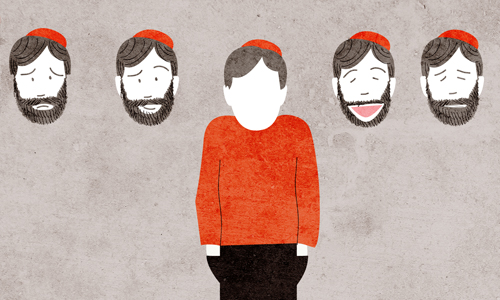 Tzorres. Reproach. Dire predictions and horrifying forecasts of the curses and calamities we will encounter in our lives if and when we should stray from the good and G‑dly path. The portion we read this Shabbat is known as the tochechah, or rebuke. It is always read in close proximity to Rosh Hashanah and isWhere is our enthusiasm and passion? intended to sober us up to the realities of life so that we can do some soul-searching and introspection in order to improve our behavior before the coming Days of Judgment.
And in the middle of all these terrifying and ominous curses there is a one-liner that seems to suggest the root cause of our problems. All this calamity will befall you “because you did not serve the L‑rd, your G‑d, amid gladness and goodness of heart, when everything was abundant.”1
The simple meaning of this verse is that we will experience these curses because we did not serve G‑d in the “good times,” when we were enjoying prosperity and abundance. We became smug, complacent, and forgot our Maker and our higher calling—why we were put here in the first place.
Commentaries offer various other interpretations, including the idea that we simply did not serve G‑d b’simchah, with joy. We may have done all the right things, but we did them with a heavy heart. We served G‑d and observed His commandments reluctantly and without any feeling. There was no enthusiasm, no joy. Being Jewish had become a burden. We found our joy and satisfaction in other areas of life, perhaps even in the undesirable and unholy domains.
The Talmud tells us that the Jews at the time of the Purim story brought Haman’s terrible decree of a Final Solution upon themselves because “they took delight in the feast of that wicked man [King Ahasuerus].”2
According to many opinions, the food the king served the Jews at his royal banquet was in fact kosher. But the problem was that the Jews “took delight” in participating in this drunken orgy where the sacred vessels of our Holy Temple were desecrated and used as party props for the evil king’s pleasure.
Where do we find our delight? Where is our enthusiasm and passion? Is it in leading good Jewish lives or in partying with princes?
The story is told of a Jew in Russia of old who was doing some business with the poretz, the local Russian squire. The squire invited the Jew to a business lunch where he offered him pork chops and non-kosher wine. When the Jew declined to partake, citing the Jewish dietary laws, the squire asked, “What if you were stranded in a desert and had nothing to eat but this, would you not eat it to save your life?”
“Well, if it was matter of life and death, then I would be permitted to eat it,” replied the Jew.
Suddenly the squire jumped up from the table, pulled out a revolver and, pointing it at the Jew, shouted, “Drink the wine or I’ll shoot!”
Immediately, the Jew gulped down the wine.
The squire burst out laughing and said, “I was only joking.” Whereupon the Jew turned red with anger and glared furiously at the squire.
“Why are you so angry?” the squire asked.
“Why am I so angry? I’ll tell you why” the Jew replied. “You couldn’t have forced me to eat the pork chops?!”
That Jew kept kosher, but was he doing it happily or begrudgingly? While keeping kosher was he fantasizing about pork chops?
The 19th century Russian czars tried to Russify young Jewish boys by drafting them into the army for a 25-year stretch. These children, known as cantonists, would be separated from their families, their people and their faith. Despite their extreme suffering, many maintained their allegiance to the G‑d of Israel with total commitment and heroism. Indeed, too many paid with their lives.
The story is told of some of these young men who were forcibly conscripted and taken far away from their families. They wrote a letter to one of the leading rabbis of Russia, asking for his advice about whatIs there joy in our Judaism, or is it tedious and tired? to do about kosher. Should they eat the non-kosher food or allow themselves to suffer malnutrition and perhaps even starve to death?
The wise rabbi answered them as follows. “If, in order to stay alive, you have no choice but to eat treif, then so be it. But, please, I beg of you, don’t suck the marrow bones.”
Where is our enjoyment, our pleasure, our geshmak?
Is there joy in our Judaism, or is it tedious and tired? It is not enough just to do the right thing. G‑d wants our joy, our enthusiasm, our fervour and fire.
As we approach Rosh Hashanah, let us resolve to do whatever it takes to find the inspiration we need to energize and invigorate our Jewish lives. Let us serve G‑d. And let us serve Him with joy.
Rabbi Yossy Goldman was born in Brooklyn, New York. In 1976 he was sent by the Lubavitcher Rebbe, of righteous memory, as a Chabad-Lubavitch emissary to serve the Jewish community of Johannesburg, South Africa. He is Senior Rabbi of the Sydenham Shul since 1986, president of the South African Rabbinical Association, and a frequent contributor to Chabad.org. His book From Where I Stand: Life Messages from the Weekly Torah Reading was recently published by Ktav, and is available at Jewish bookshops or online.
Artwork by Sefira Ross, a freelance designer and illustrator whose original creations grace many Chabad.org pages. Residing in Seattle, Washington, her days are spent between multitasking illustrations and being a mom.
FOOTNOTES
1.Deuteronomy 28:47.
2.Talmud Megillah 12a.© Copyright 2016, all rights reserved.
-------
 Ki Tavo In Depth
A condensation of the weekly Torah portion alongside select commentaries culled from the Midrash, Talmud, Chassidic masters, and the broad corpus of Jewish scholarship.
Parshat Ki Tavo In-Depth
Deuteronomy 26:1-29:8
Parshah Summary
“When you come in to the Land . . . ,” opens the Parshah of Ki Tavo, “you shall take of the first of all the fruit of the Land . . . and put it in a basket; and you shall go to the place which the L‑rd your G‑d will choose to place His name there . . .”
Upon presenting the bikkurim (first-ripened fruits) at the Holy Temple, the Jewish farmer makes a declarationavowing his gratitude for all that G‑d has done for His people:
You shall speak and say before the L‑rd your G‑d:Clearing the Tithes
An Aramean nomad was my father, and he went down to Egypt and sojourned there with a small number of people, and became there a nation great, mighty and populous.The Egyptians dealt ill with us, and afflicted us; and they laid upon us hard bondage.We cried to the L‑rd, the G‑d of our fathers; and G‑d heard our voice, and He looked on our pain and our toil and our oppression.G‑d brought us out of Egypt with a mighty hand, with an outstretched arm, with great awe, with signs and with wonders.He brought us to this place, and gave us this land, a land flowing with milk and honey.So now, behold, I have brought the first fruits of the land which You, O G‑d, have given me.You shall set it down before the L‑rd your G‑d, and prostrate yourself before the L‑rd your G‑d. You shall rejoice in every good thing which the L‑rd your G‑d has given you, and your household—you, the Levite, and the stranger that is among you.
The law of bikkurim is followed by the rules governing the separation of the various tithes the Jewish farmer sets aside from his crop (for the Levite, the poor, and for his own consumption in the holy city of Jerusalem). Every three years, any undistributed tithes must be “cleared from the house.” Like the bringing of bikkurim, this too is accompanied with a “declaration”:
When you have made an end of tithing all the tithes of your produce in the third year, which is the year of tithing, and you have given it the Levite, the stranger, the fatherless and the widow, that they may eat within your gates, and be replete—Mutual Regard
you shall then declare before the L‑rd your G‑d:
I have removed the hallowed things out of my house, and also have given them to the Levite, to the stranger, to the fatherless and to the widow, according to all Your commandments which You have commanded me; I have not transgressed Your commandments, nor have I forgotten them.I have not eaten of it in my mourning, nor have I consumed any part of it when unclean, nor given of it for the dead; but I have hearkened to the voice of the L‑rd my G‑d, and have done according to all that You have commanded me.Look down from Your holy habitation, from heaven, and bless Your people Israel, and the land which You have given us, as You swore to our fathers, a land flowing with milk and honey.
This day the L‑rd your G‑d has commanded you to do these statutes and judgments; you shall keep them and do them with all your heart, and with all your soul.Inscribing the Torah
You have avouched G‑d this day to be your G‑d, to walk in His ways; to keep His decrees, His commandments and His judgments; and to hearken to His voice.
And G‑d has avouched you this day to be a people for His own possession, as He has promised you; and that you should keep all His commandments.
And to make you high above all nations which He has made, in praise, in name and in glory; and that you be a holy people to the L‑rd your G‑d, as He has spoken.
Moses then instructs the people on the particulars of thespecial “swearing-in” ceremony—mentioned earlier in theParshah of Re’eh—which they will conduct when they enter the Promised Land under the leadership of his disciple, Joshua.
A special altar, built from twelve stones taken from the Jordan River (representing the 12 tribes of Israel), should be constructed on Mount Ebal; the stones should be plastered over, “and you shall write upon the stones all the words of this Torah very plainly.”
The twelve tribes then divided into two groups: Simeon, Levi, Judah, Issachar, Joseph and Benjamin positioned themselves on Mt. Gerizim, while Reuben, Gad, Asher, Zebulun, Dan and Naphtali faced them across the valley on the opposing Mt. Ebal. The blessings (for those who uphold the Torah) and curses (for those who violate it) were then pronounced—the blessings facing Mt. Gerizim, the curses facing Mt. Ebal.
Reward and Rebuke
Moses proceeds to spell out the blessings of a life in harmony with the divine will:
It shall come to pass, if you shall hearken diligently to the voice of the L‑rd your G‑d, to observe and to do all His commandments which I command you this day, that the L‑rd your G‑d will set you on high above all the nations of the earth. All these blessings shall befall you and overtake you, if you shall hearken to the voice of the L‑rd your G‑d.
Blessed shall you be in the city, and blessed shall you be in the field.
Blessed shall be the fruit of your womb, the fruit of your ground and the fruit of your beasts, the offspring of your cattle and the young of your sheep.
Blessed shall be your basket and your store.
Blessed shall you be when you come in, and blessed shall you be when you go out.
G‑d shall cause your enemies that rise up against you to be smitten before your face; on one road shall they come out against you, and on seven roads shall they flee before you.
G‑d shall command the blessing upon you in your barns and in all unto which you set your hand; and He shall bless you in the land which the L‑rd your G‑d gives you.
G‑d shall establish you a holy people to Himself, as He has sworn to you, if you shall keep the commandments of the L‑rd your G‑d and walk in His ways.
All people of the earth shall see that you are called by the name of G‑d, and they shall be afraid of you.
G‑d shall make you plenteous in goods, in the fruit of your womb, in the fruit of your cattle and in the fruit of your soil, in the land which G‑d swore to your fathers to give you.
G‑d shall open to you His good treasure, the heaven, to give the rain to your land in its season, and to bless all the work of your hand; you shall lend to many nations, and you shall not borrow.
G‑d shall make you the head and not the tail, and you shall be above only, and you shall not be beneath, if you hearken to the commandments of the L‑rd your G‑d, which I command you this day, to observe and to do them. You shall not turn aside from any of the words which I command you this day, to the right hand or to the left, to go after other gods to serve them.
The very opposite, however, shall come to pass “if you will not hearken to the voice of the L‑rd your G‑d, to observe to do all His commandments and His statutes which I command you this day. These curses shall come upon you, and overtake you: Cursed shall you be in the city, and cursed shall you be in the field . . . ,” and so on.
After spelling out the flipside of the enumerated blessings, Moses launches into an even more detailed account (called The Rebuke) of the terrible calamities destined to befall the errant people—ninety-eight “curses” in all, including the horrible scene (which came to pass during the siege of Jerusalem) of fathers and mothers eating the flesh of their children in their desperate hunger.
The Time of RecognitionMoses called to all Israel, and said to them:
You have seen all that G‑d did before your eyes in the land of Egypt to Pharaoh, to all his servants and to all his land. The great trials which your eyes have seen, the signs, and those great miracles.
Yet G‑d has not given you a heart to know, eyes to see and ears to hear, until this very day . . .
Keep the words of this covenant and do them, that you may prosper in all that you do.
From Our Sages
You shall take of the first of all the fruit of the land . . . (Deuteronomy 26:2)
Everything that is for the sake of G‑d should be of the best and most beautiful. When one builds a house of prayer, it should be more beautiful than his own dwelling. When one feeds the hungry, he should feed him of the best and sweetest of his table. When one clothes the naked, he should clothe him with the finest of his clothes. Whenever one designates something for a holy purpose, he should sanctify the finest of his possessions, as it is written (Leviticus 3:16), “The choicest to G‑d.”
(Maimonides)
The rule “the choicest to G‑d,” applies in all areas of life. If the school day must include both sacred and secular studies, the former should be scheduled for the morning hours, when the mind is at its freshest and most receptive. If one’s talents are to be divided between two occupations, one whose primary function is to pay the bills and a second which benefits his fellow man, he should devote his keenest abilities to the latter.
In devoting the “first-ripened fruits” of his life to G‑d, a person in effect is saying: “Here lies the focus of my existence. Quantitatively, this may represent but a small part of what I am and have; but the purpose of everything else I do and possess is to enable this percentile of spirit to rise above my matter-clogged life.”
(The Lubavitcher Rebbe)
Not all fruits are subject to the mitzvah of bikkurim (first fruits)—only those from the seven species [for which the Land of Israel is praised]. Here, in our verse, it says the word eretz (“land”), and there (in Deuteronomy 8:8)it says, “A land of wheat and barley, vines and figs and pomegranates, a land of oil-producing olives and honey[-producing dates].” Just as the earlier verse is referring to the seven species through which Eretz Yisrael is praised, here too, the fruits of which the verse speaks are those with which the Land is praised.
(Talmud; Rashi)
This phrase—Arami oved avi—also translates as “the Aramean [sought to destroy] my father,” and is interpreted as a reference to Laban the Aramean’s attempts to harm Jacob. Thus we read in the Passover Haggadah (which devotes several pages to commentary on the bikkurim declaration): “Go out and see what Laban the Aramean wanted to do to Jacob our father! Pharaoh condemned only the males, while Laban wished to uproot all.”
A number of interesting explanations are proposed by the various commentaries as to when and how Laban endeavored to destroy the people of Israel. The most basic explanation is that it refers to his desire to compel Jacob to remain with him in Charan, or at least to leave his wives and 11 sons there, claiming (Genesis 31:43), “The daughters [Leah and Rachel] are my daughters, the sons are my sons, the flocks are my flocks, and all that you see is mine . . .” Had he succeeded, G‑d forbid, there would have been no Jewish people.
Another explanation is that it refers to his plot to poison Eliezer and thus prevent Rebecca’s marriage to Isaac. (Had that happened, Jacob would never have been born. See the account of Eliezer’s mission to Charan in the Parshah of Chayei Sarah). Yet another thesis is that it was Laban’s deception of Jacob in marrying him first to Leah, instead of Jacob’s chosen bride Rachel, which created the situation in which Jacob regarded Joseph as his true firstborn and the leader amongst his sons, when in truth the leadership belonged to Leah’s children. This led to the tragic schism which rent the Jewish people in two for much of their history.
“Our pain”—this is the disruption of marital life; “our toil”—these are the children.
(Passover Haggadah)
Should not the order be reversed? The Holy Temple was built by King Solomon in Jerusalem hundreds of years after the children of Israel took possession of the land under Joshua. The correct order should therefore be “He gave us this land, and He brought us to this place”!
But here we have an allusion to that which the Targum Yonatan relates: that on the first Passover (while still in Egypt) the children of Israel were carried “on wings of eagles” (see Exodus 19:4) to the Temple Mount, where they brought the Passover offering.
(Etz Chaim)
When one eats and drinks [on the festivals], one must also feed the stranger, the orphan, the widow and the other unfortunate paupers. But one who locks the doors of his courtyard and feasts and drinks with his children and wife, but does not feed the poor and the embittered—this is not the joy of mitzvah but the joy of his stomach . . .
(Mishneh Torah, Laws of the Festivals 6:18)
You have avouched G‑d this day to be your G‑d . . . And G‑d has avouched you this day to be a people for His own possession . . . (26:17–18)
It happened that Miriam the daughter of Tanchum was taken into captivity, she and her seven sons. What did the tyrant do? He imprisoned each one separately from the others. He brought out the first son and said to him: “Bow to the idol, as did your brother.” Said he: “G‑d forbid! My brother did not bow, and neither shall I.” “Why not?” “Because it is written in our Torah (Exodus 20:2), ‘I am the L‑rd your G‑d.’” The king commanded that he be killed.
He brought out the second son and said to him: “Bow to the idol . . .” and so on. [He, too, refused] “because it is written in our Torah (Exodus 20:3), ‘You shall have no [other gods before Me].’” The king commanded that he be killed.
He brought out the third son, [who refused] “because it is written in our Torah (Exodus 22:19), ‘One who slaughters [sacrifices] to alien gods shall be destroyed.’” The king commanded that he be killed.
He brought out the fourth son, [who refused] “because it is written in our Torah (Exodus 34:14), ‘You shall not bow to a strange god.’” The king commanded that he be killed.
He brought out the fifth son son, [who refused] “because it is written in our Torah (Deuteronomy 4:39), ‘Know this day, and consider it in your heart [that the L‑rd, He is G‑d in heaven above, and upon the earth beneath; there is nothing else].’” The king commanded that he be killed.
He brought out the sixth son, [who refused] “because it is written in our Torah (Deuteronomy 6:4), ‘Hear O Israel, the L‑rd our G‑d, the L‑rd is one.’” The king commanded that he be killed.
He brought out the seventh son, who was the youngest of them all. [He, too, refused to bow to the idol, saying:] “We have already sworn to our G‑d that we shall not exchange Him for another deity, as it is written (Deuteronomy 26:17), ‘You have avouched G‑d this day to be your G‑d.’ And just as we have sworn to Him, so has He sworn to us that He shall not exchange us for another people, as it is written (Deuteronomy 26:18), ‘And G‑d has avouched you [this day to be a people for His own possession].’”
Said the king to the child: “If so, I shall throw this ring before the idol, and you go retrieve it—so that it should be said that you obeyed the ruler and bowed to the idol.”
Said the child: “Woe to you, ruler! If you, who are yourself flesh and blood, fear flesh and blood like yourself, should I not fear the King of all Kings, the Holy One Blessed Be He, King of the Universe . . . ?”
The king commanded that he be killed. . . . The sages calculated the years of that child, and found them to be no more than two years, six months, and two and one-half hours . . .
(Yalkut Shimoni)
The Jewish people are unique among the peoples of the world: their nationhood was forged not at the point at which they gained their own land, or developed a common language or culture, but on the day on which they pledged to uphold the Torah . . .
(Rabbi Samson Raphael Hirsch)
Six tribes ascended to the top of Mount Gerizim, and six to the top of Mount Ebal; the kohanim, the Levites and the ark stood below in the valley.
The Levites turned their faces towards Mount Gerizim and began with the blessing: “Blessed be the man who does not make a graven or molten image . . . ,” and both [the tribes on Mount Gerizim and the tribes on Mount Ebal] answered “Amen!” Then the Levites turned their faces towards Mount Ebal and began with the curse, saying: “Cursed be the man who makes any graven [or molten] image . . . ,” and both [groups of tribes] responded “Amen!” . . . Thus it continued in this manner for all of the blessings and curses, until the very last curse, namely (verse 26): “Cursed be the one who does not uphold [the words of this Torah] . . .”
(Talmud, Sotah 32a)
Even if you fail to recognize the blessings as such, and run away from them, they will pursue you . . .
(Shaar Bat Rabbim)
In other words, don’t be “a tzaddik in a fur coat”; rather, your goodness should influence your surroundings, in the “city” and the “field.”
(There are two ways to get warm on a cold winter day: build a fire, which warms everyone else in the room as well; or wrap yourself in furs, which conserves your own warmth but does not generate any heat or warm anyone else. Thus chassidim would refer to a righteous person whose only concern is with his own righteousness as “a tzaddik in a fur coat.”)
(Rabbi Bunim of Peshischa)
May your departure from the world be as free of sin as was your entry into the world.
(Talmud; Rashi)
It shall come to pass, if you will not hearken to the voice of G‑d . . . that all these curses shall come upon you and overtake you . . . (28:15)
It was the custom of Rabbi Schneur Zalman of Liadi to officiate as the reader (baal korei) of the weekly Torah reading in his synagogue. One year, the rebbe was away from home on the Shabbat on which the section of Ki Tavo is read. In the rebbe’s absence, someone else did the reading.
That week Rabbi Schneur Zalman’s son DovBer, who was about twelve years old at the time, was so affected by the “curses” of the Rebuke that he developed a heart ailment. Three weeks later, when Yom Kippur came around, he was still so weak that his father was hesitant to allow him to fast.
When the young DovBer was asked, “But don’t you hear the Rebuke every year?” he replied: “When Father reads, one does not hear curses.”
more
Because you did not serve G‑d with happiness and with gladness of heart, in abundance of everything, therefore you shall serve your enemies . . . (28:47–48)
Because you did not serve G‑d when you enjoyed happiness and the abundance of all good things, you shall now suffer want.
(Rashi)
Not only did you sin, you did so “with happiness and with gladness of heart”—for this the punishment is doubly severe.
(Maayanah Shel Torah)
(Maimonides)
In the case of two people wrestling, each trying to throw down the other, if one of them moves with sloth and lethargy, he will be easily defeated and felled, even if he is stronger than his fellow. So, too, in battling one’s evil inclination, one can prevail over it . . . only with alacrity that comes from joy and from a heart that is free and cleansed from every trace of worry and sadness . . .
(Tanya)
Melancholy is not a sin. But the spiritual damage which melancholy can cause, the gravest of sins cannot cause.
(Chassidic saying)
This teaches us that a person does not comprehend the mind of his master until after forty years.
(Talmud)
 -------
VIDEO
 Chasidism – What? When? Why?
There are many explanations given to define the contribution of chasidism
 Watch (7:37)
http://www.chabad.org/therebbe/livingtorah/player_cdo/aid/3413963/jewish/Chasidism-What-When-Why.htm
http://www.chabad.org/3413963
-------
 The Life of Elul
How the 18th of Elul enlivens a somber month by Yisroel Glick
Watch (2:19)<script language="javascript" type="text/javascript" src="http://embed.chabad.org/multimedia/mediaplayer/embedded/embed.js.asp?aid=3438756&width=auto&height=auto"></script><span style="clear:both;" class="lb" id="lbdiv">Visit <a href="http://www.chabad.org/multimedia/default_cdo/aid/591213/jewish/Video.htm">Jewish.TV</a> for more <a href="http://www.chabad.org/multimedia/default_cdo/aid/591213/jewish/Video.htm">Jewish videos</a>.</span>
-------
Story
The Chassid Climbed Through the Window by Yehudah Chitrik
 It once happened that that the young daughter of Nechunya the digger of wells fell into a deep well.
Some bystanders immediately ran to inform Rabbi Chanina ben Dosa, who was known as a holy man. After hearing what happened, he replied, “She will be fine.”
Time passed, and it was doubtful if she would be able to stay afloatBystanders immediately ran to inform Rabbi Chanina in the water much longer. But Rabbi Chanina once again declared that she would be fine.
After more time had passed, and it was a foregone conclusion that no one could possibly remain alive in a well for that much time, Rabbi Chanina said, “She has come out of the pit.” And sure enough, the girl had managed to climb out of the well.
When she was asked how she managed to scale the tall, steep walls, she said that she was assisted by a ram led by an old man (a reference to Abraham and the ram he brought as a sacrifice instead of Isaac).
The people then turned to Rabbi Chanina ben Dosa, asking if he was perhaps a prophet.
He said to them, “I am neither a prophet nor the son of a prophet. I made a simple calculation. Nechunya put so much effort into digging wells for the benefit of the pilgrims who come to Jerusalem every year. Shall the thing to which that pious man has devoted his labor become the downfall of his own progeny?”
It once happened that the daughter of Rabbi Mordechai (Feitelson) of Lieple was gravely ill. Seeing that her days were numbered, Rabbi Mordechai hastened to Rabbi Schneur Zalman of Liadi to ask him to pray for her recovery.
Arriving in the middle of the night, he tried to enter theAll the doors were locked home of Rabbi Schneur Zalman, but all the doors were locked. He tried the windows and finally found one that was open. The desperate father climbed into the house and found Rabbi Schneur Zalman laying on the floor saying, “Nechunya the digger of wells … become the downfall of his own progeny … Mordechai Liepler has done such and such … become the downfall of his own progeny?”
Seeing Rabbi Schneur Zalman tearfully praying for his daughter was all Rabbi Mordechai needed. He left the house and returned home, where he found his daughter well on the road to recovery.
(Talmud, Bava Kama 50a; Reshimot Devarim I, pp. 78-79.)
By Rabbi Yehudah Chitrik. Translated from the Hebrew by Rabbi Menachem Posner.
Artwork by Sefira Ross, a freelance designer and illustrator whose original creations grace many Chabad.org pages. Residing in Seattle, Washington, her days are spent between multitasking illustrations and being a mom.© Copyright 2016, all rights reserved.
-------
Your Questions
Is It Right to Be Upbeat on Rosh Hashanah? Are Bees' Legs Kosher? by Aron Moss
 Question:
I always associated going to synagogue on Rosh Hashanah and Yom Kippur with heaviness, guilt and a somberIs it fitting to be so upbeat? atmosphere. I guess that's what I grew up with. But last year I came to your services and found them to be happy, light, musical and joyous. I enjoyed the experience, but I’m wondering, is it fitting to be so upbeat on days when we are seeking forgiveness for our sins? Sorry for being so direct, but is what you are doing authentic, or just about feeling good?
Answer:
There is a curious discussion in Jewish law about bees’ legs:
What happens if a bee's leg falls off and gets stuck in a vat of honey? Bees are not kosher, and detached bees’ legs can't always be extracted from honey. Does that mean that the whole vat is non-kosher?
One opinion says no. The honey is kosher and you can eat it, bee legs and all. Because one of the fascinating properties of honey is that foreign bits that fall into it eventually become honey too. The bee legs dissolve and lose their distinct identity, so there is nothing non-kosher left, just honey.
What is unique about honey as it’s described in Jewish literature is that it doesn't overpower with brute force, like fire which violently consumes whatever it touches. Honey overpowers with sweetness. The sweetness of honey is so intense that everything it touches is overwhelmed and succumbs to its sweet embrace.
This power of honey represents a deeper approach to the High Holidays. Yes, these are somber times, and there is a real need to return to G‑d. But the introspection and good resolutions that these days inspire need not come from a place of guilt. We don't repent out of fear of fire and brimstone. Rather, when we experience the sweetness of DivineImmerse yourself in joyful Judaism love, when we feel how close G‑d is to us and what a blessing it is to be a Jew, our joy can melt away whatever is evil and purify us from our less than kosher ways.
This is why we start the High Holidays by dipping challah and apple in honey. Only a Judaism that is infused with sweetness and joy has the power to dissolve negativity, cynicism and indifference, and make us all kosher again. Sadness and heaviness will not cleanse our soul. But the experience of sweetness will.
So don't just dip your apple in honey, immerse yourself in joyful Judaism. It's the bee's knees.
I take this opportunity to wish you a year of overwhelming sweetness; may all bee legs in all their forms melt away.
(Sources: Shem Mishmuel 5681; Tosfos Avodah Zara 69a, Hahu.)
Note: In an actual case where insect parts are found in food, an authority on Jewish law should be consulted as the law is complex
Aron Moss is rabbi of the Nefesh Community in Sydney, Australia, and is a frequent contributor to Chabad.org.
Artwork by Sefira Ross, a freelance designer and illustrator whose original creations grace many Chabad.org pages. Residing in Seattle, Washington, her days are spent between multitasking illustrations and being a mom.© Copyright 2016, all rights reserved.
-------
Your Questions
My Landlord Refuses to Fix My Air Conditioner by Rosally Saltsman
 Dear Rachel,
I’ve been renting from my landlord for about five years, and we’ve had our ups and downs. About a year ago in April, my air-conditioner started dripping. I asked him periodically over the spring and summer to fix it, and he said he would. But since nothing happened in thisI decided to call the technician myself regard, I decided to call a technician myself.
The technician cleaned the filter and then said it would cost $100 to fix (I pay $1,000 dollars a month in rent). The landlord said that was too expensive, and he would send someone else to do the job. In the meantime, I renewed the lease for another year.
Fall came and went, and the landlord had still not repaired the air-conditioner. I switched to heat, and the winter passed. In the spring, I again reminded the landlord that he had still not fixed the air-conditioning unit. So he showed up to fix it himself. He did something to it, and told me to run it a while and see if it still leaked. It was too cool at the time to run it, so I waited until the next heat wave, when again it leaked.
I'm absolutely burning with anger. It very clearly says on my lease that I'm supposed to have a working air-conditioner. Besides the nuisance of having to have a towel under the unit in my living room all summer, the injustice of it rankles. This isn’t the only thing he’s avoided paying for, and it is a clear-cut violation of my rental contract. I don’t want to have to move because of this, but how can anyone be so unscrupulous? And how do I deal with this?
Steamed
Dear Steamed,
One of the questions we’re asked when we go to the Heavenly Court after 120 years (and that we have no choice but to answer honestly), is if we were honest in our business dealings. In fact, this is the first question we’re asked.1 It seems incomprehensible to me that someone would endanger their spiritual standing for $100, but everyone has their weak points, and it seems like your landlord’s is that he is a tightwad.
If you’re correct and your landlord has broken the terms of your contract, he is liable to pay for your air-conditioning repair (as well as any other repairs in the apartment he has theretofore not taken responsibility for) and possibly even damages for all the aggravation you’ve endured as a result of it. Jewish law is clear that when someone has wronged you, you are permitted—even required—to seek redress.
It’s clear from your letter that you want to do the right thing. The first order of business is to pay for the repair so you’re not troubled anymore by the leaking water and needless anguish. You don’t have to punish yourself for your landlord’s lack of integrity. Get a receipt for the repair and a guarantee for how long it’s good for. Once the repair has been made, coolly present the bill to your landlord and ask him to reimburse you or deduct the amount from the next rent payment.
If he refuses to reimburse you and demands the full rent, there are laws (both halachic and legal) to protect you. If your landlord is Jewish, you can take him to a Din Torah, which is where a rabbinical court comprised of three rabbis hears your complaint and renders judgment about what and how much he is liable for. If he’s not Jewish or if he refuses to settle this before a Court of Jewish Law, then you have a right to seek compensation legally. Perhaps you have lawyer friend who would be willing to take this on as a favor since it would cost more than $100 to sue or file a claim yourself in small-claims court. This man obviously needs incentive to uphold his end of the contract.
Be advised that he could still refuse to pay, andJewish law does not say you need to be a chump even if he does, this will most likely stress your relationship (he may not even be willing to rent to you in the future). But your seeking justice will also discourage him from doing this to future tenants (and to you again). Jewish law does not say you have to be a chump.
Once the technical and financial aspects of the repair have been taken care of, try to forgive your landlord. When we forgive the transgressions of others against us, G‑d forgives ours.
Other people’s lapses in integrity are always frustrating, and we are particularly incensed when they impact us. The world is full of injustice. The best way to combat it is to practice impeccable integrity and protect ourselves in a just manner from others. As it says in Deuteronomy 15:20, “Pursue justice justly,” and leave it up to the Ultimate Judge to make sure that justice is served.
Hoping you keep cool with a warm heart!
Rachel
Rosally Saltsman is a freelance writer originally from Montreal living in Israel.
FOOTNOTES
1.Talmud, Shabbat 31a.© Copyright 2016, all rights reserved.
-------
Women
A Visit to the 92-Year-Old ‘Mikvah Lady’ Upon Her Retirement by Lieba Rudolph
 It felt strange to be ringing Mrs. Markovic’s doorbell in broad daylight. For years, I had come to her house at night; she lived above the mikvah in Pittsburgh and served as its attendant. But this time, I was coming in response to an article in the newspaper about her retirement as the “92-year-old mikvah lady.” The article also referred to the mikvah as an “ancient Orthodox Jewish ritual,” and I wanted to write about this mitzvah in a way thatWhen I first learned about this mitzvah, it seemed daunting might bring it up to the current millennium.
It also felt strange to talk to Mrs. Markovic openly in the mikvah’s waiting area; I was used to speaking to her in a whisper as I slipped into one of the bathrooms to prepare. Since it’s a private matter, women are discreet about going to the mikvah. So discreet, in fact, that for much of the Jewish nation, mikvahobservance remains shrouded in mystery. Unfortunately, it’s also erroneously associated with being “dirty,” although nothing could be further from the truth.
In a nutshell, during menstruation and for a week afterwards, a woman is in a state of ritual impurity. During this time, she doesn’t have any physical contact with her husband. After physically examining herself for seven days, she immerses in the mikvah, a ritual bath. The mikvah is like a womb; as the woman emerges, she is reborn in a pure state, and intimacy can resume. It’s a beautiful, sacred ritual that ensures the sanctity of the Jewish home and the Jewish souls born into that home. As if that’s not enough, it really enhances marriage, too, since husband and wife look forward with anticipation to each mikvah night.
When I first learned about this mitzvah, it seemed daunting. Two weeks out of the month without any physical contact with my husband?! But, thankfully, G‑d eased me into this mitzvah; I was expecting my third child when I was becoming observant. By the time mikvah became relevant, I was already committed to Torah life.
And once I became committed to mikvah observance, the details became very important to me. To prepare for the mikvah, it’s necessary to bathe, trim and clean nails, remove makeup, comb hair, and check to ensure that nothing remains as an impediment between one’s body and the mikvah waters. Another mikvah lady might have gotten annoyed that I took so long to prepare and that I often second-guessed my scrupulousness, but Mrs. Markovic never got rattled by my mishegas. In fact, as we were reminiscing, she laughed about it.
It may have helped that she lived upstairs from the mikvah, which meant she never had to leave home to go to work. On the other hand, she was never able to leave either. Her commitment to the job was especially apparent when I came to the mikvah on Friday nights; instead of preparing or enjoying her Shabbat dinner, she was sitting with me waiting so I could immerse after nightfall. Friday-night mikvah visits weren’t exactly easy for me either. As soon as I lit my candles, I quickly walked to the other side of town, trying to avoid seeing anyone I knew, praying that I hadn’t forgotten anything in my mikvah preparations because I couldn’t do anything that would violate Shabbat. But seeing Mrs. Markovic immediately put me at ease.
It was on those quiet Friday nights waiting together that Mrs. Markovic and I inevitably discussed her life. She was matter-of-fact as she recounted the line-up when she arrived at the concentration camp; she described seeing women go crazy when their babies were pulled from their arms and shot before their eyes. These could have been unsettling images in the moments before my immersion, when I was supposed to connect to G‑d as the source of all life and all goodness. But Mrs. Markovic was living proof that, at least in her case, that’s exactly what He was. The miracle was not only that she survived, but the way she chose to live her life because she survived. It wasn’t just that she remained Torah-observant. It wasn’t just that nothing was too much to ask. She cared even when I asked her not to—when my earring back fell down the drain, she insisted on taking apart the sink pipe to find it.
TheThe hour I recently wpent with her brought back joyful memories hour I recently spent with her on that sunny afternoon brought back joyful memories of the mitzvah connected to the most sacred parts of my life. My heart swelled as I thanked her one last time for everything she did for our family. I then began to write, hoping that maybe one person could see beyond the “ancient Orthodox Jewish ritual,” and consider the mikvah’s timeless benefits for one’s home and for the entire Jewish nation. (And it’s never too late to immerse; a post-menopausal woman need only immerse one time to sanctify her entire marriage retroactively.)
I was fortunate to have Mrs. Markovic as my mikvah attendant for all those years. But, of course, the mitzvah of mikvah isn’t about meeting inspiring people. It’s about bringing G‑d into marriage and reaffirming that everything in life emanates from Him. All-encompassing as that may sound, I couldn’t describe it as anything less.
Lieba Rudolph lives in Pittsburgh, PA, and writes a weekly blog about Jewish spirituality.© Copyright 2016, all rights reserved.
-------
Women
A Paean to the Power of Dance by Elana Mizrahi
 I made my way to the Western Wall (Kotel) with my daughter and two of my sons. My eldest daughter sat with my baby, my 5-year-old and a bag of Bamba, giving me a chance to pray the afternoon services calmly by the wall. I prayed slowly alongside with theI watched him dance, appreciating his spirit others praying the afternoon prayer. Finished, I turned my head and glanced over to the men’s section as I heard a large group of men begin to sing. I saw them form a circle as they started to dance.
I called over to my 5-year-old: “Asher, come look. They’re dancing!”
I prepared my arms to lift him up to see, but instead, my agile son jumped up onto the partition. (Knowing him, this didn’t surprise me one bit.) I heard a few gasps from the women next to me. I turned to them smiling: “Don’t worry. He’s an expert at this!”
“Mommy, I’m going to do one round.”
He then jumped down (with grace, of course) and broke into the circle of dancing men. I watched him as he danced, admiring his strong sense of self and sweet inhibition, appreciating his spirit. I looked over at my daughter lovingly holding my baby on her lap then back at my son dancing (backwards no less, but no one seemed to care) in a circle of men united in song, dance and love of G‑d, His people and His Torah. My heart swelled with happiness and gratitude for this beautiful moment, and I started to open my lips in prayer.
This son of mine, thank G‑d, he is full of life, full of laughter and full of play. When I go to the park, he’s the child hanging from the trees, swinging on the monkey bars, jumping from a flying swing. I am forever telling him to “Come down. I know that you can do it, but you’re making Mommy nervous.” I am forever praying, “Please, watch over him. He is Your child after all! Dear G‑d, don’t let him fall!”
He comes home from preschool. (There, the teacher gives me wonderful reports; in class, he participates, is a model student and is well-behaved.) I brace himself for his whirlwind of energy, and as much as I can, I let him be him. Six hours later, I kiss his forehand—or at least try to—as he does somersaults and gymnastics even in his bed. I walk out of the room and within two minutes, my little acrobat is fast asleep, exhausted from his twirling and jumping, climbing and swinging. I, too, am exhausted and wish that I could, at 7 o’clock, crawl into bed myself.
Once again, watching my Asher dance, once again my lips opened in prayer, as they always seem to be doing, but this time it wasn’t a request for protection or safety. This time, I simply poured my heart out to my Creator for help in guiding me on how to cultivate and channel into goodness the beautiful energy and power of this child. I prayed for flexibility and creativity and tools for encouraging him—and that I, nor anyone else, should ever be an impediment to him or, G‑d forbid, crush his spirit. I prayed that he should always be full of life and laughter, of sweet innocence, and that he should use this to serve our Creator.
My little boy did his one round and then ran back to me, jumping over the partition with the same ease as he did before. I I prayed for flexibility and creativityembraced him, thankful that I was able to let go and enjoy the spontaneity of the moment. And, all of sudden, I realized that the tools that I prayed for I actually have—every woman has—but we sometimes fail to see it, and therefore make use of them.
G‑d created woman with a special organ: the womb. In Hebrew the word, rechem, is related to the word “mercy” or “compassion” (rechamim). This makes sense, as the womb is the organ that has the potential to house and nurture a baby.
The womb is also incredibly flexible; it expands and contracts like no other organ. What does this say about the nature of a woman? We have an incredible force—if we could only tap into it and were made aware of it—to be flexible, compassionate, nurturing, merciful, creative. We have the inherent potential to see the unique beauty and light in each child’s (or adult’s) soul, and with a lot of prayer and help from Above, we can help that light shine even brighter.
Originally from northern California and a Stanford University graduate, Elana Mizrahi now lives in Jerusalem with her husband and children. She is a doula, massage therapist, writer, and author ofDancing Through Life, a book for Jewish women. She also teaches Jewish marriage classes for brides.
Artwork by Sefira Ross, a freelance designer and illustrator whose original creations grace many Chabad.org pages. Residing in Seattle, Washington, her days are spent between multitasking illustrations and being a mom.© Copyright 2016, all rights reserved.
-------
Women
Teshuvah: Exhilarating or Debilitating? by Hani Lowenstein
 Judaism is all about growth. When we slip up, we don’t just accept our imperfections and move on, we work to correct them. This process is called teshuvah, which can be translated as “repentance” but really means “return”—returning to our true selves, returning to G‑d. There’s even a special month on the Jewish calendar dedicated to teshuvah—the month of Elul, which precedes the High Holidays.
I remember one Elul, eight years ago, when I had recently returned to New York from a transformative yearJudaism is all about growth in Israel. I was afforded the opportunity to delve into Torah learning, which pushed me to reflect upon my place in this world, my observance of the mitzvahs and my own unique service of G‑d. The classes I attended helped me come to accept that even though I would never solve life’s existential mysteries, I could still live a sincere and devoted religious life. In short, it was a life-changing year that in many senses was one long Elul.
As I sat on my bed in college amidst the hustle and bustle of New York City, I wished so much to have a meaningful Elul, the kind of Elul I experienced in Israel. So, as is my inclination, I began to write a list. A list of all the things I wanted to work on, of all the character traits I needed to improve; this list became longer and longer, and more and more nuanced. I had done an accounting of my deeds, as Maimonides cites in his Laws of Teshuvah, but something was not right.
Why? Just thinking back to this list eight years later, feelings of dread and guilt wash over my entire body. I think of going over the list and asking myself, How will I accomplish this, and where should I start, and . . . ?
My teshuvah on that Elul almost eight years ago was an unhealthy form of teshuvah. Don’t misunderstand me; my intentions were wonderful, and according to our rabbis, we must give an honest accounting of our sins. But there was something missing from my teshuvah—some outlook lacking from this process of return that is supposed to be so full of life and vitality.
Elul can be an overwhelming time. We can feel overcome with feelings of fear and dread when we contemplate the decisions that will be made on Yom Kippur—who will be sick and who will be healthy, who will be rich, and who will be poor, who will live and who will die. It’s pretty heavy.
Elul and the High Holidays remind us of our mortality, our temporary status in this world. We think of all the things we still want to accomplish while we’re in this world. The process of teshuvahhighlights the gap that exists between who we are and who we wish to be, and the recognition of this gap can be painful, to say the least. The questions play through our mind on a loop: Why didn’t I use my time better this year? Why didn’t I accomplish x, y and z that I wanted to? Why am I still so nasty and impatient to some of the people in my life I love the most? Why am I still in the same place, working on the same things?
Bridging the gap between who we are and who we want to be can seem like an insurmountable task. We question our self-discipline, our perseverance and stamina. We question whether we will ever bridge that gap, or whether each humdrum year will just fly by, one after the next, and we’ll be left feeling frustrated that nothing has changed.
So how can we have a “healthy” Elul—one in which we’re aware of the enormity of these days, but not paralyzed by fear? What steps can we take and what teachings can we incorporate into our consciousness to give us the inner strength to work towards the vision of who we can be?
Keep the following concepts in mind, and you are on your way to creating, a healthy, productive and inspirational Elul:
Our Beloved, Our Father
As we embark on our mission, we should be comforted by two descriptions of our relationship with G‑d. The letters of Elul, alef, lammed, vav, lammed, stand for Ani l’dodi v’dodi li, “I am for my Beloved, and my Beloved is for me.” 1 G‑d loves us, He has an intimate relationship with us, and He certainly wants us to return to Him.
In the Rosh Hashanah prayers, we refer to G‑d as our Father. In a healthy and normal family relationship, the father only wants the best for His child. Even when we make mistakes, all He wants is for us to return, to become better, to show him we really are the child He had so many aspirations for.
G‑d Believes in You, So Believe in Yourself
I recall in high school one of my friends writing me a birthday note that went something like this: “Happy Birthday, Hani! This is the day that G‑d decided the world couldn’t go on without you.” The point is simple but profound. G‑d brought you into this world and gave you a soul. You have a mission and purpose here.
Your process of teshuvah should begin with a broad andWhat’s blocking you from realizing your potential? optimistic vision of who you want to be. Then begin working out the details of how you will get there. Think about what’s blocking you from realizing your potential. What are your fears? What are your limiting beliefs? What parts of your personality are bogging you down and impacting your ability to reach your goal? You may want to make a flow chart, so you can visualize your process of achieving your goals.
Be Prepared to Fall, and Get Up
You may struggle to achieve your goal. You may fail and have to start again. But what matters is that you are trying. That’s what G‑d cares about. Anticipate the interval training you will experience in the workout called life, rather than dreading it before you have even become involved in the process of tesuhvah.
After the Yom Kippur prayer services are over, many synagogues have the custom of joyously singing and dancing. Why? Because we are overjoyed that we have been given the chance to renew our relationship with G‑d, to start over with a clean slate. We should merit feeling this happiness over the coming weeks of Elul as we take the first steps, even if they are small, back to our Beloved, our Father, our Creator.
Hani Lowenstein is a devoted wife and mother. She works part time in the field of Jewish education.
Artwork by Sefira Ross, a freelance designer and illustrator whose original creations grace many Chabad.org pages. Residing in Seattle, Washington, her days are spent between multitasking illustrations and being a mom.
FOOTNOTES
1.Song of Songs 6:3.© Copyright 2016, all rights reserved.
-------
Lifestyle
Cinnamon-Raisin Baked Apples By Miriam Szokovski
If you're not a fan of honey cake, or you're looking for a lighter Rosh Hashanah dessert, this one's for you. These classic baked apples are stuffed with plump raisins, cinnamon, brown sugar, and a good dash of salt which is what really takes them to the next level. I've plated them here with ice cream and toasted coconut, but they are also delicious plain—warm or cold.
 There's not much to it. You'll need to core the apples and stuff them with the raisin mixture. Sprinkle with cinnamon, drizzle with honey, bake and voila...dessert is served.


Ingredients:
8 red apples
1½ cups raisins (optional: use half golden raisins and half regular)
4 tbsp. brown sugar
1 tsp. kosher salt (don't skimp)
1/8 tsp. cinnamon
1/8 tsp. ginger powder
Honey
Directions:
Soak the raisins in warm water for 20-30 minutes, then drain.
Wash and core the apples the apples. Place in a baking dish.
Toss the raisins with the brown sugar, salt, cinnamon and ginger. Stuff the mixture into the empty core of each apple.
Drizzle the apples with honey and dust lightly with cinnamon.
Bake uncovered at 350°F for 30 minutes.
Optional: Serve with ice cream and toasted coconut.
 Miriam Szokovski is the author of the historical novel Exiled Down Under, and a member of the Chabad.org editorial team. She shares her love of cooking, baking and food photography on Chabad.org’s food blog, Cook It Kosher.© Copyright 2016, all rights reserved.
-------
Lifestyle
Teach Your Children By Dorene Schwartz-Weitz
 We are commanded to teach our children the mitzvot, and how to live by them, for they are our life. When you teach someone you become like a parent to him or her. This teaching of the written and oral Torah has been the ongoing link to our survival as Jews throughout the generations.
Dorene Schwartz-Weitz, דבורה לאה, is a multi-media international artist (and a Mommy and Bubby) who was inspired from the age of three, by her grandfather, Russian artist Yehuda Goldstein. One of the Rebbe's chosen artists, she believes her creativity to be a gift on borrowed time, and her mission the Mitzvah Kotel Project, of which this relief sculpture is part. The latest piece, “To Hear the Sound of the Shofar” is on exhibit at USC Hillel in LA.© Copyright 2016, all rights reserved.
-------
Jewish News
Get Ahead of the Times With the Chabad.org ‘Hayom’ App By Mordechai Lightstone
 In the month of Elul, the preparatory month before Rosh Hashanah, it is a Jewish tradition to undergo a personal stock-taking of how we’ve used our time.
“Hayom,” one of the latest in a suite of apps by Chabad.org, is the perfect companion for time-conscious users. “Hayom” (literally, “today” in Hebrew) focuses on delivering relevant content tailored to the user’s location and the time of day.
Using an intuitive “deck of cards” design, “Hayom” allows users to quickly find the information or topic of Jewish study they want, while simply swiping away others when complete.
For example, “Hayom” focuses on enabling personal, customized Torah study. The user is able to study relevant daily Torah texts and videos, swiping them away when finished, leaving only those not yet completed on the screen.
Using the phone’s location, “Hayom” can show an ever-expanding list of upcoming Jewish events at nearby Chabad-Lubavitch centers.
Of particular interest is the ability to sync Hayom with the Chabad.org calendar. Once logged in, the app can give reminders before personal events, yahrtzeits and birthdays—all based on the Jewish calendar.
Other features include the ability to track Shabbat candle-lighting and halachic times for locations around the world. These times can be programmed as an alert—be it 30 minutes before the start of Shabbat or a week before a yahrtzeit. They can also be shared with family and friends using built-in social sharing features, allowing users to let people around the world know relevant times and events on the Jewish calendar.
“Hayom” also has an accompanying app for the Apple Watch.
“Hayom” is available for Android and iOS, and was made available free of charge by the generous partnership of Dovid and Malkie Smetana, Alan and Lori Zekelman, the Meromim Fund, and Moris and Lillian Tabacinic.
 Rabbi Mordechai Lightstone is a rabbi by training, but a blogger by choice. He is passionate about using new media to further Jewish identity and community building. Mordechai currently resides in Brooklyn, New York, with his wife and four sons, where he happily tweets between sips of espresso.© Copyright 2016, all rights reserved.
-------
Jewish News
World’s Oldest Man to Celebrate 100 Years of Wrapping Tefillin by Chabad.org Staff
 Holocaust survivor Yisrael Kristal, the world’s oldest living man
The world’s oldest living man, Yisrael Kristal, a Holocaust survivor who lives in Haifa, Israel, is one year older on the record books today, which marked his 113th birthday on Sept. 15.
However, on 22 Elul, which corresponds this year to Sept. 25, Kristal will be celebrating his 113th Jewish birthday (considered in mystical Jewish tradition to be akin to an annual personal Rosh Hashanah) and the still rarer distinction of it being 100 years since he began wearing tefillin during daily prayers.
In an interview with Sichat Hashavua—a weekly circular published by Chabad in Israel—Kristal said that since his 13th birthday, he has wrapped tefillin every day, except for extreme circumstances during the two great wars.
As he stated: “Instead of being acclaimed as the world’s oldest man, I’d rather be known as the oldest and longest daily wearer of tefillin in the world.”
He was recognized as the world’s oldest man in March.
Kristal was born in Zarnow, Poland, on 22 Elul 5663 (Sept. 15, 1903). His mother passed away when he was 7 years old. His father was drafted into the Russian army during World War I and subsequently killed, leaving Yisrael on his own at the young age of 11. However, his father had provided him a solid traditional Jewish education, and that helped him remain a man of deep faith and religious commitment throughout his life.
His 13th Jewish birthday, ordinarily celebrated as a joyous milestone, passed without fanfare due to the war. Yet, like generations of Jewish men before him, he began wearing tefillin every weekday, with the exception of Shabbat and holidays.
One hundred years later, some 100 family members and friends will gather for a private belated bar mitzvah in which they will sing, dance and wish him a hearty “mazal tov.”
 Wrapping tefillin for an entire century (Photo: Courtesy of Sichat Hashavua)
Rebuilding a Family
In 1920, Kristal moved to Lodz, Poland, to join the family confectionery business, where they made and sold candy and other sweets. He worked there for 20 years, becoming a master of the craft.
Kristal lost his wife and two children during World War II, as well as his other relatives. He survived Auschwitz, in addition to the Wustegiersdorf, Dornhau and Schotterwerk Nazi concentration camps. When he was rescued by Allied forces in May 1945, he weighed 37 kilos (81.4 pounds) and was on the brink of death.
He left for Israel in 1950 with his second wife, Batsheva, also a survivor, and their baby son Hayim, settling in Haifa. They were soon blessed with another child, a daughter, Shulamit, and opened the Kristal Candy Factory in 1952 on Shivat Zion Street. It became increasingly successful over the years until his retirement in 1970.
Hayim and Shulamit have nine children between them—and their children have children—in a way rebuilding the family their parents had lost in Europe.
 Kristal is presented with a certificate naming him the oldest man in the world. (Photo: Guinness World Records)
‘Everything Has a Reason’
In 2012 at the age of 109, Kristal was recognized as the world’s oldest Holocaust survivor. In an interview with The Jerusalem Post, his daughter, Shulamit Kuperstoch, said: “The Holocaust did not affect his beliefs. He is not an angry person; he is not someone who seeks an accounting. He believes everything has a reason in the world. He believes he was saved because that’s what God wanted.”
This year, when interviewed on the occasion of the Guinness World Records milestone and ceremony at their Haifa home, she reported that her father’s calm response to all the fuss over his being the oldest living man encapsulated his basic outlook on life:
“I didn’t create anything; I didn’t discover anything or reveal anything new in the world. Everything is from Heaven. The Almighty gives me life, and I simply live. It is not through my own strength or cleverness or any particular lifestyle. Everything is through the Creator of All. He has granted me long life, and I am grateful to Him for it.”
Based on a lengthier article by Yerachmiel Tilles, available from the author by email: editor@ascentofsafed.com

With his family marking the milestone (Photo: Guinness World Records)© Copyright 2016, all rights reserved.
-------
Jewish News
A Lesson in Inclusion: Three Special Emissaries With Special Needs by Reuvena Leah Grodnitzky
-------
Jewish News
A Lesson in Inclusion: Three Special Emissaries With Special Needs by Reuvena Leah Grodnitzky
 The four Schmidt brothers, from left: Shmueli, Benny, Laible and Yossi, the sons of Chabad-Lubavitch emissaries Rabbi Menachem and Chava Schmidt, co-directors of Lubavitch House of Philadelphia.
While organizations nationwide are putting their heads together to find methods and programs to foster inclusion of those with special needs, one synagogue in Philadelphia has been doing so naturally for 30 years.
“As far as we’re concerned, our sons are shluchim—Chabad emissaries—and have been so since they were born,” says Rabbi Menachem Schmidt, director of Lubavitch House of the University of Pennsylvania and rabbi of the Historic Vilna Congregation in Philadelphia, of three of his five children who were born with special needs. “In G‑d’s great wisdom, they were born with the opportunities that they have, and we’ve always treated them that way. They’ve been involved with every single part of our Chabad House all the way through, and it’s a very special merit for us.”
Yossi, Shmueli and Laible Schmidt (ages 30, 27 and 26), who now live in a Hebrew Academy for Special Children (HASC) residence in the Crown Heights neighborhood of Brooklyn, N.Y., were raised in an environment that encouraged their participation in all aspects of Jewish life and observance, despite being developmentally disabled from birth. Schmidt and his wife, Chava, recall how their three younger sons became the spirit of the Shabbat table and a source of inspiration for the countless guests that they have hosted over the years.
“Even before they could stand, the boys were singing niggunim, traditional Jewish songs, and could be a part of the meal for hours,” says Chava Schmidt, whose daughter, Chani Baram, lives in Philadelphia with her husband, Rabbi Zev Baram, and children; and whose oldest son, Rabbi Benny Schmidt, lives with his wife, Shayna, and children in Brooklyn. “It was eye-opening for people because it seemed unusual that they could maintain attention for that long. Their ability to listen to the words of the Torah at the table was contradictory to what they were able to do in other settings—academically, for example.”
According to Chava Schmidt, the three took an interest in attending and participating in synagogue services as soon as they could walk, not necessarily running around and playing during services like other children.
 The boys at a cousin’s bar mitzvah
“To this day, they participate in services from the beginning to the end. They are totally sincere, focused and present,” says Chava Schmidt. “Yossi has a visual image of each page of the prayerbook and makes sure to announce the page numbers from two different prayerbooks to make all of the congregants feel welcome and comfortable during services. It is like they have an invisible disability: You don’t see it or know it immediately upon meeting them because they are a full part of the congregation.”
According to Rabbi Schmidt, when his sons reached the age of bar mitzvah, he questioned whether they could be counted for a minyan, the prayer quorum necessitating 10 Jewish men, according tohalachah (Jewish law).
“At the time, my rabbinic advisor in the matter, Rabbi Zelig Scharfstein, asked me if they know that they’re praying to G‑d when they pray,” recounts Rabbi Schmidt. “I didn’t have to think for even a millisecond that the answer is yes. So, of course, they’re counted, and they contribute greatly to the minyan and the community as full functioning members.”
And when they go to services, they go as an emissary does—bringing more spirit to the environment and praying with fervor.
‘A Different Vantage Point’
 Laible Schmidt, left, dancing at the wedding of a close family friend
Dr. Bruce Levin, who has known the brothers since their birth, emphasizes the special purity and joy that they bring to synagogue. He notes how they have comforted community members when they suffer a loss and offer a different perspective to tragedy. He also points to the heartfelt blessings that they make over the Torah during services, and the “electrifying” wishes of “Mazal tov!” that they offer during a celebration that connects them to people.
“They have an unbridled enthusiasm and an uncanny recognition for what’s important; they can really focus in on the meat of a matter,” says Levin, a physician of pain medicine. “They have a sincere care for everyone in synagogue. Their presence is uplifting because of the way they pray and [how they] love everybody. The insights they have are so deep because they see things from a different vantage point—a higher one.”
For Ari Miller, who was a part of the Vilna Congregation for eight years, his relationship with the three brothers was formative in that it helped him be more accepting of others.
“The brothers have taught me what acceptance and love is,” said Miller, who is now a property manager in Cherry Hill, N.J. “I’m much more accepting and friendly to people that I wouldn’t otherwise be because of them. They teach you that you must love a person for who he is, and for nothing more than that. Because of them, Vilna has become a place where anyone who didn’t have a place to go could feel comfortable to go—a place of total acceptance. I learned there that if you treat every single person with kindness, love and respect, they will respond in kind and act that way back.”
 Laible Schmidt on an airplane back from a Birthright Israel trip for adults with special needs. Here, he helps his seatmate don tefillin and recite the Shema.
Miller remarks how his interactions with the three brothers have pushed him to better himself.
“We have had a tremendously rewarding and inspirational friendship. For some reason, I saw past whatever challenges they may have, and was drawn to their talents,” says Miller. “They may have mastered a mitzvah in a way that you can never reach. For example, I have met few people with more love than Laible. It’s so inspiring to see the mitzvah of love your fellow in action. He has such a tremendous love for other people; he’ll walk up to people and hug and kiss them.”
“And maybe Yossi can’t count to 10, but he can pray from three prayerbooks at once and tell you the page numbers from each one,” continued Miller. “And I think I’m a nice guy, but standing next to Laible, I look like a jerk! The light that they shine—and their smile, a hug or a song—draws people to Vilna as much as Rabbi Schmidt does, if not more.”
And as Rabbi Schmidt remarks, the page calling is no mere gimmick; it’s an important tool to help congregants navigate services and make them feel comfortable in synagogue. They even do it during the High Holidays, even though a completely different prayerbook is used during those times.
“They pray in synagogue the entire Rosh Hashanah and Yom Kippur,” notes Chava Schmidt. “And even on Yom Kippur, when Yossi has higher anxiety and he’s been fasting, he still announces the page numbers. This has a powerful effect on people because of their sincerity, innocence and pure intentions. No one is forcing them to pray; it’s all coming from deep within them.”
 Shmueli Schmidt in Jerusalem
‘Perfect Model of Joy’
Neil Kerzner has also known the brothers since their birth. He finds that they encourage him to look at life from a different perspective, and emphasizes the special qualities of each one individually.
“Yossi is always talking about Moshiach, and who else would call me ‘the righteous Neil?’ ” says Kerzner, who is a lawyer in Philadelphia. “Laible is constantly energized; he’s so full of joy all the time. He grabs people and gets them dancing. If I could just tap into his perfect model of joy, I could break through all barriers. And often, it’s hard for me to understand Shmueli when he speaks to me, but yet I do somehow. It makes me think about how we’re all just trying to make ourselves understood in our own way. Shmueli is making himself understood in a way that’s higher than speech.”
Manny Hova, who has known the family for more than 20 years, has fostered strong relationships with the Schmidts, particularly with Laible.
 Shmueli Schmidt
“I’m from a Sephardic background, and from the day I met Laible, he expressed his love for Sephardic music,” relates Hova, a builder in Philadelphia and very active in the local Jewish community. “So for years, I would take him with me to Sephardic services, and he just loved the melodies and the spicy food. He would say, ‘I have Sephardic blood in me!’
“When Laible is somewhere, the whole room can feel him. It makes me feel so warm and beautiful to be with them in synagogue. It’s so special to just see how the boys are, so happy and always positive; I just love it.”
‘Reach for the Stars’
Chava Schmidt recalls how psychologists and therapists advised her, when her sons were little, not to teach them Hebrew for fear of confusing them. They worried about the right-to-left reading orientation and the confusion of learning two languages, and thus emphasized the benefits of sticking to just English.
“We didn’t listen and tried to let them reach for the stars as much as they wanted to,” says Chava Schmidt. “Already before his third birthday, Yossi was pushing to learn the aleph-bet just as he saw his siblings learn it. We tried our best to let our children grow into who they were, and not limit them or protect them.”

Yossi Schmidt in Jerusalem

Yossi Schmidt
Schmidt notes the advantage of running the Vilna Congregation themselves, so that they didn’t need to seek permission to bring their sons to services.
“We had the advantage of being able to keep an eye on them at all times, but also the challenge of educating the other kids in services, who were not always so accepting,” she says. “I definitely had to intervene with kids who didn’t always treat them as they should, such as excluding my sons. It took a gentle, modeling approach to educate kids to include other children. We modeled inclusion ourselves, showing that they are a part of our family and we don’t treat them any differently. This issue needs to be addressed with every generation of children.”
Throughout their childhood and to this day, the Schmidt brothers were raised and treated no differently from their other siblings.
 Yossi and Laible Schmidt with an Israeli soldier in the Old City of Jerusalem
“We expected them to be polite and act like a mensch. We didn’t keep them from any activity and tried our best to include them whenever possible,” says Chava Schmidt. “We look at each son as his own person and expect him to do the best he can. Treating them like any other kid—that’s inclusion.”
For example, just as Chani and Benny learned to make blessings over food before eating and to keep the laws of kashrut, so did Yossi, Shmueli and Laible. And for the Shabbat of Yossi’s bar mitzvah, Rabbi Schmidt tried to give Yossi his first aliyah to the Torah. Though Yossi was not ready to accept it at the time, three years later Yossi finally accepted his first aliyah.
“We always expect the best of our children, and if they can’t live up to it, then we adjust,” says the rabbi. “We explain to other kids how to behave; it doesn’t have to do with special needs, it just has to do with treating each other appropriately. This is something we all need to be taught as kids. That was and is still difficult because people are afraid of someone who is different.”
And for Rabbi Benny Schmidt, it is clear that his brothers’ differences are what have made them so special.
“They have definitely made our community,” he says. “They have a major hand in the warmth that is in Vilna and downtown Philadelphia.”

The Schmidt family in the early years© Copyright 2016, all rights reserved.
-------
Jewish News
The Art and Healing of Rabbi Ovadia Isakov of Derbent by Dovid Margolin
 Rabbi Ovadia Isakov, who directs Chabad Lubavitch of Derbent in Dagastan, was shot by an Islamist gunman in 2013. Three years later, he rabbi is doing well and has returned to painting. An exhibit of his work was held last month in Moscow. (Photo: Levi Nazarov)
It was after midnight when the rabbi of Derbent, Dagestan, drove up to the gates of his apartment building. It wasn’t strange for Rabbi Ovadia Isakov to be coming home at that time, especially in the summer months when evening prayers don’t begin until late. On this late July evening in 2013, Isakov had also been slaughtering kosher meat for Jews in the overwhelmingly Muslim republic in Russia, and so was pulling up at nearly 1 a.m.
He got out of his car to manually roll the gate open. From the corner of his eye, he saw a young man follow him into the building’s dark courtyard. Isakov became suspicious; the stranger stayed in the shadows, and his face was obscured. The rabbi walked back out onto the road, where the streetlights brightened the darkness. The stranger hurried after him, looking to see that no one was around. Then he pulled a gun out from his belt, pointed it at Isakov and fired.
For a time, the Rabbi of Derbent hung between life and death. Doctors operated, Chabad-Lubavitch officials in Moscow worked the phones, and Jewish communities worldwide prayed.
 Isakov, second from right, with Russian Chief Rabbi Berel Lazar, center, at the 2010 grand opening of Derbent’s synagogue and Jewish center. (Photo: FJC)
Three years later, Isakov, 43, is doing well, and together with his wife, Chaya Miriam, remains co-director of Chabad Lubavitch of Derbent. Dagestan is a hotbed of Islamic extremism and a growing provider of recruits for ISIS, which claims an affiliate in the region; thus, for continued safety reasons, the family lives in Moscow. Still, the rabbi travels to Derbent at least once a month, and is joined by his wife and five children for Jewish holidays. A number of operations and months of therapy—much of it in Israel, where Isakov was taken in the hours after the assassination attempt—have helped the rabbi navigate the long path of healing.
“After I was shot, I wanted to return fully to my physical self,” says the soft-spoken rabbi. Before he became religious, Isakov had been an accomplished artist, but mostly stopped painting after he went to yeshivah. Recuperating for a year in the mystical city of Safed in Israel’s north, Isakov suddenly had the time and inspiration to pick up a brush again. Back in Russia for the last two years, Isakov exhibited his latest work last month at Moscow’s municipal Center of the Arts.
“I wanted to heal completely,” says Isakov. “Painting was a part of my healing.”
 Isakov studied art in Makhachkala and Moscow before going to yeshivah.
From Dagestan to Moscow and Back Again
The Jews of the Caucuses, called Mountain Jews, are believed to have migrated from Persia more than a thousand years ago, living in relative peace and isolation for centuries. During Soviet times, their isolation proved to be a lifeline, and the Mountain Jews remained relatively connected to Jewish life, celebrating Shabbat, baking and eating matzah on Passover, and strictly marrying fellow Jews.
Following the collapse of the Soviet Union in 1991, Dagestan’s neighboring republic of Chechnya—both heavily Muslim Russin republics—proclaimed independence and began fighting a devastating war with Russia. Chechnya’s fighters proclaimed their struggle a holy war, as did Dagestan’s when the latter declared independence in 1999. War, religious extremism and ensuing economic struggles have led the vast majority of Dagestan’s Jews, once numbered at 33,000, to leave the volatile nation.
Mountain Jews have settled around the world, and have a very large presence in Moscow. Meanwhile, terror attacks continue to spread throughout Dagestan, a place where Boston Marathon bomber Tamerlan Tsarnaev spent six months becoming radicalized; today, it’s considered far more violent and volatile than Chechnya.

The rabbi spent a year recuperating in Safed, Israel, where he began painting again. Here, a sample of his recent artwork.

The Isakov family returned to Russia from Israel two years ago; they now live in Moscow. Isakov flies to Derbent at least once a month to serve the Jewish community there.
Isakov’s family is from Derbent, and he grew up in the region’s capital, Makhachkala, where he began drawing as a child and joined local art clubs. After graduating, he attended an art institute in Makhachkala before spending six years at the Stroganov Moscow State University of Arts and Industry, one of Russia’s oldest schools of industrial, monumental and decorative art design.
Coming from Dagestan, instructors told Isakov that as an Eastern artist, he ought to connect to the stylistic themes of his homeland.
“I needed to find myself,” says Isakov. “But although I was from Dagestan, I knew I had to turn within myself and discover my Jewish roots.”
Working on his graduate project, Isakov went to the Bolshoya Bronnaya synagogue in central Moscow, a Chabad center helmed by the venerable Rabbi Yitzchak Kogan. A wedding was taking place, the traditional chuppah canopy held up by four people in the synagogue’s street-facing courtyard.
“It was a beautiful scene,” remembers the rabbi. “And under the chuppah weren’t young people; it was an elderly couple, and their children were holding it for them. That touched me. It was before Rosh Hashanah and they blew a shofar, and that also awakened my interest; I wanted to know and understand what was going on.”

The rabbi's third exhibit in the last two years, this one took place at Moscow’s Center for the Arts.

In front of the municipal Center for the Arts
The next seven years were spent at Yeshivat Tomchei Temimim, Chabad’s flagship yeshivah in Moscow. Interested only in studying about the heritage he otherwise knew little about, Isakov neglected his art. His teacher there, however, quoted the Lubavitcher Rebbe—Rabbi Menachem M. Schneerson, of righteous memory—that he needed to be utilizing his skills to enrich the lives of others and the world around him, and not allow them to languish.
“He told me that if I had this special ability it was for a reason, and I couldn’t just let it go,” says Isakov.
In 2005, the Isakovs were sent as Chabad emissaries to Derbent, Ovadia becoming Dagestan’s chief rabbi. Slowly and patiently, they worked to nourish a dwindling Jewish community in the rough atmosphere of a dusty frontier town. Isakov revived the daily minyan, gave Torah classes, started a local Stars Jewish youth club (today called Eurostars) , performed Jewish weddings and slaughtered kosher meat.
In 2010, Derbent’s Jewish community saw the grand opening of a beautiful synagogue complex that includes a wood-paneled sanctuary and Russia’s southern most mikvah. The opening was attended by Chief Rabbi of Russia Berel Lazar, and the Republic of Dagestan’s then-president Magomedsalam Magomedov.
 More than 60 people came to the opening, Jews and non-Jews alike.
“The opening of a Jewish community center in Derbent will help to preserve the traditions of the Jewish people, who are an integral part of the culture of Dagestan,” said Magomedov at the time.
Isakov was not the first Chabad emissary to toil in Derbent; he had been preceded by Rabbi Avraham Ilyaguyev, who currently leads the Mountain Jewish community in Moscow, which dwarfs that of Dagestan itself. Chabad’s work in the city goes back at least to the beginnings of communism, when, in the winter of 1921, Rabbi Nochum Shmaryahu Sossonkin was sent to Derbent to open a chederby the Sixth Rebbe—Rabbi Yosef Yitzchak Schneersohn, of righteous memory. He taught Torah to 15 children before being forced to leave due to hunger. In the 1930s, Rabbi Simcha Gorodetsky arrived in Derbent under dangerous circumstances and opened a Jewish school that grew to 360 students.
Despite the long preceding history, Isakov’s position in Dagestan was precarious, as was that of the Jewish community, which has shrunk to around 2,000. In 2007, the rabbi’s home was vandalized by assailants while he and his family were in their bedrooms. In 2012, a bomb was thrown into the synagogue’s courtyard, though it didn’t injure anyone.
During the week before the attempt on his life, Isakov remembers waiting at a red light in his car when another car pulled up alongside him. “They made a gun sign with their hands and pointed at me,” he says.
The threat was not an empty one.
 Isakov sees his art as a part of his mission. “People are surprised when they hear, ‘The artist is the rabbi of Derbent.’ They don’t see rabbis in that way.”
‘That’s a Miracle’
When the gun flashed at close range on that dark summer night, Isakov did not immediately realize that he had been shot. He began shouting for help, his pleas getting louder when he felt his shirt growing hotter and wetter. Neighbors heard his calls, including a few young Jews who had participated in Isakov’s youth programs, and came running. Knowing a phone call wouldn’t elicit the necessary response from underpaid and underequipped local paramedics, one neighbor ran on foot to call an ambulance in person, which arrived 15 minutes later and rushed him to a local hospital.
Meanwhile, Lazar and the staff at Federation of Jewish Communities of the CIS (FJC) were awakened and began working frantically to help their fallen colleague. An emergency operation in Derbent miraculously stemmed the bleeding coming from Isakov’s badly damaged liver before a helicopter transported him to Makhachkala.
 “A Jewish tourist from Siberia was in Moscow and came to the exhibit,” says the rabbi. “She was not going to go to a synagogue, but to see a rabbi who is an artist; that was something she was interested in.”
Working with the international unit of the ZAKA emergency service team in Israel, Lazar arranged for a chartered airplane with Israeli doctors to fly Isakov to the Beilinson Medical Center in Petach Tikvah, all of which was funded by the FJC.
The attempt on Isakov’s life had not been street crime; it was a planned and sophisticated terror plot. Russian investigators later found hours of video surveillance of Isakov and his family by the perpetrators, mapping out in detail the rabbi’s regular schedule. The main suspect, who was reportedly killed in a gunfight with police, was a bomb maker who police said was behind at least 20 previous terrorist attacks.
“One of my doctors in Israel told me I was lucky and named a long list of things that had gone right for me,” says Isakov. “That’s not luck; that’s a miracle.” After being released from Beilinson, Isakov spent a year recovering in Safed, where he began painting once again. It took some time to polish his technique, but the talent remained. Moved by the city of the Kabbalists, Isakov painted Safed’s narrow alleys, landscapes of the Holy Land, and scenes of Jewish tradition and imagery. He brought his work back to Moscow when he returned and continued painting. The recent exhibit of his work is the third since he came back.
 At the opening, Isakov spoke about Jewish themes and imagery that his work explores.
“I see my art as a part of my mission,” says the rabbi, who aside from his regular commute to Derbent (where he has constant security), is very involved with the Mountain Jewish community in Moscow. “People are surprised when they hear, ‘The artist is the rabbi of Derbent.’ They don’t see rabbis in that way.”
About 60 people—Jews and non-Jews—attended the opening of Isakov’s exhibition, during which the rabbi spoke about some of the symbolism found in his paintings, including the famous pre-High Holiday parable comparing accessibility to G‑d in the Jewish month of Elul to a king who greets his subjects in the field.
“A Jewish tourist from Siberia was in Moscow and came to the exhibit,” says the rabbi. “She was not going to go to a synagogue, but to see a rabbi who is an artist; that was something she was interested in.”
It’s been a turbulous road back to his creative skill, but along the way he’s discovered other talents based on serving the Jewish community. “I want my work to bring people closer to G‑d,” he states simply. “Art is a unique path for that, and I feel blessed to be alive and doing this.”

During Soviet times, some 33,000 Jews lived in Dagestan. Today, that number has fallen to around 2,000. The rabbi (Photo: FJC)

Teaching the younger generations at the Chabad-run kindergarten. Since beginning their work in Derbent 11 years ago, the Isakovs have helped to revive and strengthen a Jewish community with deep and ancient roots. (Photo: FJC)© Copyright 2016, all rights reserved.
-------
Chabad.org Magazine - Editor: Yanki Tauber
-------

No comments:
Post a Comment