L'Arche International Newsletter - November/December 2014
NOVEMBER-DECEMBER 2014
Welcome to our very first e-newsletter!
Sign-up for our bi-monthly newsletter, featuring the latest L'Arche International news from all around the world!
It is as easy to subscribe as it is to unsubscribe, just fill in your email and press send! We promise you that we will never use your email for anything else than to send you our newsletter!
As part of its Jubilee celebrations, L'Arche International is launching an online art exhibition on December 3rd, the United Nations' International Day of Persons with Disabilities. From its beginnings in 1964, L’Arche has always emphasized the importance of creating an environment where people with disabilities could express their creativity. Most L’Arche communities around the world have art workshops and studios where …
As part of its Jubilee celebrations, L’Arche International is launching an online art exhibition on December 3rd, the United Nations‘ International Day of Persons with Disabilities.
From its beginnings in 1964, L’Arche has always emphasized the importance of creating an environment where people with disabilities could express their creativity. Most L’Arche communities around the world have art workshops and studios where people can develop their artistic gifts.
The exhibition, which features 72 paintings from artists with intellectual disabilities from 25 countries, offers a window into the creative gifts of L’Arche artists from around the world. The paintings are as varied and unique as the cultures from which they come from.
“I hope that you will take time to look at [the paintings], contemplate them, and listen to them because these paintings have been done by people who frequently have difficulties in different ways. As you look at the paintings look at the people through the paintings. These are people who have in some way lived an element of rejection but in point of fact they are incredibly beautiful people. They might have difficulty making speeches and things like that but they have beautiful gifts – gifts to be given. These paintings are gifts that they have done and remember that painting is the song of the heart.” – JEAN VANIER
An international panel of artists and curators from Canada, France, the United States, Sweden and the United Kingdom where invited to select one painting and write a reflection on it. Members of the jury include artists Reinhard Reitzenstein, Yves Charnay and Birgitta Nordström.
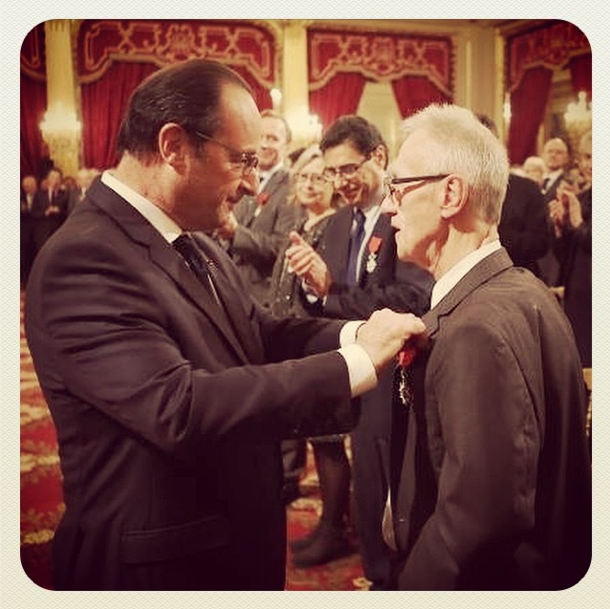
On Monday December 8th, Jean-Pierre Crépieux was the first person with an intellectual disability to receive the Legion d'Honneur, France's highest honour. Established in 1802 by Napoleon Bonaparte, the Legion d'Honneur rewards “personal merit in the service of the nation.” Jean-Pierre is being recognised for his contribution to L'Arche and the social development of …
On Monday December 8th, Jean-Pierre Crépieux was the first person with an intellectual disability to receive the Legion d’Honneur, France’s highest honour.Established in 1802 by Napoleon Bonaparte, the Legion d’Honneur rewards “personal merit in the service of the nation.” Jean-Pierre is being recognised for his contribution to L’Arche and the social development of men and women with an intellectual disability.
Born in 1944, Jean-Pierre, nicknamed “Pierrot,” was one of the first people to be welcomed at L’Arche in December 1964. In one of his first letters, in 1965, Jean Vanier wrote that Pierrot was the “nightingale” of the team, always preparing new songs.
Here is the speech made by French President François Hollande as he gave Pierrot the award:
Jean-Pierre Crépieux,
You are the person who helped to found a community, a community called L’Arche. For 40 years, first in Trosly-Breuil in the Oise department, and then in other centres, L’Arche has welcomed people with disability and voluntary assistants, who all live together. You don’t like being told that you’re disabled because, as you see it, everybody’s disabled, but not in the same way. Everybody’s talented, but not in the same way. Everybody’s kind, but not in the same way. This is the message you want to get across.
You have told us the story of your life in a book which may well teach us something about ourselves, whoever we are. Its title is, “I’m Not Afraid of Growing Old”. In it, you are completely honest about all the things that have caused you suffering or made you angry, but above all you talk about joy, the joy of being alive, the joy of being with others, and the joy of making things happen.
You were born into a large family, a very large family. At the age of five, you were separated from your brothers and sisters, and placed in a specialist care home in Sainte-Geneviève-des-Bois. And even though your relationship with your mother was always complicated, you remained very attached to her. Later, as a teenager, you found yourself on the streets, in other words, abandoned. When you were 20, a woman assistant told you about a new home that had just been set up in Trosly, a house where you could live with other people, not like you, but different from you. The name of the man who had set this place up was Jean Vanier. He asked you a simple question, “Do you want to come and join a new family, the L’Arche family?” Because you weren’t sure if you could trust him, you replied, “I’d be happy to give it a try for a couple of weeks”. And you stayed for 40 years. At Trosly, you became Pierrot, made new friends, and helped to build a community.
The L’Arche philosophy can be summed up as “living with, rather than doing things for”. Living with means living together, under the same roof, and working together. In L’Arche, people trust you. If there’s joy around, you are someone who knows how to share in that joy. If there’s sadness, you are someone who knows how to comfort, and if bad things happen, you bring the gift of happiness. When L’Arche expanded, and started up a new home in Boulogne-sur-Mer, you volunteered to go there. At the same time, you took a job at the steel works… and later, when the factory closed, you worked for the community’s social enterprise.
You’re proud of all that people with disabilities can do. You can even remember one of your friends who had only one hand, (just like your friend, Jean-Luc), but who was an outstanding carpenter, because sometimes even a one-handed person can do things better than a two-handed person. You know your rights and you know how to stand up for them. You played your part in shared community life and, when you were still a young man, you even joined the Young Christian Workers. As you have no plans to grow old, you are still a member of that organisation. For a long time, you spoke up for the people doing supported work in social enterprises, because there too people need to stand up for their rights. You know how to address elected officials. You know that France is the sum of all its citizens, and that it doesn’t judge people on their talents or on their disabilities. But you want to change the way people view disability. You want everything to be accessible – education, employment, happiness and culture – and so these are the commitments I shall be making next Thursday at the National Disability Conference I shall be holding here in this room.
Today, L’Arche, your community, has 139 centres spread across 40 countries, and here in France more than 30 communities have welcomed 1,200 people into their residential homes and 700 into their day centres. In human terms, this is a very beautiful and a great adventure.
Thanks to the light that shines from you, the Republic is a brighter place. You carry that light inside you, and that light is the sign of a successful life.
You have written a beautiful book because you have always held on to the idea that nothing is more precious than life, and that what matters is to make life more beautiful each day. You have given 50 years’ service as a co-founder of L’Arche, and for 50 years you have given joy and happiness to all your colleagues. For 50 years too you have served the cause of disability, which is why the Republic is honouring you, and through you, all those with disabilities who are proud to see you here.
Thank you.
– François Hollande (translation L’Arche International)
Jean-Pierre Crépieux,
Vous vous êtes celui qui a contribué à fonder une communauté, cette communauté s’appelle L’Arche. Elle accueille depuis 40 ans des personnes handicapées et des assistants volontaires qui vivent ensemble, à Trosly Breuil dans l’Oise d’abord puis ensuite dans d’autres centres. Vous n’aimez qu’on vous dise que vous êtes handicapé parce que pour vous, tout le monde est handicapé mais pas tous pareils. Tout le monde est talentueux mais pas tous pareils. Tout le monde est gentil mais pas tous pareils. C’est ca le sens de votre message.
Votre vie, vous l’avez racontée dans un livre qui pourrait finalement nous éclairer sur chacun d’entre nous. Son titre c’est « Je n’ai pas peur de devenir vieux ». Vous n’y cachez rien de ce qui vous a fait souffrir, de ce qui vous a mis en colère et partout dans votre récit domine la joie, la joie de vivre, la joie d’être avec les autres, la joie de faire avancer les choses.
Vous êtes né dans une famille nombreuse, très nombreuse. Vous avez été séparé de vos frères et sœurs à 5 ans, on vous a placé dans une maison spécialisée à Ste Geneviève des bois et même si vous avez toujours eu des relations compliquées avec votre mère, vous avez toujours été très attaché à elle.
Plus tard, adolescent, vous avez connu la rue, c’est-à-dire l’abandon. Quand vous avez 20 ans, une assistante vous a parlé d’un nouveau foyer qui venait d’être créé à Trosly, une maison où vous pourriez vivre avec d’autres personnes, pas comme vous, différentes de vous. L’homme qui avait créé cet endroit s’appelait Jean Vanier. Il vous a demandé cette chose simple « Veux tu venir dans une nouvelle famille, la famille de L’Arche ? » Vous lui avez répondu, parce que vous étiez méfiant : « Je veux bien faire un essai pour 15 jours ». Et vous y êtes restés 40 ans. A Trosly, vous êtes devenu Pierrot, vous avez trouvé des amis et vous avez donc fait cette communauté.
La Philosophie de L’Arche c’est une formule « vivre avec plutôt que faire pour ». Vivre avec cela veut dire vivre ensemble, habiter ensemble, travailler ensemble. A L’Arche on vous fait confiance. Quand il y a de la joie, vous vous savez la partager. Quand il y a de la peine, vous vous savez l’apaiser et quand il y a du malheur, vous donnez du bonheur. Quand L’Arche s’est étendue, avec un nouveau foyer à Boulogne sur Mer, vous avez été volontaire pour y aller. Vous avez à ce moment accepté un travail, aux Ascieries…. et quand cette usine a fermé, vous avez travaillé au Centre d’aide par le travail de la communauté.
Vous êtes fier de tout ce que peuvent faire les personnes handicapées. Vous vous souvenez même d’un de vos camarades qui n’avait qu’une main, comme votre ami Jean-Luc, et qui était pourtant un remarquable menuisier, parce que, même quand on a qu’une main, on peut faire mieux qu’avez deux mains. Vous connaissez vos droits et vous savez les défendre. Vous avez participé à la vie collective de la communauté, vous avez même rejoint, quand vous étiez jeune, la Jeunesse Ouvrière Chrétienne, mais comme vous ne pensez pas vieillir, vous êtes toujours membre de cette organisation. Vous avez longtemps porté la voix des travailleurs des Centres d’aide par le travail, parce que là aussi il faut défendre ses droits. Vous savez interpeler les élus. Vous savez que la France est la somme de ses citoyens et qu’elle ne fait pas de différence, la France, entre les talents et les handicaps. Mais vous voulez changer le regard sur le handicap. Vous voulez que tout soit accessible : l’éducation, l’emploi, le bonheur, la culture et bien ce seront les engagements que je prendrai jeudi prochain, lors de la Conférence nationale du handicap que je réunirai ici même dans cette salle.
Aujourd’hui, L’Arche, votre communauté, c’est 139 centres, répartis dans 40 pays et en, France plus de trente communautés accueillent 1200 personnes en foyer et 700 externes. C’est une très belle est grande aventure humaine.
A la République, vous apportez une lumière, celle que vous portez en vous, cette lumière qui est le signe d’une vie réussie.
Vous avez écrit un beau livre parce que vous n’avez jamais voulu perdre l’idée que rien ne vaut la vie et que ce qui compte, c’est de la rendre plus belle chaque jour.
50 ans de service en tant que co-fondateur de L’Arche, 50 ans à donner de la joie et du bonheur à tous vos collègues. 50 ans à servir la cause du handicap, c’est pourquoi la République vous distinguez vous, et à travers vous, tous ceux qui sont en situation de handicap et qui sont fiers de vous voir ici.
Merci
- See more at: http://jubile.arche-france.org/actualite/reportage-lelysee-sur-remise-legion-dhonneur#sthash.w7b82vDw.dpuf
Jean-Pierre Crépieux,
Vous vous êtes celui qui a contribué à fonder une communauté, cette communauté s’appelle L’Arche. Elle accueille depuis 40 ans des personnes handicapées et des assistants volontaires qui vivent ensemble, à Trosly Breuil dans l’Oise d’abord puis ensuite dans d’autres centres. Vous n’aimez qu’on vous dise que vous êtes handicapé parce que pour vous, tout le monde est handicapé mais pas tous pareils. Tout le monde est talentueux mais pas tous pareils. Tout le monde est gentil mais pas tous pareils. C’est ca le sens de votre message.
Votre vie, vous l’avez racontée dans un livre qui pourrait finalement nous éclairer sur chacun d’entre nous. Son titre c’est « Je n’ai pas peur de devenir vieux ». Vous n’y cachez rien de ce qui vous a fait souffrir, de ce qui vous a mis en colère et partout dans votre récit domine la joie, la joie de vivre, la joie d’être avec les autres, la joie de faire avancer les choses.
Vous êtes né dans une famille nombreuse, très nombreuse. Vous avez été séparé de vos frères et sœurs à 5 ans, on vous a placé dans une maison spécialisée à Ste Geneviève des bois et même si vous avez toujours eu des relations compliquées avec votre mère, vous avez toujours été très attaché à elle.
Plus tard, adolescent, vous avez connu la rue, c’est-à-dire l’abandon. Quand vous avez 20 ans, une assistante vous a parlé d’un nouveau foyer qui venait d’être créé à Trosly, une maison où vous pourriez vivre avec d’autres personnes, pas comme vous, différentes de vous. L’homme qui avait créé cet endroit s’appelait Jean Vanier. Il vous a demandé cette chose simple « Veux tu venir dans une nouvelle famille, la famille de L’Arche ? » Vous lui avez répondu, parce que vous étiez méfiant : « Je veux bien faire un essai pour 15 jours ». Et vous y êtes restés 40 ans. A Trosly, vous êtes devenu Pierrot, vous avez trouvé des amis et vous avez donc fait cette communauté.
La Philosophie de L’Arche c’est une formule « vivre avec plutôt que faire pour ». Vivre avec cela veut dire vivre ensemble, habiter ensemble, travailler ensemble. A L’Arche on vous fait confiance. Quand il y a de la joie, vous vous savez la partager. Quand il y a de la peine, vous vous savez l’apaiser et quand il y a du malheur, vous donnez du bonheur. Quand L’Arche s’est étendue, avec un nouveau foyer à Boulogne sur Mer, vous avez été volontaire pour y aller. Vous avez à ce moment accepté un travail, aux Ascieries…. et quand cette usine a fermé, vous avez travaillé au Centre d’aide par le travail de la communauté.
Vous êtes fier de tout ce que peuvent faire les personnes handicapées. Vous vous souvenez même d’un de vos camarades qui n’avait qu’une main, comme votre ami Jean-Luc, et qui était pourtant un remarquable menuisier, parce que, même quand on a qu’une main, on peut faire mieux qu’avez deux mains. Vous connaissez vos droits et vous savez les défendre. Vous avez participé à la vie collective de la communauté, vous avez même rejoint, quand vous étiez jeune, la Jeunesse Ouvrière Chrétienne, mais comme vous ne pensez pas vieillir, vous êtes toujours membre de cette organisation. Vous avez longtemps porté la voix des travailleurs des Centres d’aide par le travail, parce que là aussi il faut défendre ses droits. Vous savez interpeler les élus. Vous savez que la France est la somme de ses citoyens et qu’elle ne fait pas de différence, la France, entre les talents et les handicaps. Mais vous voulez changer le regard sur le handicap. Vous voulez que tout soit accessible : l’éducation, l’emploi, le bonheur, la culture et bien ce seront les engagements que je prendrai jeudi prochain, lors de la Conférence nationale du handicap que je réunirai ici même dans cette salle.
Aujourd’hui, L’Arche, votre communauté, c’est 139 centres, répartis dans 40 pays et en, France plus de trente communautés accueillent 1200 personnes en foyer et 700 externes. C’est une très belle est grande aventure humaine.
A la République, vous apportez une lumière, celle que vous portez en vous, cette lumière qui est le signe d’une vie réussie.
Vous avez écrit un beau livre parce que vous n’avez jamais voulu perdre l’idée que rien ne vaut la vie et que ce qui compte, c’est de la rendre plus belle chaque jour.
50 ans de service en tant que co-fondateur de L’Arche, 50 ans à donner de la joie et du bonheur à tous vos collègues. 50 ans à servir la cause du handicap, c’est pourquoi la République vous distinguez vous, et à travers vous, tous ceux qui sont en situation de handicap et qui sont fiers de vous voir ici.
Merci
- See more at: http://jubile.arche-france.org/actualite/reportage-lelysee-sur-remise-legion-dhonneur#sthash.w7b82vDw.dpuf
A film made at L'Arche Kenya was featured at this year's UN Enable Film Festival (UNEFF), which was held on December 3rd, the International Day of Persons with Disabilities. Entitled "Stop Ableism", the film was made by Michael McDonald, who is also the author of the beautiful "I am …
A film made at L’Arche Kenya was featured at this year’s UN Enable Film Festival (UNEFF), which was held on December 3rd, the International Day of Persons with Disabilities.
Entitled “Stop Ableism”, the film was made by Michael McDonald, who is also the author of the beautiful “I am Musa” video.
Click here to see the other films selected at the Enable Film Festival.
In October, the L’Arche International Stewardship Board and Leadership Team approved L’Arche Warsaw in Poland as a new probationary member of the International Federation of L’Arche Communities, making it the 147th L’Arche community around the world. “Both the Stewardship Board and the Leadership Team approved your application by a unanimous vote. It is with great joy that we welcome …
In October, the L’Arche International Stewardship Board and Leadership Team approved L’Arche Warsaw in Poland as a new probationary member of the International Federation of L’Arche Communities, making it the 147th L’Arche community around the world.
“Both the Stewardship Board and the Leadership Team approved your application by a unanimous vote. It is with great joy that we welcome your community as a probationary member of the Federation,” wrote L’Arche International Leaders Patrick Fontaine and Eileen Glass.
The group was born from the initiative of members of Faith and Light in Warsaw, which started in 1978. They foresaw the need for a L’Arche community from the early days but only started working actively towards that goal in 2001. The group received a renewed burst of energy from Jean Vanier’s visit a few years ago, which attracted many new members who shared the dream of a L’Arche community in Warsaw, many of whom already had lived in L’Arche.
After going through the pre-foundation stages, the group applied to become an official project in December 2008. Since then, it has continued to grow, thanks to the determination and perseverance of its members.
Today L’Arche Warsaw supports 17 people with disabilities, who live independently or with their families. The community helps them in their daily lives, helping them with health issues, housework, and their relationships with their families and neighbors. It also helps them to find jobs. “It is a very active community, and a place of joy,” says Baska Wojcik, L’Arche Poland National Leader.
L’Arche Warsaw is the fourth L’Arche community in Poland.
Since June, more than a million people have left their homes in northern Iraq to seek refuge in Kurdistan – including 125,000 Christians who were asked to choose between renouncing their faith, exile or death. Ankawa, a suburb of Erbil, the capital of the Kurdistan Region of Iraq, has become a refuge for these Christian exiles. Some have been taken …
Since June, more than a million people have left their homes in northern Iraq to seek refuge in Kurdistan – including 125,000 Christians who were asked to choose between renouncing their faith, exile or death.
Ankawa, a suburb of Erbil, the capital of the Kurdistan Region of Iraq, has become a refuge for these Christian exiles. Some have been taken in by family members, others have been able to find a room to rent in an apartment. But for most of the refugees, home is now a tent in a camp, or the mobile homes that are being hastily set up before winter arrives. Church leaders are at the frontline of this emergency management – their priority right now being to find a roof for as many people as possible, warm clothes for winter, and to organize schooling for the children.
In October, L’Arche and other organizations were invited to accompany a delegation of L’Oeuvre d’Orient that was going to Erbil to show solidarity and assess needs. L’Oeuvre d’Orient is a French organization set up to help Christians in the Middle East.
“Under what conditions will you be able to go home? Are you thinking about settling here permanently?” The people who we meet are still in shock of what has just happened to them. Many talk about leaving the country. “There is no future for us here, their children will do the exact same thing with our children in 20, 30 years.” A person with a disability announces that they have finally gotten a passport. Another person says that she wants to go home, to Qaraqosh. “We need to be safe at home,” she says.
In such a chaotic situation, no one –not even us who are visiting them– can really understand what is happening, nor can they predict how the situation will evolve in the medium term.
A camp was set up in one of the community centers, in which partitions were put up to create rooms. Fifty people live here, including Belsam, who smiles as she tells us how she became involved in organizing life in the camp. Schedules, taking turns to prepare meals, instructions not to eat in the rooms…. Sandy, a person with a severe disability, lives here with her mother. She does not talk and stays bedridden. But it seems that perhaps her fragility is creating something quite special in this makeshift community. Belsam says that people passing in the hallway say always hello to Sandy from across the partition, and that every evening, there is a moment of silence while the community thinks of her and another person who has mental difficulties.
There are many difficulties, which are inherent to life in the camps: many people talk to us about problems of promiscuity, mobile homes that house up to three families, people without jobs. There is one camp, set up in a building that is still under construction, where the rooms are prone to flooding, where the numerous children are left to their own devices, and living conditions are barely decent – leaving much sadness and bitterness. And also much discomfort between those who live here and those of us who are just visiting – how can we avoid being mere spectators of their distress?
Almost 200 people have gathered in one of the community centers of Ankawa: people with intellectual disabilities, their families and friends, many youths. They are members of the Joy and Charity movement (Al-Mahabba wal-Farah), a cousin of L’Arche and the Faith and Light movement, which was founded by Bishop Rahho, the Chaldean bishop of Mosul who was assassinated in 2008.
Of the 30 Joy and Charity movements set up in Irak, 13 were displaced by this summer’s events. The meeting that we were invited to has brought together members from Erbil and refugees, to celebrate the anniversary of one of the displaced communities. Prayer, games, dancing, laughter… in the midst of such a difficult and absurd situation, it is very surprising to see so much life and strength here. Their force seems to stem from a group of people with disabilities, who are living to the full what is given to them in the present moment.
After spending a few days with these men and women, who are still standing strong despite the unimaginably difficult situation that they have been dealt, it is impossible not to be profoundly moved.
We hear of successive exiles in Bassora, Fallujah, Bagdad and Erbil, from Samra. A Little Sister of Jesus tells us that she would like to go back to Bagdad. “If we start to think about the danger, we stop living,” she says. Belsam adds: “If you want to help us… stay longer next time, we can visit the families of people with disabilities. For them, being refugees is even harder.”
Text and photos: Stanislas Dubourg with Widad Bisher / L’Arche International
On November 11th, Her Royal Highness The Princess Royal (or Princess Anne as you might know her), met with representatives of L'Arche Canada. The meeting took place at Rideau Hall, the residence of Canada’s Governor General, during L’Arche Canada’s Jubilee celebration in Ottawa-Gatineau. L'Arche Canada National Leader, Hollee Card, shared her impressions with us: …
On November 11th, Her Royal Highness The Princess Royal (or Princess Anne as you might know her), met with representatives of L’Arche Canada.
The meeting took place at Rideau Hall, the residence of Canada’s Governor General, during L’Arche Canada’s Jubilee celebration in Ottawa-Gatineau.
L’Arche Canada National Leader, Hollee Card, shared her impressions with us:
Excited and nervous were the overriding emotions of the regional delegates as we boarded the bus to meet Her Royal Highness.
As she moved from group to group, meeting and talking with each person present, we relaxed. Her interest in each person she met was demonstrated through her questions and humour.
Jacques Lang and Madeleine Ellis presented her with a beautiful piece of art entitled ‘World Heritage’. Jacques and Madeleine pointed out the different heritage sites that make up the painting. The artwork was done collectively by members of L’Alizé workshop in L’Arche Montréal:
World Heritage
Watch Her Royal Highness with members of L’Arche Canada (after the 2:30 minute mark):
Jean Vanier and L’Arche received the Notre Dame Award for International Human Development and Solidarity on October 23. Here is an excerpt of the Kellogg Institute for International Studies' website, describing the ceremony: L’Arche and its visionary founder Jean Vanier have received the 2014 Notre Dame Award for International Human Development and Solidarity in recognition of the organization’s groundbreaking work …
Jean Vanier and L’Arche received the Notre Dame Award for International Human Development and Solidarity on October 23. Here is an excerpt of the Kellogg Institute for International Studies’ website, describing the ceremony:
L’Arche and its visionary founder Jean Vanier have received the 2014 Notre Dame Award for International Human Development and Solidarity in recognition of the organization’s groundbreaking work in service of the poor and vulnerable around the world. L’Arche is an international federation of communities for people with disabilities that promotes their human dignity while celebrating the power of positivity and friendship.
The award was formally presented on October 23 during the Kellogg Institute’s Conference on Human Dignity and Human Development at the University’s Rome Global Gateway in Italy.
Jean Vanier and L’Arche Receive Notre Dame Award for International Human Development and SolidarityIn making the presentation, Faculty Fellow R. Scott Appleby, dean of Notre Dame’s new Keough School of Global Affairs, cited L’Arche and Jean Vanier for promoting a deeper awareness of the inherent dignity of every human being, showing how human beings flourish when they are embraced and loved as they are, demonstrating that all human beings are capable in different and complementary ways, and establishing communities that value the capabilities of each member and bring out the best in all.
Jean Vanier, who was unable to travel to Rome, delivered remarks filmed in home in France.
“The whole meaning of L’Arche is to reveal to people that under their disabilities, under their difficulties and violence, there is a you, your person, and you are beautiful,” he said, explaining that what the organization does in terms of programing pales next to this power to reveal the value of each person.
In 2012, at the Atlanta General Assembly, more than 170 members of the International Federation of L’Arche elected Patrick Fontaine and Eileen Glass as co-international leaders, and Alison Lindsay-Cross as Chair of the International Stewardship Board, for a five-year mandate. Halfway through this mandate, the L’Arche International Federation Council met in October in Lyon, France, to judge the road travelled …
In 2012, at the Atlanta General Assembly, more than 170 members of the International Federation of L’Arche elected Patrick Fontaine and Eileen Glass as co-international leaders, and Alison Lindsay-Cross as Chair of the International Stewardship Board, for a five-year mandate. Halfway through this mandate, the L’Arche International Federation Council met in October in Lyon, France, to judge the road travelled since Atlanta.
The special characteristic of L’Arche International is its mode of inclusive governance: all members of L’Arche communities, whether it is people with disabilities, assistants, community leaders, staff and Board members – old and new – are represented on the Council, as intended by the constitution. It is constitutional inclusion.
With 30 members from the United States, Kenya, Ireland, Australia, India, Ukraine, Lithuania, Poland, Belgium, Syria, Slovenia, France, Switzerland, England, Scotland, Canada and Argentina, including nine people with intellectual disabilities, the Council truly reflects L’Arche International in all its diversity.
“You have been selected by the federation, you are charged with an important task. We need the experience of each part of the federation to see how we are progressing,” Eileen Glass told the Council members gathered in Lyon. “We are not here to make decisions, we are here to listen.” During three days, this “sample” of the Federation shared its view on what happens in the communities, while “observers” analyzed the underlying trends.
Council members where asked to base themselves on their personal experience, on the reality of their daily lives, so that a real “snapshot” of the Federation could reveal itself. The discussions were on the themes of the Federation mandate: How is the mission of L’Arche lived, in particular in the context of new cultures and new models? What is alive in our communities? How is leadership exercised? How do we engage with society? How is solidarity expressed? And what about partnerships between all members of the communities?
The Council was led by Anne Chabert d’Hières, Project Manager for the inclusion of people with disabilities at L’Arche International, and Christine Bruggeman, Formation coordinator at L’Arche International. Leveraging their combined experiences, Anne and Christine used a lot creativity to offer a program that was both varied and interactive, allowing each person to express themselves in a manner in which they were most comfortable, whether it was intellectual, emotional, physical, spiritual or artistic.
The work sessions were each every different from one another, with discussions taking shape around photos, drawings, role-playing etc. Participants were asked to present the fruits of their discussions at the end of each session, in the form of analysis, skits and posters. The “observers” gave an initial summary of their findings at the end of each session, underlining the general trends that they had observed, for instance: the diversification of models; the fact that people with disabilities have an increasingly important role to play in the communities; an improvement in the way leadership is exercised and creativity in the way we engage with society… A later analysis of their observations will help the Federation readjust its action plans, and better integrate the reality of communities, which the Council has allowed us to see more clearly.
Sue Mosteller was L'Arche's first International Leader after Jean Vanier, and a close friend to Henri Nouwen. A member of L'Arche Daybreak since 1976, Sue recently gave a keynote address at St Michael's College, Toronto, Canada, for the opening of a L'Arche Daybreak exhibition celebrating 50 years of L'Arche around the world. Watch the keynote address here:
Sue Mosteller was L’Arche’s first International Leader after Jean Vanier, and a close friend to Henri Nouwen.
A member of L’Arche Daybreak since 1976, Sue recently gave a keynote address at St Michael’s College, Toronto, Canada, for the opening of a L’Arche Daybreak exhibition celebrating 50 years of L’Arche around the world.
We are proud to announce that Professor Jonas Ruškus, from L'Arche in Lithuania, is the first L'Arche member to be elected at the UN Committee on the Rights of Persons with Disabilities (CRPD). His mandate at the UN will run from 2015 to 2018.The Committee on the Rights of Persons with Disabilities is composed of 18 independent experts - persons …
GROWTH COORDINATOR REQUIRED FOR L’ARCHE CANADA Click here for role description. Applicants must be Canadian. To apply, please send a cover letter and CV to Tammy Bartel before December 12. Posted on November 24, 2014. FULL TIME CHEF/PROJECT LEADER REQUIRED FOR CAFE L’ARCHE CALLAN, IN CO. KILKENNY, IRELAND Experience required in management of a catering establishment; experience …
We are proud to announce that Professor Jonas Ruškus, from L’Arche in Lithuania, is the first L’Arche member to be elected at the UN Committee on the Rights of Persons with Disabilities (CRPD). His mandate at the UN will run from 2015 to 2018.The Committee on the Rights of Persons with Disabilities is composed of 18 independent experts – persons of high moral character and recognized competence in the field of human rights. Find out more about the committee here.Jonas is a Board Member at the new L’Arche Lithuania project in Kaunas, who has also spent four years at L’Arche in Trosly, France. He is Dean of the Faculty of Social Sciences at Vytautas Magnus University in Kaunas. Here is some information about him:
Professor Ruškus is a nationally and internationally recognized expert in the area of disability. Besides his studies in special education for children having intellectual disability in Lithuania, Jonas Ruškus has gained significant experience of voluntary and professional work with people having intellectual and other types of disability in the international l’Arche community in France. The experience of community-based living and inclusion of people with disability into community settings determined his decision to devote his professional career for the implementation of human rights and social justice dealing with disability issues on the individual, organizational and social policy levels.
Currently Jonas Ruškus works in the area of social work by teaching and conducting research. He acted as a supervisor of multiple national research projects in fields of social participation of people with disabilities, inclusive education, social policy, quality of social services, monitoring of national educational system with the collaboration of the Lithuanian Government (Ministry of Education and Science, Ministry of Social Security and Labour, Research Council of Lithuania) and Non-Governmental organizations (such as Lithuanian Welfare Society for Persons with Mental Disability HOPE).
FIND ALL THE LATEST L’ARCHE INTERNATIONAL NEWS HERE




No comments:
Post a Comment