Editor's Note:
Dear Friend,
As this week’s Torah portion unfolds, all the signs point towards a disastrous confrontation. After twenty years in Charan, Jacob returned to the Holy Land to find a still-furious Esau approaching along with four hundred men. Fearing for himself and his family, Jacob prayed to G‑d, sent reconciliatory presents to Esau, and prepared for battle.
The crucial moment arrived. Jacob and Esau saw each other for the first time in decades, and Esau ran toward Jacob, embraced him and kissed him.
The Hebrew word vayishakeihu (“and he kissed him”) is topped with small dots in the Torah. According to one view, this is to highlight the anomaly of Esau’s behavior. Despite his resentment, at the moment of truth Esau’s compassion was aroused, and he kissed Jacob wholeheartedly.
This story makes me feel hopeful, when conflict fills the news and the gossip mill, for what unites us is so much stronger than what pulls us apart. On all levels, personal, communal and global, we can—and we must—overcome our differences and achieve true peace.
Take the first step. Reach out in friendship, and bring the world just a little closer to the beautiful place it can be.
Rochel Chein,
Responder for Ask the Rabbi @ Chabad.org
P.S.: Thank you to everyone who provided input last week when we asked you whether you wanted us to feature the Parshah in a Nutshell or Parshah in Depth in the magazine. Your overwhelming response was in favor of Parshah in Depth, so that’s what we’ll feature. Please continue to share your feedback. We really appreciate it!
Daily Thought:
Plumbing
Making a living is all about plumbing. You’ve got a reservoir up there, a water tank down here, and you need some way to connect the two.
The reservoir of life up there can’t be changed or moved. As for the water tank down here, that is your career, and it only receives what is decided from Above.
But you also have a second career—your principal career—and that is to bring more good into this world.
In that career, you are a plumber. You can open faucets, widen pipelines, drain all you can from an Infinite Source. It will overflow into the water tanks of your material career. It might even increase their volume.
The flow of life is in your hands.[Likutei Sichot, vol. 6, pg. 193]
This Week's Features:
How a Secret Recording Brought Torah to a Rice Farm in Thailand By Menachem Posner
For Thousands of Students, Rabbi Gordon Is a Daily Delight
Three-year study of Maimonides’ Mishneh Torah to be completed on Dec. 14 By Menachem Posner

Zevulun Brewer, who works the fields in Sakon Nakhon, Thailand, has been downloading daily online classes led by Rabbi Yehoshua B. Gordon—executive director of Chabad of the Valley in Encino, Calif.—and replaying them on his iPod as he works.
Zevulun Brewer, who works the fields in Sakon Nakhon, Thailand, has been downloading daily online classes led by Rabbi Yehoshua B. Gordon—executive director of Chabad of the Valley in Encino, Calif.—and replaying them on his iPod as he works.
It’s harvest season in Sakon Nakhon, 500 miles from Bangkok, Thailand, so Zevulun Brewer has been spending 10 to 12 hours a day driving his tractor up and down his three fields, hoping to bring back 15 tons of rice. But that doesn’t mean he can’t squeeze in some time for a side endeavor as well. Since he was connected to the Internet four years ago, he’s been downloading daily Torah study classes by Rabbi Yehoshua B. Gordon—executive director of Chabad of the Valley in Encino, Calif.— and replaying them on his iPod as he works.
Aside from appreciating the rabbi’s precise explanations, Brewer says Gordon’s personal anecdotes and wisecracks make the classes easy on the ear. “Rabbi Gordon draws upon a great reservoir of personal experiences, Chassidic stories and anecdotes of his father,” he explains, “so you really get to know him, and to get to know him is to love him.”
Gordon has been teaching a live class available on video and audio that follows the daily study cycle of Tanya, the seminal work of Chabad Chassidus, as well as the daily study of Chumash (The Five Books of Moses) with the commentary of Rashi since 2009, and on Sunday, Dec. 14 he will complete the entire 1,017-chapter series of Mishneh Torah—Maimonides’ codification of Jewish law—following the three-year track established by the Lubavitcher Rebbe, Rabbi Menachem M. Schneerson, of righteous memory.
The live class was the brainchild of tech investor and regular class attendee Daniel Aharonoff, who says it took more than a year of secretly taping the classes given at the Chabad House before the rabbi agreed to open the course to the public.
“A few years ago, I had a meeting with Rabbi Gordon,” says the 40-something Aharonoff, who was born in Germany and grew up in Los Angeles, where he attended Modern Orthodox Jewish day schools. “I told him that I’m doing well financially, but something was missing in my life. He told me to come to his daily Torah and Tanya class for three months. I replied that I’ve never been good in school and doubted that I would do any better in his class. He told me to take what he calls ‘the Gordon Challenge’—to study with him every day for three months and then take it from there.

Rabbi Yehoshua B. Gordon has been teaching a live online class that follows the daily study cycle of Tanya, and Chumash with Rashi since 2009.
“After three months, I was hooked,” he continues. “Tanya transformed my life, and I learned that starting the day with Torah study gives you more energy than a good shower and a cup of coffee. Rabbi Gordon says it fortifies you with the minerals you need to get going—and it’s true. Learning sets your head in the right direction.”
Aharonoff then began asking the rabbi if he could use his expertise from the technology sector to broadcast the classes live, so that others could take advantage of what he describes as the rabbi’s ability to paint vivid pictures that bring even the driest aspects of the subject matter to life.
After Gordon demurred—noting that the camera’s presence might inhibit him—Aharonoff began to secretly record the classes with a handheld device in his pocket.
‘The Rabbi Was Speechless’
“After a year, I took the rabbi out for lunch, telling him I had a special gift to present him,” relates Aharonoff. “Afterwards, I took out an SD card with his classes and told him what it was. For a rare moment, the rabbi was speechless.”
Around that same time, the staff of Chabad.org’s Jewish.tv reached out to Rabbi Gordon, requesting that he broadcast his much-talked-about classes … and he finally relented.
Aharonoff says he brought in all the equipment needed to start streaming and enjoyed watching how many people logged on in real time.
As the class gained popularity, the rabbi says he was pleasantly surprised to learn just how many lives he has touched. “I travel widely,” he has stated previously, “and I often meet strangers who tell me that they ‘know’ me because they learn from my classes on Chabad.org. It’s incomparable to anything else—an aspect of life that I never imagined—and it’s wonderful.”

Aside from appreciating the rabbi’s precise explanations, Brewer says Gordon's personal anecdotes and wisecracks make the classes easy on the ear.
‘Drink From the Wellsprings’
Brocha Taub, who listens to the classes in her van while driving her children to school, says the rabbi, his teachings and his jokes have become part of her family culture. “My 2-year-old daughter came up to me the other day while the class was playing,” she wrote in an email, “and she said to me, ‘Rambam? Yeah, Mommy!’ I didn’t have the heart to tell her it was actually the Chumash class.”
With just two weeks to go until the class will complete the entire Mishneh Torah following the triennial cycle the Rebbe set in motion back in 1984, Taub says she and her children are already planning their grand celebration and thinking of ways to get others to join in the learning as well.
For his part, Brewer says he’s “grateful, inspired and motivated by the strengths of Rabbi Gordon—strengths that invite and welcome even people from the furthest fringes to drink from the wellsprings of Judaism and Chassidism to find a satisfaction that seemed only possible as a dream before. I’m grateful for Rabbi Gordon’s kind, loving patience that shines through his elucidations of the most abstract concepts and humble humor that helps give over the content.”

The rabbi's study group in California and thousands of online students will soon complete the entire 1,017-chapter series of Mishneh Torah—Maimonides’ codification of Jewish law—following the three-year track established by the Lubavitcher Rebbe, Rabbi Menachem M. Schneerson, of righteous memory.
According to the latest statistics, the rabbi’s classes have been viewed nearly 2 million times since Chabad.org began tracking hits to the site—and reached others via word of mouth as well.
Reports Aharonoff: “I know that I often share things that I’ve learned throughout the day with business acquaintances and family, and other people do that as well. And when you add that all together, the effects are just astronomical.”

The live class was the brainchild of tech investor and regular class attendee Daniel Aharonoff, left, who says it took more than a year of secretly taping the classes given at the Chabad House before the rabbi agreed to open the course to the public.
© Copyright 2014, all rights reserved.
PARSHAH
Learn the Parshah In Depth
A condensation of the weekly Torah portion alongside select commentaries culled from the Midrash, Talmud, Chassidic masters, and the broad corpus of Jewish scholarship.
Parshat Vayishlach In-Depth
Genesis 32:4-36:43
Parshah Summary
"And Jacob sent messenger-angels before him to Esau his brother." Jacob is back in the Holy Land after a 20-year stay in Charan, where he has married, fathered eleven sons and a daughter, and acquired herds of sheep and cattle and many other possessions.
Thirty-four years earlier, he had fled the wrath of Esau after stealing the blessings from their father. Now, he sends angels as messengers bearing conciliatory words to his brother. The messengers, however, return to report that Esau is "coming against you, and four hundred men are with him."
And Jacob was greatly afraid, and he was distressed. And he divided the people that were with him, and the flocks and the herds and the camels, into two camps.
And he said: If Esau comes to the one camp and strikes it down, then the camp which is left shall escape.
Then he prays:
"O G-d of my father Abraham, and G-d of my father Isaac... I am unworthy of the least of all the mercies and of all the truth which You have shown Your servant, for with my staff I passed over this Jordan, and now I am become two camps.
"Now deliver me from the hand of my brother, from the hand of Esau, for I am afraid of him, lest he come and strike me, [and strike] a mother with children."
The third thing he does is to appease his brother by dispatching a gift of
two hundred she-goats and twenty he-goats, two hundred ewes and twenty rams, thirty milk camels with their colts, forty cows and ten bulls, twenty she donkeys and ten he donkeys.
Alone at Night
That night, Jacob transfers his family across the ford of Yabbok, yet mysteriously remains behind alone on the other side, where "a man wrestled with him until the breaking of the day."
And when he saw that he did not prevail against him, he touched the hollow of his thigh, and the hollow of Jacob's thigh was put out of joint, as he wrestled with him.
And [the stranger] said: "Let me go, for the day breaks." And he said: "I will not let you go, unless you bless me."
And he said to him, "What is your name?" And he said, "Jacob." And he said, "Your name shall be called no more Jacob, but Israel, for you have contended with [an angel of] God and with men, and you have prevailed."
The Embrace
The sun had risen when the two brothers meet. Jacob's family is arrayed behind him: the two "handmaids," Bilhah and Zilpah, with their four children; Leah and her six sons; and bringing up the rear, Rachel with Jacob's youngest, the six-year-old Joseph.
And Esau ran toward him and embraced him, and he fell on his neck and kissed him, and they wept.
And [Esau] lifted his eyes and saw the women and the children, and he said, "Who are these to you?" And he said, "The children with whom God has favored your servant."
Esau protests that the gift which Jacob sent is really not necessary: "I have much, my brother; keep what you have to yourself." But Jacob insists: "Now take my gift, which has been brought to you, for God has favored me [with it], and I have all [I need]."
So come with me to Se'ir, says Esau. But Jacob stalls:
"My master knows that the children are tender, and the flocks and the cattle, which are raising their young, depend upon me, and if they overdrive them one day, all the flocks will die.
"Now, let my master go ahead before his servant, and I will move [at] my own slow pace, according to the pace of the work that is before me and according to the pace of the children, until I come to my master, to Seir."
But Jacob never does get to Se'ir. He stays a while in Sukkot, where he "built for himself a house, and made sheds for his cattle." He then settles near the city of Shechem, where he purchases a plot of land for 100 kesitah.
The Rape of Dinah
And Dinah the daughter of Leah, whom she bore to Jacob, went out to see the daughters of the land.
Shechem, the son of Chamor the Hivvite, prince of the country, saw her, and he took her, lay with her, and violated her.
And his soul was drawn to Dinah the daughter of Jacob; and he loved the girl, and spoke kindly to the girl.
And Shechem spoke to his father Chamor, saying, "Take this girl for me as a wife."
Chamor went to speak with Jacob. "The soul of my son Shechem," he says, "longs for your daughter. Please give her to him for a wife."
Indeed, says the Hivvite prince, this can be the start of a most productive cooperation between our peoples: "Intermarry with us; you shall give us your daughters, and you shall take our daughters for yourselves. And you shall dwell with us, and the land shall be before you; remain, trade in it, and take possession of it."
Jacob's sons, who have in the meantime returned from the field, are greatly distressed and angered. Determined to avenge their sister's honor, they reply to Chamor's offer with cunning:
"We cannot do this thing, to give our sister to one that is uncircumcised, for that would be a disgrace to us.
"But with this, however, we will consent to you, if you will be like us, that every male will be circumcised. Then we will give you our daughters, and we will take your daughters for ourselves, and we will dwell with you and become one people.
"But if you do not listen to us to be circumcised, we will take our daughter and go."
Chamor and Shechem fall for the ploy, and convince the entire town to circumcise themselves.
And it came to pass on the third day, when they were ailing, that two of the sons of Jacob, Simon and Levi, Dinah's brothers, took each man his sword, and came upon the city unresisted, and slew all the males.
And they slew Chamor and Shechem his son with the edge of the sword, and they took Dinah out of Shechem's house and left.
Jacob's sons came upon the slain and plundered the city that had defiled their sister.
Jacob is displeased by their action:
And Jacob said to Simon and Levi: "You have sullied me, making me odious among the inhabitants of the land, among the Canaanites and the Perizzites, and I am few in number, and they will gather against me, and I and my household will be destroyed."
To which they reply:
"Could we have allowed our sister to be made a harlot?!"
The Death of Rachel
News reaches Jacob that Deborah, his mother's nurse, has died. A number of the commentaries see this as an allusion that Rebecca, too, passed away at this time.
G-d appears to Jacob and reiterates the name change given him by the mysterious stranger with whom he had wrestled all night: "Your name shall not be called any more Jacob, but Israel shall be your name."
G-d then blesses him:
Be fruitful and multiply; a nation and a multitude of nations shall come into existence from you, and kings shall come forth from your loins.
And the land which I gave to Abraham and Isaac, to you I will give it and to your seed after you will I give the land.
Jacob has now been in the Holy Land for nearly two years, making his way southward toward Hebron, where his father lives. He is nearly there when tragedy strikes:
There was but a little way to come to Efrat, when Rachel gave birth, and she had a difficult labor...
And it came to pass as her soul was departing--for she died--that she called [the child's] name Ben-Oni ("son of my grief"); but his father called him Benjamin ("son of the right").
And Rachel died, and was buried on the road to Efrat, which is Bethlehem. And Jacob set a monument upon her grave; that is the tombstone of Rachel until this day.
The Torah then mentions Reuben's sin in "violating his father's marriage bed." (The verse writes that "Reuben went and lay with Bilhah his father's concubine." But our sages are unanimous that this is not to be understood in the literal sense, but in the figurative sense of Reuben's interference in his father's marital life.)
At long last Jacob reaches Hebron, and is reunited with his father. At this point the Torah also notes that Isaac dies at the age of 180 years, and is buried by "Esau and Jacob his sons." (Chronologically, this places the death of Isaac 22 years hence, long after the events of the next parshah; indeed, in Genesis 37:3 we find Isaac weeping with Jacob over the apparent loss of Joseph.)
The Clan of Esau
Vayishlach concludes with a detailed account of Esau's world: the names of his wives, children and grandchildren; the chieftains of his clan, which developed into the nation of Edom; and the family histories of the people of Se'ir among whom Esau's family settled and intermarried.
It also lists eight kings who "reigned in Edom before there reigned any king over the children of Israel."
From Our Sages
And Jacob sent messenger-angels before him to Esau his brother (32:4)
Actual angels.
(Rashi)
The Hebrew word malachim means both "messengers" and "angels" (an angel being a divine messenger). Thus, the verse, "And Jacob sent malachim to Esau his brother," can be understood as a reference to human messengers as well. Hence Rashi's clarification that it means "actual angels."
Chassidic master Rabbi DovBer of Mezeritch sees a deeper meaning in Rashi's words: Jacob sent the "actuality" of his angels to Esau, but kept their higher spiritual essence with him.
And Jacob was greatly afraid, and he was distressed (32:8)
He was afraid that he might be killed, and distressed that he might kill.
(Midrash Rabbah)
If Esau comes to the one camp, and smites it, then the camp which is left shall escape (32:9)
He prepared himself in three ways: he sent a gift, he prayed, and he made ready for war.
(Rashi)
I am unworthy of the least of all the mercies and of all the truth which You have shown Your servant (32:11)
The meaning of this is that every kindness bestowed by G-d upon a person should cause him to be exceedingly humble. For a Divine kindness is an expression of "His right hand does embrace me"--G-d is literally bringing the person closer to Himself. And the closer a person is to G-d, the greater the humility this should evoke in him, for since "all before Him is as naught," the more "before Him" a person is, the more "as naught" does he perceive himself to be.
This is the manner of Jacob. The very opposite is the case in the contrasting realm of kelipah (evil). There, the greater the kindness shown a person, the more he grows in arrogance and self-satisfaction.
(Rabbi Schneur Zalman of Liadi)
And he took his two wives, and his two handmaids, and his eleven sons (32:23)
And where was Dinah? Jacob had placed her in a chest and locked her in, lest Esau set his eyes on her. For this, Jacob was punished in that Dinah fell into the hands of Shechem, for had he not withheld her from his brother, perhaps she would have brought him back to the proper path.
Said G-d to Jacob: "You wouldn't give her in marriage to a circumcised person; behold, she is now possessed by an uncircumcised one. You wouldn't give her in legitimate wedlock; behold, she is now taken in illegitimate fashion."
(Rashi; Midrash Rabbah)
And Jacob remained alone (32:25)
He remained for the sake of some small jars he had left behind. Hence [it is learned] that to the righteous their money is dearer than their body.
(Talmud, Chulin 91a)
This is because the righteous know that their material possessions contain "sparks of holiness" which are redeemed and elevated when the object or resource they inhabit is utilized to fulfill the Divine will. The righteous person sees these sparks of Divine potential as virtual extensions of his own soul, since he understands that the very fact that Divine Providence has caused them to come into his possession indicates that their redemption is integral to his mission in life.
(The Chassidic Masters)
More
And a man wrestled with him (32:25)
This was the "prince" of Esau (the angel who embodies the spirit of Esau).
(Midrash Rabbah; Rashi)
And when he saw that he did not prevail against him, he touched the hollow of his thigh (32:26)
Jacob's struggle with Esau's angel represents the physical suffering of galut. When the angel of Esau injured Jacob's hip-joint, he injured his righteous descendants. In the words of the Midrash, "This is the generation of the shmad"--the cruel tortures inflicted by the Romans in Mishnaic times (1st and 2nd century CE) in their effort to eradicate the faith of Israel.
There were other generations in which the same and worse was done to us. We suffered all this and persevered, as alluded to by the verse, "And Jacob arrived, whole."
(Nachmanides)
And he said: "Let me go, for the day breaks" (32:27)
Said Jacob to him: "Are you a thief or a gambler, that you are afraid of the morning?" Said he: "I am an angel, and from the day that I was created my time to sing praises to G-d has not come until now."
(Talmud, Chulin 91b)
And [Jacob] prostrated himself to the ground seven times, until he came close to his brother... And the maidservants and their children drew near and prostrated themselves. And Leah and her children drew near and prostrated themselves, and after [them], Joseph and Rachel drew near and prostrated themselves (33:3-7)
When Mordechai refused to bow to Haman, they said to him: "You're going to get us all killed! How dare you go against the decree of the king?"
Said Mordechai: "I am a Jew."
Said they to him: "Did not [our] forefathers bow to his forefather?"
Replied Mordechai: "I am a descendant of Benjamin, who was in his mother's womb at that time. Just as my forefather did not bow, so, too, I shall not kneel nor bow."
(Midrash)
And Esau ran toward him and embraced him, and he fell on his neck and kissed him (33:4)
In the Torah, the word vayishakeihu ("and he kissed him") is dotted on top, implying that this was an exception to the rule. Said Rabbi Yanai: This is to tell us that he did not intend to kiss him, but to bite him. But Jacob's throat turned to marble and broke the evil one's teeth.
(Midrash Rabbah)
What was different about this kiss? Our Sages debate this. There are those who say that it implies that Esau did not kiss Jacob with all his heart. Rabbi Shimon ben Yochai says: It is a well known law that Esau hates Jacob. Here, the kiss was an exception in that he did kiss him with all his heart.
(Rashi)
And I will move [at] my own slow pace... until I come to my master, to Seir (33:14)
Said Rabbi Abbahu: We have searched the whole of Scriptures and do not find that Jacob ever went to Esau to the mountain of Se'ir. Is it then possible that Jacob, the truthful one, should deceive him? But when would he come to him? In the Messianic Era, when "the saviors shall ascend Mount Zion to judge the mountain of Esau" (Obadiah 1:21).
(Midrash Rabbah)
More
He built for himself a house, and made sheds for his cattle (33:17)
For "himself" -- for his true self and his true priorities -- Jacob constructed a "home"; for "his cattle" -- his material possessions and other peripheral elements of his life -- he sufficed with a minimal "shed."
(The Lubavitcher Rebbe)
A chassid of Rabbi Sholom DovBer of Lubavitch (1860-1920) opened a plant for the manufacture of galoshes. Soon his every waking hour and thought was completely occupied in his new and flourishing business.
Said the Rebbe to him: "I've seen people put their feet into galoshes, but a head in galoshes...?"
Jacob arrived, whole, in the city of Shechem (33:18)
Whole in body, for he was healed of his limp. Whole in wealth, for he sustained no loss as a result of the gift [he dispatched to Esau]. Whole in his Torah, for he forgot nothing of his learning in the house of Laban.
(Talmud; Rashi)
And he bought the piece of land... for a hundred kesitah (33:19)
This is one of the three places regarding which the nations of the world cannot accuse Israel and say, "You have stolen them." The three places are: the Cave of Machpelah, the site of the Holy Temple, and the tomb of Joseph at Shechem. The cave of Machpelah, as it is written (Genesis 23:16): "And Abraham weighed to Ephron the silver." The Temple: "So David gave to Ornan for the place six hundred shekels of gold" (I Chronicles 21:25). And Joseph's tomb: "And [Jacob] bought the piece of land for a hundred kesitah."
(Midrash Rabbah)
And Dinah the daughter of Leah... went out to see the daughters of the land (34:1)
Because of her going out, she is called "the daughter of Leah." For Leah, too, was an "outgoer," as it is written, "And Leah went out to greet him" (Genesis 30:16). Regarding her it has been said, "Like mother, like daughter."
(Rashi)
More
And Jacob held his peace until they came (34:5)
Thus it is written, "But a man of wisdom holds his peace" (Proverbs 11:12).
(Midrash Rabbah)
And every male was circumcised, all that went out of the gate of [Shechem] (34:24)
When any one of them entered the city laden with his wares they said to him, "Come and be circumcised," while he would reply, "Shechem is marrying her and Magbai must be circumcised?!"
(Midrash Rabbah)
Simon and Levi, Dinah's brothers (34:25)
Was she then the sister of these two only, and not the sister of all Jacob's sons? But she is called by their name because they risked their lives for her sake.
(Mechilta)
Each man his sword (34:25)
Our Sages calculate that the younger of the two, Levi, was exactly thirteen years old at the time. The fact that the Torah refers to him as a "man" is thus one of the sources that 13 is the age at which the Jewish male attains the age of manhood and daat (intellectual maturity), rendering him a bar mitzvah, one who is bound by the commandments.
On the face of it, this seems a rather inappropriate context in which to convey the law of bar mitzvah. Simon and Levi's act seems the very antithesis of daat. Indeed, Jacob denounced their deed as irrational, irresponsible and of questionable legitimacy under Torah law. Yet this is the event that the Torah chooses to teach us the age of reason, maturity, responsibility and commitment to the fulfillment of the mitzvot!
But as Simon and Levi replied to Jacob, the situation that prompted their action did not allow them the luxury of rational consideration of its consequences. The integrity of Israel was at stake, and the brothers of Dinah could give no thought to their own person -- not to the jeopardy of their physical lives, nor to the jeopardy of their spiritual selves by the violence and impropriety of their deed. In the end, their instinctive reaction, coming from the deepest place in their souls -- deeper than reason, deeper than all self-consideration -- was validated. G-d condoned their deed and came to their assistance.
This is the message which the Torah wishes to convey when establishing the age of reason and the obligation of mitzvot. Rare is the person who is called upon to act as did Simon and Levi. This is not the norm; indeed, the norm forbids it. But the essence of their deed should permeate our rational lives. Our every mitzvah should be saturated with the self-sacrifice and depth of commitment that motivated the brothers of Dinah.
(The Lubavitcher Rebbe)
And they took Dinah out of Shechem's house, and went out (34:26)
They dragged her out... For at first she refused to go with them, saying, "And I, whither shall I carry my shame?" (II Sam. 13:13), until Simon swore that he would marry her.
(Midrash Rabbah)
There are those who say that Job lived in the times of Jacob, and that he married Dinah, the daughter of Jacob.
(Talmud, Bava Batra 15b)
And Deborah, Rebecca's nurse died (35:8)
What was Deborah doing with Jacob? Since Rebecca had said to Jacob, "And I will send and bring you from there" (Genesis 27:45), she sent Deborah to summon him from Charan, and Deborah died on the road.
(Rashi)
And Rachel died, and was buried on the road to Efrat, which is Bethlehem (35:19)
What was Jacob's reason for burying Rachel at the roadside? Jacob foresaw that the exiles from Jerusalem would pass that way. Therefore he buried her there so that she might pray for mercy for them. Thus it is written (Jeremiah 31:15): "A voice is heard in Ramah... Rachel weeping for her children..."
(Midrash Rabbah)
And it came to pass when Israel sojourned in that land, that Reuben went and lay with Bilhah, his father's concubine, and Israel heard [of it], and so, the sons of Jacob were twelve (35:22)
Whoever maintains that Reuben literally sinned is simply making an error. For the Torah immediately states, "and the sons of Jacob were twelve," teaching that they were all equally righteous. How, then, do I interpret, "and he lay with Bilhah, his father's concubine"? It means that he relocated his father's bed, for which the Torah faults him as if he had lain with his father's wife.
(Talmud, Shabbat 55a)
In what way did Reuben violate his father's bed? When Rachel died, Jacob took his bed, which always stood in Rachel's tent, and placed it in Bilhah's tent. Reuben resented his mother's humiliation. Said he: "If my mother's sister was a rival to my mother, shall the handmaid of my mother's sister be a rival to my mother?" Thereupon he arose and removed Jacob's bed.
(Rashi)
And Timna was a concubine to Eliphaz, Esau's son, and she bore to Eliphaz Amalek (36:12)
Manasseh the son of Hezekiah examined Biblical narratives to prove them worthless. Thus he jeered: Had Moses nothing better to write than, "And Lotan's sister was Timna... And Timna was concubine to Elifaz"?
What, indeed, is the Torah's purpose in writing, "And Lotan's sister was Timna"?
Timna was a royal princess, as it is written (Genesis 36:29), "Duke Lotan." Desiring to become a proselyte, she went to Abraham, Isaac and Jacob, but they did not accept her. So she went and became a concubine to Elifaz the son of Esau, saying, "I would rather be a servant to this people than a mistress of another nation." From her was descended Amalek who afflicted Israel. Why so? Because they should not have repulsed her.
(Talmud, Sanhedrin 99b)
More in Parshah:
• Be Happier than a Billionaire (By Stacey Goldman)
 "Why do you have such a big house with so few children?"
Whenever I feel deprived, unsatisfied with what I own, I remind myself of this question. A young Israeli girl was visiting America with her mother. When she saw my friend's tiny (by American standards) duplex with four (quite a brood in America) young children running about, she was so confused! How could such a huge house (by Israeli standards) be the shelter for this tiny (again, by Israeli standards) family? Imagine feeling perplexed at the notion of taking up more space than one needs.
The millionaires complain of the expense of owning a second homeAt the other end of the spectrum, my husband works in the world of high finance, where some of the most fortunate people have made millions, and occasionally, even billions. Unfortunately, they rarely gain satisfaction through their wealth. The millionaires complain of the expense of owning a second home. A man with tens of millions, the owner of several homes around the world and a private jet, related wistfully of a colleague who built his own landing strip to more efficiently reach his island home. This man, in turn, lamented his landing strip compared to the man who owned a private island. So where does it stop?
It stops with Jacob. In the Torah portion of Vayishlach, Jacob is set to meet his brother Esau after years of estrangement, since Jacob received the blessing from their father Isaac. Jacob knows that Esau is approaching with 400 men, yet it is unclear what his intentions are. Is he coming to seek revenge or reconciliation? After preparing for either outcome through an escape plan, prayer, and pre-emptive gifts, the brothers meet face to face. Much to Jacob's relief, it is a peaceful reunion.
Esau politely refuses Jacob's generous gifts, "I have rav – a lot," he tells him. Jacob implores him to accept, "I have kol – all." Amazingly, an entire universe exists between these two monosyllabic Hebrew words! Rashi, the foremost commentator on the Torah, tells us that Esau's rav conveys arrogance. In stating that he has much, he is expressing that he has more than he will ever need, Jacob's gifts will simply be another materialistic acquisition in his already overflowing coffers.
Jacob has all, everything he needs. Even in giving this very generous gift to his brother, he still has everything – he does not measure his worth through material goods. He sees his wealth as a means to allow him to continue his spiritual work, strengthening his and his family's connection with each other and with G‑d.
No amount of wealth can guarantee a sense of satisfaction with lifeEsau's material wealth appears to have interfered with what really matters in life. Rashi points out that Jacob and his family, which number seventy at the beginning of Exodus, are referred to as one soul, nefesh. Esau's family, though numbering only six, are referred to later in the Torah portion with the word for plural souls, nefashot (Breishit 46:26). Money can not make up for family disunity. In fact, strife comes to Jacob's house later on because of a material imbalance among the brothers: Joseph's coat of many colors.
No amount of wealth can guarantee a sense of satisfaction with life. Any visit to the supermarket checkout line with its glaring tabloid headlines can attest to this. In fact, as the little girl visiting from Israel can attest, everyone has a chance to achieve Jacob's sense of kol, everything. As the Sages say, "Who is rich? He who is satisfied with his lot."
Stacey Goldman teaches Torah in the Philadelphia area while raising a houseful of boys.
© Copyright 2014, all rights reserved.
VIDEO
 Why Say the Morning Blessings
In this lesson we look at the rationale for us blessing G-d in general and specifically in the morning, why Hebrew is the preferred language for prayer, and the layers of meaning to the ritual hand washing in the morning.By Shmuel Kaplan Watch Watch (30:18)
http://www.chabad.org/therebbe/livingtorah/player_cdo/aid/1052362/jewish/How-the-Mitteler-Rebbe-Took-Chassidism-to-the-Next-Level.htm
More in Video:
• How the Mitteler Rebbe Took Chassidism to the Next Level
<script language="javascript" type="text/javascript" src="http://embed.chabad.org/multimedia/mediaplayer/embedded/embed.js.asp?aid=2754063&width=auto&height=auto"></script><div style="clear:both;">Visit <a href="http://www.chabad.org/multimedia/default_cdo/aid/591213/jewish/Video.htm">Jewish.TV</a> for more <a href="http://www.chabad.org/multimedia/default_cdo/aid/591213/jewish/Video.htm">Jewish videos</a>.</div>
http://www.chabad.org/1052362
• The Kabbalah of Marriage (By Naftali Silberberg)
<script language="javascript" type="text/javascript" src="http://embed.chabad.org/multimedia/mediaplayer/embedded/embed.js.asp?aid=2433009&width=auto&height=auto"></script><div style="clear:both;">Visit <a href="http://www.chabad.org/multimedia/default_cdo/aid/591213/jewish/Video.htm">Jewish.TV</a> for more <a href="http://www.chabad.org/multimedia/default_cdo/aid/591213/jewish/Video.htm">Jewish videos</a>.</div>
YOUR QUESTIONS
Is Judaism Designed to Induce Guilt?
Imagine you’re making this wild bar mitzvah party with all your friends who brought a whole pile of gifts—and there’s one nudnik there standing next to you and kvetching.By Tzvi Freeman
 Hey Rabbi,
Before I started this whole Shabbat and Kosher thing, I had no idea how guilty I was supposed to feel. Then I discover there’s also say-your-daily-prayers and talk-only-nice-about-other-people and say-a-blessing-before-you-eat and a whole slew of other things to feel guilty about. Now I see myself failing almost every day, accelerating sometimes to a speed of one failure per minute.
This is getting really depressing. At times, I feel this whole halacha thing is not designed for happy-go-lucky wannabes like me. Can I get a modified, personalized version, with allowances for failure and perhaps even some down-time for guilt-free living?
—Gill T.
Hi Gill,
Okay, here’s your personalized version. It comes with:
Unlimited failure permit, as long as you pick yourself up afterwards and keep on trying.
Zero-tolerance for feelings of guilt, inadequacy, failure and remorse, except under controlled, clinical conditions.
Incremental, sustainable adoption of Jewish practice in all but the most crucial areas.
And that's not just your individualized program—it's everybody's.
Why?
Mitzvahs are not guilt-fertilizer. Mitzvahs are the ultimate celebration.
Because mitzvahs are not meant to be guilt-fertilizer. Just the opposite: Mitzvahs are the ultimate form of celebration. A mitzvah means you’re connecting with the Infinite Creator of the Universe on a deep, personal level. Halachah means you’re changing the world for the good. What’s more worth celebrating than that?
And there’s irrefutable proof: When you first became obligated in all this they made you a party—your bar or bat mitzvah event. If mitzvahs aren’t for celebrating, then why the party?
The earliest Torah source for that party happens to be the Zohar, where we are told to make a feast just like a wedding, to celebrate that we get to do mitzvahs.1 Proof that doing mitzvahs is a happy thing, not a do-it-or-get-zapped thing.
Now, imagine you’re making this wild bar mitzvah party with all your friends who brought a whole pile of gifts—and there’s one nudnik there standing next to you and kvetching, “What a lousy party. Your voice cracked in the middle of the Haftorah and your speech put even the rabbi to sleep. The sushi smells rotten. Your Aunt Monica didn’t even bring a gift. And your friends probably don’t even like you.”
You’ve got one of two choices: Throw the guy out, or stay far away and ignore him. And when the party is over, get your money back for the sushi.
That’s exactly what you do with guilt. Even guilt over serious, grave messups. Take the advice the of Baal Shem Tov and tell it, “Guilt, I have no time for you right now. I am too busy celebrating my mitzvahs, celebrating life and just getting stuff done. I know I messed up, I said I’m sorry, and I trust with perfect faith that G‑d has forgiven me. But you are distracting me from serving my Creator with joy—and what kind of a dumb life is that, doing all this stuff without celebration?”2
And then, one day before Yom Kippur, or sometime when you’re inspired enough and want to go even higher, you cry a little over the messes you’ve made and resolve to do even better from now on.
Success By Failure
The secret behind success is knowing how to fail.
Get this straight: The secret behind success is knowing how to fail. Failures are people who fail once. Successes are people who fail thousands of times—and pick themselves back up each time. Like little kids learning to walk. Like Babe Ruth, who held the world record for home runs—and also held the record for strike-outs.
If basketball's your game, here's a quote from Michael Jordan: “I've missed more than 9,000 shots in my career. I've lost almost 300 games. 26 times, I've been trusted to take the game winning shot and missed. I've failed over and over and over again in my life. And that is why I succeed.”
There’s a reason it works that way: Everything in the world—whether it’s energy, matter, a journey or a story—moves in waves. Wherever there’s a crest, a trough is on its way. To surf those waves, you have to learn to travel the troughs just as well as the crests. When you're little, you're good at that. When you grow older, your ego doesn't let you anymore. Drop the ego, admit you're fallible like the rest of us, and allow yourself to experience success.
And that’s the way it works with mitzvahs, too. As the Baal Shem Tov put it, “It’s not the bite of the snake that kills, it’s the poison.” The bite is the failure. The poison is the kvetching voice telling you what a failure you are.
Why is that voice saying those things? To make you into a better person? To get you to do more mitzvahs? Absolutely not. There's only one objective behind its strategy, and that is to get you depressed enough that you'll give up on the whole thing. And yours seems to be succeeding.
 Celebrate!
Guilt is the gateway to depression, and depression is the gateway to surrender. Celebration is the gateway to transcendence, higher and higher without end. When you're happy, you ride high above every obstacle and all the good things in life become so much easier.3
Don’t stop to talk with a snake. Boot it out of the party. There will be a time to clean up the mess. But why waste a good party arguing with a party-pooper?4
Rabbi Tzvi Freeman, a senior editor at Chabad.org, also heads our Ask The Rabbi team. He is the author of Bringing Heaven Down to Earth. To subscribe to regular updates of Rabbi Freeman's writing, visit Freeman Files subscription.
FOOTNOTES
1.Zohar Chadash, Breishit 20.
2.See Tzava’at Harivash 44; Ibid 46.
3.See Tanya, chapter 33.
4.On all the above, see Tanya, chapter 26.
© Copyright 2014, all rights reserved.
More in Your Questions:
• How to Celebrate Chanukah with People with Dementia (By Menachem Posner)
 Bubby’s crispy latkes, Grandpa’s melodious singing, and the image of multiple generations gazing at the Chanukah flames—these are among some of our most cherished memories of the holiday of Chanukah. But what are we to do when someone in our family is suffering from dementia and is no longer able to celebrate the Jewish holidays as he or she once did? How can we make sure that Chanukah remains meaningful and enjoyable, as well as safe, for all the family?
In search of answers, we’ve spoken to two experts in the field of eldercare and dementia.
Dr. Allen Power FACP, is a geriatrician who is a recognized leader in the field of dementia and other eldercare topics. He has written extensively about dementia care and has been interviewed by major media outlets such as BBC Television and The Wall Street Journal.
He was joined by Mr. Dan Fern, the owner of Homewatch CareGivers, a home care services company in Phoenix, AZ. On an individual level, Dan’s mother is an elderly Holocaust survivor who suffers from dementia, so he brings both professional and personal experience to the table.
As we plan our holiday celebrations with our aging parents and grandparents in mind, what can we do to make the experience as smooth as possible?
Dr. Power: Scheduling is important. Think about what time of day your parent or grandparent feels best, and schedule your celebration for that time. Some people feel better in the morning, and others do better in the evenings, so plan accordingly. Also, bear in mind that they may not be able to handle as long a party as they once did, so plan to have a shorter party, or at least a way for them to leave when you sense that they are beginning to tire.
Also, coach small children in advance. Help them understand the sensitivities involved, and let them know about communication issues or other limitations beforehand so that they can contribute to a positive experience.
Dan: I would add that it may be better to bring the party to them instead of bringing them to the party. That will reduce the level of stimulation and allow them to enjoy the celebration in a safe, familiar environment. Also, designate someone in advance whose job it will be to act as caregiver, making sure that the parent or grandparent can take a rest or go to the bathroom when they need to.
How can we deal with dietary restrictions? And what do you suggest for seniors who are no longer able to cook as they once did?
Dr. Power: I don’t have a lot of concerns about food. In many cases, you can probably work around whatever restrictions there are. Even though there are some caveats, it’s important to involve people with traditions. Flavors and smells can evoke powerful memories, even for people who forget so much, so they are important.
Dan: In my work, it is important that our staff help our clients participate to whatever degree possible. We may have women read recipes, stir a pot, cut veggies, or give them other roles they feel connected to. Of course, for men, we also try to help them take on at least part of the role they used to have, making sure they are not left out.
What do you suggest for Chanukah menorah lighting? What can we do for people who are no longer able to light the menorah on their own?
Dan: My mom is 91, and she has moderate dementia. We go to her apartment and light the candles, and she loves to watch them and sing the songs. Singing is a big part of the Jewish holidays and a form of reminiscence. It has also been shown to put you in a better mood and brings oxygen to your brain. Stimulation from light, sounds and large crowds of people can be overwhelming for her, so we come to her apartment, and she thoroughly enjoys the experience. We also make sure to take out the menorah a few days in advance and leave it out where she can see it and discuss it. Just seeing the unlit menorah brings her comfort.
Dr. Power: Also make sure that you do it in a safe way. If you are afraid the person may knock over the flames, tea lights placed on a tray are a good, safe alternative.
With Chanukah gift giving, and lots of things to give to lots of people, what can be done to ease the discomfort of a gift-giver who no longer knows who gets what?
Dr. Power: If people are forgetful, never put them on the spot. Coach family members to introduce themselves when they arrive, and to do so often throughout the visit. Set things up so that they cannot make mistakes that will embarrass them. If there is gift giving, keep a written record so that they can refer to a list.
Dan: And when they do make a mistake, don’t correct them; just go with it. My mom knows my name but she doesn’t know our relationship. Sometimes she calls me her nephew, and sometimes she calls me a relative. I don’t correct her. If they use the wrong name, just accept it. Of course, you can help things along by reminding your parent or grandparent beforehand what people’s names are and how they are related.
How many nights of Chanukah would you suggest celebrating?
Dan: It’s a unique experience every night. Even if you do exactly the same thing every night, people with dementia will not remember and will be happy to do it each time. So see them as much as you can. It’s well documented that, for people with dementia, a good mood lingers even they no longer know what caused them to feel good in the first place. Remember, you have a limited number of days to celebrate with your beloved parent or grandparent, so take advantage of all the time that is available.
Dr. Power: That’s right. One of the wonderful things about people with dementia is that they live fully in the present, so make the most of each present moment. If you want to make some visits briefer than others, that’s fine.
What tips can you suggest for taking grandchildren to see grandparents with dementia?
Dr. Power: In my writings, I spend a lot of time talking about how we can model though our speech and body language, showing others how to deal with our seniors. Treat their limitations matter-of-factly and normalize them. Tell the kids, “This is grandma, we love her and its okay.” Give the message that they don’t need to be fearful. You can also show respect by asking the senior for an opinion, demonstrating that this person is someone to be looked up to. Cast your parent or grandparent in the role of wise elder. Also, since people with dementia live in the moment, they tend to do well with little kids who also live in the moment.
Dan: When asking questions, make sure they can answer them. Say things, like, “We use this candle to light the menorah, right?” or “Remember when we had such a great time last year?” Even if they don’t remember, they are likely to say they do. You can also engage them by using open-ended comments that allow them to respond as they see fit. With a lot of people, showing affection is very appropriate. Sit next to them, hug them, kiss them and hold their hand. Do what you can to make them feel welcomed and part of what is going on around them.
With so many people living far away from parents and grandparents, what can be done to make Chanukah and other holidays special from a distance?
Dr. Power: It depends on the person. You can always call and Skype, even when it’s not Chanukah. For some people, seeing a face and voice may be very reassuring. But be aware that some people may not relate to it, and seeing a loved one on a screen may be unsettling. In those cases, a handwritten letter that someone can read to them may be better.
Dan: A major limitation for many older people is hearing impairment, which makes the phone and Skype difficult. Cards, drawings and pictures can often accomplish the same thing, and they can be looked at again and again.
Any more advice before we end our conversation?
Dr. Power: Most people with dementia are an open book. Look in their eyes and you can see how they are feeling and proceed appropriately.
Dan: Constantly monitor the situation. Be aware of the possibility that you may be pushing the limits. They may be tired and ready for a nap. Keep close tabs, and act before things become a problem.
It all comes back to the fact that we want them to have a good time, we want to make them feel comfortable and not put them on the spot. If we’re sensitive to their emotions, it can be a great Chanukah celebration. Chanukah is a time when we make and relive great memories.
Dr. Power: I hope this will help people not be fearful of bringing Chanukah to a relative with dementia. Isolation can be harmful, so I hope people take the plunge and do it well.
Rabbi Menachem Posner serves as staff editor for Chabad.org.
© Copyright 2014, all rights reserved.
ESSAY
An In-Depth Look at Predicting the End of Times
To live messianically is not to abandon the present moment, but to live the present moment so completely that it transcends its own limitations.By Eli Rubin
A Dialectical Tradition of Prediction
 The suspicion with which Jewish messianism is often regarded may well stem from the apparent contradiction it embodies. To await the Messiah is to live a life marked by optimistic anticipation for an unimaginably brighter future. But to live as a Jew requires full immersion in the demands of the present moment. The false-messiahs that litter the history of Jewish exile are nothing other than the failure of real events to live up to idealistic hopes. And yet a Judaism stripped of messianic inspiration is inconceivable. It is precisely such inspiration that has continued to sustain us despite all the trying upheavals of the ages.
For messianism to be authentically Jewish, and for it to inspire an authentically Jewish future, it must somehow bridge the gap between idealism and realism. As the writer, philosopher and critic Leon Wieseltier has put it, “Messianism is commonly interpreted as a variety of idealism. But if idealism is only a part of Judaism’s attitude towards the world, messianism must stand in a relationship also to realism.”1
The paradoxical nature of Jewish messianism is well illustrated by the phenomenon known as hishuv ha-ketz, “calculating the end.” Even before the children of Jacob became a nation, even before they were enslaved by the Pharaohs, the Bible records the first attempt to reveal the date when the Messiah would appear. As the patriarch Jacob lay on his death bed, his sons gathered to witness his last pronouncement, “And Jacob called his sons and said, ‘Gather and I will tell you that which will occur at the end of days.’” In the next verse the tension builds, “Gather and listen to the words of Jacob, and listen to Israel your father.” (Genesis, 49:1-2.) Then Jacob / Israel changes the subject. He blesses each of his sons in turn, but nothing more is said about the end of days. Following various Talmudic and Midrashic texts, the great commentator Rashi explains, “He wished to reveal the end, and the divine presence departed from him, so he began to say other things.” Jews have ever sought to predict the end. The end has ever remained elusive.
Since Talmudic times it seems that almost no generation has gone by without a rabbinic authority who practiced such calculations and another who condemned them. Maimonides famously stood on both sides of the fence. In his great legal code, Mishneh Torah, he rules that it is forbidden to calculate end dates (Hilchot Melachim, 12:1). In his Epistle to Yemen he also warns against such predictions, but goes on to note “an extraordinary tradition which I received from my father” that the Messianic era would begin in the Hebrew year 4970 (1210 according to the secular calendar) with the renewal of prophecy.
“Today - If You Listen”
Closer to our own time, two great scholars usually perceived in direct opposition to one another were both inspired to calculate end dates. Both were well versed in Jewish law and in the mystical tradition known as Kabbalah. But while one was the most authoritative opponent of the Chassidic movement, the other was one of Chassidism’s most abidingly influential leaders. The former was Rabbi Eliyahu, the famed Gaon of Vilna, the latter was Rabbi Schneur Zalman of Liadi, the founding rebbe of Chabad-Lubavitch.
Several scholars have argued that it was the calculation of 1781 as an end date that inspired the Gaon’s unrealized attempt to travel to the Holy Land. This end date was grounded in the rabbinic notion that history is divided into six millennia, corresponding to the six days of creation, and that the seventh millennium, corresponding to Shabbat, will be the era of the Messiah. (See Nachmanides commentary to Genesis 2:3.) The year 1740 coincided with the Hebrew year 5500, the midpoint (“midday”) of the sixth millennium. While some Kabbalists had predicted that this milestone would mark the onset of the Messianic era,Jews have ever sought to predict the end. The end has ever remained elusive. others fixed the decisive date a “half hour” later, which in millennial terms translated to 1781.2
Explicit evidence of the Gaon’s attempt to divine the precise date of the end of exile, as well as his reluctance to reveal it, is found in his commentary to the Zoharic text, Sifra di-Tsni`uta, “Know that all these days hint to the six millennia, which are the six days... and from this you can know the end date of redemption, which will be in its time if we are not meritorious... And I make the reader swear by G‑d, the Lord of Israel, not to reveal this.” This citation includes an important caveat. We need only await the predicted date if we are not meritorious. If our conduct as human beings is sufficiently worthy, the final redemption will transpire in an instant.3
The notion that the Messiah’s arrival can be hastened through positive human behaviour is rooted in the Talmudic account of yet another attempt to find out when the exile would end. Rabbi Joshua ben Levi once met the prophet Elijah at the entrance to Rabbi Shimon ben Yohai's tomb, and asked him, “When will the Messiah come?” Elijah directed him to put this question to the Messiah himself, saying that he could be found amongst the lepers at the city gate, and could be identified by the distinct manner in which he untied and retied his bandages. The Messiah, the Talmud tells us, replied to Rabbi Joshua’s question with a single word, “Today.” When the day passed without the Messiah’s promised revelation, Rabbi Joshua complained to Elijah. Said Elijah, “This is what the Messiah said to you, ‘I will come today - if you listen to G‑d’s voice.’” The Talmudic sage Rav put it slightly differently, “All end dates have passed. The matter is dependent on nothing other than repentance and good deeds.”4
Collapsing the Interval of Time
The Talmudic narrative implies that by listening to the voice of G‑d in the present, we bring about the arrival of the Messiah in the future. Simply speaking, this suggests that the realistic present and the idealistic future are separated by the interval of time. But a passage in Rabbi Schneur Zalman of Liadi’s Tanya suggests that the fulfillment of G‑d’s commandments during the time of exile actually has a much more immediate result. In Rabbi Schneur Zalman’s conception, the commandments are not simply rituals, and the Messiah’s coming is not simply a reward for our obedience. The commandments are intimate expressions of divine wisdom and will, and as such they are synonymous with the messianic ideal. By listening to G‑d’s voice and acting upon G‑d’s commandments as revealed in the Torah, we are drawing divine enlightenment into the environment that we inhabit, and actualizing the messianic ideal in real time.
In Rabbi Schneur Zalman’s own words: “The ultimate completion of the Messianic era…, which is the revelation of the light of the infinite, is dependent on our work and toil throughout the era of exile… because in practicing the commandment the individual draws forth the revelation of the light of the infinite.”5 According to this formulation, it is specifically in the present that the messianic ideal is to be realized. But this realization is a cumulative process. With By listening to G‑d’s voice and acting upon G‑d’s commandments... we are actualizing the messianic ideal in real time.the fulfillment of each additional commandment another element of the messianic revelation is actualized.
Echoing Maimonides, Rabbi Schneur Zalman and later leaders of Chabad displayed some ambivalence when it came to end date calculations. His grandson, Rabbi Menachem Mendel of Lubavitch, known in Chabad as the Tzemach Tzedek, chastised anyone brazen enough to predict a date that even the patriarch Jacob had been unable to reveal.6 And yet there is irrefutable evidence that Rabbi Schneur Zalman himself made such a calculation. This reckoning does not appear in any of his written works or letters, but in the transcript of an orally delivered discourse that has reached us in several manuscript copies.7 One of these manuscripts even includes notes appended by the aforementioned Tzemach Tzedek.8
Rabbi Schneur Zalman’s reckoning is framed as an interpretation of a Biblical verse describing details of the temporary sanctuary built in the desert. Specifically, it records that Moses used one thousand seven hundred and seventy five silver shekels to make hooks upon which to hang the curtains from the pillars (Exodus, 38:28). In Zoharic literature this passage, along with its masoretic cantillation marks, is obscurely connected to the time span of the exile. Taking various other allusions into account, Rabbi Schneur Zalman explains this to mean that there will be 1,775 years between the destruction of the second temple and the onset of the Messianic era. Considering that the temple was destroyed in the Hebrew year 3828, the addition of 1,775 years brings us to the year 5603, which began in September 1842 on the secular calendar.9 Recent reports claiming that the prediction was made for 5775, whose start coincides with September 2014, do not appear to have any basis in original Chabad sources.
Messianic Wellsprings
To make things even more complicated, several corroboratory traditions agree that although this calculation points to the Hebrew year 5603 (corresponding to 1842-3), which is the year recorded in the manuscripts, Rabbi Schneur Zalman actually mentioned a different date, causing some confusion among his listeners. There are contradictory accounts about what he actually said, but the consensus seems to be that instead of saying 5603 he said 5608 (corresponding to 1847-8).10
Be this as it may, both years passed by without the foretold event actually transpiring.
Rabbi Schneur Zalman’s grandson, the Tzemach Tzedek, had by then succeeded his predecessors as the third Chabad rebbe. When asked what had become of the projected messianic revelation, he pointed out that in the year 5608 a collection of Rabbi Schneur Zalman’s oral discourses, titled Likkutei Torah, had been published for the first time. In some versions of this story it is recorded that the questioner was not satisfied with this response, “We need the Messiah,”To have access to a new font of learning and spiritual illumination... is to be exposed to a new degree of messianic revelation. he insisted, “in the most literal sense.”11
The underlying assumption reflected in the Tzemach Tzedek’s response is that the onset of the Messianic era is a relative notion as well as an absolute one. To have access to a new font of learning and spiritual illumination, such as that embodied by Likkutei Torah, is to be exposed to a new degree of messianic revelation. And yet the questioner’s unanswered comeback, demanding the literal arrival of the Messiah, stands as a hard reminder that small victories can never be cause for complacency. Only if we vigorously fan the flame of spiritual enlightenment will it expand into the all-embracing fire of the ultimate messianic revelation. Like other predicted end dates, the opportunity foreseen by R. Schneur Zalman was realized partially, but not completely.
The idea that the spiritual insight provided by Chassidic teachings carries a distinctly messianic quality is rooted in the famous letter penned by Rabbi Yisrael Baal Shem Tov, the movement’s founding figure, in which he described his heavenly visit to the chamber of the Messiah. The Baal Shem Tov asked, “When will sir come?” And the Messiah replied, “When your wellsprings spread to the outside.”12
In Chabad thought this linkage between the Messianic advent and Chassidic teachings (the Baal Shem Tov’s wellsprings) is understood to be far more than cause and effect. The seventh Rebbe, Rabbi Menachem Mendel Schneerson, explained that at their core both the Messiah and Chassidism embody the quintessential purpose of all existence.13 The function of Chassidism, and especially the intellectually inclined Chabad school, is to cumulatively draw the Messianic ideal closer to its cognitive and practical apprehension. In the words of Rabbi Yoel Kahn, contemporary Chabad’s preeminent scholar, “Chassidism and the Messiah are one and the same.”14
“Not Like My Fools”
On Simchat Torah of the year 1919, Rabbi Shalom DovBer Schneersohn, the fifth rebbe of Chabad-Lubavitch, discussed the end date set by Rabbi Schneur Zalman and shared another related anecdote: It once happened that Rabbi Schneur Zalman sent two emissaries to Rabbi Nachum of Chernobyl, a contemporary Chassidic leader, regarding a certain matter. They arrived late on the day before Rosh Hashanah, and on the eve following Rosh Hashanah they sat together in the fashion of Chassidim, sharing inspiration and schnapps. At one point, R. Nachum turned to his guests and said, “This year the messiah will come.” The response of Rabbi Schneur Zalman’s emissaries was both affirmative and reserved, “If the messiah will come,” they said, “all will be well.” Said R. Nachum, “You are not like my fools, they would already be packing their travel chests.”15
As recounted by Rabbi Shalom DovBer, this episode sheds light on the balance of realism that Chabad’s messianic idealism attempts to strike. We must always expect the Messiah to appear at a moment’s notice. But that expectancy must never distract us from the realities of the present moment. So long as the Messiah has not arrived in actuality, we can never allow ourselves the luxuries of over-optimism and over-satisfaction. To truly perceive the end is to see beyond the various forms of messianic hype that so easily proliferate.
The messianic revelation is most essentially characterized by the implementation of our loftiest ideals in real life. Accordingly, messianic opportunity always lies within our immediate grasp, but we must never turn a blind eye To truly perceive the end is to see beyond the various forms of messianic hype that so easily proliferate. to the dark realities of the exile. The reality of exile is that we are simply unable to fulfill all of the Torah’s precepts in actuality. And it is the Torah’s vision of a world where we will fully live in accord with G‑d’s commandments that enshrines the ultimate arrival of the Messiah an eternal certitude.16 It is only by living the Torah’s precepts as fully as we can in the here and now that we can hope to live them fully in the future. To live messianically is not to abandon the present moment, but to live the present moment so completely that it transcends its own limitations.17
There are end date predictions that incite speculation and hysteria, hype and sensationalism. And there are end date predictions that bring the ultimate destiny of humankind into palpable relation with the here and now. According to Leon Wieseltier, “It was not knowledge that these dates furnished, it was hope. When the predictions were valued, it was not for the historical illumination that they provided, but for the spiritual fortification.”18 In this he is only partially correct. These end dates cannot be reduced to an attempt to inspire hope. The foresight of a true visionary stands as a lasting testimony that the Torah’s concrete idealism can and will be successfully implemented, if only the messianic moment is properly embraced.
The seventh Rebbe, Rabbi Menachem Mendel, often emphasized that each end date predicted by the spiritual giants of bygone generations actually embodied a real opportunity for the realization of the complete redemption. But in every case so far society has failed to rise to the occasion. End date calculations express an authentic vision of the ultimate power that can be unleashed in a single moment.19 Missed opportunities should only intensify our resolve not to let the next messianic moment pass us by.20 In the words of Maimonides: “Every individual should the entire year see themselves as if they are half meritorious and half guilty, and similarly the entire world… one mitzvah turns themselves and the entire world to the side of good.”21
Moshiach Now!
Messianism is so essential to the Jewish experience that there has not been a generation of Jews, nor any significant Jewish movement, which did not have a messianic self-perception. As has recently been demonstrated by scholars Moshe Idel and Israel Bartel, even purportedly secular Jewish movements could not escape their inherent messianism. According to Idel, most of the formative leaders of Israel’s intellectual culture, including David Ben Gurion, overtly conceived of their Zionism in messianic terms; Gershom Scholem was the notable exception.22 Bartel argues that Zionism as messianism actually had its roots in the end date widely predicted for the Hebrew year 5600 (1840), a year that is alluded to in the Zohar.23
According to Leon Wieseltier, Scholem’s attempt to distance himself from messianic idealism was rooted in a misconception. To embrace a messianic vision, Scholem thought, is to embrace “a life lived in deferment.” To live in hope, Scholem wrote, “diminishes the singular worth of the individual… he can never fulfill himself… nothing can be done definitively, nothing can be irrevocably accomplished.” If you are always looking towards a future ideal, must not the realities of the present be dismissed as inadequate? Wieseltier rejects Scholem’s characterization of Jewish messianism as “spectacularly wrong.” The absolute opposite, he asserts, is true: “It was the objective of halacha... to ensure that something can be done definitively, that something can be irrevocably accomplished, and this objective was achieved annually, monthly,If we abandon our sense of history or our vision for the future, then the present too will lose its significance. weekly, daily, and hourly.”24
Scholem’s conception places messianism in direct opposition to existentialism. The present moment is seen as nothing more than a deficient stepping stone towards the future ideal. But as Elliot Wolfson has pointed out, Chabad messianism is intimately tied to a unique conception of time. We normally think of time as a linear sequence of distinct events; the past precedes the present, which is followed by the future. G‑d, however, transcends the limitations that distinguish one moment of time from another. From the divine perspective, which is more real than our own, the past is never lost and the future has already come. Likewise, no single moment can be divorced from its context in the greater expanse of history. Time is not a succession of isolated events, but the unfolding of a united singularity.25
It is this more essential notion of time that Scholem failed to grasp. As we have already seen, Rabbi Schneur Zalman does not perceive the messianic revelation as something that will only be attained at some future date. On the contrary, messianic revelation can only be drawn forth via our actions in the present. To arrive in the Messianic era is not to lose the inadequate past, but to bring the incremental permanence of history to its ultimate culmination. It is the Torah’s prescription of repentance and good deeds throughout the era of exile that gradually uncovers the full spectrum of divine manifestation. Every thought, speech or action for the good carries the infinite potency of the messianic ideal.26
In order to understand what is demanded of us in the present moment, we must look both backwards and forwards. Real life is raised beyond mundane drudgery by messianic hope and inspiration. If we abandon our sense of history or our vision for the future, then the present too will lose its significance. The ideal of Jewish messianism can only be realized through our actions in the here and now.
The Maimonidean declaration of messianic anticipation and hope, “though he tarries… I await his coming every day,” unequivocally anchors Jewish idealism in the concrete present.27 A contemporary slogan puts it even more succinctly: “Moshiach now!”
FOOTNOTES
1.Leon Wieseltier, A Passion for Waiting: Messianism, History and the Jews, delivered on October 24, 2012 at the University of California, Berkeley. Viewable here
2.For a full overview see Arie Morgenstern, The Gaon of Vilna and His Messianic Vision (Gefen Publishing 2012).
3.Sifra di-Tsni`uta Im Biur Ha-gra (Vilna and Horodno, 1820), 54b.
4.Talmud Bavli, Sanhedrin 97b and 98a.
5.Likutei Amarim Tanya, Chapter 37.
6.Ohr Ha-torah - Tanach Vol. 1, page 183.
7.For a full overview of the extant manuscripts and a discussion of related sources see Yehoshua Mondshine, Hishuvei Kitzin in Migdal Oz, pp. 483. See also Sefer Maamarei Admur Ha-zaken - Parshiyot, pp. 419.
8.Sefer Maamarei Admur Ha-zaken - Parshiyot, page 423.
9.See also Rabbi DovBer Schneuri of Lubavitch, Imrei Binah, folio 193a (Part 3, Section 152).
10.See sources cited by Yehoshua Mondshine, Ibid..
11.See Rabbi Shalom DovBer Schneersohn, Torat Shalom, pp. 237. See additional sources cited by Yehoshua Mondshine, Ibid..
12.See Yehoshua Mondshine, Nusach Kadum Shel Igeret Aliyat Ha-neshamah Le-ha-besht, Ibid., pp. 119. See also Naftali Loewenthal, The Baal Shem Tov’s Iggeret Ha-Kodesh and Contemporary HaBaD “Outreach”, in Let the Old Make Way for the New Vol. 1 (Edited by David Assaf and Ada Rapoport-Albert, Zalman Shazar Center for Jewish History, 2009), pp. 69.
13.Rabbi Menachem Mendel Schneerson, Inyaanah Shel Torat Ha-chassidut, sections 5-6.
14.Rabbi Yoel Kahn, Chassidut U-mashiach Hai’nu Hach in Kovetz Mashiach U-ge’ulah Vol. 2, pp. 3.
15.Torat Shalom, Ibid.. It should be noted too that R. Shalom DovBer himself singled out the year 5666 as an end date. See Rabbi Menachem Mendel Schneerson, Sichot Kodesh 5713, page 370.
16.See Maimonides, Sefer Shoftim - Hilchot Melachim U-milchamotaihem, 11:1-2. See also the analysis of these passages by Rabbi Menachem Mendel Schneerson, Likutei Sichot Vol. 34, pp. 114, and Ibid., Vol 18, pp. 276.
17.Rabbi Menachem Mendel Schneerson, Torat Menachem - Hitvaduyot 5745 Vol. 5. pages 2622-2623.
18.Leon Wieseltier, Ibid..
19.See for example Sichot Kodesh 5725 Vol. 1, pages 323-324.
20.Torat Menachem, Ibid..
21.Sefer Ha-madah - Hilchot Teshuvah, 3:4.
22.Moshe Idel, Messianic Scholars: On Early Israeli Scholarship, Politics and Messianism in Modern Judaism (2012) 32 (1), pages 22-53.
23.Israel Bartel, Messianism and nationalism: Liberal Optimism vs. Orthodox Anxiety in Jewish History (2006) 20, pages 5–17.
24.Leon Wieseltier, Ibid..
25.Elliot R. Wolfson, Open Secret: Postmessianic Messianism and the Mystical Revision of Menahem Mendel Schneerson (Columbia University Press, 2009), pages 284- 289. See also pages 22-24.
26.Likutei Amarim Tanya, Chapter 37.
27.The quote is from the twelfth of Maimonides’ thirteen articles of faith as formulated in many versions of the traditional prayer liturgy. The liturgical formulation was not authored by Maimonides himself but is based on the principles he laid down in his Introduction to Perek Chelek.
© Copyright 2014, all rights reserved.
More in Essay:
• G-d Without Purpose (By Tzvi Freeman)
 G‑d, in the wrong hands, is a very dangerous idea. Especially a single, omnipotent and perfect G‑d.
If G‑d is omnipotent, then we are powerless, our world is insignificant, and that which does not fulfill its purpose is better off eliminated.
If G‑d is perfect, He needs nothing, and we have no purpose to begin with.
If G‑d is the all-consuming very ground of existence, then we are less than dust; we have no meaning at all.
In that case, ultimately, nothing matters—other than, perhaps, our own self-obliteration within the perfect, infinite oneness of non-being.
And what of a G‑d that cannot be called a being, not even a supreme being, but rather hovers beyond existence, choosing whether existence should be or not be? Within that context, we and all of existence are but an arbitrary whim, a fleeting fiction, a nothingness. In that case, ultimately, nothing matters, nothing has real meaning—other than, perhaps, our own self-obliteration within the perfect, infinite oneness of non-being.
Which is very dangerous.
It is dangerous because it expunges the seeker of enlightenment who has experienced this epiphany from any responsibility to better the world in which he or she lives, so that the people who could make the most difference are not to be found. Enoch, it is said, walked with G‑d and was no more. In the meantime, his world fell into decadence and corruption.
And it is very dangerous because it provides those who claim to know G‑d and truth with an excuse for every form of exploitation. It was Balaam’s excuse to act as a mercenary, Haman’s excuse to attempt genocide. Because, ultimately, all is equal, nothing really matters.
If G‑d is not to be a dangerous idea, G‑d must be good. But that would seem to be a small G‑d, a defined G‑d, limited by the parameters of goodness. How can we believe in a G‑d that contains all of existence and yet believe that His goodness is real and absolute?
There is only one solution, but it is a very strange and radical solution: If the idea of G‑d is not to result (G‑d forbid) in some sort of acosmic nihilism, the idea of purpose must lie even before is-and-not-is. There must first be meaning, and then the context of that meaning. There must first be love, and only then that which is loved. There must first be a story, and only then an existence to provide its stage.
There must first be a story, and only then an existence to provide its stage.
That which lies beyond existence must co-exist with the burning meaning of my existence this moment here on earth in a perfect oneness, as a singularity. But for that to make some sort of sense, everything must be turned upside down.
Memories of the Future
 The Rebbe pointed to the Great Maggid, Rabbi DovBer of Mezeritch, heir to the Baal Shem Tov, for the keys to this radical solution.
“Imagine a father,” said the Maggid, “who has a child. And the child grows up and leaves him. Others have left him before, and their memory is imprinted in his mind as ink upon parchment. But a child is different. The image of a child is not printed, but engraved within his mind, entirely one with him, so that the memory and the father are a single being—just as the stone and the letters engraved within the stone are a single entity.”
“This is true of a human father, for whom memory begins only once there is a child and the child has parted from him. But the Creator of all things is the creator of time as well. And so, for Him, the image of the child is one with Him even before time begins.”
“This is what is meant,” the Maggid concluded, “when we are told that G‑d created the human being in His image. Which image? In that image which He conceived before time began, and from which all time was initiated.”
Everything the chassidic masters said has an earlier source, usually in Talmud or Midrash. And here too:
“Before the Creator created,” ask the Talmudic sages, “with whom did He consult?” And they answer, “With the souls of the righteous.”
The sages often couch their teachings in poetic allegory, so that the fool who is not fit to know them will dismiss them as nonsense, while the seeker will strip past the poetry to discover the secret within:
If the Creator is consulting, the Rebbe points out, that could only mean that nothing has yet been decided. Nothing—not even whether anything at all should be or not be. For that, too, is deliberate—there is nothing that has to be. We are speaking then, of that point where existence itself, so to speak, is still on the table. A point that stands within every moment of time—because for every moment, that decision must be made again.
What is the spark that ignites existence? It is the memory of a story that has yet to be told.
What is the spark that ignites existence? It is the memory of a story that has yet to be told.
That is the human soul that G‑d consulted—that story: That a child will go away from its father, and from there return. And in doing so, the child shall fix up an entire world. That story is our purpose and the meaning of all that is. It is our soul at its very root and core.
Our meaning and purpose, then, precedes all is-ness, precedes the very origin of isness, and lies at the core of every detail that is, from the very first emanation of divine light, to the harshest darkness of this world that is left for us to transform.
No, we do not create ourselves. But as paradoxical as it sounds, we are the instigators of our own conception.
Not Being, and Being I
Another midrash, again stripped of its outer garb:
When Adam arose from the dust as a breathing, living being, he beheld about him a ready-made world of trees and plants, birds and fish, beasts of prey and beasts of burden. He said, “All of them were only created to serve me, and I was only created to serve my Creator.”
That’s how it translates into proper English. Translated word for word, it reads, “All of them were not created except to serve me. And I was not created, except to serve my Creator.”
Do you see the difference? “I was not created”—that statement stands on its own. I, as a being to myself, am a fiction, nothing more than a fantasy flickering in and out of existence at a finite point along an infinite continuum of time. My very sense of “I” is a fabrication, a lie. I am not. Except to serve my Creator, to play out that story from which all originates, that precedes the origin of time itself—only then do I exist. Truly exist. Because that purpose of mine is rooted in the original “I,” the only true “I”—the ”I am that which I am." The only I that is absolute.
And if so, what of this world? It is the background of the story in which I play my part, the pieces of a puzzle left for me to put together. And so, it too now exists.
Engravings in the Sky
All along, the question begs itself: What is a story, or a soul, or a purpose when there is not yet space or time, or even the concept of such? How could anything exist before existence? The entire proposal seems an oxymoron.
Maimonides writes in his Guide to the Perplexed: with existence begins duality—is and is not; exist and not exist. Before existence, there is only One. In the words of the Tikunei Zohar, “One, but not a numerical one”—because there is no possibility for a number two. If there is anything else but the One, existence has already begun.
To which we answer that the story, before it unfolds, cannot be said to exist. It is not even an idea. It is one with the perfect singularity that precedes existence.
And the Maggid is telling us that the story of our souls begins there, within that absolute oneness. For their story is not printed, as ink upon parchment. They are engraved, as letters that are one with the stone into which they are engraved. Or let me use the imagery of the Zohar: they are like “engravings upon the bright, clear sky.”
Call it G‑d’s subconscious—a very deep subconscious. Because not only is consciousness yet to be created, there is not yet anything of which to be conscious. It is a memory of time from a place that is utterly beyond the bounds of time, where past, present and future collapse into an indivisible One.
Which means that when something meaningful does occur, when the child actually turns around and returns to the essence from which he came, when the story plays itself out within time and space, it is not simply some hidden potential emerging into actuality—it is something entirely new, something that has appeared out of nowhere and nothingness.
We are acting out G‑d’s subconscious, and with that capacity creating something from nothing.
The cosmic order, the stage upon which all this plays, that is all the effect of a cause, an outcome, a result, an emergence from potential into actual. But the story itself is that from which all emerges. In acting it out, we reach, so to speak, into G‑d’s subconscious, and with the capacity of that place create something from nothing.
Begin Here
Admittedly, the concepts lie at the extreme edge of abstraction. But their thrust is concrete and vital: Not only does existence have meaning, but meaning creates existence. When you or I or any human being plays out his or her part and gets it right—meaning, when one of us decides to turn around in the right direction, and turn our entire world around along with us—at that point we are creating reality.
The Mishnah teaches, “Know that which is above you."
The Maggid reads that as “Know that which is above comes from you."
His pupil, Rabbi Schneur Zalman of Liadi, extended that to “Know that which is above exists from you."
And the Rebbe explained, “Know that all of time, from the very first emergence of existence, begins with you, now."
Effectively, the Rebbe set the entire cosmic order into a spin: Where does creation begin? At whichever point you cause it to begin—by making real that part of the story that is left for you alone. That point and the G‑d-point form a singularity, two halves of a perfect whole.
G‑d, it turns out, is a very empowering idea.
Maamar Chayav Inish Libsumei B'Puria 5718, s'if 6. Maamar Mayim Rabim 5738, s'if 5. Maamar Padah B'Shalom 5738, s'if 3. Maamar B'Sha'ah Sh'alah Moshe Lamarom 5725, s'if 6. Maamar Chai Elul 5731. See footnotes and references in all the above.
Rabbi Tzvi Freeman, a senior editor at Chabad.org, also heads our Ask The Rabbi team. He is the author of Bringing Heaven Down to Earth. To subscribe to regular updates of Rabbi Freeman's writing, visit Freeman Files subscription.
© Copyright 2014, all rights reserved.
WOMEN
You Don't Love Me!
I see how my friends’ husbands treat them. They practically trip over their feet trying to take care of their wives. You can see the love in their eyes.By Sarah Chana Radcliffe
 Galit, married 10 years, is convinced that her husband, Ari, doesn’t love her. “I know for a fact that he is incapable of loving,” she explains. “He never buys me gifts. He doesn’t just forget my birthday, he doesn’t even know when it is! He never tells me how beautiful I am, how special I am. I see how my friends’ husbands treat them. They practically trip over their feet trying to take care of their wives. You can see the love in their eyes. We have three beautiful children so there is no way I will divorce Ari, but I feel that I am doomed to live a loveless existence.”
Ari has a different take on things. “I know she feels that way. But she can’t tell me how I feel,” he says. “My wife is the only thing in the world that matters to me besides my children. I work hard for them. Of course I also love my parents and siblings, but not the way I love Galit. She blames me for not being more romantic. What can I say? This wasn’t what I saw at home, and it doesn’t come naturally to me. But I am totally there for her, and she knows it. When she was sick, who took her to the doctor, picked up her medicine and kept the kids out of her room? Isn’t that love? Why does love have to be only about flowers? She can see that I’m a good man, but she needs everything to be just her way. I don’t understand it.”
Different Strokes for Different Folks
Gender differences and personality differences, as well as differences in family backgrounds and cultures, can all be challenges in the development of secure adult love. One popular book on marriage, The Five Love Languages, points out that there are different styles of expressing love. While some people need to hear affirming words of love, others need gifts, touch, time or practical assistance. Certainly, people have love requirements that go beyond these simple categories as well.
For example, there is the woman who feels that her husband’s acceptance of his mother’s criticism of her means that he doesn’t love her: “Everyone who is looking at us from the outside would say that Michael is a wonderful, doting husband. But I know that he doesn’t really love me. Whenever his mother makes a critical remark about me, he doesn’t defend me. On the contrary, he tells me that she’s got a point! A man who does that clearly doesn’t love his wife.”
If Only He/She Were Different
People cruelly deprive themselves of love through their own narrow definitions of the term. Why make rules that turn one’s loving partner into a cold-hearted distancer? Yes, it’s natural to wish that one’s partner would communicate love the way one wants it to be communicated. But whether this happens or not is up to G-d. And it seems that G-d rarely wants it this way!
I believe that this is because G-d put us here on earth in order to grow (not to get what we want, a realization I’m sure you have come to already). And while we really, really want our spouse to be the one to grow and learn how to communicate love to us properly, our spouse’s growth is not really the issue; it is our own growth that is really relevant. We need to ask ourselves: can we grow to understand the love language of our spouse?
Of course, it is more appealing to try to get the other person in the relationship to change, but that is not the Jewish way of solving marital problems. When we focus on changing ourselves, we open the floodgates of love. (None of this applies in an abusive relationship, where one should not accept or take responsibility for a partner’s unhealthy behaviors.)
A few Torah-based behavioral patterns and perspectives that can help you grow towards your spouse are:
developing gratitude (really feeling) appreciation for what one’s partner does and who he or she is)
growing in humility (I am not the one in charge of everyone else’s behavior and words, and I do not micromanage people to make them show love to me)
developing a good eye (stop staring at the glaring hole and enjoy the donut that surrounds it)
And while we busy ourselves looking for the good in our partners, G-d will, in like fashion, busy Himself looking for the good in us!
Sarah Chana Radcliffe is the author of The Fear Fix, Make Yourself at Home and Raise Your Kids Without Raising Your Voice. Visit her parenting page or access her teleclasses.
© Copyright 2014, all rights reserved.
More in Women:
• 4 Tips for Focused Prayer (By Jolie Greiff)
 On the one hand that’s good, because I am never bored. If I find myself in a dull lecture, or stuck in a long line at the market, my mind takes flight, dreaming of projects I’m working on, composing letters (okay, e-mails) to friends, or ruminating about essays on any of a thousand topics.
The downside of daydreaming is that sometimes I find myself miles away from where I want my mind to be. One challenge I face is concentrating when praying. I am religious when it comes to prayer– I consistently pray both Shacharit, the morning prayer, and Minchah,the afternoon prayer. I enjoy praying. I feel a special connection to the Creator of the World and I find prayer uplifting and comforting. I believe that G‑d really listens to me, small as I am, and that my prayers matter to Him.
However, I am human, and sometimes my mind wanders. So I’ve developed a few methods that help keep me focused during prayer:
Stop your train of thought. I remember once going to a class at the Berkeley Chabad House when I was a student, more than thirty years ago. The teacher, Rebbetzin Leah Drizen, said that when you become distracted during prayer and start thinking of other things, you may think that you should elevate your thoughts as an antidote. For example, she said, if you start thinking about a shopping trip, you might say to yourself: “I’ll think about putting Shabbat candles on my shopping list.” This is a mistake, the rebbetzin said. The thing to do is to stop, and redirect yourself back to the words of prayer.
It’s like what happens to me when I eat one or two (or three!) too many brownies. “I have to have an antidote,” I think. “I’ll eat a carrot.” That doesn’t make me feel better. So, I move on to a banana, or a pear, or something else I deem redeeming. Afterwards, I just feel fuller and no closer to feeling better. Once I finished with the brownies, I should have just stopped eating.
Point along. When I was a little girl, I would sit next to my mother during services, and she would hold my hand, extend my pointer finger and point to each word in the prayerbook with my finger. Now, I point to the words myself to keep focused. I don’t do this all the time, but when I feel distracted, my go-to practice is to point along.
Traditionally, we cover our eyes when saying the Shema prayer so that we can really concentrate with kavanah, proper intention. Since I don’t have all the prayers memorized, it would not be reasonable to always keep my eyes closed. But I have found the pointing method helps me to focus.
If you fail, smile and keep going. Sometimes I falter. But even when I do, I try to keep negativity at bay. We are commanded, “Ivdu et Hashem b’simcha,” “Serve G‑d with joy.” How can I do that when I am annoyed at myself? I try another trick inspired by my mother.
She told me that when you smile, it registers in your brain. Even if your heart is unhappy, it’s as if the smile deposits money into your brain’s happiness account. So when I feel frustrated—by anything—I smile, and I feel the subtle shift in my mood. I don’t try to think of other things to boost me up (“Oh, Jolie, your praying is a B-, but that brisket waiting at home is an A+), but I smile as I re-focus on the words in my prayerbook.
Pick one prayer to focus on. A friend told me recently that her kavanah during prayer was shot. Instead of trying to pray all of the Amidah, the “standing prayer,” with kavanah, she tried extra hard to concentrate on every word of the first paragraph.
The paragraph begins, “Blessed are You, L‑rd, our G‑d, and the G‑d of our forefathers, G‑d of Abraham, G‑d of Isaac and G‑d of Jacob.” Why is it that the blessing doesn’t say, “G‑d of Abraham, Isaac and Jacob?” Why are the three separated? I heard once that it is because G‑d had a different, special relationship with each of our forefathers. Each of them approached Him in his own way, with Abraham instituting the morning prayer, Isaac the afternoon prayer, and Jacob the evening prayer.
The Amidah reminds us, not only of G‑d’s greatness and kindness, but also that He relates to each of us individually. We can each approach Him through prayer, not only with the prayers in our prayerbooks, but also with the personal prayers from our hearts. Knowing this is a real reason to smile.
Jolie Greiff is a journalist and a mother. She lives with her husband and two children in Ramat Beit Shemesh, Israel.
Artwork by Miriam Karp.
© Copyright 2014, all rights reserved.
STORY
The Miracle of the Long Candles
While in the forest, thieves came upon me, took all my money and said they were going to kill me...By Shaul Wertheimer

Reb Pesachya from Kherson was a chassid of the Rebbe Rashab, the fifth rebbe of Chabad-Lubavitch. Once, at a Simchat Torah gathering with the rebbe, Reb Pesachya—having already said l'chaim once or twice—stood up and declared:
"The Rebbe always says that he does not perform miracles—but I have a story to tell!
"One summer, I had a private audience with the Rebbe, and the Rebbe told me the following: 'You work in the forests, and sometimes you even need to spend a few days in a row in the forest. When Chanukah arrives, don't forget to bring candles with you. Just make sure that they are big candles.'
"When Chanukah arrived, I indeed needed to spend a few days in the forest. Recalling the Rebbe's words, I brought some large candles with me.
"While in the forest, thieves came upon me, took all my money and said they were going to kill me. I pleaded with them to spare my life, but they said they could not do so, since I would certainly go to the police, who would then pursue them. They said they had no choice but to kill me.
"My continued pleading went nowhere. I asked them if I could have one final request, and they agreed. It is Chanukah, I said, and our tradition requires us to light candles each night. Out of their 'great compassion,' they permitted me to light my candles.
"As I was lighting the candles, a local landowner passed nearby and saw the light. He had a revolver with him, chased away the robbers and saved me."
Concluding his story, Reb Pesachya said, "Is that not a miracle?!"
The Rebbe Rashab said: “Zogt a niggun!” "Someone start a song!"
Shaul Wertheimer is the director of Chabad of Queens College. He has a degree in philosophy from Northwestern University in Evanston, Ill., and graduated from the Rabbinical College of America in Morristown, N.J. He lives in Queens with his wife and children.
© Copyright 2014, all rights reserved.
LIFESTYLE
Gourmet Chanukah: Beet & Goat Cheese Latkes
A decadent Chanukah treat
Celebrate the miracle of the oil this Chanukah with these decadent goat cheese stuffed beet latkes.By Miriam Szokovski
Yes, it's that time of year again, and I can't wait for you to try this fabulous new recipe I've come up with: Beet latkes stuffed with goat cheese!

Why latkes? After winning the war against the Syrians, the Maccabees returned to Jerusalem to liberate it. They entered the Temple and cleared it of the idols placed there by the Syrian vandals. Since the Temple's golden Menorah had been stolen by the Syrians, the Maccabees now made one of cheaper metal. When they wanted to light it, they found only a small cruse of pure olive oil bearing the seal of the High Priest Yochanan. It was sufficient to light the Menorah only for one day, but by a miracle of G-d, it continued to burn for eight days, till new oil was made available, which is why we celebrate Chanukah for eight days. Because of the miracle of oil, it's traditional to eat fried foods such as latkes and sufganiyot (doughnuts).
Beets and goat cheese are a classic pairing, most typically found in salads, but I've given them a new spin in this latke recipe, and let me tell you—they are INCREDIBLE.
You'll want to freeze the goats cheese slightly so that it doesn't ooze out while frying, so that's our first step. Slice the goats cheese thinly and put it in the freezer.

Now, peel and shred the beets. You can use a food processor or a manual grater. Also shred the onion and mix it with the beets. NOTE: Some food processors get stuck when you try to grate onion, so feel free to dice the onion very finely instead. I've done it both ways. In the pictures you can see the pieces of onion because I diced them.

Mix the beets, onion, egg, flour and salt. Do not worry if the batter seems dry compared to a potato latke batter—that's the way it should be.
Now you're ready to fry and assemble the latkes. Adding a piece of carrot to the oil any time you’re frying helps absorb the burnt taste. When the carrot starts to look shriveled, remove it and put in a fresh piece. It works. Trust me. I take my frying carrots very seriously.
So Put a little oil in the frying pan and turn the fire up to medium-high (for example, if your dial gives options from 1-10, you'll want it on about 7). If the fire is too low your latkes will come out soft and a little mushy rather than nice and crisp.
Use a spoon, or a small measuring cup (1/8 cup) to scoop up the batter. Gently place a spoon of batter in the pan and flatten it.

Place a piece of goat cheese on top of the batter.

And now cover the goat cheese with another scoop of batter.

Fry for 3-4 minutes, then gently flip the latkes and fry for another 1-2 minutes on the second side. When ready, the latkes will be crisp on the outside and soft on the inside, with the goat cheese deliciously melted.
If you're looking for a non-dairy option, make these without the cheese. I fried some of the beet mixture plain and it was also a big success.
Latkes are always best served right out of the pan, but can also be refrigerated and reheated later. The best way to reheat is by doing a quick shallow fry with very little oil in the frying pan, or you can spread them out on a cookie sheet and reheat in the oven.
Then again, reheating assumes you have any left, which I have yet to experience with these decadent beauties.

Ingredients
20 oz. shredded raw beets
½ a large onion, shredded or finely diced
2 eggs
¼ cup flour
1 tsp. kosher salt
goat cheese (I used a 7oz. tube)
oil for frying
Directions
Finely slice the goat cheese into rounds and freeze for 15-20 minutes.
Mix the shredded beets, onion, flour, eggs and salt.
Pour 2-4 tbsp. of oil into the frying pan and heat on medium-high.
Use a spoon, or a small measuring cup (1/8 cup) to scoop up the batter. Gently place a spoon of batter in the pan and flatten it.
Place a piece of goat cheese on top of the batter, then cover the goat cheese with another scoop of batter.
Fry for 3-4 minutes, then gently flip the latkes and fry for another 1-2 minutes on the second side. When ready, the latkes will be crisp on the outside and soft on the inside, with the goat cheese deliciously melted.
Repeat until batter is finished.
Yields: 12 latkes.
Are you a potato traditionalist or you do you enjoy trying new latke combinations? What will you be cooking for Chanukah?
Miriam Szokovski is the author of historical novel Exiled Down Under, and a member of the Chabad.org editorial team. She enjoys tinkering with recipes, and teaches cooking classes to young children. Miriam shares her love of cooking, baking and food photography on Chabad.org’s food blog, Cook It Kosher and in the N'shei Chabad Newsletter.
© Copyright 2014, all rights reserved.
More in Lifestyle:
• Craft: Chanukah Greeting Cards (By Sharon Gross)

Create beautiful Chanukah greeting cards for your friends and family.
You will need:

Printfoam (I use Inovart), or the center of a Styrofoam plate (Using a plate is fine, but the lines will not be as sharp)
Ballpoint pen or thin wooden stick with a pointed end (used as a stylus to etch design)
Scissors
Pencil
Eraser
Ruler
A few sheets of white copy paper to sketch design
Glue stick
Bone folder
A few sheets of wax paper
Manila drawing paper cut into 3½” x 4” rectangles for printing
Card stock cut to 5½” x 8½” which is folded to 4¼”x 5½” size cards
Envelopes A2 size (4.375 x 5.75)
Water soluble block printing inks in color(s) of your choice (I use Speedball brand)
Brayer (to roll out ink)
Chinet Dinner Squares (found in supermarket) as a flat surface to roll out ink
Newspaper to cover table when printing
Directions:

Cut out 3½” x 4” rectangle from printfoam. Outline rectangle shape on white copy paper. Draw your menorah design on white paper, cut out rectangle.
NOTE: When creating your drawing keep in mind that it will print in the reverse. If you want to include letters as part of your illustration they need to be drawn backwards.
Place drawing on top of rectangle; go over design with pen gently pushing down on printfoam to make an impression. Remove paper, go back and etch the design a little deeper with the pen or stick, careful not to tear the foam sheet. Put finished printing plate aside for later.
Squeeze out small amount of ink onto dinner square. Place brayer on dinner square, rolling back and forth until a light coating of ink is on the brayer.
Apply the inked brayer across the foam rectangle, careful not to trap ink in the etched lines.
TIP: The white lines where the foam is etched will not print thus creating the design outline.
To print your design, place a sheet of manila paper on inked rectangle and gently rub with the palm of your hand. Pull the paper from the corner and admire your printed design! Repeat until you have the amount of prints you desire, let dry.
To Assemble:
Fold cardstock into as many cards as needed, use bone folder to create a clean edge by rubbing along the fold. Turn the printed papers to blank side and coat with glue. Center and place glued side down onto card stock.
Place wax paper over design; rub the edge of bone folder across for good adhesion. Pair finished greeting card with envelopes.
TIP: When applying the glue stick to the finished design make sure tabletop is covered with additional white copy paper for easy clean up. Brayer can be easily cleaned with liquid dish soap and water and dried; store ink and other materials for next time.

Sharon Gross is an artist and printmaker. She designs jewelry made from Paperclay, hand-printed greeting cards and paints with watercolor, pen and ink. Sharon loves teaching art to children and has developed children’s art workshops including How to Make Prints Without a Press.
JCreate is an online Jewish crafting magazine.
© Copyright 2014, all rights reserved.
• Jewish Art: Spinning Free

Acrylic on Stretched Canvas
Artist's Statement: The dreidle: a symbol of Chanukah that the children in ancient times used as a decoy while hiding from the Greek solders and studying Torah. Today the dreidle is a Chanukah toy beloved by everyone, that just might spin us to a new perspective on the freedoms we enjoy today.
Raised by former hippies, Yitzchok Moully was exposed to far more color than one would expect in the rigorously orthodox Chassidic community. Moully’s art contrasts strong Judaic and Chassidic images with vibrant bold colors to create a startling combination which he describes as “Chassidic Pop Art”. Moully’s art reveals that the essence of Chassidic thought is far from black and white. Moully is the Youth Rabbi at the Chabad Jewish Center in Basking Ridge, NJ, where he resides together with his wife Batsheva and five children, a Rabbi by day and an artist by night.
© Copyright 2014, all rights reserved.
JEWISH NEWS
40 Years Later: How the Chanukah Menorah Made Its Way to the Public Sphere
It was a frigid Saturday night during Chanukah of 1974, when Rabbi Abraham Shemtov had the wild idea of lighting a menorah right in front of Independence Hall. As a result of that small spark, this year public menorahs will be lighting up the world.By Menachem Posner

Rabbi Abraham Shemtov, right, in front of Independence Hall in Philadelphia at the lighting of the very first public menorah in 1974. With him were yeshivah students who helped build it from scratch. (Photo: Lubavitcher Center)
It was a frigid Saturday night during Chanukah of 1974, when Rabbi Abraham Shemtov had the unusual, perhaps wild idea of lighting a menorah right in front of Independence Hall, which houses the Liberty Bell, the icon of American freedom.
The menorah was crude and made of wood; he had fashioned it with the help of some visiting yeshivah students. Almost no one was on Independence Mall in Philadelphia that night to witness the actual lighting, but that simple 4-foot menorah was the seed from which thousands of public menorahs have sprouted up on public and private places throughout the United States and around the world.
Fast-forward 40 years, and these menorahs—many of which are set up and celebrated by Chabad-Lubavitch centers as part of Chanukah festivities—have become a staple of Jewish cultural and religious life. Jews from Moscow to Minnesota, from Monaco to Martinique, gather every year to celebrate the holiday with the lighting of an oversized menorah, usually 9-feet tall or more, and often towering above the celebrants.
But back in 1974, it was all just beginning,
The following year, Shemtov—regional director of Chabad-Lubavitch in Philadelphia and chairman of Agudas Chassidei Chabad, the umbrella organization of the Chabad-Lubavitch movement—returned with a more substantial menorah to light, as well as the permits necessary to do so.
Although he may not have known it at the time, exactly due west on the opposite U.S. coast, Chabad Rabbi Chaim Drizin in San Francisco had made arrangements to light an oversized wooden menorah in the city’s Union Square. Bill Graham—a child survivor of the Holocaust and a well-known music promoter—donated the construction of the 22–foot-tall mahogany menorah, and the tradition grew into its current form.
Over the next few years, menorahs began springing up in cities and towns all across America.
The next major development was in 1979, when Shemtov collaborated with Stuart Eizenstat—President Jimmy Carter’s chief domestic-policy adviser and executive director of the White House domestic-policy staff—to arrange for a jumbo menorah to be built on the White House Lawn. Despite the fact that Carter was awash in the opening weeks of the Iranian hostage crisis, he pointedly walked from the White House to the menorah, where he lit the shamash—the helper candle from which the others are kindled—and shared greetings with the assembled crowd.
Perhaps reflecting his state of mind, the president voiced his dismay with the fact that only four candles were then lit—one flame is added every night for the duration of the eight-day holiday—as it signified a world still very much shrouded in darkness.
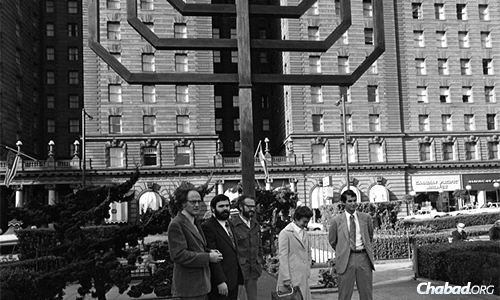
In 1975, Chabad Rabbi Chaim Drizin in San Francisco made arrangements to light an oversized wooden menorah in the city’s Union Square. Bill Graham—a child survivor of the Holocaust and a well-known music promoter—donated the construction of the 22-foot-tall mahogany menorah. To this day, it's called the Bill Graham menorah. (Photo: www.billgrahammenorah.org)
The 1980s: Growth and Challenge
Even as Jews everywhere flocked to public menorah-lightings in their cities and took pride in knowing that Chanukah was being celebrated in the public arena, the idea met with significant resistance—particularly from certain sectors of the “Jewish establishment” and from the ACLU, which claimed that it was a violation of the separation of church and state as mandated by the First Amendment.
Ironically, it was the same First Amendment that attorney Nathan Lewin would evoke time and time again as he successfully litigated dozens of cases in a decades-long effort to secure the right for Jewish people to place a menorah and observe Chanukah on public property.
In 1980, Rabbi Yisroel Brod, then director of Chabad Lubavitch of Bergen County, N.J., arranged for a large menorah to be set in front of the Bergen County Court House in Hackensack, N.J.

Rabbi Shemtov in 1979 with President Jimmy Carter at the first menorah-lighting on the White House Lawn.
“It was beautiful,” recalls Brod. “It was an ideal location. Every night we would get hoisted up by a cherry picker to light the menorah. We had people from the Federation there, and everyone had a wonderful time.”
In advance of Chanukah 1981, Brod decided to erect a second menorah in his hometown of Teaneck, N.J., with its much larger Jewish population. “I was so naïve then; I had no idea that people would have an issue with it,” he relates. “So I was shocked when I got a calls asking that we not go ahead with it.”
In response to a letter from the Jewish Community Council of Teaneck, which opposed the menorah, the Rebbe—Rabbi Menachem M. Schneerson, of righteous memory—penned two letters in which he outlined his position on the matter.
“ … experience has shown,” the Rebbe wrote in his second letter, “that the Chanukah menorah displayed publicly during the eight days of Chanukah has been an inspiration to many, many Jews, and evoked in them a spirit of identity with their Jewish people and the Jewish way of life. To many others, it has brought a sense of pride in their Yiddishkeit and the realization that there is no reason really in this free country to hide one’s Jewishness, as if it were contrary or inimical to American life and culture. On the contrary, it is fully in keeping with the American national slogan ‘e pluribus unum’ and the fact that American culture has been enriched by the thriving ethnic cultures which contributed very much, each in its own way, to American life both materially and spiritually ... ”
Concerning the legality of placing a religious symbol on public grounds, the Rebbe cited precedence from the menorahs in major cities, as well as the menorah on the White House lawn. “That it was also constitutional, legal and proper goes without saying since the President of the U.S. personally participated in it,” he wrote.
In the mid-1980s, Rabbi Yosef Landa of Chabad of Greater St. Louis kindles the menorah on the seventh night of Chanukah in the St. Louis county plaza.

Ultimately, Brod’s bid for a menorah that year was rejected by the Teaneck Township Council, and he decided not to pursue the matter.
He did arrange for a menorah to be lit for the first time in the New Jersey state capitol of Trenton. That tradition, which began in 1982, continues to this day.
By 1983, Brod’s empire of menorahs expanded to 15 stately structures standing proudly in front of town halls all across Bergen County (three municipalities—Fort Lee, Oakland and Hillside— put up their own).
The Rebbe’s letters proved to be invaluable for many emissaries facing similar issues.
A Little Help From New York
In 1981, Rabbi Yosef and Shiffy Landa, who had recently founded Chabad of Greater St. Louis the year before, decided to build a menorah on the large plaza adjacent to the St. Louis County Government Center. Working with a local fabricator, he built a 15-foot structure for $500. County executive Gene McNary attended the lighting ceremony, and the rabbi was gratified with the positive feedback he received.

In 1986, for the first time, a giant menorah was kindled at the base of the Statue of Liberty, whose famous torch serves as a beacon of freedom to immigrants entering New York.
When he began preparing for Chanukah the next year, like Brod, he “was surprised to learn how something positive like a menorah could evoke such negative responses” from within the Jewish community. Op-eds and letters flew fast and furiously. When articulating his position, he often used copies of the Rebbe’s letters to Teaneck.
Help came from an unexpected source: Ed Koch, the mayor of New York City. Speaking at a Jewish Federation event in St. Louis, Koch was asked how he would approach the issue. “I have no problem whatsoever with having a privately funded menorah on public property,” replied the Jewish mayor. “I think it’s absolutely wonderful. I’m proud to say that we have one in New York City at Fifth Avenue and Central Park.
“Let me tell you what else we do in New York,” he continued. “The menorah is in Manhattan. The people who light the menorah are the Lubavitchers. They live in Brooklyn. So when they light the menorah in Manhattan late on Friday afternoon when it’s getting close to Shabbos, we provide them with a helicopter and we fly them back to Brooklyn, so they can get home in time for Shabbos!”
After hearing all sides, McNary decided to keep the menorah on the plaza, and the tradition continued while he remained in office.
Back in Teaneck, the Township Council decided not to erect a menorah until a court ruling decided whether or not doing so was consistent with the U.S. Constitution.
That ruling would come on July 3, 1989, when the Supreme Court of the United States ruled (in a case known as County of Allegheny v. American Civil Liberties Union) that the city of Pittsburgh was allowed to place an oversized menorah lent to them by Chabad alongside a Christmas tree.

New York Mayor Ed Koch proudly told how the city hosts “the world's largest menorah” in Midtown Manhattan. (Photo: Martin Schneider)
The case was argued by Lewin, who claimed that the Pittsburgh victory set an important precedent that has since been echoed in rulings all over the country.
Still, the fight was far from over. In fact, Lewin would need to litigate the same case the following year and even flew from Los Angeles to enter a last-minute application before Supreme Court Justice William Brennan on Friday afternoon just before Chanukah.
On a national scale, Lewin explains that the Pittsburgh decision only meant that a government body had the right to display a menorah on public property right next to other holiday displays.
It would take until 1993 (as part of a court case known as Flamer v. White Plains) to establish that individuals and groups have the right to put up such displays. That year, Sonia Sotomayor, the newly elected U.S. District Court for the Southern District of New York—who went on to be appointed to the U.S. Supreme Court in 2009—ruled that “the City may not deny Rabbi Flamer a permit to erect a fixed free-standing menorah in a City park during the Chanukah holiday because of the menorah’s religious message.”
In the course of court battle over the rights to place a menorah in Cincinnati's Fountain Square, Lewin spent the entire Thanksgiving day of 2002 preparing arguments to be presented to Supreme Court Justice John Paul Stevens, who allowed the menorah to be put up “given the square's historic character as a public forum.”
Many other significant victories were won in cities like Atlanta and Grand Rapids, Mich., each one establishing important precedent that would pave the way for future menorahs.
Today,” Lewin says, “when a community has an issue, our office sends a packet explaining the issues and the previous court rulings, and that is often enough to settle the issue favorably.”
A case in point would be Hamilton, N.J., where Rabbi Yaakov and Chana Chaiton just established a Chabad center this past July for the townships of Robbinsville and Hamilton, N.J.
“We approached the township with the idea of holding a menorah lighting ceremony which would be the first ever in Hamilton, and they were considering,” says Chana Chaiton. “My husband had an afternoon meeting with the council, and we felt we needed some reassurance. I called Mr. Lewin’s office and was so touched by the attention he gave our situation. I’m sure he had a thousand important cases to attend to, but he personally took our specific needs into account and within an hour or two, he put together all the background information we would need to present the issue, and the council agreed to host the ceremony.”
She also notes that a neighboring Chabad center had a protracted battle to erect a public menorah, and Lewin had dedicated much time to help them reach a satisfactory conclusion.
“Chabad all over the U.S.—and indeed anyone who values our freedom to express our religious ideals—owes a deep debt of gratitude to the those who have paved, and continue to pave, the way for this precious avenue of celebration,” she says.
For his part, Lewin says he’s still busy in the weeks and days ahead of Chanukah, as he continues to safeguard the right to erect menorahs on public property and still litigates the issue when necessary.

For decades now, attorney Nathan Lewin has litigated for the right to place menorahs on public property. (Photo: Rikki Lewin)
‘Let There Be Light’
With the legal issues largely moot, menorahs continued to crop up all over the country.
“It is not just the custom here, but now in other countries as well,” says Rabbi Yehuda Krinsky, chairman of Merkos L’Inyonei Chinuch, the educational arm of the Chabad-Lubavitch movement, who regularly monitored the developments and reported them to the Rebbe. “From Berlin to London to Melbourne, public menorahs are almost a routine thing. It’s a beautiful display of Jewish pride and does a lot of good.
“It seems Chanukah is the most observed of the seven rabbinic mitzvahs,” he continues, “and it’s singularly because of the Rebbe’s insistence and perseverance that celebrating Chanukah in the public sphere became popular.”
At the Rebbe’s behest, following Chanukah 1985, Krinsky’s office compiled a book chronicling public menorah-lightings around the world. Titled Let There Be Light, it contains photographs of menorahs from Alabama to Australia.
The many menorahs on state, city and county municipal centers demonstrated how widely accepted the menorah had become in Jewish life.
The following year, a sequel called … And There Was Light graphically depicted how much more extensive the celebrations were during Chanukah of 1986, which went into the new year of 1987. Among its many photographs is a delegation from American Friends of Lubavitch presenting a silver menorah to President Ronald Reagan in the Oval Office, a tradition that began in 1984.

Onlookers view the lighting of the first candle on a menorah at the Mamilla Mall in Jerusalem, outside the Old City's Jaffa Gate. Even in Israel, Chabad has heightened awareness of Chanukah for millions of residents and tourists from around the world. (Photo: Miriam Alster/Flash90)
Modern Markers of History
Throughout the following decades, the number of menorah and scope of their reach has continued to blossom. Last Chanukah, it was estimated that as manyas 15,000 Chabad-Lubavitch menorahs were publically lit worldwide.
One of the largest lightings is the one near the Eiffel Tower in central Paris, which has attracted as many as 20,000 French Jews. Starting in 1989, the lighting was part of the “Chanukah Live” satellite hookup, in which the Rebbe would participate in a simultaneous celebration with communities from Moscow to Melbourne.
And in 1991, in the presence of approximately 6,000 Jewish people, longtime Chabad underground activist Avraham Genin kindled a giant menorah inside the Kremlin Palace of Congresses (it was the second year that a large public menorah had been lit in the U.S.S.R.; the previous year, a menorah had been placed near Russia’s White House).
Like before, the celebration was broadcast live.

Thousands crowd near a new 30-foot menorah—the tallest in Europe—inaugurated last year at the Brandenburg Gate in Berlin, Germany.
A new menorah—more than 30 feet tall, the highest in Europe—was constructed last year and lit on the first night of Chanukah at the Brandenburg Gate in Berlin, Germany, once the site of Nazi Party spectacles of racism and hatred, and a place that was inaccessible during the years of communist rule in East Germany.
Thousands of people attended the public ceremony, as did local dignitaries, including the president of the German parliament, Norbert Lammert, and Berlin’s mayor, Klaus Wowereit.
“Bringing light to places of darkness is the message of Chanukah,” said Chabad-Lubavitch of Berlin’s director, Rabbi Yehuda Teichtal. “There is no greater contrast then lighting a menorah here—in the place that was once the epitome of darkness—and now flooding it with the essence of light.”
Also last year, a 9-foot-high menorah was lit on the Gallaudet University campus in Washington, D.C., a federally chartered private university for the education of deaf and hard-of-hearing students.
“There was a wonderful spirit of inclusion and pride there, as the deaf community joined together with our hearing brothers and sisters around the globe in publicly celebrating our Jewish heritage,” says Rabbi Yehoshua Soudakoff, a Chabad rabbi who lit the menorah with the assistance of Gallaudet President Dr. T. Alan Hurwitz and Provost Dr. Stephen F. Weiner.
“The menorah really touches people,” asserts Rabbi Menachem Evers, who organizes the annual public lighting in Dam Square in front of the royal palace in Amsterdam, Holland. “I can recall an elderly lady who came to me with tears in her eyes, saying 60 years ago, she never dreamed she would live to see Jews proudly celebrating in the streets.”
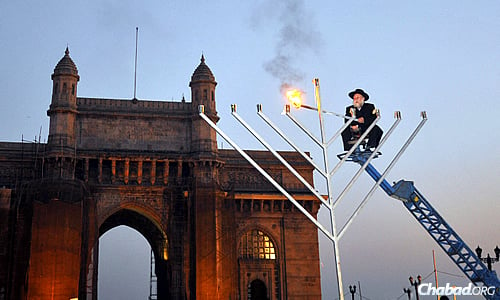
Rabbi Shimon Rosenberg of Afula, Israel, the father of Rivkah Holtzberg, lights a 25-foot steel menorah during Chanukah 2008 in front of the Gateway of India in Mumbai just weeks after his daughter and son-in-law, Rabbi Gavriel Holtzberg, were killed in a terrorist attack. Gavriel Holtzberg would light that menorah each year. (Photo by Serge Attal/Flash90)
In addition to the great outdoors, another popular venue for public menorahs are indoor shopping mall, where across the world, Chanukah menorah-lighting celebrations have become de rigueur.
This has come about in part because of a decision by the Westfield Group—which owns about 100 shopping malls in Australia, New Zealand, the United States and the United Kingdom—to partner with local Jewish communities, hosting and even covering the expense of these celebrations as part of its operating budget.
And the celebration is echoed in cities and towns, on military bases, in hospitals and nursing homes, even in prisons, and just about any other place where Jews can be found—a roaring fire of Jewish pride, kindled from a few flickering flames on one cold night back in Philadelphia.

In December 2013—39 years after lighting the first public menorah stood alone in front of Indpendence Hall in Philadelphia—Rabbi Abraham Shemtov, right, along with Rabbi Levi Shemtov, executive vice president of the American Friends of Lubavitch (Chabad) and U.S. Trade Representative Michael Froman, lit the National Chanukah Menorah on the Ellipse, just south of the White House, before thousands of visitors and dignitaries. (Photo: Judah Lifshitz)
© Copyright 2014, all rights reserved.
More in Jewish News:
• Chabad on Campus Marks a Major Milestone: 220 Centers Worldwide (By Menachem Posner and Carin M. Smilk, Chabad.edu)

Chabad on Campus activities run the gamut, from social events to educational programs, and holiday meals and programs. Here, students at the University of Texas in San Antonio enjoy an outdoor barbecue, courtesy of Rabbi Ari and Chaya Weingarten.
This is the third in a series of articles on the growth and impact of Chabad-Lubavitch worldwide.
Rabbi Levi and Adina Tiechtel couldn’t wait to get to work.
The young couple moved to Indiana just last month to start a Chabad House at Purdue University where they are serving the approximately 800 Jewish students enrolled there out of a total student population of about 40,000.
“We’d received positive feedback from administrators—strong support and encouragement,” says 25-year-old Rabbi Tiechtel, who is from the Crown Heights neighborhood of Brooklyn, N.Y. “Chabad has never had a permanent presence at this school, though there have been Chabad representatives who have visited. There was a demand from students, who wanted a stronger Jewish presence here.”
That permanent presence will now include Shabbat meals, classes, one-on-one Torah study, social events and holiday celebrations—whatever young adults need to add to their Judaism and their college experiences.
“We want to be their home away from home,” says Adina Tiechtel, 23, and originally from Toronto, Canada. “A student on campus can be very lonely; it’s a complicated time. They are trying to formulate their future and who they will be. We want to reach out to them, to be there for support in any way we can.”
As one of seven children, it’s something she knows well—listening to, talking with and offering support to others. It’s also second nature for her husband, who’s one of 13. Eight of his siblings also serve as shluchim—Chabad-Lubavitch emissaries—with three of them campus rabbis who have guided and advised him as he opens a Chabad House of his own.

Particpants in a Chabad 5K Run at Brandeis University, organized by Rabbi Peretz and Chanie Chein, co-directors of The Chabad House of Brandeis in Waltham, Mass.
“This is a family tradition,” says Tiechtel. “It’s amazing that I get to join the club.”
That club has certainly gotten a lot bigger.
‘220 Campus Centers Worldwide and Growing’
Chabad on Campus just rolled out an impressive new number: It has officially surpassed its 200th center—gone well beyond that, in fact—for a grand total of 220 centers worldwide.
In the last year alone, 33 Chabad-Lubavitch couples have settled themselves on college campuses in the United States, Canada, South America and Israel. Twenty-seven new Chabad centers have opened up, with another six couples having joined existing centers.
Chabad on Campus emissaries, are now poised to teach, entertain and advise even more students and faculty, extending their reach farther than ever before.
“When today’s college student moves into the workplace and ultimately creates a home, his or her success—and ours—will depend on the values they take with them,” says philanthropist George Rohr, chairman of the Chabad on Campus International advisory board. “The positive, lifelong impact of the campus shluchim and shluchos—as teachers, mentors and role models, along with the ‘homes away from home’ that they create for a Jewish student—is incalculable.”
As for the Tiechtels, who arrived at Purdue with their 6-month-old baby Mendel, their decision to work with students was not as much about numbers, about quantity, as it was about quality—about trying to get to meet, know and advise young Jewish men and women, wherever they are on university grounds.
“The Rebbe [Rabbi Menachem M. Schneerson, of righteous memory] said that every person is a candle, and you only add—add to the light—until that light becomes a flame in itself,” explains Rabbi Tiechtel.
His wife adds that college students “want the opportunity to grow and learn; they have so much energy. You can see them change while they’re there. They feel empowered, and we want them to also be empowered by their Jewish heritage.”

Rabbi Levi and Adina Tiechtel, with their son Mendel, co-directors of a new Chabad House at Purdue University in Indiana
Centralized Resources for Emissaries and Students
Advising and connecting with young Jews at such a crucial time in their educational, social and spiritual lives has been an important part of Chabad’s outreach efforts and the reason for establishing Chabad on Campus International.
It’s part of the continued growth that began in the early 1950s. The Rebbe began sending rabbinical students to campuses to serve as a resource for students. Since the 1960s, Chabad campus centers have opened their doors to Jewish students, regardless of their backgrounds or observance levels.
Rabbi Moshe Kotlarsky, chairman of Chabad on Campus International and vice chairman of Merkos L’Inyonei Chinuch, the educational arm of the Chabad-Lubavitch movement, notes that this year “we are marking 20 years since the Rebbe’s passing. One cannot overstate the importance that the Rebbe placed on campus activities. As we reflect on the accomplishments of the past and the work to be done in the future, we are committed to ensure that Chabad on Campus continues to grow and expand in every way.”

Rabbi Zalman Greenberg, co-director of Chabad at Lehigh University in Bethlehem, Pa., with student Geoff Newman in Israel.
Those involved on the ground know how important this task remains.
“It is vital that Jewish students—at this transformative time in their lives—have the opportunity to be an integral part of a vibrant Jewish community,” says Rabbi Yossy Gordon, executive vice president of Chabad on Campus International. “That can mean attending holiday or Shabbat services, studying Torah individually or taking a larger class, having a kosher meal, or just getting time to unwind and socialize with other Jewish students. Young adults can get connected in a safe and nurturing environment during the years they spend at university.
“Chabad is very real for them,” he emphasizes. “It’s a place where they can grow in their Judaism, meet others with similar backgrounds and interests, and be themselves.”
A Focus on Dinners and Dialogue
In addition to Chabad on Campus centers popping up all over North America, Israel is seeing a boon in Chabad services at its secondary-educational institutions.
Rabbi Dovid Kurtz, director of the Israeli branch of Chabad on Campus International, assures that more are on the way. “In the past, Rabbi Gil Blizovski, who also serves as campus rabbi at Ben-Gurion University of the Negev, was among a handful of Chabad on Campus rabbis in Israel,” he explains. “However, in the past few years, many new shluchim have joined Chabad on Campus in Israel.
 .
.A group of students from the University of Central Florida at the Western Wall in Jerusalem, as part of a Taglit-Birthright Israel trip, accompanied by Chabad Rabbi Chaim Lipskier.
“In the last year alone, 21 new couples were added, joining the six who were here previously. In total, we now serve 23 campuses.”
At the Netanya Academic College, Rabbi Shneur Landa, who co-directs the Chabad on Campus there with his wife, Musya, says that “most of the students know Chabad from their post-army travels in Thailand, South America or India. So when they see us, they are really excited to reconnect and relive those experiences.”
Now starting their second year as emissaries—they set up shop last fall—he notes that hundreds of students filled out questionnaires on what they would like to see Chabad do on campus, with some very heartening results. “There was one girl who expressed her wish to be exposed the positive side of Judaism, often absent in Israeli media today, saying she knows she has a beautiful tradition, but has not yet had a chance to see it.”
With a student body of more than 4,000, Landa says that he and his wife, who are the parents of a young son and a new baby daughter, are in the midst of a busy year. In addition to giving JLI-accredited courses, they are planning programs and reaching out to students who remain on campus for Shabbat. While Shabbat dinners have long been a staple of Chabad centers on college campuses in North America, they remain somewhat of a novelty in Israel, where many students commute to classes and eat at home with their families on Friday night.

Rabbi Shneur and Musya Landa direct Chabad on Campus in Netanya, Israel.
Still, says Landa, there are always those who stay on and near campus, and there are the international students who live in dorms, especially in Jerusalem, Tel Aviv and Haifa, so “a big focus for our centers in Israel is Shabbat meals on campus every Friday night.”
Rabbi Avi Weinstein, director of administration at Chabad on Campus International, looks forward to the continuing expansion of Chabad’s campus activities worldwide. “Having new centers around the world—and offering programs and classes to thousands of additional young men and women—is a tremendous step towards accomplishing our goal of being a resource to Jewish students, wherever they are pursuing their secondary education.”

A Chabad barbecue in Princeton, N.J., organized by co-directors of Chabad of Princeton University Rabbi Eitan and Gitty Webb

Women bake challah at Chabad Serving Drexel University in Philadelphia, co-directed by Rabbi Chaim and Moussia Goldstein.

Members of the cooking club at Chabad at the University of South Florida in Tampa, Fla., co-directed by Rabbi Pinny and Chava Backman.

A "9/11 Mitzvah Marathon" held at California State University in Northridge, Calif., with support from co-directors of Chabad @ CSUN Rabbi Chaim Shaul and Raizel Brook.

A "Pizza and Parsha" class at American University in Washington, D.C., co-directed by Chabad Lubavitch of the AU Community Rabbi Yehoshua and Esti Hecht.

A Sinai Scholars program, a Chabad on Campus educational program that offers classes on the fundamentals of Judaism, tradition and philosophy. It is currently being taught on nearly 70 campuses in North America.

A table replete with information about Chabad on Campus on display at an the annual international Shabbaton, held in New York City and attended by 1,000 or more students each year. (Photo: Bentzi Sasson)
© Copyright 2014, all rights reserved.
• Jewish School in Baltimore Gets an Unusual Gift: A Building (By Mindy Rubenstein)

Cheder Chabad of Baltimore now occupies a former synagogue that was donated to the school.
It’s not often that someone receives a 55,000-square-foot building as a gift. But that’s exactly what happened to Chabad of Park Heights and its school, Cheder Chabad of Baltimore.
“We are in the process of inaugurating the building this year as the official cheder,” teaching the basics of Jewish education and the Hebrew language to young children, says Rabbi Elchonon Lisbon, director of Chabad of Park Heights in Baltimore.
“Our experience highlights the centrality of chinuch—Jewish education—in the life of a growing community.”
And just as importantly, “we want to bring the miracle of our story to everyone’s attention, locally and beyond.”
Eight years ago, the school was just the brainchild of a handful of parents in the community who wanted to bring a Chabad chinuch (education) to their children, explains Lisbon.

The cheder started with 10 preschoolers in the basement of a local parent’s home. (Photo: MyShtub Photography)
It started with 10 preschoolers in the basement of one of the parents’ homes. The school originally catered to the children of Chabad rabbis who lived in the area and Chabad Chassidic families that had moved to Baltimore.
“The area is affordable, and there’s a lot of Yiddishkeit,” he says, noting the city’s significant and long-standing Orthodox community. That was the nucleus, he says.
But today, he notes, there is a mix of children: both Chabad and non-Chabad. The school now offers five grades for boys and two grades for girls, plus preschool, for a total of about 170 children.
Then it moved to a small house adjacent to the shul, and the school grew from 12 to 40 children.
“It was no small feat, but we did it,” says Lisbon, who credits preschool director Chanie Feldman with her tireless work and involvement along the way.
After a few more years, the school again outgrew its space.
At that point, administrators didn’t know what to do next. There was nothing readily available, says the rabbi, until he got a phone call from someone not affiliated with Chabad, telling him about a synagogue in the community that wasn’t being used anymore, and which could be an option for Chabad and its school. The owner, Dr. Paul Volosov, was apparently looking to do something positive with the building.
 .
.Rabbi Elchonon and Tziporah Lisbon oversee the school, teach classes at their Chabad House and provide outreach to the community.
“So I called him up, and he invited me to take a look,” says Lisbon.
After the tour, Volosov invited the school to come the next year and try it out—rent-free. With the abundant new space, enrollment jumped from 40 to 80 kids in one year. The rabbi says he “also renovated part of the building so we could have nice classrooms.”
Then one morning about a year ago, Volosov called, telling the rabbi that he wanted to donate the building to them.
“The story of the school,” says Lisbon, “is really a miracle.”
‘Well-Thought-Out and Guided’
Sheiny Rivkin, co-director of Chabad-Lubavitch of Towson, Md., with her husband, Rabbi Mendy Rivkin, have three of their four children—the oldest is 7—enrolled at the school, which is about six miles away. This is their fifth year there.

Rabbi Yechiel Schanowitz with students in his class; the kids are holding shofars for use during the High Holidays. (Photo: MyShtub Photography)
“The school started off like a small mom-and-pop shop, and it has grown so much,” she says. “It is really outstanding.”
She touts the staff wholeheartedly, in addition to the way all aspects of education include “the entire chinuch point of view,” even when it comes to crucial basics like motor skills. “They just understand how it’s going to affect children as they’re growing and learning to use their minds. Everything is very well-thought-out and guided.”
When learning about the Jewish holidays, for example, she notes that “the kids live it. They make everything hands-on.”
Rabbi Elchanon and Tziporah Lisbon, both originally from Massachusetts, have led the Park Heights Chabad House since 1982, running services and holiday programs, teaching Rohr Jewish Learning Institute (JLI) classes, providing outreach and overseeing “Anash”—its core group of local Chassidim.

The school now offers five grades for boys and two grades for girls, plus preschool, for a total of about 170 children.
But it’s the school, they say, that has really revved up their work and access to the local Jewish community: “It has given us a presence and availability that have really expanded our reach,” says Lisbon.
Back home after attending the Kinus Hashluchim—the International Conference of Chabad-Lubavitch Emissaries in New York—Lisbon says he spread the word about the school there, and plans to use what he gained through various workshops and networking opportunities for use in his community. “It’s about focusing on Chabad’s strength in both outreach and inreach.”
“We didn’t expect it to happen so fast and so beautifully,” acknowledges the rabbi about the cheder. “It’s really a miracle.”

Lisbon works one-on-one with a student as part of a curriculum that emphasizes the basics of Jewish education and the Hebrew language.

The owner renovated part of the building with upgraded classrooms before giving it to the school.
© Copyright 2014, all rights reserved.
____________________________
| |||||||||||||||||||||||||||||||||||||||||||||||||||||||||||||||||||||||||||


No comments:
Post a Comment