NOTE: This is a digest of news features provided by United Methodist Communications for Feb. 2-6. It includes summaries of United Methodist News Service stories and additional briefs from around the United Methodist connection. Full versions of the stories with photographs and related features can be found at umc.org/news.
Top Stories:
Duke Chapel flap occurs in context of openness
DURHAM, N.C. (UMNS) — Duke University saw major controversy after first deciding to allow Muslim students to offer the call to prayer from the Duke Chapel bell tower, then reversing the decision. But the clear trend at Duke and other schools with historic United Methodist ties is to support non-Christian religious groups, including in use of the chapel. Sam Hodges reports.


 Chapels can be battlegrounds, but trend is toward use by all
A UMNS News Feature
By Sam Hodges
Restrooms in Syracuse University’s Hendricks Chapel got an overhaul last year, including improved and expanded wudu stations. Muslim students use those for ritual washing before praying in the chapel.
“We’re very proud of our wudus,” said the Rev. Tiffany Steinwert, a United Methodist elder and Hendricks Chapel dean.
While Hendricks’ restroom rehab caused no stir, Duke University found considerable controversy last month after announcing Muslim students would offer the adhan, the Islamic call to prayer, from Duke Chapel’s bell tower.
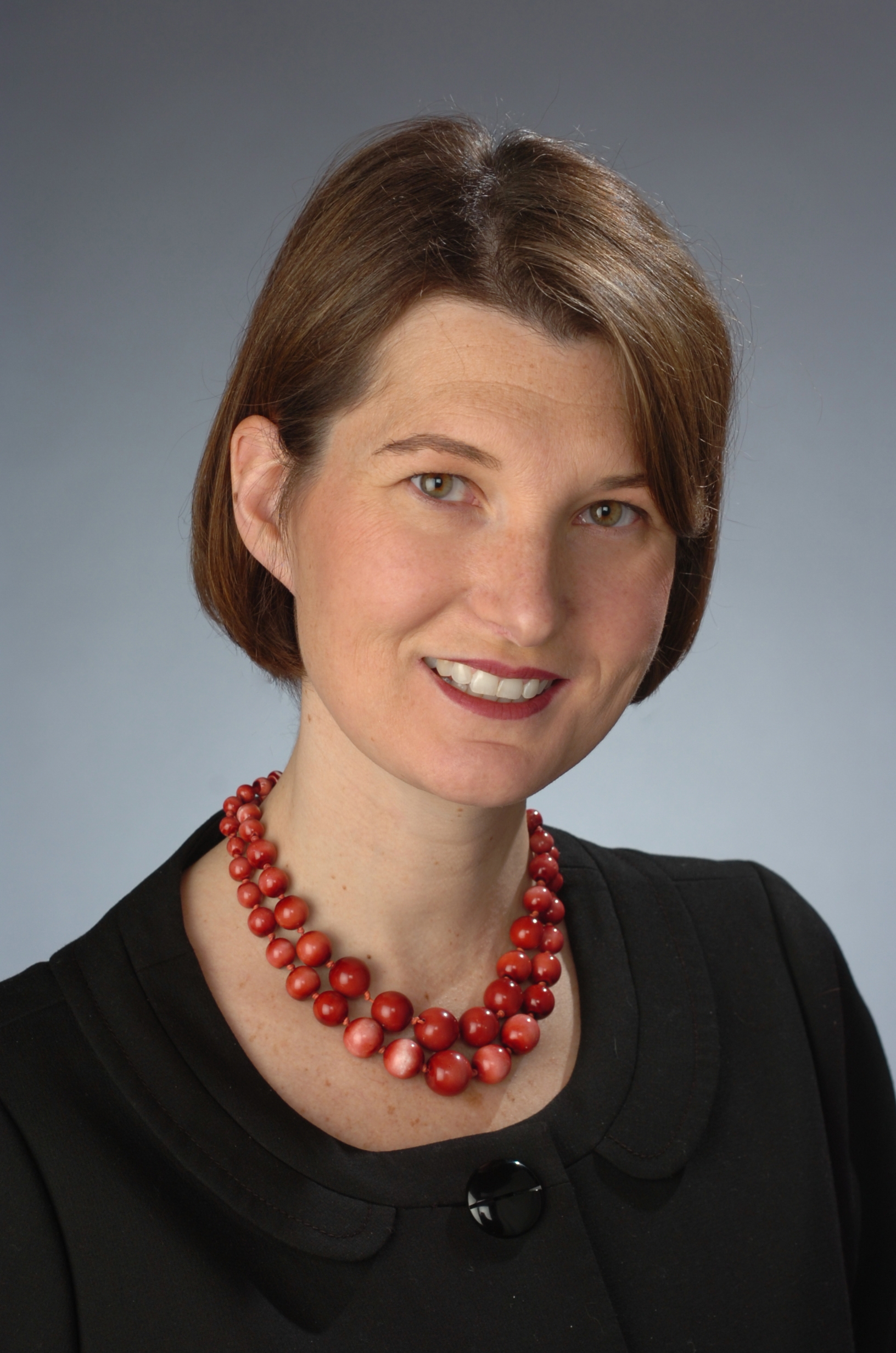
“The recent actions opened up a conversation, both within and outside the university, about plurality, interfaith engagement and theology, and also about the role of religion in the university and the centrality and nature of the Duke Chapel as a symbol of the university,” said Michael Schoenfeld, Duke’s vice president for public affairs and government relations.
University chapels can be a battleground, as Duke discovered. But the clear, longstanding trend among schools with historic United Methodist ties — including Duke and Syracuse — is for supporting non-Christian groups, including with use of chapel space.
That’s certainly the case at Emory University in Atlanta, said the Rev. Bridgette Young Ross, dean of Emory’s Cannon Chapel and a United Methodist elder.
“Every religious tradition that’s recognized on this campus is part of the community,” Young Ross said. “It’s important to be sure that all members of the community get equal access and equal respect.”
Cannon is regularly used for Christian worship, but also for Jewish services during High Holy Days. Buddhist students meet there for meditation. Muslim and Hindu students have separate prayer gatherings in the chapel on Friday afternoons.
While Cannon has not been used for the adhan, Emory lets Muslim students offer it on Fridays during Ramadan from the school’s clock tower.
Boston University’s Marsh Chapel is home to an 11 a.m. Sunday interdenominational Protestant service heard across New England via public radio. But Marsh is for all religious groups, said the Rev. Robert Allan Hill, a United Methodist elder and the chapel’s dean.
“It’s very much open to them,” Hill said. “We have had Muslim prayers in our lower chapel and on the plaza in front of the chapel.”
Southern Methodist University’s Perkins School of Theology includes Perkins Chapel, a church-like space used regularly for Protestant and Catholic worship. The chapel also has been used for interfaith services, led in part by non-Christian clergy.
The Rev. William Lawrence, dean of Perkins School of Theology, said he doesn’t know of any fully non-Christian religious services that have been held in the chapel. But SMU has in recent years designated space for Muslim prayer in the student center.
Claremont School of Theology — along with Perkins, Duke Divinity, Candler at Emory, and Boston School of Theology — is one of 13 United Methodist seminaries. Claremont is in the deeply multicultural area of greater Los Angeles, and the school’s students include Jews and Muslims. Both use the school’s Kresge Chapel, said the Rev. Kah-Jin Jeffrey Kuan, Claremont’s president and a United Methodist elder.
Kuan added: “We have made an agreement with the Jewish students that they can use the chapel for Shabbat services.”
WESLEY AND INTERFAITH COOPERATION
A number of United Methodist scholars, including the Rev. Tiffany Steinwert, have written about how Methodism founder John Wesley regarded Christian groups other than his own and how he regarded other religious faiths. Steinwert, dean of Hendricks Chapel at Syracuse, wrote a paper titled “Toward a Wesleyan Praxis of Interreligious Engagement in Higher Education.” Here’s a key paragraph:
“Wesley was not indifferent to the distinct doctrinal claims of Christianity and other world traditions. He remained firm in his conviction that the Christian faith claim was unique and soteriologically necessary. However, Wesley’s openness to the possibility that non-Christians can practice holy living and have access to the ‘inward voice of God,’ provides a window of opportunity for shared concerns between Christians and non-Christians. By momentarily suspending doctrinal truth claims, it provides space for people of diverse faith traditions to come together around a shared value of holy living for personal and social transformation.”
‘Interreligious reimagining’
For at least a decade, Duke University has let Muslim students have space within Duke Chapel for prayer services.
But in a Jan. 14 column in the Raleigh, N.C., News & Observer, Christy Lohr Sapp, Duke’s associate dean for religious life, announced Duke Chapel would go further, letting Muslim students do the adhan from the Duke Chapel tower.
Noting recent attacks in Paris and Nigeria by extremists claiming to represent Islam, she said Duke’s “peaceful and prayerful” Muslim students showed a different face of the religion, and would do so more effectively if allowed to use the chapel tower.
“The neo-gothic cathedral at the heart of Duke’s campus is a symbol of the faith of the school’s founders, but the use of it as a minaret allows for the interreligious reimagining of a university icon,” Sapp wrote.
The Rev. Franklin Graham, son of famed evangelist the Rev. Billy Graham, immediately criticized the decision.
“As Christianity is being excluded from the public square and followers of Islam are raping, butchering, and beheading Christians, Jews, and anyone who doesn’t submit to their Sharia Islamic law, Duke is promoting this in the name of religious pluralism,” he wrote on Facebook. Graham called on Duke donors to withhold support until the adhandecision was overturned.
By the next day, Duke had in fact overturned. Spokesman Schoenfeld said that what was meant as a unifying gesture “was not having the intended effect.” He also cited safety concerns. Duke did allow the call to prayer from outside the chapel.
Imam Adeel J. Zeb, Duke’s Muslim chaplain, wrote that Muslim students had not asked to do the call to prayer from the tower, but were pleased by the invitation and demoralized when it was withdrawn.
“Many of the Duke Divinity School students showed their support through email and phone communications, and visited the Center for Muslim Life to support us … and for that we are grateful,” he added.
But the Rev. Richard Hays, dean of Duke Divinity, criticized the original decision. He wrote that the university rightly supported all campus religious groups. But he said, “Christianity and Islam stand in significant theological tension with one another” and “should not be symbolically conflated” by having the adhan chanted from a Christian worship space.
Bishop Ken Carter, a Duke Divinity graduate who leads the Florida Conference of The United Methodist Church, also was critical of the first decision.
“I am coming from a very different place than Franklin Graham,” Carter said on Facebook. “I honor the goodness of many Muslims, and I acknowledge the failure of many Christians, myself included.”
But Carter added: “Jews and Muslims are right to retain the identity of their holy places, and they are not bigots if they choose not to allow other religious traditions to practice in them. Christians are also not bigots in viewing Duke Chapel as a place set apart for Christian worship.”
Others, noting Duke Chapel has made space for Muslim prayer for years, said the issue wasn’t use of the chapel itself but the public nature of the adhan. Muslims and others countered that the bells sounding from the tower represent a Christian public expression.
Meanwhile, a Jewish student from Israel weighed in, drawing on his upbringing in a land shared by Jews and Muslims.
Eidan Jacob wrote in the Duke Chronicle that “recitations of the adhan are simply part of the soundscape for many in Israel. Movements to unfairly limit the freedom of Muslims to chant it are extremely scandalous.”
UNITED METHODIST EDUCATION
There are 119 schools, colleges and universities related to The United Methodist Church, including the 13 United Methodist seminaries — among them Claremont, Duke Divinity, Candler School of Theology at Emory, and Boston School of Theology at Boston University. See an interactive mapof these institutions.
A tradition of openness
Chapel leaders at other United Methodist-related schools wouldn’t comment on Duke’s controversy. But they agreed that's in the spirit of John Wesley, Methodism’s founder, to show respect for and generosity toward other religious traditions.
Steinwert, author of a paper called “A Legacy of Holiness: Toward a Wesleyan Praxis of Interreligious Engagement in Higher Education,” noted that Syracuse’s Hendricks Chapel was designed and dedicated for of all faiths back in 1930.
She considers that an advantage as Hendricks welcomes a wide range of religious groups, including pagans.
“We were built for this work,” Steinwert said. “It’s embedded in our DNA, and it does make it easier. We’re more flexible and able to adapt to the changing religious demography.”
At the University of Evansville, the Rev. Tammy Gieselman oversees Neu Chapel. She said the United Methodist-related school has been a community leader in interfaith work, and she seeks to make Neu welcoming for all.
The chapel looks like a church. But Gieselman, a United Methodist elder, doesn’t wish for a more neutral building. Instead, if money were no object, she would add to Neu, creating designated areas for other religious groups.
She can see the scene at the front door now.
“Christians walking into a space next to Jews and Muslims who are going to pray and read out of their sacred texts — that’s rich.”
Hodges, a United Methodist News Service writer, lives in Dallas. Contact him at (615) 742-5470 or newsdesk@umcom.org
Read story and post comment
Looking toward change in relations with Cuba
NEW YORK (UMNS) — U.S. religious leaders played an unofficial but significant role in the negotiations that led to the Obama Administration's restoration of full diplomatic relations with Cuba, says the Rev. John McCullough, a United Methodist pastor and top executive of Church World Service. Linda Bloom has the story.
 Photo courtesy of Nechi Fullerton
Nechi Fullerton (left) works with Abelardo Castillo, a Cuban construction worker, at the Methodist seimary during a January 2015 volunteer trip in Havana, Cuba.PreviousNext


Looking toward change in relations with Cuba
By Linda Bloom
U.S. religious leaders played an unofficial but significant role in the negotiations that led to the Obama Administration’s restoration of full diplomatic relations with Cuba, says a United Methodist pastor.
The Rev. John McCullough, the top executive of Church World Service, said an ecumenical coalition embarked on its own diplomatic mission, hoping “to bring a sense of clarity” between the U.S. and Cuban governments. That mission was related to discussions over humanitarian concerns for Alan Gross, an American imprisoned in Cuba, and three members of the “Cuban Five” remaining in U.S. prisons.
“As an ecumenical strategy, we became focused like a laser beam on the humanitarian crisis,” he explained. “One of the real difficulties was that neither government wanted to be the first to make the move because of the level of distrust.”
MISSION AGENCY DEEPLY INTERESTED IN IMPROVING U.S.-CUBA RELATIONS
By Elliott Wright
The moves toward more open doors between the US and Cuba, including relaxed rules on visits, are in keeping with United Methodist positons. While they will no doubt improve interaction between US and Cuban Christians in the future, they are not likely to immediate change The United Methodist Church’s current relations or activities in Cuba.
“We welcome the steps that may normalize US-Cuba relations, and are glad that we already have strong ties with our Methodist brothers and sisters in Cuba,” said Thomas Kemper, chief executive of the United Methodist General Board of Global Ministries, the denomination’s mission agency “This includes a regular program of volunteer in mission (VIM) journeys in partnership with the Methodist Church in Cuba.”
Read full story
Pastor seeks help freeing brother in Congo
DES MOINES, Iowa (UMNS) — A United Methodist pastor in Iowa is trying to save the life of his brother, who is imprisoned in the Democratic Republic of Congo. And the pastor wants help from the church and the Obama administration.

Pastor seeks help freeing brother in Congo
By Heather Hahn and the Rev. Arthur McClanahan
A United Methodist pastor in Iowa is trying to save the life his brother, who is imprisoned in the Democratic Republic of Congo. And the pastor wants help from the church and the Obama administration.
The Rev. Kiboko I. Kiboko says his brother, Vano Kalembe Kiboko — a United Methodist evangelist and a former congressman in Congo — was arrested Dec. 29 by the country’s secret service.
The arrest came after Vano Kiboko publicly denounced the Dec. 8 shooting of a woman engaged in a nonviolent protest.
Now, the pastor of Norwalk United Methodist Church in Iowa fears that without intervention, his brother’s life could be in danger.
Kiboko said his brother has been incarcerated for more than a month without a hearing. His brother also has malaria and likely is not receiving needed medical attention.
The pastor asks United Methodists and others to urge U.S. Secretary of State John Kerry and President Obama to help secure his brother’s release. He also asks church members to pray to Godfor his brother and the people of the Democratic Republic of Congo.
Kiboko told United Methodist News Service that Americans should care about a non-American’s incarceration because, in the words of the Rev. Martin Luther King Jr., “Injustice anywhere is a threat to justice everywhere.”
“Vano is imprisoned for living out his baptismal covenant ‘to resist injustice and oppression in whatever forms they present themselves,’” the pastor wrote in a letter to his congregation.
United Methodist leaders around the globe are responding to the pastor’s pleas.
A tense situation

In 2012, United Methodist leaders from Congo testified before a U.S. congressional subcommittee about the brutal assaults of the M23 militia, at the time widely believed to be supported by neighboring Rwanda’s army. Congolese troops and U.N. peacekeepers defeated the militia in 2013, though there have since been reports of insurgents regrouping.
The current crisis that has caught up the Kiboko family is largely a political one. In recent months, protests have erupted against proposals to change Congo’s constitution to allow President Joseph Kabila to run for a third term. Kabila took office in 2001 after the assassination of his father, Laurent Kabila.
Vano Kiboko spoke out about a demonstration against taking land from an indigenous Congolese group. During a press conference in December, he also said the country should not amend its constitution.
His brother pointed out that Kerry had told President Kabila the same thing last year.
Efforts to help
The pastor has started a petition on Change.org addressed to Kerry, Iowa’s U.S. senators and other U.S. leaders. Some 500 people have signed, and he said that family members in Europe are also appealing to their governments on his brother’s behalf.
The pastor plans to travel to the Democratic Republic of Congo to do what he can for his brother. Their sister, the Rev. J. Kabamba Kiboko, also has traveled to the country to help. She is a pastor in Ohio and member of The United Methodist Church’s top court, the Judicial Council.
Other United Methodist leaders are also trying to help. Iowa Area Bishop Julius Calvin Trimble said he has already written President Obama, Kerry and Iowa’s U.S. Sen. Chuck Grassley, asking that they intercede.
United Methodists bishops in Congo as well as staff at the United Methodist Board of Global Ministries, the denomination’s mission agency, and the Board of Church and Society, the denomination’s social justice agency, are working to free Vano Kiboko.
Thomas Kemper, the mission agency’s top executive, sees hope in a recent vote by the Democratic Republic of Congo’s National Assembly. On Sunday, Jan. 25, the legislative body voted to strip from legislation a planned census that risked indefinitely delaying the 2016 national election. That provision had sparked days of protests in which dozens died, reports the Reuters wire service.
“We are thankful that a fragile peace has resumed in Kinshasa after the violent protests last week surrounding the electoral process,” Kemper said. “While tensions are still high, we are hopeful that the electoral legislation passed by the Parliament will support a peaceful democratic transition and will allow for an election that upholds the democratic process and safeguards human rights.”
Kemper added that mission agency staff are in prayer for Vano Kiboko and his family.
“We pray for a quick resolution,” Kemper said, “and have been working with his family, the bishops and the political authorities in the DRC to secure his release.”
The Rev. Susan Henry-Crowe, top executive of the United Methodist Board of Church and Society, said she and agency staff also hold the Kiboko family in prayer.
"We uphold the dignity of all human beings and their right to speak their conscience," she said. "We continue to hold the people in the Democratic Republic of Congo in our prayers as the country pursues a new electoral process. We pray for peace and reconciliation in the DRC so that true democracy may flourish."
She noted that in its Social Principles, the denomination says: “We hold governments responsible for the protection of the rights of the people to free and fair elections and to the freedoms of speech, religion, assembly, communications media, and petition for redress of grievances without fear of reprisal.”
Hahn is a multimedia news reporter for United Methodist News Service. McClanahan is the Iowa Conference director of communications. Contact Hahn at (615) 742-5470 or newsdesk@umcom.org.
Audio Interviews
The Rev. Arthur McClanahan interviews Bishop Trimble:
Read story and comment
'New' Harper Lee book has biblical title
DALLAS (UMNS) — The recent news that Harper Lee has a second book coming out — 55 years after publication of "To Kill a Mockingbird" — stunned the literary world. She chose a biblical title in "Go Set the Watchman." The 88-year-old Lee is a United Methodist, and members of the denomination are among the many eager to read this second Lee novel. Sam Hodges reports.

Harper Lee’s surprise book has biblical title
By Sam Hodges
It’s a literary shocker. Harper Lee, long assumed the ultimate one-book author with “To Kill a Mockingbird,” will have a second novel published.
This week’s announcement made the front page of The New York Times, under the headline “After 55 years, a Sequel of Sorts from Harper Lee.”
What is not surprising, says Dawn Wiggins Hare — Lee’s friend, fellow Monroeville, Alabama, resident and fellow United Methodist — is that the book draws its title from the Old Testament.
“Nelle Harper is very well read in the Bible,” said Hare, top executive of the United Methodist Commission on the Status and Role of Women. “Years ago, she autographed a copy of `To Kill a Mockingbird’ for me, and quoted Scripture in the personalized autograph.”
Lee’s forthcoming book is called “Go Set a Watchman,” a line from the King James Version of Isaiah 21:6.
“It’s a kind of general statement about being alert to the dangers of the enemies of Israel,” said John Holbert, an Old Testament scholar and retired professor at Southern Methodist University’s Perkins School of Theology.
The novel doesn’t come out until July, so it is unclear how the title illuminates the story or themes. But Lee’s voracious reading has always included the Bible.
“The (biblical) title would not surprise me at all, because of her family’s faith and growing up in the church,” Hare said.
Lee, 88 and in an assisted living home, is a longtime member of First United Methodist Church in Monroeville. Her older sister Alice, a lawyer who died last year at age 103, held numerous lay offices in that church and served as a General Conference delegate.
Alice Lee’s will specified that her sister, known in Monroeville as “Nelle” and “Nelle Harper,” would get her books and other personal items, but the hometown church and other United Methodist causes were listed as financial beneficiaries.
`Humbled and amazed’
Harper Lee earned instant fame in 1960 when “To Kill a Mockingbird” came out. The novel, set in a small Alabama town during the Depression, is a lyrical coming-of-age story that also forthrightly deals with race prejudice.
“To Kill a Mockingbird” won a Pulitzer Prize and became a popular film with Gregory Peck playing Atticus Finch, the lawyer hero who represents a black man falsely accused of raping a white woman.
Lee’s book, which mentions Methodism and Methodism founder John Wesley in the first chapter, has sold some 40 million copies. It remains a fixture on high school and middle school reading lists. But a few years after its publication, Lee quit giving interviews, and over the decades, hope dwindled that she would produce another book.
The “new” novel was written in the mid-1950s, before “To Kill a Mockingbird.” It occurs in the same fictional Alabama town, and concerns a visit home by the grownup Jean Louise “Scout” Finch, the girl narrator of “To Kill a Mockingbird.”
A statement from publisher HarperCollins quotes Lee as saying that she submitted “Go Set a Watchman” for publication but was persuaded by an editor to write another novel from the point of view of the young Scout. Lee never went back to the first book, but said her lawyer recently discovered a manuscript of it.
“After much thought and hesitation, I shared it with a handful of people I trust and was pleased to hear that they considered it worthy of publication,” Lee said in the statement. “I am humbled and amazed that this will now be published after all these years."
While the first reaction among Lee’s millions of fans was elation at the prospect of reading more fiction by her, questions have arisen as to whether Lee, given her age and infirmity, could really have made the decision to publish “Go Set a Watchman.” The New York Times story noted that HarperCollins dealt with Lee’s lawyer, not with Lee herself.
Others who have met with Lee recently vouch for her ability to make such a decision, and the publisher released a statement Thursday quoting Lee as saying she was "happy as hell" to have the second book coming out.
Leaning forward
The Rev. Scott Smith, pastor of First United Methodist Church in Ormond Beach, Florida, is still in the flush of excitement at the prospect of another Harper Lee book.
Smith first read “To Kill a Mockingbird” in the eighth grade, drawn to it because it was banned by his North Florida school.
He has since read it 20-25 times, he estimates, and now makes a point of reading it yearly.
He’s drawn from the book and shown clips of the film in sermons.
“I love the integrity of Atticus Finch,” Smith said.
That the author wrote another novel, set in the same town as “To Kill a Mockingbird” and dealing with some of the same characters, has the pastor leaning forward.
“I’m thrilled,” Smith said. “The day it comes out, I’ll get it, and I’ll probably read it that day.”
*Hodges, a United Methodist News Service writer, lives in Dallas. Contact him at (615) 742-5470 or newsdesk@umcom.org
Read story and post a comment
Want a better life? Try a bucket list
LEIPER'S FORK, Tenn. (UMNS) — Shirley Bachelder's bucket list has ballooned into a lifetime of adventures and celebrations for the 93-year-old — most recently a hot-air balloon ride. "God was there," she said. "I felt so close to him and felt him saying, 'Well, what do you think, Shirley?'" Susan Passi-Klaus reports on how United Methodists with a bucket list say it helps them live more fully.


 Want a better life? Try a bucket list
A UMC.org Feature by Susan Passi-Klaus*
Shirley Bachelder’s bucket list has ballooned into a lifetime of adventures and celebrations.
 At 93 years old, Shirley Bachelder took her first hot air balloon ridewith her "gratitude garland" in place. Photo courtesy of Shirley Bachelder.
In November 2014, the 93-year-old made her way to a remote Tennessee field at 5:45 a.m. in 27-degree weather. There she swung her short legs into a wicker gondola to take a hot air balloon ride, a testament to her spunk. With a delicate silk flower garland worn atop her woolen hat, this whippersnapper checked another item off her bucket list.
“I would have gone up in that balloon even if it was below zero,” she said. “All I needed was a couple pairs of gloves, my Egg McMuffin and a cup of coffee and I was ready to go.”
Was the sunrise balloon flight to Leiper’s Fork, Tennessee a dream come true for the California transplant?
“God was there,” she said. “I felt so close to him and felt him saying, 'Well, what do you think Shirley?'”
When fellow Christ United Methodist Church member Allen Johnston discovered Miss Shirley had “hot air balloon ride” still unchecked on her bucket list, he conspired with his Sunday school class to make the aerial adventure happen. On Nov. 3, 2014, Miss Shirley, in the company of another 90-something church member, lifted up, up and away.
“Shirley always has a great story,” Johnston said. “She’s so happy in her life. She’s just contagious!”
Shirley’s halo
At Shirley’s 80th birthday she looked around the purple-decked room (purple is a signature color for Shirley) and counted her blessings. She wanted to find a way to honor God. Ever since she’s worn a flower “gratitude garland” in her hair—even on her hot air balloon ride! Some people call it her “halo.”
“I told God, ‘I will celebrate every day with you and thank you each day for everything.’”
Christ UMC friends will continue helping Miss Shirley fulfill her bucket of wishes: taking a trip to Ireland, becoming a contestant on Wheel of Fortune (she’s hoping to audition for a second time), visiting a butterfly house, and even sighting a bluebird in Tennessee.
“If you have a bucket list, it proves you’re still alive,” Shirley said. “People who have stopped looking forward to creative things have made up their minds to die. We all need some crazy scheme in mind to keep us excited, so we can face life with a lot of fun and love.”
Shirley started on her bucket list when she was just 9 years old, fascinated by stories her teachers told of faraway places and out-of-the-bucket ideas. Her bucket list has led her to do everything from going back to college at age 50 (graduating with honors at 60), publishing stories in Reader’s Digest, and sampling all kinds of foods. Ostrich…yummy. Buffalo…tasty. Whale…no thank you!
Not long ago, an acquaintance suggested she see a geriatric doctor who would likely tell her to slow down. But being put out to pasture is not on Miss Shirley’s bucket list.
“I’ve been to several geriatric doctors and none of them have ever told me to slow down,” she huffed and puffed. “Life is for the living and I won’t coast to the finish line!”
Free flying birds of a feather
The Reverend Beth Estock, a United Methodist elder turned church coach and consultant with the Epicenter Group, Portland, OR, shares Shirley’s spirit of adventure.

Beth’s bucket list is no less exciting than Shirley’s. Her countdown includes a pilgrimage to Peruvian ruins in Machu Picchu, a spiritual journey to monasteries in Scotland’s Iona and a hike across Spain’s Camino de Santiago.
Bucket lists don’t have to be totally selfish, Beth said. “It’s not all about a $10,000 vacation, but it is about being open to co-creating our lives with God.”
“Instead of turning into walking zombies, how can we say ‘yes’ to the miracle of life that unfolds 24/7?” she asks. “We should be in awe and wonder constantly. This moment, and the next, and the next, is a gift from God.”
The greatest sin in life
Going for life’s gusto is a legacy Beth and her husband share with two spirited daughters, Sarah and Hannah.
“We always told our kids that the greatest sin in life is not living into the fullness of life that God calls us. God blesses us with gifts and talents. When we discover and embrace what those are, God can use us as vessels, and then we become a gift to the world.”
A bucket load on her bucket list!
Beth’s 20-year-old daughter, Hannah Petrillo, started her bucket list in the 7th grade. Originally, it included what she now calls “silly things” like “win a pie-eating contest,” “have tea with the Pope,” and “walk backwards for a day.” At last count though, her “do-one-day” list tallied 174 bucket-busting goals.
Now a freshman at Quest University, Squamish, Canada, Hannah seldom thinks small. “I got my love of adventure, and my curiosity from my mom,” she said. “She taught me to embrace life.”

“Bucket lists,” Hannah said, “are a great way to see what is important to you.”
“People get caught up in mundane things,” she continued. “There are a lot of distractions that keep people from remembering that we’re only on Earth a short time. We need to use that time to love each other, help each other and be a community.”
*Susan Passi-Klaus is a freelance writer based in Nashville, Tenn.
News media contact: Joe Iovino, UMC.org, at 615-312-3733.
Read story and post comment
Church featured in USA Today's Black History Month edition
NASHVILLE, Tenn. (UMNS) — The United Methodist Church will be featured in USA Today's special edition for Black History Month, available Feb. 2. Two separate ads will look at the critical role the denomination has played throughout groundbreaking moments in U.S. history. One ad features the Black College Fund; the other urges readers to "Rethink Church" by "encouraging conversations that build understanding and inspire reconciliation."
 UMC featured in USA Today’s Black History Month edition
United Methodist Communications
Office of Public Information
810 12th Ave. S.
Nashville, TN 37203
www.umcpresscenter.org
FOR IMMEDIATE RELEASE
UMC featured in USA Today’s Black History Month edition
Nashville, Tenn.: The United Methodist Church will be featured in USA Today’s special edition for Black History Month, released on February 2, 2015. Two separate ads will take a look at the critical role The United Methodist Church has played throughout groundbreaking moments in U.S. history.
One ad features The United Methodist Church’s Black College Fund, which supports the largest number of Black colleges and universities (HBCUs) of any church body in the United States. The ad includes a timeline of events, highlighting that the first Methodist HBCU was opened one year after the end of the U.S. Civil War.
Accompanying text reports that United Methodist HBCUs are still relevant and essential – pointing readers to a free e-book at www.umcgiving.org/BCFebook. Find additional information at www.gbhem.org/bcf. The names of all 11 United Methodist HBCUs are also listed.
Another ad urges readers to Rethink Church by “encouraging conversations that build understanding and inspire reconciliation.” This ad remembers the work of the church’s Television, Radio and Film Commission (TRAFCO) – an agency that would go on to become United Methodist Communications – for using cutting edge technologies in 1968 to ease racial tensions after the assassination of the Rev. Martin Luther King Jr.
The agency launched “Night Call,” the first call-in radio program in history. Broadcast on 117 stations across the U.S., Night Call created a place for cross-racial dialogue with influential guests such as Stokely Carmichael, Saul Alinsky, Muhammad Ali and the Rev. Jesse Jackson. With the help of the General Commission on Archives and History, Rethink Church has assembled a sampling of Night Call episodes at www.rethinkchurch.org/nightcall.
“Whether on a call-in radio show in the 60s or on Rethink Church social media platforms today, United Methodists have always encouraged compassionate discussion to help us rethink our perceptions, break down walls and reach across divides,” reads text from the ad. “That’s putting beliefs into action. That’s Church.”
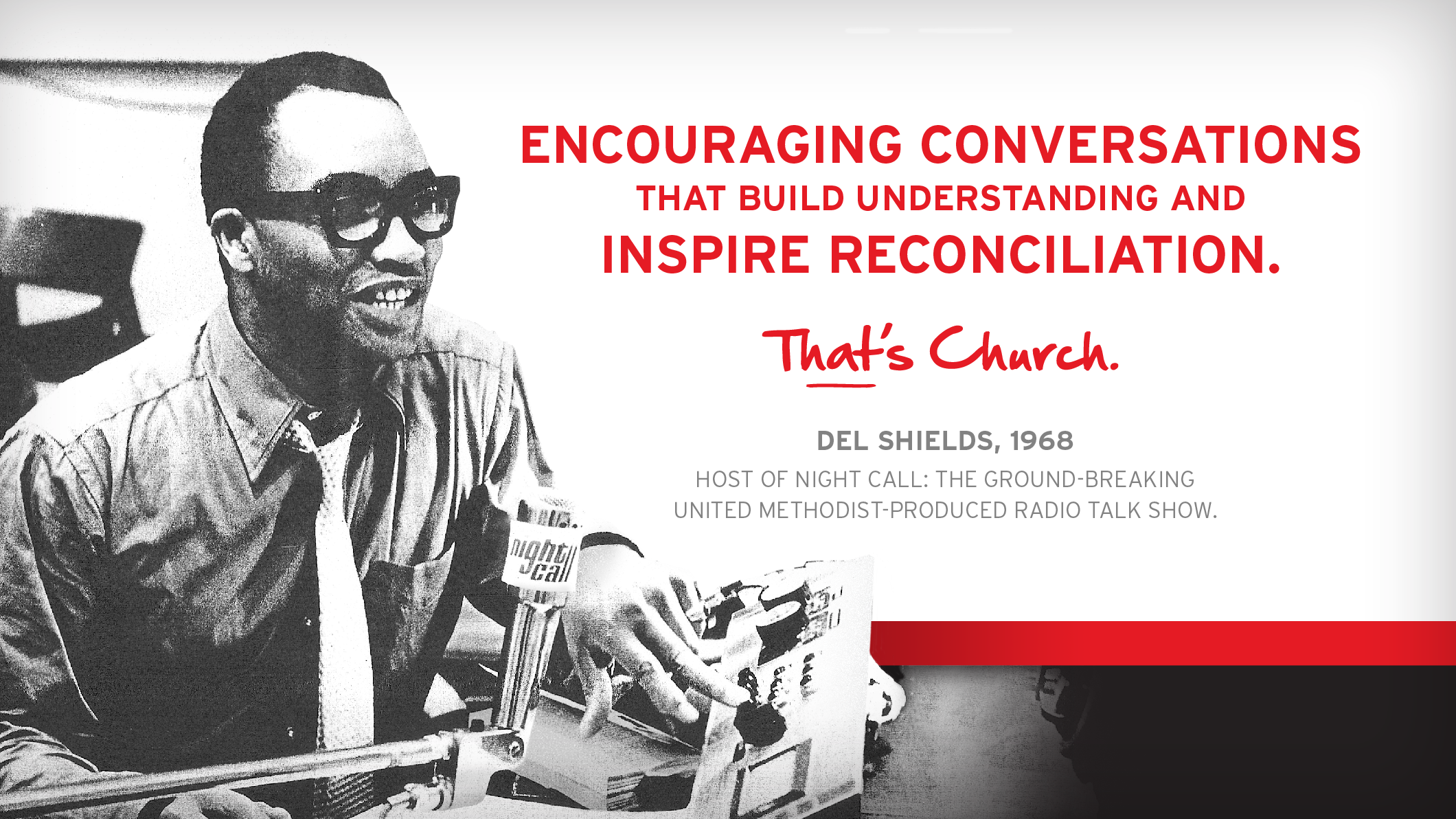 Rethink Church believes in carrying on the path that "Night Call" started by continuing to have groundbreaking conversations on race. For discussion starters, go tohttp://rethinkchurch.org/articles/conversations-on-race. Those who would like free social media banners with images from the Rethink Church Black History ad should email rethinkchurch@umcom.org.
Contact:
Natalie Bannon nbannon@umcom.org
615-742-5413
Read press release
Bishop Carter: Measuring what matters
LAKELAND, Fla. (UMNS) — The church conversation about numbers and metrics is often dominated by "two extreme and less-than-helpful perspectives," writes Florida Area Bishop Kenneth H. Carter Jr. for the Lewis Center for Church Leadership.
DURHAM, N.C. (UMNS) — Duke University saw major controversy after first deciding to allow Muslim students to offer the call to prayer from the Duke Chapel bell tower, then reversing the decision. But the clear trend at Duke and other schools with historic United Methodist ties is to support non-Christian religious groups, including in use of the chapel. Sam Hodges reports.
Photo by Megan Morr, © Duke Photography
Duke University’s Muslim students got support from students of Duke Divinity School in the controversy over whether to allow the adhan, or Muslim call to prayer, for the Duke Chapel bell tower.PreviousNextA UMNS News Feature
By Sam Hodges
Restrooms in Syracuse University’s Hendricks Chapel got an overhaul last year, including improved and expanded wudu stations. Muslim students use those for ritual washing before praying in the chapel.
“We’re very proud of our wudus,” said the Rev. Tiffany Steinwert, a United Methodist elder and Hendricks Chapel dean.
While Hendricks’ restroom rehab caused no stir, Duke University found considerable controversy last month after announcing Muslim students would offer the adhan, the Islamic call to prayer, from Duke Chapel’s bell tower.
The Rev. Tiffany Steinwart, dean of Hendricks Chapel at Syracuse University.
Before that actually happened, the university in Durham, North Carolina,reversed the decision, prompting more news coverage and counter-protests.“The recent actions opened up a conversation, both within and outside the university, about plurality, interfaith engagement and theology, and also about the role of religion in the university and the centrality and nature of the Duke Chapel as a symbol of the university,” said Michael Schoenfeld, Duke’s vice president for public affairs and government relations.
University chapels can be a battleground, as Duke discovered. But the clear, longstanding trend among schools with historic United Methodist ties — including Duke and Syracuse — is for supporting non-Christian groups, including with use of chapel space.
That’s certainly the case at Emory University in Atlanta, said the Rev. Bridgette Young Ross, dean of Emory’s Cannon Chapel and a United Methodist elder.
“Every religious tradition that’s recognized on this campus is part of the community,” Young Ross said. “It’s important to be sure that all members of the community get equal access and equal respect.”
Cannon is regularly used for Christian worship, but also for Jewish services during High Holy Days. Buddhist students meet there for meditation. Muslim and Hindu students have separate prayer gatherings in the chapel on Friday afternoons.
While Cannon has not been used for the adhan, Emory lets Muslim students offer it on Fridays during Ramadan from the school’s clock tower.
Boston University’s Marsh Chapel is home to an 11 a.m. Sunday interdenominational Protestant service heard across New England via public radio. But Marsh is for all religious groups, said the Rev. Robert Allan Hill, a United Methodist elder and the chapel’s dean.
“It’s very much open to them,” Hill said. “We have had Muslim prayers in our lower chapel and on the plaza in front of the chapel.”
Southern Methodist University’s Perkins School of Theology includes Perkins Chapel, a church-like space used regularly for Protestant and Catholic worship. The chapel also has been used for interfaith services, led in part by non-Christian clergy.
The Rev. William Lawrence, dean of Perkins School of Theology, said he doesn’t know of any fully non-Christian religious services that have been held in the chapel. But SMU has in recent years designated space for Muslim prayer in the student center.
Claremont School of Theology — along with Perkins, Duke Divinity, Candler at Emory, and Boston School of Theology — is one of 13 United Methodist seminaries. Claremont is in the deeply multicultural area of greater Los Angeles, and the school’s students include Jews and Muslims. Both use the school’s Kresge Chapel, said the Rev. Kah-Jin Jeffrey Kuan, Claremont’s president and a United Methodist elder.
Kuan added: “We have made an agreement with the Jewish students that they can use the chapel for Shabbat services.”
WESLEY AND INTERFAITH COOPERATION
A number of United Methodist scholars, including the Rev. Tiffany Steinwert, have written about how Methodism founder John Wesley regarded Christian groups other than his own and how he regarded other religious faiths. Steinwert, dean of Hendricks Chapel at Syracuse, wrote a paper titled “Toward a Wesleyan Praxis of Interreligious Engagement in Higher Education.” Here’s a key paragraph:
“Wesley was not indifferent to the distinct doctrinal claims of Christianity and other world traditions. He remained firm in his conviction that the Christian faith claim was unique and soteriologically necessary. However, Wesley’s openness to the possibility that non-Christians can practice holy living and have access to the ‘inward voice of God,’ provides a window of opportunity for shared concerns between Christians and non-Christians. By momentarily suspending doctrinal truth claims, it provides space for people of diverse faith traditions to come together around a shared value of holy living for personal and social transformation.”
‘Interreligious reimagining’
For at least a decade, Duke University has let Muslim students have space within Duke Chapel for prayer services.
But in a Jan. 14 column in the Raleigh, N.C., News & Observer, Christy Lohr Sapp, Duke’s associate dean for religious life, announced Duke Chapel would go further, letting Muslim students do the adhan from the Duke Chapel tower.
Noting recent attacks in Paris and Nigeria by extremists claiming to represent Islam, she said Duke’s “peaceful and prayerful” Muslim students showed a different face of the religion, and would do so more effectively if allowed to use the chapel tower.
“The neo-gothic cathedral at the heart of Duke’s campus is a symbol of the faith of the school’s founders, but the use of it as a minaret allows for the interreligious reimagining of a university icon,” Sapp wrote.
The Rev. Franklin Graham, son of famed evangelist the Rev. Billy Graham, immediately criticized the decision.
“As Christianity is being excluded from the public square and followers of Islam are raping, butchering, and beheading Christians, Jews, and anyone who doesn’t submit to their Sharia Islamic law, Duke is promoting this in the name of religious pluralism,” he wrote on Facebook. Graham called on Duke donors to withhold support until the adhandecision was overturned.
By the next day, Duke had in fact overturned. Spokesman Schoenfeld said that what was meant as a unifying gesture “was not having the intended effect.” He also cited safety concerns. Duke did allow the call to prayer from outside the chapel.
Imam Adeel J. Zeb, Duke’s Muslim chaplain, wrote that Muslim students had not asked to do the call to prayer from the tower, but were pleased by the invitation and demoralized when it was withdrawn.
“Many of the Duke Divinity School students showed their support through email and phone communications, and visited the Center for Muslim Life to support us … and for that we are grateful,” he added.
But the Rev. Richard Hays, dean of Duke Divinity, criticized the original decision. He wrote that the university rightly supported all campus religious groups. But he said, “Christianity and Islam stand in significant theological tension with one another” and “should not be symbolically conflated” by having the adhan chanted from a Christian worship space.
Bishop Ken Carter, a Duke Divinity graduate who leads the Florida Conference of The United Methodist Church, also was critical of the first decision.
“I am coming from a very different place than Franklin Graham,” Carter said on Facebook. “I honor the goodness of many Muslims, and I acknowledge the failure of many Christians, myself included.”
But Carter added: “Jews and Muslims are right to retain the identity of their holy places, and they are not bigots if they choose not to allow other religious traditions to practice in them. Christians are also not bigots in viewing Duke Chapel as a place set apart for Christian worship.”
Others, noting Duke Chapel has made space for Muslim prayer for years, said the issue wasn’t use of the chapel itself but the public nature of the adhan. Muslims and others countered that the bells sounding from the tower represent a Christian public expression.
Meanwhile, a Jewish student from Israel weighed in, drawing on his upbringing in a land shared by Jews and Muslims.
Eidan Jacob wrote in the Duke Chronicle that “recitations of the adhan are simply part of the soundscape for many in Israel. Movements to unfairly limit the freedom of Muslims to chant it are extremely scandalous.”
UNITED METHODIST EDUCATION
There are 119 schools, colleges and universities related to The United Methodist Church, including the 13 United Methodist seminaries — among them Claremont, Duke Divinity, Candler School of Theology at Emory, and Boston School of Theology at Boston University. See an interactive mapof these institutions.
A tradition of openness
Chapel leaders at other United Methodist-related schools wouldn’t comment on Duke’s controversy. But they agreed that's in the spirit of John Wesley, Methodism’s founder, to show respect for and generosity toward other religious traditions.
Steinwert, author of a paper called “A Legacy of Holiness: Toward a Wesleyan Praxis of Interreligious Engagement in Higher Education,” noted that Syracuse’s Hendricks Chapel was designed and dedicated for of all faiths back in 1930.
She considers that an advantage as Hendricks welcomes a wide range of religious groups, including pagans.
“We were built for this work,” Steinwert said. “It’s embedded in our DNA, and it does make it easier. We’re more flexible and able to adapt to the changing religious demography.”
At the University of Evansville, the Rev. Tammy Gieselman oversees Neu Chapel. She said the United Methodist-related school has been a community leader in interfaith work, and she seeks to make Neu welcoming for all.
The chapel looks like a church. But Gieselman, a United Methodist elder, doesn’t wish for a more neutral building. Instead, if money were no object, she would add to Neu, creating designated areas for other religious groups.
She can see the scene at the front door now.
“Christians walking into a space next to Jews and Muslims who are going to pray and read out of their sacred texts — that’s rich.”
Hodges, a United Methodist News Service writer, lives in Dallas. Contact him at (615) 742-5470 or newsdesk@umcom.org
Read story and post comment
Looking toward change in relations with Cuba
NEW YORK (UMNS) — U.S. religious leaders played an unofficial but significant role in the negotiations that led to the Obama Administration's restoration of full diplomatic relations with Cuba, says the Rev. John McCullough, a United Methodist pastor and top executive of Church World Service. Linda Bloom has the story.
Nechi Fullerton (left) works with Abelardo Castillo, a Cuban construction worker, at the Methodist seimary during a January 2015 volunteer trip in Havana, Cuba.PreviousNext
Looking toward change in relations with Cuba
By Linda Bloom
U.S. religious leaders played an unofficial but significant role in the negotiations that led to the Obama Administration’s restoration of full diplomatic relations with Cuba, says a United Methodist pastor.
The Rev. John McCullough, the top executive of Church World Service, said an ecumenical coalition embarked on its own diplomatic mission, hoping “to bring a sense of clarity” between the U.S. and Cuban governments. That mission was related to discussions over humanitarian concerns for Alan Gross, an American imprisoned in Cuba, and three members of the “Cuban Five” remaining in U.S. prisons.
“As an ecumenical strategy, we became focused like a laser beam on the humanitarian crisis,” he explained. “One of the real difficulties was that neither government wanted to be the first to make the move because of the level of distrust.”
MISSION AGENCY DEEPLY INTERESTED IN IMPROVING U.S.-CUBA RELATIONS
By Elliott Wright
The moves toward more open doors between the US and Cuba, including relaxed rules on visits, are in keeping with United Methodist positons. While they will no doubt improve interaction between US and Cuban Christians in the future, they are not likely to immediate change The United Methodist Church’s current relations or activities in Cuba.
“We welcome the steps that may normalize US-Cuba relations, and are glad that we already have strong ties with our Methodist brothers and sisters in Cuba,” said Thomas Kemper, chief executive of the United Methodist General Board of Global Ministries, the denomination’s mission agency “This includes a regular program of volunteer in mission (VIM) journeys in partnership with the Methodist Church in Cuba.”
Read full story
Mission Agency Deeply Interested In Improving U.S.-Cuba Relations
By Elliott Wright*
New York, NY, February 3, 2015—The moves toward more open doors between the United States and Cuba, including relaxed rules on visits, are in keeping with United Methodist positons. While they will no doubt improve interaction between US and Cuban Christians in the future, they are not likely to immediate change The United Methodist Church’s current relations or activities in Cuba.
“We welcome the steps that may normalize U.S.-Cuba relations, and are glad that we already have strong ties with our Methodist brothers and sisters in Cuba,” said Thomas Kemper, chief executive of the United Methodist General Board of Global Ministries, the denomination’s mission agency. “This includes a regular program of volunteer in mission (VIM) journeys in partnership with the Methodist Church in Cuba.”
Positive but cautious analyses were also offered by Aldo Gonzalez, the coordinator of the CUBA VIM program, and Icel Rodriguez, director of global missions for the Florida United Methodist Conference, which has a long-standing covenant with Cuban Methodists. The covenant includes stipulated visits between the two church entities.
The United Methodist Church, through its policy-making General Conference, has long advocated the normalization of relations between Cuba and the United States, including termination of the U.S. embargo of Cuba enacted more than a half century ago.
Agreements between President Barack Obama and Cuban President Raul Castro last December strengthened a process that may lead to mutual diplomatic relations and more person-to-person visits. Only the U.S. Congress can end the embargo. The joint announcement projected more family visits and cultural, educational and religious contacts without obtaining a “specific” U.S. license from the Office of Foreign Assets Control. A general license would still be required for travel.
“Religious activities” are among the 12 categories of “legal travel” with the general license for U.S. travel to Cuba under the proposed new rules. Prior policy in both countries has permitted visits for religious purposes but, according to Gonzalez, this history has been one of “ups and downs.” Restrictions on licensed visits were relaxed on the U.S. side in 2011 by President Obama, after having been tightened by the Bush administration.
On Jan. 28, a bipartisan group of U.S. senators announced plans to introduce and hold hearings on legislature that would lift restrictions on U.S. citizen travel to Cuba. The fate of the proposal is uncertain, as is its convergence with the earlier Obama initiatives.
“A process is just beginning and we will use every new opportunity to its fullest to strengthen our join mission and ministry with the Methodist Church in Cuba,” said Kemper, who also noted collaboration between his agency’s relief agency and the Cuban church in the wake of Super Storm Sandy in 2013. The United Methodist Committee on Relief (UMCOR) in August 2013 allocated $500,000 to rebuild homes destroyed by the storm when it hit Cuba at hurricane force.
Currently, according to Gonzalez, Cuba allows two monthly U.S. United Methodist mission volunteer teams of no more than 12 each. Those teams primarily work on church and personage reconstruction and were instrumental in building Camp Canaan, a Cuban Methodist facility, and the Methodist Theological Seminary in Havana. The program has been in effect for some 20 years. Gonzalez says that the present level of visits is in keeping with the capacity of the Cuban church as host. The Methodist Church in Cuba has more than 40,000 members and a worshipping community of 50,000, according to the latest available figures.
The Florida Conference’s 17-year-old covenant with the Cuban Methodists incorporates person-to-person visits for spiritual enrichment. Florida can send 24 persons per district to Cuba each year and there are nine districts in the conference, according to Rodriguez. A limited number of Cuban pastors can visit Florida churches each year. The relationship is of great value to congregations and church members in both countries, she added.
*Elliott Wright is an Information Consultant with Global Ministries.During a Dec. 17 news conference, President Obama announced the prisoner releases by Cuba and the U.S., along with policy changes normalizing travel, banking and trade relations.
This week, both the U.S. Senate and House are holding committee hearings on the impact of those changes.
The religious advocacy efforts included consultation from the leadership of different denominations – including The United Methodist Church – and outreach to others, such as the Jewish and Roman Catholic communities and state councils of churches.
“It was a very loud and a very consistent and a very determined clarion call for change,” McCullough stressed. “I believe that this change in policy would not have happened had that not been the case.”
Jim Winkler, who was involved as the top executive of the United Methodist Board of Church and Society and, currently, the National Council of Churches, agreed.
“I believe the longstanding advocacy of CWS, the NCC and our member denominations has been essential to encouraging the Obama Administration to move toward normalizing relations with Cuba,” he told United Methodist News Service.
Hearings this week on Cuba
On Tuesday, the U.S. Senate Committee on Foreign Relations had a hearing on “Understanding the Impact of U.S. Policy Changes on Human Rights and Democracy in Cuba.” The U.S.House Committee on Foreign Affairs is holding a similar hearing Feb. 4.
A bipartisan group of senators introduced legislation Jan. 29 to end all restrictions on travel to Cuba by U.S. citizens and a companion bill was to be introduced in the House this week.
The Rev. Phil Wingeier-Rayo, a professor at Perkins School of Theology, believes Obama’s new policy will accomplish “what the embargo hasn’t been able to do for 50 years – the opening up of trade and allowing a kind of person-to-person diplomacy.”
Wingeier-Rayo and his wife, Diana, lived in Cuba from 1991 to 1997 as missionaries with the United Methodist Board of Global Ministries – the first Protestant missionaries allowed back after the revolution. They remain in touch with many friends there, and he has returned to Cuba with mission groups three times, most recently in 2011.
Friendships are just as important as trade resources, Wingeier-Rayo pointed out. Fewer travel restrictions, he said, could broaden the exchanges between religious groups and, on a wider level, allow ordinary citizens of the U.S. and Cuba to get to know each other.
The United Methodist Florida Conference’s partnership with the Methodist Church in Cuba already demonstrates the value of people-to-people relationships, said the Rev. Armando Rodriguez Jr., pastor of John Wesley United Methodist Church in Tallahassee, Florida.
“The embargo has not worked for many years,” added Rodriguez, who moved to the U.S. from Cuba when he was 33 years old. “It’s a policy of the past. Instead of accomplishing anything positive, it actually damages the people of Cuba.”
He disagrees with the claims of Cuban-Americans in Congress that normalization would enhance the positions of the Castro brothers, as well as the opposite notion that U. S. influence would cause Cuba’s communist government to fall.
The Cuban people should determine their own future, Rodriguez believes, and more contact with people from the U.S. will help empower them to do so.
Connecting through mission
The connection between United Methodists and the Methodist Church in Cuba has flourished in recent years.In January, an 11-member group from the Arkansas Conference became the denomination's first volunteer team to arrive in Havana after Obama's announcement. They contributed to a long-term project to build housing for Cuban Methodist seminary professors.
Team leader Nechi Fullerton – who has traveled to Cuba four times since 2012 and is in frequent contact with Cuban Methodists – said she expects any official changes between the U.S. and Cuba to occur slowly.
“The people there are very excited and very hopeful, much more optimistic than I am,” added Fullerton, a member of First United Methodist Church in Little Rock.
U.S. volunteer teams bring construction supplies, medicines and other needed items, but “relationships with the people are more important than the project,” she pointed out. “They are the most inspiring people I have met. What they have done with what they have is absolutely amazing.”
Ongoing commitment to better relations
McCullough, who estimates that he has traveled to Cuba about 20 times since his first visit in the early 1990s while working for the Board of Global Ministries, has similar feelings.
REACTION TO POLICY CHANGE
Church World Service
United Methodist Board of Church and Society
U.S. and Cuban councils of churches
World Methodist Council
“A lot of Americans, which was true in my case, experience the Cubans as very a warm and gracious people,” he explained. “So it was painful to not be able to more actively engage with each other.”
Encouraging better relations between the U.S. and Cuba has been an ongoing commitment for CWS and its partners, and McCullough “has really taken a lead and made this a priority for his engagement and advocacy,” said Martin Shupack, the CWS director of advocacy.
“It’s really a global issue and it’s a humanitarian issue,” Shupack added. “As a humanitarian organization, we care about the Cuban people; we care about the Cuban churches.”
As part of a joint religious delegation meeting Nov. 1, 2010, with Obama, McCullough directly asked the president to make religious travel to Cuba less difficult. Two and a half months later, the White House announced it was easing travel restrictions for religious, educational and cultural exchanges.
More recently, McCullough said he was struck by the situation involving the Cuban Five and Alan Gross “and the impact it was having on their respective families.”
In early November, McCullough, the Rev. Gradye Parsons, stated clerk of the Presbyterian Church (U.S.A.), and Rabbi Elhanan Sunny Schnitzer, executive director of the Cuba America Jewish Mission, traveled to Havana to continue to advocate for the release of those prisoners.
When the release and policy change occurred, the trio praised the action in a joint statement with the Cuban Council of Churches.
“Our world has changed dramatically since the U.S. embargo/blockade on Cuba began in 1962,” the statement said. “There is no longer any reason to deny both our peoples the blessings of mutual exchange and expanded relationships in all aspects of life.”
Bloom is a United Methodist News Service multimedia reporter based in New York. Follow her athttp://twitter.com/umcscribe or contact her at (646) 369-3759 or newsdesk@umcom.org
By Elliott Wright*
New York, NY, February 3, 2015—The moves toward more open doors between the United States and Cuba, including relaxed rules on visits, are in keeping with United Methodist positons. While they will no doubt improve interaction between US and Cuban Christians in the future, they are not likely to immediate change The United Methodist Church’s current relations or activities in Cuba.
“We welcome the steps that may normalize U.S.-Cuba relations, and are glad that we already have strong ties with our Methodist brothers and sisters in Cuba,” said Thomas Kemper, chief executive of the United Methodist General Board of Global Ministries, the denomination’s mission agency. “This includes a regular program of volunteer in mission (VIM) journeys in partnership with the Methodist Church in Cuba.”
Positive but cautious analyses were also offered by Aldo Gonzalez, the coordinator of the CUBA VIM program, and Icel Rodriguez, director of global missions for the Florida United Methodist Conference, which has a long-standing covenant with Cuban Methodists. The covenant includes stipulated visits between the two church entities.
The United Methodist Church, through its policy-making General Conference, has long advocated the normalization of relations between Cuba and the United States, including termination of the U.S. embargo of Cuba enacted more than a half century ago.
Agreements between President Barack Obama and Cuban President Raul Castro last December strengthened a process that may lead to mutual diplomatic relations and more person-to-person visits. Only the U.S. Congress can end the embargo. The joint announcement projected more family visits and cultural, educational and religious contacts without obtaining a “specific” U.S. license from the Office of Foreign Assets Control. A general license would still be required for travel.
“Religious activities” are among the 12 categories of “legal travel” with the general license for U.S. travel to Cuba under the proposed new rules. Prior policy in both countries has permitted visits for religious purposes but, according to Gonzalez, this history has been one of “ups and downs.” Restrictions on licensed visits were relaxed on the U.S. side in 2011 by President Obama, after having been tightened by the Bush administration.
On Jan. 28, a bipartisan group of U.S. senators announced plans to introduce and hold hearings on legislature that would lift restrictions on U.S. citizen travel to Cuba. The fate of the proposal is uncertain, as is its convergence with the earlier Obama initiatives.
“A process is just beginning and we will use every new opportunity to its fullest to strengthen our join mission and ministry with the Methodist Church in Cuba,” said Kemper, who also noted collaboration between his agency’s relief agency and the Cuban church in the wake of Super Storm Sandy in 2013. The United Methodist Committee on Relief (UMCOR) in August 2013 allocated $500,000 to rebuild homes destroyed by the storm when it hit Cuba at hurricane force.
Currently, according to Gonzalez, Cuba allows two monthly U.S. United Methodist mission volunteer teams of no more than 12 each. Those teams primarily work on church and personage reconstruction and were instrumental in building Camp Canaan, a Cuban Methodist facility, and the Methodist Theological Seminary in Havana. The program has been in effect for some 20 years. Gonzalez says that the present level of visits is in keeping with the capacity of the Cuban church as host. The Methodist Church in Cuba has more than 40,000 members and a worshipping community of 50,000, according to the latest available figures.
The Florida Conference’s 17-year-old covenant with the Cuban Methodists incorporates person-to-person visits for spiritual enrichment. Florida can send 24 persons per district to Cuba each year and there are nine districts in the conference, according to Rodriguez. A limited number of Cuban pastors can visit Florida churches each year. The relationship is of great value to congregations and church members in both countries, she added.
*Elliott Wright is an Information Consultant with Global Ministries.During a Dec. 17 news conference, President Obama announced the prisoner releases by Cuba and the U.S., along with policy changes normalizing travel, banking and trade relations.
This week, both the U.S. Senate and House are holding committee hearings on the impact of those changes.
The religious advocacy efforts included consultation from the leadership of different denominations – including The United Methodist Church – and outreach to others, such as the Jewish and Roman Catholic communities and state councils of churches.
“It was a very loud and a very consistent and a very determined clarion call for change,” McCullough stressed. “I believe that this change in policy would not have happened had that not been the case.”
Jim Winkler, who was involved as the top executive of the United Methodist Board of Church and Society and, currently, the National Council of Churches, agreed.
“I believe the longstanding advocacy of CWS, the NCC and our member denominations has been essential to encouraging the Obama Administration to move toward normalizing relations with Cuba,” he told United Methodist News Service.
Hearings this week on Cuba
On Tuesday, the U.S. Senate Committee on Foreign Relations had a hearing on “Understanding the Impact of U.S. Policy Changes on Human Rights and Democracy in Cuba.” The U.S.House Committee on Foreign Affairs is holding a similar hearing Feb. 4.
A bipartisan group of senators introduced legislation Jan. 29 to end all restrictions on travel to Cuba by U.S. citizens and a companion bill was to be introduced in the House this week.
The Rev. Phil Wingeier-Rayo, a professor at Perkins School of Theology, believes Obama’s new policy will accomplish “what the embargo hasn’t been able to do for 50 years – the opening up of trade and allowing a kind of person-to-person diplomacy.”
Wingeier-Rayo and his wife, Diana, lived in Cuba from 1991 to 1997 as missionaries with the United Methodist Board of Global Ministries – the first Protestant missionaries allowed back after the revolution. They remain in touch with many friends there, and he has returned to Cuba with mission groups three times, most recently in 2011.
Friendships are just as important as trade resources, Wingeier-Rayo pointed out. Fewer travel restrictions, he said, could broaden the exchanges between religious groups and, on a wider level, allow ordinary citizens of the U.S. and Cuba to get to know each other.
The United Methodist Florida Conference’s partnership with the Methodist Church in Cuba already demonstrates the value of people-to-people relationships, said the Rev. Armando Rodriguez Jr., pastor of John Wesley United Methodist Church in Tallahassee, Florida.
“The embargo has not worked for many years,” added Rodriguez, who moved to the U.S. from Cuba when he was 33 years old. “It’s a policy of the past. Instead of accomplishing anything positive, it actually damages the people of Cuba.”
He disagrees with the claims of Cuban-Americans in Congress that normalization would enhance the positions of the Castro brothers, as well as the opposite notion that U. S. influence would cause Cuba’s communist government to fall.
The Cuban people should determine their own future, Rodriguez believes, and more contact with people from the U.S. will help empower them to do so.
Connecting through mission
The connection between United Methodists and the Methodist Church in Cuba has flourished in recent years.In January, an 11-member group from the Arkansas Conference became the denomination's first volunteer team to arrive in Havana after Obama's announcement. They contributed to a long-term project to build housing for Cuban Methodist seminary professors.
Team leader Nechi Fullerton – who has traveled to Cuba four times since 2012 and is in frequent contact with Cuban Methodists – said she expects any official changes between the U.S. and Cuba to occur slowly.
“The people there are very excited and very hopeful, much more optimistic than I am,” added Fullerton, a member of First United Methodist Church in Little Rock.
U.S. volunteer teams bring construction supplies, medicines and other needed items, but “relationships with the people are more important than the project,” she pointed out. “They are the most inspiring people I have met. What they have done with what they have is absolutely amazing.”
Ongoing commitment to better relations
McCullough, who estimates that he has traveled to Cuba about 20 times since his first visit in the early 1990s while working for the Board of Global Ministries, has similar feelings.
REACTION TO POLICY CHANGE
Church World Service
United Methodist Board of Church and Society
U.S. and Cuban councils of churches
World Methodist Council
“A lot of Americans, which was true in my case, experience the Cubans as very a warm and gracious people,” he explained. “So it was painful to not be able to more actively engage with each other.”
Encouraging better relations between the U.S. and Cuba has been an ongoing commitment for CWS and its partners, and McCullough “has really taken a lead and made this a priority for his engagement and advocacy,” said Martin Shupack, the CWS director of advocacy.
“It’s really a global issue and it’s a humanitarian issue,” Shupack added. “As a humanitarian organization, we care about the Cuban people; we care about the Cuban churches.”
As part of a joint religious delegation meeting Nov. 1, 2010, with Obama, McCullough directly asked the president to make religious travel to Cuba less difficult. Two and a half months later, the White House announced it was easing travel restrictions for religious, educational and cultural exchanges.
More recently, McCullough said he was struck by the situation involving the Cuban Five and Alan Gross “and the impact it was having on their respective families.”
In early November, McCullough, the Rev. Gradye Parsons, stated clerk of the Presbyterian Church (U.S.A.), and Rabbi Elhanan Sunny Schnitzer, executive director of the Cuba America Jewish Mission, traveled to Havana to continue to advocate for the release of those prisoners.
When the release and policy change occurred, the trio praised the action in a joint statement with the Cuban Council of Churches.
“Our world has changed dramatically since the U.S. embargo/blockade on Cuba began in 1962,” the statement said. “There is no longer any reason to deny both our peoples the blessings of mutual exchange and expanded relationships in all aspects of life.”
Bloom is a United Methodist News Service multimedia reporter based in New York. Follow her athttp://twitter.com/umcscribe or contact her at (646) 369-3759 or newsdesk@umcom.org
DES MOINES, Iowa (UMNS) — A United Methodist pastor in Iowa is trying to save the life of his brother, who is imprisoned in the Democratic Republic of Congo. And the pastor wants help from the church and the Obama administration.
Photo by the Rev. Arthur McClanahan, Iowa Conference
The Rev. Kiboko I. Kiboko, pastor of Norwalk United Methodist Church in Norwalk, Iowa, is working for the release of his brother from prison in the Democratic Republic of Congo.Pastor seeks help freeing brother in Congo
By Heather Hahn and the Rev. Arthur McClanahan
A United Methodist pastor in Iowa is trying to save the life his brother, who is imprisoned in the Democratic Republic of Congo. And the pastor wants help from the church and the Obama administration.
The Rev. Kiboko I. Kiboko says his brother, Vano Kalembe Kiboko — a United Methodist evangelist and a former congressman in Congo — was arrested Dec. 29 by the country’s secret service.
The arrest came after Vano Kiboko publicly denounced the Dec. 8 shooting of a woman engaged in a nonviolent protest.
Now, the pastor of Norwalk United Methodist Church in Iowa fears that without intervention, his brother’s life could be in danger.
Kiboko said his brother has been incarcerated for more than a month without a hearing. His brother also has malaria and likely is not receiving needed medical attention.
The pastor asks United Methodists and others to urge U.S. Secretary of State John Kerry and President Obama to help secure his brother’s release. He also asks church members to pray to Godfor his brother and the people of the Democratic Republic of Congo.
Kiboko told United Methodist News Service that Americans should care about a non-American’s incarceration because, in the words of the Rev. Martin Luther King Jr., “Injustice anywhere is a threat to justice everywhere.”
“Vano is imprisoned for living out his baptismal covenant ‘to resist injustice and oppression in whatever forms they present themselves,’” the pastor wrote in a letter to his congregation.
United Methodist leaders around the globe are responding to the pastor’s pleas.
A tense situation
Vano Kalembe Kiboko, a United Methodist, has been in prison in the Democratic Republic of Congo since Dec. 29. Photo courtesy of the Rev. Kiboko I. Kiboko, his brother.
Violence has long bedeviled the Democratic Republic of Congo, a country roughly the size of Western Europe in mineral-rich central Africa.In 2012, United Methodist leaders from Congo testified before a U.S. congressional subcommittee about the brutal assaults of the M23 militia, at the time widely believed to be supported by neighboring Rwanda’s army. Congolese troops and U.N. peacekeepers defeated the militia in 2013, though there have since been reports of insurgents regrouping.
The current crisis that has caught up the Kiboko family is largely a political one. In recent months, protests have erupted against proposals to change Congo’s constitution to allow President Joseph Kabila to run for a third term. Kabila took office in 2001 after the assassination of his father, Laurent Kabila.
Vano Kiboko spoke out about a demonstration against taking land from an indigenous Congolese group. During a press conference in December, he also said the country should not amend its constitution.
His brother pointed out that Kerry had told President Kabila the same thing last year.
Efforts to help
The pastor has started a petition on Change.org addressed to Kerry, Iowa’s U.S. senators and other U.S. leaders. Some 500 people have signed, and he said that family members in Europe are also appealing to their governments on his brother’s behalf.
The pastor plans to travel to the Democratic Republic of Congo to do what he can for his brother. Their sister, the Rev. J. Kabamba Kiboko, also has traveled to the country to help. She is a pastor in Ohio and member of The United Methodist Church’s top court, the Judicial Council.
Other United Methodist leaders are also trying to help. Iowa Area Bishop Julius Calvin Trimble said he has already written President Obama, Kerry and Iowa’s U.S. Sen. Chuck Grassley, asking that they intercede.
United Methodists bishops in Congo as well as staff at the United Methodist Board of Global Ministries, the denomination’s mission agency, and the Board of Church and Society, the denomination’s social justice agency, are working to free Vano Kiboko.
Thomas Kemper, the mission agency’s top executive, sees hope in a recent vote by the Democratic Republic of Congo’s National Assembly. On Sunday, Jan. 25, the legislative body voted to strip from legislation a planned census that risked indefinitely delaying the 2016 national election. That provision had sparked days of protests in which dozens died, reports the Reuters wire service.
“We are thankful that a fragile peace has resumed in Kinshasa after the violent protests last week surrounding the electoral process,” Kemper said. “While tensions are still high, we are hopeful that the electoral legislation passed by the Parliament will support a peaceful democratic transition and will allow for an election that upholds the democratic process and safeguards human rights.”
Kemper added that mission agency staff are in prayer for Vano Kiboko and his family.
“We pray for a quick resolution,” Kemper said, “and have been working with his family, the bishops and the political authorities in the DRC to secure his release.”
The Rev. Susan Henry-Crowe, top executive of the United Methodist Board of Church and Society, said she and agency staff also hold the Kiboko family in prayer.
"We uphold the dignity of all human beings and their right to speak their conscience," she said. "We continue to hold the people in the Democratic Republic of Congo in our prayers as the country pursues a new electoral process. We pray for peace and reconciliation in the DRC so that true democracy may flourish."
She noted that in its Social Principles, the denomination says: “We hold governments responsible for the protection of the rights of the people to free and fair elections and to the freedoms of speech, religion, assembly, communications media, and petition for redress of grievances without fear of reprisal.”
Hahn is a multimedia news reporter for United Methodist News Service. McClanahan is the Iowa Conference director of communications. Contact Hahn at (615) 742-5470 or newsdesk@umcom.org.
Audio Interviews
The Rev. Arthur McClanahan interviews Bishop Trimble:
Read story and comment
'New' Harper Lee book has biblical title
DALLAS (UMNS) — The recent news that Harper Lee has a second book coming out — 55 years after publication of "To Kill a Mockingbird" — stunned the literary world. She chose a biblical title in "Go Set the Watchman." The 88-year-old Lee is a United Methodist, and members of the denomination are among the many eager to read this second Lee novel. Sam Hodges reports.
White House photo
Author Harper Lee received the Medal of Freedom from President George W. Bush in a 2007 White House ceremony.Harper Lee’s surprise book has biblical title
By Sam Hodges
It’s a literary shocker. Harper Lee, long assumed the ultimate one-book author with “To Kill a Mockingbird,” will have a second novel published.
This week’s announcement made the front page of The New York Times, under the headline “After 55 years, a Sequel of Sorts from Harper Lee.”
What is not surprising, says Dawn Wiggins Hare — Lee’s friend, fellow Monroeville, Alabama, resident and fellow United Methodist — is that the book draws its title from the Old Testament.
“Nelle Harper is very well read in the Bible,” said Hare, top executive of the United Methodist Commission on the Status and Role of Women. “Years ago, she autographed a copy of `To Kill a Mockingbird’ for me, and quoted Scripture in the personalized autograph.”
Lee’s forthcoming book is called “Go Set a Watchman,” a line from the King James Version of Isaiah 21:6.
“It’s a kind of general statement about being alert to the dangers of the enemies of Israel,” said John Holbert, an Old Testament scholar and retired professor at Southern Methodist University’s Perkins School of Theology.
The novel doesn’t come out until July, so it is unclear how the title illuminates the story or themes. But Lee’s voracious reading has always included the Bible.
“The (biblical) title would not surprise me at all, because of her family’s faith and growing up in the church,” Hare said.
Lee, 88 and in an assisted living home, is a longtime member of First United Methodist Church in Monroeville. Her older sister Alice, a lawyer who died last year at age 103, held numerous lay offices in that church and served as a General Conference delegate.
Alice Lee’s will specified that her sister, known in Monroeville as “Nelle” and “Nelle Harper,” would get her books and other personal items, but the hometown church and other United Methodist causes were listed as financial beneficiaries.
`Humbled and amazed’
Harper Lee earned instant fame in 1960 when “To Kill a Mockingbird” came out. The novel, set in a small Alabama town during the Depression, is a lyrical coming-of-age story that also forthrightly deals with race prejudice.
“To Kill a Mockingbird” won a Pulitzer Prize and became a popular film with Gregory Peck playing Atticus Finch, the lawyer hero who represents a black man falsely accused of raping a white woman.
Lee’s book, which mentions Methodism and Methodism founder John Wesley in the first chapter, has sold some 40 million copies. It remains a fixture on high school and middle school reading lists. But a few years after its publication, Lee quit giving interviews, and over the decades, hope dwindled that she would produce another book.
The “new” novel was written in the mid-1950s, before “To Kill a Mockingbird.” It occurs in the same fictional Alabama town, and concerns a visit home by the grownup Jean Louise “Scout” Finch, the girl narrator of “To Kill a Mockingbird.”
A statement from publisher HarperCollins quotes Lee as saying that she submitted “Go Set a Watchman” for publication but was persuaded by an editor to write another novel from the point of view of the young Scout. Lee never went back to the first book, but said her lawyer recently discovered a manuscript of it.
“After much thought and hesitation, I shared it with a handful of people I trust and was pleased to hear that they considered it worthy of publication,” Lee said in the statement. “I am humbled and amazed that this will now be published after all these years."
While the first reaction among Lee’s millions of fans was elation at the prospect of reading more fiction by her, questions have arisen as to whether Lee, given her age and infirmity, could really have made the decision to publish “Go Set a Watchman.” The New York Times story noted that HarperCollins dealt with Lee’s lawyer, not with Lee herself.
Others who have met with Lee recently vouch for her ability to make such a decision, and the publisher released a statement Thursday quoting Lee as saying she was "happy as hell" to have the second book coming out.
Leaning forward
The Rev. Scott Smith, pastor of First United Methodist Church in Ormond Beach, Florida, is still in the flush of excitement at the prospect of another Harper Lee book.
Smith first read “To Kill a Mockingbird” in the eighth grade, drawn to it because it was banned by his North Florida school.
He has since read it 20-25 times, he estimates, and now makes a point of reading it yearly.
He’s drawn from the book and shown clips of the film in sermons.
“I love the integrity of Atticus Finch,” Smith said.
That the author wrote another novel, set in the same town as “To Kill a Mockingbird” and dealing with some of the same characters, has the pastor leaning forward.
“I’m thrilled,” Smith said. “The day it comes out, I’ll get it, and I’ll probably read it that day.”
*Hodges, a United Methodist News Service writer, lives in Dallas. Contact him at (615) 742-5470 or newsdesk@umcom.org
Read story and post a comment
Want a better life? Try a bucket list
LEIPER'S FORK, Tenn. (UMNS) — Shirley Bachelder's bucket list has ballooned into a lifetime of adventures and celebrations for the 93-year-old — most recently a hot-air balloon ride. "God was there," she said. "I felt so close to him and felt him saying, 'Well, what do you think, Shirley?'" Susan Passi-Klaus reports on how United Methodists with a bucket list say it helps them live more fully.
Photo courtesy of Shirley Bachelder
Shirley Bachelder's bucket list had "ride in a hot air balloon" on it until she was 93!PreviousNextA UMC.org Feature by Susan Passi-Klaus*
Shirley Bachelder’s bucket list has ballooned into a lifetime of adventures and celebrations.
In November 2014, the 93-year-old made her way to a remote Tennessee field at 5:45 a.m. in 27-degree weather. There she swung her short legs into a wicker gondola to take a hot air balloon ride, a testament to her spunk. With a delicate silk flower garland worn atop her woolen hat, this whippersnapper checked another item off her bucket list.
“I would have gone up in that balloon even if it was below zero,” she said. “All I needed was a couple pairs of gloves, my Egg McMuffin and a cup of coffee and I was ready to go.”
Was the sunrise balloon flight to Leiper’s Fork, Tennessee a dream come true for the California transplant?
“God was there,” she said. “I felt so close to him and felt him saying, 'Well, what do you think Shirley?'”
When fellow Christ United Methodist Church member Allen Johnston discovered Miss Shirley had “hot air balloon ride” still unchecked on her bucket list, he conspired with his Sunday school class to make the aerial adventure happen. On Nov. 3, 2014, Miss Shirley, in the company of another 90-something church member, lifted up, up and away.
“Shirley always has a great story,” Johnston said. “She’s so happy in her life. She’s just contagious!”
Shirley’s halo
At Shirley’s 80th birthday she looked around the purple-decked room (purple is a signature color for Shirley) and counted her blessings. She wanted to find a way to honor God. Ever since she’s worn a flower “gratitude garland” in her hair—even on her hot air balloon ride! Some people call it her “halo.”
“I told God, ‘I will celebrate every day with you and thank you each day for everything.’”
Christ UMC friends will continue helping Miss Shirley fulfill her bucket of wishes: taking a trip to Ireland, becoming a contestant on Wheel of Fortune (she’s hoping to audition for a second time), visiting a butterfly house, and even sighting a bluebird in Tennessee.
“If you have a bucket list, it proves you’re still alive,” Shirley said. “People who have stopped looking forward to creative things have made up their minds to die. We all need some crazy scheme in mind to keep us excited, so we can face life with a lot of fun and love.”
Shirley started on her bucket list when she was just 9 years old, fascinated by stories her teachers told of faraway places and out-of-the-bucket ideas. Her bucket list has led her to do everything from going back to college at age 50 (graduating with honors at 60), publishing stories in Reader’s Digest, and sampling all kinds of foods. Ostrich…yummy. Buffalo…tasty. Whale…no thank you!
Not long ago, an acquaintance suggested she see a geriatric doctor who would likely tell her to slow down. But being put out to pasture is not on Miss Shirley’s bucket list.
“I’ve been to several geriatric doctors and none of them have ever told me to slow down,” she huffed and puffed. “Life is for the living and I won’t coast to the finish line!”
Free flying birds of a feather
The Reverend Beth Estock, a United Methodist elder turned church coach and consultant with the Epicenter Group, Portland, OR, shares Shirley’s spirit of adventure.
The Rev. Beth Estock is determined to live into the fullness of God. Photo courtesy of Beth Estock.
“I have a limited amount of life; a limited amount of time to enjoy what it means to be alive, to drink it all in, to live into the fullness God has called me to,” Beth said. “I don’t want to miss anything.”Beth’s bucket list is no less exciting than Shirley’s. Her countdown includes a pilgrimage to Peruvian ruins in Machu Picchu, a spiritual journey to monasteries in Scotland’s Iona and a hike across Spain’s Camino de Santiago.
Bucket lists don’t have to be totally selfish, Beth said. “It’s not all about a $10,000 vacation, but it is about being open to co-creating our lives with God.”
“Instead of turning into walking zombies, how can we say ‘yes’ to the miracle of life that unfolds 24/7?” she asks. “We should be in awe and wonder constantly. This moment, and the next, and the next, is a gift from God.”
The greatest sin in life
Going for life’s gusto is a legacy Beth and her husband share with two spirited daughters, Sarah and Hannah.
“We always told our kids that the greatest sin in life is not living into the fullness of life that God calls us. God blesses us with gifts and talents. When we discover and embrace what those are, God can use us as vessels, and then we become a gift to the world.”
A bucket load on her bucket list!
Beth’s 20-year-old daughter, Hannah Petrillo, started her bucket list in the 7th grade. Originally, it included what she now calls “silly things” like “win a pie-eating contest,” “have tea with the Pope,” and “walk backwards for a day.” At last count though, her “do-one-day” list tallied 174 bucket-busting goals.
Now a freshman at Quest University, Squamish, Canada, Hannah seldom thinks small. “I got my love of adventure, and my curiosity from my mom,” she said. “She taught me to embrace life.”
Hannah Petrillo changed lives on her trip to Africa, numbers 63 and 30 on her bucket list. Photo courtesy of Hannah Petrillo.
When Hannah was 19 she worked four jobs to pay her way to Africa, item 30 on her bucket list. There she had the opportunity to check off item number 63 to change someone’s life, by spending three and a half months teaching First Aid to children in Uganda and volunteering at a United Methodist hospital in Kenya. Her medical background as an EMT, search and rescue volunteer, and lifeguard – 3 bucket list items she had previously completed – made it possible.“Bucket lists,” Hannah said, “are a great way to see what is important to you.”
“People get caught up in mundane things,” she continued. “There are a lot of distractions that keep people from remembering that we’re only on Earth a short time. We need to use that time to love each other, help each other and be a community.”
*Susan Passi-Klaus is a freelance writer based in Nashville, Tenn.
News media contact: Joe Iovino, UMC.org, at 615-312-3733.
Read story and post comment
Church featured in USA Today's Black History Month edition
NASHVILLE, Tenn. (UMNS) — The United Methodist Church will be featured in USA Today's special edition for Black History Month, available Feb. 2. Two separate ads will look at the critical role the denomination has played throughout groundbreaking moments in U.S. history. One ad features the Black College Fund; the other urges readers to "Rethink Church" by "encouraging conversations that build understanding and inspire reconciliation."
United Methodist Communications
Office of Public Information
810 12th Ave. S.
Nashville, TN 37203
www.umcpresscenter.org
FOR IMMEDIATE RELEASE
UMC featured in USA Today’s Black History Month edition
Nashville, Tenn.: The United Methodist Church will be featured in USA Today’s special edition for Black History Month, released on February 2, 2015. Two separate ads will take a look at the critical role The United Methodist Church has played throughout groundbreaking moments in U.S. history.
One ad features The United Methodist Church’s Black College Fund, which supports the largest number of Black colleges and universities (HBCUs) of any church body in the United States. The ad includes a timeline of events, highlighting that the first Methodist HBCU was opened one year after the end of the U.S. Civil War.
Accompanying text reports that United Methodist HBCUs are still relevant and essential – pointing readers to a free e-book at www.umcgiving.org/BCFebook. Find additional information at www.gbhem.org/bcf. The names of all 11 United Methodist HBCUs are also listed.
Another ad urges readers to Rethink Church by “encouraging conversations that build understanding and inspire reconciliation.” This ad remembers the work of the church’s Television, Radio and Film Commission (TRAFCO) – an agency that would go on to become United Methodist Communications – for using cutting edge technologies in 1968 to ease racial tensions after the assassination of the Rev. Martin Luther King Jr.
The agency launched “Night Call,” the first call-in radio program in history. Broadcast on 117 stations across the U.S., Night Call created a place for cross-racial dialogue with influential guests such as Stokely Carmichael, Saul Alinsky, Muhammad Ali and the Rev. Jesse Jackson. With the help of the General Commission on Archives and History, Rethink Church has assembled a sampling of Night Call episodes at www.rethinkchurch.org/nightcall.
“Whether on a call-in radio show in the 60s or on Rethink Church social media platforms today, United Methodists have always encouraged compassionate discussion to help us rethink our perceptions, break down walls and reach across divides,” reads text from the ad. “That’s putting beliefs into action. That’s Church.”
Contact:
Natalie Bannon nbannon@umcom.org
615-742-5413
Read press release
Bishop Carter: Measuring what matters
LAKELAND, Fla. (UMNS) — The church conversation about numbers and metrics is often dominated by "two extreme and less-than-helpful perspectives," writes Florida Area Bishop Kenneth H. Carter Jr. for the Lewis Center for Church Leadership.
Measuring What Matters: A Conversation about Metrics and Mission
by Ken Carter
 If your life is anything like mine, you may find yourself at the beginning of the year focusing on numbers from the past year. In both professional and personal spheres, these numbers become more important, whether they relate to personal finance, denominational data, institutional capacity, or charitable giving.
There is currently a lively conversation underway in the mainline church about numbers and metrics. This conversation is often dominated by two extreme and less-than-helpful perspectives. One seeks to quantify everything. In its most pronounced expression, this is the ascendency of the M.B.A. into every other professional guild, including ministry. The second perspective is an overreaction to the first. It insists that metrics should be ignored in favor of higher values — persons, or communities, or contexts.
If your life is anything like mine, you may find yourself at the beginning of the year focusing on numbers from the past year. In both professional and personal spheres, these numbers become more important, whether they relate to personal finance, denominational data, institutional capacity, or charitable giving.
There is currently a lively conversation underway in the mainline church about numbers and metrics. This conversation is often dominated by two extreme and less-than-helpful perspectives. One seeks to quantify everything. In its most pronounced expression, this is the ascendency of the M.B.A. into every other professional guild, including ministry. The second perspective is an overreaction to the first. It insists that metrics should be ignored in favor of higher values — persons, or communities, or contexts.
So how do we proceed, in work that necessarily involves mission, ministry, and transformation on the one hand, and compensation, pension, and facilities on the other? Clear thinking is rarer in our present moment than we might imagine. We are so enmeshed in our roles that we often do not see reality. Or we are so trained in a particular language that we are suspicious of those who sound different from us. Sometimes we naively hope for a future that will be different than the past. Or we privilege piety (how we feel) or action (what we do) over what we think. In the absence of clear thinking, we simply remain busy in our cycle of activity, confusing program with mission and exertion with fruitfulness.
Gil Rendle, of the Alban Institute and more recently the Texas Methodist Foundation, is one of the more helpful conversation partners in clarifying the assumptions that both help and hinder us. In his new book, Doing the Math of Mission (Rowman and Littlefield, 2014), Rendle reflects on the facets of congregational and denominational life that are in a fragile state, describing them by employing the biblical image of the wilderness. He acknowledges the anxiety and energy at the heart of our attention to mission and metrics. And he provides a number of helpful insights on how we measure the impact of our ministry.
Three Significant Distinctions
- The difference between counting and measuring. Counting focuses on resources and activities in the present. Measuring attends to the difference between where we are and where we seek to be.
- The distinction between processes and outcomes. Process is about what we do — the services we offer and the number of people we serve. Outcomes are concerned with the results we hope to achieve and the changes we imagine as a result of our efforts. Processes focus more on counting, while outcomes are linked to measuring.
- The value of missional instead of maintenance or preferential conversations. Maintenance conversations are about where we have been in light of agreed-upon rules. Conversations about people’s preferences value those persons already in our communities. Missional conversations, in contrast, focus on purpose, the future, and where God is calling us.
Three Essential Tasks
- So where does the conversation about metrics and mission lead us? It seems that there are three essential tasks:
- Integrating action and discernment. In our congregations, we cannot deny demographic trends or measures of participation. At the same time, these metrics are held in tension with thick narrative descriptions, all in service of our fundamental calling: to be missionary communities that bear witness to the Reign of God. Congregations do not have the luxury of detached analysis or extended evaluation. Rendle notes that our appropriate strategic intervention, given the fragility of the church and the complexity of our culture, is “Ready-Fire-Aim.” The challenge and adventure of congregational life and leadership are in the necessary integration of action and discernment.
- Focusing on the health and vitality of local congregations.Everything begins with the health and vitality of local congregations. Congregations, whether in Montgomery or Montclair or Monrovia, are the primary context where lives are transformed. Denominational structures and initiatives are secondary and should support congregations. Denominations can and should pay closer attention to the fruitfulness of congregations, lamenting the loss of influence in some settings, praising God for vitality in others, and remembering that the purpose of any local gathering is to bear witness to God’s dream for the world.
Remembering our purpose. Leaders are called to return, again and again, to the question of purpose. On a changed mission field, the external rewards once given by a church culture are decreasing. The intrinsic meaning of the work — to glorify God, to lead others into a transforming relationship with Jesus Christ, to see maturity and flourishing among members of the body of Christ, and to seek the common good — motivates us, even when we are making our way through a dry and barren wilderness.
The work of discernment, incorporating the kind of rigorous reflection offered by Gil Rendle, ultimately is about reading the signs of the times and listening for the still, small voice of a God to whom we are accountable.
Bishop Kenneth H. Carter, Jr., is resident bishop of the Florida Area of the United Methodist Church. The book he discusses, Doing the Math of Mission by Gil Rendle (Rowman and Littlefield, 2014), is available from Cokesbury and Amazon .
.
Read commentaryNamesake church honors 'founding father' of gospel music
PHILADELPHIA (UMNS) — Did you know the anthem "We Shall Overcome" has roots in Methodism? This video showcases the Rev. Charles Albert Tindley, a Methodist preacher known as one of the founding fathers of gospel music, and the United Methodist church he brought to prominence.View on YouTube | Download VideoPreviousNext
Tindley Temple: A Highlight of Methodist History
Share via EmailPrintThe history of The United Methodist Church oftentimes overlaps the history of the United States. One church in Philadelphia is on the national historic register because of its architecture. But Tindley Temple was really made famous because of the dynamic pastor who drew huge crowds in the ‘20s and composed the lyrics of a very familiar song.
Script:
(Video clip from the National Archives and RecordsAdministration)
(Crowd sings) “We shall overcome.”
Methodist preacher Charles Albert Tindley is credited with writing lyrics in 1901 that are now part of one of the most famous songs in American history.
The Rev. Robert L. Johnson, Tindley Temple United Methodist Church: “Blacks and whites and Jews and Catholics all stood across this country in the ‘60s singing ‘We Shall Overcome,’ not even understanding that the universal language they were singing came from a man who built a church right here on Broad Street in Philadelphia. Wow! Now, you want to talk about being proud to be Methodist, that’s a reason to be proud to be Methodist.”
The Rev. Robert Johnson is the pastor of Philadelphia’s Tindley Temple United Methodist Church, named after the figure known as one of the founding fathers of gospel music.
(Rev. Johnson praying) “Let us be grateful for the gift of music you have given us.”
(Choir singing) “… Emmanuel.”
The Rev. Robert L. Johnson: “The most exciting thing about being a congregation member here at Tindley is that you’re actually connected to a piece of history--living, breathing history that still is alive today. The organ. The ‘Messiah.’ The whole mystique about the building. You’re coming to a place that we built as African Americans. In the balcony, a dollar was given by every single member to purchase a chair. There’s members here who still remember their mothers and fathers putting up a dollar to purchase one of the chairs in the balcony.”
Charles Tindley was self-educated and known for his powerful preaching. His congregation became one of the largest Methodist churches in the United States in the 1920s, with nearly 10,000 members. In 1927, the church took the name Tindley Temple.
The Rev Robert Johnson: “You’ll see a congregation who, through the struggles and the adversities, exemplified the best of United Methodist culture and did the best that they could with what they had. It’s place that if you want to have a connection to what United Methodism really is in an African-American context, you’ve gotta come to Tindley.”
Reba Smith Poole is a lifelong member who is proud of the many generations of preachers, doctors, and leaders from Tindley Temple.
Reba Smith Poole, Tindley Temple United Methodist Church: “We are known for three things—good music, good preaching and good food. We have some of the best preachers you ever want to hear.”
(Rev. Johnson in the pulpit) “Whatever you do, enjoy yourself.”
The Rev. Robert Johnson: “We lose so much of our history and so much of who we are. And our generations to come need to understand that this belongs to you. I heard a kid sing the other day, ‘By and By.’ He had no idea that ‘By and By’ was a Tindley hymn. When I told the young man, and I brought him in here, the first thing he said was, ‘Wow. I walk by it every day and I never knew it was here.’ And people who don’t understand the history really can’t respect it. But when you understand it, you respect it and you hold it a little bit closer to your heart.”
Pastor Robert Johnson grew up attending Tindley and is one of the 50 pastors who were nurtured by the congregation.
A movie is in the works about the musical legacy of Charles Tindley also.
For more information about this historic church, contact Tindley Temple United Methodist Churchat 215-735-0442.
“I’ll Understand it Better By and By” ℗ 2015 Abingdon Press. All rights reserved. Used by Permission. From the Africana Hymnal
This story was posted January 29, 2015.
Media contact is Fran Walsh, at 615-742-5458.
Watch UMTV video and post a comment
'Vowing' to play cupid on Valentine's Day
WEST LAYFAYETTE, Ohio (UMNS) — The congregation at West Lafayette United Methodist Church is playing cupid this Valentine's Day by holding a group wedding for those who want a big church wedding but can't afford one. Leonard Hayhurst reports for the Coshocton Tribune.
West Lafayette UMC having group wedding
Leonard Hayhurst, llhayhur@coshoctontribune.com

West Lafayette UMC offering a group wedding 3 p.m. Valentine’s Day
There is no cost, but donations will be accepted to fund a mission trip
The ceremony is for any couple with a valid marriage license
Reservations are due to the church by Thursday
154CONNECT 5TWEETLINKEDINCOMMENTEMAILMORE
WEST LAFAYETTE – The average wedding nationally can cost about $25,000, according to the Wedding Report.
West Lafayette United Methodist Church is offering an alternative to those who want that big church wedding but can’t afford the cost.
A mass wedding will be held this Valentine’s Day at the church. All couples need is a valid marriage license and to make a call to the church that they will attend.
Prayers and readings of the ceremony will be done as a group, but vows and ring exchanges will be performed individually for each couple. A cake reception will follow.
The sanctuary also will be decorated for a wedding.
Family and friends are welcome to come. There is no cost, but donations will be accepted for church members to attend Red Bird Mission this June in Kentucky.
The Rev. William Buckeye said he’s not sure how many couples will participate, as the church has never done anything like this before.
Couples from the church will renew their vows before the group wedding for new couples, he said.
Buckeye became pastor at the church last summer and, since then, has made community outreach a main focus.
He had done the renewal ceremony at his past congregations, but Buckeye and his wife, Sheila, thought extending the idea to people looking to get married could connect the church to the community.
“It’s a celebration of love that doesn’t have to have all those expensive trappings around it,” Buckeye said. “All those trappings can get in the way of a simple ceremony of two people who love each other.”
Donations from couples getting married will go toward sending about 18 church members to Red Bird Mission in June in Beverly, Kentucky. Participants will perform projects such as house renovations and building wheelchair ramps for the needy.
He wants to take several youths, as Red Bird likes to teach the importance of such community service to teens.
“It’s usually pretty faith transforming,” Buckeye said of such a mission trip. “They get to see poverty at a level or depth they haven’t seen before. They also get to build some neat relationships with those they do the work for, those who might own the house or trailer.”
llhayhur@coshoctontribune.com
740-295-3417
Twitter: @llhayhurst
If you go
Interested couples in the group marriage service at 3 p.m. Saturday, Valentine’s Day, at West Lafayette United Methodist Church, 120 West Union Ave., call call the officeto register at 740-545-6368. The office is open from 9:30 a.m. to 3:30 p.m. Monday to Friday. Reservations are needed by Thursday.
Read story
New staff appointed in campus ministry, endorsing agency
NASHVILLE, Tenn. (UMNS) — The United Methodist Board of Higher Education and Ministry announced the appointment of three new staffers. The Rev. Matthew Charlton was appointed as a staff executive for collegiate ministry; Col. Gerald "Scott" Henry Jr. is the new director of extension ministry and pastoral care for the board's United Methodist Endorsing Agency; and Shelia Bates is director of faith and leadership formation for collegiate ministry. Nicole Burdakin reports.GBHEM announces key leadership positions in UMEA, Collegiate Ministry

Left to right: Colonel Gerald “Scott” Henry, Jr., the Rev. Dr. Matthew Charlton and the Rev. Sheila Bates.
Upon recommendation by the search teams and confirmation by Bishop Virginia Taylor, Holston Annual Conference, and Bishop Bill McAlilly, Tennessee Annual Conference, the General Board of Higher Education and Ministry announces the appointment of Colonel Gerald “Scott” Henry, Jr., in the United Methodist Endorsing Agency and the Rev. Dr. Matthew Charlton and the Rev. Sheila Bates in the Collegiate Ministry office.Scott Henry will serve as director of Extension Ministry and Pastoral Care in the Division of Ordained Ministry, reporting to the Rev. Myron Wingfield, beginning April 1, 2015. As director of Extension Ministry and Pastoral Care, Henry will serve as the contact person for extension ministry policy and information and provide pastoral care to the endorsed community.
After serving over 28 years in chaplaincy with the United States Air Force, Henry will retire from active service in February 2015, and he and his family will be relocating to Nashville, Tenn.
“We are excited to have Scott join our team and look forward to the many skills and experiences he brings to our work,” said the Rev. Dr. Kim Cape, general secretary of GBHEM. “Please keep Scott and his family in your prayers as they make this important transition.”
Henry will also represent the United Methodist Endorsing Agency to chaplains, military chaplain candidates and pastoral counselors certifying bodies and serve as a liaison for representation and support with government agencies and military branches that employ chaplains, as well as non-federal agencies that employ chaplains and pastoral care providers.
Prior to his military career, Henry attended Asbury Theological Seminary (MDiv, ’83) and served as a pastor in the Holston Annual Conference, where he is an ordained elder in full connection. During his career, he has served on the United Methodist Endorsing Group in the Southeastern Region, hosted the Endorsing Committee, and had relationships with the International Council of the United Methodist Church in Germany. He has experience with all branches of the military and multiple civilian organizations in a variety of multi-faceted capacities including curriculum development, establishment of joint bases, and leadership development and networking with leaders from the U.S., Europe, and Africa.
Beginning employment February 2, 2015, Matthew Charlton will lead the Collegiate Ministry office in the Division of higher education as assistant general secretary, reporting to the Rev. Dr. Gerald Lord.
In this role, Charlton will oversee and coordinate the work of the collegiate ministry office, relating collegiate ministers in the field to annual conferences and local churches with creative new programs. He has served on and chaired the Committee on Higher Education and Campus Ministry of the Tennessee Annual Conference, taught at several different institutions, and done church-based campus ministry.
Charlton is an ordained elder in the Tennessee Annual Conference and has served most recently as the senior pastor at Blakemore United Methodist Church in Nashville. Over his career, Charlton has gained a unique experience at campus, local church, and district and annual conference levels. He received a PhD from Garrett-Evangelical Theological Seminary, MA in Religion from Vanderbilt University, MDiv from Vanderbilt University Divinity School, and a BS from Middle Tennessee State University.
“I am excited about the enormous talent and vision that both Matt and Sheila will bring to our work in collegiate ministry,” said the Rev. Dr. Lord. “Matt will help us move collegiate ministries closer to local churches and annual conferences, while Sheila will bring dynamic creativity to various programs designed to bolster collegiate ministries throughout the connection. We look forward to both of them coming on board.”
The Rev. Sheila B. Bates will join Charlton in the Collegiate Ministry office as the Director of Faith and Leadership Formation on May 11, 2015. A certified candidate in the Alabama-West Florida Annual Conference, Bates has served as a youth pastor in Alpharetta, Ga., and since 2010, has been director/campus minister at Tuskegee University in Tuskegee, Ala.
Entrepreneurial and innovative in spirit, Bates has revitalized United Methodist campus ministry at Tuskegee University, growing the Wesley Foundation in number, variety of programming, and overall vitality. Among many accomplishments at Tuskegee, Bates developed a board of directors, developed Merit and Academic book scholarships and a benevolence fund, and was awarded $20,500 in grants for various service initiatives. She also has been a board member for the AL-WFL Board of Higher Education and Ministry since 2012.
Bates is a graduate of UM-related Gammon Theological Seminary (MDiv, ’10) in Atlanta, Ga., and is certified in Clinical Pastoral Education. She has previously collaborated with the Collegiate Ministry office at GBHEM as a Conference Design Team member for Imagine What’s NEXT 2014 in Denver, Colo., and NEXT 2012 in St. Louis, Mo. Bates was a facilitator and Think Tank leader at GBHEM’s Prepare and Summer Institute, two events for collegiate ministry development, in 2014, as well.
“Matt has great experience in renewing conversations between campus ministry and annual conferences,” said Cape. “And Sheila brings excellent experience to our work in campus ministry. We are pleased these three new staff members are willing to share their gifts with the entire UMC.”
Read story
Modeling sacred worth, human dignity
WASHINGTON (UMNS) — Troubling behavior in athletics is greater than any one sport or athletic program, writes Susan Greer Burton of the United Methodist Board of Church and Society. The church needs to work collectively with society "to change the culture of violence against women, children and people who are vulnerable that permeates our communities and world." Model sacred worth, human dignity
United Methodist Church can make a difference
by Susan Greer Burton on February 02, 2015

Football games were gathering places for family and friends. We watched the games and were taught the rules of the game, and we spent a lot of time visiting with each other.
Being a follower of Jesus and a sports fan can sometimes present challenges. News accounts are common of college athletes whose commitment to their craft earns revenue for the institutions and leaves them without the knowledge, skills and promise that higher education provides to build economic security. We also cannot ignore the violence against women and children that has been perpetrated by high school, collegiate and professional athletes.
The simple answer is to disband teams or suspend players.
Let’s be the church that changes culture
The more honest answer is for us to work collectively to change the culture of violence against women, children and people who are vulnerable that permeates our communities and world. The stakes are higher and the problem greater than any one sport or athletic program.
According to loveisrespect.org, “one in three adolescents in the U.S. is a victim of physical, sexual, emotional or verbal abuse from a dating partner” and “girls and young women between the ages of 16 and 24 experience the highest rate of intimate partnerviolence — almost triple the national average.” Men Can Stop Rape (MCSR), a male-positive organization seeking to change rape culture, reminds us that, “while the majority of rapes are perpetrated by men, the majority of men will never rape someone.”
All of these beliefs contribute to a culture that perpetuates violence against women and girls.
While I directed the UM Seminar Program, MCSR became one of the most requested organizations to work with middle school, high school and adult groups. They often facilitated an exercise called the “Continuum of Harm against Women.” Clergy and lay leaders, young and old, would hear different statements and discuss where the statement belonged: “most harmful,” “least harmful,”“not at all harmful” or somewhere in between.
Statements reflected the everyday occurrences in the lives of the seminar participants:
“grabbing a girl’s butt in the hallway,”
“honking or whistling at a girl,”
“playing “Grand Theft Auto” video games,”
“telling a boy he throws like a girl,”
“believing a woman’s place is at home with the children.”
The responses to the statements varied depending on who was in the room and what was deemed “normal” in their community. Female athletes would challenge the “honking and whistling” as being complimentary by naming the fear they experience when it happens while they jog. Men and boys were often part of the chorus challenging the statements that limited their interactions and responsibilities with friends and family.
It is difficult to know how beliefs and behaviors harm people who do not share our lived experiences. MCSR skillfully helped us open our eyes and hear each other in new ways and to understand that all of these beliefs contribute to a culture that perpetuates violence against women and girls.
Let’s be the church that challenges cultural norms
Jesus also used parables to teach us how to think critically and challenge cultural norms that were antithetical to his teachings.
There are many years when I am indifferent about which teams are playing in the Super Bowl. I still join friends, however, to enjoy the show – halftime musical entertainment, creative commercials, and good food and conversation. This is another place where I am challenged to live faithfully.
Jesus repeatedly challenged the cultural norms, and stood against the disrespect and denigration of women. Jesus used personal interactions with the woman accused of adultery and the woman with the issue of blood to demonstrate another way of being in relationship with women.
Jesus also used parables to teach us how to think critically and challenge cultural norms that were antithetical to his teachings.
Sunday as I watched the Super Bowl with my friends and children, I did not leave Jesus at the front door. I laughed at the commercials that were funny without demeaning any one person or group of people. I celebrated the commercials that modeled healthy masculinity and the strength and intelligence of women.
And, I interrupted the commercials that objectified women and girls – making it easier for someone to abuse and exploit God’s children. Two organizations that advocate for women in the media, The Representation Project and 3 Percent Conference, sponsored a Tweetup using #NotBuyingIt for ads that portrayed women poorly and #MediaWeLike for ads that honored the dignity and worth of women.
There were two commercials about which my children and I will definitely talk: “Doing it ‘Like a Girl’” and the official NO MORE campaign Super Bowl ad. The first demonstrated the sacred worth of girls while the second helped us become more conscious of the ways that women are abused everyday in the shadows of our communities.
Just as the MCSR exercise revealed during the honest critique of cultural norms and examination of our complicity, the ad closed by saying, “When it’s hard to talk, it’s up to us to listen.”
Let's be the church that listens
Let's teach and model healthy masculinity and value women and girls as children of God with sacred worth. Then and only then will the abuse and exploitation end.
Editor's note: Susan Greer Burton is Director of Women’s & Children’s Advocacy at the United Methodist General Board of Church & Society.
Read commentary
Ganta hospital administrator steps down
GANTA, Liberia (UMNS) — As administrator of Ganta United Methodist Hospital, Victor Doolakeh Taryor oversaw the hospital's response to health problems rarely seen in the United States — including fistula, often endured by women who have been raped multiple times, and the worst Ebola outbreak in history. Now, after eight years in that position, he is leaving the hospital, reports Julu Swen.

Photo by Julu Swen, UMNS
Victor Doolakeh Taryor chats with Nora Keah, who will serve as interim administrator at Ganta United Methodist Hospital after Taryor’s departure.PreviousNext

Ganta hospital administrator steps down
By Julu Swen
Victor Doolakeh Taryor, a United Methodist missionary, has left Ganta United Methodist Hospital after eight years as its administrator. He is planning to serve as a consultant.
During his tenure as administrator, he oversaw the hospital’s response to health problems rarely seen in the United States. These problems included fistula, often endured by women who have been raped multiple times, and the worst Ebola outbreak in history.
“UMC Ganta hospital is well prepared to respond to any Ebola outbreak more than we were when the Ebola virus first hit Liberia,” said Taryor, who is also co-chairperson of the Nimba County Ebola Task Force.
He joined the hospital’s staff in 1986 as a student. He rose through the ranks, holding the position ofshift supervisor and later director of nursing services before becoming administrator.
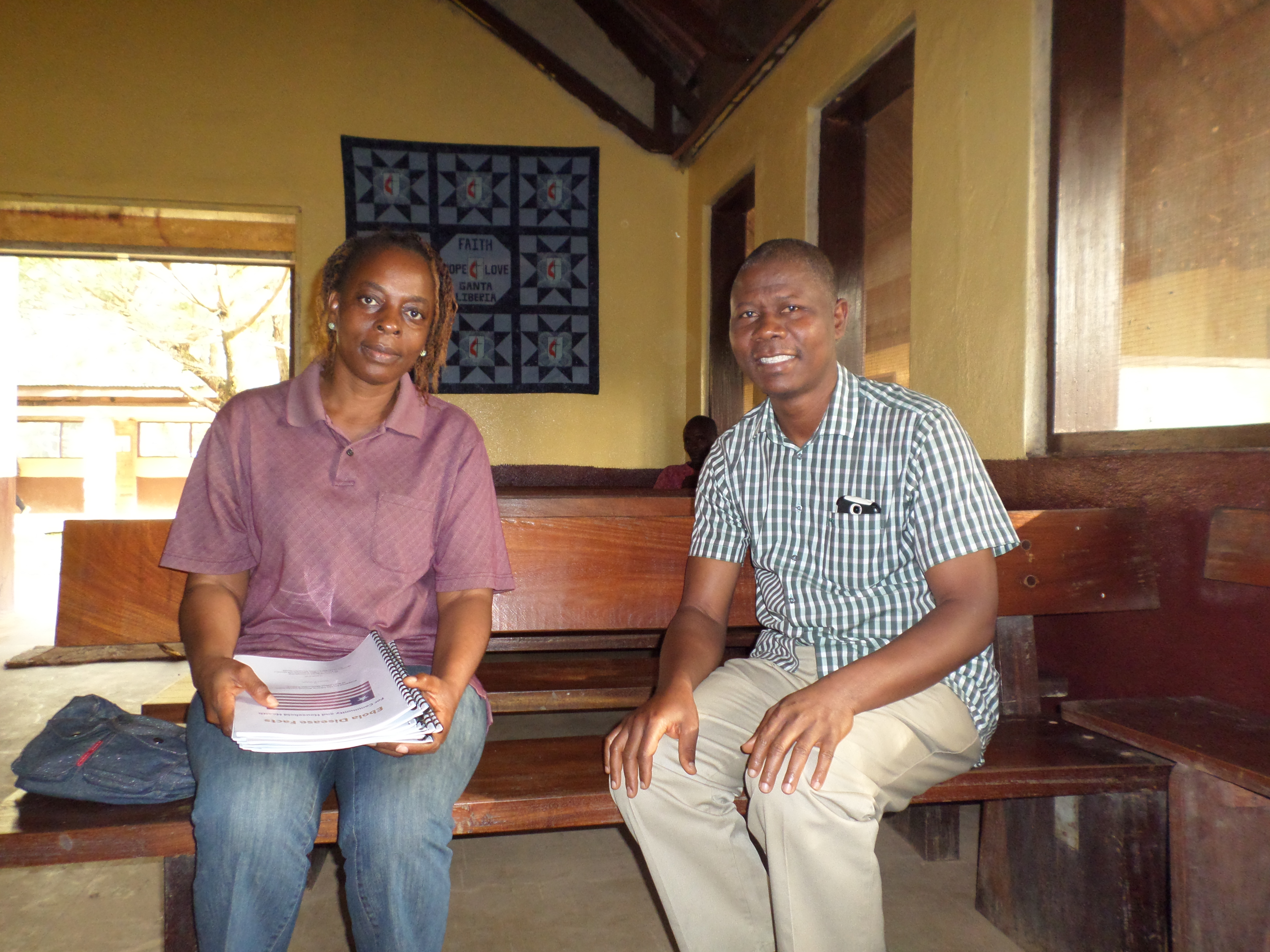
In 2008, the United Methodist Board of Global Ministries commissioned Taryor as a missionary in its Global HealthMissionary Program.
“Community service has always been my passion,” he told a gathering of Ganta Hospital staff and other United Methodists.
During the sending off service at Miller McAllister UnitedMethodist Church, the Rev. James Z. Labala described Taryor as a faithful servant of the church. Labala, the former pastor on the church, is now superintendent of the Gompa district.
“Your faithfulness in doing small jobs will lead to greater responsibilities,” the pastor told Taryor.
The Rev. Samuel Quire, assistant to Liberia Area Bishop John Innis, credited Taryor with establishing a good working relationship between Ganta hospital and the nation’s Ministry of Health.
Nora Keah is now serving as interim administrator of the hospital until the United Methodist Church in Liberia can recruit a new administrator.
*Swen is editor and publisher of West African Writers, an online publication about United Methodist happenings in West Africa and assists the denomination in Liberia with coverage for United Methodist Communications.
News media contact: Vicki Brown, newsdesk@umcom.org or 615-742-5469.
Read story and post a comment
Michigan pastor, civil rights leader, dies at 72
DETROIT (UMNS) — The Rev. Daniel Krichbaum, 72, a United Methodist minister and interfaith leader and former director of the Michigan Department of Civil Rights, died Feb. 4 of complications from a cerebral hemorrhage. He was president of a group that later became the Michigan Roundtable for Diversity and Inclusion. Krichbaum also helped lead interfaith efforts after the Sept. 11, 2001, terrorist attacks, bringing people together to promote peace and tolerance. Niraj Warikoo reports for the Detroit Free Press.Daniel Krichbaum, Michigan civil rights leader, dies
Niraj Warikoo, Detroit Free Press10:54 a.m. EST February 5, 2015
Inspired by MLK, Daniel Krichbaum arrived in Detroit during the 1967 riots and became a civil rights advocate, leading Michigan Roundtable, state Dept. of Civil Rights, and was COO under Gov. Granholm
 Buy Photo
(Photo: Detroit Free Press)
Daniel Krichbaum, a longtime civil rights and interfaith leader who was Gov. Jennifer Granholm's chief operating officer and former director of the Michigan Department of Civil Rights, died Tuesday of complications from a cerebral hemorhage. He was 72.The Bingham Farms resident had developed a rare disorder over the summer that caused excessive protein in the blood vessels in the brain, said his wife, Susan Krichbaum.
Krichbaum, an ordained United Methodist minister, was president of a group that later became called the Michigan Roundtable for Diversity and Inclusion, one of the state's oldest civil rights groups. He helped lead interfaith efforts after the Sept. 11, 2001, terrorist attacks, bringing together different faiths to promote peace and tolerance.
"The community has lost a great leader, a great human being, someone who really cared," said Shirley Stancato, CEO of New Detroit. "He didn't just talk. He took action ... If I was in a fight, I would choose Dan."
Steve Spreitzer, president and CEO of the Michigan Roundtable for Diversity and Inclusion, said that Krichbaum "truly helped make this a better place for all of us to work, learn and live."
Prior to his work in state government, Krichbaum served as president and CEO of the Michigan Roundtable for Diversity and Inclusion, executive vice president of Detroit's public television station, WTVS (Channel 56), director of Parks and Recreation for the City of Detroit under Mayor Coleman Young, and was the minister of several churches in New York and southeast Michigan.
Raised in Salem, Ohio, Krichbaum got a bachelor's degree in sociology from theCollege of Wooster and a masters of divinity degree from Union Theological Seminary at Columbia University.
He arrived in Detroit at the start of the 1967 riot, a coincidence that helped shape his views. He got a masters of philosophy of education degree from Wayne State University, according to the Michigan Department of Civil Rights. In 1976, he got a PhD in philosophy of education from Wayne State University.
Then, "he took his ministry to the streets," said his wife.
Krichbaum became president and CEO of the Detroit office of the National Conference for Community Justice, which later became the Michigan Roundtable. In 2006, he fought hard to try and defeat the statewide ballot proposal that eliminated affirmative action in state universities, organizing a big rally at Bethany Baptist Church in Detroit.
Robert Cohen, head of the Jewish Community Relations Council of Metro Detroit, said "Dan was a courageous champion for tearing down barriers that divide ethnic and faith communities and for building bridges between them. His leadership and wit will be widely missed."
The Dearborn-based Arab-American Civil Rights League said it "is saddened by the passing of a friend...Krichbaum was a model individual whose passion for civil rights and equality knew no bounds. His passion will surely be missed."
Spreitzer recalled how the influences of Krichbaum affected his work.
"As a seminary student in New York in the early 60's, Dan was fortunate to hear Rev. Dr. Martin Luther King, Jr. deliver his famous Civil Rights speech at the historic Riverside Church, with Dr. King's words etched in Dan mind and heart," Spreitzer said.
"Dan Krichbaum was a model showing us all how a person of faith can pursue equality and justice for the vulnerable at all levels of public life," said David Crumm, former Free Press Religion Writer and Editor of ReadTheSpirit.com, an online magazine. "From preaching and writing as a United Methodist minister, to working with a wide range of nonprofits, to serving in the governor's office and heading the Michigan Department of Civil Rights, Dan saw no limits in working toward these values. Many men and women across Michigan have lost a champion and a mentor."
He is also survived by four adult children and four grandchildren. A memorial service is to be held 2 p.m. Feb. 14, Saturday, at First United Methodist Church of Birmingham, 1589 West Maple Road, Birmingham, followed by a 3 to 5 p.m. reception. Funeral arrangements are being handled by AJ Desmond and Sons.
Contact Niraj Warikoo: nwarikoo@freepress.com or 313-223-4792. Follow him on Twitter @nwarikoo
Read story
United Methodist clergyman recalls 1965 Selma march
NASHVILLE, Tenn. (UMNS) — The Rev. Kent Millard, who responded to Dr. Martin Luther King Jr.'s call for clergy and seminarians to come to Selma after Bloody Sunday in 1965, answers questions about his experiences there. Rethink Church has the Q&A.
ONVERSATIONS ON RACE
WE AFFIRM ALL PERSONS AS EQUALLY VALUABLE IN THE SIGHT OF GOD.
CONVERSATIONS ON RACE
REMEMBERING SELMA
This piece is taken from a series of interviews with Rev. Kent Millard, retired United Methodist Clergy, who went to Selma, Alabama as a Boston University School of Theology student, after hearing Dr. King call for seminary students to come to Selma to support the voting rights marches.
RETHINK CHURCH: Dr. Millard, thank you for spending some time with me today to share your experiences at Selma. What brought you to Selma in the first place?
DR. KENT MILLARD: It was in March 1965 that Dr. King called Dr. Harold DeWolf, his major professor, to enroll some seminary students to come to Selma to support the voting rights marches. A total of 80 students from Boston University School of Theology (22 students) Harvard Divinity School, and Andover Newton Seminary went to Selma to march for voting rights.
Segregation laws all over the south effectively prevented African Americans from voting, and some places required people to be literate before they could vote. But it wasn’t the same requirement for everyone. If a white person came to register to vote they were given a first graders book to read. If a Black person came to register they were given something written in German, French, Italian or some other foreign language, and if they couldn't read it, were declared illiterate and disqualified fromregistering to vote.
I had heard Dr. King speak on television in August, 1963, when he gave his "I have a dream" speech at the Lincoln memorial in Washington DC and was moved in his dream of a time when African Americans "would not be judged by the color of their skin but by the content of their character."
I followed the Civil Rights movement closely and was inspired by Dr. King's sermons about loving our enemies as a model of what Christ called us to do and by offering "non-violent resistance" to those who oppress others. When Dr. King called and asked for marchers I said "yes" because I thought it was the Christian and moral response to which God called me.
RC: Was going to Selma anything like you had imagined? Did you have any expectations, hopes, or apprehensions?
KM: We knew that Rev. James Reeb, a Unitarian Minister from Boston, had been killed in Selma the previous week for marching for voting rights. We expected that there would be confrontations with the KKK and others but we just prayed that we would survive and hopefully help move the nation towards justice for all people, regardless of race.
We ended up spending about 4-5 days in Selma while Dr. King negotiated with President Johnson. When seminarians arrived, they went through non-violent training led by Jesse Jackson and Andy Young. They were pushed and shoved and called names, to simulate what they might experience on these marches and gatherings, and all they were to do was keep singing and marching. If they were hit, they were to get to the ground and cover.
WE PRAYED THAT GOD WOULD CHANGE THEIR HEARTS OF HATE TO HEARTS OF LOVE, THEIR HEARTS OF STONE TO HEARTS OF FLESH.
We were given these instructions: pair up and march, so that if law enforcement or anyone pulled you out of line, you’ll never go alone. One black woman I was paired with, said: “Sonny, you look scared. You march with me, you’ll be alright.” There were about 50-70 who marched to courthouse. Klansmen and others were shouting and throwing stones, but they didn’t attack because cameras were there.
When we marched to the courthouse in Selma, a black person would try to register to vote and be turned away. Then a Black pastor would offer a prayer praying for all those hateful people shouting ugly things at us that God "would change their hearts of hate to hearts of love, their hearts of stone to hearts of flesh."
Forty years later in 2005 I was invited to speak to a United Methodist pastor's school in Alabama where I told that story. Afterwards, a white pastor came up to me and said "I was in Selma at the same time you were but I was on the other side." I asked him "what changed you?" He said "Jesus Christ. I got so filled with hatred I couldn't stand myself. My wife convinced me to go to a Methodist revival meeting. I went forward and confessed my sins and Christ came and replace my hatred with love. I decided to go into the Methodist ministry to try to undo some of the bad things I had done to people in my younger years." I remembered the prayer of the Black pastor 40 years earlier: "turn their hearts of hate to hearts of love" and realized it had been fulfilled in the life of this man.
.jpg)
In March 2015, Dr. Millard will lead a civil rights pilgrimageto Selma, Birmingham and Memphis, and Rethink Church will share stories from this journey.
Dr. Millard was born in Texas, raised in South Dakota, educated at Dakota Wesleyan University in Mitchell, SD and went to seminary at Boston University School of Theology. He did additional graduate study in New Testament at Cambridge University in England and received his D. Min. from McCormick Seminary in Chicago.Read story
Commentary: Compassion, not judgment
ACWORTH, Ga. (UMNS) — Mark Wiman of Acworth, Georgia, writes about his personal struggles in accepting his sister's sexuality when she came out. "The real issue is relational and has to do with acceptance vs. rejection and compassion vs. judgment," writes Wiman in a blog post for United Methodist Communications' Sharing in Faith forum.
Sharing in Faith: Compassion, not judgment
 Mark Wiman Photo courtesy of Mark Wiman
I did not create the heavens and the earth. I did not create males and females. I did not write the Bible. I did not invent sex, and I did not invent marriage. I did not even design and create myself. If I could have created myself, I would be very different, believe me.
Mark Wiman Photo courtesy of Mark Wiman
I did not create the heavens and the earth. I did not create males and females. I did not write the Bible. I did not invent sex, and I did not invent marriage. I did not even design and create myself. If I could have created myself, I would be very different, believe me.
I have no control over the truth. The truth does not depend on me, and there is no need for me to defend the truth. However, I find that it is in everyone’s best interest to understand and believe the truth as best as we are able.
I have no doubt that sex acts between two people of the same gender is a sin. At the same time, I don’t think that is the real issue.
My personal encounter with the real issue came several years ago when my sister called me. You need to understand that I was a horrible big brother to my sister when we were growing up. My sister was the youngest and only girl of four children. My sister got things like a room to herself, which in my young, selfish eyes was completely unjustified; as a result, I tormented her relentlessly. This is one of the biggest regrets of my life. If you ever want to put me in my place, just remind me of how I treated my sister and I will slump in utter shame.
My sister began the call by swearing me to secrecy — to which I hesitantly agreed — and then she “came out” to me. My initial shock was then followed by horror when she asked me if I thought it was wrong. I was on the spot. Do I lie to her to spare her feelings or tell her the truth and hurt her yet again? I hesitantly and weakly chose to tell her the truth and she burst into tears and asked me if I could still love her. I assured her I loved her. I told her I had done worse things, such as tormenting her as a child. I told her that my opinion, along with $4, could buy her a latte at Starbucks. In the span of a few minutes, we were both exhausted.
My sister has now been in a monogamous homosexual relationship for several years. I have watched as other family members have struggled with the inner conflict over her relationship. We all love my sister and care about her well-being. Some believe it’s just fine and some of us cannot agree it’s right any more than we can agree that 1+1=1.
However, in my case I have come to understand that at a personal level the question of whether or not sex acts between two people of the same gender is a sin is not the issue. The real issue is relational and has to do with acceptance vs. rejection and compassion vs. judgment.
Sins like overeating are socially acceptable while others must be kept secret for fear of rejection and persecution.
I have come to see the issue of normalizing homosexual behavior as a good thing because it affords us the opportunity for growth, which often involves pain.
In my case, I value a relationship with my sister more than I value us agreeing on a definition of sin.
God is so smart.
Mark Wiman
Acworth, Ga.
Read blog and post comment5 things small churches can uniquely offer
SAVANNAH, Ga. (UMNS) — Christians, especially in the United States, have a tendency to promote the idea that the bigger the church, the better. But most churches around the world are small. What do small churches have to offer? Plenty, writes the Rev. Ben Gosden, pastor of Aldersgate United Methodist Church in Savannah.5 Things Small Churches Can Uniquely Offer…Right Now
POSTED BY BGOSDEN ON JAN 29, 2015 IN LEADERSHIP, THE CHURCH

Asbury UMC in Chestertown, MD
Church leadership has long held a bent toward the “bigger is better” mantra of capitalistic America. We franchise new church plants. We structure our institutions to favor the larger churches. The United Methodist Church itself has long been geared toward starting pastors off in smaller churches to get their feet wet in leadership only to move them to bigger (and often higher paying) churches once they prove themselves as capable leaders.The flip side of the “bigger is always better” way of viewing our churches is the reality that the vast majority of churches in America (and even around the world) are, in fact, small. Historically this has also been the case. Go back and read Paul’s letters to various churches. They weren’t worshiping 1,000+ on Sundays in a concert hall or amphitheater — they small, tightly-knit communities worshiping in homes.
Now I’m not a hater of the larger church — I’ve actually served in two different large, vibrant, downtown churches. I know the strength of larger churches from their ability to support more diverse ministry to the beauty of worshiping with a large, corporate body. But now that I’m serving a smaller church, I want to point out the unique beauty of small churches. Sometimes we need to be reminded that small churches are, in fact, beautiful and they should spend less time dealing with an inferiority complex because they aren’t as large as other churches.
Instead of trying to mimmick what the large churches in your area are doing (only to come up short of their quality because you don’t have the money or resources to duplicate it), here are 5 things I believe small churches can uniquely offer the world right where they are:
Inter-generational Ministry. There is a difference between inter-generational and multi-generational forms of ministry. Just because you have people of different ages gathered in the same space for worship does NOT make it an inter-generational ministry opportunity. Crossing borders between generations takes real effort. And too often larger churches segregate people based on age and stage of life. The small church, however, can’t do that because it’s too small. So instead of bemoaning the fact that you don’t have a youth ministry with 100+ kids in it, think of ways you can put the 5-10 youth you do have in contact with people from a different generation. Numerous statistical studies actually show that an important factor in youth remaining active in the church is the presence of a deep relationship with someone older than them who is not a member of their immediate family. Segregating children and youth into their own space in the life of the church runs the terrible risk of never allowing them to encounter and forge relationships with a diverse group of people. It also sends the subtle message that they are second-class members of your church when they are not primary in the corporate ministry life of the church. Small churches offer a rich and beautiful opportunity to forge these inter-generational relationships because, well, they have to. There aren’t enough people to segregate everyone into their own corners of the church. And thanks be to God for that!
Welcome special needs persons and families with special needs children. One of the quiet struggles churches often don’t recognize is how to incorporate persons with special needs into the life of the church. Small churches offer a unique opportunity to meet this need because they are small enough to warmly welcome and offer the individual attention a family who has a special needs child might need. It’s a daunting thing to take a child with special needs to church for fear of them standing out or somehow disturbing the flow of worship. It’s also very lonely for that child to get lost in the mix of a large, overwhelming children’s program. Small churches can offer love, hospitality, and attention to make a family feel welcome. And the truth is, small churches can offer a worship experience that is vibrant but doesn’t necessarily have the overly-produced feel that worship in a larger church might have. This is actually very welcoming to a newcomer who might feel their presence would alter the flow of worship for others. In other words, special needs can be uniquely and lovingly met and welcomed in a small church.
More people can help lead worship. Since the small church is often less concerned with production led by professional worship leaders, it can incorporate more laity in the leading of worship. Remember: nothing says the pastor is supposed to be the sole worship leader. Liturgy is the work of the people. And faithful worship incorporates the efforts of EVERYONE as together we offer ourselves to God in praise and thanksgiving. So find ways to let people pray, read scripture, serve communion, sing, and maybe even occasionally preach in the small church. One thing we’re doing this coming year in the church I’m serving is we are shifting to laity being the primary servers of communion when we celebrate the sacrament. As pastor I will preside, but we’re asking laity to serve the elements. So we’ve had a sign-up to volunteer for this duty. Again, absolutely nothing says the pastor is supposed to be the primary server of the elements. Give people a chance to lead and serve more, you might be surprised how sharing in the work of worship might begin to transform people.
More focus on community outreach. While small churches might bemoan the loss of in-house programs as numbers decline, I say it’s a great blessing. Large churches have to expend a great deal of effort managing and sustaining programs that focus inwardly on the life of the membership. Lots of money is spent on resources of Sunday Schools, youth programs, children’s ministry, etc. It’s really a rat race — just ask any pastor or staff person at a larger church in their most honest moments. Small churches just don’t have the resources to keep up in that race. So why try? There’s a great freedom in not worrying with the inwardly focused programs. You can actually look outwardly on your community and focus time and attention there. How can you open your space to community groups? Can you invite support groups to meet in your building (especially if your small church occupies a large building)? Can you find ways to resource your local community? Can you partner with other small churches or local missional efforts? You see, small church ministry is just ripe for people to finally break out from the inward, program-focused mindset of church and direct their attention to where God is at work outside of the walls of the church more fully.
Offer a family feel to others. Look, families aren’t all warm and fuzzy. They have their dysfunction. And so does a small church because if often operates like a big, extended family. However through all of that dysfunction, one thing is (hopefully) certain: People know they are loved. As our world becomes more global, there is a rise to locally-focused relationships in business, commerce, and relationships. The small church can offer something that might get lost in a large church where people don’t always know one another by name — you can actually be a part of a family. In our worst moments, that family feel leads us to gossip or insulation from others who aren’t a part of our family. In our best moments, it’s an expression of true love extended to anyone searching for a community who will love them enough to never let them go. Family is tough and it’s messy. But it’s also very beautiful. And so is small church ministry.- See more at: http://mastersdust.com/2015/01/29/5-things-small-churches-can-uniquely-offer-right-now/#sthash.AEQ8ZHJs.dpufRead blog and post a comment
Go-to site for Lenten resources
NASHVILLE, Tenn. (UMNS) — Lenten resources developed for UMC.org, along with resources from around the denomination, have been collected on one go-to Web page. In addition to resources and stories developed by United Methodist Communications, the page has materials from United Methodist Discipleship Ministries, United Methodist Board of Global Ministries, the Society of St. Andrew and others.
Topic: Lent and Easter
In the seasons of Lent and Easter, the church focuses on remembering, retelling and participating in the story of the suffering, death, and resurrection of Jesus Christ.
TAKE ACTION
Donate to One Great Hour of Sharing
Coins for Lent
RESOURCES FOR PURCHASE
Cokesbury Seasonal Selections
Upper Room Lent & Easter Reources
Lent and Easter Multimedia Resources
Lent, the period of 40 days before Easter (excluding Sundays), begins on Ash Wednesdayand ends at sundown on Holy Saturday, the evening before Easter.
During Lent, we enter into a season of preparation, self-reflection and repentance when we seek to literally “turn around” and realign our lives and focus toward God. It is a time to give up things as well as take on new life-giving practices, helping us rid ourselves of distractions and our own selfish desires. By doing so, we seek to live and love as more faithful disciples of Jesus Christ.
The Easter Season, also known as Eastertide or the Great Fifty Days, begins on Easter Day and ends on Pentecost. Focusing on Christ's resurrection and ascension and the sending of the Holy Spirit (Pentecost), Eastertide is the most joyous and celebrative season of the Christian year. We celebrate the good news that in Christ’s death and resurrection we, and all creation, are continually being made new by God’s love and saving grace.
DEVOTIONAL AND INSPIRATIONALPreviousNextView All»

From the 'I am…' sayings of Jesus to a 'renegade' look at theGospels to daily meditations, new books are basis for study and reflection in 2015. Read More

A gathering of dates, devotionals, and other resources centered on the Lenten seasons from Global Ministries. More

Daily meditations and prayers from the Society of St. Andrew that explore the themes of temptations, challenges, and perseverance in faith. More
LEARNING AND DOINGPreviousNextView All»

On Ash Wednesday, the first day of Lent, an ancient act reminds us our bodies are temporary and our lives are flawed, but a day of resurrection will come. Read More

Why do we observe Lent before Easter? Why do people give up sweets or caffeine for Lent? Find some facts about the season. Read More

Find concrete suggestions for practices you can take on for each day of Lent. More
FAMILYPreviousNextView All»

This resource gives daily ideas to support those in need. Download

Explore the meaning of Lent with your family through activities, prayers and guided discussions. Read More
Making Ash Wednesday Accessible for Children
Ash Wednesday can be among the most accessible of rituals in our liturgy for children and their families, IF it's not handled in a "stuffy" or overly formalistic way.Read More
WORSHIPPreviousNextView All»

Find liturgies, prayers, music and more for Ash Wednesday worship planning. Read More

Discipleship Ministries offers these resources to help your congregations prepare for Lent and Easter. More

Find an outline of the gospel readings for Lent, themes for each Sunday, and connections to the major verbs of the baptismalcovenant to explore during worship. More
MULTIMEDIAPreviousNextView All»

See a reflection about the sacrament Wesley called “a way in which we felt, knew, and saw God’s grace.” View

Video could give you new ways to look at Lenten sacrifices. “What is it doing in your life? What space is it creating to be closer to God?” View

Many congregations invite people to participate in devotionals, but one church asks the faithful to take their prayers to the public. ViewView resources
New Lent studies emphasize drawing nearer to God
Commentary: Jordanian pilot's murder parallels lynchings
NASHVILLE, Tenn. (UMNS) — The news of the burning of a Jordanian pilot by Islamic State militants prompted the Rev. Gilbert H. Caldwell reluctantly to look again at the pictures of the lynchings and burning of blacks by the KKK and by others. An Internet search reveals that those pictures often appeared on postcards that were widely circulated, he writes in a UMNS commentary.
Read commentary and post a comment
NCC condemns horrific violence by ISIS
Pastor knows costs of heroin all too well
BEL AIR, Md. (UMNS) — The Maryland governor's war on heroin comes too late for the Rev. Craig McLaughlin, pastor at Mt. Zion United Methodist Church. His 19-year old daughter overdosed on heroin last March. He and his wife, Lisa, are now sharing their story with anyone who will listen. WJZ-TV in Baltimore reports on the story.Local
Md. Heroin Addicts May Not Be What You Picture
February 2, 2015 11:18 PM

Jessica Kartalija
Jessica Kartalija joined the Eyewitness News team during the summer of... Read More
CBS Baltimore (con't)
Affordable Care Act Updates:
CBSBaltimore.com/ACA
Health News & Information:
CBSBaltimore.com/Health
You've Earned Points for Reading!Claim points in our Reward Center, and earn more tomorrow.Claim Points
BALTIMORE (WJZ) — Heroin is killing more Marylanders than ever before. As it continues to take a deadly toll on people across the state, Governor Larry Hogan is about to declare a state of emergency.
Jessica Kartalija has the human story behind this heroin epidemic.
A heroin epidemic is killing people across Maryland, destroying families who never thought it could happen to them—people like 19-year-old Hannah McLaughlin.
A minister’s daughter, she grew up in Harford County, singing, performing and helping out at the church. She was the last person you would expect to try heroin.
“She was creative. She was fun, very active, quickly got involved in sports,” said her mother, Lisa McLaughlin.
But when their youngest daughter hit middle school, Craig and Lisa noticed dramatic changes. When they got her drug tested, the results rocked their world.
“She had fatal levels of opiates in her body. Someone had given her a pill and she became an instant addict,” said her father, Craig McLaughlin.
Hannah is the new face of heroin addiction.
The Journal of American Medicine described today’s addict as a young person from the suburbs who starts out with painkillers but quickly discovers heroin is cheaper and easier to get.
“A lot of people that got addicted to the pharmaceuticals kind of said, `Well, heroin’s a quarter of the price, it’s twice the potency, why don’t I just go do that?” said Sam Bierman, Executive Director of the Maryland Addiction Recovery Center in Towson.
A recovering addict, Bierman knows firsthand heroin’s powerful grip. He’s been counseling people for years—many you’d never believe would get hooked.
“Addiction doesn’t care who you are or where you’re from or your race or your religion or your creed. Once you’ve got it, you’ve got it,” Bierman said.
Heroin killed more than 450 Marylanders last year alone—that’s a nearly 50% spike since 2010.
“It’s tearing families and communities apart,” Hogan said.
In an exclusive interview with WJZ, he told Vic Carter there is a heroin epidemic here.
“We’re going to declare a state of emergency. I’m going to pull together a summit to bring people from every aspect of this issue together and we’re going to tackle it as best we can. It’s a huge, huge problem that’s not getting enough attention,” Hogan said.
But for Hannah, who entered 19 rehabs over four long years, it will be too late.
“She was in her kneeling position that she used when she was shooting up in the corner of her room that she tended to use and I called her name, shook her and she didn’t respond. No parent should ever have to do that,” Lisa said.
Now, through their heartbreak, Craig and Lisa are telling Hannah’s story to anyone who will listen.
“If you are addicted, you can get out. You can get out. There is hope, you can beat it, but anything less than 1000% effort, you’ll die,” Craig said.
Since Hannah’s death, her parents have formed a support group for the families of addicts. For more information, on Mt. Zion, click here. For more information on Hannah’s Hope, click here. For more information on Maryland Addiction Recovery Center, click here.
Read story
UMCOR offers disaster training by region
NEW YORK (UMNS) — All five U.S. jurisdictions of The United Methodist Church have scheduled volunteer disaster training during 2015. "We are responding to God's call to care for our neighbors," said Cathy Earl, executive secretary for U.S. Disaster Response for the United Methodist Committee on Relief.Disaster Training? It's In Your Area

People from the South Central Jurisdiction learn about how best to respond to their neighbor in need. Photo: Audrey Phelps
By Susan Kim*February 3, 2015—Early Response Teams. CARE Teams. Long-term disaster recoverycommittees. Volunteer home repair teams. Mission Team leaders. Are you called to serve in one of these groups? If you want to learn more, check out the United Methodist Church's “Disaster Academies” or “Mission Academies,” jurisdictional training that ensures you—and your church—are prepared to help people in need.
“We are responding to God's call to care for our neighbors,” said Cathy Earl,executive secretary for U.S. Disaster Response for the United Methodist Committee on Relief (UMCOR). “To do that—and do it well--it's best to get information and understanding to be prepared to respond in the most meaningful way.”
Ignoring training isn't just a minus for the person trying to help, Earl pointed out. Ultimately, training helps the disaster survivor. “Sometimes, even the most well-meaning people can cause harm if they don't know how to respond,” said Earl.
As UMCOR celebrates 75 years of service, it is also celebrating a record number of people who are trained, in some way, to respond to disasters and other situations that result in human need. More than 15,000 people across the country are trained to serve on Early Response Teams. CARE teams—people who provide emotional and spiritual care for those affected by disasters—have become part of an increasing number of United Methodist conferences.
Below are links to information and registration for UMCOR training in 2015 in all five United Methodist jurisdictions.
Southeastern Jurisdiction (SEJ), Feb. 23-25, Biloxi, Miss.
The SEJ Disaster Academy will be hosted by the Mississippi Annual Conference, UMCOR and UMVIM. Participants will learn about disaster response ministry as they also commemorate a decade of recovery since Hurricane Katrina's devastation. “We are open for registration through February 9 and welcome anybody who wants to join us,” said Cat Foster, connectional ministries and communications project coordinator for the Mississippi Conference. Register here.
Western Jurisdiction Disaster Academy, March 2-5, Denver, Colo.
Classes are for anyone interested in putting their faith into action by helping respond to natural disasters such as fires, floods and earthquakes. Class offerings include beginning through advanced levels for various types of volunteers, response leaders, church leaders and clergy. Register here.
Northeastern Jurisdiction (NEJ) Disaster Academy, March 18-21, West River, Md.
Participants will learn how to best serve those in crisis due to natural or human disasters. Gathering with others from NEJ, as well as UMCOR staff and trainers, they will learn, share and prepare so that churches can be ready to respond. “This is the first one we've had in 15 years,” said Rev. Nick Nicholas, NEJ UMVIM coordinator. “We have 35 people signed up so far.” Register here.
North Central Jurisdiction, Aug. 27-30, Indianola, Iowa
In celebration of UMCOR's 75th anniversary, the training will include an afternoon of hands-on work and learning by trainees. “We're really excited and expecting way over 100 people,” said Lorna Jost, UMVIM coordinator for the NCJ. Register here.
South Central Jurisdiction (SCJ) Mission Academy, September 25-28, Midlothian, Texas
The SCJ has posted an online survey to gauge interest in topics for a Mission Academy. “We are looking to expand topics this year so that the courses will be useful whether or not you are serving in a disaster scenario,” said Audrey Phelps, director of UMVIM and disaster response for the SCJ.
Your gift to UMCOR U.S. Disaster Response, Advance #901670, supports training activities such as these as well as hands-on response to natural and human-caused disasters.

*Susan Kim is a journalist and a regular contributor to www.umcor.org.
Read story
Letters campaign: reauthorize child-nutrition programs
WASHINGTON (UMNS) — Thousands of churches representing nearly 50 diverse U.S. Christian denominations, including The United Methodist Church, will participate in Bread for the World's 2015 "Offering of Letters: Feed Our Children" campaign. This year's campaign urges Congress to strengthen national child-nutrition programs when the law governing them comes up for reauthorization.Reauthorize child-nutrition programs
Bread for the World launches ‘Feed Our Children’ campaign

WASHINGTON, D.C. — Bread for the World launched its 2015 Offering of Letters: Feed Our Children campaign last week, urging Congress to strengthen national child-nutrition programs when the law governing them comes up for reauthorization this year.

The Healthy, Hunger-Free Kids Act of 2010 funds and sets policy for national child-nutrition programs and must be reauthorized every five years. It includes school lunch and breakfast programs, summer feeding programs, after-school and child-care feeding programs, and The Supplemental Nutrition Program for Women, Infants, & Children (WIC). Together these programs serve about 29 million low-income children annually.
Continue strong investments
Bread wants Congress to continue the strong investments in national child-nutrition programs and to improve children’s access to feeding programs. For every seven low-income children getting a lunch at school, only four get breakfast, and only one receives meals during the summer, a time when children are most at risk of hunger.
Improvements to these programs should not be paid for by cuts to other vital safety net programs.
Improvements to these programs should not be paid for by cuts to other vital safety net programs, Bread emphasized.
“Both sides of the aisle agree that hungry children, especially in a wealthy country like ours, is unacceptable,” said Ashley. “The various child-nutrition programs are testament to the bipartisan support that is still found in Congress, support that will hopefully continue to ensure that nutritious food for children is not a privilege.”
Offering of Letters
Thousands of churches representing nearly 50 diverse Christian denominations throughout the United States will participate in Bread for the World’s 2015 Offering of Letters campaign. As part of a worship service or mass, people of faith will write lettersto their members of Congress urging the reauthorization of national child-nutrition programs. They then offer these letters to God before they are delivered to their members of Congress.
For more than 40 years, Bread for the World members have written hundreds of thousands of letters to Congress every year. This annual campaign has consistently won lasting victories for children, men and women who struggle to put food on their tables.
Bread for the World’s Offering of Letters materials are available at www.bread.org/OL.
Editor's note: Bread for the World is a collective Christian voice urging U.S.decision makers to end hunger at home and abroad.
Read story
History of Hymns: "Let Us Break Bread Together"
DALLAS (UMNS) — Perhaps the most frequent Communion hymn sung by United Methodists is an African American spiritual, "Let Us Break Bread Together." C. Michael Hawn of Southern Methodist University's Perkins School of Theology shares the story of this beloved spiritual in his weekly column for United Methodist Discipleship Ministries.History of Hymns: “Let Us Break Bread Together”by C Michael Hawn
"Let Us Break Bread Together"
African American Spiritual
The United Methodist Hymnal, No. 618
Let us break bread together on our knees.
Let us break bread together on our knees.
When I fall on my knees with my face to the rising sun,
O Lord, have mercy on me.

Perhaps the most commonly sung song during Communion among United Methodists is the African American spiritual “Let us break bread together on our knees.” For American Methodists, the usual posture for receiving the elements is kneeling at an altar rail. The procession to the rail offers the opportunity to sing. The simple structure of this spiritual provides the ideal music to accompany this ritual both because of its text and because of the spirit of the music. It is easily memorized and harmonized.
What are the roots of “Let us break bread,” among the best known of African American spirituals? In a recently published article in the Canterbury Dictionary of Hymnology, written by United Methodist Hymnaleditor, Dr. Carlton Young, he reveals the probable roots and major variants of this spiritual. Dr. Young suggests that this “spiritual was formed in the West African Gullah/Geechee slave culture that developed in the costal areas of South-Eastern colonial America, including St Helena Island, Beaufort, and Charleston, South Carolina . . ..”The text of the version that is commonly sung in the United States was first published in The Journal of American Folklore (1925). The Journal included spirituals, as well as African American folk tales and proverbs that were collected by students at the Penn School on Saint Helena Island, South Carolina.
A second version appeared in Saint Helena Island Spirituals (1925) by Nicholas Ballanta, a very significant collection that included 103 Gullah spirituals. This version incorporates the same basic text, but with variations based on the slave dialect of the region:
Let us break bread togeder on our knees . . .
When I fall on muh knees wid muh face to de risin’ sun
Oh Lawd hab mercy on me.
The music published in this collection is virtually the same as used in most hymnals.
The third version was published in Augustine T. Smythe’s The Carolina Low-Country (1931). Not only is the text significantly different, but also the slave dialect of the region is even stronger in this version:
We will all sing tuhgedduh on dat day . . .
En I’ll fall upon muh knees en face duh risin’ sun,
Oh Lawd, hab mussy on me.
A final fourth stanza begins, “We will all pray tuhgedduh on dat day . . ..” According to hymnologist Jon Michael Spencer, the phrase “on dat day” suggests a use for the song beyond Communion. It is an eschatological reference envisioning hope and a reformation of the established social order beyond human history.
The melody of this version is also significantly different in several ways, including a flattened “blues note” on the highest pitch of the song. While the melody is recognizable, rhythmic and melodic alterations are significant.
Each version incorporates the idea of “fac[ing] the rising sun.” One scholar suggests that this may come from the worship practices of Islamic West Africans. Another speculates that the sun was a symbolic West African source of spiritual light. Another phrase “on our knees” may have been a signal for a secret gathering, though this cannot be verified.
African American composer John Rosamond Johnson (1873-1954) arranged the first solo version with the three stanzas that are common to most hymnals in the United States. He also established the precedent of singing the final stanza up the octave. This practice is observed in several hymnals including The United Methodist Hymnal. This version of the spiritual was popularized by notable African American soloists in the mid-twentieth century such as Paul Robeson, Roland Hayes, and Marian Anderson.
As standardized as the text is, it has been subject to numerous alterations in several hymnals. These changes sometimes alter or eliminate the reference to the rising sun, perhaps because it is not literally accurate. Some include:
“When I fall on my knees, with my face to the Lord of life. . ..”
Others choose to replace the phrase, “on my knees” since many traditions do not receive the elements in this posture. To avoid this, some modify it as follows:
“Let us break bread together, we are one” or
“Let us break bread together in (or “with”) the Lord” or
“Let us praise God together, let us praise.”
Together in Song: Australian Hymnbook II (1999) alters virtually the entire traditional text:
Let us break bread together with the Lord . . .
As we travel through this land, all God's children hand in hand,
Lord, fill all our living with your life.
For me, the greatest loss in this version is the omission of the classic Kyrie eleison at the conclusion of each stanza, “Oh Lord, have mercy on me.”
These changes indicate the difficulty of transferring a song from one ecclesial or cultural tradition to another. However, the inclusion of a select number of African American spirituals in English language hymnals in countries such as Australia, Canada, and England is admirable and reflects the universality of one of the unique contributions of congregational song from the United States to the world. Alterations to congregational songs, especially those from folk sources, are common across cultural and national boundaries. In its most standard and historical form, this spiritual fits the practice and ethos of the Methodist Eucharist liturgy well.
Please also see Dean McIntyre's arrangement of Let Us Break Bread Together.
C. Michael Hawn is University Distinguished Professor of Church Music, Perkins School of Theology, SMU.
Read story
Get updates on United Methodist news
NASHVILLE, Tenn. (UMNS) — If you want to follow the most recent news across the United Methodist connection, like us on the UMNS Facebook page or follow us on Twitter
Looking ahead
Here are some of the activities ahead for United Methodists across the connection. If you have an item to share, email newsdesk@umcom.org and put Digest in the subject line.
Tuesday-Friday, Feb. 10-13
Thought in Leaders Conference — This conference at the Iliff School of Theology in Denver, Colorado, features practical workshops, theological education talks, faculty lectures, ministry panels, and special guest speakers. Details.
Sunday, Feb. 15
Transfiguration Sunday — Worship resources from United Methodist Discipleship Ministries.Connectional Table's last panel on human sexuality, Wesleyan identity and the life of the church— This panel, starting on this date, is available for online streaming at umc.org/connectional-table-webcast.
You can see more educational opportunities and other upcoming events in the life of the church here.
United Methodist News Service is a ministry of:
United Methodist Communications
810 12th Avenue South
Tuesday-Friday, Feb. 10-13
Thought in Leaders Conference — This conference at the Iliff School of Theology in Denver, Colorado, features practical workshops, theological education talks, faculty lectures, ministry panels, and special guest speakers. Details.
Sunday, Feb. 15
Transfiguration Sunday — Worship resources from United Methodist Discipleship Ministries.Connectional Table's last panel on human sexuality, Wesleyan identity and the life of the church— This panel, starting on this date, is available for online streaming at umc.org/connectional-table-webcast.
You can see more educational opportunities and other upcoming events in the life of the church here.
United Methodist News Service is a ministry of:
United Methodist Communications
810 12th Avenue South
Nashville, Tennessee 37203-4704 United States
NewsDesk@umcom.org
NewsDesk@umcom.org
Phone: 615.742.5400
____________________________

No comments:
Post a Comment