democracynow.org
Stories"
 State of Emergency: Charlotte NAACP & Protesters Demand Police Release Video of Keith Scott Shooting
North Carolina Governor Pat McCrory has declared a state of emergency in the city of Charlotte, where protests continued for a second night after Tuesday’s fatal police shooting of 43-year-old African American Keith Lamont Scott, the father of seven children. Police say Scott "posed an imminent deadly threat," but Scott’s family says he was unarmed. We are joined by Corine Mack, president of theNAACP Charlotte-Mecklenburg Branch, and Bree Newsome, Charlotte-based artist and activist. They both call for the release of the police video of Scott’s killing. "There has to be transparency," Newsome says. "This distrust that exists between the police and the community is completely well-founded."
TRANSCRIPT
This is a rush transcript. Copy may not be in its final form.
NERMEEN SHAIKH: North Carolina Governor Pat McCrory has declared a state of emergency in the city of Charlotte following protests Wednesday night during which police in riot gear fired rubber bullets, tear gas and pepper spray at protesters, who threw fireworks and trash at officers in return. Authorities said four officers were injured. Many demonstrators were also injured. The night’s protest also included a civilian-on-civilian shooting that left one man critically wounded and at least seven more people injured. The governor has also begun steps to deploy the National Guard.
AMY GOODMAN: This was the second night of protests in Charlotte following the fatal police shooting of 43-year-old African American Keith Lamont Scott, the father of seven. The shooting happened around 4:00 p.m. Tuesday after police arrived to serve an arrest warrant for another person at Scott’s housing complex. Accounts of the shooting diverge sharply. While the police claim they first tased and then shot Scott because he was armed and, quote, "posed an imminent deadly threat," Scott’s family says he was not armed—except with a book in hand. They say he had been sitting in his car, waiting to pick up his son after school. Charlotte Police Chief Kerr Putney said the police did not see a book and that Scott was seen entering a car with a gun.
POLICE CHIEF KERR PUTNEY: I can tell you a weapon was seized, a handgun. I can also tell you we did not find a book, that has been made reference to.
AMY GOODMAN: An eyewitness disputed the claim that Scott had a gun and not a book. This is [Taheshia] Williams.
TAHESHIA WILLIAMS: They replaced it with a gun. That’s what they did. They took the book and replaced it with a gun. Because that man, he sits out here every day. His son rides and goes to school with my daughter. That man sits out here every day and waits on his son to get off the bus. You understand how that—how that baby had to come home to that?
AMY GOODMAN: For more, we’re joined in Charlotte, North Carolina, by two guests. Corine Mack is president of the NAACP Charlotte-Mecklenburg Branch. And we’re joined once again by Bree Newsome, artist and activist. Last year, with a helmet and climbing gear, she scaled the 30-foot flagpole on the South Carolina state Capitol in Columbia, South Carolina, and unhooked the Confederate flag. As police officers shouted at her to come down, Newsome shimmied to the top, took the Confederate flag in her hand and shouted, "You come against me with hatred. I come against you in the name of God. This flag comes down today." She did this the day after the mass funeral for the nine parishioners and their minister, Clementa Pinckney, who were gunned down by a white supremacist in their church in Charleston, South Carolina.
We welcome you both to Democracy Now! Corine Mack, let’s begin with you. Can you explain what took place on Tuesday, as you understand it, and the differing—the differing accounts of what took place, despite the fact that police do have video but have not released it?
CORINE MACK: I, along with several other pastors, have been on the ground since Mr. Scott was killed. And we spoke at length with many, many people who live in the area and some who were eyewitnesses. And their account is in total contrast to what CMPD is giving us. What we were told was that Mr. Scott was sitting in his car reading a book, as he had done many, many days throughout the course of his life. He was the person that picked up his son, and he was also the person, many days, would pick up someone else’s children, if they couldn’t make it. So it’s interesting for us that a man who had a daily regimen of being seated in his car reading a book would now be seated in his car with a gun.
I’m even more disturbed with the lack of transparency in terms of the video. I think it’s important, because of the climate we’re in, the distrust of the police department and law enforcement, that that video or those videos be shown to the entire citizenry of Charlotte-Mecklenburg.
More importantly, I think it’s important to say that we spent millions of dollars to ensure that each police officer had on a body cam, and there were several cops on the day of this incident who did not. And this is not something that has happened once or twice; it’s happened far too often. Either they don’t have on a body cam, or they cut off their body cam. That’s a problem for us.
AMY GOODMAN: But there were cops who did have the body cams, is that right? And the police department has that video. Why don’t they release it, as they did in Oklahoma?
CORINE MACK: Well, that’s our question: Why won’t you release it? I understand that under the new House bill, it doesn’t truly go into effect until October 1st. So, if that is what you’re using to say that—you know, as a deterrent for releasing the body cam, that can’t be so, because today is not October the 1st. Yesterday surely wasn’t October the 1st. We would like to see that video.
NERMEEN SHAIKH: And, Bree Newsome, you were at the protest last night. Can you talk about what happened?
BREE NEWSOME: Yes. So, I actually got into town from Illinois late last night, so I got in after some of the—like the protests that were around the Omni Hotel and the incident that happened last night, which police are saying was a civilian-on-civilian shooting, but there’s some dispute about that. I can’t speak to that, because I wasn’t there personally. But I did come in in the later part of the protest, yes.
AMY GOODMAN: And can you describe those protests? What took place? The governor has declared a state of emergency.
BREE NEWSOME: Yes. Well, now, I’m not disputing that there was some vandalism that occurred last night. But just to kind of give you a sense of what the climate and the scene was, I parked my car and walked over there by myself. So sometimes the way that these incidents are depicted on television makes it seem as though the violence is much more widespread than it actually is.
I connected with several people who were down there protesting not just what has happened here in Charlotte, but just the whole institution of policing as it exists in the United States right now and, more specifically, the lack of accountability. There is no system of accountability in place. There is no real oversight in place when it comes to policing. And so, this is a real issue that people have. We are living in a police state. And what we are witnessing across America, whether it’s Ferguson, whether it’s Baltimore, whether it’s Charlotte, is an uprising of those who are most impacted by this police state. That is African Americans. That is Latinos. That is young people and LGBTQ people of color.
NERMEEN SHAIKH: And, Corine Mack, the NAACP is calling for the release of the police video. How has the police department in Charlotte responded to that request?
CORINE MACK: We received the emphatic they would not be released. And several of the clergy in Charlotte went to see the mayor in reference to the video. And we will continue to request those videos. I think it’s so important, as I stated before. To build—to begin to build trust with the citizenry, you have to release those videos. We need to see what you’re seeing. We need to know what you know.
AMY GOODMAN: I want to turn to an activist in Charlotte who’s calling for a boycott of the city. This is B.J. Murphy.
B.J. MURPHY: What we’re standing up for now is our black manhood and our black people, who are being gunned down in the street, and we don’t get no justice. So what I’m calling for and what we’re calling for is an economic boycott of the whole city of Charlotte. Since black lives do not matter for this city, then our black dollars shouldn’t matter. Right? Keep our money in our pocket and let you feel—see, we’re watching a modern-day lynching on social media, on television, and it is affecting the psyche of black people. That’s what you saw last night.
AMY GOODMAN: A representative of Nation of Islam. I’m wondering, Bree Newsome, is that the general feeling? And if you can talk about the climate? I think, according to reports, this year there have been six police killings of civilians [in Charlotte, North Carolina]. And yesterday, when we first had you on, Bree, you mentioned the killing of Jonathan Ferrell several years ago and the acquittal of the officer involved.
BREE NEWSOME: Yes, absolutely. So, what’s happening right now, there is definitely an economic connection, as well, between police brutality and these communities. The communities that are being most impacted by police brutality are communities where the city has divested money for decades, highly segregated communities. Our schools are now as segregated as they were in the '60s. There were reports that came out just yesterday that wages between black and white workers are now at the same gap that they were in 1979. And what's happening is that cities and counties and states are using police as a catch-all for all the, you know, social fallout from their lack of investment in education, in housing, in all of these things. And so that is part of what people are responding to.
One of the things that we see consistently is that the city officials, the state officials, seem to show more concern for property than for life. Oftentimes the cameras and the—you know, and the police and everyone, they don’t show up to show concern until a window gets smashed, until a police cruiser gets jumped on and smashed. And what is demonstrated in that is that money is valued over the lives of residents. And that is largely what people are responding to when they’re calling for economic boycotts. Even the decision to protest in uptown last night, this is clearly a decision to go to one of the economic centers not just of the city, but of the state, to draw attention to what is happening here.
NERMEEN SHAIKH: I want to go back to comments made by a woman who said she witnessed the shooting of Keith Scott. This is [Taheshia] Williams explaining what she saw happened.
TAHESHIA WILLIAMS: The man was sitting in his car, minding his business. I heard his wife yelling down, running down over where they stay, "Don’t do it! Please, don’t!" I looked over here, because I’m looking at where she’s running at, and that’s when I see the man standing there with the gun pointing at Mr.—what’s his name? Mr. Johnson?
REPORTER: Scott.
TAHESHIA WILLIAMS: Mr. Scott—pointed at Mr. Scott. He’s standing there like this, telling them, "I don’t have anything." When they did that, you hear four shots—boom, boom, boom, boom, boom. That man hit the ground. So they—and then they’re just standing there looking at him. I got it on video. I got it on my phone.
NERMEEN SHAIKH: That was [Taheshia] Williams reporting what she saw on Tuesday. So, Bree Newsome, can you comment on what you think happens next, what ought to happen and what you expect?
BREE NEWSOME: Well, I think there’s two issues. One is the issue of justice in this particular case, and I think that Corine has spoken to that very well. There has to be transparency, first of all. This distrust that exists between the community and the police is completely well-founded, and there’s documented reason for why there is that kind of mistrust.
Then there’s just the larger issue of policing in general and this relationship between the police and the community. And that’s a large part of what people are protesting, as well. It is, as you mentioned, not only about this most recent case with Keith Scott. It’s about Tulsa. It’s about Baton Rouge. It’s about the entire system and the way that people are being systematically funneled into the prison system. As I said yesterday on the program, I think it can very well be argued that slavery in America—chattel slavery ended, yes, but what was once chattel slavery has now evolved into the prison-industrial complex. And a lot of these interactions that are happening between the police and the community are because we’re living within a time and place where a lot of city municipalities are being funded by policing citizens, by locking citizens up, by charging them with fines. And this inevitably leads to encounters that, you know, result in fatalities like this.
AMY GOODMAN: Corine Mack, I have a question for you. Every time there’s a description of an African-American man being killed, the adjective before is either "armed" or "unarmed." In the case of Ahmad Khan Rahami—and a number of people have raised this in Charlotte—he was armed when he was caught. He actually shot the police. They shot back at him, but they didn’t kill him. And as one protester in Charlotte said, because they wanted him for questioning, they wanted to keep him alive. Now, a couple of questions. As if "armed" means that you’re automatically guilty—isn’t North Carolina an open-carry state? Even if, as the police say, though many contend this isn’t true, the—that the victim had a gun?
CORINE MACK: I’ve been consistently bringing that up. We have a Second Amendment right to carry. And so, if, in fact, Mr. Scott had a gun, what was the crime in that? The responsibility of the police was to question him, to confirm that in fact he had a permit for the gun, and allow him to go on his merry way. But every encounter we’re hearing about, when it pertains to an African-American man or woman, they are not allowed to walk away and go home to their families. They are killed. There is a culture in the police department, and they’re taught, that when you engage an African American, expect that engagement to be very different from our white counterparts, that in fact the probability is that they are criminal.
Even more concerning for me is that every time an African American is killed, they’re not the victim. They are continually demonized. And the police that kill them are never held accountable. That’s why you see the frustration. That’s why you see the pain in our community. That’s why you see the anger in our community. That’s why we have daily protests in our communities right now, because enough is enough. We are being killed. We are being lynched. These are the modern-day lynchings. OK?
AMY GOODMAN: And, Bree—
CORINE MACK: We realize that.
AMY GOODMAN: And, Bree Newsome, are there plans for more protests today?
BREE NEWSOME: Oh, yes, absolutely, especially considering what happened last night. I mean, we had another incident. According to some folks, they—folks who were there, including James Tyson—you might remember, he participated in the action with me last year to remove the Confederate flag. He said what he witnessed was someone being shot at close range with a rubber bullet. And I’ve heard that from several others. Now, I can’t speak to that specifically, because I was not present to witness that, but I’m just saying that this—part of what we’re seeing growing in the protest, it’s not—again, it’s not only about the incident that happened Tuesday. It’s also about the continued police response, which continually shows escalation, which continually shows a disregard for the lives of the community members and for how the community members feel.
I mean, people witnessed someone, this man that they see every day, sitting, waiting for his children—they witnessed him be shot and killed. And regardless of what the facts are—we won’t know until the police, you know, release the video—the fact is that there is reason for them to not trust what the police have said. Now, instead of responding in a way that would address the concerns and the way that the community is feeling, the police respond with a SWAT team. So, it’s like a continual escalation and disregard of how people are feeling, and people reach a point where they feel that they have no recourse at all. And so, until that is addressed, the protests will continue to grow, not just here, but around the country.
AMY GOODMAN: We want to thank you both for being with us. Bree Newsome, artist and activist, the woman who climbed the flagpole in South Carolina on the state House grounds and took down the Confederate flag. I also want to thank Corine Mack, president of the NAACP Charlotte-Mecklenburg Branch. I’m sure we’ll be speaking to you both again.
CORINE MACK: Thank you for having us.
AMY GOODMAN: This is Democracy Now! When we come back, we’re going to Tulsa, Oklahoma. Stay with us.
[break]
AMY GOODMAN: "American Skin (41 Shots)" by Bruce Springsteen. Actually, he composed and performed that for Amadou Diallo, who was killed in a hail of 41 police bullets in 1999 as he tried to enter his apartment after buying some fast food in New York City. This isDemocracy Now! I’m Amy Goodman, with Nermeen Shaikh. ... Read More → Tulsa Still Faces Historical Trauma from 1921 Riot That Left 300 Dead on Black Wall Street
As protests continue over the police killing of Terence Crutcher, we look at how Tulsa, Oklahoma, is no stranger to racial strife. On May 31, 1921, a white mob killed as many as 300 people, most of them black, after a black man was accused of assaulting a white elevator operator. Over two days, white mobs set fire to homes, businesses and churches in Greenwood, a thriving African-American business district known at the time as the Black Wall Street of America. When the smoke cleared, the area lay in ruins. Many blacks left and never returned. The National Guard rounded up thousands of others and held them at various locations around the city. We speak with author and attorney Hannibal Johnson, who examines this history in his book, "Black Wall Street: From Riot to Renaissance in Tulsa’s Historic Greenwood District."
TRANSCRIPT
This is a rush transcript. Copy may not be in its final form.
NERMEEN SHAIKH: Well, we turn now to an incident that occurred in Tulsa a long time ago, on May 31st, 1921, when a white mob killed as many as 300 people, most of them black. The violence broke out when a white lynch mob clashed with blacks who were protecting a black man accused of assaulting a white elevator operator. Over two days, white mobs set fires to homes, businesses and churches in Greenwood, a thriving African-American business district, known at the time as the Black Wall Street of America.
AMY GOODMAN: When the smoke—when the smoke cleared, the area lay in ruins. Many African Americans left and never returned. The National Guard rounded up thousands of African Americans, held them at various locations around Tulsa. The U.S. Army, in what’s believed the first time, bombed Black Wall Street. This is an excerpt from a History Channel documentary, The Night Tulsa Burned, when some of the survivors, who were just children when the attack occurred, describe what happened. This is George Monroe, followed by Juanita Burnett Arnold and Ernestine Alpha Gibbs.
GEORGE MONROE: I will always remember four men coming in our house with torches, and my mother saw them coming, and she put the four of we children under the bed. And from under the bed, we could see them walking to the curtains and setting fire to the curtains to set our house on fire.
JUANITA BURNETT ARNOLD: We start hearing shots. And my grandfather told us all to get up. And we got up, and we could see smoke and hear—hear shots. And we couldn’t sleep or anything. We were just frightened nearly to death.
ERNESTINE ALPHA GIBBS: As soon as daylight came, we looked outside. All of these people were coming down this railroad track. Didn’t nobody try to take a thing. And those people were coming along one track. They just had clothes on. That’s all. They didn’t try to take anything.
AMY GOODMAN: For more, we’re joined by Hannibal Johnson, author, attorney, consultant, author of a number of books about the history of Tulsa’s black community, including Black Wall Street: From Riot to Renaissance in Tulsa’s Historic Greenwood Districtand Up from the Ashes, as well as Images of America: Tulsa’s Historic Greenwood District.
Welcome to Democracy Now!, Hannibal Johnson. Explain what took place almost a century ago and how that shapes Tulsa and black Tulsa today.
HANNIBAL JOHNSON: Tulsa was the site of the worst of the so-called race riots in American history in the early 20th century, May 31st through June 1st, 1921. And this is really emblematic of what was going on in America generally, because during that period lynching was prevalent. These so-called incidents that were dubbed race riots, but were really more adequately or appropriately described as assaults on black communities or pogroms or massacres, Tulsa bears the dubious distinction of hosting the worst of those so-called events. This is a period that historians and sociologists call the nadir of race relations in America, or the low point of race relations in America. And as a result of that, of that historical trauma, that history that needs to be healed, there has been a legacy of distrust, particularly among African Americans and whites in this community. And it’s—
AMY GOODMAN: But, Hannibal Johnson, before you move forward, explain what happened. The U.S. Army bombed this area called Black Wall Street?
HANNIBAL JOHNSON: Well, according to the most authoritative source on the bombing issue, the question is still an open question. There are eyewitnesses who say the area was bombed with kerosene and/or nitroglycerin bombs that caused the fires to rage more broadly. The official version is that there were, in fact, private planes that flew over the Greenwood community and that they were on reconnaissance missions, they were surveying the area to see what happened. So, the question is: Whom do you believe?
AMY GOODMAN: And it was called Black Wall Street because?
HANNIBAL JOHNSON: Black Wall Street really is a reference to the proliferation of black entrepreneurs that thrived in early Greenwood, and actually thrived even after the riot, because what’s remarkable is the people of Greenwood who rebuilt the community in the face of seemingly insurmountable odds after the utter devastation of the 1921 Tulsa race riot.
NERMEEN SHAIKH: Well, Hannibal Johnson, the current chief of police, Chuck Jordan, has made a public apology for the police department’s dereliction of duty in the Greenwood massacre. Could you talk about that?
HANNIBAL JOHNSON: Yes. About two years ago, Chief Jordan decided, on his own initiative, that it would be appropriate and helpful to the community, in terms of healing this history, to make a public apology for the police department’s role in the riot. The police and law enforcement, generally, during the riot, we know, deputized some of the white men who invaded the Greenwood community. And they generally did not fulfill their role of protecting and serving the African-American citizenry in Tulsa. So he felt it incumbent upon the department, in the modern era, to acknowledge that dereliction of duty, to apologize for it and to help us move forward. Now, what still remains to be done generally is taking appropriate reparations, making amends for the damage that was done, and working to reconcile, which means building relationships, engaging in dialogue, chipping away at systemic and institutional racism that exists here, as it exists everywhere.
NERMEEN SHAIKH: Well, very quickly, before we end, Hannibal Johnson, given Chuck Jordan’s apology for the Greenwood massacre, how has he responded to the recent shooting death of Terence Crutcher?
HANNIBAL JOHNSON: I think we’ve seen, generally, certainly at the front end, a unified front on the behalf of city leadership, including the mayor, the district attorney, the U.S. attorney, one of our counselors, who happens to be African-American. They’ve come forward, fairly quickly, and said, "We want to be transparent. We want the investigation to be full and fair. And we want justice to be done." That is an appropriate and, I think, a trust-building type of statement to make at the outset. What remains to be seen is what follows that.
AMY GOODMAN: And the reason you feel the difference in the response in Tulsa and in Charlotte?
HANNIBAL JOHNSON: I think one of the things I love most about this city is the social capital that has been built over the course of the years. We have a very strong social infrastructure that involves nonprofits, community leadership organizations, a committed philanthropist, who work together regularly and collaborate on initiatives that build and better the community.
AMY GOODMAN: And finally, the Tulsa Race Riot Commission, that was set up like 16 years ago, in 2000, recommended reparations. What happened?
HANNIBAL JOHNSON: They recommended reparations of a number of varieties, including cash reparations for living survivors—that did not happen; cash reparations for people who lost property—that did not happen; the establishment of a scholarship fund—that did happen, for a limited time. They recommended economic redevelopment initiatives in Greenwood, set up a body to do that, but did not fund it, so that didn’t really happen. They recommended a memorial, and that, that did happen. What emerged from that was the John Hope Franklin Center for Reconciliation and John Hope Franklin Reconciliation Park, which is a beautiful park in the Greenwood area just across the Frisco tracks from downtown. So, some of what they recommended was done; other parts of it remain to be done.
AMY GOODMAN: And the number of people who it’s believed died in 1921 as a result of this attack on Black Wall Street?
HANNIBAL JOHNSON: So, the best estimate—the most credible source is that commission—and it’s likely somewhere between 100 and 300. And we’re not going to ever have a definitive number for a number of reasons. There are people who perhaps are buried in mass graves, and that’s still—there’s still a possibly of one or more mass graves here in Tulsa. Records were poor at the time. So, for a number reasons, getting an accurate count is virtually impossible. But what we do know is that the count that was issued at the time, the official count of 37, is far from accurate.
AMY GOODMAN: Hannibal Johnson, we want to thank you for being with us, author and attorney, author of Black Wall Street. And Marq Lewis, We the People Oklahoma, thanks so much for being there.
HANNIBAL JOHNSON: Thank you.
AMY GOODMAN: This is Democracy Now! When we come back, an astounding story in Connecticut. Police take a man’s video camera and don’t realize it’s still on. It records them plotting how to frame him. Stay with us. ... Read More → Connecticut State Troopers Unwittingly Film Themselves Fabricating Charges Against Protester
Did Connecticut state troopers unwittingly record themselves fabricating charges against a protester? That’s what a new lawsuit filed by the ACLU of Connecticut claims. On September 11, 2015, Connecticut resident Michael Picard was reportedly peacefully protesting at a traffic checkpoint in West Hartford when state trooper John Barone walked over to Picard and slapped Picard’s camera out of his hand. Barone then confiscated Picard’s legally carried pistol and pistol permit. When Picard picked up his camera and resumed filming, Barone erroneously claimed that filming the police is illegal. He proceeded to confiscate Picard’s camera and take it back to his police cruiser, placing it on the car’s roof. What the troopers didn’t realize was that the camera was still working and recording their full conversation. In the recording, Barone can be heard discussing with Sergeant John Jacobi how to justify charging Picard, saying at one point, "gotta cover our ass." We speak with Dan Barrett, the ACLU of Connecticut’s legal director.
TRANSCRIPT
This is a rush transcript. Copy may not be in its final form.
AMY GOODMAN: We turn now to our last segment. Nermeen?
NERMEEN SHAIKH: Did Connecticut state troopers unwittingly record themselves fabricating charges against a protester? That’s what a new lawsuit filed by the ACLU of Connecticut claims. On September 11th, 2015, Connecticut resident Michael Picard was reportedly peacefully protesting at a traffic checkpoint in West Hartford when state trooper John Barone walked over to Picard and slapped Picard’s camera out of his hand. Barone then confiscated Picard’s legally carried pistol and pistol permit. When Picard picked up his camera and resumed filming, Barone erroneously claimed that filming the police is illegal. He proceeded to confiscate Picard’s camera and take it back to his police cruiser, placing it on the car’s roof. What the troopers didn’t realize was that the camera was still working and recording their full conversation. In the recording, Barone can be heard discussing with Sergeant John Jacobi how to justify charging Picard, saying at one point, quote, "gotta cover our ass." Listen closely.
TROOPER JOHN BARONE: You want me to punch a number on this either way? Gotta cover our ass.
SGT. JOHN JACOBI: He was on—he was on the highway portion?
TROOPER JOHN BARONE: Yeah.
SGT. JOHN JACOBI: So we can hit him with reckless use of the highway by a pedestrian and creating a public disturbance, and whatever he said.
AMY GOODMAN: With the camera still rolling, the officers proceeded to call a Hartford police officer to see if there was any grudges against Picard, open an investigation of Picard in the police database, and discuss a separate protest that he had organized at the state Capitol. The police eventually charged Picard with reckless use of highway by a pedestrian and creating a public disturbance. Both charges are eventually dropped by the state after nearly a year in the Connecticut Superior Court system. Now the ACLU of Connecticut is representing Picard in a lawsuit against three of the state police troopers involved in the incident: John Barone, Patrick Torneo and John Jacobi.
For more, we go to Hartford, where we’re joined by Dan Barrett, who’s the legal director of the ACLU of Connecticut.
Dan Barrett, welcome to Democracy Now! You know, it’s really hard to hear the video that they unwittingly had on as they were scheming. Can you say what it said and what you’re calling for?
DAN BARRETT: Sure. A lot of the video, as you say, is somewhat difficult to hear, but there are many points in the video in which it’s quite clear what’s going on. And as you say, after Michael’s camera was confiscated, the state troopers appear to have a discussion in which they go over Michael’s past protests, even though Michael had never met any of the three troopers there. And then they talk about which charges they could apply to Michael. So, the salient points, to my untrained ears, are there in the video, in that we have a discussion about what appears to be retaliating against a protester for his activities.
NERMEEN SHAIKH: And could you explain, Dan Barrett, what rights do protesters have to film or photograph police officers?
DAN BARRETT: Sure. As long as the person doing the filming is not interfering with the police officers, there’s no prohibition, certainly in Connecticut, against recording the police officers doing their work in public. And that’s true, by the way, of any government employee. So, for me, the ridiculousness of the situation that Michael faced is that if he had been recording, you know, a road crew or a fire department putting out a fire, it would be laughable for one of those government employees to come up and take away his camera. But generally speaking, to answer your question, if a person is not directly interfering with the government employee who’s doing their job, then they’re free to record what’s going on on a public street.
AMY GOODMAN: So you have the police officer telling Picard, "Taking my picture is illegal." And then you have the recording capturing the troopers saying at one point, "We really got to cover our asses."
DAN BARRETT: That’s right. And so, the combination of those things is pretty galling, especially here in Connecticut, where we recently—our Legislature passed a state law, in fact, that makes clear that people can record the police doing their job. So, we have, you know, no prohibition against it. Not only that, we have our state Legislature saying quite clearly that it’s permissible and that any police officer who gets in the way of a recording can be sued. And then we have a discussion about what might be done to a protester who’s exercising his rights both to protest and to record.
NERMEEN SHAIKH: So what do you think should happen to those police officers? Should they be criminally charged?
DAN BARRETT: Well, I’m not sure about criminal charges, but I think that there’s a number of things that have to happen, all of which fall under the category of correction. And this is something that—the reason that this case is so important is not just for the right to record and the right to protest for everyone in Connecticut, but also because we’re at a moment in our history—or maybe I should say, you know, another sad moment in our history—when we’re trying to get control over the police, and we’re trying to get police departments across the country to understand that they need to behave in a different way than business as usual. And so, I think, generally speaking, what would be nice to happen to the state troopers involved here is a correction to their behavior, so some meaningful intervention which would correct their behavior and teach them that what they did was wrong and that it should never happen again.
AMY GOODMAN: How unusual—
DAN BARRETT: And an intervention—sorry, go ahead.
AMY GOODMAN: How unusual is it for police to fabricate charges?
DAN BARRETT: Well, I can’t really say empirically. I’m sure there are people who have some pretty strong opinions about that. You know, it’s really hard for me to tell. But in this case, it certainly seems, from the evidence, that what was going on is a discussion about what might be said and might be put into the record to support charges. And so it’s very disturbing.
AMY GOODMAN: And how your client, Michael Picard—I’m just going fast because we have just a few seconds—how this affected his life? He’s been dealing with this now for a year in court, these charges against him?
DAN BARRETT: Sure. Having criminal charges hanging over one’s head is never a fun period. I mean, he has, for a year, worried about what was going to happen to him, and not only that, worried about what was going to happen—as the charges are hanging over, how does that affect his protest activity? He was worried about protesting. You know, would he make things worse for himself in the criminal case? So, it was very gut-wrenching for Michael.
AMY GOODMAN: Dan Barrett, I want to thank you for being with us, head of the ACLU of Connecticut, the legal director.
And a very belated happy birthday to Amy Littlefield, who hit a milestone yesterday. Happy 30, Amy. ...Read More → Rashad Robinson: Let's Implement Stop-and-Frisk on White Billionaires Like Trump
Rashad Robinson, executive director of Color of Change, responds to Republican presidential candidate Donald Trump’s support for the controversial police tactic of stop-and-frisk. "Wouldn’t it be great if stop-and-frisk was actually implemented on white billionaires?" says Robinson. "To stop and frisk them for their foundation records, to stop and frisk them for their tax records, to stop and frisk them for the ways in which the housing market was crashed and black wealth was lost, the ways in which deals are cut on Capitol Hill."
TRANSCRIPT
This is a rush transcript. Copy may not be in its final form.
NERMEEN SHAIKH: On Wednesday, Republican presidential candidate Donald Trump responded to a question about violence in the black community at a town hall meeting in a black church in Cleveland hosted by Fox News.
RICARDO SIMMS: There’s been a lot of violence in the black community. I want to know what would you do to help stop that violence, you know, black-on-black crime.
DONALD TRUMP: Right. Well, one of the things I’d do, Ricardo, is I would do stop-and-frisk. I think you have to. We did it in New York. It worked incredibly well. And you have to be proactive. And, you know, you really help people sort of change their mind automatically. You understand. You have to have—in my opinion, I see what’s going on here, I see what’s going on in Chicago. I think stop-and-frisk—in New York City, it was—
AMY GOODMAN: You’ve been listening to Donald Trump talking about the stop-and-frisk program. Meanwhile, a former federal judge, who ruled the controversial policing tactic unconstitutional in 2013, told BuzzFeed News, quote, "Stop and frisk was not beneficial. ... [I]t was destructive," and talked about how it targeted the black and Latino community. It’s believed, over a period of years, 4 million particularly young black men, and some women, and Latino men and women were targeted.
Joining us now is Rashad Robinson, executive director of Color of Change. If you can talk both about Donald Trump suggesting the stop-and-frisk program and, overall, what’s been taking place, from Charlotte to Tulsa?
RASHAD ROBINSON: Well, you know, what’s been taking place, overall, is the overpolicing of our communities, black people being treated like enemy combatants in their own neighborhoods. And Donald Trump, this is just Donald Trump continuing to shoot from the hip, not having any facts, not having any data, not knowing how these policies actually play into how people are treated and community and police relationships.
But it also speaks to the larger fact that Donald Trump is really not trying to get black people’s votes here. He is trying to appeal to white moderates. He is trying to appeal to white Southerners. This is a sort of Sister Souljah moment à la Bill Clinton during his '92 campaign of going into black communities and channeling for white folks: "I'll shoot straight with them. I’ll tell them honestly what needs to happen."
AMY GOODMAN: Talk about—and I want to play this clip for you right now. This is Don King speaking for Donald Trump on Wednesday at a meeting of black pastors in Cleveland Heights, Ohio.
DON KING: I told Michael Jackson, I said, if you’re poor, you are a poor Negro. I would use the N-word. But if you’re rich, you’re a rich Negro. If you are intelligent, intellectual, you’re an intellectual Negro. If you’re a dancing and sliding and gliding nigger—I mean, Negro, you are a dancing and sliding and gliding Negro. So dare not alienate, because you cannot assimilate.
AMY GOODMAN: That’s Don King using the N-words. Behind him, Donald Trump’s white supporters laughing, and Donald Trump at his side?
RASHAD ROBINSON: It’s all a joke. Donald Trump and Don King both are sort of cut from the same cloth. They are entertainers that have used casinos. They have made deals with folks where they’ve gotten rich and other people have gotten poor or lost money.
And to the point about the stop and frisk, wouldn’t it be great if stop and frisk was actually implemented on white billionaires? To stop and frisk them for their foundation records, to stop and frisk them for their tax records, to stop and frisk them for the ways in which—you know, the ways in which the housing market was crashed and black wealth was lost, the ways in which deals are cut on Capitol Hill—why don’t we have that type of stop-and-frisk? I think a lot of people would support that.
AMY GOODMAN: I want to thank you so much for being with us, Rashad Robinson, executive director of Color of Change, speaking right at the time of the Wells Fargo hearing.
RASHAD ROBINSON: Absolutely.
AMY GOODMAN: Certainly, a very interesting question you have raised. ... Read More → Protests Call for Arrest of Tulsa Police Officer Betty Shelby for Fatal Shooting of Terence Crutcher
We go to Tulsa, Oklahoma, where the community is reeling over video footage showing a white police officer shooting and killing 40-year-old African American Terence Crutcher while his hands were in the air. "They released the footage Monday, and this is day six. We’re at a standstill. No arrests," says Marq Lewis, founder and a community organizer for We the People Oklahoma, a Tulsa-based grassroots organization that has joined calls for the arrest of police officer Betty Shelby, who fatally shot Crutcher. The Justice Department says it’s investigating the shooting as a possible civil rights violation.
TRANSCRIPT
This is a rush transcript. Copy may not be in its final form.
NERMEEN SHAIKH: We turn now to Tulsa, Oklahoma, where the community is reeling over video footage showing a white police officer shooting and killing 40-year-old African American Terence Crutcher while his hands were in the air. Officer Betty Shelby shot Crutcher around 8:00 p.m. on Friday after his car broke down. Some of the video released Monday came from police helicopter footage, in which the man in the helicopter can be heard saying, quote, "That looks like a bad dude, too," unquote. This is a clip from the police footage.
POLICE OFFICER 1: This guy is still walking and following commands.
POLICE OFFICER 2: Time for Taser, I think.
POLICE OFFICER 1: That’s—got a feeling that’s about to happen.
POLICE OFFICER 2: That looks like a bad dude, too. Could be on something.
POLICE OFFICER 3: Which way are they facing?
POLICE OFFICER 1: Police 1, they’re facing westbound. I think he may have just been tasered.
POLICE OFFICER 4: Shots fired!
POLICE OFFICER 3: Adam 3-21, we have shots fired. We have one suspect down. We need EMSA here.
POLICE OFFICER 2: They need to—they need to get this eastbound closed down, if they could, because they’re not going to be able to let anybody—
POLICE OFFICER 1: OK.
NERMEEN SHAIKH: That was police helicopter footage. Other footage from a police dash cam vehicle shows Crutcher walking away from officers with his hands in the air, then putting his hands on the side of his own car as he’s surrounded by officers. The video captures a voice coming over the police radio saying, "He’s just been tasered," and then a woman’s voice yelling "Shots fired!" as the video shows Crutcher’s arms falling to the pavement.
AMY GOODMAN: The Justice Department says it’s investigating the shooting of Terence Crutcher as a possible civil rights violation. On Wednesday, members of Crutcher’s family held a news conference. This is Terence Crutcher’s twin sister Tiffany.
DR. TIFFANY CRUTCHER: We know—this is what we know. We know that there was no gun in the car. We know he was unarmed. We know he was moving slow. We knew he didn’t commit a crime, like the New York bomber did, who’s still alive. We know all of those things, but my brother is dead.
AMY GOODMAN: That news conference held on Tuesday. Tulsa is no stranger to racial strife. Just last year, Tulsa was the scene of the police shooting of another unarmed black man, Eric Harris, shot by a reserve deputy. The city was also terrorized in 2012 by a hate crime shooting spree by two white men targeting black neighborhoods.
Well, for more, we’re going to start in Tulsa with Marq Lewis, founder and community organizer for We the People, a Tulsa-based grassroots organization.
Welcome to Democracy Now! Talk about what has taken place so far, Marq, and what you’re calling for. The killing actually took place last Friday. The police released the footage from the helicopter just this past week, a few days ago, is that right?
MARQ LEWIS: That was on Monday, that’s correct. They released the footage Monday, and this is day six. And that’s—we’re at a standstill now. No arrests. And that’s what we’re waiting on. We’ve been protesting peacefully. And we want to have Officer Betty to be arrested.
AMY GOODMAN: This is Betty Shelby, the officer?
MARQ LEWIS: That is correct. That is correct.
NERMEEN SHAIKH: And, Marq, you spoke to the chief of police there yesterday. What did you learn?
MARQ LEWIS: Well, he actually couldn’t talk too much about the case, but we wanted to talk more in reference to policies. We found out that as far as the de-escalation policies are concerned, and a lot of times for the blood-testing policies, they’re not mandatory. So, those are things that we wanted to make sure that we can implement. And this is a work in progress. We did—I did ask him, emphatically, "Are you going to arrest him—arrest her?" And he said he could not talk about the case. But I did let him know that, you know, the community is growing unrest. Something has to happen.
NERMEEN SHAIKH: Well, this shooting comes in the context of larger problems of police—problems between the police and community in Tulsa. The police department there produces an internal affairs report every year.
MARQ LEWIS: Absolutely.
NERMEEN SHAIKH: Could you tell us what those reports have found? And what changes have taken place as a consequence?
MARQ LEWIS: Well, what we found is that the areas that are predominantly African-American or are heavy-in-minority areas, they have a large form of use of force, more so than any other division. And it’s been that way every year. And that’s something that we haven’t seen change. We’ve addressed it with the chief. But we don’t have a plan. We also found how all of these shootings have been—began, and they happen, and they were all justified, and they’re found in policy. And we’re looking at their tactics. We’re looking at their policing. And we’re stressing that you’re overpolicing areas that are heavily minority areas, and that’s a problem.
AMY GOODMAN: Can you talk, Marq, about the difference in response in Charlotte, the mass protests that are taking place—they are calling for the video to be released, which it hasn’t—and in Tulsa, where the police released the video Monday? What caused them to release the video Monday of the shooting that had taken place the previous Friday? And, of course, the video extremely damning, and you see Mr. Crutcher with his hands in the air, walking very deliberately and slowly away from the officer towards his car and then putting his hands on the car. The officer, Officer Betty Shelby, says she thought he was reaching into his car window—which was up. The whole car was sealed.
MARQ LEWIS: Right.
AMY GOODMAN: Talk about this difference and why you think this different response in the two cities.
MARQ LEWIS: Well, I love Charlotte, and I hate to see the city going through that. And I think a lot of that has to do with their politics in the entire city. A lot of people are—they’re losing economically. And as the previous case, I think, with Jonathan, they didn’t get justice.
With here in Tulsa, one of the things that has happened—you know, you had mentioned about the previous case, Eric Harris, that was shot and killed last year—we actually saw justice. We actually saw our community localize, and we launched a grand jury investigation. So I believe that has given our community some hope and some sense of concern, some sense of relief.
But seeing this video, it is tragic. He was in a surrender position. And we have people who feel as if that they do not want to be broken down, in fear of their life. So, they’re comparing: If we are broken down, we’ll get shot; if we’re laying down, we’ll get shot; if we’re selling CDs, we’ll get shot. I mean, what message are we sending to African Americans that you can not do anything but just be black, and you may get shot? ...Read More →Headlines:
NC Gov. Declares State of Emergency Amid Protests over Police Killing
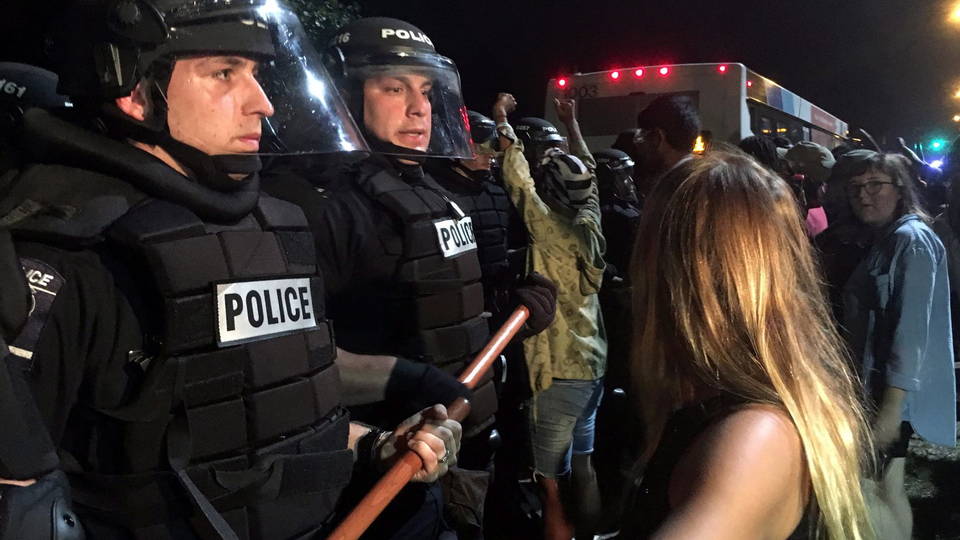 North Carolina Governor Pat McCrory has declared a state of emergency in the city of Charlotte following protests Wednesday night during which police in riot gear fired rubber bullets, tear gas and pepper spray at protesters, who threw fireworks and trash at officers. Authorities said four officers were injured. Many demonstrators were also injured. The night’s protest also included a civilian-on-civilian shooting that left one man critically wounded. The governor has also begun steps to deploy the National Guard. This was the second night of protests in the city following the fatal police shooting of 43-year-old African American Keith Lamont Scott on Tuesday. While the police claim they tased and then shot Scott because he was armed, Scott’s family says he was not armed—except with a book in hand. They say he had been sitting in his car, waiting to pick up his son after school. This comes as protests also continue in Tulsa, Oklahoma, over Friday’s fatal police shooting of 40-year-old African American Terence Crutcher, who was shot by white officer Betty Shelby while his hands were in the air. Solidarity protests to demand justice for the two men were held last night in other cities, including here in New York, while in Indianapolis every player on the WNBA team the Indiana Fever knelt during the national anthem to protest the killings. We’ll go to both Charlotte, North Carolina, and Tulsa, Oklahoma, after headlines.
No Charges to Be Filed Against Officer Who Killed Mother Korryn Gaines
 Meanwhile, Baltimore County State’s Attorney Scott Shellenberger has announced no charges will be filed against the police officer who shot 23-year-old Korryn Gaines, as well as her five-year-old son Kodi. Gaines was killed by the police gunfire on August 1, after a SWATteam broke down her door and stormed her home in order to serve a warrant related to a traffic violation. Her son Kodi was injured by police gunfire, but he survived.
Donald Trump Calls for Nationwide Stop & Frisk Program
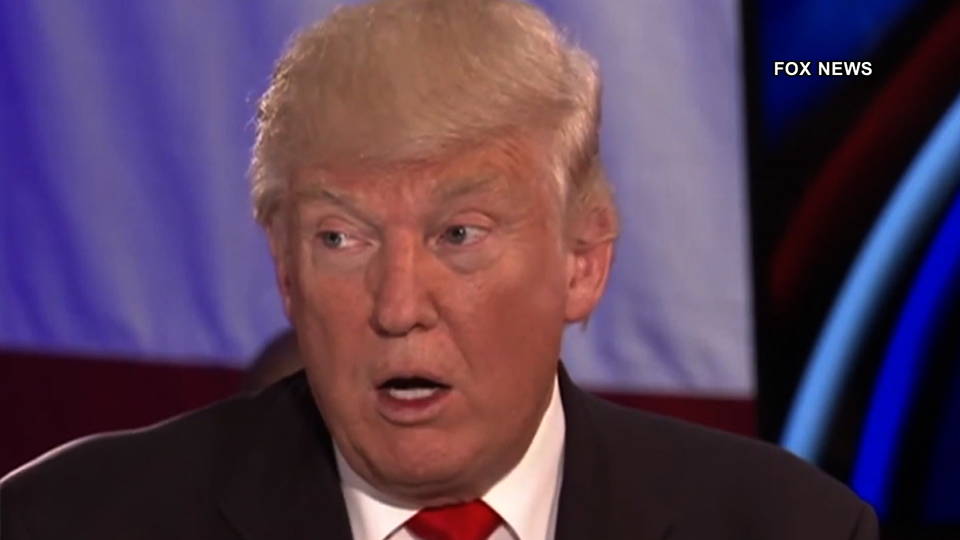 In the wake of the fatal police shootings of Terence Crutcher and Keith Lamont Scott, Donald Trump has called for a nationwide stop-and-frisk program, while speaking at a town hall meeting in a black church in Cleveland hosted by Fox News.
Ricardo Simms: "There’s been a lot of violence in the black community. I want to know what would you do to help stop that violence, you know, black-on-black crime."
Donald Trump: "Right. Well, one of the things I’d do, Ricardo, is I would do stop-and-frisk. I think you have to. We did it in New York. It worked incredibly well. And you have to be proactive. And, you know, you really help people sort of change their mind automatically. You understand. You have to have—in my opinion, I see what’s going on here, I see what’s going on in Chicago. I think stop-and-frisk—in New York City, it was so incredible the way it worked. Now we had a very good mayor. But New York City was incredible the way that worked. So I think that would be one step you could do."
Suspect in NY & NJ Bombing Flagged by Feds Twice in 2014
In more news on this weekend’s bombings in New York and New Jersey, a New York Times investigation has revealed that the main suspect, Ahmad Khan Rahami, was flagged twice for federal scrutiny in 2014, but was never questioned by federal agents. The first flag came from custom officials after he returned from Pakistan. The second flag came after his father called the FBI after Rahami reportedly stabbed a family member. During that phone call, his father referred to Rahami as a terrorist. Authorities now say Rahami was carrying a notebook that suggests he was inspired by ISIS. Rahami has been charged in a Manhattan federal court with bombing, property destruction and the use of weapons of mass destruction—but not with any terrorism-related charges, suggesting prosecutors have not been able to tie Rahami to any non-state terrorist organizations.
Hundreds Call for Release of Olowan Martinez, Arrested Blocking Dakota Access Pipeline
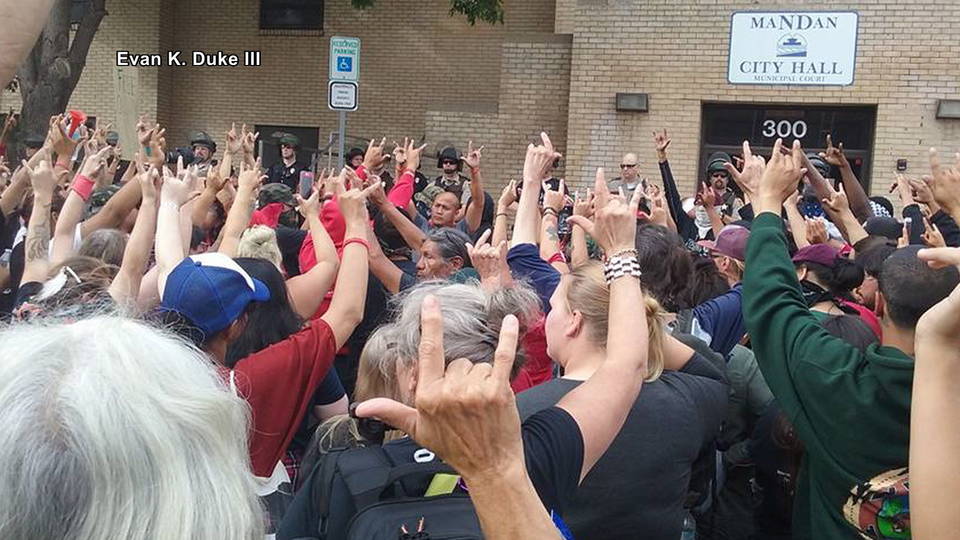 In Mandan, North Dakota, hundreds gathered Wednesday to call for the release of Lakota land defender Olowan Martinez, who was arrested on September 13 during a land defense action in which she locked herself to a piece of heavy machinery to stop construction of the $3.8 billion Dakota Access pipeline. Martinez has been held since then in the Morton County jail because she has a warrant out for her in Nebraska, where she’s been fighting the presence of liquor stores in the small town of White Clay, which is near her home on the Pine Ridge Reservation in South Dakota. This is Olowan Martinez speaking to Democracy Now! when we were in North Dakota covering the standoff at Standing Rock.
Olowan Martinez: "White Clay, Nebraska, is a small town on the edge or on the border of South Dakota and Nebraska. And it’s four liquor stores, basically—or, yes, liquor stores, I guess you could call them. They make, you know, 4 million a year just basically off the misery and the suffering of my people, who are struggling with alcohol and alcoholism, abuses from alcohol."
Amy Goodman: "So you’re saying it’s actually sort of a town of liquor stores that sell to people on the Pine Ridge Reservation?"
Olowan Martinez: "Yes, the majority of the alcohol they sell comes from Prisoner of War Camp 344, and it’s basically a very severe infection amongst our nation. And so, my idea, when we first started fighting White Clay, was to heal the wound."
That’s Olowan Martinez, who has been held for over a week after protesting the Dakota Access pipeline. On Wednesday, Oglala Lakota land defenders also disrupted the North Dakota Petroleum Council conference in Minot. They took over the stage while Department of Mineral Resources Director Lynn Helms was speaking, and demanded an end to construction of the Dakota Access pipeline. They were then escorted away by police.
South Africa: Police Attack Protesters Demanding Free Education
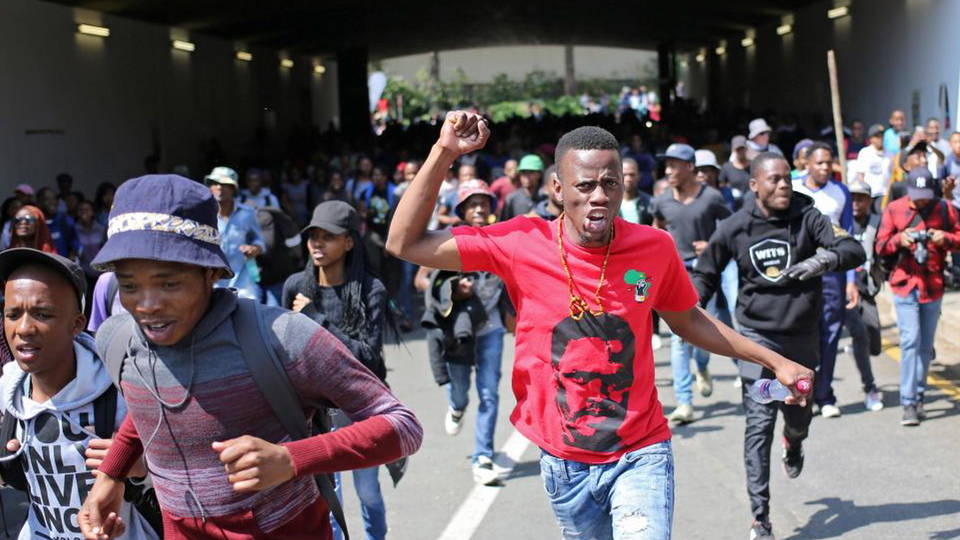 In South Africa, police attacked protesting students with tear gas and stun grenades, as students at the University of the Witwatersrand in Johannesburg protested for a second day against a proposed 8 percent tuition hike for 2017. The students are demanding free education. Last year, massive student protests across South Africa forced the university to back down from plans to increase tuition for this academic year. On Tuesday, at least 30 students were arrested and several were injured by police. The protests have forced the university to close for the week. The University of Cape Town was also closed Wednesday amid fear of protests.
DRC: Security Forces Kill Dozens Amid Protests Against Elections Postponement
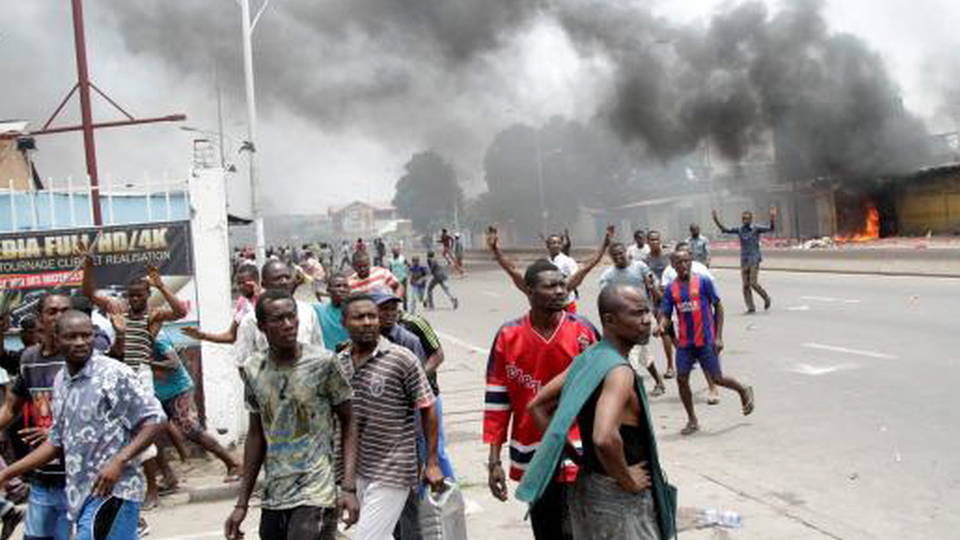 In the Democratic Republic of the Congo, security forces have killed dozens of protesters amid massive two-day demonstrations demanding President Joseph Kabila step down after his second term ends in December. Human Rights Watch says 37 protesters and six police officers have been killed so far during this week’s conflict. The protests were sparked by President Kabila’s announcement that this year’s presidential elections would be postponed.
Syrian White Helmets & Others Win 2016 Right Livelihood Awards
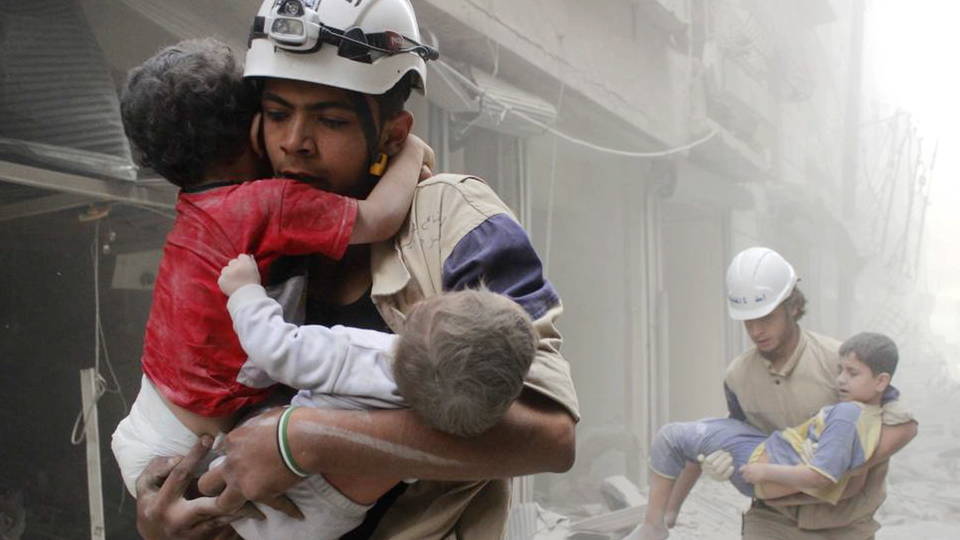 And this year’s Right Livelihood Awards, known as the Alternative Nobel Prize, have been announced in Stockholm, Sweden. This year’s winners are the volunteer rescue group the Syria Civil Defense, known as the White Helmets; Egyptian feminist Mozn Hassan; Russian human rights activist Svetlana Gannushkina; and Turkish newspaper Cumhuriyet, whose journalists have faced arrest, imprisonment and assassination attempts amid Turkey’s increasing crackdown against the press.
-------
Donate today:
Follow:


DN! IN THE NEWS

WATCH: Amy Goodman on PBS's Tavis Smiley on Dakota Access Pipeline & Land Defenders at Standing Rock
WEB EXCLUSIVE

WATCH: "Is This America?" Co-Founder of Sacred Stone Camp Recalls Dog Attack on Native Americans
NEW BOOK

Democracy Now!: Twenty Years Covering the Movements Changing America
WEB EXCLUSIVE

Exclusive Interview with Ex-Gitmo Prisoner Dhiab on Hunger Strike in Uruguay & Lawyer Who Freed Him
WORK WITH DN!

Senior TV Producer
COLUMN

"On Syria and Skittles, demagogues and the damned" by Amy Goodman and Denis Moynihan
The MS St. Louis was a German passenger ship whose most famous voyage, in the spring of 1939, became known as “The Voyage of the Damned.” On that trip, 908 German Jewish refugees were headed to Cuba, fleeing the Nazis, but only 22 of the Jewish passengers were allowed to disembark. Aid organizations pleaded with U.S. President Franklin D. Roosevelt and the government of Canada to accept the refugees. They were snubbed, and the vessel headed back to Europe. Hundreds of the repatriated refugees would die in the Holocaust. The refusal of the U.S. government to accept them remains a dark stain on our history. Sadly, our government’s current track record with refugee resettlement suggests that history may be repeating itself.
The sheer number of people suffering forced displacement today is staggering — the greatest flow of refugees since World War II. According to the United Nations High Commissioner for Refugees, 65.3 million people are forcibly displaced worldwide. Of those, 21.3 million are designated as refugees, and almost half of those people hail from just three countries: Somalia, Afghanistan and Syria. Five million have fled Syria alone, and more than 6 million are internally displaced there. Estimates put the death toll in Syria’s five-year civil war at more than 400,000. The destructive war in Yemen, meanwhile, has forced more than 3 million to flee their homes. The UNHCR predicts that 2016 will be the deadliest year for migrants attempting to cross the Mediterranean Sea. Another key statistic from Oxfam: “The six wealthiest countries [the U.S., China, Japan, Germany, France and the United Kingdom] — which make up more than half the global economy — host less than 9 percent of the world’s refugees while poorer countries and territories are shouldering most of the responsibility.”
It is in this context that the United Nations convened its first-ever high-level meeting on refugees this week, at its annual General Assembly in New York City. President Barack Obama followed that with a separate summit on the same issue. Before that could start, though, news surfaced that a desperately needed aid convoy bound for war-torn Aleppo, Syria, was hit by an airstrike, which the U.S. blamed on Russia, and Russia denied. Earlier, on Saturday, a fragile cease-fire collapsed when the U.S. struck and killed Syrian national armed forces, which the Pentagon labeled a “mistake.”
To the shock of many, the U.S. played a spoiler role at the U.N., successfully stripping language from the nonbinding statement that would have expressly forbid the detention of refugee children. Instead, it now reads that children will be imprisoned “only as a measure of last resort ... for the shortest possible period of time.” Tell that to 16-year-old Estefany Adriana Mendez, who has been held at the Berks County Residential Center — an immigrant family jail in Pennsylvania. Through a translator, the native El Salvadoran told the “Democracy Now!” news hour, “The truth for all of us here, the children who are here, and the mothers: This is a horrible experience to be in detention, because more than a year of incarceration for a child is not just.”
As the U.N refugee summit was underway, Donald Trump’s son, Donald Jr., tweeted, “If I had a bowl of Skittles and I told you just three would kill you. Would you take a handful? That’s our Syrian refugee problem.” Skittles’ parent company, Wrigley, responded, “Skittles are candy. Refugees are people. We don’t feel it’s an appropriate analogy.”
The plight of refugees is no joke to Manfred Lindenbaum, who attended the U.N. summit as an observer. A spry octogenarian, he was a refugee himself at the age of 6. Like those on the voyage of the damned, he was a German Jew. In 1939, he and his brother fled from Poland to England on the famous Kindertransport, just days before the Nazis invaded. “The United States at that point said that we’re not taking in any Jewish children.” he recalled on “Democracy Now!” “At the last minute, as the German army was coming over, a few hundred of us got onto a Polish warship to England. And they wouldn’t let my sister on. She was 14. So she was murdered with the rest of my family.”
The philosopher George Santayana wrote, more than 100 years ago, “Those who cannot remember the past are condemned to repeat it.” From the Trumps’ hateful rhetoric to Obama’s pernicious refugee policies, the lives of millions hang in the balance. Let’s hope that reason and compassion prevail over xenophobia and hate.-------
207 West 25th Street, 11th Floor
New York, New York 10001, United States
-------

No comments:
Post a Comment