Editor's Note:
Dear Friend,
My nine-year-old son has an obsession with this week’s Torah portion, Massei. You see, the Torah is chanted in public using a special tune, read from cantillation marks (known as trope). Now, two of the rarest cantillations (named karnei-farah and yerach-ben-yomo) are found exclusively in this week’s Parshah.
Oddly enough, the words to which these marks are set seem fairly dry and routine. In discussing the forty-eight cities to be set aside in Israel for the Levites, the Torah outlines the exact radial measurements for the boundaries of these cities. What is so exciting about that, so dramatic, that warrants such a shrill note?
Perhaps this is what the Torah is hinting to us: Every inch of the Land of Israel is a big deal. We must calculate and measure it, defend and protect it. It is a gift from G d, and should be treated with utmost care.
That’s my take. Feel free to share your thoughts in the comments.
Wishing our brothers and sisters in the Holy Land safety, security and strength as they battle for their survival in our precious homeland.
Moshe Rosenberg,
on behalf of the Chabad.org Team
P.S. We are proud to invite you to join us on Wednesday, July 23, at 8 p.m. for the first of many live classes where participants will be able to chat with each other and the presenter in real time.
Daily Thought:
Rewrite
There are no things. There are only words. The Divine Words of Creation telling a story, calling all into being.
The words become scattered and we no longer understand their meaning. They appear to us static and meaningless, as things. But they are not things. They are words in exile.
If so, their redemption lies in the story we tell with them.
Joy can create one story. Inspiration yet another. Reach to the divine spark within you, and a whole new story emerges.
What story will you tell with the scattered fragments of your life?(Torat Menachem 5713, Matot-Massei 4–5)
________________________________________
This Week's Features:

How Does My Mitzvah Help a Soldier in Gaza? by Tzvi Freeman
Dear Ask-the-Rabbi,
My rabbi visited my clinic today and asked me to wrap tefillin. He said it was for our boys in Gaza. So I did.
On Friday my wife lit Shabbat candles—which she doesn’t always do. She said it was for our boys in Gaza. Somehow that made sense to her. And to me.
But now I started thinking. I’m an educated man, a doctor, and I try to make sense of things. But once I’m thinking, I don’t have an explanation. How does it work? What’s the mechanism—the cause and effect? And why did it make sense before thinking?(Puzzled Jew)
Dear Puzzled Jew,
Yes, a puzzle—that’s a good example. A jigsaw puzzle where all the pieces connect to make a single whole. Same thing with Jews and mitzvahs. All of our people and all of our mitzvahs fit together to make a single, integral whole. And every piece is needed.Think of the entire Jewish people as a single living organism, and then it all makes sense.
But let me give you a better metaphor, something which you as a doctor can surely relate to. Think of the entire Jewish people as a single living organism, and then it all makes sense.
A living being, I’m sure you realize, is not like some clunky machine. For one thing, machines are made by putting parts together that originally had nothing to do with one another. Even once built, a machine is still a jumble of parts. But a living organism starts off as a single cell that then unfolds itself into an entire creature—and in such a way that even once fully developed and functioning, it remains a singularity.
In other words, unlike a machine, a living being is a single being.
And in a single being, locality is secondary. What happens in one part of a living being immediately changes the entire organism. Which is how the Jewish people works as well.
Okay, here’s an example you’re probably familiar with: Caenorhabditis elegans. I’ll bet you studied little C. elegans back in medical school—because it is holds the distinction of being the most exhaustively studied and exposed creature in the world.
C. elegans is a one-millimeter-long, transparent roundworm with exactly 959 cells (we human organisms have about 75 trillion cells). Researchers hoped that by starting with this one simple paradigm, eventually all the processes and rules that govern life could be explained. And so, by 1980, the fate of each of those cells from egg to adult was already mapped out.
But those researchers never got what they bargained for. In 2002, Sydney Brenner received a Nobel prize for all the time he spent with that little worm. Critics balked. They claimed Brenner hadn’t explained a thing—all he had done was to describe what goes on inside the little critter. And Brenner had to acknowledge they were right. “It’s not a neat, sequential process,” he explained. “It’s everything going on at the same time . . . there is hardly a shorter way of giving a rule for what goes on than just describing what there is.” (my emphasis)
Call that an irreducible singularity. Something whose only description is itself. Which means that if one part were missing, it would not be what it is. And whenever one part changes, the entirety has instantly changed.
Something like a symphony: You can’t provide me a mathematical equation that will produce Beethoven’s Pastoral. The only description I can have is by listening to it. And if one part is changed—a sweet note gone sour, or a thundering triad played softly—the experience of the entire symphony has changed.
Now apply that to the Jewish people. We are one—essentially and integrally one. We have one G‑d, one Torah, one story to tell and one destiny at which we will arrive. Each one of us has his or her integral part to play. And so, whatever any one of us does immediately redefines the state of our entire people.
Locality is meaningless—it’s not a case of cause and effect. It doesn’t take time for the signal to travel, it needs no medium to carry it, and it doesn’t diminish over space or time. Our entire people spread over the entire globe, from Abraham until you and me—we are all one irreducible singularity. One Jew has done a mitzvah—the entire people is immediately enriched, and that enrichment is felt in every individual.
Take it further: If you somehow connect with another Jew who is struggling with some ethical challenge in life, find that same challenge within yourself, fix it up—and you’ll discover that this other Jew now has an easier time overcoming that struggle. That’s how deeply we are connected.
That also answers your last question: Why did it make sense before thinking? Strange thing: I’ve also asked many Jews to wrap tefillin or light Shabbat candles or do some other mitzvah “for our boys in Gaza.” Every Jew I have asked immediately gets it. “Of course,” they say. “It’s a mitzvah.”
Because a Jew feels the effect of the mitzvah. And a Jew knows we are a people above time and space.
We are one. Everything else is commentary. Now go do another mitzvah for our boys in Gaza.
Sources
Mostly, this is based on the Rebbe’s maamar “Amar Rabbi Oshaya,” 19 Kislev, 5739. For an excellent discussion of the difference between organism and mechanism, see Stephen L. Talbott’s series of essays in The New Atlantis, especially What Do Organisms Mean? in the August 2011 edition. There is more fascinating material on this subject scattered throughout the Web.
________________________________________
 PARSHAH
A Kabbalist’s Guide to Hieroglyphics
This thing about the Jews “wandering” through the desert is a misconception. They were no more wandering through the desert than a spelling bee champion wanders through the alphabet. by Boruch Cohen
Anyone who thinks “Poindexter” is a long name never studied this week’s Torah portion with a Kabbalist.
A Kabbalist understands the Jews’ zigzagging 42-stop journey across the desert as an allusion to G‑d’s mystical 42-letter name, the one G‑d uses in creating the world.
This helps overturn the misconception that the Jews were “wandering” through the desert. They were no more wandering through the desert than a spelling bee champion wanders through the alphabet. Rather, each stop was another letter in a divine composition.
Their journey represents the journey through life. The Talmud likens it to a long trip taken by a father and son; together they share life’s pains and joys, its triumphs and defeats.
Likewise, the trip across the desert included triumphs and joys, but also mistakes, pain and doubt—a fairly normal range of experiences. The difference is that every up and down was intimately bound to the divine—shared with their Father in Heaven.
There’s a chassidic adage that G‑d loves each individual like a king loves his only son. When the son is dirty, the king bends down to offer the son a damp cloth. If the child refuses the cloth, the king lovingly cleans away the schmutz himself.
When the schmutz is removed, one sees that life forms a divine hieroglyphic—G‑d’s mystical plan for creation. The wise person realizes the need to pursue this hieroglyphic with an archeologist’s determination for discovery.
________________________________________
More in Parshah:
• Journeys (By Chana Weisberg)
 Personal journeys.
From the moment you left the homey warmth of your mother’s womb to enter into our cold, sterile world, you have begun your personal journey.
In every episode of your life, in your every moment of growth, you are stepping forward on your journey. Your every characteristic, your every talent and ability, and your every encounter with life, contribute to your reaching your final destination—to use your G‑d-given talents to accomplish your particular mission in our world.
Enthusiastically you set out on the long trek ahead of you. In your naiveté, you imagine the journey to be a straight one, with clearly delineated directions and signposts. A journey you assume you are well-equipped to master.
But instead of a well-paved road, you encounter a bumpy, winding route. You find yourself changing lanes often, following detours and side roads, stopping at rest areas and even making some U-turns. There are moments, even days or weeks, when you feel lost and confused, with no confidence to continue on.
Setbacks. Your journey is full of them. But each stop, each rest, even each wrong turn is ultimately a point of learning in your journey forward.
These are the journeys of the children of Israel, going out of the land of Egypt . . . They journeyed from —— and they camped at —— . . . (Numbers 33:1–49)
The forty-two encampments from Egypt to the Promised Land are replayed in every individual’s life, in his journey from his soul’s descent to this world at his birth until his return to his Source. (The Baal Shem Tov)
The stopping and resting stations are also part of the journey towards the “Holy Land.” Pauses, interruptions and setbacks are an inadvertent part of your journey on earth. Each stop, even those that appear as setbacks and wrong turns, are points of learning, prodding you further. (The Lubavitcher Rebbe)
Each setback is meant to provide you with a new vantage point and perception, a new awareness or sensitivity on your journey forward.
Yesterday’s destination is now surpassed, and a new one must be set and attained. Self-imposed limitations and constrictions in your attitude or outlook must be overcome to reach your goal.
This is all part of your personal journey, forward and onward . .
Relationship journeys.
She is the one for you. You just knew it from the moment you set your eyes on her.
Beauty, intelligence, sensitivity.
You gazed deeply into her eyes and saw to the depths of her soul, a reflection mirroring your own. You set out on the ultimate journey of bliss and harmony in your idyllic life together.
And then you woke up one morning and realized that your blissful journey of togetherness contained more than you bargained for.
Petty arguments, full-blown disagreements, quarrels that lasted for hours or days.
All of a sudden, you realized that this perfect soul that you call your mate has some very real needs and wants—some of which differ drastically from your own. She has her own established outlook and perception on things, which can sometimes pull in a very different direction than your own.
Your “smooth” journey has a number of bumps.
And on top of these complexities, life threw you even greater challenges. You experienced a crisis—to your health, to you emotional state, or to your financial wellbeing—external circumstance that just shouldn’t have been.
A block in your way. A restriction.
These are the journeys of the children of Israel going out of the land of Mitzrayim (Egypt). (Numbers 33:1)
Mitzrayim, the Hebrew word for Egypt, means “borders, restrictions, narrows.” On the spiritual level, the journey from Egypt is a journey from the boundaries that limit us—an exodus from the narrow straits of habit, convention and ego to the “good, broad land” of the infinite potential of our G‑dly soul. (Rabbi Schneur Zalman of Liadi)
Now begins your real journey. Now begins the hard work.
Look beneath her abrasiveness to discover her sweet essence. See beyond her criticism to find her points of validation. See beyond her endless needs to uncover the beauty of her soul. Work on yourself to transcend your constricted, ego-based vantage point.
Each crisis in your relationship is an opportunity for you to reach a higher level of closeness. Each setback is a chance to forge a deeper connection and to reveal the deeper bonds of your relationship that surface only in response to difficulty and hardship. Each restriction is an opening to reveal how your relationship is not dependent on surface beauty or good times alone.
Even in the ugly moments of your life together—even in the stops, resting areas and wrong turns of your life—you are there for one another.
For all times.
Our national, cosmic journey.
You are part of a people who was enjoined “to be a light unto the nations”—to bring the values and morality of G‑dliness to all of mankind. You are G‑d’s partner in creation.
So you start out on your journey, well prepared to make a difference, to bring light to this world. You feel embraced by the warmth and comfort of your Partner, ready to take His message to mankind. You are ready to tackle any challenge.
Then comes history. Persecutions, decimations, destructions. The Partner who had started out faithfully at your side, holding your hand, leading the way, seems to have abandoned you.
You feel utterly alone, surrounded by an all-pervasive, frigid darkness.
The journey seems endless. Hardship, loneliness, and pain surround you. Your estrangement from your Partner, the decline in your relationship, the shrouding of mutual love is unbearable.
You feel defeated, ready to despair. Your destination seems to be nowhere in sight.
All forty-two journeys—not just the first—were a “going forth out of the land of Egypt.” Each stage was a new exodus; even a single journey is a liberation from some personal Egypt. (The Lubavitcher Rebbe)
You don’t see how your contribution is bringing mankind forward, because the end point seems too far ahead; but ultimately each step is valuable as its own “exodus,” taking you that much further in the right direction.
Moreover, times of separation and setbacks are also part of your journey, and part of your growth. Ultimately, in the messianic era, these setbacks too will be revealed as points of progress and illumination. You will understand then how each of these bumps were somehow necessary for the development and deepening of your relationship with your Partner.
It is the time of Jacob’s trouble; from it he will be saved (Jeremiah 30:7).
“From it he will be saved”: Salvation is not something that simply follows trouble, it is implicit in it. (The Baal Shem Tov)
The moments of constriction, like the rest stops on our way, are ultimately meant to propel us further on your ultimate journey—towards an all-encompassing unity with your Creator. Towards the highest and greatest forms of revelation.
Perhaps this, too, is hinted to in the episode at the very conclusion of our Parshah, in the last words of the Book of Numbers.
Tzelafchad had died without sons, and his five daughters had successfully petitioned for an inheritance in the Land of Israel. Now, the leaders of their tribe approached Moses with a petition of their own. If any of these women will marry someone from another tribe, they argued, this would mean that their sons, who will inherit the land, will likewise be from another tribe.
Moses then decrees in the name of G‑d: “Any daughter who possesses an inheritance shall marry a man of the family of the tribe of her father . . . so that the inheritance shall not be removed from one tribe to another tribe.”
There was a sequel, however, to this ruling. This restriction on marriage applied only to the first generation of Jews who settled the land. The day on which this inter-tribal marriage ban was removed, years later, was the 15th day of Av. This day was then proclaimed as a national holiday, as great as Yom Kippur, the holiest day of the year. The merging and unity of the tribes was something to be celebrated.
Perhaps there is a message here for our national, cosmic journey.
Each member of the nation of Israel contains a special soul, with a G‑dly spark. Our separation from one another, and our periods of separation from G‑d, are ultimately meant to lead us to a higher time period, a greater realization of just how connected we all are—one to another, and each of us to G‑d. Like the limbs of one body, we are intrinsically one.
The fifteenth day of Av became a day of such great celebration because it represented the subsequent unity of our people with each other, and ultimately will represent our absolute unity with our Creator.
Therefore the Talmud relates that on this special day, the daughters of Jerusalem would go out and dance in the vineyards, and each of them—the “beautiful ones,” the ones “with prestigious lineage,” and even the “ugly ones” would call out to their prospective bridegrooms to come and take them. (Talmud, Taanit 26b and 31a)
Metaphorically, the maidens going out represents each of us going out to our Groom and calling to Him. Whether we are beautiful or ugly, worthy or undeserving, we announce that the bond between us is an everlasting one.
Our national journey has been a long and winding one. There were beautiful times, but even more numerous ugly times. Ultimately, each bump in our journey had a purpose, and will be revealed as the ultimate expression of closeness between our nation and G‑d.
Even in the ugly times, even in the setbacks, our connection to one another goes beyond external beauty or happy times. The bond between our nation and G‑d is an everlasting one.
________________________________________
• Leadership at a Time of Crisis (By Rabbi Jonathan Sacks)
 The Parshah of Massei always occurs at the heart of the Three Weeks. This is the time when we engage in an act of collective recall of our two greatest defeats as a nation. The symbol of the nation was the Temple in Jerusalem, so the symbol of the nation’s defeat was the destruction of the Temple. It happened twice, once in the sixth century BCE, the second time in the first century of the common era. In both cases it happened because of poor leadership.If you serve the people, they will serve you
The first defeat was set in motion some three centuries before it happened by a disastrous decision on the part of King Solomon’s son Rehoboam. The people were restless during the latter part of Solomon’s reign. They felt he has placed too heavy a burden on the people, particularly during the building of the Temple. When he died, they came to his son and successor and asked him to lighten the load. His father’s counselors told him to accede to their request. They gave him one of the finest pieces of advice ever given to a leader: if you serve the people, they will serve you.1 Rehoboam did not listen. The kingdom split. Defeat of both halves—the northern and southern kingdoms—was inevitable and only a matter of time. As Abraham Lincoln said: “A house divided against itself cannot stand.”
The second defeat, in the days of the Romans, was the result of a complete collapse of leadership during the late Second Temple period. The Hasmonean kings, having defeated Hellenism, then succumbed to it. The priesthood became politicized and corrupt. Maimonides wrote, in his Letter to the Sages of Marseilles,2 that the Second Temple fell because Jews had not learned military strategy and the laws of conquest. The Talmud says it fell because of gratuitous hatred. Josephus tells us it fell because of conflicts within the forces defending Jerusalem. All three explanations are true and part of the same phenomenon. When there is no effective leadership, divisions open up within the group. There is internal conflict, energy is wasted and no coherent strategy emerges. Again, defeat becomes inevitable.
In Judaism, leadership is not a luxury but a necessity. Ours is a small and intensely vulnerable people. Inspired, we rise to greatness. Uninspired, we fall.
But there is, oddly enough, a deeply positive message about the Three Weeks. For the fact is that the Jewish people survived those defeats. They did not merely survive. They recovered and grew stronger. They became, in the most positive sense, a nation of survivors. Who gave them that strength and courage?
The answer is three leaders whose names are indelibly associated with the Three Weeks: Moses, whose message to the generations at the beginning of Devarim is always read on the Shabbat before Tisha B’Av; Isaiah, whose vision gives that day its name as Shabbat Chazon; and Jeremiah, the prophet who foresaw the destruction and whose words form the haftarot for two of the Three Weeks.
What made these men great leaders? They were all critical of their contemporaries—but then, so are most people. It takes no skill whatsoever to be a critic. All three predicted doom. But Jeremiah himself pointed out that predicting doom is a no-risk option. If bad things happen, you are proved right. If they don’t—well, clearly G‑d decided to have compassion.3
So what made Moses, Isaiah and Jeremiah different? What made them great leaders? Specifically, what made them leaders in hard times, and thus leaders for all time? Three things set them apart.
The first is that they were all prophets of hope. Even in their darkest moments they were able to see through the clouds of disaster to the clear sky beyond. They were not optimists. There is a difference between What made Moses, Isaiah and Jeremiah different?optimism and hope. Optimism is the belief that things will get better. Hope is the belief that if we work hard enough together, we can make things better. It needs no courage to be an optimist, but it needs courage, wisdom, a deep understanding of history and possibility, and the ability to communicate, to be a prophet of hope. That is what Moses, Isaiah and Jeremiah all were. Here is Moses:
When all these blessings and curses I have set before you come on you and you take them to heart wherever the L‑rd your G‑d disperses you among the nations, and when you and your children return to the L‑rd your G‑d and obey Him with all your heart and with all your soul according to everything I command you today, then the L‑rd your G‑d will restore your fortunes and have compassion on you and gather you again from all the nations where He scattered you. Even if you have been banished to the most distant land under the heavens, from there the L‑rd your G‑d will gather you and bring you back.4
Here is Isaiah:
I will restore your leaders as in days of old, your rulers as at the beginning. Afterward you will be called the City of Righteousness, the Faithful City.5
And this is Jeremiah:
This is what the L‑rd says: “Restrain your voice from weeping and your eyes from tears, for your work will be rewarded,” says the L‑rd. “They will return from the land of the enemy. There is hope for your descendants,” says the L‑rd. “Your children will return to their land.”6
The point about all three of these prophecies is that they were delivered knowing that bad things were about to happen to the Jewish people. They are not easy hope; they express hope rescued from the valley of despair.
The second characteristic that made Moses, Isaiah and Jeremiah different was that they delivered their criticism in love. Isaiah said in the name of G‑d perhaps the loveliest words ever spoken to the Jewish people: “Though the mountains be shaken and the hills be removed, My unfailing love for you will not be shaken nor My covenant of peace be removed.”7 Jeremiah, in the midst of his critique of the nation, said in the name of G‑d, “I remember the kindness of your youth, how as a bride you loved Me and followed Me through the wilderness, through a land not sown.”8
Moses’ love for the people was evident in every prayer he said on their behalf, especially after they had made the golden calf. On that occasion he said to G‑d: “Now, please forgive their sin—but if not, then blot me out of the book you have written” (Exodus 32:32). The only effective critics are those who show loveHe was prepared to give his life for his people. It is easy to be a critic, but the only effective critics are those who truly love—and show they love—those whom they criticize.
Third, Moses, Isaiah and Jeremiah were the three prophets who, more than any others, spoke about the role of Jews and Israel in the context of humanity as a whole. Moses said, “Keep the commands, for they are your wisdom and understanding in the eyes of the nations.”9
Isaiah said in G‑d’s name: “You are my witnesses . . . that I am G‑d,”10 and “I created you and appointed you a covenant people, a light of nations, opening eyes deprived of light, rescuing prisoners from confinement, from the dungeon those who sit in darkness.”11
Jeremiah was the leader who defined for all time the role of Jews in the diaspora: “Seek the welfare of the city to which I have exiled you and pray to the L‑rd on its behalf, for in its prosperity you shall prosper,”12—the first statement in history of what it is to be a creative minority.
Why did this universal perspective matter? Because those who care only for their own people are chauvinists. They create false expectations, narrow and self-regarding emotions, and bravado rather than real courage.
Moses had to show (as he did when he rescued Jethro’s daughters from the local shepherds, Exodus 2:17) that he cared for non-Israelites as well as Israelites. Jeremiah was told by G‑d to become a “prophet to the nations,” not just to Israel.13 Isaiah, in one of the most remarkable prophecies of all time, showed as much concern for Egypt and Assyria, Israel’s enemies, as for Israel itself.14
Great leaders are great not just because they care for their own people—everyone except a self-hater does that—but because they care for humanity. That is what gives their devotion to their own people its dignity and moral strength.
To be an agent of hope, to love the people you lead, and to widen their horizons to embrace humanity as a whole—that is the kind of leadership that gives people the ability to recover from crisis and move on. It is what made Moses, Isaiah and Jeremiah three of the greatest leaders of all time.
FOOTNOTES
1.I Kings 12:7.
2.English translation available in Isadore Twersky, A Maimonides Reader (Behrman House, 1976), pp. 463ff.
3.See Jeremiah 28; Mishneh Torah, Hilchot Yesodei ha-Torah 10:4.
4.Deuteronomy 30:1–4.
5.Isaiah 1:26.
6.Jeremiah 31:15–16.
7.Isaiah 54:10.
8.Jeremiah 2:2.
9.Deuteronomy 4:6.
10.Isaiah 43:12.
11.Isaiah 42:6–7.
12.Jeremiah 29:7.
13.Jeremiah 1:5.
14.Isaiah 19:19–25.
________________________________________
• Massei in a Nutshell
 The forty-two journeys and encampments of Israel are listed, from the Exodus to their encampment on the plains of Moab across the river from the land of Canaan.
Also in Massei: The boundaries of the Promised Land are given, and cities of refuge are designated as havens and places of exile for inadvertent murderers. The daughters of Tzelafchad marry within their own tribe of Manasseh, so that the estate which they inherit from their father should not pass to the province of another tribe.
© Copyright, all rights reserved. If you enjoyed this article, we encourage you to distribute it further, provided that you comply with Chabad.org's copyright policy.
________________________________________
 WAR IN ISRAEL
Humor Me Until It’s Over
A kind word, a smile and a laugh are healing not only to each of our own individual souls; they’re the best salve for our collective one as well.
By Julie Rothschild Levi
A few days ago, a friend and I were browsing around a home goods store, an act of normalcy during a very abnormal time. A mattress protector in the bedding department caught my friend’s eye and, knowing that I’m a sucker for typos in English—which are entertainingly rampant in Israel—she showed me the packaging. Underneath the photo of a beaming family of four, the text read: “Protects you from your own mattress.”
Great, I thought, we’re not only in need of protection from Hamas missiles here. It turns out our very own mattresses are after us, too.
I live in central southern Israel, and we experience an average We experience an average of three siren warnings a dayof three siren warnings a day, not to mention the countless booms of Iron Dome missile interceptions. In our home, we don’t have a mamad, a safe room, so when the siren wails, we run to the enclave under our staircase. We apparently have 90 seconds to get there, not an easy feat at 6 AM with five children sleeping soundly in their beds. My 22-month-old has grown accustomed to wedging himself between his siblings under the stairs, and just yesterday formed his very first sentence: “Boom boom uh-oh ay yai yai.”
It’s heartbreaking, really, but it’s also kind of funny.
Funny? Well, you see, my way of coping with this pervasive war is to search for the humor in every nook and cranny, typo and toddler.
You don’t need me to tell you there’s nothing funny about war. But that’s precisely why we need to make fun of it sometimes. Humor helps us escape from the bitter pill of war, if only for a few minutes.
It took me several days of wondering what I could do to help my fellow Jews, aside from saying some extra prayers and putting a few more coins in the pushka (charity box). Then the idea hit me like a Kassam. I am a medical and professional clown, and I was specifically trained to aim a missile of light into hospital wards, battered women’s shelters and nursing homes. If there was ever a situation that warranted clowning around, this war would be it. I plan to entertain children in my city, and hopefully in other locations, in the coming weeks. My clown colleagues are doing the same, bringing the gift of comic relief to Am Yisrael.
Mitzvah gedolah lihyot b’simchah. It’s a great mitzvah to be happy. Running for cover during a siren is not a simchah-inducing act, and keeping a calm demeanor for the children gets trickier with each passing A kind word, a smile and a laugh are healingday. (A few days ago, my son came home from school after a siren and excitedly reported that part of an intercepted missile fell near the main Chabad shul. Um, cool?)
Yet G‑d gave us the tools to bring joy to the world. A kind word, a smile and a laugh are healing not only to each of our own individual souls; they’re the best salve for our collective one as well.
May we merit times of only simchah and laughter, speedily in our days.
________________________________________
More in War In Israel:
• 1967 Flashback - Gaining and giving comfort as Israel is once again under threat (by Elaine Rosenberg Miller)
 The year was 1967. My parents, my sister and I resided in Boro Park, Brooklyn, a densely populated center of modern Orthodoxy. Our apartment overlooked a magnificent Italianate synagogue, Temple Beth-El, where the most celebrated cantor in the world, Moshe Koussevitzky, led the prayers on Rosh Chodesh and the High Holidays. He was a regal, barrel-chested man, and I remember sitting in the balcony of the synagogue, listening to his voice, watching his white silk–clad figure, and feeling that I was in the presence of majesty, someone, it seemed, who had a direct connection with the heavens.
But this day in 1967 was different. It was an ordinary weekday. The rabbi stood at the lectern. The anguish and fear in the sanctuary was palpable.
It was twenty-two years since the end of World War II, when the liberation of the camps revealed the murder of six million European Jews.
The room was filled with Holocaust survivors, including my parents and my five aunts and uncles and cousins. Some of them had black numbers tattooed on their forearms.
Modern Israel, just completing its second decade, was the depository of their hopes and pride, and I was aware that this day in Temple Beth-El was a watershed. We were not safe. Israel was not safe, despite the photographs of beaches, oranges, and hora-dancing young people.
Israel was surrounded by hostile enemies. Tiny Israel, the size of New Jersey, had been attacked, and her enemies were determined to destroy her.
The rabbi spoke; money was raised.
I remember one man standing up. “I am giving my entire fortune,” he said. “If Israel falls, I have no reason to live.”
How that shocked me. Me, the American teenager, dancing to the Supremes, in love with the Beatles.
I don’t recall how the rabbi responded.
Though the adults seemed to be in a state of paralysis, they joined together under the massive domed ceiling to comfort each other and take action.
The rabbi didn’t say anything profound, that day. He didn’t quote Pirkei Avot (Sayings of the Fathers) or the Torah. He had been shaken to his core.
I don’t remember how much money the congregants raised, but I am sure the amount was substantial. I am likewise confident that the same scene was repeated in synagogues from Brooklyn to Kansas City to San Francisco.
Within days, the news arrived that Israel had defeated its enemies. Spectacularly. And we knew that we had witnessed a miracle.
Today, as bombs rain on Israel, we gather again, to talk, to comfort each other, to pray.
A young rabbi in my community of Palm Beach, Florida, traveled to Israel recently with his family and a group of teens.
“Are you sure you want to be going to Israel now?” people asked him. “Why?” he answered. “Is there a better or more important time?”
This morning he sent us an e‑mail announcing that the group had arrived safely. “We’re all in high spirits,” he wrote. “Jerusalem is as beautiful as ever. We feel safe and secure in the land which ‘G‑d’s eyes are upon, from the beginning of the year until the end.’”
________________________________________
 MULTIMEDIA
Worth the Risk
Rabbi Mordechai Dubinsky readily agreed to host a young couple from Israel who came to the United States seeking treatment for the wife’s heart condition. What he didn’t expect was to also be involved in the birth of their first child. (1970s)
Watch (5:07)
http://www.chabad.org/2635627
http://www.chabad.org/therebbe/livingtorah/player_cdo/aid/2635627/jewish/Worth-the-Risk.htm
________________________________________
More in Multimedia:
• Tightrope Walking (By Tzvi Freeman)
<script language="javascript" type="text/javascript" src="http://embed.chabad.org/multimedia/mediaplayer/embedded/embed.js.asp?aid=711084&width=auto&height=auto"></script><div style="clear:both;">Visit <a href="http://www.chabad.org/multimedia/default_cdo/aid/591213/jewish/Video.htm">Jewish.TV</a> for more <a href="http://www.chabad.org/multimedia/default_cdo/aid/591213/jewish/Video.htm">Jewish videos</a>.</div>
________________________________________
• The Chassidic Dimension—Massei (By Berel Bell)
http://www.chabad.org/2448076
http://www.chabad.org/parshah/article_cdo/aid/2448076/jewish/The-Chassidic-Dimension-Massei.htm
________________________________________
 ESSAY
ESSAYThe Value of Doing Business
A human being is a creature that looks at what is and sees the value of what could be. But how does this creature know? And from where does this new value come? by Tzvi Freeman
 Rava said: When a person is judged in the heavenly court, the first question asked is “Did you buy and sell with integrity?”(Talmud, Shabbat 31a)
Real Value
What is a human being?
A human being is a creature that looks at what is and sees the value of what could be.
That is how we farm, how we prepare food, how we conduct commerce, how we create art and how we build our lives. In simple math, we make one plus one equal three. In business talk: We create value.
It’s not possible to create real value and create it for yourself alone. Everyone and everything is a shareholder in that value. If this field now yields crops, there is more food available in the world. Once you cook that food, there are more calories available in the world. Go to market to sell that food, and there is more availability of food in the world. Do it with integrity, and there’s more trust and goodwill in the world—which means there’s more business to be made. Create music or art, the entire world gains beauty.Meaningful business means the sum total value for everyone has increased. Doing any sort of meaningful business means there is now more of something for others, and the sum total value for everyone has increased.
This is the human being: We are not just productive. We fix up. We create with foresight. We save our seed for the coming year, invest our profits in further profits, make our dreams come true.
But is that all there is to the human being? Is there no higher purpose?
Certainly, for the Creator, there is value in creatures that create value. “He didn’t create the world so it should sink into nothingness,” says the prophet. “He created it to be settled.” (Isaiah 45:18)
“Sinking into nothingness”—that’s the natural force of entropy, by which all things tend towards death and decay. Life, and particularly human life, defies entropy. Instead, we create synergy—putting things together to grow and keep growing. Settling the world with life.
Of course, there is a caveat: A settled world means a sustainable world. When value is created that benefits some at the expense of others, that creates imbalance and non-sustainability. That’s why a society needs laws to prohibit theft, usury, unfair business practices, environmental damage and other means of artificial, non-sustainable value. Artificial value pulls inward—it is really just more entropy in disguise; real value spreads outward—because it is alive.
But the question remains: Is that all there is to the human being? Are we here only to form a sustainable world? Or to fix it up into something yet greater?
Reassembling
If you ask the right questions, often they lead you to the right answers. Here’s a simple question: Why does it work? What’s behind this strange phenomenon of synergy, this potential the world provides us to increase value?
What’s behind it is that the entire universe began as a single and singular thought, a thought that contains infinite information. That thought traverses time and space, holding every event and particle of a great big universe in a single point.
But the universe we perceive from our position within time and space has been fractured into uncountable parts. With each fragmentation, more information is lost. Until we are left with parts that appear meaningless and worthless.
Imagine picking up a volume of Moby Dick, throwing it in the air and watching all the letters fly out of the book, scattering in the wind and falling to the ground. The story is gone. The characters are gone. All meaning has disappeared. You are left with nothing but lifeless letters, as lifeless as grains of sand, with no story to tell, no meaning to share.
That is the world we live in—a scattered book. Yet the Author of this book breathes within one of its characters, the human being. And so, the human being somehow sees how these pieces must fit together, and behold, value appears.From where does that value appear? From the primordial thought of the universe.
From where does that value appear? From the original great light, that infinite pack of information that filled the primordial thought of the universe. A harmonious rearrangement of a few pieces of the puzzle now resonates with that great light, and a glimmer of that light is transmitted through this new matrix. And so, here in our world we find increased value.
Rediscovery
Now we have a better idea of what we human beings are doing down here. We are not just making a better world. We are creating a magnificent one. One that can transmit to all of us who live within it the oneness and magnificence of its Creator.
Where do we create that world? Not in some spiritual heaven above. Down here on earth, doing the earthly activities of earthly human beings—but injected with meaning and higher purpose.
That, after all, was the primordial thought from which all this universe extends: The Creator’s thought of Himself being discovered within this earthly world.
________________________________________
More in Essay:
• Castle or Prison? (By Miriam Szokovski)
 Last night I drove straight into a metal pole. Not just a light bump with the front fender, but a real, full-speed collision that landed me on the median strip of a major highway, miraculously unharmed. No, I wasn’t driving under the influence; I didn’t fall asleep at the wheel, hit a patch of ice or lose control of the vehicle. I simply didn’t see the pole until it was too late.
Turning out of my driveway, I unintentionally turned too far into the center lane, the turning lane. I simply didn’t see the pole until it was too lateAs a result, I now found myself speeding along at 55 mph, not knowing I was in the wrong lane, until I collided with the metal pole indicating the beginning of a concrete median strip.
In all honesty, it is rather difficult to miss a tall metal pole, even if one is not expecting it. However, it was dark outside and, like many others, I have poor nighttime vision. Had it been daytime, it certainly would have been easier to realize I had turned into the wrong lane and correct it immediately.
The relationship between galut, exile, and geulah, redemption, is frequently paralleled to the relationship between darkness and light. Just as physical darkness is characterized and defined by the absence of light, exile can be identified as spiritual darkness created by the absence of G‑dliness in a revealed state.
The world we live in is shrouded by darkness, characterized by concealment. Physical darkness obscures and dims our vision, significantly handicapping one of our more sensitive senses. Nighttime can be frightening and misleading. Harmless objects appear menacing and take on lifelike properties. Even the branch of a tree waving innocuously in the breeze adopts new and frightening dimensions in the dark and shadowy countryside, not to mention the many children whose bedroom furniture transforms into the full gamut of monsters during the night and immediately revert to bookshelves, closets, dressers and chairs with the first light of morning.
Recently, while driving through the mountains at night, something caught my eye. On the left side of the road stood a wide body of water, with several sprawling but empty fields alongside, gently sloping upwards, forming an incline upon which sat an impressive-looking building. Strong lights shone at regular intervals along the entire length of the structure, angled vertically, casting cone-shaped beams down the walls. The center of the building seemed elevated, lending it an air of importance. Unfamiliar with the area, I speculated as to what the mysterious building might be. Had I been in a country with a history or royal monarchy, I would have easily assumed it to be an ancient palace or castle.
Shortly thereafter, I again found myself driving along that same winding road, this time in broad daylight. Imagine my surprise to see not the magnificent palace I had envisioned, not an ancient castle, not even an official government building or museum. There, behind the lake, atop the grassy hill, towered a forbidding red-brick block, surrounded by barbed wire and heavy gates. My castle was not a castle at all. My castle was not a castle at allMy castle was actually a high-security prison, isolated and removed from the city for security purposes.
What disturbed me most, though, was not the thought of being in such close proximity to a prison, nor the jarring contrast between the cold, sterile prison building and the surrounding nature. What I found most disconcerting was the absolute transformation this single structure seemed to undergo daily, for no matter how many times I drove past the prison in following weeks, I remained unable to reconcile my nighttime “palace” with the daylight prison. Nothing in its nighttime appearance could possibly have suggested the true nature of the building, yet its daytime appearance left no room to doubt the presence of criminals being detained and disciplined inside its brick walls and electric fences.
This is the effect that exile has on us. The spiritual darkness that pervades our world alters our perception, challenging our integrity.
This spiritual darkness is the very essence of exile. The Hebrew word galut means “concealment.” During exile, G‑d’s essence is covered and hidden from us. Were it to be revealed freely in our lives, we would have no doubts, no challenges, no questions. The pure and correct option would always be clearly and unquestionably obvious to us. However, during exile this clarity is withheld from us.
Nevertheless, just as the darkness didn’t change the actual nature and composition of the prison, but simply altered my perception of it, similarly the heavy layer of darkness that is galut does not eradicate or change the many sparks of G‑dliness present in our mundane world. It simply makes it more challenging to recognize and uncover them.
This concealment impairs our spiritual vision, blurring the lines between good and bad and between right and wrong, muting the distinctions between holy and unholy, pure and impure, to our limited comprehension.
Unfortunately, it becomes all too easy to be deceived by darkness, by outward appearances and external trappings, not realizing that because of our limited vision we see anything but the truth. Indeed it becomes all too easy to take a slight wrong turn in the darkness, and without realizing, we find ourselves traveling at full speed down the wrong lane.
Nevertheless, as soon as one catches himself on the wrong path, he can still reverse, backtrack his steps and begin his journey in the right direction, as illustrated by the following story.
A distraught father once traveled to the Alter Rebbe, Rabbi Schneur Zalman of Liadi, to seek advice about his rebellious son.
“Rebbe,” he cried, “my son is straying from everything we have taught him. He no longer sits and studies the sweet words of Torah, nor does he follow the commandments. I am afraid that before long he will be completely lost!”
The rebbe then asked to speak with the son directly. The man knew it would not be easy to convince his son to visit the rebbe, and he spent the entire return trip trying to construct a foolproof plan to get his son there. Before long, he came up with an excellent idea. If you take a wrong turn, you’ll only be going faster in the wrong directionTo his and his wife’s chagrin, their wayward son had become exceedingly fond of horseback riding. So, the father would ask the boy to run an errand in Liozna, where the rebbe lived, knowing that the boy would jump at the opportunity to ride into town. As soon as he appeared on the streets of Liozna, his father’s friends would whisk him away to the rebbe’s house.
The plan was executed flawlessly, and the boy found himself standing before the Alter Rebbe, quite surprised.
“Tell me,” asked the rebbe gently, “why did you choose to ride here instead of coming by wagon?”
“To tell the truth,” the boy replied, “it’s because I love to ride, and my horse is a particularly fine one. Why shouldn’t I take advantage of him?”
“Really?” continued the rebbe. “What are the advantages of such an animal?”
“A horse such as mine,” the boy explained, “runs unusually quickly. You jump on his back, speed down the road, and before you know it, you’ve reached your destination.”
“That is indeed a great advantage,” answered the rebbe, “but only if you are on the right road. If you take a wrong turn, you’ll only be going faster in the wrong direction.”
“Even so,” countered the lad, “the horse would help you get back on the right road more quickly, as soon as you realize you’re on the wrong road.”
“If you yourself realize you’re on the wrong road,” the rebbe slowly emphasized. “It’s true, my boy, if you realize you have strayed from the right path and catch yourself before it’s too late, you can quickly return.”
The words of the Alter Rebbe, uttered lovingly and deliberately, had their desired effect on the young boy, who renewed his studies and returned to his family a changed person.
May we all merit to choose the right path, despite the darkness that encumbers us. The blackest, darkest part of the night is always minutes before dawn breaks, bathing the horizon in her warm glow. Similarly, the harshest, darkest, most confusing part of exile is when redemption is imminent and the concealment will lift, giving us total clarity and perfect vision.
________________________________________
WOMEN
 “By Accident” Doesn’t Exist in Judaism
Many people on both sides of the ocean come together to bury a Jew whom no one knew. by Joannie (Henya) Tansky
Abby and I met forty years ago through a mutual babysitter. Our daughters were infants and we lived in very close proximity to each other. It was a time in our lives when we needed company, needed to vent about sleepless nights with teething babies, and needed some intelligent conversation while pushing our daughters on the swings in the park. We kept in touch over the years, even after my family moved to another suburb.It was a time in our lives when we needed company
In 2004, Abby’s mother-in-law passed away. I, along with three other women, performed the taharah, the ritual preparation for burial. After the funeral, Abby and I spoke about many issues related to Judaism, including why a taharah is performed, some of the details involved, and Jewish life in general. On that day, Abby learned that just as the Torah gives us instructions on how to live as a Jew, it also gives instructions on how to die as a Jew.
In May of 2014, I received an urgent phone call from Abby. Later, we both recognized that our friendship—all the words, all the time spent together—was distilled in that phone call.
Abby told me this story: She had a brother from whom she was estranged for decades. He had fathered five children with three women and was, for all intents and purposes, an absentee father, brother and son. At one point, he was on the wrong side of the law and spent some time in jail.
Abby’s brother had been living in Malabar, Spain, for the past four or five years and had recently been diagnosed with both pancreatic and bladder cancer. As he did not have enough money for long-term care in the hospital, he was discharged. Several months after the diagnosis, on a Friday, a friend found him dead in his apartment.
When Abby heard the news, she said she was very sorry, hung up the phone and went on with her day. She had not seen her brother in decades, and now she would never see him again. As far as she was concerned, it was the end of a very sad life filled with bad choices.
That night, Abby could not sleep. How could she leave her brother alone in a morgue in Spain, to be buried as a ward of the state? She thought of her beloved, sweet mother, who had passed away many years earlier. How could she do this to her mother? Or to her father, who had tried so hard to rehabilitate his son?
By Sunday afternoon, she decided that she would try to find a way to bury him via a Jewish funeral parlor in Malabar, but where to start? Suddenly, she remembered our talk after the passing of her mother-in-law and called me, hoping I would know what to do.
Although I was just as in the dark as she was, I told her I would see what I could do. Thus began the involvement of many people on both sides of the ocean to bury a Jew whom no one knew.
Sleuthing
We made a series of phone calls to Malabar, New York, Madrid and Gibraltar, yielding no results. Time was an issue, as Abby’s brother was in a morgue and we did not know how long they would keep him there. On Monday afternoon, I decided I could not handle this alone and called Paperman and Sons, the local Jewish funeral home. I explained the situation and said, “You are in the funeral business. Call a funeral home in Malabar and get him buried.” This was easier said than done, as we were seven hours behind Malabar and language was proving to be a huge barrier.We made a series of phone calls, yielding no results
On Tuesday morning, Mr. Paperman called to tell me that he had a Spanish-speaking employee who had lived in Malabar. The employee called the funeral home there and was able to get through right away.
The next issue was money. Abby was willing to contribute $2,000 CAD to the burial, but the funeral home wanted 16,500 euros—that’s about $25,000 CAD. Well, that was not happening, or if it was, I would be raising lots of money very quickly. Mr. Paperman and I decided to try to bargain them down, and in the end we settled on 5,000 euros, including transport, preparation, the plot, burial and the tombstone.
Abby’s Question
In the end, the compassionate people in the Jewish communities of Malabar, Malaga, Tourmalines and Montreal took it upon themselves to raise money for the funeral of a total stranger.
After hearing about the compassion and generosity of these Jewish communities, my friend Abby had a big question: Why, if her brother had caused so much heartache to others during his lifetime, did he merit to have so many people involved in making sure he was buried as a Jew? What did he do to deserve the kindness of so many strangers?
I explained to her that giving money for the burial of a destitute stranger is a great mitzvah, since the kindness can never be reciprocated. Total strangers generously participated in this mitzvah, knowing how important it is that a Jewish body be treated with dignity and buried according to Jewish law. Whether or not her brother lived a life of righteousness, he was part of a people that, in the end, are united as one.
There Are No “Accidents” in This World
Abby’s brother was buried on Friday at 3:00 PM in Malabar, Spain, five days after she had called me. On Monday evening, there was a minyan (prayer service) in her home for Leizer ben Moshe. Although he was G‑d knew about Abby’s brotherestranged from his family, many family members came to the minyan. They, as did my friend Abby, needed closure. After all is said and done, there are no atheists in a foxhole. They needed to put their father and brother to rest in a Jewish way.
Forty years ago, G‑d made sure I met my friend Abby via a third party. Forty years ago, G‑d knew about Abby’s brother. He knew that one day this sad, lonely man would need to rely on the kindness of strangers. And so He put Abby and me together to make sure that would happen. There are no accidents in this world. Everything, from the fluttering of a leaf to the burial of a Jewish man in a faraway country, is divine providence. Often, we don’t see the hand of G‑d. This time, He was there for all to see.
________________________________________
More in Women:
• When to Wear a Mask (By Miriam Adahan)
 “With a pious person, be pious. With a man of integrity, have integrity. With the crooked, act deviously.” (Psalms 18:26–27)
“Be your authentic self” is a message that we often hear in today’s culture. So it may be surprising to see that Psalms itself advocates deception when necessary. Although many people pride themselves on being honest and authentic and letting others know exactly how they feel, there are many instances when it is best to mask our thoughts and feelings, such as:Psalms itself advocates deception when necessary
1. To avoid insulting others. We might show interest in what others are saying even if we are bored, welcome guests graciously even if we’d prefer to be alone, or tell people we like their ideas even if we don’t.
For example: “I work from home, and my job is very demanding. Sometimes I’ll be in the middle of something, and a child will want to talk to me. At first I feel like I’m wearing a mask of interest when I don’t really feel it, but then I allow myself to get into his world and feel his excitement. Afterward, I’m so glad that I remembered that my family is my priority in life.”
2. To protect our boundaries. When people are domineering, intrusive or nosy, it is best to withhold information or pretend to agree in order to protect personal boundaries.
For example, when people probe or question, “Which doctor are you using? Where are you going on vacation/sending your kids to school? How much did it cost? How much do you make? Why don’t you move, get a different job, or get a degree?” it is perfectly acceptable to answer with a white lie: “I don’t know” or “We haven’t decided yet.”
If they demand, “You must come for the holidays,” you can say, “We’ve already been invited elsewhere.” When they insist, “Forget all that health food stuff! It’s a bunch of malarkey. Sugar is good for you. Don’t be such a fanatic,” you can simply say, “Thank you for your opinion.”
3. To calm us down. When we feel hostile, we are like nuclear reactors, spewing toxic negativity all around. Words spoken in anger are often irrational and always harmful. The pain of being silent is better than a lifetime of regret, for once trust in a relationship is lost, it may never be fully restored.
For example: “I was raised with a lot of criticism, so it doesn’t feel natural to act loving. What feels natural is to be angry and tell everyone how miserable I am. So I’ve learned to wear a calm mask when I’m agitated, overwhelmed and sleep-deprived. I put on a mask of love before I arrive home and greet my family members happily, even if I feel overwhelmed by their demands, their noise and my own fears. The mask is actually helping me to feel better about myself and my family members.”
4. To inspire ourselves. Talking about faith, courage and acceptance can arouse those feelings, even when we don’t feel them inwardly. The Chovot HaLevavot states, “A pious person’s countenance is cheerful, even when his heart is troubled.”1 We are also told, “An external mask of positivity will awaken internal positivity.”2
For example: “Being an older single is not easy. By a certain age, I felt so ashamed that I stopped going to social events and became quite depressed. My therapist was sympathetic, but after speaking about my pain for weeks, he told me that the only way to break this downward cycle was to start talking the spiritual talk even if it felt phony. I was angry with him at first, but then I tried it out. When people asked how I was, I’d say, Things really are perfect—from G‑d’s point of view‘Everything is perfect!’ After all, things really are perfect—from G‑d’s point of view. Even if I sometimes feel like I’ll go crazy from the pain, acting happy makes me feel powerful and inspired. Over the years, I’ve begun to be truly accepting of G‑d’s will at a deeper level.”
5. To make peace. We might compromise or agree to maintain a relationship. Agreeing with people who are nasty or punitive may avoid their wrath.
For example: “My in-laws are very contentious people who argue about everything and constantly put each other down. It doesn’t seem to bother my husband, but I cringe in disgust and try not to visit. When we must make an obligatory visit, I pretend to be dumb and numb. Unfortunately, one of my children has inherited their oppositional nature. Whenever she doesn’t get her way, she goes into a hostile snit. It’s like undergoing a root canal: I have to bear the pain and act like she’s not affecting me. Any form of engagement makes her more violent. A mask of indifference reminds me not to let such people take up too much space in my mind.”
If the goal is positive, then these “deceptions” are not only acceptable, they are worthy of heavenly applause!
FOOTNOTES
1.Chovot HaLevavot, Gate of Purity, ch. 4.
2.Sefer HaChinuch, mitzvah 16.
________________________________________
 JEWISH NEWS
Fallen Soldier Mourned in Texas Home Town
The Jewish community of South Padre Island, Texas, is mourning the loss of native-born Sgt. Sean Carmeli, one of thirteen soldiers from the Golani brigade who died in battle overnight in Gaza. by Menachem Posner
The Jewish community of South Padre Island, Texas, is mourning the loss of native-born Sgt. Sean Carmeli, one of 13 soldiers from the Golani brigade who died in battle overnight in the Shejaiyah section of Gaza City.
Sean, known in Hebrew as Nissim, was born to Israeli parents—Alon and Dalya Carmeli—who had moved to the island in pursuit of business opportunities. Over time, along with his parents and two sisters, he reconnected with his Jewish roots and began living a Torah lifestyle.
“Sean was a gentle kind boy,” says Rabbi Asher Hecht, co-director of Chabad of the Rio Grande Valley, who met the boy in summer of 2006 when he and a friend ran a day camp for local Jewish children. “He was the oldest of the local boys in our camp, and was a sweet and kind example to everyone else.”
"He was my older brother, my best friend, my everything,” Hecht reports being told by a community youth, who continued to say, “I need Sean now more then ever now.”
The Carmelis were leaders in the religious awakening that took place in the community during the first decade of the millennium. Within a few years, community members constructed a synagogue, hired a rabbi, and almost all of the members of the tight-knit community observe Torah and mitzvot.
Alon Carmeli purchased the community’s first Torah scroll and dedicated the synagogue in memory of his father-in-law, Nissim Buganim, after whom his son was named.
After spending his summers in the Chabad day and overnight camps, Sean’s parents saw that their children were growing up without many Jewish friends and made the decision to move back to Israel, said Hecht. Sean, who held dual U.S and Israeli citizenship, completed high school in Ra’anana and went on to join the army where he served with honor and distinction in the Golani brigade.
 Sean Carmeli as a young teen at a Havdalah service at Camp Gan Israel near his home in South Padre Island, Texas.
“Just before it was time for him to enter the army, Sean made a decision to spend some time in a yeshivah,” recalled Hecht.
“On a visit to Israel, my wife and I met up with Sean in the Old City in Jerusalem where he was studying, and he told us just how excited and happy he was to be able to dedicate this important time in his life to Torah study, hoping that it would open his horizons and give him the right perspective before starting his army service and influence his life as a proud Jew.”
Hecht relates that when Sean was called up, his superior told him that he did not need to go to the front because of a wound on his foot. Sean, however, insisted on accompanying his comrades into Gaza.
“Our hearts go out to his parents and dear sisters, Gal and Or,” said Hecht. “They lost their only son today, their only brother. The vacuum left by this tragedy will never be filled.
 “Sean Carmeli is a hero of the Jewish people,” he continued. “Like Rabbi Akiva and so many others before him, he gave his life to protect the survival of the Jewish people. Sean will never be forgotten.”
Carmeli, left, as a teenager, leading prayers at Camp Gan Israel near his home in South Padre Island, Texas.
________________________________________
More in Jewish News:• A Determined Resolve as Israel Buries Its Fallen Soldiers Amid New Casualties (By Yaakov Ort)
An IDF paratrooper at the funeral ceremony of Sgt. Benaya Rubel, at the Holon Military Cemetery. (Photo: Hadas Parush/Flash90)
 JERUSALEM—As funerals for soldiers killed in battle over the weekend were held throughout Israel, the Israel Defense Forces announced that seven more ground troops and officers had died on Monday. As family, friends and fellow soldiers gathered to mourn the fallen, there was a determined resolve that was palpable everywhere.
One of the soldiers was identified as Staff Sgt. Yuval Dagan, 22, of the Golani brigade and from Kfar Saba, where his funeral was held in the early evening. The identities of the others have not yet been released. Monday’s battles brought the toll in “Operation Protective Edge” to 25 since Thursday, when the IDF began its ground incursion into Gaza. More than 100 have been wounded and taken to hospitals.
Throughout the day, there were signs of certain solidarity all around the country—with the families and friends of the fallen, with soldiers on duty, and with the millions of Israelis who continued to be subjected to missile fire and underground tunnel attacks by Hamas terrorists.
More than 20,000 mourners gathered at an 11 p.m. funeral in Haifa for Sgt. Sean Carmeli, the Texas-born Golani soldier who was killed in fighting on Saturday. Fans of the Maccabi Haifa basketball team had posted a note on their Facebook page, which by early evening had acquired 25,000 “Likes” and shared more than 10,000 times: “Sean Carmeli was a lone soldier, and we don’t want his funeral to be empty.”
The post also invited readers to the military cemetery in Haifa’s Neve David neighborhood “to come give final honors to a hero who was killed so that we can live.”
The name of the seventh of 13 Golani brigade troops killed over the weekend was released by the IDF. Moshe Malko, 20, a Jerusalem native, was laid to rest today at the Mount Herzl military cemetery in the nation’s capital. He is survived by eight siblings. The other six soldiers whose names have been released are: Maj. Tsafrir Baror, 32, of Holon; Capt. Tsvi Kaplan, 28, of Kibbutz Meirav; Sgt. Gilad Yacoby, 21, of Kiryat Ono; Sgt. Oz Mendelovich, 21, of Atzmon; Carmeli; and Max Steinberg of Beersheba. Carmeli and Steinberg, hail from Texas and California.
 Rabbi Aharon Prus of Lubavitch Youth Organization of Israel helps a soldier don tefillin. (Photo: Meir Dahan)
As funerals were held and announcements of new casualties were made, Chabad-Lubavitch emissaries around the country spent the day comforting mourners and assisting those under attack. In addition to the work of shluchim, thousands of Chabad families in the southern towns continued to reach out and lift the spirits of soldiers and individuals living near Gaza.
Rabbi Yosef Yitzchak Aharonov, director the Lubavitch Youth Organization in Israel, again emphasized the importance in encouraging Jewish men everywhere to don tefillin, pointing to the “Tefillin Campaign” launched by the Rebbe—Rabbi Menachem M. Schneerson, of righteous memory—before the Six-Day War in 1967, noting that: “The nations of the world will see that the name of G‑d is called upon you, and they will fear you.” (Deuteronomy 28:10)
‘They Want to Go Back’
As the number of wounded grew, so did the number of visits to soldiers sent to Israeli hospitals.
Rabbi Aharon Prus of the Lubavitch Youth Organization in Israel spent much of the day with soldiers at the Soroka Hospital in Beersheva. “Our purpose is to encourage the soldiers, who are literally placing their very lives on the line to protect the Jewish nation living in Israel. They represent us all, and our job is to encourage them so they can do what they need to do and come home.”
 Rabbi Yossi Swerdlov, center, of the Chabad Terror Victims Project delivers packages to soldiers with Eli Katz, right, a volunteer from the United States. (Photo: Meir Dahan)
“Even though they lost comrades, their desire to succeed does not end,” continued Prus. “I just left the hospital—there are funerals today and more tomorrow, but they want to get better and continue their work where they left off. It’s amazing.”
Rabbi Menachem Kutner, director of the Chabad Terror Victims Project, also spent the entire the day with the wounded at Soroka Hospital. Reflecting on today’s funerals, Kutner noted that “it’s so very sad and tragic. The people are very tough, but everybody knows that, in Israel, if you want to stay safe, we need to pay a very, very expensive price.”
“It’s the situation every few years in Israel, and if our soldiers fail, there’s no chance to be in another situation. Hamas wants to kill us—men, women, children—everybody.”
“We know that everyone is thinking about the soldiers,” Kutner continued, “and praying that G‑d will save them, and that they will come back alive and healthy. One wounded soldier asked me to take his name and pray for him. He said, ‘Pray for me on Shabbat, and think about me and my friend.”
 “People can do a special mitzvah for the soldiers ... we all need to be doing something special.”
Rabbi Menachem Kutner of the Chabad Terror Victims Project hands a soldier at the Gaza border a much-appreciated treat. (Photo: Meir Dahan)
________________________________________
• Shared Lots Make Good Neighbors: Synagogue and Mosque Pave the Way (By Carin M. Smilk)

Rabbi Yossi Kaplan came home recently to find several men surveying the front of the Chabad House he runs. When asked what was going on, they replied that they were measuring. And they were doing so at the behest of local resident Dr. Gulamnabi Vahora in what was supposed to be a surprise: a newly paved parking lot.
To understand the reasons behind this gesture, it’s necessary to backtrack just a bit.
Kaplan, co-director of Chabad Jewish Center of Chester County with his wife, Tickey, lives on a busy thoroughfare on what was once a country road in Devon, Pa., a suburb about 20 minutes from Philadelphia. The Chabad center and synagogue adjacent to their home sit next door to a mosque—the Islamic Center of Greater Valley Forge. The Islamic Center had worked out of an unassuming white house since 1994; the Kaplans settled on the property next door in December 2002.
A new mosque was constructed from the ground up on the Islamic Center’s property four years ago, with two floors of 5,000 square feet each and an enormous parking lot to boot. Still, it never seemed to be enough for the overflow of worshippers every week on Fridays and on Muslim holidays, like Ramadan, which ends on the evening of July 28.
So from the start, the rabbi invited mosque-goers to use the synagogue lot whenever they needed to, which they promptly began to do. For its part, the Islamic Center offered Jewish drivers the use of its sizable lot for Chabad classes and events. And while the Chabad participants sometimes park there, it’s never to the extent of their Muslim neighbors, who come by the hundreds each week to pray.
 The lot has been used regularly for years by members of the mosque next door, the Islamic Center of Greater Valley Forge.
The continuous use of wheels on pavement, coupled with a record snow-filled winter, roughed up the lot visibly and physically; it was riddled with holes and cracks. Vahora aimed to fix the problem.
“I saw the condition of the parking lot, and I also happened to have just had work done on my own private home driveway, so I took the crew over there to look at it,” explains Vahora, a 65-year-old pathologist and father of four. He talked it over with his wife, Aabeda, who also felt it was a nice thing to do. “I wanted to surprise the rabbi and pay for it. We are neighbors; we work together. I wish all people would work together like this.”
‘Something Good Happens’
So last Thursday and Friday, the Chabad House parking lot got professionally paved. “They did a very good job,” affirmed Vahora, who is originally from India.
Community member Roger Barth, a professor, was one of the first congregants to see the new look.
“It was nice that they noticed,” he said. “These things make a difference in the world. The rabbi has a very good relationship with the mosque, and it shows. In fact, he brought a challah over to the imam about a week ago, something for him to help break the fast with that night.”
In the end, the doctor split the cost of $6,500 for the work with the Chabad House.
Kaplan, 42, and a father of eight, noted that congregants hadn’t been focusing on the lot because the center is closing on a nearly two-acre empty parcel of land on the other side of the Chabad property to expand space for programming, services, the Hebrew school and more. Even though funds are tied up right now, the rabbi said it was only fair to go 50-50 with the doctor.
He even cited a Talmudic story related to this decision.

Rabbi Shimon ben Shetach once purchased a donkey. The original owner had neglected to check the saddlebag before he made the sale, and inadvertently left diamonds in the bag. When they discovered the treasure, Shimon ben Shetach’s students were exuberant, for now, they were certain, their teacher would be able to teach Torah without the constant financial worries that had been plaguing him. Shimon ben Shetach did not join in their excitement though. “Do you think I am a barbarian?” he exclaimed. “I bought a donkey, not diamonds!” He promptly returned the diamonds. When the owner received them, he cried out: “Blessed is the G‑d of Shimon ben Shetach!”
About the lot itself, Kaplan said: “It’s clean; it’s nice. It had to be done, and he got it done.”
Vahora has his own anecdote to tell. “Muslims are buried in a white sheet, and my mother used to say, ‘There’s no pocket in your coffin, no drawer in the grave. You’re not going to take your money with you.’ And so, I spent some.
“The Kaplans are very nice people, and it is a good organization. I have a lot of Jewish friends and know a lot of Jewish doctors. What you spend here—for the poor, for the needy, for humanity—is going to come with you.”


The finished lot drying; to the right is a glimpse of the Islamic Center's parking area, full of cars as mosque-goers attend Ramadan prayers and the daily breaking of the daylong fast.
________________________________________
• In Skokie, Digging Deep Into Torah at the Start of the Day (By Menachem Posner)
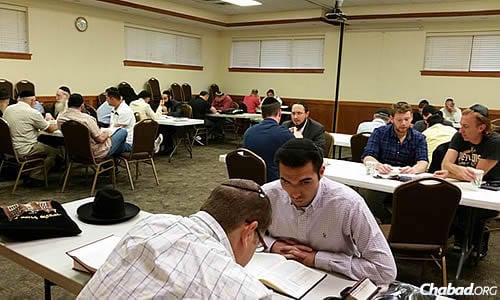
Day was breaking, and the air was still cool as I walked through the double wooden doors of Lubavitch Chabad of Skokie, north of Chicago. It was a few minutes before 5:30 a.m., and I was there to join as many as two dozen “regulars” who gather every morning for an hour of free-style Torah study.
On my way in, I meet Aaron Miller, founder of an online retail outlet. In one hand, he is holding a fruit shake. His other hand balances a stack of books in Hebrew and English.
“It’s like pickup basketball,” he explains to me. “We have more and more people coming in, learning Torah, digging deep into the text and discovering that Torah is really fun.”
For years now, Miller and a few others have been gathering for an hour of study before 6:30 prayers; recently, he decided to invite the wider community. “When there is a room full of people—each individual or group really getting into what they are studying—there is an energy that just fills the room,” he says, “and you lose track of time.”
The program, called Beis Medrash Boker (“Morning Study Hall”), was officially launched just a month ago. On the first morning, the room was festooned with balloons and the walls decorated with posters with stick-figure art. While the balloons are gone, the room is now decked out with a growing core group of devotees.
One by one, more people come into the room, holding binders, Talmud, Tanyas and other assorted study materials. Many stop briefly to fill up their cups with steaming coffee from the well-stocked refreshment table.
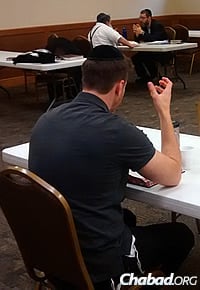 Aaron Miller deep in study.
Some people study alone, but most are in pairs. Among them are Chabad rabbis from nearby suburbs, in addition to local business people and others who have decided to join them. Miller tells me that a number of learners have now begun staying on for morning services as well—some for the first time.
“This program was created,” explains my study partner for the day, “to give each of us strength. Together, we can grow and toil in Torah, each of us motivating, encouraging and pushing each other to try new things and expand our horizons. Life is about growth. No matter what your background is, you can create a place in Torah that is uniquely your own. All you need to do is come at 5:30 with an empty coffee cup and an open mind.”
There are ambitious plans for the coming months. Alongside the regular students will be a weekly class in Chassidic texts with Rabbi Moshe Miller, an author and translator of Kabbalistic works from nearby Chicago.
Layers of Meaning
My partner and I chose to learn a teaching of the Rebbe—Rabbi Menachem M. Schneerson, of righteous memory—discussing the “wood chamber,” a structure in the Holy Temple in Jerusalem, which the High Priest would use as his personal quarters before and during Yom Kippur, when he performed the main rituals of the day.
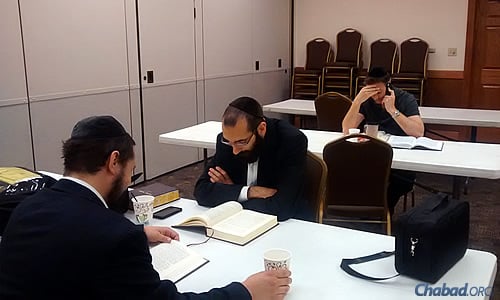
The topic is intense, as the Rebbe’s words peel back layers of meaning, probing for the reason behind the room’s three names—the Talmud also refers to it as the “chamber of the courtiers” and “chamber of princes.”
As the hour passes, our table piles high with Mishnahs, Talmuds and other books referenced in the Rebbe’s essay.
As we wend our way through the subject matter, I glance at the clock. Time has moved all too quickly. We increase our pace, racing to finish the essay before 6:30.
“Gentlemen, your diligence is impressive,” a voice prods us, “but you are needed for the minyan.”
Looking up, I see that many of the groups remain hard at work as well, trying to cram in a few more precious lines of Torah. We get up and enter the sanctuary, just a bit late for services.
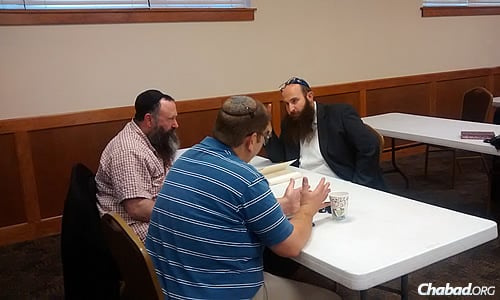
Participants bring binders, Talmud, Tanyas and other assorted study materials with them to learn from and discuss.
________________________________________
 YOUR QUESTIONS
Why Do We Tear Our Clothes After a Death?
When someone passes on, it is a tragedy. They have been lost to their family and friends, and there is a feeling of separation and distance that seems beyond repair. by Aron Moss
Question:
What is the reason for the custom of mourners tearing their clothing on the death of a loved one?
Answer:
On the most basic level, the tearing is expression of pain and sorrow over the passing. Torah law encourages—in fact mandates—such expressions as part of the mourning process.
But there is also a deeper significance. Judaism views death as a two-sided coin. On the one hand, when someone passes on, it is a tragedy. They have been lost to their family and friends, and there is a feeling of separation and distance that seems beyond repair. For this reason we observe a seven-day intense mourning period, during which the family sits at home and feels that pain and loss, followed by a year of mourning.
But often, within that very pain, the mourners have an underlying belief that “it isn’t true”—that their loved one hasn’t really gone. This is not just denial; in a way they are right. Death is not an absolute reality. Our souls existed before we were born, and they continue to exist after we die. The souls that have passed on are still with us. We can’t see them, but we sense they are there. We can’t hear them, but we know that they hear us. On the surface, we are apart. Beyond the surface, nothing can separate us.
So we tear our garments. This has a dual symbolism. We are recognizing the loss, that our hearts are torn. But ultimately, the body is also only a garment that the soul wears. Death is when we strip off one uniform and take on another. The garment may be torn, but the essence of the person within it is still intact.
From our worldly perspective death is indeed a tragedy, and the sorrow experienced by the mourners is real. But as they tear their garments, we hope that within their pain they can sense a glimmer of a deeper truth: that souls never die.
________________________________________
More in Your Questions:
• Which Year Was the Second Temple Destroyed, 69 CE or 70 CE? (By Yehuda Shurpin)
Question:
In some articles on your site it says the Second Temple was destroyed in 69 CE, and in others it says 70 CE. So what year was it?
Answer:
There are actually three different years found in Jewish sources for the destruction of the second Holy Temple in Jerusalem:
3828 / 68 CE
3829 / 69 CE
3830 / 70 CE
This discrepancy is based on a number of factors:1
How long is 420 years?
The Talmud2 states that the Second Temple stood for 420 years.
But the sages debate whether this means that the Temple was destroyed in its 420th year, or after it was standing for a full 420 years. The Temple was destroyed on the ninth of Av, which is toward the end of the Jewish calendar year, so 420 years could mean almost 420 years, or it could mean 420 years and 10 months.3
Rashi, in his commentary to the Talmud, tractate Avodah Zarah,4 and Maimonides5 are of the opinion that it was destroyed in the 420th year. However, most other Jewish sages6 are of the opinion that it was destroyed in the 421st year. In fact, Rashi appears to reverse himself, and cites this opinion in his commentary to Talmud, tractate Erchin.7
According to these opinions, the year of the Destruction was either 3828 (68 CE) or 3829 (69 CE), depending on how you interpret 420 years.
But it’s not that simple . . .
The Talmud also gives us another clue about the year of the Destruction: The Temple was destroyed in the year following a shemittah year (the seventh year in the seven-year agricultural cycle, when the land is left to lie fallow).8
Seemingly this gives us a simple way to calculate the year of the Destruction. We will take the last shemittah year and count back until we hit the proper year. The last shemittah was 57689 (2008). Counting backwards in increments of seven (5768/2008 - (277 * 7)), we get the number 3829—69 CE. If the year of the Destruction was the year after a shemittah year, that would mean the Temple was destroyed in 3830—70 CE. But that does not accord with either of the opinions mentioned above!
What gives?
To understand this, we need to go back to the beginning of creation. The Jewish New Year, Rosh Hashanah, is celebrated on the day Adam was created, which was really the 6th day of creation. Creation itself began on the 25th day of the month of Elul.
This raises the question: Was the first New Year considered the beginning of year one, or was it year two, with year one being shenat tohu, the “year of desolation”? In other words, do we count the years from the creation of man, or do we count from the creation of the world? Although it was merely six days earlier, the Talmud10 tells us that for counting purposes, even one day is considered a year.
The sages of the “East”—i.e., the Babylonian Talmud, the Seder Olam and their commentators—count from when Adam was created. The sages of the “West”—i.e. the Jerusalem Talmud—begin counting from the creation of the world.
We can now understand the discrepancy about the year of shemittah, and also why the year 70 CE is commonly given as the year the Temple was destroyed. For although the sages of the Babylonian Talmud counted from the year Adam was created, common practice11 has become to count from the year the world was created, counting the “year of desolation” as year 1.
This means that to all years given in the Babylonian Talmud and its commentaries, we must add one. Accordingly, the year of the Destruction would be 3830 (70 CE). Now the shemittah years work well: 3829 + (277 * 7) = 5768 (2008), coinciding with common practice.
Maimonides, on the other hand, is of the opinion that since the shemittah year is counted from the month of Tishrei and the Destruction occurred toward the end of the year, the Talmud considers the Temple to have been destroyed after a shemittah year, even though it was actually destroyed in such a year. According to him, the year of the Destruction, counting from the year of the creation of the world, would be 3829 (69 CE) and not 3830, but the shemittah years would still match up.12
Based on the above, we can now understand why the year of the destruction of the Temple is variously given as 3828 (68 CE), 3829 (69 CE) and 3830 (70 CE).
May we merit the rebuilding of the Holy Temple speedily in our days.
Year of Destruction
| TEMPLE DESTROYED IN ITS | COUNTING FROM CREATION OF MAN | COUNTING FROM CREATION OF WORLD | |
|---|---|---|---|
| Rashi on Avodah Zarah and Maimonides | 420th year | 3828 (68 CE) | 3829 (69 CE) |
| Tosafot and most other commentaries | 421st year | 3829 (69 CE) | 3830 (70 CE) |
1.Before we get in the reasons behind the discrepancy, it should be noted that the civil dates used here, such as 69 CE or 70 CE, are for clarification purposes only. After all, the civil calendar that is in use today was hardly functional in those early years.
2.Talmud, Erchin 12b.
3.The Second Temple was dedicated on the 24th of Kislev (see Haggai 2:18). Following the opinion of Rashi (to Exodus 30:17), and the way the Talmud in general seems to count, years are always counted from Tishrei—hence 9 Av would be 10+ months into the year. See, however, Ramban (to Exodus 30:12), that years are counted from day to day, in which case the time span in question is (420 years and) about 7 months.
4.9b, s.v. v’siman.
5.See commentaries to Mishneh Torah, Hilchot Shemittah ve-Yovel 10:2–5.
6.See, for example, the commentaries of Tosafot, Ramban, Ritva, et al. on Talmud, Avodah Zarah and Erchin loc. cit.
7.12b, s.v. arba; see also Tosafot, Avodah Zarah 9b, s.v. hai. See, however, Chatam Sofer, Responsa, Choshen Mishpat 50, who gives an alternative explanation as to the seeming discrepancy in Rashi.
8.Talmud, Taanit 29a and Erchin 11b; see also Seder Olam, ch. 30.
9.The next one will be 5775 (2015).
10.Talmud, Rosh Hashanah 2b.
11.Rabbi Yehoshua Falk Katz, Derishah, Choshen Mishpat 67:9.
12.See commentary of the Vilna Gaon (Rabbi Eliyahu ben Shlomo Zalman, Gra) on Mishneh Torah, ibid. 10:5
________________________________________
 STORY
STORYThe Fox in the Vineyard
The fox could see what luscious grapes grew in the vineyard, but the hole in the fence was too small for him. So he fasted for three days until he became thin enough to slip through . . . From the Midrash
Published and copyrighted by Kehot Publication Society
A sly fox passed a lovely vineyard. A tall, thick fence surrounded the vineyard on all sides. As the fox circled around the fence, he found a small hole in the fence, barely large enough for him to push his head through. The fox could see what luscious grapes grew in the vineyard, and his mouth began to water. But the hole was too small for him. So what did the sly fox do? He fasted for three days, until he became so thin that he managed to slip through the hole.
Inside the vineyard, the fox began to eat to his heart’s content. He grew bigger and fatter than ever before. Then he wanted to get out of the vineyard. But alas! The hole was too small again. So what did he do? He fasted for three days again, and then just about managed to slip through the hole and out again.
Turning his head towards the vineyard, the poor fox said: “Vineyard, O vineyard! How lovely you look, and how lovely are your fruits and vines. But what good are you to me? just as I came to you, so I leave you . . .”
And so, our sages say, it is also with this world. It is a beautiful world, but—in the words of King Solomon, the wisest of all men—just as man comes into this world emptyhanded, so he leaves it. Only the Torah he studied, the mitzvot he performed, and the good deeds he practiced are the real fruits which he can take with him.
________________________________________
 LIFESTYLES
Ratatouille
I love how versatile ratatouille is. It tastes good both cold and warm. You can serve it over rice or quinoa for a filling vegetarian meal, or alongside chicken, meat or fish for a flavorful, light side. by Miriam Szokovski
I love how versatile ratatouille is. It tastes good both cold and warm. You can serve it over rice or quinoa for a filling vegetarian meal, or alongside chicken, meat or fish for a flavorful, light side. It keeps well in the fridge for several days, and can also be frozen for later use. To me, it’s the perfect summer food.


Yields: 10–12 servings

1 large Spanish onion, roughly diced
2 lb. zucchini, sliced in rounds
1 red pepper, cut in strips
1 green pepper, cut in strips
¼ cup oil
1 tsp. kosher salt
Sauce Ingredients:
2½ cups tomato sauce
½ cup water
1½ tsp. dried oregano
1½ tsp. dried basil
3 tbsp. honey
½ tsp. kosher salt
Directions:
In the bottom of a strong pot, sauté the onion in the oil and 1 tsp. kosher salt until translucent (about 20 minutes).
Meanwhile, put the tomato sauce, water, oregano, basil, honey and ½ tsp. salt into a small pot and bring to a boil. Reduce to a simmer and let cook for 10–15 minutes until thick and flavorful.
Once the onions are soft and translucent, add the zucchini and peppers. Mix well. Pour in the tomato sauce and cook over a low flame until zucchini and peppers are soft.
Note: If you’re going to be freezing and later reheating the ratatouille, or even refrigerating to later reheat, I suggest cooking it until the veggies are just soft enough. If they’re too mushy, when you try to reheat it they will fall apart.
Yields: 10–12 servings

More in Lifestyles:
• Destruction of Solomon’s Temple (By James Herman)

________________________________________

No comments:
Post a Comment