 Daily Gospel for Thursday, 10 July 2014
"Peter replied, 'Master, to whom would we go? You have the words of real life, eternal life. We’ve already committed ourselves, confident that you are the Holy One of God.”"(John 6:68-69)'
Thursday of the Fourteenth week in Ordinary Time
Saints of the Day:
SAINTS RUFINA AND SECUND
Virgins and Martyrs
(3rd century°)
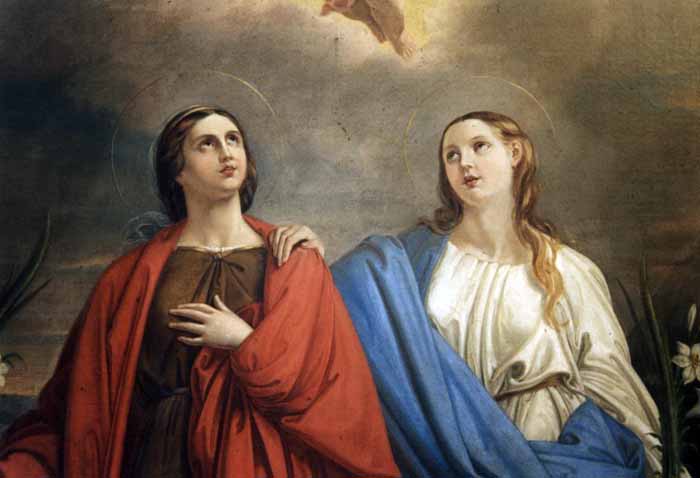
But when, guarded by angels, they persevered in their holy resolution, they were beheaded at the tenth milestone on the Aurelien Way. Their bodies were buried by a matron named Plautilla on her estate outside the city, and were afterwards buried in the basilica of Constantine, near the baptistry.
The Roman Breviary (1964)
THE SEVEN HOLY BROTHERS
and ST. FELICITAS, their Mother
Martyrs
(† c. 150)

This excited the anger of the heathen priests, who complained to the emperor that the boldness with which Felicitas publicly practised the Christian religion drew many from the worship of the immortal gods, who were the guardians and protectors of the empire, and that, in order to appease these false gods, it was necessary to compel this lady and her children to sacrifice to them.
Publius, the prefect of Rome, caused the mother and her sons to be apprehended and brought before him, and, addressing her, said, "Take pity on your children, Felicitas; they are in the bloom of youth, and may aspire to the greatest honors and preferments." The holy mother answered, "Your pity is really impiety, and the compassion to which you exhort me would make me the most cruel of mothers." Then turning herself towards her children, she said to them, "My sons, look up to heaven, where Jesus Christ with his Saints expects you. Be faithful in his love, and fight courageously for your souls."
Publius, being exasperated at this behavior, commanded her to be cruelly buffeted; he then called the children to him one after another, and used many artful speeches, mingling promises with threats to induce them to adore the gods. His arguments and threats were equally in vain, and the brothers were condemned to be scourged. After being whipped, they were remanded to prison, and the prefect, despairing to overcome their resolution, laid the whole process before the emperor. Antoninus gave an order that they should be sent to different judges, and be condemned to different deaths.
Januarius was scourged to death with whips loaded with plummets of lead. The two next, Felix and Philip, were beaten with clubs till they expired. Sylvanus, the fourth, was thrown headlong down a steep precipice. The three youngest, Alexander, Vitalis, and Martialis, were beheaded, and the same sentence was executed upon the mother four months after.
Lives of the Saints, by Alban Butler, Benziger Bros. ed. [1894]
Thursday of the Fourteenth week in Ordinary Time
book of Hosea 11: Israel Played at Religion with Toy Gods
1-9 “When Israel was only a child, I loved him.
I called out, ‘My son!’—called him out of Egypt.
But when others called him,
he ran off and left me.
He worshiped the popular sex gods,
he played at religion with toy gods.
Still, I stuck with him. I led Ephraim.
I rescued him from human bondage,
But he never acknowledged my help,
never admitted that I was the one pulling his wagon,
That I lifted him, like a baby, to my cheek,
that I bent down to feed him.
Now he wants to go back to Egypt or go over to Assyria—
anything but return to me!
That’s why his cities are unsafe—the murder rate skyrockets
and every plan to improve things falls to pieces.
My people are hell-bent on leaving me.
They pray to god Baal for help.
He doesn’t lift a finger to help them.
But how can I give up on you, Ephraim?
How can I turn you loose, Israel?
How can I leave you to be ruined like Admah,
devastated like luckless Zeboim?
I can’t bear to even think such thoughts.
My insides churn in protest.
And so I’m not going to act on my anger.
I’m not going to destroy Ephraim.
And why? Because I am God and not a human.
I’m The Holy One and I’m here—in your very midst.
Psalm 80: An Asaph Psalm
1-2 Listen, Shepherd, Israel’s Shepherd—
get all your Joseph sheep together.
Throw beams of light
from your dazzling throne
So Ephraim, Benjamin, and Manasseh
can see where they’re going.
Get out of bed—you’ve slept long enough!
Come on the run before it’s too late.
3 God, come back!
Smile your blessing smile:
That will be our salvation.
8-18 Remember how you brought a young vine from Egypt,
cleared out the brambles and briers
and planted your very own vineyard?
You prepared the good earth,
you planted her roots deep;
the vineyard filled the land.
Your vine soared high and shaded the mountains,
even dwarfing the giant cedars.
Your vine ranged west to the Sea,
east to the River.
So why do you no longer protect your vine?
Trespassers pick its grapes at will;
Wild pigs crash through and crush it,
and the mice nibble away at what’s left.
God-of-the-Angel-Armies, turn our way!
Take a good look at what’s happened
and attend to this vine.
Care for what you once tenderly planted—
the vine you raised from a shoot.
And those who dared to set it on fire—
give them a look that will kill!
Then take the hand of your once-favorite child,
the child you raised to adulthood.
We will never turn our back on you;
breathe life into our lungs so we can shout your name!
Holy Gospel of Jesus Christ according to Saint Matthew 10:5-8 Jesus sent his twelve harvest hands out with this charge:
“Don’t begin by traveling to some far-off place to convert unbelievers. And don’t try to be dramatic by tackling some public enemy. Go to the lost, confused people right here in the neighborhood. Tell them that the kingdom is here. Bring health to the sick. Raise the dead. Touch the untouchables. Kick out the demons. You have been treated generously, so live generously.
9-10 “Don’t think you have to put on a fund-raising campaign before you start. You don’t need a lot of equipment. You are the equipment, and all you need to keep that going is three meals a day. Travel light.
11 “When you enter a town or village, don’t insist on staying in a luxury inn. Get a modest place with some modest people, and be content there until you leave.
12-15 “When you knock on a door, be courteous in your greeting. If they welcome you, be gentle in your conversation. If they don’t welcome you, quietly withdraw. Don’t make a scene. Shrug your shoulders and be on your way. You can be sure that on Judgment Day they’ll be mighty sorry—but it’s no concern of yours now.
Thursday of the Fourteenth week in Ordinary Time
Commentary of the Day:
Saint Bonaventure (1221-1274), Franciscan, Doctor of the Church
Life of Saint Francis, Legenda major, ch. 3 (trans. ©Franciscan Institute of St Bonaventure University)
"Make this proclamation: 'The kingdom of heaven is at hand'"
At the same time, another good man entered the Order [of Saint Francis], bringing the number of the man of God's blessed offspring to seven. Then the pious father called all his sons to himself and, as he told them many things about the kingdom of God, contempt for the world, the denial of their own wills, and the chastising of their bodies, he revealed his proposal to send them to the four corners of the world… "Go," the gentle father said to his sons, "while you are announcing peace to the people, preach repentance for the forgiveness of sins (Mk 1,4). Be patient in trials, watchful in prayer, strenuous in work, moderate in speech, reserved in manner, and grateful for favors, for because of all these things an eternal kingdom is being prepared for you" (Mt 5,3; Lk 6,20).
As they humbly prostrated themselves on the ground before God's servant, they accepted the command of obedience with a spirit of joy. Then Francis spoke to each one individually: "Cast your care upon the Lord, and he will sustain you" (Ps 54[55],23). He was accustomed to saying this phrase whenever he sent a brother under obedience. Knowing he should give himself as an example to others, he too then set out with one companion for one part of the world that he might first practice rather than preach (cf. Acts 1,1).
-------

No comments:
Post a Comment