 DAILY GOSPEL for Wednesday, 23 July 2014
"Peter replied, 'Master, to whom would we go? You have the words of real life, eternal life. We’ve already committed ourselves, confident that you are the Holy One of God.'" (John 6:68-69)
Wednesday of the Sixteenth week in Ordinary Time
Feast of the Church: In Europe: Feast of St Bridget, Religious, patron of Europe - Proper readings
Readings for the Feast in Europe
Letter to the Galatians 2:19-21 What actually took place is this: I tried keeping rules and working my head off to please God, and it didn’t work. So I quit being a “law man” so that I could be God’s man. Christ’s life showed me how, and enabled me to do it. I identified myself completely with him. Indeed, I have been crucified with Christ. My ego is no longer central. It is no longer important that I appear righteous before you or have your good opinion, and I am no longer driven to impress God. Christ lives in me. The life you see me living is not “mine,” but it is lived by faith in the Son of God, who loved me and gave himself for me. I am not going to go back on that.
Is it not clear to you that to go back to that old rule-keeping, peer-pleasing religion would be an abandonment of everything personal and free in my relationship with God? I refuse to do that, to repudiate God’s grace. If a living relationship with God could come by rule-keeping, then Christ died unnecessarily.
Psalms 34:2 I live and breathe God;
if things aren’t going well, hear this and be happy:
3 Join me in spreading the news;
together let’s get the word out.
4 God met me more than halfway,
he freed me from my anxious fears.
5 Look at him; give him your warmest smile.
Never hide your feelings from him.
6 When I was desperate, I called out,
and God got me out of a tight spot.
7 God’s angel sets up a circle
of protection around us while we pray.
8 Open your mouth and taste, open your eyes and see—
how good God is.
Blessed are you who run to him.
9 Worship God if you want the best;
worship opens doors to all his goodness.
10 Young lions on the prowl get hungry,
but God-seekers are full of God.
11 Come, children, listen closely;
I’ll give you a lesson in God worship.
Holy Gospel of Jesus Christ according to Saint John 15: The Vine and the Branches
1-3 “I am the Real Vine and my Father is the Farmer. He cuts off every branch of me that doesn’t bear grapes. And every branch that is grape-bearing he prunes back so it will bear even more. You are already pruned back by the message I have spoken.
4 “Live in me. Make your home in me just as I do in you. In the same way that a branch can’t bear grapes by itself but only by being joined to the vine, you can’t bear fruit unless you are joined with me.
5-8 “I am the Vine, you are the branches. When you’re joined with me and I with you, the relation intimate and organic, the harvest is sure to be abundant. Separated, you can’t produce a thing. Anyone who separates from me is deadwood, gathered up and thrown on the bonfire. But if you make yourselves at home with me and my words are at home in you, you can be sure that whatever you ask will be listened to and acted upon. This is how my Father shows who he is—when you produce grapes, when you mature as my disciples.
Read the commentary of the Gospel by
Blessed John Paul II, Pope from 1978 to 2005
Apostolic Letter issued Motu Proprio "Spes aedificandi", October 1, 1999 (© Libreria Editrice Vaticana)
"Saint Bridget of Sweden, co-patroness of Europe"
In order to build the new Europe on solid foundations it is certainly not enough to appeal to economic interests alone; for these, while sometimes bringing people together, are at other times a cause of division. Rather there is a need to act on the basis of authentic values, which are founded on the universal moral law written on the heart of every person. A Europe which would exchange the values of tolerance and universal respect for ethical indifference and skepticism about essential values would be opening itself to immense risks and sooner or later would see the most fearful spectres of its past reappear in new forms.
To remove this threat, the role of Christianity-which tirelessly points to the horizon of ultimate truth-is once again seen to be vital. Also, in light of the many areas of agreement with other religions acknowledged by the Second Vatican Council (cf. Declaration on the Relationship of the Church to Non-Christian Religions Nostra Aetate), it must be strongly emphasized that openness to the Transcendent is a vital dimension of human existence. It is essential, therefore, for all Christians who live in the different nations of the Continent to renew their commitment to bear witness to their faith. Theirs is the task of nourishing the hope of full salvation by the proclamation which properly belongs to them: the proclamation of the Gospel, the "Good News" that God has drawn near to us and in his Son Jesus Christ has offered us redemption and fullness of divine life. In the power of the Spirit who has been given to us we can lift our eyes to God and call upon him with the tender name of "Abba", Father! (cf. Rom 8:15: Gal 4:6).
It is precisely this proclamation of hope that I have wished to strengthen by calling for a renewed devotion, in a "European" context, to these three great women, who in different historical times made so significant a contribution to the growth of the Church and the development of society.
Saints of the day:
SAINT BRIDGET OF SWEDEN
Patron saint of Sweden and co-patron of Europe
(1304-1373)

St. Bridget was born of the Swedish royal family, in 1304. In obedience to her father, she was married to Prince Ulpho of Sweden, and became the mother of eight children, one of whom, Catherine, is honored as a Saint.
After some years she and her husband separated by mutual consent. He entered the Cistercian Order, and Bridget founded the Order of St. Saviour, in the Abbey of Wastein, in Sweden.
In 1344 she became a widow, and thenceforth received a series of the most sublime revelations, all of which she scrupulously submitted to the judgment of her confessor. By the command of Our Lord, Bridget went on a pilgrimage to the Holy Land, and amidst the very scenes of the Passion was further instructed in the sacred mysteries.
She died in 1373.
Lives of the Saints, by Alban Butler, Benziger Bros. ed. [1894]
Blessed Vasiľ Hopko
(1904-1976)
Bishop and martyr
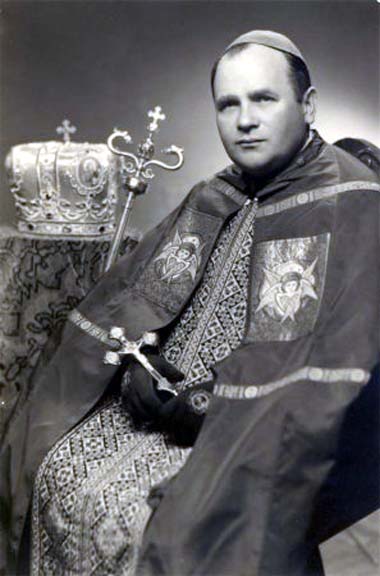
Vasil' Hopko was born on April 21, 1904 in Hrabské, a small village in eastern Slovakia. His father died when he was 1 year old, leaving his mother alone to care for the child. Vasil's mother left for the United States in 1908 to find work, putting Vasil' under the care of his grandfather. When the boy was 7, he went to live with his uncle, Demeter Petrenko, a Greek-Catholic priest.
His uncle's example awakened in Vasil' a call to the priesthood, and in 1923 he decided to enter the Greek-Catholic Seminary of Presov. He was ordained a priest on February 3, 1929 and was entrusted with the pastoral care of the Greek-Catholic faithful in Prague. Here, he was involved in many different activities: work with youth, the elderly, the unemployed and orphans. Fr Vasil' founded the Movement of Greek-Catholic Students and the Greek-Catholic Youth Union, and contributed to the building of the city's Greek-Catholic parish, becoming its priest. It was also in Prague that, after 22 years, the young priest met his mother who had returned from the United States.
In 1936, Fr Vasil' returned to Slovakia where he served as spiritual father in the Greek-Catholic Seminary of Presov. In 1941, he was appointed as secretary of the Bishop's Curia, and he became professor of moral and pastoral theology at the Theological Faculty in Presov in 1943. He also found free moments to write and publish various works and became the first editor of the magazine Blahovistnik (The Gospel Messenger).
After World War II, the Czechoslovakian Republic fell under a growing Soviet Bolshevik and atheist influence. Foreseeing a systematic "Sovietization" and the resulting totalitarian-atheistic Marxism, Bishop Gojdic of Presov asked the Holy See for an Auxiliary Bishop to help him defend against the attacks on the Greek-Catholic faithful and the Church. Fr Vasil' became the newly-appointed Auxiliary Bishop and was ordained on May 11, 1947. He helped the Bishop greatly, preparing the people for hard times on the horizon.
Little by little the Czechoslovakian Communist Party prepared for the violent elimination of the Greek-Catholic Church in its nation. On April 28, 1950, the Communists carried out their work of "liquidation" during the so-called "Council of Presov", held without the presence of Bishops. Here they declared that the Greek-Catholic Church of Czechoslovakia no longer existed and that all its priests, faithful and churches were to be transferred over to the Orthodox Church. Bishops Gojdic and Hopko were arrested.
Following the arrest, Bishop Hopko underwent drastic interrogation and torture so he would deny his faith and confess to fabricated accusations. On October 24, 1951, after more than a year of cruel and diabolic interrogation, he was condemned by the State Court to 15 years in prison and a loss of all civil rights for 10 years. While in prison, in addition to the torture he received, he was given small doses of arsenic which caused a chronic poisoning, which was later verified by an analysis of his bones.
On May 12, 1964 he was released from prison for health reasons. After years of mistreatment, the Bishop suffered from grave physical ailments and mental depression caused by the constant torture and inhuman treatment. Notwithstanding all this, he continued to contribute actively to the resurgence of the Greek-Catholic Church.
On June 13, 1968, the renewal of the Greek-Catholic Church of Czechoslovakia was re-estabilized after 18 years of open persecution. From 1968, Bishop Hopko began living in Presov; on December 20, 1968, Pope Paul VI confirmed his appointment as Auxiliary Bishop for all Greek-Catholic faithful in Czechoslovakia. He carried out this responsibility with great care, encouraging the faithful and ordaining priests.
Bishop Hopko died on July 23, 1976 in Presov. He made his own the words of Bishop Gojdic: "For me, it is not important if I die in the Bishop's Palace or in prison; what matters is entering into Paradise".
He was beatified by Pope John Paul II on September 14, 2003 at Bratislava. - Copyright © Libreria Editrice Vaticana
Wednesday of the Sixteenth week in Ordinary Time
Book of Jeremiah 1: Demolish, and Then Start Over
1-4 The Message of Jeremiah son of Hilkiah of the family of priests who lived in Anathoth in the country of Benjamin. God’s Message began to come to him during the thirteenth year that Josiah son of Amos reigned over Judah. It continued to come to him during the time Jehoiakim son of Josiah reigned over Judah. And it continued to come to him clear down to the fifth month of the eleventh year of the reign of Zedekiah son of Josiah over Judah, the year that Jerusalem was taken into exile. This is what God said:
5 “Before I shaped you in the womb,
I knew all about you.
Before you saw the light of day,
I had holy plans for you:
A prophet to the nations—
that’s what I had in mind for you.”
6 But I said, “Hold it, Master God! Look at me.
I don’t know anything. I’m only a boy!”
7-8 God told me, “Don’t say, ‘I’m only a boy.’
I’ll tell you where to go and you’ll go there.
I’ll tell you what to say and you’ll say it.
Don’t be afraid of a soul.
I’ll be right there, looking after you.”
God’s Decree.
9-10 God reached out, touched my mouth, and said,
“Look! I’ve just put my words in your mouth—hand-delivered!
See what I’ve done? I’ve given you a job to do
among nations and governments—a red-letter day!
Your job is to pull up and tear down,
take apart and demolish,
And then start over,
building and planting.”
Psalms 71:1-3 I run for dear life to God,
I’ll never live to regret it.
Do what you do so well:
get me out of this mess and up on my feet.
Put your ear to the ground and listen,
give me space for salvation.
Be a guest room where I can retreat;
you said your door was always open!
You’re my salvation—my vast, granite fortress.
4-7 My God, free me from the grip of Wicked,
from the clutch of Bad and Bully.
You keep me going when times are tough—
my bedrock, God, since my childhood.
I’ve hung on you from the day of my birth,
the day you took me from the cradle;
I’ll never run out of praise.
Many gasp in alarm when they see me,
but you take me in stride.
12-16 God, don’t just watch from the sidelines.
Come on! Run to my side!
My accusers—make them lose face.
Those out to get me—make them look
Like idiots, while I stretch out, reaching for you,
and daily add praise to praise.
I’ll write the book on your righteousness,
talk up your salvation the livelong day,
never run out of good things to write or say.
I come in the power of the Lord God,
I post signs marking his right-of-way.
17-24 You got me when I was an unformed youth,
God, and taught me everything I know.
Now I’m telling the world your wonders;
I’ll keep at it until I’m old and gray.
God, don’t walk off and leave me
until I get out the news
Of your strong right arm to this world,
news of your power to the world yet to come,
Your famous and righteous
ways, O God.
God, you’ve done it all!
Who is quite like you?
You, who made me stare trouble in the face,
Turn me around;
Now let me look life in the face.
I’ve been to the bottom;
Bring me up, streaming with honors;
turn to me, be tender to me,
And I’ll take up the lute and thank you
to the tune of your faithfulness, God.
I’ll make music for you on a harp,
Holy One of Israel.
When I open up in song to you,
I let out lungsful of praise,
my rescued life a song.
All day long I’m chanting
about you and your righteous ways,
While those who tried to do me in
slink off looking ashamed.
Holy Gospel of Jesus Christ according to Saint Matthew 13: A Harvest Story
1-3 At about that same time Jesus left the house and sat on the beach. In no time at all a crowd gathered along the shoreline, forcing him to get into a boat. Using the boat as a pulpit, he addressed his congregation, telling stories.
3-8 “What do you make of this? A farmer planted seed. As he scattered the seed, some of it fell on the road, and birds ate it. Some fell in the gravel; it sprouted quickly but didn’t put down roots, so when the sun came up it withered just as quickly. Some fell in the weeds; as it came up, it was strangled by the weeds. Some fell on good earth, and produced a harvest beyond his wildest dreams.
9 “Are you listening to this? Really listening?”
Wednesday of the Sixteenth week in Ordinary Time
Commentary of the day:
Saint John-Mary Vianney (1786-1859), priest, curé of Ars
Sermons
"A sower went out to sow"
Now if you ask me what Jesus Christ means by the sower who goes out early to sow seed in his field: my dear brethren, that sower is the good God himself! He began his work for our salvation from the beginning of the world by sending his prophets to us before the coming of the Messiah to teach us what we had to do to be saved. And, not satisfied with sending his servants, he came himself, marked out for us the way we should take, and came to preach his holy word.
Do you know what those people are like who aren't sustained by that holy word or who abuse it? They are like the sick without a doctor, like a traveller who has gone astray without a guide, like a poor man without means. Let us rather say, my brethren, that it is altogether impossible to love God and please him without being nourished by this divine word. What is there that can draw us to attach ourselves to him if not because we know him? And what enables us to know him with all his perfections, beauty and love for us if not God's word, which teaches us all he has done for us and the good things he is preparing for us in the life to come if we try hard to please him?
-------

No comments:
Post a Comment