NOTE: This is a digest of news features provided by United Methodist Communications for August 18-22. It includes summaries of United Methodist News Service stories and additional briefs from around the United Methodist connection. Full versions of the stories with photographs and related features can be found at umc.org/news.
Top Stories
Doctor's daily prayer for Liberia: 'God, send help'
NASHVILLE, Tenn. (UMNS) - A United Methodist doctor from Raleigh, North Carolina, talks about volunteering at an Ebola center in Liberia for Samaritan's Purse. Dr. Vicki Morris says the situation is much worse than current news reports. "There just aren't enough public health people to respond."
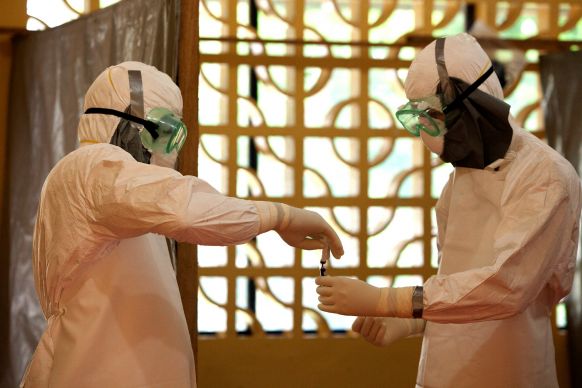
Photo courtesy of Samaritan’s Purse.
Since July 2014, Samaritan’s Purse has been managing an Ebola isolation center in Liberia located in Foya near the border with Guinea. The organization’s team of medical doctors and highly trained nurses is providing direct clinical care to patients infected with the virus.
Doctor’s daily prayer for Liberia: ‘God, send help’ by Kathy L. Gilbert Nashville, Tenn. (UMNS)
Dr. Vicki Morris just finished volunteering in one of the last places on earth anyone would want to be right now: an Ebola treatment center in rural Liberia.
Morris wasn’t ready to leave even though she knew the situation was getting dangerous.
“That was just heartbreaking to me … I felt like we were abandoning our nurses, we were abandoning our patients and we didn’t know who was coming in to take over, if anybody,” she said. She has learned since that Doctors Without Borders took over the center.
UMNS COVERAGE OF EBOLA OUTBREAK
Health care workers on front lines of Ebola outbreak
Sierra Leone task force targets Ebola
Ebola changes church life in eastern Sierra Leone
Ebola outbreak closes United Methodist health center
Church responds to international emergency of Ebola
Nurses, doctors save lives but lose their own
Social support key to Ebola fight, leaders say
Church uses communication to combat Ebola outbreak
Ebola quarantine sparks violent protests
Sierra Leone Video Diary: Ebola Outbreak
United Methodist Health Workers Treat Ebola
Morris, a member of Soapstone United Methodist Church in Raleigh, North Carolina, and an infectious disease specialist, was in Foya, Liberia, from July 5-Aug.1, working with Samaritan’s Purse. The nondenominational Christian organization runs a center close to the Guinea border where the Ebola outbreak started in May.
She planned to be there six weeks but was evacuated after only three weeks because of the beginning of civil unrest, which has led President Ellen Johnson Sirleaf to quarantine neighborhoods and impose a curfew.
Morris called Bishop Hope Morgan Ward after she returned to the U.S. In a video, the North Carolina bishop appealed to the church to give gifts to the United Methodist Committee on Relief to fight the Ebola outbreak.
Heartbreaking to leave
Morris worked with Liberian doctors and nurses as well as other volunteers from Samaritan’s Purse.
Groups from the center went into the communities daily to educate people about Ebola and one group was attacked.
“They made it back with injuries but nothing serious,” she said. “After that it just seemed to unravel.”
The center had from 20 to 30 patients at the time she was evacuated.
“Every day we went in dressed up in the suits (protective equipment), there wasn’t a lot we could do but we could start IVs and give them medication. The only blood test we did was for Ebola and malaria.”
Courageous nurses
Those samples were sent to a laboratory in Guinea. She said she is still on the email list and gets notices when samples go out from Foya, so she knows cases are still coming in.
“On the day we left, 17 cases came in all at once from that district where the group was attacked.”
The nurses and health care professionals are still at the center, still treating patients, she said. “Samaritan’s Purse pulled out. The nurses could have run away but they didn’t, they stayed to take care of the patients.
“Lots of people tell me I am courageous but I look at those nurses and I think, ʿYou have a lot more guts and courage than I do.’”
Morris said the Ebola patients themselves helped care for each other, especially looking out for children who came to the center alone. Some of the children had parents who had died or were too sick to care for them. Some had healthy parents who had to stay outside of the center.
She agrees with Ken Isaacs, director of Samaritan’s Purse, who testified before Congress on Aug.7 that the reported cases of Ebola only represent 25 percent to 50 percent of the actual cases.
Humanitarian mission needed
“There is a lot of paranoia and distrust and people are staying in the villages and dying,” she said. “Every day, I look at the news reports and talk to contacts I have there and the situation is much, much worse than what you are reading, especially the civil unrest.”
Morris said she is concerned about Liberia and feels some type of military response is needed as a humanitarian mission to at least get in supplies and provide security.
“It is beyond the capacity of the Liberian government or the Ministry of Health or even NGO’s like The United Methodist Church. There just aren’t enough public health people to respond.”
Morris is glad the attention of the world is on West Africa and this Ebola outbreak.
“Some of the things that bother me that I am reading are the focus seems to be on fear and concern that this will get into the United States and affect us. That’s a concern, but we should be sympathetic and wanting to help even if it doesn’t affect us.”
Morris said she was amazed by the people of Liberia. “They are not stupid or evil—I know you see a lot of things in the media that make you think otherwise, but they are just amazing people.”
She said many of Liberians think Ebola is God’s punishment. She said she told everyone she met, “God hears your prayers, God loves you.”
Morris said the experience changed her and she is still thinking and praying about what she is supposed to do next.
“My prayer, every day, is ‘God, send help.’”
*Gilbert is a multimedia news reporter for United Methodist News Service. Contact her at (615) 742-5470 or newsdesk@umcom.org.
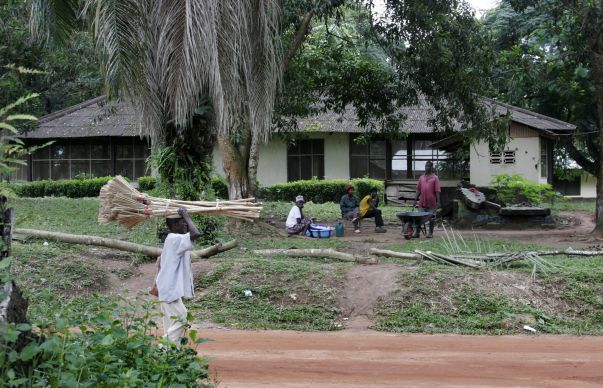
2012 file photo by Jan Snider, United Methodist Communications
Ganta Hospital in Liberia where the Ebola virus outbreak has caught the nation unprepared. Funding for critical protective gear for health practitioners and patients in Liberia has been seriously lacking. A similar situation exists in Côte d’Ivoire should Ebola cases arise, Dunbar writes.
Commentary: Cultural norms, politics hinder Ebola response by Nyamah Dunbar DABOU, Côte d’Ivoire (UMNS)
Information is key in public health crises such as the Ebola outbreak, and misinformation is often the line between life and death.
That is why The United Methodist Church stresses information and training components so much for our health boards and community health workers.
 Nyamah Dunbar
Photo courtesy of Nyamah Dunbar.
Officially, Côte d’Ivoire has no confirmed cases. However, the nation is officially on alert, and the borders with Liberia and Guinea are closed. Unfortunately, I'm seeing and hearing what I saw when Liberia reported its first cases back in March. People in Côte d’Ivoire have received via radio/TV the same general basic health messages for prevention:
Don't eat "bush meat" - primates and other wild animals
Don't shake hands
Don't touch dead bodies
Avoid crowds
Report anyone who has a fever or appears to be ill
On a recent visit to Dabou United Methodist Hospital, I spoke with the chief medical officer, who shared frustrations that were similar to what I heard in Liberia. The concern was that every one of the precautionary measures listed above violates West African cultural norms.
These are tactile communities. Here, people don't just greet each other; they stand and hold hands as they speak or walk down the street together. People just don't leave the sick or the dead; true grief is not considered real unless it is emotional and actively displayed (kissing the dead, hugging them, rolling and crying on the ground).
So the Ebola crisis touches on the true cultural sense of “African-ness.”
Habits must change
I hope the crisis doesn’t spread to Côte d’Ivoire, but if the country fails to capture the public understanding and prevent the spread of the disease, it could suffer a similar catastrophe to that of its neighbors.
Liberia (Like Sierra Leone and Guinea) suffers from a weak health infrastructure. All of the major hospitals in the nation buckled under this crisis and either shut down completely or significantly reduced their work to basic operations. This is when fear and panic hit the ceiling. The majority of the population finally gets it that this Ebola is a real crisis, even though there are minor sectors of the population who do not believe the existence of the virus. People were even afraid to walk or sit next to each other when I was in Monrovia.
Under these conditions, how do you go to the church? Not surprisingly, this question has played a major role in the debate. People have drawn into their respective faiths even more deeply. "God will not allow me to die from Ebola" is a common statement. But do they understand that inasmuch as God wouldn't allow it, the necessary precautions must be taken?
The necessary precautions rely so much on the changing of habits. Sanitation remains a serious issue linking to a wide range of basic illnesses across Africa; and the Ebola fear has made people more cautious about hand-washing. In Liberia, every government/business/private office, including grocery stores, is required to set up sanitized stations at entries and exits. People are complying, although I saw a security guy nearly have to wrestle with an adult to wash his hands before entry to an office.
Poor support for health care
In addition to the need for changing cultural norms, politics poses a challenge. Governments were too slow in responding at the onset of the crisis. Resources have been limited, and long-standing issues which have hampered overall development, continue to plague the health sector. Health workers in some public institutions have not been paid for nearly five months, and they fear for their lives in responding to the outbreak, particularly when the necessary protective gear and treatment are lacking. How can the nation ask them to stand up to the Ebola crisis?
Funding for critical protective gear for health practitioners and patients in Liberia has been seriously lacking. A similar situation exists here in Côte d’Ivoire, with hospitals and health care workers being told there is no support for protective equipment and gear should Ebola cases arise.
This would be a perfect time for the region’s church leaders to step up, but unfortunately from what I observed in Liberia and discussed at Dabou with local United Methodist pastors, many have sentiments similar to general population: fear and panic, while some are jaded regarding the government's response. While some church leaders have undermined the health messaging around the issue, the message of caution for the virus has begun to creep into Sunday sermons.
Reasons for hope
However, all hope is not lost. The World Bank has decided to allocate $200 million toward the response effort, and private initiatives are supporting a response, too. If these funds are properly managed and channeled through the right institutions, the situation should be brought under control within an estimated timeframe of six months, according to the World Health Organization (WHO).
The other potential positive outcome, both for the public and government/health ministries, is that some learning curve should occur to avoid future catastrophes and focus more on establishing public health messaging, investing in capacity building, and supporting better health systems within these countries.
For Liberia, at least, I can attest that the outbreak has been a global embarrassment. It has shown the underbelly issues that health workers in development and the national sector have been aware of and could have easily predicted. At the close of this crisis, there is hope that there will be a joint initiative between the government, private sector, and citizens to ensure that as a nation and a region, we are never caught off guard and unprepared for any similar outbreak.
Dunbar, founder of Sankofa Inc. Agribusiness and former program manager in West Africa for United Methodist Committee on Relief, is based in Liberia.
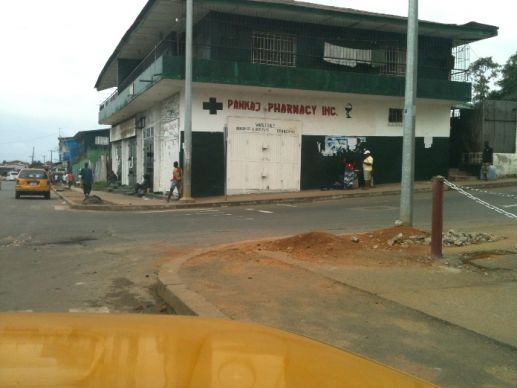
Photo by Julu Swen, UMNS
A store in Monrovia, Liberia, was closed after a nationwide curfew and other restrictions were imposed to stop the spread of Ebola. Violent protests broke out after two Monrovia neighborhoods were quarantined and people were not allowed to leave. In the rest of the city, some stores and banks were closed because of confusion about restrictions imposed by the government.
Ebola quarantine sparks violent protests by Julu Swen MONROVIA, Liberia (UMNS)
Protesters hurled rocks and stormed barricades in an effort to escape the West Point neighborhood that was cordoned off after a quarantine aimed at containing the spread of Ebola. A United Methodist pastor was among those unable to leave.
Reports indicated late Wednesday that residents were observing the curfew and the neighborhood had calmed down.
Residents of the community, the largest slum area in Monrovia, scuffled with security forces who attempted to stop a community liaison with the national government from leaving with her family. The official, Haja Miatta Flowers, now travels under heavy security.
“The protestors were actually throwing stones at Madam Flowers and her entourage, who were racing in the direction of the security forces who barricaded entrances to West Point,” said Theoway Harmon, chairman of the board of the John Kofi Ashmun United Methodist Church in West Point. “There was shooting during the scuffle and three persons were wounded, one of whom was brought into the community hospital here in West Point.” That person was moved later when the hospital was closed, he said.
The Rev. Agrippa Nyentee, pastor of Grace United Methodist Church, has been unable to get out of the neighborhood since the lockdown began. He reported traders were hiking food prices and that some people were hoarding food, especially staples like rice, for fear the lockdown will last a long time.
Residents of the community, the largest slum area in Monrovia, scuffled with security forces who attempted to stop a community liaison with the national government from leaving with her family. The official now travels under heavy security.
Residents of Monrovia woke up to a tense situation Wednesday morning after Liberian President Ellen Johnson Sirleaf quarantined West Point and Dolo’s Town and imposed a nationwide curfew from 9 p.m. to 6 p.m.
The busy shopping area of Water Street, which separates West Point from the rest of the city, was cordoned off by security forces.
Several stores and banks were closed because of confusion about restrictions imposed by the government and how people would react to those restrictions.
Protest turns violent
Over the weekend, looters raided a health center treating Ebola patients in West Point and protests turned violent there after the neighborhood, which is home to about 50,000, was quarantined, according to published news reports.
“Absolutely, no one will leave these communities and no one will go in,” said the president, who is a United Methodist, in a nationally televised address. She called on Liberians to increase their involvement in the campaign against the spread of the deadly disease.
“The fight against the spread of the Ebola virus is becoming difficult because of increased disbelief of the people, disrespect and noncompliance to some of the advice given by health workers, and the refusal of many Liberians to let go their cultural practices,” Sirleaf said.
Liberia now accounts for 576 of the 1,350 Ebola deaths in the five-month outbreak, according to the World Health Organization. The virus continues to spread in Guinea, Sierra Leone, and Nigeria, with a total of 221 new cases reported from Aug. 17-19.
Nyamah E. Dunbar, founder of Sankofa Inc. Agribusiness and former program manager in West Africa for United Methodist Committee on Relief, said the necessary precautionary measures violate the cultural norms of West Africa.
“So the Ebola crisis is touching on the true cultural sense of ‘Africaness,’ ” she said. She said that is why UMCOR stresses information and training components for health boards and community health workers.
“Even the decision by the government in Liberia to cremate dead Ebola corpses has shaken the culture to its core - where this is symbolically compared to condemning them to hell,” she said.
Removing bodies
Meanwhile, protesters in Ganta City in Nimba County on Tuesday blocked the movement of vehicles leaving the city for the provisional city of Saclepea. They were demanding the removal of bodies from their communities.
“Residents of the Ganta City in Nimba County are now fleeing the city due to the Ebola related health risk this is being created due to the failure of the County Health Team to quickly dispose of dead bodies in the around the city,” the Rev. James Labala, superintendent of the Gompa District, said in a telephone interview. The United Methodist clergyman said checkpoints have been erected at major entry points into the city and that eight bodies had not been removed by health workers.
Labala said the County Health Team in Nimba County has just one ambulance for the entire county and that it had not been back to pick up bodies since Aug. 15.
Julu Swen is a communicator in Liberia.
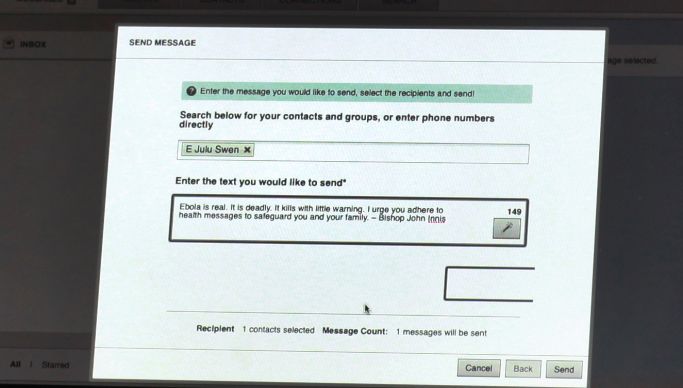
Photo by Kathleen Barry, United Methodist Communications
Jill Costello, project manager with the ICT4D Church Initiatives at United Methodist Communications, Nashville, Tenn., sends an historic text message regarding the Ebola outbreak on the morning of August 19 to Julu Swen in the office of Liberia Bishop John G. Innis.
United Methodist Communications fights Ebola with technology
United Methodist Communications
Office of Public Information
810 12th Ave. South
Nashville, TN 37203
FOR IMMEDIATE RELEASE
United Methodist Communications fights Ebola with strategic messaging and technology
Nashville, Tenn.: Efforts to contain the Ebola outbreak have met difficulties due to widespread myths and misinformation about the deadly virus. In collaboration with bishops in Sierra Leone and Liberia, and their communicators, United Methodist Communications has implemented a crisis communications strategy in West Africa aimed at controlling the outbreak, saving lives and comforting those affected by this epidemic.
United Methodist Communications is also in contact with bishops in Nigeria and Cote d’Ivoire.
“In the Ebola crisis, communication precedes prevention and treatment,” said the Rev. Larry Hollon, chief executive of United Methodist Communications. “The contagion cannot be contained without clear communication about the reality of the Ebola virus, sanitation, isolation of sick people, and proper handling of the deceased. This has to be communicated effectively and widely. In these circumstances, a clear message saves lives.”
Sierra Leone and Liberia received $10,000 crisis communications grants to create and distribute banners, posters and photocopies of messages that aid in prevention, diagnosis and treatment; messaging for radio to address prevention, care and pastoral needs; and Internet access.
Additionally, at the request of Bishop Innis and his communicator, Julu Swen, United Methodist Communications is sending text messages to church leaders in Liberia to keep them informed and encouraged in this time of crisis. African communicators are being equipped and trained to take over this communication in the near future.
United Methodist Communications’ Information and Communications Technologies for Development (ICT4D) team learned from a recent CNET report that the majority of the telecommunications market in Liberia is wireless, with 69% relying on mobile phones. That number is 67% in Sierra Leone, making text messages a crucial way to distribute prayers for encouragement and life-saving messages.
The first text message was sent today, August 19, on behalf of Bishop John Innis of Liberia to his district superintendents. The agency will also be sending approved health and pastoral messages on the bishop’s behalf until the Liberian conference communicator takes over the task. The message sent today reads: Ebola is real. It kills with little warning. Please adhere to health messages to safeguard your family. Let us be in prayer. God is with us. – Bishop John Innis.
“Prayers of Encouragement,” an Upper Room publication, will be made available to World Reader users in a variety of formats, including tablets, smartphones and biNu, billed as “Your Smartphone in the Cloud.” This is technology that United Methodist Communications has tested and used previously and is well-received in developing nations. Additionally, the agency will send words of encouragement from this booklet via text.
The agency has also partnered with Iheed and award-winning animator and activist Firdaus Kharas of Chocolate Moose Media to create a short animation that promotes prevention and dispels local rumors. The animation will be made available in local dialects for use by community health workers and for television.
Along with these efforts, the United Methodist Committee on Relief, Church of the Resurrection and the Indiana Conference of The United Methodist Church have all sent grants to affected countries. These funds support United Methodist hospitals and health clinics, and will be used to purchase supplies for patient treatment and management, construction of isolation wards, and training of front line personnel to protect themselves from infection.
The Foundation for United Methodist Communications has established an emergency communications fund where individuals can donate to provide communications support in crises and disasters, such as this outbreak.
###
Media contact:
Diane Degnan ddegnan@umcom.org
615-742-5406 (office) 615-483-1765 (cell)

Digba Massaquoi waits with her 5-year-old son, Lahai, who is ill, at the health clinic in Benduma, outside Bo, Sierra Leone. Beside her on the bench are insecticide-treated mosquito nets provided by Imagine No Malaria as part of an integrated health campaign.
Fighting malaria means fighting Ebola by Julia Frisbie* (Imagine No Malaria)
The biggest Ebola outbreak in recorded history is sweeping across Guinea, Sierra Leone and Liberia, and has a foothold in Nigeria. The World Health Organization has reported that 1,069 people in those countries have died from Ebola. The disease has been declared a public health emergency of international concern because it is highly contagious, has no cure, and has a death rate of up to 90 percent in some outbreaks.
United Methodist health workers equipped by Imagine No Malaria to fight malaria are now also fighting Ebola. The same trained and skilled health professionals are on the front lines.
“It is a blessing and a gift that a strengthened infrastructure is in place, thanks to the ministry of Imagine No Malaria,” said the Rev. Gary Henderson, executive director of Imagine No Malaria. “No one dreamed that the church would be called upon in this way.”
Today, fighting malaria means fighting Ebola. Imagine No Malaria alone is not equipped to launch an emergency response to the Ebola epidemic, but we are part of a global denomination armed with the belief that the world is our parish. The people of The United Methodist Church are responding with supplies, grant money and advocacy. Your donations are making a difference in this fight.
Imagine No Malaria supports programs in all four countries where Ebola is present, and our comprehensive approach has strengthened hospitals and health posts.
Misinformation and denial are keeping sick people from getting help. Some people are hiding from government officials and medical teams because they fear that if they go into quarantine, they will never see their loved ones again. Since the early symptoms of malaria and Ebola are similar, many malaria patients are not getting treatment. This crisis jeopardizes the progress The United Methodist Church has made toward improving access to health care.
“In the Ebola crisis, communication precedes prevention and treatment,” said the Rev. Larry Hollon, top staff executive of United Methodist Communications, in a blog post. “The contagion cannot be contained without greater effort at sanitation, isolation of sick people, and proper handling and burial of the deceased. And this has to be communicated effectively and widely. In these circumstances, a clear message saves lives.”
Imagine No Malaria infrastructure helps
The people of The United Methodist Church are responding in many ways to the Ebola crisis. Many missionaries serving in the affected countries have chosen to stay and fight the disease alongside their brothers and sisters. Through the United Methodist Committee on Relief, both Sierra Leone and Liberia have received grants for supplies, especially personal protective equipment such as gloves and facemasks. Protecting health workers is a priority because caring for Ebola patients puts them at high risk.
Many hospitals in West Africa have simply shut their doors because they lack safety gear to protect their staff. However, several United Methodist hospitals and health clinics have stayed open, thanks to support from UMCOR and missionary staff. Ganta United Methodist Hospital in Liberia is near the border with Guinea, where the outbreak first occurred. The hospital is constructing a treatment unit specifically for Ebola.
“It is the only major facility open within a 100-mile radius,” wrote Dr. Wilfred S. Boayue, chair of the Liberia Annual Conference Health Board. “We keep reminding the staff to be very careful and use whatever protective gear they have to remain safe. In addition to their duties at the hospital, they have formed a task force to collaborate with the city and county government in community awareness campaigns, including messages on the local radio station.”
This type of communication is crucial, since Ebola was relatively unknown in West Africa before the outbreak. United Methodists have provided grant money for radio programming, television ads, posters and text-message alerts.
A big part of the fight against Ebola is a fight against fear. “If people don’t trust the government and the health care providers, they’re not going to get help,” said Shannon Trilli, UMCOR global health consultant.
United Methodists are working to get correct information to the people who need it most. In a statement, Liberian Bishop John G. Innis wrote, “United Methodist pastors, district superintendents and Sunday school teachers must share the information about the Ebola virus with their local churches and districts.”
Advocacy, prayer needed
Bishop John K. Yambasu of Sierra Leone chairs the Religious Leaders Task Force on Ebola.
“Our major focus is teaching the people the practices of personal hygiene as the only effective and sustainable way of preventing the disease,” he said. He noted that 80 percent of Sierra Leoneans belong to a faith group. Because they often trust their faith leaders more than they trust their elected officials, faith groups will be key players in changing the public discourse. “We work towards increasing community awareness and education,” Yambasu said.
You can help get the word out by sharing this article. The more international attention this epidemic receives, the more governments and organizations will engage in sending needed funds, supplies and health care workers. The United Methodist Church is a key partner in the fight against malaria, so we are in a good position to advocate for a swift Ebola response.
Prayer is another way to be in solidarity with people who face Ebola. United Methodists around the world activated their prayer chains last week as Yambasu called for three days of prayer and fasting. (Click here to read a prayer by Janjay Innis, young adult missionary and the bishop’s daughter.)
We also must pray for our brothers and sisters in other parts of Africa who, while not directly affected by Ebola, still face serious health challenges, including malaria. Imagine No Malaria continues to work toward health and healing in 11 other sub-Saharan African countries.
Imagine No Malaria is not just about malaria. It is about health. It is about community. It is about creating strong and lasting health systems. When hospitals are equipped to deal with malaria, they also can rise to the challenges of other diseases. When you donate through Imagine No Malaria, you join a global movement of The United Methodist Church to end preventable deaths and improve lives while at the same time strengthening health systems.
*Frisbie is an Imagine No Malaria field coordinator in the Pacific Northwest and a writer and regular contributor to www.umcor.org.
____________________________
Poverty: The Common Vector
NASHVILLE, Tenn. (UMNS) - While the Ebola outbreak continues, media coverage, at least on television, seems to be waning. Print media continue to provide stories that enlarge understanding about the crisis and its effects on people across the region. But this too will fade, and that's part of an ongoing problem, writes the Rev. Larry Hollon, top executive of United Methodist Communications, in a blog post.
http://www.larryhollon.com/blog/category/21st-century-faith/?j=207288&e=glparker1952@aol.com&l=460_HTML&u=5816255&mid=6206185&jb=17
The Malaria-Ebola Nexus in Communications and Media,Economics and Development,Global Citizenship,Global Health,Media & Culture,Tech Tools Digba Massaquoi waits with her 5-year-old son, Lahai, who is ill, at the health clinic in Benduma, outside Bo, Sierra Leone, in July 2014. Amid fears about Ebola, many people in West Africa are choosing not to go to health clinics or hospitals for treatment of other illnesses. Photo by Mike DuBose, UMNS.
 Digba Massaquoi waits with her 5-year-old son, Lahai, who is ill, at the health clinic in Benduma, outside Bo, Sierra Leone, in July 2014. Amid fears about Ebola, many people in West Africa are choosing not to go to health clinics or hospitals for treatment of illnesses. Photo by Mike DuBose, UMNS.
The World Health Organization has declared the Ebola outbreak an international health emergency, with 2,000 people infected so far and more than 1,000 deaths in Sierra Leone, Liberia, Guinea and Nigeria. As these countries frantically try to contain Ebola, fearful people are not going to health clinics or hospitals for other illnesses. These illnesses add to the burden created by Ebola.
Malaria is one of the diseases either not being treated or being treated through self-medication, which creates its own problems. The rainy season is under way, when more malaria cases occur. This compounds the problem. Improper use of malaria medications can result in resistance to the drugs. The medications require a patient to follow a course of treatment, and failure to do so can result in a more drug-resistant parasite in the future.
Researchers suspect a highly resistant parasite now affecting people in south Asia is a result of haphazard malaria drug usage during the Vietnam War.
Both diseases disproportionately affect the poor and ill-informed. Because Ebola and malaria have common early symptoms, such as fever, headache and vomiting, there may be confusion about the cause of illness among both those who are ill and health care providers.
Life-saving messages needed
While malaria is curable, Ebola is not. But there is real concern that the mortality rate from malaria may rise because patients will not seek treatment. Therefore, it is critical to get accurate, life-saving messages to people in these areas.
Communication and education are two of the four pillars The United Methodist Church and its health workers are using in the fight against malaria and Ebola. Neglect of any disease of poverty is costly in human lives and productivity, which means costs to national economies, added burdens for weak national health services, and great human suffering and death.
This panel from an info graphic illustrates malaria's toll. Graphic by Work the World.
 This panel from an info graphic illustrates malaria’s toll – as well as lives saved by international efforts. Please click on the infographic link in the narrative to see the entire infographic Graphic by Work the World.
An infographic by Work The World of the UK illustrates both the severity of the toll malaria takes and also the hopeful potential to reduce its consequences. Behavior change communication is essential to reducing the humanitarian crisis of Ebola and the ongoing crisis of malaria.
Responding to the crisis
United Methodist Communications has provided $10,000 crisis communications grants to United Methodist annual (regional) conferences in Liberia and Sierra Leone to help get out health education messages through printed fliers, banners and radio. United Methodist Communications is also networking with other church agencies and international and interreligious organizations to coordinate communications efforts. It has also provided training and software to local communicators to enable them to send broadcast text messages to local people.
Similarly, the United Methodist Committee on Relief, the Indiana Annual Conference and the United Methodist Church of the Resurrection have provided cash assistance to affected regions for medical supplies and communications.
The Foundation for United Methodist Communications has established an emergency communications fund to provide support during situations such as this one so that funding will be readily available in the event of a crisis or disaster. Your help is needed to ensure that we are able to meet these needs as they occur. You can donate here.
This situation also underlines the ongoing need to continue the malaria work the people of The United Methodist Church have supported for the past seven years. The world has made great strides in reducing deaths from malaria, but we are still working toward the goal of elimination. To give to Imagine No Malaria, visit ImagineNoMalaria.org.
____________________________
Scholar takes his turn with Wesley's letters
DALLAS (UMNS) - As most good United Methodists know, John Wesley felt his heart "strangely warmed" as he listened to a reading of Martin Luther's preface to the Epistle to the Romans. The Rev. Ted A. Campbell, associate professor of church history at Southern Methodist University's Perkins School of Theology, gets a similar glow whenever he learns of a previously undiscovered letter by Wesley.
Scholar takes his turn with John Wesley’s letters by Sam Hodges DALLAS (UMNS)
As most good United Methodists know, John Wesley felt his heart “strangely warmed” as he listened to a reading of Martin Luther’s preface to the Epistle to the Romans.
The Rev. Ted A. Campbell, associate professor of church history at Southern Methodist University’s Perkins School of Theology, gets a similar glow whenever he learns of a previously undiscovered letter by Wesley, who founded the Methodist movement in 18th century England.
Take the time Campbell heard that an administrator at Rice University owned such a letter.
“I just drove down to Houston giddy at the thought that this might be a real John Wesley letter that had never seen the light of day,” Campbell said.
Campbell did authenticate the letter. And the owner, Barbara Harrison, eventually gave it to Perkins’ Bridwell Library.
“I was delighted that he was so thrilled,” Harrison recalled. “That’s why I felt comfortable donating it. I knew how important it was to him.”
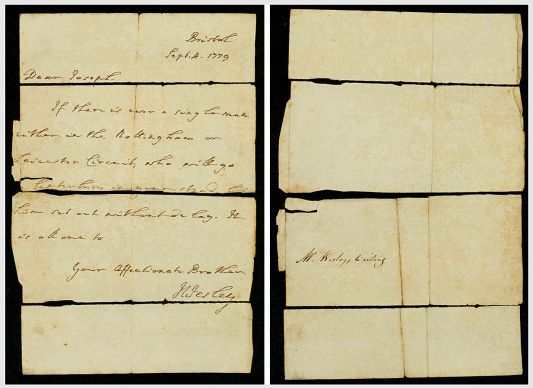
TRANSCRIPTION
[Letter mutilated. Address panel and left margin wanting]
Sept. 4, 1779 [D]ear Joseph
If there is ever a single man [ei]ther in the Nottingham or [Lei]cester Circuit, who will go [to] Canterbury in your stead let [hi]m set out without delay. It [is] all one to Your Affectionate Brother J Wesley [Wesley was in Bristol at this time, although he does not include the place in this letter. Richard Heitzenrater speculates that "Joseph" may been Joseph Pescod, who was in the Leicester circuit in 1777 and 1779 (in Pembroke in 1778), or perhaps Joseph Harper, who had been appointed to the Kent (Canterbury) circuit in 1778, the previous year (which had just ended).
The minutes also list in Kent for 1778 (along with James Rogers) a third person simply by initials, M. F. (for Michael Fenwick, who fell out of favor). I think Michael was a single rascal so perhaps Wesley was trying to replace him with another single man."]
There are plenty of John Wesley experts. But for this era, Campbell is the go-to scholar — “da man” as they say in sports — on Wesley’s letters.
He’s just finished editing the third volume of Wesley’s letters, covering 1756 to 1765, for the Wesley Works Editorial Project, a projected 34-volume, definitive collection of sermons, journals and letters. Campbell’s volume should be out next year from the United Methodist Publishing House.
Another three to four volumes will be needed to cover the balance of Wesley’s letters. Campbell, 60, will continue to balance teaching at Perkins with editing the letters, knowing the effort will likely consume the rest of his academic career.
“If I work to 70 or 75, I can do two to three more volumes,” he said.
Randy Maddox, a Duke Divinity School professor and current guiding force behind the Wesley Works Editorial Project, thinks Campbell is just the right scholar for this painstaking editing job.
“Ted brings high passion for this work — not just the passion to see it published, but for the details,” Maddox said.
On Wesley’s trail
Campbell grew up in a Methodist family in Beaumont, Texas, and attended Lon Morris College, a two-year United Methodist school in the East Texas town of Jacksonville. In the spring of 1974, he went with a group of fellow students to Perkins to hear Professor Albert Outler lecture on theology and the Wesleyan spirit.
“That was transformative,” Campbell said. “That was the moment I knew I wanted to pursue the Wesleyan studies thing.”
From Lon Morris, Campbell went to the University of North Texas, where he majored in Latin, reading John Wesley biographies in his spare time. He enrolled next at Oxford University in England – Wesley’s school. There, as part of Lincoln College, where Wesley was a fellow, he earned a bachelor’s in Christian theology. That’s the same degree Wesley had.
Campbell also served as a Methodist lay preacher during his two years in Oxford, and became friends with the Rev. Stuart Rhodes, a British Methodist clergyman who shared a story that seems in retrospect to have been an omen.
“Stuart told me that one day somebody had put two letters under the door of his study,” Campbell said. “They ended up being absolutely authentic letters John Wesley had written to a woman in Ireland.”
Black or red wax
Campbell returned to the United States, earning his Ph.D. at Southern Methodist University and becoming an ordained elder of The United Methodist Church. He’s since taught at Methodist Theological School in Ohio, Duke Divinity School, Wesley Theological Seminary and Perkins. He was president of Garrett-Evangelical Theological School from 2001 to 2005.
At Duke, his first regular full-time academic appointment, he got to work with Professor Frank Baker, who edited the first two volumes of John Wesley letters in the Wesley Works Editorial Project.
“He kind of took me as an understudy,” Campbell said.
For financial and other reasons, the project went on a long hiatus. Maddox got it going again in 2007, by which time Baker had died. At a breakfast meeting during an American Academy of Religion gathering, Maddox prevailed on Campbell to step up his work on the third volume of the letters.
Even though he’d been Baker’s protégé, Campbell didn’t quite know what he was getting into.
“It’s a tremendous learning curve,” he said.
Campbell had to ground himself in Wesley’s writing style, including abbreviations, as well as the vast cast of characters Wesley was writing to and mentioning in letters. Along the way he learned all about the postal service in 18th century England, which at points included thrice-a-day delivery in London.
“It was so good in London that sometimes you would send a note in the morning, it would be delivered that morning, the person receiving it would write a response, and it would be back that evening,” Campbell said. “It wasn’t quite email or text messages, but it was a very quick system.”
Campbell can now talk at length about the goose feather quills Wesley fashioned for writing and the kind of paper he used. He is pretty sure he can tell which letters Wesley wrote while riding in a carriage. He knows the minutiae of Wesley’s handling of letters, which were sent without envelopes.
“He would fold his letters in a very specific way that he always used, putting the address on the outside,” said Campbell, who has mastered the technique. “He’d put on his seal, either black wax or red wax, and he had a series of different seals. We can document his seals at different times of his career.”
A life in letters
Campbell believes Wesley’s letters yield a different perspective on the man than the sermons or journals.
Some letters offer Wesley’s views on theological matters and liturgical practices, and others elaborate controversies within the Methodist movement. Wesley’s tensions with his brother (and fellow Methodist movement leader) Charles Wesley are documented in the letters and by the absence of correspondence between them for long stretches.
Last year, Campbell published a scholarly article titled “John Wesley’s Intimate Disconnections, 1755-1764." It deals in part with John Wesley’s advisory letters to young women, including a warm one Wesley’s wife, Mary, intercepted, causing her deep hurt and straining their already difficult relationship.
“The letters reveal a very personal side of Wesley that is not present in his works that he wrote for the public,” Campbell said. “Some of it is very reassuring. Some of it is very pastoral, theological and profound. Some of it is problematic, like his relationships with these women that I have written about.”
Many of the letters are brisk and business-like, and the one Campbell drove to Houston to authenticate certainly meets that description.
“[D] ear Joseph If there is ever a single man [ei]ther in the Nottingham or [Lei]cester Circuit, who will go [to] Canterbury in your stead let [hi]m set out without delay. It [is] all one to Your Affectionate Brother J Wesley,” Wesley wrote a correspondent on Sept. 4, 1779.
That’s by no means the shortest.
“Some of John Wesley’s letters are like tweets,” Campbell said. “There’s one that says, ʽFrankie, why are you not in Bristol? Are you out of your wits?’ He doesn’t even sign it. It’s like, ʽDude!’ You can imagine him putting the little frowny face emoticon at the end.”
Attics and desk drawers
The contents of about 3,300 John Wesley letters are available to scholars. John Rylands Library in Manchester, England, has the most original manuscripts, with about 600; followed by Perkins’ Bridwell Library, with 135 (available online); and the United Methodist Archives Center at Drew University, with 130. Duke Divinity School has a massive collection of photocopies of letters and other Wesley material, assembled by Baker.
A while back, Campbell and a graduate student undertook a rigorous estimate, based on Wesley’s letter-writing patterns, and concluded he probably wrote about 18,000. Most are no doubt lost for good, but Campbell notes that previously unknown Wesley letters come up for sale every so often, with the going rate at about $3,000 to $4,000.
He suspects there are Wesley letters in the attics or desk drawers of people who don’t know how eager scholars are to see them.
Campbell is probably the most eager of all, though occasionally ambivalence takes hold.
“Sometimes I feel guilty because I know he never intended anyone else to see these letters,” he said.
The feeling always passes, or at least is overridden, by his scholar’s desire to understand Wesley as fully as possible.
So if you think you have a Wesley letter, Campbell welcomes hearing from you. And he will enjoy the irony of doing so by email, at tedc@smu.edu.
Hodges, a United Methodist News Service writer, lives in Dallas. Contact him at (615) 742-5470 or newsdesk@umcom.org
____________________________
Marching for climate change action
NEW YORK (UMNS) - United Methodists are among those planning to march in midtown Manhattan on Sunday, Sept. 21, to call for renewed action on climate change. Participants in the People's Climate March hope to send a message to world leaders gathering for a U.N. summit two days later.
Marching for climate change action by Linda Bloom NEW YORK (UMNS)
United Methodists are among those planning to march in midtown Manhattan on Sunday, Sept. 21, to call for renewed action on climate change and other societal priorities that make for healthy communities.
Participants in the People’s Climate March, loosely coordinated through 350.org, hope to send a message to world leaders gathering for a U.N. summit two days later.
United Methodist staff members who are informally organizing denominational participation in the march are the Rev. Pat Watkins, Board of Global Ministries; the Rev. Kathleen Stone, United Methodist Women, and John Hill, Board of Church and Society. “We’re trying to march as a block,” Stone explained.
United Methodist partnering organizations for the march include Caretakers of God’s Creation, a grassroots group, and Park Slope United Methodist Church in Brooklyn.
A Facebook Page, United Methodists at the Peoples Climate March in NYC, has been set up to provide information and a way to communicate. Those interesting in gathering also can email Watkins at pwatkins@umcmission.org.
The march begins at Columbus Circle and is expected to proceed east along the south end of Central Park before turning south on Sixth Avenue to 42nd Street, where it will continue west, ending on 11th Avenue.
The exact time of the march is still under negotiation, Stone said, but the Church of St. Paul and St. Andrew, 86th Street and West End Avenue, will be used as a pre-parade gathering spot for United Methodists.
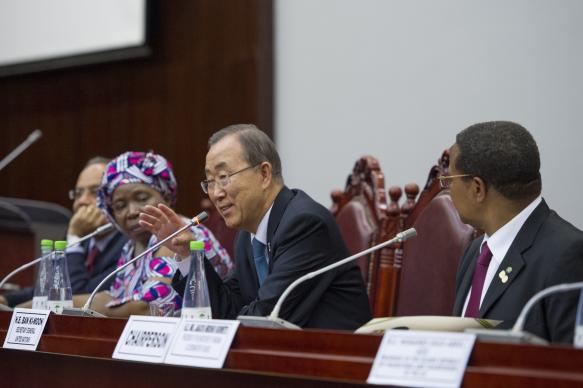
United Nations Secretary General Ban Ki-moon is convening the Sept. 23 Climate Summit to spur political action on global warming and encourage leaders from government and the private sector to announce new initiatives.
“Solutions exist and we are already seeing significant changes in government policies and investments in sustainable ways of living and doing business,” Ban said in an Aug. 11 press release. “The race is on, and now is the time for leaders to step up and steer the world towards a safer future.”
In 2010, governments agreed that global temperature increases should be kept below 2 degrees Celsius. The Climate Summit will focus on actions and solutions to reduce carbon emissions but is not part of the actual negotiating process for the United Nations Framework Convention on Climate Change.
Stone believes Ban feels strongly about obtaining a climate agreement and views the summit as a way for heads of state to look beyond other global disputes to get climate change on their agendas.
“This is a pregnant moment,” Stone said. “We need on-the-ground pressure.”
March organizers have been working hard to get people of color and immigrant, indigenous and neighborhood groups involved, Stone said. She considers such participation exciting and important, given the fact that climate change “is more of a reality for people of color and many immigrant groups.”
The World Council of Churches and Religions for Peace also has invited 30 religious leaders to an Interfaith Summit on Climate Change Sept. 21-22 in New York. Summit participants will adopt a statement on climate change and present it to the U.N. Secretary General in a public event at 1 p.m. Sept. 22 at the Church Center for the United Nations. Afterward, the statement will be distributed to other religious leaders and groups for signature.
*Bloom is a United Methodist News Service multimedia reporter based in New York. Follow her at http://twitter.com/umcscribe or contact her at (646) 369-3759 or newsdesk@umcom.org.
____________________________
Ukrainian United Methodists feel strain of war
NEW YORK (UMNS) - Members of two United Methodist churches in Eastern Ukraine continue to feel the impact of fighting between rebels and Ukrainian military forces. In an Aug. 14 letter, Bishop Eduard Khegay of the United Methodist Eurasia Episcopal Area wrote that the congregation in Lugansk has been particularly hard hit.
Ukrainian United Methodists feel strain of war by Linda Bloom NEW YORK (UMNS)
Members of two United Methodist churches in Eastern Ukraine continue to feel the impact of fighting between rebels and Ukrainian military forces.
In an Aug. 14 letter, Bishop Eduard Khegay of the United Methodist Eurasia Episcopal Area wrote that the congregation in Lugansk has been particularly hard hit. The other church is in Krasnoarmeisk, near Donetsk.
“The bombing of Lugansk was felt by many of our United Methodist people,” reported Khegay, who is based in Moscow. “One bomb fell in the garden of the neighboring house next to our church building. The neighbor suffered and the windows of our church were broken.”
The New York Times described Luhansk as a city under siege with relentless shelling that has left residents “terrified of the bombing.”
Most of the 65-member congregation has fled the city as refugees, the bishop said, with only three elderly members remaining. Ten members moved to the Chelyabinsk region of Russia where they have found shelter and small jobs with the assistance of the United Methodist congregation in Satka.
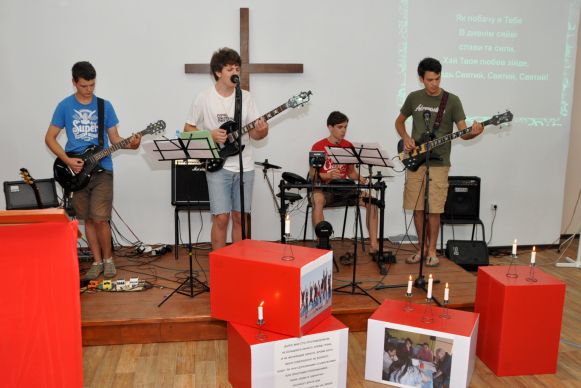
A special offering for Lugansk church members was taken when more than 130 participants gathered for the 125th anniversary celebration of the Methodist Camp Crystal near Voronezh, Russia. The Aug. 6-10 event included a Ukraine praise group. “Praying together with and for our Ukrainian friends touched the hearts of all of us,” Khegay noted in his letter.
The pastor of the Lugansk church, the Rev. Alexandr Merziyakov, has moved with his family to Simferopol, Crimea, to live with his mother. “I am grateful that in this difficult time Alexandr looks for opportunity to start a new church in Simferopol,” Khegay said. “Please pray for the movement of the spirit in this new place of ministry.”
Last April, the denomination’s Ukraine Annual Conference voted to transfer two churches in Sevastopol and Kerch, Crimea, to the South Russia Annual Conference. The month before, Crimea had declared its independence from Ukraine and became part of the Russian Federation.
The United Methodist Board of Global Ministries has kept a watch over the situation in eastern Ukraine, in coordination with Khegay, and German United Methodists have called upon their government to support a negotiated settlement between Moscow and Kiev.
The Rev. John Calhoun, a board missionary, and the Rev. Vladimir Khabriko, are coordinating ministries to help refugees from Crimea living in Kiev. Local United congregations in other parts of Ukraine and in western Russia also are helping the displaced.
UPDATE ON POLITICAL CRISIS
Missionary John Calhoun offers an update on the political crisis in the Ukraine and how local United Methodist congregations are bringing relief to families displaced by the conflict. Calhoun serves in Kiev (Kyiv) in ministry with The United Methodist Church in Ukraine.
Khegay thanked the denomination for prayers and support, particularly noting the assistance from the United Methodist Committee on Relief for aid to refugees.
“As people called Methodist, we move as the Spirit moves us to be where suffering people are, to comfort those who need help, to bring food and water and to start new churches as God leads us,” he wrote.
*Bloom is a United Methodist News Service multimedia reporter based in New York. Follow her at http://twitter.com/umcscribe or contact her at (646) 369-3759 or newsdesk@umcom.org.
____________________________
Mercado: Technology aids disaster recovery
NASHVILLE, Tenn. (UMNS) - As part of a team sent by United Methodist Communications days after Typhoon Haiyan struck the Philippines, April Grace G. Mercado saw firsthand how technology can save lives after a disaster. "When Haiyan happened, all communication towers were knocked down. Satellite phones were rendered useless because of thick clouds overhead. The only useful form of communication was ham radios," she said. Mercado is a panelist at the Game Changers Summit, a conference hosted by United Methodist Communications Sept. 3-5 in Nashville.
April Mercado: Technology aids disaster recovery by Joey Butler*
<iframe width="690" height="388" src="//www.youtube.com/embed/gpuh1In6a1Y" frameborder="0" allowfullscreen></iframe>
United Methodist Communications will host the Game Changers Summit Sept. 3-5, 2014, in Nashville, Tenn. The conference will demonstrate how information and communications technology (ICT) can be used to improve all facets of life. The focus? Helping parts of the world left behind by the technological revolution, to solve problems in education, wellness and community development with cutting-edge communications tools. This article series will spotlight some of the speakers and panelists participating in the Game Changers Summit.
April Grace G. Mercado has seen firsthand how technology can save lives after a disaster. As part of a team sent by United Methodist Communications days after Typhoon Haiyan struck the Philippines, Mercado helped assess needs and spread information.
“We connected to the emergency telecom cluster to get our stories out of the area,” Mercado says. “When Haiyan happened, all communication towers were knocked down. Satellite phones were rendered useless because of thick clouds overhead. The only useful form of communication was ham radios.”
The team also distributed solar chargers to survivors to combat widespread power outages, and solar lamps to cut down on using oil lamps, which pose fire and health hazards.
Food, water and shelter are an immediate need in the aftermath of disaster, but Mercado also sees technology as a vital tool in keeping survivors informed of where to find aid, or where to go for safety.
“We could have prevented much loss of life if information had been disseminated properly to the public. That might have saved all the senior citizens and children who perished while taking refuge in the basement of the Leyte Coliseum,” Mercado wrote in a commentary for United Methodist News Service.
Mercado feels that providing technology for disaster relief or for long-term development is an ideal ministry for The United Methodist Church.
“Our world is changing. The church needs to follow the times. It’s important our church follows technology changes to minister to more people, not just typical Sunday churchgoers. You can reach out to more people by social media, you can witness through Twitter, Ustream, Facebook. That’s how I see ICT as being important in ministry of church today.”
*Butler is a multimedia editor/producer for United Methodist Communications.
Be a game changer! Register for the Game Changers Summit, Sept. 3-5, 2014.
For more about the Game Changers Summit, go to umcom.org/gamechangers.
Game Changers Summit: September 3-5, 2014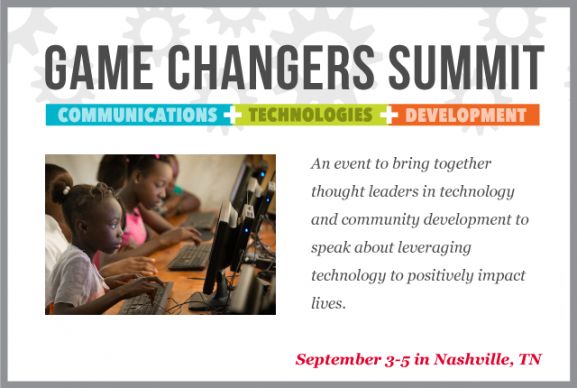 The Game Changers Summit will add rocket fuel to your mission-based programs. You’ll meet leading thinkers in technology and community development and learn how to leverage the world's growing access to cell towers, Internet and hardware.
Simple technology is transforming lives:
Printed textbooks in remote village schools are often decades old, but children are getting a modern education thanks to computer labs (sometimes solar-powered).
United Methodist communicators are helping prevent cholera and malaria by using group text messaging in areas without Internet.
Mission teams are bringing solar-powered devices to areas where electricity is unreliable, providing light and cellphone charging – often as a means of income generation.
United Methodists are using a "smartphone in the cloud" platform to provide e-books, information and videos in areas where smartphones are scarce.
The Game Changers Summit will amplify the impact of your programs in powerful and cost-effective ways. Mark your calendars now, and watch for updates here.
Email us at ict4d@umcom.org Or call us at 877-228-3168.
SPECIAL THANKS TO OUR SPONSORS WHO HELPED MAKE THIS HAPPEN:

____________________________
By the numbers: deacons as delegates
CHICAGO (UMNS) - An analysis of clergy delegates elected so far for the 2016 United Methodist General Conference also looks at the role of deacon, which some consider to be "women's work." Erin Kane looks at the statistics in "Women by the Numbers" for the United Methodist Commission on the Status and Role of Women.
Women by the Numbers/August 2014
So far, 10% of elected clergy delegates are deacons by Erin Kane, GCSRW Director of Research and Monitoring
At the request of a reader, I did more research on the General Conference delegates elected so far this year in the U.S. and determined that only 4 of those 42 clergy members are deacons (less than 10%). By comparison, deacons in full connection make up lessthan 4% of United Methodist clergy compared to 71%
elders in full connection (the other 25% are part - and
full-time local pastors and associated members.)
Those numbers mean that so far, deacons are well represented as General Conference delegates compared to their portion of the clergy population.
However, men who are deacons are overrepresented. Men currently make up half of the elected deacons, but as they next chart shows, they make up less than a quarter of the order.
Some might argue that a larger participation rate among deacons is unnecessary in the delegations to General Conference because it is the elders who are called to administer the discipline. However, because deacons are called to “leading congregations in interpreting the needs, concerns, and hopes of the world” (Book of Discipline ¶328) their voice is vital at General Conference to help the church define our ministry and interpret the Four
Areas of Focus.
Why do so few people choose to be deacons? And of the people who do pursue deaconship, why are more than three quarters of them women?
There is a larger cultural perception that women are more suited to the role of deacon than elder. In fact, some men who choose the path of deacon say they are discouraged from doing so and instead encouraged to pursue ordination as elders. There is this
idea that elders function in a “head of the household” type of role in that they administer sacraments and keep order. Deacons are viewed more as helpers or servants. Living in a culture where the overarching expectations place men in authoritative, administrative roles makes it difficult for people to picture men as being adequately fulfilled in a role that is defined by exclusion from headship. But it is more fitting to see the role of deacon as defined by specialization, compassion, and justice.
This gender divide within similar job descriptions is not isolated to The United Methodist Church. In the medical field, nursing is more often pursued by women than men, and men who elect to pursue nursing are questioned. Shouldn’t they want to be doctors? Nursing is for women. Doctors make decisions and
prescribe medication, but nurses do the caring work. However, when men began to enter the field of nursing at higher rates, overall wages increased. Unfortunately, a wage gap between the genders still occurred. In 2013, the average female nurse’s salary was $9,600 less a year than a male’ nurse’s salary
of $60,700 even though only 9.6% of nurses are men.
Our society places more value on work that comes with a prestigious title and a high salary. guaranteed employment. Thus, the move to include deacons as ordained members of the clergy in 1996 was a great step for The United Methodist church to take in professionalizing women’s role in the church.
Devaluation of women’s work can lead to the feminization of poverty: “There is a systematic undervaluation of professions where women are heavily represented: whether it’s fast food work
(skews female by 13% among adult workers), teaching (70% women) or nursing (over 90%), the pay is often not enough to really live comfortably on, or accurately reflect the value of the work.”
The population and proportion of deacons has been growing consistently since 2006. In that year, deacons made up only 2.8% of the total U.S. clergy, while elders made up 71.7%. The deacon numbers spiked up to 3.4% of total clergy over 5 years in 2011, and made up 3.7% of the total clergy by 2012. Elders, on the other hand, have been slowly declining as a portion of ordained
leadership, dropping to 70.8% in 2012 from 71.7% in 2006.
_________________
2006 2.8%(Deacons) 71.7%(Elders) 25.5%(All Others)
2011 3.4%(Deacibs) 70.9%(Elders) 25.7%(All Others)
2012 3.7%(Deacons) 70.8%(Elders) 25.5%(All Others)
______________
UMC Clergy 2006-2012
Deacons Elders All Other
Traditionally, this has not happened with
many careers in which women are the
majority (social workers, day care
professionals, nurses, teachers, etc.).
When we devalue feminized labor, it
means that we don’t consider women’s
work ‘real’ work and that we think that
some work is only for women, and
therefore requires less skill. Generally
speaking, work that is considered women’s
work is grossly undervalued or devalued.
Christine Yvette Lewis discussed this issue
with Stephen Colbert on the Colbert
Report in 2011. Domestic care workers like
nannies and housekeepers are isolated
and have few resources to demand fair
wages, benefits, and protections.
Similarly, deacons are vastly underpaid
compared to elders and have no This does not mean however that only women should pursue ordination as deacons. Men and women
who feel called to word, service, compassion and justice should receive the encouragement to pursue
deaconship without regards to gender. For a resource on this, click here.
Discussion
How does your community honor its deacons?
What can the deacons in your community contribute to General Conference?
Next Month:
Women and leadership in higher education institutions of The UMC.
And:
If you’re considering a run for 2016 or 2020 General Conference delegate, check out our step-by-step
guide here.
If you want to respond to these discussion questions, or if you have an idea for an article or research,
email Erin Kane, our director of research and monitoring.
____________________________
Healthcare foundation to honor UMCOR work
NEW YORK (UMNS) - The Methodist Healthcare Foundation will honor the work of the United Methodist Committee on Relief and five other U.S.-based and international health leaders Aug. 28 in Memphis, Tennessee. UMCOR will receive the foundation's "Living Award" for its role in the denomination's Imagine No Malaria initiative.
UMCOR to Receive Methodist Healthcare Honor
The Methodist Healthcare Foundation will honor the work of the United Methodist Committee on Relief (UMCOR) and five other U.S.-based and international leaders in the field of health during a ceremony in Memphis, Tennessee, next week.
UMCOR will receive a Methodist Healthcare Foundation Living Award for its role in the implementation of The United Methodist Church’s Imagine No Malaria (INM) initiative, which spans 16 countries in Africa.
Over the course of the initiative, which began with General Conference 2008, UMCOR has been responsible for training annual conference health boards, issuing grants and distributing anti-malaria bed nets, while also continuing to implement relief and development programming around the world.
UMCOR has distributed 1.9 million bed nets, trained more than 11,000 community health volunteers, and established 13 United Methodist health boards, which today guide annual (regional) conference health strategy and outreach on the continent.
Rev. J. Denise Honeycutt, UMCOR head, will represent the organization at the awards presentation on August 28 at the Peabody Hotel. She will be accompanied by Dr. Olusimbo Ige, who leads UMCOR’s INM implementation efforts.
Of the award, Honeycutt said, “It gives me great joy to receive this honor on behalf of UMCOR—our staff and directors. It is particularly meaningful now, as we look toward the future and the evolving role of The United Methodist Church in bringing health and wholeness to communities around the world.”
She indicated that the awards ceremony also will provide an opportunity to meet some of the people from U.S.-based annual conferences “whose tireless partnership has allowed INM to accompany the peoples of Africa and achieve so much in the effort to end malaria infections and deaths.”
Methodist Healthcare Foundation is part of Methodist LeBonheur Healthcare, an integrated, not-for-profit healthcare system affiliated with The United Methodist Church and based in Memphis. It has locations and partners across the Mid-South.
In addition to UMCOR, the Methodist Healthcare Foundation also will honor Henry and Jeanne Varnell, Dr. James H. Beaty, Community Alliance for the Homeless and Dr. William E. Routt, Jr.
____________________________
WCC notes interfaith efforts in Ferguson aftermath
GENEVA (UMNS) - The World Council of Churches has praised St. Louis area churches and religious communities for their efforts to provide prayer, support for peaceful protests and an "open and honest dialogue on racism and issues of class" following the death of Michael Brown in Ferguson, Missouri.
WCC expresses solidarity with churches and people in Ferguson shooting
In the wake of a racially charged police shooting in the state of Missouri, United States, “the efforts of the churches, faith communities, ecumenical and interfaith partners and civil society organizations and coalitions that have called for prayer, calm, peaceful protest, and open and honest dialogue on racism and issues of class” have received support and encouragement from the World Council of Churches (WCC).
Writing to the Interfaith Partnership of Greater Saint Louis, general secretary of the WCC, Rev. Dr Olav Fykse Tveit praised area churches and religious communities that have sought an end to conflict in the aftermath of “the tragic killing by a police officer of Michael Brown, an unarmed eighteen-year-old African American man, and the dangerous escalation of violence in the several days following.”
Tveit also praised their common efforts toward building peace, the promotion of healing within the community and a process of reconciliation at local and national levels.
On Monday, Jim Winkler, president and general secretary of the National Council of Churches in the U.S.A., deplored the killing of Michael Brown and others like it, called for a thorough investigation of the shooting, and drew attention to the larger issues raised by such deaths.
“These killings, as well as those of hundreds of other Americans each year at the hands of increasingly militarized police forces [are] of great and growing concern. A peaceful, healthy society requires trust and positive relationships between citizens and law enforcement. That can best occur in circumstances in which deep-seated social problems such as racism and inequality are being addressed,” said Winkler.
Reiterating the WCC’s condemnation of “the use of violence as a means of resolving conflicts,” Tveit assured the family of Michael Brown and the wider community of “the prayers of this global fellowship of churches,” and support for “honest examination and reform related to policing policies and practices.”
Full text of the letter to the Interfaith Partnership from the WCC
Statement on Michael Brown’s death by the National Council of the Churches of Christ in the USA
A prayer for Ferguson offered by the leadership of the Presbyterian Church (USA)
A report from the region’s bishop of the United Methodist Church
An account from a Saint Louis pastor of the African Methodist Episcopal Zion Church
Message on Ferguson Crisis from Christian Church (Disciples of Christ in United States and Canada)
WCC member churches in the United States of America
Bishop Schnase's Statement on Ferguson
Dear friends,
People have asked about what the United Methodist Church is doing in response to the events in recent days in Ferguson, Missouri, and so I’d like to lift up a few significant points of engagement and offerings of ministry.
The Missouri Conference launched a new church start in Ferguson two years ago after identifying the community as underserved by the United Methodist Church. Wellspring United Methodist Church is located two blocks from the area seen frequently on television news in recent days. The congregation has offered services of prayer and reconciliation and provided meeting space for community and church leaders. Under the leadership of Rev. Willis Johnson, the church has been on the forefront of efforts to ease tensions, offer consolation and prayer for those who grieve, and to seek the truth about the events that led to the death of Michael Brown.
Let me strongly suggest that you listen to the following National Public Radio interview with Rev. Willis Johnson for the program All Things Considered. The interview and the accompanying photograph are powerful, and they bear witness to the courage and faith of United Methodists on the front lines as they engage issues of race, anger, fear, and a longing for reconciliation.
http://www.npr.org/2014/08/14/340422502/ferguson-pastor-this-is-not-a-race-issue-this-is-a-human-issue
I would also draw your attention to the article by Heather Hahn of the United Methodist News Service. Her article highlights the involvement of other United Methodist Churches in the St. Louis area and from across Missouri that have reached out with volunteers to help with educational ministries for children and youth during the time that the Ferguson schools have been closed. The Missouri Conference Office of Mission, Service, and Justice has also offered support and volunteers to help with such basic tasks as clean up and support for those businesses that have been looted or suffered damage. Heather’s article can be found at http://www.umc.org/news-and-media/church-leaders-strive-to-be-peacemakers-in-ferguson
United Methodist voices, including that of the Missouri Governor Jay Nixon (an active United Methodist himself), have sought to de-escalate rather than to intensify, to work toward peace and justice rather than to avoid, blame, or ignore.
We continue to hold in our prayers all those who have most personally and painfully been affected by the violence, and we continue to look for opportunities to serve and to bring a ministry of healing to a community that has been deeply hurt.
We ask for your support. If you are looking for a way to engage positively, I invite you to correspond directly with Rev. Johnson at Wellspring United Methodist Church in Ferguson:
fwjohnson@wellspringchurchstl.org
314-521-4217
Facebook: Wellspringchurchstl
Twitter: WellspringSTL or FWillisJohnson
You may also contact the Missouri Conference Office of Mission, Service, and Justice Ministries: 573-474-7155 or office@umocm.com.
Yours in Christ,
Robert Schnase
COMMENTARY ON THE DEATH OF MICHAEL BROWN
Bishop Minerva Carcaño, GCORR board president, responds to the death of Michael Brown and recent events in Ferguson, Mo.
I don’t know all the details or all the truth about the fatal shooting of 18-year-old Michael Brown in Ferguson, Missouri. What I do know is that we are all accountable for his death and accountable to the African American young people in our communities everywhere. When Trayvon Martin was killed in Sanford, Florida, I turned to African American young people I know in an effort to understand what Trayvon’s death meant to them and how it affected them. With others, I tried to be a pastor to them as it became clear that the death of Trayvon was personal for them.
 If Trayvon could be murdered then what about them? Does being black make them a ready target? If they were murdered, would anyone care? It was a sobering conversation. Recently, a young woman who participated in the conversation asked me when we were going to have another time together. It was necessary to keep talking, she said. I want to keep talking with these young people. The future of our churches and communities depends on them and our relationship with them. The death of Michael Brown has made the conversation so much more urgent. As I get ready for that next accountability and pastoral conversation, particularly with African American young people, and out of respect and care for them, I have become more observant and more concerned.
As I read and listen to the news about the death of Michael Brown I have observed and am greatly concerned about several things, and the list grows every day. I am concerned that:
- after more than a week, no information is clearly available about what prompted the shooting and death of unarmed Michael Brown;
- the response of local and state officials has been a military response with police officers in riot gear and armored vehicles, police sharpshooters in position on top of those armored vehicles in the face of demonstrators, the use of rubber bullets, tear gas and smoke canisters, and the arrest of many;
- there has been looting and damage to and destruction of businesses in Ferguson, in Michael Brown’s own neighborhood and the community where he lived and died;
- the composition of the local police department in Ferguson, which is primarily white, does not reflect the majority African American population of Ferguson; and
- the conflict between demonstrators and the police is escalating.
African American young people of Ferguson, Sanford, and every other community in the U.S. need our caring attention and a clear word of what is right and what is wrong. It is morally wrong that young African American teenagers are being killed in our communities. Racial ethnic communities should not be treated as war zones. Looting and the destruction of private property are not helpful, but one must consider the underlying factors that lead persons to the extreme place of destroying their own community. A white police department in a predominantly black community is a clear sign of racial disparity that should be questioned. All of this merits prayerful conversation with African American young people, the members of our congregations, and the leaders of our communities. Right now this is particularly true for those who live in Ferguson. However, the rest of us should not wait until what has happened in Ferguson happens in our communities before starting the deep conversation about racism, racial profiling, economic injustice, and other related issues that I suspect underlie all that we are seeing in Ferguson.
May prayerful Christian conversation lead us to actions of social holiness that by God’s grace transform all the places where racism and all its symptoms and systemic manifestations still prevail and give African American and other racial ethnic young people hope of a better future. As we do this work, let us continue to pray for the family of Michael Brown and all the people of Ferguson, Missouri.
Bishop Minerva G. Carcaño is the Los Angeles area resident bishop for the California-Pacific Annual Conference. She also serves as president of the General Commission on Religion and Race Board of Directors.
We Are All St. Louisans Now by Kenneth J. Pruitt On Saturday, August 9, 2014, our child, Mike Brown, was shot and killed in the streets of his home community of Ferguson, Mo. in St. Louis County. We join in solidarity, prayer, anger, and sadness with our sisters and brothers who continue to mourn his death. As a collective of regular contributors to this blog, and as people of faith in the living God, we seek at this time to speak with one voice.
We believe we are all one. There is no us and them. We are all family. When one of us hurts, we all hurt. When one of us celebrates, we all celebrate. We believe that we, as a community, have lost sight of this reality. We believe that we are made in the image and likeness of God, and that when we see our human family, we can’t unsee God. We can’t act towards others or speak to others in any other way than we would towards God.
We believe in our citizens’ right to protest. We denounce unnecessarily harsh tactics used by St. Louis County Police Department and the Ferguson Police Department. We believe the police state is not the long-term answer to social unholiness and relational blasphemy. We are grateful and humble to stand with local leaders and their nonviolent work in our city and county. We thank Antonio French‘s tireless documentation of the beauty and pain of the Ferguson community over the past week. We thank pastors such as Traci Blackmon of Christ the King UCC and Willis Johnson of Wellspring UMC who have embodied bold, prophetic leadership. We celebrate the impeccable leadership of Captain Ron Johnson of the Missouri Highway Patrol, whose calm, empathetic presence has created a marked change in protests on West Florissant Avenue. We also call upon our fellow St. Louisans to refrain from violence. Your anger is wholly justified, but violence, even when it seems the only tactic left to draw attention to the ills of the community, leads down a path towards death. Love has won, is winning, and will always win. That narrative has already been written. We are called to live into it.
We call on our local, national, and international press to strive for painstakingly fair reporting. Social media and mainstream news outlets have been awash with inaccurate, sensationalized, and one-sided reports of events in Ferguson and St. Louis County. It is the duty of the press in a democracy to serve the people with fair, balanced, and accurate reporting. Coverage heavily weighted towards looting solidifies stereotypes of African Americans in the media. Coverage weighted towards discussion of the reasons anyone would resort to looting could foster productive discussions of poverty, race, and disenfranchisement. We ask our fellow St. Louisans and Americans to not seek judgment, but rather, to seek knowledge and wisdom, and to be critical of news coverage as the story of Ferguson continues to unfold.
We believe that the church, particularly our United Methodist Church, can’t sit this one out. The world is literally watching. We are waiting for answers and looking for people of faith to ask the right questions. These are the moments when the wheat is separated from the chaff, the sheep from the goats. The United Methodist Church has not always served the African American community in this city in the way that our Christ would have us serve. Justice begins at the margins. Jesus calls from the outskirts of our comfort zones. The Gospel is proclaimed most clearly in the streets of the Canfield Green Apartments, not in our comfortable sanctuaries and gated suburbs.
We believe that music and prayer are soothing to the soul during these times of crisis. Healing takes community, touch, and voices lifted in unison. Healing takes looking into the eyes of your neighbor, embracing, saying, “I’ll pray for you. You pray for me. I love you. You are important to me. I need you to survive.” Our prayer is also, “Lord forgive us as we turn a blind eye while the world goes to Hell.” We believe that crossing borders—denominational, geographical, racial—is necessary, and that listening, crying, and singing with our mothers and brothers should be a priority for all people of faith during this tragedy.
We believe that a transformed community is possible, but that we must do our part. We will be present with one another. We will attend worship services and vigils to honor Mike Brown. We will extend hands, to friend and stranger, to hold in prayer. We will demand accountability from our local governments. We will give generously to scholarships for the youth of our community.
We call on our leaders to listen to and to watch what is happening. A true leader is one who leads from the bottom up, not from the top down. Systemic change in the way of the Gospel begins with the powerless. Most of our elder pastors and superintendents are white. Many of them are men. Privilege comes with the responsibility to point to unheard voices. Host discussions of race in your churches. Preach on racial reconciliation. Allow marginalized people to share your pulpits. Innovate the way your church is led in a segregated city by purposefully seeking out people of color to hold positions of leadership. Take a hard look at the messages, worship environment, and ethnic makeup of your local church and ask if people of color would feel welcome and safe there. If they wouldn’t, make the necessary changes so that they would.
We believe that sunshine can come out of this storm and that St. Louis can not only heal, but can be made stronger than ever through this tragedy.
We believe that Mike Brown deserves better than to be remembered in relation to looting and violence.
We believe that it is our duty to honor his memory by doing all we can to reconcile all divides throughout our beautiful city, this St. Louis that we love so much.
We believe that we need your help. Pray for us.
<iframe src="//player.vimeo.com/video/103216521" width="500" height="281" webkitallowfullscreen mozallowfullscreen allowfullscreen></iframe>
Michael Brown // Call to Christ Followers from Harmony Church StL on Vimeo.
###
Jon Copeland, Kenneth J. Pruitt, Hannah Shanks, members of simple church, members of the Anam Cara community, and friends in the St. Louis area all contributed to this post. Many thanks to Rev. Nathan Hopping at Harmony UMC for the video. Contact Wellspring UMC, as mentioned in the video, to contribute to higher education scholarships in memory of Michael Brown: (314) 521-4217. Photo by Kenneth J. Pruitt, taken on Sunday, August 10th on the 2900 block of the Canfield Green Apartments in Ferguson, Mo.
____________________________
Impact of a drive-thru prayer ministry
IVYLAND, Pa. (UMNS) - St. John's United Methodist Church in the Eastern Pennsylvania Annual (regional) Conference embarked on a new ministry recently: Drive-thru Prayer. Ruth Portzline, a certified lay minister at the church, describes how prayer volunteers gather each Wednesday afternoon under a canopy outside the church to offer prayer to folks who drive by.
Church offers drive-thru prayer ministry
 St. John’s UMC in Ivyland embarked on a new ministry three weeks ago: Drive-thru Prayer. Every Wednesday from 4:30 to 6 pm we set up a canopy in front of our church, and prayer volunteers gather to offer prayer to folks who drive by typically on their way home from work.
The first week, six cars stopped; the second week, there were five. Last week 12 cars stopped for prayer.
We believe there are many who are struggling but don’t feel they can come to church. St. John’s wanted to find a way to reach out to them with the love of Christ. Even though they may not be affiliated with a church, they still need to know that Jesus loves them and cares about everything that concerns them.
So we decided to offer an opportunity for drive-thru prayer. When a car comes into the church driveway the occupants don't have to get out. Two prayer volunteers meet and greet them at their car and ask what are their prayer needs. Then one of the volunteers offers a prayer for those specific needs.
This is a non-threatening time or situation. No one is pushing any doctrine. We just want them to know that Jesus loves them and hears their prayers, and that St. John’s is here for them, too.
After the prayer, we give them a “prayer square”–-a gift from our Prayer Shaw ministry--along with St. John’s contact information. They then go on their way.
 As a way to advertise this ministry, a large banner is displayed on the front lawn of the church. Every Wednesday morning signs are placed near the road, and during the Drive-thru Prayer times, volunteers stand near the road holding up signs.
Our prayer is that this ministry will grow, and that we will be able to touch lives with the love of Christ.
St. John's UMC is at 820 Almshouse Road, Ivyland, PA 18974. Phone: 215-357-6998. E-mail: stjumc@aol.com. Visit our Web site at http://www.stjohnsivyland.com
Also, article about our Drive-Thru Prayer Ministry was to appear in the Aug. 13 issue of the Intelligencer and Bucks County Courier Times newspapers. See the article and watch the short video at either www.theintell.com or www.BucksCountyCourierTimes.com.
By Ruth Portzline, Certified Lay Minister
Assistant Pastor, St. John’s UMC, Ivyland, PA
Editor's Note: This is an excellent example of a church promoting its ministry to its community and to the conference. Kudos to Ruth Portzline and St. John's UMC. If your church is planning or doing an innovative ministry, please let us know about it at communications@epaumc.org. And by all means, let your community know through your local news media, visible signs, flyers and social media.
___________________________
Kentucky church finds way to reach youth
UPTON, Ky. (UMNS) - Upton United Methodist Church is experiencing a surge in attendance and professions of faith ��� defying the demographic trends of its shrinking rural community. The Kentucky Annual (regional) Conference reports how the church has found revitalization in part through prayer and intentional outreach to youth.
Upton UMC Reaching Out to YouthUpton UMC Reaching Out to YouthUpton UMC has been experiencing a surge in attendance and professions of faith under the leadership of the Reverend Becci Loy. The church’s revitalization has been driven by their intentional outreach efforts to the community, and God has blessed their efforts in some wonderful ways. But their intentional efforts to reach the young people of the community have resulted in an incredible summer program that has taken on a life of its own.
Upton is a little town in the center of the state that has a small population of around 650 persons. Demographic studies reveal that the town is declining, has a high level of poverty, and a very low religiosity. But the community also has many unchurched youth, and that opportunity did not go unnoticed by Becci and her church leaders. They noted there were very few outlets in that rural town that were appealing to young people. Through their intentional efforts to build relationships, several teens made decisions for Christ, were baptized, and have become active in the church. It became very obvious God was doing something special.
With the help of the district and utilizing new church principles, plans were made for a very intentional summer “experiment” they call “Emerge”. The community center was rented, and after a lot of publicity, gaming, fun activities and preview events, a ministry began to gel. The church members had a candle light prayer walk circling the town and prayed for the Holy Spirit to be poured out upon every person in the community. In a matter of a few months a newly formed “youth band” was taught a few worship songs and a Thursday night worship service was launched right there in the community center. A meal is served by volunteers, the band plays, and Becci preaches the gospel in a relevant way to that generation. Along with music some sort of drama, video, or other creative interpretation helps the message to relate. The beginning month was difficult and slow, but what is happening now is beyond everyone’s expectations!
In recent weeks upwards of 100 - 150 youth and adults are attending each week, all different ages coming from a twenty mile radius around. A dozen youth came to Christ at the outset and were baptized. Fifteen others have recently made decisions for Christ, not necessarily from the worship service but from the relationships that have been made possible. Emerge ministry seems to be the talk of the town, and the church at Upton is highly energized about reaching out to others! What started as an experiment may take on a life of its own. The ministry will, in all probability, continue on in some fashion throughout the year.
Where do we get the idea that there is little opportunity, or that the demographics have to be just right before we can do anything? This small church, in this small community, recognized the great need around them and decided to do something different. And because of their faithfulness and desire to reach out, God is blessing this entire community in some incredible ways.
District
Elizabethtown
Church
Upton
Open hearts. Open minds. Open doors.
____________________________
New curriculum for local pastors
NASHVILLE, Tenn. (UMNS) - A new curriculum for local pastors focuses on transformative leadership, while online interactive classes will provide easier access for educational opportunities, especially for part-time local pastors who have regular employment outside the church.
Interactive online classes, new curriculum offer new options for local pastors by Vicki Brown
 A new curriculum for local pastors focuses on transformative leadership, while online interactive classes will provide easier access for educational opportunities, especially for part-time local pastors who have regular employment outside the church.
“The new curriculum puts the emphasis in terms of leadership for the church, not simply job functions,” said the Rev. Rena Yocom, the General Board of Higher Education and Ministry’s assistant general secretary for Clergy Formation and Theological Education. “What does it mean to be a leader who cares about creating community and transforming society so that it looks more akin to the reign of God?”
The new curriculum for Course of Study—the training and education program for local pastors who serve a specific appointment but do not itinerate—will be in use beginning this fall, while the new interactive online curriculum will be available beginning in January.
The new curriculum has an integrated approach. It addresses foundational understandings of the Bible, theology, church history, Wesleyan identity and application of scripture. The other half is more like “on the job training,” which builds skills in preaching, worship, mission and evangelism. The integration will help pastors understand that what one believes about the grace of God impacts how a church does mission. And what we believe about the cross, atonement and resurrection will be central to how pastors administer the sacraments, or conduct funerals and memorial services.
“The previous curriculum had many good features, but it was 25 years old. It needed updating, and we needed a curriculum that addresses our current context,” Yocom said.
Yocom said while some classes have previously been available online, it was basically a conversion of the correspondence classes used electronically. In the previous format, there were no discussions with the other students and little input from the instructor until the end of the class. The new online classes will be offered in 10-week terms. GBHEM requires that all courses have 20 hours of class time. In this new format, there will be the equivalent requirement of two hours of class per week, but on the student’s time schedule. In addition to weekly input from the instructor, Yocom said, one of the goals of this new format of online classes will be to create interaction among the students enrolled in a particular class.
The hope is that the online curriculum will be more accessible for local pastors who serve a church and also hold a job in another field, Yocom said. The Book of Discipline requires that students in Course of Study may only take one-half of their classes online. The online classes will be offered in a 10-week winter term and a 10-week fall term. They will not be offered in the summer when students are most likely to participate in a Regional School on a seminary campus.
Regional Course of Study schools and extension schools will offer the new curriculum beginning this fall. Full-time local pastors attend the regional schools, while part-time local pastors may take the curriculum at extension schools. The regional schools are typically two to four week sessions of classes, while extension schools are on the weekend so that part-time local pastors who work can attend.
Last year, GBHEM sponsored a research project to examine the numbers and trends related to local pastors in conferences. It indicated a rise in the number of part-time local pastors, which indicates a new need in accessibility for their training. A current research project is underway to gather information about what the numbers, the costs and trends are in facilitating either the regional and/or extension schools.
“Eight of our United Methodist seminaries are partners in offering Course of Study to train local pastors. The data from these two studies was shared with the GBHEM Board of Directors and will be shared with the Ministry Study Commission,” Yocom said.
To learn more about local pastors and Course of Study, visit www.gbhem.org/localpastors or www.gbhem.org/cos.
Brown is former associate editor and writer, Office of Interpretation, General Board of Higher Education and Ministry.
____________________________
Looking ahead
Here are some of the activities ahead for United Methodists across the connection. If you have an item to share, email newsdesk@umcom.org and put Digest in the subject line.
Deadline to register for workshop "Small Churches Can Have A Big Impact: Making your Voice & Vote Count!" Monday, Aug. 25 - Event is at 9 a.m. to 4 p.m. ET Saturday, Sept. 6. Ohio West Area Bishop Gregory V. Palmer will be the keynote speaker at this workshop at The Methodist Theological School in Ohio, 3081 Columbus Pike, Delaware, Ohio. $20-25. Details on PDF.
Webinar "Planning Your Fall Financial Campaign," Tuesday, Aug. 26 - 7-8 p.m. ET This ecumenical webinar features advice on how to customize a stewardship campaign by meeting people where they are on their journey of faith. $10. Details.
Free webinar "Reaching Younger People - What Churches Are Doing," Tuesday, Aug. 26 - 6:30 p.m. CT, Ministries with Young People director Chris Wilterdink and Betsey Heavner of the United Methodist Board of Discipleship will show examples of changes churches are making to engage people under 35 and develop multigenerational ministry. Details.
Free webinar "Creating a Single Board Leadership Structure," Thursday, Aug. 28 -6:30 p.m. CT, Tips from United Methodist Board of Discipleship for reorganizing leadership for vital ministry. Details.
Deadline for early-bird discount on 2015 United Methodist Program Calendars, Sunday. Aug. 31 – Order before date and receive 10 percent discount. Use Promo Code CAL15EP
National Hunger Action Month, September - United Methodist partner, the Society of St. Andrew, offers resources to make September a time to take a stand against hunger including a daily prayer calendar, study guides and children's sermon ideas. Resources.
Game Changers Summit, Wednesday-Friday, Sept. 3-5 – United Methodist Communications invites local churches to attend a conference at Gaylord Opryland Hotel in Nashville, Tennessee. The event will focus on how congregations can use technology to strengthen international development. Details
Deadline to register for online course "United Methodism 101," Wednesday, Sept. 3 – United Methodist Communications will offer the course Sept. 3-Oct.15. $9.99. Details.
Early bird deadline for the United Methodist Church of the Resurrection Leadership Institute, Wednesday Sept. 3- Gathering is Wednesday-Friday, Sept. 24-26. The keynote speaker is Len Sweet, United Methodist scholar and best-selling author. Details
Free webinar "What Can a Congregation do to Change?" Thursday, Sept. 4 - 6:30 p.m. CT, Phil Maynard, author of " Shift: Helping Congregations Back into the Game of Effective Ministry" will offer practical ideas for congregational transformation. Details
Converge 2014: A Gathering of Pastors for Pastors, Monday-Wednesday, Sept. 8-10 -The event for clergy and church staff will be at St. Paul's United Methodist Church in Joplin, Mo. Erwin Raphael McManus, founder of MOSAIC community of faith in Los Angeles, will be the keynote speaker.$70, discounted from what's on the website. Details.
Deadline to register for six online courses from United Methodist Communications, Tuesday, Sept. 9 - United Methodist Communications will offer the following courses Sept. 10-Oct. 22."Communicating Faith in the 21st Century," "Connectional Giving," "Moodle 100: Basic Training," "Tools for Increasing Your Church's Vitality," "Web Ministry 100: What is Web Ministry?" and "Welcoming Ministry 100." Costs vary. Connectional Giving is free. Details.
GO On Tour, Saturday, Sept. 13-Saturday, Nov.15 - A worship concert featuring Christian hip-hop artist Tedashii and speakers from next year's national United Methodist youth event YOUTH 2015, will visit each of The United Methodist Church's five U.S. jurisdictions this fall. Tickets are $15. Details of 10-city tour.
Worship Design Studio Planning Retreat, Sunday-Wednesday, Sept. 14-17 - At Lake Junaluska Conference and Retreat Center, the Rev. Marcia McFee will guide participants through the entire liturgical year (starting with Advent) in order to map out worship themes and general plans for each season. Details.
Catapult Conference, Monday-Wednesday, Sept. 15-17 - Conference on "launching leaders into kingdom mission" will be at Cornerstone Church, a United Methodist congregation, 2125 Hamilton Road, Auburn, Alabama. Details
Hispanic/Latino/a Heritage Month, Monday, Sept. 15-Wednesday, Oct. 15 - The United Methodist Board of Discipleship shares worship resources.
Deadline to apply for Central Conference Theological Education Grants, Tuesday, Sept. 30 -Applications for the 2015 grants for theological education in Africa, Europe and the Philippines are available. The Central Conference Theological Education Commission expects to award an additional $1 million to theological institutions, Boards of Ordained Ministry, and agencies integrally related to training United Methodist pastors. Details.
World Communion Sunday, Oct. 5 - United Methodists observe World Communion Sunday by celebrating communion with other Christians around the world on this special Sunday. Churches are also encouraged to receive a special offering to support ethnic undergraduate and graduate students, which often enables first-generation students to attend college. To download the World Communion Sunday pastor's kit .World Communion Sunday envelopes and posters.
____________________________

No comments:
Post a Comment