democracynow.org
Stories:
 Expanding the Debate: Green Ajamu Baraka "Debates" Pence & Kaine in Democracy Now!Special - Part 1
Vice-presidential candidates Republican Mike Pence and Democrat Tim Kaine faced off in Longwood University in Farmville, Virginia, Tuesday night in their first and only debate before next month’s election. Third-party vice-presidential candidates, including Libertarian William Weld and the Green Party’s Ajamu Baraka, were excluded from the debate stage under stringent rules set by the Commission on Presidential Debates, which is controlled by the Democratic and Republican parties. On Tuesday night, Democracy Now! aired a special "Expanding the Debate" broadcast, where we gave major third-party candidates a chance to respond to the same questions in real time as the major candidates. The Green Party’s Ajamu Baraka joined us live from Richmond, Virginia. Baraka is a longtime human rights activist and the founding executive director of the U.S. Human Rights Network and coordinator of the U.S.-based Black Left Unity Network’s Committee on International Affairs.
TRANSCRIPT
This is a rush transcript. Copy may not be in its final form.
AMY GOODMAN: Vice-presidential candidates Republican Mike Pence and Democrat Tim Kaine faced off in Longwood University in Farmville, Virginia, Tuesday night in the first and only debate before next month’s election—the first and only vice-presidential debate. Pence is the governor of Indiana and a former congressman. Tim Kaine is the junior senator from Virginia and Virginia’s former governor.
Third-party vice-presidential candidates, including Libertarian William Weld and the Green Party’s Ajamu Baraka, were excluded from the debate stage under stringent rules set by the Commission on Presidential Debates, which is controlled by the Democratic and Republican parties.
Well, on Tuesday night, Democracy Now! aired a special "Expanding the Debate" broadcast, where we gave major third-party candidates a chance to respond to the same questions in real time as the major candidates. The Green Party’s Ajamu Baraka joined us live from Richmond, Virginia. Libertarian vice-presidential candidate William Weld did not respond to our invitation. Ajamu Baraka is a longtime human rights activist, founding executive director of the U.S. Human Rights Network and coordinator of the U.S.-[based] Black Left Unity Network’s Committee on International Affairs. Today we air highlights from our "Expanding the Debate" special. We begin with moderator Elaine Quijano of CBSNews.
ELAINE QUIJANO: Senator Kaine, on the campaign trail, you praised Secretary Clinton’s character, including her commitment to public service, yet 60 percent of voters don’t think she’s trustworthy. Why do so many people distrust her? Is it because they have questions about her emails and the Clinton Foundation?
SEN. TIM KAINE: Elaine, let me tell you why I trust Hillary Clinton. Here’s what people should look at as they look at a public servant. Do they have a passion in their life that showed up before they were in public life? And have they held onto that passion throughout their life, regardless of whether they were in office or not, succeeding or failing? Hillary Clinton has that passion. From a time as a kid in a Methodist youth group in the suburbs of Chicago, she has been focused on serving others with a special focus on empowering families and kids. As a civil rights lawyer in the South, with the Children’s Defense Fund, first lady of Arkansas and this country, senator, secretary of state, it’s always been about putting others first.
And that’s a sharp contrast with Donald Trump. Donald Trump always puts himself first. He built a business career, in the words of one of his own campaign staffers, "off the backs of the little guy." And as a candidate, he started his campaign with a speech where he called Mexicans rapists and criminals, and he has pursued the discredited and really outrageous lie that President Obama wasn’t born in the United States. It is so painful to suggest that we go back to think about these days where an African American could not be a citizen of the United States. And I can’t imagine how Governor Pence can defend the insult-driven, selfish, "me first" style of Donald Trump.
ELAINE QUIJANO: Governor Pence, let me ask you: You have said Donald Trump is, quote, "thoughtful, compassionate and steady," yet 67 percent of voters feel he is a risky choice, and 65 percent feel he does not have the right kind of temperament to be president; why do so many Americans think Mr. Trump is simply too erratic?
GOV. MIKE PENCE: Well, let me—let me say, first and foremost, that, Senator, you and Hillary Clinton would know a lot about an insult-driven campaign. It really is remarkable, at a time when, literally, in the wake of Hillary Clinton’s tenure as secretary of state, where she was the architect of the Obama administration’s foreign policy, we see entire portions of the world, particularly the wider Middle East, literally spinning out of control. I mean, the situation we’re watching hour by hour in Syria today is the result of the failed foreign policy and the weak foreign policy that Hillary Clinton helped lead in this administration and create. The newly emboldened—the aggression of Russia, whether it was in Ukraine or now their heavy-handed approach—
SEN. TIM KAINE: You guys love Russia. You both have said—
GOV. MIKE PENCE: —their heavy-handed approach—
SEN. TIM KAINE: You both have said Vladimir Putin is a better leader than the president.
GOV. MIKE PENCE: Well, hang on a sec.
ELAINE QUIJANO: Gentlemen, we’re going to get to Russia in just a moment. But I do want to get back to the question at—
GOV. MIKE PENCE: But in the midst—in the midst—yeah, Elaine, thank you. Thank you.
SEN. TIM KAINE: No, but, Elaine—
GOV. MIKE PENCE: Thank you. Thank you, Senator. I’ll—yeah.
SEN. TIM KAINE: These guys have praised Vladimir Putin as a great leader. How can that they defend that?
ELAINE QUIJANO: Yes, and we will get to that, Senator.
GOV. MIKE PENCE: Yeah, yeah.
ELAINE QUIJANO: We do have that coming up here. But in the meantime, the questions were about your running mates.
GOV. MIKE PENCE: Well, Senator, I must have hit a—
ELAINE QUIJANO: And your running mates—
GOV. MIKE PENCE: Yeah, I must have hit a nerve here, because—
ELAINE QUIJANO: Why the disconnect?
GOV. MIKE PENCE: At a time of great challenge in the life of this nation, where we’ve weakened America’s place in the world, stifled America’s economy, the campaign of Hillary Clinton and Tim Kaine has been an avalanche of insults. Look, to get to your question about trustworthiness, Donald Trump has built a business, through hard times and through good times. He’s brought an extraordinary business acumen. He’s employed tens of thousands of people in this country—
SEN. TIM KAINE: And paid few taxes and lost a billion dollars a year.
GOV. MIKE PENCE: —built, literally, a global reputation.
ELAINE QUIJANO: But why the disconnect with your running mates?
GOV. MIKE PENCE: But there’s a—there’s a reason why people question the trustworthiness of Hillary Clinton. And that’s because they’re paying attention. I mean, the reality is, when she was secretary of state, Senator—come on—she had a Clinton Foundation accepting contributions from foreign governments—
SEN. TIM KAINE: You are Donald Trump’s apprentice.
GOV. MIKE PENCE: —and foreign donors.
SEN. TIM KAINE: Let me talk about this issue of the state of the world.
GOV. MIKE PENCE: But, Senator, I think—I think I’m still on my time.
SEN. TIM KAINE: Well, I think—isn’t this a discussion?
ELAINE QUIJANO: This is our open discussion.
SEN. TIM KAINE: Yeah, let’s talk about the state of the world.
GOV. MIKE PENCE: Senator, well—well, let me interrupt.
ELAINE QUIJANO: Governor, you have an opportunity—
GOV. MIKE PENCE: Let me interrupt you and finish my sentence, if I can.
SEN. TIM KAINE: Finish your sentence.
GOV. MIKE PENCE: The Clinton Foundation accepted foreign contributions from foreign governments and foreign donors while she was secretary of state.
SEN. TIM KAINE: OK, now I can weigh in. Now—
GOV. MIKE PENCE: She had a private server—
SEN. TIM KAINE: Now, I get to weigh in. Now, let me just say this.
ELAINE QUIJANO: Which I did raise. Senator, please—
GOV. MIKE PENCE: —that was discovered—
ELAINE QUIJANO: You have an opportunity to respond.
GOV. MIKE PENCE: —to keep that pay-to-play process out of the reach of the public.
SEN. TIM KAINE: Governor Pence—Governor Pence doesn’t think the world’s going so well, and he, you know, is going to say it’s everybody’s fault.
GOV. MIKE PENCE: Do you?
SEN. TIM KAINE: Let me tell you this: When Hillary Clinton became secretary of state, Governor Pence, do you know that Osama bin Laden was alive?
GOV. MIKE PENCE: Yes.
SEN. TIM KAINE: Do you know that we had 175,000 troops deployed in the battlefield in Iraq and Afghanistan? Do you know that Iran was racing toward a nuclear weapon and Russia was expanding its stockpile? Under Secretary Clinton’s leadership, she was part of the national team, public safety team, that went after and revived the dormant hunt against bin Laden and wiped him off the face of the Earth. She worked a deal with the Russians to reduce their chemical weapons stockpile. She worked a tough negotiation with nations around the world to eliminate the Iranian nuclear weapons program without firing a shot.
GOV. MIKE PENCE: Eliminate the Iranian nuclear weapons program?
SEN. TIM KAINE: Absolutely, without firing a shot. And instead of 175,000 American troops deployed overseas, we now have 15,000.
GOV. MIKE PENCE: Right, and we—
SEN. TIM KAINE: These are very, very good things.
GOV. MIKE PENCE: And Iraq has been overrun by ISIS, because Hillary Clinton failed to renegotiate.
SEN. TIM KAINE: Well, if you want to plug some more American troops in Iraq, you can propose that.
GOV. MIKE PENCE: Hillary Clinton—Hillary Clinton—
ELAINE QUIJANO: All right.
GOV. MIKE PENCE: Hillary Clinton failed to renegotiate a status of forces agreement.
AMY GOODMAN: We’re going to bring Green Party vice-presidential nominee Ajamu Baraka into this discussion. If you can respond to Governor Pence and Senator Kaine?
AJAMU BARAKA: Well, I think that we are seeing a dramatic example of why the people of this country dislike and distrust both of these major candidates and their vice-presidential running mates. We have this silly bickering as opposed to getting to the real issues to debate for the American people. There’s a reason why they are both distrusted: because I think that the American people understand that both represent the politics of the establishment, the status quo, that the American people are very distrustful of. They see that, in fact, the Middle East has spun out of control. We see that the—Hillary Clinton led the attacks on a number of countries, including Libya, led the justifications for destabilizing Syria. They see that Donald Trump has his bombastic rhetoric regarding carpet bombing in the Middle East and attacking this nation and that nation. And they are sick of it.
Many people in this country are prepared to support a peace candidate. And the only peace candidate, the only peace ticket, in this race is, in fact, the Green Party. So this kind of bickering and these kinds of personal attacks, as opposed to having a serious conversation about the critical issues that face this country, issues of war and peace, is a perfect example of why more and more people are looking beyond these two parties and looking for a real alternative. And the only alternative we have right now is, in fact, the Green Party and the Stein-Baraka ticket.
AMY GOODMAN: Green Party vice-presidential candidate Ajamu Baraka joining inDemocracy Now!’s "Expanding the Debate" special, as we bring you more highlights in a minute.
[break]
AMY GOODMAN: "If I was President" by Wyclef Jean. His home country, Haiti, is being ravaged by Hurricane Matthew. The issue of climate change was not raised in one question during last night’s sole vice-presidential debate of the 2016 election. This isDemocracy Now!, democracynow.org, The War and Peace Report. I’m Amy Goodman, as we return to our "Expanding the Debate" special. On Tuesday night, vice-presidential candidates Republican Governor Mike Pence and Democratic Senator Tim Kaine faced off at Longwood University in Farmville, Virginia, for their first and only debate before next month’s election. Democracy Now! aired a special "Expanding the Debate" broadcast Tuesday, where we gave major third-party candidates a chance to respond in real time to the same questions put to the major candidates. The Green Party’s Ajamu Baraka joined us live from Richmond, Virginia. Today we’re airing highlights from that "Expanding the Debate" special. This is moderator Elaine Quijano of CBS News.
ELAINE QUIJANO: The New York Times released part of Mr. Trump’s 1995 tax return and reported that he could have avoided paying federal income taxes for years. Yesterday, Mr. Trump said he brilliantly used the laws to pay as little tax as legally possible. Does that seem fair to you?
GOV. MIKE PENCE: This is probably the difference between Donald Trump and Hillary Clinton and Senator Kaine. I mean—I mean, Hillary Clinton and Senator Kaine—and God bless you for it, career public servants, that’s great—Donald Trump is a businessman, not a career politician. He actually built a business. Those tax returns that were—that came out publicly this week show that he—he faced some pretty tough times 20 years ago. But like virtually every other business, including The New York Times not too long ago, he used what’s called net operating loss. We have a tax code, Senator, that actually is designed to encourage entrepreneurship in this country.
SEN. TIM KAINE: But why won’t he release his tax returns?
GOV. MIKE PENCE: Well, we’re answering the question about—about the business thing. Is he—
SEN. TIM KAINE: I do want to come back on this, but—
GOV. MIKE PENCE: His tax return—his tax returns showed he went through a very difficult time, but he used the tax code just the way it’s supposed to be used. And he did it brilliantly.
SEN. TIM KAINE: How do you know that? You haven’t seen his tax returns.
GOV. MIKE PENCE: He created a runway—because he’s created a business that’s worth billions of dollars today.
SEN. TIM KAINE: How do you know that?
GOV. MIKE PENCE: And with regard to paying taxes, this whole riff about not paying taxes and people saying he didn’t pay taxes for years, Donald Trump has created tens of thousands of jobs. And he’s paid payroll taxes—
SEN. TIM KAINE: Elaine, let me talk about that.
GOV. MIKE PENCE: —sales taxes, property taxes.
ELAINE QUIJANO: Senator, I’m going to give you about 30 seconds to respond, and I have question on Social Security for you.
GOV. MIKE PENCE: The only issue on taxes is Hillary Clinton is going to raise taxes—
SEN. TIM KAINE: OK.
GOV. MIKE PENCE: —and Donald Trump and I are going to cut them.
SEN. TIM KAINE: Donald Trump started this campaign in 2014. He said, "If I run for president, I will absolutely release my taxes." He’s broken his first—
GOV. MIKE PENCE: And he will.
SEN. TIM KAINE: He’s broken his first promise. Second, he stood on the stage last—
GOV. MIKE PENCE: He hasn’t broken his promise. He said he’ll do it.
SEN. TIM KAINE: He stood on the stage last week, and when Hillary said, "You haven’t been paying taxes," he said, "That makes me smart." So it’s smart not to pay for our military? It’s smart not to pay for veterans? It’s smart not to pay for teachers? And I guess all of us who do pay for those things, I guess we’re stupid. And the last thing I’ll say is this—
GOV. MIKE PENCE: Senator, do you take all the deductions that you’re entitled to?
SEN. TIM KAINE: The last thing—the last thing I want to ask Governor Pence is this—
GOV. MIKE PENCE: I do.
SEN. TIM KAINE: Governor Pence had to give Donald Trump his tax returns to show he was qualified to be vice president. Donald Trump must give the American public his tax returns to show that he’s qualified to be president.
GOV. MIKE PENCE: Yeah.
SEN. TIM KAINE: And he’s breaking his promise.
GOV. MIKE PENCE: Elaine, I have to respond to this.
ELAINE QUIJANO: You get very little time here, 20 seconds.
GOV. MIKE PENCE: I mean, yeah, I’ll be—I’ll be very respectful.
ELAINE QUIJANO: Governor?
GOV. MIKE PENCE: Look, Donald Trump has filed over a hundred pages of financial disclosure, which is what the law requires.
SEN. TIM KAINE: But he said he would release his tax returns.
GOV. MIKE PENCE: The American people can review that. And he’s going—Senator—
ELAINE QUIJANO: All right, gentlemen, I need ask you about Social Security—
GOV. MIKE PENCE: —he’s going to release his tax returns when the audit is over.
SEN. TIM KAINE: Richard Nixon released tax returns when he was under audit.
GOV. MIKE PENCE: The issue the American people care about: They’re going to raise your tax, and we’re going to cut your taxes.
SEN. TIM KAINE: If you can’t meet the Nixon standard, people ought to have some—
ELAINE QUIJANO: Gentlemen, gentlemen, the people at home cannot understand either one of you when you speak over each other. I would, please, ask you to wait until it is that the other is finished.
AMY GOODMAN: I want to go back to Green Party’s Ajamu Baraka, his response to the question about The New York Times releasing part of Donald Trump’s 1995 tax returns that showed he could have avoided paying taxes for 18 years.
AJAMU BARAKA: Look, on the issue of taxes, I’m more concerned about the fact that we have a number of corporations, multinational corporations based in the U.S., that historically don’t pay any taxes. So we have a issue with individuals, rich individuals, who are able to avoid taxes, but we also have these multinational corporations, based in the U.S., that are avoiding taxes to the tune of $717 billion.
You know, there is a different code for the rich and one for the rest of us. And what we have to do is to eliminate that contradiction. So the real issue is not just the fact that Donald Trump took advantage of the tax laws. The real issue is that those tax laws exist. So, if we’re going to have a fair economy, if we’re going to have fairness in this economy, we have to eliminate those kinds of loopholes. And we are prepared to, in fact, do that. It’s a shame that we have corporations that make billions of dollars but yet are able to avoid paying any tax here in this country.
AMY GOODMAN: This is moderator Elaine Quijano of CBS News.
ELAINE QUIJANO: All right, I’d like to turn to our next segment now. And in this, I’d like to focus on social issues. You have both been open about the role that faith has played in your lives. Can you discuss, in detail, a time when you struggled to balance your personal faith and a public policy position? Senator Kaine?
SEN. TIM KAINE: Yeah, that’s an easy one for me, Elaine. It’s an easy one. I’m really fortunate. I grew up in a wonderful household with great Irish Catholic parents. My mom and dad are sitting right here. I was educated by Jesuits at Rockhurst High School in Kansas City. My 40th reunion is in 10 days. And I worked with Jesuit missionaries in Honduras, now nearly 35 years ago, and they were the heroes of my life. I try to practice my religion in a very devout way and follow the teachings of my church in my own personal life. But I don’t believe in this nation, a First Amendment nation, where we don’t raise any religion over the other, and we allow people to worship as they please, that the doctrines of any one religion should be mandated for everyone.
For me, the hardest struggle in my faith life was the Catholic Church is against the death penalty, and so am I. But I was governor of a state, and the state law said that there was a death penalty for crimes if the jury determined them to be heinous. And so I had to grapple with that. When I was running for governor, I was attacked pretty strongly because of my position on the death penalty. But I looked the voters of Virginia in the eye and said, "Look, this is my religion. I’m not going to change my religious practice to get one vote, but I know how to take an oath and uphold the law. And if you elect me, I will uphold the law." And I was elected, and I did. It was very, very difficult to allow executions to go forward, but in circumstances where I didn’t feel like there was a case for clemency, I told Virginia voters I would uphold the law, and I did. That was a real struggle. But I think it is really, really important that those of us who have deep faith lives don’t feel like we can just substitute our own views for everybody else in society regardless of their views.
ELAINE QUIJANO: Governor Pence?
GOV. MIKE PENCE: Well, it’s a wonderful question. And my Christian faith is at the very heart of who I am. I was—I was also raised in a—in a wonderful family of faith. It was church on Sunday morning and grace before dinner.
But my Christian faith became real for me when I made a personal decision for Christ when I was a freshman in college. And I’ve tried to live that out, however imperfectly, every day of my life since. And with my wife at my side, we’ve followed a calling into public service, where we’ve—we’ve tried to—we’ve tried to keep faith with the values that we cherish.
And with regard to when I struggle, I appreciate, and—and—and I have a great deal of respect for Senator Kaine’s sincere faith. I truly do.
SEN. TIM KAINE: That’s shared.
GOV. MIKE PENCE: But, for me, I would tell you that, for me, the sanctity of life proceeds out of the belief that that ancient principle that—where God says, "Before you were formed in the womb, I knew you." And so, for my first time in public life, I’ve sought to stand with great compassion for the sanctity of life.
The state of Indiana has also sought to make sure that we expand alternatives in healthcare counseling for women, non-abortion alternatives. I’m also very pleased at the fact we’re well on our way in Indiana to becoming the most pro-adoption state in America. I think if you’re going to be pro-life, you should—you should be pro- adoption.
But what I can’t understand is with Hillary Clinton, and now Senator Kaine at her side, is to support a practice like partial-birth abortion. I mean, to hold to the view—and I know, Senator Kaine, you hold pro-life views personally, but the very idea that a child that is almost born into the world could still have their life taken from them is just anathema to me. And I cannot—I can’t conscience about—about a party that supports that, or that—I know you’ve historically opposed taxpayer funding of abortion. But Hillary Clinton wants to—wants to repeal the long-standing provision in the law where we said we wouldn’t use taxpayer dollars to fund abortion.
So, for me, my faith informs my life. I try and spend a little time on my knees every day. But it all, for me, begins with cherishing the dignity, the worth, the value of every human life.
SEN. TIM KAINE: Elaine, this is a fundamental question, a fundamental question. Hillary and I are both people out of religious backgrounds. Her Methodist Church experience was really formative for her as a public servant. But we really feel like you should live fully and with enthusiasm the commands of your faith. But it is not the role of the public servant to mandate that for everybody else.
So let’s talk about abortion and choice. Let’s talk about them. We support Roe v. Wade. We support the constitutional right of American women to consult their own conscience, their own supportive partner, their own minister, but then make their own decision about pregnancy. That’s something we trust American women to do that.
And we don’t think that women should be punished, as Donald Trump said they should, for making the decision to have an abortion. Governor Pence wants to repeal Roe v. Wade. He said he wants to put it on the ash heap of history. And we have some young people in the audience who weren’t even born when Roe was decided. This is pretty important. Before Roe v. Wade, states could pass criminal laws to do just that, to punish women if they made the choice to terminate a pregnancy.
I think you should live your moral values. But the last thing, the very last thing, that government should do is have laws that would punish women who make reproductive choices. And that is the fundamental difference between a Clinton-Kaine ticket and a Trump-Pence ticket that wants to punish women who make that choice.
GOV. MIKE PENCE: No, it’s—it’s really not. Donald Trump and I would never support legislation that punished women who made the heartbreaking choice to end a pregnancy.
SEN. TIM KAINE: Then why did Donald Trump say that?
GOV. MIKE PENCE: We just never would.
SEN. TIM KAINE: Why did he say that?
GOV. MIKE PENCE: Well, look, it’s—look, he’s not a polished politician like you and Hillary Clinton. And so, you know—
SEN. TIM KAINE: Well, I would admit that’s not a polished thought.
GOV. MIKE PENCE: —things don’t always come out exactly the way he means them.
SEN. TIM KAINE: Well, can I say—
GOV. MIKE PENCE: But I’m telling you what the policy of our administration would be.
SEN. TIM KAINE: Great, great line from the—great line from the Gospel of Matthew—
GOV. MIKE PENCE: But what—but what—
SEN. TIM KAINE: "From the fullness of the heart, the mouth speaks."
GOV. MIKE PENCE: Yeah.
SEN. TIM KAINE: When Donald Trump says women should be punished or Mexicans are rapists and criminals—
GOV. MIKE PENCE: I’m telling you—
SEN. TIM KAINE: —or John McCain is not a hero, he is showing you who he is.
GOV. MIKE PENCE: Senator, you’ve whipped out that Mexican thing again. He—look—
SEN. TIM KAINE: Can you defend it?
GOV. MIKE PENCE: There are criminal aliens in this country, Tim, who have come into this country illegally, who are perpetrating violence—
SEN. TIM KAINE: You want to—
GOV. MIKE PENCE: —and taking American lives.
SEN. TIM KAINE: You want to use a big tar brush against Mexicans on that?
GOV. MIKE PENCE: He also said, "And many of them are good people." You keep leaving that out of your quote. And if you want me to go there, I’ll go there.
But here’s—there is a choice here, and it is a choice on life. I couldn’t be more proud to be standing with Donald Trump, who’s standing for the right to life. It’s a principle that Senator Kaine—and I’m very gentle about this, because I really do respect you—it’s a principle that you embrace. And I have appreciated the fact that you’ve supported the Hyde Amendment, which bans the use of taxpayer funding for abortion, in the past, but that’s not Hillary Clinton’s view. People need to understand, we can come together as a nation. We can create a culture of life. More and more young people today are embracing life, because we know we are—we’re better for it. We can—like Mother Teresa said at that famous National Prayer Breakfast—
SEN. TIM KAINE: But this is important. I—
GOV. MIKE PENCE: —bring the—let’s welcome the children into our world. There are so many families—
SEN. TIM KAINE: Let—
GOV. MIKE PENCE: —around the country who can’t have children. We could improve adoption—
SEN. TIM KAINE: But, Governor—
GOV. MIKE PENCE: —so that families that can’t have children can adopt more readily those children from crisis pregnancies.
SEN. TIM KAINE: Governor, why don’t you trust women to make this choice for themselves? We can encourage people to support life. Of course we can. But why don’t you trust women? Why doesn’t Donald Trump trust women to make this choice for themselves? That’s what we ought to be doing in public life, living our lives of faith or motivation with enthusiasm and excitement, convincing each other, dialoguing with each other about important moral issues of the day.
GOV. MIKE PENCE: Because there—
SEN. TIM KAINE: But on fundamental issues of morality—
GOV. MIKE PENCE: Because, Senator—
SEN. TIM KAINE: —we should let women make their own decisions.
GOV. MIKE PENCE: Because there is—a society can be judged by how it deals with its most vulnerable—the aged, the infirm, the disabled and the unborn. I believe it with all my heart. And I couldn’t be more proud to be standing with a pro-life candidate in Donald Trump.
AMY GOODMAN: Mike Pence and Tim Kaine. Ajamu Baraka, Green Party nominee for vice president?
AJAMU BARAKA: Well, I have to say that while I’m not a person of faith, necessarily, in terms of the organized religious view, I do operate from a ethical framework, informed by my lived experiences, but informed by my understanding of the kinds of values that we must have in order to be fully formed human beings and to live in harmony with each other and with nature. And so I believe in the value of cooperation. I believe in the possibility of peace. I believe that human beings can be more than what they are today.
But I also believe very passionately that we cannot have a situation in this country where women are criminalized for exercising their self-determination over their bodies, that women have a fundamental right to autonomy and self-determination over themselves, their sex lives and everything else. And it’s sort of absurd for me to see these two white males engage in this kind of conversation. Well, to a certain extent, I guess we have to agree, though, with—more with Tim Kaine than the right-wing patriarchy of Mike Pence. I believe that he represents a position that is quite troubling, one that we have to reject as a society evolving in a way—in a direction in which we are going to represent and support and recognize the equal rights of everyone in the society.
It’s also quite surreal to me that both talk about the sanctity of life, just 20 minutes from talking about militarism and going to war. I guess that’s one reason why some of us find ourselves unable to completely understand the morality of some of these individuals who call themselves people of faith. It’s a clear contradiction to me. Tim Kaine, who says he believes in life, felt—said he was compelled to sign off on those death sentences in Virginia. That’s not true. He had the ability to commute those death penalty cases to life in prison. He made a political choice. And as a consequence, someone’s life was taken. So, you know, these kinds of ethical contradictions are the kinds of contradictions that we find reflected also in the contradictory policies of both of these candidates.
AMY GOODMAN: Green Party’s Ajamu Baraka joining in Democracy Now!'s "Expanding the Debate" special with the two major-party candidates that took place in Virginia last night. This is Democracy Now! We'll continue our "Expanding the Debate" special in a moment.
[break]
AMY GOODMAN: "Paranoid" by Black Sabbath, here on Democracy Now!, democracynow.org, The War and Peace Report. I’m Amy Goodman, as we return to our "Expanding the Debate" special. On Tuesday night, vice-presidential candidates Republican Governor Mike Pence, Democratic Senator Tim Kaine faced off at Longwood University in Farmville, Virginia, in their first and only debate before next month’s election. On Tuesday night, Democracy Now! gave major third-party candidates a chance to respond to the questions in real time live as the major candidates. The Green Party’s Ajamu Baraka joined us live from Richmond, Virginia. Today we’re airing highlights from our "Expanding the Debate" special. We go back to moderator Elaine Quijano of CBSNews.
ELAINE QUIJANO: Senator Kaine, Governor Pence, please—
SEN. TIM KAINE: Syria.
ELAINE QUIJANO: I want to turn now to Syria. Two hundred fifty thousand people, 100,000 of them children, are under siege in Aleppo, Syria. Bunker buster bombs, cluster munitions and incendiary weapons are being dropped on them by Russian and Syrian militaries. Does the U.S. have a responsibility to protect civilians and prevent mass casualties on this scale, Governor Pence?
GOV. MIKE PENCE: The United States of America needs to begin to exercise strong leadership to protect the vulnerable citizens and over 100,000 children in Aleppo. Hillary Clinton’s top priority when she became secretary of state was the Russian reset, the Russian reset. After the Russian reset, the Russians invaded Ukraine and took over Crimea. And the small and bullying leader of Russia is now dictating terms to the United States to the point where all the United States of America, the greatest nation on Earth, just withdraws from talks about a ceasefire, while Vladimir Putin puts a missile defense system in Syria while he marshals the forces and begins—look, we have got to begin to lean into this with strong, broad-shouldered American leadership.
It begins by rebuilding our military. And the Russians and the Chinese have been making enormous investments in the military. We have the smallest Navy since 1916. We have the lowest number of troops since the end of the Second World War. We’ve got to work with the Congress—and Donald Trump will—to rebuild our military and project American strength in the world.
But about Aleppo and about Syria, I truly do believe that—that what America ought to do right now is to immediately establish safe zones, so that families and vulnerable families with children can move out of those areas, work with our Arab partners, real time, right now, to make that happen.
And secondly, I just have to tell you that the provocations by Russia need to be met with American strength. And if Russia chooses to be involved and continue, I should say, to be involved in this barbaric attack on civilians in Aleppo, the United States of America should be prepared to use military force to strike military targets of the Assad regime to prevent them from this humanitarian crisis that is taking place in Aleppo.
Now, there’s a broad range of other things that we ought to do, as well. We ought to—we ought to deploy a missile defense shield to the Czech Republic and Poland, which Hillary Clinton and Barack Obama pulled back on, out of not wanting to offend the Russians back in 2009.
ELAINE QUIJANO: Governor, your two minutes are up.
GOV. MIKE PENCE: We’ve just got to have American strength on the world stage. And when Donald Trump becomes president of the United States, the Russians and other countries in the world will know they’re dealing with a strong American president.
ELAINE QUIJANO: Senator Kaine?
SEN. TIM KAINE: Hillary and I also agree that the establishment of a humanitarian zone in northern Syria, with the provision of international human aid, consistent with the U.N. Security Council resolution that was passed in February 2014, would be a very, very good idea.
And Hillary also has the ability to stand up to Russia in a way that this ticket does not. Donald Trump, again and again, has praised Vladimir Putin. And it’s clear that he has business dealings with Russian oligarchs who are very connected to Putin. The Trump campaign management team had to be fired a month or so ago because of those shadowy connections with pro-Putin forces. Governor Pence made the odd claim—he said, inarguably, Vladimir Putin is a better leader than President Obama. Vladimir Putin has run his economy into the ground. He persecutes LGBT folks and journalists. If you don’t know the difference between dictatorship and leadership, then you got to go back to a fifth grade civics class.
I’ll tell you what offends me—
GOV. MIKE PENCE: Well, that offended me.
SEN. TIM KAINE: Governor Pence just—Governor Pence just said—Governor Pence just said that Donald Trump will rebuild the military. No, he won’t. Donald Trump is avoiding paying taxes. The New York Timesstory—and we need to get this—but The New York Times story suggested that he probably didn’t pay taxes for about 18 years, starting in 1995. Those years included the years of 9/11.
So, get this. On 9/11, Hillary Clinton and Donald Trump’s hometown was attacked by the worst terrorist attack in the history of the United States. Young men and women—young men and women signed up to serve in the military to fight terrorism. Hillary Clinton went to Washington to get funds to rebuild her city and protect first responders. But Donald Trump was fighting a very different fight. It was a fight to avoid paying taxes so that he wouldn’t support the fight against terror.
ELAINE QUIJANO: The question was about Aleppo, Senator.
SEN. TIM KAINE: He wouldn’t support troops. He wouldn’t—he wouldn’t support—this is important, Elaine. When a guy running for president will not support the troops, not support veterans, not support teachers, that’s really important.
ELAINE QUIJANO: All right.
SEN. TIM KAINE: And I said about Aleppo, we do agree the notion is we have to create a humanitarian zone in northern Syria. It’s very important.
AMY GOODMAN: Ajamu Baraka, vice-presidential nominee for the Green Party, your response?
AJAMU BARAKA: This is a very dangerous conversation. What we are seeing from both candidates, of both—of both parties, is a commitment to go to war. You know, it’s very disheartening to see the kind of images coming from the conflict in Syria. But that conflict had a genesis. It didn’t just emerge out of thin air. And not to get into the details of how this conflict evolved, I think it’s important, though, to say that, you know, the U.S., their hands are not—are not clean, that this notion that the U.S. was standing on the side and not involved, that narrative is a false narrative.
And this idea that the collapse of the last ceasefire can be put at the foot of the Russians is, in fact, a outright lie. Now, that may be painful for folks who are not following the situation very closely, but it is, in fact, a fact, that, basically, the Pentagon undermined the agreement, the ceasefire agreement, that was negotiated by John Kerry, when they attacked the Syrian army and killed 62 of their soldiers, when they attacked a known site. That was the effective collapse of that ceasefire.
So, going into Syria and establishing a humanitarian zone, we’re talking about an act of war. Where is the legitimacy for that? The U.S. has no legitimacy to be operating in that territory. And this plan on both the Democrat side and the Republican side to take the U.S. back into a war—because when you’re talking about a intervention, you’re talking about boots on the ground. Another war? The American people are tired of this. And I don’t think they’re going to go for the justification for intervention again into this conflict.
AMY GOODMAN: Green Party vice-presidential candidate Ajamu Baraka as part of our "Expanding the Debate" special, when we gave him a chance to respond to the same questions posed to Democrat Tim Kaine and Republican Mike Pence in real time. ... Read More →What we would do with the Stein-Baraka administration is use the power of the state to engage in a real peace process, to use the power of this state to have real national reconciliation in Syria, to de-escalate the issues—de-escalate the conflict in Syria and across the Middle East. So, we’re not going to stand by and allow for this kind of war propaganda to be whipped up by both of these candidates and by the corporate media.
 Allan Nairn: Regardless of Who Wins in November, U.S. Wars & Aggression Will Continue
Vice-presidential candidates Virginia Senator Tim Kaine and Indiana Governor Mike Pence squared off Tuesday night in the only vice-presidential debate, where they discussed everything from Donald Trump’s tax history to their running mates’ foreign policy platforms. Democracy Now! expanded the debate by giving Green Party vice-presidential candidate Ajamu Baraka a chance to respond to the same questions posed to Democrat Tim Kaine and Republican Mike Pence. After the debate, Democracy Now! hosted a roundtable of guests, including prize-winning investigative journalist Allan Nairn, who gave his response to the three candidates’ answers.
TRANSCRIPT
This is a rush transcript. Copy may not be in its final form.
AMY GOODMAN: After the debate, I spoke to prize-winning investigative journalist Allan Nairn for his response.
ALLAN NAIRN: On the one hand, the debate didn’t really convey the gravity of the threat of Trump. The fact that an all but open white supremacist and proto-fascist has a chance to take over the U.S. executive branch and free up the Paul Ryan agenda in Congress and an ultra-right agenda from the Supreme Court, that didn’t fully come through. However, I think there were some very important factual points that came out of it.
One was that I think Pence succeeded in exploding the idea that some people have that Trump—a Trump presidency would somehow be less lethal than a Democratic presidency. I mean, to begin with, both parties, the Democrats and the Republicans, are lawless. They’re willing to violate the domestic murder laws of every country in the world. They’re willing to violate international law. They’re willing to violate aggression—to commit aggression. They’re willing to continue the U.S. policy of trying to run—run the world. And it’s the case that, whoever gets elected, U.S. behavior overseas is likely to be even worse than it is now, in that Clinton is even somewhat more aggressive than Obama has been. But there’s been this notion around that Trump would somehow pull back from that. Pence made it clear: absolutely not. Trump has already, in essence, promised a new war with Iran, when he, one, promises to void the Iran nuclear deal; two, says he’ll sink Iranian ships if they taunt American sailors.
Now, in this debate, Pence essentially promised a military confrontation with Russia. Trump has gotten some credit from some by talking about how bad NATO is, which is justified, and by implying he would somehow be less aggressive in the Middle East. Well, Pence exploded both of those. Pence said he wants to put missile defense systems in Poland and the Czech Republic, which is precisely the number one priority of Russia to stop, which Russia has said repeatedly, if you do that, it leads to military confrontation with us. And then, secondly, Pence openly called for U.S. attacks on the Syrian army, which would be an even hotter military confrontation with Russia.
There’s the added dimension, which they didn’t talk about tonight, but which becomes even more menacing when you put it in this context, of the Trump policy of a return to the old U.S. policy of conquest for resources, like what the U.S. did with Iran in '53 with the coup to secure the oil for the Western interests, what they did with Guatemala in ’54, called in by the United Fruit Company to put the military in power and begin a mass slaughter there. Trump says, "Go in and take the oil." Well, that has implications for many countries, especially for Venezuela. The next president is going to face inevitable confrontations with North Korea over nuclear weapons and with Venezuela, where the government is on the verge of collapse. Venezuela has the world's number one oil reserves, even greater than those of Iran, Iraq, Libya and Saudi Arabia. With the Trump principle of "take the oil," the outlook is even more ominous for a place like Venezuela than it would be under a Clinton administration.
On other issues, too, I think there were very significant statements. Pence attacked Kaine for implying that there was an element of racism in the massive police killings of African Americans, essentially saying, "That’s outrageous. How can you say there’s any racism involved?" Well, if you follow the logic of that, that means that in a situation where you have massively disproportionate police shootings of African Americans and you then say, as Pence was saying, that there’s no racism involved, that means you’re saying that those African Americans essentially deserved it, since so many more African Americans are shot in that manner than whites.
AMY GOODMAN: Investigative journalist Allan Nairn during our "Expanding the Debate" special on Tuesday. ... Read More →On Social Security, I think the remarks of both were very significant. Kaine merely said we have to protect Social Security. Pence merely said we have to meet the obligations. Now, those are both code phrases which have been used by those who are trying to cut Social Security in the name of cutting the—cutting the deficit. Kaine correctly pointed out that Pence has been a leader in the Paul Ryan movement to completely destroy Social Security, to privatize it. And nothing Pence said backed away from that. And Kaine didn’t even commit to preserving Social Security as it is and not cutting benefits, which Clinton has already done, so he actually took a step back on the issue.
 Andrew Bacevich: Election Pits Hawkish Clinton vs. Ill-Prepared, "Strategically Illiterate" Trump
Vice-presidential candidates Virginia Senator Tim Kaine and Indiana Governor Mike Pence squared off Tuesday night in the only vice-presidential debate. Ahead of the debate, Democracy Now! hosted a roundtable with a number of guests, including Columbia University law professor Katherine Franke, who chairs the board of the Center for Constitutional Rights, and historian Andrew Bacevich, a retired colonel and Vietnam War veteran. His latest book is "America’s War for the Greater Middle East."
TRANSCRIPT
This is a rush transcript. Copy may not be in its final form.
AMY GOODMAN: This is Democracy Now!, democracynow.org, The War and Peace Report. I’m Amy Goodman. Prior to last night’s debate, Democracy Now!'s Nermeen Shaikh and I hosted a roundtable with a number of guests, including Columbia University law professor Katherine Franke, who chairs the board of the Center for Constitutional Rights, and historian Andrew Bacevich, a retired colonel and Vietnam War vet, his latest book, _America's War for the [Greater] Middle East_. Nermeen began by asking Professor Bacevich about the recent presidential town hall hosted by NBC’s Matt Lauer on the Hudson here in New York.
NERMEEN SHAIKH: You, last month, attended the Commander-in-Chief Forum, which took place on the USS Intrepid aircraft carrier. Could you tell us what happened at that forum and what that tells you about the way in which foreign policy and national security issues are being talked about in this campaign season?
ANDREW BACEVICH: Well, it was a—it was a great missed opportunity, because the moderated interviews, first with Hillary Clinton and then with Donald Trump, basically were a waste of time. The candidates were never asked the sorts of questions that Americans need to hear about with regard to national security. So, for example, there was no discussion of President Obama’s planned trillion-dollar modernization of our nuclear arsenal, whether or not that’s a good idea, bad idea, necessary, inflammatory. There was no discussion about what we might learn from our post-9/11 wars in the greater Middle East, particularly Iraq and Afghanistan, but not limited to those two. Those wars have obviously been unsuccessful. What should we learn from them? And how would those lessons apply to either a Trump administration or a Clinton administration going forward? So, again, I think it was a—really, a terrible missed opportunity.
AMY GOODMAN: One thing that wasn’t commented on—this was anNBC forum, Matt Lauer was the moderator—was even that this discussion about foreign policy took place on a warship, you know, in the New York Harbor. I mean, even for the military and veterans, isn’t the military the last resort, really the failure of civilization not to be able to resolve its problems? But to hold it on the Intrepid, your thoughts on this, Professor Bacevich?
ANDREW BACEVICH: Well, you’re making a very good point. And, of course, our politicians do ritually talk about the military being a last resort, but any examination of U.S. policy, not simply since the end of the Cold War—or, since the end of—since 9/11, but, I think, more broadly, since the end of the Cold War, would suggest otherwise, that the military has become the preferred option as far as American statecraft is concerned. Why? Because of expectations in Washington, shared by both parties, shared by both of these two presidential candidates, that, somehow or other, military power offers the most effective way to achieve our purposes.
And this notion persists despite the accumulation of evidence that suggests otherwise. I mean, the evidence suggests that the American reliance on American military power has been enormously costly, both in terms of lives lost, lives shattered, dollars wasted, with very little to show in terms of positive results. But it’s—I think it’s really tragic and a judgment on our politics that these—these accumulating military failures simply don’t get the kind of scrutiny that they deserve, even here—even here in the middle of a presidential election.
NERMEEN SHAIKH: Well, Professor Bacevich, you mentioned earlier that there was no discussion of nuclear issues at that forum on the USSIntrepid. But you’ve also written a piece on the first presidential debate and the failure of both Trump and Clinton to respond to a very specific question that the moderator, Lester Holt, addressed to them about the long-standing U.S. policy on first use. So, can you say exactly what happened when that question was posed last week?
ANDREW BACEVICH: Yeah, sure. So, this is—this is Lester Holt, who moderated in the first direct debate between the two candidates. And he asked a question that basically said the following: President Obama has been considering a change to the U.S. policy on nuclear first use; do you agree with the current policy? And this gets into a little bit of nuclear theology, because first use has a very specific meaning in that context. And what it means is that the United States, for decades now, has adhered to a policy that basically says we will not restrict our use of nuclear weapons to responding to a nuclear weapons attack. That restriction is called no first use. It will only use nuclear weapons in response to a nuclear weapons attack.
So, Obama supposedly thought about changing this policy, decided not to. Lester Holt wanted to know what the two candidates thought. He asked Trump first, and Trump’s meandering answer basically suggested that he, Trump, had no idea about what the phrase "first use" means. That’s troubling. When the question then was tossed to Secretary Clinton, she basically changed the subject. She avoided any discussion of U.S. nuclear policy and U.S. nuclear strategy. And again, to me, this—their failure to address Lester Holt’s question in a serious way robbed the American people of an opportunity to reflect on one of these core issues related to U.S. nuclear strategy.
NERMEEN SHAIKH: Well, can you also outline—you’ve explicitly stated some of your concerns about Trump’s foreign policy positions, to the extent that you can identify any consistency on them, in particular, on Iraq and his comments about how the U.S. should have taken the oil, etc., and also Clinton’s foreign policy, her tenure as secretary of state, her position on Libya, her subsequent defense of her position on Libya, and what that might indicate about the position she’s likely to take, if she becomes president, on Syria, on ISIS, etc.?
ANDREW BACEVICH: Well, I think, frankly, it’s impossible for us to gauge what a Trump foreign policy would look like. He is, by and large, uninformed. He’s strategically illiterate. He knows as much about national security policy as I know about running a business. And what I know about running a business is next to nothing.
And the problem, I think—one of the problems with our—with the media coverage of the campaign, the way the mainstream media has covered it, is that the appalling prospect of a Trump presidency has caused the campaign to be about Trump, the imperative of revealing simply how ill-prepared he is for the office, of revealing how uncouth he is, his sketchy relationship with truth, and therefore the discussion of the campaign hasn’t really admitted any debate, serious debate, over what—over the national security issues that we really do confront.
As for Secretary Clinton, it seems to me she is very much a mainstream, hawkish, liberal internationalist. The most significant aspect of her tenure as secretary of state, in my judgment, is certainly not the Benghazi episode, but was her support for the intervention in Libya to overthrow Muammar Gaddafi, which succeeded in doing that and basically turned Libya into a failed state that was not—then became subject to a new jihadist franchise. Her record very much deserves close examination. My own sense is that if she becomes president—and I expect that she will become president—is that we will find very little change in the trajectory of U.S. policy, in the excessive militarization of U.S. policy. I see very little indication that she has the sort of creative intellect that will lead her to ask serious questions about that trajectory. And we’re going to get more of the same, and more of the same is not good enough.
NERMEEN SHAIKH: Well, very quickly, before we wrap, Professor Bacevich, could you just outline some of the questions—you were critical of the mainstream media—the questions that you think the candidates should have been asked on foreign policy? You mentioned a couple on nuclear issues. What about the others?
ANDREW BACEVICH: Well, I think—I think one question is—has to do with the—what is the authorization, what is the authority, under which the president continues to conduct our wars in the greater Middle East, specifically the new war in Iraq against ISIS and U.S. involvement in the civil war in Syria? Nominally, the authorization is the document that was passed by the Congress in the immediate wake of 9/11. That document said that the president was authorized to go after parties that perpetrated 9/11. Obviously, the Assad regime didn’t perpetrate 9/11.ISIS didn’t perpetrate 9/11. It didn’t exist at the time. So I think we really ought to have a serious discussion over who says that we should be at war and why doesn’t the Congress exercise any serious voice in that regard, as the Constitution of the United States calls for. That would be one very important question, I think, that deserves to be at the forefront of this discussion.
AMY GOODMAN: The issue of Syria—I wanted to bring Katherine Franke into this discussion. And this goes to the vice-presidential candidates, particularly to what’s happening in Indiana. And then I wanted to get Professor Bacevich’s response to this. Syrian refugees and what’s taking place now, the effects of what’s taking place, the horror, the catastrophe of Syria today, and what the U.S. is doing about it?
KATHERINE FRANKE: Well, in particular, what Mike Pence has done about it is, as governor of the state of Indiana, he has issued a ruling saying that he will not allow any Syrians to be placed in the state of Indiana—with federal money, I would say. So, the states receive substantial grants from the federal government to aid in the resettlement of refugees, including Syrians. And the president has said that we will bring in a great number of Syrians.
This policy was challenged by a resettlement group in Indiana that works with, among other people, Syrians. And a judge, a local judge in—a federal court judge in Indiana enjoined the policy, saying that this was unfair and discriminatory. And just yesterday, a three-judge panel of the Seventh Circuit Court of Appeals—not a liberal circuit, by any means, and all three of those judges very conservative—Judge Posner, Judge Easterbrook and Diane Sykes, who is, by the way, on Donald Trump’s list of possible Supreme Court nominees—found—upheld the lower court’s injunction and said that this is absolutely discriminatory to say that we will not admit into our state people from one national origin or from one country on the absolutely fabricated claim that they would be terrorists.
And one of the things that, if I can read for a second what Judge Posner said, which was just so spot on, is that the argument made by Mike Pence’s lawyers is the equivalent of saying "that he wants to forbid black people to settle in Indiana not because they’re black but because he’s afraid of them, and since race is therefore not his motive he isn’t discriminating." That’s essentially what Mike Pence is saying: "I don’t hate Syrians. I’m just afraid of them." So, a three-judge panel has overturned that ruling, and Syrians can now be settled in Indiana.
AMY GOODMAN: At the same time, Texas officially withdrew from the refugee resettlement program, isn’t that right, Governor Abbott?
KATHERINE FRANKE: Well, they can withdraw altogether, and the state cannot facilitate the resettlement of people. But the local resettlement groups, the private groups that do this, can apply for federal money and basically go around the states that are obstructing this settlement. But Indiana took the money from the federal government and then said, "But we’re afraid and are prepared to discriminate against Syrians."
AMY GOODMAN: I wanted to go back, before we say goodbye to Professor Bacevich, to the comments of Donald Trump about veterans struggling with PTSD. He was asked about the issue during an event with veterans in Herndon, Virginia. And this is just getting some attention now.VETERAN: When you become president, will you support and fund a more—more holistic approach to solve the problems and issues of veteran suicide, PTSD, TBI and other related military mental and behavioral health issues? And will you take steps to restore the historic role of our chaplains and the importance of spiritual fitness and spiritual resiliency programs?DONALD TRUMP: Yes, I would. Look, we need that so badly. And when you—when you talk about the mental health problems, when people come back from war and combat, and they see things that maybe a lot of the folks in this room have seen many times over, and you’re strong and you can handle it, but a lot of people can’t handle it.
AMY GOODMAN: Andrew Bacevich, your response to Donald Trump?
ANDREW BACEVICH: Well, I mean, he never misses a chance to shoot himself in the foot. And once again, clearly, he’s rendering a judgment about a subject that he really knows nothing about. I am not an expert in combat fatigue, in PTSD. But my general understanding is that each of us, as individuals, has a certain capacity to absorb stress, and that once, as individuals, that capacity is expended, is used up, that we are, as individuals, susceptible then to PTSD-like symptoms. But this is not a matter of a judgment of character, of strength or weakness. So he was totally out of line. And, you know, it’s certainly not the first time, and I’m sure it won’t be the last time, that he says something that is so remarkably stupid.
AMY GOODMAN: And on the issue of refugees, we see right now in France they’re trying to dismantle the—what’s called "The Jungle," where thousands of refugees from throughout the Middle East come to try to get in to make their way into Britain. Democracy Now! was there just in December. And the desperation of people from Afghanistan, from Somalia, from Iraq, from Syria—a map of the U.S. bombing targets. It is just astounding to see this massive crisis of refugees that we haven’t seen since World War II. What is our responsibility? And what do you want to hear the candidates, both tonight with both Pence and Kaine, and also the—of course, the presidential candidates, Clinton and Trump?
ANDREW BACEVICH: Well, I mean, I would certainly never defend Governor Pence’s policy, which I would view as utterly reprehensible. I’m not sure that I would agree that the Obama administration has covered itself with glory here. If I’m not mistaken, the president had promised to admit 10,000 Syrian refugees, and we just now reached that goal. He promises to admit more. But 10,000 is a drop in the bucket.
AMY GOODMAN: Historian Andrew Bacevich. His son, Andrew Bacevich Jr., was an Army officer who died in Iraq in 2007. We also spoke to Columbia University law professor Katherine Franke. She’s chair of the board of the Center for Constitutional Rights. To watch our full "Expanding the Debate" special, go to democracynow.org. Special thanks to Mike Burke, to Sam Alcoff, to Charina Nadura and Andre Lewis. ... Read More →To the extent that we have a moral responsibility—and I believe we do, because of the contribution we have made to creating the mess that is the Middle East today—then it seems to me that the example of Angela Merkel is one that we should reflect upon. Germany has admitted a million refugees. A smaller country with a smaller population has admitted a vastly larger number of refugees. Maybe a million isn’t the right number, but the current administration and we, collectively, the American people, could do far, far more than we have done up to this point.
 Expanding the Debate: Ajamu Baraka Spars with Pence & Kaine in Democracy Now! Special - Part 2
Donald Trump and Hillary Clinton faced off Monday night in one of the most anticipated debates in U.S. history. The debate was held at Hofstra University on Long Island and moderated by NBC Nightly News anchor Lester Holt. Throughout the 90-minute, often antagonistic, debate, Clinton and Trump sparred on everything from foreign policy to trade deals to personal stamina. But third-party candidates, including Libertarian Gary Johnson and the Green Party’s Jill Stein, were excluded from the debate stage under stringent rules set by the Commission on Presidential Debates, which is controlled by the Democratic and Republican parties. For more, we air excerpts from the presidential debate and get response from Green Party presidential nominee Dr. Jill Stein.
TRANSCRIPT
This is a rush transcript. Copy may not be in its final form.
AMY GOODMAN: While the Green Party’s Jill Stein was escorted off the campus at Hofstra, what would it sound like if she actually participated in the debate? Well, today, as is our tradition, Democracy Now! expands the debate. Debate moderator Lester Holt will ask Hillary Clinton and Donald Trump questions. After their responses, we stop the tape to give Dr. Jill Stein a chance to answer the same question from her own podium. We invited Libertarian candidate Gary Johnson to join us, as well, but he couldn’t make it. NBC News host Lester Holt, take it away.
LESTER HOLT: We’re calling this opening segment "Achieving Prosperity." And central to that is jobs. There are two economic realities in America today. There’s been a record six straight years of job growth, and new census numbers show incomes have increased at a record rate after years of stagnation. However, income inequality remains significant, and nearly half of Americans are living paycheck to paycheck. Beginning with you, Secretary Clinton, why are you a better choice than your opponent to create the kinds of jobs that will put more money into the pockets of American workers?
HILLARY CLINTON: Well, thank you, Lester, and thanks to Hofstra for hosting us.
The central question in this election is really what kind of country we want to be and what kind of future we’ll build together. Today is my granddaughter’s second birthday, so I think about this a lot.
First, we have to build an economy that works for everyone, not just those at the top. That means we need new jobs, good jobs, with rising incomes. I want us to invest in you. I want us to invest in your future. That means jobs in infrastructure, in advanced manufacturing, innovation and technology, clean, renewable energy, and small business, because most of the new jobs will come from small business.
We also have to make the economy fairer. That starts with raising the national minimum wage and also guarantee, finally, equal pay for women’s work. I also want to see more companies do profit sharing. If you help create the profits, you should be able to share in them, not just the executives at the top.
And I want us to do more to support people who are struggling to balance family and work. I’ve heard from so many of you about the difficult choices you face and the stresses that you’re under. So let’s have paid family leave, earned sick days. Let’s be sure we have affordable child care and debt-free college.
How are we going to do it? We’re going to do it by having the wealthy pay their fair share and close the corporate loopholes.
Finally, we, tonight, are on the stage together, Donald Trump and I. Donald, it’s good to be with you. We’re going to have a debate where we are talking about the important issues facing our country. You have to judge us: Who can shoulder the immense, awesome responsibilities of the presidency? Who can put into action the plans that will make your life better? I hope that I will be able to earn your vote on November 8th.
LESTER HOLT: Secretary Clinton, thank you. Mr. Trump, the same question to you. It’s about putting money—more money into the pockets of American workers. You have up to two minutes.
DONALD TRUMP: Thank you, Lester.
Our jobs are fleeing the country. They’re going to Mexico. They’re going to many other countries. You look at what China is doing to our country in terms of making our product: They’re devaluing their currency, and there’s nobody in our government to fight them. And we have a very good fight, and we have a winning fight, because they’re using our country as a piggy bank to rebuild China, and many other countries are doing the same thing. So we’re losing our good jobs, so many of them.
When you look at what’s happening in Mexico, a friend of mine who builds plants said it’s the eighth wonder of the world. They’re building some of the biggest plants anywhere in the world, some of the most sophisticated, some of the best plants. With the United States, as he said, not so much. So, Ford is leaving. You see that, their small car division leaving, thousands of jobs leaving Michigan, leaving Ohio. They’re all leaving. And we can’t allow it to happen anymore.
As far as child care is concerned and so many other things, I think Hillary and I agree on that. We probably disagree a little bit as to numbers and amounts and what we’re going to do, but perhaps we’ll be talking about that later.
But we have to stop our jobs from being stolen from us. We have to stop our companies from leaving the United States and, with it, firing all of their people. All you have to do is take a look at Carrier air conditioning in Indianapolis. They left, fired 1,400 people. They’re going to Mexico. So many hundreds and hundreds of companies are doing this. We cannot let it happen.
Under my plan, I’ll be reducing taxes tremendously, from 35 percent to 15 percent for companies, small and big businesses. That’s going to be a job creator like we haven’t seen since Ronald Reagan. It’s going to be a beautiful thing to watch. Companies will come. They will build. They will expand. New companies will start. And I look very, very much forward to doing it. We have to renegotiate our trade deals, and we have to stop these countries from stealing our companies and our jobs.
AMY GOODMAN: Dr. Jill Stein?
DR. JILL STEIN: So, I’ll start just by thanking Democracy Now! for holding a real debate, which the American people are clamoring for. Over 75 percent of Americans are saying they want an open debate. The two candidates of the establishment parties are the most disliked and untrusted in our history, so we owe the American people a full debate.
On this question of prosperity, I think Donald Trump knows what he’s talking about, about the offshoring of jobs, because, in fact, Donald Trump has offshored all of his jobs, aside from his real estate. All of the products that he manufactures and markets, in fact, are produced offshore. And he, in fact, has been an advocate of closing factories, moving them offshore or down south, and then moving them back—in this case, to Michigan—so that workers’ wages could be suppressed. So, indeed, he does exemplify the very problem that he is talking about.
The prosperity issue has really reached crisis proportions, because prosperity has gone to the top, not to American workers who are struggling. Half of Americans are basically in poverty or near poverty and struggling to survive. So we need truly transformative solutions. This won’t be solved around the margins.
My campaign is calling for a Green New Deal, which is an emergency jobs program that will create 20 million good-wage, living-wage jobs as part of solving the emergency of climate change. So we—we call for 100 percent clean, renewable energy by 2030, in time to actually solve the climate crisis. And in doing so, we would revive the economy, turn the tide on climate change and actually improve our health so much by phasing out fossil fuels, which in fact kill 200,000 people every year and cause lots more illness in addition to that, but we gain so much money by saving on these needless sick care expenditures that that savings alone is enough to pay the costs of the Green New Deal.
And in addition, 100 percent renewable energy makes wars for oil obsolete. And we call for cutting the military budget from this bloated, dangerous budget, in fact, which is bankrupting us, and putting our dollars into true security here at home.
AMY GOODMAN: Hillary Clinton?
HILLARY CLINTON: I know how to really work to get new jobs and to get exports that help to create more new jobs.
LESTER HOLT: Very quickly—
DONALD TRUMP: But you haven’t done it in 30 years or 26 years, any number you want to—
HILLARY CLINTON: Well, I’ve been a senator, Donald.
DONALD TRUMP: You haven’t done it. You haven’t done it.
HILLARY CLINTON: And I have been a secretary of state.
DONALD TRUMP: And excuse me.
HILLARY CLINTON: And I have done a lot—
DONALD TRUMP: Your husband signed NAFTA, which was one of the worst things that ever happened to the manufacturing industry.
HILLARY CLINTON: Well, that’s your opinion. That is your opinion.
DONALD TRUMP: You go to New England, you go to Ohio, Pennsylvania, you go anywhere you want, Secretary Clinton, and you will see devastation where manufacture is down 30, 40, sometimes 50 percent.NAFTA is the worst trade deal maybe ever signed anywhere, but certainly ever signed in this country.
And now you want to approve Trans-Pacific Partnership. You were totally in favor of it. Then you heard what I was saying, how bad it is, and you said, "I can’t win that debate." But you know that if you did win, you would approve that, and that will be almost as bad as NAFTA. Nothing will ever top NAFTA.
HILLARY CLINTON: Well, that—that is just not accurate. I was against it once it was finally negotiated and the terms were laid out. I wrote about that in—
DONALD TRUMP: You called it the gold standard.
HILLARY CLINTON: I wrote about—well, I hope—I—
DONALD TRUMP: You called it the gold standard of trade deals.
HILLARY CLINTON: And you know what?
DONALD TRUMP: You said it’s the finest deal you’ve ever seen.
HILLARY CLINTON: No.
DONALD TRUMP: And then you heard what I said about it, and all of a sudden you were against it.
HILLARY CLINTON: Well, Donald, I know you live in your own reality—
DONALD TRUMP: Oh, yeah.
HILLARY CLINTON: —but that is not the facts. The facts are, I did say I hoped it would be a good deal, but when it was negotiated—
DONALD TRUMP: Not.
HILLARY CLINTON: —which I was not responsible for, I concluded it wasn’t. I wrote about that in my book—
DONALD TRUMP: So is it President Obama’s fault?
HILLARY CLINTON: —before you even announced.
DONALD TRUMP: Is it President Obama’s fault?
HILLARY CLINTON: Look, there are different—there—
DONALD TRUMP: Secretary, is it President Obama’s fault?
HILLARY CLINTON: There are different—
DONALD TRUMP: Because he’s pushing it.
HILLARY CLINTON: There are different views about what’s good for our country, our economy and our leadership in the world. And I think it’s important to look at what we need to do to get the economy going again. That’s why I said new jobs with rising incomes, investments, not in more tax cuts that would add $5 trillion to the debt—
DONALD TRUMP: But you have no plan.
HILLARY CLINTON: —but in—oh, I do. In fact, I have written—
DONALD TRUMP: Secretary, you have no plan.
AMY GOODMAN: Jill Stein?
DR. JILL STEIN: So, clearly more heat than light coming out of much of the discussion in last night’s debate. In addition to establishing an emergency jobs program, we need to do another major initiative, and that is to end the predatory student loan debt, which has basically held an entire generation hostage, unable to actually participate in the economy and create a decent future for themselves. So we call for bailing out the students, as the Democrats and Republicans bailed out Wall Street. After Wall Street had crashed the economy through their waste, fraud, and abuse, we say it’s about time to bail out the victims of that abuse. This would be the stimulus package of our dreams, to unleash an entire generation that is already trained. They have the skills. They have the passion and the vision. They need to be turned loose by canceling that debt.
There are many ways we can pay for it. It’s $1.3 trillion. We came up with $16 trillion to bail out Wall Street when they needed it. We can pay for ending student debt by creating a small tax on Wall Street, for example, or by increasing the income tax on the highest bracket of earners up to, say, 60 or 65 percent. We also call for making higher education free, because, in fact, it pays for itself. For every dollar that we put into higher education, in fact, we get back $7 in return in improved benefits and in actual increased revenues. So, we simply cannot afford not to make public higher education free.
AMY GOODMAN: Dr. Jill Stein, joining Hillary Clinton and Donald Trump in Democracy Now!'s special, "Expanding the Debate," based on last night's debate at Hofstra University, the first presidential debate. This is Democracy Now! This is what democracy sounds like. Back with the debate in a minute.
[break]
AMY GOODMAN: "Everybody Wants to Rule the World" by Tears for Fears. This isDemocracy Now!, democracynow.org, The War and Peace Report. I’m Amy Goodman, as we return to our "Expanding the Debate" special, as we air excerpts from the debate between Hillary Clinton and Donald Trump and expand the debate by giving Green Party presidential candidate Jill Stein a chance to respond to the same questions posed to the major-party candidates. NBC News anchor Lester Holt, take it away.
LESTER HOLT: I want to move to our next segment. We move into our next segment talking about America’s direction. And let’s start by talking about race. The share of Americans who say race relations are bad in this country is the highest it’s been in decades, much of it amplified by shootings of African Americans by police, as we’ve seen recently in Charlotte and Tulsa. Race has been a big issue in this campaign, and one of you is going to have to bridge a very wide and bitter gap. So how do you heal the divide? Secretary Clinton, you get two minutes on this.
HILLARY CLINTON: Well, you’re right. Race remains a significant challenge in our country. Unfortunately, race still determines too much, often determines where people live, determines what kind of education in their public schools they can get. And, yes, it determines how they’re treated in the criminal justice system. We’ve just seen those two tragic examples in both Tulsa and Charlotte.
And we’ve got to do several things at the same time. We have to restore trust between communities and the police. We have to work to make sure that our police are using the best training, the best techniques, that they’re well prepared to use force only when necessary. Everyone should be respected by the law, and everyone should respect the law. Right now that’s not the case in a lot of our neighborhoods. So I have, ever since the first day of my campaign, called for criminal justice reform. I’ve laid out a platform that I think would begin to remedy some of the problems we have in the criminal justice system.
But we also have to recognize, in addition to the challenges that we face with policing, there are so many good, brave police officers who equally want reform. So we have to bring communities together in order to begin working on that as a mutual goal.
And we’ve got to get guns out of the hands of people who should not have them. The gun epidemic is the leading cause of death of young African-American men, more than the next nine causes put together.
So we have to do two things, as I said. We have to restore trust. We have to work with the police. We have to make sure they respect the communities and the communities respect them. And we have to tackle the plague of gun violence, which is a big contributor to a lot of the problems that we’re seeing today.
LESTER HOLT: All right, Mr. Trump, you have two minutes. How do you heal the divide?
DONALD TRUMP: Well, first of all, Secretary Clinton doesn’t want to use a couple of words, and that’s "law" and "order." And we need law and order. If we don’t have it, we’re not going to have a country.
And when I look at what’s going on in Charlotte, a city I love, a city where I have investments, when I look at what’s going on throughout various parts of our country, whether it’s—I mean, I can just keep naming them all day long—we need law and order in our country.
And I just got today the—as you know, the endorsement of the Fraternal Order of Police. We just—just came in. We have endorsements from, I think, almost every police group, very—I mean, a large percentage of them in the United States.
We have a situation where we have our inner cities, African Americans, Hispanics are living in hell, because it’s so dangerous. You walk down the street, you get shot. In Chicago, they’ve had thousands of shootings, thousands since January 1st, thousands of shootings. And I’m saying, "Where is this? Is this a war-torn country? What are we doing?" And we have to stop the violence. We have to bring back law and order. In a place like Chicago, where thousands of people have been killed, thousands over the last number of years—in fact, almost 4,000 have been killed since Barack Obama became president. Over four—almost 4,000 people in Chicago have been killed. We have to bring back law and order.
Now, whether or not in a place like Chicago you do stop-and-frisk, which worked very well—Mayor Giuliani is here—worked very well in New York. It brought the crime rate way down. But you take the gun away from criminals that shouldn’t be having it. We have gangs roaming the street. And in many cases, they’re illegally here, illegal immigrants. And they have guns. And they shoot people. And we have to be very strong. And we have to be very vigilant. We have to be—we have to know what we’re doing. Right now, our police, in many cases, are afraid to do anything. We have to protect our inner cities, because African-American communities are being decimated by crime. Decimated.
LESTER HOLT: Your two minutes is—your two minutes expired.
AMY GOODMAN: Jill Stein?
DR. JILL STEIN: So, first, just to be clear, immigrants are among the most peaceful and nonviolent populations in the United States, so one should not be misled by Donald Trump’s efforts to do fear mongering and create animosity towards immigrants.
Where we need to start in addressing this crisis of police violence and the issues of the Black Lives Matter campaign, we need to begin with accountability. We need to ensure that police do not have impunity to wreak havoc in communities of color. And that needs to start with police review boards, or so-called citizen review boards, where the community actually has the ability to control their police rather than having the police control the communities. And those review boards should have the power to hire and fire police chiefs. They should also have the power of subpoena.
In addition, communities should have independent investigators who are available to look into every case of death or serious injury at the hands of police, so that every person who dies in—with—due to police actions, their family has a right to know what happened. Each case should be investigated.
And in addition, we call for a truth and reconciliation commission, because we are a society that is divided by fear, that is divided by suspicion, long-standing hatred. In fact, it’s known that when slavery was ended, it simply transformed into lynchings, which then led to Jim Crow, which then led to redlining and segregation, and then the war on drugs and then this epidemic of police violence. So there’s a long-standing and cumulative legacy of racism and violence that we must come to terms with as a society. So we call for a truth and reconciliation commission in order to truly have a conversation about race, so that we can transcend this history of division and violence and racism.
AMY GOODMAN: Thank you. Lester Holt?
LESTER HOLT: But I do want to follow up. Stop-and-frisk was ruled unconstitutional in New York, because it largely singled out black and Hispanic young men.
DONALD TRUMP: No, you’re wrong. It went before a judge, who was a very against-police judge. It was taken away from her. And our mayor, our new mayor, refused to go forward with the case. They would have won on appeal. If you look at it, throughout the country, there are many places where it’s allowed.
LESTER HOLT: The argument is that it’s a form of racial profiling.
DONALD TRUMP: No, the argument is that we have to take the guns away from these people that have them and that are bad people that shouldn’t have them. These are felons. These are people that are bad people that shouldn’t be—when you have 3,000 shootings in Chicago from January 1st, when you have 4,000 people killed in Chicago by guns from the beginning of the presidency of Barack Obama, his hometown, you have to have stop-and-frisk. You need more police.
You need a better community, you know, relation. You don’t have good community relations in Chicago. It’s terrible. I have property there. It’s terrible what’s going on in Chicago. But when you look—and Chicago’s not the only—you go to Ferguson, you go to so many different places. You need better relationships. I agree with Secretary Clinton on this. You need better relationships between the communities and the police, because in some cases it’s not good.
But you look at Dallas, where the relationships were really studied, the relationships were really a beautiful thing, and then five police officers were killed one night very violently. So there’s some bad things going on. Some really bad things.
LESTER HOLT: Secretary Clinton, you want to weigh in?
DONALD TRUMP: But we need—Lester, we need law and order. And we need law and order in the inner cities, because the people that are most affected by what’s happening are African-American and Hispanic people. And it’s very unfair to them what our politicians are allowing to happen.
LESTER HOLT: Secretary Clinton?
HILLARY CLINTON: Well, I’ve heard—I’ve heard Donald say this at his rallies, and it’s really unfortunate that he paints such a dire, negative picture of black communities in our country.
DONALD TRUMP: Ugh.
HILLARY CLINTON: You know, the vibrancy of the black church, the black businesses that employ so many people, the opportunities that so many families are working to provide for their kids—there’s a lot that we should be proud of and we should be supporting and lifting up.
But we do always have to make sure we keep people safe. There are the right ways of doing it, and then there are ways that are ineffective. Stop-and-frisk was found to be unconstitutional, and in part because it was ineffective. It did not do what it needed to do.
Now, I believe in community policing. And, in fact, violent crime is one-half of what it was in 1991. Property crime is down 40 percent. We just don’t want to see it creep back up. We’ve had 25 years of very good cooperation.
But there were some problems, some unintended consequences. Too many young African-American and Latino men ended up in jail for nonviolent offenses. And it’s just a fact that if you’re a young African-American man and you do the same thing as a young white man, you are more likely to be arrested, charged, convicted and incarcerated.
So, we’ve got to address the systemic racism in our criminal justice system. We cannot just say law and order. We have to say—we have to come forward with a plan that is going to divert people from the criminal justice system, deal with mandatory minimum sentences, which have put too many people away for too long for doing too little.
AMY GOODMAN: Jill Stein?
DR. JILL STEIN: Well, let me just comment that Hillary Clinton knows what she’s talking about when she refers to the injustices and the racial biases in our criminal justice system. Indeed, it was Bill Clinton’s omnibus crime bill of the 1990s, which Hillary supported, that opened the floodgates to mass incarceration and to this assault by police and the criminal injustice system on communities of color. So, indeed, that bill, that she herself promoted, saying how we needed to, quote, "bring them to heel," referring to African-American communities and youth, that indeed does need to be put behind us.
When Donald Trump talks about law and order, the place where law and order is most needed in our society, the place of greatest lawlessness and crime, is actually Wall Street. In fact, all the cops on the beat were laid off prior to the Wall Street crash in the years leading up to it; that is, from the Department of Justice, the FBI investigators, the security and exchange watchdogs had all been laid off. So, we call for actually bringing back the cops on the beat. Wall Street does not regulate itself. It needs people on Wall Street watching Wall Street, so we can in fact catch the crooks before they crash the economy again.
Stop-and-frisk was indeed unconstitutional and was indeed a flagrant case of racial profiling. It’s also true that it was not effective. In fact, crime rates were dropping in cities all over the country while they were also dropping in New York. So, to attribute that to stop-and-frisk, which was not causing the reduction around the country, is just wrong thinking.
And then, let me say also, regarding policing, we need to end the broken windows policing, which is confrontational, aggressive policing that results in the kinds of tragedies we saw last week, particularly with Keith Scott, who in fact was just sitting in his car reading a book. It’s disputed that he had a gun, as the police claimed, but in fact it is legal to have a gun and to carry a gun openly in North Carolina. So, this is really a classic study of the violence, the inherent violence, of this broken windows policing. Police need to be trained in de-escalation techniques. We need to be demilitarizing our police and changing the hiring practices so that police actually look like the communities that they should be a part of.
AMY GOODMAN: Green Party presidential candidate Jill Stein, joining Democratic presidential candidate Hillary Clinton and Republican presidential candidate Donald Trump in Democracy Now!'s special, "Expanding the Debate" special. And we'll continue with it in a minute.
[break]
AMY GOODMAN: "Soldier of the Heart" by Judee Sill, here on Democracy Now!, democracynow.org, The War and Peace Report. We return to our "Expanding the Debate" special. We’re airing excerpts of the first Hillary Clinton-Donald Trump debate and expanding the debate by giving Green Party presidential candidate Jill Stein a chance to respond to the same questions posed to the major-party candidates. I’m Amy Goodman. Back to Lester Holt.
LESTER HOLT: Mr. Trump, for five years you perpetuated a false claim that the nation’s first black president was not a natural-born citizen. You questioned his legitimacy. In the last couple of weeks, you acknowledged what most Americans have accepted for years: The president was born in the United States. Can you tell us what took you so long?
DONALD TRUMP: I’ll tell you very—well, just very simple to say. Sidney Blumenthal works for the campaign and close—very close friend of Secretary Clinton. And her campaign manager, Patti Doyle, went to—during the campaign, her campaign against President Obama, fought very hard. And you can go look it up, and you can check it out. And if you look at CNN this past week, Patti Solis Doyle was on Wolf Blitzer saying that this happened. Blumenthal sent McClatchy, highly respected reporter at McClatchy, to Kenya to find out about it. They were pressing it very hard. She failed to get the birth certificate.
When I got involved, I didn’t fail. I got him to give the birth certificate. So I’m satisfied with it. And I’ll tell you why I’m satisfied with it.
LESTER HOLT: That was in 2011.
DONALD TRUMP: Because I want to get on to defeating ISIS, because I want to get on to creating jobs, because I want to get on to having a strong border, because I want to get on to things that are very important to me and that are very important to the country.
LESTER HOLT: I will let you respond. It’s important. But I just want to get the answer here. The birth certificate was produced in 2011. You continued to tell the story and question the president’s legitimacy in 2012, ’13, ’14, ’15.
DONALD TRUMP: Yeah.
LESTER HOLT: As recently as January. So the question is: What changed your mind?
DONALD TRUMP: Well, nobody was pressing it. Nobody was caring much about it. I figured you’d ask the question tonight, of course. But nobody was caring much about it. But I was the one that got him to produce the birth certificate. And I think I did a good job.
Secretary Clinton also fought it. I mean, you know, now everybody in mainstream is going to say, "Oh, that’s not true." Look, it’s true. Sidney Blumenthal sent a reporter. You just have to take a look at CNN, the last week, the interview with your former campaign manager. And she was involved. But just like she can’t bring back jobs, she can’t produce.
LESTER HOLT: I’m sorry. I’m just going to follow up, and I will let you respond to that, because there’s a lot there. But we’re talking about racial healing in this segment. What do you say to Americans, especially people of color who [inaudible]—
DONALD TRUMP: Well, it was very—I say nothing. I say nothing, because I was able to get him to produce it. He should have produced it a long time before. I say nothing.
But let me just tell you. When you talk about healing, I think that I’ve developed very, very good relationships over the last little while with the African-American community. I think you can see that. And I feel that they really wanted me to come to that conclusion. And I think I did a great job and a great service not only for the country, but even for the president, in getting him to produce his birth certificate.
LESTER HOLT: Secretary Clinton?
HILLARY CLINTON: Well, just listen to what you heard. And clearly, as Donald just admitted, he knew he was going to stand on this debate stage and Lester Holt was going to be asking us questions, so he tried to put the whole racist birther lie to bed.
But it can’t be dismissed that easily. He has really started his political activity based on this racist lie that our first black president was not an American citizen. There was absolutely no evidence for it, but he persisted. He persisted year after year, because some of his supporters, people that he was trying to bring into his fold, apparently believed it or wanted to believe it.
But, remember, Donald started his career back in 1973 being sued by the Justice Department for racial discrimination, because he would not rent apartments in one of his developments to African Americans, and he made sure that the people who worked for him understood that was the policy. He actually was sued twice by the Justice Department. So he has a long record of engaging in racist behavior.
And the birther lie was a very hurtful one. You know, Barack Obama is a man of great dignity. And I could tell how much it bothered him and annoyed him that this was being touted and used against him. But I like to remember what Michelle Obama said in her amazing speech at our Democratic National Convention: "When they go low, we go high." And Barack Obama went high, despite Donald Trump’s best efforts to bring him down.
AMY GOODMAN: Dr. Jill Stein?
DR. JILL STEIN: So, it’s important—excuse me—that Hillary Clinton point out Donald Trump’s record of flagrant, blatant racism. It’s also important, I think, to point out the record of Hillary Clinton’s actions that have also been hurtful, particularly to the African-American and Latino communities. In addition to the omnibus crime bill that opened the floodgates to mass incarceration and massively disproportionate locking up of African Americans, particularly young men, in addition to that, Secretary Clinton—prior to being secretary, of course—supported the destruction of Aid to Families with Dependent Children and the replacement of this basic social safety net with a new program, so-calledTANF, Temporary Assistance to Needy Families, that locked out a large proportion of the families that needed assistance, throwing an additional 1 million-plus children and their families into poverty. And that problem persists to this day.
Secretary Clinton also has a track record for suppressing the minimum wage. This was in the African-American country of Haiti, where Secretary Clinton led the charge to push down the minimum wage from an abysmal 60 cents an hour down to a mere 40 cents an hour, in order to prop up the corporate profits of American corporations that were residing in Haiti. So, she certainly has a track record of her own that needs to be aired.
To talk about racial healing, it’s important to recognize not only do we have to end violent policing—not one more violent, racist killing—but we need to look at where the money of our municipal budgets are going. In Los Angeles, for example, where the police department has a particularly violent record, half of the city’s budget actually goes into policing. Well, what the Black Lives Matter movement is suggesting there is that a substantial portion of that money needs to be spent on prevention. An ounce of prevention is worth a ton of cure in this case. We need programs for youth. We need quality schools. We need to end the school-to-prison pipeline and the sense of hopelessness that it creates. And, in fact, we need school systems that teach to the whole student for lifetime learning, that incorporate art, music and recreation and community engagement, not this high-stakes testing which is used as an excuse to shut down public schools, to abuse teachers, to fire them and to turn our public schools into a resource for the private charter industry.
AMY GOODMAN: Back to Lester Holt.
LESTER HOLT: You mentioned ISIS, and we think of ISIS certainly as over there, but there are American citizens who have been inspired to commit acts of terror on American soil—the latest incident, of course, the bombings we just saw in New York and New Jersey, the knife attack at a mall in Minnesota, in the last year, deadly attacks in San Bernardino and Orlando. I’ll ask this to both of you: Tell us specifically how you would prevent homegrown attacks by American citizens. Mr. Trump?
DONALD TRUMP: Well, first I have to say one thing, very important. Secretary Clinton is talking about taking out ISIS. "We will take out ISIS." Well, President Obama and Secretary Clinton created a vacuum the way they got out of Iraq, because they got out wrong. They shouldn’t have been in, but once they got in, the way they got out was a disaster. AndISIS was formed. So she talks about taking them out. She’s been doing it a long time. She’s been trying to take them out for a long time. But they wouldn’t have even been formed if they left some troops behind, like 10,000 or maybe something more than that. And then you wouldn’t have had them.
Or, as I’ve been saying for a long time, and I think you’ll agree, because I said it to you once, had we taken the oil—and we should have taken the oil—ISIS would not have been able to form either, because the oil was their primary source of income. And now they have the oil all over the place, including the oil—a lot of the oil in Libya, which was another one of her disasters.
LESTER HOLT: Secretary Clinton?
HILLARY CLINTON: Well, I hope the fact checkers are turned upping—turning up the volume and really working hard. Donald supported the invasion of Iraq.
DONALD TRUMP: Wrong.
HILLARY CLINTON: That is absolutely—
DONALD TRUMP: Wrong.
HILLARY CLINTON: —proved over and over again.
DONALD TRUMP: Wrong.
HILLARY CLINTON: He actually advocated for the actions we took in Libya, and urged that Gaddafi be taken out—after, actually, doing some business with him one time.
AMY GOODMAN: Jill Stein?
DR. JILL STEIN: So, this is another example of why we need to open up these debates, because mostly they are arguing—Secretary Clinton and Donald Trump are arguing about their record and who said what, when, and when did they take various positions. We’re not discussing the fundamental fact that we have a catastrophic failed policy of regime change, of a foreign policy based on economic and military domination, which is blowing back at us big time. If we want to have peace at home, we need to achieve peace abroad. And in the words of Martin Luther King, "Peace is not simply the absence of violence: It is the presence of justice."
So, let’s look at our foreign policy. What have these regime change wars accomplished? They’ve cost us $5 to $6 trillion since 9/11, which comes out to about $50,000 per American household. Tens of thousands of U.S. soldiers have been killed and maimed, over a million people killed in Iraq alone. And what do we have for all of this? What we have to show are failed states, mass refugee migrations, which are tearing apart the Middle East and Europe, for that matter, and worse terrorist threats. They are not getting better. They only get worse with each turn of the cycle of violence.
So, we need a new kind of offensive in the Middle East, what we call a peace offensive in the Middle East. And it begins with a weapons embargo. Since we, the United States, are supplying the weapons directly or indirectly to all parties, all combatants on all sides, and we are the major supplier of weapons to the region, as well as around the world, it’s clear that we have enormous power here to initiate this weapons embargo and to work, in fact, with the Russians to achieve it also, because they, too, are paying a price that they cannot afford for these failed wars. In addition, we need to put a freeze on the bank accounts of those countries, largely our allies, who are continuing to fund terrorist enterprises. Hillary Clinton’s own leaked emails as secretary of state identified the Saudis as still the major funder, even many years after 9/11, still the major funder of terrorist Sunni jihad enterprises. We got this started. We can put it to a stop.
AMY GOODMAN: And that does it for Part 1 of our "Expanding the Debate" special. Many stations are running our full two-hour special. For those that aren’t, you can go to democracynow.org. ... Read More → Katherine Franke on How Religion Impacts Views of VP Nominees Mike Pence & Tim Kaine
On Tuesday night, vice-presidential candidates Virginia Senator Tim Kaine and Indiana Governor Mike Pence sparred over the economy, foreign policy and healthcare during the only vice-presidential debate. Democracy Now! hosted a roundtable of guests, including Columbia University law professor Katherine Franke, who directs the Center for Gender and Sexuality Law. She spoke about Governor Mike Pence’s record on one of the most contentious campaign issues this year: reproductive rights and the religious views of Pence and Kaine.
TRANSCRIPT
This is a rush transcript. Copy may not be in its final form.
AMY GOODMAN: Democracy Now!’s Nermeen Shaikh and I also spoke to Columbia University law professor Katherine Franke, who directs the Center for Gender and Sexuality Law. She spoke about Governor Mike Pence and his record on reproductive rights and Planned Parenthood.
KATHERINE FRANKE: As governor, he cut all of the money, the funding, to Planned Parenthood in the state of Indiana, and it resulted in the closing of all of their clinics. What resulted from that? Since these clinics did reproductive rights work, certainly, and family planning work, certainly, but they also did HIV testing and counseling—and as a result of the closing of these—of the Planned Parenthood clinics, the HIV rate, infection rate, skyrocketed in Indiana. And this was in—all over the news. And so, the anti-abortion crusade has a ripple effect much farther out beyond just the issue of abortion itself.
NERMEEN SHAIKH: And, Katherine Franke, can you say a little about Tim Kaine and, in particular, his Catholicism, in the context of positions he’s taken both on abortion and the death penalty?
KATHERINE FRANKE: Yeah, it’s such an interesting question. Both of these vice-presidential candidates profess, sincerely, to be devout Christians—Mike Pence, a evangelical Protestant, and Tim Kaine, a Catholic.
AMY GOODMAN: I mean, Mike Pence famously said, "I am a Christian, I’m a conservative, and I’m a Republican—in that order."
KATHERINE FRANKE: "In that order," that’s right. And what I think we’re seeing in these two candidates are two faces of Christianity in this country, one with Mike Pence, where Christianity is really being weaponized as a way to justify a range of discrimination, small-minded, mean, xenophobic thinking, and in the case of Tim Kaine, a different kind of Christianity, what I would call a more catholic way—with a little C—of thinking faith and thinking brotherly love, if you will, a Christianity of compassion, of care, of responsibility to those who are the weakest. You may remember that when he was in law school, he left for a year and went to Honduras to do volunteer work there. You know, if one my students said they would like to do that at Columbia, I would welcome it, whether they were Catholic or not. But I think Tim Kaine’s Catholicism runs very deep for him as a sense of—out of a sense of responsibility and public service. And what I see in Mike Pence is the way in which religion passes as a justification for thinking the world in old-fashioned, perhaps, ways that never existed before, but in narrow-minded ways and often hateful ways. And it’s a—it’s a real contrast between the two. Now, Kaine does say that in his own personal faith he’s opposed to abortion and he’s also opposed to the death penalty, but he also says that as a public official, as an elected official, his obligation is to abide by the law and the Constitution. I don’t see that from Mike Pence.
AMY GOODMAN: That’s Columbia University law professor Katherine Franke. To watch our full "Expanding the Debate" special from Tuesday night, visit democracynow.org. It was three-and-a-half hours. We aired the full debate and, again, gave the Green Party vice-presidential nominee, Ajamu Baraka, a chance to respond to every question in real time.
We had also invited William Weld of the Libertarian Party; he didn’t take us up on the invitation. In that special, we also spoke to Intercept journalists Lee Fang and Zaid Jilani; attorney Chase Strangio of the ACLU’s LGBT and AIDS Project; Naila Awan, the civil and human rights lawyer at Demos; and Andrew Bacevich, retired colonel and Vietnam War veteran, his latest book, America’s War for the Greater Middle East: A Military History.
Tune in Sunday for Democracy Now!’s "Expanding the Debate" coverage of the next Donald Trump-Hillary Clinton debate, the second of three presidential debates.
That does it for our show today. Our website is democracynow.org. And you can follow us on Facebook, as well as Instagram, Twitter and all different forms of social media. And tell your friends about Democracy Now!, people-powered media. ... Read More →Headlines:
11 Feared Dead in Caribbean as Hurricane Matthew Hurtles Toward U.S.
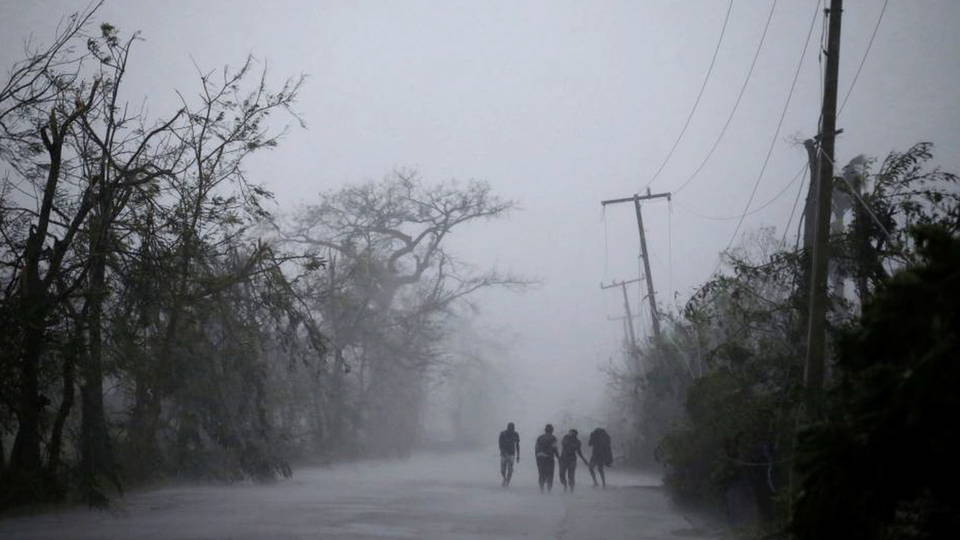 At least 11 people are feared to be dead in the Caribbean after the massive Category 4 Hurricane Matthew slammed into Haiti and the Dominican Republic Tuesday with winds up to 145 miles an hour and torrential downpours. It’s the strongest storm to hit the Caribbean in nearly a decade. In Haiti, Matthew has killed at least four people and displaced thousands more across a country still recovering from the devastating 2010 earthquake. The storm also knocked out most communications across Haiti and flooded a major bridge connecting southern Haiti to the rest of the country. The United Nations has warned the hurricane poses the greatest humanitarian threat to Haiti since the earthquake six years ago. The hurricane has also hit the Bahamas and Cuba, where the U.S. military evacuated 700 employees, and some family pets, from the naval base at Guantánamo Bay, although it did not evacuate the 61 prisoners held there. The storm is now hurtling toward the U.S. coast. In anticipation, multiple governors have declared states of emergency, and South Carolina Governor Nikki Haley has ordered the evacuation of coastal regions inhabited by more than a million people.

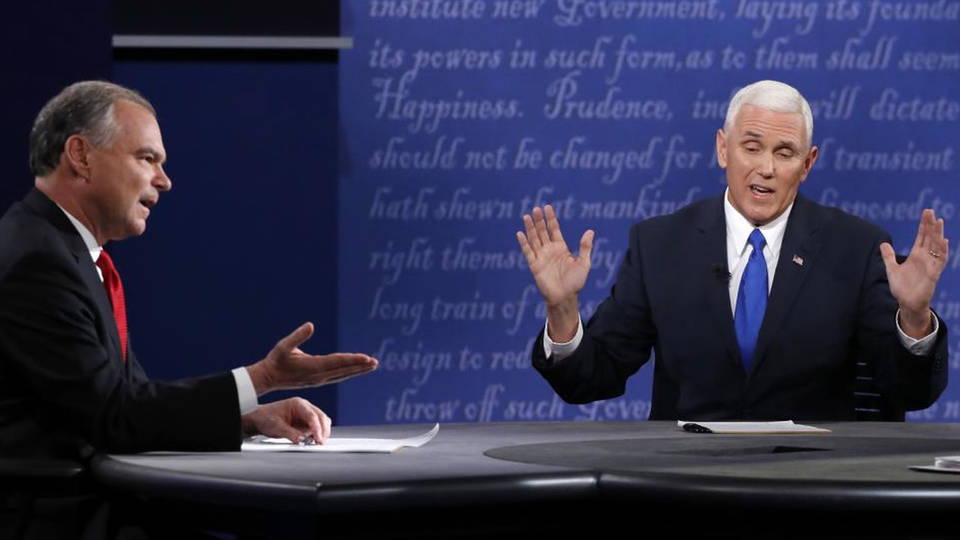 In news from the campaign trail, vice-presidential candidates Virginia Senator Tim Kaine and Indiana Governor Mike Pence squared off Tuesday night in the only vice-presidential debate. It was held at Longwood University in Farmville, Virginia, and moderated by Elaine Quijano ofCBS News. The debate was tense, with Kaine frequently attacking Pence over the proposals and character of his running mate, Donald Trump.
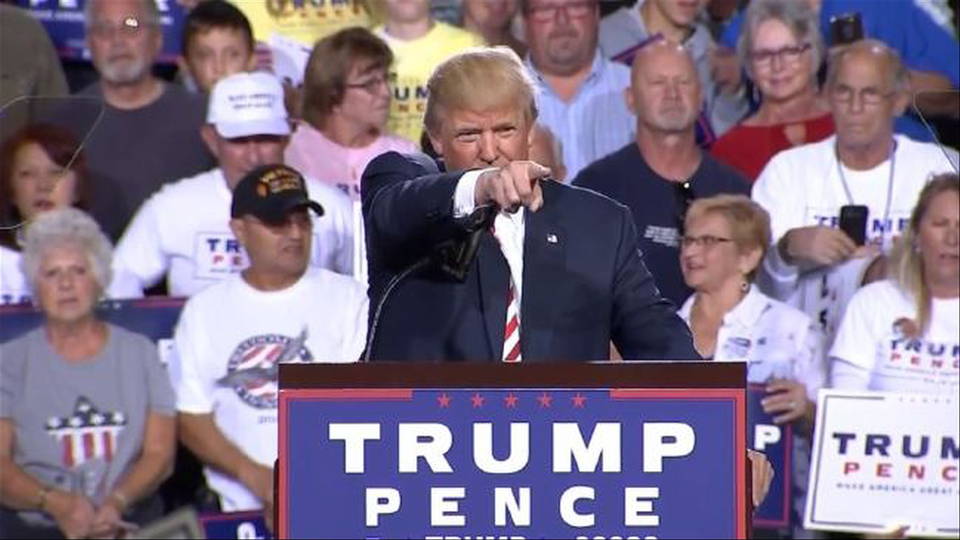 In more campaign news, a fight broke out at a Donald Trump campaign rally in Prescott, Arizona, between a Trump supporter and a protester Tuesday. There have been episodes of violence at Trump rallies throughout the campaign, which some have linked to Trump’s rhetoric. In March, three anti-Trump protesters sued Donald Trump, arguing he "incited a riot" at a rally in Louisville, Kentucky, causing them to be attacked by his supporters after he repeatedly called on the crowd to "get them out, get them out."
 In Indiana, state police have raided Indiana’s largest voter registration office. The Intercept reports nearly a dozen police officers searched the Indianapolis offices of the Indiana Voter Registration Project, seizing multiple computers and workers’ personal cellphones. The police say the search is related to an ongoing investigation into possible voter registration fraud. But organizers say the operation was an attack on voter registration efforts in the Republican-controlled state.
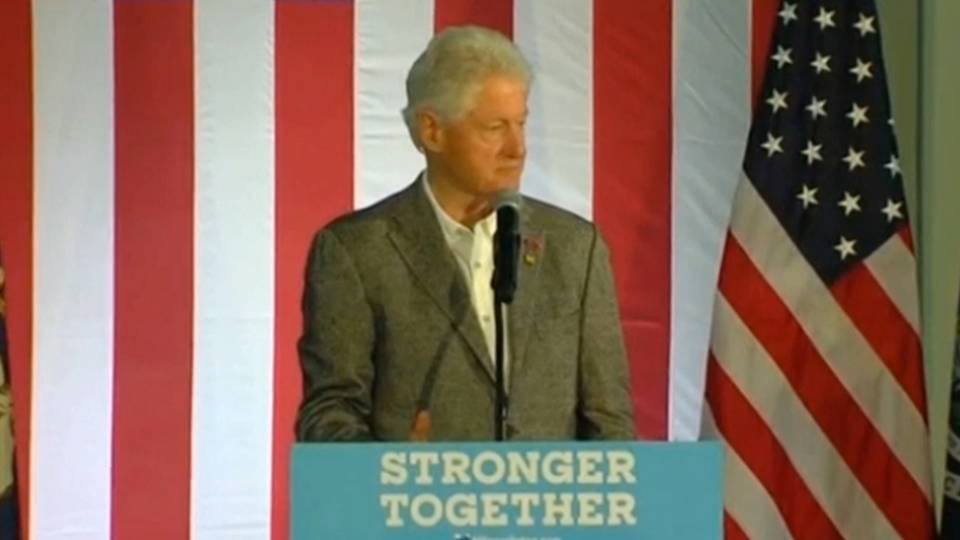 Former President Bill Clinton is trying to walk back his comments Monday in which he called Obamacare "the craziest thing in the world" while campaigning for Hillary Clinton in Flint, Michigan.
 Former employees of the email giant Yahoo say Yahoo secretly scanned the contents of hundreds of millions of email accounts and turned the information over to the NSA or FBI. In order to do so, Yahoo secretly built a special software program specifically designed to search every user’s emails for keywords provided by the U.S. government. If true, the practice represents the first known time a giant email company searched all arriving emails in real time at the behest of the U.S. government’s domestic surveillance programs.
 This comes as newly revealed documents show how the Justice Department subpoenaed Open Whisper Systems, the maker of the popular encrypted messaging application Signal, in efforts to get a wide range of information about two phone numbers—and then imposed a gag order on Open Whisper Systems preventing the company from talking about it. The encrypted application maker did not turn over the desired information because the company does not store such information about its users. The Justice Department sought the information in early 2016, but it’s only coming to light now because the gag order has been lifted.
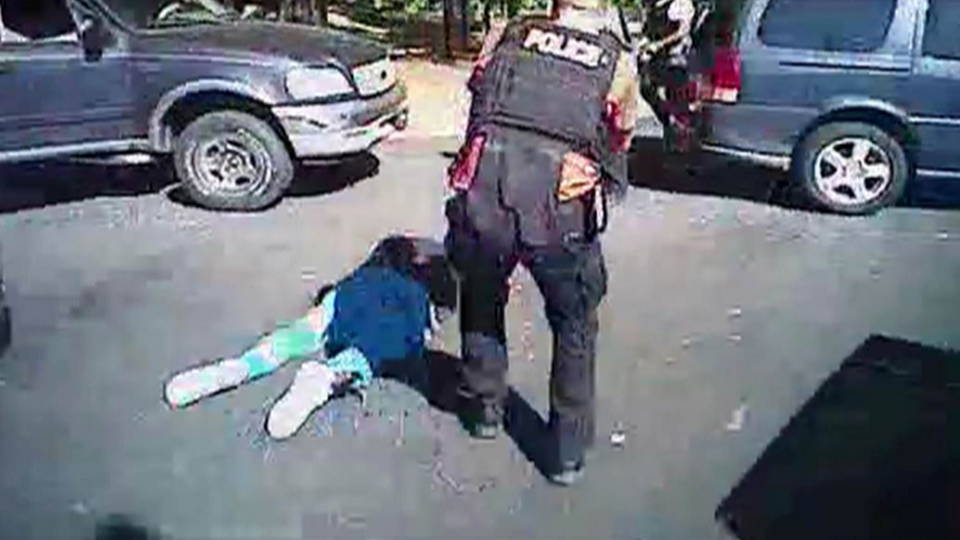 In Charlotte, North Carolina, police have released the full body camera video of the fatal police shooting of African-American father Keith Lamont Scott. The 16-minute video shows Scott lying on the ground, handcuffed, with multiple bullet wounds from the police shooting. The video does not show Scott with a gun, as the police have claimed he had, although officers did twice make reference to a gun during the video. North Carolina is an open-carry state. This is Scott’s family lawyer, Justin Bamberg.
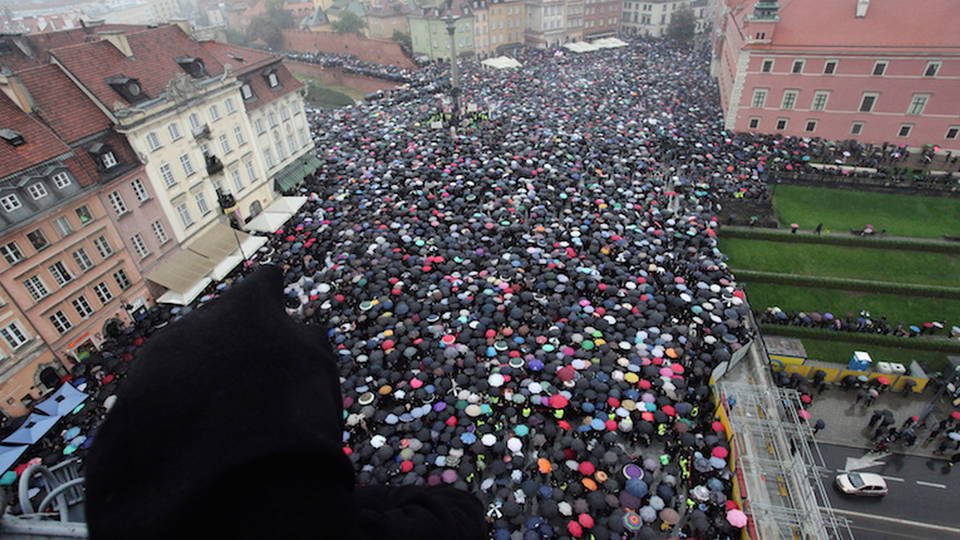 In Poland, as many as 6 million women poured into the streets for a nationwide protest Monday opposing proposals to completely ban abortions across Poland. Already by law, Polish women are only allowed to access an abortion if the child is the result of rape or incest, or if their lives are in danger as a result of the pregnancy. But the new proposed laws would make all abortions illegal and punishable by up to five years in prison for patients who obtain them. Doctors could also be jailed for providing abortions. The Catholic Church in Poland is supporting the proposed ban.
 In Mexico, two students from the Ayotzinapa Rural Teachers’ College in the southern state of Guerrero have been killed by gunmen on Tuesday. The attack came after gunmen stopped a bus traveling to the town of Tixtla. At least one other person was killed and three others wounded in the attack, including an 8-year-old boy. It’s not known who the gunmen were.
 Meanwhile, also in Mexico, a group of women who were reportedly kidnapped, tortured and raped by Mexican police officers 10 years ago have now taken their case to the Inter-American Human Rights Court. The events occurred in San Salvador Atenco in the state of México. The women were kidnapped amid two days of popular protests in May 2006, after police cracked down on a group of female flower sellers. The current president of Mexico, Enrique Peña Nieto, was the governor of the state of México at the time. This is Bárbara Méndez, a survivor of the sexual torture.
 And in Minnesota, thousands of nurses have voted to remain on strike into a second month, as they demand a contract that includes safe staffing ratios in the hospitals, improved security in emergency rooms and the right to retain their union-backed health insurance plans. More than 4,000 nurses are currently participating in the strike, which began on September 5, exactly one month ago.
-------
And in Minnesota, thousands of nurses have voted to remain on strike into a second month, as they demand a contract that includes safe staffing ratios in the hospitals, improved security in emergency rooms and the right to retain their union-backed health insurance plans. More than 4,000 nurses are currently participating in the strike, which began on September 5, exactly one month ago.
-------
Donate today:
Follow:


SPECIAL BROADCAST
At least 11 people are feared to be dead in the Caribbean after the massive Category 4 Hurricane Matthew slammed into Haiti and the Dominican Republic Tuesday with winds up to 145 miles an hour and torrential downpours. It’s the strongest storm to hit the Caribbean in nearly a decade. In Haiti, Matthew has killed at least four people and displaced thousands more across a country still recovering from the devastating 2010 earthquake. The storm also knocked out most communications across Haiti and flooded a major bridge connecting southern Haiti to the rest of the country. The United Nations has warned the hurricane poses the greatest humanitarian threat to Haiti since the earthquake six years ago. The hurricane has also hit the Bahamas and Cuba, where the U.S. military evacuated 700 employees, and some family pets, from the naval base at Guantánamo Bay, although it did not evacuate the 61 prisoners held there. The storm is now hurtling toward the U.S. coast. In anticipation, multiple governors have declared states of emergency, and South Carolina Governor Nikki Haley has ordered the evacuation of coastal regions inhabited by more than a million people.TOPICS:
South Korea: Typhoon Chaba Kills 5, Now Heading Toward Japan
Meanwhile, in South Korea, Typhoon Chaba has killed at least five people after it made landfall Wednesday, flooding out South Korea’s main port and major cities. The typhoon is now hurtling toward Japan. Scientists have linked the increasing intensity of hurricanes and typhoons to climate change.
TOPICS:
Vice-Presidential Nominees Tim Kaine & Mike Pence Squared Off in Debate
In news from the campaign trail, vice-presidential candidates Virginia Senator Tim Kaine and Indiana Governor Mike Pence squared off Tuesday night in the only vice-presidential debate. It was held at Longwood University in Farmville, Virginia, and moderated by Elaine Quijano ofCBS News. The debate was tense, with Kaine frequently attacking Pence over the proposals and character of his running mate, Donald Trump.Sen. Tim Kaine: "I’ll just say this: We trust Hillary Clinton—my wife and I—and we trust her with the most important thing in our life. We have a son deployed overseas in the Marine Corps right now. We trust Hillary Clinton as president and commander-in-chief. But the thought of Donald Trump as commander-in-chief scares us to death."
Governor Pence, meanwhile, defended Donald Trump’s refusal to release his tax returns, amid new revelations that suggest Trump could have avoided paying taxes for up to 18 years. This clip begins with Senator Kaine.
Sen. Tim Kaine: "But why won’t he release his tax returns?"
Gov. Mike Pence: "Well, we’re answering the question about—about the business thing."
Sen. Tim Kaine: "I do want to come back on this, but—"
Gov. Mike Pence: "His tax return—his tax returns showed he went through a very difficult time, but he used the tax code just the way it’s supposed to be used, and he did it brilliantly."
Sen. Tim Kaine: "How do you know that? You haven’t seen his tax returns."
Third-party vice-presidential nominees were excluded from the debate. But on Tuesday night, Democracy Now! expanded the debate in real time: After every question answered by the major-party vice-presidential candidates Mike Pence and Tim Kaine, we paused to get response from Green Party vice-presidential nominee Ajamu Baraka. We’ll run parts of this expanded debate after headlines.
TOPICS:
Fight Breaks Out Between Trump Supporter and Protester at AZ Rally
In more campaign news, a fight broke out at a Donald Trump campaign rally in Prescott, Arizona, between a Trump supporter and a protester Tuesday. There have been episodes of violence at Trump rallies throughout the campaign, which some have linked to Trump’s rhetoric. In March, three anti-Trump protesters sued Donald Trump, arguing he "incited a riot" at a rally in Louisville, Kentucky, causing them to be attacked by his supporters after he repeatedly called on the crowd to "get them out, get them out."TOPICS:
Indiana: Police Raid Voter Registration Office
In Indiana, state police have raided Indiana’s largest voter registration office. The Intercept reports nearly a dozen police officers searched the Indianapolis offices of the Indiana Voter Registration Project, seizing multiple computers and workers’ personal cellphones. The police say the search is related to an ongoing investigation into possible voter registration fraud. But organizers say the operation was an attack on voter registration efforts in the Republican-controlled state.Bill Clinton: Obamacare is "The Craziest Thing in the World"
Former President Bill Clinton is trying to walk back his comments Monday in which he called Obamacare "the craziest thing in the world" while campaigning for Hillary Clinton in Flint, Michigan.Bill Clinton: "The people who are getting killed in this deal are small business people and individuals who make just a little too much to get any of these subsidies. Why? Because they’re not organized, they don’t have any bargaining power with insurance companies, and they’re getting whacked. So you’ve got this crazy system where all of a sudden 25 million more people have healthcare, and then the people who are out there busting it sometimes 60 hours a week wind up with their premiums doubled and their coverage cut in half. It’s the craziest thing in the world."
On Tuesday, Bill Clinton attempted to walk back his comments by saying Obama’s signature legislation did a "world of good."
TOPICS:
Report: Yahoo Secretly Scanned Emails of All Users for NSA & FBI
Former employees of the email giant Yahoo say Yahoo secretly scanned the contents of hundreds of millions of email accounts and turned the information over to the NSA or FBI. In order to do so, Yahoo secretly built a special software program specifically designed to search every user’s emails for keywords provided by the U.S. government. If true, the practice represents the first known time a giant email company searched all arriving emails in real time at the behest of the U.S. government’s domestic surveillance programs.TOPICS:
DOJ Subpoenaed & Imposed Gag Order Against Signal Maker
This comes as newly revealed documents show how the Justice Department subpoenaed Open Whisper Systems, the maker of the popular encrypted messaging application Signal, in efforts to get a wide range of information about two phone numbers—and then imposed a gag order on Open Whisper Systems preventing the company from talking about it. The encrypted application maker did not turn over the desired information because the company does not store such information about its users. The Justice Department sought the information in early 2016, but it’s only coming to light now because the gag order has been lifted.TOPICS:
Charlotte: Police Release Full Body Cam Video of Keith Lamont Scott Killing
In Charlotte, North Carolina, police have released the full body camera video of the fatal police shooting of African-American father Keith Lamont Scott. The 16-minute video shows Scott lying on the ground, handcuffed, with multiple bullet wounds from the police shooting. The video does not show Scott with a gun, as the police have claimed he had, although officers did twice make reference to a gun during the video. North Carolina is an open-carry state. This is Scott’s family lawyer, Justin Bamberg.Justin Bamberg: "I can tell you that it is very difficult to watch. It’s difficult for a wife to watch. And what you’re seeing is real life. You see Mr. Scott on the ground. You see him handcuffed. And you see a human being, a father, a husband, lose his life."
Keith Lamont Scott’s killing by police has sparked massive protests in Charlotte and nationwide.
TOPICS:
New York City: Not a Single NYPD Cop Is Wearing a Body Camera
OCTOBER 05, 2016
HEADLINES
Meanwhile, the New York Police Department has admitted not a single one of its 34,800 officers is currently wearing a body camera. On Monday, the NYPD said it picked a company to provide about 5,000 body cameras to the force over the next five years, but no contract has been signed.
Poland: Up to 6 Million Women Protest Proposed Abortion Ban
In Poland, as many as 6 million women poured into the streets for a nationwide protest Monday opposing proposals to completely ban abortions across Poland. Already by law, Polish women are only allowed to access an abortion if the child is the result of rape or incest, or if their lives are in danger as a result of the pregnancy. But the new proposed laws would make all abortions illegal and punishable by up to five years in prison for patients who obtain them. Doctors could also be jailed for providing abortions. The Catholic Church in Poland is supporting the proposed ban.TOPICS:
Mexico: 2 Students from Ayotzinapa Teachers College Killed by Gunmen
In Mexico, two students from the Ayotzinapa Rural Teachers’ College in the southern state of Guerrero have been killed by gunmen on Tuesday. The attack came after gunmen stopped a bus traveling to the town of Tixtla. At least one other person was killed and three others wounded in the attack, including an 8-year-old boy. It’s not known who the gunmen were.TOPICS:
Mexico: Women Raped by Mexican Police Bring Case to Int'l Court
Meanwhile, also in Mexico, a group of women who were reportedly kidnapped, tortured and raped by Mexican police officers 10 years ago have now taken their case to the Inter-American Human Rights Court. The events occurred in San Salvador Atenco in the state of México. The women were kidnapped amid two days of popular protests in May 2006, after police cracked down on a group of female flower sellers. The current president of Mexico, Enrique Peña Nieto, was the governor of the state of México at the time. This is Bárbara Méndez, a survivor of the sexual torture.Bárbara Méndez: "During the detention and during transportation, I was tortured physically, psychologically and sexually. I was caught up in the penal process for more than two-and-a-half years. It was a very heartbreaking experience, and it has left a big impact on my life, to be detained and tortured under those conditions."
TOPICS:
Minnesota: Thousands of Nurses Continue Strike into Second Month
And in Minnesota, thousands of nurses have voted to remain on strike into a second month, as they demand a contract that includes safe staffing ratios in the hospitals, improved security in emergency rooms and the right to retain their union-backed health insurance plans. More than 4,000 nurses are currently participating in the strike, which began on September 5, exactly one month ago.TOPICS:
Donate today:
Follow:
SPECIAL BROADCAST


Senior TV Producer
207 West 25th Street, 11th Floor
New York, New York 10001, United States
-------
-------

No comments:
Post a Comment