 From the Lewis Center for Church Leadership of Wesley Theological Seminary
Leading Ideas "The 75 Percent Rule to Reach Younger People | Why Year-End Evaluations Rarely Help Leaders Grow"
Lewis Center for Church Leadership from The Wesley Theological Seminary of Washington, D.C., United States for Wednesday, October 12, 2016

SUBSCRIBE | Topics | Authors | Reprints
-------
 The 75 Percent Rule to Reach Younger People by Lee Kricher
Lee Kricher, pastor of Amplify Church in Pittsburgh, says it’s unlikely that younger adults will be drawn to a service where the people in visible leadership are significantly older than they are. So his church has instituted a rule requiring that 75 percent of worship leaders in visible roles be 35 years old or younger, since that’s the average age of the community they seek to serve.
I have found that people in their fifties, sixties, and older tend to be very open to attending a church where the majority of people in visible leadership are significantly younger than they are. On the other hand, I have found that it is less likely that young adults and young parents will be drawn to a weekend service where the vast majority of people in visible leadership are significantly older than they are.
That is why we instituted the 75 percent rule. The 75 percent rule is that 75 percent of all of the people in visible leadership during any given weekend service must be the average age of or younger than the community we serve. For Amplify Church, that means that 75 percent of those in visible leadership during any given weekend service need to be 35 years old or younger. That requires us to identify a lot of young people who can speak effectively, lead worship, play instruments, and do the announcements!
A woman in her early twenties who visited our church told me, “I’ll definitely be coming back because so many of the people up front look like me.”
Think about your church services over the past few months. If a high percentage of the people who were up front — those who spoke, did readings, shared announcements, led singing, and played instruments — were older than the average age of the community you serve, chances are your services are less appealing to young people than you may realize.
I remember a comment made by a woman in her early twenties who visited our church. She came reluctantly in response to an invitation from a friend. After her first service, she told me, “I’ll definitely be coming back.” I asked her why, and she said, “Because so many of the people up front look like me.” Even if you use 50 percent as your goal instead of 75 percent (as we did when we started our turnaround), you will at least be committed to having young people involved every weekend in visible leadership.
I am not saying that people over 35 years old do not have significant leadership roles in our church. In fact, the roles filled by our members in their forties, fifties, sixties, and older provide the strong and stable foundation without which we could not be a strong and stable church. In addition to the natural mentoring they do with our young leaders, they fill many of our most critical leadership roles. They also make up a very high percentage of our small group leaders, perhaps the most critical role in the church.
One of our church members who makes a significant “behind the scenes” contribution is a woman in her sixties who has served as a volunteer continuously for more than 30 years. For many years, she created the overhead transparencies that were used for our worship services. Later she adapted to creating PowerPoint slides on a PC. Now she prepares the entire service using ProPresenter on a Mac. With constant changes in technology, she was pushed further and further and further out of her comfort zone, but to her credit, she adapted. She serves from a booth in our balcony and knows that she is making a tremendous contribution even though she is not in a visible up-front role.
 The 75 percent rule does require that talented people in their forties and fifties and older be willing to step aside from being up front every week during weekend services — even when people in the church are telling them how much they are missed when they don’t play or sing or speak. I admire them greatly because they have embraced our vision for mentoring younger leaders and have stepped up to the challenge. They know that by letting go of their “right” to be up front every week, they are opening the door for the next generation.
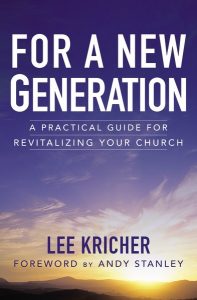
Taken from For a New Generation by Lee Kricher. Copyright © 2016 by Lee D. Kricher. Used by permission of Zondervan (zondervan.com).
Related Resources:
- What Churches Do Young Adults Attend? by Lovett H. Weems, Jr.
- Lessons from Churches that Reach Young Adults by Lovett H. Weems, Jr.
- Making Space for Faithful Following by Denise Janssen
-------
 Why Year-End Evaluations Rarely Help Leaders Grow By Lovett H. Weems, Jr.
Lovett H. Weems, Jr., explains why year-end performance evaluations are insufficient to help people grow and improve. While year-end reviews are important, ongoing feedback that occurs “along the way” during the course of the year is not only less anxiety producing; it is also more effective in helping someone do their job better.
Year-end reviews are common for most of us. Everyone understands that they are important, but rarely do those being reviewed or those doing the reviewing look forward to the task. One reason is that we have trouble remembering when these evaluations have produced beneficial results for either.
If you are not receiving the feedback you need, ask for it from those who know you well and have your best interests at heart. Opening the lines of communication will produce multiple benefits and strengthen relationships.
Year-end reviews are only as effective as what has happened throughout the year leading up to the review. Here is where understanding two types of evaluation can help.
Formative Evaluation
Formative evaluation is intended for growth and occurs when no decisions need to be made. This is feedback that you receive “along the way” during the course of the year. It may come in check-in sessions or informal conversations.
The only goal of formative evaluation is helping you improve and succeed. Remember, no decisions are made or judgments recorded. For example, no promotion or salary level or new work setting is dependent on formative evaluation.
Formative feedback is what all of us need most because it makes growth more likely. Such feedback normally comes from a trusted source who has your best interests at heart. Formative feedback helps you know specifically what you can do differently to improve. There is no fear or anxiety about your future to distract from the goal of growth.
Summative Evaluation
Formative evaluation needs to be supplemented with summative evaluation. Summative evaluation is a more formal review that normally results in a decision, report, recommendation, or other assessment. This is the classic year-end evaluation.
Summative evaluation has a place, but it is not where growth tends to occur. Any time a decision is to be made, the person under review usually can hear nothing but what the decision is. So summative reviews are necessary, but we should not expect them to be a catalyst for change — unless they are connected to a healthy dose of formative feedback along the way.
If a concern comes up in your year-end evaluation that is new for you, then the process has failed. If you are regularly late for work, for example, the year-end review is not the place for the concern to surface for the first time. If such an issue remains a problem after formative feedback, then it will come as no surprise to you when it shows up on the year-end agenda.
80/20 Formula
There is no magic formula for the right balance of formative and summative feedback. Using 80 percent formative and 20 percent summative is a good goal. Remember, formative is for change and growth. Summative is for drawing conclusions, making decisions, and rendering judgments. Unfortunately, this ratio is probably reversed in the practices of the church.
Just think about everything that comes at about the same time that year-end reviews are done. Not only must these review reports be submitted, but often salary recommendations come about this time. And for some pastors, this is the time when churches make their wishes known about the continuance of the pastor. No wonder those under review miss the nuances of the feedback they are offered. Too much is compressed into an annual evaluation. The “feedback for growth” component easily is lost. As committees prepare for these year-end reviews, they often realize that the formative work has been neglected throughout the year.
A Way Forward
Think about how you give and receive feedback throughout the year. Are you receiving the feedback you need to improve? What about those who look to you for feedback? Are you sharing with them thoughtful critique and suggestions that can help them grow?
It is important to keep in mind that there are crucial criteria for sharing feedback with others for their improvement and growth. The quality of the conversation and the level of trust among those involved make all the difference. Remember, you are always talking “with” someone, not “to” them. Unless we feel the other person genuinely cares for us and wants the best for us, hearing criticism is too difficult and will be ineffective.
If you are not receiving the feedback you need, ask for it from those who know you well and have your best interests at heart. Opening the lines of communication will produce multiple benefits and strengthen relationships. Your desire to know what others think will go a long way toward creating an environment in which formative feedback is given and received with appreciation.
Then year-end reviews can go from covering a long list of complaints that have built up all year and can become a way to affirm strengths, identify places for growth, and set goals for the coming year. Those goals can then become the starting point for the next year’s work and the next summative review.
Related Resources:
- Cultivating a Feedback-Friendly Congregation by Lovett H. Weems, Jr.
- Principles for Sound Staff Evaluation by Dan Hotchkiss
- Clergy Evaluation Resources from the Lewis Center
-------
The Right Question
Leaders do not need answers. Leaders must have the right questions.
Changes can be exciting or threatening, depending on your perspective. In the best of cases, some will be more excited and welcoming of the change than others. Apart from the specifics of the change, how you as a leader implement the change will either enhance the trust people have in you or diminish your credibility. One person suggests using this question in approaching any upcoming change:
Will the way I handle this change raise, maintain, or diminish trust?

LPLI, the Lewis Pastoral Leadership Inventory™, is a confidential, online, 360° leadership development instrument. It helps pastoral leaders improve their ministry effectiveness by identifying individual strengths and weaknesses within a three-fold understanding of fruitful leadership encompassing Character, Competence, and Contribution. Users receive a personalized leadership profile report that can be used for self-discovery, gathering feedback from others, setting goals for improvement, identifying continuing education needs, and tracking progress over time. LPLI is customizable for groups, and CEU credit is available.
Quotable Leadership:
Churches are likely to grow toward partnership among their members when there is a dynamic of leadership behavior among a variety of people and not just one leader. [Letty M. Russell]
Churches are likely to grow toward partnership among their members when there is a dynamic of leadership behavior among a variety of people and not just one leader. [Letty M. Russell]
 Learn 50 Ways to Increase Worship Attendance
Worship attendance is vital to the mission of the church. Our free "50 Ways" tip sheet provides practical strategies to help you improve the attendance of current members; invite new people to attend worship; make your church visible and attractive; welcome worship guests warmly; and make worship accessible to newcomers. Read "50 Ways to Increase Worship Attendance" now.
Vital worship strengthens other areas of ministry by inspiring faith, building community, and connecting people to the congregation’s mission. Because worship is at the center of congregational life, strong attendance is more than a number. It is a vital sign.
Prepared by Robert Crossman
Improve the attendance of current members
- Strive to increase the number of times current members are in worship each year. Start with yourself.
- At least once or twice each year, perhaps in the New Year’s resolution season, teach and preach the importance of faithful worship attendance.
- Invite church members to make a written commitment to grow one step toward faithful attendance.
- Include a commitment to faithful worship attendance as part of a holistic annual stewardship commitment.
- Keep a record of attendance and monitor it.
- Know that it is important to respond to absentees before they drop out of active attendance. Once a regular attender misses six consecutive weeks, it is hard to return to the habit of consistent Sunday worship.
- Form a worship membership care team to review attendance within 24 hours of each service.
- Send a handwritten note (signed by the membership care team, not the pastor) to anyone who has missed three Sundays in a row. Say, “Looking through the attendance slips, we’ve missed your name! Hope to see you next Sunday.” In a smaller church, the wording can be more personal.
- Ask a personal friend (a choir mate, Sunday School class member, or someone who sits in the same pew) to telephone people who have missed four Sundays in a row. “Hi John. We’ve noticed that Fred has missed church the last four Sundays. Can you telephone him this evening?”
- Maintain a loving, invitational relationship with those who have been absent for five or more Sundays. Never be judgmental.
- Know that is often very difficult to return to worship after the death of a loved one. Form a Grief Support Team to send handwritten notes monthly until the family has returned to regular Sunday attendance.
- Telephone every household in the church and everyone who has ever visited to invite them to some special event four times a year. Say, “Hi, we are calling everyone related to First Church this week, reminding everyone that this Sunday the choir is singing the Messiah. I hope you will be there.”
Invite new people to attend worship
- Decide today to open your minds, hearts, and doors to new faces, even if it means changing your music, sermon content, Sunday School, and enlarging your personal circle of Christian friends.
- Pray for the unchurched in your community. Pray for children being raised outside the church, couples in marriages that don’t have Christ at their center, etc. But pray also for specific families and individuals — friends, relatives, associates, neighbors — by name every day.
- Know that personal invitations are the most effective method of increasing worship attendance. Invest 60 seconds once a week to invite someone to attend worship with you.
- Continue to invite a person every two months even if they decline your invitations. Those invited may eventually come to a season of life when they are receptive to attending worship. Regular invitations are more likely to overlap one of these seasons.
- Recycle your worship bulletins. Keep Sunday’s bulletin in your car or on your desk until you have given it to someone along with your personal invitation for them to join you in worship.
- At least once a year, perhaps in the pre-Christmas season, preach and teach the importance of becoming an inviting people. Invite the congregation to make a written commitment to grow one step toward faithful inviting and witnessing.
- Distribute to members simple printed invitations during the Christmas and Easter seasons that they can give to family and friends. Print at the top of the card, “If you are not active in a church, worship with us this season.”
- Have a “Bring a Friend Day” or “F.R.A.N.” Day — a church-wide effort to bring a Friend, Relative, Associate or Neighbor. Select a Sunday when something special is happening, such as homecoming, the start of Vacation Bible School, or Christmas Eve. And prepare as you would for company coming.
- Know that the people who are on the fringe of your church are your future, your prospect list, and your next potential generation of deeply devoted disciples. Avoid the tendency to denigrate or alienate those who are not yet fully committed disciples.
- Find ways continually to invite these “near the edges” of your church, especially those who already have a positive impression of the church, such as those who have come to the church for a wedding, a funeral, or to vote and those who already worship a couple of times a year. Do not drop them from the newsletter or membership list.
- Distribute door hangers in target neighborhoods near your church. It is more effective to cover the same 500 doors six times, than to do 3,000 doors one time.
- Send mass mailers to targeted postal routes near your church six to eight times a year. The back-to-school season, pre-Christmas, and pre-Easter times are logical for these mailing.
- Have a website. Increasingly, people use the internet and Google the same way our grandparents used the Yellow Pages. The web presence can be very simple, a single page with a map, worship times, simple welcoming invitation, and contact information.
Make your church visible and attractive
- Purchase permanent roadside directional signs to point the way to your building. If your building is not on the main highway, install a prominent sign on the highway.
- Purchase temporary yard signs to put out for a few days and then remove. They catch the eye and are relatively inexpensive. They should be very simple with little wording, such as: “Worship 10 a.m. Sunday. You’re Invited.” “Easter Sunday 11 a.m. You’re Invited.”
- Don’t hide your cars. If there is parking in front of the building, use it. Cars in the parking lot lets the community know that something important is happening at your church.
- Make a good first impression through the appearance of your building and landscaping. A well cared for exterior lets guests know that you are expecting company.
- Clearly indicate the main entry to your building so that worship guests can find it easily.
- Reserve the best parking spaces for guests. The pastor, staff, and church officers should park on the edge of the parking lot, leaving the best spaces for others.
- Make the nursery the nicest room in the church to attract and keep families with young children. It should be clean and well equipped, in an easy-to-find location close to the worship space, and staffed with adults. As your church grows, you will need pagers, check in and check out procedures, and nursery staff wearing uniforms with a photo ID.
- Have clean, neat Sunday School rooms for children. The Sunday School program should be well-staffed and well-resourced.
Welcome worship guests warmly
- Greet guests when they first arrive in the parking lot. Give a couple of people orange vests and have them wave and smile as cars pull in. On rainy days, they can escort people to the door under a church umbrella. If the lot is large, they can drive folks to the door in golf carts.
- Greet guests as they arrive at the door, saying “Good to see you. Glad you are here.” Do not ask for their names as many guests are cautious and prefer anonymity. The larger the church, the more this is true.
- Clearly mark the rest rooms, nursery, and worship rooms. In a large building with a complicated layout, have greeters stand at the intersection of hallways ready to escort guests who are unsure about finding their way.
- Find a way to acknowledge and welcome guests in worship without singling them out or embarrassing them. In many communities, guests prefer to be anonymous so don’t ask them to stand and introduce themselves.
- Have an easy and readily available method for worship guests who wish to give you their name and contact information.
- Practice the “Circle of Ten.” Encourage church leaders to personally greet everyone — member or guest — who may sit within ten feet of them on Sunday.
- Know that guests typically leave the building within three minutes after the service. Encourage church leaders to follow the “Rule of Three,” devoting the first three minutes after the benediction to speaking with people they don’t know before speaking to family and friends.
- Have greeters at all the exits, smiling, shaking hands, and simply saying to members and guests as they leave, “Glad you were here. I hope to see you next Sunday.”
- Start a “First Friends” ministry as a way to reach a new age, racial, or cultural group. Train a pool of people, from a variety of ages and stages of life, to watch for first time guests, sit by them, treat them to lunch, and telephone them the next Saturday inviting them to Sunday worship.
Make worship accessible to newcomers
- Make your worship bulletin or screens visitor friendly. Include the actual words, or at least the page numbers, for any songs or responses commonly known to members but not newcomers.
- Preach sermons that don’t assume familiarity with the inner workings of the church or a high level of previous biblical knowledge.
- Present all musical offerings well and in a style most likely to appeal to worship guests.
- Consider adding an additional worship service to reach new people who would prefer a different time; or to reach new people who would prefer a different style of worship and music.
- Start a new church or a second worship site at a different location as a way of increasing attendance.
Follow up with visitors
- Develop a systematic plan for following up with visitors after their first, second, and third visits.
- One model some use includes 1) follow up with first-time visitors with a doorstep visit before 3 p.m. that same Sunday, a letter or telephone call from the pastor within two days, and placement on the newsletter and email lists; 2) follow up with second-time visitors with telephone call within 36 hours from someone related to the visitor’s interests or needs — for example, a Youth Minister, or Sunday School Teacher, or Choir Director; and 3) follow up with persons who visit a third time with a telephone call to request a home visit.
- Invite newcomers who have visited in recent months to an informal coffee with the pastor or other social gathering that includes fellowship and information.
Dr. Robert Crossman is Minister of New Church Starts and Congregational Advancement for the Arkansas Conference of the United Methodist Church. Used by permission.
 Download a PDF of this page to share with others.
-------
Editors: Dr. Ann A. Michel and Dr. Lovett H. Weems, Jr.
Lewis Center for Church Leadership of Wesley Theological Seminary
Connect with the Lewis Center:


Lewis Center for Church Leadership
Editors: Dr. Ann A. Michel and Dr. Lovett H. Weems, Jr.
Lewis Center for Church Leadership of Wesley Theological Seminary
Connect with the Lewis Center:
Lewis Center for Church Leadership
Wesley Theological Seminary
4500 Massachusetts Avenue NorthWest
Washington, D.C. 20016, United States
-------

No comments:
Post a Comment