


 Ministry Matters: "Halloween — Immigration — The Trump effect — InterVarsity's purge" in Nashville, Tennessee, United States for Monday, 24 October 2016
-------
 Halloween and Christian faith by Mike PoteetBigstock/Subbotina Anna
I was a third-grade devil!
The Halloween I was nine years old, I went trick-or-treating as the devil. I had no satanic interest; I simply thought it would be fun to wander around wearing inflatable horns on my head and brandishing a plastic pitchfork. Wearing red polyester pajamas and cowboy boots to complete my costume, I wasn’t even as frightening as Casper the Friendly Ghost.
But I remember how some friends reacted. “Aren’t you a Christian? Isn’t your dad a minister?” (Yes, and he was happily snapping Polaroids.) “I’m surprised you’re trick-or-treating at all.”
I realized then that not everyone agrees about how or even whether Christians should celebrate Halloween. That question has interested me ever since, especially as the holiday’s popularity has increased exponentially.
According to the National Retail Federation, over 171 million Americans (69.1 percent of the population) will celebrate Halloween this year. Their total spending — on costumes, decorations, candy, greeting cards and more — will reach $8.4 billion, the highest level the annual survey has recorded, an average of $82.93 per person.
What makes Halloween so popular, and why do Christians disagree about whether they should join in?
Christian name, non-Christian holiday
Although Halloween as we know it emerged from several sources (see “Halloween Origins” on page 3), its name has a Christian etymology. In Calendar: Christ’s Time for the Church, Laurence Hull Stookey explains that the early church ran out of days on which to commemorate its martyrs and saints. To solve this “crisis,” one date became “a kind of omnibus occasion” commemorating them all. Believers in different places kept this festival on various dates until, in 837, Pope Gregory IV fixed November 1 as All Saints’ Day. In medieval England, it was called Alholowmesse, “All Hallows’ Mass.” The night before was “All Hallows’ Eve,” ultimately shortened by the 18th century to “Halloween.”
Today, some Christians promote Halloween festivities focusing on our communion with the saints, that “great cloud of witnesses” to Christ (Hebrews 12:1) now living with him. One creative Catholic blogger, for example, showcases on her site kids’ costumes that do double duty as depictions of saints and trick-or-treating outfits. One child who dressed on November 1 as Saint Denis, the decapitated third-century French bishop, had gone out the night before as “Guy Carrying His Own Head.”
Despite its name, modern Halloween has no real connection to Christianity in American culture. In fact, it holds no single, definitive meaning. Halloween, like beauty, is largely in the eye of the beholder. “If it is a fixture in our annual calendar,” writes historian Nicholas Rogers, “it is also a holiday that has been reinvented” many times and is changing still: “That is part of the secret of its resilience and vibrancy.”
Adults and Halloween
One of Halloween’s biggest changes in recent years is its emergence as a holiday for grown-ups. “Like treats snatched from a trick-or-treat bag,” USA Today reporter Bruce Horovitz claims, “adults have slowly been stealing Halloween from kids for years.”
One major trend Horovitz points to as evidence for his claim is the big business of Halloween costumes for adults. The number of costumes for grown-ups purchased at Halloweenexpress.com rose from less than 30 percent to more than 60 percent between 2002 and 2012. Some costumes are bigger versions of what the kids wear. This year, for instance, superhero costumes are tops among both kids and adults. Others are adult in a more risqué sense. Various risqué occupational costumes (police officer, nurse, teacher), almost exclusively intended for women, fill store racks and websites.
Is what Horovitz calls “the adultification of Halloween” cause for concern? Halloween can provide grown-ups welcome and low-stress chances to socialize. “You don’t have to travel or deal with relatives,” marketer Denise Delahorne told Forbes magazine. “There’s not the holiday pressure to find a date if you are single.” And Halloween’s make-believe aspect can be fun, even therapeutic. Kelly David, spokesperson for the Spirit Halloween chain of seasonal stores, told one business journal that Halloween dress-up “is an escape from reality for a day. For adults, you can put on a Halloween costume and forget about work, the bad economy, and other pressures.”
But can Halloween lead us to indulge our imaginations too much? Christians might consider the apostle Paul’s admonitions to “capture every thought to make it obedient to Christ” (2 Corinthians 10:5), focusing our minds on what is true, holy, just, pure, lovely and praiseworthy (Philippians 4:8). What kind of Halloween costumes meet those criteria? What kind of Halloween celebrations might help adults nurture a childlikesense of imagination and play without encouraging childish behavior?
Facing death
One aspect of Halloween that’s never changed is its preoccupation with mortality. As Halloween historian David Skal writes, “The grand marshal of the Halloween parade is, and always has been, Death.”
Plastic skulls and skeletons adorn house windows and porches. Trick-or-treaters make their rounds costumed as vampires (the “living dead”) and zombies (the “walking dead,” a phrase made more familiar by the comic book and TV series of that name). Horror movies like Halloween (1978) and its sequels link murderous mayhem to October 31. Although it’s emphasized more in some eras and customs than in others, Halloween retains an unbreakable connection to what The Walking Dead creator Robert Kirkman calls “the unrelenting, unstoppable possibility of death that looms over all of our lives at all times.”
In Latin America, especially in Mexico, and in Hispanic communities elsewhere, the holiday most like Halloween is Día de los Muertos, the Day of the Dead, which is frequently celebrated over several days. It faces death even more frankly. Celebrants light candles at and decorate loved ones’ graves; dance in parades with faces brightly painted to look like skulls (calaveras); and eat sugar skulls (calaveras de azúcar), candy coffins and sweet “bread of the dead” (pan de muertos) at parties. Helen Tafoya-Barraza, a clinical counselor for University of New Mexico Hospitals, writes on her website that Día de los Muertos teaches people, especially children, not to be afraid of death and “to enjoy and appreciate every moment.” She says the Day of the Dead is “a true celebration of life.”
More than a good scare
Halloween’s images of death are, for many, simply entertaining frights. Talking to the BBC about Universal Studios’ annual theme park of haunted mazes and “scare zones,” Mike Aiello, Universal’s director of entertainment, said, “A lot of people really enjoy it. I’ve always perceived someone being scared or wanting that adrenalin rush as the same as someone who wants to laugh … They’re two ends of a really dramatic, emotional spectrum — the laugh and the scare — [and] there’s a rush either way. And for those few moments when you’re experiencing that you’re not thinking about anything else.”
Nothing would keep Christians, however, from seeing more in Halloween’s depictions of death and evil— vampires, witches, ghosts, even devils. Might they serve as indirect reminders that while “the cosmic powers of this present darkness” (Ephesians 6:12, NRSV) are real and we all will one day return to dust (Genesis 3:19), we have nothing to fear from sin, evil and death because God, in raising Jesus Christ from the grave, has triumphed over them all?
Scripture says Jesus “disarmed” the powers of darkness and “exposed them to public disgrace by leading them in a triumphal parade” (Colossians 2:15). How humiliated was the devil, I wonder, by my nine-year-old self, clomping from door to door in blowup horns and too-big boots, asking for candy?
Christians may never agree on whether they can or should celebrate Halloween. But we can agree with a stanza from “A Mighty Fortress Is Our God,” the famous hymn by Martin Luther, who sparked the Protestant Reformation when he posted his 95 Theses on, coincidentally, October 31, 1517: “The Prince of Darkness grim, we tremble not for him; / his rage we can endure, for lo, his doom is sure; / one little word”—Jesus Christ, the Word of God—“shall fell him.”
Related: Redeeming Halloween by rediscovering Allhallowtide
Be sure to check out FaithLink, a weekly downloadable discussion guide for classes and small groups.

-------

Sponsored
-------
 Why is immigration a Christian issue? by James C. Howell
Nothing illustrates the inner conflicts Christians might experience, and the brutal truth that we live in a fallen world better, than the question of immigration. On the one hand, we are law and order people; we believe laws are to be obeyed — so all illegal immigrants, on Christian principles, should be sent home immediately, right? “Let every person be subject to the governing authorities” (Romans 13:1).
But then we are hospitality people, too; throughout the Bible we find warm sentiments toward the stranger, the foreigner, the sojourner, the needy — so immigrants, illegal or not, on Christian principles, should be welcomed and cared for, right? “The alien who lives near you shall be to you as the native born; you shall love him as yourself” (Leviticus 19:34). Or think of the way Jesus described the way those who will be saved treat aliens: “I was a stranger, and you welcomed me” (Matthew 25:35). After all, Mary and Joseph, with the child Jesus in tow, were refugees themselves.
What would the “default” Christian posture on immigration be? I suspect it is to steer clear of hostile or suspicious attitudes, and if possible to err on the side of hospitality. But why? Because modern America has something in common with ancient Israel that seems pertinent. Repeatedly, God told the Israelites, “The stranger shall be to you as the native; you shall love him as yourself, for you were strangers once” (Leviticus 19:34). “Love the sojourner, for you once were sojourners” (Deuteronomy 10:19); “You shall not oppress a stranger, for you were strangers once” (Exodus 22:21). Israel entered the Promised Land as immigrants from another place, so God urges them to be kind and welcoming to immigrants.
America, too, is a nation of immigrants. Way back we all came from somewhere. The records from Ellis Island are free online; I’ve found quite a few Howells there. While there has always been nagging prejudice against the Irish or Italians or Middle Eastern people and now Hispanics or Arabs, we never evade the eloquence of the poem Emma Lazarus composed for the pedestal of the Statue of Liberty, which so many immigrants passed as they arrived on our shores: “Give me your tired, your poor, your huddled masses yearning to breathe free… Send these, the homeless, tempest-tost to me, I lift my lamp beside the golden door!” These thoughts are not only kin to the Bible; back in those days, American thought on many issues was still shaped by the Bible!
This default mood doesn’t settle policy. Security certainly matters. Ancient Israel must have had the occasional immigrant who proved to be a criminal. But the baseline way we look at them, feel about them, and treat them is to be Christlike. Churches all over the country are engaging in significant ministries of welcome and aid — something that pleases the heart of God. Conservative evangelicals and mainline progressives are increasingly united in their determination to welcome refugees and press for immigration reform.
A consistent Christian ethic that is pro-life will surprise and overturn classic political party alignments. Could it be that pro-life, pro-immigration, anti-death penalty and anti-guns might fit together more neatly than we could have imagined?
Read Rev. Howell's previous 'Tis the Season articles covering the 2016 election here. This article originally appeared on the author's blog. Reprinted with permission.
-------
 The Trump effect, InterVarsity's purge and why some men don't like church
News and Religion podcast
Shane Raynor and the panel discuss the "Trump effect" and the country's expectations for morality from politicians. They also talk about InterVarsity's decision to terminate employees who disagree with the organization's views on gay marriage and they consider a religion columnist's recent post on why some men think church is for women. Guests are David Dorn, Joseph Yoo and Mark Lockard.
Republican presidential candidate Donald Trump. Photo: Bigstock/Andy Katz
-------
 Playing the comparison game
 By Joseph Yoo
Bigstock/Raymond Gregory
I’ve always felt an affinity with Peter. Sometimes I like to think he was named Rock... as in, “dumb as a rock.” He’s often impulsive with his actions and words. I tend to be, too.
Peter has this really intimate moment with Jesus on the beach.
Peter was sad that Jesus asked him a third time, “Do you love me?” He replied, “Lord, you know everything; you know I love you.” Jesus said to him, “Feed my sheep. I assure you that when you were younger you tied your own belt and walked around wherever you wanted. When you grow old, you will stretch out your hands and another will tie your belt and lead you where you don’t want to go.” He said this to show the kind of death by which Peter would glorify God. After saying this, Jesus said to Peter, “Follow me.”(John 21:17b-19)
Peter doesn’t respond with a “I will go” or even a, “Hey, are you sure?” He sees the other disciple “whom Jesus loved” and Peter says, “Lord, what about him?”
I love Jesus’ response: “What difference does that make to you? You must follow me.” Or in the NIV, “What is that to you?”
Theodore Roosevelt once said, “Comparison is the thief of joy.”
Boy, ain’t that the truth.
Nothing good comes from comparing yourself with someone else. It will usually either bring out your pride or bring out your envy — both tools that can be used to dismantle peace, unity and community.
Sometimes we even begin to view that neighbor, whom we are called to love, not as a neighbor but as our competition.
Someone has to be a winner and a loser when we’re playing the comparison game.
If we think we’re winning, our joy can be replaced by arrogance.
If we think we’re losing, our joy is swallowed up by jealousy and resentment.
- Why does he get that corner office?
- Why is she allowed to work out-of-the-office and I’m forced to work in the office?
- Why did she get that promotion?
- What does he have that I don’t?
Peter asks Jesus, “What about him?” And Jesus responds, “What’s it to you? Just follow me.”
We’re called to follow Christ. God created each of us with purpose and intention.
God has called you with a clear purpose that is uniquely yours. You’re called to be you. Not him. Not her. Not them.
You must follow me.
Don’t worry about what Jim is doing in children’s ministry. Don’t worry about what Sarah is doing as the lead pastor. Or what anyone else is doing, for that matter. God has a unique plan and purpose for them. What is it to you in their journey with God? Each of us is called to work for God’s Kingdom. God made us different, equipping us with unique gifts and talents and empowering us for our own callings and life’s work.
We’re in this together. We all have the same goal.
Comparison leads us away from the work of the Kingdom.
So instead of comparing, let’s be grateful.
For our teammates. For teamwork. For community. For an opportunity to serve.
It’s difficult to be resentful, envious, angry or competitive when we truly have a thankful heart.
-------

Sponsored
-------

Trump vs. Hillary vs. truth By David Dorn
Bigstock/Nicoleta Ionescu
Based on what the U.S. presidential candidates have said and done, which one do you line up with the most? Related: Why I’m neither optimistic nor pessimistic about American politics
David Dorn is the Lead Contemporary Pastor for Marvin United Methodist Church in Tyler, Texas. He is also the author of Reclaiming Anger, Under Wraps Youth Study and the founder of The PREPOSTEROUS Project.
-------
By David DornBigstock/Nicoleta Ionescu
Based on what the U.S. presidential candidates have said and done, which one do you line up with the most? Related: Why I’m neither optimistic nor pessimistic about American politics
David Dorn is the Lead Contemporary Pastor for Marvin United Methodist Church in Tyler, Texas. He is also the author of Reclaiming Anger, Under Wraps Youth Study and the founder of The PREPOSTEROUS Project.
-------
 Site where Romans breached Jerusalem walls is pinpointed
 By Michelle Chabin / Religion News Service
Workers slowly expose artifacts at the excavation site in the Russian Compound in Jerusalem. Slingstones on the ground are evidence of the battle that was waged at the site 2,000 years ago. Photo by Yoli Shwartz, courtesy of the Israel Antiquities Authority
JERUSALEM (RNS) The site where, nearly 2,000 years ago, the Roman army breached the outer walls of ancient Jerusalem before capturing the city and destroying the Second Jewish Temple has been discovered, the Israel Antiquities Authority says.
Archaeologists made the discovery last winter during an exploratory survey at a future construction site, the IAA said on Thursday (Oct. 20).
After expanding the excavation archaeologists discovered the remains of a tower jutting from what they believe was the Third Wall, the outermost wall surrounding Jerusalem at the end of the Second Temple period.
Opposite the tower’s western facade they found dozens of catapults and stones the archaeologists are certain were used by the Romans, led by Titus, against the Jewish guards who defended the wall from the tower.
 A spearhead from the battle against Titus' army. Photo by Clara Amit, courtesy of the Israel Antiquities Authority
Rina Avner, one of the lead archaeologists, told RNS that the discoveries confirm a detailed account of the battle by the contemporary historian Josephus.
“We found pottery from the Second Temple period within the cement of the wall, which was on the same level as the balustrades. We dated the embedded pottery to 70 A.D., the year Josephus said the Romans attacked the city and destroyed the Second Temple, forcing the Jews into exile.
“We were able to cross-reference our finds with the writings of Josephus. It was amazing,” Avner said.
The find comes amid an outcry over a recent resolution by UNESCO that ignores Jewish and Christian ties to the Temple Mount and refers exclusively, as Muslims do, to the Haram al-Sharif, or Noble Sanctuary.
The archaeologist said the latest discoveries add to the large volume of other proof that Jews lived in Jerusalem thousands of years ago.
The UNESCO resolution “erases history and actually tries to destroy our past and the Christians' past,” Avner said.
-------
 Niceness versus kindness By Brent Lamberth
Bigstock/enterlinedesign
As is evident in most coffee shops across America, baristas are trained to offer polite conversation and care to customers while they simultaneously maintain a steady focus on their primary task of preparing and serving drinks. Yet, when baristas Pierce Dunn and Evan Freeman of Vancouver, BC, noticed a grieving woman pull up to the drive-through window of their coffee shop, they did something bold. They stopped what they were doing and listened to the woman tell them about her recently deceased husband. Then, together, they reached out the window to hold her hand and to pray for her. Unbeknownst to the baristas, the driver of another car also waiting in line snapped a picture of them praying for the woman.

A Christian perspective
From a Christian perspective, this story is striking and startling because such a small act of kindness has been viewed by the world as a rare and special moment. Yet, in today’s world, we often find ourselves substituting a “nice” gesture for a “kind” action. A polite habit can even be used as a cop-out or excuse for avoiding deeper conversations and bolder actions. And while our intentions may be good, our nice habits are often void of value and substance, and the power of our Christian faith is subsequently held at bay.
Jesus’ example
The message and character of Jesus was rooted in kindness and care for others. He never allowed rules, reputation or risk to hold him back from serving those in need. He was and is the perfect example of kindness: one who puts others’ needs before his or her own. His disciples were and still today are called to the same task.
Question of the day: What does it take to be kind?
Focal scriptures: Luke 13:10-17; Acts 8:29-38; John 13:4-9
Luke 13:10 Yeshua was teaching in one of the synagogues on Shabbat. 11 A woman came up who had a spirit which had crippled her for eighteen years; she was bent double and unable to stand erect at all. 12 On seeing her, Yeshua called her and said to her, “Lady, you have been set free from your weakness!” 13 He put his hands on her, and at once she stood upright and began to glorify God.
14 But the president of the synagogue, indignant that Yeshua had healed on Shabbat, spoke up and said to the congregation, “There are six days in the week for working; so come during those days to be healed, not on Shabbat!” 15 However, the Lord answered him, “You hypocrites! Each one of you on Shabbat — don’t you unloose your ox or your donkey from the stall and lead him off to drink? 16 This woman is a daughter of Avraham, and the Adversary kept her tied up for eighteen years! Shouldn’t she be freed from this bondage on Shabbat?” 17 By these words, Yeshua put to shame the people who opposed him; but the rest of the crowd were happy about all the wonderful things that were taking place through him.
Acts 8:29 The Spirit said to Philip, “Go over to this chariot, and stay close to it.” 30 As Philip ran up, he heard the Ethiopian reading from Yesha‘yahu the prophet. “Do you understand what you’re reading?” he asked. 31 “How can I,” he said, “unless someone explains it to me?” And he invited Philip to climb up and sit with him.
32 Now the portion of the Tanakh that he was reading was this:
“He was like a sheep led to be slaughtered;
like a lamb silent before the shearer, he does not open his mouth.
33 He was humiliated and denied justice.
Who will tell about his descendants,
since his life has been taken from the earth?”[Acts 8:33 Isaiah 53:7–8]
34 The eunuch said to Philip, “Here’s my question to you — is the prophet talking about himself or someone else?” 35 Then Philip started to speak — beginning with that passage, he went on to tell him the Good News about Yeshua.
36 As they were going down the road, they came to some water; and the eunuch said, “Look! Here’s some water! Is there any reason why I shouldn’t be immersed?” 37 [Acts 8:37 Some manuscripts include verse 37: And Philip said, “If you believe with all your heart, you may.” He answered, “I believe that Yeshua the Messiah is the Son of God.”] 38 He ordered the chariot to stop; then both Philip and the eunuch went down into the water, and Philip immersed him.
John 13:4 So he rose from the table, removed his outer garments and wrapped a towel around his waist. 5 Then he poured some water into a basin and began to wash the feet of the talmidim and wipe them off with the towel wrapped around him.
6 He came to Shim‘on Kefa, who said to him, “Lord! You are washing my feet?” 7 Yeshua answered him, “You don’t understand yet what I am doing, but in time you will understand.” 8 “No!” said Kefa, “You will never wash my feet!” Yeshua answered him, “If I don’t wash you, you have no share with me.” 9 “Lord,” Shim‘on Kefa replied, “not only my feet, but my hands and head too!”
For a complete lesson on this topic visit LinC.-------

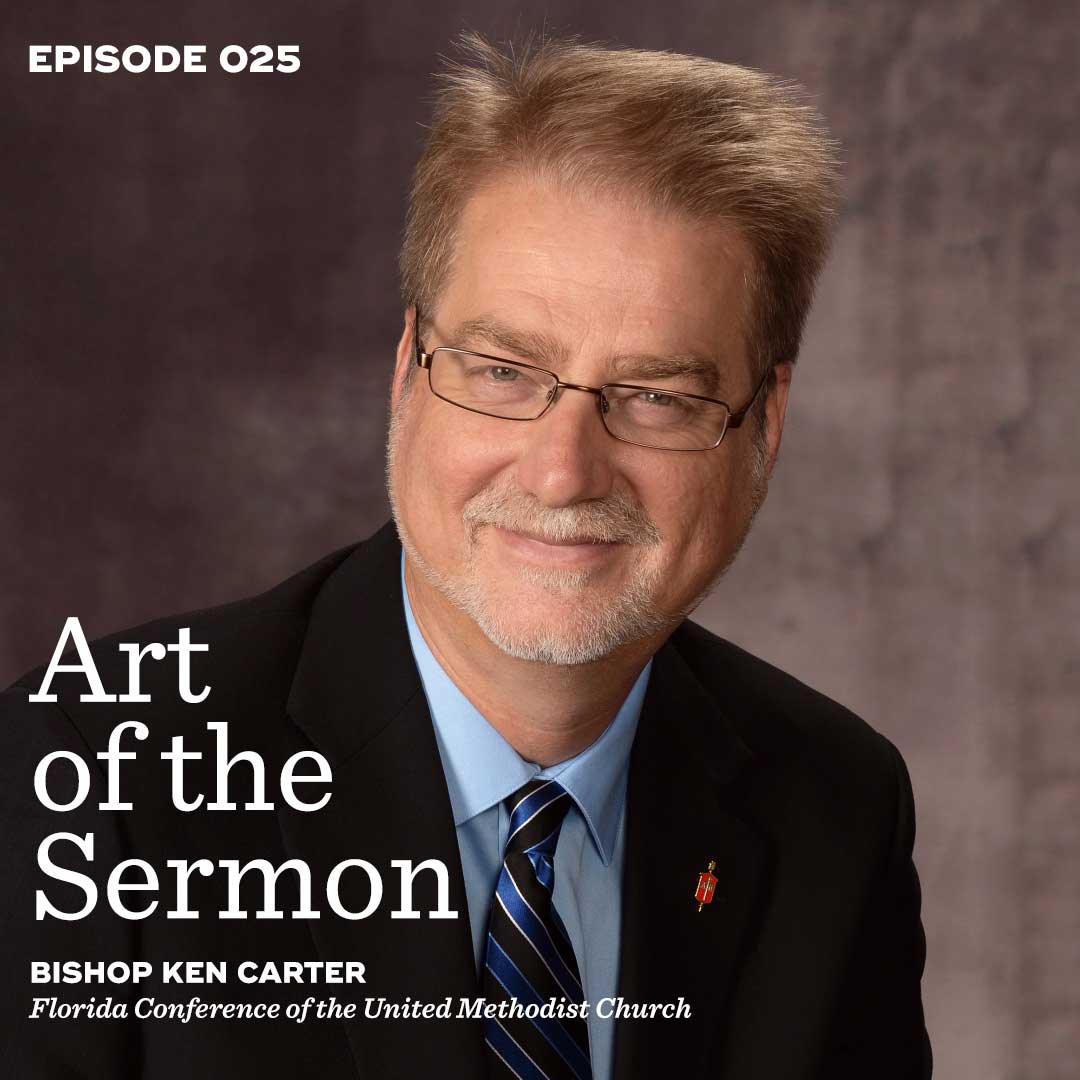
Bishop Ken Carter on preaching
 By Dan Wunderlich
Bigstock
In this two-part episode of Art of the Sermon, Dan Wunderlich talks with United Methodist bishop Ken Carter. In part 1, Bishop Carter shares the role preaching has played throughout his career. In part 2, he passionately shares about how preaching can be a tool for finding unity in seasons of conflict. He also reflects on the future of preaching in fresh expressions of ministry.
Part 1: A career in preaching [Show notes]

Thanks for checking out this episode of Art of the Sermon! Be sure to subscribe through iTunes, Google Play Music, or your favorite podcast app. If you enjoy this episode, leave a review on our podcast’s page in the iTunes store. This will help others discover the show!
Guest: Bishop Ken Carter, Florida Conference of the United Methodist Church and President-Elect of the UMC Council of Bishops
General Topic: The role preaching has played from local pastor to bishop
Introduction to Bishop Carter (1:10)
Philosophy and general approach to preaching (3:04)
Preaching in the local church (4:39)
Adapting sermons to multiple churches (7:33)
Finding opportunities to preach while serving as an associate pastor (9:18)
How preaching changed while serving a larger church (11:43)
Bishop Carter’s sermon preparation process (15:01)
Serving as a District Superintendent (19:11)
Role of preaching in serving as a bishop (21:13)
Role of sermons at Annual Conference/Church Meetings (24:54)
Links to things mentioned in the episode
Florida Conference of the United Methodist Church
The UMC Council of Bishops
Talk Like TED: The 9 Public-Speaking Secrets of the World’s Top Minds by Carmine Gallo
Zan Holmes, Jr.
Will Willimon
Reaching out to our guest
Bishop[at]FLUMC[dot]org
@BishopKenCarter (Twitter)
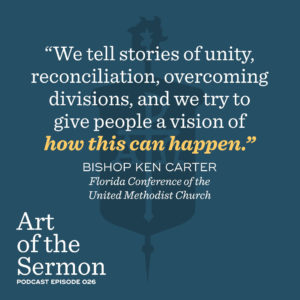
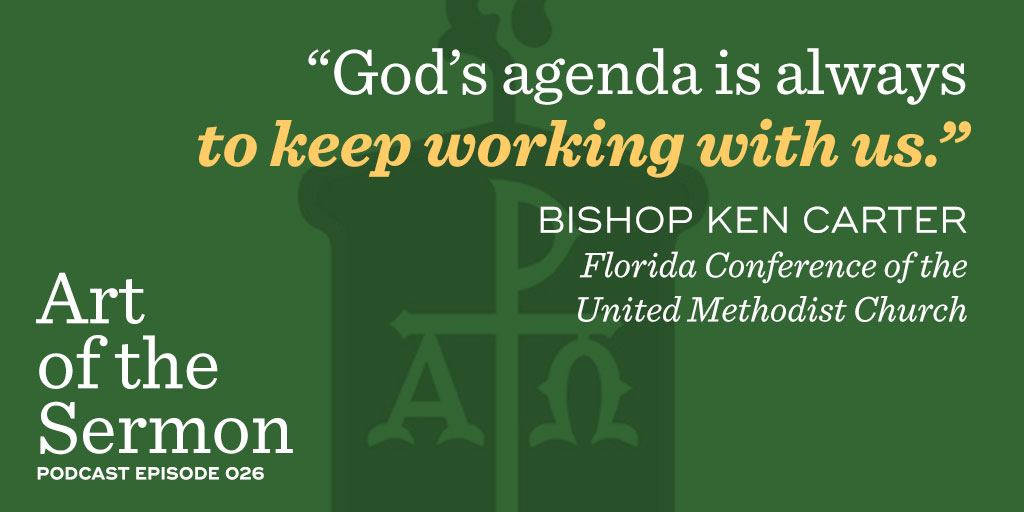
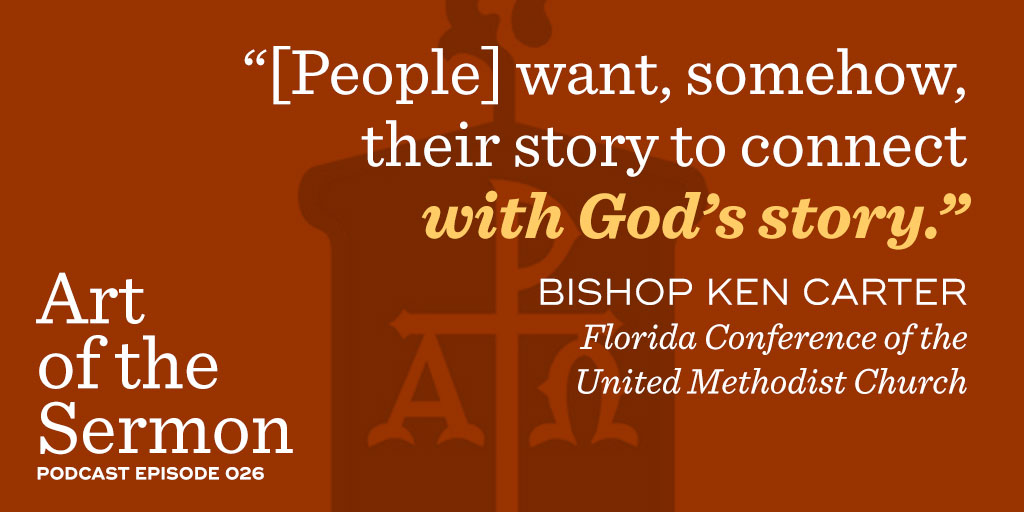
Share Your Favorite Quotes
Instagram/Facebook (Click on image for full size)
Twitter (Click on image for full size)
Next Episode arrives October 20, 2016!
Part 2 of our interview with Bishop Ken Carter of the Florida Conference of the United Methodist Church
Connect with the Show
I would love to hear what you think about the show—especially this episode. You can connect with the show and send me your feedback through the following channels:
Facebook – Facebook.com/ArtOfTheSermonTwitter- Twitter.com/ArtOfTheSermonInstagram- Instagram.com/ArtOfTheSermonYou can also comment on the the post below!
Art of the Sermon is a project by Dan Wunderlich of Defining Grace. Learn more atDefiningGrace.com
Sign up to receive resources and updates from Defining Grace in your inbox.
Including a FREE PDF with 10 Action Steps for Better Church Announcements!
CLICK HERE TO SUBSCRIBE
Part 2: Preaching as a tool for unity [Show notes]026: Preaching as a Tool for Unity – Part 2 with Bishop Ken Carter – Art of the Sermon
Thanks for checking out this episode of Art of the Sermon! Be sure to subscribe through iTunes, Google Play Music, or your favorite podcast app. If you enjoy this episode, leave a review on our podcast’s page in the iTunes store. This will help others discover the show!
Guest: Bishop Ken Carter, Florida Conference of the United Methodist Church and President-Elect of the UMC Council of Bishops
General Topic: Preaching as a tool for unity
The role of preaching in times of conflict (1:11)
Wesleyan theology in today’s world (5:30)
Preaching in fresh expressions of the Church (7:35)
Favorite and most challenging preaching experiences (10:08)
Impactful preachers and communicators (12:00)
Influential books (13:00)
Recommended preachers (15:02)
How to follow Bishop Carter’s work (17:35)
Links to things mentioned in the episode
Florida Conference of the United Methodist Church
The UMC Council of Bishops
Fresh Expressions Movement in Florida
This American Life
Poking Holes in the Darkness by Ken Carter
John Claypool
Earnest Campbell
William Sloane Coffin
Flannery O’Connor
Just Say the Word by Robert Jacks
Richard Lischer
John Wesley
Karl Barth
William Barber
The Moth
Reinhold Nieburh
Dietrich Bonhoeffer
Deliverance to the Captives by Karl Barth
Shaking of the Foundations by Paul Tillich
A Ray of Darkness by Rowan Williams
Barbara Brown Taylor
Bishop Greg Palmer
Reaching out to our guest
Bishop[at]FLUMC[dot]org
@BishopKenCarter (Twitter)
Share Your Favorite Quotes
Instagram/Facebook (Click on image for full size)
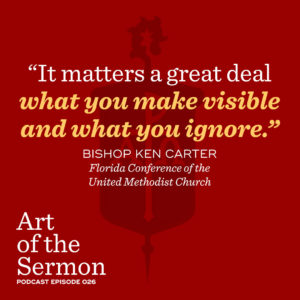
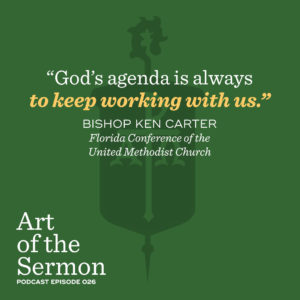
Twitter (Click on image for full size)
Next Episode arrives November 3, 2016!
An interview with Kristen Soltis Anderson, Co-Founder of Echelon Insights and Political Contributor to ABC News
Connect with the Show
I would love to hear what you think about the show—especially this episode. You can connect with the show and send me your feedback through the following channels:
Facebook – Facebook.com/ArtOfTheSermonTwitter- Twitter.com/ArtOfTheSermonInstagram- Instagram.com/ArtOfTheSermonYou can also comment on the the post below!
Art of the Sermon is a project by Dan Wunderlich of Defining Grace. Learn more atDefiningGrace.com
Sign up to receive resources and updates from Defining Grace in your inbox.
Including a FREE PDF with 10 Action Steps for Better Church Announcements!
CLICK HERE TO SUBSCRIBE
Thanks for checking out Art of the Sermon! Be sure to subscribe through iTunes, Google Play Music, or your favorite podcast app. If you enjoy these episodes, leave a review on our podcast’s page in the iTunes store. This will help others discover the show!
-------

Stuck in the crowd? By Michael Renninger
Father Michael Renninger
Father Michael Renninger, pastor of St. Mary Catholic Church in Richmond, Virginia, tells the story of Zacchaeus from Luke 19:1-10, but he begins with a story about being stuck in the crowd at a parade as a little boy, and needing someone to lift him up so he could see. What crowd are you stuck in, especially in this political season? How can you rise above it, and see Jesus? This sermon is from A Sermon for Every Sunday, a series of lectionary-based video sermons designed for use in worship, Bible study, small groups, Sunday school classes or for individual use.
-------
Thanks for checking out this episode of Art of the Sermon! Be sure to subscribe through iTunes, Google Play Music, or your favorite podcast app. If you enjoy this episode, leave a review on our podcast’s page in the iTunes store. This will help others discover the show!
Guest: Bishop Ken Carter, Florida Conference of the United Methodist Church and President-Elect of the UMC Council of Bishops
General Topic: Preaching as a tool for unity
The role of preaching in times of conflict (1:11)
Wesleyan theology in today’s world (5:30)
Preaching in fresh expressions of the Church (7:35)
Favorite and most challenging preaching experiences (10:08)
Impactful preachers and communicators (12:00)
Influential books (13:00)
Recommended preachers (15:02)
How to follow Bishop Carter’s work (17:35)
Links to things mentioned in the episode
Florida Conference of the United Methodist Church
The UMC Council of Bishops
Fresh Expressions Movement in Florida
This American Life
Poking Holes in the Darkness by Ken Carter
John Claypool
Earnest Campbell
William Sloane Coffin
Flannery O’Connor
Just Say the Word by Robert Jacks
Richard Lischer
John Wesley
Karl Barth
William Barber
The Moth
Reinhold Nieburh
Dietrich Bonhoeffer
Deliverance to the Captives by Karl Barth
Shaking of the Foundations by Paul Tillich
A Ray of Darkness by Rowan Williams
Barbara Brown Taylor
Bishop Greg Palmer
Reaching out to our guest
Bishop[at]FLUMC[dot]org
@BishopKenCarter (Twitter)
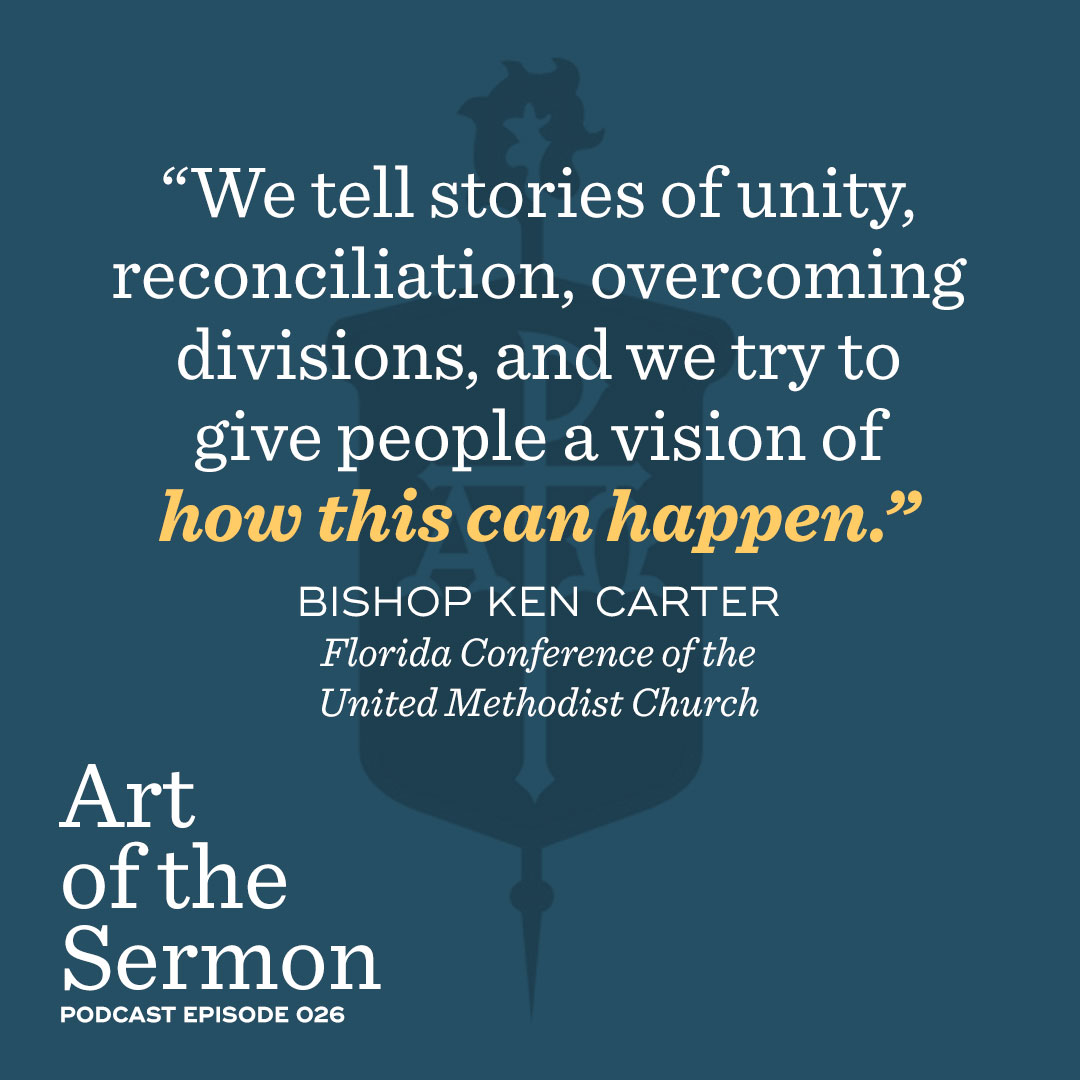
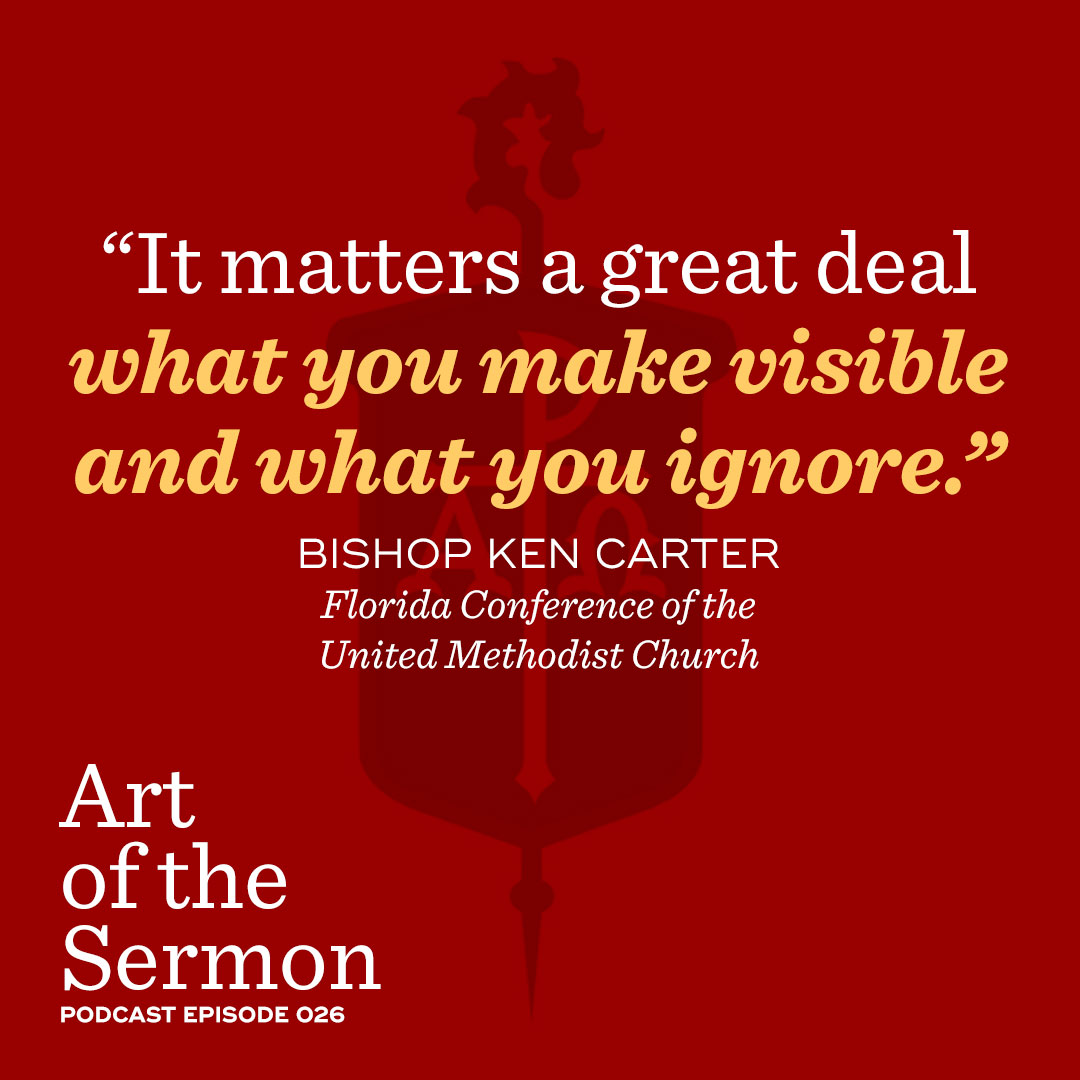
Share Your Favorite Quotes
Instagram/Facebook (Click on image for full size)
Twitter (Click on image for full size)
Next Episode arrives November 3, 2016!
An interview with Kristen Soltis Anderson, Co-Founder of Echelon Insights and Political Contributor to ABC News
Connect with the Show
I would love to hear what you think about the show—especially this episode. You can connect with the show and send me your feedback through the following channels:
Facebook – Facebook.com/ArtOfTheSermonTwitter- Twitter.com/ArtOfTheSermonInstagram- Instagram.com/ArtOfTheSermonYou can also comment on the the post below!
Art of the Sermon is a project by Dan Wunderlich of Defining Grace. Learn more atDefiningGrace.com
Sign up to receive resources and updates from Defining Grace in your inbox.
Including a FREE PDF with 10 Action Steps for Better Church Announcements!
CLICK HERE TO SUBSCRIBE
Thanks for checking out Art of the Sermon! Be sure to subscribe through iTunes, Google Play Music, or your favorite podcast app. If you enjoy these episodes, leave a review on our podcast’s page in the iTunes store. This will help others discover the show!
-------
Stuck in the crowd?
By Michael RenningerFather Michael Renninger
Father Michael Renninger, pastor of St. Mary Catholic Church in Richmond, Virginia, tells the story of Zacchaeus from Luke 19:1-10, but he begins with a story about being stuck in the crowd at a parade as a little boy, and needing someone to lift him up so he could see. What crowd are you stuck in, especially in this political season? How can you rise above it, and see Jesus? This sermon is from A Sermon for Every Sunday, a series of lectionary-based video sermons designed for use in worship, Bible study, small groups, Sunday school classes or for individual use.
-------
 This Sunday, October 30, 2016
24th Sunday after Pentecost: Habakkuk 1:1-4; 2:1-4; Psalm 119:137-144; 2 Thessalonians 1:1-4, 11-12; Luke 19:1-10
-------
Lectionary Readings:
(Courtesy of Vanderbilt Divinity Library)
Twenty-Fourth Sunday after Pentecost, Year C
Sunday, 30 October 2016
Habakkuk 1:1-4; 2:1-4
Psalm 119:137-144
2 Thessalonians 1:1-4, 11-12
Luke 19:1-10
Scripture Text: Habakkuk 1:1 This is the prophecy which Havakuk the prophet saw:
2 Adonai, how long must I cry
without your hearing?
“Violence!” I cry to you,
but you don’t save.
3 Why do you make me see wrongdoing,
why do you permit oppression?
Pillage and cruelty confront me,
so that strife and discord prevail.
4 Therefore Torah is not followed;
justice never gets rendered,
because the wicked fence in the righteous.
This is why justice comes out perverted.
Habakkuk 2:1 I will stand at my watchpost;
I will station myself on the rampart.
I will look to see what [God] will say through me
and what I will answer when I am reproved.
2 Then Adonai answered me; he said,
“Write down the vision clearly on tablets,
so that even a runner can read it.
3 For the vision is meant for its appointed time;
it speaks of the end, and it does not lie.
It may take a while, but wait for it;
it will surely come, it will not delay.
4 “Look at the proud: he is inwardly not upright;
but the righteous will attain life through trusting faithfulness.
Psalm 119:צ (Tzadeh)
137 You are righteous, Adonai;
and your rulings are upright.
138 You have commanded your instructions
in righteousness and great faithfulness.
139 My zeal is destroying me,
because my foes have forgotten your words.
140 Your word is refined to complete purity,
and your servant loves it.
141 I may be small and despised,
but I do not forget your precepts.
142 Your righteousness is eternal righteousness,
and your Torah is truth.
143 Trouble and distress have overtaken me,
but your mitzvot are my delight.
144 Your instruction is righteous forever;
give me understanding, and I will live.
2 Thessalonians 1:1 From: Sha’ul, Sila and Timothy
To: The Messianic Community of the Thessalonians, united with God our Father and the Lord Yeshua the Messiah:
2 Grace to you and shalom from God the Father and the Lord Yeshua the Messiah.
3 We have to keep thanking God for you always, brothers, as is appropriate; because your trust continues to grow greater, and the love you each have for one another continues to increase. 4 Therefore, we boast about you in the congregations of God because of your perseverance and trust in all the persecutions and troubles you are going through.
11 With this in view, we always pray for you that our God may make you worthy of his calling and may fulfill by his power every good purpose of yours and every action stemming from your trust. 12 In this way, the name of our Lord Yeshua will be glorified in you, and you in him, in accordance with the grace of our God and the Lord Yeshua the Messiah.
Luke 19:1 Yeshua entered Yericho and was passing through, 2 when a man named Zakkai appeared who was a chief tax-collector and a wealthy man. 3 He was trying to see who Yeshua was; but, being short, he couldn’t, because of the crowd. 4 So he ran on ahead and climbed a fig tree in order to see him, for Yeshua was about to pass that way. 5 When he came to the place, he looked up and said to him, “Zakkai! Hurry! Come down, because I have to stay at your house today!” 6 He climbed down as fast as he could and welcomed Yeshua joyfully. 7 Everyone who saw it began muttering, “He has gone to be the house-guest of a sinner.” 8 But Zakkai stood there and said to the Lord, “Here, Lord, I am giving half of all I own to the poor; and if I have cheated anyone, I will pay him back four times as much.” 9 Yeshua said to him, “Today salvation has come to this house, inasmuch as this man too is a son of Avraham. 10 For the Son of Man came to seek and save what was lost.”
The John Wesley's Notes-Commentary: Habakkuk 1:1-4; 2:1-4
Verse 1
[1] The burden which Habakkuk the prophet did see.
The burden — The prophet seems to speak of these grievous things, as a burden which he himself groaned under.
Verse 4
[4] Therefore the law is slacked, and judgment doth never go forth: for the wicked doth compass about the righteous; therefore wrong judgment proceedeth.
Therefore — Because the wicked go on with impunity.
The law — The whole law, moral, ceremonial, and judicial.
Is slacked — Is slighted, and not observed.
Go forth — From magistrates, judges, and public officers.
Doth compass about — As it were besieges, with design to oppress and ruin.
Verse 1
[1] I will stand upon my watch, and set me upon the tower, and will watch to see what he will say unto me, and what I shall answer when I am reproved.
Upon my watch — I will stand as a watchman on my watch-tower.
He — The Lord.
Reproved — Called to give an account of the mysteriousness of providence; either to satisfy doubters, or to silence quarrellers.
Verse 2
[2] And the LORD answered me, and said, Write the vision, and make it plain upon tables, that he may run that readeth it.
Upon tables — What was of publick concern, and therefore to be published, was anciently written or engraven upon tables, smooth stones, or wood, and then hung up in a publick place to be read.
May run — That none may need to stop, but every one may plainly and clearly discern what is written.
Verse 3
[3] For the vision is yet for an appointed time, but at the end it shall speak, and not lie: though it tarry, wait for it; because it will surely come, it will not tarry.
At the end — When the period appointed of God shall come.
Shall speak — Be accomplished, and not disappoint your expectation.
Verse 4
[4] Behold, his soul which is lifted up is not upright in him: but the just shall live by his faith.
Which is lifted up — That proudly contests with the justice and wisdom of the Divine Providence, and provides for his own safety by his own wit.
The just — The humble and upright one, who adores the depth of divine providence, and is persuaded of the truth of divine promises.
Shall live — Supports himself, by a firm expectation of the deliverance of Zion.
Psalm 119:137-144
Verse 140
[140] Thy word is very pure: therefore thy servant loveth it.
Pure — Without the least mixture of falsehood.
Verse 142
[142] Thy righteousness is an everlasting righteousness, and thy law is the truth.
Everlasting — The same in all ages and places.
Verse 143
[143] Trouble and anguish have taken hold on me: yet thy commandments are my delights.
Trouble — Outward troubles and anguish of spirit.
2 Thessalonians 1:1-4, 11-12
Verse 3
[3] We are bound to thank God always for you, brethren, as it is meet, because that your faith groweth exceedingly, and the charity of every one of you all toward each other aboundeth;
It is highly observable, that the apostle wraps up his praise of men in praise to God; giving him the glory.
Your faith groweth — Probably he had heard from them since his sending the former letter.
Aboundeth — Like water that overflows its banks, and yet increaseth still.
Verse 4
[4] So that we ourselves glory in you in the churches of God for your patience and faith in all your persecutions and tribulations that ye endure:
Which ye endure — "That ye may be accounted worthy of the kingdom."
Verse 11
[11] Wherefore also we pray always for you, that our God would count you worthy of this calling, and fulfil all the good pleasure of his goodness, and the work of faith with power:
All the good pleasure of his goodness — Which is no less than perfect holiness.
Verse 12
[12] That the name of our Lord Jesus Christ may be glorified in you, and ye in him, according to the grace of our God and the Lord Jesus Christ.
That the name — The love and power of our Lord may be glorified - Gloriously displayed in you.
Luke 19:1-10
Verse 2
[2] And, behold, there was a man named Zacchaeus, which was the chief among the publicans, and he was rich.
The chief of the publicans — What we would term, commissioner of the customs. A very honourable as well as profitable place.
Verse 4
[4] And he ran before, and climbed up into a sycomore tree to see him: for he was to pass that way.
And running before — With great earnestness.
He climbed up — Notwithstanding his quality: desire conquering honour and shame.
Verse 5
[5] And when Jesus came to the place, he looked up, and saw him, and said unto him, Zacchaeus, make haste, and come down; for to day I must abide at thy house.
Jesus said, Zaccheus, make haste and come down — What a strange mixture of passions must Zaccheus have now felt, hearing one speak, as knowing both his name and his heart!
Verse 7
[7] And when they saw it, they all murmured, saying, That he was gone to be guest with a man that is a sinner.
They all murmured — All who were near: though most of them rather out of surprise than indignation.
Verse 8
[8] And Zacchaeus stood, and said unto the Lord; Behold, Lord, the half of my goods I give to the poor; and if I have taken any thing from any man by false accusation, I restore him fourfold.
And Zaccheus stood — Showing by his posture, his deliberate, purpose and ready mind, and said, Behold, Lord, I give - I determine to do it immediately.
Verse 9
[9] And Jesus said unto him, This day is salvation come to this house, forsomuch as he also is a son of Abraham.
He also is a son of Abraham — A Jew born, and as such has a right to the first offer of salvation.
Verse 10
[10] For the Son of man is come to seek and to save that which was lost.
Matthew 18:11.
-------
The Upper Room Ministries
PO Box 340004
Nashville, Tennessee 37203-0004, United States
(Courtesy of Vanderbilt Divinity Library)
Twenty-Fourth Sunday after Pentecost, Year C
Sunday, 30 October 2016
Habakkuk 1:1-4; 2:1-4
Psalm 119:137-144
2 Thessalonians 1:1-4, 11-12
Luke 19:1-10
Scripture Text: Habakkuk 1:1 This is the prophecy which Havakuk the prophet saw:
2 Adonai, how long must I cry
without your hearing?
“Violence!” I cry to you,
but you don’t save.
3 Why do you make me see wrongdoing,
why do you permit oppression?
Pillage and cruelty confront me,
so that strife and discord prevail.
4 Therefore Torah is not followed;
justice never gets rendered,
because the wicked fence in the righteous.
This is why justice comes out perverted.
Habakkuk 2:1 I will stand at my watchpost;
I will station myself on the rampart.
I will look to see what [God] will say through me
and what I will answer when I am reproved.
2 Then Adonai answered me; he said,
“Write down the vision clearly on tablets,
so that even a runner can read it.
3 For the vision is meant for its appointed time;
it speaks of the end, and it does not lie.
It may take a while, but wait for it;
it will surely come, it will not delay.
4 “Look at the proud: he is inwardly not upright;
but the righteous will attain life through trusting faithfulness.
Psalm 119:צ (Tzadeh)
137 You are righteous, Adonai;
and your rulings are upright.
138 You have commanded your instructions
in righteousness and great faithfulness.
139 My zeal is destroying me,
because my foes have forgotten your words.
140 Your word is refined to complete purity,
and your servant loves it.
141 I may be small and despised,
but I do not forget your precepts.
142 Your righteousness is eternal righteousness,
and your Torah is truth.
143 Trouble and distress have overtaken me,
but your mitzvot are my delight.
144 Your instruction is righteous forever;
give me understanding, and I will live.
2 Thessalonians 1:1 From: Sha’ul, Sila and Timothy
To: The Messianic Community of the Thessalonians, united with God our Father and the Lord Yeshua the Messiah:
2 Grace to you and shalom from God the Father and the Lord Yeshua the Messiah.
3 We have to keep thanking God for you always, brothers, as is appropriate; because your trust continues to grow greater, and the love you each have for one another continues to increase. 4 Therefore, we boast about you in the congregations of God because of your perseverance and trust in all the persecutions and troubles you are going through.
11 With this in view, we always pray for you that our God may make you worthy of his calling and may fulfill by his power every good purpose of yours and every action stemming from your trust. 12 In this way, the name of our Lord Yeshua will be glorified in you, and you in him, in accordance with the grace of our God and the Lord Yeshua the Messiah.
Luke 19:1 Yeshua entered Yericho and was passing through, 2 when a man named Zakkai appeared who was a chief tax-collector and a wealthy man. 3 He was trying to see who Yeshua was; but, being short, he couldn’t, because of the crowd. 4 So he ran on ahead and climbed a fig tree in order to see him, for Yeshua was about to pass that way. 5 When he came to the place, he looked up and said to him, “Zakkai! Hurry! Come down, because I have to stay at your house today!” 6 He climbed down as fast as he could and welcomed Yeshua joyfully. 7 Everyone who saw it began muttering, “He has gone to be the house-guest of a sinner.” 8 But Zakkai stood there and said to the Lord, “Here, Lord, I am giving half of all I own to the poor; and if I have cheated anyone, I will pay him back four times as much.” 9 Yeshua said to him, “Today salvation has come to this house, inasmuch as this man too is a son of Avraham. 10 For the Son of Man came to seek and save what was lost.”
The John Wesley's Notes-Commentary: Habakkuk 1:1-4; 2:1-4
Verse 1
[1] The burden which Habakkuk the prophet did see.
The burden — The prophet seems to speak of these grievous things, as a burden which he himself groaned under.
Verse 4
[4] Therefore the law is slacked, and judgment doth never go forth: for the wicked doth compass about the righteous; therefore wrong judgment proceedeth.
Therefore — Because the wicked go on with impunity.
The law — The whole law, moral, ceremonial, and judicial.
Is slacked — Is slighted, and not observed.
Go forth — From magistrates, judges, and public officers.
Doth compass about — As it were besieges, with design to oppress and ruin.
Verse 1
[1] I will stand upon my watch, and set me upon the tower, and will watch to see what he will say unto me, and what I shall answer when I am reproved.
Upon my watch — I will stand as a watchman on my watch-tower.
He — The Lord.
Reproved — Called to give an account of the mysteriousness of providence; either to satisfy doubters, or to silence quarrellers.
Verse 2
[2] And the LORD answered me, and said, Write the vision, and make it plain upon tables, that he may run that readeth it.
Upon tables — What was of publick concern, and therefore to be published, was anciently written or engraven upon tables, smooth stones, or wood, and then hung up in a publick place to be read.
May run — That none may need to stop, but every one may plainly and clearly discern what is written.
Verse 3
[3] For the vision is yet for an appointed time, but at the end it shall speak, and not lie: though it tarry, wait for it; because it will surely come, it will not tarry.
At the end — When the period appointed of God shall come.
Shall speak — Be accomplished, and not disappoint your expectation.
Verse 4
[4] Behold, his soul which is lifted up is not upright in him: but the just shall live by his faith.
Which is lifted up — That proudly contests with the justice and wisdom of the Divine Providence, and provides for his own safety by his own wit.
The just — The humble and upright one, who adores the depth of divine providence, and is persuaded of the truth of divine promises.
Shall live — Supports himself, by a firm expectation of the deliverance of Zion.
Psalm 119:137-144
Verse 140
[140] Thy word is very pure: therefore thy servant loveth it.
Pure — Without the least mixture of falsehood.
Verse 142
[142] Thy righteousness is an everlasting righteousness, and thy law is the truth.
Everlasting — The same in all ages and places.
Verse 143
[143] Trouble and anguish have taken hold on me: yet thy commandments are my delights.
Trouble — Outward troubles and anguish of spirit.
2 Thessalonians 1:1-4, 11-12
Verse 3
[3] We are bound to thank God always for you, brethren, as it is meet, because that your faith groweth exceedingly, and the charity of every one of you all toward each other aboundeth;
It is highly observable, that the apostle wraps up his praise of men in praise to God; giving him the glory.
Your faith groweth — Probably he had heard from them since his sending the former letter.
Aboundeth — Like water that overflows its banks, and yet increaseth still.
Verse 4
[4] So that we ourselves glory in you in the churches of God for your patience and faith in all your persecutions and tribulations that ye endure:
Which ye endure — "That ye may be accounted worthy of the kingdom."
Verse 11
[11] Wherefore also we pray always for you, that our God would count you worthy of this calling, and fulfil all the good pleasure of his goodness, and the work of faith with power:
All the good pleasure of his goodness — Which is no less than perfect holiness.
Verse 12
[12] That the name of our Lord Jesus Christ may be glorified in you, and ye in him, according to the grace of our God and the Lord Jesus Christ.
That the name — The love and power of our Lord may be glorified - Gloriously displayed in you.
Luke 19:1-10
Verse 2
[2] And, behold, there was a man named Zacchaeus, which was the chief among the publicans, and he was rich.
The chief of the publicans — What we would term, commissioner of the customs. A very honourable as well as profitable place.
Verse 4
[4] And he ran before, and climbed up into a sycomore tree to see him: for he was to pass that way.
And running before — With great earnestness.
He climbed up — Notwithstanding his quality: desire conquering honour and shame.
Verse 5
[5] And when Jesus came to the place, he looked up, and saw him, and said unto him, Zacchaeus, make haste, and come down; for to day I must abide at thy house.
Jesus said, Zaccheus, make haste and come down — What a strange mixture of passions must Zaccheus have now felt, hearing one speak, as knowing both his name and his heart!
Verse 7
[7] And when they saw it, they all murmured, saying, That he was gone to be guest with a man that is a sinner.
They all murmured — All who were near: though most of them rather out of surprise than indignation.
Verse 8
[8] And Zacchaeus stood, and said unto the Lord; Behold, Lord, the half of my goods I give to the poor; and if I have taken any thing from any man by false accusation, I restore him fourfold.
And Zaccheus stood — Showing by his posture, his deliberate, purpose and ready mind, and said, Behold, Lord, I give - I determine to do it immediately.
Verse 9
[9] And Jesus said unto him, This day is salvation come to this house, forsomuch as he also is a son of Abraham.
He also is a son of Abraham — A Jew born, and as such has a right to the first offer of salvation.
Verse 10
[10] For the Son of man is come to seek and to save that which was lost.
Matthew 18:11.
-------
The Upper Room Ministries
PO Box 340004
Nashville, Tennessee 37203-0004, United States
-------
 WHAT WE ARE AND WHAT WE CAN BE By Philip Wise2 Thessalonians 1:1-4, 11-12
Every pastor can understand Paul’s situation: addressing a problem he’s already addressed. In 1 Thessalonians Paul attempted to comfort and strengthen the church in Thessalonica because of the persecution they were experiencing. That persecution has continued, and Paul’s second letter to the congregation is an effort to shore up their faith with instructions and encouragement. This is emphasized by Paul’s repeating the same greeting found in his first letter with one addition. Paul adds the words “from God our Father and the Lord Jesus Christ” (2 Thessalonians 1:2). This was Paul’s way of emphasizing that these words are not just his.
In verses 3-4, Paul attempts to lift the spirits of the Thessalonian Christians by affirming the right things they are doing. Paul offers thanks for two specific things: their growing faith and their love for one another.
It is interesting that Paul says he “must”(v. 3) give thanks to God for these spiritual traits found in that church. Thanksgiving is an obligation, but one we can ignore. Paul recognized that whatever strengths the Thessalonians possessed were gifts from God and therefore worthy of thanksgiving. There is a temptation for pastors and church members to brag on their church because of some spiritual traits or ministry accomplishments. Paul’s admonition to thank God instead of thanking ourselves is one we should take to heart.
Many of the congregations to whom Paul addresses himself could not and would not have been characterized as loving and growing in faith. The Corinthian congregation comes to mind as a community that experienced frequent conflict. That’s the reason Paul gives his extended explanation of the importance of love in 1 Corinthians 13. No such admonition is necessary for the Thessalonians.
Paul admits that he boasts about the Thessalonians’ steadfastness and faith in the face of persecution. Those words must have been very pleasing to the church in Thessalonica, but I wonder how it was received by other congregations. Comparing churches is a dangerous business for any minister, but Paul did it regularly. For the Thessalonians this was an affirmation of who they were. Every congregation—just like every individual Christian—falls short in some way, but every congregation also has strengths. Finding traits that are praiseworthy is a good pattern for every pastor and Christian. It is a pattern that every spouse, every parent, every friend ought to follow. Perhaps the secret to praising others is to follow Paul’s example and give God thanks for the good gifts we see in others.
Paul’s praise should not be taken to mean that the church at Thessalonica had no problems. It did. There was uncertainty about the “day of the Lord.” There was evidence of the works of Satan in the congregation. Some of the church members were not working and had become dependent on the congregation. Paul addresses these concerns, but he starts with affirmation.
Paul begins by affirming the good things that are happening in Thessalonica. It is these characteristics that will sustain the Thessalonian Christians in the face of persecution. But Paul wants more from the Thessalonians and he contends that God does too. Paul couches this desire in a prayer. It’s a prayer about what the Thessalonians can be.
Paul’s prayer is also a prayer that is stimulated by their unjust suffering. His prayers for them aren’t a “now and then” occurrence. Paul claims to “always” (v. 11) pray for them. The question for us is What stimulates our prayers? Is it our own needs, our own desires, our own situation? Surely, we should pray about these things. Unfortunately, that’s where some Christians stop. Shouldn’t the suffering that goes on in our world motivate us to pray? The people who keep up with Christian persecution say that thousands of Christians are dying as martyrs for their faith every year. Does that fact motivate you to pray? It’s easier, of course, to pray for people we know by name. Paul knew these Thessalonians, and their suffering was personal for him. We can make the suffering of Christians in our world personal too. We do it by learning their names and learning about their suffering.
Paul prays for two primary things. First, he prays that the Thessalonians will be worthy of God’s call. What call? It’s the call to follow Christ, to join God’s family, and to build the kingdom of God. It’s a call to accept the discipline of Christ. For these Christians who were suffering, it was a reminder that Christ suffered in order to show himself worthy of the calling God had given him.
Second, Paul prays that God will complete their good intentions and hard work. This is a problem for all Christians. Do our good intentions and our work for the Kingdom make a difference? Paul is praying that God will complete what the Thessalonians desire to do. Because we all have good intentions that go unfulfilled and hard work that never shows results, this is a prayer that every Christian can pray.
What is the goal of Paul’s thanksgiving and prayers? It is that the Thessalonian Christians will glorify Christ in and through them. I once heard a Bible teacher say, “Paul’s favorite phrase is ‘in Christ.’ ” That Christ lives in every Christian is a sacred idea for every believer. The way we live our lives is a testimony of the power of Christ to overcome our weaknesses and shortcomings. As Paul emphasizes, it is the “grace of our God and the Lord Jesus Christ” (v. 12) that makes it possible to live the godly life—even in the face of persecution.… read more
-------
 WORSHIP CONNECTION: OCTOBER 30, 2016 By Nancy C. Townley24th Sunday after Pentecost
COLOR: Green
SCRIPTURE READINGS: Habakkuk 1:1-4; 2:1-4; Psalm 119:137-144; 2 Thessalonians
1:1-4, 11-12; Luke 19:1-10
CALLS TO WORSHIP
Call to Worship #1:
L: For all those who have paved the way for our freedom of worship, we give thanks, O Lord.
P: For those who have taught us about witness and the power of love, we give thanks, O Lord.
L: For those who work in our church that we may come to know what it means to serve, we give thanks, O Lord.
P: For all the saints, those who rest from their labors, and those who labor still, we give thanks, O Lord.
L: Praise be to God, who continually inspires and guides workers and witnesses.
P: Open our hearts and spirits, O Lord, and help us to become good workers for you. AMEN
Call to Worship #2:
L: Our hearts are filled with joy when we think of those who have framed our faith.
P: We appreciate all those people who have taught us the great lessons of faith and life.
L: We offer our love and support to those who labor diligently in the world, helping those in need.
P: We give of our substance, our prayers, and our support to their work.
L: Lord, encourage us in our work, that we might bear witness to your love.
P: Keep us ready to serve you in all that we say and do. AMEN.
Call to Worship #3:
[Using THE UNITED METHODIST HYMNAL, p. 378, “Amazing Grace,” offer the following call to worship as directed.]
Soloist: singing verse 1 of “Amazing Grace”
L: How many times in our lives have we felt lost, alone, abandoned.
P: Yet there is One who will never leave our side. We can depend upon God’s loving presence to rescue us and to heal our brokenness.
Soloist: singing verse 3 of “Amazing Grace”
L: Even though we have been battered and blown by storms and struggles, we still can place our trust in God’s abiding presence.
P: It is the grace of God that has brought us through and will continue to be with us all our lives.
Soloist: singing verse 6 of “Amazing Grace”
L: Our lips shall sing and shout forth our praise of God.
P: Let our hearts and spirits rejoice and continually be praising God for all God’s mercies. AMEN.
Call to Worship #4:
L: Sometimes we feel too small and insignificant to be of any notice to Jesus.
P: Yet the Lord provides a tree for us to climb so that we can see Jesus.
L: That tree is faithfulness, compassion, love, hope, joy.
P: We are given the opportunity to witness to the Savior’s presence in our lives.
L: Lord, help us when we forget how much we are loved by Christ.
P: Open our hearts to receive his invitation this day. AMEN.
PRAYERS, LITANY/READING, BENEDICTION
Opening Prayer
Lord God of love and peace, open our hearts today to receive the invitation of Jesus to come and be present in our lives. Release us from our smallness and create an atmosphere of confession and healing love in our hearts and our spirits. For we ask these things in Jesus’ Name, AMEN.
Prayer of Confession
Lord of mercy, forgive us when we make excuses for our lack of faith. We let our selfishness and apathy get in the way of illumination and peace. We find ways to duck out of our opportunities for service and witness, claiming that we are too small or too ill-equipped to be effective witnesses to Jesus Christ. How foolish we can be! All of our lives God has been present to us, whether or not we knew it. God’s love is always surrounding us. Yet we have not taken the time to recognize it. We whine and complain about the misfortunes that have befallen us and wonder where God is. We want immediate release from our struggles. And when release comes, we again move off in our own realms of self-centeredness. Help us, O Lord. Stop us from being so faithless. Open our hearts with your forgiving spirits that we, having been healed and forgiven, may actually be effective witnesses to your love and compassion. For we ask this in Jesus’ Name. AMEN.
Words of Assurance
You have always been loved by God. Know that you are healed and forgiven, that God has placed a special blessing in your life. Rejoice! For God is with you. Serve God in all that you say, think, and do. AMEN.
Pastoral Prayer
God of trees and pathways, you stand ready for us to gaze in your direction. As Jesus walked down the Jericho path, observing Zacchaeus, help us to remember that you are continually present to us, watching and guiding our steps. When we falter, you pick us up, dust us off, and place us back on the path. When we run in directions that are harmful, you are ready to rescue and redeem us. When we shout our disbelief, you offer to us your love and are ready to receive us. Today as we have gathered, remembering all those who have gone before us, who have paved the way for our faith, help us to be aware that we stand in that same long line of witnesses to your love. Give us courage and strength to serve you in all that we do. Remind us again that you are not looking for us to be perfect before we come to you, for you will take our rough edges and make them smooth. You will find the sparkling gem in the rough stone. You will help us learn to serve and witness to your love. Let us place our trust and our lives in your loving care. For we ask this in the name of Jesus Christ our Lord. AMEN.
Reading
[This reading is done effectively as “Readers’ Theater"--it may be done with one person present, within view of the congregation, and the “voice” offstage, using a microphone, if one is available. Or it may be done with both characters in front of the congregation. I recommend that if both characters are in front of the congregation, Voice should be seated to the side and slightly behind Reader 1. This will need to be rehearsed. Each participant should think about the strength of his/her lines.]
Reader 1:
How can I see him? Nobody will let me through the crowd! They won’t move for me! It’s just not fair! I have as much right as anyone to see Jesus.
Voice:
Hey, Zacchaeus, why don’t you climb up that sycamore tree?
Reader 1:
It’s always this way. They are just jealous. I got the job as tax collector and worked my way up to chief tax collector. They don’t like it. They say I’m a traitor and so that’s why they are keeping me out. And then they wonder why I don’t associate with them, the scum of the earth!
Voice:
Hey, Zacchaeus, why don’t you climb up that sycamore tree?
Reader 1:
You know, even if I saw Jesus, I don’t know what I’d be looking for. They say he’s some sort of miracle worker, that he likes everyone. Ha! I’ve heard that before. He probably won’t like me. No one does. Just because I’m small of stature doesn’t mean that I don’t matter. But I probably won’t matter to him. I’m not one of the obedient faithful.
Voice:
Hey, Zacchaeus, why don’t you climb up that sycamore tree?
Reader 1:
Still, maybe there’s a way to see Jesus. I just want to get a look, you know. Not that it will matter to either him or to me. Perhaps if I just climbed up into that sycamore tree over there. It’s an easy climb, and it would certainly give me a vantage point to see Jesus. Ha! They can’t keep me from seeing him after all.
Voice:
Zacchaeus, hurry and come down from that tree. I want to visit you in your home today!
Reader 1:
Who, me? You want to visit with me? You want to come to my house?
Voice:
That’s right. Are you going to come down?
Reader 1:
Yes. Yes, I’m coming. I can’t believe this. Look at all those others. He’s not going to their house. He’s coming to my house.
Voice:
Zacchaeus, I am pleased to spend some time with you.
Reader 1:
Lord, I don’t really deserve this visit. You probably know all about me. How I have lied and stolen from my own people. I have lined my pockets anttheir expense.
Voice:
What do you want to do about this, Zacchaeus?
Reader 1:
Well, I will give half of all that I have to help the poor, and I will make restitution to all those whom I have defrauded, paying back four times as much as I have stolen. Please forgive me for my greed and my selfishness.
Voice:
Salvation has come to this house today, Zacchaeus, son of Abraham. For you were lost to greed and avarice, but now you have been found, forgiven, and healed.
Benediction
Do not be afraid to witness to the love of God through Jesus Christ. Go in peace, knowing that God’s peace and love go with you. AMEN.
ARTISTIC ELEMENTS
The traditional color for this Sunday is GREEN.
Note: Today is an interesting mix of emphases. If you are celebrating All Saints Sunday or celebrating the 23rd Sunday after Pentecost, there is a way to create a worship center that may encompass either focus.
SURFACE:
Place four or five risers on the main worship center. The tallest riser should be about 8” above the level of the table; the other risers should be shorter, heights of your discretion. The tallest riser should be placed on the center back of the table (a cross will rest on that riser). The other risers should be “staggered” across the table, not in a straight line, with shorter risers in the front.
FABRIC:
Cover the entire worship center in green fabric, making sure that it drapes down over the front and “puddles” on the floor. Take a strip of brown or tan fabric; place it under the riser on which the cross will be setting, and weave it across the worship center, draping it down onto the floor with the green fabric (this represents the path). This brown fabric may be about 12” to 14” wide.
CANDLES:
If your focus is on All Saints Day, have a variety of votive candles, which you will place in front of each of the risers, with the exception of the cross riser. You may determine the number that seems right for your setting. If you are focusing on Pentecost 23, I recommend a cluster of 35 votive candles on each of the risers on the worship center, with the exception of the cross riser
FLOWERS/FOLIAGE:
I have used a small, potted artificial tree to represent the sycamore tree on which Zacchaeus climbed. I placed it at the side of the table, covering the pot with fabric that matched the main color (in this case, green). Other plants, which are leafy and of moderate size, may be used on either side of the cross and in front of the worship center. If you are focusing on All Saints Sunday, I would use ivy on either side of the cross riser and a green leafy plant in front of the worship center on the floor.
ROCKS/WOOD:
Not recommended for this setting.
OTHER:
If you are focusing on All Saints Sunday, you may want to have pictures of some of the “saints” of your church who have been instrumental in “growing” the church. Place these on the four risers on the worship center. You might also consider pictures of the disciples, apostles, missionaries, etc., who, for you, represent All Saints. This can be very effective.… read more
-------

By Carolyn C. BrownFrom a Child's Point of View
Old Testament: Habakkuk 1:1-4; 2:1-4. This passage deals with fairness on the national/global level. Older children appreciate Habakkuk's question when it is presented in personal terms (e.g., a farmer caught in the cross-fire between warring armies; a child starving in a country where the leaders live in luxury). They quickly agree with Habakkuk that it is not fair, and they wonder why a loving God allows such things to happen.
God's answer—that in the long haul, justice will be done—seems a bit like a cop-out to children who live so much in their own present. It helps to hear a trusted adult speak with appreciation of this view and cite examples. But it will be some years before children really accept this view.
They can, however, apply God's "sign" to their present. Basically, it says that no matter what seems to get the best results at the moment, it is always better to live by God's ways.
Psalm: 119:137-144. This is a psalm to sing while waiting for God's justice to be realized. Its vocabulary is a major obstacle to a straightforward message—judgments, testimonies, precepts, righteousness, commands, laws, and faithfulness are used interchangeably. If it is suggested that all these words describe God's ways, children can begin to understand some of the praise statements. The Good News Bible translation is particularly helpful.
Epistle: 1 Thessalonians 1:1-4, 11-12. In this letter, Paul and his co-workers greet the Christians at Thessalonica and compliment them on their discipleship. Verses 11 and 12, especially as presented in the Good News Bible, offer two significant encouragements to children:
1. Verse 11 expresses the hope that each of us will live up to the calling (or potential) for which God created us. Underlying that hope is the belief that God has a good plan for each person. Children dream of doing something wonderful and good during their lives. Paul, in this text, tells them that he hopes those dreams will come true. He also hopes that they will be worthy of their dreams and of God's plan for their lives.
2. Verse 12 encourages readers to live so well that people will say, "If this person is a disciple of Jesus, then Jesus must be wonderful," and "You can see the loving power of Jesus in this person."
Children will need help to dig both these encouragements out of Paul's words.
Gospel: Luke 19:1-10. This story of Zacchaeus is most likely familiar to the children. They relate quickly to the short fellow who is elbowed to the back of the crowd, is resourceful enough to climb a tree in order to see Jesus, and then is singled out by Jesus for special attention. The story gives them hope that Jesus notices and cares for them, particularly if they feel overlooked or shoved to the side.
Younger children will overlook the fact that Zacchaeus was a tax-collecting cheat. Jesus' notice of the short guy is plenty to satisfy their needs. Older children appreciate the fact that not only was Zacchaeus short (an awful fate for a ten-to-twelve-year-boy in our sports-minded culture), but he was also unpopular—and deserved to be, because he cheated! Zacchaeus was "pond scum" (substitute the ultimate put-down currently used by children in your congregation)!
Jesus' treatment of Zacchaeus does two things. First, it assures children that Jesus loves them and will forgive them—even when they have acted like pond scum. Second, it challenges them to treat the Zacchaeuses they meet with the same forgiving love that Jesus lavished upon the original.
Watch Words
Avoid speaking in generalizations about the evil, the wicked, and oppression, in favor of naming specific oppressors and evil practices that children recognize.
Instead of speaking of the salvation that came to Zacchaeus' house, talk about the friendship and forgiveness Jesus offered, and about Zacchaeus' response.
Let the Children Sing
The hymns of discipleship mentioned during the last weeks continue to be good choices. "We Shall Overcome" or "They'll Know We Are Christians by Our Love" are especially appropriate and are singable by children.
Celebrate the importance of the Bible with "Wonderful Words of Life."
"I Sing a Song of the Saints of God" is one way to respond to Paul's challenges.
The Liturgical Child
1. Present Psalm 119 as an acrostic, with each verse praising the Bible read by a different reader. Readers may be of different ages or members of a children's class. Young readers do better if they memorize their verses.
2. Explore the Lord's Prayer petition, "Thy kingdom come, Thy will be done on earth as it is in heaven." Then offer a litany prayer for God's justice. (To each prayer, the congregation responds: "Thy Kingdom come, thy will be done on earth as it is in heaven.")
Lord, it is easy to pray, "Thy will be done," but so much around us seems to go against your will. We need your direction and courage and power. (RESPONSE)
You created the world filled with food, but we see pictures of hungry children every day on TV. Help us find ways to share. (RESPONSE)
God, we all need a home. But so many people do not have one. Work with us to find houses for all who live in our area. Guide those who work to resettle refugees. (RESPONSE)
Lord, guide us as a nation. Give us the wisdom to elect fair leaders. Direct those leaders to laws and policies that are just. (Describe current situations in the world and your community which cry out for God's justice). (RESPONSE)
God, make us doers of your justice. Help us to play fair at school and at work. Teach us not to make enemies, but to make friends. Give us the courage to stand up for your ways among our friends. And remind us of that way when we are tempted "to forget." (RESPONSE)
WE pray in Jesus' name. Amen.
3. Ask the children's choir or a children's class to sing a song about Zacchaeus as an anthem for the worship service. (Most children's groups have a much-loved Zacchaus song in their repertory.)
4. Base the charge preceding the benediction on 1 Thessalonians 1:11-12:
May God make you worthy of the life to which you are called. May God give you the power to do the good deeds you want to do. May Jesus look good because of what you do. And, may you look good because of what God does through you.
5. Even if you do not celebrate All Saints, praise the God who is so powerful that we need not fear any other force in the universe. Pray for fun and safety while celebrating Halloween. And pray for the wisdom to remain our loving selves while wearing masks and costumes.
Sermon Resources
1. Introduce the Zaccheus Game. Every player takes the role of Jesus, watching for people who are lonely, "up a tree," or just plain having a bad day. when such a "Zacchaeus" is found, the player does something nice for him or her. Sometimes the player does not ever know if the kindness makes a difference. But sometimes the player can see the person respond—almost as readily as Zacchaeus responded to Jesus' request to be his dinner guest.… read more
Old Testament: Habakkuk 1:1-4; 2:1-4. This passage deals with fairness on the national/global level. Older children appreciate Habakkuk's question when it is presented in personal terms (e.g., a farmer caught in the cross-fire between warring armies; a child starving in a country where the leaders live in luxury). They quickly agree with Habakkuk that it is not fair, and they wonder why a loving God allows such things to happen.
God's answer—that in the long haul, justice will be done—seems a bit like a cop-out to children who live so much in their own present. It helps to hear a trusted adult speak with appreciation of this view and cite examples. But it will be some years before children really accept this view.
They can, however, apply God's "sign" to their present. Basically, it says that no matter what seems to get the best results at the moment, it is always better to live by God's ways.
Psalm: 119:137-144. This is a psalm to sing while waiting for God's justice to be realized. Its vocabulary is a major obstacle to a straightforward message—judgments, testimonies, precepts, righteousness, commands, laws, and faithfulness are used interchangeably. If it is suggested that all these words describe God's ways, children can begin to understand some of the praise statements. The Good News Bible translation is particularly helpful.
Epistle: 1 Thessalonians 1:1-4, 11-12. In this letter, Paul and his co-workers greet the Christians at Thessalonica and compliment them on their discipleship. Verses 11 and 12, especially as presented in the Good News Bible, offer two significant encouragements to children:
1. Verse 11 expresses the hope that each of us will live up to the calling (or potential) for which God created us. Underlying that hope is the belief that God has a good plan for each person. Children dream of doing something wonderful and good during their lives. Paul, in this text, tells them that he hopes those dreams will come true. He also hopes that they will be worthy of their dreams and of God's plan for their lives.
2. Verse 12 encourages readers to live so well that people will say, "If this person is a disciple of Jesus, then Jesus must be wonderful," and "You can see the loving power of Jesus in this person."
Children will need help to dig both these encouragements out of Paul's words.
Gospel: Luke 19:1-10. This story of Zacchaeus is most likely familiar to the children. They relate quickly to the short fellow who is elbowed to the back of the crowd, is resourceful enough to climb a tree in order to see Jesus, and then is singled out by Jesus for special attention. The story gives them hope that Jesus notices and cares for them, particularly if they feel overlooked or shoved to the side.
Younger children will overlook the fact that Zacchaeus was a tax-collecting cheat. Jesus' notice of the short guy is plenty to satisfy their needs. Older children appreciate the fact that not only was Zacchaeus short (an awful fate for a ten-to-twelve-year-boy in our sports-minded culture), but he was also unpopular—and deserved to be, because he cheated! Zacchaeus was "pond scum" (substitute the ultimate put-down currently used by children in your congregation)!
Jesus' treatment of Zacchaeus does two things. First, it assures children that Jesus loves them and will forgive them—even when they have acted like pond scum. Second, it challenges them to treat the Zacchaeuses they meet with the same forgiving love that Jesus lavished upon the original.
Watch Words
Avoid speaking in generalizations about the evil, the wicked, and oppression, in favor of naming specific oppressors and evil practices that children recognize.
Instead of speaking of the salvation that came to Zacchaeus' house, talk about the friendship and forgiveness Jesus offered, and about Zacchaeus' response.
Let the Children Sing
The hymns of discipleship mentioned during the last weeks continue to be good choices. "We Shall Overcome" or "They'll Know We Are Christians by Our Love" are especially appropriate and are singable by children.
Celebrate the importance of the Bible with "Wonderful Words of Life."
"I Sing a Song of the Saints of God" is one way to respond to Paul's challenges.
The Liturgical Child
1. Present Psalm 119 as an acrostic, with each verse praising the Bible read by a different reader. Readers may be of different ages or members of a children's class. Young readers do better if they memorize their verses.
2. Explore the Lord's Prayer petition, "Thy kingdom come, Thy will be done on earth as it is in heaven." Then offer a litany prayer for God's justice. (To each prayer, the congregation responds: "Thy Kingdom come, thy will be done on earth as it is in heaven.")
Lord, it is easy to pray, "Thy will be done," but so much around us seems to go against your will. We need your direction and courage and power. (RESPONSE)
You created the world filled with food, but we see pictures of hungry children every day on TV. Help us find ways to share. (RESPONSE)
God, we all need a home. But so many people do not have one. Work with us to find houses for all who live in our area. Guide those who work to resettle refugees. (RESPONSE)
Lord, guide us as a nation. Give us the wisdom to elect fair leaders. Direct those leaders to laws and policies that are just. (Describe current situations in the world and your community which cry out for God's justice). (RESPONSE)
God, make us doers of your justice. Help us to play fair at school and at work. Teach us not to make enemies, but to make friends. Give us the courage to stand up for your ways among our friends. And remind us of that way when we are tempted "to forget." (RESPONSE)
WE pray in Jesus' name. Amen.
3. Ask the children's choir or a children's class to sing a song about Zacchaeus as an anthem for the worship service. (Most children's groups have a much-loved Zacchaus song in their repertory.)
4. Base the charge preceding the benediction on 1 Thessalonians 1:11-12:
May God make you worthy of the life to which you are called. May God give you the power to do the good deeds you want to do. May Jesus look good because of what you do. And, may you look good because of what God does through you.
5. Even if you do not celebrate All Saints, praise the God who is so powerful that we need not fear any other force in the universe. Pray for fun and safety while celebrating Halloween. And pray for the wisdom to remain our loving selves while wearing masks and costumes.
Sermon Resources
1. Introduce the Zaccheus Game. Every player takes the role of Jesus, watching for people who are lonely, "up a tree," or just plain having a bad day. when such a "Zacchaeus" is found, the player does something nice for him or her. Sometimes the player does not ever know if the kindness makes a difference. But sometimes the player can see the person respond—almost as readily as Zacchaeus responded to Jesus' request to be his dinner guest.… read more
-------

CELEBRATE SPIRITUAL SUCCESS
2 THESSALONIANS 1:1-4, 11-12
2 THESSALONIANS 1:1-4, 11-12
One thing that Christians need to learn to do is celebrate. After a promotion, a championship, or an award people celebrate (see Luke 15:6, 9, 32). Too often believers fail to celebrate the goodness of God's blessings. No, this is not the time to stop pressing on, but Christians can learn to celebrate along the way.
When Paul and his colleagues wrote the believers at Thessalonica, the first chapter was a celebration in prayer. Though they couldn't be present physically, they were present spiritually, and the apostles celebrated the past advance and the future potential of the Thessalonian believers.
I. Celebrate Spiritual Success by Thanking God for Spiritual Advances (vv. 1-4)
In the past, Paul had been concerned about the Thessalonian believers. His first letter to them revealed that concern. Since then reports had come back regarding their spiritual progress. This second letter was a celebration. As always, Paul was eager for his fellow believers to experience the grace and peace of God. Beyond that, however, there was already cause to thank God.
The first cause for celebration was the Thessalonians' exceptional growth in faith. The first report Paul had received from the church told of a puny and feeble people. Paul had admitted to the Thessalonians that he wanted to see them again so that he might supply what was lacking in their faith (1 Thess. 3:10) . But now, in the most recent report, how they had matured! Paul felt compelled to thank God for the growth spurt of faith.
The second cause for celebration was the Thessalonians' increasing love for one another. The last time Paul had written them he had prayed that the Lord would make their love increase and overflow (1 Thess. 3:12) . That prayer had been realized. Nothing cheered the apostles more than to see their spiritual children growing in faith and increasing in love.
There was a third cause for celebration. In fact, Paul and company not only thanked God, but boasted to all the churches about the perseverance the Thessalonians had demonstrated through their most recent trials. They had kept their confidence in Christ. It was appropriate to celebrate their success.
II. Celebrate Spiritual Success by Petitioning God for Spiritual Potential (vv. 11-12)
Still, Paul was not satisfied. The future promised further challenges for the Thessalonians. They had not yet realized their full potential. With God's help they would. So Paul prayed for three things.
First, Paul petitioned God for the Thessalonians' ultimate spiritual witness. He wanted to see them live up to their calling as Christians. Not all believers lived lives worthy of Christ's name. The apostles prayed that the Thessalonians would. Second, Paul petitioned God for the Thessalonians' ultimate spiritual enablement. He wanted God to empower them to fulfill all their commitments to Christ. Every desire and every behavior must be prompted by faith. Finally, Paul petitioned God so that the Thessalonians might glorify the Lord Jesus and be glorified in him. Only the grace of God could accomplish all this, but still, that was their spiritual potential.
As Paul wrote to the believers in Thessalonica his expectations for them had changed. They had grown in faith, increased in love, and persevered in trials. That was cause to thank God. The celebration was well begun. But the battle was not yet over. To fulfill their potential they still needed a divine dose of God's grace to live worthy of their Christian calling, to carry out their Christian commitments, and to glorify God. (Timothy S. Warren)
FILLING THE GOD-SHAPED VOID
LUKE 19:1-10
It has been suggested that each of us has a God-shaped void within us that nothing else will satisfy other than the presence of God. Zacchaeus was a perfect example of this.
I. There Is a Universal Search for Meaning to Fill the Void
A study by the Surgeon General found that our nation's college students drink nearly four billion cans of beer and enough wine and liquor to bring their annual consumption of alcoholic beverages to thirty-four gallons per person. College students suffer from a more fundamental malaise than alcohol and drug abuse. Their lives are meaningless.
We are living in the midst of a spiritual crisis of unprecedented proportions. Our nation has lost its way. We suffer from meaninglessness, which in turn leads to separation, alienation, and ultimately to despair. The same is true for much of Europe. There is no sense of community and, as one German leader commented, "the specter of nihilism looms over us."
II. God Wants to Bring Meaning to Our Lives
Although we think that we are searching for meaning, it is really God who does the searching. The Bible records God's search for mankind. He called Abraham from Ur of the Chaldees; he came to Isaiah in the temple; he came to Hosea in his marital tragedy; he came to Amos on the hills of Tekoa; he came to Samuel as a boy in the temple; and today, God finds us.
Our search is so scattered. Life is not a search for Easter eggs. Perhaps we should "be still and know," in order to be found.
III. Finding God's Meaning for Us Makes a Radical Change in Life
When Jesus wanted a disciple, he did not say, "Come and get (something)," or "Look, I have (this) to give you." He made remarkably few promises. There was much to be done and rarely a word about anything to be had. There was not so much a bounty to be grasped as a hurdle to be leaped and a road to be traveled.
Meaning comes not in getting but in doing. Zacchaeus does not enter the Christian life by negotiating a contract. He immediately saw his task: feed the hungry, set the record straight.
The prodigal (Luke 15) should have returned to the Far Country, set the record straight, and balanced the books of those he damaged. Zacchaeus, in searching for himself, determined it was futile but when he was found, he discovered also his neighbor. (William L. Self)… read more
-------
PULPIT RESOURCE 

 INSPIRING-HUMOROUS-EDGY-CONFRONTING-RELEVANT
DOWNLOAD A SAMPLE NOW
Welcome to the new Pulpit Resource from Will Willimon. For over three decades Pulpit Resource helps preachers prepare to preach. Now in partnership with Abingdon Press, this homiletical weekly is available with fresh and timely accessibility to a new generation of preachers.
No sermon is a solo production. Every preacher relies on inherited models, mentors in the preacher’s past, commentaries on biblical texts by people who have given their lives to such study, comments received from members of the congregation, last week’s news headlines, and all the other things that make a sermon communal.
No Christian does anything on their own. We live through the witness of the saints; preachers of the past inspire us and judge us. Scripture itself is a product of the community of faith. A host of now-forgotten teachers taught us how to speak. Nobody is born a preacher.
Pulpit Resource is equivalent to sitting down with a trusted clergy friend over a cup of coffee and asking, “What will you preach next Sunday?” Whenever I’ve been asked by new preachers, “How can I develop as a preacher?” my usual response is, “Get in a group of preachers. Meet regularly. Learn how to give and how to receive help. Sort through the advice of others, and utilize helpful insights.”
That’s Pulpit Resource.
Ready to Subscribe?
You now have the new option of subscribing to Pulpit Resource online to allow you easy access at any time. The print version is also still available for subscription. Simply pick the option that best meets your needs to subscribe today.
ONLINE ONLY SUBSCRIPTION – $70 PRINT SUBSCRIPTION – $70 ONLINE AND PRINT SUBSCRIPTION – $80
Alert! Subscribers to Pulpit Resource who purchased through Logos Productions:
If you subscribed to Will Willimon’s Pulpit Resource through Logos Productions before December 31, 2015, we have a record of your postal address and subscription expiration date, but we do not have your account in our system. To continue receiving Pulpit Resource for the life of your paid subscription, you must call customer service at 1-800-409-5346 or email subscriptions@ministrymatters.com. Your new account will not be charged until it is time to renew your annual subscription.
-------
 STUCK IN THE CROWD?By Michael RenningerFather Michael Renninger
Father Michael Renninger, pastor of St. Mary Catholic Church in Richmond, Virginia, tells the story of Zacchaeus from Luke 19:1-10, but he begins with a story about being stuck in the crowd at a parade as a little boy, and needing someone to lift him up so he could see. What crowd are you stuck in, especially in this political season? How can you rise above it, and see Jesus? This sermon is from A Sermon for Every Sunday, a series of lectionary-based video sermons designed for use in worship, Bible study, small groups, Sunday school classes or for individual use.read more
-------


Ministry Matters
2222 Rosa L. Parks Boulevard
Nashville, Tennessee 37228, United States
-------
Ministry Matters
2222 Rosa L. Parks Boulevard
Nashville, Tennessee 37228, United States
-------

No comments:
Post a Comment