 Upper Room Daily Reflections from The Upper Room Ministries of Nashville, Tennessee, United States "Breath, Wind, Spirit" for Friday, 1 May 2015
Today's Reflection:
 POWERFUL. INVISIBLE. BEYOND THE BOUNDS of birth, death, time. Of – but more than the essence of our being. Pervasive. Omnipresent in human experience. All these descriptive words and phrases apply to breath, wind, and spirit, words that are interchangeable translations of the Hebrew term ruach. All are well-suited for imaging the presence and movement of the sacred in our lives.
Exercise
Pay attention to the air that surrounds your body. Can you feel it on your skin? Do you see evidence of its presence? …
For several minutes, consider your breathing.
From where does your breath come? Where does it go?
Is the breath yours, or is the universe in a sense breathing you as you breathe it?
Are you sharing breath with plants and trees? with other species of animals? with persons of differing gender, age, sexual orientation, race, political views, religious view, cultures?…
Now, inhale and hold your breath until it becomes uncomfortable to do so.
Exhale; then inhale the gift that awaits you.
Now return to regular breathing, aware that: Breath is bearing oxygen to every cell of your body. The gift of life is given with every breath.
If you feel inclined, pray as you breathe:
• as you inhale: “For breath, wind, spirit.”
• as you exhale: “Thank you.”
As you go from this place, continue to be mindful of the wonder of breath, wind, and spirit.[Gerrie L. Grimsley and Jane J. Young, Contemplative by Design]
From pages 37 and 39 of Contemplative by Design: Creating Quiet Spaces for Retreats, Workshops, Churches, and Personal Settings by Gerrie L. Grimsley and Jane J. Young. Copyrigth © 2008 by Gerrie L. Grimsley and Jane J. Young. All rights reserved. Used by permission of Upper Room Books. http://bookstore.upperroom.org/ Learn more about or purchase this book.
Today’s Question:
Follow the meditation suggestion in today’s excerpt.
Today’s Scripture:
Those who say, “I love God,” and hate their brothers or sisters, are liars; for those who do not love a brother or sister whom they have seen, cannot love God whom they have not seen.[1 John 4:20, NRSV]
This Week: pray for someone living with chronic pain.
POWERFUL. INVISIBLE. BEYOND THE BOUNDS of birth, death, time. Of – but more than the essence of our being. Pervasive. Omnipresent in human experience. All these descriptive words and phrases apply to breath, wind, and spirit, words that are interchangeable translations of the Hebrew term ruach. All are well-suited for imaging the presence and movement of the sacred in our lives.
Exercise
Pay attention to the air that surrounds your body. Can you feel it on your skin? Do you see evidence of its presence? …
For several minutes, consider your breathing.
From where does your breath come? Where does it go?
Is the breath yours, or is the universe in a sense breathing you as you breathe it?
Are you sharing breath with plants and trees? with other species of animals? with persons of differing gender, age, sexual orientation, race, political views, religious view, cultures?…
Now, inhale and hold your breath until it becomes uncomfortable to do so.
Exhale; then inhale the gift that awaits you.
Now return to regular breathing, aware that: Breath is bearing oxygen to every cell of your body. The gift of life is given with every breath.
If you feel inclined, pray as you breathe:
• as you inhale: “For breath, wind, spirit.”
• as you exhale: “Thank you.”
As you go from this place, continue to be mindful of the wonder of breath, wind, and spirit.[Gerrie L. Grimsley and Jane J. Young, Contemplative by Design]
From pages 37 and 39 of Contemplative by Design: Creating Quiet Spaces for Retreats, Workshops, Churches, and Personal Settings by Gerrie L. Grimsley and Jane J. Young. Copyrigth © 2008 by Gerrie L. Grimsley and Jane J. Young. All rights reserved. Used by permission of Upper Room Books. http://bookstore.upperroom.org/ Learn more about or purchase this book.
Today’s Question:
Follow the meditation suggestion in today’s excerpt.
Today’s Scripture:
Those who say, “I love God,” and hate their brothers or sisters, are liars; for those who do not love a brother or sister whom they have seen, cannot love God whom they have not seen.[1 John 4:20, NRSV]
This Week: pray for someone living with chronic pain.
Did You Know?
In need of prayer? The Upper Room Living Prayer Center is a 7-day-a-week intercessory prayer ministry staffed by trained volunteers, call 1-800-251-2468 or visit The Living Prayer Center web site.
Saints, Inc.:
This week we remember: Catherine of Siena (April 29).
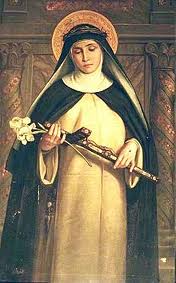 St. Catherine of Siena was born in 1347 to a family that already had 23 children. Early on, she identified herself as an activist, even cutting off her hair to show her parents that she vehemently refused to marry. She developed a habit of self-imposed solitude, only emerging for mass. When she was eighteen she joined a group of women called the Mantellate, who served the poor and sick in the community. Two years later she had a mystical experience that caused her to devote her life solely to God.
Catherine became widely sought after for her theological viewpoints and ability to interpret the Bible, and even the Pope asked for her counsel. Her thoughts survive in her work Dialogue, in which she sets up a theological debate with God. In it she develops love and truth as the only ways to strive for the perfection of God. Catherine always labored first out of love for God, and died after years of fasting and penance when she was only thirty-three.
If St. Catherine had taken the Spiritual Types Test, she would probably have been a lover.
St. Catherine of Siena was born in 1347 to a family that already had 23 children. Early on, she identified herself as an activist, even cutting off her hair to show her parents that she vehemently refused to marry. She developed a habit of self-imposed solitude, only emerging for mass. When she was eighteen she joined a group of women called the Mantellate, who served the poor and sick in the community. Two years later she had a mystical experience that caused her to devote her life solely to God.
Catherine became widely sought after for her theological viewpoints and ability to interpret the Bible, and even the Pope asked for her counsel. Her thoughts survive in her work Dialogue, in which she sets up a theological debate with God. In it she develops love and truth as the only ways to strive for the perfection of God. Catherine always labored first out of love for God, and died after years of fasting and penance when she was only thirty-three.
If St. Catherine had taken the Spiritual Types Test, she would probably have been a lover.
Lectionary Readings
(Courtesy of Vanderbilt Divinity Library)
Fifth Sunday of Easter - COLOR: White
Lectionary Texts:
Acts 8:26-40
Psalm 22:25-31
1 John 4:7-21
John 15:1-8
Lectionary Scriptures:
Acts 8:26 An angel of Adonai said to Philip, “Get up, and go southward on the road that goes down from Yerushalayim to ‘Azah, the desert road.” 27 So he got up and went. On his way, he caught sight of an Ethiopian, a eunuch who was minister in charge of all the treasure of the Kandake, or queen, of Ethiopia. He had been to Yerushalayim to worship; 28 and now, as he was returning home, he was sitting in his chariot, reading the prophet Yesha‘yahu. 29 The Spirit said to Philip, “Go over to this chariot, and stay close to it.” 30 As Philip ran up, he heard the Ethiopian reading from Yesha‘yahu the prophet. “Do you understand what you’re reading?” he asked. 31 “How can I,” he said, “unless someone explains it to me?” And he invited Philip to climb up and sit with him.
32 Now the portion of the Tanakh that he was reading was this:
“He was like a sheep led to be slaughtered;
like a lamb silent before the shearer, he does not open his mouth.
33 He was humiliated and denied justice.
Who will tell about his descendants,
since his life has been taken from the earth?”[a]
34 The eunuch said to Philip, “Here’s my question to you — is the prophet talking about himself or someone else?” 35 Then Philip started to speak — beginning with that passage, he went on to tell him the Good News about Yeshua.
36 As they were going down the road, they came to some water; and the eunuch said, “Look! Here’s some water! Is there any reason why I shouldn’t be immersed?” 37 [b] 38 He ordered the chariot to stop; then both Philip and the eunuch went down into the water, and Philip immersed him. 39 When they came up out of the water, the Spirit of the Lord snatched Philip away. The eunuch saw no more of him, because he continued on his way — full of joy. 40 But Philip showed up at Ashdod and continued proclaiming the Good News as he went through all the towns until he came to Caesarea.[Footnotes:
Acts 8:33 Isaiah 53:7–8
Acts 8:37 Some manuscripts include verse 37: And Philip said, “If you believe with all your heart, you may.” He answered, “I believe that Yeshua the Messiah is the Son of God.”]
Psalm 22:25 (24) For he has not despised or abhorred
the poverty of the poor;
he did not hide his face from him
but listened to his cry.”
26 (25) Because of you
I give praise in the great assembly;
I will fulfill my vows
in the sight of those who fear him.
27 (26) The poor will eat and be satisfied;
those who seek Adonai will praise him;
Your hearts will enjoy life forever.
28 (27) All the ends of the earth
will remember and turn to Adonai;
all the clans of the nations
will worship in your presence.
29 (28) For the kingdom belongs to Adonai,
and he rules the nations.
30 (29) All who prosper on the earth
will eat and worship;
all who go down to the dust
will kneel before him,
including him who can’t keep himself alive,
31 (30) A descendant will serve him;
the next generation will be told of Adonai.
1 John 4:7 Beloved friends, let us love one another; because love is from God; and everyone who loves has God as his Father and knows God. 8 Those who do not love, do not know God; because God is love. 9 Here is how God showed his love among us: God sent his only Son into the world, so that through him we might have life. 10 Here is what love is: not that we have loved God, but that he loved us and sent his Son to be the kapparah for our sins.
11 Beloved friends, if this is how God loved us, we likewise ought to love one another. 12 No one has ever seen God; if we love one another, God remains united with us, and our love for him has been brought to its goal in us. 13 Here is how we know that we remain united with him and he with us: he has given to us from his own Spirit. 14 Moreover, we have seen and we testify that the Father has sent his Son as Deliverer of the world. 15 If someone acknowledges that Yeshua is the Son of God, God remains united with him, and he with God. 16 Also we have come to know and trust the love that God has for us. God is love; and those who remain in this love remain united with God, and God remains united with them.
17 Here is how love has been brought to maturity with us: as the Messiah is, so are we in the world. This gives us confidence for the Day of Judgment. 18 There is no fear in love. On the contrary, love that has achieved its goal gets rid of fear, because fear has to do with punishment; the person who keeps fearing has not been brought to maturity in regard to love.
19 We ourselves love now because he loved us first. 20 If anyone says, “I love God,” and hates his brother, he is a liar. For if a person does not love his brother, whom he has seen, then he cannot love God, whom he has not seen. 21 Yes, this is the command we have from him: whoever loves God must love his brother too.
John 15:1 “I am the real vine, and my Father is the gardener. 2 Every branch which is part of me but fails to bear fruit, he cuts off; and every branch that does bear fruit, he prunes, so that it may bear more fruit. 3 Right now, because of the word which I have spoken to you, you are pruned. 4 Stay united with me, as I will with you — for just as the branch can’t put forth fruit by itself apart from the vine, so you can’t bear fruit apart from me.
5 “I am the vine and you are the branches. Those who stay united with me, and I with them, are the ones who bear much fruit; because apart from me you can’t do a thing. 6 Unless a person remains united with me, he is thrown away like a branch and dries up. Such branches are gathered and thrown into the fire, where they are burned up.
7 “If you remain united with me, and my words with you, then ask whatever you want, and it will happen for you. 8 This is how my Father is glorified — in your bearing much fruit; this is how you will prove to be my talmidim.
John Wesley's Notes-commentary for
Acts 8:26-40
Verse 26
[26] And the angel of the Lord spake unto Philip, saying, Arise, and go toward the south unto the way that goeth down from Jerusalem unto Gaza, which is desert.
The way which is desert — There were two ways from Jerusalem to Gaza, one desert, the other through a more populous country.
Verse 27
[27] And he arose and went: and, behold, a man of Ethiopia, an eunuch of great authority under Candace queen of the Ethiopians, who had the charge of all her treasure, and had come to Jerusalem for to worship,
An eunuch — Chief officers were anciently called eunuchs, though not always literally such; because such used to be chief ministers in the eastern courts.
Candace, queen of the Ethiopians — So all the queens of Ethiopia were called.
Verse 28
[28] Was returning, and sitting in his chariot read Esaias the prophet.
Sitting in his chariot, he read the Prophet Isaiah — God meeteth those that remember him in his ways. It is good to read, hear, seek information even in a journey. Why should we not redeem all our time?
Verse 30
[30] And Philip ran thither to him, and heard him read the prophet Esaias, and said, Understandest thou what thou readest?
And Philip running to him, said, Understandest thou what thou readest? — He did not begin about the weather, news, or the like. In speaking for God, we may frequently come to the point at once, without circumlocution.
Verse 31
[31] And he said, How can I, except some man should guide me? And he desired Philip that he would come up and sit with him.
He desired Philip to come up and sit with him — Such was his modesty, and thirst after instruction.
Verse 32
[32] The place of the scripture which he read was this, He was led as a sheep to the slaughter; and like a lamb dumb before his shearer, so opened he not his mouth:
The portion of Scripture — By reading that very chapter, the fifty-third of Isaiah, many Jews, yea, and atheists, have been converted. Some of them history records. God knoweth them all. Isaiah 53:7
Verse 33
[33] In his humiliation his judgment was taken away: and who shall declare his generation? for his life is taken from the earth.
In his humiliation his judgment was taken away — That is, when he was a man, he had no justice shown him. To take away a person's judgment, is a proverbial phrase for oppressing him.
And who shall declare, or count his generation — That is, who can number his seed, Isaiah 53:10; which he hath purchased by laying down his life?
Verse 36
[36] And as they went on their way, they came unto a certain water: and the eunuch said, See, here is water; what doth hinder me to be baptized?
And as they went on the way they came to a certain water — Thus, even the circumstances of the journey were under the direction of God. The kingdom of God suits itself to external circumstances, without any violence, as air yields to all bodies, and yet pervades all.
What hindereth me to be baptized? — Probably he had been circumcised: otherwise Cornelius would not have been the first fruits of the Gentiles.
Verse 38
[38] And he commanded the chariot to stand still: and they went down both into the water, both Philip and the eunuch; and he baptized him.
And they both went down — Out of the chariot. It does not follow that he was baptized by immersion. The text neither affirms nor intimates any thing concerning it.
Verse 39
[39] And when they were come up out of the water, the Spirit of the Lord caught away Philip, that the eunuch saw him no more: and he went on his way rejoicing.
The Spirit of the Lord caught away Philip — Carried him away with a miraculous swiftness, without any action or labour of his own. This had befallen several of the prophets.
Verse 40
[40] But Philip was found at Azotus: and passing through he preached in all the cities, till he came to Caesarea.
But Philip was found at Azotus — Probably none saw him, from his leaving the eunuch, till he was there.
Psalm 22:25-31
Verse 25
[25] My praise shall be of thee in the great congregation: I will pay my vows before them that fear him.
Great congregation — In the universal church, of Jews and Gentiles.
Verse 26
[26] The meek shall eat and be satisfied: they shall praise the LORD that seek him: your heart shall live for ever.
Satisfied — This is doubtless to be understood, of those spiritual blessings, that grace and peace, and comfort, which all believing souls have in the sense of God's love, the pardon of their sins, and the influences of God's spirit.
Seek him — That seek his favour.
Your heart — He speaks of the same persons still, though there be a change from the third to the second person, as is usual in these poetical books.
For ever — Your comfort shall not be short and transitory, as worldly comforts are, but everlasting.
Verse 27
[27] All the ends of the world shall remember and turn unto the LORD: and all the kindreds of the nations shall worship before thee.
The world — All nations from one end of the world to the other. So this is an evident prophecy of the calling of the Gentiles, and a clear proof, that this psalm immediately speaks of Christ; to whom alone, this and divers other passages of it, belong.
Remember — They shall remember their former wickedness with grief and shame, and fear; particularly in worshiping dead and impotent idols. They shall remember their great and manifold obligation to God, which they had quite forgotten, his patience in sparing them so long, in the midst of all their impieties, and in giving his son for them: they shall remember the gracious words and glorious works of Christ, what he did, and suffered for them; which possibly divers of them had been eye and ear-witnesses of.
The Lord — Into the only true God, and unto Jesus Christ, to whom this name of Jehovah is often ascribed in scripture.
Verse 28
[28] For the kingdom is the LORD's: and he is the governor among the nations.
For — This is added as a reason, why the Gentiles should be converted, because God is not only God and the Lord of the Jews, but also of the Gentiles, and of all nations.
Verse 29
[29] All they that be fat upon earth shall eat and worship: all they that go down to the dust shall bow before him: and none can keep alive his own soul.
Fat — Kings and princes, and the great men of the world.
Shall eat — Shall feed upon the bread of life, Christ and all his benefits.
Worship — This is added to shew what kind of eating he spoke of.
Go down — That is, all mankind, for none can escape death.
Verse 30
[30] A seed shall serve him; it shall be accounted to the Lord for a generation.
A seed — Christ shall not want a seed or posterity, for though the Jewish nation will generally reject him, the Gentiles shall come in their stead.
A generation — That believing seed shall be reputed both by God and men, The generation, or people of the Lord, as the Jews formerly were.
Verse 31
[31] They shall come, and shall declare his righteousness unto a people that shall be born, that he hath done this.
They — The seed last mentioned.
Come — From Judea and Jerusalem (from whence the gospel was first to go forth) to the Gentile world, to the several parts whereof the apostles went upon this errand.
His — God's righteousness: his wonderful grace and mercy unto mankind, in giving them Christ and the gospel; for righteousness is often put for mercy or kindness.
Unto — Unto succeeding generations. Whereby David gives us a key to understand this psalm, and teaches us that he speaks not here of himself, but of things which were to be done in after-ages, even of the spreading of the gospel among the Gentiles, in the time of the New Testament.
That he — They shall declare that this is the work of God, and not of man.
1 John 4:7-21
Verse 7
[7] Beloved, let us love one another: for love is of God; and every one that loveth is born of God, and knoweth God.
Let us love one another — From the doctrine he has just been defending he draws this exhortation. It is by the Spirit that the love of God is shed abroad in our hearts. Every one that truly loveth God and his neighbour is born of God.
Verse 8
[8] He that loveth not knoweth not God; for God is love.
God is love — This little sentence brought St. John more sweetness, even in the time he was writing it, than the whole world can bring. God is often styled holy, righteous, wise; but not holiness, righteousness, or wisdom in the abstract, as he is said to be love; intimating that this is his darling, his reigning attribute, the attribute that sheds an amiable glory on all his other perfections.
Verse 12
[12] No man hath seen God at any time. If we love one another, God dwelleth in us, and his love is perfected in us.
If we love one another, God abideth in us — This is treated of, 1 John 4:13-16.
And his love is perfected — Has its full effect.
In us — This is treated of, 1 John 4:17-19.
Verse 14
[14] And we have seen and do testify that the Father sent the Son to be the Saviour of the world.
And in consequence of this we have seen and testify that the Father sent the Son - These are the foundation and the criteria of our abiding in God and God in us, the communion of the Spirit, and the confession of the Son.
Verse 15
[15] Whosoever shall confess that Jesus is the Son of God, God dwelleth in him, and he in God.
Whosoever shall, from a principle of loving faith, openly confess in the face of all opposition and danger, that Jesus is the Son of God, God abideth in him.
Verse 16
[16] And we have known and believed the love that God hath to us. God is love; and he that dwelleth in love dwelleth in God, and God in him.
And we know and believe — By the same Spirit, the love that God hath to us.
Verse 17
[17] Herein is our love made perfect, that we may have boldness in the day of judgment: because as he is, so are we in this world.
Hereby — That is, by this communion with God.
Is our love made perfect; that we may — That is, so that we shall have boldness in the day of judgment - When all the stout-hearted shall tremble.
Because as he — Christ.
Is — All love.
So are we — Who are fathers in Christ, even in this world.
Verse 18
[18] There is no fear in love; but perfect love casteth out fear: because fear hath torment. He that feareth is not made perfect in love.
There is no fear in love — No slavish fear can be where love reigns. But perfect, adult love casteth out slavish fear: because such fear hath torment - And so is inconsistent with the happiness of love. A natural man has neither fear nor love; one that is awakened, fear without love; a babe in Christ, love and fear; a father in Christ, love without fear.
Verse 19
[19] We love him, because he first loved us.
We love him, because he first loved us — This is the sum of all religion, the genuine model of Christianity. None can say more: why should any one say less, or less intelligibly?
Verse 20
[20] If a man say, I love God, and hateth his brother, he is a liar: for he that loveth not his brother whom he hath seen, how can he love God whom he hath not seen?
Whom he hath seen — Who is daily presented to his senses, to raise his esteem, and move his kindness or compassion toward him.
Verse 21
[21] And this commandment have we from him, That he who loveth God love his brother also.
And this commandment have we from him — Both God and Christ.
That he who loveth God love his brother — Every one, whatever his opinions or mode of worship be, purely because he is the child, and bears the image, of God. Bigotry is properly the want of this pure and universal love. A bigot only loves those who embrace his opinions, and receive his way of worship; and he loves them for that, and not for Christ's sake.
John 15:1-8
Verse 2
[2] Every branch in me that beareth not fruit he taketh away: and every branch that beareth fruit, he purgeth it, that it may bring forth more fruit.
Every one that beareth fruit, he purifieth — by obeying the truth, 1 Peter 1:22; and by inward or outward sufferings, Hebrews 12:10,11. So purity and fruitfulness help each other.
That it may bear more fruit — For this is one of the noblest rewards God can bestow on former acts of obedience, to make us yet more holy, and fit for farther and more eminent service.
Verse 3
[3] Now ye are clean through the word which I have spoken unto you.
Ye are clean — All of you, to whom I now speak, are purged from the guilt and power of sin; by the word - Which, applied by the Spirit, is the grand instrument of purifying the soul.
Verse 4
[4] Abide in me, and I in you. As the branch cannot bear fruit of itself, except it abide in the vine; no more can ye, except ye abide in me.
Abide in me — Ye who are now pure by living faith, producing all holiness; by which alone ye can be in me.
Verse 5
[5] I am the vine, ye are the branches: He that abideth in me, and I in him, the same bringeth forth much fruit: for without me ye can do nothing.
I am the vine, ye are the branches — Our Lord in this whole passage speaks of no branches but such as are, or at least were once, united to him by living faith.
Verse 6
[6] If a man abide not in me, he is cast forth as a branch, and is withered; and men gather them, and cast them into the fire, and they are burned.
If any one abide not in me — By living faith; not by Church communion only. He may thus abide in Christ, and be withered all the time, and cast into the fire at last.
He is cast out — Of the vineyard, the invisible Church. Therefore he was in it once.
Verse 7
[7] If ye abide in me, and my words abide in you, ye shall ask what ye will, and it shall be done unto you.
If ye abide in me, ye shall ask — Prayers themselves are a fruit of faith, and they produce more fruit.
Verse 8
[8] Herein is my Father glorified, that ye bear much fruit; so shall ye be my disciples.
So shall ye be my disciples — Worthy of the name. To be a disciple of Christ is both the foundation and height of Christianity.
PO Box 340004
Nashville, Tennessee 37203-0004 United States
___________________________________
Sermon Story "Staying Connected" by Gary Lee Parker for Sunday, 3 May 2015 with Scripture: John 15:1 “I am the real vine, and my Father is the gardener. 2 Every branch which is part of me but fails to bear fruit, he cuts off; and every branch that does bear fruit, he prunes, so that it may bear more fruit. 3 Right now, because of the word which I have spoken to you, you are pruned. 4 Stay united with me, as I will with you — for just as the branch can’t put forth fruit by itself apart from the vine, so you can’t bear fruit apart from me.
5 “I am the vine and you are the branches. Those who stay united with me, and I with them, are the ones who bear much fruit; because apart from me you can’t do a thing. 6 Unless a person remains united with me, he is thrown away like a branch and dries up. Such branches are gathered and thrown into the fire, where they are burned up.
7 “If you remain united with me, and my words with you, then ask whatever you want, and it will happen for you. 8 This is how my Father is glorified — in your bearing much fruit; this is how you will prove to be my talmidim.
I have heard. I have read, I have even read some thoughts on this passage of Scripture where Jesus calls Hmself he Vine and His followers are the branches. The branches stay connected to the vine and bear much fruit. There have been many interpretations or understandings what bearing fruit is here even that one must daily or constantly bring others into the fellowship with Jesus, but let us look at the Scripture in I John 4 about love. There is a possibilty that the fruit Jesus is talking about is Love. The Love fully God, the loving all other people, and the loving ourselves in an uncodtional way that we may Love other people as God loves us. This love brins a iight to the people who love unconditionally while hate appears to whither people up into a disgruntled and bitter life. Could love be the fruit that we are to bear? How have you heard this passage understood in your lifetime? How are yo understanding this as we see so much hatred in the world that causes violence? We know that if we truly love others no matter who they are we have a tendency not to hate them or do harsh things towards them in violent words or actions. We seek our lives and see how we are remaining connected to Jesus and showing His love in our lives for us, others, and mostly God. We come and examine ourselves as we ccome and eat His body and drink His blood in partaking of the Holy Sacrament of the Holy Eucharist to receive more of His love to give to all other people. As we come to receive, we come singing the Hymn "The Love of God" by Frederick M. Lehman, 1917 verse 3 and by Meir Ben Isaac Nehorai, 1050 verse 3 translated by Anonymous/Unknown
1. The love of God is greater far
Than tongue or pen can ever tell;
It goes beyond the highest star,
And reaches to the lowest hell;
The guilty pair, bowed down with care,
God gave His Son to win;
His erring child He reconciled,
And pardoned from his sin.
Refrain:
Oh, love of God, how rich and pure!
How measureless and strong!
It shall forevermore endure—
The saints’ and angels’ song.
2. When hoary time shall pass away,
And earthly thrones and kingdoms fall,
When men who here refuse to pray,
On rocks and hills and mountains call,
God’s love so sure, shall still endure,
All measureless and strong;
Redeeming grace to Adam’s race—
The saints’ and angels’ song.
Refrain:
Oh, love of God, how rich and pure!
How measureless and strong!
It shall forevermore endure—
The saints’ and angels’ song.
3. Could we with ink the ocean fill,
And were the skies of parchment made,
Were every stalk on earth a quill,
And every man a scribe by trade;
To write the love of God above
Would drain the ocean dry;
Nor could the scroll contain the whole,
Though stretched from sky to sky.
Refrain:
Oh, love of God, how rich and pure!
How measureless and strong!
It shall forevermore endure—
The saints’ and angels’ song.
____________________________
Gary Lee Parker
4147 Idaho Street, Apt. 1
San Diego, California 92104-1844, United States
____________________________


