democracynow.org
Stories:

Largest Pay Raise for American Workers in History? NY & CA Approve $15 Minimum Wage Hike
Advocates are calling it one of the largest pay raises for American workers in the history of the country. About 5 million workers will see their wages increase substantially after a historic victory for the "Fight for 15" campaign. Both the state of California and New York City are poised to raise the minimum wage to $15 an hour in the coming years. On Thursday, the California Legislature voted to raise the minimum wage incrementally each year until it reaches $15 an hour by 2022. Meanwhile, New York Governor Andrew Cuomo says he has reached a budget deal that will hike the minimum wage in New York City to $15 by the end of 2018. "It’s remarkable that only about three years ago this movement started with a single strike of a bunch of McDonald’s workers in New York City, and it has spread across the country," says Democracy Now! co-host Juan Gonzalez. "And it’s going to continue to spread, because there’s too many Americans who cannot live on the federal minimum wage."
TRANSCRIPT
This is a rush transcript. Copy may not be in its final form.
AMY GOODMAN: Juan, this is quite a remarkable victory in both New York and California around the minimum wage.
JUAN GONZÁLEZ: Yes. The advocates are calling it, actually, the largest—one of the largest pay raises for American workers in the history of the country. About 5 million people are going to see—minimum-wage workers—are going to see their wages increase substantially over the next few years. And it’s remarkable that only about three years ago this movement started with a single strike of a bunch of McDonald’s workers in New York City, and it has spread across the country. And it’s going to continue to spread, because there’s too many Americans who cannot live on the federal minimum wage or on some higher state minimum wages in some areas. So this is a remarkable movement that’s also going to boost the economy, because all of these low-wage workers are going to immediately spend that money. And so, it’s remarkable that a movement has been able to get this far so quickly.
AMY GOODMAN: And, of course, we’ll continue to cover it, as this wave of both protest and response, with real laws, sweeps the country. ... Read More →

Exclusive: Cherelle Baldwin on Being Found Not Guilty for Defending Herself Against Abusive Ex
In a Democracy Now! exclusive, Cherelle Baldwin joins us for her first interview since a Connecticut jury found her not guilty in the death of her abusive ex-boyfriend, Jeffrey Brown. According to court documents, Brown had repeatedly threatened Baldwin, took her credit cards and money, and assaulted her during visits to see their son. Baldwin eventually attained a court order barring threats, harassment and assaults during visits, but Brown continued sending Baldwin threatening text messages. Then, according to a police affidavit based on Baldwin’s statements, Brown showed up at her house, climbed through her window and attacked her, choking her with his belt. Baldwin escaped and managed to get inside her car, but so did Brown, who again choked her. What happened next is hard for even Baldwin to remember, but when police arrived they found Baldwin on the ground with a broken leg, and Brown was lifeless in front of the car, pinned against the garage wall. Baldwin was eventually arrested on murder charges. Since the incident, Baldwin has spent nearly three years in jail, held on a million-dollar bond. A first trial in 2015 ended in a hung jury and was declared a mistrial. Prosecutors then moved to retry Baldwin. The jury reached its verdict on Thursday, hours after her mother appeared on Democracy Now! The case has caught the attention of domestic violence organizations nationwide, who cite it as an example of how black women are disproportionately imprisoned when they defend themselves against domestic abuse. "When I received letters, I would cry. So many women told me different stories, how they were in my situation. I didn’t know so many women were going through that," Baldwin says. "Especially at a young age, it touched me a lot. I had so much support that I didn’t even know I had. It helped me a lot while being incarcerated." We are also joined by Baldwin’s mother, Cynthia Long, and her defense attorney, Miles Gerety.
TRANSCRIPT
This is a rush transcript. Copy may not be in its final form.
JUAN GONZÁLEZ: Now to today’s top story. The verdict: not guilty. That was the decision of a Connecticut jury Thursday in the murder trial of Cherelle Baldwin. We first reported on the case yesterday, just hours before the jury acquitted Baldwin, a 24-year-old mother. She was charged with the 2013 killing of her ex-boyfriend, Jeffrey Brown, who Baldwin says had stalked and abused her.
According to court documents, Brown had repeatedly threatened Baldwin, took her credit cards and money, assaulted her during visits to see their son. Baldwin eventually attained a court order barring threats, harassment and assaults by him during his visits, but Brown continued sending Baldwin threatening text messages. Then, according to a police affidavit based on Baldwin’s statements, Brown showed up at her house, climbed through her window and attacked her, choking her with his belt. Baldwin escaped and managed to get inside her car, but so did Brown, who again choked her. What happened next is hard for even Baldwin to remember, but when police arrived, they found her on the ground with a broken leg, and Brown was lifeless in front of the car, pinned against the garage wall. Baldwin was eventually arrested on murder charges.
AMY GOODMAN: Since the incident, Cherelle Baldwin has spent nearly three years in prison, held on a million-dollar bond. A first trial in 2015 ended in a hung jury, 11 to one, was declared a mistrial—in her favor, the 11 to one. Prosecutors moved to retry Cherelle. After the non-guilty verdict was read, Cherelle Baldwin fell to the floor sobbing, saying, "My baby is going to get his mommy back." Jeffrey Brown’s father, Jeffrey Hines, said he respected the decision of the jury. He pointed to a class ring he wears which has a symbol of the scales of justice and said, "They made a decision. That’s it."
The case has caught the attention of domestic violence organizations nationwide, who cited the case as an example of how black women are disproportionately imprisoned when they defend themselves against domestic abuse.
Well, today, in a Democracy Now! exclusive, Cherelle Baldwin joins us in our studio for her first interview since being freed yesterday. Also with us is her mother, Cynthia Long, who we spoke to yesterday on Democracy Now! in Bridgeport, but today she is with us in New York, and her attorney, defense attorney Miles Gerety.
Thank you so much for joining us, all. Cherelle, welcome to the free world.
CHERELLE BALDWIN: Yes, thank you so much.
AMY GOODMAN: How did you feel when you heard that verdict yesterday in the Bridgeport courtroom?
CHERELLE BALDWIN: I just, like, collapsed. I just—I couldn’t believe it. When they said "not guilty of all five accounts," I just—it was just like God sent an angel down and saved me. It was amazing.
AMY GOODMAN: You had been in prison for nearly three years—
CHERELLE BALDWIN: Yes.
AMY GOODMAN: —awaiting this trial.
CHERELLE BALDWIN: Yes.
JUAN GONZÁLEZ: What’s it been like, in terms of—you have a five-year-old son. How were you able to maintain relations with him during that period of time that you were in prison? And what’s been his reaction now that you’re back out?
CHERELLE BALDWIN: Well, he hasn’t seen me yet, but I’m going to see him on Monday. But I would see him twice a month up at York CI correctional facility. And the whole time, he thought I was at school. He didn’t know that I was in jail, because we wore like burgundy shirts and jeans, so he thought I was at school. But he said to me last weekend, he was like, "Mommy, when you come home, we’re going to play Lego Batman." And I said, "I promise you, when I come home, I’m going to play Lego Batman with you." And I’m going to keep my promise. When I come home Monday, I’m going to play Lego Batman all day with him.
GOODMAN: Cynthia Long, we spoke to you yesterday just before the verdict. We didn’t know how long the jury would be out. But what was your response?
CYNTHIA LONG: I was just totally overjoyed. And I was so happy, because I believed that my daughter was innocent the whole time. And I am just so grateful that the jury got to hear her side of the story and that, you know, they made the right decision. It just overwhelmed me, you know, with tears, because there are so many domestic violence victims out there that are still struggling in the jail for fighting back. And, you know, I’m just so grateful that everything turned out well for Cherelle.
JUAN GONZÁLEZ: And, Miles Gerety, could you talk about how you got involved in the case and also the significance of the case, especially in light of the fact that there was this history of abuse that existed beforehand, why the prosecutors even attempted a murder conviction?
MILES GERETY: I got involved when I was told about the facts of this case. And Cherelle had a nice, really good lawyer, but who hadn’t tried any murder cases. So I got involved for the first trial and then again for the second trial.
You know, battered women, when they step out of the role and defend themselves, there’s a lot of prejudice. I mean, a lot of jurors, a lot of men especially, can’t—once a woman steps out of that role, will think, "Oh, she’s not battered," or see avenues of escape. You know, Cherelle was in her bedroom. And you mentioned a window, but we don’t know how he got in. Cherelle was in her bedroom, was attacked in her bedroom, choked and whipped horrifically. I mean, she’s got—not even noted, by the way, when she got to the hospital. She crashed her car into a cement wall going 21 miles an hour, 30.8 feet per second. So she’s concussed. She wakes up next to the car, not really knowing what had happened, because she had retrograde amnesia. Because she didn’t know how it happened and what had happened, the assumption was that she was lying. And so, you have this woman who—one of the nicest, sweetest people on Earth, who wouldn’t hurt a fly, who is desperate to get back to her child, to save her child. You know—
AMY GOODMAN: Because her baby was inside.
MILES GERETY: Inside, crying, when she left. And the thing that gets me—
AMY GOODMAN: He was what? Eighteen months old?
MILES GERETY: Eighteen months. And when Cherelle—OK, there’s a thing called the castle doctrine in most states. You have a right—you don’t have to retreat from your own home. The court ruled, in two trials, that as soon as she stepped off her porch, as soon as she stepped out of her house, that doctrine didn’t apply, which would mean if a woman was attacked in her home and thrown out the window, when she’s on the grass of her neighbor, suddenly she doesn’t—her duty of care towards her attackers has changed.
JUAN GONZÁLEZ: And even though her garage is part of her home.
MILES GERETY: Right. And what a lot of women’s groups are saying, first place, there ought to be a virtual castle doctrine. If there’s a court order saying you’re not to be attacked, you’re not to be harassed, you ought not to have the duty to retreat. And, you know, as much talk as there is of "Stand Your Ground," this is a situation where Cherelle, being slight at the—you know, smaller than Jeffrey Brown, not having—you know, women are likely to own a gun a third as—you know, three times as many men have guns. If she was bigger and stronger and beat him to death in her apartment, she never would have been charged. But as soon as she leaves her home, they changed. And that’s wrong. I mean, that is really—that law needs to be changed. And, you know, it’s amazing to me that in 2016 we’re still dealing with the societal pressures, you know, where if a woman defends herself, suddenly she’s complicit in her battering. And, you know, this is really a problem.
AMY GOODMAN: We’re—
MILES GERETY: And it—I’m sorry.
AMY GOODMAN: We’re going to break, and when we come back, we’re also going to talk about what this $1 million bond was. I mean, a year ago, another trial was deadlocked, 11 to one in Cherelle’s favor, and she had to remain in prison simply because she could not afford the bond that a more well-off woman could have afforded. Cherelle Baldwin is with us. Not guilty on all counts was the decision of the jury yesterday in the death of her abusive ex-partner. We’re also joined by her mother, Cynthia Long, and her attorney, Miles Gerety. We’ll be back with them in a minute.
[break]
AMY GOODMAN: Aaliyah, "Never No More," here on Democracy Now!, democracynow.org, The War and Peace Report. I’m Amy Goodman, with Juan González. A Democracy Now! special today: Cherelle Baldwin is free. After nearly three years in prison, she was found not guilty on all counts in a second trial in the death of her abusive ex-partner, who choked her, went after her. Ultimately, she ended up with a broken leg, he ended up dead, and their, that time, 18-month-old baby inside alone in her house. We’re also joined by Cherelle’s mother, Cynthia Long, and Cherelle’s attorney, Miles Gerety. She was found not guilty just yesterday in a Bridgeport courtroom and is here in New York with us today.
Cherelle, what happened on the day of your abuser’s death did not start on that day. You had gotten an order of protection. Where were the police through this period, if he violated this order of protection a number of times?
CHERELLE BALDWIN: I can’t—the police, I don’t think they really cared too much. And like, basically, it was always pats on the back, like it wasn’t nothing—they didn’t take domestic violence serious at all. So, they probably would think, "He would never hurt her, or he would never try to kill her." But on May 18, it became like a life-or-death situation.
AMY GOODMAN: You had gotten texts before he even came to the house?
CHERELLE BALDWIN: Yes. And I told him, I said, "If you touch me, I’m going to call the cops on you." He kept threatening. He said he’s going to kill me, my family. It was horrible.
JUAN GONZÁLEZ: And interestingly, or ironically, you had tried to get help for him, right?
CHERELLE BALDWIN: Yes.
JUAN GONZÁLEZ: Because you had—you realized that he had had a terrible childhood and problems in his own life that made him so violent.
CHERELLE BALDWIN: Yes. I spoke to a domestic violence advocate, and I told him, I said, "Is there any way you can get anger management for him?" I said, "He’s abusive. He’s violent toward everything. I don’t know why he’s so upset. All I’m doing is trying to help him." And they just totally ignored it, gave him a conditional discharge and basically a pat on the back, "Go about your life."
AMY GOODMAN: Cynthia Long, when your daughter was arrested on first-degree murder charges and they set a million-dollars bond, was there any chance you could raise that?
CYNTHIA LONG: No, not a million dollars. And it’s usually like, I think, 10 percent of that; it’s like $100,000. It just was no way. The home value in Bridgeport is not even close or nearly to that much, if we had to put up the home. So, it was nearly impossible for us to do that, so we had to kind of wait, you know, until she had a trial.
JUAN GONZÁLEZ: And, Cherelle, I wanted to ask you, what’s your response to the enormous support that you’ve gotten from survivors’ groups around the country? And were you surprised by that and how much of a cause your case became?
CHERELLE BALDWIN: Yes. When I received letters, I would cry. So many women told me different stories, how they were in my situation. And, you know, I didn’t know as much women was going through that. And especially at a young age, it touched me a lot, because I had so much support and—that I didn’t even know I had. It helped me a lot while being incarcerated.
AMY GOODMAN: The text he sent you that morning, before he came to your house, said, "DOA"?
CHERELLE BALDWIN: Yes, "You will be DOA on sight."
AMY GOODMAN: Dead on arrival?
CHERELLE BALDWIN: Yes.
MILES GERETY: Twice.
AMY GOODMAN: Two of those texts.
MILES GERETY: Yeah.
CHERELLE BALDWIN: Yes.
AMY GOODMAN: Miles Gerety, talk about this million-dollar bond, even after the first trial, 11 to one in her favor.
MILES GERETY: I should be careful what I say, but I was incredibly disappointed. It should have been lowered. The fact that they tried her a second time on murder, when you had a jury, but for one holdout, who really—the jury at one point wrote a note and said he wouldn’t really negotiate or—at any rate, it was incredible.
But I did want to make one little point. The reason they would not put Jeffrey Brown in some sort of anger management, domestic violence program—and some of them last 52 weeks; and Jeffrey was really troubled, I think he may have had intermittent explosive disorder—was because he was a convicted felon. That’s absurd. The reason for these programs is not just to help the guy, which 90 percent of the time it’s a man, but their future intimate partners. And I mean, so, because—and Cherelle, not a convicted felon, Cherelle, who was working a good job and trying to make it as a single mother, could—didn’t get help. He needed help, and she begged, repeatedly, to get it. And they said he was a convicted felon, so they just let him plead to a crime. That is absolutely stupid. It’s really a mistake. And yeah, these programs actually do work, a lot of the time. And so it was a real tragedy.
You know, she loved Jeffrey Brown. This was not—you know, women who are battered began with a relationship, during a honeymoon phase, with someone who was charming and nice. And Jeffrey Brown could be charming and nice. But he had a real problem. He must have been exposed to something Cherelle herself had been, and Cindy had had a bad marriage with an abusive husband—not Bernard Baldwin, but somebody else. And, you know, this pattern repeats and repeats.
What got me about her case is it seemed the police investigation was geared to do one thing: to basically prove that everything she said was a lie. And she was wrong. I mean, he didn’t get through a window, but he had done that once before. And after hitting your head and being concussed and having amnesia for a while, retrograde amnesia, she didn’t know what had happened. So, part of my argument to the jury was: What if she didn’t remember anything? Would the police have spoken to her father and found out that the baby was left alone, the covers were torn off the bed? Would they have—would they have, you know, done any of the things to say, well, how did he really get in the house? Jeffrey Brown was parked 468 feet, a football field and a half, away from her house. He had sent her texts that morning saying "DOA on sight, DOA on sight," other things that basically threatened everybody was going to get killed. Just the same, Cindy offered the police—they didn’t find her cellphone, the family did—offered the police this phone, and nobody wanted it.
AMY GOODMAN: You, Cindy—
JUAN GONZÁLEZ: Let me ask you, there was the—
AMY GOODMAN: I just want to ask that one point on the phone. You offered the police Cherelle’s phone?
CYNTHIA LONG: Yes, I did, in the hospital. After I saw the text message, I offered them the phone.
AMY GOODMAN: So they took it as evidence?
MILES GERETY: No.
CYNTHIA LONG: No. They said there was no need for it.
JUAN GONZÁLEZ: I wanted to ask you about this whole issue of specific Connecticut laws in terms of domestic abuse cases, where police officers in Connecticut disproportionately end up arresting both—both people in a home when they go. Could you talk about that and what the—
MILES GERETY: OK, historically—look, Connecticut has the best domestic violence expert in the world, Evan Stark. He’s the guy—he’s the reason people talk about domestic violence. And so, Connecticut does have a law that arrests have to be made. The problem is, battered women frequently depend on their batterer to help support their children. You know, there’s this whole relationship. And battered women frequently don’t—they don’t want the guy to go to jail. They want him to get help. So, Cherelle’s situation was typical. What’s so frustrating about it is, because Jeffrey Brown was a convicted felon as a young man, he wasn’t offered help.
And then, when she—when this happened, the presumption seemed to be that she’s lying about what happened. Nobody thinks, if you’re in your bedroom and you say somebody came in the window, a window you can’t see, then maybe you’re wrong. You know, when you have a witness who can’t see what they’re allegedly talking about, you say, "Well, maybe they’re wrong." Nobody thought, "Hey, she hit a windshield at 21 miles an hour. She ran out of her home barefoot in a nightgown and without glasses," which Cherelle is not wearing now, but Cherelle is as close to—she’s minus-four. She’s really, really nearsighted. She hit the sole side of her house, just bouncing off. You know, the top speed was 21, but the car started at zero, then nine miles an hour, then 16, then 19, then 21. Those are second intervals. And the thing about it that to me is so incredible, he was riding the hood. This is somebody—the fireman said he had the belt he had been beating her with, it wrapped in his hand, in his lifeless body. I mean, if that doesn’t tell you she’s been robbed and she’s been beaten and she’s a victim—
AMY GOODMAN: Cherelle, what would you say to prosecutors around the country about prosecuting women in your situation?
CHERELLE BALDWIN: I believe that they should investigate more, don’t just assume. If they see if a woman—if a woman been through domestic violence, look at the history. Look at the evidence that’s right there. They didn’t even—clearly, they didn’t in my case. They ignored text messages. They ignored ropes. They ignored everything. And I believe that they shouldn’t prosecute women that’s trying to get help. I tried my best to do everything, and it didn’t work. It just was just me for defend myself. I just don’t understand. He pleads guilty, but don’t get no prison time? And then, as soon as I defend myself, they want to give me up to 60 years? It just—I don’t understand it at all.
AMY GOODMAN: How do class, race and gender fit in, Miles Gerety, into determining whether domestic violence, how domestic violence survivors are treated?
MILES GERETY: Well, domestic violence itself is an equal opportunity provider. But there—I have no doubt that if Cherelle Baldwin was living in a million-dollar house in Greenwich and this happened, versus, you know, her grandmother’s two-family in Bridgeport in an industrial area of town, the investigation would have been a lot different. And, you know, here’s somebody who never had been in trouble. When she met Jeffrey Brown, he said his name was Jarell Brown and told her he worked in a warehouse nights, when he was really a drug dealer. But she was pregnant by him before she even knew who he was. And, I mean, it’s just a tragedy. And clearly, minority women pay the strongest—the greatest price. And the notion that because a guy’s a felon we’re not going to get him treated is crazy, just crazy. So it’s OK if she’s beaten, if she’s whipped, because we’re not going to get people treated.
AMY GOODMAN: Well, Cherelle, what are your plans now? You’re just freed less than 24 hours at this moment.
CHERELLE BALDWIN: Yes. Well, my plans are to just—my son. My main—get my life together for my son. You know, he’s been without me for two-and-a-half, almost three years. And it’s just—I’m just so happy to—you know, because I fought for him. There was times I—there was times I felt like giving up, but I looked at his picture every day, and I said, "I’m going to go home to you. I’m going to fight for you." And it’s just—it’s going to be hard trying to get my life back together, but, you know, I did this for him. I had to. The reason this situation happened, you know, is—I’m going to get myself together for him.
AMY GOODMAN: Well, I want to thank you all very much for being here and sharing your story. And congratulations on your freedom.
CHERELLE BALDWIN: Thank you.
AMY GOODMAN: We’ve been speaking with Cherelle Baldwin and her mother, Cynthia Long, as well as her attorney, Miles Gerety. Cherelle Baldwin is free, after almost three years in jail facing 60 years in prison for killing her abusive ex-partner as he came to her house to attack her, sending texts that said "DOA, DOA."
This is Democracy Now! When we come back, we look at the situation in Yemen. Hundreds of thousands of people marched against the U.S.-backed Saudi bombing campaign in Yemen. What’s happening to this country? Stay with us. ... Read More →

Human Rights Advocates: U.S.-Backed Saudi Offensive in Yemen a "Dark Mark" on Obama’s Presidency
Hundreds of thousands took to the streets in Yemen this week to protest the first anniversary of the U.S.-backed, Saudi-led offensive against Houthi rebels. The protests were said to be the largest in Yemen since demonstrations in 2011 forced the resignation of President Ali Abdullah Saleh. Since last March, more than 6,000 people have been killed in Yemen, about half of them civilians. "Yemenis are asking me, ’Why is there no global outrage when our schools, our universities, our hospitals, our clinics, when football fields, when playgrounds are bombed with U.S. bombs?" says Sarah Leah Whitson, executive director of Human Rights Watch’s Middle East and North Africa Division. Her recent piece for the Los Angeles Times is headlined "The U.S. is quietly helping Saudi Arabia wage a devastating aerial campaign in Yemen." Meanwhile, the U.S. launched air attacks on al-Qaeda in southern Yemen, killing 14 people described by local sources as suspected militants. We also get response from Farea Al-Muslimi, a visiting scholar at the Carnegie Middle East Center in Beirut. He is also the co-founder and chairman of the Sana’a Center for Strategic Studies. In 2013, he testified before the Senate Judiciary Subcommittee hearing on the U.S. secret drone program.
TRANSCRIPT
This is a rush transcript. Copy may not be in its final form.
JUAN GONZÁLEZ: We turn now to Yemen, where hundreds of thousands took to the streets to protest the first anniversary of the U.S.-backed, Saudi-led offensive against the Houthi rebels. The protests were said to be the largest in Yemen since demonstrations in 2011 forced the resignation of President Ali Abdullah Saleh. This is one protester, Ibrahim al-Ubaidi, speaking at Saturday’s demonstration.
IBRAHIM AL-UBAIDI: [translated] Today, all Yemenis, from all different sects and regardless of their political affiliations, came out today in the masses, a crowd of over a million, to show the world that the Yemeni people can never be shaken nor defeated.
AMY GOODMAN: Since the U.S.-backed, Saudi-led intervention began last March, more than 6,000 people have been killed in Yemen, about half of them civilians. According to UNICEF, nearly 10 million children are in dire need of humanitarian assistance, and 320,000 are at risk of severe acute malnutrition. Meanwhile, the U.S. launched air attacks on al-Qaeda in southern Yemen, killing 14 people described by local sources as suspected militants.
For more, we’re joined by two guests. In Beirut, Lebanon, we’re joined by Farea Al-Muslimi, a visiting scholar at the Carnegie Middle East Center in Beirut. He’s also the co-founder and chair of the Sana’a Center for Strategic Studies. In 2013, he testified before the Senate Judiciary Subcommittee hearing on the U.S. secret drone program. And we’re also joined by Sarah Leah Whitson, executive director of Human Rights Watch’s Middle East and North Africa Division. Her recent piece in the Los Angeles Times is headlined "The U.S. is quietly helping Saudi Arabia wage a devastating aerial campaign in Yemen."
We welcome you both to Democracy Now! Sarah Leah Whitson, explain what the U.S. is doing in Yemen.
SARAH LEAH WHITSON: What the U.S. is doing goes well beyond providing military assistance, as in the weapons that are actually being used in this war. What’s less known and less understood, and what the U.S. government has been very deliberately vague about, is that the U.S. is actually sitting in the Riyadh Command Center providing targeting assistance—this is what they’ve told us—as well as providing refueling for aircraft. Now, the targeting assistance, it is what’s most problematic, because we don’t know whether they’re providing targeting assistance on a strike-by-strike basis, whether they’re just reviewing the strike lists, whether they’re actually telling the Saudis what they should strike. And that is what we are asking the United States to come clean about. We want to know exactly which strikes the U.S. government has provided assistance for.
JUAN GONZÁLEZ: And you’ve also documented the use of—by the Saudis, of cluster bombs in their attacks. Could you talk about that, as well?
SARAH LEAH WHITSON: Yes. So, the U.S. and the United Kingdom have both sold cluster munitions to Saudi Arabia. And now we have documented finding in strikes the duds of American-made cluster munitions. Recently, some British-made cluster munitions were also found. These cluster bombs were used in civilian areas and civilian sites, including, for example, Sana’a University, where there were remnants of cluster munitions.
AMY GOODMAN: One of the issues you emphasize in your Los Angeles Times piece is that Saudi Arabia has been on what you call a "global arms shopping spree" and is now the world’s largest purchaser of weapons.
SARAH LEAH WHITSON: It’s true. It’s a petrodollar-funded acquisition campaign, and it has been going on for a long time. The figures I cited of their purchases from the United States just last year of $20 billion is just a piece of it. They are a shopper from many, many European countries. And if you look at the arms that they’ve been buying for the past two decades, the figures are just staggering. What I think is even more surprising is that UAE, with a population of less than a million people, a fighting-age population of, you know, a couple of 20,000 or 30,000 men, is the fourth largest purchaser of weapons and is fighting, actively fighting, in five wars. It’s just—it’s very hard to comprehend the purpose of these weapons, but it’s very clear that the narrative of a Sunni-Shia war, of this enmity between Saudi Arabia and Iran, is very, very lucrative for defense companies.
AMY GOODMAN: And how much are U.S. companies profiting?
SARAH LEAH WHITSON: Well, just last year, $20 billion. If you look a five-year ratio—and the figures are not always easy to come by, because they’re hidden sort of as contracts and when they’re going to be fulfilled and when they’re not going to be fulfilled—the figure just from the United States is well over $50 billion.
JUAN GONZÁLEZ: And, Farea Al-Muslimi, I’d like to ask you to talk about the humanitarian crisis that’s resulting from these constant attacks and bombardments on Yemen.
FAREA AL-MUSLIMI: Sure. I mean, this is something that has been going through the last year. The humanitarian situation has gotten really bad, or really worse than it was. What’s, I guess, more striking in this war in Yemen is humans are kind of the weakest cycle in this intense fighting happening between the Houthis and between the Saudis, whom—both sides have very little, if any, consideration for humanitarian laws and for international war laws. This is a serious issue because it’s not just the bombing that has—you know, and the extensive fighting that has been killing civilians, but also the imposed internal and external siege on the country have made medicine, food and all sorts of basic lives close to impossible to get in some areas, even if you had the cash. The problem of fuel shortages, the problem of—has created a lot of—or much of a black market, much of a black market around Yemen.
But more importantly, despite the fact, you know, both sides, the Houthis and the Saudis, have been claiming to fight each other, actually, the biggest payer or the biggest consequences of this war have been civilians around Yemen, not, I think—I’m pretty sure that the 6,000 figure of those died the last year are much less than they are actually—they are actually in the ground. I’m sure it’s much, much more than this. It’s just very hard right now to document, to travel around the country, and it’s very hard for international media to continue following the news in Yemen. There is obviously other crises in the region, like Syria, Libya, that has gotten a lot of attention, comparatively speaking, to Yemen, and have, in a way—in a way or another, have made Yemen’s space in the international media and in the international even aid work attention very much limited than it actually needs or much less than the catastrophe on the ground.
JUAN GONZÁLEZ: And, Farea, I want to go to—back to 2013, when you testified in Washington on Capitol Hill about the U.S. drone war. You spoke a week after your home village was hit by a U.S. drone strike.
FAREA AL-MUSLIMI: What Wessab’s villagers knew of the U.S. was based on my stories about my wonderful experiences here. The friendships and values I experienced and described to the villagers helped them understand the America that I know and that I love. Now, however, when they think of America, they think of the terror they feel from the drones that hover over their heads, ready to fire missiles at any time. What the violent militants had previously failed to achieve, one drone strike accomplished in an instant. There is now an intense anger against America in Wessab.
This is not an isolated incident. The drone strikes are the face of America to many Yemenis. I have spoken to many victims of U.S. drone strikes, like a mother in Jaar who had to identify her innocent 18-year-old son’s body through a video in a stranger’s cellphone, or the father in Shaqra who held his four- and six-year-old children as they died in his arms. Recently in Aden, I spoke with one of the tribal leaders present in 2009 at the place where the U.S. cruise missiles targeted the village of al-Majalah in Lawdar, Abyan. More than 40 civilians were killed, including four pregnant women. The tribal leader and others tried to rescue the victims, but the bodies were so decimated that it was impossible to differentiate between those of children, women and their animals. Some of these innocent people were buried in the same grave as their animals.
JUAN GONZÁLEZ: Farea Al-Muslimi, the response of the members of Congress when you testified afterwards? And obviously, nothing much has changed in terms of the drone strikes, but your assessment of the impact that this is having on Yemen?
FAREA AL-MUSLIMI: I mean, clearly, the issue of the U.S. policy in Yemen is not, you know, since last year, since it started, unconditionally supporting the Saudis in this big warfare, but even goes back to 2013 and much before that, when it conducted a lot of airstrikes, but also drone strikes, around Yemen. What’s, I guess, you know, as much as—and this is not just something new, but I think something that will always carry with the legacy of a President Obama, which is, you know, compared to his relative success in Cuba, with the nuclear deal, Yemen has been one of the big dark marks in his eight years in the presidency. First of all, you know, he used the drones in one year comparatively much more than even Bush used in eight years. But then it went on to this support of unconditional airstrikes in Yemen with the Saudis.
But even more—I think even much more dangerous than the arm deals is this international protection at the U.N. Security Council. Let’s not forget, last year, the United States and the United Kingdom and much of the big powers blocked the attempt to create an international investigative committee on war crimes that have been possibly committed in the conflict in Yemen. Despite the fact there has been a clear evidence of multiple war crimes have been committed, the United States and a lot of the Western countries have blocked any attempt to investigate this, have even provided an easy path and easy, comfortable support for the coalition in the U.N. Security Council, but overall in the Western decision-making cycles.
AMY GOODMAN: What about the media coverage, Farea? And I want to put that question to Sarah Leah Whitson also. Where is the media spotlight on the catastrophe that is Yemen right now?
FAREA AL-MUSLIMI: I mean, it’s unfortunately not as much as it should be, very, very limited. But there is kind of also strict rules have been imposed by both the Houthis and the coalition and the legitimate government. Both are not, obviously, doing anything good around the country, so they have imposed strict conditions and strict lines against, you know, even attempting to travel to the country, or even very, very strong, tight or very oppressive, even on those journalists around the country—even those right now in Sana’a or in Yemen have been jailed multiple times. And some have been used as human shields by the Houthis. At the same time, other journalists have been killed in airstrikes around the country. So, it’s—you know, it’s a problem where there isn’t already much correspondents and much media in Yemen, but even it has just got much worse since this last coalition or since this last war started earlier last year.
AMY GOODMAN: And, Sarah Leah Whitson, what you think the media needs to pay attention to?
SARAH LEAH WHITSON: Well, I was just in Yemen last week, and I can say that it’s very hard for international media to operate in Yemen, particularly to get out of, for example, Sana’a, because it’s just simply very dangerous. And airstrikes are a real, live threat. There are land mines, there are cluster munitions. It’s a very high security risk for journalists to get out, particularly to the areas that have been the worst struck. We’ve been trying to do our best in that circumstance. Very brave U.N. workers have been trying to do their best to get aid. But it’s not an easy war to cover.
What I find more disturbing, understanding the limited coverage, is the absence of a framing of a narrative into the terror that’s being brought on the Yemeni people. You know, there’s this global outrage when Brussels Airport and a coffee shop is struck, and Yemenis are asking me, "Why is there no global outrage when our schools, when our universities, when our hospitals, when our clinics, or when football fields, when playgrounds are bombed with U.S. bombs? Where is the outrage at attacks on civilians here in Yemen?" And the absence of that parallel framing, of that comparison, is very, very difficult for Yemenis to understand.
JUAN GONZÁLEZ: And the prospects for some kind of a negotiated settlement or peace between the warring factions?
SARAH LEAH WHITSON: Well, we can hope for it. Every time there’s a major attack on civilians, like the recent attack on a marketplace where Saudi bombs killed over a hundred civilians, and there is a bit of outrage from the U.N. that comes from that, the Saudis immediately talk about a ceasefire and a peace process. Clearly, the war is going very badly for the Saudis, in that they’re not effectuating their gains, they’re not displacing the Houthis from power, they’re not able to restore former President Hadi to power. And there’s a lot of pressure domestically on Saudi Arabia to wrap it up. The Emirates already wants out. They’ve reduced their troops by half. They realize this was not a good idea. So I think there are a lot of pressure, good pressure points to get Saudi to wrap up this war, end this war. But whether that will bring peace to Yemen is very hard to say, because the country has been so seriously disrupted, not just politically, of course, but on a humanitarian scale.
AMY GOODMAN: You were very critical, Farea Al-Muslimi, of The New York Times op-ed, "Yemen’s President: A Path to Peace." What did you object to?
FAREA AL-MUSLIMI: Well, it’s not objection, but, I mean, very few people would make people like, you know, Hamid Karzai or Nouri al-Maliki look fine. Unfortunately, our president is one of those people. I mean, there has been so much happening in Yemen and so much destruction have been done the last year and a half and before that, and it is very hard to imagine the Houthis’ ability to have done this harm or for the Saudis, if it was not for his and his Cabinet’s misperformance around the country and in their—in achieving their duties. It’s very hard to see the president claiming 85 percent of the country is liberated, while he’s still outside the country, while still remotely.
There has been serious issues in Yemen. There has—a lot of political failure has happened the last three years. And unfortunately, you know, whether the president or the Houthis or the team that has been running the country are a big part of this problem. And it’s very hard to imagine any way forward with this mentality of blaming or of mentality of, you know, not taking responsibility of what they should have done in Yemen over the last few years. It’s hard to imagine that anything could have been fixed or could be fixed in the near future, as we are still having this big failure by the government, but also this failure to act upon the international resolutions, 2216. And it’s a serious issue. For example, we have Hadhramaut in the east side of the country, where it’s literally taken by al-Qaeda, one of the richest and one of the biggest areas in Yemen, while the Cabinet and the president and the government has done nothing to liberate this from al-Qaeda. It’s a very serious issue we have in Yemen that, you know, not just the Houthis and not just all of this coup sides by Saleh, but also by the government and by the regime that is not doing what it should have been doing since the last four years.
AMY GOODMAN: And, Sarah Leah Whitson, finally, in our last minute, how hard is it to find out what the U.S. is doing in Yemen right now? And what should the U.S. know, people, the U.S. population, know?
SARAH LEAH WHITSON: Well, more importantly, the U.S. population should know that the United States government is actively fighting in this war. According to the laws of war, it is a party to the conflict. It’s helping. It’s fighting alongside Saudi Arabia, supporting the war in Yemen, that is indiscriminately bombarding Yemeni children, Yemeni schools, Yemeni hospitals. And it will be very hard for President Obama to complain about violent extremist attacks that attack Paris and Brussels, even Ankara, when our weapons and our military personnel are assisting Saudi Arabia commit terrible attacks on Saudi schools and Saudi hospitals. That’s going to come back to us. To the U.S. government, we have an open question: What are you targeting? Tell the American people what you are targeting in Yemen.
AMY GOODMAN: We’re going to leave it there, and I thank you so much for being with us. Sarah Leah Whitson is executive director of Human Rights Watch’s Middle East and North Africa Division. We’ll link to her piece in the Los Angeles Times, "The U.S. is quietly helping Saudi Arabia wage a devastating aerial campaign in Yemen." And thanks so much to Farea Al-Muslimi, speaking to us from Beirut, Lebanon, visiting scholar at the Carnegie Middle East Center there in Beirut and co-founder of the Sana’a Center for Strategic Studies.
That does it for our show. The Democracy Now! 20th anniversary tour begins next week. I’ll be in Ithaca on April 6; Columbus, Ohio, on the 8th; St. Louis and Columbia, Missouri, and Kansas City on the 9th; Los Angeles and Santa Barbara on the 10th. And the0-city tour continues from there; check our website at democracynow.org.
Democracy Now! has two job openings. Check our website. ... Read More →
Headlines:Sanders and Clinton Campaign in New York Ahead of PrimaryBoth former Secretary of State Hillary Clinton and Vermont Senator Bernie Sanders campaigned in New York state Thursday, ahead of the New York primary later this month. During a speech at the State University of New York at Purchase, Clinton faced disruption from protesters who yelled, "If she wins, we lose!" Meanwhile, more than 16,000 people gathered in St. Mary’s Park in the South Bronx for a Bernie Sanders rally Thursday, where Sanders stressed his Brooklyn roots.
Sen. Bernie Sanders: "I went to public schools in Brooklyn, New York. I had a good education, and I want every kid in this city and in this state to have a quality, good public education. And that means that instead of giving tax breaks to billionaires or fighting wars we should not be fighting, we’re going to be investing in housing and education and healthcare."
Sanders spoke alongside actress Rosario Dawson, director Spike Lee and Puerto Rican rapper Residente, one of the founders of the group Calle 13. He said he supports Sanders’ foreign policy positions.
Residente: "I support Bernie Sanders because he has spoken out against those Latin American dictatorships financed by the United States which left more than half a million people dead or disappeared. This means being opposed to a Pinochet in Chile, Ríos Montt in Guatemala, Videla in Argentina, just to name a few. ... Thought of Hillary Clinton, who has dared to praise the likes of Henry Kissinger, the author of the most despicable Latin American genocide and the architect of Latin American dictatorships, responsible for all of those who disappeared in the '60s, ’70s and ’80s, it's enough for me not to vote for her."
This comes as Hillary Clinton and Bernie Sanders head into a tight race in Wisconsin on Tuesday.
TOPICS:
2016 Election
Border Patrol Agents' Union Endorses Trump
Meanwhile, Republican presidential front-runner Donald Trump met in Washington, D.C., with leaders of the Republican National Committee amid increasing tension between the GOP leadership and the party’s leading candidate. Trump is facing a wave of backlash in Wisconsin ahead of the Tuesday contest, with recent polls showing his rival, Texas Senator Ted Cruz, leading Trump by at least 10 points. This comes as Trump picked up an endorsement Wednesday from the National Border Patrol Council. It was the Border Patrol agents’ union’s first-ever presidential primary endorsement. Donald Trump has promised to build a wall across the entire length of the U.S.-Mexico border and to force Mexico to pay for it—a proposal which experts have said is not feasible.
TOPICS:
Donald Trump
2016 Election
Amid GOP Turmoil, Companies Weigh Whether to Sponsor RNC
Some major companies are reportedly reconsidering whether to sponsor the Republican National Convention in Cleveland in July. The New York Times reports Apple, Google and Wal-Mart are all reassessing their plans amid increasing turmoil in the GOP race. Under pressure from activists, Coca-Cola has already dramatically reduced its sponsorship of the event—from $600,000 in 2012 to only $75,000 this year. This comes as Cleveland is purchasing thousands of sets of police riot gear in advance of the RNC, using a $50 million federal grant. The city is also planning to rent enough interlocking steel barricades to stretch for three miles.
TOPICS:
2016 Election
Chicago Police Union Hires Cop Who Killed Laquan McDonald as Janitor
In Chicago, protesters rallied Thursday to denounce the police union for hiring former Chicago police officer Jason Van Dyke to work as a janitor, after Van Dyke was dismissed from the police department over the 2014 fatal shooting of African-American teenager Laquan McDonald. Officer Van Dyke shot 17-year-old Laquan McDonald 16 times while the teenager was at a distance and walking away, posing no threat. Van Dyke is currently facing six counts of first-degree murder. Three weeks ago, he was hired by the police union at an hourly rate of $12 an hour. Activist Ja’Mal Green said his hiring is a "slap in the face to Chicago residents."
TOPICS:
Police Brutality
Chicago
Chicago Teachers Union Launches One-Day Strike
This comes as the Chicago Teachers Union is slated to launch a one-day strike today to protest the lack of state funding for education. The Chicago public school district currently faces a $1.1 billion deficit. Chicago Teachers Union President Karen Lewis said, "We are dying the death of a thousand cuts."
TOPICS:
Chicago
Education
Protests
Report: 12 U.S. Generals Are Deployed to Iraq
The Pentagon continues to face questioning over its military presence in Iraq. The Daily Beast has reported there are at least 12 U.S. generals deployed to Iraq to lead a force that is officially supposed to consist of only 3,870 U.S. troops. A troop force of this size would usually be led by only a single colonel.
TOPICS:
Iraq
Top Women's Soccer Players File Wage Discrimination Suit
Five top U.S. women’s soccer players have filed a landmark lawsuit with the Equal Employment Opportunity Commission accusing U.S. soccer of wage discrimination. The players say they earn only about 40 percent of what male players earn, despite the fact that the U.S. women’s national team has won three World Cups and four Olympic championships. The U.S. men’s national team, in comparison, has never even reached the World Cup finals. On Thursday, soccer player Hope Solo and her teammates spoke to Matt Lauer on NBC’s "Today Show."
Hope Solo: "I’ve been on this team now for a decade and a half, and I’ve been through numerous CBA negotiations. And honestly, not much has changed. We continue to be told we should be grateful just to have the opportunity to play professional soccer and to get paid for doing it. And in this day and age, you know, it’s about equality. It’s about equal rights. It’s about equal pay. And we’re pushing for that. And we believe now the time is right, because we believe it’s a responsibility for women’s sports, and specifically for women’s soccer, to really do whatever it takes to push for equal pay and equal rights and to be treated with respect."
TOPICS:
Sports & Politics
Mississippi Advances Sweeping Anti-LGBT Legislation
The Mississippi Senate has voted to advance a piece of sweeping anti-LGBTlegislation, which will allow organizations and businesses to deny people an array of services based on religious objections. Opponents of the legislation say House Bill 1523 would legalize discrimination against LGBT people seeking everything from wedding products to counseling services to housing. Erik Fleming with the ACLU of Mississippi says, "It is very broad and very dangerous. It basically sanctions religious discrimination." This comes after North Carolina passed a sweeping law known as the "bathroom bill," which bars cities and towns from passing laws prohibiting discrimination against LGBT people in public accommodations.
TOPICS:
LGBT
Mississippi
Hacker Says He Was Paid to Rig Mexican President Peña Nieto's Election
An imprisoned Colombian hacker has told Bloomberg Businessweek that he was paid to rig elections throughout Latin America on behalf of right-wing candidates—including the controversial 2012 election of Mexican President Enrique Peña Nieto. Andrés Sepúlveda says he was paid to $600,000 to deploy an array of online techniques to bolster Peña Nieto’s campaign and to sabotage his opponents, including tapping the phones and computers of other candidates and managing tens of thousands of fake social media profiles and Twitter bots to drum up support for Peña Nieto. Speaking to Bloomberg, Sepúlveda said, "My job was to do actions of dirty war and psychological operations, black propaganda, rumors—the whole dark side of politics that nobody knows exists but everyone can see." Peña Nieto’s office has rejected the claims. Sepúlveda said he was also paid to rig the re-election of Colombian President Álvaro Uribe and the election of right-wing Honduran President Porfirio Lobo Sosa, who was elected in 2009 following the U.S.-backed coup. Sepúlveda is currently serving a 10-year prison sentence for hacking crimes related to Colombia’s 2014 presidential election.
TOPICS:
Mexico
Honduras
Colombia
U.N. Peacekeepers Accused of Sexual Abuse in Central African Republic
The scandal over sexual abuse by U.N. peacekeeping forces in the Central African Republic is growing. On Thursday, the United Nations announced 108 new allegations of sexual abuse. The majority of the victims are minors. The former director of the U.N. peacekeeping mission in the Central African Republic resigned last year amid similar allegations. Stéphane Dujarric, spokesperson for the United Nations secretary-general, spoke Thursday.
Stéphane Dujarric: "Good morning. Let me start with the situation in Central African Republic. And let me say at the outset that the secretary-general is shocked to the core at the latest allegations of abuse in the Central African Republic. His focus is on the victims and their families. We’re talking about women, young children, who have been traumatized in the worst imaginable way."
TOPICS:
United Nations
Sexual Assault
Nevada: 8 Arrested for Blocking Entrance to Drone Base
In Nevada, eight people were arrested blockading two gates to the Creech Air Force Base. The base is one of several homes for the U.S. military’s lethal drone program in Pakistan, Afghanistan, Somalia, Yemen and other countries. Six of the eight protesters arrested Thursday are veterans. The action is the first in a two-week mobilization at the base demanding it be shut down.
TOPICS:
Drones
Protests
Canada: Hunger Striker Protesting Massive Hydroelectric Dam Project
In Vancouver, Canada, an activist has entered her third week on a hunger strike to protest the construction of an $8.8 billion hydroelectric dam project in northern British Columbia—the largest public infrastructure project in the province’s history. The Canadian company BC Hydro is behind the project. Speaking outside BC Hydro’s offices, hunger striker Kristin Henry called on Canadian Prime Minister Justin Trudeau to halt the project.
Kristin Henry: "I would also like to see Trudeau step up to his promises to reassess and redevelop relations with the indigenous communities here. You know, he’s allowing the permits to go through right now. This is a federal river, and he’s granting permits. And he made a lot of promises to get into office, a lot of them based on relations with indigenous communities, and he’s not owning up to them. And this is a perfect example of it, where he is letting industry blow through indigenous rights. You know, he’s in no way owning up to what he promised us."
TOPICS:
Canada
Hunger Strike
Environment
Fight for 15 Scores Big Victories in California and New York City
An in a historic victory for the "Fight for 15" campaign, both the state of California and New York City are poised to raise the minimum wage to $15 an hour in the coming years. On Thursday, the California Legislature voted to raise the minimum wage incrementally each year until it reaches $15 an hour by 2022. Governor Jerry Brown says he plans to sign the legislation on Monday. Meanwhile, New York Governor Andrew Cuomo says he has reached a budget deal that will hike the minimum wage in New York City to $15 by the end of 2018. In regions of upstate New York, the minimum wage will be raised to $12.50.
TOPICS:
New York
California
Economy
Donate today:
Follow:


SPEAKING EVENTS


"It's a Revolution": Actress Rosario Dawson on Why She Supports Sanders for President Over Clinton
WORK WITH DN!

Broadcast Engineer
Director of Finance and Operations
---------------------
Announcing Democracy Now!'s 20th Anniversary 100-City Tour - Democracy Now! - Democracy Now! is celebrating 20 years with a 100-city tour & a new book release!
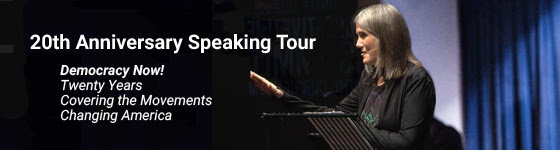
In these times of war and elections, independent media is more important than ever. Democracy Now!'s Amy Goodman is on a 100-city tour with a new book: Democracy Now! Twenty Years Covering the Movements Changing America, written with David Goodman and Denis Moynihan. Proceeds from speaking events will support independent media outlets across the country.
Join Democracy Now! at a speaking event near you—and help us spread the word!
Find an event near you!
4/6 Ithaca, NY
4/8 Columbus, OH
4/9 St. Louis, MO
4/9 Columbia, MO
4/9 Kansas City, MO
4/10 Los Angeles, CA
4/10 Santa Barbara, CA
4/11 San Francisco, CA
4/12 Stanford U, CA
4/12 Santa Clara, CA
4/13 Santa Cruz, CA
4/14 Los Angeles, CA
4/14 Pitzer College, CA
4/15 Los Angeles, CA
4/15 Studio City, CA
4/16 Santa Rosa, CA
4/16 Willits, CA
4/16 Redway, CA
4/17 Davis, CA
4/17 Chico, CA
4/17 Berkeley, CA
4/18 Salt Lake City, UT
4/19 Idaho Springs, CO
4/19 Denver, CO
4/20 Denver, CO
4/21 Boulder, CO
4/22 Colorado Springs, CO
4/23 Carbondale, CO
4/23 Paonia, CO
4/23 Eagle, CO
4/24 Salida, CO
4/24 Taos, NM
4/25 Albuquerque, NM
4/26 Santa Fe, NM
4/27 Flagstaff, AZ
4/28 Tucson, AZ
4/28 Phoenix, AZ
4/29 Fresno, CA
4/30 San Mateo, CA
4/30 Grass Valley, CA
5/1 Houston, TX
5/1 New Orleans, LA
5/2 Sarasota, FL
5/3 Atlanta, GA
5/4 Spokane, WA
5/5 Olympia, WA
5/6 Seattle, WA
5/7 Mount Vernon, WA
5/8 Eugene, OR
5/8 Portland, OR
5/9 Minneapolis, MN
5/10 Cambridge, MA
5/11 Montclair, NJ
5/12 New York, NY
5/13 Washington, DC
5/14 Portland, ME
5/14 Bar Harbor, ME
5/15 Bangor, ME
5/17 Chicago, IL
5/18 Madison, WI
5/19 Toronto, ON
5/20 Toronto, ON
5/21 Troy, NY
5/22 New York, NY
5/23 Philadelphia, PA
5/24 Brooklyn, NY
6/11 Chicago, IL
7/1 Chicago, IL
7/29 Provincetown, MA
7/30 Martha's Vineyard, MA
8/19 Seattle, WA
New events are being added daily.
Check democracynow.org/events for updates and event details.
VOLUNTEER AT AN EVENT →
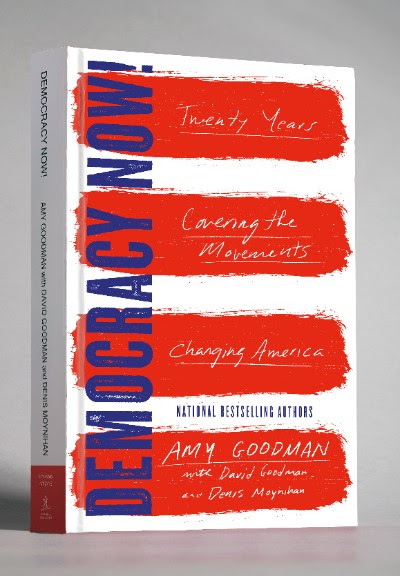
Click here to order your signed copy of the new book today (ships April 12)
CLICK HERE TO SHARE ON FACEBOOK →
CLICK HERE TO SHARE ON TWITTER →
FORWARD THIS EMAIL TO A FRIEND →
DONATE TODAY →

207 West 25th Street, Floor 11
New York, New York 10001, United States
--------------------
--------------------


