In this electoral season, politicians will be forced to listen to those who have been traditionally left out of the electoral process in this country; they will learn about the power of a new and unsettling force that is organizing across this country, and they will hear our demands!
FIND AN EVENT
MORAL MOVEMENT NEWS

The Rev. Drs. William J. Barber II and Liz Theoharis
By impacting both elections and policies, only then, will we truly be able to put a dent in the number of people living in poverty in the richest nation on earth.
Opinion
The war on poverty begins at the ballot box
Voter suppression and gerrymandering have created unfair elections that keep poor people out of the democratic process
Reverend William Barber and Dr Liz Theoharis
Measure, 13.9% or about 45 million are poor.
This data is not much different than in 2016, nor is it a complete picture of the deep economic insecurity plaguing tens of millions of people in the United States.
This data also reports that another 29.4% of the population or another 95 million people are “low-income” and struggling to meet their daily needs. Taken together, this means that 43.3% or about 140 million people are living in precarious conditions, either poor or one emergency away from severe economic hardship.
Earlier this year, IPS and the Poor People’s Campaign: A National Call for Moral Revival released the Souls of Poor Folk: Auditing Americareport and found that, drawing on SPM data from 2016, 140 million were poor or low-income. Recent reports from the Urban Institute, the Federal Reserve and the United Way, have found similar numbers.
With the economy approaching full employment and the stock market rising, why are so many of us being left behind?
With the economy approaching full employment and the stock market rising, why are so many of us being left behind?
The high number of people experiencing poverty this year and over the past years is not because of some moral failure on the part of the poor. It is not because they do not understand how to spend or save money. It is not because they aren’t working – many work two or three jobs just to get by.
The root of inequality in the US can be traced back to our broken democracy. Racialized voter suppression and gerrymandering have created unfair elections that keep poor people, especially poor black, Latinx and Native Americans, out of the democratic process. Since 2010, more than 23 states have passed racist voter suppression laws. In the unfair elections that follow, politicians are elected who care more about tax cuts for the wealthy than living wages, universal healthcare, and critical social services for the poor.
The weight of poverty lies squarely on the shoulders of politicians who lack the will and political courage to truly eradicate poverty despite abundant resources to do so.
If we are to truly wage a war on poverty, we must start by mobilizing and registering poor and disenfranchised voters who have been left out of the process for far too long.
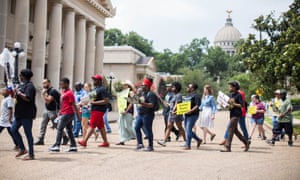
Earlier this year, the Poor People’s Campaign waged the most expansive wave of non-violent civil disobedience in history, calling attention to the systemic racism, poverty, militarism and ecological devastation plaguing the nation. We marched on state houses and Capitol Hill, risking arrest to lift up the voices of people directly affected by these issues.
Now, with the midterms in sight, we’re deepening our organizing efforts with an eye toward registering and mobilizing poor voters and building moral knowledge and political power in our communities from the bottom up. We plan on executing massive voter registration efforts in addition to a series of town halls aimed at highlighting the true face of poverty in the US. We believe by empowering often forgotten communities and driving those voters to the polls, the poor and disenfranchised can be a game changer in this election and the years to come.
The Poor People’s Campaign has built organizing committees in 40 states, including in every state of the former Confederacy, which will form the backbone of this next phase of our campaign. Those committees are composed of poor people, clergy and advocates who will recruit new leaders in each state to engage tens of thousands of poor and low-income people around the issues that affect their lives.
What makes this different from the typical voter registration and mobilization drive is we’re not a single-issue effort gearing up for a particular election. We’re building deep infrastructure in the states to fight for long-term change. By impacting both elections and policies, only then, will we truly be able to put a dent in the number of people living in poverty in the richest nation on earth.
Since you’re here…
… we have a small favour to ask. More people are reading the Guardian’s independent, investigative journalism than ever but advertising revenues across the media are falling fast. And unlike many news organisations, we haven’t put up a paywall – we want to keep our reporting as open as we can. So you can see why we need to ask for your help. We do it because we believe our perspective matters – because it might well be your perspective, too.
The Guardian is editorially independent, meaning we set our own agenda. Our journalism is free from commercial bias and not influenced by billionaire owners, politicians or shareholders. No one edits our Editor. No one steers our opinion. This is important because it enables us to give a voice to the voiceless, challenge the powerful and hold them to account. It’s what makes us different to so many others in the media, at a time when factual, honest reporting is critical.
If everyone who reads our reporting, who likes it, helps to support it, our future would be much more secure. For as little as $1, you can support the Guardian – and it only takes a minute. Thank you.
Support The Guardian
READ MORE
 “A New and Unsettling Force”: The Leadership of the Poor
Willie Baptist and Dan Jones
In a series of new essays, the members of the Kairos Center reflect on economics, history, religion and social change, drawing from their diverse experiences and backgrounds.
“A New and Unsettling Force”: The Leadership of the Poor by Willie Baptist and Dan Jones
That idea is more true today than ever. The current technological revolution is transforming every part of the economy all over the world. Because of our “cruelly unjust” class-based society, this revolution is bringing more poverty and violence instead of shared wealth. The poor are feeling the effects first: they’re becoming totally unnecessary, from the perspective of those who own and control the economy. This puts them in position to lead the “middle class” to political independence and clarity, as they face the trauma and fear of downward mobility.
This data is not much different than in 2016, nor is it a complete picture of the deep economic insecurity plaguing tens of millions of people in the United States.
This data also reports that another 29.4% of the population or another 95 million people are “low-income” and struggling to meet their daily needs. Taken together, this means that 43.3% or about 140 million people are living in precarious conditions, either poor or one emergency away from severe economic hardship.
Earlier this year, IPS and the Poor People’s Campaign: A National Call for Moral Revival released the Souls of Poor Folk: Auditing Americareport and found that, drawing on SPM data from 2016, 140 million were poor or low-income. Recent reports from the Urban Institute, the Federal Reserve and the United Way, have found similar numbers.
With the economy approaching full employment and the stock market rising, why are so many of us being left behind?
With the economy approaching full employment and the stock market rising, why are so many of us being left behind?
The high number of people experiencing poverty this year and over the past years is not because of some moral failure on the part of the poor. It is not because they do not understand how to spend or save money. It is not because they aren’t working – many work two or three jobs just to get by.
The root of inequality in the US can be traced back to our broken democracy. Racialized voter suppression and gerrymandering have created unfair elections that keep poor people, especially poor black, Latinx and Native Americans, out of the democratic process. Since 2010, more than 23 states have passed racist voter suppression laws. In the unfair elections that follow, politicians are elected who care more about tax cuts for the wealthy than living wages, universal healthcare, and critical social services for the poor.
The weight of poverty lies squarely on the shoulders of politicians who lack the will and political courage to truly eradicate poverty despite abundant resources to do so.
If we are to truly wage a war on poverty, we must start by mobilizing and registering poor and disenfranchised voters who have been left out of the process for far too long.
Earlier this year, the Poor People’s Campaign waged the most expansive wave of non-violent civil disobedience in history, calling attention to the systemic racism, poverty, militarism and ecological devastation plaguing the nation. We marched on state houses and Capitol Hill, risking arrest to lift up the voices of people directly affected by these issues.
Now, with the midterms in sight, we’re deepening our organizing efforts with an eye toward registering and mobilizing poor voters and building moral knowledge and political power in our communities from the bottom up. We plan on executing massive voter registration efforts in addition to a series of town halls aimed at highlighting the true face of poverty in the US. We believe by empowering often forgotten communities and driving those voters to the polls, the poor and disenfranchised can be a game changer in this election and the years to come.
The Poor People’s Campaign has built organizing committees in 40 states, including in every state of the former Confederacy, which will form the backbone of this next phase of our campaign. Those committees are composed of poor people, clergy and advocates who will recruit new leaders in each state to engage tens of thousands of poor and low-income people around the issues that affect their lives.
What makes this different from the typical voter registration and mobilization drive is we’re not a single-issue effort gearing up for a particular election. We’re building deep infrastructure in the states to fight for long-term change. By impacting both elections and policies, only then, will we truly be able to put a dent in the number of people living in poverty in the richest nation on earth.
Since you’re here…
… we have a small favour to ask. More people are reading the Guardian’s independent, investigative journalism than ever but advertising revenues across the media are falling fast. And unlike many news organisations, we haven’t put up a paywall – we want to keep our reporting as open as we can. So you can see why we need to ask for your help. We do it because we believe our perspective matters – because it might well be your perspective, too.
The Guardian is editorially independent, meaning we set our own agenda. Our journalism is free from commercial bias and not influenced by billionaire owners, politicians or shareholders. No one edits our Editor. No one steers our opinion. This is important because it enables us to give a voice to the voiceless, challenge the powerful and hold them to account. It’s what makes us different to so many others in the media, at a time when factual, honest reporting is critical.
If everyone who reads our reporting, who likes it, helps to support it, our future would be much more secure. For as little as $1, you can support the Guardian – and it only takes a minute. Thank you.
Support The Guardian
READ MORE
Willie Baptist and Dan Jones
In a series of new essays, the members of the Kairos Center reflect on economics, history, religion and social change, drawing from their diverse experiences and backgrounds.
“A New and Unsettling Force”: The Leadership of the Poor by Willie Baptist and Dan Jones
This is the third chapter of a forthcoming book from the Kairos Center, on the call for and the work of organizing the new Poor People’s Campaign. Each chapter is accompanied by the edited transcript of a discussion about its key themes by leaders in poor people’s struggles from around the country. Click here to view the other chapters.
The dispossessed of this nation — the poor, both white and Negro — live in a cruelly unjust society. They must organize a revolution against that injustice, not against the lives of the persons who are their fellow citizens, but against the structures through which society is refusing to take means which have been called for, and which are at hand, to lift the load of poverty.
The only real revolutionary, people say, is a man who has nothing to lose. There are millions of poor people in this country who have very little, or even nothing, to lose. If they can be helped to take action together, they will do so with a freedom and a power that will be a new and unsettling force in our complacent national life.
Rev. Dr. King wrote these words for a series of lectures he gave in December of 1967. The passage is one of the clearest statements of how he saw America’s political and economic situation at that time; as well as the vision and strategy behind his call for a Poor People’s Campaign. Looking closely at it can help us understand that vision and strategy, especially the idea that the poor — as a united social force — can and must lead the rest of our society.That idea is more true today than ever. The current technological revolution is transforming every part of the economy all over the world. Because of our “cruelly unjust” class-based society, this revolution is bringing more poverty and violence instead of shared wealth. The poor are feeling the effects first: they’re becoming totally unnecessary, from the perspective of those who own and control the economy. This puts them in position to lead the “middle class” to political independence and clarity, as they face the trauma and fear of downward mobility.
“The dispossessed of this nation, the poor, both white and Negro, live in a cruelly unjust society…”
Rev. Dr. King didn’t envision the Poor People’s Campaign as a charitable crusade. It wasn’t a campaign for the poor. It was a campaign of the poor to awaken a broad mass movement to abolish poverty and transform the whole of society.
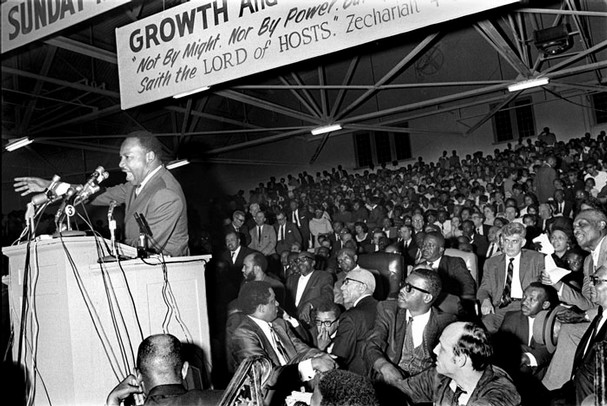
Dr. King speaking in Memphis in April, 1968.
The middle layers of society are the social base of the political power structure. They uphold and protect the cruelly unjust economic system that by its very nature produces poverty. They serve as the “officer corps” of the major institutions of power and influence such as the military, criminal justice and education systems, mass media, and the civic bureaucracy at all levels of government.
The current chronic economic crisis is casting whole sections of these middle layers down into the ranks of the poor and dispossessed. Because of the important role they’ve played for the power structure, this is a threat to the entire global capitalist economic and political system. It’s a time of instability, and this downwardly-mobile middle could be kept on the side of the existing Powers That Be to stabilize the system, or they could move closer to the emerging struggles of the poor and dispossessed to revolutionize the system. The side they take will determine whether or not poverty is abolished and society is transformed.
Politicians in both major parties fight over who’s really representing the interests of the “middle class” and whose policies are going to “rebuild” it. Both parties, along with other religious and ideological leaders, work on behalf of the rich and powerful to keep the critical mass of the middle from going over to the poor and dispossessed.
On the other side, the poor — through their unity and organization — can win large sections of the middle. This is because most of them are as dispossessed as the poor. They too have no ownership or control over the economy or any security over their livelihood and life. Many in families with middle incomes have once in their lifetime experienced poverty and likely will again in the future. Many are just one paycheck or healthcare crisis away from the plight of the poor and homeless. They’re feeling increasingly insecure about their children’s future.
This is the major strategic significance we see in Rev. Dr. King’s idea for the Poor People’s Campaign. He saw that the poor could lead the rest of the nation through a much-needed “revolution of values,” but only if they could unite across color lines and all other lines of division. He took up the task with deep commitment and clarity:
I choose to identify with the underprivileged. I choose to identify with the poor. I choose to give my life for the hungry. I choose to give my life for those who have been left out … This is the way I’m going. If it means suffering a little bit, I’m going that way … If it means dying for them, I’m going that way.
This goes directly against all the anti-poor propaganda that the American people have been subjected to for decades, which maintains that a poor person can only be either a criminal case or a charity case. The poor can be blamed and shamed or they can be pitied. But no one, particularly from middle class, should choose to identify as poor.
In describing the poor, Rev. Dr. King went out of his way to highlight the fact that poverty crosses racial lines. The poor are “both white and Negro.” Poor Latinos, Asians, and American Indians also played leading roles in the Poor People’s Campaign as it came together. There are people today who claim that “white poverty” and “Black poverty” should be thought of as two different conditions. That “poor whites” and “poor people of color” are two fundamentally different groups, who ought to be organized separately. Looking at the reality of America in 1967, Rev. Dr. King opposed that idea.
He was clear about the necessity of the unity of the poor and dispossessed. He taught this message in his last speech:
You know, whenever Pharaoh wanted to prolong the period of slavery in Egypt, he had a favorite, favorite formula for doing it. What was that? He kept the slaves fighting among themselves. But whenever the slaves get together, something happens in Pharaoh’s court, and he cannot hold the slaves in slavery. When the slaves get together, that’s the beginning of getting out of slavery.
He argued that the poor can unite as the poor no matter their different races and ethnicities. Being poor — having to struggle all the time for what you need to survive — was and is a shared experience for people living in a “cruelly unjust society.” The poor of all races have “little or nothing to lose” with the ending of the poverty-producing social system.
The society Rev. Dr. King described wasn’t just cruel economically. His criticism here excluded no part of society. Society was and is also “cruelly unjust” legally, politically, religiously and racially. It’s cruel in its treatment of women, children, queer people and trans people and disabled people. Its wars are cruel, as are its courts, prisons, schools, hospitals, nursing homes, mines, pipelines, and borders.
It’s the poor, in all their diversity, who deal with the worst of that cruelty and injustice, in all its diversity. Uniting the poor, “both white and Negro,” means uniting against all of this cruelty to strike at its roots.
“They must organize a revolution against that injustice, not against the lives of the persons who are their fellow citizens, but against the structures through which the society has refused to take measures which have been called for, and which are at hand, to lift the load of poverty…”
Earlier in 1967, in a speech to the SCLC staff at their annual retreat in Frogmore, South Carolina, Rev. Dr. King said that the time had come to move from a “reform movement” to a “revolutionary movement.” He added: “there must be a radical redistribution of economic and political power.”
Here, he takes that idea a step further by specifying that it’s the poor who must organize that revolution. The idea that the poor can organize or lead anything, let alone a revolution, goes against everything society says about poor people, and everything that poor people are taught about themselves. But it’s the position that Rev. Dr. King took, and an idea he chose to devote his life to.
He makes it clear as well that this revolution can’t focus on getting rid of individuals — not just particular rich people, parties, or politicians — but “structures.” It has to go beyond elections and policies to deeper truths about how decisions are made for our society. It has to get to the question of power, and how to put it in the hands of the poor.
In particular, the revolution that Rev. Dr. King was calling for has to attack the structures that refuse “to take measures … which are at hand, to lift the load of poverty.” In 1967, Rev. Dr. King was arguing that it was possible, given the enormous productivity of the economy, to abolish poverty. It’s even more true today, when the ability of the global economy to produce has grown and continues to grow by leaps and bounds. Poverty is not a problem of scarcity, but of abandonment in the midst of abundance.
This revolution, organized and led by the united poor, is about dealing with that contradiction: on the one hand, the technical possibility of ending poverty; and on the other, the stubborn refusal of the rich and powerful as a ruling class to have that possibility turned into a reality.
“The only real revolutionary, people say, is a man who has nothing to lose. There are millions of poor people in this country who have very little, or even nothing, to lose.”
Rev. Dr. King didn’t make his commitment to the leadership of the poor at random. It wasn’t a purely moralistic decision either. Seeing the cruel injustice of the current structures, seeing the pressing need not just for reform but for a thorough revolution, he had no illusions about the difficulties ahead in carrying it out. The opposition would be fierce and violent. He had already seen this himself in the condemnations and dismissals that came his way after announcing his opposition to the war in Vietnam, when he called the U.S. government the “greatest purveyor of violence” around the world.
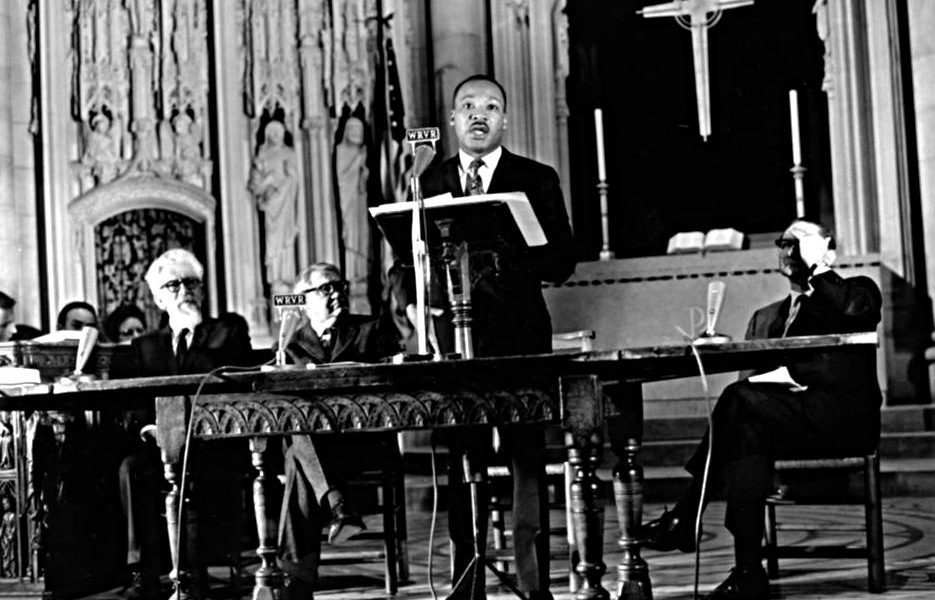 Rev. Dr. Martin Luther King, Jr. giving the Beyond Vietnam speech fifty years ago at Riverside Church in New York City.
History has shown that the Powers That Be will by no means allow for the political unity of those on bottom of the economic ladder. They have used and will continue to use any and every means to discredit, silence, imprison and assassinate anyone who attempts, as Rev. Dr. King did, to help “the poor to take action together.”
Rev. Dr. Martin Luther King, Jr. giving the Beyond Vietnam speech fifty years ago at Riverside Church in New York City.
History has shown that the Powers That Be will by no means allow for the political unity of those on bottom of the economic ladder. They have used and will continue to use any and every means to discredit, silence, imprison and assassinate anyone who attempts, as Rev. Dr. King did, to help “the poor to take action together.”
Only the poor — those who really have “little or nothing to lose” — could lead that kind of life-or-death fight through to its finish. The Poor People’s Campaign strategy, based on the leadership of the poor, was a necessary departure from the civil rights coalition of poor and middle class Black people and some middle class and wealthy white liberals.
Myths like American Exceptionalism, white supremacy and male superiority have many of us, including many poor people, falsely believing that we have something to lose with the abolition of this inhumane poverty-producing system, when in fact getting rid of this system opens the way for everyone to have everything to gain. At the end of the day, however, the economic and social position of the poor and dispossessed is such that the existing structures don’t promise to let any of us — no matter our color, nationality, or gender — keep what little we have, and certainly don’t have anything better in store for us.
Their class position means that the poor they have the least stake, objectively, in the status quo. And their current poverty anticipates the impoverishment that is engulfing and threatening increasing sections of the masses of people, especially those in the so-called middle class who are dispossessed of any ownership and control of the economy. Because of this, the poor can and must lead the middle class and others into a clearer understanding of the causes of and solutions to their problems.
“If they can be helped to take action together, they will do so with a freedom and a power that will be a new and unsettling force in our complacent national life.”
On the other hand, this leadership isn’t automatic or mechanical. Just because the poor are, objectively, positioned as the leading revolutionary force in society, doesn’t mean that they will inevitably step into that role.
For Rev. Dr. King the main requirement for the poor to lead was for them to unite. He pointed out that if the poor could “be helped to take action together” they would do so with “a freedom and a power” capable of unsettling the complacency of the masses of the people including large sections of the middle strata. Through becoming a social and political force united and organized across racial and other lines, the poor can move to the forefront of a broad movement for the emancipation and betterment of all humanity.
Given all the ways that poor and dispossessed in America are shamed and locked up, isolated and divided, united action is as difficult to achieve as it is necessary. Exactly because the “cruelly unjust” nature of our society shows itself in such diverse ways, it takes real ideological effort to expose the connections between injustices: their shared roots in the “structures” of wealth and power that Rev. Dr. King referenced. Achieving this necessary unity and leadership of the poor requires the identification, education and training of many leaders with clarity, competence and commitment like that of the Rev. Dr. Martin Luther King Jr.
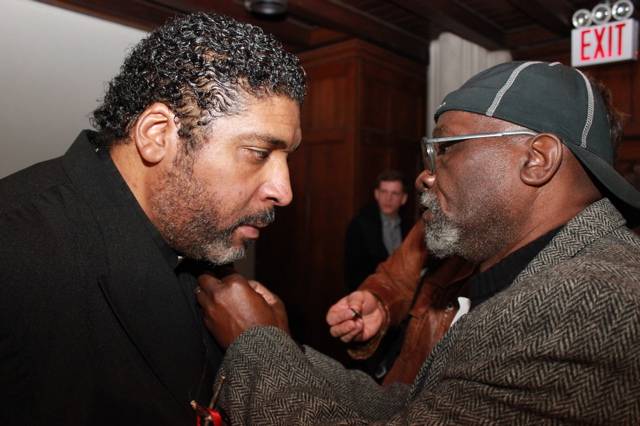 Willie Baptist speaks with Rev. Dr. Barber, co-chair of the Poor People's Campaign: A National Call for Moral Revival.
Discussion Questions:
Willie Baptist speaks with Rev. Dr. Barber, co-chair of the Poor People's Campaign: A National Call for Moral Revival.
Discussion Questions:
 Tell Congress to Stop Violence Against Children and Families
Poor People's Campaign: A National Call for Moral Revival
The violence perpetrated against children in these times is a moral emergency. We implore Congress to convene a hearing about this violence against our children.
SIGN THE PETITION
Follow us on Medium to read more from Rev. Barber & the Moral Movement
READ OUR BLOG
JOIN THE POOR PEOPLE'S CAMPAIGN: A NATIONAL CALL FOR MORAL REVIVAL
We're uniting tens of thousands of people across the country to challenge the evils of systemic racism, poverty, the war economy, ecological devastation and the nation’s distorted morality.
SIGN THE PLEDGE
Trainings & Events


EXPLORE
Support Our Work
Repairers of the Breach is a nonpartisan not-for-profit organization that works with diverse religious leaders from every U.S. State and the District of Columbia to develop a prophetic social justice vision rooted in moral analysis, moral articulation, and moral action. Help us continue this work by making a one-time donation or becoming a monthly sustainer.
***
The middle layers of society are the social base of the political power structure. They uphold and protect the cruelly unjust economic system that by its very nature produces poverty. They serve as the “officer corps” of the major institutions of power and influence such as the military, criminal justice and education systems, mass media, and the civic bureaucracy at all levels of government.
The current chronic economic crisis is casting whole sections of these middle layers down into the ranks of the poor and dispossessed. Because of the important role they’ve played for the power structure, this is a threat to the entire global capitalist economic and political system. It’s a time of instability, and this downwardly-mobile middle could be kept on the side of the existing Powers That Be to stabilize the system, or they could move closer to the emerging struggles of the poor and dispossessed to revolutionize the system. The side they take will determine whether or not poverty is abolished and society is transformed.
Politicians in both major parties fight over who’s really representing the interests of the “middle class” and whose policies are going to “rebuild” it. Both parties, along with other religious and ideological leaders, work on behalf of the rich and powerful to keep the critical mass of the middle from going over to the poor and dispossessed.
On the other side, the poor — through their unity and organization — can win large sections of the middle. This is because most of them are as dispossessed as the poor. They too have no ownership or control over the economy or any security over their livelihood and life. Many in families with middle incomes have once in their lifetime experienced poverty and likely will again in the future. Many are just one paycheck or healthcare crisis away from the plight of the poor and homeless. They’re feeling increasingly insecure about their children’s future.
This is the major strategic significance we see in Rev. Dr. King’s idea for the Poor People’s Campaign. He saw that the poor could lead the rest of the nation through a much-needed “revolution of values,” but only if they could unite across color lines and all other lines of division. He took up the task with deep commitment and clarity:
I choose to identify with the underprivileged. I choose to identify with the poor. I choose to give my life for the hungry. I choose to give my life for those who have been left out … This is the way I’m going. If it means suffering a little bit, I’m going that way … If it means dying for them, I’m going that way.
This goes directly against all the anti-poor propaganda that the American people have been subjected to for decades, which maintains that a poor person can only be either a criminal case or a charity case. The poor can be blamed and shamed or they can be pitied. But no one, particularly from middle class, should choose to identify as poor.
In describing the poor, Rev. Dr. King went out of his way to highlight the fact that poverty crosses racial lines. The poor are “both white and Negro.” Poor Latinos, Asians, and American Indians also played leading roles in the Poor People’s Campaign as it came together. There are people today who claim that “white poverty” and “Black poverty” should be thought of as two different conditions. That “poor whites” and “poor people of color” are two fundamentally different groups, who ought to be organized separately. Looking at the reality of America in 1967, Rev. Dr. King opposed that idea.
He was clear about the necessity of the unity of the poor and dispossessed. He taught this message in his last speech:
You know, whenever Pharaoh wanted to prolong the period of slavery in Egypt, he had a favorite, favorite formula for doing it. What was that? He kept the slaves fighting among themselves. But whenever the slaves get together, something happens in Pharaoh’s court, and he cannot hold the slaves in slavery. When the slaves get together, that’s the beginning of getting out of slavery.
He argued that the poor can unite as the poor no matter their different races and ethnicities. Being poor — having to struggle all the time for what you need to survive — was and is a shared experience for people living in a “cruelly unjust society.” The poor of all races have “little or nothing to lose” with the ending of the poverty-producing social system.
The society Rev. Dr. King described wasn’t just cruel economically. His criticism here excluded no part of society. Society was and is also “cruelly unjust” legally, politically, religiously and racially. It’s cruel in its treatment of women, children, queer people and trans people and disabled people. Its wars are cruel, as are its courts, prisons, schools, hospitals, nursing homes, mines, pipelines, and borders.
It’s the poor, in all their diversity, who deal with the worst of that cruelty and injustice, in all its diversity. Uniting the poor, “both white and Negro,” means uniting against all of this cruelty to strike at its roots.
“They must organize a revolution against that injustice, not against the lives of the persons who are their fellow citizens, but against the structures through which the society has refused to take measures which have been called for, and which are at hand, to lift the load of poverty…”
Earlier in 1967, in a speech to the SCLC staff at their annual retreat in Frogmore, South Carolina, Rev. Dr. King said that the time had come to move from a “reform movement” to a “revolutionary movement.” He added: “there must be a radical redistribution of economic and political power.”
Here, he takes that idea a step further by specifying that it’s the poor who must organize that revolution. The idea that the poor can organize or lead anything, let alone a revolution, goes against everything society says about poor people, and everything that poor people are taught about themselves. But it’s the position that Rev. Dr. King took, and an idea he chose to devote his life to.
He makes it clear as well that this revolution can’t focus on getting rid of individuals — not just particular rich people, parties, or politicians — but “structures.” It has to go beyond elections and policies to deeper truths about how decisions are made for our society. It has to get to the question of power, and how to put it in the hands of the poor.
In particular, the revolution that Rev. Dr. King was calling for has to attack the structures that refuse “to take measures … which are at hand, to lift the load of poverty.” In 1967, Rev. Dr. King was arguing that it was possible, given the enormous productivity of the economy, to abolish poverty. It’s even more true today, when the ability of the global economy to produce has grown and continues to grow by leaps and bounds. Poverty is not a problem of scarcity, but of abandonment in the midst of abundance.
This revolution, organized and led by the united poor, is about dealing with that contradiction: on the one hand, the technical possibility of ending poverty; and on the other, the stubborn refusal of the rich and powerful as a ruling class to have that possibility turned into a reality.
“The only real revolutionary, people say, is a man who has nothing to lose. There are millions of poor people in this country who have very little, or even nothing, to lose.”
Rev. Dr. King didn’t make his commitment to the leadership of the poor at random. It wasn’t a purely moralistic decision either. Seeing the cruel injustice of the current structures, seeing the pressing need not just for reform but for a thorough revolution, he had no illusions about the difficulties ahead in carrying it out. The opposition would be fierce and violent. He had already seen this himself in the condemnations and dismissals that came his way after announcing his opposition to the war in Vietnam, when he called the U.S. government the “greatest purveyor of violence” around the world.
Rev. Dr. Martin Luther King, Jr. giving the Beyond Vietnam speech fifty years ago at Riverside Church in New York City.Only the poor — those who really have “little or nothing to lose” — could lead that kind of life-or-death fight through to its finish. The Poor People’s Campaign strategy, based on the leadership of the poor, was a necessary departure from the civil rights coalition of poor and middle class Black people and some middle class and wealthy white liberals.
Myths like American Exceptionalism, white supremacy and male superiority have many of us, including many poor people, falsely believing that we have something to lose with the abolition of this inhumane poverty-producing system, when in fact getting rid of this system opens the way for everyone to have everything to gain. At the end of the day, however, the economic and social position of the poor and dispossessed is such that the existing structures don’t promise to let any of us — no matter our color, nationality, or gender — keep what little we have, and certainly don’t have anything better in store for us.
Their class position means that the poor they have the least stake, objectively, in the status quo. And their current poverty anticipates the impoverishment that is engulfing and threatening increasing sections of the masses of people, especially those in the so-called middle class who are dispossessed of any ownership and control of the economy. Because of this, the poor can and must lead the middle class and others into a clearer understanding of the causes of and solutions to their problems.
“If they can be helped to take action together, they will do so with a freedom and a power that will be a new and unsettling force in our complacent national life.”
On the other hand, this leadership isn’t automatic or mechanical. Just because the poor are, objectively, positioned as the leading revolutionary force in society, doesn’t mean that they will inevitably step into that role.
For Rev. Dr. King the main requirement for the poor to lead was for them to unite. He pointed out that if the poor could “be helped to take action together” they would do so with “a freedom and a power” capable of unsettling the complacency of the masses of the people including large sections of the middle strata. Through becoming a social and political force united and organized across racial and other lines, the poor can move to the forefront of a broad movement for the emancipation and betterment of all humanity.
Given all the ways that poor and dispossessed in America are shamed and locked up, isolated and divided, united action is as difficult to achieve as it is necessary. Exactly because the “cruelly unjust” nature of our society shows itself in such diverse ways, it takes real ideological effort to expose the connections between injustices: their shared roots in the “structures” of wealth and power that Rev. Dr. King referenced. Achieving this necessary unity and leadership of the poor requires the identification, education and training of many leaders with clarity, competence and commitment like that of the Rev. Dr. Martin Luther King Jr.
Willie Baptist speaks with Rev. Dr. Barber, co-chair of the Poor People's Campaign: A National Call for Moral Revival.- What in your experience has demonstrated the necessity of the leadership of the poor as a social force?
- What forms of organizing have you found most effective in exposing the shared roots of the injustices against which we organize?
- What forms of organizing have you found most effective in building clarity, competence and commitment of leaders?
- What are the barriers and opponents to these forms of organizing?
- What lessons do you take from King’s strategic vision for the Poor People’s Campaign of 1968?
Poor People's Campaign: A National Call for Moral Revival
The violence perpetrated against children in these times is a moral emergency. We implore Congress to convene a hearing about this violence against our children.
SIGN THE PETITION
Follow us on Medium to read more from Rev. Barber & the Moral Movement
READ OUR BLOG
JOIN THE POOR PEOPLE'S CAMPAIGN: A NATIONAL CALL FOR MORAL REVIVAL
We're uniting tens of thousands of people across the country to challenge the evils of systemic racism, poverty, the war economy, ecological devastation and the nation’s distorted morality.
SIGN THE PLEDGE
Trainings & Events
Monday, October 8, 2018
Kansas Poor People’s Hearing with Rev. Drs. William J. Barber II and Liz Theoharis
Wednesday, October 10, 2018
Missouri Poor People’s Hearing with Rev. Drs. William J. Barber II and Liz Theoharis
Monday, October 15, 2018
Arkansas Poor People’s Hearing with Rev. Drs. William J. Barber II and Liz Theoharis
Check out more events, tune in to our livestream and find movement resourcesEXPLORE
Support Our Work
Repairers of the Breach is a nonpartisan not-for-profit organization that works with diverse religious leaders from every U.S. State and the District of Columbia to develop a prophetic social justice vision rooted in moral analysis, moral articulation, and moral action. Help us continue this work by making a one-time donation or becoming a monthly sustainer.
***