
"Lord, to whom shall we go? You have the words of eternal life."[John 6:68]
Saturday of the Fifth week of Easter
Saints of the day:
Saint Pachomius
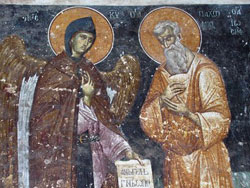
St. Pachomius was born about 292 in the Upeer Thebaid in Egypt and was inducted into the Emperor's army as a twenty-year-old. The great kindness of Christians at Thebes toward the soldiers became embedded in his mind and led to his conversion after his discharge. After being baptized, he became adisciple of an anchorite, Palemon, and took the habit. The two of them led a life of extreme austerity and total dedication to God; they combined manual labor with unceasing prayer both day and night. Later, Pachomius felt called to build a monastery on the banks of the Nile at Tabennisi; so about 318 Palemon helped him build a cell there and even remained with him for a while. In a short time some one hundred monks joined him and Pachomius organized them on principles of community living. So prevalent did the desire to emulate the life of Pachomius and his monks become, that the holy man was obliged to establish ten other monasteries for men and two nunneries for women. Before his death in 346, there were seven thousand monks in his houses, and his Order lasted in the East until the 11th century. St. Pachomius was the first monk to organize hermits into groups and write down a Rule for them. Both St. Basil and St. Benedict drew from his Rule in setting forth their own more famous ones. Hence, though St. Anthony is usually regarded as the founder of Christian monasticism, it was really St. Pachomius who began monasticism as we know it today. Other saints whose feast day is May 9th are St. Gregory Nazianzen and St. Beatus.
Saint Gregory Nazianzen
January 14
(329-390)
After his baptism at 30, Gregory gladly accepted his friend Basil’s invitation to join him in a newly founded monastery. The solitude was broken when Gregory’s father, a bishop, needed help in his diocese and estate. It seems that Gregory was ordained a priest practically by force, and only reluctantly accepted the responsibility. He skillfully avoided a schism that threatened when his own father made compromises with Arianism. At 41, Gregory was chosen suffragan bishop of Caesarea and at once came into conflict with Valens, the emperor, who supported the Arians. An unfortunate by-product of the battle was the cooling of the friendship of two saints. Basil, his archbishop, sent him to a miserable and unhealthy town on the border of unjustly created divisions in his diocese. Basil reproached Gregory for not going to his see.When protection for Arianism ended with the death of Valens, Gregory was called to rebuild the faith in the great see of Constantinople, which had been under Arian teachers for three decades. Retiring and sensitive, he dreaded being drawn into the whirlpool of corruption and violence. He first stayed at a friend’s home, which became the only orthodox church in the city. In such surroundings, he began giving the great sermons on the Trinity for which he is famous. In time, Gregory did rebuild the faith in the city, but at the cost of great suffering, slander, insults and even personal violence. An interloper even tried to take over his bishopric.
His last days were spent in solitude and austerity. He wrote religious poetry, some of it autobiographical, of great depth and beauty. He was acclaimed simply as “the Theologian.”
Comment:
It may be small comfort, but post-Vatican II turmoil in the Church is a mild storm compared to the devastation caused by the Arian heresy, a trauma the Church has never forgotten. Christ did not promise the kind of peace we would love to have—no problems, no opposition, no pain. In one way or another, holiness is always the way of the cross.
Quote:
“God accepts our desires as though they were a great value. He longs ardently for us to desire and love him. He accepts our petitions for benefits as though we were doing him a favor. His joy in giving is greater than ours in receiving. So let us not be apathetic in our asking, nor set too narrow bounds to our requests; nor ask for frivolous things unworthy of God’s greatness.”
Saint Beatus

Feastday: May 9
Death: 112
A monk and hermit, called Beatus of Lungern and earlier designated as the Apostle of Switzerland. Baptized in England by St. Barnabas and ordained by St. Peter, Beatus went to Switzerland. He lived and died on Mount Beatenburg above Lake Thun. The cave became a popular pilgrim's destination, the famed site of Beatus' fight with a dragon.
5th Week of Easter
Acts of the Apostles 16:1 Sha’ul came down to Derbe and went on to Lystra, where there lived a talmid named Timothy. He was the son of a Jewish woman who had come to trust, and a Greek father. 2 All the brothers in Lystra and Iconium spoke well of Timothy. 3 Sha’ul wanted Timothy to accompany him; so he took him and did a b’rit-milah, because of the Jews living in those areas; for they all knew that his father had been a Greek.
4 As they went on through the towns, they delivered to the people the decisions reached by the emissaries and the elders in Yerushalayim for them to observe. 5 Accordingly, the congregations were strengthened in the faith and increased in number day by day.
6 They traveled through the region of Phrygia and Galatia, because they had been prevented by the Ruach HaKodesh from speaking the message in the province of Asia. 7 When they came to the frontier of Mysia, they tried to go into Bithynia; but the Spirit of Yeshua would not let them. 8 So, after passing by Mysia, they came down to Troas.
9 There a vision appeared to Sha’ul at night. A man from Macedonia was standing and begging him, “Come over to Macedonia and help us!” 10 As soon as he had seen the vision, we lost no time getting ready to leave for Macedonia; for we concluded that God had called us to proclaim the Good News to them.
Psalm 100: (0) A psalm of thanksgiving:
(1) Shout for joy to Adonai, all the earth!
2 Serve Adonai with gladness.
Enter his presence with joyful songs.
3 Be aware that Adonai is God;
it is he who made us; and we are his,
his people, the flock in his pasture.
5 For Adonai is good, his grace continues forever,
and his faithfulness lasts through all generations.
Holy Gospel Accoaring to Saint John 15:18 “If the world hates you, understand that it hated me first. 19 If you belonged to the world, the world would have loved its own. But because you do not belong to the world — on the contrary, I have picked you out of the world — therefore the world hates you. 20 Remember what I told you, ‘A slave is not greater than his master.’ If they persecuted me, they will persecute you too; if they kept my word, they will keep yours too. 21 But they will do all this to you on my account, because they don’t know the One who sent me.
Saturday of the Fifth week of Easter
Commentary of the day:
Origen (c.185-253), priest and theologian,
Exhortation to Martyrdom, 41-42
Behold, for us Christians the time has come to boast, for it is written: “We even boast of our afflictions! We know that affliction makes for endurance, and endurance for tested virtue, and tested virtue for hope. And this hope will not leave us disappointed, because the love of God has been poured out in our hearts through the Holy Spirit.” (Rom 5:3-5)…
“As we have shared much in the suffering of Christ, so through Christ do we share abundantly in his consolation.” (2 Cor 1:5) So let us welcome the sufferings of Christ with great fervor. May they be granted us in abundance, if we want to be abundantly consoled, since all “who are sorrowing will be consoled.” (Mt 5:4) … Those who share in the sufferings will also share in the consolation, in proportion with the sufferings which let them have a part with Christ. Learn this from the apostle, who said with confidence: “Our hope for you is firm because we know that just as you share in the sufferings, so you will share in the consolation.” (2 Cor 1:7)
“As we have shared much in the suffering of Christ, so through Christ do we share abundantly in his consolation.” (2 Cor 1:5) So let us welcome the sufferings of Christ with great fervor. May they be granted us in abundance, if we want to be abundantly consoled, since all “who are sorrowing will be consoled.” (Mt 5:4) … Those who share in the sufferings will also share in the consolation, in proportion with the sufferings which let them have a part with Christ. Learn this from the apostle, who said with confidence: “Our hope for you is firm because we know that just as you share in the sufferings, so you will share in the consolation.” (2 Cor 1:7)
___________________________________

No comments:
Post a Comment