Daily Gospel for Thursday, 21 May 2015
"Lord, to whom shall we go? You have the words of eternal life."[John 6:68]
Thursday of the Seventh week of Easter
Saints of the day:
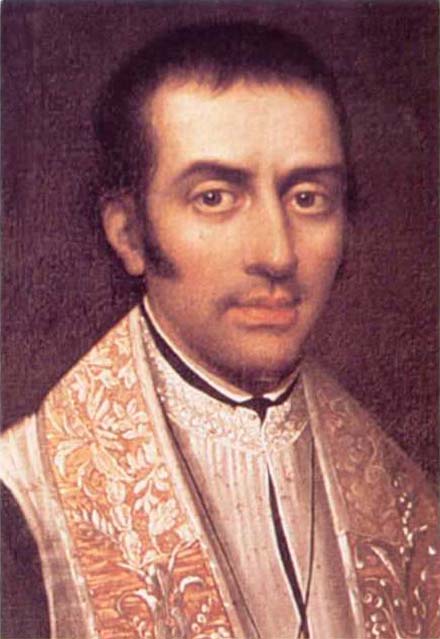
Eugene de Mazenod
Bishop of Marseille, founder of the Congregation
of the Missionaries, Oblates of Mary Immaculate
(1782-1861)
Bishop of Marseille, founder of the Congregation
of the Missionaries, Oblates of Mary Immaculate
(1782-1861)
CHARLES JOSEPH EUGENE DE MAZENOD came into a world that was destined to change very quickly. Born in Aix-en-Provence in the south of France on August 1, 1782, he seemed assured of position and wealth from his family, who were of the minor nobility. However, the turmoil of the French Revolution changed all that forever. When Eugene was just eight years old his family fled France, leaving their possessions behind, and started a long and increasingly difficult eleven year exile.
The Years in Italy
The Mazenod family, political refugees, trailed through a succession of cities in Italy. His father, who had been President of the Court of Accounts, Aids and Finances in Aix, was forced to try his hand at trade to support his family. He proved to be a poor businessman, and as the years went on the family came close to destitution. Eugene studied briefly at the College of Nobles in Turin, but a move to Venice meant the end to formal schooling. A sympathetic priest, Don Bartolo Zinelli, living nearby, undertook to educate the young French emigre. Don Bartolo gave the adolescent Eugene a fundamental education, but with a lasting sense of God and a regimen of piety which was to stay with him always, despite the ups and downs of his life. A further move to Naples, because of financial problems, led to a time of boredom and helplessness. The family moved again, this time to Palermo where, thanks to the kindness of the Duke and Duchess of Cannizzaro, Eugene had his first taste of noble living and found it very much to his liking. He took to himself the title of "Count" de Mazenod, did all the courtly things, and dreamed of a bright future .
Return to France: the Priesthood
In 1802, at the age of 20, Eugene was able to return to his homeland - and all his dreams and illusions were quickly shattered. He was just plain "Citizen" de Mazenod, France was a changed world, his parents had separated, his mother was fighting to get back the family possessions. She was also intent on marrying off Eugene to the richest possible heiress. He sank into depression, seeing little real future for himself. But his natural qualities of concern for others, together with the faith fostered in Venice began to assert themselves. He was deeply affected by the disastrous situation of the French Church, which had been ridiculed, attacked and decimated by the Revolution. A calling to the priesthood began to manifest itself, and Eugene answered that call. Despite opposition from his mother, he entered the seminary of St. Sulpice in Paris, and on December 21, 1811, he was ordained a priest in Amiens.
Apostolic endeavours: Oblates of Mary Immaculate
Returning to Aix-en-Provence, he did not take up a normal parish appointment, but started to exercise his priesthood in the care of the truly spiritually needy-prisoners, youth, servants, country villagers. Often in the face of opposition from the local clergy, Eugene pursued his course. Soon he sought out other equally zealous priests who were prepared to step outside the old, even outmoded, structures. Eugene and his men preached in Provencal, the language of the common people, not in "educated" French. From village to village they went, instructing at the level of the people, spending amazingly long hours in the confessional. In between these parish missions the group joined in an intense community life of prayer , study and fellowship. They called themselves "Missionaries of Provence". However, so that there would be an assured continuity in the work, Eugene took the bold step of going directly to the Pope and asking that his group be recognized officially as a Religious Congregation of pontifical right. His faith and his persistence paid off-and on February 17d, 1826, Pope Leo XII approved the new Congregation, the "Oblates of Mary Immaculate". Eugene was elected Superior General, and continued to inspire and guide his men for 35 years, until his death. Together with their growing apostolic endeavours-preaching, youth work, care of shrines, prison chaplaincy, confessors, direction of seminaries, parishes - Eugene insisted on deep spiritual formation and a close community life. He was a man who loved Christ with passion and was always ready to take on any apostolate if he saw it answering the needs of the Church. The "glory of God, the good of the Church and the sanctification of souls" were impelling forces for him.
Bishop o f Marseilles
The Diocese of Marseilles had been suppressed after the 1802 Concordat, and when it was re-established, Eugene's aged uncle, Canon Fortune de Mazenod, was named Bishop. He appointed Eugene Vicar General immediately, and most of the difficult work of re-building the Diocese fell to him. Within a few years, in 1832, Eugene himself was named auxiliary bishop. His Episcopal ordination took place in Rome, in defiance of the pretensions of the French Government that it had the right to sanction all such appointments. This caused a bitter diplomatic battle, and Eugene was caught in the middle, with accusations, misunderstandings, threats, and recriminations swirling around him. It was an especially devastating time for him, further complicated by the growing pains of his religious family. Though battered, Eugene steered ahead resolutely, and finally the impasse was broken. Five years later, he was appointed to the See of Marseilles as its Bishop, when Bishop Fortune retired.
A heart as big as the world
Whilst he had founded the Oblates of Mary Immaculate primarily to serve the spiritually needy and deprived of the French countryside, Eugene's zeal for the Kingdom of God and his devotion to the Church moved the Oblates to the advancing edge of the apostolate. His men ventured into Switzerland, England, Ireland. Because of his zeal, Eugene had been dubbed "a second Paul," and bishops from the missions came to him asking for Oblates for their expanding mission fields. Eugene responded willingly despite small initial numbers, and sent his men out to Canada, to the United States, to Ceylon (Sri Lanka), to South Africa, to Basutoland (Lesotho). As missionaries in his mould, they fanned out preaching, baptising, caring. They frequently opened up previously uncharted lands, established and manned many new dioceses, and in a multitude of ways they "left nothing undared that the Kingdom of Christ might be advanced." In the years that followed, the Oblate mission thrust continued, so that today the impulse of Eugene de Mazenod is alive in his men in 68 different countries.
Pastor of his Diocese
During all this ferment of missionary activity, Eugene was an outstanding pastor of the Church of Marseilles-ensuring the best seminary training for his priests, establishing new parishes, building the city's cathedral and the spectacular Shrine of Notre Dame de la Garde above the city, encouraging his priests to lives of holiness, introducing many Religious Congregations to work in the diocese, leading his fellow Bishops in support of the rights of the Pope. He grew into a towering figure in the French Church. In 1856, Napoleon III appointed him a Senator, and at his death he was the senior bishop of France.
Legacy of a Saint
May 21, 1861, saw Eugene de Mazenod returning to his God, at the age of 79, after a life crowded with achievements, many of them born in suffering. For his religious family and for his diocese, he was a founding and life-giving source: for God and for the Church, he was a faithful and generous son. As he lay dying he left his Oblates a final testament, "Among yourselves-charity, charity, charity: in the world-zeal for souls." The Church in declaring him a saint on December 3, 1995, crowns these two pivots of his living-love and zeal. His life and his deeds remain for all a window unto God Himself. And that is the greatest gift that Eugene de Mazenod, Oblate of Mary Immaculate, can offer us.
He was canonized by Pope John Paul II on December 3, 1995.
Site officiel du Vatican - Copyright © Libreria Editrice Vaticana
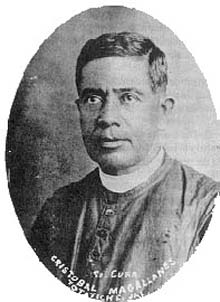
Saint Cristobal Magallanes Jara
(1869 - 1927)Cristóbal Magallanes was born in 1869 in the Archdiocese of Guadalajara. His parents, Rafael Magallanes and Clara Jara, were poorfarmers and devout Catholics. Growing up on a farm, young Cristóbal worked as a shepherd but felt truly called to look after human sheep. At the age of 19 he entered the seminary and wasordained a priest when he was 30.He taught school in Guadalajara for a time until returning to his home village of Totatiche, to minister as a parish priest for nearly two decades. There he also opened a carpentrybusiness to providejobs for local men and helped to plan and construct a dam to aid the people of the area. But Father Magallanes was most interested in bringing the Catholic faith to those who had not heard the Good News of Jesus, in this case the Huichol people in the region.During this time in Mexico’s history, the government feared the power of theCatholic Church , and it tried to eliminate the practice of the faith. A constitution even banned the training of priests, and the seminary where young Cristóbal had studied was closed and turned into a museum. So in 1915 Father Magallanes opened his own small seminary in Totatiche and soon had more than a dozen students.The government did not look kindly on this kind of behavior and accused the priest of trying to incite rebellion, even though he preached against violence of any kind. He was on his way to celebrate Mass when he was arrested. Without a trial, he was convicted. He gave away his few possessions to his jailers, and on May 21, 1927, he and 21 other priests and three lay Catholics were executed. His last words to his executioners were, “I die innocent, and ask God that my blood may serve to unite my Mexican brethren.”
He was canonized by Pope John Paul II on May 21, 2000.
SAINT HOSPITIUS,
Recluse
(+681)
Recluse
(+681)
St. HospitiusS shut himself up in the ruins of an old tower near Villafranca, one league from Nice in Provence. He girded himself with a heavy iron chain and lived on bread and dates only. During Lent he redoubled his austerities, and, in order to conform his life more closely to that of the anchorites of Egypt, ate nothing but roots.
For his great virtues Heaven honored him with the gifts of prophecy and of miracles. He foretold the ravages which the Lombards would make in Gaul. These barbarians , having come to the tower in which Hospitius lived, and seeing the chain with which he was bound, mistook him for some criminal who was there imprisoned. On questioning the Saint, he acknowledged that he was a great sinner and unworthy to live. Whereupon one of the soldiers lifted his sword to strike him; but God did not desert His faithful servant: the soldier's arm stiffened and became numb, and it was not until Hospitius made the sign of the cross over it that the man recovered the use of it. The soldier embraced Christianity, renounced the world, and passed the rest of his days in serving God.
When our Saint felt that his last hour was nearing, he took off his chain and knelt in prayer for a long time. Then, stretching himself on a little bank of earth, he calmly gave up his soul to God, on the 21st of May, 681.
Lives of the Saints, by Alban Butler, Benziger Bros. ed. [1894]

Jesuit missionary and martyr. He was born a member of a noble Polish family in 1590. Entered the Society of Jesus at Vilna in 1622, he preached in the church of St. Casimir there. He took solemn vows in 1630 and was made superior of the Jesuits in Brobuisk. There he preached and distinguished himself by his work of mercy during a plague. In 1636, Andrew was sent to the Lithuanian missions. A house was provided for him in Pinsk, Belarus, by Prince Radziwell, and he worked there despite attacks by Protestants and schismatics. On May 10, 1657, Andrew was kidnapped by two Cossacks who beat him and tied him to the saddles of their horses so they could drag him to a place of torture. He was partially flayed alive and finally decapitated. His remains were buried in Pinsk and then moved to Polosk.
Thursday of the Seventh week of Easter
Acts of the Apostles 22:30 However, the next day, since he wanted to know the specific charge the Judeans were bringing against him, he released him and ordered the head cohanim and the whole Sanhedrin to meet. Then he brought Sha’ul down and put him in front of them.
:6 But knowing that one part of the Sanhedrin consisted of Tz’dukim and the other of P’rushim, Sha’ul shouted, “Brothers, I myself am a Parush and the son of P’rushim; and it is concerning the hope of the resurrection of the dead that I am being tried!” 7 When he said this, an argument arose between the P’rushim and the Tz’dukim, and the crowd was divided. 8 For the Tz’dukim deny the resurrection and the existence of angels and spirits; whereas the P’rushim acknowledge both. 9 So there was a great uproar, with some of the Torah-teachers who were on the side of the P’rushim standing up and joining in — “We don’t find anything wrong with this man; and if a spirit or an angel spoke to him, what of it?” 10 The dispute became so violent that the commander, fearing that Sha’ul would be torn apart by them, ordered the soldiers to go down, take him by force and bring him back into the barracks.
11 The following night, the Lord stood by him and said, “Take courage! For just as you have borne a faithful witness to me in Yerushalayim, so now you must bear witness in Rome.”
Psalm 16: (0) Mikhtam. By David:
(1) Protect me, God,
for you are my refuge.
2 I said to Adonai, “You are my Lord;
I have nothing good outside of you.”
5 Adonai, my assigned portion, my cup:
you safeguard my share.
7 I bless Adonai, my counselor;
at night my inmost being instructs me.
8 I always set Adonai before me;
with him at my right hand, I can never be moved;
9 so my heart is glad, my glory rejoices,
and my body too rests in safety;
10 for you will not abandon me to Sh’ol,
you will not let your faithful one see the Abyss.
11 You make me know the path of life;
in your presence is unbounded joy,
in your right hand eternal delight.
Holy Gospel of Jesus Christ According to Saint John 17:20 “I pray not only for these, but also for those who will trust in me because of their word, 21 that they may all be one. Just as you, Father, are united with me and I with you, I pray that they may be united with us, so that the world may believe that you sent me. 22 The glory which you have given to me, I have given to them; so that they may be one, just as we are one — 23 I united with them and you with me, so that they may be completely one, and the world thus realize that you sent me, and that you have loved them just as you have loved me.
24 “Father, I want those you have given me to be with me where I am; so that they may see my glory, which you have given me because you loved me before the creation of the world. 25 Righteous Father, the world has not known you, but I have known you, and these people have known that you sent me. 26 I made your name known to them, and I will continue to make it known; so that the love with which you have loved me may be in them, and I myself may be united with them.”
Thursday of the Seventh week of Easter
Commentary of the day:
Symeon the New Theologian (c.949-1022), Greek monk, saint of the Orthodox churches
Ethics 1, 6-8
The body of Christ’s Church, harmonious result of the coming together of his saints from the beginning of time, reaches its perfectly balanced and integral constitution in the union of the children of God, the firstborn whose names are written in heaven ( cf Lk 10,20)… Our Savior-God himself shows us the indissoluble and indivisible character of union with himself when he says to the apostles: “I am in the Father and the Father is in me; you in me and I in you” (Jn 10,38; 14,20). And he spells this out even more clearly by adding: “I have given them the glory you gave me, that they may be one as we are one, I in them and you in me, that they may be perfectly one.” And again: “That the love with which you have loved me may be in them and that I also may be in them”…
How marvellous this inexpressible condescension of the love God bears for us, he who is the friend of man ! (Wsd 1,6). That which he is by nature with regard to his Father he grants us to be by adoption and grace in his own regard…The glory given to the Son by the Father, the Son in his turn gives to us through divine grace. Even better: just as he is in the Father and the Father in him so will the Son of God be in us and we in the Son through grace, if we desire it. Having once become like us through the flesh, he has made us sharers of his divinity and incorporates us all in him. In addition, the divinity in which we participate by this communion is not divisible into separate parts but it necessarily follows that we too, once we have become inseparable from it in truth, are inseparable from the one Spirit, making up one body with Christ.
____________________________

No comments:
Post a Comment