democracynow.org
Stories:

"Just Take Me to Jail": Remembering Muhammad Ali's Refusal to Fight in Vietnam
Thousands are expected to gather in Louisville Friday for the funeral of Muhammad Ali, one of the world’s most iconic figures of the 20th century. He was considered by many to be the greatest boxer of all time, but he will also be remembered for his activism against racism and war. In 1966, Ali announced his refusal to fight in Vietnam. After his conscientious objector status request was denied in April 1967, he refused induction. Ali’s title was taken away from him, and he was sentenced to a five-year prison term. He appealed all the way to the Supreme Court, and in 1971 his conviction was finally reversed.
TRANSCRIPT
This is a rush transcript. Copy may not be in its final form.
AMY GOODMAN: Thousands are expected to gather in Louisville on Friday for the funeral of Muhammad Ali, one of the world’s most iconic figures of the 20th century. He was considered by many to be the greatest boxer of all time, but he will also be remembered for his activism against racism and war. He died Friday in Arizona after suffering for decades from Parkinson’s syndrome. Muhammad Ali was born Cassius Clay in Louisville in 1942. He first gained fame in 1960 when he won the gold medal at the Olympic Games in Rome.
NEWSREEL: But the most popular U.S.A. winner was the lighthearted Cassius Marcellus Clay V, in white here, who easily defeated Poland’s Zbigniew Pietrzykowski. Clay was by far the best of the U.S.A. boxers.
AMY GOODMAN: After winning the gold medal, the young Cassius Clay returned to the segregated South. In a 1971 interview on the BBC, he described what happened next.
MUHAMMAD ALI: Won the Olympic gold medal in Rome, Italy, Olympic champion—the Russian standing right here, and the Pole right here. Is Poland considered a communist country?
MICHAEL PARKINSON: Yeah.
MUHAMMAD ALI: Yeah, I’m defeating America’s so-called threats or enemies. And the flag is going don-ton-ton-ton-tonnn, don-ton-ton-ton-ton—I’m standing so proud—don-ton-tonnn, ton-ton-tonnn—because I done whooped the world for America—don-ton-ton-ton-ton-tonnn. I took my gold medal, thought I’d invented something. I said, "Man, I know I’m going to get my people freedom now. I’m the champion of the whole world, the Olympic champion. I know I can eat downtown now."
And I went downtown that day, had my big old medal on and went in a restaurant. See, at that time, like, things weren’t integrated; black folks couldn’t eat downtown. And I went downtown, I sat down, and I said, "You know, a cup of coffee, a hot dog." He said—the lady said, "We don’t serve Negroes." I was so mad, I said, "I don’t eat them, either. Just give me a cup of coffee and a hamburger."
You know, and I said, "I’m the Olympic gold medal winner. Three days ago, I fought for this country in Rome. I won the gold medal. And I’m going to eat." The manager—heard her tell the manager, and she says—he said, "Well, I’m not the—I’m not the man—he’s got to go out." Anyway, I didn’t raise—they put me out. And I had to leave that restaurant, in my home town, where I went to church and served in their Christianity, and fought—my daddy fought in all the wars. Just won the gold medal and couldn’t eat downtown. I said, "Something’s wrong."
AMY GOODMAN: That was Muhammad Ali describing his return to Louisville, Kentucky, after winning the 1960 Olympic gold medal. Four years later, he became the heavyweight champion of the world, defeating Sonny Liston. After the fight, he declared, "I am the greatest." On the next day, the then-Cassius Clay shocked the sports world and announced he was joining the Nation of Islam and changing his name. After briefly being named Cassius X, Nation of Islam leader Elijah Muhammad renamed him Muhammad Ali. For years, many news outlets refused to refer to the boxer by his new name, instead using what Ali called his slave name. Muhammad Ali grew close to Malcolm X, and he became a vocal critic of U.S. actions at home and abroad. The FBI and National Security Agency soon began monitoring his communication. In 1966, Muhammad Ali filed for conscientious objector status and announced his refusal to fight in Vietnam.
MUHAMMAD ALI: My conscience won’t let me go shoot my brother, or some darker people or some poor, hungry people in the mud, for big, powerful America. And shoot them for what? They never called me nigger. They never lynched me. They didn’t put no dogs on me. They didn’t rob me of my nationality, and rape and kill my mother and father. Why would I want to—shoot them for what? I got to go shoot them, those little poor little black people, little babies and children, women; how can I shoot them poor people? Just take me to jail.
AMY GOODMAN: After Muhammad Ali’s conscientious objector status request was denied in April 1967, he refused induction. Muhammad Ali’s title was taken away from him. He was sentenced to a five-year prison term. He appealed all the way to the U.S. Supreme Court, and in 1971 his conviction was finally reversed. He did not go to prison, but was forced to wait four years before regaining his boxing license. In 1974, Muhammad Ali reclaimed the world heavyweight champion title, defeating George Foreman in what was known as the Rumble in the Jungle, an historic boxing match in Kinshasa, Zaire, now the Democratic Republic of the Congo. This is a clip from the documentary When We Were Kings.
MUHAMMAD ALI: Yeah, I’m in Africa. Yeah, Africa is my home. Damn America and what America thinks. Yeah, I live in America, but Africa is the home of the black man, and I was a slave 400 years ago, and I’m going back home to fight among my brothers.
AMY GOODMAN: In addition to fighting overseas, Muhammad Ali grew increasingly involved in world affairs. During a visit to two Palestinian refugee camps in southern Lebanon, Ali said, quote, "In my name and the name of all Muslims in America, I declare support for the Palestinian struggle to liberate their homeland and oust the Zionist invaders," unquote. In 1990, Muhammad Ali traveled to Baghdad and met with Saddam Hussein against the wishes of the U.S. government. During the trip, he secured the release of 15 Americans being held by the Iraqi government.
To talk more about Muhammad Ali, we’ll be joined by two guests: Ishmael Reed and Elizabeth Alexander. Ishmael Reed is the educator, writer and activist. He wrote the book, The Complete Muhammad Ali, which was published last year, recipient of the MacArthur "genius" award, currently a visiting scholar at the California College of the Arts. And we’ll be joined by Elizabeth Alexander, poet and professor, director of Creativity and Free Expression at the Ford Foundation, former chair of African Studies—African American Studies at Yale University. She is the author of the poem "Narrative: Ali," written from the perspective of Muhammad Ali. She is the poet who in 2009 recited the inaugural poem when President Obama first took office. We’ll be back with them in a minute. ... Read More →

"The Greatest": Ishmael Reed on the Untold History of Muhammad Ali
We talk about the life and legacy of boxing champion and activist Muhammad Ali with educator and writer Ishmael Reed, author of the book, "The Complete Muhammad Ali," which was published last year. Reed is a recipient of the MacArthur "genius" award and is currently a visiting scholar at the California College of the Arts.
TRANSCRIPT
This is a rush transcript. Copy may not be in its final form.
AMY GOODMAN: This is Democracy Now!, democracynow.org, The War and Peace Report. I’m Amy Goodman. To talk more about the life and legacy of Muhammad Ali, we are joined by two guests. Ishmael Reed, educator, writer, activist, his new book is The Complete Muhammad Ali. Reed is recipient of the MacArthur "genius" award and is currently a visiting scholar at the California College of the Arts. And in New York, we’re joined by poet and professor Elizabeth Alexander. She’s the director of Creativity and Free Expression at the Ford Foundation, former chair of African American Studies at Yale University, author of the poem "Narrative: Ali," written from the perspective of Muhammad Ali. Elizabeth Alexander recited the inaugural poem when President Obama first took office in 2009.
We welcome you both to Democracy Now! Ishmael Reed, why don’t we begin with you? Can you start off by sharing your reaction to hearing of the death of Muhammad Ali? And talk about why you spent years researching his life.
ISHMAEL REED: Well, I think that his death sort of represents a great tragedy, because this is a man who stayed in the ring too long, was abandoned by his entourage, was broke and suffering from brain damage when he fought his last two fights, according to Angelo Dundee, his trainer. It’s a great tragedy. And without the intervention of his current wife, I think he might be—might have died a long time ago. So, I’m very skeptical about this adulation that’s happening now, because none of those people who are praising him wanted to rescue him or tried to intervene when, for example, he was suffering horrible physical damage from taking punches from people like Larry Holmes. So I think that this is a great tragedy.
I think that not enough attention has been given to the influence of the Nation of Islam on Muhammad Ali. You played some of his speeches. Those speeches were taken right out of Elijah Muhammad’s Message to the Blackman. So I think that this is the great flaw in what I’m hearing from commentators about his death, is that without the Nation of Islam, nobody would have ever heard of Muhammad Ali.
AMY GOODMAN: Ishmael, can you start off by giving us a thumbnail sketch of Muhammad Ali’s life?
ISHMAEL REED: Well, he grew up in a middle-class home. His father, Cash, was a great provider. He was a man who earned a living by painting signs. I went to Louisville and talked to some of the people who knew Muhammad Ali when he was growing up. So he lived a relatively comfortable life. I also interviewed Rahman, his brother, who said the same thing, that they were provided for. And I’m always sort of like offended by the fact that some of the biographers of Muhammad Ali dismiss Cash as some kind of an alcoholic or some ne’er-do-well. This is a man who lived up to his responsibilities.
I interviewed Ed Hughes, the late Ed Hughes, who was Muhammad Ali’s oldest friend, and he talked about how Muhammad Ali had the gift of gab and could spout and express himself and how he’s very generous, would give people whom he didn’t know—for example, in the Philippines, he gave a man $25,000. So he’s very generous with his money and with, you know, giving to charities. So I think he’ll be remembered as somebody with a big heart.
But on the other hand, he had, you know, hangers-on and parasites and people who would con him, took his money, got him involved in criminal enterprises, used his name. So this is a great tragedy. This is a kid who had a big heart and was just exploited, all the way up to the last fight or the second-to-last fight, when he fought Larry Holmes, where he was shortchanged money that was owed to him for that fight. And the attorney who was suing Don King, when he heard that Muhammad Ali was swindled, he burst out into tears. So it’s a sad story.
AMY GOODMAN: In 1964, Malcolm X spoke out in support of Muhammad Ali after the press began to attack him for joining the Nation of Islam.
MALCOLM X: Well, he’s never been involved in any trouble. His record is clean. He’s actually an all-American boy, or an all-African boy, as you will. And an effort on the part of the press to attack him actually hurts America all over the world. I’ve gotten letters from countries myself, foreign countries, expressing confidence and pride in the clean image that Cassius represents. And I think to attack him, especially on religious grounds, would be most destructive to America’s image abroad. My advice always to Brother Cassius is that he never do anything that will in any way tarnish or take away from his image as the heavyweight champion of the world, because I frankly believe that Cassius is in a better position than anyone else to restore the—a sense of racial pride to not only our people in this country, but all over the world. And he is trying his best to live a clean life and project a clean image. But despite this, you find the press is constantly trying to paint him as something other than what he actually is. He doesn’t smoke, he doesn’t drink. In fact, if he was white, they would be referring to him as the all-American boy, like they used to refer to Jack Armstrong.
AMY GOODMAN: So that’s Malcolm X talking about Muhammad Ali, the fact that he had converted. Ishmael Reed, over the weekend, you know, the media was filled with images and discussions of Muhammad Ali, and there were a number of photos that would go by of him standing with Malcolm X, but there was almost no reference. I mean, I didn’t see any reference to that relationship. Talk about his decision to join the Nation of Islam, his relationship with Malcolm X.
ISHMAEL REED: Well, you know, I think it’s a mistake to say that Malcolm X recruited Muhammad Ali for the Nation of Islam. Actually, it was a man named Abdul Rahman, whose name before that was Sam X. Muhammad Ali saw Rahman selling copies of Muhammad Speaks in Florida and approached him and told Rahman that he had been reading Muhammad Speaks. And it was Rahman who invited him into the Nation.
Now, many people talk about that famous expression, "No Vietnamese ever called N-word," as they say nowadays. That was created by Rahman. They were at a house. The Muslim women were cooking for the gathering there, and the reporters were outside. Ali comes in and says—asks Rahman what he should tell them. And Rahman says, "Tell them that no Vietnamese ever called you nigger." And so, that’s one of the mythologies that we hear about Ali’s career.
Now, back up some, he also was following the precedent of Elijah Muhammad, who’s some sort of bogeyman, even though he organized people, brought in $70 million a year, started cattle farms, which were sabotaged by racists, and was engaged in international trade. I mean, there was the other side to it, I mention that, the criminals who were involved in the Nation of Islam. But Elijah Muhammad refused to fight in World War II. He was a conscientious objector in World War II, because he would not fight the Asiatic black man. This is where Ali gets his idea of not fighting the Vietnamese. As a matter of fact, Elijah Muhammad went around the country making pro-Japanese speeches. They tried to get him for sedition. They couldn’t get him for sedition, so they got him as a draft dodger, and he spent five years in prison. So, a lot of people don’t understand that when the Japanese Navy defeated what was considered a white nation, the Soviet Union, in 1905—or Russia, tsarist Russia, excuse me, in 1905, there was rejoicing all over the country. People like W. E. B. Du Bois, George Schuyler and others praised this as a victory of a black nation over a white nation, imperialist nation. So, this is the kind of background that led to Muhammad Ali refusing to fight in the Vietnam War.
AMY GOODMAN: This is a clip from the documentary The Trials of Muhammad Ali, featuring Abdul Rahman Muhammad, who helped introduce Ali to the Nation of Islam.
ABDUL RAHMAN MUHAMMAD: Cassius Clay was training for the Sonny Liston fight, for the heavyweight championship. I wanted him to be a registered Muslim. When you come into Islam, we write a letter saying we believe in the teachings, and we put our slave name in the letter. Those are the names the slave masters had when they owned our ancestors. So he wrote his letter, sent it off to Chicago. And then they sent back what we call "X." He became "Cassius X."
And then the promoters, they was trying to get Ali to denounce the religion. And they told Ali, "You’ve got to get rid of them Muslim cooks and Captain Sam"—that’s me—"and denounce that religion; otherwise, there ain’t gonna be no fight." Well, Ali had been training all his life for the fight for the heavyweight championship, so that’s something to scare a man to death. And I was all, "Man, don’t believe that." I said, "Money is the white man’s god." And I said, "You’re the only one can make any money for him." I said, "Hold to your belief."
AMY GOODMAN: After Cassius Clay changed his name to Muhammad Ali, many news outlets refused to use his name. The debate over his name even extended into the ring. During a ’66 interview with Howard Cosell, Muhammad Ali accused challenger Ernie Terrell of being an Uncle Tom for refusing to call him Muhammad Ali.
HOWARD COSELL: You continue to be unafraid of this man.
ERNIE TERRELL: Yeah. I’d like to say something right here. You know, Cassius Clay is—
MUHAMMAD ALI: Why do you want to say 'Cassius Clay,' when Howard Cosell and everybody is calling me Muhammad Ali? Now, why you gotta be the one, of all people, who’s colored, to keep saying 'Cassius Clay'?
ERNIE TERRELL: Howard Cosell is not the one who’s going to fight you. I am.
MUHAMMAD ALI: You’re making it really hard on yourself now.
ERNIE TERRELL: Well—
MUHAMMAD ALI: Why don’t you keep the thing in the sport angle? Why don’t you call me my name, man?
ERNIE TERRELL: Well, what’s your name? You told me your name was Cassius Clay a few years ago.
MUHAMMAD ALI: I’ve never told you my name was Cassius Clay. My name is Muhammad Ali. ... You’re just acting just like an old Uncle Tom, another Floyd Patterson. I’m going to punish you.
ERNIE TERRELL: Wait a minute. Wait a minute. Let me tell you something, man. You ain’t got no business calling me no—
MUHAMMAD ALI: Back off of me! Back off of me!
ERNIE TERRELL: Don’t call me no Uncle Tom, man.
MUHAMMAD ALI: That’s what you are, a Uncle Tom.
ERNIE TERRELL: Why are you going to call me an Uncle Tom? I ain’t do nothing to you for you to call me no Uncle Tom.
MUHAMMAD ALI: You heard me. Just back off of me!
HOWARD COSELL: And so, ladies and gentlemen—
MUHAMMAD ALI: Uncle Tom.
HOWARD COSELL: —as the two contestants prepare for battle right now—
MUHAMMAD ALI: Wait what? Back off of me, man! Back off of me, man!
HOWARD COSELL: Another interview has been recorded for posterity, as the two gentlemen continue to promote the fight.
AMY GOODMAN: So that was Howard Cosell with Muhammad Ali and Ernie Terrell. And, Ishmael Reed, in the midst of that fight, which Muhammad Ali won, as he was punching Ernie Terrell, he was saying, "What’s my name? What’s my name?" Is that right?
ISHMAEL REED: Well, I think that’s the showmanship that we expected of Muhammad Ali. Floyd Patterson recalls an incident where he ran into Muhammad Ali and called him Cassius Clay, and he wasn’t offended. He said, "It’s perfectly all right if you call me Cassius Clay." But I think some of those antics that we hear from Muhammad Ali was to sort of like juice the gate up. He got these antics from Gorgeous George. Many people don’t remember Gorgeous George, who was this flamboyant wrestler. And according to Rahman Ali, Muhammad Ali had seen Gorgeous George in Louisville. Gorgeous George used to get up in these flamboyant costumes, and he was like the villain. He was a heavy, and he boasted a lot. I think Donald Trump is influenced by both Ali and Gorgeous George. He played the heavy to sweeten the gate, and he sort of like played at androgyny, but nobody’s going to pick a fight with a Gorgeous George or question his manhood. Clark Blaise, who is a great French-Canadian writer, I interviewed him, and he said when he heard that the heavyweight champion of the world was calling himself "pretty," he knew there had been a change in the culture of boxing.
AMY GOODMAN: And his—
ISHMAEL REED: Now, now, now, one more thing—Amy, I want to mention this. Ernie Terrell was considered the Mob fighter. There was a—my book was published in Canada. And so, some of my passages have a Canadian emphasis. There was a showdown between organized crime, which ran boxing, up to the Nation of Islam, introduced the organization called Main Bouts. The showdown happened in Toronto. Ali and Herbert Muhammad were warned that if Ali didn’t take a dive and didn’t, you know, fall to Ernie Terrell, he would wind up at the bottom of Lake Michigan. Now, according to George Chuvalo, whom Ali fought, the man who made the threat was paid a visit by the Nation of Islam. And if you want to know what happened after that, you can read my book. ... Read More →

"Narrative: Ali": Elizabeth Alexander Recites Her Poem Written from Muhammad Ali's Perspective
Muhammad Ali, one of the most iconic figures of the 20th century, has died at the age of 74. Poet and professor Elizabeth Alexander reads her persona poem "Narrative: Ali," written from Ali’s perspective.
TRANSCRIPT
This is a rush transcript. Copy may not be in its final form.
AMY GOODMAN: To talk more about the life and legacy of Muhammad Ali, we are turning to poet and professor Elizabeth Alexander, director of Creativity and Free Expression at the Ford Foundation, former chair of African American Studies at Yale University. She’s the author of the persona poem "Narrative: Ali," written from the perspective of Muhammad Ali.
Welcome to Democracy Now!, Elizabeth Alexander. How did you get interested in Muhammad Ali?
ELIZABETH ALEXANDER: In the late 1980s, they started to show some of his great fights on, I think, probably, the Wide World of Sports, something like that. And I had never seen them. I had never watched this man in his physical magnificence and originality. I knew who he was, of course. I knew what he stood for. But to be able to sort of put together the whole package of physical expression and might along with his belief in the word and the medium of the word, along with all the things that he stood for and the way that he was able to be an iconic black man, and to project himself as a free black man in the world in so many different contexts, that captivated me. And then the mysterious thing of poetic process happened, which is I started to imagine and hear his voice and wanted to write in his voice. And so, out of that came a long poem, an epic poem, called "Narrative: Ali."
AMY GOODMAN: Now, I want to warn people, in this poem, you use the N-word. Can you talk about your choice to do this?
ELIZABETH ALEXANDER: One of the things—excuse me—about writing in persona is that you want to have a kind of fidelity to your subject. You don’t want to veer outside of how you have researched or imagined that they might speak or their historical context. And so, that’s not a word that I throw around, but that is a word that’s used in two different contexts, both how he understood himself as a black person in America at a particular point in time and also how he talked about himself in a colloquial setting with another black man. So, it is how I researched and imagined he would have used that word, and to shy away from it felt disingenuous to the subject.
AMY GOODMAN: Why don’t you share your poem?
ELIZABETH ALEXANDER: Yes. And, you know, epic poems have heroes. I really appreciate so much all of the context that Ishmael Reed has given us, and it’s wonderful to be on the show with him. And I’m thinking about what sparks the imagination, I’m thinking about iconicity, I’m thinking about epic heroes in this poem.
"Narrative: Ali" by ELIZABETH ALEXANDER
a poem in twelve rounds
1. My head so big
they had to pry
me out. I’m sorry
Bird (is what I call
my mother). Cassius
Marcellus Clay,
Muhammad Ali;
you can say
my name in any
language, any
continent: Ali.
2. Two photographs
of Emmett Till,
born my year,
on my birthday.
One, he’s smiling,
happy, and the other one
is after. His mother
did the bold thing,
kept the casket open,
made the thousands look upon
his bulging eyes,
his twisted neck,
her lynched black boy.
I couldn’t sleep
for thinking,
Emmett Till.
One day I went
Down to the train tracks,
found some iron
shoe-shine rests
and planted them
between the ties
and waited
for a train to come,
and watched the train
derail, and ran,
and after that
I slept at night.
3. I need to train
around people,
hear them talk,
talk back. I need
to hear the traffic,
see people in
the barbershop,
people getting
shoe shines, talking,
hear them talk,
talk back.
4. Bottom line: Olympic gold
can’t buy a black man
a Louisville hamburger
in nineteen-sixty.
Wasn’t even real gold.
I watched the river
drag the ribbon down,
red, white, and blue.
5. Laying on the bed,
praying for a wife,
in walk Sonji Roi.
Pretty little shape.
Do you like
chop suey?
Can I wash your hair
underneath
that wig?
Lay on the bed,
Girl. Lie
with me.
Shake to the east,
to the north,
south, west—
but remember,
remember, I need
a Muslim wife. So
Quit using lipstick.
Quit your boogaloo.
Cover up your knees
like a Muslim
wife, religion,
religion, a Muslim
wife. Eleven
months with Sonji,
first woman I loved.
6. There’s not
too many days
that pass that I
don’t think
of how it started,
but I know
no Great White Hope
can beat
a true black champ.
Jerry Quarry
could have been
a movie star,
a millionaire,
a senator,
a president—
he only had
to do one thing,
is whip me,
but he can’t.
7. Dressing-Room Visitor
He opened
up his shirt:
"KKK" cut
in his chest.
He dropped
his trousers:
latticed scars
where testicles
should be, His face
bewildered, frozen
in the Alabama woods
that night in 1966
when they left him
for dead, his testicles
in a Dixie cup.
You a warning,
they told him,
to smart-mouth,
sassy-acting niggers,
meaning niggers
still alive,
meaning any nigger,
meaning niggers
like me.
8. Training
Unsweetened grapefruit juice
will melt my stomach down.
Don’t drive if you can walk,
don’t walk if you can run.
I add a mile each day
and run in eight-pound boots.
My knuckles sometimes burst
the glove. I let dead skin
build up, and then I peel it,
let it scar, so I don’t bleed
as much. My bones
absorb the shock.
I train in three-minute
spurts, like rounds: three
rounds big bag, three speed
bag, three jump rope, one-
minute breaks,
no more, no less.
Am I too old? Eat only
kosher meat. Eat cabbage,
carrots, beets, and watch
the weight come down:
two-thirty, two-twenty,
two-ten, two-oh-nine.
9. Will I go
like Kid Paret,
a fractured
skull, a ten-day
sleep, dreaming
alligators, pork
chops, saxophones,
slow grinds, funk,
fishbowls, lightbulbs,
bats, typewriters,
tuning forks, funk
clocks, red rubber
ball, what you see
in that lifetime
knockout minute
on the cusp?
You could be
let go,
you could be
snatched back.
10. Rumble in the Jungle
Ali boma ye,
Ali boma ye,
means kill him, Ali,
which is different
from a whupping
which is what I give,
but I lead them chanting
anyway, Ali
boma ye, because
here in Africa
black people fly
planes and run countries.
I’m still making up
for the foolishness
I said when I was
Clay from Louisville,
where I learned Africans
live naked in straw
huts eating tiger meat,
grunting and grinning,
swinging from vines,
pounding their chests—
I pound my chest but of my own accord.
11. I said to Joe Frazier,
first thing, get a good house
in case you get crippled
so you and your family
can sleep somewhere. Always
keep one good Cadillac.
And watch how you dress
with that cowboy hat,
pink suits, white shoes—
that’s how pimps dress,
or kids, and you a champ,
or wish you were, ’cause
I can whip you in the ring
or whip you in the street.
Now back to clothes,
wear dark clothes, suits,
black suits, like you the best
at what you do, like you
President of the World.
Dress like that.
Put them yellow pants away.
We dinosaurs gotta
look good, gotta sound
good, gotta be good,
the greatest, that’s what
I told Joe Frazier,
and he said to me,
we both bad niggers.
We don’t do no crawlin’.
12. They called me "the fistic pariah."
They said I didn’t love my country,
called me a race-hater, called me out
of my name, waited for me
to come out on a stretcher, shot at me,
hexed me, cursed me, wished me
all manner of ill will,
told me I was finished.
Here I am,
like the song says,
come and take me,
"The People’s Champ,"
myself,
Muhammad.
AMY GOODMAN: That’s Elizabeth Alexander reading her poem "Narrative: Ali." In fact, Muhammad Ali was not just the greatest boxer. He was not just an activist, a war resister. He was a poet, too.
ELIZABETH ALEXANDER: He was a poet, and he claimed himself as a poet. On the one hand, he spoke in ways that are very familiar in the African-American rhetorical tradition, with flourish, with a sense of rhythm, with a sense of rhyme, with a sense of occasion. But he brought that out for people to see in public. And when asked for a poem one time, he replied simply, "Me, we." He understood poetic economy. He understood that in a very short, concentrated place, you could do big things. He understood that poetry was memorable. He understood that poetry belonged to everyone. He recorded an album in 1963, I think, of spoken word poetry. He consorted with poets. There’s an absolutely fantastic exchange visit that he had with Marianne Moore, when they decided to write a poem together, a sonnet, on the annihilation of Ernie Terrell. And George Plimpton brought them together and wrote about it, and it’s a wonderful account. So, I think that that was a consistent identity.
AMY GOODMAN: He’s the original rapper, hip-hop.
ELIZABETH ALEXANDER: Well, he was. And I think that what we see in that is the way that hip-hop and rap has very, very long and deep roots in black expressive culture.
AMY GOODMAN: I wanted to go back to Muhammad Ali in his own words, in 1968, interviewed on Channel 13, PBS, here in New York, by Bud Collins.
BUD COLLINS: What about jail? Now, you’re appealing. Is that correct?
MUHAMMAD ALI: Oh, yes, jail, that could come up. And if I should lose appeal, then I’ll have to go to jail. And I’ll be out of there in a few years.
BUD COLLINS: Have you thought about jail, what it might mean? Have you talked about people who have been in jail five years?
MUHAMMAD ALI: Well, well, we all talk about, the Honorable Elijah Muhammad, that black people actually have been in jail for 400 years we’ve been here in America. But I don’t worry about jail, if I believe in Allah, I believe in Elijah Muhammad as the messenger of God, and many a great men have to go to jail. And so, I don’t pay no attention to it. If the time comes, I’ll just have to go. Boys in Vietnam are dying for what they believe, and I can’t get on them for dying for what they believe. So I’ll just have to—and they’re dying to free foreign people 10,000 miles away, so I’ll just have to suffer so that the so-called Negroes could be free, so they could have an idol and an image they can look up to that didn’t sell them out, that didn’t betray them.
BUD COLLINS: Do you think you can do more for your people by going to jail?
MUHAMMAD ALI: Oh, yes, sir.
AMY GOODMAN: That was Muhammad Ali in ’68 being interviewed by Bud Collins, the journalist and tennis commentator. Bud also just died in March at the age of 86. Your dad, Elizabeth Alexander, was secretary of the Army, is that right?
ELIZABETH ALEXANDER: Yes.
AMY GOODMAN: And here is Muhammad Ali saying no to the war in Vietnam.
ELIZABETH ALEXANDER: Well, my dad says no to wars, too. So, I mean, we could have that whole conversation. But I think that, actually, since you bring him up, part of why Ali resonated for me is that he was a free black man in a way that my father is a free black man, and that taught me what I wanted to see in this world, what we need to see in this world. Muhammad Ali was imperfect, complicated. You know, what did it mean as a feminist writer to think about, you know, this is a man with a complicated history with women. This is a man working in a quintessentially male, physically expressive form. I’m very well aware of what class and race says about vulnerable bodies, what does it mean to make your body more vulnerable because that seems to be the way you can move in the world. All of those ironies are powerful ones.
But at the end of the day, there’s still someone who, as a very, very young man, as a very, very young man, met a juncture and said no and paid the price and stood for years for that and sacrificed that very thing that was his currency. And that’s what shines on: the power of self. Not very many of us are able to project that true, again, free self onto a world stage. So what we see in the work of other artists—I mean, you’ve been playing this amazing music—Yasiin Bey, so many people, other poets, you know, Khaled Mattawa, Marianne Moore, you know, people who have been inspired by what he gave, and made something more out of it.
AMY GOODMAN: Ishmael Reed, your final reflection on the man you have spent years researching, written a book about, The Complete Muhammad Ali?
ISHMAEL REED: Well, I think we shouldn’t—we can praise Muhammad Ali, but we shouldn’t forget about Sugar Ray Robinson, Joe Louis, Henry Armstrong and Sonny Liston, who fought—fought armed white men. I mean, Sonny Liston beat up two cops and was hounded by the police from city to city, wherever he went. And Sonny Liston was born near slavery and had great challenges and busted a whole bunch of people on the way up and the way down. Sugar Ray Robinson and Joe Louis fought armed MPs in a segregated bus station, fisticuffs, and the fight only stopped when somebody said, "That’s Joe Louis." So, we can honor Muhammad Ali, but we shouldn’t dismiss some of the other great fighters as Uncle Toms.
AMY GOODMAN: And your thought, as we go out today, Elizabeth?
ELIZABETH ALEXANDER: My final thought is that complicated people who make difficult choices sometimes, in a very curious and mysterious way, rise to the level of iconicity. And so, I think that when we—when we have that, the piece to remember, along with the complexities and the contradiction, is what might their example lead other people to do and stand up for.
AMY GOODMAN: Ending with the quote of Muhammad Ali, "I am America. I am the part you won’t recognize. But get used to me. Black, confident, cocky; my name, not yours; my religion, not yours; my goals, my own; get used to me." Muhammad Ali died this weekend at the age of 74. His funeral is in Louisville, Kentucky, on Friday. Thousands are expected to attend. Ishmael Reed, thanks so much for being with us, educator, writer and activist. His book, The Complete Muhammad Ali. And Elizabeth Alexander, poet and chancellor of the Academy of American Poets, author of the persona poem "Narrative: Ali," written from the perspective of Muhammad Ali. ... Read More →

John Legend Reads Muhammad Ali's 1966 Antiwar Speech: "The Real Enemy of My People is Right Here"
Music legend John Legend reads Muhammad Ali’s speech against the Vietnam War in 1966. "Why should they ask me to put on a uniform and go 10,000 miles from home and drop bombs and bullets on brown people in Vietnam, while so-called Negro people in Louisville are treated like dogs and denied simple human rights?" Ali said. John Legend’s reading appears in the film "The People Speak," which is based on Howard Zinn and Anthony Arnove’s "Voices of a People’s History of the United States."
TRANSCRIPT
This is a rush transcript. Copy may not be in its final form.
AMY GOODMAN: Well, I want to turn to the famed singer-songwriter John Legend reading the words of Muhammad Ali’s 1966 speech on Vietnam.
JOHN LEGEND: [reading Muhammad Ali] "Why should they ask me to put on a uniform and go 10,000 miles from home and drop bombs and bullets on brown people in Vietnam, while so-called Negro people in Louisville are treated like dogs and denied simple human rights? No, I am not going 10,000 miles from home to help murder and burn another poor nation simply to continue the domination of white slave masters of the darker people the world over. This is the day when such evils must come to an end. I have been warned that to take such a stand would put my prestige in jeopardy and could cause me to lose millions of dollars which should accrue to me as the champion.
But I have said it once, and I will say it again: The real enemy of my people is right here. I will not disgrace my religion, my people or myself by becoming a tool to enslave those who are fighting for their own justice, freedom and equality. If I thought the war was going to bring freedom and equality to 22 million of my people, they wouldn’t have to draft me, I’d join tomorrow. But I either have to obey the laws of the land or the laws of Allah. I have nothing to lose by standing up for my beliefs. So I’ll go to jail. We’ve been in jail for 400 years."
AMY GOODMAN: That was John Legend, yes, the singer-songwriter, in a clip from The People Speak, which was inspired by the late great historian Howard Zinn’s groundbreaking books, A People’s History of the United States and Voices of a People’s History of the United States. That speech was Muhammad Ali’s speech. Ishmael Reed, talk about what happened to him, being—announcing that he would not go to war, being sentenced to five years in prison, being stripped of his heavyweight title, the case going right to the U.S. Supreme Court, before it was overturned, before it was reversed.
ISHMAEL REED: Well, Ron Lyle, who fought Muhammad Ali, said that the three years that were taken out of his career missed a—did not provide an opportunity for us to see him at his prime. And after that three-year absence from the ring, he lost his speed, slowed down. Before, you couldn’t hit the guy. I mean, he said he was pretty because people couldn’t touch him. But after he lost his speed, people could hit him, and you could touch him, and that continued to the end of his career. Now, I interviewed the great trainer, Emanuel Steward, who said that—who incidentally said that he thought that Joe Louis was the greatest heavyweight champion of all time. But he said that Ali should have quit after he fought George Foreman. And even in that fight, he took a lot of punishment to the body. So, I think the three years deprived him of, you know, our seeing him at his prime.
AMY GOODMAN: George Foreman was the Rumble in the Jungle?
ISHMAEL REED: Mm-hmm.
AMY GOODMAN: In what was then Zaire, now the Democratic Republic of Congo. Mobutu Sese Seko set up this whole battle, one that the dictator didn’t even go actually to see, perhaps afraid he would be assassinated if he came out in public?
ISHMAEL REED: Well, he thought—they thought that the people would elect Muhammad Ali leader, you know, the president of the Congo. That’s why Mobutu was afraid. But, you know, Muhammad Ali did sort of play footsies with dictators like Mobutu, Marcos. I interviewed the great journalist Emil Guillermo, who used to work for NPR. I met him, a Harvard graduate. He said that the fight in Manila brought the Philippines into the 20th century. They were no longer dismissed as "our little brown cousins," but became a first-class nation because of that fight and the publicity that came as a result of that fight. Now, the Aquino family was in San Francisco and other places. They objected to that fight, because they thought it would bring prestige to Marcos. But at the same time where he’s palling around with Marcos, he went out and met with the rebels during Ramadan. So, that shows you how complex Ali was.
AMY GOODMAN: We’re going to break, and when we come back, we’ll also be joined by Elizabeth Alexander. Ishmael Reed is an educator, writer, activist. His latest book, The Complete Muhammad Ali. Reed the recipient of the MacArthur "genius" award, currently visiting scholar at the California College of Arts. We’re going to hear Elizabeth Alexander recite her poem, "Narrative: Ali." Stay with us. ... Read More →
Headlines:Muhammad Ali Dies at 74; Champion Boxer Remembered for Activism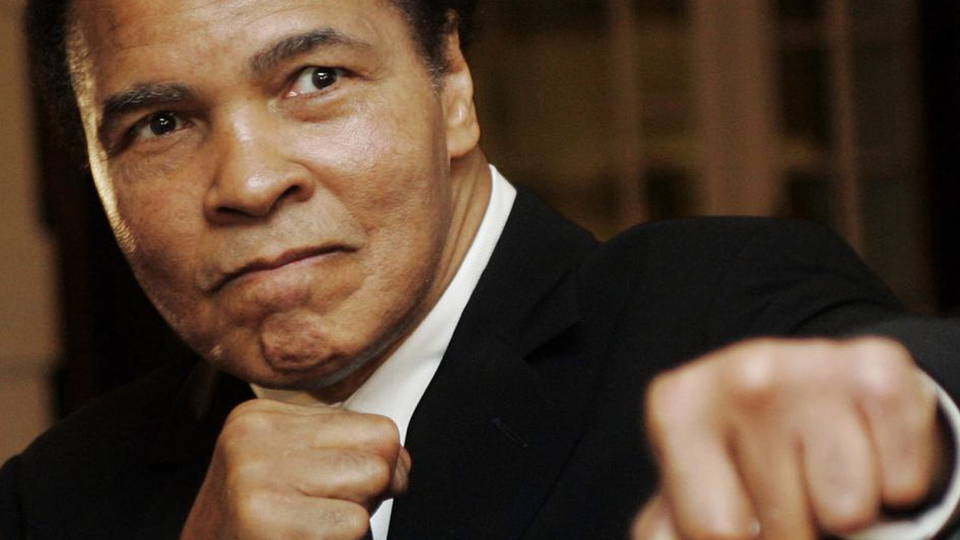
Thousands are expected to gather in Louisville Friday for the funeral of Muhammad Ali, one of the world’s most iconic figures of the 20th century. Ali was considered the greatest boxer of all time, but he will also be remembered for his activism, including his role in the Black Power movement and his opposition to the Vietnam War. After he refused military induction in 1967, his title was taken away from him, and he was sentenced to a five-year prison term. He appealed all the way to the Supreme Court, and in 1971 his conviction was finally reversed. He did not go to prison but was forced to wait four years before regaining his boxing license. Muhammad Ali died Friday in Arizona after suffering for decades from Parkinson’s syndrome. We’ll spend the rest of the hour remembering him after headlines.
Clinton Wins Puerto Rico Primary; Protesters Denounce Support for Debt Bill
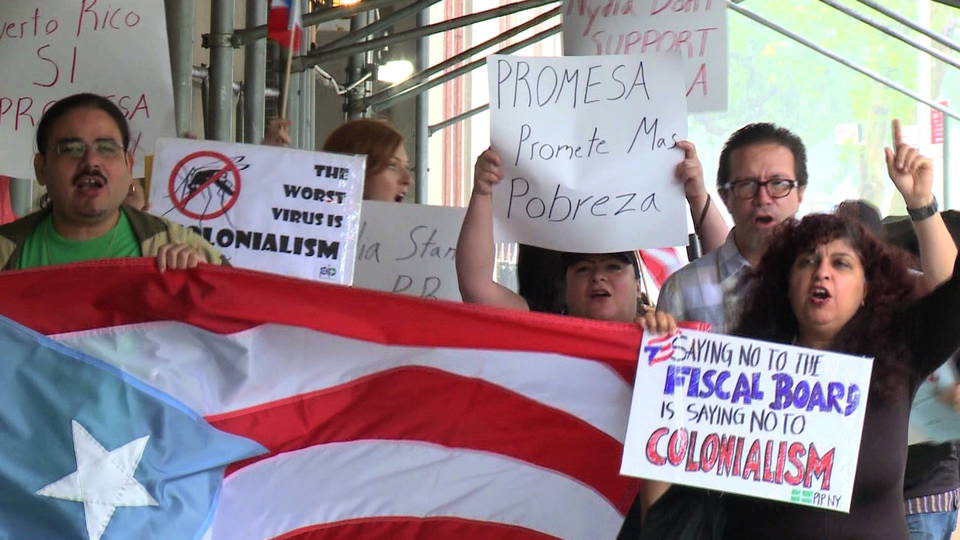
Hillary Clinton has won the Democratic primary in Puerto Rico, as California and five other states prepare to vote in key primaries on Tuesday. As Puerto Rican residents voted Sunday, here in New York protesters rallied outside Clinton’s Brooklyn headquarters to protest her support for a bill to address Puerto Rico’s economic crisis. The bill establishes an oversight board critics say will have near-total control over Puerto Rico’s finances. Clinton’s rival, Bernie Sanders, has opposed the measure known as PROMESA, or Puerto Rico Oversight Management and Economic Stability Act. David Galarza of United Against PROMESA denounced Clinton’s support of the legislation.
David Galarza: "We’re here specifically in front of 1 Pierrepont Plaza, which is the national headquarters for Hillary Clinton, who is a presidential candidate, who’s running today in the primary in Puerto Rico, where the people do have a primary vote but cannot vote in general elections, to tell her loud and clear that the diaspora, boricuas living here, and our allies that believe in freedom and justice and truth are opposed to PROMESA for all it represents. Bernie Sanders has been very clear in his opposition on PROMESA, and we applaud him for that. But Hillary is not—is not that clear, or she’s saying that she supports this PROMESA bill with all its warts and with all its problems."
Clinton, Sanders to Face Off in California and 5 Other States
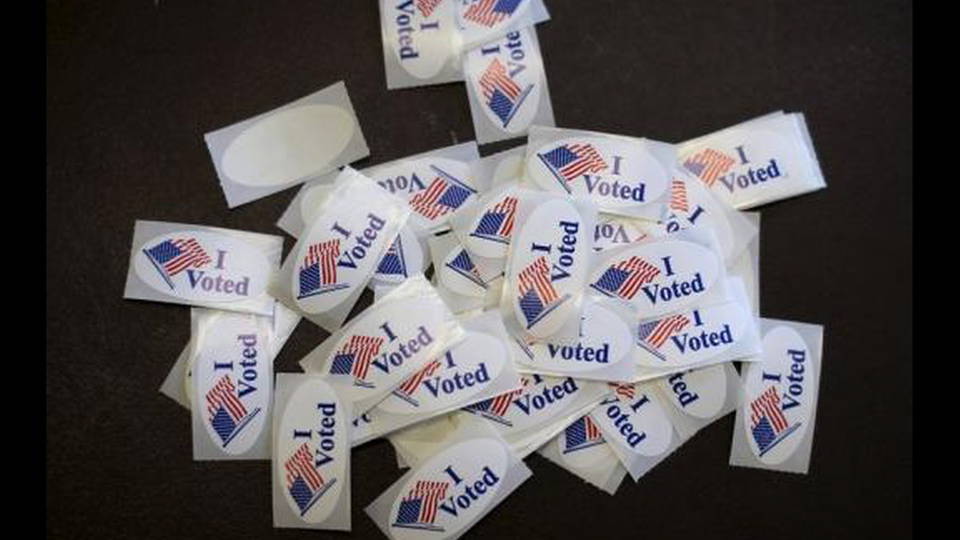
Six states hold Democratic presidential contests on Tuesday: California, Montana, New Jersey, New Mexico, North Dakota and South Dakota. Ahead of the key primary in California, the number of registered voters has surged to a record high. Of the nearly 650,000 people who registered in the final six weeks, more than three-quarters were registered Democrats. Campaigning in Fairfield, California, Vermont Senator Bernie Sanders said he will win the state if voter turnout is high.
Sen. Bernie Sanders: "And I will tell you—you don’t have to turn on the TV on election night, because I will tell you exactly what will happen—what will happen is, if you hear that there is a large voter turnout, we will win. If you hear that there is a very large voter turnout, we’ll win by a lot. If you hear that there is a low voter turnout, we’ll lose. Just the facts."
Hillary Clinton touted her ties to California during a campaign stop in Oakland.
Hillary Clinton: "My first legal job was the Children’s Defense Fund, but I also worked for a law firm right here in Oakland. I worked here in Oakland in the summer of 1971. And I had just started dating my husband. This may be too much information. It was the spring of 1971."
Hillary Clinton is close to the threshold of 2,383 delegates needed to win the nomination, and could declare victory on Tuesday. But a large portion of her lead comes from unpledged superdelegates who could change their vote at any time. Heading into Tuesday’s primaries, Clinton has 290 more pledged delegates than Sanders, but leads him 548 to 46 among unpledged superdelegates. Sanders has vowed to remain in the race, saying the Democratic convention in July will be a contested convention.
Trump Doubles Down on Attacks on Judge's Mexican Heritage
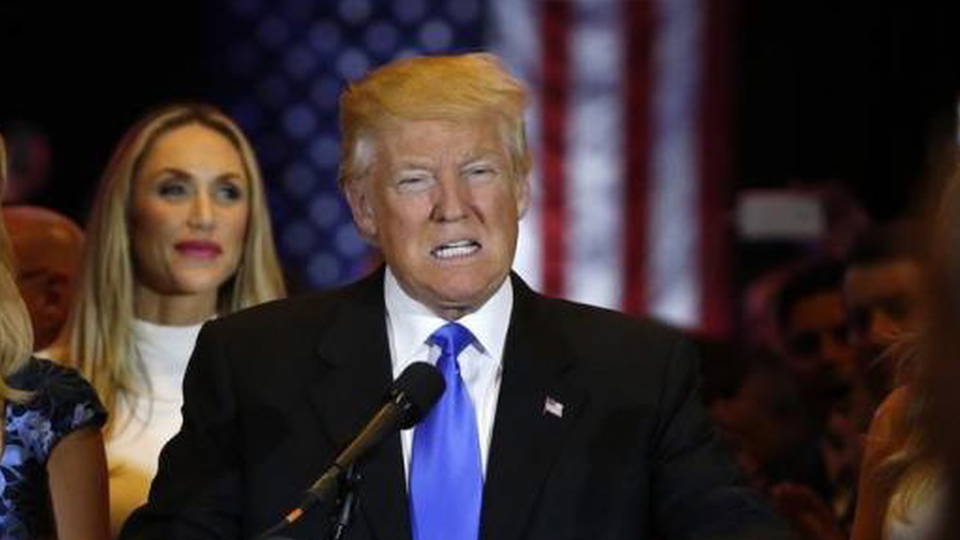
Presumptive Republican presidential nominee Donald Trump has doubled down on his claim a federal judge should recuse himself from a lawsuit over the defunct for-profit Trump University, because he is of Mexican heritage. Trump defended his remarks to CNN’s Jake Tapper.
Donald Trump: "This judge is of Mexican heritage. I’m building a wall, OK? I’m building a wall. I am going to do very well with the Hispanics, the Mexicans that are voting."
Jake Tapper: "So no Mexican judge could ever be involved in a case that involves you?"
Donald Trump: "Well, he’s a member of a society where—you know, very pro-Mexico. And that’s fine. It’s all fine. But I think"—
Jake Tapper: "Except that you’re calling into question his heritage."
Donald Trump: "I think he should recuse himself."
Jake Tapper: "Because he’s Latino."
Donald Trump: "And then you also say, 'Does he know the lawyer on the other side?' I mean, does he know the lawyer? And, you know, a lot of people say yes. I don’t know."
Jake Tapper: "But I’m not talking about that. I’m talking about"—
Donald Trump: "No, that’s another—that’s another problem."
Jake Tapper: "But you’re invoking his race when talking about whether or not he can do his job."
Donald Trump: "Jake, I’m building a wall. OK?"
Tapper asked Trump 23 times whether his comments were racist. Ultimately Trump said he believed they were not.
Trump: "It's Possible" Muslim Judge Would Be Biased, Too
In an interview on CBS’s "Face the Nation," host John Dickerson asked Trump if his call to ban all Muslims from entering the United States might disqualify Muslim judges from presiding over cases involving Trump, too.
John Dickerson: "My question is: If it were a Muslim judge, would you also feel like they wouldn’t be able to treat you fairly, because of that policy of yours?"
Donald Trump: "It’s possible, yes. Yeah, that would be possible, absolutely."
Mitch McConnell Refuses to Say If Trump's Attack on Judge is Racist
Republican leaders have moved to distance themselves from Trump’s comments. Just one day after endorsing Trump, House Speaker Paul Ryan said he disagreed with Trump’s comments about Judge Gonzalo Curiel, calling them "out of left field." Former House Speaker Newt Gingrich called Trump’s comments "inexcusable." And in an interview with Chuck Todd on NBC’s "Meet the Press," Senate Majority Leader Mitch McConnell opposed Trump’s remarks but repeatedly refused to say if they were racist.
Chuck Todd: "He has called—he has essentially said he cannot be impartial because he’s Hispanic. That’s a—is that not a racist statement?"
Sen. Mitch McConnell: "I couldn’t disagree more with a statement like that."
Chuck Todd: "Is it a racist statement?"
Sen. Mitch McConnell: "I couldn’t disagree more with what he had to say."
Chuck Todd: "OK, but do you think it’s a racist statement to say?"
Sen. Mitch McConnell: "I don’t agree with what he had to say. This is a man who was born in Indiana. All of us came here from somewhere else."
Texas AG Moves to Gag Official Who Says He Was Ordered to Drop Trump U. Probe
Meanwhile in Texas, Republican Attorney General Ken Paxton has moved to silence a former official who said he was ordered to drop a fraud investigation into Trump University for political reasons. Former Deputy Chief of Consumer Protection John Owens told the Associated Press he had built a solid case against Trump for scamming millions from students, but was told to drop the probe in a highly unusual move. The Texas Attorney General’s Office issued a cease-and-desist letter to Owens after he released a 14-page summary of the case against Trump.
NPR Photographer, Translator Killed in Afghanistan
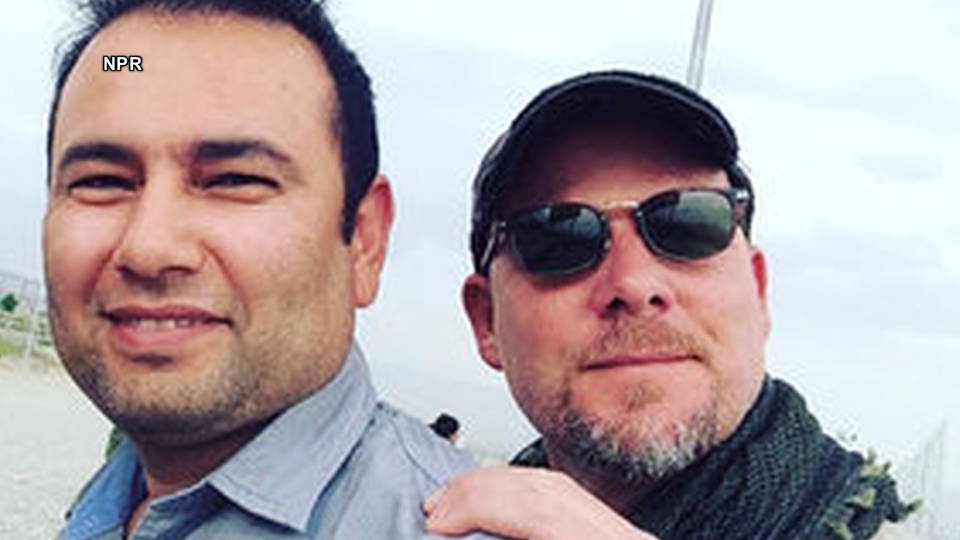
An NPR photographer and Afghan interpreter have been killed in Afghanistan while traveling with an Afghan army unit. Award-winning photojournalist David Gilkey died along with interpreter Zabihullah Tamanna and an Afghan soldier after their Humvee was hit by rocket-propelled grenades. Elsewhere in Afghanistan, an Afghan Parliament member was killed by a bomb near his home in the capital Kabul, while gunmen stormed a court building in the eastern province of Logar, killing seven.
Somalia: Radio Producer Shot Dead in Mogadishu
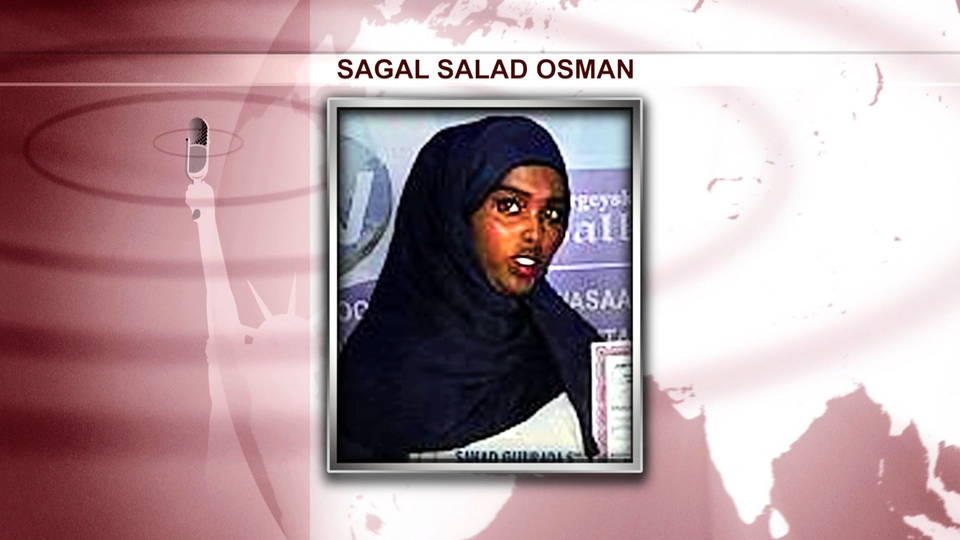
In Somalia, a woman journalist was shot dead in the capital Mogadishu. Sagal Salad Osman, a producer for the state-run Radio Mogadishu, was killed by unidentified gunmen. Somalia is one of the most dangerous countries for journalists.
Oregon: Fire Chief Hopes Derailment Will Be "Death Knell" for Oil by Rail

In Oregon, a so-called "bomb train" carrying volatile crude oil from North Dakota derailed Friday in the city of Mosier, causing a massive fire and forcing about 100 residents to evacuate. The crash damaged the wastewater treatment plant and sewer lines. Local fire chief Jim Appleton told Oregon Public Broadcasting that while he previously defended the safety of shipping oil by rail, he now thinks the shipments are "insane." "I hope this becomes [the] death knell for this mode of shipping this cargo."
NY Gov. Cuomo Signs "McCarthyist" Executive Order to Divest from Groups Aligned with BDS
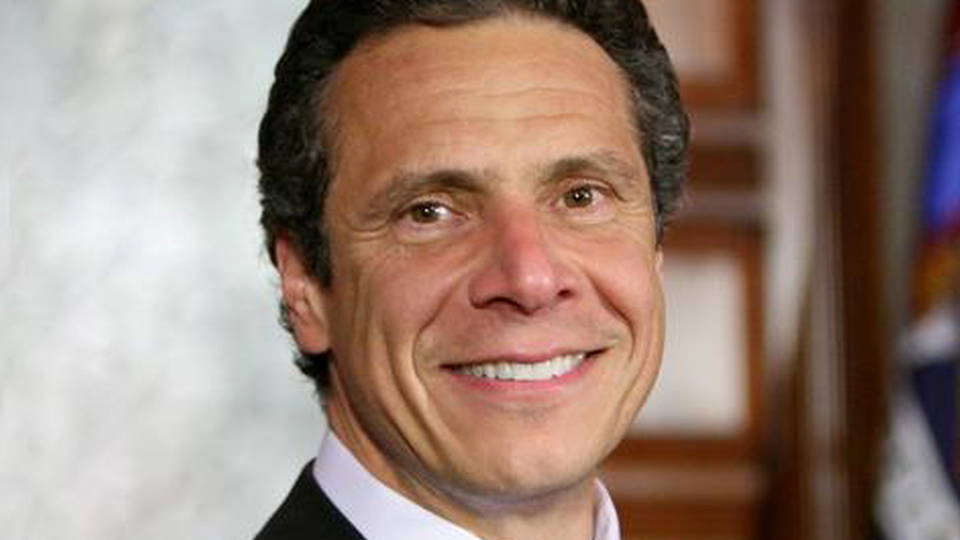
New York Governor Andrew Cuomo has issued the first-ever executive order forcing state agencies to divest from any organizations aligned with the Boycott, Divestment and Sanctions movement. BDS is an international campaign to pressure Israel to comply with international law and respect Palestinian rights. The order forces state officials to make a list of businesses and groups who are engaged in activities targeting Israel. Legal groups have declared the order unconstitutional and a form of "21st century McCarthyism."
Switzerland: Voters Reject Basic Income Proposal
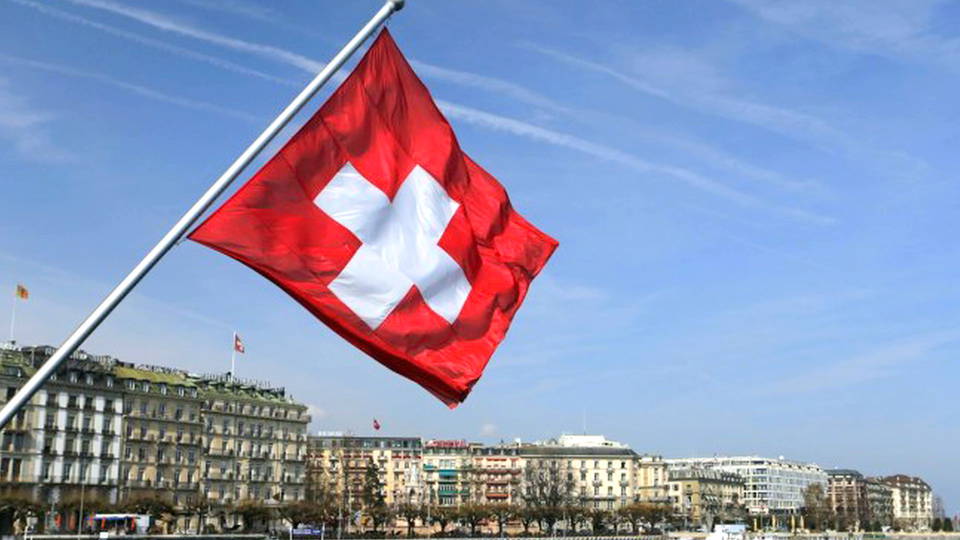
In Switzerland, voters have rejected a proposal to give everyone a guaranteed basic income of $2,500 per month. But Che Wagner of Basic Income Switzerland celebrated the historic vote, which marked the first time any country has voted on basic income.
Che Wagner: "Today, for us, is a very successful day. We expected 15 percent approval, and yet it’s over 20 percent, which means the Swiss want the debate to continue, but they not yet want it introduced right away. I think it’s also a statement that the Swiss want experiments on a local scale, so to better find out and know more about the effects of basic income, to then have another step maybe seven or 10 years from now."
Peru: Wall Street Favorite Leads over Ex-President's Daughter in Presidential Race
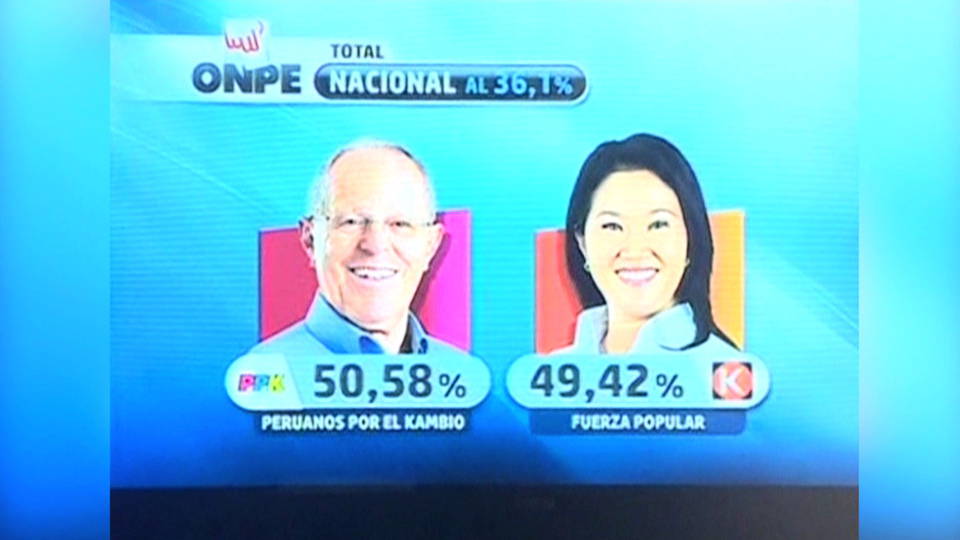
In Peru, former Wall Street investor and World Bank economist Pedro Pablo Kuczynski appears poised to win the presidential race, defeating Keiko Fujimori, the daughter of imprisoned former President Alberto Fujimori. Keiko Fujimori, who was expected to win, is trailing in a tight race amid corruption scandals and protests over the legacy of her father, who was imprisoned for crimes including ordering massacres by death squads.
Mexico Accused of Crimes Against Humanity in U.S.-Backed Drug War; PRI Loses Hold in State Races
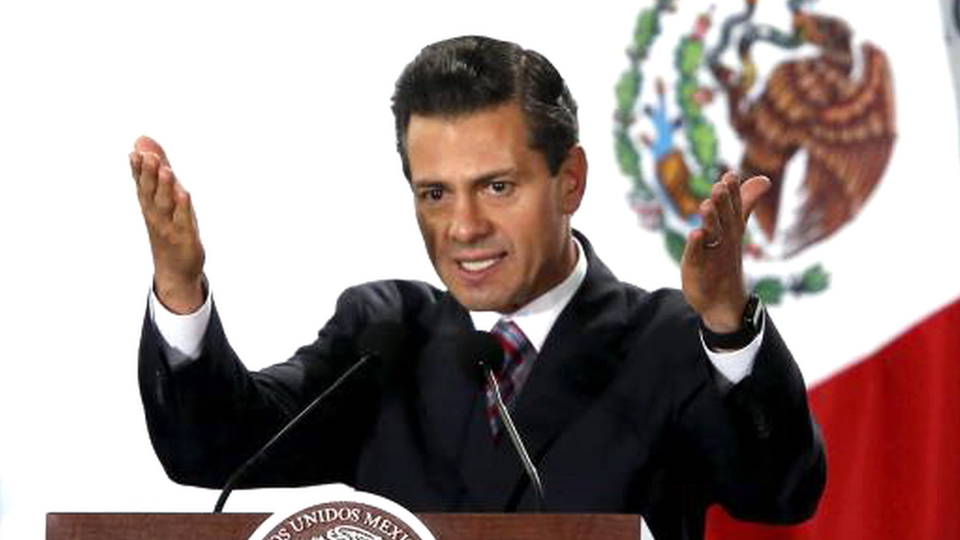
A new report accuses Mexico of committing crimes against humanity as part of the U.S.-backed drug war. The report, due out Tuesday from the New York-based Justice Initiative, marks the first time an international organization has publicly argued Mexico’s pattern of killings, torture and forced disappearances constitutes crimes against humanity. The news comes as violence has marred gubernatorial elections held in 12 Mexican states. Mexican President Enrique Peña Nieto’s ruling PRI party appears to have lost power in Veracruz and a number of other states where it has ruled uninterrupted for nearly 90 years.
Victim Reads Powerful Letter to Ex-Stanford Swimmer Who Sexually Assaulted Her
And a former Stanford University swimmer convicted of sexually assaulting an unconscious woman has been sentenced to six months in jail after the judge expressed concern a longer sentence would have "a severe impact on him." Brock Allen Turner was caught by two witnesses thrusting on top of the victim as she lay unconscious behind a dumpster. In a packed California court, the victim read aloud what the local prosecutor called "the most eloquent, powerful and compelling piece of victim advocacy that I’ve seen in my 20 years as a prosecutor." She began by recounting how she woke up in a hospital with pine needles in her hair, her underwear missing and no idea what had happened to her. "You took away my worth, my privacy, my energy, my time, my intimacy, my confidence, my own voice, until today," she read, addressing her rapist directly. "You bought me a ticket to a planet where I lived by myself." She concluded her statement with a message to survivors everywhere: "On nights when you feel alone, I am with you. When people doubt you or dismiss you, I am with you. I fought everyday for you. So never stop fighting, I believe you."
Donate today:
Follow:


SPEAKING EVENTS


Muhammad Ali
WEB EXCLUSIVE

Dave Zirin & Jules Boykoff on the 2016 Rio Olympics & Brazil's Collapsing Political System
WORK WITH DN!

News Producer
Office Coordinator
207 West 25th Street, 11th Floor
New York, New York 10001, United States
---------------------
---------------------

No comments:
Post a Comment