Alban Weekly "A youth fishing ministry combines Christian practices with social enterprise" from The Alban at Duke Divinity School in Durham, North Carolina, United States for Monday, 12 November 2018
Alban Weekly "A youth fishing ministry combines Christian practices with social enterprise" from The Alban at Duke Divinity School in Durham, North Carolina, United States for Monday, 12 November 2018
PRACTICAL WISDOM FOR LEADING CONGREGATIONS
Faith & Leadership: A learning resource for Christian leaders and their institutions from Leadership Education at Duke Divinity
The Rev. Matthew McNelly, far right, on the water with teens and a summer intern with GoFish!
GoFish! Ministries takes kids out on Washington’s Snake River to share life together and earn money through a state program that pays anglers to catch an aggressive species of fish.
Come late summer, the rolling Palouse wheat fields stretch like a golden carpet south to the breaks of the Snake River Canyon. Far below, the river winds through rocky channels on its way to the Columbia River and eventually the Pacific Ocean.
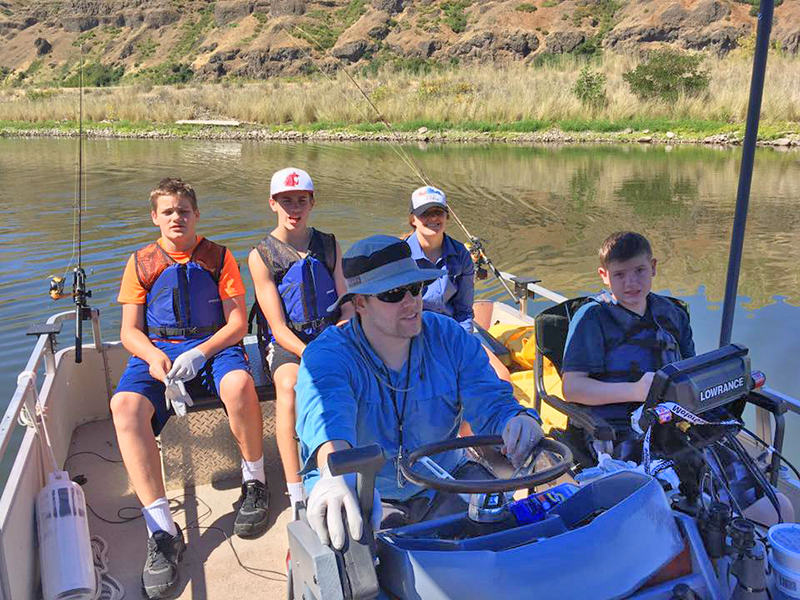
This evening, the Rev. Matthew McNelly, co-pastor of the Pullman Presbyterian Church, is preparing a silver pontoon fishing boat named the Suzie Q for launch on the river. It’s 102 degrees as his crew and passengers don life jackets and the engine roars to life. McNelly slowly motors out of the cove and into the open current, where their adventure is about to begin.
The Rev. Matthew McNelly drives the Suzie Q as teen participants head out to catch pikeminnow.
The Suzie Q is the humble stage for an enterprising and multifaceted new youth ministry called GoFish! In essence a floating monastic community, the participants share a river trip complete with Bible readings, prayer, discussion, meals and campfires, all while being paid to catch northern pikeminnow -- an aggressive fish that preys on juvenile salmon.
The innovative program welcomes youth in McNelly’s congregation ages 10 and up, as well as youth from other churches or with no particular faith background. On the boat, they are given a chance to work and learn life skills in a social enterprise based on ancient Christian practices. Over the last two summers, McNelly’s crew has helped 40 participants catch hundreds of different types of fish, including nearly 200 large pikeminnow worth over $1,000.
What might a “social enterprise based on ancient Christian practices” look like in your context?
The name GoFish! comes from the Gospel of Matthew, where Jesus calls a group of fishermen tending their nets to become his first disciples. “Follow me,” he says, “and I will make you fishers of men.”
“Fishermen are deeply acquainted with failure,” McNelly said. “There are days when you go out and don’t catch anything. And you are wet and cold. Jesus needed a group of people who would not back down from the mission of the gospel, even when things were difficult or people were rejecting his message and failure seemed to be at every turn. Fishermen are resilient folks.”
It’s an apt analogy for the challenges McNelly has also faced as a pastor, including reviving an aging, dwindling congregation. The process of launching an unconventional ministry itself was difficult and took prayer, faith and a healthy dose of hope to persevere through the inevitable obstacles and disappointments.
“In GoFish! I can have conversations of faith with kids while we’re doing life on the river,” he said. “Through the trials and tribulations of catching fish and losing fish -- getting hung up on the bottom or getting skunked one day -- we talk about how we deal with success or failure as followers of Christ.”
Aboard the Suzie Q
Back on the river, the Suzie Q chugs downstream into the setting sun, the dry canyon hillsides reflected in the rippling water.
McNelly is at the helm in a floppy gray hat and sunglasses. He wears a quick-dry shirt and khaki cargo pants. Around his neck hangs a black cord with a pair of silver nail clippers for cutting fishing line.
“The key to catching pikeminnow is finding them,” he says as he points out the boat’s high-tech GPS fish finder and 3D navigation system. He also uses an underwater fish-shaped camera that allows him to survey activity taking place deep below their feet.
“We’re looking for rocks and boulders on the river bottom, where pikeminnow like to swim,” McNelly explains. “We’re at 38 feet now.”
The boat gently rocks as he throws out the anchor.
His passengers include two 12-year-old boys -- Isaac, a cheerful, round-faced redhead, and Preston, a quiet boy in blue plaid shorts who politely offers gum. Isaac is an old hand at fishing, having already caught enough pikeminnow to earn $65. For Preston, it’s the first time out.
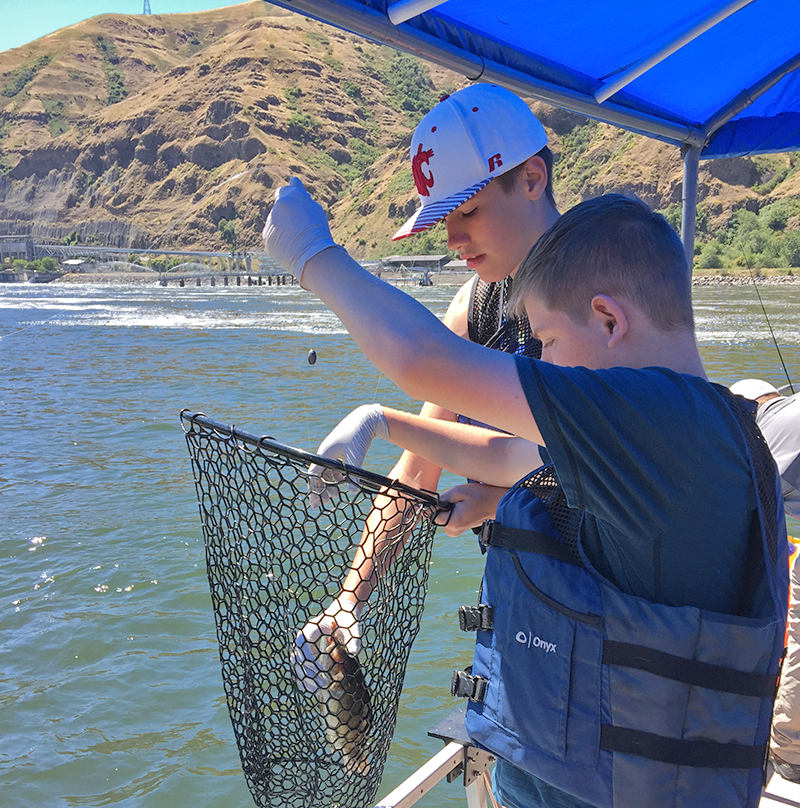
While the deckhand readies the poles, the boys put on gray nitrile gloves to keep their scent off the bait. With great concentration, they carefully load night crawlers and large brown Mormon crickets onto the hooks.
McNelly helps Preston gently toss his line out into the water.
“All right, you’re fishing, dude!” he says. “We’re in a little current, so there will be some tension on your line, but you’ll know when a fish hits -- that line will be bouncing all around.”
“We try real hard to make sure every kid gets to land at least one fish,” McNelly says.
After half an hour, he decides to move on. There have been no bites, and several lines have gotten stuck on rocks. A welcome breeze is blowing as the boat turns and heads upriver, trailing a foamy wake.
At first, the participants caught few fish, but with a better boat and equipment and some advice from a pro, the youth have started having success.
An innovative solution to a financial challenge
McNelly grew up along the Columbia River in Longview, Washington, where he spent time outdoors fishing with friends.
“We’d get up, grab a tackle box and ride our bikes to the lake,” he said. “I loved the adventure and mystery of fishing -- you don’t know what’s happening out in the water. My sense of wonder was piqued out there.”
His interest continued at Whitworth College in Spokane, where he joined the swim team, became a lifeguard and earned a degree in biology. Eventually, the call to ministry led McNelly to Princeton Theological Seminary. He and his wife, Amy, became a clergy couple and, later, associate pastors in California, where he channeled his passion for the water into a youth surfing program.
When their children arrived, the McNellys moved back to the Northwest to accept a ministry position in the university town of Pullman. He and Amy have a 5-year-old son, Jonah, and three daughters: Lydia, 15, Eliza, 13, and Naomi, 8.
“We’ve been here 12 years, and a lot has changed,” he said. In the beginning, the average age in their new congregation was about 70, but McNelly said they worked hard to reach multiple generations, and the church now has a large contingent of families with children, as well as baby boomers.
“I think one thing that allowed us to become healthier is the willingness to experiment and not be afraid to fail -- on both my part and that of the congregation,” he said. “We’ve learned to embrace the ongoing rapid pace of change in society. I believe change is the one main constant, and that we always have to be adapting and innovating.”
McNelly’s philosophy was put to the test three years ago.
Financial demands motivated McNelly to come up with the idea for GoFish!, which is deeply rooted in the local environment. Are there places in your community where you could look for innovative solutions to financial stresses?
“We had a number of longtime supporters pass away and hadn’t yet raised up a financial base among our younger members,” he said. “So we needed to make some changes to make sure the trajectory of the congregation was a positive one.
“My wife and I share duties -- I was full time and she was quarter time. In the Presbyterian Church, if a married couple is sharing more than one FTE at the same church, the denomination requires the congregation to pay double medical and pension dues for that family.
“We realized this was hampering the church, so I offered to step back to three-quarters time so they would only have to pay one pension and medical fee. It saved the church about $15,000 and was only a net loss of about $3,000 for us,” he said.
Not long after, McNelly happened to hear about the Northern Pikeminnow Sport-Reward Program, which pays anglers to catch predatory fish in the Snake and Columbia river systems. The top fisherman in 2015 had netted more than $100,000.
“I thought, ‘Why not try it as an extra way to make some money for the family?’” he said. “That’s what really started the ball rolling with the idea for GoFish! Ministries.”
Each person receives cash for the pikeminnow they've caught, which means fewer fish to eat young salmon.
Stalking the elusive pikeminnow
The sport-reward program is funded by the Bonneville Power Administration and runs from May through September. The goal is to mitigate some of the negative impacts on salmon that have been caused by dams.
Each spring, millions of juvenile salmon and steelhead migrate down the rivers on their way to the Pacific Ocean. Many are injured or killed as they pass through dams, and millions more are eaten by pikeminnow along the way. It all leads to threatened populations and fewer salmon returning to spawn in the rivers.
The sport-reward program helps thin out the older pikeminnow, which eat the most salmon. Payments range from $5 to $8 per fish, depending on how many fish an angler catches. BPA also throws in a few specially tagged pikeminnow worth $500 apiece.
As a result, nearly 5 million northern pikeminnow have been removed from the rivers since the program began in 1990, and predation on juvenile salmon has dropped 40 percent.
As McNelly learned more about the program, his vision for a youth ministry began to take shape.
“I got a lot of help in launching the idea from the Princeton Institute for Youth Ministry at Princeton Theological Seminary,” he said. “They host two-day workshops called ‘Hatchathons.’”
Similar to the TV show “Shark Tank,” these intensive workshops provide a collaborative incubator experience that helps turn new ideas for Christian social enterprises into real-life sustainable ministries. Participants are given access to financial advisors, marketing consultants, theologians and other professionals who help them “hatch” their projects.
Buoyed by the encouragement he received, McNelly took his idea for GoFish! public in 2016.
“Our first seed money was $5,000 from a missional initiative grant through the Presbytery of the Inland Northwest in Spokane,” he said. “I used it to buy rods, reels, tackle, a fish finder and safety equipment.”
Around the same time, two church members each donated $2,000 toward the purchase of a boat. One was a woman whose late husband called her “Suzie Q.”
McNelly also reached out to the Washington Department of Fish and Wildlife and was put in touch with local Pullman fisherman Dave Thom. They said Thom might be willing to teach him the basics.
Where does wisdom reside in your own community? How could you tap into it?
“This was a big development, because most fishermen in this program are very tight-lipped about the where and how of catching pikeminnow, as they see others as competition,” McNelly said. “But Dave has been incredibly supportive from the beginning -- especially considering he was one of the top 20 pikeminnow anglers that year.
“It was totally providential and showed God’s leading that Dave also happened to be a member of the Lutheran church directly across the street from our congregation and then sold us the pontoon for $4,000.”
That first summer, McNelly renamed the boat “Suzie Q” and went out fishing alone, as a pilot program. He soon discovered there’s a steep learning curve for catching pikeminnow.
“I only made about $500,” he said with a laugh. “I thought I could fund the ministry from the proceeds, but pikeminnow are harder to catch than I expected. I had to totally rethink my ideas of how to run the fishing program.”
Two brothers work together to pull in a fish.
‘Save salmon, experience creation, earn money and encounter Christ’
The second year, McNelly received another $5,000 grant from the Presbytery, plus two $1,000 grants from anonymous donors who wanted to fund innovative Christian ministries within the Pullman community. The funds paid for gas, moorage fees, an operating budget for the ministry and some of McNelly’s salary.
McNelly was now spending Mondays and Sundays at the church and Tuesdays through Fridays taking kids out fishing. He established four main goals for GoFish!
“We want to save salmon, experience creation, earn money and encounter Christ,” he said. “That summer, we did well on experiencing creation and encountering Christ, but not so well on saving salmon and making money.”
McNelly changed GoFish! when he realized it wasn't working. Does your organization have the resilience to keep going in the face of failures, large or small?
Nevertheless, his enthusiasm began to pay off in fall 2017, when McNelly received a windfall of financial gifts, including $5,000 from the woman named Suzie Q.
“I’d taken her out fishing, and we didn’t catch much,” he said. By then, he had realized that the best fishermen were trolling deep in the water with a different type of equipment. Pikeminnow prefer to swim near the river bottom, where they eat salmon smolts -- young silvery fish that are migrating out to sea -- as they move by in the current.
“We were eating lunch at Boyer Park when she wrote out a check and asked, ‘Will this help?’”
With that donation, McNelly bought a trolling motor, new rods, and downriggers to hold fishing lines near the river bottom.
Then came the call from Leadership Education at Duke Divinity letting him know that he had been nominated for a $10,000 Traditioned Innovation Awardby colleagues who knew about his program, including some from the Princeton Hatchathon. He received the grant in 2017.
Leadership Education at Duke Divinity recognizes institutions that act creatively in the face of challenges while remaining faithful to their mission and convictions. Winners receive $10,000 to continue their work.
“The award enabled us to completely rebuild the boat last spring,” McNelly said. “We spent more than 200 hours stripping it down to the bare bones and ran new electronics and electrical wire.”
“Another thing I realized last year was that the most successful people fish at night and early morning,” he said. “I’d been taking kids out just before noon, so we’d end up fishing at the worst time of the day. This year, I also invested in boat lights, tents and other camping gear for night fishing.
“Now, we offer overnight river trips, where we set up camp, have dinner, and fish until 10 or 11 p.m. or later, depending on how the fish are biting. Then we get up early and go out again in the morning. This summer, I’m hoping to see a greater number of fish caught, salmon saved and money earned.”
A summer intern hunts for crickets to use as bait.
‘… the birds in the sky, and the fish in the sea …’
In the canyon, a flock of Canada geese skims the now-glassy surface of the river. The sun has drifted below the horizon, leaving the Suzie Q bobbing in burnished shadows.
It’s time for the evening reading, and tonight, McNelly chooses Psalm 8 (NIV), sometimes called the sportsman’s psalm.
“Lord, … how majestic is your name in all the earth! You have set your glory in the heavens,” he begins.
“… When I consider … the work of your fingers, the moon and the stars, … all flocks and herds, and the animals of the wild, the birds in the sky, and the fish in the sea, all that swim the paths of the seas …”
The boat sways as McNelly closes and then leads the group in a few moments of silence. He follows with a discussion on the many ways God’s beauty is expressed in nature.
While the passengers contemplate his message, the fish finder suddenly comes alive with underwater activity. Joe, an older participant, reels in a silver fish with orange fins -- a pikeminnow worth $5.
McNelly drops the camera into the river and quickly picks up images of blue mysid shrimp and one very large crawdad. Later that night, they will marvel at the sight of an 8-foot sturgeon gliding along the river bottom.
The full moon is high when the group finally heads back to the campground for s’mores. After a short break, McNelly and the crew return to the river, where they eventually catch nine more “money fish.”
“Though it’s still in its infancy, GoFish! has become Pullman Presbyterian’s summer youth ministry,” McNelly said.
Do your ministries connect with those outside the church, whether they are youth or adults?
He’s hoping this can be a first point of contact for kids who would never go to a church -- who didn’t grow up with it -- but who do like to go fishing. The youth will encounter caring, committed adults and might see something different about their attitude and how they live.
He also hopes eventually to offer weeklong fishing camps where children and adults from urban areas can come and spend time on the river.
Swimming is part of the fun of the fishing trips.
“This program isn’t about just catching fish -- it’s about the complete sensory experience,” he said. “The brightness of the sun radiating off the water. The smell of the river, the sound of the motor. Plus all the wildlife we see: ospreys, coyotes running along the ridges, chukars cackling in the brush.
“This is a program that helps us reconnect with life -- our bodies and senses, the created order.”
Questions to consider
What might a “social enterprise based on ancient Christian practices” look like in your context?
Financial demands motivated McNelly to come up with the idea for GoFish!, which is deeply rooted in the local environment. Are there places in your community where you could look for innovative solutions to financial stresses?
Where does wisdom reside in your own community? How could you tap into it?
McNelly changed GoFish! when he realized it wasn't working. Does your organization have the resilience to keep going in the face of failures, large or small?
Do your ministries connect with those outside the church, whether they are youth or adults?
Faith & Leadership: A learning resource for Christian leaders and their institutions from Leadership Education at Duke Divinity
IDEAS THAT IMPACT: SOCIAL ENTERPRISE MINISTRIES
Alexandria Andrews and the Rev. Dr. Argrow “Kit” Evans-Ford examine freshly cut bars of soap. The natural soaps are one of the bath and body products made at Argrow's House and sold to support the ministry. Photos by Greg Boll/Greg Boll Photography
Inspired by her own experience and that of her grandmother, the Rev. Dr. Argrow "Kit" Evans-Ford has established a safe space for women and a bath products business to help support it.
The Rev. Argrow “Kit” Evans-Ford knows the battered and bruised women who come to her social enterprise, Argrow’s House of Healing and Hope, very well.
Nestled in a quiet Davenport, Iowa, neighborhood near the Mississippi River, the small white house provides a safe space for women who have suffered violence and abuse. Women like herself.
Evans-Ford was a Peace Corps volunteer when she was attacked on the Caribbean island of St. Kitts. Cleaning her apartment one evening, she heard the door creak. She was not alarmed; the wind sometimes pushed it open. But as she turned to go and close it, she realized that someone had come in. He had a knife.
The young woman tried repeatedly to escape as her assailant cut her, slammed her to the floor, choked, dragged and attempted to rape her. Her screams eventually drew neighbors, who stopped the attack.
Evans-Ford was physically rescued, but it would be years before she was mentally or spiritually healed. Post-traumatic stress disorder -- common among survivors -- affected her profoundly. In time, and thanks to professional help, she regained her strength and confidence.
When she did, she knew she wanted to help other women with similar experiences.
Argrow's House
Argrow’s House is the result of Evans-Ford’s dream of providing a sanctuary to women in need of healing. The Christian ministry, founded in December 2017, employs four survivors, who create and sell bath and body products in a social enterprise.
It also provides free services, from counseling and spiritual direction to yoga and massage, to about 100 women who are struggling with wounds that are much more than skin-deep.
“One in four women are survivors of sexual assault,” Evans-Ford said. “Many women suffer domestic violence as well. I’m moving forward with my call. It’s a blessing that I’m able to do that.”
‘Handmade by women healing from violence’
On the outside, Argrow’s House has a picket fence, a tidy lawn and flowers. Inside, the scent of lavender fills the air. Walk through the largely empty living and dining rooms -- left open for yoga and Zumba classes, but easily filled with folding chairs for support groups -- and you pass a large purple sign. It reads: “Natural bath and body products handmade by women healing from violence and abuse.”
The quote is printed next to a drawing of the original Argrow, Evans-Ford’s grandmother, for whom the house is named. She was a survivor of violence and abuse, yet she modeled resilience and joy throughout her life, Evans-Ford said.
This bottle will be filled with essential oil, one of Argrow's House products.
The kitchen is as busy and cluttered as the rest of the house is calm and spare. Two women are packaging lavender bath balms for a 200-piece order. The deadline is this morning, and they’ve only just begun, but they talk and laugh as if they have all day.
After the things they’ve survived, a tight deadline is a piece of cake.
A model to replicate
After her own attack, Evans-Ford looked to her grandmother’s experience and saw an intersection of their lives and purpose. Like her grandmother, who became a deacon, she would find her path through the church.
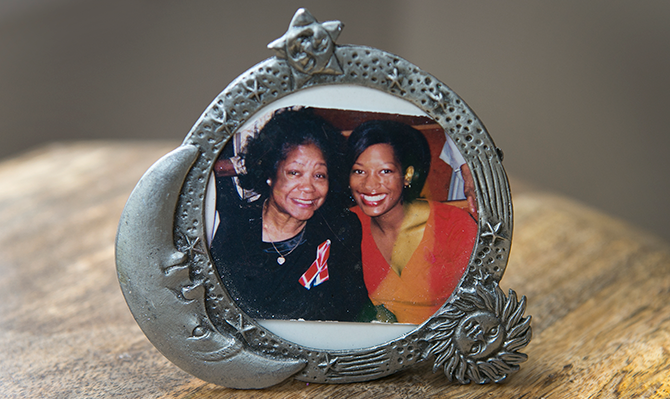
A photo of Evans-Ford, right, with her grandmother Argrow, sits on a table in the house.
Evans-Ford earned an M.Div. and a doctor of ministry degree in spiritual direction from Garrett-Evangelical Theological Seminary, finishing in 2012. While she was a student, she volunteered overseas again, this time in South Africa, where she helped women heal from rape.
She also volunteered in Nashville, Tennessee, for an organization called Thistle Farms. Dedicated to helping survivors by providing a home atmosphere with free services from therapy to job training, Thistle Farms also employs survivors in a soap-making business.
The Thistle Farms model seemed to be a good fit for the holistic social enterprise Evans-Ford was beginning to imagine.
The next few years were taken up with life itself -- meeting and marrying her husband, the Rev. Dwight Ford, and moving to the Quad Cities, Iowa/Illinois, area. Evans-Ford began a busy and multifaceted career as a visiting professor of theology at St. Ambrose University, a writer and blogger, inspirational speaker, dancer, spiritual director, minister and model. And she became the mother of two children.
She had developed a five-year plan for her social justice enterprise during seminary, and she was now ready to put the pieces in place.
Evans-Ford sits in one of the upstairs bedrooms of Argrow's House, which will be available for abuse survivors.
Having worked in community development in the Peace Corps, Evans-Ford knew what to do. She began to develop relationships with people in the community. She started serving as a minister in her husband’s church. She also connected with survivors through a webinar series she created called “Overcoming the S.T.O.R.M.,” designed to help women of color heal from violence and abuse.
Do you have a five-year plan for your ministry? Does your personal plan differ from that of your organization?
Evans-Ford “jumped on it,” she said, traveling to Atlanta to enter the first cohort of Do Good X’s startup accelerator program in 2017. There she found information, inspiration and a community of peers with whom she could continue to work out her idea.
Do Good X
FTE President and Do Good X creator Stephen Lewis said that Evans-Ford’s approach in founding Argrow’s House addresses some of the obstacles that can undermine an enterprise.
First, he said, it’s important to know that there is a demand for what you are offering.
Have you researched the need for the services your organization offers? If so, in what ways did that research shape or inform your plans?
“Nine out of 10 entrepreneurial endeavors fail,” he said. “Don’t come up with a solution [first] and then try to find the problem. Ask, ‘What solutions might we create to solve the problems?’ Ask if they will use the solution you are creating. Determine if there is a demand for your solution.”
Evans-Ford was sure of the demand. Being a survivor herself gave her insight she could not have had otherwise. Her work in Africa and Nashville added to her understanding. With nearly 1 in 3 women in the U.S. a survivor of domestic abuse and almost 1 in 5 a survivor of rape, the need for services was clear.
Another key task is to acquire financial and human resources, Lewis said. “You must be able to tell the story of ‘why?’ Why are you doing this? Why will it help? You must have a good origin story. People are compelled by your ‘why.’ Get good at telling it, and selling your story. Invite people to join you in the cause.”
Evans-Ford had learned to share her own personal and haunting story, difficult as it was. Sharing it publicly had become part of her own healing journey. It got easier as time went on, she said.
What is your story? Your organization’s? Have you honed the telling of your story so that you can “invite people to join you in the cause?”
“The fear [of assault] doesn’t haunt me the way it used to,” she said. Counseling helped her work through the continuing aftereffects of the assault, and a speech coach helped her work on her delivery.
“I hated having to tell it over and over again,” she said. “But I learned to share from the heart, and show that you can get on the other side of joy.”
As for the enterprise part of the equation, Evans-Ford had decided on beautiful, colorful bath products that would bring joy in both the making and the using.
Colorful bath balms made at Argrow's House are for sale online.
Do Good X provided critical support there, too, by connecting her with soap-making mentors who assisted with product development, packaging, marketing, shipping and distribution.
When she left Atlanta, Evans-Ford was ready to launch Argrow’s House.
Partners in the cause
Evans-Ford’s earliest partnerships included Grace City Church, where her husband pastors. Thanks to Grace, Argrow’s House acquired the property and a mortgage.
“They used one of their properties as collateral for us to purchase Argrow’s House without having to put down a large down payment,” she said.
Other financial partnerships -- including a $10,000 investment from the General Board of Global Ministries, the global mission of the United Methodist Church -- often came by way of those who had heard Evans-Ford speak or come across her mission online.
“I worked to develop relationships and networked every day with people in the Quad Cities and around the country,” Evans-Ford said. “I reached out to people I know who have certain skill sets. I asked if they would donate their time.”
What kinds of partnerships do you need to get your new ministry started? What is the best way to cultivate the partners you need?
The result is a full calendar of free services at Argrow’s House. Certified domestic abuse counselors and licensed clinical social workers provide therapy and lead group discussions. Yoga and Zumba teachers lead exercise classes. Others lead sewing and cooking classes, spiritual direction and massage therapy.
“Research shows the most effective strategies for helping women heal from violence and abuse are different for everyone,” Evans-Ford said. “You need to offer a variety of experiences.”
Now ready to develop the products Argrow’s House would sell, Evans-Ford needed a new kind of help. She called on Tosha Greer, a friend from church known for her whipped shea body butter and sugar scrubs. Greer began consulting for the product development department of the nascent social enterprise, attending essential-oil blending classes with Evans-Ford and spending untold hours experimenting in the kitchen of the house, which also serves as the manufacturing plant.
Together, they developed “beautiful, colorful products that reflect joy.”
Argrow's House natural soaps are made with shea butter and essential oils.
When Evans-Ford was ready to hire someone to help get the word out, she knew whom to ask. Alexandria Andrews had earned her bachelor’s degree in communications just months before entering a relationship that nearly destroyed her life. Now, the 28-year-old woman had left her abuser and was trying to find her way forward. This was exactly the person for whom Argrow’s House was intended.
“The thing about my story is it shows it can happen to so-called normal people,” Andrews said. “He was my high school crush. We came back together after college. He swept me off my feet and promised me a fairy-tale life.”
For Andrews, who would become Evans-Ford’s first survivor-employee, the promised life ended at the altar. Once married, the verbal abuse began and eventually became physical. Evans-Ford noticed that every time Andrews came to church, she had a new facial injury.
“Everyone else believed my story [of bumping into a door or falling], but not Dr. Kit,” Andrews said. “She spoke up. She wanted to make sure I knew that when I was ready to get out of the relationship, she’d be there for me.”
Financial, social and emotional empowerment
Getting a job after suffering abuse restores more than financial stability, as important as that is. It also helps restore victims’ confidence and self-respect, Andrews said, especially if they have been robbed of financial independence by their abusers, a condition she understands firsthand.
“This is my very first job that I’m proud to put on my résumé,” Andrews said. “I wake up every day with a purpose and a plan. I’m so energized.”
Andrews and Evans-Ford make soaps in the kitchen of Argrow's House.
Andrews is energized, too, by the community she has found at Argrow’s House, which may be the most valuable gift of all. Whether in a yoga class or a group discussion session, survivors share fellowship and stories that encourage healing, together.
What kind of community do you want to create?
They encourage each other to speak up and speak out, Andrews said. That has helped strengthen her interactions with others both in and outside the survivor community. It’s helped her -- and her fellow survivors -- grow the “big voice” needed for becoming whole.
“We empower each other,” Andrews said. “My ex used to make me feel like what I went through wasn’t a big deal, was normal. Argrow’s House says, ‘No, that’s not normal.’”
Looking forward
Argrow’s House is off to a solid start, FTE’s Lewis said. “Kit’s done so much in six months.”
Evans-Ford said Argrow’s House has served about 100 women so far, with about 30 coming for free services weekly.
The enterprise has new partnerships with five women’s shelters that refer clients to Argrow’s House for services -- which will always be offered at no charge, Evans-Ford said.
“Treatment is expensive,” she said. “I was employed by the U.S. government at the time of my attack, so my PTSD treatment was covered. Not everyone can afford it.”
More services and assistance will be implemented soon. The basement will become a clothing shop for women and children who leave with nothing but what’s on their backs. A first-floor room will become a food pantry. Both second-floor bedrooms will become home to two survivors.
Down the road, Evans-Ford would like to buy the brick building next door and turn it into a self-sustaining soap-making factory, run solely by survivor-employees. She’d like to see about getting their bath products into a store like Whole Foods. She’d also like to buy another property to support more transitional housing.
This summer calls for another product launch, and next fall for a gala to pay off the mortgage. Donor appreciation dinners dot the calendar. In the meantime, Evans-Ford continues her own healing journey.
Together, she and the women of Argrow’s House will get “on the other side of joy.”
Questions to consider
Do you have a five-year plan for your ministry? Does your personal plan differ from that of your organization?
Have you researched the need for the services your organization offers? If so, in what ways did that research shape or inform your plans?
What is your story? Your organization’s? Have you honed the telling of your story so that you can “invite people to join you in the cause?”
What kinds of partnerships do you need to get your new ministry started? What is the best way to cultivate the partners you need?
A learning resource for Christian leaders and their institutions from Leadership Education at Duke Divinity
Allen Woods, left, works with budding entrepreneurs involved in the MORTAR program in the Over-the-Rhine neighborhood of Cincinnati. Photos courtesy of MORTAR
Too often, neighborhood revitalization leaves behind the people who already live in urban neighborhoods. A new model in Cincinnati seeks to train and support locals so they can benefit from the economic boom.
William Thomas saw the problem.
The boarded-up storefronts in his poor Cincinnati, Ohio, neighborhood were coming back to life. Businesses were opening. Housing rehabilitation and construction were underway.
As he and friend Derrick Braziel walked through this area, called Over-the-Rhine, they saw a turnaround story familiar to many inner-city neighborhoods across the country. In some ways, this story was a positive one. But the economic vitality also had a damaging impact: the people already living there -- many of them poor and black -- were being left behind.
“We saw a lot of white-owned businesses pop up and saw a lot of residents who looked like us without the opportunities,” Thomas said, as he recalled that moment in 2014. “We saw a problem and complained about what was going on.”
Allen Woods and fellow co-founders William Thomas and Derrick Braziel seek to change neighborhoods by supporting residents who want to become entrepreneurs.
So college buddies Thomas and Braziel decided to stop complaining and start doing something. Now, four years later, the two men and another friend, Allen Woods, lead MORTAR, a community-based nonprofit that helps train budding entrepreneurs in neighborhoods that need revitalization.
These three men -- between the ages of 32 and 41 -- also have created a support network that makes sure these new entrepreneurs have the help they need to succeed.
They’ve already graduated 175 people from their entrepreneur training program, and then supported them with retail space, legal help, marketing materials and more. They have plans -- big plans -- to expand in Cincinnati and beyond, targeting other cities that can use the MORTAR model to revitalize neighborhoods.
“What MORTAR has been able to do is reach a segment of the population that hasn’t been reached, the underserved,” said Eric Denson, a senior development analyst for the city of Cincinnati. “They’re serving a niche. They’re out on the streets, making themselves available, making [clients] know what’s available.”
Not only do these newly minted entrepreneurs help the area thrive and grow; the residents who are then able to stay have a stake in the neighborhood and its revitalization.
“We affect the community; … we see a large number of people pursuing their dreams,” Sadell Bradley, MORTAR’s strategic director, said. “It’s a unique kind of fire.”
Much like rubbing two sticks together, igniting this fire took patience and perseverance.
That’s where MORTAR comes in. The group’s name was inspired by a simple thought: When looking at redevelopment, we should look beyond the buildings to the people. While literal mortar holds buildings together, people are the mortar that holds communities together.
MORTAR doesn't seek to stop gentrification but rather empowers local residents to benefit from it. Are there similar opportunities to empower people to benefit from economic trends in your community?
The MORTAR office is in the middle of Over-the-Rhine, on its main thoroughfare, Vine Street. The area thrives with restaurants, shops and vibrant nightlife -- a far cry from less than a decade ago, when Over-the-Rhine was dubbed the most dangerous neighborhood in America.
The neighborhood reached a low point in 2001, when a white police officer shot an unarmed black teenager, starting days of riots. By 2002, the city of Cincinnati had developed a plan for Over-the-Rhine’s revitalization.
There’s no doubt that OTR is coming back. Its population is on the rise, up to nearly 7,000 residents after dropping by more than half between 1990 and 2014. Some 175 new business have opened in the area since 2006. The arts-and-culture scene bustles, and community events keep the neighborhood busy year-round.
While outside forces have come in, MORTAR has played an integral role in ensuring that more neighborhood people have a chance at entrepreneurial success and can stay in the area when the going gets good.
This was the mission that inspired Thomas and Braziel to take their idea to a local pitch night, where startup businesses vied to attract notice -- and perhaps funding.They won $2,500.
MORTAR co-founders Allen Woods, Derrick Braziel and William Thomas at a recent pitch night.
But they knew they would need much more money to launch their program. While still working full time at other jobs back in 2014, they met with as many potential funders as possible. They received far more rejection than funds.
“We got a lot of, ‘That sounds good’ or redirecting us to another organization that did similar work,” Thomas said. “We weren’t sure whether it [was] because we were three young black men or the idea was too risky -- or both.”
Most news stories about MORTAR note that it’s an African-American-led group but don’t explain why that matters. While small minority businesses are opening at a faster rate than any others, minorities are likely to receive smaller small-business loans and at higher interest rates than their white counterparts, as shown, for example, in a 2010 U.S. Commerce Department report. That lack of access to capital can kill a business before it gets off the ground.
Are you facing unique challenges to your work? How do you keep from being discouraged by them?
None of that deterred MORTAR’s leaders, and things changed in 2015. MORTAR was seeking applicants for its first training class, and the announcement appeared in a local newspaper. The article also mentioned that MORTAR was looking for space for its burgeoning business.
The founders were contacted by a local entrepreneur who offered them free office and storage space in Over-the-Rhine.
“He wanted to figure out a way to give back, and this was it,” Thomas said.
That gesture made a huge difference. MORTAR now had an office, a place from which it could work -- and didn’t have to worry about paying for it right away.
After the success of the first training class, funding started coming in. It was slow at first -- about $20,000 the first year, about $50,000 the second -- but with MORTAR in the news and building momentum, community groups started to notice -- and became a huge part of MORTAR’s success. The nonprofit now has an impressive list of partners that includes several big banks, 3CDC, Proctor & Gamble, and the University of Cincinnati, whose law school provides legal assistance.
MORTAR’s leaders have networked beyond the city as well. Braziel spoke to the Forum for Theological Exploration’s Do Good X in 2017, spreading the message of “how we can tap into the nontraditional to empower others to change the world.”
How can your organization “tap into the nontraditional”? How would you find nontraditional partners and community support for your endeavors?
As its community involvement grew, so did MORTAR’s ability to raise funds. The group raised $500,000 in 2017 and hopes to raise $700,000 in 2018, Braziel said.
The increased funding helps MORTAR continue to spread its own brand of gospel -- bringing together the resources to help make the entrepreneurial dream a success.
Another type of gospel has influenced that mission.
Principles of faith
Christian faith, in one way or another, lies at the heart of Thomas and Braziel’s calling.
One of Thomas’ grandparents was a pastor at a nondenominational Cincinnati church -- a place where Thomas spent many Sundays of his youth.
Braziel grew up in the AME Church, but he found Christ in what he described as a “new and real” way during a mission trip through Athletes for Christ. When he and Thomas met at college, he was “digging into Scripture” when he came across a Bible verse, Ecclesiastes 9:4: “Anyone who is among the living has hope -- even a live dog is better off than a dead lion” (NIV). That verse changed his life.
“As long as a person has breath in their lungs, it doesn’t matter what their education pedigree is, how much money they have in their bank account, what their race is; we’re here to help,” Braziel said.
“We think the best way to do this is social, racial and economic justice. Loving God’s people comes through in the idea of giving them a space for their ideas to be cultivated and developed.”
When he studied that verse, he said, “I knew I needed to dedicate my life [to] supporting black and brown people using the love and promise of God.”
The Very Rev. Gail Greenwell, the dean of Christ Church Cathedral, one of MORTAR’s community partners, notes that MORTAR’s work is steeped in Judeo-Christian values.
“Keeping people in poverty benefits the empire, and we are trying to benefit the reign of God,” she said. “People who have experienced generational poverty need help lifting themselves out of it.
“That’s why MORTAR isn’t just a training program. It’s a support network that helps build skills and self-esteem, like a family that stays together and offers constant support.”
Graduates of MORTAR's first class in 2015.
‘The special sauce’ of MORTAR
MORTAR accepts 12 to 15 people into each of its six yearly training classes, all of which are 14 weeks long. When students begin the program, they generally have one emotion.
“They’re usually very scared,” said Woods, MORTAR’s managing partner and creative director. “For most of our participants, based on their background, they’ve been told ‘no’ for so long, they’ve been taught to believe that everything is impossible. It’s often the first time they’ve been around people who have that spirit of affirmation, that they can accomplish these things, while holding them accountable.”
The class helps students understand business basics. It costs just $250, and MORTAR offers payment plans for students who can’t afford the entire fee upfront. The budding entrepreneurs get help refining their ideas and are assigned mentors to guide them through the class.
“There’s more to make a successful business,” Braziel said. “A network, legal help, mentors -- that’s the special sauce of MORTAR.”
Networks and ongoing relationships are key to the MORTAR model. Does your organization make such connections to its clients, employees or participants?
Graduates go into the alumni program, which provides further support, including business mentors, networking opportunities, access to business funding, pop-up store space to showcase goods and services, and legal help.
What MORTAR has done is leverage relationships in a way that helps more than just the individual graduates; it helps revitalize their neighborhood.
“One of the major connections has been the prominence of MORTAR as a change agent within the community,” said Bradley, MORTAR’s strategic director. MORTAR has forged so many connections it’s now a big part of Cincinnati’s fabric.
“The ties politically and socially, grant-making operations -- it’s bringing everyone together in support of this cause,” Bradley said. “I’ve lived here 30 years, and I’ve not seen an organization that has been able to galvanize this kind of support.”
Such support has proved critical to Rebecca Denney’s success.
A system of continuing support
Denney is living her dream, and she credits MORTAR’s class, network and continued support.
Denney left a corporate job to figure out her next step in life. As a health-conscious eater, she wanted to open a place that focused on healthy eating. She had an idea, a logo and a menu, but she didn’t know what to do next. She had no business plan and didn’t know how to move forward.
She went through the MORTAR training program, and through its network of resources, she landed a catering job for a large nonprofit. The nonprofit was so impressed with her food that it offered a chance to fulfill her dream -- a small cafe nestled in the bottom floor of a downtown Cincinnati office building.
That’s where she opened Paleolicious, a breakfast and lunch shop, with the tagline “Because healthy food should always be delicious.”
But just because she’s graduated and has her own business -- and dreams of expansion -- doesn’t mean she’s on her own. One MORTAR graduate hired her to cater her art gallery grand opening; another hired her to do a cooking class for her bridal shower.
“It’s amazing how everybody has each other’s back,” she said.
Woods, lauded in 2016 as a Cincinnati Business Courier Forty under 40 Business Leader, said that’s MORTAR’s mission: “The support after the fact is just as critical as the initial training. We’re creating a system that allows us to continue to guide them.”
Graduates are in the alumni program for 18 months, and when that time is up, they are still welcome to come back -- and many do -- for assistance. MORTAR never shuts them out.
MORTAR has graduated 200 budding entrepreneurs in 15 classes over the last four years, and about 65 percent of them are still active in their new ventures in some way. Some MORTAR grads, like Denney, work at their business full time; others operate them on the side for extra money. In all, MORTAR graduates have a median business income of $23,000 a year.
By traditional business measures, that may not seem too impressive. But it’s important to remember that most MORTAR grads are African-American, with single-owner businesses.
“Those traditional measures -- jobs created, revenue -- don’t always work with the people we work with, so we need some more nontraditional measures,” Braziel said.
MORTAR is still working on exactly what those should be. Braziel believes they’ll be more qualitative, such as measuring whether a business has incorporated or has grown its social media audience.
As Cincinnati neighborhoods such as Over-the-Rhine are revitalized, MORTAR helps ensure that people already living there benefit economically.
Branching out
MORTAR is now in five Cincinnati communities. Thomas, who does much of the groundwork, meets with high-level stakeholders such as developers, community councils, businesses and organizations to make sure they’ll support MORTAR’s efforts.
That support comes in several different ways. Maybe it’s financial. Maybe someone can offer space for entrepreneurs. Maybe they’ll help spread the word. Once MORTAR has that community support, it’s ready to start recruiting for training classes.
MORTAR is pursuing other citywide efforts as well. It is opening pop-up stores throughout Cincinnati, offering space to its graduates at a reduced rate, so they have a place to sell their wares. The first was in Over-the-Rhine, in the former storage space next to MORTAR’s office.
There are now four, including the MORTAR Mess Hall, where entrepreneurs rotate two to three days a week preparing food at a local bar. The city of Cincinnati is also using the pop-up concept, with two locations downtown and two in another neighborhood.
In the Walnut Hills neighborhood, where MORTAR has opened a pop-up, the nonprofit has also been working with the local neighborhood association and is helping local entrepreneur and MORTAR grad Brian Jackson open the city’s first black-owned brewery.
Now MORTAR is branching out to other cities, expanding to Milwaukee, where Woods and Bradley recently spent time showcasing a new curriculum for an entrepreneur training class.
MORTAR seeks to expand on a local and regional level. What scale of impact does your organization seek to have? Could you expand your horizon and stay sustainable?
The concept, Woods said, is transferable to other communities, but “it requires people who care to step up and create the platform for other people.”
And that isn’t the only challenge.
MORTAR is doing well, but its leaders realize that success can be fleeting. Funding is a constant challenge. It costs $2,500 per person -- at least $30,000 total -- to put on one MORTAR training class.
MORTAR knows it needs to define success in a different way, and to manage growth.
“We are an all-black organization, and that brings its own set of risks,” Braziel said. “Access to capital will always be a problem. From a perception standpoint, we’re always fighting against being held to a different standard and being told to perform at a higher level. Everybody makes mistakes. We’re only going to be successful if people are willing to take a risk on us.”
So far, the people of Cincinnati have, and as a result, there is hope. Just as in Ecclesiastes 9:4.
Questions to consider
MORTAR doesn't seek to stop gentrification but rather empowers local residents to benefit from it. Are there similar opportunities to empower people to benefit from economic trends in your community?
Are you facing unique challenges to your work? How do you keep from being discouraged by them?
How can your organization “tap into the nontraditional”? How would you find nontraditional partners and community support for your endeavors?
Networks and ongoing relationships are key to the MORTAR model. Does your organization make such connections to its clients, employees or participants?
MORTAR seeks to expand on a local and regional level. What scale of impact does your organization seek to have? Could you expand your horizon and stay sustainable?
A youth pastor who began a church-based social enterprise shares advice for others interested in this kind of ministry. The three initial phases are discernment, consulting with the community and testing.
Starting a Christian social enterprise is difficult and passion-filled work. It comes with a ton of setbacks and self-doubt. And a ton of excitement.
I believe that social enterprise -- a business with a social good in mind -- can offer a new way forward for the church.
But I realize as I evangelize about this new model that people will have questions about how to get started. How can a local congregation or minister launch a social enterprise that maximizes missional impact in a community?
I have identified three initial phases for this work: habitation and discernment; consulting with the community; and testing.
The advice here is aimed at ministers and congregations interested in starting a small-scale enterprise that has a relatively low bar for entry into the marketplace. Launching a large-scale idea for social innovation requires much more capital and risk.
Habitation and discernment
As Christians, we have an obligation to prayerfully inhabit a place in order to do this work in ways that honor God and neighbor.
I have participated in several programs that help launch social enterprises, and one problem I’ve seen is that they often encourage people to ideate quickly.
This worries me. We Christians have a long history of doing things to others in unhealthy and wasteful ways. I think we have a theological obligation to take the time to inhabit a place, to listen well and to pray, and only then, after a period of discernment, to come up with an idea.
Ideally, I think would-be social entrepreneurs should live in a community at least three and a half years to discern the context and to build up leadership capital and trust within the local church before formulating ideas. That time is also important for discerning whether the needs of the context and the specifics of a potential enterprise line up with a leader’s God-given gifts.
I happen to love physical labor and mentoring teens, and I know something about lawn care. So launching a teen landscaping company made sense for me. It was also something that our state’s highly restrictive teen labor law would allow.
It’s critical for churches preparing to launch a social enterprise to understand the social needs and marketplace of their particular community. And since the purpose of social enterprise is to place the mission ahead of the profit, it is crucial to think about the mission thoroughly.
Consulting with the community
The next step is to look at the cloud of witnesses.
One of my favorite lines in the book of Acts is when the apostles and the elders at the Jerusalem Council, trying to discern how Jewish and Gentile converts are to interact with one another and the standards of faith, arrive at their answers and say, “It seemed good to the Holy Spirit and to us ...” (Acts 15:28 NIV).
The idea here, at least in my Reformed mind, is that the discernment of God’s will seems to have been a group, rather than an individual, process. This is an important ethic in starting a Christian social enterprise.
That’s why I began by talking with the leadership at my church.
My initial conversation was with my head of staff. I made sure he understood why I was trying to do this and what the potential implications were in time, energy and dollars.
I also shared a couple of books to help explain the concepts behind my project, such as asset-based community development and social enterprise in general.
What was critical, in my case, was that my head of staff understood missional theology, allowed the staff a good deal of autonomy and was not opposed to marketplace-based thinking. We also had trust in each other.
My next step was to inform our Session, which is our church’s governing body. I worried that they would find my idea confusing or frightening, so I prepared a presentation on my own ministry journey, my idea for the enterprise, the financial implications for them and a critical FAQ.
I wanted to make clear that I wasn’t proposing to detonate their existing youth ministry. I also was not planning to leave the church. I made sure to help them understand how my idea linked directly to my job reaching out to teens in our county.
I also framed it as a six- to 12-month experiment and asked for four to eight hours per week to work on it during the initial phase.
To my utter amazement, they really liked the idea and thought it fit well with the stated mission and vision of our church.
I gathered eight key people on an informal team. I invited people who had run their own businesses, people who would be good mentors and people who were trusted by the church. I also consulted with folks who had legal and tax experience.
For a church that doesn’t have folks with particular experience, I’d recommend exploring congregants’ connections to people in the community who support the idea and consulting with the local community foundation.
Testing
The last phase is experimentation and testing.
I started small. I hooked up my V-6 to a church trailer and mowed a few clients’ properties each week. I also shadowed a local landscaping company’s crews and paid close attention to people I saw out working.
The point is to start with a manageable volume of business to see whether the ministry leader is cut out for the work. This also provides a glimpse of what the actual market looks like in the area -- sort of like an informal market survey.
But most importantly, this phase offers a test of what ministry looks like in this setting.
Is it possible to do effective ministry within the context of this business? What is the actual potential of kingdom impact on customer and employee? This is essential.
At the heart of Christian social enterprise is the mission. Whatever shape it may take, the mission must be the focus in a church-based business.
This is an in-depth look at the power teams bring to congregational work. Wimberly demonstrates that younger generations in particular are much happier working in a team, rather than a committee environment. Congregations using teams are able to mobilize members across generations for both short and long term tasks.
After clarifying the differences between teams and committees, readers learn the important steps needed to set-up new teams. Leaders who simply create a team without attention to the formation process increase the likelihood of team failure. Using real-world examples and case studies, Wimberly addresses problems teams can expect to experience, as well as ways to resolve those issues. He highlights the surprising similarities between how teams and congregations function, both positively and negatively, providing keen insights from the business world and showing how they can be used to solve issues in congregations.
Here readers will find both the theory and practice of making a successful transition to a congregation doing its work through highly motivated, efficient teams.






No comments:
Post a Comment