NOTE: This is a digest of news features provided by United Methodist Communications for March 23-27. It includes summaries of United Methodist News Service stories and additional briefs from around the United Methodist connection. Full versions of the stories with photographs and related features can be found at umc.org/news.
Top Stories

Photo by Vicki Brown, UMNS
Munashe Furusa, right, receives the medallion of the Africa University vice chancellor from Bishop David Yemba, chancellor of Africa University, and the Rev. Kim Cape, top executive of the United Methodist Board of Higher Education and Ministry.


Africa University’s new leader: ‘Right kind of role model’ by Vicki Brown
MUTARE, Zimbabwe (UMNS)
Africa University’s new vice chancellor has “a rags-to-riches story” as a first-generation college graduate, said the keynote speaker at the inauguration of Munashe Furusa, the United Methodist-related university’s new leader.
“It is a rags-to-riches story when no one in your family has done it and you reach the top of the university,” said Tawana Kupe, deputy vice chancellor at Witwatersrand University in Johannesburg, South Africa. Kupe was a mentor when Furusa was a student at the University of Zimbabwe.
“He’s therefore the right kind of role model for students at Africa University,” Kupe said, adding that Furusa demonstrates what perseverance and dedication can accomplish.
Bishops and other dignitaries from The United Methodist Church attended the ceremony March 21, along with Zimbabwean government officials, chiefs, ambassadors and local business leaders, as well as students and faculty.
Furusa called Africa University a “product of the rich legacy of The United Methodist Church” of starting education and health institutions. “Student success is our way of renewing Africa and investing in its future,” he said.
The vice chancellor serves as chief executive of the university. Before coming to Africa University about eight months ago, Furusa was dean of the College of Arts and Humanities at California State University, Dominquez Hills, where he was successful in establishing public-private partnerships that provided internships and job opportunities for students.
#UMC @Africa_Univ inaugurates new leader, a first-gen college grad with a rags-to-riches story
 TWEET THIS
Furusa, a Zimbabwean, promised that over the next few years, the university would boost its research and technology efforts. Furusa said staff in a new research office would work with professors to get grants for research.
He was ceremonially robed and given a medallion of office by Bishop David Yemba, university chancellor and bishop of the Democratic Republic of Congo, and the Rev. Kim Cape, top executive of the United Methodist Board of Higher Education and Ministry, the church agency that steered the founding of Africa University.
Challenges ahead
Furusa acknowledged during the meeting of the university’s board of directors that the institution faces many problems, including aging buildings, overcrowded dorms and the need to hire more professors with doctorates to retain accreditation with the Zimbabwe government.
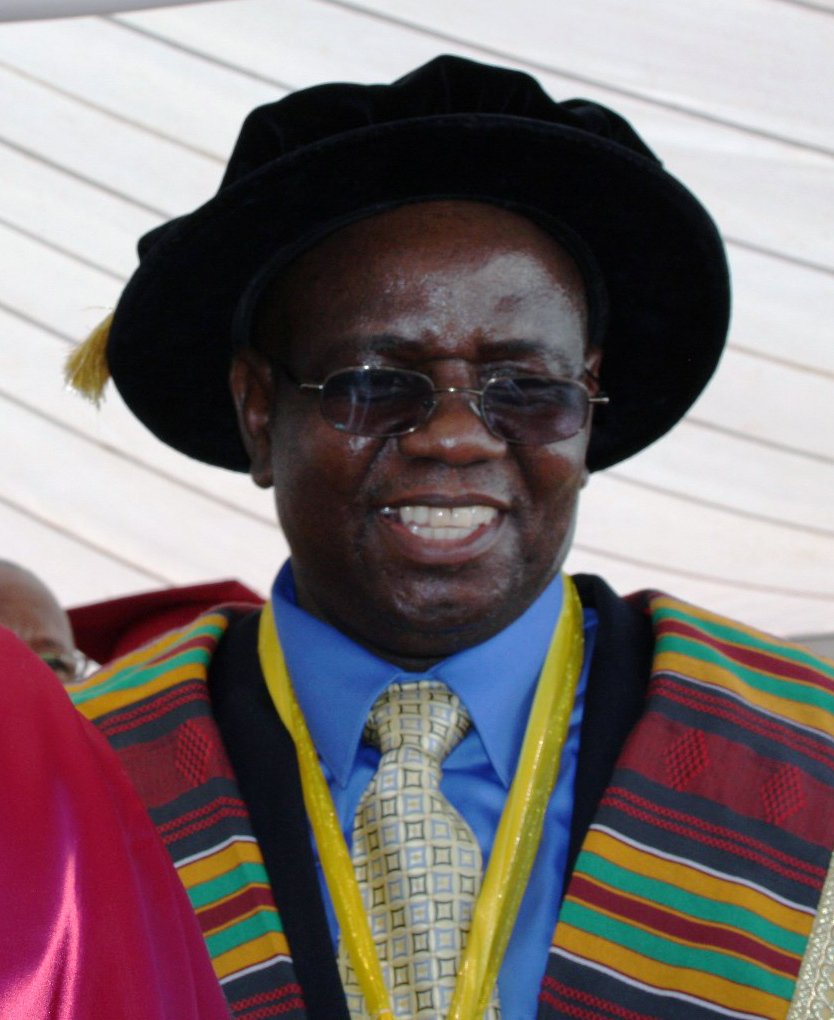
Munashe Furusa smiles after his installment as Africa University's fourth vice chancellor. Photo by Vicki Brown, UMNS
Everything seems urgent, Furusa said, but he added that his strategy is to “prune and grow” at the same time, shifting resources to programsthat need to grow.
During his inaugural address, he spoke of accepting the leadership of Africa University with “great joy” because of his commitment to its pan-African mission. The university has about 1,500 students from 26 countries. “Africa happens every day at Africa University,” has become his mantra.
More than 5,300 graduates are taking leadership roles in business, politics and health care around the continent, and many speakers talked about Africa University’s important role in providing leaders to solve the political and economic problems of the continent.
Students praised Furusa for being open to their concerns and for already making changes, such as setting up a gym room.
Daniel Njorama, a student from Zimbabwe, said Furusa brings “a new perspective on leadership.”
“He held a student address where we aired our concerns. I really respected that,” Njormana said.
Rangarira Pashapa, the student representative to the board of directors, spoke on behalf of the students during the inauguration. “It means so much that we have a vice chancellor that cares so much about us and our social welfare,” he said.
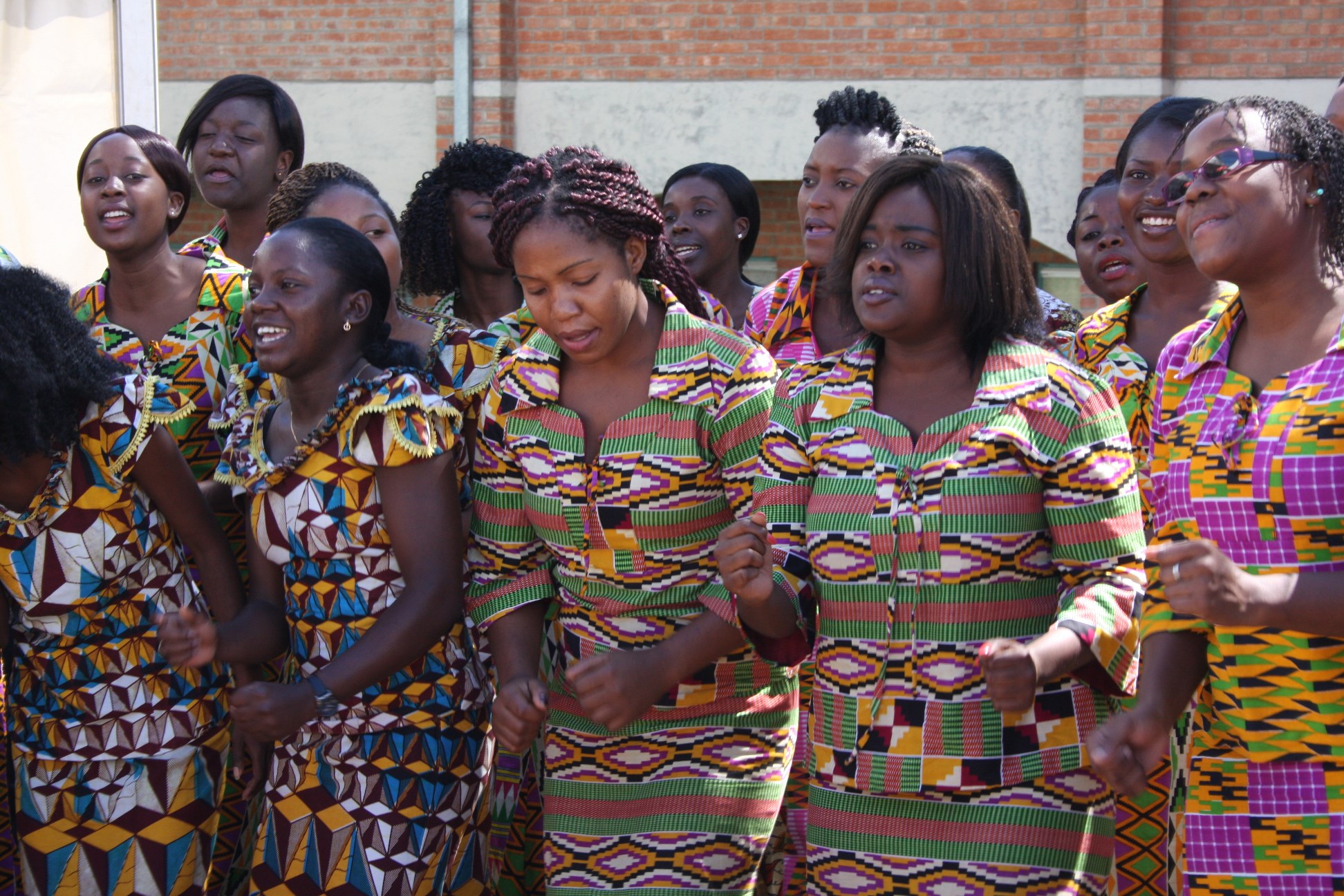
The Africa University Choir performs at the inauguration of Munashe Furusa as vice chancellor. Photo by Vicki Brown, UMNS
Donations will help meet needs
The need for more dorms got some help in the form of a $110,000 donation toward a new women’s dorm from the Lotteries and Gaming Board of the Zimbabwe Ministry of Home Affairs. Students cheered when James Salley, AU’s associate vice chancellor for Institutional Development, made the announcement.
Salley said the gift has a double benefit, since along with numerous other donations made in honor of Furusa’s inauguration, it puts the university well over the top in raising $500,000 for a grant from ELMA Philanthropies.
ELMA, a group of foundations in New York and South Africa, has partnered with Africa University to increase donations from Africa. ELMA will match donations from Africans by June 30 up to $500,000. Prior to the inauguration, about $385,000 had been raised toward the match.
More than $180,000 was donated to the university in honor of Furusa’s inauguration and checks were still coming in.
Salley announced numerous other donations from African businesses and the Zimbabwean government, including $10,000 from TelOne for the women’s dorm, and $7,000 worth of bandwidth for the university. The telecommunications company also pledged to provide three student internships.
Other donations were announced from many individuals and both chiefs – local leaders – who attended the event.
Endowed professorships
The largest donation announced during several days of ceremonies for the inauguration was the Indiana Conference’s gift of $1 million to an endowed chair in the Faculty of Agriculture and Natural Resources. The conference also pledged to raise $600,000 for scholarships.
The Foundation for Evangelism announced at the chancellor’s dinner that it is launching a campaign with Africa University to raise $1 million for an endowed professorship in theology.
The chair would be named for John Wesley Z. Kurewa, the first vice chancellor of the university, who has served as the E. Stanley Jones Professor of Evangelism at Africa University since 2000. The current E. Stanley Jones professorship is supported by the foundation, but not endowed.
Church and university connection
Zimbabwe Bishop Eben Nhiwatiwa praised Furusa for embracing The United Methodist Church as the university’s “perpetual friend.”
“You have all our support,” Nhiwatiwa said, noting local United Methodists were pleased when Furusa attended the Ebenezer Convention, a convention in Harare that was attended by 55,000 United Methodists in August 2014.
Bishop Marcus Matthews, vice chair of the AU board and leader of the Baltimore-Washington Conference, looks forward to Furusa’s leadership, saying the new vice chancellor’s years in higher education in the U.S. and his experience in development will be good for Africa University.
“He told me that his dream was to end his academic career in Zimbabwe, giving back to Africa. It’s kind of a dream fulfilled,” Matthews said.
Brown is news editor for United Methodist News Service. Taurai Emmanuel Maforo, communicator of the Zimbabwe Episcopal Area of The United Methodist Church, contributed to this story. Contact Brown at newsdesk@umcom.org or 615-742-7400.
Correction: This story now has the correct last name for John Wesley Z.Kurewa, the first vice chancellor of Africa University.

Download
Photo by Vicki Brown, UMNS
Munashe Furusa, Africa University's new vice chancellor, reports to the board of directors on issues facing the United Methodist school, including the need for more on need for more faculty with doctorates. Bishop Marcus Matthews, right, listens to the report.PreviousNext


Africa University, new leader face many challenges by Vicki Brown
MUTARE, Zimbabwe (UMNS)
As Africa University celebrated the installation of its new vice chancellor, the 23-year-old United Methodist-related university’s board struggled with growing pains.
The board of directors at its March 20 meeting discussed aging buildings, overcrowded dorms and the need for more professors with doctorates to retain Zimbabwean accreditation of programs.
Bright spots included the announcement of an endowed professorship in agriculture and natural resources, a fundraising campaign for an endowed chair in theology, a record 31 U.S. United Methodist conferences that paid 100 percent of their apportionments to the university, and an endowment that stands at $63.3 million. In addition, 1,405 students used the new online registrationsystem for the second semester of the 2014-15 academic year.
Munashe Furusa, who was inaugurated March 21 as the university’s top executive, reported on cost-cutting measures, a staff audit, a new program for a B.A. in media studies and planning for hospitality and tourism degree.
“We are looking at strategies to get people with Ph.D.s,” Furusa said. One of those strategies could be to help instructors or professors finish a doctoral program. Fifteen are now working on doctorates, Furusa said.
The Zimbabwe Education Ministry requires that 60 percent of instructors must have doctorates for accreditation of each faculty. A faculty at African University is the equivalent of a school or college at a university in the U.S. None of the faculties now meet that standard.
Furusa said he is developing plans to correct the problem by the end of 2016, but added that salaries and fringe benefits at Africa University are lower than at state universities in Zimbabwe. He said a candidate turned down an offer because of salary.
One strategy Africa University is exploring is to partner with the United Methodist Board of Global Ministries to find missionaries with doctorates to teach.
Growth brings new challenges
Bishop David Yemba, the university’s chancellor and a bishop in the Democratic Republic of Congo, said the university is at the right place, but growth is sometimes difficult.
“When we are growing, there are new challenges,” Yemba said.
Bishop Marcus Matthews, the board’s vice chair, agreed.
“To have a university that is only 23 years old that has all of its buildings paid for and no debt is a university with great opportunities ahead,” said Matthews, leader of the Baltimore-Washington Conference.
#UMC @Africa_Univ faces growing pains, including overcrowded dorms & shortage of profs with doctorates TWEET THIS
Matthews said he is excited about the university’s new leader, noting that Furusa is the first vice chancellor with significant development or fundraising experience as well as 17 years of experience in higher education in the U.S.
“How do we improve the infrastructure to the extent that the university is attractive to parents and students?” Matthews asked, suggesting that dorm renovations, better sports fields and more recreational opportunities would be a start.
The board approved a 2015-16 budget of $12 million with a provision that if income is more than that amount, more can be spent. Last year, total income was $12.8 million and the university ended the year with a $4,000 surplus, the finance committee report said.
Furusa said the university has 353 employees — 208 permanent and 115 on fixed-term contracts — for about 1,500 full-time students and another 1,000 enrolled part-time or through distance-learning programs. The staff includes more than 100 full-time professors, along with part-time and visiting lecturers. “This suggests the existing staff load is high for an institution of our size,” he said.
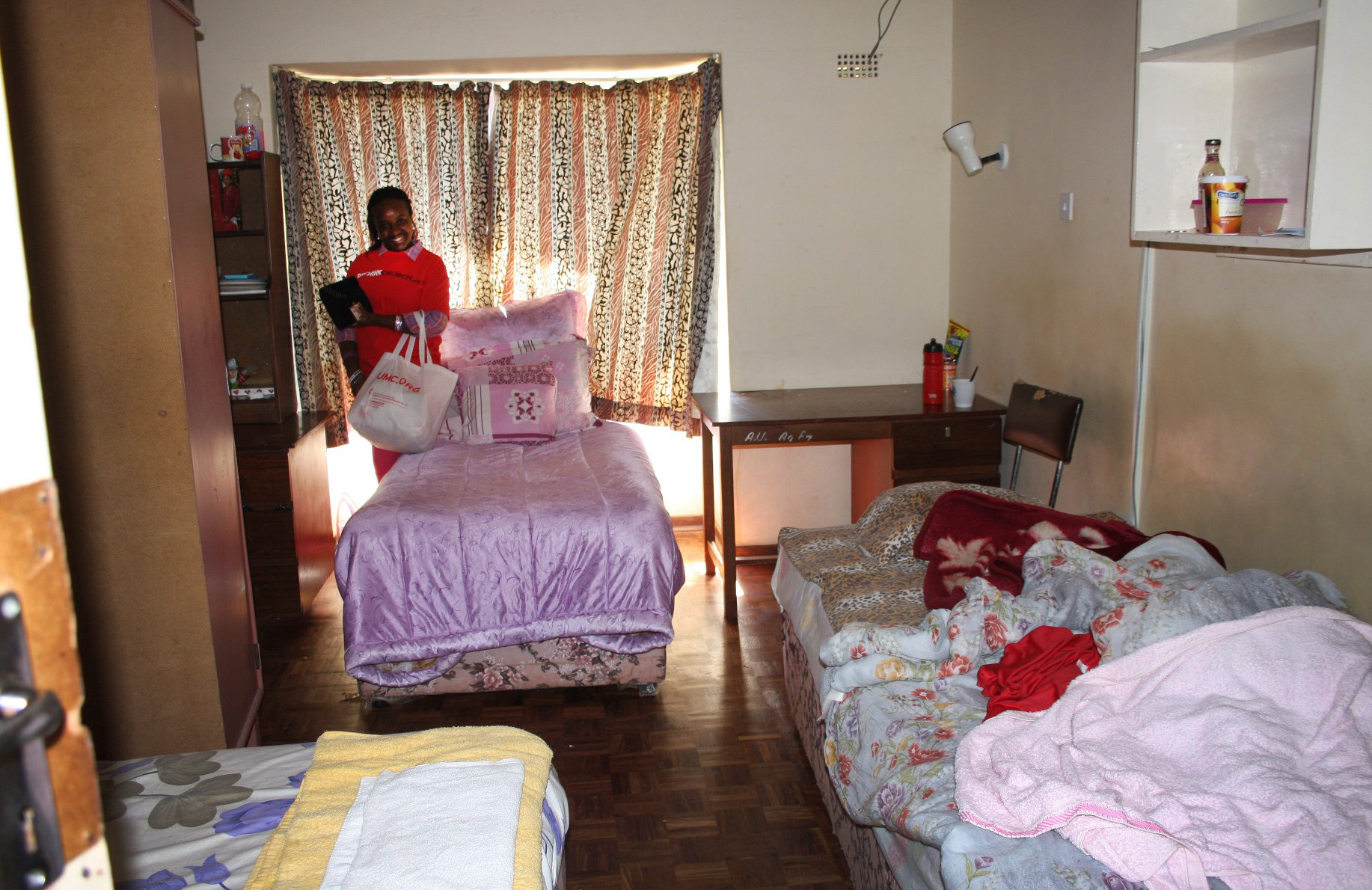
Three beds are visible in Tapiwawashe Muganyura's room in one of the women's residence halls at Africa University. The board of directors encouraged Vice Chancellor Munashe Furusa to come up with a plan to renovate the aging buildings and build new ones. Photo by Vicki Brown, UMNS
Aging, overcrowded dorms
“Accommodation for students remains a major challenge,” Furusa told the board.
Students now are living three to a room in rooms planned for two, with 27 students housed at a women’s center in Mutare and others living at the Fairfield Orphanage at Mutare Mission. Some common areas in the residence halls have been converted to living space, the building and grounds committee reported.
“I am saddened by the condition in which our students live,” said Maggie Jackson, the committee chair. The committee urged management to come up with a detailed plan for refurbishing the residence halls, seek funds for new residence halls, and consider using more off-campus housing to reduce crowding.
Students and alumni agree that more dorm rooms and recreational facilities are needed, although a gym has been set up in a vacant room. During the inauguration, donations announced included more than $120,000 toward a new women’s dorm.
Tapiwawashe Muganyura and Joshua Madzivanyika, both students from Zimbabwe, agreed that more and better residence halls are needed.
“For me, I’d like to see us boost extracurricular activities,” Madzivanyika said.
Alumni also are concerned about residence halls. Angeline Mafembo, a graduate who teaches at Watershed College in Zimbabwe and has a young sister who attends Africa University, said she worries about the safety of women who live off campus.
More than one board member said plans need to be drafted and estimates prepared so money can be raised for building new dorms.
Margaret Makadzange, a member of the board of directors, expressed concern that the residence halls and other issues discussed by the board were long-standing problems. “We have been talking about these things for many meetings. What is the way forward?”
Furusa reported to the board that the Ubuntu Retreat Center is not finished. The West Michigan District of the Michigan Conference raised $500,000 for the center. A timeline for completion was drawn up, and final payments are being withheld. Under an adjudication agreement of the dispute, if the contractor does not adhere to the completion timeline, the company can be replaced, Furusa said.
Furusa agreed that the university faces many challenges, but said plans are being developed and actions taken.
“At times it seems as though everything becomes a priority,” he told the board.
Brown is news editor for United Methodist News Service. Contact her at newsdesk@umcom.org or 615-742-7400.

Photo by Vicki Brown, UMNS
Africa University presents a gift to the Foundation for Evangelism delegation that attended the inauguration of Vice Chancellor Munashe Furusa and announced plans to endow a chair in the Faculty of Theology.


Kurewa: ‘This has been like Jesus at the mountain’ by Vicki Brown
MUTARE, Zimbabwe (UMNS)
John Wesley Kurewa compared the commitment by the Foundation for Evangelism to endow a professorship in Africa University’s Faculty of Theology to the experience of Jesus on the mountaintop.
“Don’t you wish we could stay here forever?” he asked supporters of the United Methodist university who were gathered for the chancellor’s dinner during several days of celebrations surrounding the inauguration of the new vice chancellor, Munashe Furusa.
Foundation officials announced a commitment to endow an E. Stanley Jones Professorship of Evangelism that will be named for Kurewa, who served from 1992-1997 as the first vice chancellor of the university. Kurewa is now the E. Stanley Jones Professor of Evangelism at Africa University.
The professorship is funded by the Foundation for Evangelism in Lake Junaluska, North Carolina, but not endowed. Endowment means raising enough money to ensure that income from those funds can support the chair in perpetuity.
Evangelism in Africa
During the dinner, Jane Boatwright Wood, president of the Foundation, and Larry Klemann, chairman of the board, announced plans to raise funds for the John Wesley Kurewa Chair, an E. Stanley Jones Professor of Evangelism, in partnership with Africa University. Details about the campaign, including a dollar goal, will be announced later.
Wood spoke of attending Kurewa’s class and experiencing his interaction with students, as well as hearing students speak of how their evangelism classes have equipped them for ministry.
“They spoke articulately about evangelism in Africa — culturally sensitive, Biblically grounded and life-transforming. They taught us about The United Methodist Church in Africa and together we discussed the profound impact of African theologians and Christian leaders on evangelism worldwide,” Wood said.
“They spoke with great respect and admiration of Dr. Kurewa, sharing personal stories of the impact his teaching and writing has had on their personal ministries. This experience has been a revival for us all,” she said.
Klemann said his interaction with students was especially meaningful.
“It is the memories of these accomplished, exceptional young leaders, their commitment to this university and to transforming lives that I will take away. But beyond that I will leave with a deep understanding that I have walked the campus of Africa University and experienced for myself the presence of God here among those gathered,” he said.
Training pastors as evangelicals
Kurewa, in thanking the foundation, said that the main purpose of the foundation is to “enable our pastors to understand and believe in evangelism.”
“If we cannot be evangelicals, then what did God call us for? We must introduce as many people to Christ as we can,” he said.
The foundation was established by Harry Denman, former top executive of the church’s Board of Evangelism, now part of the United Methodist Discipleship Ministries.
Denman, who had a passion for sharing the gospel message, recognized the need for an organization that would support the church in the practice of evangelism in the spirit of John Wesley and established the foundation to provide that support, Klemann said.
The foundation’s flagship program is the E. Stanley Jones Professors of Evangelism, which helps to ensure there is a professor of evangelism on faculty at every United Methodist seminary.
“We are keenly aware that in order to recruit and retain the most capable professors, funding is needed,” Klemann said.
Because of that, the foundation has partnerships with United Methodist seminaries and seminariestraining leaders in the Wesleyan tradition to place E. Stanley Jones professors of evangelism on the faculties of 10 United Methodist seminaries in the U.S., as well as professors in Germany, Moscow, and Africa University.
Kurewa left Africa University to teach in Ohio, returning in 2000 to the Faculty of Theology.
Brown is news editor for United Methodist News Service. Contact her at newsdesk@umcom.org or 615-742-7400.

Map by Andrew Heneen, Wikimedia Commons.
The plane was bound from Barcelona to Duesseldorf on March 24 when it crashed in a remote mountain valley in France.PreviousNext


Prayers asked for families of 150 dead in German plane crash by Kathy L. Gilbert
NASHVILLE, Tenn. (UMNS)
“Our country is in mourning,” said Germany’s United Methodist Bishop Rosemarie Wenner, for 150 who died in a plane crash reportedly caused intentionally by a co-pilot of a German A320.
“We are shocked by the news that one of the pilots obviously has chosen to bring all the people in the plane to death,” she said in a statement to United Methodist News Service.
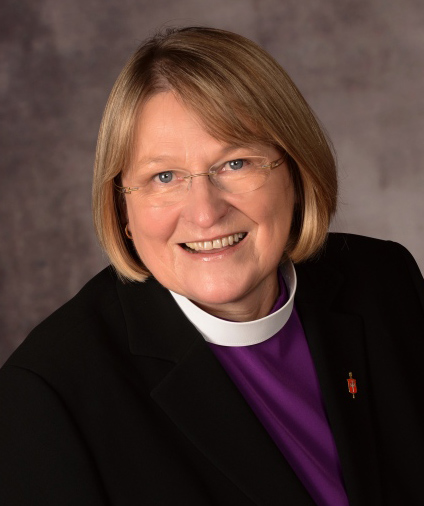
Bishop Rosemarie Wenner
Photo courtesy of the Council of Bishops.
The plane was bound from Barcelona to Duesseldorf on March 24 when it crashed in a remote mountain valley in France. Among the victims are a class of German high school students and teachers in Haltern, Westphalia, returning from an exchange visit to Spain.
French investigators have said the co-pilot, Andreas Lubitz, intentionally sent the plane into its doomed descent. Information recovered from the cockpit voice recorder revealed he took control of the plane when the captain left briefly to go to the restroom.
“It looks like a human tragedy,” Wenner said. “We are grateful for all the signs of sympathy from all over the world and for all those who assist those who are most affected,” she said.
The Rev. Klaus Ulrich Ruof, director of the United Methodist Germany Office of Communication, said all the pastors in the region were contacted but none reported any church members affected by the plane crash. As far as he knows, no United Methodist pastors are part of the teams involved in recovery or counseling.
Thomas Kemper, top executive of the United Methodist Board of Global Ministries, shared an emailhe received from United Evangelical Mission asking for prayer for the churches in Rhineland and Westphalia who are “doing their utmost to assist those who are now mourning.”
“The Rhenish Church has dispatched a team of 15 emergency counselors to Duesseldorf Airport to comfort and support those who are waiting for news of their family members and friends. They are going to stay there as long as they will be needed, which will likely be for many more hours,” said the Rev. Barbara Rudolph of the church board of the Evangelical Church of the Rhineland.
The World Council of Churches and the Conference of European Churches released a joint statement expressing grief over the news and calling for prayers for victims, their families and the teams working with them in the aftermath of the tragedy.
“As Christians we bring all who are mourning in God's presence, we pray for those who are working hard to rescue the victims and we are grateful for the service of counselors and others,” Wenner said.
Gilbert is a multimedia news reporter for United Methodist News Service. Contact her at (615) 742-5470 or newsdesk@umcom.org.

Photo illustration by Mike DuBose, UMNS
In 2014, giving to United Methodist ministries was up almost across the board.


Record number of conferences at 100 percent giving by Heather Hahn
NASHVILLE, Tenn. (UMNS)
If The United Methodist Church had a “Paid in Full” rubber stamp, it would likely need more ink.
That’s because — looking at recent years at least — a record number of conferences have paid 100 percent of their apportionments, part of an overall bright picture in denominational giving.
In 2014, 25 of 57 U.S. annual conferences paid full apportionments to support the national and international ministries of the general church. That number is up from 20 in both 2012 and 2013, and it’s the highest number in at least 10 years — the period of time for which the General Council on Finance and Administration, the denomination’s finance agency, has ready records.
The previous high was in 2007 when 23 conferences paid in full — just before the world economic crisis. At the time, the denomination had more than 60 conferences in the United States.
“I characterize this as very, very good news,” said Charlie Moore, a member of the finance agency’s board. He is chair of the board’s committee on General Agency and Episcopal Matters and a member of Community United Methodist Church in Crofton, Maryland. The Baltimore-Washington Conference, where he serves on the finance committee, is maintaining its tradition of paying 100 percent.
“I think it is a reflection of the recovering economy, but I also think it’s evidence of the continuing commitment on the part of the people in the pews and annual conference leadership to support the connection.”
Apportionments are the share each conference or local church pays to support international, national and regional missions. At the general church level, the money supports bishops, United Methodist ministerial education, most general agencies and denomination-wide efforts such as the Black College Fund and Africa University in Zimbabwe. The offering also pays for the work of United Methodist News Service.
"Very, very good news" #UMC conferences in record number contribute to general church ministries TWEET THIS
The giving begins at the local church.
Hand Memorial United Methodist Church in Pelham, Georgia, is among 10 South Georgia Conference churches that for the first time in years paid their full apportionments. The 161-member church last fully contributed in 2010.
The Rev. Carrie Myers, the church’s pastor, said re-educating the congregation on where the money goes — such as helping young pastors attend seminary — was a catalyst to more giving.
“We have recognized the overall ministry that can be done through apportionments because we can do more collectively across the globe than we can do as an individual church,” she said.
The church met its apportionments without shortchanging its local ministries, she added.
“We just had to remind ourselves that giving is important and God calls us to do that, and he calls us to give to more than the operating of the church budget.”
More signs of United Methodist generosity
The number of conferences in the 100 percent club is not the only positive sign.
PAID IN FULL
The following U.S. conferences paid full general church apportionments in 2014:
Alaska, Baltimore-Washington, Central Texas, Desert Southwest, East Ohio, Greater New Jersey, Holston, Illinois Great Rivers, Iowa, Kentucky, Minnesota, New York, New England, North Carolina, Oklahoma Indian Missionary, Oregon-Idaho, Peninsula-Delaware, Rio Grande, Rocky Mountain, Susquehanna, Tennessee, Western Pennsylvania, West Michigan, West Ohio and West Virginia
Preliminary figures from the General Council on Finance and Administration show 2014 United Methodist giving to support the denomination is up almost across the board.
Last year, United Methodists gave more than $130 million to general church funds, nearly 91 percent of the requested apportionments. That’san increase from 2013 when United Methodists gave $128.6 million to general church funds, an apportionment-collection rate of just under 90 percent.
The denomination's budget for general funds is based on the assumption that 86 percent of apportionments will be collected.
In 2014, giving also grew for five of the six Special Sundays — special offerings scheduled throughout the year to support various ministries of the church.
The Special Sundays designated by General Conference — the denomination’s top lawmaking body — are Human Relations Day, One Great Hour of Sharing, Native American Ministries Sunday, Peace with Justice Sunday, World Communion Sunday and United Methodist Student Day.
Only Native American Ministries Sunday, which supports Native American seminary students and congregations, saw a downturn in remittances from 2013.
The surge in giving comes as United Methodist membership and attendance in U.S. continues adecades-long-decline. However, Moore points out, those figures don’t tell the story of United Methodist generosity.
“I think what it boils down to is that the giving per member, or the giving per attendee, has been increasing,” Moore said.
He added: “I always characterize it that our church really doesn’t have a stewardship problem as much as it has an attendance problem. The stewardship amongst those who are still with us is still very significant, very positive.”
The United Methodist Church in fact is growing with now an estimated 12.8 million members worldwide.
U.S. United Methodists, at this point, bear the lion’s share of general church expenses. But that could change soon.
Church leaders, including bishops, in Africa, Europe and the Philippines have made it a goal to contribute more to the denomination’s global ministries. The General Council on Finance and Administration board is working with those leaders to develop an apportionment formula for conferences outside the United States that it will propose to the 2016 General Conference.
Every conference in Africa, Europe and the Philippines already contributes at least 10 percent of its bishop’s office expenses. Some pay as much as 80 percent. There are 76 conferences outside the United States.
The finance agency requests apportionments from each U.S. conference based on a formula that includes its local church expenditures, local church costs, the economic strength of the conference, and a base percentage approved by General Conference.
At the conference level
The increased giving at the general church level reflects the commitment on the part of conferences to the United Methodist connection.
RESOURCES ON UNITED METHODIST GIVING
Overview of how United Methodist giving is used
The United Methodist video series “Chuck Knows Church” on apportionments
Overview from the General Council on Finance and Administration on conferences' general church giving as of December 2014
Prayer, persistence, patience pay off for local churches
The 2012 General Conference lowers apportionments
The Financial Commitment Book approved by the 2012 General Conference. Report 8 explains the U.S. apportionment formula
“There is a lot of discussion among treasurers of the importance of paying apportionments at 100 percent,” said the Rev. Jodi Smith, the North Texas Conference’s director of the center for connectional resources. She is this year’s president of the National Association of Annual Conference Treasurers.
The Rocky Mountain Conference paid its full apportionments for the first time since 1976. The conference encompasses United Methodists in Colorado, Utah and parts of Wyoming.
Noreen Keleshian, conference treasurer and benefits officer, said the conference asks local churches to give 13 percent of their incomes, adjusted for such things as payments to endowment funds. Usually, about half of the churches pay that percentage, Keleshian said.
The conference also budgets to pay 95 percent of its general church apportionments. But meeting that goal depends largely on the vagaries of local church finances.
“If the churches have a bad year,” she said, “we don’t get as much money.”
In 2014, many Rocky Mountain churches clearly had a good year. Revenue came in at about $115,000 higher than the conference had budgeted, and expenses ended up lower. When the conference’s finance council met in December, it decided immediately to use the surplus to pay its apportionments in full.
Now that it has done so, the Rocky Mountain Conference’s Bishop Elaine Stanovsky is pushing the conference to continue contributing the full amount.
Keleshian is sharing the news around the conference.
“Whenever I say, ‘With your help — with the generosity of the churches in the conference — we paid our apportionments at 100 percent,’ you can hear an audible gasp and then everybody claps,” she said. “It’s important for our solid churches that do pay to hear that we’ve met our commitment.”
Hahn is a multimedia news reporter for United Methodist News Service. Contact her at (615) 742-5470 or newsdesk@umcom.org.
Photo by Vicki Brown, UMNS
Munashe Furusa, Africa University's new vice chancellor, reports to the board of directors on issues facing the United Methodist school, including the need for more on need for more faculty with doctorates. Bishop Marcus Matthews, right, listens to the report.PreviousNext
Africa University, new leader face many challenges by Vicki Brown
MUTARE, Zimbabwe (UMNS)
As Africa University celebrated the installation of its new vice chancellor, the 23-year-old United Methodist-related university’s board struggled with growing pains.
The board of directors at its March 20 meeting discussed aging buildings, overcrowded dorms and the need for more professors with doctorates to retain Zimbabwean accreditation of programs.
Bright spots included the announcement of an endowed professorship in agriculture and natural resources, a fundraising campaign for an endowed chair in theology, a record 31 U.S. United Methodist conferences that paid 100 percent of their apportionments to the university, and an endowment that stands at $63.3 million. In addition, 1,405 students used the new online registrationsystem for the second semester of the 2014-15 academic year.
Munashe Furusa, who was inaugurated March 21 as the university’s top executive, reported on cost-cutting measures, a staff audit, a new program for a B.A. in media studies and planning for hospitality and tourism degree.
“We are looking at strategies to get people with Ph.D.s,” Furusa said. One of those strategies could be to help instructors or professors finish a doctoral program. Fifteen are now working on doctorates, Furusa said.
The Zimbabwe Education Ministry requires that 60 percent of instructors must have doctorates for accreditation of each faculty. A faculty at African University is the equivalent of a school or college at a university in the U.S. None of the faculties now meet that standard.
Furusa said he is developing plans to correct the problem by the end of 2016, but added that salaries and fringe benefits at Africa University are lower than at state universities in Zimbabwe. He said a candidate turned down an offer because of salary.
One strategy Africa University is exploring is to partner with the United Methodist Board of Global Ministries to find missionaries with doctorates to teach.
Growth brings new challenges
Bishop David Yemba, the university’s chancellor and a bishop in the Democratic Republic of Congo, said the university is at the right place, but growth is sometimes difficult.
“When we are growing, there are new challenges,” Yemba said.
Bishop Marcus Matthews, the board’s vice chair, agreed.
“To have a university that is only 23 years old that has all of its buildings paid for and no debt is a university with great opportunities ahead,” said Matthews, leader of the Baltimore-Washington Conference.
#UMC @Africa_Univ faces growing pains, including overcrowded dorms & shortage of profs with doctorates
TWEET THISMatthews said he is excited about the university’s new leader, noting that Furusa is the first vice chancellor with significant development or fundraising experience as well as 17 years of experience in higher education in the U.S.
“How do we improve the infrastructure to the extent that the university is attractive to parents and students?” Matthews asked, suggesting that dorm renovations, better sports fields and more recreational opportunities would be a start.
The board approved a 2015-16 budget of $12 million with a provision that if income is more than that amount, more can be spent. Last year, total income was $12.8 million and the university ended the year with a $4,000 surplus, the finance committee report said.
Furusa said the university has 353 employees — 208 permanent and 115 on fixed-term contracts — for about 1,500 full-time students and another 1,000 enrolled part-time or through distance-learning programs. The staff includes more than 100 full-time professors, along with part-time and visiting lecturers. “This suggests the existing staff load is high for an institution of our size,” he said.
Three beds are visible in Tapiwawashe Muganyura's room in one of the women's residence halls at Africa University. The board of directors encouraged Vice Chancellor Munashe Furusa to come up with a plan to renovate the aging buildings and build new ones. Photo by Vicki Brown, UMNS
Aging, overcrowded dorms
“Accommodation for students remains a major challenge,” Furusa told the board.
Students now are living three to a room in rooms planned for two, with 27 students housed at a women’s center in Mutare and others living at the Fairfield Orphanage at Mutare Mission. Some common areas in the residence halls have been converted to living space, the building and grounds committee reported.
“I am saddened by the condition in which our students live,” said Maggie Jackson, the committee chair. The committee urged management to come up with a detailed plan for refurbishing the residence halls, seek funds for new residence halls, and consider using more off-campus housing to reduce crowding.
Students and alumni agree that more dorm rooms and recreational facilities are needed, although a gym has been set up in a vacant room. During the inauguration, donations announced included more than $120,000 toward a new women’s dorm.
Tapiwawashe Muganyura and Joshua Madzivanyika, both students from Zimbabwe, agreed that more and better residence halls are needed.
“For me, I’d like to see us boost extracurricular activities,” Madzivanyika said.
Alumni also are concerned about residence halls. Angeline Mafembo, a graduate who teaches at Watershed College in Zimbabwe and has a young sister who attends Africa University, said she worries about the safety of women who live off campus.
More than one board member said plans need to be drafted and estimates prepared so money can be raised for building new dorms.
Margaret Makadzange, a member of the board of directors, expressed concern that the residence halls and other issues discussed by the board were long-standing problems. “We have been talking about these things for many meetings. What is the way forward?”
Furusa reported to the board that the Ubuntu Retreat Center is not finished. The West Michigan District of the Michigan Conference raised $500,000 for the center. A timeline for completion was drawn up, and final payments are being withheld. Under an adjudication agreement of the dispute, if the contractor does not adhere to the completion timeline, the company can be replaced, Furusa said.
Furusa agreed that the university faces many challenges, but said plans are being developed and actions taken.
“At times it seems as though everything becomes a priority,” he told the board.
Brown is news editor for United Methodist News Service. Contact her at newsdesk@umcom.org or 615-742-7400.
Photo by Vicki Brown, UMNS
Africa University presents a gift to the Foundation for Evangelism delegation that attended the inauguration of Vice Chancellor Munashe Furusa and announced plans to endow a chair in the Faculty of Theology.
Kurewa: ‘This has been like Jesus at the mountain’ by Vicki Brown
MUTARE, Zimbabwe (UMNS)
John Wesley Kurewa compared the commitment by the Foundation for Evangelism to endow a professorship in Africa University’s Faculty of Theology to the experience of Jesus on the mountaintop.
“Don’t you wish we could stay here forever?” he asked supporters of the United Methodist university who were gathered for the chancellor’s dinner during several days of celebrations surrounding the inauguration of the new vice chancellor, Munashe Furusa.
Foundation officials announced a commitment to endow an E. Stanley Jones Professorship of Evangelism that will be named for Kurewa, who served from 1992-1997 as the first vice chancellor of the university. Kurewa is now the E. Stanley Jones Professor of Evangelism at Africa University.
The professorship is funded by the Foundation for Evangelism in Lake Junaluska, North Carolina, but not endowed. Endowment means raising enough money to ensure that income from those funds can support the chair in perpetuity.
Evangelism in Africa
During the dinner, Jane Boatwright Wood, president of the Foundation, and Larry Klemann, chairman of the board, announced plans to raise funds for the John Wesley Kurewa Chair, an E. Stanley Jones Professor of Evangelism, in partnership with Africa University. Details about the campaign, including a dollar goal, will be announced later.
Wood spoke of attending Kurewa’s class and experiencing his interaction with students, as well as hearing students speak of how their evangelism classes have equipped them for ministry.
“They spoke articulately about evangelism in Africa — culturally sensitive, Biblically grounded and life-transforming. They taught us about The United Methodist Church in Africa and together we discussed the profound impact of African theologians and Christian leaders on evangelism worldwide,” Wood said.
“They spoke with great respect and admiration of Dr. Kurewa, sharing personal stories of the impact his teaching and writing has had on their personal ministries. This experience has been a revival for us all,” she said.
Klemann said his interaction with students was especially meaningful.
“It is the memories of these accomplished, exceptional young leaders, their commitment to this university and to transforming lives that I will take away. But beyond that I will leave with a deep understanding that I have walked the campus of Africa University and experienced for myself the presence of God here among those gathered,” he said.
Training pastors as evangelicals
Kurewa, in thanking the foundation, said that the main purpose of the foundation is to “enable our pastors to understand and believe in evangelism.”
“If we cannot be evangelicals, then what did God call us for? We must introduce as many people to Christ as we can,” he said.
The foundation was established by Harry Denman, former top executive of the church’s Board of Evangelism, now part of the United Methodist Discipleship Ministries.
Denman, who had a passion for sharing the gospel message, recognized the need for an organization that would support the church in the practice of evangelism in the spirit of John Wesley and established the foundation to provide that support, Klemann said.
The foundation’s flagship program is the E. Stanley Jones Professors of Evangelism, which helps to ensure there is a professor of evangelism on faculty at every United Methodist seminary.
“We are keenly aware that in order to recruit and retain the most capable professors, funding is needed,” Klemann said.
Because of that, the foundation has partnerships with United Methodist seminaries and seminariestraining leaders in the Wesleyan tradition to place E. Stanley Jones professors of evangelism on the faculties of 10 United Methodist seminaries in the U.S., as well as professors in Germany, Moscow, and Africa University.
Kurewa left Africa University to teach in Ohio, returning in 2000 to the Faculty of Theology.
Brown is news editor for United Methodist News Service. Contact her at newsdesk@umcom.org or 615-742-7400.
Map by Andrew Heneen, Wikimedia Commons.
The plane was bound from Barcelona to Duesseldorf on March 24 when it crashed in a remote mountain valley in France.PreviousNext
Prayers asked for families of 150 dead in German plane crash by Kathy L. Gilbert
NASHVILLE, Tenn. (UMNS)
“Our country is in mourning,” said Germany’s United Methodist Bishop Rosemarie Wenner, for 150 who died in a plane crash reportedly caused intentionally by a co-pilot of a German A320.
“We are shocked by the news that one of the pilots obviously has chosen to bring all the people in the plane to death,” she said in a statement to United Methodist News Service.
Bishop Rosemarie Wenner
Photo courtesy of the Council of Bishops.
The plane was bound from Barcelona to Duesseldorf on March 24 when it crashed in a remote mountain valley in France. Among the victims are a class of German high school students and teachers in Haltern, Westphalia, returning from an exchange visit to Spain.
French investigators have said the co-pilot, Andreas Lubitz, intentionally sent the plane into its doomed descent. Information recovered from the cockpit voice recorder revealed he took control of the plane when the captain left briefly to go to the restroom.
“It looks like a human tragedy,” Wenner said. “We are grateful for all the signs of sympathy from all over the world and for all those who assist those who are most affected,” she said.
The Rev. Klaus Ulrich Ruof, director of the United Methodist Germany Office of Communication, said all the pastors in the region were contacted but none reported any church members affected by the plane crash. As far as he knows, no United Methodist pastors are part of the teams involved in recovery or counseling.
Thomas Kemper, top executive of the United Methodist Board of Global Ministries, shared an emailhe received from United Evangelical Mission asking for prayer for the churches in Rhineland and Westphalia who are “doing their utmost to assist those who are now mourning.”
“The Rhenish Church has dispatched a team of 15 emergency counselors to Duesseldorf Airport to comfort and support those who are waiting for news of their family members and friends. They are going to stay there as long as they will be needed, which will likely be for many more hours,” said the Rev. Barbara Rudolph of the church board of the Evangelical Church of the Rhineland.
The World Council of Churches and the Conference of European Churches released a joint statement expressing grief over the news and calling for prayers for victims, their families and the teams working with them in the aftermath of the tragedy.
“As Christians we bring all who are mourning in God's presence, we pray for those who are working hard to rescue the victims and we are grateful for the service of counselors and others,” Wenner said.
Gilbert is a multimedia news reporter for United Methodist News Service. Contact her at (615) 742-5470 or newsdesk@umcom.org.
Photo illustration by Mike DuBose, UMNS
In 2014, giving to United Methodist ministries was up almost across the board.
Record number of conferences at 100 percent giving by Heather Hahn
NASHVILLE, Tenn. (UMNS)
If The United Methodist Church had a “Paid in Full” rubber stamp, it would likely need more ink.
That’s because — looking at recent years at least — a record number of conferences have paid 100 percent of their apportionments, part of an overall bright picture in denominational giving.
In 2014, 25 of 57 U.S. annual conferences paid full apportionments to support the national and international ministries of the general church. That number is up from 20 in both 2012 and 2013, and it’s the highest number in at least 10 years — the period of time for which the General Council on Finance and Administration, the denomination’s finance agency, has ready records.
The previous high was in 2007 when 23 conferences paid in full — just before the world economic crisis. At the time, the denomination had more than 60 conferences in the United States.
“I characterize this as very, very good news,” said Charlie Moore, a member of the finance agency’s board. He is chair of the board’s committee on General Agency and Episcopal Matters and a member of Community United Methodist Church in Crofton, Maryland. The Baltimore-Washington Conference, where he serves on the finance committee, is maintaining its tradition of paying 100 percent.
“I think it is a reflection of the recovering economy, but I also think it’s evidence of the continuing commitment on the part of the people in the pews and annual conference leadership to support the connection.”
Apportionments are the share each conference or local church pays to support international, national and regional missions. At the general church level, the money supports bishops, United Methodist ministerial education, most general agencies and denomination-wide efforts such as the Black College Fund and Africa University in Zimbabwe. The offering also pays for the work of United Methodist News Service.
"Very, very good news" #UMC conferences in record number contribute to general church ministries
TWEET THISThe giving begins at the local church.
Hand Memorial United Methodist Church in Pelham, Georgia, is among 10 South Georgia Conference churches that for the first time in years paid their full apportionments. The 161-member church last fully contributed in 2010.
The Rev. Carrie Myers, the church’s pastor, said re-educating the congregation on where the money goes — such as helping young pastors attend seminary — was a catalyst to more giving.
“We have recognized the overall ministry that can be done through apportionments because we can do more collectively across the globe than we can do as an individual church,” she said.
The church met its apportionments without shortchanging its local ministries, she added.
“We just had to remind ourselves that giving is important and God calls us to do that, and he calls us to give to more than the operating of the church budget.”
More signs of United Methodist generosity
The number of conferences in the 100 percent club is not the only positive sign.
PAID IN FULL
The following U.S. conferences paid full general church apportionments in 2014:
Alaska, Baltimore-Washington, Central Texas, Desert Southwest, East Ohio, Greater New Jersey, Holston, Illinois Great Rivers, Iowa, Kentucky, Minnesota, New York, New England, North Carolina, Oklahoma Indian Missionary, Oregon-Idaho, Peninsula-Delaware, Rio Grande, Rocky Mountain, Susquehanna, Tennessee, Western Pennsylvania, West Michigan, West Ohio and West Virginia
Preliminary figures from the General Council on Finance and Administration show 2014 United Methodist giving to support the denomination is up almost across the board.
Last year, United Methodists gave more than $130 million to general church funds, nearly 91 percent of the requested apportionments. That’san increase from 2013 when United Methodists gave $128.6 million to general church funds, an apportionment-collection rate of just under 90 percent.
The denomination's budget for general funds is based on the assumption that 86 percent of apportionments will be collected.
In 2014, giving also grew for five of the six Special Sundays — special offerings scheduled throughout the year to support various ministries of the church.
The Special Sundays designated by General Conference — the denomination’s top lawmaking body — are Human Relations Day, One Great Hour of Sharing, Native American Ministries Sunday, Peace with Justice Sunday, World Communion Sunday and United Methodist Student Day.
Only Native American Ministries Sunday, which supports Native American seminary students and congregations, saw a downturn in remittances from 2013.
The surge in giving comes as United Methodist membership and attendance in U.S. continues adecades-long-decline. However, Moore points out, those figures don’t tell the story of United Methodist generosity.
“I think what it boils down to is that the giving per member, or the giving per attendee, has been increasing,” Moore said.
He added: “I always characterize it that our church really doesn’t have a stewardship problem as much as it has an attendance problem. The stewardship amongst those who are still with us is still very significant, very positive.”
The United Methodist Church in fact is growing with now an estimated 12.8 million members worldwide.
U.S. United Methodists, at this point, bear the lion’s share of general church expenses. But that could change soon.
Church leaders, including bishops, in Africa, Europe and the Philippines have made it a goal to contribute more to the denomination’s global ministries. The General Council on Finance and Administration board is working with those leaders to develop an apportionment formula for conferences outside the United States that it will propose to the 2016 General Conference.
Every conference in Africa, Europe and the Philippines already contributes at least 10 percent of its bishop’s office expenses. Some pay as much as 80 percent. There are 76 conferences outside the United States.
The finance agency requests apportionments from each U.S. conference based on a formula that includes its local church expenditures, local church costs, the economic strength of the conference, and a base percentage approved by General Conference.
At the conference level
The increased giving at the general church level reflects the commitment on the part of conferences to the United Methodist connection.
RESOURCES ON UNITED METHODIST GIVING
Overview of how United Methodist giving is used
The United Methodist video series “Chuck Knows Church” on apportionments
Overview from the General Council on Finance and Administration on conferences' general church giving as of December 2014
Prayer, persistence, patience pay off for local churches
The 2012 General Conference lowers apportionments
The Financial Commitment Book approved by the 2012 General Conference. Report 8 explains the U.S. apportionment formula
“There is a lot of discussion among treasurers of the importance of paying apportionments at 100 percent,” said the Rev. Jodi Smith, the North Texas Conference’s director of the center for connectional resources. She is this year’s president of the National Association of Annual Conference Treasurers.
The Rocky Mountain Conference paid its full apportionments for the first time since 1976. The conference encompasses United Methodists in Colorado, Utah and parts of Wyoming.
Noreen Keleshian, conference treasurer and benefits officer, said the conference asks local churches to give 13 percent of their incomes, adjusted for such things as payments to endowment funds. Usually, about half of the churches pay that percentage, Keleshian said.
The conference also budgets to pay 95 percent of its general church apportionments. But meeting that goal depends largely on the vagaries of local church finances.
“If the churches have a bad year,” she said, “we don’t get as much money.”
In 2014, many Rocky Mountain churches clearly had a good year. Revenue came in at about $115,000 higher than the conference had budgeted, and expenses ended up lower. When the conference’s finance council met in December, it decided immediately to use the surplus to pay its apportionments in full.
Now that it has done so, the Rocky Mountain Conference’s Bishop Elaine Stanovsky is pushing the conference to continue contributing the full amount.
Keleshian is sharing the news around the conference.
“Whenever I say, ‘With your help — with the generosity of the churches in the conference — we paid our apportionments at 100 percent,’ you can hear an audible gasp and then everybody claps,” she said. “It’s important for our solid churches that do pay to hear that we’ve met our commitment.”
Hahn is a multimedia news reporter for United Methodist News Service. Contact her at (615) 742-5470 or newsdesk@umcom.org.
Prayer, persistence, patience pay off for local churches by Kara Witherow
It took prayer, persistence, and patience, but last year, for the first time since 2006, Ashburn First United Methodist Church paid 100 percent of its apportionments.
It was one of a handful of South Georgia congregations that had not paid 100 percent of their apportionments in several years and then paid them in full in 2014.
For Ashburn First UMC, understanding, education, and developing a long-term plan were critical to their success.
“They wanted to do the right thing,” Rev. Alan Miller said of his Ashburn First UMC congregation. But finances aren’t flowing like they once did for the small church in a county-seat town. “It’s easy to see some things as non-essentials.”
When Rev. Miller was appointed to Ashburn First UMC in June 2010 the church was paying little more than 20 percent of its apportionments. With a focus on education and understanding – and a look toward the future – the finance team, backed by church leaders and the congregation, developed a plan to slowly increase giving each year. They also took a hard look at expenses, lowered them, and managed their resources well, all while maintaining an aging property.
“I felt like if I would have pushed it too soon I might have lost the battle – people would have been too pressured. So every year we incrementally upped our giving and last year I saw that it was within reach and that we could do this,” Rev. Miller said.
He credits former District Superintendent Dr. Wayne Moseley’s and current District Superintendent Dr. Nita Crump’s gentle guidance and supportive spirits for helping the congregation. He also says that Sycamore UMC, which is a member of a two-point charge with Ashburn First UMC, was an encouragement to the congregation.
“Sycamore, with its 15 or so members, pays its apportionments and has for years and years, and we’re grateful for that and their inspiration,” he said.
Being a fully connectional church is important to Rev. Miller and the Ashburn First UMC congregation, and they are proud of the hard work they have done.
“The UMC is a connectional partnership and apportionments are our share of the total weight and responsibility of doing the work and ministry we have been called to do,” Rev. Miller said. “This is a great accomplishment by a great group of people at Ashburn First UMC. I’m proud of them, I’m proud of what they’ve done, and I’m proud of the open hearts they’ve kept about it all.”
Forest Hills United Methodist didn’t have a funding problem, they had a budgeting problem.
The Macon church – one of the largest in the conference – hadn’t fully paid its apportionments since 2007 and hadn’t fully budgeted for them in years, either.
Prior to Rev. Baxter Hurley’s June 2013 appointment to Forest Hills UMC, Bishop King strongly encouraged pastors of the conference’s largest churches to increase their apportionment giving to 100 percent.
“We realized that the problem wasn’t with a lack of funds in the church,” Rev. Hurley said when he and church leaders looked at the finances. “We weren’t budgeting for apportionments. We were only budgeting for 70 percent and we weren’t even paying 70 percent. So I said the next year we had to budget 100 percent, and they agreed.”
But since the church carries some debt, reallocating funds was a matter of trust and reprioritization, he said. Funds that had been earmarked in the past fordebt reduction have now been budgeted for apportionment giving. The debt will be paid, Rev. Hurley said, but the refocusing was important.
“I bought into the Methodist system when I became a UM pastor,” Rev. Hurley said. “I believe in the apportionment system and where the money goes, so I want to make sure my church fully funds those.”
Forest Hills UMC is unique in that it has several United Methodist clergy who are affiliated with the congregation but not appointed to the church. A few are retired clergy and others are extension minsters, but all understand the importance of apportionment giving. Several long-standing laity also advocated for the increase in apportionment giving.
“It was a quiet and strong witness that helped bolster the argument that I was making,” Rev. Hurley said.
Ashburn First UMC and Forest Hills UMC are just two of 10 South Georgia UM churches that in 2014 fully paid their apportionments for the first time in several years. The others were Adrian UMC (for the first time since 2010), Andrew UMC (for the first time since 2010), Attapulgus (for the first time since 2009), Bloomfield UMC (for the first time since 2010), Grace UMC – Savannah (for the first time since since 2010), Hand Memorial UMC (for the first time since 2010), Hilton UMC (for the first time since 2011), and Nepsey-Warren UMC (for the first time since 2010). Click here for a list of churches that paid more than 100% of their 2014 apportionments.
Of the 621 local churches in the South Georgia Conference, 428 paid 100 percent of their apportionments and an additional 21 churches paid more than 100 percent.
“That’s 72 percent of our congregations at or over the 100 percent mark,” said Dr. Derek McAleer, Director of Administrative Services. “It is also gratifying to see that 93 congregations increased the percentage they paid in 2014 over 2013. This is a wonderful sign of their generous spirit.”
Balancing the mission of the church with the needs of a large and well-used facility has been a challenge for Leesburg United Methodist Church.
The congregation paid their pension and insurance benefits cost in full in 2014, which was a great step forward, and now have set their sights on paying their 2015 apportionments in full. They are on track to do so and have already mailed in their first payment.
“Apportionments have been a shadow on the church, like a dark cloud … they have not been paying apportionments like they have wanted to,” said Tim Hunter, a certified public accountant and Leesburg UMC’s finance committee chairman.
With a focus on prayer, education and transparency, the congregation has had a pretty remarkable turnaround in its finances.
“Constant prayer is driving this,” he said. “We kind of have to step out in faith, too, and make that payment each month even if we’re kind of short on something else or if the tithes didn’t come in like we expected it. It’s a step in faith and an expectation that God will do what we know He can do.”
A few insights into how each dollar given in a local church is spent:

Photo by Kathryn Spry
Cadence Cobb (left) and her mother, Megan Cobb, dig at Hillcrest United Methodist Church, Nashville, Tennessee, where they were among the 75 volunteers from the congregation and the surrounding community planting 250 native trees as part of a Creation Care effort on March 14, 2015.


Assuming role of ‘creation care’ as God’s mandate by Linda Bloom
NEW YORK (UMNS)
For some United Methodists, taking care of God’s creation is a biblical mandate.
As the Rev. Josh Amerson, associate pastor at Glenn Memorial United Methodist Church in Atlanta, points out, “God's first word to Adam was to till and keep the earth. We humans have done exceedingly well at the tilling, but until recently the keeping has been overlooked.”
While Glenn Memorial is focusing on sustainability through practices like composting and recycling, Amerson added, “We are eager to engage with environmental justice issues that will impact communities around the world.”
This spring, the congregation is lending support to the denomination’s annual creation care conference, "Environmental Resurrection: Let Justice Roll Down Like Waters," which meets in the Atlanta area April 24-25 at Decatur First United Methodist Church.
A free concurrent event for teens, Youth Climate Convergence!, is set for 10:30 a.m. to 3:30 p.m. Saturday, April 25, at the church. A special Saturday dinner in Decatur is planned by seminary students for all seminary student attendees.
“Too often, caring for the environment has been seen as separated from — or even antithetical to — our calling as Christians,” said the Rev. Katy Hinman, associate minister of Decatur First. “My hope is that this conference will help people understand that our care for other people and for justice is intimately tied to our treatment of all of God's creation.”
Lydia Stewart Castle, Glenn Memorial’s environmental committee chair, agreed, noting the importance of making connections between faith and a personal responsibility to care for the earth. “Co-hosting the caring for creation conference furthers this mission because it raises awareness, provides the opportunity to share with like-minded people, strengthens our faith, and encourages us to set examples for others,” she said.
Target audience: people of faith
Now in its eighth year, the creation care conference was started as a mission of the Lake Junaluska Conference and Retreat Center, says Michael Paul Black, a lay member of Decatur First and a faculty member in the neuroscience department at Georgia State University.
Black later volunteered to organize the event in the Atlanta area, where Peachtree Road United Methodist Church was the host last year. Both Decatur First and Glenn Memorial have made larger commitments to this year’s conference, he noted.
For the first time, Caretakers of God’s Creation — a grassroots denominational group now related to the United Methodist Board of Global Ministries — is playing a central role as a conference organizer and sponsor, he said. The Rev. Pat Watkins, a United Methodist missionary who helps guide the organization, is among the speakers.
TO REGISTER
The theme for this year's national creation care conference, April 24-25 at the campus of Decatur First United Methodist Church near Atlanta, is "Environmental Resurrection: Let Justice Roll Down Like Waters." Find registration information here.
The target audience is all people of faith. The idea was to have a mix of speakers from the fields of science and theology “so that we can have a dialogue,” Black explained.
The April 24 noon keynote address, for example, features Matthew Tejada, director of environmental justice for the U.S. Environmental Protection Agency, and Ellen Ott Marshall, associate professor of Christian Ethics and conflict transformation at Emory University’s Candler School of Theology.
Some speakers will focus on the need for climate-related work in areas where The United Methodist Church already is assisting low-income or disadvantaged communities, Black said.
For example, the denomination’s Imagine No Malaria initiative has helped lower infections in Africa, but climate change also has affected rainfall patterns there. “If we don’t get a handle on climate change, the areas hit by mosquito-borne malaria are going to be much larger,” he explained.
In addition to speakers and panelists, the program includes workshops, environmental justice working groups, and Friday morning tour options of places such as the Atlanta Beltline and historic Fourth Ward Park, which are generating “great case studies” of transforming areas that suffered environmental degradation, Black said.
‘All have a role’
Church members, congregations and The United Methodist Church as a whole “all have a role toplay in living responsibly on this Earth in a way that helps to bring peace, justice, and provision to all people,” Hinman pointed out.
At Decatur First, that realization has translated into actions both practical and liturgical, from retrofitting sanctuary lighting and sponsoring a community-wide recycling event to incorporating environmental justice themes into worship.
Their actions could have an impact far beyond the Atlanta area, noted Gary Garrett, a congregation member and senior technical analyst for the Southern States Energy Board.
“Climate change is much more likely to impact and disrupt the lives of millions of marginalized worldwide, and we as people of faith are called upon to act and advocate on behalf of those who do not have a voice — to reduce greenhouse gas emissions from human activity such as burning fossil fuels for electricity and transportation,” he said.
It’s important to understand that looking after the environment is a way of ministering “to the least of these,” said Beth Bond, a member of Decatur First and curator of sustainable news for Southeast Green, which promotes a sustainable economy.
“Whether it's clean water, chemical-free food, or healthy air, millions of disadvantaged populations are affected by these environmental effects,” she explained. “As God's people, part of us taking care of these sensitive populations is taking care of the planet. Creation care is a key component of social justice.”
Bloom is a United Methodist News Service multimedia reporter based in New York. Follow her athttps://twitter.com/umcscribe or contact her at (646) 369-3759 or newsdesk@umcom.org
'Bloody Sunday' 50th: Sights and SoundsSELMA, Ala. (UMNS) — On the weekend of March 7-8, tens of thousands converged on Selma, Alabama, to commemorate the 50th anniversary of "Bloody Sunday," where civil rights workers were severely beaten by state and local police as they crossed the Edmund Pettus Bridge on March 7, 1965. United Methodist News Service photographer Mike DuBose was there to document the experience.
View slideshow
View mobile-friendly version
http://www.umc.org/news-and-media/bloody-sunday-50th-anniversary-sights-and-sounds
It took prayer, persistence, and patience, but last year, for the first time since 2006, Ashburn First United Methodist Church paid 100 percent of its apportionments.
It was one of a handful of South Georgia congregations that had not paid 100 percent of their apportionments in several years and then paid them in full in 2014.
For Ashburn First UMC, understanding, education, and developing a long-term plan were critical to their success.
“They wanted to do the right thing,” Rev. Alan Miller said of his Ashburn First UMC congregation. But finances aren’t flowing like they once did for the small church in a county-seat town. “It’s easy to see some things as non-essentials.”
When Rev. Miller was appointed to Ashburn First UMC in June 2010 the church was paying little more than 20 percent of its apportionments. With a focus on education and understanding – and a look toward the future – the finance team, backed by church leaders and the congregation, developed a plan to slowly increase giving each year. They also took a hard look at expenses, lowered them, and managed their resources well, all while maintaining an aging property.
“I felt like if I would have pushed it too soon I might have lost the battle – people would have been too pressured. So every year we incrementally upped our giving and last year I saw that it was within reach and that we could do this,” Rev. Miller said.
He credits former District Superintendent Dr. Wayne Moseley’s and current District Superintendent Dr. Nita Crump’s gentle guidance and supportive spirits for helping the congregation. He also says that Sycamore UMC, which is a member of a two-point charge with Ashburn First UMC, was an encouragement to the congregation.
“Sycamore, with its 15 or so members, pays its apportionments and has for years and years, and we’re grateful for that and their inspiration,” he said.
Being a fully connectional church is important to Rev. Miller and the Ashburn First UMC congregation, and they are proud of the hard work they have done.
“The UMC is a connectional partnership and apportionments are our share of the total weight and responsibility of doing the work and ministry we have been called to do,” Rev. Miller said. “This is a great accomplishment by a great group of people at Ashburn First UMC. I’m proud of them, I’m proud of what they’ve done, and I’m proud of the open hearts they’ve kept about it all.”
Forest Hills United Methodist didn’t have a funding problem, they had a budgeting problem.
The Macon church – one of the largest in the conference – hadn’t fully paid its apportionments since 2007 and hadn’t fully budgeted for them in years, either.
Prior to Rev. Baxter Hurley’s June 2013 appointment to Forest Hills UMC, Bishop King strongly encouraged pastors of the conference’s largest churches to increase their apportionment giving to 100 percent.
“We realized that the problem wasn’t with a lack of funds in the church,” Rev. Hurley said when he and church leaders looked at the finances. “We weren’t budgeting for apportionments. We were only budgeting for 70 percent and we weren’t even paying 70 percent. So I said the next year we had to budget 100 percent, and they agreed.”
But since the church carries some debt, reallocating funds was a matter of trust and reprioritization, he said. Funds that had been earmarked in the past fordebt reduction have now been budgeted for apportionment giving. The debt will be paid, Rev. Hurley said, but the refocusing was important.
“I bought into the Methodist system when I became a UM pastor,” Rev. Hurley said. “I believe in the apportionment system and where the money goes, so I want to make sure my church fully funds those.”
Forest Hills UMC is unique in that it has several United Methodist clergy who are affiliated with the congregation but not appointed to the church. A few are retired clergy and others are extension minsters, but all understand the importance of apportionment giving. Several long-standing laity also advocated for the increase in apportionment giving.
“It was a quiet and strong witness that helped bolster the argument that I was making,” Rev. Hurley said.
Ashburn First UMC and Forest Hills UMC are just two of 10 South Georgia UM churches that in 2014 fully paid their apportionments for the first time in several years. The others were Adrian UMC (for the first time since 2010), Andrew UMC (for the first time since 2010), Attapulgus (for the first time since 2009), Bloomfield UMC (for the first time since 2010), Grace UMC – Savannah (for the first time since since 2010), Hand Memorial UMC (for the first time since 2010), Hilton UMC (for the first time since 2011), and Nepsey-Warren UMC (for the first time since 2010). Click here for a list of churches that paid more than 100% of their 2014 apportionments.
Of the 621 local churches in the South Georgia Conference, 428 paid 100 percent of their apportionments and an additional 21 churches paid more than 100 percent.
“That’s 72 percent of our congregations at or over the 100 percent mark,” said Dr. Derek McAleer, Director of Administrative Services. “It is also gratifying to see that 93 congregations increased the percentage they paid in 2014 over 2013. This is a wonderful sign of their generous spirit.”
Balancing the mission of the church with the needs of a large and well-used facility has been a challenge for Leesburg United Methodist Church.
The congregation paid their pension and insurance benefits cost in full in 2014, which was a great step forward, and now have set their sights on paying their 2015 apportionments in full. They are on track to do so and have already mailed in their first payment.
“Apportionments have been a shadow on the church, like a dark cloud … they have not been paying apportionments like they have wanted to,” said Tim Hunter, a certified public accountant and Leesburg UMC’s finance committee chairman.
With a focus on prayer, education and transparency, the congregation has had a pretty remarkable turnaround in its finances.
“Constant prayer is driving this,” he said. “We kind of have to step out in faith, too, and make that payment each month even if we’re kind of short on something else or if the tithes didn’t come in like we expected it. It’s a step in faith and an expectation that God will do what we know He can do.”
A few insights into how each dollar given in a local church is spent:
- · 90 cents of every dollar given to a local church in South Georgia were used by that local church (in 2013)
- · 8 cents were paid for Conference apportionments
- · 1 cent was paid for district apportionments
- · A little less than a penny (.008) was given to general and Conference advance specials
Photo by Kathryn Spry
Cadence Cobb (left) and her mother, Megan Cobb, dig at Hillcrest United Methodist Church, Nashville, Tennessee, where they were among the 75 volunteers from the congregation and the surrounding community planting 250 native trees as part of a Creation Care effort on March 14, 2015.
Assuming role of ‘creation care’ as God’s mandate by Linda Bloom
NEW YORK (UMNS)
For some United Methodists, taking care of God’s creation is a biblical mandate.
As the Rev. Josh Amerson, associate pastor at Glenn Memorial United Methodist Church in Atlanta, points out, “God's first word to Adam was to till and keep the earth. We humans have done exceedingly well at the tilling, but until recently the keeping has been overlooked.”
While Glenn Memorial is focusing on sustainability through practices like composting and recycling, Amerson added, “We are eager to engage with environmental justice issues that will impact communities around the world.”
This spring, the congregation is lending support to the denomination’s annual creation care conference, "Environmental Resurrection: Let Justice Roll Down Like Waters," which meets in the Atlanta area April 24-25 at Decatur First United Methodist Church.
A free concurrent event for teens, Youth Climate Convergence!, is set for 10:30 a.m. to 3:30 p.m. Saturday, April 25, at the church. A special Saturday dinner in Decatur is planned by seminary students for all seminary student attendees.
“Too often, caring for the environment has been seen as separated from — or even antithetical to — our calling as Christians,” said the Rev. Katy Hinman, associate minister of Decatur First. “My hope is that this conference will help people understand that our care for other people and for justice is intimately tied to our treatment of all of God's creation.”
Lydia Stewart Castle, Glenn Memorial’s environmental committee chair, agreed, noting the importance of making connections between faith and a personal responsibility to care for the earth. “Co-hosting the caring for creation conference furthers this mission because it raises awareness, provides the opportunity to share with like-minded people, strengthens our faith, and encourages us to set examples for others,” she said.
Target audience: people of faith
Now in its eighth year, the creation care conference was started as a mission of the Lake Junaluska Conference and Retreat Center, says Michael Paul Black, a lay member of Decatur First and a faculty member in the neuroscience department at Georgia State University.
Black later volunteered to organize the event in the Atlanta area, where Peachtree Road United Methodist Church was the host last year. Both Decatur First and Glenn Memorial have made larger commitments to this year’s conference, he noted.
For the first time, Caretakers of God’s Creation — a grassroots denominational group now related to the United Methodist Board of Global Ministries — is playing a central role as a conference organizer and sponsor, he said. The Rev. Pat Watkins, a United Methodist missionary who helps guide the organization, is among the speakers.
TO REGISTER
The theme for this year's national creation care conference, April 24-25 at the campus of Decatur First United Methodist Church near Atlanta, is "Environmental Resurrection: Let Justice Roll Down Like Waters." Find registration information here.
The target audience is all people of faith. The idea was to have a mix of speakers from the fields of science and theology “so that we can have a dialogue,” Black explained.
The April 24 noon keynote address, for example, features Matthew Tejada, director of environmental justice for the U.S. Environmental Protection Agency, and Ellen Ott Marshall, associate professor of Christian Ethics and conflict transformation at Emory University’s Candler School of Theology.
Some speakers will focus on the need for climate-related work in areas where The United Methodist Church already is assisting low-income or disadvantaged communities, Black said.
For example, the denomination’s Imagine No Malaria initiative has helped lower infections in Africa, but climate change also has affected rainfall patterns there. “If we don’t get a handle on climate change, the areas hit by mosquito-borne malaria are going to be much larger,” he explained.
In addition to speakers and panelists, the program includes workshops, environmental justice working groups, and Friday morning tour options of places such as the Atlanta Beltline and historic Fourth Ward Park, which are generating “great case studies” of transforming areas that suffered environmental degradation, Black said.
‘All have a role’
Church members, congregations and The United Methodist Church as a whole “all have a role toplay in living responsibly on this Earth in a way that helps to bring peace, justice, and provision to all people,” Hinman pointed out.
At Decatur First, that realization has translated into actions both practical and liturgical, from retrofitting sanctuary lighting and sponsoring a community-wide recycling event to incorporating environmental justice themes into worship.
Their actions could have an impact far beyond the Atlanta area, noted Gary Garrett, a congregation member and senior technical analyst for the Southern States Energy Board.
“Climate change is much more likely to impact and disrupt the lives of millions of marginalized worldwide, and we as people of faith are called upon to act and advocate on behalf of those who do not have a voice — to reduce greenhouse gas emissions from human activity such as burning fossil fuels for electricity and transportation,” he said.
It’s important to understand that looking after the environment is a way of ministering “to the least of these,” said Beth Bond, a member of Decatur First and curator of sustainable news for Southeast Green, which promotes a sustainable economy.
“Whether it's clean water, chemical-free food, or healthy air, millions of disadvantaged populations are affected by these environmental effects,” she explained. “As God's people, part of us taking care of these sensitive populations is taking care of the planet. Creation care is a key component of social justice.”
Bloom is a United Methodist News Service multimedia reporter based in New York. Follow her athttps://twitter.com/umcscribe or contact her at (646) 369-3759 or newsdesk@umcom.org
'Bloody Sunday' 50th: Sights and SoundsSELMA, Ala. (UMNS) — On the weekend of March 7-8, tens of thousands converged on Selma, Alabama, to commemorate the 50th anniversary of "Bloody Sunday," where civil rights workers were severely beaten by state and local police as they crossed the Edmund Pettus Bridge on March 7, 1965. United Methodist News Service photographer Mike DuBose was there to document the experience.
View slideshow
View mobile-friendly version
http://www.umc.org/news-and-media/bloody-sunday-50th-anniversary-sights-and-sounds
On the weekend of March 7-8, 2015, tens of thousands converged on tiny Selma, Alabama, for events commemorating the 50th anniversary of the event known as “Bloody Sunday,” where civilrights workers attempting to march from Selma to Montgomery were severely beaten by state and local police as they crossed the Edmund Pettus Bridge on March 7, 1965. National outrage from the televised coverage of the violence is seen as a turning point that led to the passing of the Voting Rights Act later that year.
Among the thousands in attendance were a number of United Methodists — some of whom had traveled to Selma for the original marches while they were seminary students — and one retired United Methodist bishop who takes his own seminary students to Selma every year on a civil rights pilgrimage.

Photo by Mike DuBose, UMNS
Jerry Chambers, a civil rights activist and retired educator from Dallas relates the story of Viola Liuzzo to students at her memorial on U.S. Hwy. 80 near White Hall, Ala. Liuzzo, a civil rights activist from Detroit, was volunteering with the Southern Christian Leadership Conference in 1965 when she was shot and killed by members of the Ku Klux Klan.
United Methodists annually honor slain civil rights worker by Joey Butler
SELMA, Ala. (UMNS)
Viola Liuzzo was not United Methodist, but she’s been embraced by several in the denomination.
VIOLA LIUZZO, CIVIL RIGHTS HERO
View slideshow»
Liuzzo was a civil rights activist killed March 25, 1965, after the Selma-to-Montgomery marches. She had been helping shuttle fellow activists from Selma, Alabama, to the Montgomery airport when a car with Ku Klux Klan members pulled up beside her and fired shots into her car, killing her. Liuzzo was 39 years old. It is believed that she was targeted for being a white woman with an African-American man in her car.
Leroy Moton, the 19-year-old who was in the car with her, escaped injury and pretended to be dead while the Klansmen inspected the car for survivors.
The housewife and mother of five had been active in civil rights issues in Detroit and, like many, became outraged at the violence inflicted upon black protesters that she saw on television. Hearing of plans for a 54-mile march from Selma to Montgomery to support voting rights, she headed south, telling her husband: "It's everybody's fight."
Mary Liuzzo Lilleboe, one of Viola's children, said that when her mother was out of town, they were left in the care of a woman they considered like a grandmother. Though Liuzzo's family was not Methodist, their caretaker took them to Scott Methodist Church in Detroit, and the children had fond memories of attending there.
In 1991, Liuzzo was honored by the SCLC/W.O.M.E.N (Women’s Organizational Movement for Equality Now) — founded by Evelyn Lowery — with a marker on Highway 80 in Lowndes County, near Selma. Beneath the inscription are the names of both Evelyn and the Rev. Joseph Lowery, a United Methodist pastor and civil rights leader who was president of the Southern Christian Leadership Conference at the time.
The marker stands next to Wright’s Chapel African Methodist Episcopal Church, yards from where Liuzzo’s car came to rest.
Her memorial has become a stop on numerous civil rights heritage tours. Each year, retired United Methodist Bishop Woodie W. White takes a group of students from Candler School of Theology in Atlanta on such a tour, and Liuzzo’s marker holds a special significance for White.
“This is one of the most special stops for me because I was a young pastor in Detroit when she was killed, and it was a major event in Detroit. Our congregation participated in mourning her death,” he said.
White also shared a story from a 2013 visit to Liuzzo’s memorial:
“Mrs. Lowery had made arrangements to find Leroy Moton, the young man who was in the car with Viola when she was murdered. After she was killed, he had to leave the area and went north. We had just finished the annual memorial ceremony, and she had made arrangements for him to meet Mary, one of Viola’s daughters. On this spot, they embraced in an extremely powerful moment. This young man said it changed his life because he felt so guilty. Now to meet the daughter, he said it was a moment of release for him.”
*Butler is a multimedia producer/editor for United Methodist Communications in Nashville, Tennessee.
Among the thousands in attendance were a number of United Methodists — some of whom had traveled to Selma for the original marches while they were seminary students — and one retired United Methodist bishop who takes his own seminary students to Selma every year on a civil rights pilgrimage.
Photo by Mike DuBose, UMNS
Jerry Chambers, a civil rights activist and retired educator from Dallas relates the story of Viola Liuzzo to students at her memorial on U.S. Hwy. 80 near White Hall, Ala. Liuzzo, a civil rights activist from Detroit, was volunteering with the Southern Christian Leadership Conference in 1965 when she was shot and killed by members of the Ku Klux Klan.
United Methodists annually honor slain civil rights worker by Joey Butler
SELMA, Ala. (UMNS)
Viola Liuzzo was not United Methodist, but she’s been embraced by several in the denomination.
VIOLA LIUZZO, CIVIL RIGHTS HERO
View slideshow»
Liuzzo was a civil rights activist killed March 25, 1965, after the Selma-to-Montgomery marches. She had been helping shuttle fellow activists from Selma, Alabama, to the Montgomery airport when a car with Ku Klux Klan members pulled up beside her and fired shots into her car, killing her. Liuzzo was 39 years old. It is believed that she was targeted for being a white woman with an African-American man in her car.
Leroy Moton, the 19-year-old who was in the car with her, escaped injury and pretended to be dead while the Klansmen inspected the car for survivors.
The housewife and mother of five had been active in civil rights issues in Detroit and, like many, became outraged at the violence inflicted upon black protesters that she saw on television. Hearing of plans for a 54-mile march from Selma to Montgomery to support voting rights, she headed south, telling her husband: "It's everybody's fight."
Mary Liuzzo Lilleboe, one of Viola's children, said that when her mother was out of town, they were left in the care of a woman they considered like a grandmother. Though Liuzzo's family was not Methodist, their caretaker took them to Scott Methodist Church in Detroit, and the children had fond memories of attending there.
In 1991, Liuzzo was honored by the SCLC/W.O.M.E.N (Women’s Organizational Movement for Equality Now) — founded by Evelyn Lowery — with a marker on Highway 80 in Lowndes County, near Selma. Beneath the inscription are the names of both Evelyn and the Rev. Joseph Lowery, a United Methodist pastor and civil rights leader who was president of the Southern Christian Leadership Conference at the time.
The marker stands next to Wright’s Chapel African Methodist Episcopal Church, yards from where Liuzzo’s car came to rest.
Her memorial has become a stop on numerous civil rights heritage tours. Each year, retired United Methodist Bishop Woodie W. White takes a group of students from Candler School of Theology in Atlanta on such a tour, and Liuzzo’s marker holds a special significance for White.
“This is one of the most special stops for me because I was a young pastor in Detroit when she was killed, and it was a major event in Detroit. Our congregation participated in mourning her death,” he said.
White also shared a story from a 2013 visit to Liuzzo’s memorial:
“Mrs. Lowery had made arrangements to find Leroy Moton, the young man who was in the car with Viola when she was murdered. After she was killed, he had to leave the area and went north. We had just finished the annual memorial ceremony, and she had made arrangements for him to meet Mary, one of Viola’s daughters. On this spot, they embraced in an extremely powerful moment. This young man said it changed his life because he felt so guilty. Now to meet the daughter, he said it was a moment of release for him.”
*Butler is a multimedia producer/editor for United Methodist Communications in Nashville, Tennessee.
50 years later, still part of the movement by Erik Alsgaard
Phillip Hunter greeted me at the door of his Bel Air, Md., home wearing a yellow shirt, a bow tie and crisp, new bib overalls. The overalls seemed out of place, given that Hunter, 67, is a retired lawyer and doesn’t live on a farm.

Phillip Hunter stands in his home office in Bel Air, Md. Behind him is a photograph taken in 1965 during one of the marches in Selma, Ala., his hometown. Hunter is visible standing between the American flags.
But there’s a story behind the overalls, one that Hunter lived personally and one that he’s sharing these days throughout the state.
Hunter, you see, knows a lot about the 1960’s Civil Rights movement in Selma, Ala. He should know. He was born and raised there.
A member of Ames UMC in Bel Air, Hunter was born in 1947. He has vivid memories of segregated bathrooms, drinking fountains, schools… you name it. The governmental systems in those days were all white; the Ku Klux Klan was frequently active in the community.
His father, the Rev. J.D. Hunter, was a Baptist minister, the president of the National Association for the Advancement of Colored People (NAACP) in Selma, and a member of the Courageous Eight. The elder Hunter also was editor of the black newspaper in town, the Selma Citizen.
J.D. Hunter was harassed, going back to the 1940’s, said Phillip. “Because of his activities, my father was blackballed,” he said. “He couldn’t get a loan to support his business.” J.D. Hunter was also ordered to “cease and desist” all activities by the NAACP by none other than Sheriff Jim Clark, later notorious for his violent behavior on the Edmond Pettus Bridge on March 7, 1965 – Bloody Sunday.
“My growing up experience in Alabama was good and bad,” Hunter said. “As you know, Alabama was highly segregated back then, more like Apartheid in South Africa.” Poll taxes, literacy tests and other schemes were put in place to block African-Americans from their right to vote.
Lines were clearly drawn between the races, Hunter said. Local law enforcement was anti-black. “If you stayed in your so-called ‘place,’ you had fewer problems,” he said, meaning “don’t interrupt the normal course of behavior.”
Hunter’s generation, though, wasn’t one to simply stay in their place. The Civil Rights Movement, Hunter said, was already at work before he was born, long before Martin Luther King, Jr., arrived.
“King couldn’t have come to Selma if there hadn’t been an organization already at work,” Hunter said.
In 1962 or 63, Hunter attended his first Civil Rights meeting in the basement of his home church, Tabernacle Baptist Church. James Foreman and James Baldwin spoke. These meetings were the precursor to Dr. King’s coming, Hunter said. It was at that time that various marches were held throughout Selma, demonstrating for the right to vote and for integrating facilities.
1963 was also the year of the March on Washington. Hunter wanted to attend, but for lack of money to buy a $25 round-trip bus ticket, he didn’t go. His father also didn’t go.
At one of the marches, Hunter was part of a group that was rounded up and incarcerated for two weeks. He was 14 years old.
“They rounded us up and took us to the National Guard Armory in Selma,” he said. From there, they wereshipped to Camp Thomasville outside Selma.
Hunter said that he and the others would have been released immediately if they had signed a statement that said, in essence, they wouldn’t march or demonstrate for five years.
“I didn’t read it fully,” Hunter said of the statement. “In essence, as young folks, signing that would have shut us down.”
At Camp Thomasville, people were segregated by gender, finger-printed and placed in cow pens. With no beds, people slept on dirt floors. The clothes they wore when they entered the facility are what they wore for two straight weeks. No baths were available and the food was watered-down mushy grits and fat-back bacon.
“Part of the strategy of the movement at that time,” Hunter said, “was to fill up all the jails in Selma. Make them pay to house us. We crowded out the jails in Selma, so they shipped us out to facilities outside the county.”
In jail, they sang Freedom Songs to keep their spirits up. The jail warden would get mad, Hunter recalled, but they would keep on singing: “We Shall Overcome.” “Can’t Nobody Turn Me Around.” “If You Miss Me From the Back of the Bus, I’ll Be in the Front of the Bus.” “Ain’t Scared of Nobody.” “Wade In the Water.” “Jesus On the Mainline.” “Freedom Train.”
After two weeks, Hunter lost 10 pounds. The group appeared for a hearing before Judge Reynolds, a die-hard segregationist, Hunter said. The smell was so bad that the judge ordered the bailiffs to spray deodorizing aerosol, but that didn’t help.
The judge, in the end, simply threw the group out of court. “Get on out of here,” Hunter remembers the judge snapped. Most in the group were juveniles and were never formally charged. Access to legal council was never available.
It was that experience that shaped the future of Hunter’s professional life. After graduating High School in 1965, he left Selma and went to New York to live with his brother, John Hunter, Jr., in a small, cramped rooming apartment.
“I caught the first thing smokin’ out of Selma,” he said, in reference to any vehicle with an exhaust pipe.
He entered Tennessee State University and then obtained his law degree from the University of Kentucky in 1973. “I wanted to fight injustice,” he said, “and to stand up for justice.”
See Phillip Hunter recite one of his original poems, “Stand Up,” written in 2007.https://www.youtube.com/watch?v=h2ov-Gw1cwo
Hunter entered the military, serving in the Judge Advocate General (JAG) Corps. There, he represented men – black and white – that were not receiving adequate legal counsel, he said.
“Any time I saw some unfairness,” Hunter said, “I stood up for it. Sometimes it got me in trouble.” Many of his cases were won on appeal, Hunter said, based on the racist and unfair treatment of his clients.
After serving in the military, Hunter entered private law practice in Hopkinsville, Kentucky, practicing general law. He moved to Maryland in the late 1980’s, and has been a member at Ames UMC ever since, where he teaches adult Sunday school and is a lay speaker.
Hunter participated in all three 1965 marches: Bloody Sunday, Turnaround Tuesday, and the successful march from Selma to Montgomery. That makes him a “foot soldier.”
His memories of March 7, 1965, are still vivid. He has a certificate testifying to his participation, signed by Martin Luther King, Jr., framed and hanging in his home office.

The Diploma given to Phillip Hunter in May 1965, signed by Dr. Martin Luther King, Jr.
They were briefed Bloody Sunday morning, he said, at Brown’s Chapel. Hunter and his marching partner were about one-third of the way back from the front, he said, and they made it across the bridge. Then the tear gas got them.
“We were being pulverized by the State Troopers,” he said.
Hunter tried to get back to Brown’s Chapel by swimming across the river, but the current was too swift and Hunter only knew how to do the dog paddle.
He eventually climbed back up the river bank and got across the bridge. There was a lot of confusion, Hunter said. People were being “patched up” and sent to the hospital. Hunter, himself, was unhurt. “People were angry and retaliation was in the air,” he said. “Some of the leaders tried to calm us down; others had other ideas.”
But the purpose of the march had been achieved.
“We wanted the world to see what was happening in Selma,” he said. “(Sheriff) Jim Clark was the main actor, and he acted in a violent way that day.”
After Bloody Sunday, King put out the call for supporters of the movement to descend on Selma. Whereas Bloody Sunday had 500 marchers, Turnaround Tuesday – where King led the marchers across the bridge only to stop, kneel and pray – had five times that many participants.
The rest, as they say, is history.
On March 7, 2015, Presidents Barack Obama and George W. Bush visited Selma to commemorate the 50thanniversary of the first march. More than 40,000 people gathered to hear speeches and make a symbolic walk across the Edmund Pettus Bridge.
One of those people was Phillip Hunter. “I wouldn’t have missed it,” he said. “It was a great honor to shake the president’s hand and to see the respect 50 years later. God has allowed me and others to survive to see the day when President Obama could get the votes and be elected that, in 1965, we could not imagine.”
Also that day, President Obama signed into law a bill that awarded the Selma foot soldiers the Congressional Gold Medal. Hunter is grateful for the recognition.
If you look at photographs from the 1965 marches, you’ll see some young black men wearing bib overalls. “That was a sign you were part of the movement,” Hunter said. “It’s what we marched in, demonstrated in.”
Hunter said that law enforcement caught on and if you were spotted wearing bib overalls, you were targeted as being part of “that group” and you were in trouble.
Hunter, you’ll recall, wore bib overalls for the interview for this story.
On purpose.
He’s still part of the movement.

Photo by Phileas Jusu, UMNS
Dr. Lowell Gess prays for Sierra Leone at a weekly devotion held at the United Methodist Church house in Freetown.


Ebola doesn’t stop 93-year-old’s return to Sierra Leone
By Phileas Jusu
FREETOWN, Sierra Leone (UMNS)
In early September, 2014, 93-year-old Dr. Lowell Gess bought a plane ticket to Sierra Leone.
The earliest booking he could get was Jan. 3, 2015, but Gess was determined to provide whatever services he could to fight Ebola in a country that had been a second home to him.
HOW YOU CAN HELP
Donate through UMCOR
Support United Methodist Kissy General Hospital
In a report he wrote after his return in early March, the retired United Methodist missionary did note that at the time he bought the ticket he thought that perhaps three months would give him pause to think about going into the lion’s den.
If it did give him pause, it didn’t stop him.
“My calling has been in medical missions. I love God and my neighbor. I serve in the name of Jesus Christ who said in Matthew 25:40 ‘Inasmuch as you have done it unto one of the least of these, my brethren, you have done it unto Me,’ ” Gess reflected.
“The people of West Africa thought they were being abandoned; they were being shunned by the world. And so I wanted to come and show that I am a part of the fellowship of the church and of Kissy Eye Hospital and by being present I thought it was important to actually be here and be of help,” he said.
A 58-year residency
Gess loves Sierra Leone where he spent 58 years of his missionary journey.
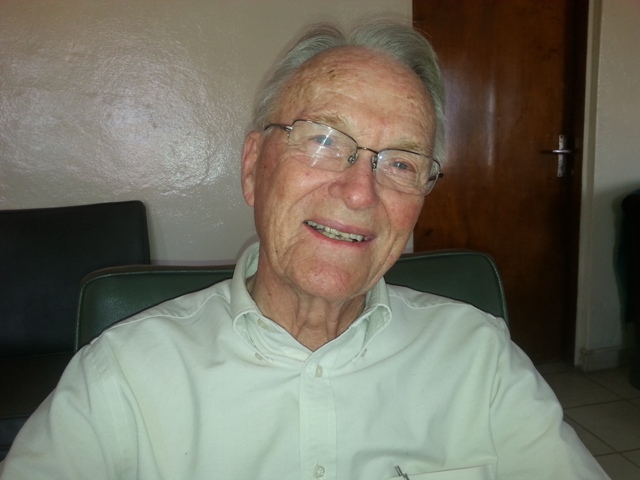
Read about Dr. Lowell Gess and his 58 year journey in Sierra Leone.
“I had made up my mind in the first week of September. But I couldn’t get here. I didn’t tell anybody that I was coming. Finally, after several weeks, I told my children. Somebody let it out. It spread like wildfire. It even got to the radio and TV. They sent out camera crews and said ‘We understand you are going to Africa where there is Ebola. Why?’ Anyway I explained to them that I felt called to keep on with the work. So it was a Christian testimony. And that went out to all the states in America,” Gess explained.
Gess took along with him medicines much needed at the time — drugs worth more than $60,000 — which he shared among three hospitals, Connaught Hospital in central Freetown, Lunsar Eye Hospital in the north and United Methodist Lowell and Ruth Gess Eye Hospital in Kissy, eastern Freetown, a facility named after Gess and his late wife. Gess fondly calls the facility in eastern Freetown “Kissy Eye.”
Gess arrived at a time in January when there was great fear of the Ebola virus but after two weeks when new infection rates started declining, he said he once again began to feel relaxed.
That decline ended in February after new cases in Freetown occurred as infected people using canoes moved from the coastal districts into Freetown. With new infection rates rising again, the government re-introduced more restrictions on travel on Feb. 27, including curtailing the hours of work for boats.
Though new infection figures are far lower than they were, Sierra Leone’s new Ebola cases accountfor at least 60 percent of cases in the last three weeks in the three West Africa countries hardest hit by the disease. The U.S. Center for Disease Control still recommends avoiding nonessential travel to Sierra Leone, Guinea and Liberia.
Before his departure, Gess warned against complacency, which is cited as one of the reasons behind the new infections. He said people should not think Ebola is over “until there is zero in every village. Unless we are careful, it could spring up again.”
Gess refuses to take credit for all the relief he took to Sierra Leone, instead attributing it to thepeople in America who gave generously.
“I am just a channel because many people opened their hearts and their pocketbooks to help Sierra Leone because of the plague of Ebola,” he said.
Helping out at the hospital
Another reason Gess returned to Sierra Leone was to help at the United Methodist health facilities at Kissy, including the Lowell and Ruth Gess Eye Hospital.
Besides teaching, Gess was busy fixing equipment in the hospital that was unused because of minor problems. He supervised the construction of a bridge within the hospital and the construction of a new surgery area for the eye hospital, replacing an old one that he called dangerous because of poor construction.
“In addition to that, this compound needed a doctor especially when Dr. (Martin) Salia had died. My presence was a help. To have an MD, a bonafide doctor around at the time, was needed. In fact, the Kissy Eye Hospital is the first health center in all of Sierra Leone that is doing surgery now,” Gess said.
In the week before his return to the U.S., Gess sounded satisfied that the eye hospital was now up and running.
“They did over 20 operations yesterday, and some of those patients had to be lead in because they were blind. But tomorrow, they will go home with nobody leading them,” he said.
One thing Gess regrets, though, is that he did not touch anyone on this trip to Sierra Leone. During his last devotion with staff of the United Methodist Sierra Leone Conference on Feb. 25, he said touching constitutes a significant element in the Christian ministry, citing biblical references from the woman who touched Jesus’ garment and was made whole and other people who received healing from Jesus’ touch.
“Over 58 years I’ve been in Africa, I have had the privilege of touching people. A statistician estimated that I have touched over 350,000 people in Sierra Leone. This time in the two months I’ve been here, I’ve touched no one. We pray that today, the spirit of God will touch us,” he said.
As a final note in his reflection on the trip, Gess wrote:
“I have never lived for two months on such a high level of adrenaline.
“I settled into the plane seat and wended my way back to my primary home in Alexandria (Minnesota) …crossing the ocean for the 186th time.
“It was a spiritual experience. I have never been more dependent on God’s grace or experienced more highly the joy of ministering in the name of my Savior and Lord.
“Why did I do it? Like Paul in I Corinthians 9:23 ‘I do all for the Gospel’s sake’ or as the popular Good News Bible used in Africa ‘All this I do for the Gospel’s sake in order to share in its blessings.’ ”
Jusu is director of communications for The United Methodist Church in Sierra Leone. News media contact: Vicki Brown at (615) 742-5470 or newsdesk@umcom.org.

Photo by Eveline Chikwanah.
An evangelism team of almost 60 men and women praise and preach evangelism in the Mahusekwa communal area of Zimbabwe.


Zimbabwe United Methodist revival “unrivaled” in district
By Eveline Chikwanah
MAHUSEKWA, ZIMBABWE (UMNS)
The sea of people, dressed mostly in red, blue and white, sang and moved rhythmically in tune to the music. At strategic locations, they stopped and upped the tempo, sang louder, clapped their hands and danced, before allowing the group’s leader to address passers-by entranced by the unusual spectacle.
Moving beyond the area of the few grocery shops and other utility buildings, the team of almost 60 men and women crossed the residential area, pausing to praise and preach at many locations before converging at the home of Mark Muringani, 67, who has been ill since November.
“My father has not been able to walk for almost five months now. My mother and I move him from the bedroom and place him under the tree shade where he sits daily. He is in pain from the waist down to his legs,” his daughter explained to the group.
The weekend of March 13-15 will remain firmly entrenched in the minds of villagers in the Mahusekwa area as the weekend the Chitungwiza-Marondera District of The United Methodist Church brought to town a revival unrivaled by any they had seen.
The annual district revival of the church’s men’s union of Mubvuwiwe United Methodist Church was on the sprawling grounds opposite the police station at the Mahusekwa rural service center. Huge colorful tents, including one that comfortably seated 1,000 people, were put up to shelter congregants at the bushy site, 90 kilometers southeast of Harare, the nation’s capital. The church is popular nationally for its singing accompanied by drum beats and rattles.
Door-to-door evangelism
The Mubvuwiwe church on Saturday afternoon conducted door-to-door evangelism, known asvhuserere in the local language chiShona. One of the five randomly selected teams landed on Muringani’s doorstep.
After a mass prayer, Pastor Rufaro Magomo prayed for the elderly man’s healing and the group contributed $17 to assist him.
Muringani’s home is adjacent to land that was first allocated to The United Methodist Church to construct a church sanctuary before congregants realized the area was too small. The congregation has since filed an application with local council authorities to obtain a bigger property for the church sanctuary. The vhuserere team prayed at the temporary rundown grass shelter where church services are now.
The evangelism team trekked for about three hours and more than 6 kilometers (nearly 4 miles) inviting residents and informal traders they encountered to the three-day revival. Their final stop was the state-of-the-art Mahusekwa Government Hospital where Magomo prayed for six patients at the facility.
Tarisai Zhuwao, 31, and Fatima Hatendi, 34, have been undergoing treatment for Multidrug-resistant Tuberculosis for more than three months. The two women were overjoyed to receive more than 30 visitors from the church that Saturday afternoon.
“We could hear people singing church hymns since yesterday afternoon and yearned to attend the church service,” Zhuwao said. She expressed a desire to become a member of The United Methodist Church when she is discharged from the hospital.
“Before I fell ill with MDR-TB, I was not a strong Christian,” Hatendi said in a tearful, moving testimony. “When I was hospitalized, I was semi-conscious, unable to walk or eat, and cannot even recall what happened on the day I was brought here. I did not know the implications of my condition and only learned later that I was suffering from the most deadly form of tuberculosis.”
However, she testified that she has witnessed a miracle since tests carried out after three months of treatment have shown she was almost cured of the disease. Multidrug-resistant Tuberculosis does not respond to Isoniazid and Rifampicin, the two most powerful anti-TB drugs. Its treatment requires isolation and about six months hospitalization since it is highly contagious.
“By God’s abundant grace, I have been healed. Laboratory tests have shown that I no longer have the bacteria and look forward to going home soon,” said Hatendi. She asked for Magomo’s contact details and said she wanted to join the church when she returned home.
Great commission of The United Methodist Church
The door-to-door evangelism was part of the great commission drawn from The United Methodist Church’s mission to go forth and make disciples of Jesus Christ for the transformation of the world. More than 20 people whose homes had been visited attended the Saturday night service.
Constable Martha Madzitire of the Mahusekwa police Victim Friendly Unit also presented a paper on domestic violence and child sexual abuse. She said the unit was formed in 1995 to create a conducive environment for women and children to report abuse cases at police stations without being subjected to embarrassment and humiliation. Madzitire said Mashonaland East Province, where Mahusekwa is located, has the highest reported cases of sexual abuse of children in the country.
Stewart Kamusha, chairperson for the union’s evangelism committee, said the revival had “powerful messages from the guest preachers and it was indeed a life-changing experience.”
Kamusha said more than 1,000 people attended the gathering and eight souls were won to Christ during the three-day event, which included the traditional all-night church service on Saturday. He said the evangelism team had identified Mahusekwa for this year’s venue since they believe the area has potential for church growth.
Preachers at the convention included the Rev. David Mupaya, the Rev. Archford Muchingami and evangelist Rangarirai Nyahodza.
Taurayi Mbengano, the church’s chairperson for Chitungwiza-Marondera District, said the revival was spiritually uplifting. “Many people from Mahusekwa repented and joined the church during the revival. We witnessed the sick being healed and experienced the power of the holy spirit during the services held,” he said.
Chikwanah is a communicator of the Zimbabwe East Annual Conference. News media contact: Vicki Brown, news editor, newsdesk@umcom.org or 615-742-5469.

Photo by Mark Jabin A. Salvador
Some 9,000 United Methodists marched together in Quezon City, Philippines, March 21 to pray and demonstrate family unity, solidarity and Christian discipleship.


Filipino United Methodists rally for unity, discipleship
By Gladys P. Mangiduyos
QUEZON CITY, Philippines
Some 9,000 United Methodists converged March 21 to pray, march together and have fellowship for the family unity and solidarity.
The march also magnified the significance of the growing discipleship ministries launched in March 2013 by the Manila episcopal area of The United Methodist Church in the Philippines.
Bishop Rodolfo Juan and his cabinet led the procession at the Quezon City Memorial Circle, which included participants from United Methodist churches and institutions from Metro Manila and other provinces, such as Bulacan, Pampanga, Bataan, Zambales, Nueva Ecija, Aurora, Quezon, Batangas, Laguna, Rizal, Cavite, Romblon, Mindoro and Palawan.
The bishop admonished the marchers to “commit their families to making disciples” and “become centers for the transformation of the world.”
In an interview, Juan said that the march promoted discipleship. “With the overwhelming participation, I believe we achieved what we envisioned,” he added.
“I thought of launching this big rally so that it can really catch the attention of the whole (episcopal area) and also send a strong message to our community.”
The bishop added that the family march had three goals: to promote family solidarity; to promote his episcopal area’s Disciples of Christ program, particularly its care groups; and to promote the church’s headquarters renovation project. Participants in the family march had to secure a ticket as a way to help fund the needed resources.
A force to be reckoned with
“With its lofty objective, as stated in its vision, to make disciples of Jesus Christ for the transformation of the world, the family march is a force to be reckoned with,” said Homer Ortega, the chair of the event. “It is something that is important and powerful and must not be ignored.
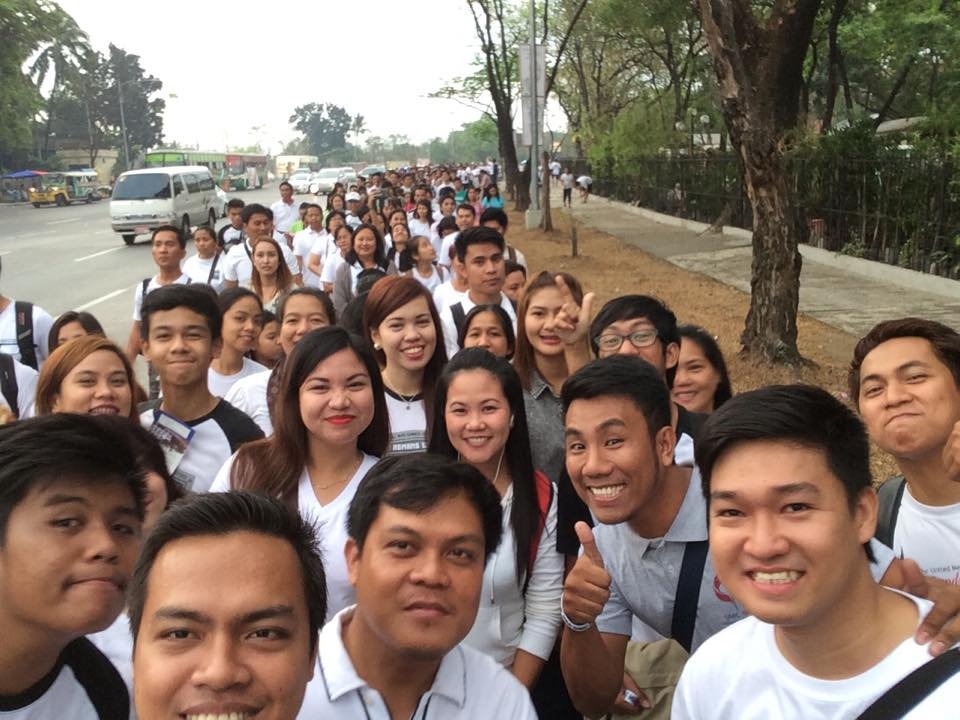
Students from Wesley Divinity Seminary,Wesleyan University, flash smiles and signs ofaffirmation during a March 21 United Methodist family march and rally in Quezon City, Philippines. Photo by SJ Earl Canlas and Jimuel Mari
“We could make The United Methodist Church a force in the affairs of the nation,” Ortega said.
The Rev. Joey Umali, a district superintendent who came with more than 500 participants from the North Bulacan district, affirmed that the family march has allowed them to experience the powerful spirit of belongingness.
“I was there. Wow, we felt so blessed and inspired seeing so many Methodists from the Manila Episcopal Area!”
He agreed there was strength in numbers. “There are times that we need to show force to animate and energize our rank,” Umali explained. “We felt that deep sense of pride out of that show of unity — pride in ourselves for the glory of God.”
Discipleship movement
The Manila episcopal area launched the United Methodist Church Disciples of Christ movement to fulfill the Great Commission. Shared with the area’s conferences by the Rev. John B. Manalo and the Rev. Elino Rivera, the movement is a discipleship and evangelism model patterned after the small-group ministry of John Wesley.
“Through the formation of DOC care groups, United Methodist church members can now be a part of small group that resembles a family-like gathering of worship, sharing and prayer,” the Rev. Jestril Alvarado said.
The family march, said Manalo, was an effort to revive devotion among United Methodist families. “This would be one concrete manifestation that UMC families are united in faith, in prayer and in fulfilling Christ’s ministry and mission here on earth.”
The event emphasized the theme of bringing families to unity, he said, by upholding spiritual disciplines like family devotion, prayer, Bible reading and meditation and other practices that will strengthen relationships and Christian values.
The Rev Elijah Lorenzo, who traveled with church members early in the morning to attend, said the Disciples of Christ movement has “clarified the vision” for soul-winning and discipleship.
“Our church must respond to the needs of younger generation,” he said. “We must rediscover the Wesleyan zeal for intimacy with God and deep passion for souls, not just preserving the institution or our buildings and practices. Study the effect of longer tenure to local church growth. Leave too much of dirty politics out of the church.”
Mangiduyos is a deaconess in the United Methodist Philippines Central Conference and a professor at Wesleyan University-Philippines in Cabanatuan City.
News media contact: Linda Bloom (646) 369-3759 or newsdesk@umcom.org

Photo by Arthur McClanahan, Iowa Conference
Four young leaders hold a lit candle symbolizing that they have the power within them to do amazing things during the third National Consultation on Hispanic/Latino Ministry.


Time to rethink Hispanic/Latino ministry
By the Rev. Gustavo Vasquez
DURHAM, N.C. (UMNS)
If you think most Latinos in the United States generally speak only Spanish and lead lives isolated from the nation’s other ethnic groups, think again.
English has displaced Spanish as the first language used in Hispanic/Latino families, and a higher proportion of U.S. Hispanics/Latinos are part of interracial or interethnic couples than any other U.S. ethnic group.
Those were just two data points shared at The United Methodist Church’s third National Consultation for Hispanic/Latino Ministry, which drew 250 United Methodist leaders March 12-14 to Duke Divinity School in Durham, North Carolina.
The consultation took as its theme the Spanglish phrase “El Espíritu de Dios (the Spirit of God) is Upon Us.”
The meeting drew United Methodists of various ages and races from all five U.S. jurisdictions. About a fifth of those in attendance were young adults. It focused on ministries for people not just from Spanish-speaking countries but also those from Portuguese-speaking countries, such as Brazil.
The diverse, dynamic and changing realities of Hispanic/Latino people were the main topics of discussion groups and plenary sessions. The meeting also focused on nurturing a new generation of church leaders to address those realities.
The Rev. Francisco Cañas, director of the National Plan for Hispanic/Latino Ministry, said in the closing session that the consultation would help in development of Hispanic/Latino ministries.
“But, far from thinking that we have reached the end, we must be convinced that it is only the beginning of a new time and a new way to bring hopeful changes into the church,” he said. “The Hispanic/Latino people — especially young people — must have a leading role in the mission of The United Methodist Church.”
He and other Hispanic/Latino leaders at the meeting have a message for the denomination: We are diverse, we have gifts to share, and we are an integral part of the church.
Make no mistake: The Hispanic/Latino population in the U.S. continues to grow. The U.S. Census Bureau projects that by 2050, the Hispanic population will reach about 106 million, about double what it is today. Between 2000 and 2010 alone, Hispanics made up more than half of U.S. population growth.
If the church wants to build the relationships necessary for its growth, many United Methodists will need to better understand their Hispanic/Latino neighbors and possibly rethink some assumptions.
Changing population
CONSULTATION RECOMMENDATIONS
After discussions and deliberations in plenary sessions and discussion groups, the consultation made these recommendations:
Raise up and support young Hispanic/Latino leaders as “bridge builders” and partners in ministry for the church and world
Create cultural competence across the whole church
Evaluate and improve the standards for, and development and equipping of, mentors and coaches for relevant spiritual leadership
Recognize Hispanics/Latinos as valuable gifts to the church and the world
Create collective, collaborative leadership structures that honor and validate all forms of ministry — laity and clergy— to facilitate all peoples’ journeys into ministry
Invest in intercultural and multicultural ministry
Equip and support the church out in the community and with the community, including enabling action for social holiness and transformational justice (racial justice, LGBTQ justice, gender equality, and immigration)
Manuel Pastor, professor of Sociology and American Studies and Ethnicity at the University of Southern California, told those at the consultation that the number of Hispanic/Latino births in the United States now outstrips the numbers arriving through immigration.
He said projections show that in a few decades Hispanics/Latinos will be dominant population group in in many U.S. cities including Los Angeles, San Diego, Phoenix and Miami.
He also stressed that there is growing cultural, linguistic and generational diversity in this segment of the population.
A presentation by Mark Hugo Lopez, director ofHispanic research at Pew Research Center, showed significant changes in demographic, political and religious trends of the Hispanic/Latino people.
Lopez said that the percentage of Hispanic/ Latino students attending college is growing faster than other ethnic groups. However, he added, they remain below the college enrollment rate of white Anglo and Asian students. The National Center for Education Statistics reports that in 2013, 66 percent of Hispanic high school graduates immediately enrolled in college, while 67 percent of non-Hispanic whites and 81 percent of Asians did.
Lopez said awareness campaigns about education have had a positive effect in recent times among Hispanics/Latinos students.
He also said that “recent research shows more openness among Hispanic/Latino population about new models of family.” He noted that according to Pew research, a plurality of Hispanics in the U.S. — 46 percent — now favor same-sex marriage. That’s up from 30 percent in 2006.
Lopez also said that more Hispanics/Latinos in the U.S. are likely to be in interracial and interethnic couples.
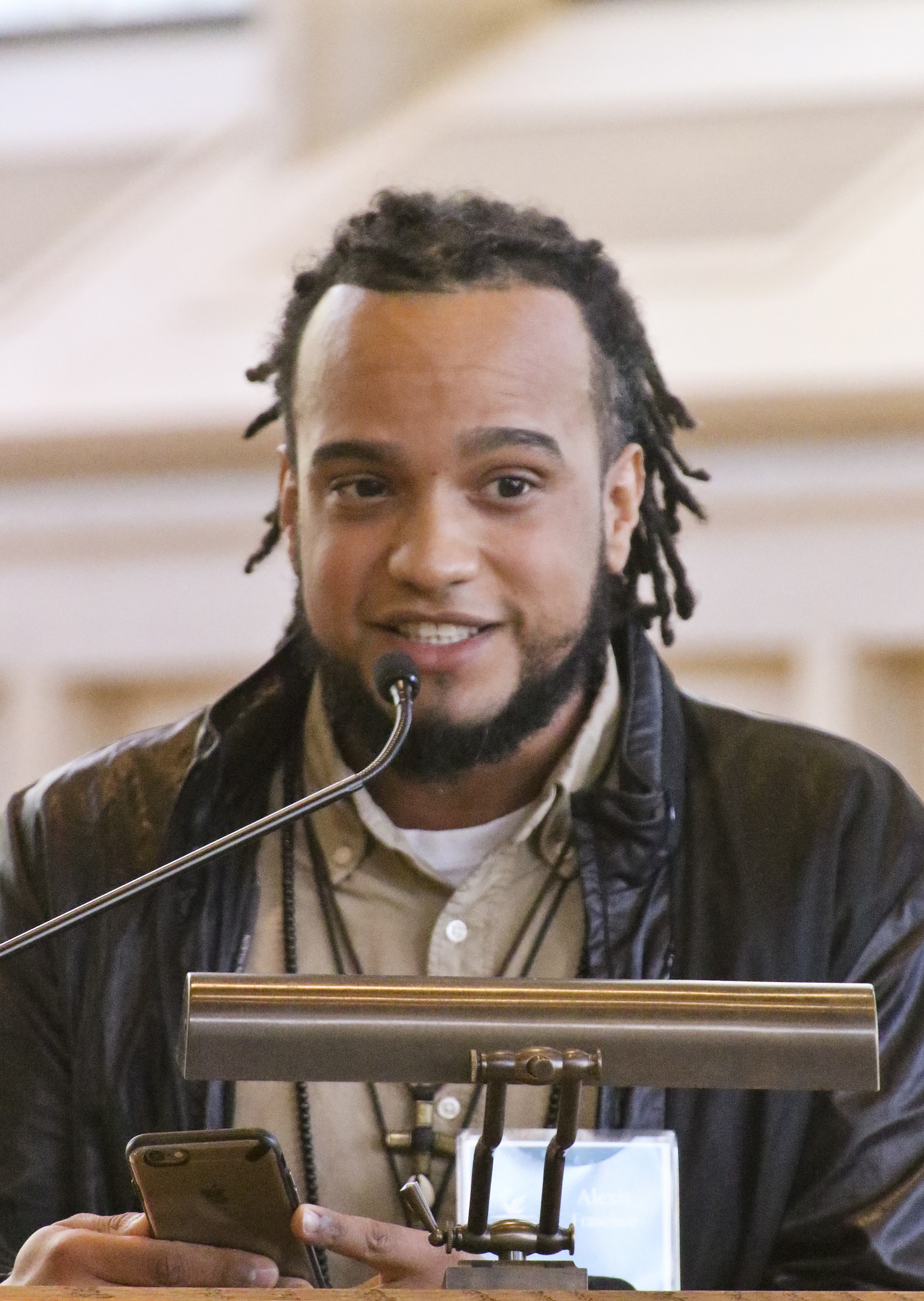
Alexis Francisco speaks during the third National Consultation on Hispanic/Latino Ministries held at Duke University Divinity School in Durham, N.C. Photo by Arthur McClanahan, Iowa Conference
What this means for the church
United Methodists at the gathering said the data challenges ministry plans based on racial and cultural segregation of the population. The model of “racial-ethnic” churches becomes limited and inefficient in this scenario.
Alexis Francisco is a United Methodist young lay leader of Dominican descent from the Bronx, New York. He outlined his experience as a second-generation Hispanic / Latino and stressed the need to rethink the current model of separate "racial-ethnic” ministries to meet the growing demand for inclusiveness.
Luis Velazquez, a certified candidate for ordained United Methodist ministry, also preached about the change that must be made.
The church needs to be an open space that mentors and empowers new generations of Hispanic/Latino who have the call and countless talents to serve, Velazquez said. He is a “dreamer” — a young adult who is not a U.S. citizen but who has lived most of his life as undocumented in the U.S.
“The time that we live in is an opportunity for young people, who have an identity forged between various cultures, to build bridges of inclusion and approach.”
The consultation, he said, “as a divine dialogue, has great potential to produce many strategies in which we can all reaffirm our commitment to support and accompany the changes in the coming years, as America also grows into its new self.”
Vasquez is director of the Hispanic / Latino Communications at United Methodist Communications in Nashville, Tenn. Contact him at (615) 742-5111 or gvasquez@umcom.org
Use Wesley's playbook, UMM presidents urged
Phillip Hunter greeted me at the door of his Bel Air, Md., home wearing a yellow shirt, a bow tie and crisp, new bib overalls. The overalls seemed out of place, given that Hunter, 67, is a retired lawyer and doesn’t live on a farm.

Phillip Hunter stands in his home office in Bel Air, Md. Behind him is a photograph taken in 1965 during one of the marches in Selma, Ala., his hometown. Hunter is visible standing between the American flags.
But there’s a story behind the overalls, one that Hunter lived personally and one that he’s sharing these days throughout the state.
Hunter, you see, knows a lot about the 1960’s Civil Rights movement in Selma, Ala. He should know. He was born and raised there.
A member of Ames UMC in Bel Air, Hunter was born in 1947. He has vivid memories of segregated bathrooms, drinking fountains, schools… you name it. The governmental systems in those days were all white; the Ku Klux Klan was frequently active in the community.
His father, the Rev. J.D. Hunter, was a Baptist minister, the president of the National Association for the Advancement of Colored People (NAACP) in Selma, and a member of the Courageous Eight. The elder Hunter also was editor of the black newspaper in town, the Selma Citizen.
J.D. Hunter was harassed, going back to the 1940’s, said Phillip. “Because of his activities, my father was blackballed,” he said. “He couldn’t get a loan to support his business.” J.D. Hunter was also ordered to “cease and desist” all activities by the NAACP by none other than Sheriff Jim Clark, later notorious for his violent behavior on the Edmond Pettus Bridge on March 7, 1965 – Bloody Sunday.
“My growing up experience in Alabama was good and bad,” Hunter said. “As you know, Alabama was highly segregated back then, more like Apartheid in South Africa.” Poll taxes, literacy tests and other schemes were put in place to block African-Americans from their right to vote.
Lines were clearly drawn between the races, Hunter said. Local law enforcement was anti-black. “If you stayed in your so-called ‘place,’ you had fewer problems,” he said, meaning “don’t interrupt the normal course of behavior.”
Hunter’s generation, though, wasn’t one to simply stay in their place. The Civil Rights Movement, Hunter said, was already at work before he was born, long before Martin Luther King, Jr., arrived.
“King couldn’t have come to Selma if there hadn’t been an organization already at work,” Hunter said.
In 1962 or 63, Hunter attended his first Civil Rights meeting in the basement of his home church, Tabernacle Baptist Church. James Foreman and James Baldwin spoke. These meetings were the precursor to Dr. King’s coming, Hunter said. It was at that time that various marches were held throughout Selma, demonstrating for the right to vote and for integrating facilities.
1963 was also the year of the March on Washington. Hunter wanted to attend, but for lack of money to buy a $25 round-trip bus ticket, he didn’t go. His father also didn’t go.
At one of the marches, Hunter was part of a group that was rounded up and incarcerated for two weeks. He was 14 years old.
“They rounded us up and took us to the National Guard Armory in Selma,” he said. From there, they wereshipped to Camp Thomasville outside Selma.
Hunter said that he and the others would have been released immediately if they had signed a statement that said, in essence, they wouldn’t march or demonstrate for five years.
“I didn’t read it fully,” Hunter said of the statement. “In essence, as young folks, signing that would have shut us down.”
At Camp Thomasville, people were segregated by gender, finger-printed and placed in cow pens. With no beds, people slept on dirt floors. The clothes they wore when they entered the facility are what they wore for two straight weeks. No baths were available and the food was watered-down mushy grits and fat-back bacon.
“Part of the strategy of the movement at that time,” Hunter said, “was to fill up all the jails in Selma. Make them pay to house us. We crowded out the jails in Selma, so they shipped us out to facilities outside the county.”
In jail, they sang Freedom Songs to keep their spirits up. The jail warden would get mad, Hunter recalled, but they would keep on singing: “We Shall Overcome.” “Can’t Nobody Turn Me Around.” “If You Miss Me From the Back of the Bus, I’ll Be in the Front of the Bus.” “Ain’t Scared of Nobody.” “Wade In the Water.” “Jesus On the Mainline.” “Freedom Train.”
After two weeks, Hunter lost 10 pounds. The group appeared for a hearing before Judge Reynolds, a die-hard segregationist, Hunter said. The smell was so bad that the judge ordered the bailiffs to spray deodorizing aerosol, but that didn’t help.
The judge, in the end, simply threw the group out of court. “Get on out of here,” Hunter remembers the judge snapped. Most in the group were juveniles and were never formally charged. Access to legal council was never available.
It was that experience that shaped the future of Hunter’s professional life. After graduating High School in 1965, he left Selma and went to New York to live with his brother, John Hunter, Jr., in a small, cramped rooming apartment.
“I caught the first thing smokin’ out of Selma,” he said, in reference to any vehicle with an exhaust pipe.
He entered Tennessee State University and then obtained his law degree from the University of Kentucky in 1973. “I wanted to fight injustice,” he said, “and to stand up for justice.”
See Phillip Hunter recite one of his original poems, “Stand Up,” written in 2007.https://www.youtube.com/watch?v=h2ov-Gw1cwo
Hunter entered the military, serving in the Judge Advocate General (JAG) Corps. There, he represented men – black and white – that were not receiving adequate legal counsel, he said.
“Any time I saw some unfairness,” Hunter said, “I stood up for it. Sometimes it got me in trouble.” Many of his cases were won on appeal, Hunter said, based on the racist and unfair treatment of his clients.
After serving in the military, Hunter entered private law practice in Hopkinsville, Kentucky, practicing general law. He moved to Maryland in the late 1980’s, and has been a member at Ames UMC ever since, where he teaches adult Sunday school and is a lay speaker.
Hunter participated in all three 1965 marches: Bloody Sunday, Turnaround Tuesday, and the successful march from Selma to Montgomery. That makes him a “foot soldier.”
His memories of March 7, 1965, are still vivid. He has a certificate testifying to his participation, signed by Martin Luther King, Jr., framed and hanging in his home office.

The Diploma given to Phillip Hunter in May 1965, signed by Dr. Martin Luther King, Jr.
They were briefed Bloody Sunday morning, he said, at Brown’s Chapel. Hunter and his marching partner were about one-third of the way back from the front, he said, and they made it across the bridge. Then the tear gas got them.
“We were being pulverized by the State Troopers,” he said.
Hunter tried to get back to Brown’s Chapel by swimming across the river, but the current was too swift and Hunter only knew how to do the dog paddle.
He eventually climbed back up the river bank and got across the bridge. There was a lot of confusion, Hunter said. People were being “patched up” and sent to the hospital. Hunter, himself, was unhurt. “People were angry and retaliation was in the air,” he said. “Some of the leaders tried to calm us down; others had other ideas.”
But the purpose of the march had been achieved.
“We wanted the world to see what was happening in Selma,” he said. “(Sheriff) Jim Clark was the main actor, and he acted in a violent way that day.”
After Bloody Sunday, King put out the call for supporters of the movement to descend on Selma. Whereas Bloody Sunday had 500 marchers, Turnaround Tuesday – where King led the marchers across the bridge only to stop, kneel and pray – had five times that many participants.
The rest, as they say, is history.
On March 7, 2015, Presidents Barack Obama and George W. Bush visited Selma to commemorate the 50thanniversary of the first march. More than 40,000 people gathered to hear speeches and make a symbolic walk across the Edmund Pettus Bridge.
One of those people was Phillip Hunter. “I wouldn’t have missed it,” he said. “It was a great honor to shake the president’s hand and to see the respect 50 years later. God has allowed me and others to survive to see the day when President Obama could get the votes and be elected that, in 1965, we could not imagine.”
Also that day, President Obama signed into law a bill that awarded the Selma foot soldiers the Congressional Gold Medal. Hunter is grateful for the recognition.
If you look at photographs from the 1965 marches, you’ll see some young black men wearing bib overalls. “That was a sign you were part of the movement,” Hunter said. “It’s what we marched in, demonstrated in.”
Hunter said that law enforcement caught on and if you were spotted wearing bib overalls, you were targeted as being part of “that group” and you were in trouble.
Hunter, you’ll recall, wore bib overalls for the interview for this story.
On purpose.
He’s still part of the movement.
Photo by Phileas Jusu, UMNS
Dr. Lowell Gess prays for Sierra Leone at a weekly devotion held at the United Methodist Church house in Freetown.
Ebola doesn’t stop 93-year-old’s return to Sierra Leone
By Phileas Jusu
FREETOWN, Sierra Leone (UMNS)
In early September, 2014, 93-year-old Dr. Lowell Gess bought a plane ticket to Sierra Leone.
The earliest booking he could get was Jan. 3, 2015, but Gess was determined to provide whatever services he could to fight Ebola in a country that had been a second home to him.
HOW YOU CAN HELP
Donate through UMCOR
Support United Methodist Kissy General Hospital
In a report he wrote after his return in early March, the retired United Methodist missionary did note that at the time he bought the ticket he thought that perhaps three months would give him pause to think about going into the lion’s den.
If it did give him pause, it didn’t stop him.
“My calling has been in medical missions. I love God and my neighbor. I serve in the name of Jesus Christ who said in Matthew 25:40 ‘Inasmuch as you have done it unto one of the least of these, my brethren, you have done it unto Me,’ ” Gess reflected.
“The people of West Africa thought they were being abandoned; they were being shunned by the world. And so I wanted to come and show that I am a part of the fellowship of the church and of Kissy Eye Hospital and by being present I thought it was important to actually be here and be of help,” he said.
A 58-year residency
Gess loves Sierra Leone where he spent 58 years of his missionary journey.
Read about Dr. Lowell Gess and his 58 year journey in Sierra Leone.
“I had made up my mind in the first week of September. But I couldn’t get here. I didn’t tell anybody that I was coming. Finally, after several weeks, I told my children. Somebody let it out. It spread like wildfire. It even got to the radio and TV. They sent out camera crews and said ‘We understand you are going to Africa where there is Ebola. Why?’ Anyway I explained to them that I felt called to keep on with the work. So it was a Christian testimony. And that went out to all the states in America,” Gess explained.
Gess took along with him medicines much needed at the time — drugs worth more than $60,000 — which he shared among three hospitals, Connaught Hospital in central Freetown, Lunsar Eye Hospital in the north and United Methodist Lowell and Ruth Gess Eye Hospital in Kissy, eastern Freetown, a facility named after Gess and his late wife. Gess fondly calls the facility in eastern Freetown “Kissy Eye.”
Gess arrived at a time in January when there was great fear of the Ebola virus but after two weeks when new infection rates started declining, he said he once again began to feel relaxed.
That decline ended in February after new cases in Freetown occurred as infected people using canoes moved from the coastal districts into Freetown. With new infection rates rising again, the government re-introduced more restrictions on travel on Feb. 27, including curtailing the hours of work for boats.
Though new infection figures are far lower than they were, Sierra Leone’s new Ebola cases accountfor at least 60 percent of cases in the last three weeks in the three West Africa countries hardest hit by the disease. The U.S. Center for Disease Control still recommends avoiding nonessential travel to Sierra Leone, Guinea and Liberia.
Before his departure, Gess warned against complacency, which is cited as one of the reasons behind the new infections. He said people should not think Ebola is over “until there is zero in every village. Unless we are careful, it could spring up again.”
Gess refuses to take credit for all the relief he took to Sierra Leone, instead attributing it to thepeople in America who gave generously.
“I am just a channel because many people opened their hearts and their pocketbooks to help Sierra Leone because of the plague of Ebola,” he said.
Helping out at the hospital
Another reason Gess returned to Sierra Leone was to help at the United Methodist health facilities at Kissy, including the Lowell and Ruth Gess Eye Hospital.
Besides teaching, Gess was busy fixing equipment in the hospital that was unused because of minor problems. He supervised the construction of a bridge within the hospital and the construction of a new surgery area for the eye hospital, replacing an old one that he called dangerous because of poor construction.
“In addition to that, this compound needed a doctor especially when Dr. (Martin) Salia had died. My presence was a help. To have an MD, a bonafide doctor around at the time, was needed. In fact, the Kissy Eye Hospital is the first health center in all of Sierra Leone that is doing surgery now,” Gess said.
In the week before his return to the U.S., Gess sounded satisfied that the eye hospital was now up and running.
“They did over 20 operations yesterday, and some of those patients had to be lead in because they were blind. But tomorrow, they will go home with nobody leading them,” he said.
One thing Gess regrets, though, is that he did not touch anyone on this trip to Sierra Leone. During his last devotion with staff of the United Methodist Sierra Leone Conference on Feb. 25, he said touching constitutes a significant element in the Christian ministry, citing biblical references from the woman who touched Jesus’ garment and was made whole and other people who received healing from Jesus’ touch.
“Over 58 years I’ve been in Africa, I have had the privilege of touching people. A statistician estimated that I have touched over 350,000 people in Sierra Leone. This time in the two months I’ve been here, I’ve touched no one. We pray that today, the spirit of God will touch us,” he said.
As a final note in his reflection on the trip, Gess wrote:
“I have never lived for two months on such a high level of adrenaline.
“I settled into the plane seat and wended my way back to my primary home in Alexandria (Minnesota) …crossing the ocean for the 186th time.
“It was a spiritual experience. I have never been more dependent on God’s grace or experienced more highly the joy of ministering in the name of my Savior and Lord.
“Why did I do it? Like Paul in I Corinthians 9:23 ‘I do all for the Gospel’s sake’ or as the popular Good News Bible used in Africa ‘All this I do for the Gospel’s sake in order to share in its blessings.’ ”
Jusu is director of communications for The United Methodist Church in Sierra Leone. News media contact: Vicki Brown at (615) 742-5470 or newsdesk@umcom.org.
Photo by Eveline Chikwanah.
An evangelism team of almost 60 men and women praise and preach evangelism in the Mahusekwa communal area of Zimbabwe.
Zimbabwe United Methodist revival “unrivaled” in district
By Eveline Chikwanah
MAHUSEKWA, ZIMBABWE (UMNS)
The sea of people, dressed mostly in red, blue and white, sang and moved rhythmically in tune to the music. At strategic locations, they stopped and upped the tempo, sang louder, clapped their hands and danced, before allowing the group’s leader to address passers-by entranced by the unusual spectacle.
Moving beyond the area of the few grocery shops and other utility buildings, the team of almost 60 men and women crossed the residential area, pausing to praise and preach at many locations before converging at the home of Mark Muringani, 67, who has been ill since November.
“My father has not been able to walk for almost five months now. My mother and I move him from the bedroom and place him under the tree shade where he sits daily. He is in pain from the waist down to his legs,” his daughter explained to the group.
The weekend of March 13-15 will remain firmly entrenched in the minds of villagers in the Mahusekwa area as the weekend the Chitungwiza-Marondera District of The United Methodist Church brought to town a revival unrivaled by any they had seen.
The annual district revival of the church’s men’s union of Mubvuwiwe United Methodist Church was on the sprawling grounds opposite the police station at the Mahusekwa rural service center. Huge colorful tents, including one that comfortably seated 1,000 people, were put up to shelter congregants at the bushy site, 90 kilometers southeast of Harare, the nation’s capital. The church is popular nationally for its singing accompanied by drum beats and rattles.
Door-to-door evangelism
The Mubvuwiwe church on Saturday afternoon conducted door-to-door evangelism, known asvhuserere in the local language chiShona. One of the five randomly selected teams landed on Muringani’s doorstep.
After a mass prayer, Pastor Rufaro Magomo prayed for the elderly man’s healing and the group contributed $17 to assist him.
Muringani’s home is adjacent to land that was first allocated to The United Methodist Church to construct a church sanctuary before congregants realized the area was too small. The congregation has since filed an application with local council authorities to obtain a bigger property for the church sanctuary. The vhuserere team prayed at the temporary rundown grass shelter where church services are now.
The evangelism team trekked for about three hours and more than 6 kilometers (nearly 4 miles) inviting residents and informal traders they encountered to the three-day revival. Their final stop was the state-of-the-art Mahusekwa Government Hospital where Magomo prayed for six patients at the facility.
Tarisai Zhuwao, 31, and Fatima Hatendi, 34, have been undergoing treatment for Multidrug-resistant Tuberculosis for more than three months. The two women were overjoyed to receive more than 30 visitors from the church that Saturday afternoon.
“We could hear people singing church hymns since yesterday afternoon and yearned to attend the church service,” Zhuwao said. She expressed a desire to become a member of The United Methodist Church when she is discharged from the hospital.
“Before I fell ill with MDR-TB, I was not a strong Christian,” Hatendi said in a tearful, moving testimony. “When I was hospitalized, I was semi-conscious, unable to walk or eat, and cannot even recall what happened on the day I was brought here. I did not know the implications of my condition and only learned later that I was suffering from the most deadly form of tuberculosis.”
However, she testified that she has witnessed a miracle since tests carried out after three months of treatment have shown she was almost cured of the disease. Multidrug-resistant Tuberculosis does not respond to Isoniazid and Rifampicin, the two most powerful anti-TB drugs. Its treatment requires isolation and about six months hospitalization since it is highly contagious.
“By God’s abundant grace, I have been healed. Laboratory tests have shown that I no longer have the bacteria and look forward to going home soon,” said Hatendi. She asked for Magomo’s contact details and said she wanted to join the church when she returned home.
Great commission of The United Methodist Church
The door-to-door evangelism was part of the great commission drawn from The United Methodist Church’s mission to go forth and make disciples of Jesus Christ for the transformation of the world. More than 20 people whose homes had been visited attended the Saturday night service.
Constable Martha Madzitire of the Mahusekwa police Victim Friendly Unit also presented a paper on domestic violence and child sexual abuse. She said the unit was formed in 1995 to create a conducive environment for women and children to report abuse cases at police stations without being subjected to embarrassment and humiliation. Madzitire said Mashonaland East Province, where Mahusekwa is located, has the highest reported cases of sexual abuse of children in the country.
Stewart Kamusha, chairperson for the union’s evangelism committee, said the revival had “powerful messages from the guest preachers and it was indeed a life-changing experience.”
Kamusha said more than 1,000 people attended the gathering and eight souls were won to Christ during the three-day event, which included the traditional all-night church service on Saturday. He said the evangelism team had identified Mahusekwa for this year’s venue since they believe the area has potential for church growth.
Preachers at the convention included the Rev. David Mupaya, the Rev. Archford Muchingami and evangelist Rangarirai Nyahodza.
Taurayi Mbengano, the church’s chairperson for Chitungwiza-Marondera District, said the revival was spiritually uplifting. “Many people from Mahusekwa repented and joined the church during the revival. We witnessed the sick being healed and experienced the power of the holy spirit during the services held,” he said.
Chikwanah is a communicator of the Zimbabwe East Annual Conference. News media contact: Vicki Brown, news editor, newsdesk@umcom.org or 615-742-5469.
Photo by Mark Jabin A. Salvador
Some 9,000 United Methodists marched together in Quezon City, Philippines, March 21 to pray and demonstrate family unity, solidarity and Christian discipleship.
Filipino United Methodists rally for unity, discipleship
By Gladys P. Mangiduyos
QUEZON CITY, Philippines
Some 9,000 United Methodists converged March 21 to pray, march together and have fellowship for the family unity and solidarity.
The march also magnified the significance of the growing discipleship ministries launched in March 2013 by the Manila episcopal area of The United Methodist Church in the Philippines.
Bishop Rodolfo Juan and his cabinet led the procession at the Quezon City Memorial Circle, which included participants from United Methodist churches and institutions from Metro Manila and other provinces, such as Bulacan, Pampanga, Bataan, Zambales, Nueva Ecija, Aurora, Quezon, Batangas, Laguna, Rizal, Cavite, Romblon, Mindoro and Palawan.
The bishop admonished the marchers to “commit their families to making disciples” and “become centers for the transformation of the world.”
In an interview, Juan said that the march promoted discipleship. “With the overwhelming participation, I believe we achieved what we envisioned,” he added.
“I thought of launching this big rally so that it can really catch the attention of the whole (episcopal area) and also send a strong message to our community.”
The bishop added that the family march had three goals: to promote family solidarity; to promote his episcopal area’s Disciples of Christ program, particularly its care groups; and to promote the church’s headquarters renovation project. Participants in the family march had to secure a ticket as a way to help fund the needed resources.
A force to be reckoned with
“With its lofty objective, as stated in its vision, to make disciples of Jesus Christ for the transformation of the world, the family march is a force to be reckoned with,” said Homer Ortega, the chair of the event. “It is something that is important and powerful and must not be ignored.
Students from Wesley Divinity Seminary,Wesleyan University, flash smiles and signs ofaffirmation during a March 21 United Methodist family march and rally in Quezon City, Philippines. Photo by SJ Earl Canlas and Jimuel Mari
“We could make The United Methodist Church a force in the affairs of the nation,” Ortega said.
The Rev. Joey Umali, a district superintendent who came with more than 500 participants from the North Bulacan district, affirmed that the family march has allowed them to experience the powerful spirit of belongingness.
“I was there. Wow, we felt so blessed and inspired seeing so many Methodists from the Manila Episcopal Area!”
He agreed there was strength in numbers. “There are times that we need to show force to animate and energize our rank,” Umali explained. “We felt that deep sense of pride out of that show of unity — pride in ourselves for the glory of God.”
Discipleship movement
The Manila episcopal area launched the United Methodist Church Disciples of Christ movement to fulfill the Great Commission. Shared with the area’s conferences by the Rev. John B. Manalo and the Rev. Elino Rivera, the movement is a discipleship and evangelism model patterned after the small-group ministry of John Wesley.
“Through the formation of DOC care groups, United Methodist church members can now be a part of small group that resembles a family-like gathering of worship, sharing and prayer,” the Rev. Jestril Alvarado said.
The family march, said Manalo, was an effort to revive devotion among United Methodist families. “This would be one concrete manifestation that UMC families are united in faith, in prayer and in fulfilling Christ’s ministry and mission here on earth.”
The event emphasized the theme of bringing families to unity, he said, by upholding spiritual disciplines like family devotion, prayer, Bible reading and meditation and other practices that will strengthen relationships and Christian values.
The Rev Elijah Lorenzo, who traveled with church members early in the morning to attend, said the Disciples of Christ movement has “clarified the vision” for soul-winning and discipleship.
“Our church must respond to the needs of younger generation,” he said. “We must rediscover the Wesleyan zeal for intimacy with God and deep passion for souls, not just preserving the institution or our buildings and practices. Study the effect of longer tenure to local church growth. Leave too much of dirty politics out of the church.”
Mangiduyos is a deaconess in the United Methodist Philippines Central Conference and a professor at Wesleyan University-Philippines in Cabanatuan City.
News media contact: Linda Bloom (646) 369-3759 or newsdesk@umcom.org
Photo by Arthur McClanahan, Iowa Conference
Four young leaders hold a lit candle symbolizing that they have the power within them to do amazing things during the third National Consultation on Hispanic/Latino Ministry.
Time to rethink Hispanic/Latino ministry
By the Rev. Gustavo Vasquez
DURHAM, N.C. (UMNS)
If you think most Latinos in the United States generally speak only Spanish and lead lives isolated from the nation’s other ethnic groups, think again.
English has displaced Spanish as the first language used in Hispanic/Latino families, and a higher proportion of U.S. Hispanics/Latinos are part of interracial or interethnic couples than any other U.S. ethnic group.
Those were just two data points shared at The United Methodist Church’s third National Consultation for Hispanic/Latino Ministry, which drew 250 United Methodist leaders March 12-14 to Duke Divinity School in Durham, North Carolina.
The consultation took as its theme the Spanglish phrase “El Espíritu de Dios (the Spirit of God) is Upon Us.”
The meeting drew United Methodists of various ages and races from all five U.S. jurisdictions. About a fifth of those in attendance were young adults. It focused on ministries for people not just from Spanish-speaking countries but also those from Portuguese-speaking countries, such as Brazil.
The diverse, dynamic and changing realities of Hispanic/Latino people were the main topics of discussion groups and plenary sessions. The meeting also focused on nurturing a new generation of church leaders to address those realities.
The Rev. Francisco Cañas, director of the National Plan for Hispanic/Latino Ministry, said in the closing session that the consultation would help in development of Hispanic/Latino ministries.
“But, far from thinking that we have reached the end, we must be convinced that it is only the beginning of a new time and a new way to bring hopeful changes into the church,” he said. “The Hispanic/Latino people — especially young people — must have a leading role in the mission of The United Methodist Church.”
He and other Hispanic/Latino leaders at the meeting have a message for the denomination: We are diverse, we have gifts to share, and we are an integral part of the church.
Make no mistake: The Hispanic/Latino population in the U.S. continues to grow. The U.S. Census Bureau projects that by 2050, the Hispanic population will reach about 106 million, about double what it is today. Between 2000 and 2010 alone, Hispanics made up more than half of U.S. population growth.
If the church wants to build the relationships necessary for its growth, many United Methodists will need to better understand their Hispanic/Latino neighbors and possibly rethink some assumptions.
Changing population
CONSULTATION RECOMMENDATIONS
After discussions and deliberations in plenary sessions and discussion groups, the consultation made these recommendations:
Raise up and support young Hispanic/Latino leaders as “bridge builders” and partners in ministry for the church and world
Create cultural competence across the whole church
Evaluate and improve the standards for, and development and equipping of, mentors and coaches for relevant spiritual leadership
Recognize Hispanics/Latinos as valuable gifts to the church and the world
Create collective, collaborative leadership structures that honor and validate all forms of ministry — laity and clergy— to facilitate all peoples’ journeys into ministry
Invest in intercultural and multicultural ministry
Equip and support the church out in the community and with the community, including enabling action for social holiness and transformational justice (racial justice, LGBTQ justice, gender equality, and immigration)
Manuel Pastor, professor of Sociology and American Studies and Ethnicity at the University of Southern California, told those at the consultation that the number of Hispanic/Latino births in the United States now outstrips the numbers arriving through immigration.
He said projections show that in a few decades Hispanics/Latinos will be dominant population group in in many U.S. cities including Los Angeles, San Diego, Phoenix and Miami.
He also stressed that there is growing cultural, linguistic and generational diversity in this segment of the population.
A presentation by Mark Hugo Lopez, director ofHispanic research at Pew Research Center, showed significant changes in demographic, political and religious trends of the Hispanic/Latino people.
Lopez said that the percentage of Hispanic/ Latino students attending college is growing faster than other ethnic groups. However, he added, they remain below the college enrollment rate of white Anglo and Asian students. The National Center for Education Statistics reports that in 2013, 66 percent of Hispanic high school graduates immediately enrolled in college, while 67 percent of non-Hispanic whites and 81 percent of Asians did.
Lopez said awareness campaigns about education have had a positive effect in recent times among Hispanics/Latinos students.
He also said that “recent research shows more openness among Hispanic/Latino population about new models of family.” He noted that according to Pew research, a plurality of Hispanics in the U.S. — 46 percent — now favor same-sex marriage. That’s up from 30 percent in 2006.
Lopez also said that more Hispanics/Latinos in the U.S. are likely to be in interracial and interethnic couples.
Alexis Francisco speaks during the third National Consultation on Hispanic/Latino Ministries held at Duke University Divinity School in Durham, N.C. Photo by Arthur McClanahan, Iowa Conference
What this means for the church
United Methodists at the gathering said the data challenges ministry plans based on racial and cultural segregation of the population. The model of “racial-ethnic” churches becomes limited and inefficient in this scenario.
Alexis Francisco is a United Methodist young lay leader of Dominican descent from the Bronx, New York. He outlined his experience as a second-generation Hispanic / Latino and stressed the need to rethink the current model of separate "racial-ethnic” ministries to meet the growing demand for inclusiveness.
Luis Velazquez, a certified candidate for ordained United Methodist ministry, also preached about the change that must be made.
The church needs to be an open space that mentors and empowers new generations of Hispanic/Latino who have the call and countless talents to serve, Velazquez said. He is a “dreamer” — a young adult who is not a U.S. citizen but who has lived most of his life as undocumented in the U.S.
“The time that we live in is an opportunity for young people, who have an identity forged between various cultures, to build bridges of inclusion and approach.”
The consultation, he said, “as a divine dialogue, has great potential to produce many strategies in which we can all reaffirm our commitment to support and accompany the changes in the coming years, as America also grows into its new self.”
Vasquez is director of the Hispanic / Latino Communications at United Methodist Communications in Nashville, Tenn. Contact him at (615) 742-5111 or gvasquez@umcom.org
Use Wesley's playbook, UMM presidents urged
NASHVILLE, Tenn. (UMNS) — To carry out their goal of making disciples of Jesus Christ, United Methodist Men should use the playbook established by John Wesley — with the help of modern technology and terminology. That's what Gil Hanke, top executive of the Commission on United Methodist Men, advises. Rich Peck reports.
News
Goal is clear, but we don’t know how to get there, says Hanke

NASHVILLE, Tenn.–– “UM Men have a clear goal of making disciples of Jesus Christ for the transformation of the world, but we haven’t a clue about how to achieve that goal.”
That’s what Gil Hanke, top staff executive of the General Commission on UM Men, told presidents of annual conference units of UM Men at a March 5-8 meeting here.
“It’s as if we wanted to teach people how to swim by providing information on the history of swimming, a list of the best places to swim and a study of swimming techniques without bringing them to a swimming pool,” said Hanke. “You can’t create swimmers without getting wet.” He invited the men to jump into the disciple making pool.
Hanke asked the conference presidents to use modern technology and new terminology to recast a play from a playbook established by John Wesley. Quoting from The Class Meeting, a book by Kevin M. Watson, Hanke said early Methodists utilized small group structures not to study the Bible, but rather to lovingly engage one another in conversations about their souls.
Hanke encouraged leaders of UM Men to use the eight chapters of Watson’s book as a way to introduce the class-meeting to eight men through electronic meetings where men can participate without leaving their homes or offices.
“If 30 of you can find eight people in eight districts to participate in eight meetings, and if those eight men can each form groups of 10 from 10 churches and if those 10 can form groups of 10, we will reach 26,670 men by Christmas,” said Hanke.
He does not suggest that men use the title of “class meeting.” “Call it a ‘Transformation Group,’ a ‘T-group’ or anything you wish,” said Hanke who participates in three similar groups. He noted that it might seem strange to begin such a group with a book, but the study serves as an effective beginning.
This process interfaces well with all that we do.as a movement,” he said.
“I hope you’ll do what Gil asked you to do,” said Tim Bias, top staff executive of Discipleship Ministries. “People are famished to be in loving relations with others and to understand that God is real.”
Bishop James Swanson, president of the General Commission on UM Men, participated in the meeting electronically and also endorsed the process.
The book may be ordered from Amazon.
Episcopalians, UMs Celebrate Interim Shared Eucharist

News
Goal is clear, but we don’t know how to get there, says Hanke
NASHVILLE, Tenn.–– “UM Men have a clear goal of making disciples of Jesus Christ for the transformation of the world, but we haven’t a clue about how to achieve that goal.”
That’s what Gil Hanke, top staff executive of the General Commission on UM Men, told presidents of annual conference units of UM Men at a March 5-8 meeting here.
“It’s as if we wanted to teach people how to swim by providing information on the history of swimming, a list of the best places to swim and a study of swimming techniques without bringing them to a swimming pool,” said Hanke. “You can’t create swimmers without getting wet.” He invited the men to jump into the disciple making pool.
Hanke asked the conference presidents to use modern technology and new terminology to recast a play from a playbook established by John Wesley. Quoting from The Class Meeting, a book by Kevin M. Watson, Hanke said early Methodists utilized small group structures not to study the Bible, but rather to lovingly engage one another in conversations about their souls.
Hanke encouraged leaders of UM Men to use the eight chapters of Watson’s book as a way to introduce the class-meeting to eight men through electronic meetings where men can participate without leaving their homes or offices.
“If 30 of you can find eight people in eight districts to participate in eight meetings, and if those eight men can each form groups of 10 from 10 churches and if those 10 can form groups of 10, we will reach 26,670 men by Christmas,” said Hanke.
He does not suggest that men use the title of “class meeting.” “Call it a ‘Transformation Group,’ a ‘T-group’ or anything you wish,” said Hanke who participates in three similar groups. He noted that it might seem strange to begin such a group with a book, but the study serves as an effective beginning.
This process interfaces well with all that we do.as a movement,” he said.
“I hope you’ll do what Gil asked you to do,” said Tim Bias, top staff executive of Discipleship Ministries. “People are famished to be in loving relations with others and to understand that God is real.”
Bishop James Swanson, president of the General Commission on UM Men, participated in the meeting electronically and also endorsed the process.
The book may be ordered from Amazon.
Episcopalians, UMs Celebrate Interim Shared Eucharist
Episcopal Bishop Stacy Sauls, left, looks on as interim NYAC Bishop Jane Allen Middleton presides over Holy Communion during a shared Eucharist on March 3. In the photo below, Ann Wareham, a member of the John Street UMC reads from Isaiah 49.
By Joanne S. Utley
In celebration of the ecumenical bonds developing between two denominations, members of the United Methodist and Episcopal churches came together to share in Holy Communion early this month at the John Street UMC in New York City.
Some 50 people joined New York Area Interim Bishop Jane Allen Middleton and Episcopal Bishop Stacy F. Sauls in the worship service to commemorate the churches’ recent interim eucharistic sharing agreement. The John Street church was chosen for its historic significance as the “mother church of American Methodism,” and the date – March 3 – is celebrated as the feast day of John and Charles Wesley in the Episcopalian tradition.
For the past 10 years, the United Methodist and Episcopal churches have been in talks to deepen their expression and practice of Christian unity. This move toward “full communion” involves two denominations developing a relationship based on a common confessing of the Christian faith – it does not mean that the denominations will merge. This relationship involves the mutual recognition of members, of ordained clergy, and the sacraments; the joint celebration of Holy Communion/Eucharist; and a common commitment to evangelism, mission, and service. Both the UMC and Episcopal Church already share full communion with the Evangelical Lutheran Church in America, but not with one another.
In welcoming the gathering to the church he leads, Rev. Jason Radmacher noted that the early Methodists in New York were dependent upon the local Anglican parish for the sacraments. They would come to what was then the Wesley Chapel on John Street for worship, and then walk to St. Paul’s Chapel of the Trinity Parish to receive the sacraments.
That all changed after the American Revolution when the Methodists separated from the Church of England. The Methodist Episcopal Church was founded at the Christmas Conference of December 1784; the first proper Eucharist was celebrated at John Street in January 1785, with Bishop Thomas Coke presiding.
“May tonight help revive those ties that have lain dormant,” Radmacher said.
As he began his message, Bishop Sauls confessed that he, “like many Episcopal bishops,” had grown up as a Methodist.
“My mother would be very proud to see me standing in a Methodist pulpit tonight,” he said as the gathering responded in laughter.
Sauls, who is the chief operating officer for the Episcopal Church, explained that he had not come to talk about Christian unity, but about how the church is using the power and authority it has been given to fulfill the gospel of Jesus Christ. He said that the main problem before the church is not a crisis of authority, but rather one of “powerlessness.”
“We need to become powerless so that we can call upon the authority of God through the Holy Spirit,” he said. “The sooner we realize that, we will receive power over and above all our imagination.”
Sauls explained that the gospel comes as a surprise to many because the message of Jesus is found not in power, but in “our powerlessness.”
“The one thing we need to do tonight is to call on the help and inward power of the Holy Spirit,” he said. “We [Methodists and Episcopalians] are not called together because of what we can give one another . . . we’re called to turn to the needs of the world.”

By Joanne S. Utley
In celebration of the ecumenical bonds developing between two denominations, members of the United Methodist and Episcopal churches came together to share in Holy Communion early this month at the John Street UMC in New York City.
Some 50 people joined New York Area Interim Bishop Jane Allen Middleton and Episcopal Bishop Stacy F. Sauls in the worship service to commemorate the churches’ recent interim eucharistic sharing agreement. The John Street church was chosen for its historic significance as the “mother church of American Methodism,” and the date – March 3 – is celebrated as the feast day of John and Charles Wesley in the Episcopalian tradition.
For the past 10 years, the United Methodist and Episcopal churches have been in talks to deepen their expression and practice of Christian unity. This move toward “full communion” involves two denominations developing a relationship based on a common confessing of the Christian faith – it does not mean that the denominations will merge. This relationship involves the mutual recognition of members, of ordained clergy, and the sacraments; the joint celebration of Holy Communion/Eucharist; and a common commitment to evangelism, mission, and service. Both the UMC and Episcopal Church already share full communion with the Evangelical Lutheran Church in America, but not with one another.
In welcoming the gathering to the church he leads, Rev. Jason Radmacher noted that the early Methodists in New York were dependent upon the local Anglican parish for the sacraments. They would come to what was then the Wesley Chapel on John Street for worship, and then walk to St. Paul’s Chapel of the Trinity Parish to receive the sacraments.
That all changed after the American Revolution when the Methodists separated from the Church of England. The Methodist Episcopal Church was founded at the Christmas Conference of December 1784; the first proper Eucharist was celebrated at John Street in January 1785, with Bishop Thomas Coke presiding.
“May tonight help revive those ties that have lain dormant,” Radmacher said.
As he began his message, Bishop Sauls confessed that he, “like many Episcopal bishops,” had grown up as a Methodist.
“My mother would be very proud to see me standing in a Methodist pulpit tonight,” he said as the gathering responded in laughter.
Sauls, who is the chief operating officer for the Episcopal Church, explained that he had not come to talk about Christian unity, but about how the church is using the power and authority it has been given to fulfill the gospel of Jesus Christ. He said that the main problem before the church is not a crisis of authority, but rather one of “powerlessness.”
“We need to become powerless so that we can call upon the authority of God through the Holy Spirit,” he said. “The sooner we realize that, we will receive power over and above all our imagination.”
Sauls explained that the gospel comes as a surprise to many because the message of Jesus is found not in power, but in “our powerlessness.”
“The one thing we need to do tonight is to call on the help and inward power of the Holy Spirit,” he said. “We [Methodists and Episcopalians] are not called together because of what we can give one another . . . we’re called to turn to the needs of the world.”
Following the sermon, Bishop Middleton, who began leading the New York Annual Conference on January 1, presided over the sacrament of Holy Communion. In a nod to the traditions of the two denominations, bothgrape juice and wine were served as part of the holy feast.
“It was a great joy for me and, I think, for everyone present to join together the best of both our denominations in the celebration,” Middleton said after the service. “I believe John and Charles Wesley would be very pleased to see that we’re in a special relationship of shared communion.” The Wesley brothers, though branded as the founders of Methodism, never intended to break from the Anglican Church.
The liturgists represented both laity and clergy from the two denominations: Nicholas Birns, a member of Grace Episcopal Church, and the Very Rev. Kurt H. Dunkle, dean and president of The General Theological Seminary of the Episcopal Church; and Ann Wareham, a member of John Street UMC, and Rev. Denise Smartt Sears, Metropolitan District superintendent of the New York Annual Conference.
After the service, the gathering enjoyed a time of fellowship on the lower level of the church that also houses its collection of 18th and 19th century church artifacts.
According to Rev. Radmacher, the 2016 General Conference plans to honor John Street UMC on the occasion of the congregation’s 250thanniversary. The church web site explains its history this way: the “John Street Church has been at witness for God’s love in the heart of New York City since our first worship service in 1766. In nearly two and a half centuries of ministry we have served soldiers wounded in the American Revolution, investors who lost everything in the Great Depression, and a neighborhood devastated by the terrorist attacks of September 11, 2001.”
The dialogue concerning “full communion” will continue with the final decision to be made by the governing bodies of both denominations.
“My hope for future will be that our General Conference will indeed confirm the shared communion relationship in 2016,” Middleton said. The Episcopal General Convention will consider the matter two years later in 2018.
 The Very Rev. Kurt H. Dunkle, left, of the Episcopal Church, Bishop Jane Allen Middleton, and Rev. Jason Radmacher offer communion elements during the shared Eucharist at the John Street UMC.
“It was a great joy for me and, I think, for everyone present to join together the best of both our denominations in the celebration,” Middleton said after the service. “I believe John and Charles Wesley would be very pleased to see that we’re in a special relationship of shared communion.” The Wesley brothers, though branded as the founders of Methodism, never intended to break from the Anglican Church.
The liturgists represented both laity and clergy from the two denominations: Nicholas Birns, a member of Grace Episcopal Church, and the Very Rev. Kurt H. Dunkle, dean and president of The General Theological Seminary of the Episcopal Church; and Ann Wareham, a member of John Street UMC, and Rev. Denise Smartt Sears, Metropolitan District superintendent of the New York Annual Conference.
After the service, the gathering enjoyed a time of fellowship on the lower level of the church that also houses its collection of 18th and 19th century church artifacts.
According to Rev. Radmacher, the 2016 General Conference plans to honor John Street UMC on the occasion of the congregation’s 250thanniversary. The church web site explains its history this way: the “John Street Church has been at witness for God’s love in the heart of New York City since our first worship service in 1766. In nearly two and a half centuries of ministry we have served soldiers wounded in the American Revolution, investors who lost everything in the Great Depression, and a neighborhood devastated by the terrorist attacks of September 11, 2001.”
The dialogue concerning “full communion” will continue with the final decision to be made by the governing bodies of both denominations.
“My hope for future will be that our General Conference will indeed confirm the shared communion relationship in 2016,” Middleton said. The Episcopal General Convention will consider the matter two years later in 2018.
The Very Rev. Kurt H. Dunkle, left, of the Episcopal Church, Bishop Jane Allen Middleton, and Rev. Jason Radmacher offer communion elements during the shared Eucharist at the John Street UMC.
The Adam Hamilton interview on ‘Revival’ of John Wesley

CLICK THE COVER to visit the book’s Amazon page. (NOTE: Links to additional “Revival” multi-media resources appear in the interview, below.)
Why are so many people fascinated by a preacher, born more than 300 years ago in a little town 150 miles north of London? For long stretches of American history, John Wesley was all but forgotten. Adam Hamilton, the most famous United Methodist pastor in the U.S. these days, thinks Wesley’s rising popularity stems from the culture into which he was born in 1703.
At that time, the English were exhausted by a tragic and bloody history of religious conflict. The skeptical winds of the Enlightenment had been blowing across Europe, which meant that Wesley faced an era in which many bright people were walking away from the church. Much like today, the mid 1700s was “a perfect seedbed for the revival in which Wesley would play so prominent a part,” Hamilton writes in his new book, Revival: Faith as Wesley Lived It .
.
Wesley’s life parallels many religious trends today:
John and his brother Charles understood that popular music was a key to church growth and, together, they unleashed on the world one of the largest bodies of then-contemporary church music.
John was a ceaseless pamphleteer and independent publisher who hauled a printing press into his church—a master of his era’s social media.
John wasn’t afraid of taking a stand on red-hot issues—condemning slavery long before the rise of the American abolitionist movement and supporting a daring new movement that encouraged compassionate care for the animals around us.
Most importantly, the Wesleys proclaimed that their brand of Christianity was a faith for head and heart. Emotion and intellect both were welcomed—faith and skeptical questions as well.
How do we know Wesley is trending? His name keeps popping up. Widely read inspirational writers like Rob Bell and Tony Campolo have been talking about Wesley more in recent years. Google’s N-gram Viewer, which searches phrases in 5 million books published since 1800, provides more evidence: Books about John Wesley peaked in the U.S. in the early 1800s. Then, Wesley buzz rose again for a few years just after World War II. Most recently, Wesley has been trending upwards since 2004.
ReadTheSpirit Editor David Crumm interviewed the author. Here are …
HIGHLIGHTS OF OUR INTERVIEW
WITH ADAM HAMILTON
ON JOHN WESLEY’S ‘REVIVAL’
 DAVID: There are many good books about the life of John Wesley. Amazon says there are more than 500. Thousands of other books include a chapter or more on Wesley.
Why do you think he’s so popular today?
ADAM: I agree with you. I think there’s a great resurgence of interest in Wesley today.
He’s being embraced by people across the religious spectrum. Evangelicals continue to claim him as the father of the small group movement with an emphasis on spiritual disciplines and evangelical revival. And progressives in the church look to his teaching of the importance of works that go along with faith and his teaching that your faith doesn’t mean much if you’re not concerned for your neighbor. Almost everyone across the theological spectrum finds something they like and that inspires them in Wesley’s life.
There are people who follow Wesley all around the world. He’s had 300 years of people looking to him and taking what he’s taught and applying it in different ways.
WORLDWIDE WESLEY FAMILY TREE
DAVID: You’re right about the global scope. Today, there are many churches that trace roots back to the teachings of John Wesley. Of course, you’re part of the biggest branch: the United Methodist Church. Wikipedia’s “Wesleyanism” article lists more than a dozen current denominations that trace roots to Wesley.

Adam Hamilton
ADAM: In traveling and researching and writing this book, my hope was to help people from the entire Wesleyan background to rediscover this powerful inspiration that still is important in our world today. I’m convinced that John Wesley’s approach to the gospel may be one of the best hopes we have of reaching new generations of young people who are not religiously involved at all.
DAVID: You and Abingdon Press make rediscovering Wesley pretty easy. You’ve divided your message into a whole array of multimedia options. There’s a Revival DVD that goes along with the book that shows you talking about Wesley in all of these settings where Wesley lived and worked in the UK. Want to direct a series of group discussions? There’s a Revival Leader Guide, a Revival Youth Study Book, and even a Revival Children’s Leader Guide.
ADAM: I want to teach people—whatever their age—about the life of Wesley by following his life, but not by providing a long biography in this case. There are other in-depth biographies of Wesley out there. I wanted to tell people about his heart and character, by going to places that were important in his life and ask: How does what Wesley did here, or there, affect our lives today? I want people, whatever their age, to ask: How could this affect my life now?
If you get the DVD along with the book, you can use it in your small group and you’ll see me standing in the place where each chapter unfolds, talking about that part of Wesley’s life.
A WESLEYAN PILGRIMAGE
DAVID: That’s one reason I heartily recommend this book. Your aim is to reach young people, especially, and one way to do that is to have a strong video component. More than that, people want to experience religion today. In the Catholic world, pilgrimage has been a huge part of Catholic spirituality for many centuries. Methodists aren’t so big on that idea of traveling as a spiritual discipline, but your book invites people on a Wesleyan pilgrimage. You’ve even got specific travel tips sprinkled throughout the book. You’re saying people should hit the road and rediscover Wesley.
ADAM: That’s exactly what I’m doing this summer. I’m leading two groups of people to places that were important in Wesley’s life. One group will be people from our Church of the Resurrection and a second group will be pastors from other United Methodist churches.
DAVID: Let’s talk about one of the places you take readers—and viewers of the DVD—the famous church in London known as The Foundry. Americans who follow faith-and-politics in the news know another Foundry church in Washington D.C., which is famous for all of the presidents who have worshiped there. For 200 years, the D.C. Foundry has kept the name of Wesley’s Foundry alive in this country.
So, tell us about Wesley’s original Foundry in London. And, remind us: Where are we in his timeline?
ADAM: The Foundry work really begins in the 1740s.
He wound up there because he needed to find a place to meet in London after he experienced breaks with other religious societies. The Foundry was an old cannon factory—an ironworks used for making weaponry. It was a very large building and he saw it as a place where Methodists could meet in London. In the fall of 1739, he takes hold of the building and begins having it renovated. It becomes the home of Methodism in London for the next 38 years.
What the Foundry represents for me is Wesley’s emphasis on works of mercy. That’s what I talk about in that chapter of the book.
DAVID: Let me read a couple of lines: “At the Foundry in the 1740s, the Methodist works of mercy saw new expression. Wesley started a fund to make small loans, akin to today’s microlending, and the fund made loans to 250 people in the first year. On Fridays, the poor who were sick came to be treated and were provided basic medical care. In 1747, Wesley published a book on ‘easy and natural’ methods for ‘curing most diseases.’ Wesley and the Methodists at the Foundry leased two houses for poor and elderly widows and their children. And, they started a school for children who roamed the street.”
ADAM: And at Foundry, they brought in a printing press.
MASTER OF 18TH CENTURY SOCIAL MEDIA
DAVID: Let’s talk about that printing press at Foundry. John Wesley was deeply involved in the major issues of his era and, over time, he became a prophet way out ahead of others. He certainly was in his condemnation of slavery and in his call for compassionate care for animals. Some of Wesley’s critics used to joke that you could tell Wesley followers in a village by how well they treated their horses.
ADAM: That printing press was important! Wesley was constantly printing and publishing his sermons and tracts and responses to debates of the day. He published hundreds of different pamphlets and he published a huge number of books, too. He made these as cheaply as he could and distributed them as widely as he could. He was a major user of the social media of his day. If he were alive today, he would have been a master of social media.
DAVID: And that’s a big part of the reason that Methodism took off like wildfire across America after the Revolution. Of course, the explosion of Methodism in the early 1800s was the work of some other geniuses of religious organization. Historian Martin Marty once called Francis Asbury the George S. Patton of strategic deployment for Methodism for the way he deployed circuit riders across the American frontier—each one toting around with him Methodist books, like Wesley’s sermons.
ORGANIZATIONAL GENIUS
ADAM: Wesley had many talents. He was an effective preacher and we know from so many accounts that people were stirred when they saw or heard him. He was an Energizer Bunny who just kept going and going and going.
We know he traveled 250,000 miles across the British Isles and he did most of that on horseback. He was constantly reading and we know he did a lot of that reading while riding his horse! (Laughs!) Today, he’d be a terrible driver! He’d want to text while he was driving.
And he had this capacity to organize so it would continue after he was gone. His publishing efforts were a big part of this. He equipped the circuit riders—these traveling preachers—in his movement with a number of essential books. Every circuit rider at least had a copy of his notes on the New Testament, plus copies of his sermons. Publishing was a huge part of Wesley’s life. I own a copy of his notes on the New Testament that dates back to three years before he died in 1791. It’s one of the great treasures I have in my library.
DAVID: And you’ve said repeatedly over the years that you model your own ministry on Wesley’s, right?
ADAM: Yes, and I’ve shared this with my church and at many conferences where I’ve spoken. Here at our Church of the Resurrection, we have multiple campuses—and we also have more congregations that partner with us in other ways. We upload the sermons and share them online. Our partnering churches can just take the sermon and use it in that form, or they can preach their own sermon using some of the things they find in our sermons.
When I explain the way we do this, I say: “If Wesley were alive today, he would be uploading his sermons to share them and help other pastors preach. He would actively share his ideas and themes. From the beginning, he was providing so many ways that he knew a movement could flourish and grow.”
DAVID: So, we’re now about three centuries from his birth and roughly two centuries from his death. When readers go through your book, they will learn about parts of Wesley’s life when he was a failure. Early in his life, he had some unfortunate experiences. And they will learn about the faith that shaped his ministry into a movement that now circles the globe. Some of the things I’ve mentioned in our interview—the opposition to slavery and the care for animals, for example, were themes he emphasized much later in his long life.
ADAM: Yes, you’re right. When he was older, Wesley did become a sort of heroic and widely popular figure. In the last 30 years of his life, in particular, he was a folk hero across Great Britain. People wanted to meet him and talk to him in a way that wasn’t true early in his ministry. In that part of his life, he could speak more freely about issues like slavery.
In this book, I tried to capture what I love about Wesley and the most important thing I want to emphasize is that Wesley was able to hold in tension things that often would split communities apart. He taught that we should hold together the intellect and the heart. He didn’t want people to check their brains at the door.
Centuries ago—and still today—he called men and women to trust in Christ and, at the same time, to live out their faith in the world.
(Originally published at www.ReadTheSpirit.com, an on line magazine covering religion, spirituality, values and interfaith and cross-cultural issues.)
DO YOU UNDERSTAND WHAT YOU'RE SIGNING UP FOR?

CLICK THE COVER to visit the book’s Amazon page. (NOTE: Links to additional “Revival” multi-media resources appear in the interview, below.)
Why are so many people fascinated by a preacher, born more than 300 years ago in a little town 150 miles north of London? For long stretches of American history, John Wesley was all but forgotten. Adam Hamilton, the most famous United Methodist pastor in the U.S. these days, thinks Wesley’s rising popularity stems from the culture into which he was born in 1703.
At that time, the English were exhausted by a tragic and bloody history of religious conflict. The skeptical winds of the Enlightenment had been blowing across Europe, which meant that Wesley faced an era in which many bright people were walking away from the church. Much like today, the mid 1700s was “a perfect seedbed for the revival in which Wesley would play so prominent a part,” Hamilton writes in his new book, Revival: Faith as Wesley Lived It
.Wesley’s life parallels many religious trends today:
John and his brother Charles understood that popular music was a key to church growth and, together, they unleashed on the world one of the largest bodies of then-contemporary church music.
John was a ceaseless pamphleteer and independent publisher who hauled a printing press into his church—a master of his era’s social media.
John wasn’t afraid of taking a stand on red-hot issues—condemning slavery long before the rise of the American abolitionist movement and supporting a daring new movement that encouraged compassionate care for the animals around us.
Most importantly, the Wesleys proclaimed that their brand of Christianity was a faith for head and heart. Emotion and intellect both were welcomed—faith and skeptical questions as well.
How do we know Wesley is trending? His name keeps popping up. Widely read inspirational writers like Rob Bell and Tony Campolo have been talking about Wesley more in recent years. Google’s N-gram Viewer, which searches phrases in 5 million books published since 1800, provides more evidence: Books about John Wesley peaked in the U.S. in the early 1800s. Then, Wesley buzz rose again for a few years just after World War II. Most recently, Wesley has been trending upwards since 2004.
ReadTheSpirit Editor David Crumm interviewed the author. Here are …
HIGHLIGHTS OF OUR INTERVIEW
WITH ADAM HAMILTON
ON JOHN WESLEY’S ‘REVIVAL’
DAVID: There are many good books about the life of John Wesley. Amazon says there are more than 500. Thousands of other books include a chapter or more on Wesley.Why do you think he’s so popular today?
ADAM: I agree with you. I think there’s a great resurgence of interest in Wesley today.
He’s being embraced by people across the religious spectrum. Evangelicals continue to claim him as the father of the small group movement with an emphasis on spiritual disciplines and evangelical revival. And progressives in the church look to his teaching of the importance of works that go along with faith and his teaching that your faith doesn’t mean much if you’re not concerned for your neighbor. Almost everyone across the theological spectrum finds something they like and that inspires them in Wesley’s life.
There are people who follow Wesley all around the world. He’s had 300 years of people looking to him and taking what he’s taught and applying it in different ways.
WORLDWIDE WESLEY FAMILY TREE
DAVID: You’re right about the global scope. Today, there are many churches that trace roots back to the teachings of John Wesley. Of course, you’re part of the biggest branch: the United Methodist Church. Wikipedia’s “Wesleyanism” article lists more than a dozen current denominations that trace roots to Wesley.
Adam Hamilton
ADAM: In traveling and researching and writing this book, my hope was to help people from the entire Wesleyan background to rediscover this powerful inspiration that still is important in our world today. I’m convinced that John Wesley’s approach to the gospel may be one of the best hopes we have of reaching new generations of young people who are not religiously involved at all.
DAVID: You and Abingdon Press make rediscovering Wesley pretty easy. You’ve divided your message into a whole array of multimedia options. There’s a Revival DVD that goes along with the book that shows you talking about Wesley in all of these settings where Wesley lived and worked in the UK. Want to direct a series of group discussions? There’s a Revival Leader Guide, a Revival Youth Study Book, and even a Revival Children’s Leader Guide.
ADAM: I want to teach people—whatever their age—about the life of Wesley by following his life, but not by providing a long biography in this case. There are other in-depth biographies of Wesley out there. I wanted to tell people about his heart and character, by going to places that were important in his life and ask: How does what Wesley did here, or there, affect our lives today? I want people, whatever their age, to ask: How could this affect my life now?
If you get the DVD along with the book, you can use it in your small group and you’ll see me standing in the place where each chapter unfolds, talking about that part of Wesley’s life.
A WESLEYAN PILGRIMAGE
DAVID: That’s one reason I heartily recommend this book. Your aim is to reach young people, especially, and one way to do that is to have a strong video component. More than that, people want to experience religion today. In the Catholic world, pilgrimage has been a huge part of Catholic spirituality for many centuries. Methodists aren’t so big on that idea of traveling as a spiritual discipline, but your book invites people on a Wesleyan pilgrimage. You’ve even got specific travel tips sprinkled throughout the book. You’re saying people should hit the road and rediscover Wesley.
ADAM: That’s exactly what I’m doing this summer. I’m leading two groups of people to places that were important in Wesley’s life. One group will be people from our Church of the Resurrection and a second group will be pastors from other United Methodist churches.
DAVID: Let’s talk about one of the places you take readers—and viewers of the DVD—the famous church in London known as The Foundry. Americans who follow faith-and-politics in the news know another Foundry church in Washington D.C., which is famous for all of the presidents who have worshiped there. For 200 years, the D.C. Foundry has kept the name of Wesley’s Foundry alive in this country.
So, tell us about Wesley’s original Foundry in London. And, remind us: Where are we in his timeline?
ADAM: The Foundry work really begins in the 1740s.
He wound up there because he needed to find a place to meet in London after he experienced breaks with other religious societies. The Foundry was an old cannon factory—an ironworks used for making weaponry. It was a very large building and he saw it as a place where Methodists could meet in London. In the fall of 1739, he takes hold of the building and begins having it renovated. It becomes the home of Methodism in London for the next 38 years.
What the Foundry represents for me is Wesley’s emphasis on works of mercy. That’s what I talk about in that chapter of the book.
DAVID: Let me read a couple of lines: “At the Foundry in the 1740s, the Methodist works of mercy saw new expression. Wesley started a fund to make small loans, akin to today’s microlending, and the fund made loans to 250 people in the first year. On Fridays, the poor who were sick came to be treated and were provided basic medical care. In 1747, Wesley published a book on ‘easy and natural’ methods for ‘curing most diseases.’ Wesley and the Methodists at the Foundry leased two houses for poor and elderly widows and their children. And, they started a school for children who roamed the street.”
ADAM: And at Foundry, they brought in a printing press.
MASTER OF 18TH CENTURY SOCIAL MEDIA
DAVID: Let’s talk about that printing press at Foundry. John Wesley was deeply involved in the major issues of his era and, over time, he became a prophet way out ahead of others. He certainly was in his condemnation of slavery and in his call for compassionate care for animals. Some of Wesley’s critics used to joke that you could tell Wesley followers in a village by how well they treated their horses.
ADAM: That printing press was important! Wesley was constantly printing and publishing his sermons and tracts and responses to debates of the day. He published hundreds of different pamphlets and he published a huge number of books, too. He made these as cheaply as he could and distributed them as widely as he could. He was a major user of the social media of his day. If he were alive today, he would have been a master of social media.
DAVID: And that’s a big part of the reason that Methodism took off like wildfire across America after the Revolution. Of course, the explosion of Methodism in the early 1800s was the work of some other geniuses of religious organization. Historian Martin Marty once called Francis Asbury the George S. Patton of strategic deployment for Methodism for the way he deployed circuit riders across the American frontier—each one toting around with him Methodist books, like Wesley’s sermons.
ORGANIZATIONAL GENIUS
ADAM: Wesley had many talents. He was an effective preacher and we know from so many accounts that people were stirred when they saw or heard him. He was an Energizer Bunny who just kept going and going and going.
We know he traveled 250,000 miles across the British Isles and he did most of that on horseback. He was constantly reading and we know he did a lot of that reading while riding his horse! (Laughs!) Today, he’d be a terrible driver! He’d want to text while he was driving.
And he had this capacity to organize so it would continue after he was gone. His publishing efforts were a big part of this. He equipped the circuit riders—these traveling preachers—in his movement with a number of essential books. Every circuit rider at least had a copy of his notes on the New Testament, plus copies of his sermons. Publishing was a huge part of Wesley’s life. I own a copy of his notes on the New Testament that dates back to three years before he died in 1791. It’s one of the great treasures I have in my library.
DAVID: And you’ve said repeatedly over the years that you model your own ministry on Wesley’s, right?
ADAM: Yes, and I’ve shared this with my church and at many conferences where I’ve spoken. Here at our Church of the Resurrection, we have multiple campuses—and we also have more congregations that partner with us in other ways. We upload the sermons and share them online. Our partnering churches can just take the sermon and use it in that form, or they can preach their own sermon using some of the things they find in our sermons.
When I explain the way we do this, I say: “If Wesley were alive today, he would be uploading his sermons to share them and help other pastors preach. He would actively share his ideas and themes. From the beginning, he was providing so many ways that he knew a movement could flourish and grow.”
DAVID: So, we’re now about three centuries from his birth and roughly two centuries from his death. When readers go through your book, they will learn about parts of Wesley’s life when he was a failure. Early in his life, he had some unfortunate experiences. And they will learn about the faith that shaped his ministry into a movement that now circles the globe. Some of the things I’ve mentioned in our interview—the opposition to slavery and the care for animals, for example, were themes he emphasized much later in his long life.
ADAM: Yes, you’re right. When he was older, Wesley did become a sort of heroic and widely popular figure. In the last 30 years of his life, in particular, he was a folk hero across Great Britain. People wanted to meet him and talk to him in a way that wasn’t true early in his ministry. In that part of his life, he could speak more freely about issues like slavery.
In this book, I tried to capture what I love about Wesley and the most important thing I want to emphasize is that Wesley was able to hold in tension things that often would split communities apart. He taught that we should hold together the intellect and the heart. He didn’t want people to check their brains at the door.
Centuries ago—and still today—he called men and women to trust in Christ and, at the same time, to live out their faith in the world.
(Originally published at www.ReadTheSpirit.com, an on line magazine covering religion, spirituality, values and interfaith and cross-cultural issues.)
DO YOU UNDERSTAND WHAT YOU'RE SIGNING UP FOR?
By Mike Slaughter

The Lenten season marks a time for soul assessment and realigning with the priorities of God. Just as the Spirit led Jesus into the wilderness for 40 days to confront temptation, the 40 days of Lent require us to do our own fearless moral and spiritual inventory of our internal landscape. As I note in “Renegade Gospel: The Rebel Jesus,” it’s an opportunity to ask ourselves, “Do I understand what I have signed up for?”
Jesus’ encounters with people in the final weeks leading up to his arrest and crucifixion illuminate the meaning of the cross and the cost of following Jesus in obedient discipleship. Almost immediately after beginning his final trek from Galilee to the Holy City, Jesus encountered three different individuals. He invited all three to join him in his journey, and their responses illustrate our own confusion about what it means to be a Jesus follower.
The first man enthusiastically offered himself as a volunteer, saying, “I will follow you wherever you go” (Luke 9:57). Jesus responded, “Foxes have dens and birds have nests, but the Son of Man has no place to lay his head” (vs. 58). In other words, “Do you really understand what you are signing up for?” In the man’sresponse we see the genesis of a problem deeply rooted in the twenty-first-century church: We come to Jesus offering ourselves as volunteers rather than as servants. In my years of pastoral ministry, I have intentionally chosen not to use the word volunteer. Volunteers serve out of the convenience of their calendars, controlling when, where and how they participate. They say, “I’ll be there as long as I have the time, it’s not too inconvenient, and it doesn’t conflict with more pressing priorities (such as kids’ soccer, a golf league, a dinner party and on and on).” Volunteers follow Jesus up to a point — the point of interference with their lifestyle.
Our comfortable lifestyles are the first points of challenge that Jesus makes when we seek to join his countercultural company of the committed. He doesn’t hesitate to challenge those lifestyles or the values that have become possessive idols.
Lent reminds us we can’t follow the living God in the way of the cross while clinging to lifestyles committed solely to self-comfort and convenience.
Watch our recent interview with Mike Slaughter.
Mike Slaughter is the author of “Renegade Gospel.” He blogs at MikeSlaughter.com.
Lent quiz: Test your knowledge of the seasonNASHVILLE, Tenn. (UMNS) — How much do you know about Lent and Easter? If you missed any of United Methodist Communication's daily Lent quizzes, you can catch up.
To take the quiz

Photo by Kathleen Barry, United Methodist Communications
A figurine from Bolivia depicts the Last Supper of Jesus and his Disciples.


Lent Quiz: Test your knowledge of the season
See how much you know about the traditions and symbols of Lent & Easter by clicking on the dailyquestions below.
We encourage you to share the link to this page with others, too. Good luck!
Click on a question below to take the quiz:

Lent quiz: What is another term for Palm Sunday in the United Methodist Church?

Lent quiz: Palm Sunday is March 29. What is the symbolism of palm branches?

Lent Quiz: Where does it say the Messiah rode a donkey into Jerusalem?

Lent Quiz: What are the Stations of the Cross?

Lent Quiz: What group was not typically crucified in Rome?

Lent Quiz: Why do we use lilies as a symbol of Easter?

Lent Quiz: Which disciple objects to Jesus washing his feet?

Lent Quiz: At the Last Supper, the disciples would have been—

Lent Quiz: What song in The Faith We Sing, from St. Patrick, would also be a good Lenten devotion?

Lent Quiz: What snack food has significance during Lent?

Lent Quiz: Why do some churches hold Easter sunrise services?

Lent Quiz: What does INRI mean on a crucifix?

Lent Quiz: True or false, Jesus predicted his death and Resurrection?

Lent Quiz: Communion is based on the Last Supper of Christ. Can anyone receive communion at a United Methodist Church?

Lent Quiz: Whom do the Gospels say Jesus first spoke to after he arose?

Lent Quiz: When do congregations ‘strip the Lord’s Table?’

Lent Quiz: What in nature is used as a symbol of Easter?

Lent Quiz: Many people fast during Lent. How often did John Wesley fast?

Lent Quiz: What do some United Methodists not sing at Lent?

Lent Quiz: What does a Tenebrae service consist of?

Lent Quiz: To whom does Jesus say, “Get behind me, Satan”?

Lent Quiz: Why do people give things up for Lent?

Lent Quiz: Does The United Methodist Church have official rules for observing Lent?

Lent Quiz: Why are eggs associated with Easter?

Lent Quiz: True or False? Sundays are not counted in the 40 days of Lent

Lent Quiz: How did the early church observe Lent?

Lent Quiz: What does the term 'Lent,' which comes from the Anglo Saxon word 'lencten,' mean?

Lent Quiz: When did United Methodists officially start the 'imposition of ashes?'
Looking ahead:
Here are some of the activities ahead for United Methodists across the connection. If you have an item to share, email newsdesk@umcom.org and put Digest in the subject line.
Thursday, April 2
Deadline to submit Culture of Call Award nominations — The Foundation for Evangelism gives the award annually to one local United Methodist congregation that encourages the next generation of leaders with a passion for evangelism to enter full-time Christian service. Details
Sunday, April 5
Easter — Worship resources from United Methodist Discipleship Ministries and Cokesbury.com.
You can see more educational opportunities and other upcoming events in the life of the church here.
United Methodist News Service is a ministry of:
United Methodist Communications
810 12th Avenue South
The Lenten season marks a time for soul assessment and realigning with the priorities of God. Just as the Spirit led Jesus into the wilderness for 40 days to confront temptation, the 40 days of Lent require us to do our own fearless moral and spiritual inventory of our internal landscape. As I note in “Renegade Gospel: The Rebel Jesus,” it’s an opportunity to ask ourselves, “Do I understand what I have signed up for?”
Jesus’ encounters with people in the final weeks leading up to his arrest and crucifixion illuminate the meaning of the cross and the cost of following Jesus in obedient discipleship. Almost immediately after beginning his final trek from Galilee to the Holy City, Jesus encountered three different individuals. He invited all three to join him in his journey, and their responses illustrate our own confusion about what it means to be a Jesus follower.
The first man enthusiastically offered himself as a volunteer, saying, “I will follow you wherever you go” (Luke 9:57). Jesus responded, “Foxes have dens and birds have nests, but the Son of Man has no place to lay his head” (vs. 58). In other words, “Do you really understand what you are signing up for?” In the man’sresponse we see the genesis of a problem deeply rooted in the twenty-first-century church: We come to Jesus offering ourselves as volunteers rather than as servants. In my years of pastoral ministry, I have intentionally chosen not to use the word volunteer. Volunteers serve out of the convenience of their calendars, controlling when, where and how they participate. They say, “I’ll be there as long as I have the time, it’s not too inconvenient, and it doesn’t conflict with more pressing priorities (such as kids’ soccer, a golf league, a dinner party and on and on).” Volunteers follow Jesus up to a point — the point of interference with their lifestyle.
Our comfortable lifestyles are the first points of challenge that Jesus makes when we seek to join his countercultural company of the committed. He doesn’t hesitate to challenge those lifestyles or the values that have become possessive idols.
Lent reminds us we can’t follow the living God in the way of the cross while clinging to lifestyles committed solely to self-comfort and convenience.
Watch our recent interview with Mike Slaughter.
Mike Slaughter is the author of “Renegade Gospel.” He blogs at MikeSlaughter.com.
Lent quiz: Test your knowledge of the seasonNASHVILLE, Tenn. (UMNS) — How much do you know about Lent and Easter? If you missed any of United Methodist Communication's daily Lent quizzes, you can catch up.
To take the quiz
Photo by Kathleen Barry, United Methodist Communications
A figurine from Bolivia depicts the Last Supper of Jesus and his Disciples.
Lent Quiz: Test your knowledge of the season
See how much you know about the traditions and symbols of Lent & Easter by clicking on the dailyquestions below.
We encourage you to share the link to this page with others, too. Good luck!
Click on a question below to take the quiz:
Lent quiz: What is another term for Palm Sunday in the United Methodist Church?
Lent quiz: Palm Sunday is March 29. What is the symbolism of palm branches?
Lent Quiz: Where does it say the Messiah rode a donkey into Jerusalem?
Lent Quiz: What are the Stations of the Cross?
Lent Quiz: What group was not typically crucified in Rome?
Lent Quiz: Why do we use lilies as a symbol of Easter?
Lent Quiz: Which disciple objects to Jesus washing his feet?
Lent Quiz: At the Last Supper, the disciples would have been—
Lent Quiz: What song in The Faith We Sing, from St. Patrick, would also be a good Lenten devotion?
Lent Quiz: What snack food has significance during Lent?
Lent Quiz: Why do some churches hold Easter sunrise services?
Lent Quiz: What does INRI mean on a crucifix?
Lent Quiz: True or false, Jesus predicted his death and Resurrection?
Lent Quiz: Communion is based on the Last Supper of Christ. Can anyone receive communion at a United Methodist Church?
Lent Quiz: Whom do the Gospels say Jesus first spoke to after he arose?
Lent Quiz: When do congregations ‘strip the Lord’s Table?’
Lent Quiz: What in nature is used as a symbol of Easter?
Lent Quiz: Many people fast during Lent. How often did John Wesley fast?
Lent Quiz: What do some United Methodists not sing at Lent?
Lent Quiz: What does a Tenebrae service consist of?
Lent Quiz: To whom does Jesus say, “Get behind me, Satan”?
Lent Quiz: Why do people give things up for Lent?
Lent Quiz: Does The United Methodist Church have official rules for observing Lent?
Lent Quiz: Why are eggs associated with Easter?
Lent Quiz: True or False? Sundays are not counted in the 40 days of Lent
Lent Quiz: How did the early church observe Lent?
Lent Quiz: What does the term 'Lent,' which comes from the Anglo Saxon word 'lencten,' mean?
Lent Quiz: When did United Methodists officially start the 'imposition of ashes?'
Looking ahead:
Here are some of the activities ahead for United Methodists across the connection. If you have an item to share, email newsdesk@umcom.org and put Digest in the subject line.
Thursday, April 2
Deadline to submit Culture of Call Award nominations — The Foundation for Evangelism gives the award annually to one local United Methodist congregation that encourages the next generation of leaders with a passion for evangelism to enter full-time Christian service. Details
Sunday, April 5
Easter — Worship resources from United Methodist Discipleship Ministries and Cokesbury.com.
You can see more educational opportunities and other upcoming events in the life of the church here.
United Methodist News Service is a ministry of:
United Methodist Communications
810 12th Avenue South
Nashville, Tennessee 37203-4704 United States
NewsDesk@umcom.org
NewsDesk@umcom.org
Phone: 615.742.5400

____________________________
____________________________


No comments:
Post a Comment