 |
|
Christian Coon, co-founding pastor of Urban Village Church in Chicago and author of Failing Boldly, believes that a key to fruitful ministry is the ability to endure failure and learn from your mistakes. In the book, he outlines practical steps to encourage honest evaluation.
Hollywood star Reese Witherspoon dislikes watching herself on screen. In an interview in 2010, she said: “Who feels good looking at themselves…? Nobody, right? And it’s torture! Why would you want to watch yourself being stupid and pretending to be someone else?” Why would you want to watch yourself being stupid, indeed? It’s one of the toughest things about learning from your failures.
And yet doing a review of our failures is necessary. We want to make sure that we are learning from failure, so we don’t simply fail for failure’s sake. This isn’t easy, of course, because who, other than coroners, likes to do autopsies?
We must document failures and then actually use what we learn when we attempt these events and programs again.
Anything worth doing is worth evaluating
Evaluation is crucial. When people ask me about church planting, I often encourage them to think about going through community organizing training, which, among other things, helps individuals learn the necessity of building public relationships. Something else we’ve learned from community organizing is that anything worth doing is worth evaluating.
Speaking the truth in love
We haven’t perfected the art of evaluation at Urban Village, but we have learned it’s almost impossible to be totally objective about evaluation. Real people put in lots of real hours, and they understandably have ownership in what they created and how it turned out. That’s why you can’t forget the tried-and-true process of naming the things that went well and honoring the faithful effort. There’s an emotional aspect to risking and failing, which is why it’s key to remember not to take things too seriously, to name and acknowledge the pain of failing, and to remember that your true identity is not failure but belovedness. But you also have to speak the truth in love (with others and with yourself) when evaluating, and there are practical steps you can follow.
Build evaluation into everything you do
First, you have to include evaluation in your ministry plan. People put a lot of time into planning or organizing an event, and the vast majority of their efforts understandably go into the steps leading up to the event. In my experience, though, even the best planners sometimes fail to include a post-event meeting where you evaluate what happened.
Often you’re so unbelievably relieved and exhausted when the event is over that you just want to put all your notes in a file folder or an Internet cloud maybe to review in the future. But later evaluation rarely happens. When you plan something, then, make sure that you also include a post-event gathering. Make it a celebration of both the lives you touched and the failures that occurred.
Document failures
Second, as you go about working the plan or creating the event, make sure someone is recording everything, and make sure that you know where this information is, especially if the event is annual. There have been times at Urban Village when we’ve done the evaluation after the event and identified some good things to do differently the next time, and somebody writes notes and puts them into some Internet cloud, and the event comes along the next year and we forget who recorded the notes and where the notes are, which means we are relying on our memories.
The tricky thing about memories, though, is they become hazy, and we tend to remember all the wonderful things that happened and never remember the failures. We cannot simply rely on our memories. We must document failures and then actually use what we learn when we attempt these events and programs again.
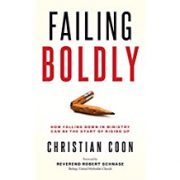 This article is adapted from Failing Boldly: How Falling Down in Ministry Can Be the Start of Rising Up (Discipleship Resources, 2017). Copyright © 2017 by Christian Coon. All rights reserved. Used by permission. The book is at Cokesbury, Amazon, and Upper Room Books.
Related Resources
Read more.
|
|
|
Diversity-oriented churches, despite the challenges they face, are some of the fastest growing churches in the United States, says Brian Leander of Adelphi University. He names seven characteristics that help explain how these churches are able to embrace greater racial, ethnic, cultural, and socio-economic diversity.
Recent trends suggest that a significant number of churches are overcoming the limiting effects of racial conflict, prejudice, and ethnocentrism despite church traditions and systems that promote homogeneity as a practical alternative to the inevitable conflicts between different people groups. Diversity-oriented churches, despite the challenges they face, are some of the fastest growing churches in the United States.
What is a diversity-oriented church?
At the group level, the term diversity is used to refer to heterogeneity within a group on characteristics such as informational (professional background, education, skills), visible (race, age, ethnicity) or value-based (ethic, motivation) differences. Diversity-oriented churches are missional multicultural organizations which are intentional about deconstructing socially divisive constructs in the church, denominations, and their communities with the message of the Gospel.
If the mission of the Church is the formation of one body out of many people who were previously divided socially, then it is reasonable to expect that local churches would be suitable examples of reconciliation, conflict resolution, and intercultural mission effectiveness.
Motivated by biblical mandates for reconciliation, justice, and evangelism, these churches express value for diversity in their vision, ministry practices, worship style, human resources practices, leadership practices, polity, and community engagement. In these organizations, members and leaders promote value and respect for perceived and actual differences between a wide variety of individuals.
One body in Christ
The Christian faith is predicated upon the belief that Jesus’ ministry of reconciliation accomplished two otherwise impossible objectives: first restoring the relationship between humankind and the Creator, and secondly restoring the harmonious relationship God intended for people in community. Ephesians 2:13-16 (NIV) states it this way: “… now in Christ Jesus you who once were far away have been brought near through the blood of Christ. For he himself is our peace, who has made the two one and has destroyed the barrier, the dividing wall of hostility, by abolishing in his flesh the law with its commandments and regulations. His purpose was to create in himself one new man out of the two, thus making peace, and in this one body to reconcile both of them to God through the cross, by which he put to death their hostility.”
If the mission of the Church is the formation of one body out of many people who were previously divided socially, then it is reasonable to expect that local churches would be suitable examples of reconciliation, conflict resolution, and intercultural mission effectiveness. More importantly, it is fair to expect that the alignment of the church’s attitudes, beliefs, and behaviors with Jesus’ vision, mission, values, and practices would bear fruit, which in this case would include spiritual, personal, organizational, and community reconciliation.
Seven key characteristics
The following are some key characteristics of diversity-oriented churches:
- Leadership that strategically creates vision and value congruence across the organization that empowers teams and individuals and fosters higher than normal levels of organizational commitment and productivity towards being multicultural.
- Top-management team that reflects the demographics of the church membership and the community.
- Organizational strategy that is clearly articulated and supported by decisive action when inequalities and conflict in the church and in the community need to be addressed.
- A leadership development plan that is predicated upon the recruitment, training, and professional development of future generations of leaders.
- A formal plan to focus leadership with respect to organizational change and diversity management.
- Policies and procedures for conflict resolution and reconciliation at all levels of the organization and in the community.
- The leader defines, legitimizes, and reproduces the organization’s vision, mission, values, and practices across generations.
These seven criteria are by no means exhaustive; however, they begin to address how some churches are choosing to depart from traditional homogeneous models of church development that do not account for racial, ethnic, cultural, and socio-economic diversity in local congregations and communities.
This article is adapted from Dr. Leander’s paper on “Intercultural Leadership in Diversity-Oriented Churches.” Used by permission. Learn more about his work at abrianleander.com.
Related Resources:
|
|
Worship attendance is vital to the mission of the church. Our free "50 Ways" tip sheet provides practical strategies to help you improve the attendance of current members; invite new people to attend worship; make your church visible and attractive; welcome worship guests warmly; and make worship accessible to newcomers.
Vital worship strengthens other areas of ministry by inspiring faith, building community, and connecting people to the congregation’s mission. Because worship is at the center of congregational life, strong attendance is more than a number. It is a vital sign.
Prepared by Robert Crossman
Improve the attendance of current members
- Strive to increase the number of times current members are in worship each year. Start with yourself.
- At least once or twice each year, perhaps in the New Year’s resolution season, teach and preach the importance of faithful worship attendance.
- Invite church members to make a written commitment to grow one step toward faithful attendance.
- Include a commitment to faithful worship attendance as part of a holistic annual stewardship commitment.
- Keep a record of attendance and monitor it.
- Know that it is important to respond to absentees before they drop out of active attendance. Once a regular attender misses six consecutive weeks, it is hard to return to the habit of consistent Sunday worship.
- Form a worship membership care team to review attendance within 24 hours of each service.
- Send a handwritten note (signed by the membership care team, not the pastor) to anyone who has missed three Sundays in a row. Say, “Looking through the attendance slips, we’ve missed your name! Hope to see you next Sunday.” In a smaller church, the wording can be more personal.
- Ask a personal friend (a choir mate, Sunday School class member, or someone who sits in the same pew) to telephone people who have missed four Sundays in a row. “Hi John. We’ve noticed that Fred has missed church the last four Sundays. Can you telephone him this evening?”
- Maintain a loving, invitational relationship with those who have been absent for five or more Sundays. Never be judgmental.
- Know that is often very difficult to return to worship after the death of a loved one. Form a Grief Support Team to send handwritten notes monthly until the family has returned to regular Sunday attendance.
- Telephone every household in the church and everyone who has ever visited to invite them to some special event four times a year. Say, “Hi, we are calling everyone related to First Church this week, reminding everyone that this Sunday the choir is singing the Messiah. I hope you will be there.”
Invite new people to attend worship
- Decide today to open your minds, hearts, and doors to new faces, even if it means changing your music, sermon content, Sunday School, and enlarging your personal circle of Christian friends.
- Pray for the unchurched in your community. Pray for children being raised outside the church, couples in marriages that don’t have Christ at their center, etc. But pray also for specific families and individuals — friends, relatives, associates, neighbors — by name every day.
- Know that personal invitations are the most effective method of increasing worship attendance. Invest 60 seconds once a week to invite someone to attend worship with you.
- Continue to invite a person every two months even if they decline your invitations. Those invited may eventually come to a season of life when they are receptive to attending worship. Regular invitations are more likely to overlap one of these seasons.
- Recycle your worship bulletins. Keep Sunday’s bulletin in your car or on your desk until you have given it to someone along with your personal invitation for them to join you in worship.
- At least once a year, perhaps in the pre-Christmas season, preach and teach the importance of becoming an inviting people. Invite the congregation to make a written commitment to grow one step toward faithful inviting and witnessing.
- Distribute to members simple printed invitations during the Christmas and Easter seasons that they can give to family and friends. Print at the top of the card, “If you are not active in a church, worship with us this season.”
- Have a “Bring a Friend Day” or “F.R.A.N.” Day — a church-wide effort to bring a Friend, Relative, Associate or Neighbor. Select a Sunday when something special is happening, such as homecoming, the start of Vacation Bible School, or Christmas Eve. And prepare as you would for company coming.
- Know that the people who are on the fringe of your church are your future, your prospect list, and your next potential generation of deeply devoted disciples. Avoid the tendency to denigrate or alienate those who are not yet fully committed disciples.
- Find ways continually to invite these “near the edges” of your church, especially those who already have a positive impression of the church, such as those who have come to the church for a wedding, a funeral, or to vote and those who already worship a couple of times a year. Do not drop them from the newsletter or membership list.
- Distribute door hangers in target neighborhoods near your church. It is more effective to cover the same 500 doors six times, than to do 3,000 doors one time.
- Send mass mailers to targeted postal routes near your church six to eight times a year. The back-to-school season, pre-Christmas, and pre-Easter times are logical for these mailing.
- Have a website. Increasingly, people use the internet and Google the same way our grandparents used the Yellow Pages. The web presence can be very simple, a single page with a map, worship times, simple welcoming invitation, and contact information.
Make your church visible and attractive
- Purchase permanent roadside directional signs to point the way to your building. If your building is not on the main highway, install a prominent sign on the highway.
- Purchase temporary yard signs to put out for a few days and then remove. They catch the eye and are relatively inexpensive. They should be very simple with little wording, such as: “Worship 10 a.m. Sunday. You’re Invited.” “Easter Sunday 11 a.m. You’re Invited.”
- Don’t hide your cars. If there is parking in front of the building, use it. Cars in the parking lot lets the community know that something important is happening at your church.
- Make a good first impression through the appearance of your building and landscaping. A well cared for exterior lets guests know that you are expecting company.
- Clearly indicate the main entry to your building so that worship guests can find it easily.
- Reserve the best parking spaces for guests. The pastor, staff, and church officers should park on the edge of the parking lot, leaving the best spaces for others.
- Make the nursery the nicest room in the church to attract and keep families with young children. It should be clean and well equipped, in an easy-to-find location close to the worship space, and staffed with adults. As your church grows, you will need pagers, check in and check out procedures, and nursery staff wearing uniforms with a photo ID.
- Have clean, neat Sunday School rooms for children. The Sunday School program should be well-staffed and well-resourced.
Welcome worship guests warmly
- Greet guests when they first arrive in the parking lot. Give a couple of people orange vests and have them wave and smile as cars pull in. On rainy days, they can escort people to the door under a church umbrella. If the lot is large, they can drive folks to the door in golf carts.
- Greet guests as they arrive at the door, saying “Good to see you. Glad you are here.” Do not ask for their names as many guests are cautious and prefer anonymity. The larger the church, the more this is true.
- Clearly mark the rest rooms, nursery, and worship rooms. In a large building with a complicated layout, have greeters stand at the intersection of hallways ready to escort guests who are unsure about finding their way.
- Find a way to acknowledge and welcome guests in worship without singling them out or embarrassing them. In many communities, guests prefer to be anonymous so don’t ask them to stand and introduce themselves.
- Have an easy and readily available method for worship guests who wish to give you their name and contact information.
- Practice the “Circle of Ten.” Encourage church leaders to personally greet everyone — member or guest — who may sit within ten feet of them on Sunday.
- Know that guests typically leave the building within three minutes after the service. Encourage church leaders to follow the “Rule of Three,” devoting the first three minutes after the benediction to speaking with people they don’t know before speaking to family and friends.
- Have greeters at all the exits, smiling, shaking hands, and simply saying to members and guests as they leave, “Glad you were here. I hope to see you next Sunday.”
- Start a “First Friends” ministry as a way to reach a new age, racial, or cultural group. Train a pool of people, from a variety of ages and stages of life, to watch for first time guests, sit by them, treat them to lunch, and telephone them the next Saturday inviting them to Sunday worship.
Make worship accessible to newcomers
- Make your worship bulletin or screens visitor friendly. Include the actual words, or at least the page numbers, for any songs or responses commonly known to members but not newcomers.
- Preach sermons that don’t assume familiarity with the inner workings of the church or a high level of previous biblical knowledge.
- Present all musical offerings well and in a style most likely to appeal to worship guests.
- Consider adding an additional worship service to reach new people who would prefer a different time; or to reach new people who would prefer a different style of worship and music.
- Start a new church or a second worship site at a different location as a way of increasing attendance.
Follow up with visitors
- Develop a systematic plan for following up with visitors after their first, second, and third visits.
- One model some use includes 1) follow up with first-time visitors with a doorstep visit before 3 p.m. that same Sunday, a letter or telephone call from the pastor within two days, and placement on the newsletter and email lists; 2) follow up with second-time visitors with telephone call within 36 hours from someone related to the visitor’s interests or needs — for example, a Youth Minister, or Sunday School Teacher, or Choir Director; and 3) follow up with persons who visit a third time with a telephone call to request a home visit.
- Invite newcomers who have visited in recent months to an informal coffee with the pastor or other social gathering that includes fellowship and information.
Dr. Robert Crossman is Minister of New Church Starts and Congregational Advancement for the Arkansas Conference of the United Methodist Church. Used by permission.
|
The Congregational Attendance Profile (CAP) Video Tool Kit doesn't just track attendance -- it reveals clues to improve attendance. Using CAP's templates, you can effortlessly produce a two-year trends chart showing the big picture. Churches have shown major improvement in attendance by acting on lessons learned from this resource.
|
Quotable Leadership:
Out of intense complexities, intense simplicities emerge.
[Winston Churchill]
|
From worship attendance patterns to diversity, finances to mission engagement and more, the church of today is not the church of yesteryear. This ebook explores these topics and more, along with discussion questions for further exploration. Changes Congregations Are Facing Today is an ideal conversation starter, especially for churches evaluating their own ministries or engaging in planning for the future.
|
|





No comments:
Post a Comment