 |
|
The secret of great preaching, according to Charley Reeb, is to engage your listeners. Stop thinking about what would impress your seminary professors, he says, and instead focus on sermons that will make a difference to people's real-life circumstances and challenges.
Many preachers prepare sermons designed to reach the crowd at a seminary chapel service. They imagine their seminary professors sitting in the back pew critiquing their sermons. Other preachers sound like they have just come from a creative writing retreat. They have read everything Barbara Brown Taylor and Fred Craddock have written and seek to imitate it. If you are preaching every week to other preachers and professors, stick with this approach. However, if it is your goal to reach the majority of listeners in churches you must change your approach.
Engage your listeners
So, what is the secret to great preaching? It is three simple words: Engage your listeners! You know, those people you are talking to in worship — the ones who chose not to do a thousand other things on a weekend so they might hear a relevant word from God for their lives. Many preachers assume their listeners will be engaged regardless of what they say and how they say it. This is a fatal mistake.
Engaging your listeners is not pandering to them or entertaining them; it’s respecting them and caring about them.
This may sting a little but if you want to be a great preacher you must accept it: “If people aren’t interested they’re not listening.” Oh, they may look like they’re listening but their minds and hearts are far away. They are thinking about the talk they must have with their bosses on Monday, their grocery lists, where they are going to lunch after worship, or the texts they have received that look more interesting than anything you are saying. They have checked out, and the opportunity for them to be transformed by your message has been lost.
So how do you get your listeners interested in what you have to say? To begin with, stop thinking about your seminary textbooks, commentaries, and professors, and start thinking about the lives of your listeners. To be blunt: Don’t be selfish when you prepare sermons. Think of others when you preach! Ask yourself, how will this biblical message engage those who take the time to get up, dress up, and show up to worship?
Know your people
When you preach there may be a woman sitting in the back who is going through a bitter divorce. There may be a teenager who has been dragged to worship by his parents. There may be a man sitting near the front who hasn’t been to church in years because of how harshly he was treated by his Christian friends. How will your sermon connect with each of these people? Will it connect? Be honest. Will they remember what you said 30 minutes after worship?
Here is a good exercise. If you are currently serving a church, spend ten minutes writing down everything you know about your people, both good and bad — health issues, peer pressures, questions of faith, marital problems, graduations, family problems, issues with kids, issues at work, births, deaths, personal struggles and temptations, new jobs, job layoffs, money problems, great achievements in sports, and so on.
When you are finished with the list, take a good look at it and ask yourself this question, “Have any of my sermons in the last few months touched on most of these experiences?” Now ask yourself this question, “What difference do my sermons make for people who are going through these experiences?” And then ask yourself a third question, “Why should the people on the list care about the messages I preach?” Finally, ask yourself, “Is it easy for the folks on this list to understand my sermons?”
The Word made flesh
Engaging your listeners is not pandering to them or entertaining them; it’s respecting them and caring about them. When you engage your listeners, you are showing sensitivity to where they are in their lives and offering something that could help them. Average listeners today don’t care what you have to say if they don’t sense that you understand them and care about them.
Jesus knew this, which is why he was such an outstanding communicator. The Bible says of Jesus, “The large crowd listened to him with delight” (Mark 12:37). Why? Because he engaged them. He walked among them, listening to them, caring for them, and healing them. He told stories and illustrated his messages with everyday examples they could understand. Jesus’s listeners knew he cared, which is why they probably hung on his every word. Jesus was figuratively and literally “the Word … made flesh” (John 1:14 KJV). Good preaching is making the “word become flesh” for your listeners.
Adapted from That’ll Preach! 5 Simple Steps to Your Best Sermon Ever
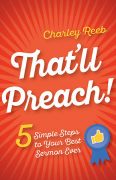
(Abingdon Press: 2017) by Charley Reeb. Used by permission. All rights reserved. The book is available at Cokesbury and Amazon.
Related Resources
Read more.
|
|
|
Lewis A. Parks, author of Small on Purpose, says the small church offers a surrogate family for those whose basic family unit is dispersed or in need of wider circles of reinforcement. Smaller congregations today are not unlike the house churches in the New Testament era, he says, which redefined familial relationships around the bonds of faith.
Outside my front door is the campus of a megachurch that averages 3,000 persons in worship weekly. Some parents with children have left my church for this church. They wanted a more complete Christian environment for their family — for their children to be around other children as they learned, played, came to confession of faith, and grew into adulthood. It is a compelling logic, and I never tried to argue against it.
Small churches have a quiet but diffuse witness to share with congregations of all sizes. It is a witness to the worth of being a place where everyone knows your name and all together we can call upon the name of the Lord and thereby experience more abundant life.
What I have tried to do is figure out what the alternative logic might be for a small church. And I think it may be this: the small church offers a surrogate family for those whose basic family unit is dispersed or in need of wider circles of reinforcement. There are widows and widowers that fear being swallowed by their memories, regrets, and health issues. They know they need regular face-to-face and name recognition contact. They know they need their faith to be tangible and incarnate.
There are empty nesters whose grown children and fast-growing grandchildren live at a distance. These empty nesters have surplus space to care for persons to whom they are not related, except by the waters of baptism and a shared Christian worldview. She has time to be aunt to the young single mother who struggles with addiction. He has time to be uncle to the young man trying to start a new business. Together they visit those of the church family who can no longer leave their residences.
There are the young single adults who obviously are just passing through on their way to life after college, military service, or the entry-level job. For a few months they lend their enthusiasm, their gifts, their surprising preference for small church and traditional liturgy. They sit alone in the pews comfortable and confident in their youth but give themselves freely in the social exchanges through which their elders soak up their energy.
Grandparents bring their grandchildren. They are not giving up on the missing generation with its casual secularity, but they would see their children’s children exposed to religious faith. It is a gentle act of subversion. Those who thrive in large families where celebrations are frequent plan surprise birthday and anniversary celebrations for those who have no one else to remember. The well-dressed, bookish homeless man settles into the pew next to the family of five sporting the casual Hawaiian look.
The surrogate family of Jesus
Sometimes it occurs to me that I am witnessing the last stages of decay of a once vibrant organism, the leftovers of the heyday of nuclear families of the 1950s, ‘60s, and ‘70s, the church on its way down. I counter those gloomy thoughts by remembering some other churches on their way up, the house churches of the New Testament and first two centuries. The persons in those small churches, so to speak, come from broken homes. They answer the call to exclusive, ultimate loyalty to Jesus as Lord.
In the new surrogate family of Jesus, some of the established family patterns and practices of the ancient Mediterranean are left behind such as exclusion by bloodline, firm hierarchical relations, and the limited roll assigned to women. Other patterns and practices, such as sibling solidarity, fellowship around the table, and worship, are kept but reminted to fit the members of the new surrogate family. In the Gospels Jesus builds that first surrogate community precursor to the church.
The drama of the loss of biological ties and traditional family ties and the gain of new faith-based and future-oriented family ties saturates the pages of the New Testament. It is a narrative of collapse and restoration ignited by the example and lordship of Jesus Christ. It is a staple of the soul care that can be replicated in the small-church setting.
The worth and witness of the small church
The decline of mainline churches has brought the nature and mission of the church front and center. Some see small churches as part of the problem. They judge their size as a business enterprise that never quite took off; small churches have not carried their weight. I prefer to see the small church as part of the solution. These “failed enterprises” have been around a long time. They have replenished themselves with new players and new services for decades, and in some cases centuries. That’s a durability worth pondering.
Small churches have a quiet but diffuse witness to share with congregations of all sizes. It is a witness to the value of maintaining focus over the long run, of being thrown again and again on the Spirit for buoyancy and gifts, of being shrewd in dire circumstances. It is a witness to the worth of being a place where everyone knows your name and all together we can call upon the name of the Lord and thereby experience more abundant life.
 This article is excerpted from Small on Purpose: Life in a Significant Church (Abingdon Press, 2017) by Lewis A. Parks. Used by Permission. The book is available at Cokesbury and Amazon.
Related Resources
|
The Right Question
Leaders do not need answers. Leaders must have the right questions.
Many leaders, especially those at or near the top of leadership in their organizations, find that they are often insulated from the kinds of critical feedback or clues that previously they relied upon to shape their planning and actions. Hal Gregersen suggests some questions for leaders who think they may be in this situation.
1. How many barriers do people have to cross to talk directly with you?
2. How much of your typical workweek is spent outside your office or organization?
3. In a typical conversation, how many questions do you ask and how many statements do you make?
4. How many times this week have you said, "I don't know" in response to a question?
Want more Right Questions? Read Right Questions for Church Leaders.
|
What can you do when 20 percent of your congregation does 80 percent of the learning, serving, and leading? The Increasing Active Engagement Tool Kit includes videos, narrated presentations, outlines of key points, and supplementary materials to help you get and keep people involved and engaged.
|
Single persons in ministry face a unique set of challenges around maintaining boundaries, privacy, and social connections, particularly if they serve in a congregation that has only been served in the past by married clergy. "To the Point: Suggestions for Churches with a Single Pastor" describes how congregations and pastors can work together on the "tender balance" between being supportive and allowing privacy.
All clergy face many challenges. But single persons in ministry can face a unique set of challenges around maintaining boundaries, privacy, and social connections, particularly if they serve in a congregation that has only been served in the past by married clergy. Some of the best advice for churches comes from a young single pastor — “congregations and pastors both should work on the tender balance between being supportive and allowing privacy.”
Church members can often subconsciously communicate the assumption that they expect their pastor to be married. For example, a single clergyman starting ministry in a new congregation was asked repeatedly “When will be meeting your wife?” or “Will your wife be teaching Sunday School or serving on the altar guild?” Similarly, congregants can project the assumption that marriage is normative for or sought by everyone when they drop hints about eligible friends the pastor might like to meet. While these kinds of comments are generally well intended, they can make a single person feel awkward, judged, or even inadequate. Congregations need to be sensitive to and accepting of different marital statuses among clergy.
It is easy for single clergy to fall into the trap of letting the church become their primary social outlet and support network. This is especially true if they have left behind friends and family to begin ministry in a new church and community. It is important to recognize that all clergy, but especially single clergy, need to build a set of relationships and friendships outside the church — people for whom they are not the “pastor.” This may mean that they seek opportunities for involvement beyond the church, such as book clubs, sports teams, or community groups, and find people who share common interests. Churches can encourage them to take time off to renew themselves and to connect with friends and family. Encourage them to connect with other clergy in the community that you feel will be supportive colleagues.
Single clergy often feel they are navigating a minefield when it comes to dating. In addition to fix-up attempts, they have concerns about a lack of privacy, the potential for rumors and ill-informed assumptions, and questions about when and how to let the congregation know about a serious relationship. These all can leave a single clergyperson vulnerable and confused. You can help by recognizing that it is normal and important for them to date. Trust the pastor to operate within their own level of comfort regarding how much they share with the congregation.
It is important that the congregation be aware of norms and expectations about whether it is appropriate for pastors to date congregants. Denominations or judicatories normally have clearly defined policies on this question, usually not permitting such dating. Both pastor and congregation must understand these policies and their rationale. Appropriate church leaders may need to educate the congregation about the policies. But always remember that great sensitivity is required so that this issue does not loom too large in people’s minds or distract from the larger issues in establishing the pastor’s ministry.
Single clergy who are parents may also feel they are vulnerable or open to special scrutiny. Pay attention to expectations for evening meetings and the need for childcare. Such care will also benefit other church members. The church does not have special responsibility for the pastor’s childcare but should do everything possible to make possible the active participation of those with young children.
Lewis Fellows, participants in a Lewis Center leadership development program for young clergy, contributed to this resource.
|
Quotable Leadership:
…religious leadership. One of the most unique characteristics of theological education is that graduates go immediately into positions of leadership upon graduation, if not before. From week one, the new… [Jan Singer]
|
The Developing Your Operating Budget Video Tool Kit helps you understand what an operating budget is, different ways that churches create their annual operating budgets, and five common budgeting models. No matter your church size, this resource will provide clues and wisdom to help your budget advance your mission and accomplish God's vision for your congregation.
|
|





No comments:
Post a Comment