
Lausanne Global Analysis · July 2017
SHARE:


Welcome to the July issue of the Lausanne Global Analysis, which will soon also be available in Portuguese and Spanish.
In this issue we examine how the 2011 Japan Earthquake transformed gospel understanding in Japanese churches; we consider how to reach Muslims through music, drawing on bridge-building lessons from Pakistan; we address the challenge of ‘fake news’ and its impact on Christian witness in today’s post-truth society; and, in the light of his first 100 days in office, we ask what the ‘Trump Effect’ means for the church and mission.
DAVID TAYLOR
Welcome to the July issue of the Lausanne Global Analysis, which is also available in Portuguese and Spanish. We look forward to your feedback on it.
You may have noticed some changes to our layout and some new functions beginning with our March issue. The Lausanne Global Analysis has been redesigned as a primarily web-based publication, with beautiful imagery and fonts optimized for reading on your mobile device or computer.
 However, we have received several comments from readers who relied heavily on the downloadable version, so we have reintroduced a simpler PDF version of each individual article. The PDF has a less elaborate design and is available particularly for readers with slow or limited internet access. To download any LGA article as a PDF, simply click the PDF button on the right side of the screen. You will be given an option to download that article as a PDF, or print it on your home printer in A4 or US Letter size.
We have also discontinued executive summaries since very few of our readers were using them. We welcome your input on the redesign through email to analysis@lausanne.org, and we hope you enjoy the new design!
In this issue we examine how the 2011 Japan Earthquake transformed gospel understanding in Japanese churches; we consider how to reach Muslims through music, drawing on bridge-building lessons from Pakistan; we address the challenge of ‘fake news’ and its impact on Christian witness in today’s post-truth society; and, in the light of his first 100 days in office, we ask what the ‘Trump Effect’ means for the church and mission.
‘The Great East Japan Earthquake of 2011 prompted Japanese churches to rethink how they engage in evangelism and church development’, writes Shoichi Konda (member of the Japan Lausanne Committee). In the Tohoku area of northern Japan, there are many examples of people who previously had shown no interest in the gospel but became receptive following the disaster. This openness came about through neither a major evangelistic campaign nor an attractive church program. Rather, people were drawn to Christianity as they saw Christ in the lives of Christian volunteers who, without demanding anything in return, kept coming to the disaster areas to provide aid and support. Lessons have been gleaned through relief work for more effective evangelism. Starting house churches seems to be the key to multiplication, moving out of the church building and into the local community. Churches throughout Japan should reconsider how to engage in mission. ‘The unprecedented scale of this disaster has opened the eyes of Japanese Christians to a more holistic understanding of the gospel and is stimulating a transformation in foundational church structures’, he concludes.
‘Traditional methods of mission in Pakistan have often made little impact. However, media and art are emerging as vehicles for evangelization’, writes Eric Sarwar (a founder of the Tehillim School of Church Music and Worship in Pakistan). Many are unaware that Islam is in fact a liturgical and canonical faith with distinct musical practices. Sufis are particularly open to artistic expression (poetry, music, and dance). The book of Psalms is the main literary and musical resource for fostering Muslim-Christian engagement around a common divine heritage of song. Ethnomusicology and missiology can help the Church to engage with diverse Islamic societies through Muslim music culture. They open up the possibilities of a laity model of mission that releases the force of Christian musicians, singers, and artists to witness to Christ in the Muslim world. Almost 80 percent of music teachers in Muslim schools in Pakistan are Christians. A missionary force of young Christian music teachers could be trained and equipped for vibrant mission in their respective schools. In the broader Islamic world, Sufism has an important role in missional engagement. ‘Music and Sufispirituality are potential bridges between hungry hearts and Christ’, he concludes.
‘We now live in a “post-truth” society’, writes Tony Watkins (Network Coordinator for Lausanne Media Engagement Network). The term ‘post-truth’ is closely connected with ‘fake news’ . Fake news spreads quickly across the media, often due to political agendas. Social media have become the main way we access news. Fake news is also driven by greed. However, often on social media, it is merely careless, unverified reporting that quickly spreads. Social media platforms persuade us to share content by ‘social proof’. We also share posts that push our emotional buttons. When ‘alternative facts’ take over from truth, a culture is in big trouble. When public discourse becomes nothing but competing viewpoints claiming to be ‘facts’, any appeal to a source of authority, such as the Bible, is neutralised by writing it off as just ancient fake news. Moreover, suppressing the truth brings God’s wrath. Christians should be passionate about truth because we follow the One who is the Truth. We must be prepared to challenge false assertions and spin. ‘If the church is to have a prophetic role within society, we must dare to speak precisely those biblical truths which most challenge and discomfort society’, he concludes.
‘The “first hundred days” is a yardstick commonly used… to measure the effectiveness and impact of US presidents’, writes Tom Harvey (Academic Dean of the Oxford Centre for Mission Studies). In evaluating President Donald Trump’s first hundred days, one should look not only at his record internationally and domestically, but also at the ‘Trump Effect’. This may be his most enduring legacy. In spite of having solid Republican majorities in Congress, Trump has at the time of writing been unable to ratify any significant legislation. Yet no one can deny his impact on the international and national stage. His constant use of Twitter has been petty or tawdry at best when challenging critics or settling minor affronts. His populism will catalyse charismatic leaders around the world who trade on nativist ethnic biases and anti-immigrant bigotry. His likely legislative failure will further erode effective US governance. As a result of championing Trump, his personal and political character flaws are hurting the perception of US Evangelical Christians. The deepening partisan ideological divide in all sectors of US society will have major ramifications for the church, while ‘internationally, Trump’s “America First” does not bode well for mission’, he concludes.
We hope that you find this issue stimulating and useful. Our aim is to deliver strategic and credible analysis, information and insight so that as a leader you will be better equipped for the task of world evangelization. It’s our desire that the analysis of current and future trends and developments will help you and your team make better decisions about the stewardship of all that God has entrusted to your care.
Please send any questions and comments about this issue to analysis@lausanne.org. The next issue of The Lausanne Global Analysis will be released in September.
Lausanne Global Analysis seeks to deliver strategic and credible information and insight from an international network of evangelical analysts to equip influencers of global mission. Browse all the past issues at lausanne.org/lga. The publication of the LGA is overseen by its Editorial Advisory Board. Articles represent a diversity of viewpoints within the bounds of our foundational documents. The views and opinions expressed in these articles are those of the authors and do not necessarily reflect the personal viewpoints of Lausanne Movement leaders or networks. Inquiries regarding the Lausanne Global Analysis may be addressed to analysis@lausanne.org.
 David Taylor serves as the Editor of the Lausanne Global Analysis. David is an international affairs analyst with a particular focus on the Middle East. He spent 17 years in the UK Foreign and Commonwealth Office, most of it focused on the Middle East and North Africa. After that he then spent 14 years as Middle East Editor and Deputy Editor of the Daily Brief at Oxford Analytica. David now divides his time between consultancy work for Oxford Analytica, the Lausanne Movement and other clients, also working with Christian Solidarity Worldwide (CSW), the Religious Liberty Partnership and other networks on international religious freedom issues.
 July 2017 Issue Overview
David Taylor
Welcome to the July issue of the Lausanne Global Analysis, which is also available in Portuguese and Spanish. We look forward to your feedback on it.
You may have noticed some changes to our layout and some new functions beginning with our March issue. The Lausanne Global Analysis has been redesigned as a primarily web-based publication, with beautiful imagery and fonts optimized for reading on your mobile device or computer.
However, we have received several comments from readers who relied heavily on the downloadable version, so we have reintroduced a simpler PDF version of each individual article. The PDF has a less elaborate design and is available particularly for readers with slow or limited internet access. To download any LGA article as a PDF, simply click the PDF button on the right side of the screen. You will be given an option to download that article as a PDF, or print it on your home printer in A4 or US Letter size.
We have also discontinued executive summaries since very few of our readers were using them. We welcome your input on the redesign through email to analysis@lausanne.org, and we hope you enjoy the new design!
In this issue we examine how the 2011 Japan Earthquake transformed gospel understanding in Japanese churches; we consider how to reach Muslims through music, drawing on bridge-building lessons from Pakistan; we address the challenge of ‘fake news’ and its impact on Christian witness in today’s post-truth society; and, in the light of his first 100 days in office, we ask what the ‘Trump Effect’ means for the church and mission.
‘The Great East Japan Earthquake of 2011 prompted Japanese churches to rethink how they engage in evangelism and church development’, writes Shoichi Konda (member of the Japan Lausanne Committee). In the Tohoku area of northern Japan, there are many examples of people who previously had shown no interest in the gospel but became receptive following the disaster. This openness came about through neither a major evangelistic campaign nor an attractive church program. Rather, people were drawn to Christianity as they saw Christ in the lives of Christian volunteers who, without demanding anything in return, kept coming to the disaster areas to provide aid and support. Lessons have been gleaned through relief work for more effective evangelism. Starting house churches seems to be the key to multiplication, moving out of the church building and into the local community. Churches throughout Japan should reconsider how to engage in mission. ‘The unprecedented scale of this disaster has opened the eyes of Japanese Christians to a more holistic understanding of the gospel and is stimulating a transformation in foundational church structures’, he concludes.
‘Traditional methods of mission in Pakistan have often made little impact. However, media and art are emerging as vehicles for evangelization’, writes Eric Sarwar (a founder of the Tehillim School of Church Music and Worship in Pakistan). Many are unaware that Islam is in fact a liturgical and canonical faith with distinct musical practices. Sufis are particularly open to artistic expression (poetry, music, and dance). The book of Psalms is the main literary and musical resource for fostering Muslim-Christian engagement around a common divine heritage of song. Ethnomusicology and missiology can help the Church to engage with diverse Islamic societies through Muslim music culture. They open up the possibilities of a laity model of mission that releases the force of Christian musicians, singers, and artists to witness to Christ in the Muslim world. Almost 80 percent of music teachers in Muslim schools in Pakistan are Christians. A missionary force of young Christian music teachers could be trained and equipped for vibrant mission in their respective schools. In the broader Islamic world, Sufism has an important role in missional engagement. ‘Music and Sufispirituality are potential bridges between hungry hearts and Christ’, he concludes.
‘We now live in a “post-truth” society’, writes Tony Watkins (Network Coordinator for Lausanne Media Engagement Network). The term ‘post-truth’ is closely connected with ‘fake news’ . Fake news spreads quickly across the media, often due to political agendas. Social media have become the main way we access news. Fake news is also driven by greed. However, often on social media, it is merely careless, unverified reporting that quickly spreads. Social media platforms persuade us to share content by ‘social proof’. We also share posts that push our emotional buttons. When ‘alternative facts’ take over from truth, a culture is in big trouble. When public discourse becomes nothing but competing viewpoints claiming to be ‘facts’, any appeal to a source of authority, such as the Bible, is neutralised by writing it off as just ancient fake news. Moreover, suppressing the truth brings God’s wrath. Christians should be passionate about truth because we follow the One who is the Truth. We must be prepared to challenge false assertions and spin. ‘If the church is to have a prophetic role within society, we must dare to speak precisely those biblical truths which most challenge and discomfort society’, he concludes.
‘The “first hundred days” is a yardstick commonly used… to measure the effectiveness and impact of US presidents’, writes Tom Harvey (Academic Dean of the Oxford Centre for Mission Studies). In evaluating President Donald Trump’s first hundred days, one should look not only at his record internationally and domestically, but also at the ‘Trump Effect’. This may be his most enduring legacy. In spite of having solid Republican majorities in Congress, Trump has at the time of writing been unable to ratify any significant legislation. Yet no one can deny his impact on the international and national stage. His constant use of Twitter has been petty or tawdry at best when challenging critics or settling minor affronts. His populism will catalyse charismatic leaders around the world who trade on nativist ethnic biases and anti-immigrant bigotry. His likely legislative failure will further erode effective US governance. As a result of championing Trump, his personal and political character flaws are hurting the perception of US Evangelical Christians. The deepening partisan ideological divide in all sectors of US society will have major ramifications for the church, while ‘internationally, Trump’s “America First” does not bode well for mission’, he concludes.
We hope that you find this issue stimulating and useful. Our aim is to deliver strategic and credible analysis, information and insight so that as a leader you will be better equipped for the task of world evangelization. It’s our desire that the analysis of current and future trends and developments will help you and your team make better decisions about the stewardship of all that God has entrusted to your care.
Please send any questions and comments about this issue to analysis@lausanne.org. The next issue of The Lausanne Global Analysis will be released in September.
Lausanne Global Analysis seeks to deliver strategic and credible information and insight from an international network of evangelical analysts to equip influencers of global mission. Browse all the past issues at lausanne.org/lga. The publication of the LGA is overseen by its Editorial Advisory Board. Articles represent a diversity of viewpoints within the bounds of our foundational documents. The views and opinions expressed in these articles are those of the authors and do not necessarily reflect the personal viewpoints of Lausanne Movement leaders or networks. Inquiries regarding the Lausanne Global Analysis may be addressed to analysis@lausanne.org.
David Taylor serves as the Editor of the Lausanne Global Analysis. David is an international affairs analyst with a particular focus on the Middle East. He spent 17 years in the UK Foreign and Commonwealth Office, most of it focused on the Middle East and North Africa. After that he then spent 14 years as Middle East Editor and Deputy Editor of the Daily Brief at Oxford Analytica. David now divides his time between consultancy work for Oxford Analytica, the Lausanne Movement and other clients, also working with Christian Solidarity Worldwide (CSW), the Religious Liberty Partnership and other networks on international religious freedom issues. Christian Witness Amidst Disaster in Japan - How the 2011 Earthquake transformed gospel understanding in Japanese churches
Shoichi Konda
The Great East Japan Earthquake of 2011[1] prompted Japanese churches to rethink how they engage in evangelism and church development. In the Tohoku area of northern Japan, there are many examples of people who previously had shown no interest in the gospel, but became receptive following their 2011 disaster experience. This openness came about through neither a major evangelistic campaign nor an attractive church program. Rather, people were drawn to Christianity as they saw Christ in the lives of Christian volunteers who, without demanding anything in return, kept coming to the disaster areas to provide aid and support.
Christian volunteers never stopped comingImmediately following the 2011 disaster, a great number of local and overseas volunteers came to the tsunami-ravaged Tohoku seacoast. However, a few months later—when evacuation centers began to close, water and food distribution became unnecessary, and the work of removing tsunami mud from houses largely came to an end—most volunteers and support organizations stopped coming; but not Christian volunteers.
CHRISTIANS WERE AWARE THAT THOSE SUFFERING WERE DEALING NOT JUST WITH PHYSICAL NEEDS.
They worked through local churches and continued to support people affected by the disaster, even after people had moved from evacuation centers into temporary housing. Christians were aware that those suffering were dealing not just with physical needs such as clothing, food, and housing—they were also dealing with spiritual needs, as they wrestled with the loss of loved ones and possessions that had been dear to them.
As they asked themselves why such a disaster had fallen upon them, pastors and Christian volunteers found themselves engaged in ‘presence ministry’ as they tirelessly listened to victims repeat their stories of grief, anxiety, and regret. Even today, six years since the earthquake and tsunami, many pastors, both men and women, continue to visit elderly people in the Tohoku region who are lonely and stuck in temporary housing. Pastors share cups of tea, engage in conversation, and offer spiritual support.
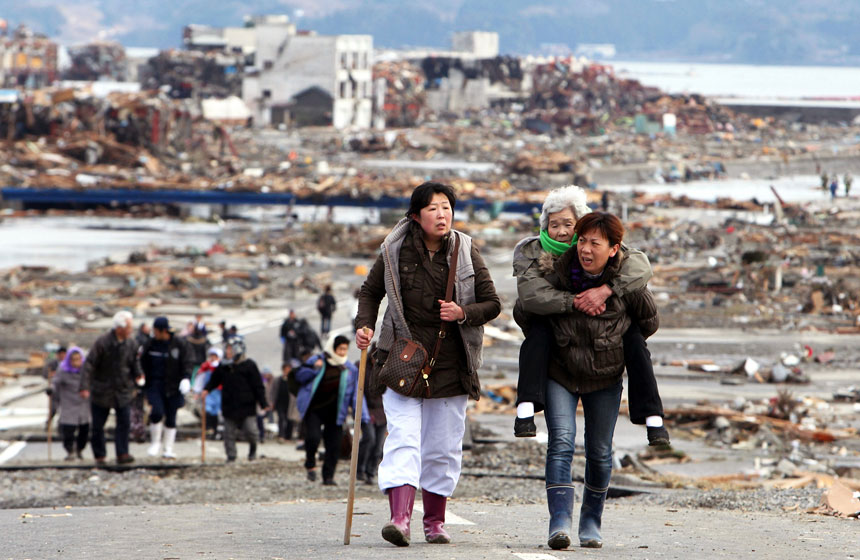
Christ in the lives of Christians
AS CHRISTIANS KEEP VISITING THE PEOPLE AFFECTED BY THE DISASTER, THEY HAVE COME TO BE CALLED KIRISUTO-SAN OR ‘MR./MS. CHRIST’, WITH RESPECT AND APPRECIATION.
Now that most of the volunteers are gone, people in the disaster areas often voice their concern that the rest of the world might forget about them, even though the work of restoration is a long way from completion. As Christians keep visiting the people affected by the disaster, they have come to be called Kirisuto-sanor ‘Mr./Ms. Christ’, with respect and appreciation. This is reminiscent of what happened in the first century. People first used the term Christian in scorn for Christ-followers, but later came to use it with respect and affection. So it is 20 centuries later in northern Japan as people see Christ in the lives of Christians.
Most Christians who engaged in relief work in Tohoku never asked for anything in return, such as requiring victims to listen to a presentation of the gospel. Overwhelmed by Tohoku’s utter devastation and people’s tragic circumstances, Christian workers did not think of engaging in ‘unworthy proselytizing’.[2]
Regrettably, at times, small numbers of passionate, rather fanatic Christians would suddenly show up at the doors of people in temporary housing areas. They would distribute one evangelistic tract or another without attempting to obtain any kind of permission from the residents. Some of these Christians presented an evangelistic message and invited any who might want to believe, but never gave any thought to the open scars of the people to whom they were speaking. Local residents rejected these Christians categorically.
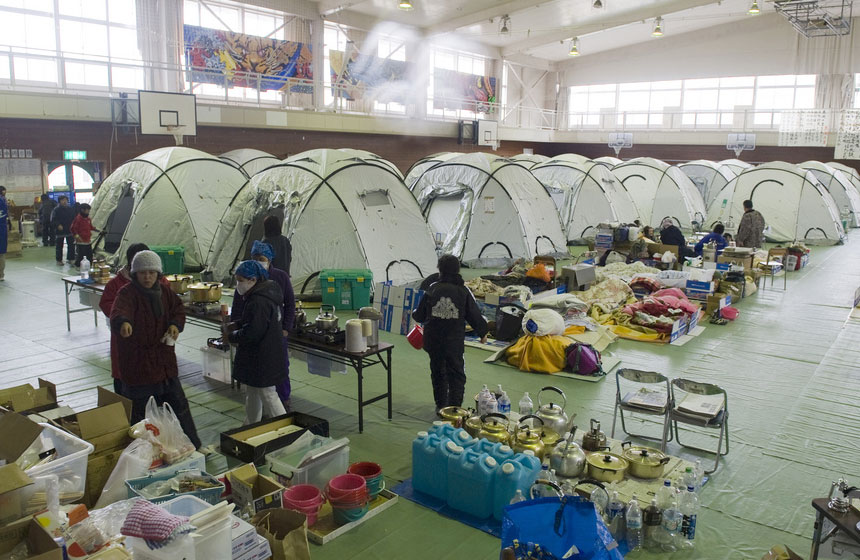
Responses to presence
Meanwhile, the same locals accepted Christians who simply presented themselves as helpers from the church and kept serving people’s needs. Residents in temporary housing embraced these Christians as friends. Over time, they would ask them to speak about the Bible. When they asked Christians why they would repeatedly come from such a long way away to help them, it was an open invitation to share their testimonies.
In Iwaki city, Fukushima prefecture, Pastor Eiji Sumiyoshi’s church became a distribution center for relief materials that had come from churches far and wide following the 2011 disaster. Although there had been explosions in the nuclear power plant 80 kilometers north of the church[3] and many residents had fled the city, Sumiyoshi stayed. He knew of people around the church who were staying, and could not just forsake these people.
Along with other activities, he helped meet needs in the community by serving meals at the evacuation center. His continued presence totally surprised the local residents. Since Sumiyoshi had been assigned to the Iwaki church from Tokyo only four years before the disaster, locals assumed he would be among the first to flee. When they learned Sumiyoshi had chosen to stay for their sake, they responded with gratitude and respect.
Several people voluntarily developed a desire to attend his church and listen to him preach on Sundays. A few became regulars, and in time were baptized. Like any local community in Japan, people in Fukushima prefecture normally perceive newcomers as strangers for at least the first few years. However, Pastor Sumiyoshi has now won the trust of his neighbors. ‘From the time of my assignment to the Iwaki church until the disaster hit the area, I had never been able to speak as openly with my neighbors as I have since’, comments Sumiyoshi.

Fishermen’s responses
Another pastor repeatedly went to help in a fishing village along the seacoast where the tsunami had caused significant devastation. One day, a fisherman came up to the pastor and said, ‘I carry the dragon god on my shoulders, but on top of my head is Jesus’.
The dragon god is an indigenous deity to whom local fishermen traditionally pray for seafaring safety and a good catch when they go fishing at the risk of their lives. The community of fishermen is so tightly knit that denying the dragon god can result in ostracism. This is probably why the fisherman dared not profess that he would abandon the dragon god, even though he accepted Jesus as his Master. He declared his faith as best as he could at the time, by saying he had Jesus on top. This is how the pastor interpreted the fisherman’s statement.
The day would come when the fisherman would no longer need the dragon god on his shoulders. He would then commit himself solely to Jesus. The pastor prayerfully waits to see that happen. A local fisherman, hitherto bound by traditional religious practice and customs, has accepted Jesus in his heart. In the pastor’s mind, this is an unprecedented breakthrough.
In a different case, another pastor has also been ministering aid to a fishing village. A few fishermen have come to believe in Jesus. However, the pastor has no intention of urging them to attend the Sunday worship service at his church, which is located inland. Fishermen do not follow the calendar week. They go fishing when the weather is good. They rest when the water is rough.
The pastor drives to the fishing village on a day when there is bad weather in order to hold a worship service at a fisherman’s house. When the news gets around about the pastor’s arrival, one fisherman after another comes to the gathering. The worship service is not in a conservative Western style. For most of these fishermen, reading books is not part of their lifestyle. The pastor, therefore, shares gospel accounts, using a picture book he has made to tell stories of Jesus.
SINCE THE 2011 DISASTER MUCH HAS BEEN HAPPENING IN THE MOST CONSERVATIVE RURAL COMMUNITIES IN JAPAN.
Lessons learned
Before the 2011 disaster, pioneering evangelists had attempted to plant churches in the fishing villages along the seacoast. The Christianity they presented was perceived as Western, a religion completely irrelevant to the local people. To follow Jesus, one had to abandon idols and attend a church worship service every Sunday. Such a conservative approach to evangelism never produced real fruit. Christians in Japan, Protestants and Catholics combined, account for less than one percent of the population. Bound by strong religious traditions, the seacoast area in Tohoku has a particularly small number of Christians and churches in relation to the population.
However, since the 2011 disaster much has been happening in the most conservative rural communities in Japan. These phenomena are not unlike insider movements that have been emerging in the strongholds of Islam and Hinduism all over the world.[4]
Paradigm shift
In Tohoku, the Miyagi Mission Network[5] (MMN) was created in order to use the lessons that had been gleaned through relief work for more effective evangelism. Over time, Pastor Yukikazu Otomo, the director of MMN, has come to believe that starting house churches is the key to multiplying churches and Christians. Otomo is convinced of the value of a paradigm shift: to move out of the church building into the local community and to start house churches in the homes of believers rather than follow the traditional model of gathering people in a church building.
THE UNPRECEDENTED SCALE OF THIS DISASTER HAS OPENED THE EYES OF JAPANESE CHRISTIANS TO A MORE HOLISTIC UNDERSTANDING OF THE GOSPEL AND IS STIMULATING A TRANSFORMATION IN FOUNDATIONAL CHURCH STRUCTURES.
The Sixth Japan Congress on Evangelism (JCE6)[6] was held in September 2016. One of the 15 projects of JCE6—Churches bearing burdens together—explored how churches could make use of the lessons learned through the experience of the Great East Japan Earthquake.
Some pastors who attended the project workshop expressed regret that the church largely had been uninterested in the pain of communities and the people within them. Through their involvement in disaster area support activities, pastors have realized that the scope of pastoral care should not be confined within the boundaries of the church, but extend to people in general society.
The 2011 catastrophe prompted this sort of awareness, and churches throughout Japan—regardless of whether they have had such an experience—should reconsider how to engage in mission. The unprecedented scale of this disaster has opened the eyes of Japanese Christians to a more holistic understanding of the gospel and is stimulating a transformation in foundational church structures.
Endnotes
- A 2011 report issued by the office of Disaster Management, Cabinet Office of Japan.http://www.bousai.go.jp/kaigirep/chousakai/tohokukyokun/pdf/Outline.pdf ↑
- The Cape Town Commitment, Part II. C. 1 ↑
- Summary of the accidents at the Fukushima Daiichi Nuclear Power Plant, issued by the World Nuclear Association. http://www.world-nuclear.org/information-library/safety-and-security/safety-of-plants/fukushima-accident.aspx ↑
- The Cape Town Commitment, Part II. C. 4 ↑
- Website (in Japanese only)http://www.mm-network.jp/ ↑
- http://jcenet.org/eng/ ↑
Feature image from ‘stand tall japan2‘ by Daniel Pierce (CC BY 2.0).
First image is from ‘Leaving The City‘ by Warren Antiola (CC BY-NC-ND 2.0). Second image is from ‘Ofunato‘ by Warren Antiola(CC BY-NC-ND 2.0). Third image is from ‘A Fisherman At Miyako Bay‘ by infradept (CC BY-NC-ND 2.0).

 Shoichi Konda is a member of the Japan Lausanne Committee. He has served as a Christian journalist for more than 30 years, and is former editor-in-chief of The Christian Shimbun, a major Japanese Christian weekly journal published by Word of Life Press Ministries. He is also a lecturer on cultic groups, religious rights in the history of Japan mission, and cooperative ministries of pastors and laypeople.
Reaching Muslims through Music - A bridge building lesson from Pakistan
MEDIA AND ART ARE EMERGING AS VEHICLES FOR EVANGELIZATION.
Because of constitutional restrictions and Islamic influence, traditional methods of mission in Pakistan have often made little impact. However, media and art are emerging as vehicles for evangelization. Given the low literacy rate in Pakistan (ranking 160 out of 198 countries), indigenous art is a powerful tool for sharing the gospel with Muslims. Pakistan has a colourful range of poetic-musical expressions, with diverse musical forms. Indeed the book of Psalms (Zabor) was translated into Punjabi lyrical poetry in the late nineteenth century, and a Muslim convert and a Hindu musician were hired to compose tunes in the local raga-based music.[1]
Why is the Muslim cup so hard to raise to the lip?Pakistan ranks number four in the most recent list of the fifty most dangerous countries for Christians in the world.[2] . Muslim and Christian practices of worship, teachings about God, and worldviews are totally different from each other. Islamic da‘wa (invitation) and Christian evangelism both seek to convert the other.
Notwithstanding the optimistic calls to evangelize the Muslim world at various missional conferences, such as Cairo (1906), Edinburgh (1910), Lucknow (2011), and Lausanne (1983, 2010), the mission enterprise is still struggling.
Internal reasons include lack of training, ignorance about the Muslim worldview, misunderstanding about Muslim theology and practices, and failure to deal with the Muslims’ common felt needs.[3]
External reasons for historical hostility include doctrinal disagreement (particularly Christological understanding) and a self-sufficiency and sense of superiority in Muslim thought. Western colonialism and the way it has tainted missional enterprise are also preventing Muslims from accepting the gospel. Another reason is the exclusion of ordinary people from interfaith engagement.
Psalms and Sufis in Pakistan
THE BOOK OF PSALMS OFFERS ONE POTENTIAL APPROACH TO SUCH CHRISTIAN-MUSLIM ENGAGEMENT.
The Book of Psalms offers one potential approach to such Christian-Muslim engagement. It represents a shared common heritage of divine revelation in Christianity and Islam, as David is revered as a prophet and musician in Islam. Indeed, Muslims accept the Torah, the Zabor and the Injil (Gospel) as divine revelations (Quran. 3:18-20, 64-71; 4:171; 5:77-80).
I myself had a vision of using the Psalms in this way. I decided to use them to engage with Sufi Muslims in Pakistan. I was already engaged with other Muslims (Shia, Sunni, and others), both educators through my part-time job as a music teacher and artists in mainstream media through our work in a recording studio. However, I decided to engage with Sufis specifically for several reasons:
Sufism is all inclusive, trans-sectarian, and trans-national.
Sufis are more open to artistic expression (poetry, music, and dance).
They are seekers of truth.
They are also victims of the Salafism/Wahhabism brand of extremist Islam.
Sufism is a ‘parallel religion’ to canonical or doctrinal Islam in Muslim societies. Sufis consider themselves the legitimate heirs and true interpreters of the esoteric teaching of the prophet Muhammad and his cousin and son-in-law Ali in order to connect with God through Sufi practices. Sufis do not belong to specific sects. Sufism is a spiritual movement including Sunnis, Shia, Ahmadi, and even non-Muslims.
In March 2012, I visited the famous Sindhi Sufi shrine of Shah Abdul Latif Bhittai, the ‘Rumi’[4] of South Asia, and ‘poet-laureate’ of Sindh. His collection of poetry, Shah Jo Risalo, comprises nearly 30 surs, or musical compositions, with hundreds of verses.[5]
I entered the shrine with a music team and was warmly welcomed by the chief spiritual leader. We were the first Christians to visit the shrine for over 250 years. The room was full of devotees. After we shared our thoughts and purpose—promoting religious tolerance, love, and peace—our host invited us for a return visit for the annual Urs (celebration of Shah Latif’s union with God) to present the Psalms at an all-night event, along with Sufi singers.
I presented him with gifts: a picture of Christ on the cross, and a copy of the New Testament and the Psalms in the Sindhi language, as a token of love, peace, and harmony. His love and openness amazed us, removing our fears. Onlookers understood that this was a special event indeed. Our host asked his son to lead us into the shrine to visit the tomb. A procession escorted us to the shrine and opened the inner door for us. I saw this as God opening a door, usually only open for high officials, for us to engage with Sufis.

‘MUSIC IS NO LONGER AN AIM, BUT A VEHICLE. SONG IS NO LONGER AN END, BUT A TRANSPORTATION, A PATH TO THE DIVINE.’
Mission and music
As Jalal ad-Din Muhammad Rumi noted, ‘Music is no longer an aim, but a vehicle. Song is no longer an end, but a transportation, a path to the divine.’ Many are unaware that Islam is in fact a liturgical and canonical faith with distinct musical practices.
Regarding whether music is halal (permissible) or haram (prohibited), Islamic scholars are divided[6]:
- Mainstream Sunni Schools of Islamic Jurisprudence lack agreed rules and opinions about music and art.
- Sunni conservative/extremists like Taliban and ISIS who are inspired by Wahhabi ideology do not accept music.
- Other Sunni sects like Barelvi and Deobandi accept music for restricted religious celebrations.
According to the musical adab (rules) in Sufism, the social situation; state of mind and intent of the artist; and purpose and text of a song determine the validity of music in Muslim context.
One of the major reasons for the lack of success of Western missions in the Muslim world is the misunderstanding of Muslim music culture, as all branches of Islam have their own musical traditions. Roberta King, who spearheaded ethnomusicology for missions, lamented that not only did Western missionaries fail to understand music and the related dynamics of cultural events in the mission field, but they also ‘kept the music in periphery to the schematic of the missio Dei’[7].
William Gairdner, one of the leading missionaries in Egypt early in the 20th century, received criticism from his supporters and his mission agency when he used drama and music in the last few years of ministry in Cairo, showing how the church was ignorant of the imaginative and transformative force of music in mission.[8]
Music culture and musicking in Muslim society
Muslim music culture also features in socio-political spheres of life:
- Saudi women are demanding their equal rights through music video.[9]
- The Pakistan Army released a musical video to pay tribute to the victims of Peshawar school attack by Taliban in December 2014.[10]
- The Taliban themselves endorse songs that legitimate their ideology and use poetry and songs to recruit new jihadis.[11]
Musicologist Christopher Small introduced the theory of ‘musicking’ as a collective action of a whole community. Musicking expresses the idea that music is a collective action and binds participants in any given context . It is an inclusive phenomenon that affects each person who is present at any musical event. An organized event in a Muslim context can bring interfaith singers ,musicians, and artists together to promote religious harmony and peacebuilding. Examples include the Fez festival in Morocco, Psalm festivals and Sufi Urs gatherings
MUSICKING HELPS TO MOVE BEYOND SOUND AND TEXT AND TO ENTER THE SOCIAL REALM SURROUNDING MUSIC MAKING AND MUSICAL PERFORMANCE.
Music culture in Pakistan
Music culture in Pakistan is heterogeneous. The context is an oral culture. Musicking theory suggests that it has great potential for mission. Musicking helps to move beyond sound and text and to enter the social realm surrounding music making and musical performance.
The religious music culture of Pakistan is divided into canonical and non-canonical:
- Adhan (call to prayer) and Qur’anic qirat (cantillation) fall in the canonical category.
- The non-canonical religious-spiritual music activities of Pakistan take place outside the mosque in social contexts such as Ramadan nights, the Prophet’s birthday (Mawlid or Milad), birthdays of Sufi imams (urs), weddings, and condolences. They include the Sunni Mawlid, the Shia Majlis-e-Marsya(commemoration of the massacre at the battle of Karbala in 680 AD) and the Sufi Sama’ or zikr (practice of listening or remembrance).
Since the book of Psalms was translated into Punjabi lyrical poetry and composed as local cultural music a century ago, it has been used for Christian-Muslim combined worship resources. Christian and Muslim artists/singers and musicians work together to produce Psalms, hymns, gospel songs as worship resources for Christian worship concerts, conventions or crusades . Pakistan is unique in that its most famous gospel singers are largely Muslims, due to a dearth until recently of Christian artists. Islamic authorities have no role in this, as these singers and musicians are professional artists and music in Pakistan is a large and influential industry.
Conclusion
‘Has the Church learned the lesson? She failed in the seventh century; is she going to retrieve the failure in the twentieth?’[12], asked Gairdner. His encounter with Muslim mystical works transformed his missional approach from polemic to a spiritual search and outreach with musical and dramatic expressions. ‘We need a song note in our message to Moslems, not the dry cracked note of disputation, but the song note of joyous witness [and] tender invitation’, he concluded[13].
Nearly a century later, ethnomusicology and missiology help the church to engage with diverse Islamic societies through Muslim music culture. They open up the possibilities of a laity model of mission that releases the force of Christian musicians, singers, and artists to witness to Christ in the Muslim world.
THE BOOK OF PSALMS IS THE MAIN LITERARY AND MUSICAL RESOURCE FOR FOSTERING MUSLIM-CHRISTIAN ENGAGEMENT AROUND A COMMON DIVINE HERITAGE OF SONG.
The book of Psalms is the main literary and musical resource for fostering Muslim-Christian engagement around a common divine heritage of song. Music culture and musicking are vital tools for peacebuilding as mission. As Roberta King observes, ‘transformative music communication evokes relational bridges for living together peacefully as neighbors as it initiates, nourishes, and replenishes communities amid entangled realities of difference’[14].
Practical pathways
Music and Sufi spirituality are thus potential bridges between hungry hearts and Christ. According to the head of the largest private school chain in Pakistan, almost 80 percent of music teachers in Muslim schools are Christians. A missionary force of young Christian music teachers could be trained and equipped for vibrant mission in their respective schools.
In the broader Islamic world, Sufism has an important role in missional engagement. Engagement with Sufis is a blessed and prophetic work, indispensable to the Missio Deiin an Islamic context. Who knows but that we may bring Sufi seekers of truth to a point where they may be surprised by the Truth, the Way and the Life?
Further reading
- Goddard, Hugh. A History of Christian-Muslim Relations. Chicago: A New Amsterdam Books, 2000.
- King, Roberta R. (Un) Common Sounds: Songs of Peace and Reconciliation Among Muslims and Christians. Edited by Roberta R. King and Sooi Ling Tan. Eugene, OR: Cascade Books, 2014.
- Reisacher, Evelyne. Joyful Witness to the Muslim World. Grand Rapids: Baker Academics, 2016.
- Smith, Jane Idleman. Muslims, Christians, and the Challenges of Interfaith Dialogue. Oxford: Oxford University, 2007.
- Strictly speaking, in Islamic understanding the word ‘music’ is translated as ghina, which suggests commercial or entertainment music. In a missional context, qirat or tilawat (cantillation) is the referent. ↑
- See https://www.opendoorsusa.org/christian-persecution/stories/announcing-2017-world-watch-list/. Accessed on Jan 23,2017 ↑
- Editor’s Note: See article by Gordon Hickson entitled “‘Ordinary Christians’ Can Reach Muslims Better Than Specialists: The Mahabba Network” in January 2017 issue of Lausanne Global Analysis. ↑
- A reference to the famous Persian poet Jalāl ad-Dīn Muhammad Rūmī ↑
- Video available at https://vimeo.com/album/2880961/video/95810655. ↑
- Beside hurmat (permissive rules) of food there are only five things that are Haram in the Quran: 1) adultery, 2) injustice, 3) to destroy someone’s life, possession, integrity/honor,4) shirk (any other God) without any logic, and 5) to announce haram and halal by own understanding. https://www.youtube.com/watch?v=376w1QPz07w ↑
- King, Roberta R. 2004. “Toward a Discipline of Christian Ethnomusicology: A Missiological Paradigm.” Missiology: An International Review, Vol. XXXII, no. 3. 295-304 ↑
- Editor’s Note: See article by David Emmanuel Singh entitled “Multiple Centres of Islam in India” in March 2013 issue of Lausanne Global Analysis https://www.lausanne.org/content/lga/2013-03/multiple-centres-of-islam-in-india. ↑
- https://www.youtube.com/watch?v=BX6iMj6sccI ↑
- https://www.youtube.com/watch?v=y0LE0mk-V38 ↑
- Taliban has come, song in praise of Taliban in Pakistan https://www.youtube.com/watch?v=siUHzt9TIIw ↑
- Gairdner 1909, 105; Anastasios 2013,19. ↑
- Henry Temple Gairdner, quoted by Tucker 2004, 244. ↑
- King 2016.Music, “Peacebuilding, and Interfaith Dialogue: Transformative Bridges in Muslim-Christian Relations.” SAGE, International Bulletin of Mission Research,1-15 ↑
 Eric Sarwar is a musician, songwriter, author, and church planter, and a founder of the Tehillim School of Church Music & Worship in Pakistan. He has a Th.M in Worship Studies from Calvin Theological Seminary and is pursuing his Ph.D. in Intercultural Studies at Fuller Theological Seminary, Pasadena, California.Eric Sarwar
 Contending for the Truth Amidst the Fake News Epidemic - Christian witness in today's post-truth society
Tony Watkins
‘Truth has perished; it is banished from the lips’ (Jeremiah 7:28).
POST-TRUTH ‘RELATES TO CIRCUMSTANCES IN WHICH OBJECTIVE FACTS ARE LESS INFLUENTIAL IN SHAPING PUBLIC OPINION THAN EMOTIONAL APPEALS.’
We now live in a ‘post-truth’ society. The adjective ‘post-truth’ was Oxford Dictionaries’ Word of the Year for 2016. It relates to ‘circumstances in which objective facts are less influential in shaping public opinion than emotional appeals’. This perfectly describes the 2016 political campaigns leading to the ‘Brexit’ vote in the UK and the US presidential election.[1]
Casper Grathwohl, President of Oxford Dictionaries, said that the term’s rocketing popularity is ‘fuelled by the rise of social media as a news source and a growing distrust of facts offered up by the establishment.’ He suggests that it will become ‘one of the defining words of our time.’[2]As Grathwohl implies, the term ‘post-truth’ is closely connected with the deluge of ‘fake news’ we have experienced. Jonathan Freedland writes, ‘In this era of post-truth politics, an unhesitating liar can be king. The more brazen his dishonesty, the less he minds being caught with his pants on fire, the more he can prosper. And those pedants still hung up on facts and evidence and all that boring stuff are left for dust, their boots barely laced while the lie has spread halfway around the world’. [3]
The changing news landscape
FAKE NEWS AFFECTS FAR MORE THAN POLITICS, BUT IT HAS RECENTLY CHARACTERISED THAT SPHERE OF PUBLIC LIFE TO A FRIGHTENING DEGREE.
Why do fake news wildfires spread so quickly across the media landscape? One key factor fanning the flames is, of course, political agendas. Fake news affects far more than politics, but it has recently characterised that sphere of public life to a frightening degree. There have always been lying politicians desperate to promote themselves, and propaganda is a vital tool for any totalitarian state. Yet it does feel that there is something very different about the current political landscape, at least in the West.
Two things are different in particular:
First, social media allow anybody to communicate anything at any time to a vast audience. Donald Trump exemplified this during his 2016 election campaign when he tweeted things that were inflammatory or blatantly untrue, but which resonated well with his target audience.
Second, social media have become the main way we access news; so the incomes of established news media are plummeting. They desperately need more clicks on their content to bring in more advertising revenue. The Guardian’s editor-in-chief Katharine Viner laments that ‘the new measure of value for too many news organisations is virality rather than truth or quality.’[4]
‘All are greedy for gain . . . all practice deceit’ (Jer 6:13; 8:10).
FAKE NEWS IS ALSO DRIVEN BY GREED.
Fake news is also driven by greed. A great deal of it is dreamed up by teenagers in Veles, Macedonia.[5] Having discovered that they could attract vast traffic to bogus websites by publishing sensationalist stories, they are becoming rich by selling advertising. These teenagers have become masters at click-bait headlines. Interestingly, most fake news stories from Macedonia have been pro-Trump; the hoaxers found during the US election campaign that pro-Clinton stories did not bring in anything like the same traffic.
Macedonia is not the only fake-news factory:
The Czech government now has a unit confronting the flow of potentially destabilising fake news in the lead-up to the general election in October 2017. The false stories (mostly about migrants) come from websites which, the Czech authorities claim, are supported by the Russian government.[6]
In Burundi, journalists accuse President Pierre Nkurunziza of using fake news to re-ignite ethnic tensions while simultaneously dismissing UNHCR and EU reports of human rights abuses as lies.[7]
However, fake news is not always created with an obvious agenda. Often on social media, especially following an atrocity or disaster, it is merely careless, unverified reporting which quickly spreads. Anyone who was on Twitter after recent terrorist incidents in Western Europe will know just how much conflicting ‘information’ was circulating.
Information cascades and filter bubbles
23 percent of US adults have shared fake news
Whatever its origin, fake news relies on social media to spread widely and rapidly. A survey by the Pew Research Center in 2016 suggests that 23 percent of US adults have shared fake news, knowingly or not.[8] We need to look at sociological and psychological reasons to understand why people share it with others at all.
The key way social media platforms persuade us to share content is by social proof. The more ‘likes’ or ‘shares’ a post has, the more likely we are to like or share it ourselves. And so it spreads in ever-widening circles, accumulating more likes and shares as it goes. It does not take much for an unstoppable ‘information cascade’ to develop.
We also share posts that push our emotional buttons: if something makes us laugh or cry, or angers us, we will share it. We may share something just because the headline or image has stimulated the pleasure centres in the brain—even though we have not engaged with the actual content. If we later see something revealing that what we have shared is false, that affects us less. A rebuttal does not stimulate the brain’s pleasure centres; so we do not bother sharing it. In other words, our response to much of what we see within social media is primal, not rational.
WE ALL HAVE A STRONG PSYCHOLOGICAL TENDENCY TO LATCH ON TO INFORMATION THAT CONFIRMS IDEAS WE ALREADY HAVE.
Then there is the problem of confirmation bias. We all have a strong psychological tendency to latch on to information that confirms ideas we already have. Conversely, we tend to avoid or reject anything that challenges us. So we readily believe anything that meshes with our existing worldview or values, and dismiss anything that threatens them.
Even without all these factors, social media platforms would still be ‘filter bubbles’. When we like and click on things in Facebook’s news feed, its algorithm delivers us more of those kinds of things, and less of the content with which we do not engage. Day by day, our timelines become increasingly filled with things that reinforce our perspectives—whether or not they are true.

Truth stumbles in the street
When ‘alternative facts’ take over from truth, a culture is in big trouble. Katharine Viner says, ‘This does not mean that there are no truths. It simply means . . . that we cannot agree on what those truths are, and when there is no consensus about the truth and no way to achieve it, chaos soon follows.’[9]
Isaiah’s assessment of his society is startlingly relevant: ‘So justice is driven back, and righteousness stands at a distance; truth has stumbled in the streets, honesty cannot enter. Truth is nowhere to be found, and whoever shuns evil becomes a prey’ (Isa 59:14–15; see also Jer 9:3–6).
WHEN PUBLIC DISCOURSE BECOMES NOTHING BUT COMPETING VIEWPOINTS CLAIMING TO BE ‘FACTS’, DEBATE OVER THE TRUTH OF THE GOSPEL BECOMES MUCH HARDER.
The implications for the church are sobering. When public discourse becomes nothing but competing viewpoints claiming to be ‘facts’, debate over the truth of the gospel becomes much harder. Those insisting on the existence of ‘true truth’ are swiftly dismissed as bigots, and their message is ignored. Any appeal to a source of authority, such as the Bible, is neutralised by writing it off as just ancient ‘fake news’.
Where do we go from here?
Paul follows Isaiah in insisting that suppressing the truth brings God’s wrath (Rom 1:18). Will God ‘give us over’ to our pursuit of feelings over truth, so that the West totally loses its bearings and collapses in chaos? Or will we embrace truth and wisdom once more and turn away from the relativistic mess into which we are sliding? We must pray that the West takes this second route and that the majority world does not also become infected by the post-truth disease.
I see some signs that people and even media companies are increasingly troubled by the present state of our society. Mark Zuckerberg has committed to tackling fake news on Facebook[10] and The New York Times has promised a ‘renewed focus on truth and transparency’,[11] for example. Are people realising afresh how vital truth is to society? Or is it just a momentary slow-down in the decline? The role Christians play in society could well be the deciding factor.
Responding to fake news
Christians should be passionate about truth because we follow the One who is the Truth (John 14:6). However, it is inconvenient and uncomfortable to do so; it makes us unpopular and requires courage. Yet we must not flinch from it. That means not only holding to truth intellectually, but living it out day by day.
‘The Lord detests lying lips, but he delights in people who are trustworthy’ (Prov 12:22).
It is tempting to share something which fits comfortably with our views, whether or not we are sure of its truthfulness. However, we must never become like those Paul warns against, who ‘gather around them . . . teachers to say what their itching ears want to hear’ (2 Tim 4:3). Instead, we must resist our confirmation bias, questioning the assertions that come streaming our way. We must not assume that ‘social proof’ proves anything. We must commit to discovering the truth, which includes doing our best to be sure of the sources of the information which comes our way.
CHRISTIANS SHOULD BE PASSIONATE ABOUT TRUTH BECAUSE WE FOLLOW THE ONE WHO IS THE TRUTH (JOHN 14:6).
Our commitment to truth must take us beyond simply reporting and sharing things that are true. We must be prepared to challenge false assertions and spin, to present alternative viewpoints, and to share fresh perspectives. If the church is to have a prophetic role within society, we must dare to speak precisely those biblical truths which most challenge and discomfort society (Jer 7:27–28; John 16:7–11). Let us pray for courage to do so.
Endnotes
- Editor’s Note: See article by Darrell Jackson entitled ‘BREXIT and Its Impact on European Mission’ in September 2016 issue of Lausanne Global Analysis. See also article by Thomas Harvey entitled, “Trump’s First Hundred Days” in this issue. ↑
- ‘Oxford Dictionaries Word of the Year 2016 is . . . Post-truth’, Oxford Dictionaries, 16 November 2016. ↑
- Jonathan Freedland, ‘Post-truth politicians such as Donald Trump and Boris Johnson are no joke’, The Guardian, 13 May 2016. Mark Twain is credited (falsely, ironically) with saying ‘A lie will go round the world while truth is pulling its boots on’ (or lacing its boots). The Victorian preacher C.H. Spurgeon quoted the saying in Gems from Spurgeon (1859), referring to it as ‘an old proverb’. ↑
- Katharine Viner, ‘How technology disrupted the truth’, The Guardian, 12 July 2016. ↑
- Emma Jane Kirby, ’The city getting rich from fake news’, BBC Magazine, 5 December 2016; Samanth Subramanian, ‘The Macedonian Teens Who Mastered Fake News’, Wired, 15 February 2017. ↑
- Robert Tait, ‘Czech Republic to fight “fake news” with specialist unit’, The Guardian, 28 December 2016. ↑
- Rossalyn Warren, ‘”Fake news” fuelled civil war in Burundi. Now it’s being used again’, The Guardian, 4 March 2017. ↑
- Michael Barthel, Amy Mitchell and Jesse Holcomb, ‘Many Americans Believe Fake News Is Sowing Confusion’, Pew Research Centre, 15 December 2016. ↑
- Katharine Viner, ‘How technology disrupted the truth’. ↑
- Mark Zuckerberg, Facebook note, 13 November 2016. ↑
- Minda Smiley, ‘”We are preparing for the story of a generation”: New York Times executive editor Dean Baquet discusses covering President Trump’, The Drum, 12 March 2017. ↑
 Tony helps Christian leaders develop a better understanding of how the Bible (especially the prophets) relates to today's media. He partners with several organisations, including Damaris Norway and the Lausanne Media Engagement Network, for which he is the Network Coordinator. He is a visiting lecturer at the Norwegian School of Theology and Gimlekollen School of Journalism and Communications, Norway. Tony is the author of Focus: The Art and Soul of Cinema and Dark Matter: A Thinking Fan's Guide to Philip Pullman, and co-author of seven other books. Visit tonywatkins.uk for free resources on media and the Bible.
 Trump’s first 100 days - What does the ‘Trump Effect’ mean for the church and mission?
Tom Harvey
The ‘first hundred days’ is a yardstick commonly used by pundits, politicians, and analysts to measure the effectiveness and impact of US presidents internationally and domestically. Historically, after the first hundred days, the president’s ability to guide key legislation through Congress lessens dramatically as attention turns to the next Congressional election cycle.
IN EVALUATING PRESIDENT DONALD TRUMP’S FIRST HUNDRED DAYS, ONE SHOULD LOOK ALSO AT WHAT IS NOW REFERRED TO AS THE ‘TRUMP EFFECT’.In evaluating President Donald Trump’s first hundred days, one should look not only at his record internationally and domestically, but also at what is now referred to as the ‘Trump Effect’. This may be his most enduring legacy, as well as being a key factor in assessing the implications for churches and global mission of his first 100 days.
Mercurial foreign policies
Where President Barack Obama preferred subtle diplomacy and shunned direct military intervention, Trump from the start harangued perceived enemies, and did not hesitate to order strikes on Syria when the red-line of regime use of chemical weapons was crossed. He initially challenged China’s South China Sea military outposts and later threatened military action against North Korea. His reflex for open brinksmanship has only been matched by his mercurial penchant quickly to change direction when it suits his overall goal:
Early praise for President Vladimir Putin turned to scorn over developments in Syria.
Early censure of China gave way to praise of President Xi Jinping in hopes Xi might intervene with North Korea.
Trump’s penchant for swirling interventions has raised tensions, especially in the Middle East:
Syria
He has supported both Turkey and its enemies, the Kurdish People’s Protection Units (YPG), in their battle against ISIS. However, their mutual animosity long predates ISIS. YPG gains along the Turkish border threaten a full-scale conflict between both Turkey and YPG, which could exacerbate the Syrian conflict and draw in Russian and US forces. This could easily turn a toxic regional conflict into a war that threatens international peace.
Israel-Palestinians
Trump’s pick for ambassador initially cheered Prime Minister Binyamin Netanyahu and pro-Israel supporters in the US, but jitters have arisen due to his courting of PA President Mahmoud Abbas and expressed interest in re-starting peace talks.
Thus, Trump’s tactics have yet to be fully tested even if they have already set both the teeth of allies and enemies on edge. Trump also strained key alliances when he placed a travel ban upon several Muslim-majority nations and when he ceded leadership on climate change to China, instead focusing on untethering US domestic manufacturing restrained by Obama-era regulations.
Domestic policy frustrations
Trump has announced a tougher policy on immigration, and ramped up efforts to expel those in the US illegally. This flows from his ‘America First’ strategy that played well with blue-collar workers and those fearful of terrorist infiltration. Meanwhile, his pledge to build a wall to keep out immigrants soured relations with Mexico and others in the region and frustrated European states that have taken in significant numbers of refugees, even if it mollified European populists who themselves have made immigration an election issue.
Trump, like Obama before him, has leaned heavily upon Executive Action:
- He gutted Obama’s banking and industrial regulations that he claimed had been stifling economic growth.
- He ended Department of Justice investigations into institutional racism and rolled back employment and access rules adopted by Obama on transgender employment and recognition.
- More significantly, Trump placed a conservative justice known as a staunch defender of religious liberty into the Supreme Court. This should enable Christian businesses and institutions to retain religious standards and freedom of conscience in matters of business services, employment and tax exempt status that had been under threat in light of recent court decisions.
His proposed border wall floundered as liberals viewed it as unconscionable and conservatives as unaffordable.
The likely fate of his attempt to replace Obama’s Affordable Care Act with a viable alternative agreeable to both conservative and moderate factions of the GOP is uncertain.
Trump has been unable to get the majority of his appointees to staff the Executive Branch approved and the budget is unlikely to pass unless the Mexican wall is dropped.
This legislative vacuum is ominous for both Trump’s legacy and the ability of the GOP to govern. Executive Action remains in place only while he is in office and is removed with the stroke of a pen. Legislation, on the other hand, sets policy until it is overturned by Act of Congress. Thus, the GOP has increasingly appeared to lack both vision and the ability to govern. Voters are likely to punish the party in the upcoming mid-term elections. Should Trump lose either house of Congress, he will effectively be a ‘zombie’ president who can do little more than posture during the final two years of his term.

TRUMP MAY HAVE ACCOMPLISHED NOTHING LEGISLATIVELY, YET NO ONE CAN DENY HIS IMPACT ON THE INTERNATIONAL AND NATIONAL STAGE POLITICALLY AND SOCIALLY.
Trump Effect
- Trump may have accomplished nothing legislatively, yet no one can deny his impact on the international and national stage politically and socially. In terms of personal character, Trump’s controversial claims against opponents both real and perceived often have proven distorted or outright fabrications.
- Such misrepresentation at the highest levels of the US government led to an excoriating editorial by the editors of The Wall Street Journal, normally an ally of conservatives ideologically, who expressed outrage at his blatant falsehoods. In their view, he had besmirched both the presidency and the integrity of the US internationally. They pointed as well to the ill-advised and perhaps illegal communications of Trump officials with Russian officials that led to tension between the president and the CIA, FBI, and US military intelligence agencies.
- Trump’s behaviour toward the opposite sex has appeared to be quite circumspect since his election. He has been very successful in projecting devotion and loyalty to his family, including his wife and children. However, his previous lewd personal behaviour and comments about women that surfaced during the campaign have generated unease and concerns that these character flaws might surface once again.
- Trump’s constant use of Twitter has been petty or tawdry at best when challenging critics or settling minor affronts. His outright attack on major news outlets and individual members of the press has generated an unprecedented level of acrimony and partisanship. It led The Washington Post to change its masthead to read ‘Democracy Dies in Darkness’ suggesting that the Fourth Estate was under immediate threat from Trump. Furthermore, the shrill rhetoric of the president and the political parties is now reflected in the press as supposed reporting increasingly channels partisan ideological views.
- International impacts
- On the one hand, he has accomplished very little; and most likely even that ability will diminish with each passing day.
- On the other hand, his presence and populism will catalyse charismatic leaders who trade on nativist ethnic biases and anti-immigrant bigotry.
Domestic impacts
The Trump presidency, much like that of Obama, will likely fail legislatively. This will further erode effective governance. The US Constitution was designed to nurture and depend on realistic compromise and moderation. What made presidents Lyndon Johnson, Ronald Reagan, and Bill Clinton effective was their ability to ‘reach across the aisle’ to forge legislative compromises with their adversaries that benefited the nation as a whole. The tragic legacy of both the Obama and now Trump administrations is that, apart from use of Executive Action, they were rendered legislatively dysfunctional due to an inability to forge compromise.
This dysfunction has led to the ascendancy of the Supreme Court and the consequent political infighting over proposed justices to fill vacant seats. With legislative paths blocked, judges are increasingly viewed not as disinterested referees, but as Platonic Guardians who by imaginative interpretation and artful polysemy take on the mantle of governance. Nonetheless, such moves represent not the ‘rule of law’ but a ‘rule of judges’ never envisioned by those interested in representative democracy.

THE DEEPENING PARTISAN IDEOLOGICAL DIVIDE IN ALL SECTORS OF US SOCIETY WILL MEAN THAT GOVERNANCE WILL MOST LIKELY LURCH FROM ONE EXTREME TO ANOTHER.
Implications for churches and mission
The deepening partisan ideological divide in all sectors of US society will mean that governance will most likely lurch from one extreme to another. This will have major ramifications for the church and mission.
Evangelical leaders were, and continue to be, deeply divided over Trump’s election and presidency. That said, it has been widely reported that nearly 80 percent of self-identifying White Evangelicals voted for Trump; as such, his presidency, both merits and demerits, will be laid at their door. This means that should the presidency or Congress become controlled by the Democratic Party, it is quite likely that the government will become decidedly anti-Evangelical.
There was a time when Evangelicals and their views were equally represented in both parties; that is no longer true. Further, as a result of championing Trump, his personal and political character flaws have hurt the perception of Evangelical Christians. This is particularly true among African- American and Latino Christians who are dismayed by the hypocrisy of those who preach ‘family values’ but voted for a man who exuded moral decadence.
Internationally, Trump’s ‘America First’ does not bode well for mission:
- The natural tendency of governments is to engage in tit for tat—to refuse visas to Americans if the US bans travel of their citizens to the US.
- Emphasis on ‘America First’ does little to foster the international goodwill that missions should communicate.
- The prestige of all citizens of a nation is affected by the person who is their chief representative. The fact that Trump is not respected internationally will affect the reputation of his countrymen and countrywomen.
Photo credits
- Feature image from ‘Donald Trump‘ by Gage Skidmore (CC BY-SA 2.0).
- First image is from ‘Make America Great Again hat‘ by Gage Skidmore (CC BY-SA 2.0). Second image is from ‘Trump T-shirt‘ by Gage Skidmore (CC BY-SA 2.0).
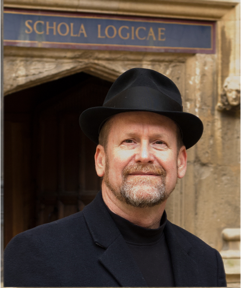 Thomas Harvey is Academic Dean of the Oxford Centre for Mission Studies, Oxford UK. From 1997-2008 he served as Senior Lecturer of Systematic Theology at Trinity Theological College in Singapore.
-------
Lausanne Global Analysis seeks to deliver strategic and credible information and insight from an international network of evangelical analysts to equip influencers of global mission. Browse all the past issues at lausanne.org/lga. The publication of the LGA is overseen by its Editorial Advisory Board. Articles represent a diversity of viewpoints within the bounds of our foundational documents. The views and opinions expressed in these articles are those of the authors and do not necessarily reflect the personal viewpoints of Lausanne Movement leaders or networks. Inquiries regarding the Lausanne Global Analysis may be addressed to analysis@lausanne.org.
-------

No comments:
Post a Comment