A strange realization hit me as I pushed my two children in a stroller through the streets of my city this week: Some of the many people sitting on the curb were likely viewing us with suspicion or even hostility.
It was not my first Fourth of July parade marching on behalf of World Relief, the Christian ministry where I’ve worked for more than a decade and one of nine organizations nationally that partners with the U.S. State Department to resettle refugees. Never previously would our message—a sign proclaiming “We Welcome Refugees,” the “Welcome to America” banner that church-based volunteers often bring with them to the airport to pick up newly arriving refugees—have struck me as anything other than one more element of the patriotic milieu as we celebrate our nation, including its history as a beacon of refuge for those fleeing persecution.
This year, pushing my kids in a stroller alongside World Relief colleagues, volunteers and a newly naturalized former refugee from the Democratic Republic of Congo proudly draped in American flag decorations, the thought occurred to me that I might be putting my own kids at risk by having them carry the “We Welcome Refugees” sign. Many Americans today feel very strongly that our nation should not be welcoming refugees.
With the president’s refugee-related executive order now allowed by the Supreme Court to go (with some exceptions) into effect, many refugees and their friends are once again feeling the whiplash of the U.S. refugee resettlement program, long a point of pride among most Americans and broadly supported by politicians from the left to the right, become heatedly controversial. Americans today are sharply divided on the question of refugees.
I personally feel the dissonance of that divide within American evangelicalism on a daily basis. In my work with churches throughout the country, I interact regularly with Christians whose faith has driven them to befriend resilient refugees who fled terror and persecution to replant themselves in communities throughout the United States.
As refugee policy questions have become headline issues, evangelical Christians—most of whom tend to be politically conservative—have advocated fiercely for refugees, and not just in deep-blue large cities but in red-leaning suburbs like Wheaton, Illinois, and small cities like Spokane, Washington. Hundreds of pastors—including some of the most prominent evangelical leaders in the country—signed onto a letter to President Trump voicing support for refugee resettlement that ran as an ad in the Washington Post, and some of them visitedWashington, D.C. recently to personally advocate with their elected officials.
According to polls, though, these evangelicals are the minority: The significant majority of white evangelicals, at least, support the refugee resettlement moratorium that is part of the executive order. I see this side of evangelicalism in my work, too: While World Relief actually has experienced a significant uptick in the number of local churches wanting to help refugees in the past year, we’ve also seen an increase in requests from pastors for guidance in responding to disgruntled members of their congregations who do not want their churches serving or advocating for refugees. I’ve observed four primary barriers to evangelicals engaging refugees more robustly.
First, there’s been a deficit of discipleship on the topic of refugees and related immigration issues. A 2015 LifeWay Research poll found that just 12 percent of American evangelicals say that their views on immigration-related issues are primarily influenced by the Bible. Only about one in five say they have ever been challenged by their pastor to reach out to refugees or other immigrants arriving in their communities.
That’s not because the Bible does not speak to the theme (Old Testament scholar Walter Kaiser counts 36 references to God’s concern for the foreigner alongside the orphan and the widow, and Jesus Himself began His earthly life seeking refuge in Egypt) nor because most pastors are unaware of biblical teachings (86 percent of Protestant pastors acknowledge that Christians have an obligation to “care sacrificially for refugees and foreigners”). Frankly, though, it’s a scary topic to preach on, likely to generate pushback from some in the pews.
That pushback from congregants is largely driven by security concerns, which are a second barrier to evangelical engagement with refugees. These fears are fueled by particular media outlets and politicians that have successfully created an association between refugees and terrorism in the minds of many Americans—despite the fact that, since the Refugee Act was signed into law in 1980, no individual admitted as a refugee to the U.S. has ever taken the life of an American citizen in a terrorist attack.
Beyond a dramatic overestimation of the actual threat involved in welcoming refugees, though, some American evangelicals have idolized security. While we bid farewell with expressions like “be safe” and “take care,” in Scripture we’re told repeatedly to “be not afraid” and “take courage.” Jesus’ words, while quite clear, are hardly fodder for a feel-good suburban evangelical sermon, especially in an age of terrorism: “Do not be afraid of those who kill the body and after that can do no more” (Luke 12:4). For a Christian, we can love fearlessly—not because the U.S. government has an extremely thorough refugee vetting process with a remarkably strong safety record (though it does), but because God promises to be present with us and he “is our refuge and strength” (Psalm 46:1).
Closely related to security concerns is a third barrier: a particular fear of Muslims. Perhaps influenced by media that gives far more coverage to terrorist attacks perpetrated by Muslims than those perpetrated by non-Muslims, and (for the average Christian) not influenced by even a single personal relationship with a Muslim that might serve to help rebut stereotypes, many American Christians fear welcoming Muslims will increase the risk of terrorism. Others fear that Muslims will bring with them the imposition of Sharia, overtaking the U.S. Constitution and the values it protects.
It’s common, but inaccurate, to presume that most refugees coming to the U.S. are Muslims; in fact, over the past decade, there have been more Christians resettled as refugees than those of any other faith. But it’s likewise a misconception that most Muslims are sympathetic to terrorist groups like ISIS; the vast majority of Muslims worldwideoppose such groups, which Muslim scholars condemn as heretics.
While many Muslims seek to live by the principles of Sharia as a matter of personal piety—not so unlike how most Christians would (hopefully) say that biblical commands should guide their lives—most Muslims in the U.S. do not believe that Sharia should be used as a legal source, just as most Christians affirm the biblical teaching that adultery, lying or coveting are sinful but few advocate for them to be made illegal.
In any case, the U.S. Constitution already explicitly forbids establishing a religious law—whether Muslim, Christian or otherwise—from being established as the law of the land in the United States. (It’s also worth noting that many Muslims in the U.S. are fairly nominal in their faith; while Americans fret about Sharia, plenty of Muslims could not define the term, just as plenty of self-reporting Christians would probably struggle to tell you what the Beatitudes are).
As a Christian who believes that “salvation is found in no one else” but Jesus (Acts 4:12), I want for Muslims to have the opportunity to experience the transformational hope I have found in Christ. As teams from local churches partnering with World Relief welcome refugee families from non-Christian backgrounds, they often are asked why they extend such kindness and welcome, and they have the opportunity to “give an answer … for the hope that you have” (1 Peter 3:15); many refugees in turn have made the decision to follow Jesus. When our response to Muslims is fear instead of love, we miss a divinely orchestrated opportunity to share the love of Christ.
A final barrier that keeps many evangelicals from welcoming refugees, and one that the 4th of July holiday can exacerbate if we treat our nation’s Independence Day as a true “holy day,” is that many have bought into the idea that their American identity is synonymous with or equally as important as their Christian faith. Many American Christians thus insist that we should merely “look out for our own.” It’s become something of a talking point among critics of refugee resettlement (albeit rarely, in my experience, from those deeply involved in serving veterans) that we should be caring for homeless veterans, not the poor and persecuted of the rest of the globe.
From an economic perspective, though, welcoming refugees is more than just humanitarianism: It’s also in our country’s national interest. A recent study by economists at the University of Notre Dame found that, over the course of 20 years, the average refugee pays in about $20,000 more in taxes than the cost of their resettlement and of social services for which they qualify.
Beyond the net positive fiscal contribution, refugees (like other immigrants) also stimulate local economies by their consumption, and they’re uniquely entrepreneurial, starting small businesses at rates higher than native-born U.S. citizens. A few of those refugee-fueled small businesses have gone big, such as Sergey Brin’s Google or Andy Groves’ Intel, each of which employs tens of thousands of Americans.
From a Christian perspective, the biblical command to love our neighbors is broad: Jesus offers a Samaritan who shows compassion to a traveler of a different ethnicity and religion as the model of neighborly love, emphasizing that the neighbor whom God commands us to love cannot be narrowly defined to include only those who share our citizenship.
Jesus insisted that God’s concern was greater than just for one’s own nation—and it got Him into trouble. According to Luke’s Gospel, the crowds in Jesus’ hometown of Nazareth were amazed by His preaching, but if you read just a few verses later, they had kicked Him out of the synagogue and were trying to throw Him off a cliff (Luke 4:22-29).
What had He said that so upset the people of Nazareth? He dared to suggest that God’s love was bigger than just for them and their kind: that God had sent the prophet Elijah not to an Israelite widow but to a foreigner, and that God could have had Elisha heal the sick of Israel, but He instead sent him to heal a Syrian. “Nazareth First” might have won Jesus a local election, but it would not have been faithful to the universality of God’s love, which He makes clear we are to emulate.
Despite these significant barriers to American evangelicals fully embracing refugees—biblical illiteracy, an unhealthy obsession with security, fear of Muslims and a parochial view of our call to love—the church-based volunteers who marched alongside me on the 4th of July give me hope.
When American evangelicals actually meet refugees, they rebut many of their stereotypes and misconceptions and remind them of the biblical truth that each of them, like each of us, are people made in the image of God with inherent dignity and potential.
[MATTHEW SOERENS is the US Director of Church Mobilization for World Relief and the coauthor of Seeking Refuge: On the Shores of the Global Refugee Crisis (Moody Publishers, 2016).]
-------
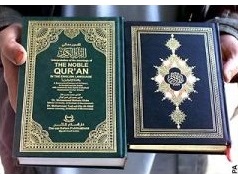 sha·ri·a
SHəˈrēə/Submit
noun
Islamic canonical law based on the teachings of the Koran and the traditions of the Prophet (Hadith and Sunna), prescribing both religious and secular duties and sometimes retributive penalties for lawbreaking. It has generally been supplemented by legislation adapted to the conditions of the day, though the manner in which it should be applied in modern states is a subject of dispute between Islamic fundamentalists and modernists.
-------
Sharia Law
Shariah law
Sharia law is the law of Islam. The Sharia (also spelled Shari'a or Shariah) law is cast from Muhammad's words, called "hadith," his actions, called "sunnah," and the Quran. Sharia law itself cannot be altered, but the interpretation of Sharia law, called "fiqh," by imams is given some latitude.
As a legal system, Sharia law is exceptionally broad. While other legal codes regulate public behavior, Sharia law regulates public behavior, private behavior, and even private beliefs. Of all legal systems in the world today, Sharia law is the most intrusive and restrictive, especially against women.
According to Sharia law (see links for details; capital punishments):
• Theft is punishable by amputation of the hands (Quran 5:38 - graphic image).
• Criticizing or denying any part of the Quran is punishable by the sword.
• Criticizing Muhammad or denying that he is a prophet is punishable by the sword.
• Criticizing or denying Allah is punishable by the sword (see Allah moon god).
• A Muslim who becomes a non-Muslim is punishable by the sword (See Compulsion).
• A non-Muslim who leads a Muslim away from Islam is punishable by the sword.
• A non-Muslim man who marries a Muslim woman is punishable by the sword.
• Girls' cIitoris should be cut (Muhammad's words, Book 41, Kitab Al-Adab, Hadith 5251).
• Muslim men have sexuaI rights to any woman or girl not wearing Hijab (see Taharrush).
• A girl or woman who suffered lgtisab (raрe) cannot testify in court against her attacker(s).
• Testimonies of 4 male witnesses are needed to prove lgtisab of a female (Quran 24:13).
• A female who alleges lgtisab without producing 4 male witnesses is guilty of adultery.
• A female found guilty of adultery is punishable by stoning (see "Islamophobia").
• A man convicted of lgtisab can have his conviction dismissed by marrying his victim.
• A woman can have 1 husband, who can have up to 4 wives; Muhammad can have more.
• A man can marry an infant girl and consummate the marriage when she is 9 years old.
• A man can beat his wife for insubordination (Quran 4:34, also see Religion of Peace).
• A man can unilaterally divorce his wife; a wife needs her husband's consent to divorce.
• A divorced wife loses custody of all children over 6 years of age or when they exceed it.
• A woman's testimony in court, allowed in property cases, carries ½ the weight of a man's.
• A female heir inherits half of what a male heir inherits (see Mathematics in Quran).
• A woman cannot drive a car, as it leads to fitnah (upheaval).
• A woman cannot speak alone to a man who is not her husband or relative.
• Meat to eat must come from animals that have been sacrificed to Allah - i.e., be "Halal."
• Muslims are to subjugate the world under Islam (Quran 9:29 and Palestine Issue).
• Muslims should engage in Taqiyya and lie to non-Muslims to advance Islam.
• The list goes on (see Sharia law in America, Canada, UK, Europe & Saudi Arabia).
-------
Sharia Law in America
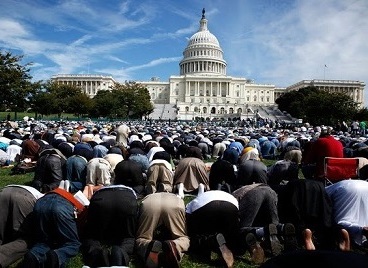 Sharia law in the United States of America ("America") has reached penetration phase 3 (see Spread of Islam).
As the number of court cases in which civil law and Sharia law clash rose across America, many American states introduced bills banning their state courts from accommodating Sharia law.
Many of those bills have been stalled by the Muslim Brotherhood, which accuses the bills' sponsors and supporters of Islamophobia, campaigns against their re-election, and sues in court. States that have managed to pass Sharia law-blocking legislation, known as "ALAC" (American Laws for American Courts), are listed on Islamization of America.
While fighting to a draw in many state legislatures, Sharia law has been advancing faster, in many cases unopposed, in other American institutions, as follows:
● An increasing number of America's public schools are commemorating Muslim holidays, serving Halal food, and holding Islamic prayers towards Mecca. In 2014, Rocky Mountain High School in Fort Collins, Colorado became the first American high school to recite the Pledge of Allegiance in Arabic, replacing "One nation under God," with "One nation under Allah" (see Allah Moon God).
● Bill Clinton was the first US president to hold a White House Eid al-Fitr dinner at the end of Ramadan, the Muslim month-long, dawn-to-dusk fast. Eid al-Fitr includes six Takbirs, the raising of hands and shouting, "Allahu Akbar!" to declare that Allah is "greater" (than the God of Christianity and the idols of other religions - see Jesus vs. Muhammad and Halal). Every US president since Clinton, including George W. Bush, held this blasphemous dinner for a total of 20 years (1996 to 2016) until Donald Trump scrapped it in 2017.
● In 2000, the Republican National Convention became the first US presidential convention to open with a Muslim prayer to Allah.
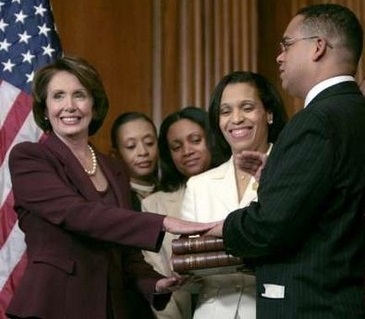 ● In 2007, Quran for the first time was used to swear into office a new US Congressman, Keith Ellison (right). In 2017, this former spokesman for Nation of Islam became the second highest leader of the Democratic National Committee (DNC).
● In 2009, a Christian US soldier at Baghram Air Force Base in Afghanistan received Bibles in two local languages from his American church as planned. The US army confiscated those Bibles and instead of at least returning them to his church, burned those Bibles. When Terry Jones, a pastor in Florida, announced his plan to burn a copy of the Quran in 2010, General David Petraeus, the commander of the US military in Afghanistan, publicly objected to his plan, while US Secretary of State Hillary Clinton denounced his plan as "disgraceful" (see Bible vs. Quran and War against Islam).
● In the landmark 2010 pro-Sharia ruling on S.D. v. M.J.R., Judge Joseph Charles Jr. of New Jersey concluded that the Muslim ex-husband repeatedly had raped (see Taharrush) his Muslim ex-wife. After testimony from the Muslim man's imam, the judge denied the ex-wife's request for a permanent restraining order against her ex-husband, citing the Muslim man's "belief."
● To attract and manage Muslim wealth, an increasing number of American financial institutions quietly began taking steps to become Sharia-compliant. This includes donating a percentage of their annual profits to Islamic groups that are designated by their Sharia-compliance advisors, many of whom belong to the Muslim Brotherhood and funnel funds to Jihadi groups (the donations must go to one or more of eight recipient categories, one of which is Jihad), including Hamas and Hezbollah (see Hitler's Islam, how to Stop Islam).
Continue to today: Islamization of USA
-------
be·at·i·tude
bēˈadəˌt(y)o͞od/
noun
- supreme blessedness.
synonyms: blessedness, benediction, grace; More - the blessings listed by Jesus in the Sermon on the Mount (Matt. 5:3–11).plural noun: the Beatitudes

The teachings of Jesus of Nazareth were simple but unique and innovative at the time of his life on earth. He began teaching about 30 AD during the ruthless Roman occupation of Palestine. At the time there were four major groups in the Jewish religion, the Pharisees, Sadducees, Essenes, and the Zealots, all of whom presented a different viewpoint to the Jewish people. The Pharisees demanded strict observance of the Mosaic law expressed in the Torah, but also accepted the oral tradition of Jewish customs and rituals. The Sadducees were mainly from the priestly families and strictly accepted the Law of Moses but rejected oral tradition. The Pharisees, unlike the Sadducees, believed in the resurrection of the dead. The monastic Essenes awaited a Messiah that would establish a Kingdom on earth and free the Israelites from oppression. The Zealots were a militant Jewish group who wanted freedom for their homeland, and were centered in Galilee; one of the Twelve Apostles was Simon the Zealot.
The Ten Commandments, given to Moses on Mount Sinai in the Old Testament Book of Exodus, related a series of "Thou shalt not" phrases, evils one must avoid in daily life on earth.
In contrast, the message of Jesus is one of humility, charity, and brotherly love. He teaches transformation of the inner person. Jesus presents the Beatitudes in a positive sense, virtues in life which will ultimately lead to reward. Love becomes the motivation for the Christian. All of the Beatitudes have an eschatological meaning, that is, they promise us salvation - not in this world, but in the next. The Beatitudes initiate one of the main themes of Matthew's Gospel, that the Kingdom so long awaited in the Old Testament is not of this world, but of the next, the Kingdom of Heaven.
While the Beatitudes of Jesus provide a way of life that promises salvation, they also provide peace in the midst of our trials and tribulations on this earth.
An early contemplation on the Beatitudes came from St. Gregory of Nyssa, a mystic who lived in Cappadocia in Asia Minor around 380 AD. He described the Beatitudes this way:
from which nothing is absent that a good desire may want.
Perhaps the meaning of beatitude may become clearer to us
if it is compared with its opposite.
Now the opposite of beatitude is misery.
Misery means being afflicted unwillingly with painful sufferings."

THE EIGHT BEATITUDES OF JESUS "Blessed are the poor in spirit,
for theirs is the kingdom of heaven.
Blessed are they who mourn,
for they shall be comforted.
Blessed are the meek,
for they shall inherit the earth.
Blessed are they who hunger and thirst for righteousness,
for they shall be satisfied.
Blessed are the merciful,
for they shall obtain mercy.
Blessed are the pure of heart,
for they shall see God.
Blessed are the peacemakers,
for they shall be called children of God.
Blessed are they who are persecuted for the sake of righteousness,
for theirs is the kingdom of heaven."Gospel of St. Matthew 5:3-10

It is pride, the opposite of humility, that brings misery. For pride brings anger and the seeking of revenge, especially when one is offended. If every man were humble and poor in spirit, there would be no war!
St. Gregory describes another reason to mourn: the more one ascends in meditation of Divine Truth, Beauty, and Goodness, and then realize the poverty of human nature, man can only be left in sorrow. When one contemplates that we were made in the image and likeness of God and lived in Paradise, the Garden of Eden, and compare that to our present state after the Fall, one can only mourn our present condition. But the sentence continues that they shall be comforted, by the Comforter, the Holy Spirit, and hopefully one day in the Kingdom of Heaven. Pray for the fruit of the Holy Spirit (Galatians 5:22) - love, joy, peace, patience, kindness, generosity, faithfulness, gentleness, and self-control.
Mourning in this context is called a blessing, because mourning our fallen nature creates in us a desire to improve ourselves and to do what is right!
1 Feed the Hungry
2 Give drink to the thirsty
3 Clothe the naked
4 Shelter the homeless
5 Comfort the imprisoned
6 Visit the sick
7 Bury the dead
The Spiritual Works of Mercy
1 Admonish sinners
2 Instruct the uninformed
3 Counsel the doubtful
4 Comfort the sorrowful
5 Be patient with those in error
6 Forgive offenses
7 Pray for the living and the dead
"Blessed are they who are persecuted for the sake of righteousness, for theirs is the Kingdom of Heaven."
The biblical passage continues to elaborate: "Blessed are you when men revile you and persecute you and utter all kinds of evil against you falsely on my account. Rejoice and be glad, for your reward is great in heaven, for so men persecuted the prophets who were before you" (Matthew 5:11-12). Jesus said many times that those who follow Him will be persecuted. "If they persecute me, they will persecute you" (John 15:20-21). Before his Conversion, Saul persecuted the early Church in Jerusalem, which scattered the Christians throughout the regions of Judea and Samaria (Acts 8:1). St. Peter advised "Whoever is made to suffer as a Christian should not be ashamed but glorify God because of the name" (I Peter 4:16). The Woman who brought forth the male child destined to rule all nations with an iron rod was persecuted in Revelation 12.
Stephen, Peter and Paul, nearly all of the Apostles, and many Christians in the Roman era suffered martyrdom. Oppressive governments and endless conflicts in the last one hundred years, such as World Wars I and II, and the Middle East wars in Iraq, Egypt, and Syria have seen their share of martyrs, such as Maximilian Kolbe, Dietrich Bonhoeffer, Latin American martyrs, and Middle East Christians. St. Maximilian Kolbe offered his life in place of a stranger at the Auschwitz death camps on August 14, 1941. Dietrich Bonhoeffer was a Lutheran pastor who was hanged on April 9, 1945 for condemning the leadership of Hitler in Nazi Germany. The Central American Martyrs include the 38 recognized martyrs of La Cristiada, the Cristero War from 1926 to 1929, when the Mexican government persecuted priests of the Catholic Church, such as St. Christopher Magallanes, St. Toribio Romo Gonzalez, and the 14 year old martyr Blessed Jose Luis Sanchez del Rio. Another Central American martyr was Oscar Romero, Archbishop of San Salvador, who was assassinated while saying Mass at Divine Providence Hospital on March 24, 1980 for speaking out against government human rights violations.
As in the time of Jesus of Nazareth (Matthew 2:23) and the early Christian Church (Acts 24:5), a Christian in the Middle East today is still called a Nazarene or in Arabic Nasrani or plural Nasara. Middle Eastern Christians have suffered severe persecution since the crises in Iraq and Syria. At least 58 Christians were slaughtered during Sunday Mass at Our Lady of Salvation Syriac Eastern Catholic Church in Baghdad on October 31, 2010. In July 2014 the terrorist Islamic State marked remaining Christian homes in Mosul with the Arabic letter Noon - for Nazarene, Nasrani, or Nasara - and advised residents that they have 24 hours to leave, convert to Islam, or die. Sixty thousand Christians in Mosul have been displaced from their homes, and over one million Christians have fled Iraq since the beginning of the Iraq War in 2003. It is estimated that the present turmoil in Syria has resulted in over 700,000 Christian refugees escaping to Jordan, Lebanon, and other Middle Eastern countries. But the Lord promised those that suffer for his sake will be rewarded with the Kingdom of Heaven!
-------

No comments:
Post a Comment