
"Working on 'Wicked' Problems" by L. Gregory Jones and Nathan Jones

Congregational and institutional leaders often feel like jugglers spinning multiple plates, with each plate representing an urgent problem needing our attention: personnel decisions, employee conflicts, budget challenges, difficult constituents, deferred maintenance, outdated communications strategies.
This demanding exercise can absorb all of our energy as we try to make progress on each problem without letting any of the plates fall to the floor and break into pieces.
Indeed, because each problem seems so urgent, institutional leaders often rush forward to problem solving before undertaking an important prior step: problem description.
In an interview with Faith & Leadership, Jennifer Riel makes a case for the importance of problem description. Drawing on the work of her colleague Roger Martin, Riel points to a critical distinction between two types of problems -- "hard" ones and "wicked" ones.
Hard problems, she says, prove difficult to solve, often requiring repeated attempts. With enough thought and effort, however, such problems are ultimately surmountable.
Wicked problems, on the other hand, bewilder us because they frustrate our attempts at grabbing hold of them. Not only do they lack clear starting and ending points; they cross social and conceptual boundaries, and their dimensions often change the more deeply we explore possible solutions.
The 2008 economic crisis, and the particular problems it created for institutional leaders, illustrates the distinction between the two.
Consider the challenge faced by the president of a relatively small, free-standing denominational seminary: how to balance the school's budget in the wake of the economic downturn and the associated shrinking of the school's endowment and decline in revenues from contributions.
Defining the economic challenge as a set of "hard" problems meant that the primary issue was how to tighten an already-tight budget. In seeking solutions, several risks had to be weighed -- for example, alienating faculty and administrators whose own budgets would be cut and harming programs vital to the school's mission.
Yet even in the midst of these difficulties, the president could envision ways forward, even if they were painful -- instituting uniform cuts across the board, cutting one entire program to preserve the rest, eliminating positions, borrowing money to cover short-term cash flow needs. None of these options was appealing, but the trade-offs were clear.
Along with these "hard" problems, though, the economic downturn created a set of "wicked" problems.
Consider the different economic models supporting the seminary, and the perplexing questions they raised.
To what extent would the current sources of financial support remain reliable in the future, especially if significant funding had historically come from a denomination in decline? How generous would the seminary's philanthropic supporters be in light of a stock market that continued to plummet, with uncertain economic indicators for the future?
What risks were there in taking on more debt?
Would tuition-paying students still be willing to uproot their lives to relocate for school? Would a declining denomination still need candidates with the master of divinity degree for ordination, or would congregations look for other ways to supply their congregational needs? How much needed to be invested in technology, even during difficult times, to cope with the emergence of competing online programs?
Once we begin to ask questions about a problem's wicked dimensions, we discover that those of us trying to address the wicked problems are likely contributing to the problems even as we address one or more dimensions of them. We also discover a series of further issues and questions -- and we become even more aware of the wickedness of the problems.For example, while forecasting future economic conditions is always precarious, it now involves global trends that make gauging future economic prospects for investments even more difficult -- for the seminary itself and for its supporters.
And our economic issues spread out to broader ones: Are congregations and philanthropists as committed now, and will they be in the future, to theological education in its current form? How does the emergence of very large congregations, often either nondenominational or only loosely tied to denominations, affect the supply and demand for master of divinity graduates? How will the burdens of student loans affect people’s willingness to enroll full time in the institution? How are emerging online programs affecting enrollment patterns -- and are they a source of new funding or a potential drain on precious seminary resources?
At every turn, investigations into wicked problems trigger new questions and issues, many of which lack clear answers themselves.
The immediacy of a crisis makes it tempting to define the situation as a “hard” problem that will require us simply to roll up our sleeves and work harder.
The real creativity of leadership, however, will come when we can take a step back and acknowledge the importance of understanding our situation as a wicked problem. Leaders ought to ponder whether there are more dimensions to a problem, and perhaps better and deeper ways to frame the problem and its diverse dimensions, than we are initially tempted to think. When we do so, we are more likely to develop steps toward generative solutions.
The first step in describing a wicked problem is to live with the questions, continually sharpening and refining them until they are broad and deep enough for people to think about from a variety of angles. Because wicked problems change their shape and unfold into unexpected arenas, no single perspective can lay claim to full explanation.
The seminary president might ask questions such as the following: What deep trends will most determinatively affect theological education in the next two decades? What are the underlying drivers to our economic model, and which ones are most vulnerable to those trends? How adaptive is our budgeting process to unexpected economic events beyond our control?
Yet even when a wicked problem is thoughtfully described through a few well-framed questions, addressing it will require unconventional strategies and modes of thought.
As Riel suggests, our education typically trains us to deal with hard problems by applying various forms of analytical thinking. And we are tempted to do the same with wicked problems as well, even though our analytical habits will blind us to the wicked dimensions and constrict us to trying to solve just hard problems. We will return to trying to manage the budget rather than wrestling with the deeper issues affecting the economic well-being of the institution.
The methods needed for tackling wicked problems will involve a different kind of approach. Rather than just working harder, we will devote more attention to how we describe and define the problems in the first place. We will also spend more time on questions, probing deeply, and we will listen to different stakeholders implicated both in the description of the problem and in developing potential generative solutions. We will outline these steps in further detail in another reflection.
Wicked problems cannot be solved in the ways that hard problems can; rather, as we live with the questions, and explore possible solutions, we will design several interrelated experiments to test their generativity.
This improves the chances we will make genuine progress toward generative solutions.Working on hard problems typically leads us to plead with others to help us. Working on wicked problems invites new kinds of collaboration -- working together, shoulder to shoulder, with key stakeholders to frame the issues and to develop new experiments. Such creative collaboration can yield fruitful, dynamic results, strengthen multiple institutions and offer new signs of hope.
Monday, 2 March 2015
This demanding exercise can absorb all of our energy as we try to make progress on each problem without letting any of the plates fall to the floor and break into pieces.
Indeed, because each problem seems so urgent, institutional leaders often rush forward to problem solving before undertaking an important prior step: problem description.
In an interview with Faith & Leadership, Jennifer Riel makes a case for the importance of problem description. Drawing on the work of her colleague Roger Martin, Riel points to a critical distinction between two types of problems -- "hard" ones and "wicked" ones.
Hard problems, she says, prove difficult to solve, often requiring repeated attempts. With enough thought and effort, however, such problems are ultimately surmountable.
Wicked problems, on the other hand, bewilder us because they frustrate our attempts at grabbing hold of them. Not only do they lack clear starting and ending points; they cross social and conceptual boundaries, and their dimensions often change the more deeply we explore possible solutions.
The 2008 economic crisis, and the particular problems it created for institutional leaders, illustrates the distinction between the two.
Consider the challenge faced by the president of a relatively small, free-standing denominational seminary: how to balance the school's budget in the wake of the economic downturn and the associated shrinking of the school's endowment and decline in revenues from contributions.
Defining the economic challenge as a set of "hard" problems meant that the primary issue was how to tighten an already-tight budget. In seeking solutions, several risks had to be weighed -- for example, alienating faculty and administrators whose own budgets would be cut and harming programs vital to the school's mission.
Yet even in the midst of these difficulties, the president could envision ways forward, even if they were painful -- instituting uniform cuts across the board, cutting one entire program to preserve the rest, eliminating positions, borrowing money to cover short-term cash flow needs. None of these options was appealing, but the trade-offs were clear.
Along with these "hard" problems, though, the economic downturn created a set of "wicked" problems.
Consider the different economic models supporting the seminary, and the perplexing questions they raised.
To what extent would the current sources of financial support remain reliable in the future, especially if significant funding had historically come from a denomination in decline? How generous would the seminary's philanthropic supporters be in light of a stock market that continued to plummet, with uncertain economic indicators for the future?
What risks were there in taking on more debt?
Would tuition-paying students still be willing to uproot their lives to relocate for school? Would a declining denomination still need candidates with the master of divinity degree for ordination, or would congregations look for other ways to supply their congregational needs? How much needed to be invested in technology, even during difficult times, to cope with the emergence of competing online programs?
Once we begin to ask questions about a problem's wicked dimensions, we discover that those of us trying to address the wicked problems are likely contributing to the problems even as we address one or more dimensions of them. We also discover a series of further issues and questions -- and we become even more aware of the wickedness of the problems.For example, while forecasting future economic conditions is always precarious, it now involves global trends that make gauging future economic prospects for investments even more difficult -- for the seminary itself and for its supporters.
And our economic issues spread out to broader ones: Are congregations and philanthropists as committed now, and will they be in the future, to theological education in its current form? How does the emergence of very large congregations, often either nondenominational or only loosely tied to denominations, affect the supply and demand for master of divinity graduates? How will the burdens of student loans affect people’s willingness to enroll full time in the institution? How are emerging online programs affecting enrollment patterns -- and are they a source of new funding or a potential drain on precious seminary resources?
At every turn, investigations into wicked problems trigger new questions and issues, many of which lack clear answers themselves.
The immediacy of a crisis makes it tempting to define the situation as a “hard” problem that will require us simply to roll up our sleeves and work harder.
The real creativity of leadership, however, will come when we can take a step back and acknowledge the importance of understanding our situation as a wicked problem. Leaders ought to ponder whether there are more dimensions to a problem, and perhaps better and deeper ways to frame the problem and its diverse dimensions, than we are initially tempted to think. When we do so, we are more likely to develop steps toward generative solutions.
The first step in describing a wicked problem is to live with the questions, continually sharpening and refining them until they are broad and deep enough for people to think about from a variety of angles. Because wicked problems change their shape and unfold into unexpected arenas, no single perspective can lay claim to full explanation.
The seminary president might ask questions such as the following: What deep trends will most determinatively affect theological education in the next two decades? What are the underlying drivers to our economic model, and which ones are most vulnerable to those trends? How adaptive is our budgeting process to unexpected economic events beyond our control?
Yet even when a wicked problem is thoughtfully described through a few well-framed questions, addressing it will require unconventional strategies and modes of thought.
As Riel suggests, our education typically trains us to deal with hard problems by applying various forms of analytical thinking. And we are tempted to do the same with wicked problems as well, even though our analytical habits will blind us to the wicked dimensions and constrict us to trying to solve just hard problems. We will return to trying to manage the budget rather than wrestling with the deeper issues affecting the economic well-being of the institution.
The methods needed for tackling wicked problems will involve a different kind of approach. Rather than just working harder, we will devote more attention to how we describe and define the problems in the first place. We will also spend more time on questions, probing deeply, and we will listen to different stakeholders implicated both in the description of the problem and in developing potential generative solutions. We will outline these steps in further detail in another reflection.
Wicked problems cannot be solved in the ways that hard problems can; rather, as we live with the questions, and explore possible solutions, we will design several interrelated experiments to test their generativity.
This improves the chances we will make genuine progress toward generative solutions.Working on hard problems typically leads us to plead with others to help us. Working on wicked problems invites new kinds of collaboration -- working together, shoulder to shoulder, with key stakeholders to frame the issues and to develop new experiments. Such creative collaboration can yield fruitful, dynamic results, strengthen multiple institutions and offer new signs of hope.
Monday, 2 March 2015
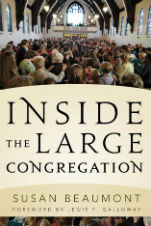
This book articulates why size matters and how it matters in the world of large congregations. It is written for anyone who wants to better understand the leadership and organizational dynamics of the large church, anyone seeking to understand the challenges of leading from inside the large congregation.
Buy the book
Buy the book
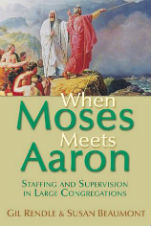
Rendle and Beaumont have taken the best of human resource practices and immersed them in a congregational context, providing a comprehensive manual for supervising, motivating, and coordinating staff teams. They give both detailed and big picture guidance on hiring, job descriptions, supervision, performance evaluation, staff-team design, difficult staff behavior, and more.
Buy the book

Upcoming Webinar: The Adaptive Leader with Susan Beaumont
The Adaptive Leader
A webinar hosted by The Church Network in association with Alban
Tuesday, March 3 at 2:30 p.m. EST
Plenty of leaders are able to calm an environment down by reinforcing the status quo. Others are able to stir things up to such an extent that the organization boils over in anxiety. Neither of those conditions produces a sustainable change environment. The truly adaptive leader is able to mobilize people to tackle tough challenges and thrive in the midst of the work, particularly in environments that are ambiguous and unpredictable. What does it take to be that kind of leader? This webinar will explore the conditions and leadership practices that foster truly adaptive work.
Learn more and register
For Church Network members $59, For non-Church Network members $79
Time: 2:30PM(Eastern) / 1:30PM(Central) / 12:30PM(Mountain) / 11:30AM(Pacific)
Duration: 1 hour
0.1 CEU
More about Adaptive Leadership
In Decision-Making, Begin with Love by Nancy JamesConversations about solutions often begin with what isn’t possible. But starting with what you love about possible options can energize and motivate your team.
Business management specialist Jennifer Riel was facilitating a conversation about an adaptive problem when she asked a question that changed the atmosphere in the room.
“What do you love about this solution?”
As group members considered different solutions to a problem they were facing, this question lifted their energy and creative thinking. Riel, the associate director of the Desautels Centre for Integrative Thinking at the University of Toronto’s Rotman School of Management, invited the participants in the Generative Solutions retreat to imagine themselves living into the solutions they were considering.
How often have you experienced decision-making conversations that began by asking what you would love about the possible solutions? Why is it that we are more likely to begin with what we won’t love, or the equivalent of what isn’t possible?
Meetings seem to bring out the hard-wired tendency of groups to begin with the downside of proposed solutions. You have probably helped decorate walls with paper filled with lists and concluded meetings wondering how the final solution actually emerged from the conversation. Typically in these situations, people leave unsure about what to do next.
When Riel asked the participants what they loved, she changed the conversation.
The question focuses on what is most meaningful to those participating in the decision. Using integrative thinking, stakeholders are able to consider how variables they care about can be combined and improved upon to enhance the eventual solution even further.
When individuals can imagine themselves implementing the solution, you have created natural alignment and commitment. Energy for implementation will be easier to muster and maintain.
Because adaptive problems and their potential solutions affect multiple constituents, we teach Generative Solutions participants to view the implementation of new solutions as experiments. Experimenting -- including collecting feedback and making adjustments -- helps contribute to more robust solutions.
We can also apply some form of “What do you love?” to those decisions that leaders must make and implement alone.
For instance, ask yourself: What do I love about having to give difficult feedback to someone I care about? Your answer is probably, “Nothing!” But what if you press on the question a bit more?
Your answers might be: Because they will hear it from someone who cares about them and wants them to succeed. Because it may prevent someone else from providing it, in perhaps a less helpful way.
Consider the alternative: I love the decision not to give feedback now because… Your reasons might be that you need time to prepare with a concrete example of the problematic behavior or that you need a clearer way to describe the impact of the problematic behavior.
How do you foster positive responses to group decision-making?
What do you love about changing to a positive approach when considering alternative solutions to problems with your team?
What do you love about changing to a positive mindset when facing tough individual decisions?
Rethinking the Role of Pastor by David LosePastors shouldn’t be the only ones to interpret Scripture and connect faith and daily life. Their role ought to be to form congregants to do that work themselves.
Editor’s note: This is the second in a four-part series. Read the first part here.
Harvard leadership guru Ron Heifetz(link is external) makes a critical distinction between technical and adaptive problems. In the former, we need to revise our way of doing something in a particular context; in the latter, we need to revise (or reinvent) our whole way of thinking about the context in which we are doing things.
“Moneyball” helps us see the difference -- and how it relates to our life in the church. (If you haven’t seen the film (link is external) or read the book (link is external), it may be helpful to refer to my earlier post to recap the story.) If the problem is that the A’s don’t have enough money to buy the best players, they really only have one option if they want to win. They have to make their scouting and player development systems even better than they have been. That’s the way baseball teams have always solved that problem.
But in the following clip, Peter Brand (played by Jonah Hill) argues that the real problem is an insufficient understanding of baseball itself and, in particular, how baseball games are won.
He asks coach Billy Beane not to refine or change established practices (technical change), but rather to reconsider his whole way of thinking about baseball and, in light of that changed pattern of thought, to discover new practices (adaptive change).
How can we apply this thinking to the church? Rather than refine preaching by adding a slide show, changing worship by employing contemporary music or jazzing up confirmation by showing cartoons, we need instead to reconsider the fundamental nature of being the church in the world today.
In the previous post I suggested that the dominant reality is the one to which we’ve paid the least attention: Church is no longer an assumed part of people’s lives. More than that, our people are besieged 24/7 with obligations and opportunities and will not keep giving more than one hour a week to an activity unless it contributes tangibly to improving the other 167 hours.
Yet we continue to practice ministry like they’ll come back if only our pastors figure out how to do what they’ve always done, only better. And that’s just the problem: our focus is on what the pastors do. In our current model of church, the pastors are the interpreters of Scripture. They are the ones who make connections between faith and life. And they are the ones comfortable talking about their faith.
To put it both more bluntly and more accurately, the pastors are typically the only ones who interpret Scripture, make connections or talk about their faith. They are, in a very real sense, the professional Christians. And, oddly enough, we are at a point where I think the better our pastors perform these tasks the deeper the crisis gets, as after a riveting sermon the average lay person looks on in admiration and believes he or she could never do that.
This way of thinking, if not medieval, is at least better suited to the church of the mid-20th century rather than the 21st century.
We need to shift from a “performative” model of ministry -- in which the mark of competence is that the professional does the central tasks of the faith well -- to a “formative” model of ministry. In this model, the mark of competence is that, as time passes, the congregation members get better themselves at the central skills of the faith, such as interpreting Scripture, making connections between faith and life, and sharing their faith with others.
What does this mean for our practices? I can’t provide a complete answer, but I do have some hunches.
Preaching needs to become more participatory (link is external), in which congregants don’t simply sit back and listen to what the professional Christian says but are given a chance to acquire and practice some new skills.
Worship needs to be concerned less with looking like a concert performance (whether of traditional or contemporary music) and more like a dress rehearsal for our life in the world.
Confirmation needs to give our youth and the significant adults in their lives opportunities to work out why their faith matters and practice using that faith to help them navigate the challenges they are facing.
Foremost, we need to re-imagine that pastors are not first and foremost excellent practitioners or performers of the faith but rather are coaches, teachers and conductors (link is external) whose success is gauged by their ability to increase our skills and confidence in using our faith in daily life.
This post originally appeared on David Lose’s blog(link is external).
Adaptive Change and Transformation by Virginia O. "Ginger" Bassford
 Adaptive change demands new learning. A UMC district superintendent finds an example of adaptive change and transformation in the story of a courageous 7-year-old boy.
Even grown-ups like to play dress-up.
We revel in the crisp fall evening filled with masks and capes. The good saints barely have time to comfort our memories; before the stroke of midnight, Christmas begins to fill the stores, and carols to fill the air. Then the King cake is hardly in the oven before Mardi Gras arrives, and the masks and costumes come out again.
Who doesn’t enjoy donning a mask, with its warm childhood associations of innocence and cheer? But for a leader, it’s important sometimes to drop the mask, even though it can be frightening. Challenging. A step into the unknown.
Taking the step to drop the mask and respond to a problem honestly -- not with a “that’s fine” or a “that’s nice,” but enacting what clearly needs to be done -- is what Ronald Heifetz and Martin Linsky might call a “technical” change. Technical change entails putting in place a solution to a problem for which you know the answer. The change might be difficult, but it’s known.
“Adaptive” change comes in keeping the mask off -- making a change that’s not just routine but that also involves changing hearts and minds. Adaptive change can alter a whole system.
Perhaps you recall the mask and cape worn by Darth Vader. Not the original Darth, but the winsome boy in the Volkswagen ad during Super Bowl 2011.
I thought of this when I read that the actor -- a 7-year-old boy named Max Page -- has undergone heart surgery to correct a congenital defect. While his surgeons prepared to do the technical work of open-heart surgery, Max did the adaptive, internal work that would change his life and the lives of those he encountered.
As the surgery approached, Max focused on the possible outcomes. With the help of his mom and brother, he decided to make a “can do” list, and to “fun up” his house. He thought about life after surgery and all the things he would be able to do, as well as the things he could do beforehand to make ready, so he would be equipped to cope with the recovery.
Then he re-imagined his home -- turned it into a place of intrigue and creativity -- with themed rooms, special rules and secret codes. He utilized the resources that had been preparing him for just such a time -- his most articulate, adaptive self.
Perhaps that is the greatest attraction of adaptive change: the “can do” spirit of those who venture into the unknown and emerge on the other side. It’s neither “fine” nor “nice.” It is real.
I have some experience with this in my own life. It was a chilly day as the nurse assisted my dad into my car. I drove him from the hospital where he was a patient to another across town for specialized testing. He was in excruciating pain. The doctors couldn’t figure out why, but Daddy and I knew that the answer could not possibly be good.
At 20, I wasn’t ready to be without a dad. But we both knew that I soon would be.
“You’ll see, Daddy; I’ll grow up well,” I promised him. “One day I’ll do something that would make you so proud. I love God … I’ll put God first. You’ll see.”
For two months after that car ride, I worked nights and stayed with my dad during the day. I grew up fast. He died the Friday after Thanksgiving. The conversations we had during that time were raw, authentic -- and life has never been the same. I had no idea at first how I would keep my promise.
I began by leaning into what frightened me most, by embracing a change, stepping out beyond the edge of my known world. Adaptive change demands new learning. Falling down, getting up; falling down, getting up. Adaptive change nearly always requires some sort of reconsideration of what we thought was so but have learned is not. Things concerning our family. Our work. And most often, our inner selves.
Taking off the mask requires immense courage. It is not work for cowards, or those who refuse to lean into pain. Whether at work or at home, on the playground or on campus, transformation begins within us. Speak the truth. Have the courage to confront. Stay focused on the purpose, and do not be drawn off. Risk hostility and sabotage. Be willing to choose between what appear to be conflicting values. Adaptive change does not happen without cost.
“Mighty Max” -- whose surgery was successful -- still uses his mask and cape to help kids like himself face their fears. He teaches us what he has learned: even intense pain can lead to great, new gain. He uses his talents to raise money for children with heart defects. His mom reports that he says to them, “Kids, if you use your FORCE and dream big, you can achieve anything. We may be small -- but we’re mighty!”
I want to be like that kid when I grow up. I want to change the world with the purpose-focused force that comes from deep within, to love and serve God as I promised my dad. No mask and cape required.
Visit Alban.org
Alban
Buy the book
Upcoming Webinar: The Adaptive Leader with Susan Beaumont
The Adaptive Leader
A webinar hosted by The Church Network in association with Alban
Tuesday, March 3 at 2:30 p.m. EST
Plenty of leaders are able to calm an environment down by reinforcing the status quo. Others are able to stir things up to such an extent that the organization boils over in anxiety. Neither of those conditions produces a sustainable change environment. The truly adaptive leader is able to mobilize people to tackle tough challenges and thrive in the midst of the work, particularly in environments that are ambiguous and unpredictable. What does it take to be that kind of leader? This webinar will explore the conditions and leadership practices that foster truly adaptive work.
Learn more and register
For Church Network members $59, For non-Church Network members $79
Time: 2:30PM(Eastern) / 1:30PM(Central) / 12:30PM(Mountain) / 11:30AM(Pacific)
Duration: 1 hour
0.1 CEU
More about Adaptive Leadership
In Decision-Making, Begin with Love by Nancy JamesConversations about solutions often begin with what isn’t possible. But starting with what you love about possible options can energize and motivate your team.
Business management specialist Jennifer Riel was facilitating a conversation about an adaptive problem when she asked a question that changed the atmosphere in the room.
“What do you love about this solution?”
As group members considered different solutions to a problem they were facing, this question lifted their energy and creative thinking. Riel, the associate director of the Desautels Centre for Integrative Thinking at the University of Toronto’s Rotman School of Management, invited the participants in the Generative Solutions retreat to imagine themselves living into the solutions they were considering.
How often have you experienced decision-making conversations that began by asking what you would love about the possible solutions? Why is it that we are more likely to begin with what we won’t love, or the equivalent of what isn’t possible?
Meetings seem to bring out the hard-wired tendency of groups to begin with the downside of proposed solutions. You have probably helped decorate walls with paper filled with lists and concluded meetings wondering how the final solution actually emerged from the conversation. Typically in these situations, people leave unsure about what to do next.
When Riel asked the participants what they loved, she changed the conversation.
The question focuses on what is most meaningful to those participating in the decision. Using integrative thinking, stakeholders are able to consider how variables they care about can be combined and improved upon to enhance the eventual solution even further.
When individuals can imagine themselves implementing the solution, you have created natural alignment and commitment. Energy for implementation will be easier to muster and maintain.
Because adaptive problems and their potential solutions affect multiple constituents, we teach Generative Solutions participants to view the implementation of new solutions as experiments. Experimenting -- including collecting feedback and making adjustments -- helps contribute to more robust solutions.
We can also apply some form of “What do you love?” to those decisions that leaders must make and implement alone.
For instance, ask yourself: What do I love about having to give difficult feedback to someone I care about? Your answer is probably, “Nothing!” But what if you press on the question a bit more?
Your answers might be: Because they will hear it from someone who cares about them and wants them to succeed. Because it may prevent someone else from providing it, in perhaps a less helpful way.
Consider the alternative: I love the decision not to give feedback now because… Your reasons might be that you need time to prepare with a concrete example of the problematic behavior or that you need a clearer way to describe the impact of the problematic behavior.
How do you foster positive responses to group decision-making?
What do you love about changing to a positive approach when considering alternative solutions to problems with your team?
What do you love about changing to a positive mindset when facing tough individual decisions?
Rethinking the Role of Pastor by David LosePastors shouldn’t be the only ones to interpret Scripture and connect faith and daily life. Their role ought to be to form congregants to do that work themselves.
Editor’s note: This is the second in a four-part series. Read the first part here.
Harvard leadership guru Ron Heifetz(link is external) makes a critical distinction between technical and adaptive problems. In the former, we need to revise our way of doing something in a particular context; in the latter, we need to revise (or reinvent) our whole way of thinking about the context in which we are doing things.
“Moneyball” helps us see the difference -- and how it relates to our life in the church. (If you haven’t seen the film (link is external) or read the book (link is external), it may be helpful to refer to my earlier post to recap the story.) If the problem is that the A’s don’t have enough money to buy the best players, they really only have one option if they want to win. They have to make their scouting and player development systems even better than they have been. That’s the way baseball teams have always solved that problem.
But in the following clip, Peter Brand (played by Jonah Hill) argues that the real problem is an insufficient understanding of baseball itself and, in particular, how baseball games are won.
He asks coach Billy Beane not to refine or change established practices (technical change), but rather to reconsider his whole way of thinking about baseball and, in light of that changed pattern of thought, to discover new practices (adaptive change).
How can we apply this thinking to the church? Rather than refine preaching by adding a slide show, changing worship by employing contemporary music or jazzing up confirmation by showing cartoons, we need instead to reconsider the fundamental nature of being the church in the world today.
In the previous post I suggested that the dominant reality is the one to which we’ve paid the least attention: Church is no longer an assumed part of people’s lives. More than that, our people are besieged 24/7 with obligations and opportunities and will not keep giving more than one hour a week to an activity unless it contributes tangibly to improving the other 167 hours.
Yet we continue to practice ministry like they’ll come back if only our pastors figure out how to do what they’ve always done, only better. And that’s just the problem: our focus is on what the pastors do. In our current model of church, the pastors are the interpreters of Scripture. They are the ones who make connections between faith and life. And they are the ones comfortable talking about their faith.
To put it both more bluntly and more accurately, the pastors are typically the only ones who interpret Scripture, make connections or talk about their faith. They are, in a very real sense, the professional Christians. And, oddly enough, we are at a point where I think the better our pastors perform these tasks the deeper the crisis gets, as after a riveting sermon the average lay person looks on in admiration and believes he or she could never do that.
This way of thinking, if not medieval, is at least better suited to the church of the mid-20th century rather than the 21st century.
We need to shift from a “performative” model of ministry -- in which the mark of competence is that the professional does the central tasks of the faith well -- to a “formative” model of ministry. In this model, the mark of competence is that, as time passes, the congregation members get better themselves at the central skills of the faith, such as interpreting Scripture, making connections between faith and life, and sharing their faith with others.
What does this mean for our practices? I can’t provide a complete answer, but I do have some hunches.
Preaching needs to become more participatory (link is external), in which congregants don’t simply sit back and listen to what the professional Christian says but are given a chance to acquire and practice some new skills.
Worship needs to be concerned less with looking like a concert performance (whether of traditional or contemporary music) and more like a dress rehearsal for our life in the world.
Confirmation needs to give our youth and the significant adults in their lives opportunities to work out why their faith matters and practice using that faith to help them navigate the challenges they are facing.
Foremost, we need to re-imagine that pastors are not first and foremost excellent practitioners or performers of the faith but rather are coaches, teachers and conductors (link is external) whose success is gauged by their ability to increase our skills and confidence in using our faith in daily life.
This post originally appeared on David Lose’s blog(link is external).
Adaptive Change and Transformation by Virginia O. "Ginger" Bassford
Even grown-ups like to play dress-up.
We revel in the crisp fall evening filled with masks and capes. The good saints barely have time to comfort our memories; before the stroke of midnight, Christmas begins to fill the stores, and carols to fill the air. Then the King cake is hardly in the oven before Mardi Gras arrives, and the masks and costumes come out again.
Who doesn’t enjoy donning a mask, with its warm childhood associations of innocence and cheer? But for a leader, it’s important sometimes to drop the mask, even though it can be frightening. Challenging. A step into the unknown.
Taking the step to drop the mask and respond to a problem honestly -- not with a “that’s fine” or a “that’s nice,” but enacting what clearly needs to be done -- is what Ronald Heifetz and Martin Linsky might call a “technical” change. Technical change entails putting in place a solution to a problem for which you know the answer. The change might be difficult, but it’s known.
“Adaptive” change comes in keeping the mask off -- making a change that’s not just routine but that also involves changing hearts and minds. Adaptive change can alter a whole system.
Perhaps you recall the mask and cape worn by Darth Vader. Not the original Darth, but the winsome boy in the Volkswagen ad during Super Bowl 2011.
I thought of this when I read that the actor -- a 7-year-old boy named Max Page -- has undergone heart surgery to correct a congenital defect. While his surgeons prepared to do the technical work of open-heart surgery, Max did the adaptive, internal work that would change his life and the lives of those he encountered.
As the surgery approached, Max focused on the possible outcomes. With the help of his mom and brother, he decided to make a “can do” list, and to “fun up” his house. He thought about life after surgery and all the things he would be able to do, as well as the things he could do beforehand to make ready, so he would be equipped to cope with the recovery.
Then he re-imagined his home -- turned it into a place of intrigue and creativity -- with themed rooms, special rules and secret codes. He utilized the resources that had been preparing him for just such a time -- his most articulate, adaptive self.
Perhaps that is the greatest attraction of adaptive change: the “can do” spirit of those who venture into the unknown and emerge on the other side. It’s neither “fine” nor “nice.” It is real.
I have some experience with this in my own life. It was a chilly day as the nurse assisted my dad into my car. I drove him from the hospital where he was a patient to another across town for specialized testing. He was in excruciating pain. The doctors couldn’t figure out why, but Daddy and I knew that the answer could not possibly be good.
At 20, I wasn’t ready to be without a dad. But we both knew that I soon would be.
“You’ll see, Daddy; I’ll grow up well,” I promised him. “One day I’ll do something that would make you so proud. I love God … I’ll put God first. You’ll see.”
For two months after that car ride, I worked nights and stayed with my dad during the day. I grew up fast. He died the Friday after Thanksgiving. The conversations we had during that time were raw, authentic -- and life has never been the same. I had no idea at first how I would keep my promise.
I began by leaning into what frightened me most, by embracing a change, stepping out beyond the edge of my known world. Adaptive change demands new learning. Falling down, getting up; falling down, getting up. Adaptive change nearly always requires some sort of reconsideration of what we thought was so but have learned is not. Things concerning our family. Our work. And most often, our inner selves.
Taking off the mask requires immense courage. It is not work for cowards, or those who refuse to lean into pain. Whether at work or at home, on the playground or on campus, transformation begins within us. Speak the truth. Have the courage to confront. Stay focused on the purpose, and do not be drawn off. Risk hostility and sabotage. Be willing to choose between what appear to be conflicting values. Adaptive change does not happen without cost.
“Mighty Max” -- whose surgery was successful -- still uses his mask and cape to help kids like himself face their fears. He teaches us what he has learned: even intense pain can lead to great, new gain. He uses his talents to raise money for children with heart defects. His mom reports that he says to them, “Kids, if you use your FORCE and dream big, you can achieve anything. We may be small -- but we’re mighty!”
I want to be like that kid when I grow up. I want to change the world with the purpose-focused force that comes from deep within, to love and serve God as I promised my dad. No mask and cape required.
Visit Alban.org
Alban
312 Blackwell Street, Suite 101
Durham, North Carolina 27701 United States
____________________________
____________________________

No comments:
Post a Comment