Chabad Magazine "Fire in Flatbush: How Should We Respond?" for Tuesday, Nissan 4, 5775 · March 24, 2015
Editor's Note:
Dear Reader,
We join with the Jewish community all over the world in mourning the tragic loss of seven precious souls on Shabbat morning in Brooklyn and pray for the recovery of the survivors. May the Omnipresent console the Sassoon family among the mourners of Zion and Jerusalem.
As we all know, Passover matzah is meticulously prepared with much care to prevent it from leavening. The difference between matzah and chametz (leavened bread) is that one rises and expands, while the other remains flat and plain.
It’s interesting that the two words are spelled in Hebrew using almost identical letters, with one slight difference. Matzah is spelled mem-tzaddi-hei, while chametz is spelled chet-mem-tzaddi. The two letters which are different, heiand chet, are actually very similar in appearance; the only difference is that the left leg of the chet rises all the way to the top, while the hei’s leg remains low.
Lowly matzah represents humility.
We sometimes need a reminder to remain humble. Whether it’s in our family life, social circles, or even at work, allowing our egos to get the better of us is never a good thing. A healthy self-esteem is one that occasionally gets out of the way.
So this year, when you eat your matzah at the Seder, take a moment to reflect on its meaning, and how its humble message can be applied to your own life.
Traditional handmade shmurah matzahs are now sold at many supermarkets, and are often available for purchase at synagogues and Chabad centers. Make sure to include them at your Seder table and share this sacred tradition with your friends and family. In case you cannot find shmurah matzah locally, you can order online.
Wishing you a happy Passover,
Eliezer Zalmanov,
on behalf of the Chabad.org Editorial Team

What is divine wisdom?
Divine wisdom is the inner delight of the Infinite, condensed and crystallized until fit for human consumption.
What is a mitzvah?
A mitzvah is divine wisdom condensed and crystallized until it can be performed as a physical action.
That is why in the study of Torah there is infinite delight.
That is why in the act of a mitzvah there is unlimited joy.[Maamar Arbaah Rashei Shanim Heim, 5731. Tanya, Igeret Hakodesh 29]
Divine wisdom is the inner delight of the Infinite, condensed and crystallized until fit for human consumption.
What is a mitzvah?
A mitzvah is divine wisdom condensed and crystallized until it can be performed as a physical action.
That is why in the study of Torah there is infinite delight.
That is why in the act of a mitzvah there is unlimited joy.[Maamar Arbaah Rashei Shanim Heim, 5731. Tanya, Igeret Hakodesh 29]
This Week's Features Printable Magazine


<script language="javascript" type="text/javascript" src="http://embed.chabad.org/multimedia/mediaplayer/embedded/embed.js.asp?aid=2611814&width=auto&height=auto"></script><span style="clear:both;" class="lb" id="lbdiv">Visit <a href="http://www.chabad.org/multimedia/default_cdo/aid/591213/jewish/Video.htm">Jewish.TV</a> for more <a href="http://www.chabad.org/multimedia/default_cdo/aid/591213/jewish/Video.htm">Jewish videos</a>.</span>
CURRENT
Fire in Flatbush: How Should We Respond? by Mendel Kalmenson

(Photo: Yonatan Sindel/Flash90)
Those that lie in the dust will arise and sing
Rabbi Mendel Kalmenson is the rabbi of Beit Baruch and executive director of Chabad of Belgravia, London, where he lives with his wife, Chana, and children.
Mendel was an editor at the Judaism Website—Chabad.org, and is also the author of a popular book titled Seeds of Wisdom.
FOOTNOTES
1. Leviticus 10:1–3.
2. Zevachim 115b.
4. Igrot Kodesh, vol. 13, pp. 239–241; Torat Menachem—Menachem Tzion, vol. 2, p. 504.
5. Yoma 69b.
7. Jeremiah, who prophesied at the end of the First Temple era, said this in response to seeing the officers of Nebuchadnezzar entering the Temple and celebrating with abandon. See Rashi ad loc.
8. See Rashi ad loc.
9. The Temple’s destruction actually highlights G‑d’s awesomeness! For all the nations then gathered to destroy the Jewish people, yet we have survived. See Rashi ad loc.
10. See Sichot Kodesh 5734, vol. 2, pp. 182–183; Torat Menachem—Menachem Tzion, vol. 2, pp. 414–415.
11. In fact, in defense of those who lost their faith as a result of the Holocaust, the Rebbe once wrote (Likkutei Sichot, vol. 33, p. 260) that “the angel Michael—the advocate of the Jewish people—would certainly argue in their favor that after the Holocaust, people were subjected to the compelling force of their emotional pain; taking into consideration the personal (family) losses and the devastating proportions [of the tragedy] . . .”
It’s important to note, however, that depending on the context, challenging G‑d to justice is not always justified. When someone wrote to the Rebbe in an admiring fashion about a Jewish leader who, following the Holocaust, publicly challenged the notion of a divine order in the world, the Rebbe responded (Igrot Kodesh, vol. 23, p. 369) that challenging G‑d regarding our perceived injustice in the world is a valid Jewish response to tragedy only if the challenge “tears forth out of a place deep within the believing Jewish heart,” in which case the intensity of the cry to G‑d, “Will the Judge of all the earth not do justice?” is itself a testament of one’s deep-seated belief that there is a Higher Being from whom to demand an explanation. If, however, the challenge comes from a place of convenience and not conviction—that is, as a means of justifying a non-observant lifestyle—it is merely a cop-out and is entirely unjustifiable, and has no relation to the challenges of men like Abraham and Moses who, though challenging G‑d to justice, never lost their faith in G‑d or their commitment to His ways.
13. Shemot Rabbah 3:1 and 45:5.
15. Torat Menachem—Hitvaaduyot 5744, vol. 1, pp. 290–291.
17. See Sefer HaSichot 5752, pp. 404–406.
18. Torat Menachem—Hitvaaduyot 5742, vol. 4, pp. 1882–1883.
19. Igrot Kodesh, vol. 12, p. 414.
20. Bereishit Rabbah 20:5.
© Copyright 2015, all rights reserved.
Getting Ready for Passover
Print Our Passover To-Do List
A month before Passover:
Begin learning about Passover and studying its laws.
Begin the housecleaning process. Methodically inspect and rid every part of your home of any traces of chametz. Be on the lookout for crumbs of all sorts, hidden stashes of crunchy chocolate, fermented drinks (nearly all are made with grain), etc. Make a list of all the rooms in your house, and cross off each one as you complete it.
Enforce the pre-Passover house rules: No food may leave the kitchen. After eating, clothes must be brushed off and hands thoroughly washed.
Set aside a special space or spaces to stash the chametz you will be selling for the duration of Passover (see next item). This can be a closet, a cabinet in the kitchen or a room in the basement, as long as it can be locked and inaccessible to you for all of Passover.
Arrange for the selling of your chametz. Fill out a form and bring it to your Rabbi, delegating to him the task of selling your chametz before Passover. (You can also sell your chametz online.)
Buy the Passover essentials: purchase your matzah and wine in advance, and store it in a place where it is absolutely safe from any contact with any chametz.
If you’re not making a Seder at home, your local Chabad-Lubavitch center has reserved a place for you! Click here to register for a Seder at the location of your choice.
A few days before Passover:
Begin work on making your kitchen “Kosher for Passover.” Put away all utensils that have been used year round, and lock or seal those cabinets. Put away all non-kosher-for-Passover food, and seal those cabinets. Once your kitchen is completely clean, do the special procedure to kosher your kitchen and appliances for Passover.
(Now that your kitchen is clean and all your non-kosher-for-Passover food put away, you will only be able to prepare and eat kosher-for-Passover foods there. If you’re not ready to start eating only kosher-for-Passover food yet, you can buy ready-prepared food and eat it outside of the house, or in a place that will be “sold” for the duration of Passover.)
Take stock of your Passover inventory. Take out any special-for-Passover dishes or silver from where they are stored. Polish the silver. Make sure you have Haggadahs for the Seder.
Do your Passover shopping. Buy the Seder ingredients, plus general food for Passover. Store these in your newly cleaned refrigerator and cabinets—empty, of course, of any non-Passover food. You can now begin cooking for the holiday in your kosher-for-Passover kitchen.
Make sure that your holiday clothes and shoes are ready, ironed and polished. Treat yourself to something new—an outfit, shoes, or even just a tie.
Thursday night—4/2/2015 (24 hours before Passover):
Do the ritual search for chametz. Take a candle, a spoon and a feather, and search the house for any remaining or forgotten chametz.
Friday morning—4/3/2015:
If you are a firstborn son, or the father of a firstborn son under the age of bar mitzvah, participate in a siyum or other mitzvah feast, in order to be absolved of the “fast of the firstborn.”
The last time for eating chametz is approximately two hours before midday (click here for local times). Past this point, no chametz is eaten until after the festival.
The final time for getting rid of chametz is approximately one hour before midday; click here for local times. (By this time, all cabinets and areas containing chametz that will be sold should be sealed.)
Burn any leftover chametz that is not being sold, including anything that was found Thursday night at the search for the chametz. Recite the “nullification statement,” renouncing all ownership of any chametz that may still remain in your possession.
Friday afternoon:
Prepare for the Seder. Ready the items for the Seder plate, set the table, and do last-minute things for the Seder meal.
Recite the Order of the Passover Offering, recalling and reliving the Korban Pesach which was offered in the Holy Temple at this time.
Light the festival candles to usher in the holiday. Light before sunset. Click here for a summary of the laws of Yom Tov.
Friday night:
Go to the synagogue for the evening holiday services, which includes the special addition of the Hallel prayer.
Hold the first Passover Seder. Follow the 15 steps, recite the Haggadah, tell and relive the story of the Exodus, and enjoy the matzah, wine and bitter herbs. Make sure to eat theafikoman by midnight.
Shabbat morning—4/4/2015:
Go to the synagogue for the Passover prayer services (which include a special prayer for dew) and Torah reading.
Shabbat night:
The Omer count begins tonight.
Outside the Holy Land, tonight begins a second day of Yom Tov (hallowed festival day), which is basically a repeat of the first. Light the festival candles from a pre-existing flame (as it is forbidden to create a new flame on Yom Tov) after nightfall. The entire Seder is repeated tonight. (This time, however, there’s no midnight end time; you can go on until morning.) The next day is the second festival day; go to the synagogue for the special Passover prayers and Torah reading. (For details, see P through S above.)
Sunday night—4/5/2015:
We’ve now entered the four “intermediate days” of Passover. Perform the havdalah ritual (sans incense and candle), marking the close of the first days of the holiday. Celebrate the intermediate days with matzah, kosher-for-Passover cooking, family trips (in the newly cleaned car), and more retelling of the Exodus story. It’s still Passover, so we don’t eat, own or derive enjoyment from chametz, but most activities prohibited the first and last two days are permitted. We also add special passages to our prayers: Hallel, Yaaleh Veyavo and Musaf.
Thursday evening—4/9/2015:
Tonight begin the final two festival days of Passover. Light candles at the specified time, and enjoy festive meals Thursday night, Friday afternoon and night, and Shabbat afternoon.
There is a custom to stay awake the night of the Splitting of the Sea and study Torah through the night.
Shabbat morning—4/11/2015:
Yizkor, the memorial prayer for departed parents, is recited following the reading of the Torah during the morning prayer service.
Shabbat afternoon:
As the day wanes, spend the final hours of Passover with “Moshiach’s Meal”—a special feast in honor of the Redemption. We’ve spent eight days celebrating the exodus from Egypt. Now, as we leave Passover, we pray for the exodus from our present exile and a brighter tomorrow.
Shabbat night:
At nightfall, the Passover holiday comes to an end. Make havdalah over your last cup of kosher-for-Passover wine. Put away the Passover dishes, Haggadahs, and all other Passover items, locking them away until next year. Then . . .
you can once again enjoy chametz food and drinks, and feast on pizza, bread, beer—anything kosher. (Just make sure it’s not chametz that was in the possession of a Jew during Passover.) But as you do, don’t forget the eight days of freedom you’ve just experienced, and remember that throughout the year—as you enjoy all your leavened food—you still carry a bit of the matzah spirit with you!
© Copyright 2015, all rights reserved.
Getting Ready for Passover
Where’s the Meaning in the Cleaning? By Aron Moss

Question:
I love Pesach. I hate Pesach cleaning. I’ve heard that Passover is about spiritual freedom and overcoming personal limitations, but what does housecleaning have to do with it?
Answer:
My wife finds a new spiritual lesson in the Pesach cleaning every year. Here is her latest insight:
Do you know which parts of the house are the hardest to clean? Which areas accumulate the most junk? You would think it’s the busy areas, the rooms that get the most traffic and the sections that get the most use.
But that’s not the case. In fact, quite the opposite is true. The messiest parts of the house are those you don’t live in. A spare room, an unused cupboard, a neglected garage—these are the most cluttered, dusty and disorganized corners of the house. The more deserted and empty an area is, the more mess it will accumulate. If you don’t fill a room with useful things, it will become the dumping ground for those tchachkes that belong nowhere. Empty space does not remain empty for long. It gathers dust, and much more.
Your life works in exactly the same way. A mind that is left idle is fertile ground for needless worries and fears. It is when we have nothing to think about that we start feeling down and sorry for ourselves. The most dangerous people are bored people. When you have nothing better to do, you get up to no good.
On the other hand, when we are busy, we are less likely to get into trouble. As one great chassidic master said, “I don’t expect my disciples not to sin because they are too righteous to sin. I expect them not to sin because they are too busy.”
So, as you clean out the house for Pesach, ponder those messy corners of nothingness, and marvel at how emptiness can be so full of junk. Let it inspire you to fill your mind with wisdom and your schedule with good deeds.
Want to find some meaning in life? Mind your own busy-ness.
Aron Moss is rabbi of the Nefesh Community in Sydney, Australia, and is a frequent contributor to Chabad.org.
© Copyright 2015, all rights reserved.
Study Chassidic Teachings
In Depth: When Your Child Will Ask
A talk of the Rebbe, Rabbi Menachem M. Schneerson, of blessed memory, free translation by Tzvi Freeman

Note: On Tuesday, March 31, at 8 PM Eastern Time, Chabad.org and JNet will be hosting an online talk by Rabbi Freeman on this maamar. Click here for the video page, which includes a chat box for your questions and discussion with other viewers.
Whether you’ve just read the foreword/synopsis or studied the whole thing, bookmark this page and set a reminder on your calendar to come back here that night.
Foreword and Synopsis
The maamar “When Your Child Will Ask” of 5738 (1978 in the secular calendar) is a classic work of the Rebbe, Rabbi Menachem M. Schneerson, of righteous memory. In it, the Rebbe asks the sort of questions that many would say are not to be asked, and proposes solutions that some would say are radical, even outrageous—all the while remaining thoroughly grounded in tradition, faith and reason.
The Rebbe here deals with the wise child of the Haggadah, understood as the archetype of wisdom. Wisdom, strangely enough, is epitomized not by its answer, but by its question.
Wisdom Asks
What is that question?
“What are the testimonies, the decrees and the judgments that G‑d our G‑d commanded you?”
What sort of wise question is that? It’s a question that a “wise” person, a person who believes in the inherent and complete superiority of the spiritual over the material would ask, isn’t it?
And yes, at first, the question seems to be challenging something very fundamental to Jewish practice: the performance of mitzvot. Mitzvot are not just good deeds. They are literally “commandments”—instructions from Above to be carried out in our material world. Do this, don’t do that. Almost entirely oriented toward some sort of physical action in a physical world.
And so the question of the wise child—the paradigm of wisdom—would seem to be, “Wouldn’t it be better that we sit and meditate on this night of Passover?”“What’s the point? Wouldn’t it would be better for us to sit and meditate on this night of Passover upon the oneness of G‑d, chanting and singing to enhance our spiritual state, until we attain such enlightenment that our souls can experience a true exodus from the prison of the body and its material form?
“Why,” the wise child seems to be asking, “this obsession with doing, with actions performed within the limitations and darkness of the physical realm? What sort of enlightenment am I supposed to get out of this?”
The Rebbe, however, rejects that interpretation of the wise child’s question—on compelling evidence from the wording of the question itself. If this interpretation were correct, the Rebbe asserts, the wise child should have simply said, “What are these mitzvot? Tell me the point of them.” He doesn’t. Instead, he categorizes the mitzvot. And a categorization not according to types of action, but according to the type of mental focus demanded by each mitzvah. Some are testimonies, some are decrees, some are judgments. It’s not just “Do these in the manner of automatons, just because I want them done.” It’s also “Do these, and make sure to understand what each one of these is about as you do them. Do them with mental focus.”
The wise child’s question, then, is quite the opposite of the interpretation suggested above. True wisdom has no problem understanding that G‑d can be found wherever He desires to be found. G‑d is not a subjective experience, a conception of my mind or a titillation of my spiritual aspirations. G‑d is the ultimate reality, both of heaven and of earth. If He desires to be found in these particular physical activities that we call mitzvot, then that is where He is found—in the physical realm where those mitzvot are performed. And at Sinai, He expressed this to be His innermost desire. Everything else is but background—including the entire world of the spirit.
What emerges is that the wise child seems to be asking, “Who needs spirituality? “Who needs spirituality? How do you expect to find G‑d there?”How do you expect to find G‑d there, in your subjective experience of Him? Why should we pretend to have any understanding of what we are doing and why we are doing it? Can a created being understand its Creator? As long as you’re in the picture, can you expect G‑d to be there as well? Step out of front stage center, off the stage altogether, into the oblivion of just getting it done. And where do you get it done? Down here on earth!”
A counterintuitive question, indeed. Nothing less could be expected from the wise child of the Rebbe’s maamar.
And then the paternal character of the Haggadah answers Wisdom, saying, “This is the power of Torah. If, as you say, you will put yourself entirely to the side, G‑d can be present not only in these actions, but even in your subjective awareness of Him. G‑d desires more than for His quintessential Self to be drawn into this material world. He desires to found here, openly, by all His creatures."
G-d desires to dwell in light.
Mitzvot in Three Parts
Along the path to this paternal response to Wisdom, the Rebbe takes us on a fascinating exploration of the three categories by which the wise child divvies up the mitzvot—testimonies, decrees and judgments.
In his classic commentary to the Torah, Nachmanides explains each of these as follows: “Testimonies” are mitzvot such as Passover, Sukkot, Shabbat and tefillin. In keeping these, Jews testify both to the birth of our people in the Exodus, and to the origin of heaven and earth in the six days of creation.
“Decrees” are those mitzvot which appear to have no utility or benefit—such as the prohibition against eating pork, or against wearing a mixture of wool and linen. And with this absence of utility is how the mitzvah is to be fulfilled. As Maimonides instructs, a person should not say, “I don’t like pork; I can’t stand the feeling of wool and linen together.” Rather, he should say, “I would like to taste some; I’d like to try some on. But what can I do? My Father in Heaven has decreed that I should not.”1
“Judgments” are quite the opposite. “If we had not been commanded, we would have learned not to steal from the ant, and modesty from the cat.” Judgments are laws in which we readily recognize a benefit to society, laws that we would likely have legislated ourselves even if we had not been commanded. When it comes to these mitzvot, you cannot say, “I would like to steal, but what can I do since my Father in heaven has decreed I should not.” No, when it comes to these mitzvot, a person has to understand and feel for himself that this is the way it must be.
But the Rebbe points out that this tripartite categorization is more than a filing system for mitzvot. Every mitzvah serves as a pathway by which divine light enters into this world, and that pathway has three essential steps.Every mitzvah contains to some degree an aspect of all three categories. And the reason? Because every mitzvah serves as a pathway by which G‑d’s light enters into this world, and that pathway has three essential steps.
G‑d in Three Steps
First, all mitzvot are testimonies. Every Jew is testimony that there is a G‑d in the world. In every mitzvah he or she does, a Jew must know, “I am doing this because I am a Jew. G‑d is my very life and being. There is no other reason we could be here.” The mitzvot are the means by which we openly declare that testimony.
What is this G‑d? What is His relationship with the world? Such questions must remain, at this point, unanswered and untouched. Testimonies are but the first step of making G‑d available to an open, subjective experience for all of humanity. But there are still two more steps remaining.
All mitzvot are decrees. Decrees are defined as those mitzvot that defy reason—matters such as the prohibition against eating pork, wearing a mixture of wool and linen, or most of the sacrifices in the Temple. Even when we do come up with some sort of reason for them, it never really satisfies a pragmatic, down-to-earth mentality. To such a mindset, G‑d says, “This is my decree. You aren’t meant to understand. You are meant to just do.”
Why would G‑d make such decrees? Within the unreasonableness of decrees, the Rebbe finds a kind of reason: Decrees are a revelation of transcendence, of G‑d insofar as He has no need for this creation of His, or for any creation whatsoever.
But the Rebbe is also quick to point out what is lacking in such a posture: The very need to negate the utility of our world is, to a certain degree, a recognition that it is something worthy of negation. Which means that to some degree, the world does have its own reality. Which is a compromise. It places G‑d in a relationship with His creation, thereby creating a kind of dualism. But G‑d is one. If there were a duality here, we are no longer speaking of G‑d in His quintessential self.
Furthermore—and still more compromisingly: With supra-rational decrees, G‑d is locking Himself out of a vital aspect of his creation—namely the minds of His creations.In His supra-rational decrees, G‑d is locking Himself out of a vital aspect of his creation—namely the minds of His creations. If G‑d is everywhere, as paradoxical as this may seem, He should be accessible within reason no less than to the degree by which He transcends it.
And, as we saw, all mitzvot testify to the fact that G‑d is here now—only that the testimony is void of information, of any hint of what and how. Indeed, testimonies enter the realm of the human mind—we wouldn’t have come up with them ourselves, but neither do our minds reject them. In testimonies, G‑d is truly found everywhere. In the decree-element of mitzvot, G‑d abandons the realm of the intellect—thereby providing us an awareness of His transcendent, infinite light, but compromising His omnipresence.
Yet all mitzvot are to some degree decrees—all carry this transcendental, supra-rational element in them. Even when we perform a mitzvah that makes sense to us, that provides real utility in this world, that we would do even if we were never commanded to do it—we don’t do it for any of those reasons. We do it as a mitzvah—as the command of our Creator. Yes, we understand that honoring parents, loving your fellow and refraining from murdering him makes sense. And we understand that we are meant to do these things with an understanding that they make sense. But why is that? Because our Creator has so decreed that we should do these with an understanding that they make sense.
G‑d Within Reason
So, at their final destination, all mitzvot are judgments. Judgments are those mitzvot we described above as having utility and making sense to the pragmatist in this world. And, in a way, all mitzvot really do have sense to them—even those that make no sense. First of all, because we can always attempt to find some sort of purpose behind them; and even if we don’t, we can rest assured that the One who decreed them has designed His world in such a way that these decrees will somehow prove beneficial—even if we have no idea how that works. But furthermore, we can understand that we human beings need laws that transcend our intellect. Because we human beings grasp, if only tacitly and implicitly, that there is something beyond us, that our very bounded reality is not the sum total and the end-all of all that is. We need wonder, we need awe.
Judgments, then, are those aspects of the mitzvot that present G‑d as immanently relevant to our world. Judgments are those aspects of the mitzvot that present G‑d as immanently relevant to our world.He is the very life-force, the form and the being of all that is. Quite in contrast to decrees, judgments demonstrate that the Creator cares for His creation. And He desires that His creation care for His world, care for Him, and know Him as a caring Being.
All of which makes for a grand process of drawing G‑d’s presence openly into His world: first, without compromise, by means of the testimony of just being a Jew who is doing mitzvot; and second, by revealing Him as an all-transcendent Being beyond this world, and then drawing Him openly into this world in which we live and understand.
Wisdom Resolved
All of which the wise child cannot understand. “G‑d has been compromised,” he argues. “There’s no way out. Even to say that G‑d is beyond understanding is a compromise. He just is. If there are steps, if reason and subjective human emotion is involved, then it’s not G‑d. It may be His light, it may be a sense of closeness or divine energy, but it’s not Him in His quintessential Self. That can only be found by just doing—by just performing the physical action of the mitzvot that He desires.”
When the father of the Haggadah answers the wise child, when he says that, no, Even to say that G‑d is beyond understanding is a compromise.these steps can bring G‑d Himself within the world of your understanding and your subjective feelings, he points out that they can work for the very same reason that the wise child rejects them. They can work because when the Jew performs a mitzvah, no matter what intent he or she may have in mind, there is always that one underlying factor and true intent: “I am doing this because I am a Jew, because my soul is one with G‑d, and this is what G‑d wants me to do.”
And that applies not only to those decrees for which we can find no apparent reason, and not only to those testimonies that we would probably never have come up with ourselves, but even to the reasoning, the understanding and intuition that Torah demands. Why must I understand? Why must I feel? Because this is what G‑d wants me to do.
Isn’t there something paradoxical about this? Indeed, it is a paradox. G‑d is found in His most absolute, objective and uncompromised oneness within the relative and subjective experience of a finite human mind. That is a paradox. And in order to experience G‑d firsthand with all our being, we must put ourselves aside entirely. Another paradox. At least, from the perspective of a created being. But Torah does not begin from the perspective of a created being. It begins from the view of the Creator.
A Final Note on Paradox
Is the question of the wise child ever answered in the end? Yes and no. After all, he keeps coming back year after year with the same question. Every year—even every day—he is again a child, discovering anew this fresh wonder. He listens carefully to the answer, his eyes open wide, and his mind never ceases to continue in its wonder.
Wisdom accepts paradox, but keeps turning it over and over again nonetheless. That is its very essence, that is what makes it wisdom—its fascination with a truth it can never contain, namely a reality which would seem to leave no place for anything at all, not even the wisdom that perceives it. It is and it is not. And it is both. And it is neither. It is perceived, but lies beyond perception. It is wonder. It is G‑d.
Paradox runs incessantly through everything the Rebbe taught. It appears in varied forms and iterations, yet we sense beneath it all an ineffable singular theme. Always, there is a common denominator: It can neither be ignored or dismissed, seeing that it is everywhere and in everything. It lies both at the foundation of faith and at the foundation of reason, within the core of the human psyche and spread throughout the vast macrocosmos beyond us. Like two parallel lines that never meet, it is a paradox that deftly escapes all resolution.
All but one: Faced with inescapable paradox, forced to surrender to a reality entirely beyond our own.We are forced to surrender to a reality entirely beyond our own, beyond the possibility of any paradox at all—because it is beyond any sort of duality—to a perspective that forces us to re-examine and redefine everything that we know, down to the very meaning of reality itself.
And to how we are to go about living within that reality: With awe and wonder.
Maamar: When Your Child Will Ask
Glossary
Photo by Oneinfocus.
Chabad: An approach to inspired living through engaging the mind in the contemplation of the divine. Relies heavily on Lurianic Kabbalah and the teachings of the Baal Shem Tov and his disciples and successors.
Maamar (pl. maamarim): A spoken meditation on matters of the divine. Meant to be memorized and pondered, especially before morning prayers.
כ. כִּי יִשְׁאָלְךָ בִנְךָ מָחָר לֵאמֹר מָה הָעֵדֹת וְהַחֻקִּים וְהַמִּשְׁפָּטִים אֲשֶׁר צִוָּה י‑הֹו‑ה אֱלֹהֵינוּ אֶתְכֶם:
20. If tomorrow your child asks you, “What are the testimonies, the decrees and the judgments which G‑d our G‑d has commanded you?”
כא. וְאָמַרְתָּ לְבִנְךָ עֲבָדִים הָיִינוּ לְפַרְעֹה בְּמִצְרָיִם וַיּוֹצִיאֵנוּ י‑הֹו‑ה מִמִּצְרַיִם בְּיָד חֲזָקָה:
21. You shall say to your child, “We were slaves to Pharaoh in Egypt, and G‑d took us out of Egypt with a strong hand.
כב. וַיִּתֵּן י‑הֹו‑ה אוֹתֹת וּמֹפְתִים גְּדֹלִים וְרָעִים בְּמִצְרַיִם בְּפַרְעֹה וּבְכָל בֵּיתוֹ לְעֵינֵינוּ:
22. And G‑d gave signs and wonders, great and awesome, upon Egypt, upon Pharaoh and upon all his household, before our eyes.
כג. וְאוֹתָנוּ הוֹצִיא מִשָּׁם לְמַעַן הָבִיא אֹתָנוּ לָתֶת לָנוּ אֶת הָאָרֶץ אֲשֶׁר נִשְׁבַּע לַאֲבֹתֵינוּ:
23. And he brought us out of there, so that He might bring us and give us the land which He swore to our fathers.
כד. וַיְצַוֵּנוּ י‑הֹו‑ה לַעֲשׂוֹת אֶת כָּל הַחֻקִּים הָאֵלֶּה לְיִרְאָה אֶת י‑הֹו‑ה אֱלֹהֵינוּ לְטוֹב לָנוּ כָּל הַיָּמִים לְחַיֹּתֵנוּ כְּהַיּוֹם הַזֶּה:
24. And G‑d commanded us to perform all these decrees, to revere G‑d our G‑d, for our good all the days, to keep us alive, as of this day.
כה. וּצְדָקָה תִּהְיֶה לָּנוּ כִּי נִשְׁמֹר לַעֲשׂוֹת אֶת כָּל הַמִּצְוָה הַזֹּאת לִפְנֵי י‑הֹו‑ה אֱלֹהֵינוּ כַּאֲשֶׁר צִוָּנוּ:
25. And it will be for our merit that we will be careful to do all these commandments before G‑d our G‑d, as He has commanded us.”
Haggadah
The wise child, what does he say?
“What are the testimonies, the decrees and the judgments which G‑d our G‑d has commanded you?”
The wicked child, what does he say?
“What is this service to you?”
He says you, excluding himself.
By so excluding himself from the community, he has denied the main principle . . .
The Maamar
The problem with the wise child
If tomorrow your child asks you, “What are the testimonies, the decrees and the judgments which G‑d our G‑d has commanded you?”—Deuteronomy 6:20
The Haggadah identifies this child as the “wise child”:
The wise child, what does he say?
“What are the testimonies . . .”
The rebbes of Chabad ask a simple question: Since he’s called wise—and true wisdom is Torah wisdom—he certainly must know about mitzvot. If so, what is he asking when he says, “What are the testimonies, the decrees and the judgments . . .”?
We can take this question a little further. From the answer to the wise child, we can determine what his question was. Look at how the passage continues:
You should tell your child . . . And G‑d commanded us to perform all these decrees . . . for our own good . . .
The prescribed answer explains to the child the advantage of fulfilling mitzvot—that they are for our own good, etc. That tells us that the child’s question, “What are the testimonies . . . ,” means, “What good are these mitzvot?” But how is it possible that a wise child should ask such a question?
Taking this yet further, we find an even greater puzzle. Looking more carefully at the prescribed response, we find two general themes:
“G‑d took us out of Egypt . . . and commanded us . . . to do all these decrees.”
In other words, since He freed us from Egyptian bondage, we are now bonded to Him, to fulfill His mitzvot.
That fulfilling these mitzvot is “for our own good.”
It seems that both these ideas are new to him. So, if he doesn’t know what mitzvot are about—not only that mitzvot are for our own good, but even that we are required to do the mitzvot with the “yoke of heaven” upon our shoulders—how, then, can we call him wise?
Another question to ask—and this is also a common question asked by the rebbes of Chabad. Look at the last words of the child’s question:
“. . . which G‑d our God has commanded you?”
Note the you—and not us. Compare this to the account in the Haggadah of the wicked child:
The wicked child, what does he say?
“What is this service to you?”
He says you, excluding himself.By so excluding himself from the community, he has denied the main principle . . .
The wicked child is condemned for having excluded himself from the community by saying “you” rather than “us.” Yet the wise child uses the same language—and is still considered not wicked, but wise!
True, the wise child has prefaced that you by saying our G‑d. That precludes any conclusion that he is excluding himself from the community. Nevertheless, it’s still puzzling: Why does he throw in that word you. Why not say, “. . . that our G‑d has commanded us”? Or simply say, “that G‑d has commanded,” and stop there?
1b. The classic response
Here’s the essential point of explanation provided by the previous rebbes of Chabad. It relies on a distinction between the way the forefathers performed mitzvot and the way we perform them post-Sinai:
For the forefathers, Abraham, Isaac and Jacob, fulfilling mitzvot was principally a spiritual activity. Whatever physical activity was involved was meant only to assist the spiritual.
For us, after the Torah was given at Mount Sinai, the main focus is on actually doing something. Doing a mitzvah is not simply a preparation or a means to assist in the mental focus necessary for spiritual ascent—on the contrary: the main thing is to get the mitzvah done.
This doesn’t mean that mitzvot have no content to them other than a simple action. On the contrary, a mitzvah draws G‑d’s presence into the world. The difference is that pre-Sinai, this was achieved exclusively through meditation and such. After Sinai, G‑d’s presence is drawn into the world principally by physical action.
Take an example from a Passover-related mitzvah, eating matzah on the Seder night. If a person will sit and focus his mind on all the Kabbalistic secrets of eating matzah but, G‑d forbid, leave out the actual eating, he has not fulfilled the mitzvah and he hasn’t drawn anything new into the world. If, on the other hand, he just eats the mitzvah—even if he had no mental focus at all—he has fulfilled the mitzvah and he draws divine light into the world.2
The wise child’s question, then, is, “How can you possible draw Infinite Light into open presence in this world through a physical action (i.e. doing a mitzvah)?”
That explains why he says, “What are the testimonies . . . which G‑d our G‑d has commanded you?” By saying you, he is specifying that he is asking about the mitzvot after Sinai. He is saying that since your job after the giving of the Torah is principally one of just doing—unlike the job of the forefathers—how can you draw Infinite Light into the world this way?
The response is to explain that “we were slaves to Pharaoh in Egypt, and G‑d took us out from Egypt . . . to do all these decrees . . .” Meaning: The Egyptian exile and the Exodus were a preparation to the giving of the Torah. Once the Torah was given, we were empowered that through physically doing mitzvot (“. . . to do all these decrees . . .”), we will draw from higher than that which the forefathers could reach through their spiritual service. We will reach all the way to drawing G‑d to be openly present in His very essence.
2. Four questions on the classic response
A few things here require explanation. We seem to have explained why, after including himself with the rest of us by saying “which G‑d our G‑d commanded,” the wise child uses the word you instead of us. This is because he is asking about the mitzvot as they are after the Torah was given, and not about the mitzvot of our forefathers. Yet you would think that this would have been understood just as well if he had used a more inclusive term, saying, “that G‑d our G‑d commanded us.”
We also need to explain why the wise child goes into the details: “What are the testimonies, the decrees and the judgments . . .” Since his question pertains to mitzvot in general, what’s his point in categorizing them?
This becomes yet more puzzling when you consider that he’s categorizing them according to the mental focus (kavanah) of the mitzvah:
Decrees (chukim חוקים) are mitzvot about which G‑d says, “I have instituted a decree, decreed a decree, and you have no permission to deliberate over it.” In other words, your intent in fulfilling them is simply that they are G‑d’s command.
Testimonies (eidot עדות) are mitzvot that provide testimony to an event of the past. For example, Shabbat testifies to G‑d’s creation of the world, as well as to our liberation from slavery in Egypt. Passover testifies to the events of that liberation. Sukkot testifies to the divine protection afforded us in our exodus from Egypt through the Sinai Desert. Tefillin are a sign that since G‑d liberated us from Egyptian bondage, we are bonded to Him. Obviously, all of these are meant to be performed with that understanding in mind—otherwise, why would they be called testimonies?
Judgments (mishpatim משפטים) are mitzvot that have an obvious utility to them. For example, honoring and respecting parents and elders contributes to a stable society, as does respect of private property and refraining from belligerence towards others. Even more than eidot, these are to be performed not just because G‑d commanded them, but also because of their apparent reason.
For the wise child to use this categorization of the mitzvot here is puzzling, since, as we said, his question is about how the physical act of the mitzvah can have any effect—as opposed to the mental or spiritual focus that goes along with it. If so, why categorize them by the intent they require?
Another puzzling issue is that, while the wise child asks about all three categories of mitzvot—testimonies, decrees and judgments—the prescribed response, “. . . so G‑d commanded us to do all these decrees,” mentions only one: decrees. What happened to the other two?
Yet another puzzle: The categories are out of order!
Let’s examine again the three categories of mitzvot used by the wise child. We said that mishpatim are mitzvot that the human mind would obligate even had they not been commanded—such things as robbery, theft, and honor due to parents. Eidot are those that are a symbolic memorial—such as Shabbat, Passover, Sukkot and tefillin. Concerning mishpatim, the sages said, “If they were not commanded, we would learn modesty from the cat and respect of another’s property from the ant.”3 But let’s say we had not been commanded to do the eidot. Even if we would choose to commemorate them, it’s doubtful that we would choose these particular rituals. Yet, nevertheless, once we have been commanded to do things this way, we can rationally accept them.
Chukim, on the other hand, are those mitzvot for which human intellect can find no place even once the Torah has commanded them. They are performed in the way we are told: “I have instituted a statute, decreed a decree.”
If so, you would expect the order in which the wise child places these categories to be “mishpatim, eidot and chukim,” thereby ordering them from most rational to the most obedient; or “chukim, eidotand mishpatim,” the other way around. But the order of “eidot, chukim and mishpatim” that he uses does not seem to satisfy any criteria. What is he trying to say with such an order?
3. A key from another maamar
We can gain some understanding of all this by first prefacing something my honored teacher and father-in-law, the rebbe, said in a maamar that began with this same verse. (He said this maamar on his first Passover in America, after he settled here.)
He also dwelt on this issue of the wise child’s reference to you rather than us, and how this seems to render him similar to the wicked child. He adds a point in that maamar: True, the wise child says “G‑d our G‑d” and thereby includes himself in the Jewish community, accepting upon himself to do whatever he must do as a Jew. Yet this is only when it comes to the mainstay. When it comes to the specific issues of chukim, eidot and mishpatim, there he says you.
From the language used in the maamar, we have an insight into our question. We also asked why the wise child says you and not us. But the question here is more specific: Why is it that when it comes to general principles—accepting the yoke of heaven along with his fellow Jews—the wise son doesn’t leave us any room to err? There he explicitly includes himself. Why only when he refers tospecifics—eidot, chukim and mishpatim—only then does he leave us room to wonder why he leaves himself out of the picture?
3a. The seed of the explanation
Phrasing the question this way will allow us to solve the puzzle. It seems that the problem of the wise child is not with mitzvot in general, but with their division into categories.
To explain: In all mitzvot, there are two elements:
All mitzvot have the equal and common denominator of being commands from G‑d.
Mitzvot are divided into three categories of eidot, chukim and mishpatim.
These two elements are also factors in our mindful intent when performing mitzvot. In that intent, there are also two elements:
A general intent that by doing this mitzvah you are fulfilling G‑d’s command. This intent is the same no matter what mitzvah you are doing.
A specific intent dependent on the mitzvah—either because it testifies to some event (eidot), or because G‑d has so decreed (chukim), or because even if I hadn’t been commanded it would make sense to keep this (mishpatim).
The question of the wise child, “What are the eidot, the chukim and the mishpatim . . .” is, then:
“Since all mitzvot are G‑d’s will and command, what does it matter that some are eidot, some chukim and some mishpatim? G‑d is there just by you doing them!”
That’s why my father-in-law points out that even once the wise child has said our G‑d concerning the generalities, we might still err to think that he excludes himself from the community when it comes to the details—and therefore should have said us instead of you: What he is pointing out is that it is possible to parse these two sections of his statement, one referring to the general focus of every mitzvah (in which he includes himself), and the other referring to the specific intent (from which he excludes himself, because he doesn’t see their relevance).
But now we have to understand what exactly is the problem the wise child has with this categorizing of mitzvot by specific intent.
4. Three elements in every mitzvah
A clue to the solution is another key issue discussed in that maamar of my father-in-law. He points out that these three categories of eidot, chukim and mishpatim are not just categories of mitzvot, but elements of every mitzvah:
The mitzvot of chukim and mishpatim are also called eidot—as it says in Psalms, “He established eidot in Jacob . . .”4
The reasons provided for eidot and mishpatim apply only to the general whole of the mitzvah, but not to its details.5 When it comes to details, we’re back to “I instituted a decree, I decreed a decree.” In other words, chukim.
Similarly, in the mitzvot of eidot and chukim there is also an element of mishpatim, as we will see later.
There’s a larger idea behind this. You see, when mitzvot draw G‑dliness openly into the world, that occurs on three general levels:
The light (or energy) that is invested within each world to sustain its existence and vitalize it. In general, we call this “ohr hamemallei אור הממלא”—meaning “the light that fills everything.” Think of this as G‑d’s immanent presence within the workings of His world.
The light that transcends investment into any world, but still has some relation to them. In general, we call this “ohr hasovev אור הסובב”—meaning “the light that encompasses everything.” Think of this as G‑d’s presence as a Creator who utterly transcends His creation.
The quintessential Infinite Light (atzmut ohr ein sof עצמות אור אין סוף) that absolutely transcends any relationship to worlds. G‑d just as He is.
The light that is invested within our world—ohr hamemallei—can be grasped rationally as well. Any thoughtful person can understand that there must be a unified force that sustains and vitalizes everything about us in a harmonious order. That’s why it can be drawn into the world openly through the element of mishpatim—the rational side of mitzvot.
When it comes to the light that encompasses all—ohr hasovev—this can no longer be grasped through inductive reason. The only way to approach this is through a kind of negative, deductive reasoning—you deduce that the source of this worldly energy must be something that entirely transcends the world, but you have no idea of what that is.
Knowing of something that your mind cannot directly approach is a kind of surrender of the mind to something greater than itself. Therefore, the way the ohr hasovev is drawn openly into the world is through the fulfillment of chukim—since chukim are all about surrendering your intellect, “you have no permission to deliberate over them.”
Once we get to the quintessential Infinite Light, however, we are talking about something that is not relative to any world or level. If so, it makes no sense to say that this is outside the realm of intellect.
Rabbi Schneur Zalman, the first rebbe of Chabad, explains this in the second volume of Tanya. He writes that someone who says about G‑d that He is impossible to understand is like someone who says about some lofty and deep concept that it’s impossible to touch it with his hands. “Anyone hearing such a statement,” he continues, “would laugh at it.”6 Even a negative simile—saying that one thing is not at all like another—is useful only when those two things have some relationship with one another. The tactile world and the world of intellect are two distinct realms that are entirely unrelated.
All the more so intellect and G‑d. In the analogy of intellect and tactility, there still must be some sort of relationship, since both are finite creations. But Creator and created are not just two different realms—the Creator has no bounds, whereas a created being is bounded by its definition. Saying that G‑d cannot be understood is far more absurd than saying that an idea cannot be touched.
Now we understand why the quintessential Infinite Light cannot be drawn through chukim—surrendering our sense of reason: When it comes to the quintessential Infinite Light, the statement “intellect has no place” is not applicable. The reason that mitzvot are able to draw the quintessence of the Infinite Light into the world is not because they transcend intellect, but simply because they are the will and dictate of that quintessence.
MITZVAHRELATIONSHIPBRINGS . . .
Eidot עדות Reasonable Quintessential Infinite Light
Chukim חוקים Beyond reason Light that encompasses all
Mishpatimמשפטים Rational Light that fills all
4b. Eidot
This brings us to the mitzvot that are called eidot—testimonies. The reason all the mitzvot (even chukim and mishpatim) are called by the name eidot is because they elicit and reveal something that is inherently closed off and hidden, namely the quintessence of the Infinite Light, which is yet higher than the encompassing, transcendental light.
This makes the term “testimonies” yet more appropriate. A court requires testimony only on something that is unknown. When it comes to something obviously apparent, testimony is superfluous—it’s there before us.
Even when it comes to the sort of matter that the Talmud says will inevitably become public knowledge, testimony is not required. In such cases, the court only requires sufficient evidence. 7
The same applies with the non-physical: The ohr hamemallei (light that fills all) is something obviously apparent and intellectually understood.
The ohr hasovev (encompassing light) transcends investment in created worlds—similar to something that will “inevitably become public knowledge.” We could say that it is a kind of concealment that is liable to disclosure. Why? Because once we grasp the ohr hamemallei that is invested within our reality, we realize that it must be only a reflection of something much greater. After all, it is invested in a particular instance, namely this world. So we come to a knowledge that there must be a force that transcends this world, and ultimately, any world. We call this the ohr hasovev: the source of the glimmer of light invested within our world.
The idea of eidot, on the other hand, relates to the quintessence of the Infinite Light, beyond even sovev. It is that which is not relatively concealed, or liable to disclosure, but concealed absolutely and inherently. Mitzvot are called eidot, then, because they draw down and reveal the quintessential Infinite Light that transcends even the encompassing light—much as the testimony of witnesses reveals facts that could otherwise not be known.
MITZVAHEQUIVALENTBELOWABOVE
Eidot עדות Testimony The unknowable G‑d Himself
Chukim חוקים Evidence Events liable to disclosure G‑d’s transcendence
Mishpatim משפטים Nothing Common public knowledge G‑d’s immanence
5. Chukim and engraving
A few more concepts and definitions
TERMDIRECT TRANSLATIONMEANING
Etzemעצם Bone. Also the Greek atom, which originally meant an indivisible and fundamental substance of all things. an essence, the thing itself
Ohr אור Light information or energy that emanates from a thing
Gilluiגילוי Disclosure, revelation the perception of the thing externally
Otiotאותיות Letters articulations of information
Keterכתר Crown intermediary stage between Etzem (see above) and creation
Bittulביטול Nullification The dissolution of some element when entering a greater context. For example, the bittul of the light of a candle when held up against the sun. Or the bittul of a small mind before a great intellect.
Here we’ll go much more in depth concerning the advantage of eidot over chukim. [This section may be skipped on the first time through the maamar.—Editor]
Generally we say that the advantage of chukim is that they are undiluted and uncompromised expressions of divine will. Providing reasons for a mitzvah makes it more palatable, but also conceals the raw desire inside. In chukim, we are not distracted by reason—since chukim are openly super-rational desires. What, then, is the advantage of eidot in expressing G‑d’s innermost will?
We can understand this through something else my father-in-law explained in his maamar. He writes that “chukim are of the same etymology as chakikah.”
Chakikah means engraving. If you follow that maamar through, you will see that there are two things he wants to bring out with this:
The first is the advantage that engraved letters have over written letters. Letters written with ink upon a page are extrinsic to the page. Not so engraved letters—they are one with the stone into which they are engraved.
The maamar relates this to the aspect of keter—which is interchangeable with the ohr hasovev (the encompassing light). What is the connection between the two? Perhaps because they are both unbounded.
When the ohr hamemallei is revealed, it is a bounded revelation, and therefore almost as though it were something foreign and extrinsic to the absolute, uncompromised essence from which it extends—much like ink on a page. But when the ohr hasovev is revealed, since it is unbounded just as the absolute Infinite Light is unbounded, it is not extrinsic—much like the engraved letters are to the stone.
Then there’s another idea of the relationship of chukim to engraving:
Through the chukim, an engraving is made in the world. This is cited in the Midrash8 as an interpretation of the verse, “If it were not for my covenant day and night, I never set the decrees (chukim) of heaven and earth.”9 The Midrash relates this to the chukim of Torah, saying that they are “the decrees with which I engraved the heavens and the earth.” The maamar explains this engraving of heaven and earth as the sense of not-being (bittul) achieved in the world through drawing within it the ohr hasovev—which is itself the engraving above.
This is similar to what we discussed, that chukim demand that we surrender our intellect to something beyond intellect.
5b. The problem with chukim
Now, although we said that engraving does not add anything to the thing itself, nevertheless we can’t deny that there has been a change in the engraved material. What was originally a simple stone is now decorated with letters. This is particularly so when engraving upon a luminous, sparkling stone. In the place where it is engraved, that stone no longer sparkles quite the same.
Another issue, aside from the change (degradation) of the stone by the engraving, is that engraving is all about creating an empty space. Something is now missing from the stone. In other words, the engraving itself is in a way the opposite of the stone.
Let’s apply these two ideas to the analog of the ohr hasovev, a light that extends from the absolute Infinite Light to become a light that transcends and encompasses the created worlds:
Firstly, we can say that the degradation of the light to become a light that encompasses the worlds is like the change and degradation effected in the stone—that it is no longer simple (and neither does it shine and sparkle as much). It’s no longer in its original, pristine state.
Further, we can say that by this occurring, there is now a possibility for a world to exist (and, in fact, the world’s existence is through the medium of the ohr hasovev). The word “world” in Hebrew, olam, is directly related to the word he’elem, which means concealment—because the very existence of a world is the opposite of revealed light. This parallels the point made about engraving—that something of the stone is lost.
Perhaps then, all this can be applied to the chukim: They are called chukim, related to chakikah (engraving), for both of the reasons above:
Firstly, these are called chukim in consonance with the statement of our sages, that G‑d says, “I have instituted a decree, decreed a decree, and you have no permission to deliberate over it.”10 There are two things going on here. One is that the will for chukim is not as it is at His very quintessence, but rather in a posture of descent, so to speak, stepping down to dismiss reason (“you have no permission to deliberate over it”). That is like the change and degradation in the stone caused by the engraving.
Then there is another way of looking at it: There is now a mind (the one that this will for chukim is dismissing) that exists in such a way that its understanding and comprehension is the opposite of this will—to the point that it is necessary to dismiss it and say that you do not have permission to deliberate over this. There is now a place where, so to speak, G‑d does not belong—namely, your mind. This is similar to the idea that engraving creates a hollow that is the opposite of the stone.
Accordingly, we have a better understanding of the advantage of eidot over chukim: Chukim are the divine will for mitzvot in a posture of descent, negating something (namely intellect) that is its opposite. Eidot, on the other hand, are the will for mitzvot as they exist within His quintessential being. Therefore, nothing need be negated.
Chukim and Transcendence
?☝☟
Engraving Intrinsic Compromised
Chukim Effect bittul Create negative space
6. Applied
We’ve discussed the distinction between eidot on the one hand, and chukim and mishpatim on the other in cosmic terms: Chukim and mishpatim deal with the forms of light that exist in relationship to the cosmos—mishpatim with the light that is invested within the created worlds (memallei), and chukim with the light that transcends investment (sovev). Eidot are related to the essential Infinite Light that entirely transcends any relationship with the cosmos.
Now we can apply this same scheme to our personal mission in life to serve G‑d:
Chukim and mishpatim lie within the realm of human intellect (at least, that level of the soul that relates to intellect). In other words, contemplation.
The distinction is only in the form of contemplation: With mishpatim, the contemplation is on the reasons for mitzvot. This includes the contemplation that even the mitzvot that are chukim have reasons, only that the reasons for these mitzvot remain G‑d’s own wisdom. They don’t extend from there to the intellect of created beings.
But with chukim, the meditation is that all the mitzvot—even those that are called mishpatim—are G‑d’s will, a will that transcends reason, even the reason that exists in G‑d’s own wisdom.
The idea behind eidot, on the other hand, lies not in any contemplation, but in the person himself. As the verse says, “You are My witnesses.”11 “You” doesn’t just mean that you bear testimony, but that you yourselves are both the testifier and the testimony. Since the soul of every single Jew is an “actual share of G‑d Above,”12 being rooted in the quintessence of G‑d Himself (higher than the root of Torah and mitzvot), therefore the very existence of a Jew testifies to that quintessence. It’s just that the this root of the soul needs the eidot aspect of the mitzvot in order to be brought out into a revealed state.
7. Hamshachah versus gillui
DEVICETRANSLATIONDEALS WITH . . .
Hamshachah drawing or extending something from one place to another. the thing itself
Gillui disclosing or opening up something so that its effect is felt (by human perception or otherwise). information about the thing
Two important notes here: First, although G‑d is found everywhere, nevertheless we can speak of Him being drawn into our world. A simple comparison would be when we say that a person is in a situation where he does not feel comfortable, and we attempt to draw him into the situation. In other words, to bring all of him there.
Another point: It’s crucial to the understanding of this maamar to realize that these two—hamshachah and gillui—should be mutually exclusive when dealing with “the thing itself.” Once something is having an effect on the place to where it is drawn, it no longer remains its quintessential self. It takes on a meaning defined by its relationship and effect upon this place. On the other hand, if it remains uncompromised by the relationship, that would seem to imply there is no gillui.
The maamar continues here to point out that despite all the above, mitzvot accomplish both hamshachah and gillui of the quintessential self of G‑d without compromise. And this is where the question of the wise child lies.
It could be said, then, that the most fundamental idea of mitzvot is that they are eidot—an extension of the quintessence of the Infinite Light. If so, what is the point of the chukim and mishpatimaspects of the mitzvot which draw the ohr hasovev and the ohr hamemallei into our world? Their purpose is that when this quintessential Infinite Light is drawn into the world, it should be there openly(gillui). Since that quintessential Infinite Light transcends gillui, therefore it must go through the process of being drawn into the ohr hasovev and into the ohr hamemallei (chukim and mishpatim).
So first off, there’s the eidot—drawing the quintessence itself. Then—so that it can be there openly—there’s a gillui of the ohr hasovev through the chukim concept of mitzvot. Then—so that the gilluican be absorbed—there’s a gillui of the ohr hamemallei through the mishpatim-concept of the mitzvot.
Now, returning to the question of the wise child: We said that his question was, “Since the mitzvot are all G‑d’s commands, why this division of eidot, chukim and mishpatim?” Now we see that this is closely related to the question we cited from the maamar of my father-in-law: “How is it possible to bring G‑dliness into the open (gillui) through the post-Sinai mitzvot, since their whole focus is just getting it done?”
Here is the explanation:
7a. Explanation of the wise child’s question
The wise child understands that for G‑dliness to be drawn into the world by doing mitzvot is not so wondrous—they are, after all, G‑d’s innermost will. If His will is being done here, He is here, in all His essence. The wise child’s question is, “How, through doing mitzvot, do we draw a gilui of G‑dliness?” Gilui would seem to be related to a spiritual service, not physical action.
That’s why he enumerates eidot, chukim and mishpatim. He doesn’t just say, “What are these mitzvot?” Mitzvot draw G‑dliness into the world because of their common denominator—that they are G‑d’s dictate and will. The wise child has no problem with that. The division into eidot, chukim and mishpatim is another idea—gillui, disclosing G‑dliness openly (through eidot, subliminally; throughchukim, transcendentally; through mishpatim, a gillui that is absorbed inwardly).
In other words: The wise child has no problem with the idea of finding G‑d through physical action. The wise child can even fathom this miracle of Torah that allows the quintessential revelation of raw, uncompromised G‑dliness through a spiritual service. The problem he has is when both these two coincide.
The question of the wise child, then, is, “These mitzvot of post-Sinai, their main focus being just getting done—their whole point is to bring G‑dliness here. So how are eidot, chukim and mishpatimrelevant, since that’s all a process of gillui? How is it possible that mitzvot could effect both at once: That the Infinite Light is here in all His absolute quintessence, and yet openly at the same time?
8. The answer to the wise child
We answer the wise child, “We were slaves to Pharaoh in Egypt. And G‑d took us out from there . . .”
What we are telling him is that at the giving of the Torah (to which the Egyptian exile and the Exodus were a prelude), we were given the capacity to draw G‑d into His world in the highest, most absolute and essential way. But not only that: We were given the capacity that whatever we draw into this world through physical-action mitzvot will be here openly—with gillui.
That’s why we say, “And G‑d commanded us to do all these chukim, to revere . . .” The word “revere” is is yirah, which has the same letters as re’iyah—meaning “seeing” (as the maamar states). We are saying that when we bring G‑d’s presence into His world by doing the mitzvot (“commanded us to do”), it will be open and apparent to the point of being actually visible to our eyes.
The main gillui through our action of mitzvot will be in the time to come. Then the vision will be on the highest level, to the point of “seeing G‑d our G‑d.” That means seeing the essence of the Infinite, blessed be He.
Now we understand why we say to this wise child that G‑d “commanded us to do all the chukim . . .” Here, the word chukim doesn’t refer to a specific form of mitzvot. It refers to the general intent we have in every mitzvah—that we do it because it is G‑d’s will.
We are saying this because this intent is vital to the process of gillui. If we would do the mitzvot only because of their reasons, that alone cannot draw G‑dliness into the open. Yes, they are still G‑d’s mitzvot no matter how you do them, but nevertheless, whatever we elicit through such mitzvot will remain subliminal. The only way that the mitzvot can draw G‑dliness openly into the world is when we do them—even the eidot and mishpatim—with this in mind: We are doing them because they are G‑d’s will.
Yes, we are meant to recognize that there is reason behind this mitzvah, and to do it with a sensitivity to that reason. Someone who says, “I don’t like people, but what can I do, G‑d says I have to like them” is not fulfilling the mitzvah of loving his fellow.
But even that, that very sense that we are doing this mitzvah with understanding and feeling, even that must be out of a surrender to G‑d’s will. It is G‑d’s will that I understand. It is G‑d’s will that I must feel; that I must be human.
It turns out that the answer to this paradox that the wise child perceives is quite simple: Yes, it is a paradox. You are asked to be and not be at once, and G‑d in all His unbounded, uncompromised quintessence will be found within your tightly bounded, subjective world. But that is the power of this Torah we were given at Sinai. It is a Torah of a G‑d who knows no bounds, not even those of unboundedness, a G‑d to whom all opposites are a singularity.
9. Why is a wise child asking this?
Nevertheless, after all we’ve said, we still need further explanation why a child who is called wise by the “Torah of Truth” asks this question. Since he is wise, it’s reasonable to assume that he is aware of the revolution that the giving of the Torah caused in the world. He knows that when the Torah was given, the power was given to draw from the absolute highest into this world by doing action-mitzvot, and that even this can be open, with gillui. So what is his question, “What are the testimonies . . .”?
We can explain this with the help of an idea discussed elsewhere, concerning the stories of the forefathers that are written in the Torah. The question is: what are these stories doing there? However the forefathers served G‑d was only a preface to what we accomplish in a post-Sinai world. Post-Sinai, their form of serving G‑d would seem to be outdated and irrelevant.
It must be that even now, in some way, our service of G‑d must have something of the forefathers to it. What is that? It is that every day the Torah must be like new—or even more: actually new in our eyes. This doesn’t simply mean valuing Torah and mitzvot and holding them precious. It’s about how we learn that Torah and how we fulfill those mitzvot. Every day they have to be on a yet higher level, following the maxim “In matters of holiness, you must always go higher and never lower.” Not just higher, but incomparably higher, to the point that you look at the Torah and mitzvot you did previously and they are at least as though they were insignificant—or, optimally, truly insignificant relative to the Torah and mitzvot of this day today.
That’s the pre-Sinai relevance to post-Sinai divine service: The giving of the Torah happens every day. That’s why we say, “Blessed are You . . . giver of the Torah” in present tense, and not “who gave the Torah.” If so, each day we have to reach a yet higher level. Which explains why we have to serve G‑d in the same modality as the forefathers did as we prepare for the giving of the Torah of this day.
That is the answer to the peculiar wording of the question of the wise child, “What are the testimonies . . . which G‑d our G‑d commanded you.” Since the Torah and mitzvot of the wise child are actually new each day, therefore he is perpetually in a pre-Sinai state. That’s why he says you and not us—because he himself still stands before the giving of the Torah.
10. The night of Passover
There’s a connection here to be made with the wise child’s question and the night of Passover. Although the question “What are the testimonies . . .” is quite simply a question on all of Torah and mitzvot, nevertheless, the night of Passover is the principal day for this question. This is because Passover is the birth of the Jewish nation.
This fact is used to explain the connection between the night of Passover and the mitzvah of chinuch—to raise children, educating them in the Jewish way. That education, after all, begins the moment the child is born.
So there is our connection: Since the wise child is rising higher and yet higher continuously, he asks, “What are the testimonies,” because he stands perpetually prior to the giving of the Torah, at a point where he can’t relate to anything at all, like a child who was just now born.
11. The Response
This is the meaning of the response, “We were slaves to Pharaoh in Egypt. And G‑d took us out of Egypt with a strong arm . . .”: This is speaking to someone who is at the level of a child just born—not just as the wise child, who is at this level through all the ascents he has made, but even in the most simple sense. More than that, it is speaking to someone who is in a situation where he is a slave to Pharaoh in Egypt, standing before the birth process of the Exodus. And G‑d takes out even that person with a mighty hand.
“A mighty hand” means a tremendous degree of revelation, to the point that “then the King of kings of kings, the Holy One, blessed be He, was revealed to them in all His glory, He Himself, and He redeemed them.” This is a leap from one extreme to another—from the lowest depth, of being slaves to Pharaoh in Egypt, to the highest heights, the revelation of G‑d Himself in all His glory.
11a. Signoff
And so it should be for us, that “As in the days that you left Egypt, so I will show them wonders”13 in an exodus that leaps from one extreme to the other, out of the multiply intense darkness of exile. And especially in the generation that is called the “heels of the Moshiach,” when the darkness is even greater. This is the time when we should come immediately to the revelation of “The glory of G‑d will be revealed, and all flesh will see . . . ,”14 “And sovereignty will be G‑d’s” 15, with the coming of the righteous Moshiach, speedily in our days in actuality.
FOOTNOTES
1. Shemoneh Perakim, chapter 6.
2. Shulchan Aruch ha-Rav 475:28.
3. Talmud, Eruvin 100b.
5. Guide for the Perplexed III, 26.
6. Shaar ha-Yichud veha-Emunah, chapter 9.
7. Talmud, Rosh Hashanah 22b.
8. Vayikra Rabbah 35:4.
10. Bamidbar Rabbah 19.
12. Tanya, chapter 2.
© Copyright 2015, all rights reserved.
Study Chassidic Teachings
Even Deeper: Intimacy in the Place of Otherness by Eli Rubin

Abstract: Why did G‑d create the world? What is the purpose of the mitzvot? The Jewish tradition embraces a wide gamut of approaches, from the rigorously rationalist to the profoundly mystical. But the native source from which these streams flow is Midrash, a genre most obviously distinguished by its richly impressionistic literary style and by the authority of its tone. The Lubavitcher Rebbe’s reading of the wise son’s question and the Haggadah’s answer demonstrates how Chabad Chassidic thought rediscovers the Midrashic orientation, and reintegrates the intervening rationalist and mystical streams so that they collaboratively rearticulate the authoritative testimony of their source, making the intimate essence of G‑d openly resonant in the place of otherness.
Part One: The Lost Language of Faith
We are used to thinking in linear terms, stringing a spectrum of ideas between two poles. The notion that this linear orientation can be bent into a circle, so that the poles of faith and reason coincide, seems utterly counterintuitive. And yet, when the Jewish philosophical tradition is traced to its earliest roots, we encounter the distinctly nonlinear mode of thought presented in the collection of ancient texts known as Midrash.1
The more linear modes of philosophical and mystical thought actually represent something of a departure from the original orientation of Midrash. Like a person trying to articulate the deepest secrets of their heart to a stranger, the most axiomatic assumptions of Midrash are regrettably lost in transmission.
Nevertheless, Midrash has always been studied, and all streams of Jewish thought draw from its wellsprings. When we probe the depths of these wellsprings, we find that the axiomatic assumptions of Midrash are rediscovered and revived in the wellsprings of Chassidism, especially as developed by the Chabad school.2
Unlike formal works of ethics, philosophy or theology, Midrash does not present linear arguments leading from premises to conclusions. Neither does Midrash speak in a single voice. Instead, Midrash curates anecdotes, hermeneutics, parables, hints and metaphors to conjure a colorful mosaic of meaning that transcends direct definition in propositional terms. Midrash is comprised of impressionistic commentaries to the Torah, which are at once chaotic and harmonious, specific and all-encompassing, bearing on all kinds of ethical, epistemological Midrash is most obviously characterized by its kaleidoscopic vision and authoritative voice.and religious questions.3
It was primarily in the medieval period that more systematic accounts of Jewish belief began to appear.4 These accounts were partially formulated in correspondence with contemporaneous intellectual and religious movements, and are necessarily marked by a more rigidly defined religious orientation. In this way the rationalist and mystical schools emerged as distinct strains of Jewish thought. This distinction has never been as clearcut as is popularly supposed, but it provides a useful frame of reference within which the history of Jewish thought can be discussed.5
The project of the rationalist school was chiefly to buttress religious faith with the tools of natural philosophy, justifying the commandments in terms of their benefit to humankind, and presenting logical arguments for the existence of G‑d. The project of the mystical school, on the other hand, was primarily to endow religious faith and ritual with transcendent potency and soulful feeling. The mystical school articulates a vision of how terrestrial man can achieve and experience spiritual union (yichud), with the supernal realms and with G‑d’s own self.6
Midrash is most obviously characterized by its kaleidoscopic vision and authoritative voice. In its treatment of the biblical text, and in its treatment of religious and ethical questions, Midrash does not proceed sequentially from A to B, formulating composite arguments or instructions, but operates on a principle of ubiquitous similarity and relevance. The entire Torah and the entire spectrum of religious thought are treated as a single, interrelated whole. As the word of G‑d, the Torah cannot be fragmented by context. Midrash testifies to the essential unity of the Torah by illuminating one passage by reference to any other passage, as well as to any question of ethics, theology or The entire Torah and the entire spectrum of religious thought are treated as a single, interrelated whole.faith.7
Where rationalist and mystical ideation can often seem abstract and esoteric, Midrash speaks with forthright relevance to the existential issues of real life.8Midrash formulates the all-encompassing potency of its truths through a diverse panorama of creative exegesis, colorful allegory and vivid narrative. Rather than communicating through the more rigid packages of logical argument and experiential description, Midrash instead expresses itself in a far more authoritative tone of declarative testimony.9
In an earlier article, I discussed the deep tie between unity and faith in Chabad thought, the central axiom of faith being that all the disparate elements of experience are somehow refractions of a single prism.10 It accordingly comes as no surprise that the most obvious axiom of Midrash is the essential unity of the entire Torah, nor that this sensibility is best expressed through Midrashic decontextualization and diversity. Since Midrash is the original wellspring of Jewish thought, meaning-making and faith, how else could it function but as a harmonious kaleidoscope of all-encompassing impressionism?
Rationalist works speak the language of intellectual reason. Mystical works speak the language of soulful experience. Midrashic texts speak the all-encompassing language of faith.11
Midrashic testimony speaks more authoritatively than any argument, and eclipses any experience. Midrashic impressionism subverts the hierarchies that separate sophistication from simplicity, unity from multiplicity, and transcendence from tangibility. Midrashic faith extends the quintessence of Jewish identity into a circle of meaning that is at once accessible and elusive. It takes sensitive and attentive study to discover the harmonious meaning that lies beneath the chaotic mosaic of its surface.12
Maimonides famously reinterpreted Midrash to conform with Aristotelian philosophical principles.13 More mystically inclined commentators employed elements associated with the Neoplatonist school to The axiomatic assumptions of Midrash are rediscovered and revived in the wellsprings of Chassidism.similar effect.14 The purpose of both rationalists and mystics was actually to preserve Midrashic teachings. But the intellectual frameworks they employed channeled Jewish thought through the constraints of borrowed forms.15
A survey of the teachings of Rabbi Schneur Zalman of Liadi, the founder of Chabad, and his successors reveals them to be deeply grounded in all the diverse branches of the Jewish philosophical tradition. But Chabad thought also uncovers a unified vision underlying all the divergent strands of the tradition. Naftali Loewenthal has written that Chassidic teachings represent “a revival of the midrashic mode, in which a text acts as the germinator of an inspired outpouring of visionary narrative, perceptions, and ideas.”16 In this article, my purpose is to take this argument one step further, demonstrating how Chabad teachings harmonize and incorporate the divergent strands of rationalism and mysticism so that they are themselves integrated within the kaleidoscopic framework of the Midrashic perspective.
Part Two: In Search of the Cosmic Good
Of all the issues explored over the centuries, the question of cosmic purpose stands at the center of Jewish intellectual inquiry. Why do we exist? Why did G‑d choose to create the world and place humankind within it? Closely intertwined with this inquiry is a question regarding the divinely mandated commandments, the mitzvot: Why should an infinite G‑d be concerned about the minutiae of human behavior?
Rationalist and mystical thinkers alike tended to address these questions in terms of utility. But R. Schneur Zalman addressed them in terms of utterly non-utilitarian desire. This radically different approach exemplifies the unique character of his thought, and the degree to which he looked to Midrash for insight and inspiration. The way R. Schneur Zalman’s successors further elucidated and developed his approach illustrates how they reintegrated the rationalist Rationalist and mystical thinkers alike addressed these questions in terms of utility. Rabbi Schneur Zalman addressed them in terms of utterly non-utilitarian desireand mystical branches of Jewish thought within the original Midrashic orientation.
One of the earliest systematic works of Jewish philosophy was The Book of Doctrines and Opinions, known in Hebrew as Sefer Emunot ve-De’ot, by Rabbi Saadiah Gaon. The following passage exemplifies the rationalist understanding of why the world exists and why the mitzvot are important:
The creation of the world was an expression of goodness and kindness on G‑d’s part . . . and afterwards He gave them a cause through which they will reach the most complete happiness and the most complete goodness . . . that which He commanded them to implement and warned them to desist from.17
In the rationalist model, the virtues of goodness and kindness are held to be the motivating factors that inspired G‑d to bring other beings into existence. Similarly, the purpose of the mitzvot is to provide humankind with a path to ultimate virtue and happiness.18
A more mystical formulation of the same notion considers the attainment of divine knowledge and union, rather than human virtue and happiness, to be the good that inspired G‑d to create man. As the Zohar puts it:
Before G‑d made a countenance or conceived any form, He was alone, without form or likeness. There was no one who could know Him before creation . . .
Accordingly, G‑d brought the world and humanity into being “in order that they should know Him.”19
This approach was further articulated by Rabbi Isaac Luria, the famed Arizal of Safed, and transcribed by his student Rabbi Chaim Vital:
Regarding the ultimate purpose of the creation of the worlds . . . the cause of the matter is that . . . if the worlds and all that is in them were not created, the true demonstration of His eternal being could not be made apparent . . .20
As in the rationalist model, these texts imply that the purpose of creation is the achievement of an ideal. But here the recipient of that good is G‑d rather than humanity. The purpose is not that humanity For the rationalist, the good is described in terms of human value. For the mystic, it is described in terms of divine worth.should attain virtue and happiness, but that the fullness of divine capacity and majesty should become known.
Elsewhere, R. Chaim Vital echoes R. Saadiah Gaon’s concept of creation as an act of goodness extended by G‑d towards creation. But in doing so, he shifts the measure of good from the attainment of human virtue and happiness to the attainment of divine knowledge and spiritual union with G‑d:
It arose in His will to create the world in order to do goodness to His creations, that they may recognize His greatness and merit to be a supernal chariot to cleave unto Him, blessed be He.21
The metaphor of the supernal chariot, which is also alluded to in the Zoharic passage excerpted earlier, denotes utter submission to the will of the chariot driver. In this formulation, the ultimate good for man is to transform the self into a vehicle of the divine will. Accordingly, the Torah and its commandments map out a path via which we humans can subjugate ourselves to G‑d and achieve the mystic union for which we were created.22
For rationalist and mystical thinkers alike, the general purpose of creation leads directly to the divine preoccupation with the minutiae of human behavior. And for both, the ultimate goal is the attainment of a sought-after good. But they are distinguished by their understanding of the nature of that good. For the rationalist, the good is described in terms of human value. For the mystic, it is described in terms of divine worth.
Throughout history, the greatest Jewish thinkers reiterated different formulations and combinations of the same general approach. But Rabbi Schneur Zalman of Liadi returned to the earlier Midrashic sources and drew forth a radically non-utilitarian understanding of what lies at the core of cosmic purpose.
Part Three: Intimacy in the Place of Otherness
The traditional approach assumes the existence of a spectrum of possibilities ranging from more ideal to less ideal. It also assumes that divine activity and instruction must be motivated by some lofty ideal. This actually implies that the creative project is essentially utilitarian in nature, and we would do well to question whether these assumptions are valid. Can anything really be of utility to G‑d? Can there really be an objective set of ideals that somehow inspire G‑d to embark on the cosmic project? Are such ideals themselves not products of G‑d’s creative capacity?
If G‑d is actually the author of all ideals, no utilitarian ideals can motivate the project of creation. Such compelling impetus can extend only from within G‑d’s essential self.
A striking formulation in several Midrashic texts indicates that creation actually stems from something both more transcendent and more subjective than might reasonably be supposed:
When G‑d created the world, He desired that there should be a dwelling for Himself in the lower realms just as there is in the higher realms.23
The important word here is “desire,” which suggests something more urgent and intimate than the cold demands of an objective good. Some Midrashic texts suggest The important word here is “desire,” which suggests something more urgent and intimate than the cold demands of an objective good.that this desire was partially satisfied when the Jewish people built a portable sanctuary for G‑d shortly after the revelation of the Ten Commandments in the Sinai Desert. But it is also implied that this is a macro desire, which encompasses all of creation. The building of the sanctuary is therefore to be seen as a microcosmic achievement, and only the precursor for the incremental transformation of the entire world into a dwelling for G‑d. This conclusion is alluded to in the original Midrashic texts, but in Rabbi Schneur Zalman’s foundational work, Tanya, it is amplified in the most explicit terms:
The ultimate purpose of the creation of this world is that the Holy One, blessed be He, desired to have a dwelling in the lower realms. The purpose . . . is not for the sake of the higher realms, because for them there is a descent from the light of His blessed countenance. The ultimate purpose is this lowest realm.24
The lowest realm, R. Schneur Zalman explains, is low in terms of the degree to which divinity is revealed therein; it is “this physical and materialistic world” that is
the lowest of the low in terms of the concealment of His blessed light, and darkness that is doubled and doubled again, to the extent that it is filled with husks(kelipot) and otherness (sitra achara) that actually oppose G‑d.
It is precisely here, in the lowest realm, that G‑d’s ultimate desire lies:
For so it arose in His blessed will that He would have pleasure when otherness is suppressed and darkness transformed into light; when the light of G‑d, the infinite, blessed be He, shines in the place of darkness and otherness that is all this world, and with greater intensity and greater power, and with the advantage of light that emerges from darkness . . .25
In this model, divine motivation is shifted from objective reason to subjective desire, and the entire hierarchy of ideals is subtly turned on its head. G‑d’s purposeSpiritual illumination and truth cannot satisfy divine desire unless they are drawn into the place of greatest spiritual deficit.is not simply to bestow goodness and inspire perfection. If that were the case, the world could have been made perfect from the outset. Instead, G‑d’s utterly non-utilitarian wish is to draw perfection into the place of imperfection. The purposeful orchestration of imperfection is actually integral to the satisfaction of G‑d’s essential desire. Spiritual illumination and truth cannot satisfy divine desire unless they are drawn into the place of greatest spiritual deficit, where darkness and otherness rule, and where divinity is least apparent.
Aside from the notion of desire, the Midrashic texts cited in Rabbi Schneur Zalman’s writings and oral discourses also invoke the notion of “a dwelling,” or a home for G‑d, “in the lower realms.” As we will see, this concept is the foundation for the ultimate integration of the rationalistic and midrashic approaches within the Midrashic framework.
In a discourse articulating the significance of this notion, Rabbi Schneur Zalman distinguishes between the unmitigated revelation of the transcendent essence of G‑d, and the limited revelation of G‑d that is drawn progressively through the sequence of worlds (hishtalshelut ha-olamot). To enter into the role of Creator, G‑d figuratively descends from the essential transcendence of the divine self.26 In this cosmological model, G‑d’s presence is more overtly and intensely manifest in the “higher” realms. In the “lower” realms, the glimmer of divine ubiquity is progressively obscured by increasing layers of fractured opacity. G‑d’s essential self, however, remains entirely transcendent of even the loftiest revelation.27
Rabbi Schneur Zalman likens G‑d’s presence within the sequence of worlds to a person journeying away from home and staying at a series of increasingly less hospitable guest houses. A “dwelling,” however, is not simply a guest house, but a home. And “a dwelling in the lower realms” is a home away from home. Accordingly, the Midrash is understood to mean that G‑d desired a dwelling that would be like the home of a friend in a far-off city, Humankind’s purpose is to make divine ubiquity so apparent that even in this world, in this place of otherness, G‑d will be at home.where the individual feels as comfortable and as uninhibited as in his or her own dwelling.
Our own world is the lowest in the cosmic sequence, the furthest from G‑d’s essential home, and the place where G‑d is least likely to feel at home. Yet it is specifically in this lowest realm that G‑d desired a home away from home. According to R. Schneur Zalman, humankind’s purpose is to make divine ubiquity so apparent that even in this world, in this place of otherness, G‑d will be at home.28
Extending the analogy of a journey, Rabbi Schneur Zalman compares the mitzvot to the path that a person must travel from their own dwelling to arrive at the home of a friend in a far-off city:
Similarly, there is a supernal path and approach via which the revelation of the Infinite goes and comes to reside in the lower realms and establish its dwelling within them. For in truth, there is no relationship at all between the emanations and creations in comparison to His blessed essence. Therefore, there must be a path and an approach that serves as a mediator via which He can descend and be drawn down, so that His dwelling and revelation should be immanent within the lower realms just as it is above, a simple unity . . . These paths are the practical mitzvot, which are called “the paths of G‑d,” because in them is the approach and the passage of the revelation of the Infinite, blessed be He, that He may descend and settle in the lower realms.29
The primary purpose of the mitzvot is not to achieve any human or divine ideal, but to satisfy and facilitate the divine desire for a dwelling in the lower realms.
The mitzvot, Rabbi Schneur Zalman further explains, are not independent of the divine self. They are not mere mediators between G‑d and the created realm. Mitzvot themselves actually embody the divine. As the Zohar says, they are “limbs of the king.” Mitzvot extend G‑d’s own self into this world, bringing divine intimacy into the place of otherness.30
Part Four: Reframing the Hierarchy of Ideals
This Midrashic vision of cosmic purpose is reiterated, and further analyzed, elucidated and developed, in countless texts by Rabbi Schneur Zalman and his successors. On the one hand, these Chabad teachings amplify the tone of authoritative testimony with which Midrash speaks. But at the same time, they make striking accommodations for the rationalistic and mystical approaches of the intervening centuries.
One of the most studied of these texts is the first discourse in the landmark treatise known as Samech-Vav, orally delivered in sections between 1905 and 1907 by Rabbi Sholom DovBer Schneersohn, the fifth rebbe of Chabad-Lubavitch.31 Taking special note of Rabbi Schneur Zalman’s departure from the traditional modes of rationalist and mystical idealism, he cites another Midrash which likewise describes the motivation for creation in vividly impressionistic terms of divine desire:
“His thighs (shokav שוקיו) are pillars of marble” (Song of Songs 5:15): Shokav refers to the world, for He yearned to create it, as it says (ibid. 7:11), “To me is his yearning (teshukato תשוקתו).” How do we know that this is what is meant? For it says, “He completed (va-yechulu ויכלו) the heaven and the earth” (Genesis 2:1). Va-yechulu is nothing other than an expression of desire (ta’avah תאוה), as it says (Psalms 84:3), “My soul desired and yearned (kaltah כלתה).”32
This Midrash, Rabbi Shalom DovBer observes, indicates that G‑d created the world “only because of yearning, because the Blessed Holy One yearned to create it, and we know no logical reason as to why He so yearned . . .” We know only that the object of divine desire is “a dwelling in the lower realms,” that the indwelling of the divine essence is achieved through the practice of mitzvot, and that “this is not due to any logical requirement or reason, but only because He desired so, which is beyond understanding and reason.” In this context Rabbi Shalom DovBer cites the testimony of the third rebbe of Chabad does not bring the search for meaning to an end, but rather to a new beginning, reopening a forgotten avenue of creativity and thought.Chabad-Lubavitch that Rabbi Schneur Zalman would elaborate on this theme, saying, “Regarding a desire, questions are not to be asked.”33
This sounds like a conversation stopper. And in a sense, this approach does undermine the axiomatic conceptual hierarchy that previously gave meaning to the question of why G‑d created the world. The question “why” demands an answer in the form of an objective motivational reason. But Rabbi Schneur Zalman uncovers something more essential, a non-answer that renders the question moot. Despite this, Chabad does not bring the search for meaning to an end, but rather to a new beginning, reopening a forgotten avenue of creativity and thought. The rich possibilities of rationalist logic and mystical experience are not to be abandoned. They are to be reapplied in a new direction and extended beyond their previous limits.
Why were these Midrashic sources so rarely discussed by the great thinkers of the intervening generations? We can only assume that the long shadows of Aristotelian and Neoplatonic influence obscured the more transcendent modes of Midrashic thought. The linear hierarchy of human reason could look only to an objective ideal for direction, and was unable to square it with the utter subjectivity of divine yearning. But Rabbi Schneur Zalman bent the line between these two polarities into a circle. Objective reason does not stand in opposition to subjectivity, but extends outwards from the subjective core. Rational inquiry can therefore transcend itself, arriving at a more essential vision.
Rabbi Schneur Zalman and his successors did not arrive at their conclusions only by Midrashic authority, but also by reasoned argument. Ultimate purpose must be tied to the very darkness and physicality of this lowly world, because if it could be reduced to a shining ideal, then the created world would be a utopian one.34 Ultimate purpose cannot simply be knowledge and recognition of G‑d’s greatness, nor submission to divine will and mystic union, because these ideals The driving purpose of creation cannot be something distinct from the essence itself.would have been achieved far more easily in a more spiritual realm.35
A deeper and more disruptive subtext to these arguments was explicated by Rabbi Menachem Mendel Schneerson, the seventh rebbe of Chabad-Lubavitch. Since the divine essence (ha-atzmut) is beyond any duality, it is beyond any relationship with something other than itself. Accordingly, no external object can affect the divine essence, and the purpose of creation can never be reduced to any objective ideal. The driving purpose of creation cannot be something distinct from the essence itself. It can only be a wholly subjective yearning: the inexplicably intimate desire of G‑d, the essence of all things. The world’s non-utopian nature echoes its origin in an essential yearning unconstrained by ideal.36
This argument also leads to the striking conclusion that G‑d is not bound or driven by our idealistic conception of how one ought to behave. This has significant bearing on the problem of evil. From the new perspective uncovered by Rabbi Schneur Zalman and his successors, the problem shifts in form. The dark possibility of evil is an intentional result of G‑d’s specific desire for a dwelling in a lowly realm. The objective hierarchy of ideals does not dictate divine purpose. It is only a means to the desired end. Ultimately, the purpose of these ideals is the eventual subversion of all hierarchies: that the very highest of beings will be made most manifest in the very lowest of realms. And this purpose must be achieved by man. Accordingly, the problem of evil is ours to deal with.37
Part Five: Beyond Transcendence
In resurrecting divine desire as the core of cosmic purpose, Chabad returns to the Midrashic reservoir from which the Jewish philosophical tradition flows. At the same time, the specific object of that desire, an intimate home in the place of otherness, paves the way for a radical rethinking of how the entire tradition, including its rationalist and mystical branches, should be interpreted.
Ostensibly, the utter subjectivity of divine desire should strip objective reason of all significance. But for Rabbi Schneur Zalman and his successors, the contrary is true. In relation to the divine essence, objective reason belongs to the realm of otherness, and it is precisely in the realm of otherness that G‑d most desires to be manifest. The ultimate achievement of a dwelling in the lower realms can be achieved only when the rational mind somehow assimilates divine essentiality. Objective reason belongs to the realm of otherness, and it is precisely in the realm of otherness that G‑d most desires to be manifestThe divine essence must be revealed in terms that allow it to be experienced, apprehended and internalized by humanity.
As we have already seen, Rabbi Schneur Zalman described the mitzvot as “the approach and the passage” through which the divine essence “travels” to dwell and be revealed in the lower realms. In a discourse delivered in 1978, the seventh rebbe, Rabbi Menachem Mendel, probed the question of how the mitzvot facilitate this revelation.38 His discussion is framed as a philosophical reflection on the famous passage from the Passover Haggadah in which the wise son asks, “What are these testimonials, decrees and just laws to you?”39
The wise son enumerates three distinct types of mitzvot: “Testimonials” (eidot in Hebrew) refers to commandments that commemorate the wonders wrought by G‑d in creation or on behalf of the Jewish people, such as the laws of Shabbat and Passover. “Decrees” (chukim) refer to inexplicable commandments, like those mandating the kosher diet or the law of the red heifer. “Just laws” (mishpatim) refers to laws that human logic would independently ordain as the only means of upholding a civilized, safe and orderly society, such as those governing monetary transactions or prohibiting violence.40
In Chassidic texts it is frequently said that every individual mitzvah actually incorporates something of all three of these types: something of the testimonial, something of the inexplicable and something of the rational.41 In the present discourse, R. Menachem Mendel further explains that the three types of mitzvot embody and facilitate three different aspects of divine revelation:
The mishpatim are easily grasped and assimilated by the human mind, revealing the facet of divinity that enters into an immanent, and rationally conceivable, relationship with humankind and creation(ohr ein sof ha-memallei kol almin). At once transcendent of human intellect and immanently grasped within human intellect, the eidot are testimony to the all-pervasive essence of G‑d.These laws do not suppress the individual’s sense of self, and allow the individual to integrate G‑d’s will into his or her natural understanding of reality.
The chukim are beyond human understanding, revealing the facet of divinity that transcends creation (ohr ein sof ha-sovev kol almin). These laws impose upon man’s sense of autonomy, commanding the individual to submit to G‑d’s will without hope of understanding why these precepts are important.
The eidot are in an altogether different category. They are not logically ordained as the mishpatim are. But neither are they utterly inexplicable like the chukim. As testimony to G‑d’s miraculous presence within this lowly world, they allow man to contemplate transcendent divinity and incorporate that transcendence into the mundane cycle of human life.42
To further illustrate the distinction between chukim and eidot: The kosher dietary laws, an example of the former, seem to be a set of arbitrary restrictions. But the laws of Shabbat, an example of the latter, are easily appreciated as an oasis in time, set aside from the mundane workweek to celebrate G‑d’s presence within our lives. Such laws do not occur obviously to the human mind, but neither does the human mind reject them as arbitrary or inexplicable.43 At once transcendent of human intellect and immanently grasped within human intellect, the eidot are testimony to the all-pervasive essence of G‑d.44
In citing the triadic classification of mitzvot as eidot, chukim and mishpatim, the wise son displays both knowledge and analytical ability. Accordingly, R. Menachem Mendel argues, the wise son’s question should not simply be understood as a request for information about the nature and significance of mitzvot. Instead, it is to be interpreted as a profound attack on the very assumption that the mitzvot can be so neatly characterized and explained: “What are these testimonials, decrees and just laws to you?” With that last word, R. Menachem Mendel explained, the wise son does not dissociate himself from the Jewish people as a whole, but only from the class of intellectual who ascribes value to anything other than the simple will of G‑d.
At their core, all the mitzvot derive from G‑d’s essential desire. This quality is as much the province of the chukim and mishpatim as it is that of the eidot. To perform any mitzvah is to touch the unknowable essence of all things. But neither the immanent revelation reflected by the mishpatim, nor the transcendent revelation reflected by the chukim, can adequately communicate the true nature of that elusive core. The imposition of this threefold classification The wise son’s question can be reread as an attack on the peripheral ideals embodied in the rational and mystical approaches to G‑d.on the mitzvot, the wise son argues, appears to be both artificial and redundant.45
This line of argument can be more broadly applied to the various explanations given for the creation of the world and the purpose of the mitzvot. In fact, one way to conceive of the general difference between the rationalist and mystical approaches is in terms of immanence and transcendence. The rationalist explanations, which focus on the human achievement of ultimate happiness and virtue, reflect the aspect of divinity that enters into an immanent relationship with creation and can be grasped in natural human terms. The mystical explanations, which focus on spiritual union and subjugation to the divine, reflect the aspect of divinity that transcends worldly perception, and which humankind can apprehend only if their sense of self is subdued.46
In reviving the Midrashic focus on divine desire, Chabad uncovers a more essential impetus that cannot be reduced to either of these ideals. Neither the assimilation of G‑d’s rationally accessible wisdom, nor the mystical subjection of the self to G‑d’s transcendent will, can reflect or draw forth G‑d’s essential self. This new perspective seems to render redundant the most fundamental assumptions about the purpose of existence laid down by rationalist and mystical authorities alike.
According to R. Menachem Mendel’s analysis and interpretation, the wise son’s question can be reread as an attack on the peripheral ideals embodied in the rational and mystical approaches to G‑d. Given that all the mitzvot embody G‑d’s essential desire, why should three distinct categorizations be used in reference to them? “What are these testimonials, decrees and just laws to you?”47
Part Six: Communicating the Ineffable
To the wise son’s question, the Passover Haggadah provides the following response: “We were slaves to Pharaoh in Egypt, and G‑d took us out from Egypt . . . and G‑d commanded us to fulfill all these decrees, to fear (ליראה) the L‑rd your G‑d . . .”
In a distinctly midrashic twist, successive Chabad rebbes pointed out that the Hebrew word for fear (יראה) is composed of the same letters as the Hebrew word for sight (ראיה). Applied in the present context, the answer to the wise son’s question is that the purpose of the mitzvot is not only to touch the divine essence, but “to see the L‑rd your G‑d.” The reason why rationalism and mysticism should not be dismissed as peripheral and redundant is because human cognition and experience are the central vehicles of divine revelation. It is not enough that the divine essence should be drawn forth and made present within the created realm; the presence of On the one hand, the essence is “utterly distinct from any specific aspect.” On the other hand, “it is the essence of all specific aspects.”the divine essence must be fully revealed and articulated for all to see and assimilate.48
Divine essentiality is the most elusive concept in the chassidic canon. But the line distinguishing the essential core of divine being from its external manifestations can be discovered, and ultimately the ineffable can be communicated without being compromised. In the present discourse, Rabbi Menachem Mendel addresses this only indirectly. But in a landmark treatise delivered in 1965, he built on earlier chassidic texts to delineate a dual description of the essence that is both precise and concise: On the one hand, the essence is “utterly distinct from any specific aspect.” On the other hand, “it is the essence of all specific aspects.”49
By way of illustration: Arms, legs, and even the faculties of intellect and emotion are all specific aspects of the human being. But the essence of what it is to be human cannot be reduced to any one of those aspects. A human who lacks a limb or a cognitive faculty is no less human than anyone else. The essence of humanity transcends any such specifics, and yet stands as the immanent core of all of them.
This double-sided delineation of essentiality provides the key to understanding the role and purpose of chukim and mishpatim. Since eidot stand as testimony to the ineffable essence of divinity, they actually embody a decidedly introverted projection of divinity. The full import of eidot can be disclosed only in juxtaposition to its external manifestations: as that which is not limited to transcendence or immanence, but is simultaneously both. The inexplicable chukim and the logically ordained mishpatim respectively embody the opposing poles of transcendence and immanence. Only through their collaboration can humankind perceive the essence of divine being, which embraces both transcendence and immanence, The inexplicable chukim and the logically ordained mishpatim respectively embody the opposing poles of transcendence and immanence.and eradicates the linear opposition distinguishing them.
This brings us back to Rabbi Menachem Mendel’s explanation of the Haggadah’s response to the wise son’s question. “G‑d commanded us to fulfill all these decrees to see the L‑rd your G‑d . . .” The mistake of the wise son was to reduce the immanent and transcendent revelations of G‑d to the sum of their parts. It is true that neither of them alone are full expressions or revelations of the divine self. But the suggestion here is that it is specifically through their cumulative conjunction that the ineffable essence of G‑d can indeed be communicated. Without them, divine essentiality will remain forever introverted.
In Rabbi Menachem Mendel’s own words:
First is the aspect of eidot, drawing forth the essence. Afterwards, this presence should be made manifest; this is achieved by the revelation of the transcendent manifestation that is reflected via the aspect of chukim. And afterwards, this presence should be internalized; this is achieved by the revelation of the immanent manifestation that is reflected via the aspect of mishpatim . . .
This is what is meant by the assertion that “G‑d commanded us to fulfill all these decrees ליראה (to fear) . . . ,” יראה having the same letters as ראיה (sight) . . . That which is drawn forth through the practical mitzvot shall become apparent to the extent that it can be seen . . . perceiving the very being of the Infinite, blessed be He (ראיית מהות אין סוף ברוך הוא).”50
The coincidence of immanence and transcendence leads to the discovery of the more essential quality that is the immanent core of both of them, but which is lost when these two modes of revelation are perceived in isolation. Without the mishpatim and the chukim, G‑d’s essence, as represented by the eidot, would remain forever intangible.
The discussion of eidot, chukim and mishpatim is not a local discussion. This discussion directly addresses the far broader question of where Chassidism standsWhere does Chassidism stand within the wider expanse of the Jewish intellectual tradition?within the wider expanse of the Jewish intellectual tradition. In his 1965 talk, R. Menachem Mendel said that Chassidism’s role is to reveal how all the different genres of Torah equally express their unified source in G‑d’s ineffable essence. Chassidism achieves this, he explained, by seamlessly alternating between different Torah genres and integrating them with each other.51
Seen in its larger context, the present discussion of eidot, chukim and mishpatim is a study in the Chassidic integration of the rationalist and mystical streams of Jewish thought. In isolation from one another, each embodies a departure from the essentially Midrashic orientation of Jewish thought; each becomes more abstractly esoteric, more linear and monolithic. In their integration they transcend themselves, becoming the collaborative modes that disclose the ineffable essence of divine being, and through which the essential core of cosmic purpose is realized.
As Rabbi Schneur Zalman phrased it, the divine desire is not simply to be present within the realm of otherness, but “that He shall dwell in the lower realms as He dwells in His essence . . . as one who dwells in his friend’s home just as he does in his own.”52 This is not only the key to understanding the triadic classification of the mitzvot, but also to rehabilitating the rationalist and mystical explanations for created existence. The core of cosmic purpose will not be attained till the essence of divine being is made fully resonant within the created realm. And that can occur only when divine essentiality permeates the full range of human cognition and experience.53
From the Chassidic perspective, the variant strains of the Jewish philosophical tradition are seen as a single Midrashic sequence, at once divergent and harmonious, When the loftiest ideals of rationalism and mysticism are collaboratively realized, the all-encompassing essence of G‑d will be fully resonant throughout this world.which cumulatively testifies to the essence of divine being:
Midrashic texts assert the inexplicable desire of G‑d to have a dwelling in the lower realm. The rational and mystical branches of Jewish thought provide the paths through which that desire can be achieved. When divine essentiality permeates human intellect, and is expressed through human emotion and activity, then humanity and the world at large will be raised to their loftiest ideals. When the loftiest ideals of rationalism and mysticism are collaboratively realized, then the all-encompassing essence of G‑d will be fully at home and fully resonant throughout this world.
Transcendence is usually conceived of as standing in opposition to immanence. But in the divine essence, in the essence of all things, transcendence and immanence coincide. The divine essence transcends all things, and is simultaneously the immanent core of all things. Through the triadic prism of eidot, chukimand mishpatim, of midrashic testimony, mystical experience and rational thought, the intimate essence of G‑d can openly reside in the place of otherness.54
FOOTNOTES
1. For a general introduction to Midrashic thought, see Benjamin D. Sommer, “Concepts of Scriptural Language in Midrash,” in Jewish Concepts of Scripture: A Comparative Introduction (New York University Press, 2012), 64–79. In terms of literary style, such texts as Sefer ha-Bahir, Sefer ha-Zohar and the Heichalot literature may also be included in the general genre of Midrash, though they incorporate a distinctly kabbalistic, or mystical, frame of reference. In Chabad texts, Zohar is sometimes referred to explicitly as “Midrash ha-Zohar.” See, for example, Rabbi Schneur Zalman of Liadi,Likkutei Torah, Vayikra 5c.
2. For an important overview of the role of Midrash in Chassidism in general, and in Chabad Chassidism in particular, see Naftali Loewenthal, “Midrash in Habad Hasidism,” in Michael Fishbane and Joanne Weinberg (editors), Midrash Unbound: Transformations and Innovations (The Littman Library of Jewish Civilization, 2013). The present article will not only present an analysis of the role Midrash plays in Chassidism, but also demonstrate how Chabad Chassidism reintegrates the entire tradition of Jewish thought into the original Midrashic framework.
3. On Midrash and rabbinic Aggadah as theological impressionism, see Howard Wettstein, The Significance of Religious Experience (Oxford University Press, 2012), 78–102.
4. The works of Philo of Alexandria (25 BCE – 50 CE), who in some ways anticipated later trends in Jewish thought, represent a rare exception to this generalization.
5. See Dan Cohn-Sherbok, Medieval Jewish Philosophy: An Introduction (Routledge, 1996). See also Hava Tirosh-Samuelson, “Philosophy and Kabbalah: 1200–1600” in Daniel H. Frank and Oliver Leaman (editors), The Cambridge Companion to Medieval Jewish Philosophy (Cambridge University Press, 2003).
6. See Elliot R. Wolfson, “Jewish Mysticism: A Philosophical Overview” in Daniel Frank and Oliver Leaman (editors), History of Jewish Philosophy (Routledge, 2004).
7. See Sommer, “Concepts,” 67–69; Michael Fishbane, The Exegetical Imagination: On Jewish Thought and Theology (Harvard University Press, 1998), 2–5.
8. See Fishbane, The Exegetical Imagination. Fishbane notes that “the principle of similarity” is applied not only between different verses in the Torah, but extends to all reality; existence, he says, is textualized “by having the ideals of (interpreted) Scripture embodied in everyday life.”
9. On Midrash as “an assertive discourse of power and authority . . . to be believed and obeyed,” see Michael Fishbane, Biblical Myth and Rabbinic Mythmaking (Oxford University Press, 2003), 1.
10. See Eli Rubin, Can You Square the Circle of Faith? How to preserve an open mind and a unified core of cohesive meaning.
11. On how unity, specifically monotheism, is expressed through the diversity of Midrash see the extensive discussions in Michael Fishbane, Biblical Myth.
12. See Fishbane, The Exegetical Imagination, 6.
13. For some examples of this, see Moshe Halbertal, Maimonides: Life and Works, 137–42 and 142–58.
14. See R. Baine Harris, preface to Neoplatonism in Jewish Thought (ed. Lenn E. Goodman, SUNY Press, 1992), p. xi: “Jewish thinkers had to deal with Neoplatonism, both because they were wise enough to see that no religious thinkers can afford to ignore any well-ordered philosophy contemporary to them and because they saw in the speculations of certain Neoplatonic philosophers epistemological and metaphysical notions that were quite compatible with their own historical and traditional attempts to characterize the nature of G‑d and his relation to nature and man.” See also following note.
15. See previous note. Also see Moshe Idel’s cautionary remark that he regards “Neoplatonic elements as somewhat less formative for the early Kabbalah than what is accepted by scholars” (“Metamorphoses of a platonic theme in Jewish mysticism,” in Jewish Studies at the Central European University 3: 67, and sources cited in footnote 3 there.
16. Loewenthal, “Midrash,” 432.
17. Sefer Emunot ve-De’ot, Maamar Shlishi, Hakdamah (Introduction to Article Three).
18. Following this general line of reasoning, many thinkers offered specific explanations of how the various commandments function as steps along the path to ultimate virtue and happiness. Maimonides is certainly one of the most authoritative and best-known voices of this general genre. Other examples include Rabbi Levi ben Gershon (also known as Gersonides or Ralbag) in Milchamot Hashem, and Rabbi Yosef Albo in Sefer ha-Ikkarim.
19. Zohar 2:42.
20. Etz Chaim, Heichal Aleph 1:1 (Derush Iggulim ve-Yosher).
21. Etz Chaim, Sha’ar ha-Kelalim, chapter 1.
22. Accordingly, many mystical texts further explain how each individual commandment enables the individual to subjugate particular aspects of the self and achieve particular kinds of supernal union. For examples of this approach, see the relevant sources cited and discussed by the third rebbe of Chabad-Lubavitch, Rabbi Menachem Mendel Schneersohn, in his work Derech Mitzvotecha. See also Elliot R. Wolfson, “Jewish Mysticism” (cited above, note 6).
23. Variations of this statement appear in Midrash Tanchuma, Bechukotai 3 and Nasso 16, and in Bereishit Rabbah 3.
24. Tanya, Likkutei Amarim, chapter 36. The only other Jewish thinker, to my knowledge, who invoked this Midrashic approach to the purpose of creation was Rabbi Yehuda Loewe (known by the acronym Maharal) of Prague. See his Gevurot Hashem, chapter 66.
25. Ibid.
26. For more on this figurative descent and its depiction in the tzimtzum narrative, see Eli Rubin, Creation Impossible: What is tzimtzum like?.
27. Ma’amarei Admur ha-Zaken 5565 1:489–90.
28. Tanya, Likkutei Amarim, chapter 36.
29. Ma’amarei Admur ha-Zaken, ibid.
30. Ibid.
31. Yom Tov Shel Rosh ha-Shanah 5666 (Brooklyn: Kehot Publication Society, 1970; new printing, 2011).
32. Bamidbar Rabbah 10.
33. Rabbi Shalom DovBer’s discussion of this topic begins on page 3 in the 1970 edition. This particular comment appears at the top of page 8.
34. This is perhaps the most straightforward explanation of Rabbi Schneur Zalman’s own argument, “The purpose . . . is not for the sake of the higher realms, because for them there is a descent from the light of His blessed countenance.” See Rabbi Shalom DovBer Schneersohn, discourse beginning “Erdah na” in Sefer ha-Ma’amarim 5658.
35. See the discussion in the first discourse of Samech-Vav, cited above in notes 32 and 34.
36. Discourse beginning “Basi le-Gani” of 5711, section 4. This was the inaugural discourse presented by the seventh rebbe upon his public acceptance of the leadership in 1951. See also Likkutei Sichot5:245, note 36, and the discussion in Haoros u-Beurim no. 1013 (Tetzaveh 5771), 55–65.
37. For more on the problem of evil in the thought of the seventh rebbe, see Eli Rubin, The Holocaust: Facing Evil with Faith.
38. Discourse beginning “Ki Yish’alcha Bincha” of 5738, in Sefer ha-Ma’amarim Melukat (new edition, Kehot, 2004), 3:138ff.
39. The phrase is borrowed from Deuteronomy 6:20. See Jerusalem Talmud, Pesachim 10:4.
40. See the commentary of Nachmanides to Deuteronomy 6:20.
41. See sources cited in “Ki Yish’alcha Bincha,” 141 (beginning of section 4).
42. “Ki Yish’alcha Bincha,” 141–2 (section 4). Regarding the category of eidot, see also ibid., 144: “The essential being of a Jew is testimony to the essence of G‑d. But the revelation of the root of the soul is through the testimony of the commandments.”
43. Ibid., 140 (end of section 2). Also see Sefer ha-Maamarim Melukat (2004 edition), 4:14; Likkutei Sichot 32:175, note 18.
44. “Ki Yish’alcha Bincha,” 144 (end of section 6).
45. Ibid., 140–1 (section 3).
46. For an example of the association of rational thought with immanence and mystical thought with transcendence in the teachings of R. Menachem Mendel, see the discourse entitled “Ve-Nachah” of 5714, section 4 (Sefer ha-Ma’amarim Melukat 3:173–4). For a reversal of these associations, see Rabbi Yosef Yitzchak Schneerson, Sefer ha-Sichot 5700, 26.
47. “Ki Yish’alcha Bincha” 140–1 (section 3).
48. Ibid., 144–5 (section 8), and sources cited there.
49. Kuntres Inyanah Shel Torat ha-Chassidut, sections 7 and 17.
50. “Ki Yish’alcha Bincha,” 144 (section 7).
51. Kuntres Inyanah Shel Torat ha-Chassidut, section 3.
52. Ma’amarei Admur ha-Zaken 5565 1:489–90.
53. In this vein, see Rabbi Menachem Mendel Schneerson, Likkutei Sichot 6:21, note 69: “The reasons given in the Zohar and Etz Chaim are a preface and preparation for the fulfillment of the purpose of ‘a dwelling in the lower realms.’ For the concept of a dwelling is [not only that the entire essence is present there, but also] that the essence is present there in a revealed way, and therefore the reasons of ‘to do good to the creations’ and ‘that they should recognize His greatness’—the aspect of revelation . . .”
54. “Ki Yish’alcha Bincha” 144–5 (first paragraph of section 7, and section 8).
© Copyright 2015, all rights reserved.
Your Questions
Why Aren’t Potatoes Kitniyot? By Yehuda Shurpin

I don’t get the whole prohibition of kitniyot. I can’t eat rice or peas because they may be mistaken for chametz, yet my local supermarket is selling kosher-for-Passover cakes and cookies made out of potato starch, which look exactly like the real thing. What gives?!
Reply
One cannot overstate the importance of customs and the place they hold in Jewish law. But indeed, it is quite fascinating which foods are considered kitniyot. While peas, rice and mustard seeds are considered kitniyot, potatoes—out of which many make potato starch and cakes that look exactly like the real thing—are not.
The very word “kitniyot” perhaps lends to the confusion. While it is generally translated as “beans” or “legumes,” in this context, it is not an exact translation. The Code of Jewish Law, for example, mentions “rice and other types of kitniyot”1—and rice is obviously not a bean or legume.
To help clear some of the confusion and get to the heart of your question, let’s briefly explore the three main reasons behind the custom of not eatingkitniyot:2
1) Cooked dishes and porridge made from chametz grains or kitniyot appear similar, and one may confuse the two.
2) Kitniyot are often grown in fields adjacent to those in which chametz grain is grown, and these grains tend to mix together. The kitniyot grains can also be confused with the five grains that can become chametz.
3) Kitniyot are often ground into a type of flour that can easily be confused with chametz.
What about potato starch? Why is that not considered kitniyot? Actually, Rabbi Abraham Danzig (1748–1820), known for his halachic work Chayei Adam, is of the opinion that since kitniyot are often ground into a type of flour that can easily be confused with chametz, potato starch is included in the category ofkitniyot and may not be eaten by Ashkenazim during Passover.3
However, as a trip to your local kosher supermarket can attest, the overwhelming majority of rabbis reject this opinion and hold that potato starch is not included in kitniyot.4
One possible reasons for this is offered by Rabbi Moses Feinstein (1895–1986), who explains that the custom to not eat kitniyot on Passover developed differently than some other customs. With regard to some bans, a group of rabbis gathered together and created a formal ban, but with regard to kitniyot, different communities developed the custom of refraining from eating certain foods on Passover, either because they could be mistaken for chametz or because they were grown or processed in proximity to flour. Eventually, the custom not to eat these foods became accepted throughout Ashkenazic Jewry. And once a custom has become accepted, it is binding and has the force of Jewish law.5
In the case of kitniyot, if the rabbis would have gathered together and issued a formal ban on any food that looks like chametz and/or is processed in close proximity to flour, then any foods falling under that rubric would have been prohibited as well (such as potatoes).
However, there never was a formal ban issued. Instead, over time, the custom developed that certain foods were not eaten on Passover. As such, the prohibition only applies to those specific foods which were known about and accepted as being kitniyot when the custom began. Since potatoes were not introduced to Europe until the 16th century, they are not considered kitniyot.6
Many kashrut organizations in the United States apparently follow this opinion. But this leads us to another question: Why is corn (maize), a New World crop, generally considered kitniyot? One possible explanation is that unlike potatoes, corn has many of the characteristics of kitniyot, since it is threshed, winnowed and milled.7
In the Shulchan Aruch HaRav, Rabbi Schneur Zalman of Liadi (1745–1812) gives a slightly different explanation about what is included in the custom of not eating kitniyot, which precludes the question about potatoes and corn. He explains that the prohibition of kitniyot applies to any legume-like foods which, when cooked, appear similar to those dishes made out of grain. Additionally, certain foods are prohibited, such as mustard seeds, since they grow in pods similar to other kitniyot, and cumin, since its seeds are similar to grain. However, any other type of garden seeds or vegetables are not included in the prohibition of kitniyot.8
Based on Rabbi Schneur Zalman’s explanation, corn would be considered kitniyot, but potatoes, which are actually tubers that grow underground, would not.
For more on the custom of not eating kitniyot, see The History, Rationale and Practice of Avoiding Kitniyot on Passover.
Rabbi Yehuda Shurpin responds to questions for Chabad.org's Ask the Rabbi service.
FOOTNOTES
1. Shulchan Aruch, Orech Chaim, 453:1.
2. See Hagohot Hasemak 222 (cited by the Bach 453) and Hagohot Maimonit (cited by the Beit Yosef 453).
3. Nishmat Adam, Hilchot Pesach, question 20. This opinion is also mentioned in the Pri Megadim, Orech Chaim 453:1; however, he rejects this opinion.
4. Pri Megadim, Orech Chaim 464:1, responsum Sheilat Ya’avetz 2:147:4.
5. For more on this, see Why Aren’t Customs Reversible?
6. Rabbi Moshe Feinstein, Iggrot Moshe, Orech Chaim 3:63.
7. This is aside from the fact that it often grows near other grains.
8. Shulchan Aruch HaRav, Orech Chaim 453:3-4.
© Copyright 2015, all rights reserved.
Your Questions
Why is the Shabbat before Passover called the “Great Shabbat”? By Baruch S. Davidson

The Shabbat before Pesach is called "Shabbat Hagadol" (the "Great Shabbat") for a number of reasons:
1) The primary event commemorated on this Shabbat is a great miracle which occurred on this day, several days before the Exodus. The Jewish people were commanded by Moses to take a lamb and tie it to their bedposts on Shabbat, the 10th day of Nissan, five days before they were to leave Egypt. When the Egyptians inquired by the Jews why they were buying lambs en masse, they were told that these lambs were intended for the Paschal Offering, which would be sacrificed in preparation of the Plague of the Firstborn. For some reason, this information rattled the Egyptian firstborn, who immediately insisted that Pharaoh grant the Jews the liberty they demanded. When Pharaoh refused their request, the Egyptian firstborn waged war with Pharaoh's army, and many Egyptians who were guilty of atrocities against the Jews were killed on that day.
2) Furthermore, on this day it was demonstrated that the Egyptians were powerless against the Jews. They must have been mightily peeved by the fact that the Jews were planning to slaughter lambs, an Egyptian deity -- but were incapable of doing anything to hamper their plans.
3) Some suggest that this Shabbat earned the title "Gadol," because it is the day when the rabbis traditionally deliver extensive lectures about the laws of Passover, and pontificate about the lessons to be learned from the holiday.
4) The Haftorah read in many communities on this Shabbat speaks of the coming of Moshiach, referring to the day of his arrival as the "yom Hashem hagadol v'hanora" -- the "great" and awesome day of the L-rd.1
Click here for more about Shabbat Hagadol.
Have a Happy and Kosher Pesach!
Rabbi Baruch S. Davidson
Rabbi Baruch S. Davidson is a member of the Chabad.org Ask the Rabbi team.
FOOTNOTES
© Copyright 2015, all rights reserved.
VIDEO

In this first episode, Rabbi Shusterman presents the practical Passover laws and customs for Bedikat Chametz (searching for chametz) and selling chametz. by Rabbi Yosef Shusterman
 Watch (12:35)
<script language="javascript" type="text/javascript" src="http://embed.chabad.org/multimedia/mediaplayer/embedded/embed.js.asp?aid=2893962&width=auto&height=auto"></script><span style="clear:both;" class="lb" id="lbdiv">Visit <a href="http://www.chabad.org/multimedia/default_cdo/aid/591213/jewish/Video.htm">Jewish.TV</a> for more <a href="http://www.chabad.org/multimedia/default_cdo/aid/591213/jewish/Video.htm">Jewish videos</a>.</span>
More in Video:
<script language="javascript" type="text/javascript" src="http://embed.chabad.org/multimedia/mediaplayer/embedded/embed.js.asp?aid=2611814&width=auto&height=auto"></script><span style="clear:both;" class="lb" id="lbdiv">Visit <a href="http://www.chabad.org/multimedia/default_cdo/aid/591213/jewish/Video.htm">Jewish.TV</a> for more <a href="http://www.chabad.org/multimedia/default_cdo/aid/591213/jewish/Video.htm">Jewish videos</a>.</span>
<script language="javascript" type="text/javascript" src="http://embed.chabad.org/multimedia/mediaplayer/embedded/embed.js.asp?aid=1490990&width=auto&height=auto"></script><span style="clear:both;" class="lb" id="lbdiv">Visit <a href="http://www.chabad.org/multimedia/default_cdo/aid/591213/jewish/Video.htm">Jewish.TV</a> for more <a href="http://www.chabad.org/multimedia/default_cdo/aid/591213/jewish/Video.htm">Jewish videos</a>.</span>
VOICES
Nana Ruth, Passover and the Flowers That Kept on Coming By Chana Gittle Deray

Nana Ruth, as she became affectionately known in our home, was coming for the Passover Seder.
Midday on Passover eve, in walked Nana Ruth, a trim, professional woman wearing a crisp, cream-colored suit with a matching clutch and perfectly coifed hair. Her coordinating pumps elegantly graced her movie-star legs—legs that should have been insured by Lloyd’s of London. Especially as they walked through my pre-Passover home.
I was mesmerized—and horrified—as I watched her carefully navigate the maze of books, toys, bags, vacuum hoses and children, all while balancing a beautiful bouquet of flowers in one hand. Finally, she arrived in our kitchen, which had been transformed into our Passover kitchen extraordinaire.Nana ruth was coming for the Passover Seder
Ruth’s eyes opened wide as she took in the scene. The room was draped with plastic, foil and bed sheets to cover appliances that would not be needed. There were cases of fruits and vegetables piled about, and piles of peels on the floor. The kitchen resembled a cross between an operating room, an Apollo cockpit and a barn.
A homemade stove was propped on top of the regular stove, which was covered with a sheet, looking like a ghost of its former self. There were children peeling potatoes onto large piles on the floor—a tradition born the year my husband brilliantly and thoughtfully built us a Passover stove, finishing two hours before the holiday. That year, we lined up the children, instructing them to peel as fast as they could, creating large piles of peels on the floor. The entertaining acrobatics of catching our balance while rushing by on the slippery peels, combined with the thrill of doing something otherwise forbidden, was so joyful, it became our minhag, our cherished tradition, to create peel piles on the floor each Passover eve.
Ruth gracefully closed her jaw, and smiled. She handed us the flowers, wiped a child’s nose, and turned on her heel to navigate her path back to the door.
Oy. I cringed. Would she really come back?
Nana Ruth did come back. And she brought her husband Herman with her.
We had a very lively Seder that night—Ruth, Herman, and our large, gregarious family. It would have been laughable if it weren’t so embarrassing. With children and grape juice spilling everywhere, Ruth wiped spills and noses, while Herman sat as if watching a Ping-Pong match, following the busyness of the children and smiling a smile that I could not read . . . or perhaps didn’t want to.
I still remember the silence after they left, broken only by the voice of an older child: “That’ll be a Passover Seder they’ll never forget!”
Surprisingly, Nana Ruth and Herman came back the next year.
And the year after that.
And the one following that year as well.
In fact, much to my surprise, each Passover eve, Nana Ruth would appear, impeccably dressed, with her perfectly coiffed hair, to navigate her path to the kitchen to drop off her flowers. We never knew what she would catch us in the middle of: the little ones cleaning their toys in the tub, using more enthusiasm and water than the manufacturer recommended—or the hallway carpet could hold; the older boys hauling the furniture to the lawn—to better reach the garden hose; or a loud choir of older children mimicking old Passover story tapes in nasal voices. But it was, for sure, a behind-the scenes event we would likely have chosen not to share.
Each time she came for theEach time she came, I would breathe deeply Seder, I would breathe deeply, wondering why she came back. It’s not as if she didn’t have local family of her own that she could have joined for the Seder. Family whom she could have sat comfortably with, at a first-class table set with the finest linens, beautiful china and crystal, and polished silver. I could just see her with lots of polite throat-clearing and proper chatter. Sure, we had cleaned up the peel piles and made a beautiful home before the Seder, with the children dressed in their holiday finest, seated at a pretty table covered with thick plastic. We had done away with real dishes early on, voting to have more people singing at the table than scrubbing at the sink. And as for our grandmother’s fine silver—well, the year my husband searched four large black garbage bags in our dark alley for a fork, only to find it hidden in the dishrack, gave birth to the tradition of plastic utensils.
But Nana Ruth just kept coming back. She even came back the year one child took it upon herself to enforce our tradition of washing in age order, broadcasting each time, “NANA RUTH’S THE OLDEST—SHE GOES FIRST!”
Although Ruth was sophisticated, well-spoken and anything but shy, she never mentioned this slight. Or the peel piles. Or that she could hear us from the curb as she pulled up to deliver her flowers. Instead, she would watch the children with fascination and respect as they swept or vacuumed or did any other job she may have caught them at, and praised them for being involved and responsible and part of the family. She enjoyed how it was all a team effort. Ruth smiled as she watched the children haul piles of school-made hagaddahs to the table, so they could give lively divrei Torah, words of Torah, making our Seder longer than anyone would be expected to sit for. Yet, she would sit, smile and wipe.
Each year, I marveled at the juxtaposition of our boisterous clan and this refined, elegant woman, who somehow looked joyfully relaxed in our lively chaos.
I grew to understand that our Seder, with its busyness and lack of elegance, had the love, joy and strength of traditions, with a promise of future generations continuing them, that was all very satisfying to Ruth. That was what she saw. And that was what drew her back year after year.
As for Herman, he continued coming with Ruth, watching the children spill, give divrei Torah, sing . . . all the while following the action with that smile that I could not read, and was afraid to ask about. One year, after Herman was no longer alive, Nana Ruth confided in us that although she loved him dearly, Herman was somewhat of a sourpuss.
“Your Seder was the only time Herman ever smiled.”
I got it. And I stopped cringing.
Chana Gittle Deray is an inspirational speaker and writer best known for her warm humor—with a strong purpose. Her popular work gives women a reason to laugh, while exploring the many tools G-d has given them to build strength and joy. For more of her writing, visit her blog.
© Copyright 2015, all rights reserved.
Voices
It’s All Aluminum Foil to Me By Shimon Posner

If you want to gauge an American Jewish community, Ben Gurion is purported to have said, don’t bother checking out their synagogues and centers. See if they have a kosher restaurant. He could have been talking about Passover. Forget about what’s going on in synagogue or who is going to synagogue. Forget about the dining rooms. You want to see Passover? Look in the kitchen.
Growing up, the mark for me between the haves and the have-nots of who has a real Passover and who does not was all wrapped up in aluminum foil. If the countertops, refrigerators, sinks and even the faucets -– especially the faucets -– having been exposed to non-Passover cooking the year long, now for Passover were plastered and enveloped in layers of protective aluminum foil, creating a virtual, new, above–level surface to create and celebrate a Passover, then this home had a full Passover.
A Passover complete with sleepless nights (she was up ‘til four in the morning!). Of cleaning underneath the mattresses, emptying every closet, oversized grocery lists (the check-out girl took one look at my three carts and you know what she said?) family from out-of-town and visitors or friends all getting around a long, extended table, probably with a folding table or two added to the end with rented chairs and. . . all of this was visible in the folds of the aluminum foil around the faucets and the edges of the countertops.
My sister from Brazil once showed me an advertisement that caught her eye -– that caught her imagination. A picture of a home library with leather-bound classics, museum-quality art and a single, well-place antique. The caption read, “You don’t have to look in the kitchen to know they own a Cuisinart.”
Passover cannot be known from the prayers recited in synagogue (even though I love the tune for Passover morning prayers and feel cheated that it is squeezed between two seder nights). Passover cannot be known from four questions or sweet wine or even from Maxwell House Haggadah. Passover can’t even be known from Passover.
Passover in a child’s mind, the place where memories are made, where memories are solidified, jelled, preserved, slow-roasted and developed into full-bodied palates – that Passover is made in the preparations.
It was once, I couldn’t have been more than ten, when a new family from Persia had moved to Nashville and discovered us just before Passover. They came to my parents’ home to get Shmurah Matzah. Like everyone they instinctively came to the kitchen door (few people even know where our front door was). They walked in to the kitchen, saw the foil and, ”Ahhhh! Just like in Iran!” I was surprised only because I couldn’t imagine Iran having anything so advanced as our aluminum foil. But I knew that this family knew, really knew what Passover is. I knew also that they felt at home.
Nothing grows outside of its environment. And when that environment must be created, nurtured for a specific life to spring forth there from, then the preparations become that much more necessary. You can go out and order in soup and roasted chicken. You cannot go out and order in a family focus that brings all these forces together and from them creates a something out of relative nothing. Like prayer, you can’t put nothing in and expect to take something out. If you don’t sweat for it than how can it ever get into your blood?
Close your eyes and see the rows of tables with men, women and children finding place around the dining room. Hear the singing that you love and inhale the distinctively Passover smells. You will be awed by the sanctity of the simple acts we do: washing, reciting, eating, drinking. What binds this all together is wrapped up in silver foil.
Rabbi Shimon Posner is the director of Chabad of Rancho Mirage, California.
© Copyright 2015, all rights reserved.
Parshah
Be Like the Outdoor Altar Based on the teachings of the Lubavitcher Rebbe

Rabbi Elazar would give a coin to a pauper and only then he would pray (Talmud, Bava Batra 10a)
The Holy Temple in Jerusalem was a human-like structure: its chambers and furnishings corresponded to the various organs and faculties which make up the human being. As our sages point out, when G-d tells Moses, "they shall make for Me a Sanctuary, and I shall dwell within them" (Exodus 25:8) He does not say, "I shall dwell within it" but, "within them." In other words, while the Holy Temple was the focal point of man's service of his Creator and the place which most expressed G-d's presence in our world, the objective of the Temple service was that man apply the awareness and experience of the Divine which pervaded the Holy Temple to all aspects of his daily life. So each of the Temple's vessels and the services which were performed with them has its equivalent in the manner in which man lives his life and serves his Creator.
The services performed in the Temple fall under two general categories: the "inner services" in the Temple proper (the heichal), and the "outer services" in the Temple courtyard (the azarah). On the individual level, this translates into the two basic domains of human endeavor: (a) a person's inner spiritual development, and (b), the more external areas of his life - his efforts to refine his material self and his involvements with his fellows and the world about him.
The Path of the Flame
A person's instinctive feeling may be that he ought to work his way from the inside out. First, he will deal with the internal needs of his soul; then, he will turn his attention to "outside" matters. Having achieved an inner peace and perfection, he will be in the position to truly influence his surroundings. Tend to the home fires, he tells himself, before concerning yourself with the illumination of the outside.
But in the Temple, things are done the other way around. The day begins by lighting the fire on the mizbeiach hachitzon, the "external altar" which stands in the Temple courtyard. In fact, Torah law specifically stipulates that the "internal altar" and the menorah (candelabra) which stand in the Temple's inner chamber, are to be lighted from the fires of the external mizbeiach.
The menorah's seven oil lamps represent the Divine wisdom of Torah; the "internal altar" corresponds to man's refinement and perfection of his higher, spiritual faculties. But spiritual gluttony is no less selfish than the physical sort, and one who focuses solely on self-realization and self-fulfillment -- be it in the most positive and lofty sense -- is turning his Holy Temple inside out.
True, the more one himself possesses, the more he has to give to others. It is also true that as long as a person is himself lacking in a certain area, it is extremely difficult for him to rectify such a failing in his fellow. Yet certainly the needs of others cannot be ignored until such time as one has attained perfection.
Furthermore, we often find that in reaching out to others, the primary beneficiary is oneself: an idea explained to others is now more fully and deeply understood, helping another in a crisis opens up reserves of faith and fortitude one hardly knew existed. This is the lesson implicit in the fact that the menorah and the "internal altar" were lit from the fire out in the courtyard: reach out to others - the "other" within you (i.e. your material self) and the literal others to whose lives he can contribute some light and warmth. These selfless acts of illumination will, in turn, ignite the "home fires" of your Temple's inner chambers in the true and ultimate sense. Your study and prayer will imbue your mind and heart with a true appreciation of and attachment to the Almighty.1
Based on the teachings of the Lubavitcher Rebbe, Rabbi Menachem Mendel Schneerson; adapted by Yanki Tauber.
Originally published in Week in Review.
Republished with the permission of MeaningfulLife.com. If you wish to republish this article in a periodical, book, or website, please email permissions@meaningfullife.com.
FOOTNOTES
1. Based on an address by the Rebbe, Nissan 10, 5729 (March 29, 1969).
© Copyright 2015, all rights reserved.
Parshah
Poem: With Great Joy, My Friend Danced Before His Bride By Yehoshua November

This week, we read the Torah passage that commands us to remember Amalek, the first nation to attack the Jewish people after their miraculous redemption from Egypt. Interestingly, the verb the Torah selects to describe Amalek's attack, Karcha, is rooted in the word Kar, which means cold. In addition, the Heberew word Amalek shares the same numerical value as the Heberw word Safek, or doubt.
Thus, in Jewish mysticism, Amalek is seen as more than just a historical nation that audaciously attacked the Jewish people in the height of their glory.Amalek is also that force within the Jewish psyche that attempts to cast "doubt" on our belief in Divine Providence and tries to "freeze" our hearts, preventing us from becoming fiery or excited about spirituality. Today, when the identity of the historical Amalek remains in question, the obligation to oppose him plays out on the spiritual front, against our complacency and cynicism concerning the supernatural areas of Judaism, against our own doubts. The following poem is written against the backdrop of this idea.
With Great Joy, My Friend Danced Before His Bride
He kicked his legs in the air and thrust his portly body so high,
none of the wedding guests encircling him could
believe it. And had you seen
the innocence
on his face, you would know
what it was like to stand as a Jew at Mount Sinai,
to see the eyelids of parents and children
parted as wide as a sea, in equal amazement.
And if, a short while later,
when my friend lost three successive jobs,
you heard the voices of those who said,
You see, the marriage was all a big mistake,
it should have been thought through a little more thoroughly,
then you would know how that great cynic Amalek
tries to make a Jew doubt that he comes from a place
a little higher than this world,
that he is more than just a heavy body carrying a trunk of sorrow
in the direction of probability’s push.
And if you saw how my friend leaped high out of his bed
and printed out a thousand copies of his resume--
how he believed in himself and his young marriage
enough to save them both—
then you might begin to understand what Mark Twain meant
when he said, All things are mortal but the Jew;
all other forces pass, but he remains.
And you might remember or not forget
that Amalek is just a liar
and, despite what he says,
and though it has taken so long,
the world is waiting to be made holy.
Yehoshua November’s poetry collection, G-d’s Optimism, is a finalist for the L.A. Times Book Prize in Poetry and the winner of the 2010 MSR Poetry Book Award. His work has been selected as the winner of the Bernice Slote Award and has also been nominated twice for the Pushcart Prize. His poems have appeared in a number of literary journals, including Prairie Schooner, The Sun, Margie, Provincetown Arts, and New Works Review. November teaches writing at Rutgers University and Touro College.
© Copyright 2015, all rights reserved.
Story
The Rebbe’s Passover Punishment By Menachem Posner

Rabbi Yosef Yitzchak Schneersohn—the Previous Rebbe, of righteous memory—in his younger years.
It was Passover eve of 1910. In the town of Lubavitch, every Jewish home was freshly scrubbed. The tables were bedecked with threadbare but meticulously cleaned white linen, surrounded by families about to begin their Seder celebrations.
But before Rabbi Yosef Yitzchak Schneersohn could begin his own Seder, he first took a detour to visit the yeshivah, Tomchei Temimim, where he served as dean. (He would later become the sixth Lubavitcher Rebbe.)
There, he was pleased to find the large study hall lit upEvery Jewish home was freshly scrubbed with a sea of candles. Dozens of tables filled the room. Each table had eleven settings, for ten younger students and one senior student, who would serve as a memuneh, the overseer and guide who would take the place of their fathers, many of whom were hundreds of miles away.
Each student’s place was set with a kaarah, a ceremonial tray holding bitter herbs, a bone, an egg, a bit of vegetable and the special sweet mixture known ascharoset, all arrayed on a kerchief that covered three hand-baked matzahs.
Two of the matzahs were made from flour that had been zealously guarded against contact with water from the time of the grinding. The third matzah—the one to be used for the very first bite of matzah over which the special blessing is said—was made from wheat that had been under close watch from the time of harvest. Both types were considered shmurah matzah, guarded from water, but the difficulty involved in watching the wheat from the time of harvest made the second kind prohibitively expensive and a highly prized commodity.
While all Passover matzahs are made from only flour and water, the two kinds of matzah were made from different grades of grain and were easily distinguishable.
As the Rebbe strode through the hall, he took his time delighting over the students’ shining faces, the meticulously prepared settings, the care that had been put into ensuring that every speck of leaven had been cleaned from the premises, and the festive atmosphere that filled the room.
Suddenly, he stopped.
Turning to one of the tables, he lifted the kerchief covering the matzahs of the memunah, a 16-year-old boy named Yochanan Gordon. Lo and behold, he discovered three coveted shmurah matzahs, guarded from the moment of harvest, instead of just one.
“Hay lach minayin?” demanded the Rebbe, using a Talmudic expression that literally translates as “From where do you have this?”
Yochanan managed to mutter, “A memuneh git zich an eitzah,” “A memunah figures things out.”
“For this,” the Rebbe replied, “you’ll go without midday meal tomorrow.”
The following day after prayers, Yochanan steered clear of the dining hall. He knew that there was no food for him there, and besides, he was in no mood to socialize.
Instead, he chose to still his hunger pains by walking along the river, which ran through the town and served as the local mikvah, swimming pool and laundromat.

In this old map of the village of Lubavitch (by Rabbi Zalman Shimon Dvorkin and Hendel Lieberman), the river (in blue) and the yeshivah (in red) are seen to be quite close to each other.
As he strolled along, he suddenly heard his name being called out.
Turning around, he saw his friends, Shlomo Chaim Kesselman and Peretz Mochkin, running along the riverbank.
“Yochanan!” they called. “Here you are! We’ve been looking everywhere. The dean knew you’d have no place to eat today and sent us to find you. He wants you to join him at home for the holiday meal.”He suddenly heard his name being called out
By the time Yochanan arrived, the meal had already been finished. But he gained something more than a full belly. He learned that Rabbi Yosef Yitzchak truly cared about each and every student; even those who were punished deserved a warm holiday meal.
Nowadays, when it is relatively easy to obtain shmurah matzah made with flour that has been watched since the time of harvest, it is preferable to do so for the Seder. (See Shulchan Aruch HaRav 453:19.)
Rabbi Menachem Posner serves as staff editor for Chabad.org.
© Copyright 2015, all rights reserved.
Jewish News
Yehuda Avner, 86, Israeli Diplomat, Adviser to Seven Prime Ministers, Acclaimed Author by Chabad.org Staff

Yehuda Avner, diplomat and author, at his home in Jerusalem. (Photo: Miriam Alster/Flash 90)
Yehuda Avner, the religiously observant acclaimed Israeli diplomat, author and ambassador who served seven Israeli prime ministers and presidents in many roles, and was a conduit to world leaders for decades, passed away yesterday in Jerusalem. He was 86 years old.
Born in Manchester, England, in 1929, Avner emigrated at the age of 18 to then British Mandate Palestine and fought in Israel’s War of Independence.
In 1956, he joined Israel’s Ministry of Foreign Affairs and served the top echelon of Israel’s leadership across the political spectrum—as a speech writer for Prime Ministers Golda Meir and Levi Eshkol; as a senior adviser to President Zalman Shazar, and Prime Ministers Menachem Begin, Yitzhak Rabin and Shimon Peres; and as Israel’s ambassador to the United Kingdom and Australia. He wrote about his years of service to Israel in a best-selling and critically acclaimed memoir, “The Prime Ministers.”
A proud practicing Jew, Avner was a familiar sight at state dinners in Washington and other world capitals eating only kosher food wearing his signature crocheted kippah.
In his memoirs and other writings, Avner eloquently described the encounters of those he served with the Rebbe, Rabbi Menachem M. Schneerson, of righteous memory. Avner’s reminiscences of many of those meetings are available in Jewish Educational Media’s “My Encounter with the Rebbe” series.
In a Chabad.org article “To Ignite the Soul,” Avner wrote about visits to the Rebbe by Yitzhak Rabin, then Israel’s ambassador to the United States, and later visits by Israeli President Zalman Shazar and Prime Minister Menachem Begin.
Avner recalled Yitzhak Rabin’s first meeting with the Rebbe: “He and the Rebbe spoke mainly of Washington affairs; but when the sage turned to things celestial, like Torah, eternity, and spiritual destiny, the ambassador’s eyes glazed over,” wrote Avner. “Dogmas of this sort were too inscrutable for this Palmach-bred, austere old soldier to whom reality was a physical phenomenon, not a metaphysical marvel.

Yehuda Avner
“Nonetheless, he was impressed,” continued Avner. “Exiting, he confided to me, ‘That man knows more about what’s going on in Israel and the Middle East than most members of the Knesset.’ ”
Avner recounted visits by Shazar, who hailed from a Chabad background. “On his rare visits to New York he would abjure diplomatic protocol, choosing to call on the Rebbe in Brooklyn as a disciple, rather than solicit the Rebbe to call on him at the Waldorf as a head of state,” he wrote. “This aroused the ire of members of the Israeli government and press, prompting an exasperated Shazar to exclaim one Purim eve en route to 770, while lolling in a limousine escorted by siren-shrieking NYPD outriders, ‘What do they want of me back home? I may be the president of Israel, but I’m also a simple [c]hassid going to meet his [R]ebbe. Who can object to that?’ ”
A Personal Encounter
Avner also wrote and spoke about his own encounters with the Rebbe. Before traveling to Washington, D.C., for a crucial meeting with President Jimmy Carter on issues vital to Israel’s security, Prime Minister Menachem Begin met with the Rebbe for hours. Following the meeting, Begin told the Rebbe that Avner would be dispatched to confidentially brief the Rebbe on the results.

Yehuda Avner, right, before Israeli Prime Minister Menachem Begin's meeting with the Rebbe.
“The presentation, interrogation, and clarification had taken close to three hours,” wrote Avner. “It was now after two in the morning, and I was exhausted. The Rebbe, full of vim and vigor, asked me to communicate the following message to Mr. Begin: “By maintaining your firm stand on Eretz Yisroel in the White House, you have given strength to the whole of the Jewish people. You have succeeded in safeguarding the integrity of Eretz Yisroel while avoiding a confrontation with the United States. That is true Jewish statesmanship: forthright, bold, without pretense, or apology. Be strong and of good courage.”
Yehuda Avner is survived by his wife Mimi, and their children and grandchildren.
© Copyright 2015, all rights reserved.
Jewish News
Making Matzah and Memories at Historic Bakery in Kfar Chabad by Menachem Posner

Working the dough at the historic matzah bakery in Kfar Chabad, Israel.
Prior to Passover 1950: The village of Kfar Chabad in central Israel had been settled just months earlier by a group of hardy survivors of Stalinist oppression and Nazi destruction.
While most of the villagers worked the land and raised livestock—eking out a living from Israel’s sacred soil—some residents took it upon themselves to explore a new avenue: a matzah bakery that would produce the very best handmade matzahs from shmurah flour, which had been guarded from contact with moisture from the time of harvest.
Although its original purpose was primarily to supply the village with matzah, the bakery quickly attracted a large following from around Israel and beyond. They were drawn by its adherence to the highest standards of matzah production under the careful guidance of the village rabbi, Rabbi Zalman Garelik.
In fact, residents tell of how the fourth Belzer Rebbe—Rabbi Aaron Rokeach, of righteous memory—would come to bake matzahs there. Since the streets were not yet paved, Chassidim would carry the venerable sage in a chair over the bumpy roads to the matzah bakery.
Another regular visitor was the renowned halachist (commentator and decisor of Jewish law) Rabbi Avrohom Yeshaya Karelitz, of righteous memory, known as the Chazon Ish, who would come to bake matzahs for his personal use.
The Rebbe—Rabbi Menachem M. Schneerson, of righteous memory—encouraged the founding and continued function of the bakery, which he saw as an ideal source for shmurah matzah all across the globe. He once told the bakery’s founder, Rabbi Yosef Perman, that “every Jewish seder table should have shmurah matzah from Kfar Chabad,” advising him on many aspects of the production and marketing of the matzahs.

"Matzot Kfar Chabad": The sign outside the bakery reads, "Amazing taste, exacting quality."
Sure enough, matzahs were soon being shipped to Europe, North America and even Australia. And, of course, the matzahs had become a Passover staple within Israel as well. In fact, old records show orders for many tons of matzah from the Ministry of Defense and other clients.
In 1954, four years after the Kfar Chabad bakery’s founding, the Rebbe launched a global shmurah matzah initiative to create awareness and promote observance of the holiday. This year, an estimated 4 million hand-baked shmurah matzahs will be distributed by the Chabad-Lubavitch movement. In addition, millions of Passover guides in 17 different languages will educate people on the meaning and practices of the holiday.
A Taste of the Visitor’s Center
In time, the Kfar Chabad bakery expanded and modernized. In the late 1970s, Rabbi Mordechai Shmuel Ashkenazi—who had succeeded Garelik as rabbi of the village—instituted the use of stainless-steel surfaces for the matzah-baking, something that was viewed as an innovation. The Rebbe—referring to himself as “a small chemist”—supported his decision, saying it did not pose a risk of making the matzahs leaven and was the cleaner, better way to go.
In the early 1980s, Perman sold the bakery to Rabbis Yaakov and Zalman Stambler. The brothers took it upon themselves to enlarge the factory, allowing for significantly more output in keeping with an ever-increasing demand. It also allowed them to streamline the baking process, reportedly allowing the bakers to produce finished matzahs faster than any other bakery in Israel. (After all, speed is essential to the production of matzahs.) It is also the largest such bakery in Israel.

Using a redler to make holes in the dough
Other unique measures taken were the regular changing of the baker’s uniforms and other tools, as well as using extreme heat to purge the “redler” (hole-making apparatus) every 18 minutes, thus ensuring that no dough possibly remains long enough to become chametz (leaven).
Since the 1960s, the bakery had also taken on another important function. It had become an educational center, where thousands of Israeli schoolchildren come to learn about the process of matzah-baking and the holiday of Passover in a program known as “Matzah LeTalmid” (“Matzah for Student”).
All through the 1960s and `70s, tens of thousands attended yearly. But with the new bakery in place, there was capacity for many more people to visit.
By 1986, Kfar Chabad magazine reported that a record 28,000 children had been through the bakery that year alone, with as many as 3,500 visiting in a single day during the pre-Passover season.

Kneading the dough
Before entering the bakery itself, the kids learn the difference between chametz and matzah, that every Jew must eat an olive-sized portion of matzah at the seder, and that the flat matzah symbolizes humility.
Every step of the way serves as another opportunity for education. For example, when the children wait to see how fast the fully baked matzahs emerge from the oven, they don’t simply count; instead, they recite a quick Torah passage.
A full-fledged visitor’s center now includes a model bakery where the kids roll and bake their own matzahs using authentic equipment. A trip to the matzah bakery has become de rigueur for middle- and elementary-school-age children—and even preschoolers—from across the country.
Adults go, too, including public officials. In the years since the bakery’s establishment, only two years after the founding of Israel, officials from across the nation’s public spectrum—from political newcomers to prime ministers and presidents of almost every party—have visited the bakery and taken home hand-made shmurah matzahs for their Passover seder. Just before Passover 2014, Prime Minister Benjamin Netanyahu visited the bakery, experiencing what hundreds of thousands of kids and grownups have enjoyed before him.
“Every year, for decades, I have been getting shmurah matzahs from Chabad,” said the premier last spring in the Chassidic village of Kfar Chabad in Israel, “but this is the first time that I actually got to make it myself.”
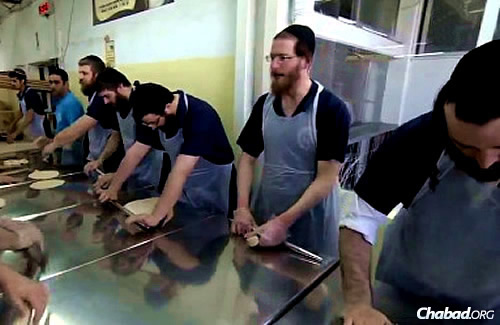
Rolling the dough for shmurah matzah at the historic bakery in Kfar Chabad, Israel.

Putting the dough into the ovens to bake

Boys and girls eye some shmurah matzah. Thousands of Israeli schoolchildren have visited the bakery over the years, particularly during the pre-Passover season. (Photo: Kfar Chabad magazine)

Mayor of Kfar Chabad Benyamin Lipshitz watches as Israeli Prime Minister Benjamin Netanyahu admires a matzah he helped bake.
© Copyright 2015, all rights reserved.
Jewish News
How Chabad Took Root in Argentina: The Early Years by Dovid Margolin

The Jewish history of Argentina is as rich and varied as the rest of its culture. Here, the Tzivos Hashem boys choir performs at a holiday celebration in Argentina.
This is the first in a five-part series on Chabad’s impact on Jewish life in Argentina, one of the largest Jewish communities in the world.
BUENOS AIRES, Argentina—This city pulses with life. During the day, it is a honking, traffic-filled mess. At night, the city’s wide, tree-lined boulevards stretch past people lounging in cafes and restaurants, regularly full until the wee hours of the morning. The grand examples of European-style architecture—vibrant, colorful, cosmopolitan—have gained Buenos Aires a telling moniker, the “Paris of South America.”
The capital and largest city of Argentina, Buenos Aires (“Good Airs” or “Fair Winds”) is the second-largest metropolitan area in South America after Greater São Paulo, Brazil.
Its Jewish history is as rich and varied as the rest of its culture. The first mass immigration of Jews to Argentina took place in the late 1800s, followed by a number of subsequent waves. Constituted mostly of Ashkenazim of European descent, the Jewish community also includes a sizable, organized Sephardic community.
While building their own schools, synagogues and community centers, the Jews of Argentina have taken on some of the customs of their adopted homeland; socializing is one of them. Argentines live life and enjoy it. With a glass of Malbec in hand and enough meat on the grill (in Spanish, the parrilla)to feed a small country, an Argentine social gathering of family, friends and neighbors can last many long, happy hours.

In 1985, Rabbi Tzvi Grunblatt, left, director of Chabad of Argentina, hands materials to David Goldberg, president of Argentine Jewry's umbrella organization DAIA, so he can light the Chanukah candles on the first public menorah in Buenos Aires. At right is Israeli ambassador to Argentina Dr. Efraim Tari.
An average Friday-night Shabbat meal will also go late, very late. If someone is celebrating a happy occasion—a bris, a wedding or other life-cycle event—their Jewish friends and fellow community members will come out en masse. At a recent Shabbat afternoon kiddush honoring the birth of a daughter of a community member at Beit Chabad Olleros in Belgrano—a tony Buenos Aires neighborhood dotted with villas and embassies—men, women and children spent an entire summer afternoon eating, drinking and chatting.
Family, community, tradition; this is what makes Argentine Jewry tick.
Political and Economic Instability
Despite the comfortable and fulfilling lifestyle of community and tradition, the story of Argentina’s Jews is not a simple one. Argentina—once a prosperous, beautiful country looked to as an example of South American stability—has been anything but stable for generations. The presidential election of 1989 was the first handover of power to an elected successor in more than 60 years. Populist presidents, military coups and a culture of corruption have made predicting its future a difficult task.
Along with political uncertainty have come intermittent periods of economic crises, the last major one 15 years ago at the cusp of the 21st century. When it comes to Argentina, “it is not a question of if there will be another crisis,” goes the common refrain, “it’s a question of when.”
Many of the country’s Jews have prospered financially, but the community as a whole certainly cannot be defined as wealthy. Indeed, many live in poverty. Along with other communal organizations, Chabad-Lubavitch of Argentina’s Chabad Foundation helps care for Jews in need, and its groundbreakingieladeinu (Hebrew for “our children”) Jewish child-care center has literally written the book on how communities should respond to instances of child abuse.

Standing at the front door of 770 Eastern Parkway (the world headquarters of the Chabad-Lubavitch movement), yeshivah student Berel Baumgarten, right, shows the Rebbe—Rabbi Menachem M. Schneerson, of righteous memory—a pin specially created for the Mesibos Shabbos group to encourage Shabbat observance. This picture was taken in 1942, eight years before the Rebbe would accept the mantle of Chabad leadership.
Politics and economics have taken their toll on Argentina’s Jewish population; today, the community numbers around 250,000, down from a peak of 400,000 in the 1960s. Most live in Buenos Aires and its environs. The fact that two mass terrorist attacks targeting Jews have never been solved—one at the Israeli embassy in 1992, which killed 29 people; and the other at the AMIA (Argentine Jewish Mutual Aid Society) building in 1994, which killed 85 people and injured more than 300—doesn’t help matters.
Since 1955, when the Lubavitcher Rebbe—Rabbi Menachem M. Schneerson, of righteous memory—sent Rabbi Berel Baumgarten as the first Chabad-Lubavitch emissary to Argentina, Chabad has had a vast impact on the spiritual and material life of Argentine Jewry. In 1978, Argentine native Rabbi Tzvi Grunblatt returned to the country with his wife, Shterna, and they have since run Chabad of Argentina, overseeing what has grown to become a network of 52 synagogues, schools and social-service organizations.
‘It Was a Different World’
It’s 9 p.m. at Chabad Headquarters on Aguero Street, and as usual, Rabbi Grunblatt is at his desk, working. It has been a long day, yet Grunblatt still has a community social function to attend. With a $15 million operating budget to cover—excluding building projects and special events—Grunblatt is busy from morning to evening with nary a break.

The South American nation of Argentina, highlighted in red.
His family’s story is similar to that of many Jews who came to Argentina in the 1930s and 1940s, before or right after the Holocaust. His mother was 15 when she arrived in Uruguay with her family in 1940, having escaped war-torn Europe using visas granted to a small number Jews by Florencio Rivas, the Uruguayan consul in Berlin. Grunblatt’s father was in Europe throughout the duration of the war, surviving a Nazi labor camp before ultimately winding up in Argentina in 1947.
“When my mother came on the ship to Uruguay, there was only one other Jewish family on it that kept kosher,” relates Grunblatt. “The others on the ship asked her, ‘Why are you doing this? This is over.’ ”
The Buenos Aires Grunblatt grew up in was a very different place than the thriving Jewish metropolis it is today. “You did not see one beard and not one man covering his head anywhere,” noting that his father bucked the pervading trend by wearing a yarmulka (skullcap), as he did throughout his life. “My mother came to Argentina to get married because my grandfather wanted my mother to marry someone who knew how to study Torah, and there was a much larger community in Buenos Aires than in Uruguay. My grandfather thought that if the young man can learn Torah, then he would succeed at business, too.”
However, quipped the rabbi, “he was wrong about the business part.”
Although there were many traditional synagogues in Argentina, Jewish communal life, according to Grunblatt, was for the most part dominated by liberal strains of Judaism and a variety of radical-revolutionary secular Jewish groups. Jewish schools and social clubs abounded, but religious observance and knowledge of tradition were disappearing at a rapid rate.

Rabbi Berel Baumgarten, standing, top right, listens as the Rebbe speaks at a farbrengen gathering at 770 Eastern Parkway, Lubavitch World Headquarters, in the early 1960s.
The First Emissary
It was as a child that Grunblatt first encountered Chabad in the form of Rabbi Baumgarten, a looming, bearded American chassid who looked out of place on the streets of Buenos Aires.
Baumgarten’s mission to Argentina was not embarked upon with the same detailed research that accompanies the founding of a contemporary Chabad center. Prior to his first journey to South America, originally undertaken for business prospects, he asked the Rebbe for a blessing. The Rebbe gave him shmura matzah, instructing him to distribute it to Jewish people he met throughout his travels.
“The Rebbe told him not to give it for free,” Grunblatt says, remembering Baumgarten’s telling of the event. “The Rebbe told him to give it out, but to demand some form of payment in return; to put ontefillin or place a mezuzah on the door—something. But then, the Rebbe told him that when he comes to a place where the demand for the matzah is so high that he’s forced to break it into pieces, there he should give it out for free, and that is the place he should settle.
“That place was Buenos Aires.”
It was Baumgarten’s genuine Chassidic joy and warmth, coupled with his breadth of Torah scholarship that made him a magnet for Argentine Jews. “When the Jews here saw him, they looked at him as an angel from G‑d; they had never seen someone like him,” attests Grunblatt. “He was a holy person.”

Baumgarten served as the Rebbe's first emissary to Buenos Aires, Argentina.
Throughout his years there, Baumgarten would serve as a rosh yeshivah, a school teacher, a rabbi, and the chaplain of a Jewish senior home and orphanage. Wherever he went, he left a lasting impression on the Jews he encountered.
“Reb Berel Baumgarten had a great effect on many individuals,” attests Grunblatt. “By 1958, only a few years after he was here, there were already three Argentine yeshivah students learning in the central Lubavitch Yeshiva at 770: Mordechai Srugo and Aaron Tawil, who are both alive and well, and Chaim Swued, who passed away recently.”
But his mission did not begin and end with whatever spiritual effect he might have had on a fellow Jew. “When he became the rabbi of the Jewish orphanage, he fought for the rights of the children. He fought that they should receive fresh food because he saw that the workers were stealing it and leaving the rotting food for the children.”
This approach didn’t make him popular among the staff at the orphanage, who were used to running things as they wished. But for Baumgarten, there could be no other way. Once, he opened the kitchen lights just as some workers were stealing meat meant for the children. When a staff member pulled a gun on the rabbi to threaten him, he responded by opening his shirt and daring them to shoot him.
Life was difficult for him financially; even years after establishing himself in Argentina, his organization remained in debt. At times, he struggled to put food on his table. During a particularly challenging time, he entered the Rebbe’s office for a private audience. “The Rebbe looked at him and said, ‘No more complaints!’ And the Rebbe threw his pencil down on the table,” tells Grunblatt. “ ‘You have to go with joy,’ the Rebbe told him. He said, ‘You have to go with joy not because I said so; you have to want to go with joy yourself.’ ”

On a trip to Israel, Baumgarten meets with former president Zalman Shazar, an author and scholar who hailed from a Chabad background.
While Baumgarten was still in New York, he received a call from Rabbi Chaim Mordechai Aizik Hodakov, the Rebbe’s chief secretary, who told him that the Rebbe had directed that a monthly subsidy be sent to Baumgarten from Lubavitch World Headquarters in New York. Baumgarten would continue receiving that personal subsidy from the Rebbe each month until his passing in 1978.
To New York City and Back
Of the various positions Baumgarten held, one of them was as a rosh yeshivah at the decidedly non-Chassidic Yeshivas Chofetz Chaim in Buenos Aires. As the child of religious parents, that was where Grunblatt was sent to study in 1967. Inspired and connected to their teacher— Baumgarten—Grunblatt and many of his classmates would eventually affiliate themselves with Chabad, forming what was to become the initial core of the Chabad community in Buenos Aires.
“When it came time for me to go to yeshivah, my father didn’t want to send me to a Chassidic [one]. He thought that first I need to learn the fundamentals, and then after that, I can involve myself withchassidus,” says Grunblatt. “But after searching around, it ended up that in 1969, not many yeshivahs wanted to accept a 15-year-old Argentine student with no money. But Lubavitch took me, so I went to New York.
“At that time, I did not know the difference between Chabad and Satmar; all I knew was Reb Berel Baumgarten, and that he was a real Jew.”
On subsequent trips home—in 1971, and again, in 1976 and 1977—Grunblatt and his fellow Argentine Chabad yeshivah students energetically worked to help Baumgarten in his work and reach out to more Jews and spread Chabad’s message. Among their activities was a mass Lag BaOmer Parade in 1976, Argentina’s first.

Baumgarten, seated third from left, poses together with his table at what appears to be a wedding celebration.
The Era of the Juntas
In March of 1976, the Argentine military executed a coup d’état, deposing President Isabel Peron and replacing the government with a junta comprised of Gen. Jorge Rafael Videla, Adm. Emilio Eduardo Massera and Brig. Gen. Orlando Ramon Agosti.
(Peron was the third wife and successor of the highly popular President Juan Peron, who had died in 1974. Peron himself had been the overthrown in a previous coup in 1955, but had been re-elected when democracy returned for a short while in the 1970s.)
Many Argentine Jews were active in leftist politics and labor movements, which labeled them as targets of the junta’s brutal crackdown on political dissidents known as the “Dirty War,” and which saw the arrest and disappearance of thousands of innocent men and women.
“In 1975-76, that was the second time that Merkos shluchim [Chabad emissaries] were sent to Argentina, and we spread out to visit 10 to 15 cities in the country,” explains Grunblatt. “It was during the times of the juntas, and when we came it was like perfect timing for the people. Everybody was listening to us. Before the junta, many Jewish children had belonged to a variety of very leftist, secular Jewish youth organizations, especially in the smaller communities. That was their connection to Jewish life. But the junta closed down all of these leftist groups, including the Jewish ones, so when we came it was like a breath of fresh air for all these communities.”

The rabbi, center in back, conversing with others at a wedding.
One Sunday in 1977, Grunblatt remembers going with his brother Nosson to a country club in Buenos Aires, where they stood by a table all day asking Jewish club members to wrap tefillin. One Jewish man refused, but when Nosson Grunblatt (today, the chief editor of the Kehot Publication Society in Spanish) asked him if he would like to talk instead, the man agreed.
“My brother and this man spoke the whole evening, and they agreed Nosson would go to his house to speak to his family, too,” recalls Grunblatt. “My brother ended up speaking to the family about Judaism the whole night and didn’t come home.
“My mother was sure he was kidnapped by the government. We didn’t know who the man was; we didn’t know which house he had gone to. If this Jewish man was some kind of figure on the left, the military could have come in and taken everyone who was in the house, including my brother. In the morning, when he was still not home, my mother began calling the police stations and hospitals. Then my brother walks in to the house in the morning like nothing happened.”
That night might have shaken up Grunblatt’s family, but the effect on the man from the country club was much more profound.
“That family,” adds Grunblatt, emphatically, “is today a large, fully observant Jewish family.”

Grunblatt addresses a crowd at a central community gathering in Buenos Aires in honor of the Rebbe.
Passing the Torch
Sometime in the 1970s, Rabbi Berel Baumgarten visited London and then Israel, where he saw Chabad’s unprecedented growth in those places. Big buildings were being erected, while back home, Baumgarten was still working in extremely modest circumstances. On his return to Argentina, he stopped in New York, where he had a private audience with the Rebbe. Baumgarten would usually write a long letter to the Rebbe detailing his work, but this time he wrote nothing. When the Rebbe asked him why he had not written his usual letter, he replied that he had witnessed the scale of work that had been accomplished in England and Israel, and felt that comparatively, he had accomplished nothing at all.
“Success is not measured by buildings, but by students,” the Rebbe replied. Pulling out a report written by the staff at the main yeshivah in 770, the Rebbe pointed at where they had written glowingly of the success of four Argentine yeshivah students sent there by Baumgarten. “This is success,” he said.
Baumgarten passed away in 1978. Shortly thereafter, Chabad community members in Buenos Aires asked the Rebbe to send a new emissary to take the helm of Chabad activities in the country. They requested Grunblatt, who was not yet married, by name.
Not long thereafter, Grunblatt met and married Shterna Kazarnovsky. When the week of Sheva Brachot (“Seven Blessings”) was over, the young couple set out to Argentina for life.
“For life,” he says, “until Moshiach comes.”
© Copyright 2015, all rights reserved.
Jewish News
Chassidic Bar Mitzvah in Rural Florida Marks a First for Many by Mindy Rubenstein

Tzvi Eber became a bar mitzvah in western Florida where his parents, Rabbi Yossi and Dina Eber, co-direct Chabad of West Pasco. Here, he entertains one of the younger of the 250 guests.
The first-ever Chassidic bar mitzvah in Pasco County—a mix of rural and suburban neighborhoods on Florida’s west coast near Tampa—drew about 250 people from the area, as well as from Massachusetts, New York, France and even Russia.
“It was amazing. It was absolutely nothing like others I have been to,” said Scott Morris, 52, who works locally as a swimming-pool contractor, has two children in college and has lived for 30 years in Oldsmar, Fla.
About six months ago, Morris took a class with Rabbi Yossi Eber, who since 2006 has served as co-director of Chabad of West Pasco in Trinity, Fla., with his wife, Dina. He said it changed his life.
“I absolutely fell in love with a form of Judaism I never knew,” he said.
“They are the most genuine, down-to-earth, nicest people you could ever meet,” he said of the Ebers and their six children, including two sets of twins. “Even if you don’t follow all the rules [of observant Judaism], there’s no judgment. They accept you as you are.”
Morris attended the December bar mitzvah of Tzvi, the Ebers’ oldest child and only son.
“You walked in and felt like you entered another country. There were guys with beards and black hats and coats. But within minutes, you could feel the warmth and camaraderie,” he described. “It was just an incredible evening.”
He said he has traveled the world and observed numerous cultural celebrations in other countries, yet “dancing with them that night was transformational.”

For many attending, it was their first time at a Chassidic event.
‘Definitely a First’
Rabbi Eber explained that the ceremony and the celebration were done like they would have been in New York. Even the musician was a friend from New York, who played traditional Chassidic music, as opposed to contemporary tunes.
“The spirit of the night was so awesome,” he said. “After all the planning, you see in a very real way what it turned into—something very special.”
In fact, the couple says the arrangements were so all-encompassing that it took a while for them to get back to normal.
Dina Eber affirmed that “it was a very public event, and for many people here, their first time at a simcha in a long while. For many, it was their first time at a Chassidic event or even a traditional bar mitzvah. It was definitely a first.”
She acknowledged that some were surprised by the separation of men and women for the duration of the evening, but like many new experiences since the Ebers have been there, they took it in stride. “It became really fun and very real,” she said.
“That’s what people are looking for—a sense of community, of having an identity” in the heart of a very non-Jewish area, where some Jews are completely disconnected, she explained. “People are taking on mitzvahs, eating kosher and just aware of being Jewish in general. They’re taking classes and programs, and enjoying the holidays.”
This year, for example, about 50 people came to their Purim party, and 100 or more are expected at their Passover seder.

Women enjoy dinner separately from the men, as is customary at a traditional simcha. All of the dishes, utensils and kosher food had to be brought into the venue by family and friends.
‘Happiness Through the Room’
Janet Carroll, now in her 80s, used to live in the northeastern part of the United States, but for more than 20 years now has resided in New Port Richey, Fla.
She was in awe over the bar mitzvah arrangements. The venue was a local hall, and so everything had to come in from the outside, much of it from out of the area, she explained, including all of the dishes, utensils and kosher food. “That was a monumental task. It was mind-boggling. It was as if every single part was done by a friend or relative.”
Plus, “people were there from all over the world; that, in itself, was different,” she said.

The words of the bar mitzvah boy visibly moved the audience.
During the event, the Ebers introduced family members from around the United States and the world, including Dina’s brother and his family, who all came the way from Moscow. Dina Eber herself grew up in France, where her father serves a spiritual dean for a yeshivah.
“I never had such a good time in my whole life as I had at that bar mitzvah,” said Carroll. “I cannot tell you what a joy it was to get up and dance with all those women. Not since I was a teenager have I done those dances, heard that music.”
Carroll actually tutored Tzvi in reading when he was a little boy. Now, she marveled, “he’s a young man.”
Barbara Goldblatt, 65, another community member who attended the event, said: “That night was one of the most beautiful nights I have ever experienced.”
“I’ve been to many bar mitzvahs,” said Goldblatt, who moved from New York to New Port Richey in 2001. “At this one, as a Jew, you could feel G-d all over the place. It was just so joyous! The look on the rabbi’s face was enough to make your heart melt. Happiness was all through the room.”
Which is fitting, she said, as Rabbi Eber “always has time to help others, to listen to somebody.”
As for the service, she noted that it was exceptional. “When Tzvi got up and spoke ... I’m not an emotional person, but it brought tears to my eyes.”
“I believe,” she said, “G-d brought me down here from New York for this.”

“The spirit of the night was so awesome,” said Rabbi Eber.

“It became really fun and very real,” said Dina Eber.

Happiness filled the room; one guest said dancing with the men that night was “transformational.”

A bar mitzvah tradition: up in the chair for the young man of honor.
© Copyright 2015, all rights reserved.
Lifestyle
How to Make Healthy Grilled Chicken Salad by Miriam Szokovski
As Passover comes closer and closer, you might be trying to use up some fridge and pantry items to make way for your new kosher for Passover groceries. Stir fries and salads are the perfect way to combine these foods for a quick, tasty meal. This would also make a delicious addition to your Shabbat lunch.

This salad is pretty flexible. I used lettuce, mango, avocado, radishes and grilled chicken but you can easily make substitutions. Got some croutons, chow mein noodles or flatbread crackers you want to use up? Toss them on top!

You can grill fresh chicken with a simple spice rub (salt, pepper, paprika, garlic), or you can use leftover chicken you have on hand. You could also use flaked tuna instead, cold cuts or a dryish meat.

You might already have salad dressing you would like to use up. Otherwise, I’m sharing three of my favorite dressings.
Yields: 8 servings
Salad Ingredients
1 mango, peeled and cubed
1 avocado, peeled and cubed
1 small jicama, peeled and cubed (or: 4-5 radishes, sliced)
Grilled chicken, sliced
Lettuce—Romaine (2 heads) or iceberg (1 small-medium head)
Directions
Toss salad ingredients together.
Pour dressing of your choice over the salad immediately before serving.
NOTE: Some people like their salads more dressed, some prefer them lighter. Start by pouring on some of the dressing, taste it and see how much more you want to add.
Creamy Yellow Dressing
Thick and creamy with no mayonnaise!

1 small raw onion
⅓ cup vinegar
¼ cup sugar or honey
¾ cup olive oil
2 tbsp. mustard
½ tsp. salt
Light & Easy Dressing
Simply whisk the ingredients together and pour over the salad.
1/3 cup olive oil
¼ fresh lemon juice
3 cloves garlic, crushed
1 tsp. kosher salt
1 tsp. sugar
Peanut Sauce
Sweet and spicy with a little bit of tang.

3 tbsp. peanut butter
4 tbsp. vinegar
1.5 tbsp. soy sauce
1/4 tsp. garlic powder
1/2 tsp. red pepper flakes
2 tbsp. water
5 tbsp. sugar (6 tbsp. if you're using natural, unsweetened peanut butter)
Peanut Sauce Directions
Put the peanut butter in a small saucepan and turn the heat on very low. The peanut butter will start to soften. Stir it a little to make sure it doesn't stick to the bottom of the pot and burn.
Slowly add in the vinegar, soy sauce and water, one tablespoon at a time. Mix in one direction. Add the garlic powder, red pepper flakes and sugar.
Mix until all ingredients are thoroughly combined. Turn off the fire.
Refrigerate until cooled. Pour over salad immediately before serving.

Stay tuned next week—I'll be sharing FOUR variations of charoset!
Planning your Passover menus? We've got loads of delicious kosher for Passover recipes for you.
Miriam Szokovski is the author of historical novel Exiled Down Under, and a member of the Chabad.org editorial team. She enjoys tinkering with recipes, and teaches cooking classes to young children. Miriam shares her love of cooking, baking and food photography on Chabad.org’s food blog, Cook It Kosher and in the N'shei Chabad Newsletter.
© Copyright 2015, all rights reserved.
Chabad.org Magazine - Editor: Yanki Tauber
____________________________

No comments:
Post a Comment