Editor's Note:
Dear Friend,
Weeks before Purim, the holiday spirit fills my home, as bits and pieces of costumes come on and off my children; Purim tunes fill the air; and the little voices beg for just one more hamantash. The dining room table has become Mishloach Manot central, covered with baskets and boxes, ribbons and wrappings, to be used in preparing the gifts of food sent on Purim. As Purim draws closer, various delicacies join the chaos. My kids eagerly help me prepare the packages, ready for delivery on Purim day.
Each year as I tie bows and plan the best route through town, one particular Purim memory comes to mind. I was a child of eight or so when I brought the brightly-colored package to my classmate’s quiet home. It was the only one that she received that day. I knew that my chocolates and fruit brought her true Purim joy and told her that someone cared. Mishloach Manot are sent as expressions of friendship and unity, and my friend’s shining eyes taught me what this mitzvah is all about.
As you prepare your Mishloach Manot, consider adding one more person to your list, someone to whom your gift will make all the difference.
Happy Purim!
Rochel Chein
responder for Ask the Rabbi @ Chabad.org
P.S. Did you ever give or receive a gift that touched your heart deeply? Please post a comment and tell us about it.
P.P.S. This week, US-Israel relations are on our minds. Here is the Rebbe’s advice from 24 years ago to a prime minister of Israel.

Infinite & Intimate
"As water, face to face, so the heart of a man to his fellow."(Proverbs 27:19)
Does G‑d then laugh? Does the Infinite Light cry over failure and rejoice in success? Does He that brings time and space into existence truly love with the passion of a frail human being or feel remorse as a creature trapped within the tunnel of time?
But G‑d desired the human soul with all its struggles. And the proof: We are here.
And when G‑d conceived this being, He looked down from His lofty realm beyond love and laughter, passion and remorse, and He said, "Shall she then be alone in his place and I in mine? Is this oneness?"
So He arranged a meeting place. He determined that the boundless emotions that are the fabric of the human soul would glimmer as well within the purity of the Infinite Light.
So that in love and laughter and compassion and awe and beauty, This human creature and G‑d could find one another, and neither would be alone.[Maamar B’Sha’ah She’alah 5725]

| Purim How to Celebrate Purim in 1,000 Words Editor’s NotePurim begins this year on Wednesday evening, March 4, 2015, and continues through Thursday night, March 5. What follows is a brief step-by-step guide to Purim observance. We have also included links to additional Purim resources. Time for Some Fun! Purim, celebrated on the 14th of Adar, is the most fun-filled, action-packed day of the Jewish year. It commemorates our nation’s miraculous salvation more than two millennia ago. The Purim Story in a Nutshell  Meanwhile, the anti-Semitic Haman was appointed prime minister of the empire. Mordechai, the leader of the Jews (and Esther’s cousin), defied the king’s orders and refused to bow to Haman. Haman was incensed and convinced the king to issue a decree ordering the extermination of all the Jews on the 13th of Adar—a date chosen by a lottery Haman made (hence the name Purim, “lots”). Mordechai galvanized all the Jews, convincing them to repent, fast and pray to G‑d. Meanwhile, Esther asked the king and Haman to join her for a feast. At the feast, Esther revealed to the king her Jewish identity. Haman was hanged, Mordechai was appointed prime minister in his stead, and a new decree was issued granting the Jews the right to defend themselves against their enemies. On the 13th of Adar, the Jews mobilized and killed many of their enemies. On the 14th of Adar, they rested and celebrated. How We Celebrate Though we dress up in holiday finery, Purim doesn't feature holiday work restrictions. Nonetheless, all the better if you can take the day off from work and focus on the holiday and it’s four special mitzvahs: (Note: If you are spending Purim in Jerusalem, the laws vary. Click here for details.) 1. Hear the Megillah 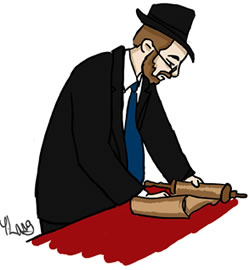 When Haman’s name is mentioned (following Chabad custom, only when accompanied with an honorific title), you can twirl graggers (noisemakers) or stamp your feet to eradicate his evil name. Tell your kids that Purim is the only time when it’s a mitzvah to make noise! The megillah is read from a handwritten parchment scroll, using an age-old tune. Contact your local Chabad rabbi if for any reason you can’t make it to your synagogue for the megillah reading. He’ll do his best to send a megillah reader to your home or office. 2. Give to the Needy (Matanot La’Evyonim) 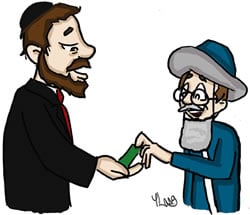 Give money or food to at least two needy people during the daylight hours of Purim, March 5. In case you can't find any needy people, your synagogue will likely be collecting money for this purpose. At least, place two coins in a charity box earmarked for the poor. On Purim, we give a donation to whoever asks; we don’t verify his or her bank balance first. As with the other mitzvahs of Purim, even small children should fulfill this mitzvah.
3. Send Food Gifts to Friends (Mishloach Manot)
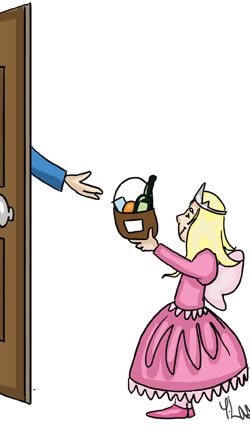 On Purim day, March 5, send a package containing at least two different ready-to-eat food items and/or beverages (e.g., pastry, fruit, beverage) to at least one Jewish acquaintance during the daylight hours of Purim. Men send to men and women to women. It is preferable that the gifts be delivered via a third party. Children, in addition to sending their own gifts of food to their friends, make enthusiastic messengers. 4. Feast! 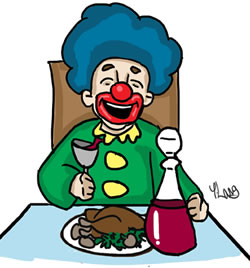 The table should be festively bedecked with a nice tablecloth and candles. Wash for bread orchallah, andenjoy a meal featuring meat, wine and plenty of Jewish songs, words of Torah and joyous Purim spirit. Sing, drink, laugh, have fun together. Note: When Purim falls on a Friday, out of deference to the approaching Shabbat, we start the meal earlier, ideally before midday. Special Prayers  In the morning service, there is a special Torah reading (Exodus 17:8-16), describing the battle Joshua waged against Amalek—Haman's ancestral nation—almost one thousand years before the Purim events unfolded. Masquerade! 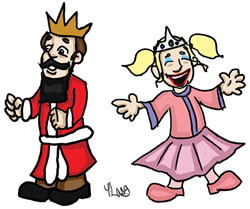 Dress up your kids before taking them to the synagogue for the megillah reading. Many synagogues have a masquerade party, along with prizes for the children, during or after the megillah reading. Shushan Purim In certain ancient walled cities—Jerusalem is the primary example—Purim is observed not on the 14th of Adar (the date of its observance everywhere else), but on the 15th of Adar. This is to commemorate the fact that in the ancient walled city of Shushan, where the battles between the Jews and their enemies extended for an additional day, the original Purim celebration was held on the 15th of Adar. The 15th of Adar is thus called “Shushan Purim,” and is a day of joy and celebration also in those places where it is not observed as the actual Purim. Pre- and Post-Purim Observances Torah Reading of Zachor On the Shabbat before Purim (this year, February 28), a special reading is held in the synagogue. We read the Torah section called Zachor (“Remember”), in which we are enjoined to remember the deeds of (the nation of) Amalek (Haman’s ancestor) who sought to destroy the Jewish people. The Fast of Esther To commemorate the prayer and fasting that the Jewish people held during the Purim story, we fast on the day before Purim. This year we fast on Wednesday, March 4. The fast begins approximately an hour before sunrise, and lasts until nightfall. Click here for exact times for your location. The “Half Coins” (Machatzit HaShekel) It is a tradition to give three coins in “half” denominations—e.g., three half-dollar coins—to charity, to commemorate the half-shekel that each Jew contributed as his share in the communal offerings in the time of the Holy Temple. This custom, usually performed in the synagogue, is done on the afternoon of the “Fast of Esther,” or before the reading of the Megillah. Shushan Purim In certain ancient walled cities—Jerusalem is the primary example—Purim is observed not on the 14th of Adar (the date of its observance everywhere else), but on the 15th of Adar. This is to commemorate that fact that in the ancient walled city of Shushan, where the battles between the Jews and their enemies extended for an additional day, the original Purim celebration was held on the 15th of Adar. The 15th of Adar is thus called “Shushan Purim,” and is a day of joy and celebration also in those places where it is not observed as the actual Purim. Useful Purim Links: Click here for our mega-Purim site. Here for a global Purim event directory. Here for Purim FAQ. Here for the story of Purim. Here for Purim insight and inspiration. Here for Purim stories. Here for Purim multimedia. Here for our Purim Kids’ Zone. Here for Purim shopping. Here for Purim recipes. Illustrations by Yehuda Lang. To view more artwork by this artist, click here. © Copyright 2015, all rights reserved. Purim The Real Reason Why We Eat Hamantaschen By Yehuda Shurpin  Join us as we search for the ancient roots of this delicious pastry. History One of the oldest mentions of a Purim treat referred to as oznei Haman is in a Purim comedy skit written by Yehudah Sommo (1527- 1592) of Italy.1 Literally translated as “Haman’s ears,” this name led to the myth that the pastries celebrate the cutting off of the wicked man’s ears before he was hanged.2 However, “oznayim” can sometimes refer to non-Purim pastries. In fact, in describing the manna which fell from heaven while the Jews were in the desert, both Rabbi Yosef ibn Kaspi (1279-1340)3 and Rabbi Don Yitzchak Abarbanel (1437-1508) describe a pastry called oznayim, with no mention of Haman or Purim at all.4 (In many Eastern European cultures, there are stuffed dumplings referred to as “little ears.”) Lastly, there is no documentation of any such barbaric mutilation having been carried out. Daniel, Esther and the Real Hamantash Although nowadays you can find hamantaschen filled with practically any type of filling (sweet or savory), the classic hamantash was always filled with poppy seeds. Indeed, the very word “haman” can either refer to the wicked Haman or poppy seeds (mohn), and the Yiddish word“tash” means pocket. Thus,“hamantaschen” means “poppy-seed-filled pockets.” This is in line with the classic explanation given in the Code of Jewish Law for eating hamantaschen on Purim: Some say that one should eat a food made out of seeds on Purim in memory of the seeds that Daniel and his friends ate in the house of the king of Babylon, as the verse states,5 “And he gave them seeds.”6 But what in the world does Daniel eating seeds have to do with Purim? The Talmud explains that Hatach, Queen Esther’s faithful messenger and one of the lesser-known heroes of the Purim story, is a pseudonym for none other than Daniel. Furthermore, as we read in the Purim story, when Esther was in the king’s palace, she kept her identity secret. The Talmud explains that since the food was unkosher, she survived on various beans and seeds.7 It is in commemoration of both Daniel and Esther that there is a custom to eat beans and seeds on Purim.8 The way this custom is traditionally observed is by eating pastry pockets, a.k.a. taschen filled with mohn, poppy seeds.9 Based on this reason for eating hamantaschen, whenever the classic halachic sources discuss this custom, specific mention is made of the hamantash being filled with poppy seeds.10 In addition to the classic reason for hamantaschen, many other explanations have been offered to explain this custom. Indeed, just about every aspect of this treat is laden with symbolism. Here are some explanations given. The Weakening of Haman “Tash” in Hebrew means “weaken.” Thus, the hamantash celebrates the weakening of Haman and our wish that G‑d always save us by weakening our enemies.11 Hidden Messages During the Purim story, many Jews did not believe they were going be completely wiped out. Mordechai convinced them of the seriousness of the threat by sending them numerous letters warning them of the impending doom. Afraid to send the letters by conventional routes lest their enemies intercept them, he sent the letters hidden inside pastries. In commemoration of this, we eat pastries with a filling.12 Hidden Sweetness A well-known insight into the hamantash points to the fact that the filling is hidden inside the dough. In earlier times, our ancestors were accustomed to experiencing open miracles. In a time of exile, we don’t necessarily experience openly revealed miracles anymore. Nevertheless, the Purim story shows that this does not mean that we’ve been abandoned (G‑d forbid). On the contrary, G‑d is ever present. He’s just operating in a behind-the-scenes fashion, just as the filling of the hamantash is hidden within the dough.13 Three Corners While there is an old legend that Haman wore a three-cornered hat, and to commemorate his downfall, we eat a three-cornered pastry,14 there is a deeper significance as well. The Midrash says that when Haman recognized (the merit of) our three forefathers, his strength immediately weakened. Because of this, we eat three-cornered pastries and call them “Haman weakeners (tashen).” Another reason for corners: The Hebrew word for “corner” in Hebrew is “keren,” which literally means “horn,” and can also denote “ray,” “fortune,” or “pride.” Thus, the sages understand the verse, “And all the kerens of the wicked I shall cut down” as referring to Haman, and “Exalted will be the keren of the righteous”15 as referring to Mordechai.16 Kreplach (Dumplings) No discussion of hamantaschen can ignore its sister food, kreplach,17 meat-filled dumplings often served in soup. We customarily eat them three times a year: Purim, the eve of Yom Kippur, and Hoshanah Rabbah. Rabbi Yosef ben Moshe of Hoechstaedt (1423–1490), author of Leket Yosher, is perhaps the earliest halachic authority who mentions kreplach as specifically connected to Purim.18 Kreplach are also mentioned by Rabbi Yoel Sirkes (the Bach, 1561- 1640),19 his son-in-law, Rabbi Dovid Halevi (the Taz),20 Rabbi Yeshaya Halevi Horowitz (the Shalah, 1565 -1630),21 and many others. Various reasons have been given for eating kreplach on Purim, and it seems plausible that some aspects of this custom have transferred over to the hamantash as well. Hidden Holidays On most holidays, the sanctity of the day is apparent, since we abstain from many forms of work. There are three times a year when we eat a festive holiday meal replete with meat even though work is permitted and the specialness of the day is somewhat obscured: Purim, Erev Yom Kippur, and Hoshanah Rabbah—the three days when we eat kreplach.22 Meat and Flour Rabbi Schneur Zalman of Liadi explains, in relation to Yom Kippur, that the meat in the middle of the kreplach signifies the emotional attributes, called the middot, whereas the dough enveloping the meat—made from wheat flour—signifies knowledge (da’at) of G‑d and the Torah, which is also compared to flour. On the eve of Yom Kippur, the innermost attribute of kindness, which is hidden within intellect, shines forth. We pray that G‑d’s attribute of kindness and mercy will be revealed in our mind and hearts, and that we too will respond to others with kindness and compassion. The Zohar compares the holiday of Purim to that of Yom Kippur. In fact, it is explained that one can accomplish more through rejoicing and celebrating on Purim than one can accomplish through fasting and praying Yom Kippur. This is hinted to in the very names of the holidays, for Yom Kippur can be read as Yom Haki-Purim—the day which is (only) like Purim.23 Therefore, just as on the eve of Yom Kippur we eat kreplach, we do so on Purim as well.24 Hamantaschen in Exile Although there is no obligation to eat hamantaschen on Purim, many have gone through great hardships just to fulfill this perhaps minor custom. Rebbetzin Chana, the mother of the Lubavitcher Rebbe, writes in her memoirs that when she accompanied her husband, Rabbi Levi Yitzchak Schneerson, into exile for spreading Judaism, it was at times impossible to get anything special for Shabbat, including bread and candles. One time, she got hold of flour and set aside some in order to bake hamantaschen for Purim. In her words: The festival of Purim arrived. We had a Megillat Esther, which I had once included in a food package I had sent my husband. For Purim, we were visited by two evacuees, a young Jewish man, inclined towards Communism, and his female neighbor, an engineer who had once studied Yiddish and was interested in Judaism. Some time before, I had set aside some white flour, with which I baked two hamantaschen. Although it’s a minor custom, it played an important role in our lives, reminding us that we were still human and still Jews, and that not every day was the same. We were reminded that we could be concerned with loftier concepts—not just with thinking about our daily bread, and drawing the pail of water from the well and hauling it through the mud, always spilling some and making the already swampy ground even muddier. The two guests were our company for Purim. They regarded hamantaschen as an excessive extravagance and, as was prevalent in that culture, inveighed against the “old-fashioned” customs.25 Thank G‑d, most of us do not need to save flour for our hamantaschen and need not fear that we will be denigrated for eating them. So what are we waiting for? Let’s bake some hamantaschen! Click here for an array of hamantaschen recipes ranging from kid-friendly to gourmet. Rabbi Yehuda Shurpin responds to questions for Chabad.org's Ask the Rabbi service. FOOTNOTES 1. See C. Shirman, Letoldot Hashira v’Hadrama Haivrit, 2, pg. 52-53, cited by R’ Eliezer Brodt in “The Origins of Hamentashen in Jewish Literature: A Historical-Culinary Survey Revisited.” 2. See Yom Tov Lewinsky, Sefer Hamoadim (pp. 153-154). 3. Metzarif Lekesef on Exodus 16:31. 4. See commentary of the Abarbanel on Exodus, ch. 16 (p. 143 in standard edition). 5. Daniel 1:16. 6. Rabbi Yosef Karo in Beit Yosef on the Tur, Orech Chaim 695 and Rabbi Moshe Isserlis in his gloss to Shulchan Aruch, Orech Chaim 695:2. 7. See Talmud Megillah 13a; Kol Bo and Orchot Chaim, Laws of Purim. 8. See Talmud Megillah 13a; Kol Bo and Orchot Chaim, Laws of Purim. 9. Sefer Matamim, Purim 2. 10. In addition to the commentaries on Shulchan Aruch, Orech Chaim 695, see, for example, Shulchan Aruch Harav 158:9, Seder Birchat Hanehnin 2:7, and Aruch Hashulchan 695:20. 11. Otzar Kol Minhagei Yeshurun, 50:11, p. 126. 12. Menuchah u’Kedusha 2:20, based in part on Rabbi Moses Alshich. 13. Rabbi Yisrael Isserlin, Menucha u’Kedusha 2:20. 14. Yom Tov Lewinsky in Sefer Hamoadim, pg. 154. 15. Psalms 75:11. 16. Sefer Matamim, Purim 3. 17. Their name appears to be related to the French word crepe. 18. Orech Chaim, p 34. There he writes that his teacher, the famed Rabbi Yisroel Isserlin, would not eat kreplach on Purim since there was an issue of which blessing to make over them. (It seems that they used to be made with some sweet filling, unlike nowadays when they are usually filled with meat.) There is a halachic debate about the blessing recited on a thick dough which was cooked or fried. Some hold that one should recite the blessing of mezonot even if it looks like bread, since the blessing only goes according to the time it was cooked. Others maintain that one should recite the blessing hamotzi. Apparently, Rabbi Isserlin was of the opinion that it is like bread and one should recite hamotzi. The custom is to recite the blessing of mezonot. If one is eating enough to be satiated, then, if it was fried, one should make sure to only eat it as part of a meal on which he made hamotzi. See Rabbi Schneur Zalman of Liadi in Luach Birchat Hanehnin 8:11-12 and Seder Birchat Hanehnin 2:12. 19. Bach to Orech Chaim 168. 20. Shulchan Aruch, Orech Chaim 168:3. 21. Shalah, Shaar Haosiot, Kedushat Haachila 2. 22. Sefer Geulat Yisroel, cited in Sefer Haminhagim (Chabad) p. 58. 23. Tikunei Zohar 21. 24. See Mamarei Admur Hazaken, Inyanim p. 180 and Sefer Haminhagim (Chabad) p. 58. 25. Memoirs of Rebbetzin Chana, ch. 18. © Copyright 2015, all rights reserved. Purim She Is Esther, or Is She? By Nechama Rubinstein  There has always been a roaring debate amongst comic-book aficionados as to whether Clark Kent is the disguise to Superman’s true identity or vice versa . . . So what about our heroine? When we are first introduced to her in the beginning of the megillah, we learn that her name is “Hadassah, she is Esther.”1 Some may wonder whether this queen of ours was truly Esther or Hadassah at heart. So, we must explore why the megillah tells us of the existence of Esther’s two names—of her dual identity, so to speak. Esther’s evolution seems to be one of a different natureThe Hebrew origin of the name Esther can be traced to two sources. R. Judah, in the Talmud, says: “Hadassah was her name. Why then was she called Esther? Because she concealed (masteret) the facts about herself, as it says,2‘Esther did not make known her people or her kindred.’”3 The second meaning comes from the phrase “Anochi haster astir panai” (“I will hide, hide Myself . . .”).4 These Hebrew phrases both allude to the secrecy, the hiddenness, and the dual identities of Queen Esther, and convey the essence of the Purim story.5 It is not uncommon for women (or men, for that matter) in the Torah to have multiple names. Avram became Avraham, Yiscah became Sarai and then, ultimately, Sarah. Miriam and Yocheved, according to some sources, were also none other than the midwives Shifrah and Puah. But Esther’s evolution seems to be one of a different nature. Her second name does not, on the surface, bring her closer to G‑d or to her people. It puts her into hiding. Queen Esther, as she is most commonly known, was born neither to the role of queen nor to the name of Esther. She was born to the to the Jewish nation and to the tribe of Benjamin, a lowly Israelite girl in a big, bad Persian world. She was given the Hebrew name Hadassah, named for the myrtle or hadas. It is well known that the myrtle emits a scent only when crushed. Fragrance has always been linked to the highest levels of the worlds. It is said that the heavens have a scent that can be detected by some people with lofty and holy souls. So the idea that the hadas is associated with fragrance is telling. Hadassah would become the embodiment of her true self, and fulfill her destiny, only when she was crushed and incognito—as someone else. Sometimes it is only when we find ourselves surrounded by unfamiliarity that we discover who we really are. When we are in the midst of the “other,” the “I” is able to fully reveal its self. So, Hadassah was able to tap into her soul’s potential and live on the level of unity with the shechinah (divine presence) when surrounded by the unholy, and certainly un-Jewish, world that was the palace life. She was able to live on the level of yechidah—the part of the soul that is united with the shechinah at all times. This is how she was able to have prophecy and “speak with G‑d.” If we explore the properties of the myrtle a bit further, we discover that it has another interesting, if lesser known, property. Taste. It is commonly said that the hadas is flavorless. However, it has been used in Middle Eastern cooking for centuries as a flavor-enhancing herb—much in the way that we use the common bay leaf to give a dish a depth of flavor and aroma. It has never become popular outside the Middle East, though, because if misused or overused, it becomes bitter, pungent and too intense. Our Hadassah, too, accessed this property. This was her secret weapon of sorts. She was able to use it on Haman, and even against her husband, the king. Esther was beautiful and sweet, yes. But we cannot gloss over the fact that it was Esther who brought about Haman’s death, and it was Esther who managed to get weapons into the hands of the Jews in order that they be able to defend themselves. It was not a passive but an active defense that Mordechai and Esther organized. She just did so using her “feminine wiles.” According to the Lubavitcher Rebbe, Rabbi Menachem Mendel Schneerson, of righteous memory, men often choose to influence their environment by force. Thus, although they may attain their goals, the manner in which they secure their conquest may cause friction with those around them. In contrast, the inner dimension (pnimiyut) which characterizes a woman’s approach makes the ideas which she presents attractive to others, and causes them to be accepted as part of their own perspective.6 Esther’s beauty makes her queen, it is true, but it doesn’t help her to influence the kingPhysical beauty is an external quality. It can certainly be used to open doors, but what happens once you walk through those depends on something much deeper. This is where pnimiyut, or essence, comes in. One can connect with someone else truly, fully and completely only when one is willing to give from one’s essence. In order to truly connect or truly influence, we must do so from our core—from our pnimiyut. Esther’s beauty makes her queen, it is true, but it doesn’t help her to influence the king; it is rather from her pnimiyut that Esther is able to draw the strength she needs to do so. And this is what ultimately brought the destruction of her enemy and the enemy of her people, Haman. So, about that ongoing debate amongst comic-book enthusiasts. Clark Kent or Superman—who was the “real” man? Apparently it comes down to the question of when the issue was published. From 1938 to 1986, it would appear that the Man of Steel was “legit,” but post-1986 Clark Kent seems to be the persona he most identifies with. In our heroine’s case, the “real” woman would always be Hadassah. But, of course, in the megillah, all is not always what it seems. The story of Purim is the tale of a nation in exile, a G‑d in hiding, and the beautiful and meek concubine who was not all she seemed. The megillah is about things hidden. It is the only book in the canon of Jewish writings that does not mention the Almighty. It is a book about secret vendettas, assassination attempts discussed under the cover of darkness, a queen hiding her heritage. But it is also a story of truth. Because some truths cannot be revealed in the open. Because sometimes it is not what is said but what is omitted that is important. Our heroine is best known as Queen Esther. And while her essence remained Hadassah throughout her days, it is not a contradiction to call her by her royal title. According to Kabbalistic teachings, the divine attribute of malchut, or royalty, is a feminine attribute.7 Furthermore, it is through the queen that the light of G‑d is revealed, because it is through the queen that the wishes of the king are revealed.8 Once she tapped into her essence and accepted her destiny as the savior of the Jewish nation, Hadassah then also became the embodiment of a queen—not just a Persian queen, but the queen of the Jewish nation. She became Esther HaMalkah. Nechama Rubinstein was raised on the Caribbean island of Bonaire, and now resides in downtown Fort Lauderdale, with her rabbi/law-student husband and two children. She has a personal interest in children’s cancer research, and enjoys advocating for natural birthing and working on her in-progress collection of short stories. FOOTNOTES 1. Esther 2:7. 2. Ibid. 2:20. 3. Talmud, Megillah 13a. 4. Deut. 31:18. 5. Bnei Yissaschar on Esther 2:7. 6. From a public address on Shabbat Parshat Noach 5751 (Sichos In English, volume 46). 7. Sefer Yetzirah 1:5; Tanya, Iggeret HaKodesh 30. 8. Lessons in Tanya, vol. 2, ch. 52 (p. 787). © Copyright 2015, all rights reserved. Purim Visit Our Purim Site  Line 162 Character 145 Reason '=' is an unexpected token. The expected token is ';'. Line 162, position 145. © Copyright 2015, all rights reserved. Parshah Will the Real Leader Please Stand Up? By Sholom Kesselman  Exodus 32:6 describes the scene: “On the next day they arose early, offered up burnt offerings, and brought peace offerings, and the people sat down to eat and to drink, and they got up to make merry.” Rashi comments on the words “to make merry”: “In this, there is [also] a connotation of sexual immorality and bloodshed . . .”1Where was the Jewish leadership at this time? Where was the Jewish leadership at this time? Why were they not able to stop the sinning before it got out of hand? One cannot answer that since Moses was on the mountain receiving the Torah from G‑d, the Jews were without leaders. The Torah clearly describes how Moses appointed temporary leaders in his place: “Moses and Joshua his servant arose, and Moses ascended to the mount of G‑d. And to the elders he said, ‘Wait for us here until we return to you, and here Aaron and Chur are with you; whoever has a case, let him go to them.’"2 Aaron had excellent credentials as a leader. He was Moses’ older brother and his right-hand man throughout the entire process of the exodus from Egypt. He was later appointed as high priest and received frequent prophecies from G‑d. Chur, too, was a high-ranking and well-known personality. He was Moses’ nephew, the son of his older sister Miriam. Chur’s father was the famous Kalev ben Yefuna, the very righteous and courageous man who stood up to the 10 sinful spies and argued for the goodness of the land of Israel. Chur had already been active as a leader during the war with Amalek, as we see from Exodus 17:12: “Now Moses’ hands were heavy, so they took a stone and placed it under him, and he sat on it. Aaron and Chur supported his hands, one from this [side], and one from that [side], so he was with his hands in faith until sunset.” Aaron and Chur were both very righteous and respected men, deserving and capable of leading the people. How is it that despite their presence and leadership, the Jews managed to carry out such a public and grand rebellion against G‑d? Let’s examine the reactions of Chur and Aaron to the golden calf. Chur’s reaction can be inferred from a comment of Rashi: “Aaron saw many things. He saw his sister’s son Chur, who had reproved them [the Israelites], and they assassinated him.”3 It is clear from this that Chur did indeed attempt to stop the sinning. He realized that as a leader, it was up to him to respond, and he did so with serious rebuke and condemnation. But his response was so harsh that, in their frenzy, the Jews did the unthinkable and actually killed him. Chur’s response seems natural under the circumstances, and his personal sacrifice was very noble. He did whatever he could to stop the Jews’ sinning, until only death silenced him. But it was not enough. The sinning continued and only seemed to intensify. Aaron’s response was exactly the opposite. He was known as a peaceful and loving person, not the confrontational type. He used diplomacy and appeasement and pretended to go along with the “plan,” in an attempt to stall things until Moses returned. In the end, he simply ran out of time, and the Jews did what they did with Aaron powerless to stop them. What was it about Moses’ leadership that even Aaron and Chur could not replicate? We first need to understand what it takes to be the ultimate, ideal leader of the Jewish people. The ultimate leader mustThe ultimate leader must embody two opposite dynamics embody two opposite dynamics. On the one hand, he must care deeply for his people, love them, and have only their best interests in mind. And he must find a way to communicate his love, devotion and care, so that the people know their leader feels this way about them. On the other hand, a leader needs to display strength and boldness. He must communicate to his people what is right and what is wrong and stand firmly for what is true and correct. Aaron and Chur each excelled in one of these qualities. Chur, like his father Kalev, was the bold and courageous leader who stood strongly for what was right. The problem was that the Jews didn’t feel his love and devotion. He came across as too critical and harsh, which produced the opposite effect he was trying to achieve. With Aaron, the Jews felt understood, they felt loved and cared for, and they felt like he related well to them and their needs. The problem was that he was too kind and peace-loving, and the people took advantage of this. It is perhaps for this reason that Moses appointed both of them to lead together. Moses knew of their individual strengths and realized that it would take the combination of both to provide solid leadership. If Chur and Aaron would have tempered each other’s reaction and responded to the sin as one, perhaps they could’ve stopped it. Moses, on the other hand, was the ultimate leader who possessed both of these opposite qualities within himself. He was first and foremost a loving and caring leader. He was the one who came to the defense of a helpless Jew in Egypt, which almost cost him his life. He was the shepherd who ran after one stray sheep and returned it lovingly to its flock. He was the judge who sat from morning until evening listening to and advising all those who came before him with their problems and issues. He was the leader who came to the defense of his people time and time again and begged G‑d to forgive them. But at the same time, he was strong and fearless. He stood up to Pharaoh, the ruler of the most powerful empire in the world. He knew how to take a stand and was never intimidated by the masses. Nothing encapsulates this more than his reaction to the golden calf. He seemed to know just what to do the moment he descended from the mountain, and he put a stop to the sinning without facing any opposition. What did he in fact do? He smashed the Luchot, the Tablets. It was this one bold and brilliant move that finally put an end to all the nonsense. What was so brilliant and significant about this one act? It was the double message that it sent. It was a paradox—and that’s what made it so powerful. On the one hand, it was an act of harshness and condemnation. It sent a very strong and clear message that what was going on was totally unacceptable. It said, “Because of this sin, you do not deserve to have G‑d’s most precious gift—the Torah.” But on the other hand, it was an act motivated by and infused with pure love and care. It communicated to the people how Moses was their defender and was looking to protect them. Rashi explains Moses’ motivation for smashing the Luchot: This can be compared to a king who went abroad and left his betrothed with the maidservants. Because of the immoral behavior of the maidservants, she acquired a bad reputation. Her bridesman [the person appointed to defend the bride should any problems arise] arose and tore up her marriage contract. He said, “If the king decides to kill her, I will say to him, ‘She is not yet your wife.’”4 Moses broke the Luchot to save the Jews. It was an act of love, done purely for the benefit of his people, and they were able to feel this love.What was so brilliant and significant about this one act? It was this potent combination, strength and love, that made Moses stand out as such a dynamic and successful leader. We all find ourselves in positions of leadership, whether in our communities, schools or families. There will be times when we will be faced with a difficult situation and we will have to react and show leadership. Let us learn from Moses how to do this best. Take a strong stand and don’t show any weakness. But at the same time, let the love shine through. Then others will accept what you have to say because they see it’s right and they know that you only want was is best for them. Rabbi Sholom Kesselman lives in Los Angeles CA. He teaches Chassidus at the Yeshiva Ohr Elchonon Chabad and advanced Talmud at the Cheder Menachem junior high. FOOTNOTES 1. Midrash Tanchuma 20. 2. Exodus 24:13-14. 3. Rashi on Exodus 32:5. 4. Rashi on Exodus 34:1. © Copyright 2015, all rights reserved. Story When the Chassidic Rebbe Danced with the Antisemites By Yitzchak Buxbaum  But even though they were joyful, one problem was on everyone’s mind. There was a rumor that some of the gentiles in Dinov wereThe musicians were playing planning a pogrom that was to take place a month hence—on Passover, when pogroms were often carried out by drunken peasants incited by their priests. It was said that the pogrom would be on the first night of Passover, when all the Jews would be in their homes, celebrating the Seder. In fact, Rebbe David had heard that these anti-Semites were meeting right then in a tavern on the gentile side of town to plan their evil deeds. About midnight, Rebbe David said to his Chassidim at the table, “We’ve done something right here in the synagogue to wipe out Amalek. But do you want to finish the job? To really wipe out Amalek? The Chassidim called back, “Yes, Rebbe, we’re ready!” “If your answer is yes,” said Rebbe David, “then sing and dance with me now with all your heart and soul!” The rebbe led the Chassidim in a joyous song, and they danced with ecstatic abandon. They sang the Chassidic melody over and over until everyone present had entered fully—with head, hands, feet, and even boots—into the supernal realm of joy. In the midst of this exuberant and elated singing and dancing, which carried everyone present to the heights of joyous ecstasy, the rebbe suddenly called out, “The time has come. Let’s go!” He got up and led the Chassidim and the musicians outside the synagogue, and they all piled into wagons and started riding through the streets—with the musicians playing and the Chassidim singing—right into the gentile neighborhood. Dinov was a tiny town; they reached the gentile neighborhood in a few minutes. The rebbe had them drive right up to the tavern where the anti-Semites were doing their plotting, and the Chassidim climbed down from the wagons and followed the rebbe into the tavern, all of them singing and dancing in joyous abandon. The peasants were by this time a little drunk and had begun to curse the Jews. But just then Rebbe David walked in the door, holy and pure and shining like an angle of G‑d. He walked right up to the leader of the anti-Semites, took his hand, and started to dance with him. Then each chassid took the hand of an anti-Semite, and they all began to dance in great joy. The whole room became filled with holiness and sweetness.They all began to dance in great joy After an hour or two of singing and dancing, they sat down to rest, and all the peasants and chassidim crowded around Rebbe David. Turning to the peasants, he said, “My dearest brothers, there’s something I must ask you. I’m so happy to be with you, and I’m so glad I came. But I have to tell you: I heard that you hate Jews! Is there somebody here that hates us?” The leader of the anti-Semites, looking down at his feet, shook his head in denial and said embarrassedly, “No, that’s not true!” All the peasants looked around at one another, and each one said, “Not me! Maybe someone else; I don’t hate Jews!” “I’ve heard an unbelievable rumor—though I’m sure it’s not true!—that you were planning a pogrom against us,” said the rebbe. “Not us!” said the leader, looking around evasively and blushing with shame at his fellow plotters. “If that’s so,” said Rebbe David, “then why shouldn’t we be the best of friends?” All the peasants were so moved the rebbe’s holiness and love that they all shouted out, “Yes, Rebbe, yes! Be our best friend!” Then the real dancing began. Text of story excerpted by permission from Jewish Tales of Mystic Joy by Yitzhak Buxbaum, JosseyBass, 2002 Image: Detail from a work by chassidic artist Shoshannah Brombacher. To view or purchase Ms Brombacher's art, click here © Copyright 2015, all rights reserved. Women Asking for Help vs. Standing on Your Own By Elana Mizrahi  I know that it sounds contradictory. I know that it sounds confusing, but it’s not. “Miri, you birthed seven children. When a woman gives birth and she has a doula, what does the doula do? She massages, she encourages, she helps the woman change positions. She focuses the woman on the goal of having a baby. She relaxes and distracts. She’s a tremendous help. She offers many tools that the woman can use to ease pain and speed up the birthing process. But, Miri, who has the baby? The mother or the doula? In the end, as much of a help as the doula is, only the mother can birth that baby! Would she have been able to give birth without the doula? With G‑d’s help, of course! Is the doula’s help essential in the process, of course! Is it making sense now?” Miri liked the analogy. She got it, and she went to her appointment with the psychiatrist. She also made me repeat to her about ten times that, with G‑d’s help, she had the power and the ability to pull herself out of her downward spiral. In the time when Purim took place, there were rules in the Persian Empire. Nobody, not even the queen, was allowed to approach the king without the king first calling for that person’s presence. Esther found herself in a difficult situation. The king had not called her to come for a month already, and yet her uncle Mordechai insisted that she approach the king as a messenger to save her people from annihilation by the evil Haman. Esther was frightened—rightfully so—of her fate. Mordechai insisted. He told her that she had to do this. This was why she was given the role, why G‑d put her in the role of queen. Esther consented and said that yes, she would go, but she asked for something in return. She asked for support. "Go and gather all the Jews who are in Shushan and fast for my sake. Do not eat and do not drink for three days, night and day. My maids and I shall also fast in the same way. Then I shall go to the king, though it is unlawful, and if I perish, I perish."1 Was Esther capable of going to the king on her own? Yes, if not, as Mordechai explained, G‑d wouldn’t have chosen her for the role. Did Esther in the end go to the king on her own? Yes, we see that she approached him alone. Did the three days of fasting and praying of all the city’s Jews help her and make her mission that much more successful? Did they arouse more mercy from the Heavens and give her strength and support? Yes, absolutely. But isn’t this a contradiction? Isn’t this confusing? No, I don’t think so. In the entire Book of Esther, G‑d isn’t mentioned once. He’s the director, the producer, behind the scenes. He orchestrates and coordinates EVERYTHING, and yet He’s hidden, He gives us capability to be the “leading” characters in the scene. He wants us to act, to do something! But we also know that, like Esther, the star performer, we need help! We need supporting roles. It’s not a contradiction. It doesn’t have to be confusing. It’s about finding the balance. It’s about taking responsibility and about asking for help when you need it. It’s about seeking support in all the challenges in our lives and about affirming to ourselves, over and over that, “With G‑d’s help, I can do it.” FOOTNOTES 1. Esther 4:16. © Copyright 2015, all rights reserved. Lifestyle 10 Hamantaschen Recipes for Purim By Miriam Szokovski Wondering why Hamantaschen are traditional Purim fare? The reasons and symbolism are abundant. Check out The History and Meaning of Hamantaschen. Today I've got a great round-up of sweet and savory, traditional and non-traditional hamantaschen. Choose some to make, or come up with your own combinations. Note: If you're sharing your hamantaschen with others, be sure to let them know whether they're meat, dairy or pareve. Chocolate-Dipped Cream Cheese Hamantaschen
Elegant and delicious!
 Chocolate dough, chocolate filling and chocolate drizzle. Need I say more? And to top it all off, they are grain free, gluten free and dairy free!  These are not just regular hamantaschen with apple filling. This is pie-crust dough, with real apple-pie filling. Full disclosure - this is definitely more work than making regular hamantaschen and is for the more experienced baker. The dough is fragile and you need to be very careful and precise. 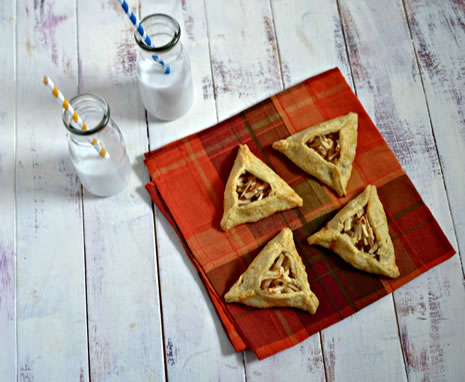
While it's fun to experiment, there's nothing like tradition. And does it get more traditional than poppy seed hamantaschen?!
Sushi Onigri Hamantaschen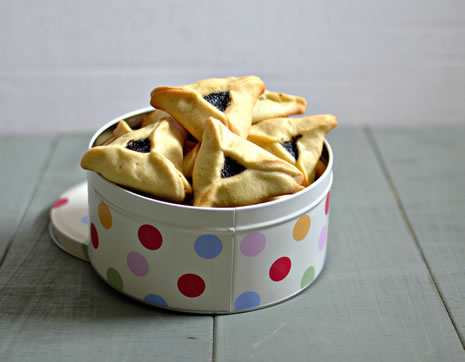
Sushi has become a staple (read: obsession) in many Jewish homes. You can find sushi bars at most kosher restaurants, groceries, and even pizza shops. So what better way to celebrate Purim and enjoy everyone’s favorite food than with these adorable sushi hamantaschen?
Pulled BBQ Brisket Hamantaschen
Would you believe that BBQ pulled brisket and mmashed potatoes make awesome savory yeast hamanstaschen (not cookie)?!
Orange Chocolate Hamantaschen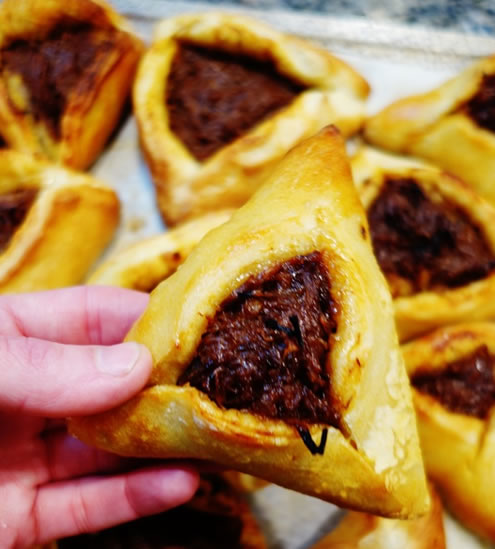
Love Sabra? Then this is the hamantasch for you. It’s also the hamantasch for you if you are a real chocolate lover.
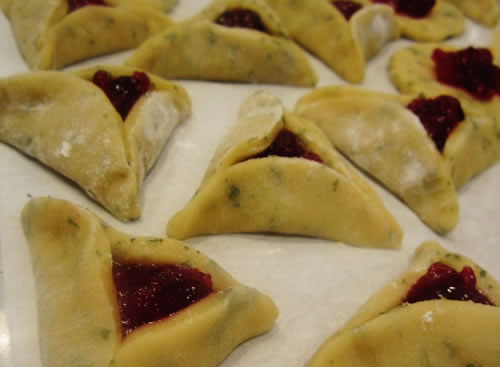
Cranberry Sage Hamantaschen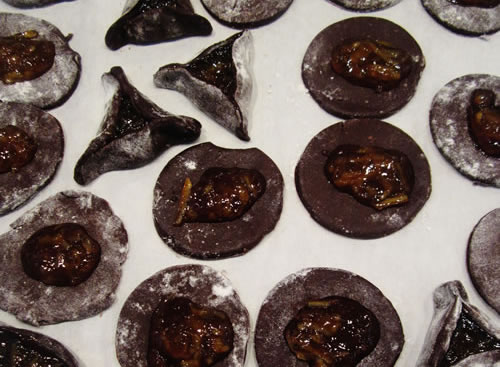
Are you an adventurous baker? This one mixes sweet and savory. Fresh sage is incorporated into the sweet cookie dough, and then filled with spiced cranberry conserve.
This one is fun for the kids or the young-at-heart adults.
Rice Crispy Treat Hamantaschen
A sweet and sticky version of the traditional cookie.
Stylish and Healthy Mishloach Manot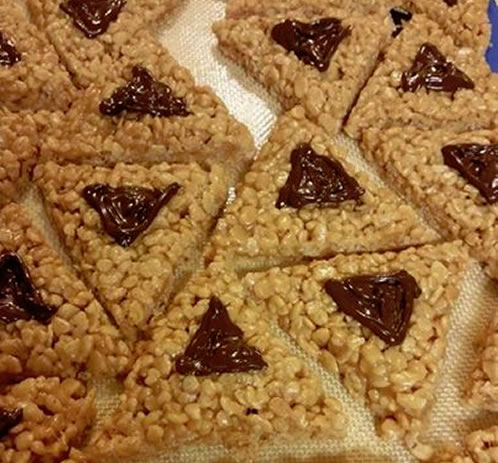
Don't forget about the mitzvah of mishloach manot - sending food gifts to others on Purim. A stylish basket arranged by hand shows you care, and everyone welcomes treats they don’t feel guilty eating!
Want to share your hamantasch recipe with us? Please do! Contact us here. Happy Purim! Miriam Szokovski is the author of historical novel Exiled Down Under, and a member of the Chabad.org editorial team. She enjoys tinkering with recipes, and teaches cooking classes to young children. Miriam shares her love of cooking, baking and food photography on Chabad.org’s food blog, Cook It Kosher and in the N'shei Chabad Newsletter. © Copyright 2015, all rights reserved. Lifestyle Craft: Purim Characters By Dena Ackerman  Color these illustrations and mount them onto felt. Bring the Purim story to life on a felt storyboard! Great prop for teachers and homeschoolers. Make Puppets Children can color each character and secure them to popsicle sticks. Your children will be so proud to share what they learned with you! Send Purim Cards Download each photo and paste into your favorite graphics program (Microsoft Word or Publisher work too). Position each picture on the right-hand side of a landscape (horizontal) page. Print your character out, leaving the left side blank to form a card. Fold your paper and cut along the outline of the character and color him/her in. Open the card and write your personal message inside. Design Mishloach Manot Tags Print your favorite character and color him/her in. Cut along the outline of the character. Punch a hole at the very top and use ribbon or string to tie the tag onto your mishloach manot packages. Don’t forget to sign your family’s name. Purim Place Cards
Color and cut out your favorite characters, leaving room at the bottom to write your guests’ names. Just be careful where you seat Haman!
Click here to print the images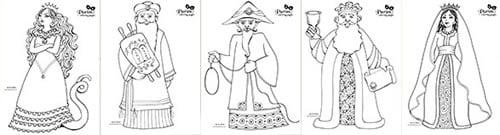 JCreate is an online Jewish crafting magazine. Dena Ackerman is a representational artist who works in watercolor, acrylic, ink, and colored pencil. She also illustrates books for children, and teaches drawing and painting to adults. © Copyright 2015, all rights reserved. Lifestyle Art: Hamantashen Star of David 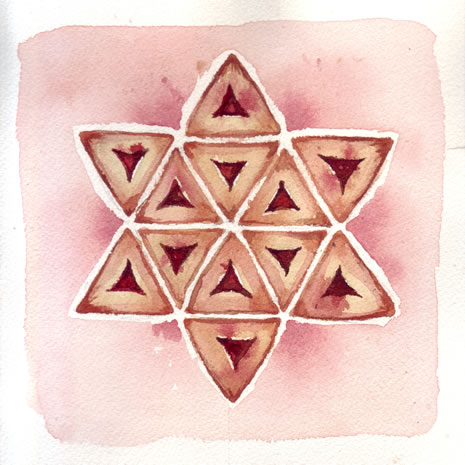 Artist’s Statement: Hamantashen. Triangles. Magen David. Purim. Hmmm. Artwork by Esther Rosen. Esther is a chief executive homemaker living in Brooklyn with her husband and young assistants. During quieter moments, Esther explores various art forms and creative processes, and welcomes opportunities to share her work with others. © Copyright 2015, all rights reserved. Purim for Kids Printable Purim Crown By Dena Siegel Dressing up like a king or queen for Purim? Want to act out the Purim story with friends or siblings?
This crown is for you!
 Decorate. You can color in the lines or turn it around and decorate freely on the blank side. You could also use glitter, sequins or feathers to make it fancier. Cut a rubber band open and loop it through the holes on either side of the crown. Add some tape around the edges of the hole so it doesn’t tear. The rubber band will make sure the crown doesn’t fall off while you are busy with your royal duties. Click here to print the crown.   © Copyright 2015, all rights reserved. Purim for Kids Chocolate-Filled Funfetti Hamantaschen By Miriam Szokovski  2 eggs ½ cup sugar ¼ cup oil 1 tsp. vanilla 2 cups flour 1½ tsp. baking powder 1/3 cup sprinkles 1 bar of chocolate (or 1 cup chocolate chips) Directions Mix the eggs, sugar, oil and vanilla. Add 1 cup of flour and the baking powder. Mix. Add the second cup of flour until the dough forms a soft, but not sticky ball. You may need 2-3 more tablespoons of flour if your dough is sticky. Gently knead in the sprinkles. Roll out the dough and cut out circles. Put a piece of chocolate, or 3-4 chocolate chips in the center of each circle. Gently fold the sides and pinch shut tightly. Bake for 10-12 minutes on 350°F. Ask an adult to help you put the pan in and out of the oven.   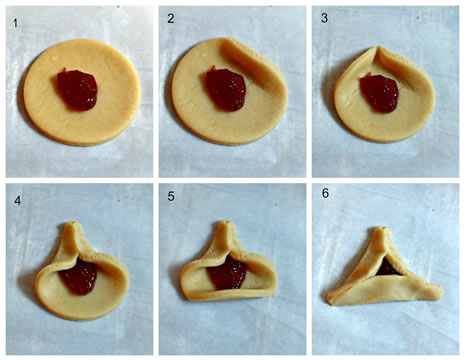 © Copyright 2015, all rights reserved. |

Sing along with Rabbi B and discover how the mitzvahs of Purim engage all our senses. by Yossi Berktin
 Watch (2:00)
<script language="javascript" type="text/javascript" src="http://embed.chabad.org/multimedia/mediaplayer/embedded/embed.js.asp?aid=2876483&width=auto&height=auto"></script><span style="clear:both;" class="lb" id="lbdiv">Visit <a href="http://www.chabad.org/multimedia/default_cdo/aid/591213/jewish/Video.htm">Jewish.TV</a> for more <a href="http://www.chabad.org/multimedia/default_cdo/aid/591213/jewish/Video.htm">Jewish videos</a>.</span>
More in Purim for Kids:
• Printable Purim Crown (By Dena Siegel)
Dressing up like a king or queen for Purim?
Want to act out the Purim story with friends or siblings?
This crown is for you!
Decorate. You can color in the lines or turn it around and decorate freely on the blank side. You could also use glitter, sequins or feathers to make it fancier.
Cut a rubber band open and loop it through the holes on either side of the crown. Add some tape around the edges of the hole so it doesn’t tear. The rubber band will make sure the crown doesn’t fall off while you are busy with your royal duties.
Click here to print the crown.

Dena Siegel is the creator of Chai & Home, a style blog for elegant and modern Jewish living. For holidays and every day, Chai & Home showcases how Jewish life can be beautifully lived.
© Copyright, all rights reserved. If you enjoyed this article, we encourage you to distribute it further, provided that you comply with Chabad.org's copyright policy.
• Chocolate-Filled Funfetti Hamantaschen (By Miriam Szokovski)
Ingredients
2 eggs
½ cup sugar
¼ cup oil
1 tsp. vanilla
2 cups flour
1½ tsp. baking powder
1/3 cup sprinkles
1 bar of chocolate (or 1 cup chocolate chips)
Directions
Mix the eggs, sugar, oil and vanilla.
Add 1 cup of flour and the baking powder. Mix.
Add the second cup of flour until the dough forms a soft, but not sticky ball. You may need 2-3 more tablespoons of flour if your dough is sticky.
Gently knead in the sprinkles.
Roll out the dough and cut out circles.
Put a piece of chocolate, or 3-4 chocolate chips in the center of each circle.
Gently fold the sides and pinch shut tightly.
Bake for 10-12 minutes on 350°F. Ask an adult to help you put the pan in and out of the oven.
How to Fold Hamantaschen
BY MIRIAM SZOKOVSKI
2 eggs
½ cup sugar
¼ cup oil
1 tsp. vanilla
2 cups flour
1½ tsp. baking powder
1/3 cup sprinkles
1 bar of chocolate (or 1 cup chocolate chips)
Directions
Mix the eggs, sugar, oil and vanilla.
Add 1 cup of flour and the baking powder. Mix.
Add the second cup of flour until the dough forms a soft, but not sticky ball. You may need 2-3 more tablespoons of flour if your dough is sticky.
Gently knead in the sprinkles.
Roll out the dough and cut out circles.
Put a piece of chocolate, or 3-4 chocolate chips in the center of each circle.
Gently fold the sides and pinch shut tightly.
Bake for 10-12 minutes on 350°F. Ask an adult to help you put the pan in and out of the oven.

Miriam Szokovski is the author of historical novel Exiled Down Under, and a member of the Chabad.org editorial team. She enjoys tinkering with recipes, and teaches cooking classes to young children. Miriam shares her love of cooking, baking and food photography on Chabad.org’s food blog, Cook It Kosher and in the N'shei Chabad Newsletter.
© Copyright, all rights reserved. If you enjoyed this article, we encourage you to distribute it further, provided that you comply with Chabad.org's copyright policy. • Play the Purim Match-It Game (By Yossi Berktin)Jewish News
Joyous Themes This Purim Holiday to Focus on Jewish Solidarity by Karen Schwartz

In many ways, the joyous result of Jewish solidarity and faith in the unseen hand of G‑d is what the Purim story is all about: Queen Esther linked her fate with the Jewish people in Shushan at a time when they needed it the most, while the Jewish people prayed, fasted and gave charity to ensure a successful outcome.
With anti-Semitism and terror on the rise around the world, Chabad centers have been developing innovate, festive themes to gather their communities together and bring new faces through the door to celebrate and complete some of the holiday’s four mitzvahs—hearing the Megillah read, sending gifts of food to others, giving charity to the needy and eating a festive meal.
Purim, which is celebrated annually on the 14th day of the Hebrew month of Adar—corresponding this year from the night of Wednesday, March 4, to Thursday, March 5—recalls the Jewish people’s salvation in ancient Persia from Haman’s plot to destroy them.
One theme this year for the holiday at a number of Chabad centers is “Purim in Paris.” Like the French-themed Shabbat meals that took place around the world in January after a week of violence there, this week’s meals and celebrations will emphasize solidarity with European Jewry.
Take, for instance, an event right outside Washington, D.C.
Rabbi Mordechai Newman, co-director of Chabad Lubavitch of Alexandria-Arlington in Virginia with his wife, Yehudis, is holding their 14th-annual event with the international theme of “Purim Around the World,” this year with a French flair.
To inspire solidarity with the Jews of Paris, French food is on the menu: chicken Provençal, beef bourguignon, and other classic sides and desserts. They’re looking forward to a big crowd.
“We felt this would serve as a way to make people feel that we’re all in it together,” he says. “We feel that the message of Purim, which is about being proud of being Jewish, is especially vital and timely this year.”
Hats Off to Royalty
Much farther north, Yocheved Boyarsky’s family is getting ready for an “Enchanted Purim” in chilly Canada. The co-director of the Rohr Chabad Student Network of Ottowa with her husband, Rabbi Chaim Boyarsky, along with their five daughters, ages 3 to 11, are preparing to get decked out in medieval garb for their Purim party. The rabbi and his wife are dressing up as a medieval king-and-queen duo; their girls are going to be princesses.
They’re expecting 150 to 170 participants from their largely student community to join them at a hall rented on campus for a Megillah reading, hypnotist and catered buffet “fit for a king (and queen).” They plan on giving out castle-themed mishloach manot for their guests to hand out the next day and are entering those who bring a friend who has never been to Chabad before in a raffle for tickets to an Ottawa Senators ice-hockey game.
The rabbi explains that “the holiday teaches us the story of Mordechai; he didn’t bow, he stood up for Jewish pride, and we try and instill that value. If you stand for nothing, you fall for anything … the goal is to instill joy and Jewish pride.”

There will be castle piñatas, table decorations and a “castle wall,” but mostly, the evening will be about the atmosphere, stresses Yocheved Boyarsky. “It’s what you do with the mood you create, the costumes you’ll be wearing and the people coming in—the whole spirit of the evening.”
For many students, it will be their first Jewish event, she says, and hopefully, they’ll be back for more. “Purim is a very exciting holiday, and they’re going to find out all kinds of other things that we do, our upcoming events. We really hope that this will be a great way to have an exciting, enjoyable Jewish experience on campus.”
Setting Up for the Holiday
Everyone’s preparing for the holiday this week, and Chabad.org’s comprehensive Purim guide links users to a directory of holiday events in more than 400 cities around the globe, a synopsis and more-lengthy retelling of the Purim story, a study section with frequently-asked-questions, and a commentary on the Scroll of Esther. The Purim audio and video section includes an hour-long excerpt of a 1973 Purim gathering with the Rebbe, Rabbi Menachem M. Schneerson, of righteous memory, Purim songs and a video on how a bakery makes the holiday’s signature hamantash pastry.
Rabbi Yanky Majesky, co-director of Chabad Lubavitch of North Orlando in Lake Mary, Fla., with his wife, Chanshy, is setting up for a Megillah reading where people dress up in the costumes resonant of the “Roaring Twenties.” The evening is going to be set in a social hall on the grounds of the Central Florida Zoo, complete with a murder-mystery show (a different one is slated for the kids). They’ll start off with the Megillah reading, then dinner and the show.
“We hope that they experience Yiddishkeit in a family fun environment, and it makes them want to incorporate more Yiddishkeit in their lives and be more involved with the community,” says the rabbi.
They’re expecting about 100 people for the 1920s-themed event and are really excited about the show, where people will have to do a little sleuthing. “Mystery is what Purim is all about,” affirms Majesky. “That’s why we have hamantashen (they’re all covered up) and costumes. And G‑d’s name is not even mentioned in the Megillah.”
As part of their broader Purim plans, volunteers are giving out 100 baskets of food and treats to the community.
Rabbi Shlame Landa of the Connecticut-based Chabad of Fairfield and his wife, Miriam, are getting ready for Thursday evening’s “Purim Under the Sea”—a popular theme at Chabad centers this year. For their community, they’re planning a kosher fish buffet and a “Bubblemania” show to give the event a symbolic feel.
Their Chabad House will resemble an aquarium, with sea-like wallpaper and sea-related costumes. “We’ve done Purim in Israel, Purim at the Circus, Purim in Africa, but this is our first time going underwater,” says the rabbi.

The festivities will begin with an interactive Megillah reading, followed by dinner and entertainment. “There will be all kinds of ocean-related crafts for children, and hopefully, everyone will learn a little something while being together with other Jews to celebrate Purim,” he explains. They’re expecting 100 people; the night before, they’re also hosting an adult social for another 40 to 50 guests.
“I hope they come away with a memorable Jewish experience and one that children will look back at fondly. It’s something we can take with us throughout the year.”
Hospitals, Nursing Homes and Prisons
Rabbi Mendel Katzman, co-director of Chabad-Lubavitch of Nebraska in Omaha with his wife, Shani, is revving up for Megillah readings around town. They’re also planning to open a new center in Lincoln; as such, they’re holding a program for University of Nebraska college students on Wednesday evening and something for the community the next day, on Thursday, for the first time.
There will be events in Omaha as well; in fact, their Purim feast, which usually draws about 75 people, is now in its 28th year. It will feature an Israeli chef who, in addition to planning and preparing the feast, will be sharing a personal miracle and “encouraging everyone to pay more attention to G‑d’s blessings,” explains Katzman.
Over the years, they’ve extended their reach during the holiday to include Megillah readings at hospitals, nursing homes and even prisons.
Meanwhile, he adds, world events have been raising people’s consciousness regarding Jewish identity.
“I think people are becoming more interested in looking back into Jewish history, into Torah, into G‑d’s miracles,” he says. “They’re really trying to connect in ways we haven’t seen before. I’m really looking forward to a very special Purim.”

© Copyright 2015, all rights reserved.
Jewish News
Jewish Teens Take Over Times Square, Soaking in Sights and Sounds
Chabad.org Staff


© Copyright 2015, all rights reserved.
Jewish News
Q&A: Paris Rabbi Calls for a New Consciousness in Wake of Terror and Anti-Semitism by Carin M. Smilk

France is still reeling from a week of violence in Paris in early January that left 17 people dead, including four Jewish men shot and killed at the Hyper Cacher kosher grocery on a Friday afternoon before Shabbat. An enormous rally that included heads of state from around the world took place the Sunday afterwards, and a show of support against terror and anti-Semitism rippled throughout the country. Chabad rabbis, students and volunteers weaved through the crowd of more than 1.5 million people at the Paris rally, wrapping tefillin and bolstering the spirits of Jews who were there.
One month later, attacks occurred in Copenhagen, with a shooting at an arts event dealing with the freedom of speech and religion, which left a civilian dead, and another shooting the next day outside the city’s Great Synagogue, where a Jewish security man was killed while guarding approximately 80 people attending a bat mitzvah celebration.
Europe is grappling with significant issues regarding the security and future of its Jewish population, but nowhere is that more telling than in France, where eyes are turned to see what its leaders are doing and how Jewry there is faring. Chabad Rabbi Chaim Shneur Nisenbaum, of the Complexe Scolaire Beth Haya Moushka School in Paris and spokesperson for Beth Loubavitch in Paris, responds to some of the most pressing concerns.
Q: Did the attack on the Hyper Cacher supermarket in Paris come as a huge surprise? Particularly after the March 2012 shootings that targeted Jewish civilians in Toulouse and a spike in attacks against Jews last summer during Israel’s war with Hamas in Gaza, how high was the level of concern regarding the safety of French Jewry?
A: After the attacks of last summer, we knew that it was only the beginning. Over the years, as we saw growing anti-Semitism from certain immigrant populations, we tried to make the authorities aware of this new danger. But unfortunately, it was to no avail. The leaders of the community, observant or not, were fully aware of it. We just hoped to be wrong. Still, a Jew was not afraid in his day-to-day life in Paris, and nobody thought it was possible [that deadly terrorist attacks on the streets of Paris] could happen.
Concerning the French community as a whole, everybody was shocked by the attack at Hyper Cacher. Yet the strong public response—the demonstrations, the signs of support, etc.—came more as a result of the attack on the Charlie Hebdo publication than the attack at Hyper Cacher because of the symbolic importance of fighting for the freedom of speech.
All this emotion, however, moved everyone to the consciousness of a growing anti-Semitism among the second and third generations of Muslim immigrants from North Africa. This public awareness is new because this group was always considered the victims of global society, and as such, weren’t expected to harm other communities. Right now, leaders of Islam in France are condemning those acts, which is really important as their voices were not so loud in the past.
It must also be said that French President François Hollande and French Prime Minister Manuel Valls took what happened much more seriously than their predecessors. Nevertheless, it is clear—and all the more so after the attacks in Denmark—that the problem is not uniquely French, but European. And maybe it can be found in all other countries in the world, even in the United States, that this new danger is here. It’s a danger that comes with every person seduced by jihadist ideas and who feels that the murderers are, in fact, heroes of their cause.

Q: How can French leadership ameliorate the situation? Is it a matter of law and order, protection and security, education and communication? Why is anti-Semitism seemingly so strong in France right now, stronger even than in many other European nations?
A: There is a strong will by the French government to fight this new anti-Semitism. They have made very clear statements and adopted strong measures besides the efforts in security matters. The action has to be in several fields at the same time. Of course, police and justice officials have to be very active, but in the long term, only education can effect change. Schools have to teach that we are all members of the same French nation and that nothing can divide us, even if we don’t think or live the same way. That’s the position of the French government.
Anti-Semitism isn’t any stronger in France than it is, for instance, in Belgium or England. There have been a number of surveys about this issue. European security agencies and departments know that the risk of an attack is very high everywhere, and that England could be next. Remember that before these recent attacks in France and Denmark, there was the case in Belgium [four people, including an Israeli couple, were killed in a May 2014 attack inside the Jewish Museum of Belgium in Brussels]. This is connected with the presence of large Islamic communities in those places as well, as in France.

Q: How do you reassure Jewish families for the long-term? What words of comfort do you offer—what prayers, what advice? And more than that, how do you keep people from leaving the country, as they have been doing for quite some time now?
A: We quote the words of the Rebbe [Rabbi Menachem M. Schneerson, of righteous memory] in similar situations—that with Torah, prayer and charity, we can overcome all of these negative events, and that we must be confident in G‑d and be proud of our Judaism.
As for Jews leaving, the aliyah from France has been growing in large measure for a few years. Last year, some 7,000 Jews emigrated from France to Israel, and after these recent events, we think about 10,000 to 15,000 more will leave. These numbers do not include Jews who are moving to countries other than Israel for the same reasons (mainly England, the United States, Canada and Australia). For all of them, we don’t know how to help [with their decision].
The point is that the Jews who are leaving for security reasons—fearing for their future and their children’s future—sometimes put themselves in material and spiritual difficulty. Materially speaking, they are moving to countries they don’t really know, the languages of which they don’t speak and without any precise idea of how to earn a living. Many of them will come back to France having lost everything, first here and then there, along with their hopes. Spiritually speaking, French Jews are used to the way they are accompanied in their lives by certain institutions, in particular, Chabad Loubavitch. Living among non-Jews, they may feel the privilege and obligation to behave as Jews (sending their children to Jewish schools, going to shul, etc.). But in Israel, things in that regard are not so simple, and I personally know several people in that situation who came back because they saw problems over time.

Q: For the Jews who remain in France, do they feel safe? Are they comfortable wearing kipahs and continuing to shop in kosher stores? Are people looking over their shoulders? Is anything changing besides a need for more security?
A: Some Jews have stopped wearing kipahs while in the streets, but it’s definitely a small minority. People still buy food in kosher stores, but we have observed fewer people going out to kosher restaurants, which is a real French habit [going out to eat].
The community leaders keep repeating, at every juncture, that we have to live freely as Jews and not change aspects of our way of life because of the current situation. People go to work, use the Métro, and walk in the streets of Paris and other cities without feeling in danger. For the moment, everything is quiet, and there are French soldiers everywhere. Nevertheless, we have to see what the reactions will be following the attacks in Denmark.
On the positive side, Jews seem to be more united and more aware of the need of G‑dly support. We saw it for the big meetings that Loubavitch recently organized. For example, in Paris, the Siyum HaRambam (the celebration of the annual completion of the study of Maimonides’ Mishneh Torah) was planned in a big hall one month after its actual conclusion, which was right after the Hyper Cacher attack. Obviously, we didn’t want to cancel it in spite of various warnings from the police and the hall owners. And, in fact, the attendance was much larger than in the previous years. The same was true for the Beis Loubavitch gala dinner in mid-February—around 2,000 people participated, and contributions were more generous than ever before.
Q: What can others, especially world Jewry, do in response to the current tense situation? How can those outside the country support French Jewry and/or help?
A: When we see the concern of other Jews around the word, this strengthens our unity, and is important in and of itself. If everybody adds in good deeds—wherever he or she is—that will be of a great general help. Let’s hope for good news.


© Copyright 2015, all rights reserved.
Jewish News
Q&A: Berlin’s Rabbi: Jews Need to Live Proudly, Show Identity and Fight Ignorance by Menachem Posner

In light of the recent attacks in Paris and Copenhagen, where Jewish people were murdered in a kosher market and outside of a synagogue, as well as a number of violent acts recently against Jews in Berlin, Germany, Chabad-Lubavitch Rabbi Yehuda Teichtal, rabbi of the Berlin’s Jewish community, responds to questions regarding Jewry in that Western European capital.
Q: What’s the feeling like in Berlin right now?
A: There is no doubt that there is the feeling that things are heating up. But then they are heating up all over the world, and things are much more serious in other parts of Europe. The Jewish community here is large, growing and very young. True, anti-Semitism is a serious issue; however it is not keenly felt on a day-to-day basis.
That said, anti-Semitic events have been on the rise in the past year, particularly since the summer, when some protests against Israel’s war with Hamas in Gaza took on distinct anti-Jewish overtones, and we cannot take matters of security too seriously.
Q: What response has there been?
A: The government here is working hard to combat this hatred and to make sure that everyone remains safe. Their efforts are commendable and send a very strong, reassuring message.
As Jews, our response must be to remain proud of who we are and continue living life as we have all along. To suggest that Jewish people hide their identity or otherwise retreat in fear is a terrible mistake, handing a victory to terrorists and thugs. We need to devote ourselves to the study of Torah and performance of mitzvahs with confidence and pride, demonstrating through love of our fellows and acts of kindness what it truly means to be a Jew. Of course, necessary precautions need to be taken, but by and large, it is imperative that Jews continue to live as Jews inwardly and outwardly, in all neighborhoods.
Q: In your opinion, what can be done about the growing anti-Jewish sentiment in Europe?
A: We need to build bridges, not escape hatches. To mitigate hatred, we must fight ignorance, and this can only be accomplished through education and open dialogue.
Sure, when I walk openly as a Jew in the street someone may say something, but the key is for me to help him understand and respect me, not for me to stop respecting myself. On the contrary, for Jews to stop living openly as Jews would be a gift to the enemies of freedom, who wish intimidate and harm people who are not like themselves.
If the Jews cave and stop allowing themselves to live outwardly and openly as Jews, there is no telling who else in civil society it will be tomorrow.
In addition, it’s time for everyone to speak out when they see someone say or act in a hateful manner. The effort must come from all directions.
Q: Do you have any closing remarks?
A: We are a strong and resilient people. We in Germany live in a free society, which recognizes the right of every individual to live a full and enriching lifestyle. In the 19 years that I have lived in Berlin, we have seen a Jewish renaissance that is still unfolding, and I have no doubt that it will continue to flourish, openly and proudly, with complete faith in G‑d.
© Copyright 2015, all rights reserved.
Chabad.org Magazine - Editor: Yanki Tauber
_____________________________
No comments:
Post a Comment