NOTE: This is a digest of news features provided by United Methodist Communications for March 9-13. It includes summaries of United Methodist News Service stories and additional briefs from around the United Methodist connection. Full versions of the stories with photographs and related features can be found at umc.org/news.
Top Stories:
United Methodists return for ‘Bloody Sunday’ 50th anniversarySELMA, Ala. (UMNS) — United Methodist leaders — two who took part in the original civil rights marches in 1965 and one who comes each year with his seminary students — joined President Barack Obama and thousands of others who marched across Selma's Edmund Pettus Bridge to remember the violent clash between police and protesters known as "Bloody Sunday." Joey Butler and Mike DuBose have the story and photos.

Photo by Mike DuBose, UMNS
United Methodist Bishop Woodie W. White (center) crosses the Edmund Pettus Bridge in Selma, Ala., during the 50th anniversary observance of the "Bloody Sunday" civil rights march. He is joined by his wife Kim (right), Ruby Shinhoster of the Southern Christian Leadership Conference’s Women’s Organizational Movement for Equality Now (left) and Candler student Beth Clark.PreviousNext


United Methodists return for “Bloody Sunday” 50th by Joey Butler
SELMA, Ala. (UMNS)
Every year, retired United Methodist Bishop Woodie White gets to see the story of the civil rights movement through fresh eyes: those of his students.
This year, White and his students, along with other United Methodists, joined an estimated crowd of 80,000 who packed Selma, Alabama, March 7-8 for a weekend of events marking the 50thanniversary of “Bloody Sunday,” including a speech by President Barack Obama and the annual march across the Edmund Pettus Bridge.
White, bishop-in-residence at Candler School of Theology at Emory University in Atlanta, takes students from his “Methodist Church and Race” class on an annual pilgrimage, with stops in Alabama cities where pivotal moments of the movement occurred.
The trip always culminates with a march over the Edmund Pettus Bridge in Selma, where a violent confrontation between police and peaceful marchers occurred March 8, 1965. The clash helped bring about passage of the 1965 Voting Rights Act.
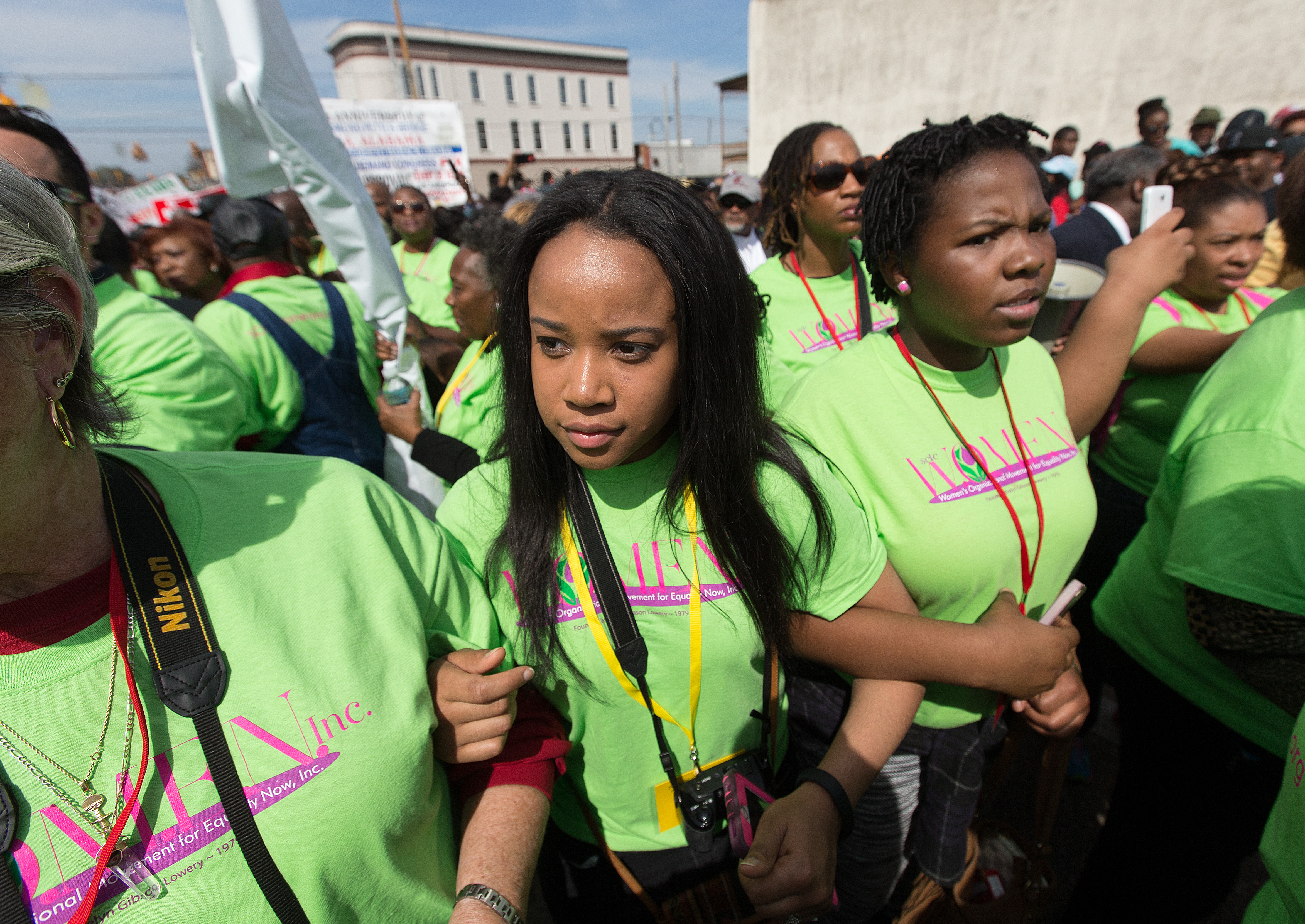
Candler School of Theology student Monique Scroggins (second from left) links arms with other marchers from the Southern Christian Leadership Conference to cross the Edmund Pettus Bridge in Selma, Ala., during the 50th anniversary observance of the "Bloody Sunday." Photo by Mike DuBose, UMNS.
White said one of the things he wants his students to gain insight on is “how much people sacrificed and gave. However imperfect we are right now, I want them to see where we were and I want them to have from this a sense of responsibility that they now have a job to do.”Amber Lea Gray, a first-year student at Candler, said it was eye-opening to get to meet and hear stories from original Freedom Riders, such as what it was like to be on a bus when it was bombed.
“I’m from Mississippi and live in the South, and there’s a whole culture that I was unaware of, being a white female – a hurt I wasn’t aware of, and a passion for justice,” Gray said.
‘The spirit of Selma went with us’
The Revs. Kent Millard and Don Messer were students at Boston University School of Theology in 1965 when the call came from the Rev. Martin Luther KingJr. for seminarians, laity and clergy to join in the march for freedom in Selma. They joined a group of 83 seminary students who traveled by bus to participate in the Selma-to-Montgomery march but it was delayed for several days. Instead, they were part of other marches throughout Selma protesting illegal arrests and demanding voting rights for all.
“We left Selma, but the spirit of Selma went with us,” Messer said. “We were challenged to commit our lives to the continuing work of securing human rights for all people.”
Millard, now retired from the Indiana Conference, showed a photograph of King speaking at Boston University, with himself in the background acting as a bodyguard.
“Dr. King asked me, when I met him at Boston University, ‘Mr. Millard, what are you going to do for civil rights in your lifetime?’ That is the question I continue asking myself.”
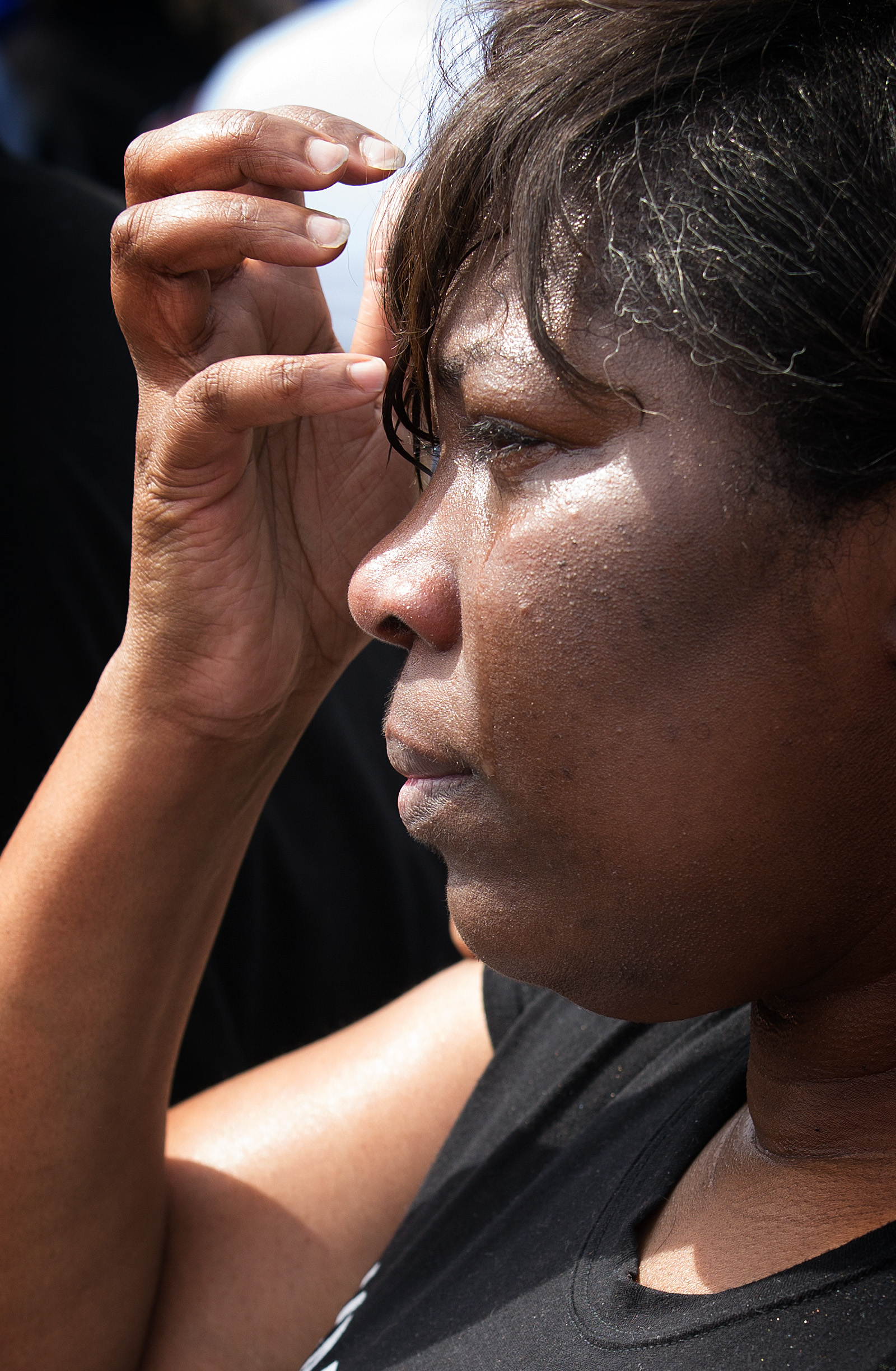
A marcher sheds tears during the 50th anniversary observance of the "Bloody Sunday." Photo by Mike DuBose, UMNS.
Messer, former president of Iliff School of Theology and current executive director of the Center for the Church and Global AIDS, was coming back to Selma for the first time since 1980. He said that while remembering the violent clashes of 1965 is somber, the atmosphere now has an air of celebration.“When you sing gospel songs and freedom songs, there is always a spirit of celebration,” he said. “We have a lot to be proud of, as President Obama said, but we do have a long way to go. We have to face up to the reality of the evil of racism in ourselves, our families, our society and our church. It’s an unending struggle and we need to be ever alert and active.”
Elizabeth Pollard, a third-year student at Candler, said it was “a powerful experience to walk across the Edmund Pettus Bridge and think of all who went before me. It’s bittersweet because I’ve been able to live to see the result. To think about how this bridge on the original day was covered in blood – I appreciate the sacrifice and I don’t take it lightly that I was able to participate 50 years later.”
While marching across the Edmund Pettus for yet another year, White was asked if the experience ever gets old.
“No. Never. It’s new every time we do it.”
*Butler is a multimedia producer/editor for United Methodist Communications. Contact him at (615) 742-5470 or newsdesk@umcom.org.UMTV:
Eyewitness to Selma: Faith Leaders’ Stand for Civil Rights
In March 1965, a nonviolent protest about voting rights for African Americans turned tragic when police attacked demonstrators on what would come to be called “Bloody Sunday.” On March 9, the Rev. Martin Luther King Jr. asked faith leaders to join him for a second march in support of equal rights for black voters. A young Methodist pastor in Boston heard his call and soon found himself in the middle of history. Like so many, the Rev. Gil Caldwell can never forget that event 50 years ago.
Script:
(Music: “We shall overcome.”)
Many of the memories Gil Caldwell has of the civil rights struggle in the U.S. are painful, but they also remind him of why he risked his life and was so committed to the cause.
The Rev. Gilbert H. Caldwell: “Having a chance to meet Martin King in 1958, I think I knew full well that even as I went into the ministry of The United Methodist Church, that I would be involved as I could be in the civil rights movement that he led.”
Caldwell was 24 and completing his studies at Boston University School of Theology when the 29-year-old Martin Luther King, Jr. came to rally support for area public schools.
Voice of the Rev. Gilbert H. Caldwell: “There I am, of course, on the right hand side of the picture looking up. Whether I was concerned about security or not, I’m not sure.”
Later, when Caldwell was a Methodist pastor in Boston and a member of the Southern ChristianLeadership Conference, he headed south to Selma to walk with King again.
The Rev. Gilbert H. Caldwell: “I was not there for Bloody Sunday but because of my involvement with SCLC in Massachusetts, was one of those who received communication from Martin King asking for religious leaders to come to Selma. I was there for that ‘Turnaround Tuesday.” That was the day we did not have permission from the officials to begin the march, so we marched across the Edmund Pettus Bridge, so that Sunday became Turnaround Tuesday.”
(Clip from movie “Selma,” Paramount Pictures) “White, black and otherwise, come to Selma. I heard about the attack of innocent people. I couldn’t just stand by.”
The Rev. Gilbert H. Caldwell: “That of course was the time when Rev. James Reeb, the white, Unitarian minister was with us and, of course, was beaten and killed. One of the things I do remember about that day, Bishop James Pike, an Episcopal bishop many, many years ago. He was, I remember standing next to him on the steps of Brown’s Chapel AME Church, and as he looked out at that gathering on that Tuesday following Bloody Sunday, he was saying, ‘This is the greatest ecumenical gathering the world has ever seen.’”
(Clip from movie “Selma,” Paramount Pictures)
The Rev. Gilbert H. Caldwell: “There are people who felt the civil rights movement was too confrontational, that it was too activistic, and that was not how some people saw justice. The black residents of Selma impressed me, as I remember I could feel their support. I had the feeling that those persons were vicariously identifying with us. In fact, that we were standing up for them in ways that they could not stand up themselves. I’ve written about Harry Belafonte being responsible for bringing in a number of Hollywood stars and picking up the tab for the plane. I remember being on the stage with those celebrities. There was that. And then of course, the triumph of getting to Montgomery, and the signing of the legislation that brought to the forefront the whole purpose of the march. There was just so much violence during those days, but there was a kind of exhilaration that there was purpose, there was meaning in what we were doing. So many people cannot understand the depth of the patriotism of Martin King and other civil rights heroes and heroines. They love the country, its possibilities and potential in ways some people have yet to comprehend.”
Tag:
Caldwell continues to advocate for equal rights for all people. He wrote a commentary after seeing the 2015 film, "Selma."
He also offered his memories of walking with King for a series about United Methodists who shared MLK's dream.
Media contact is Fran Walsh, at 615-742-5458.
This video was posted on March 6, 2015.At 75: UMCOR training extends church's reach in disastersNEW YORK (UMNS) — Call it the "Katrina effect." As the United Methodist Committee on Relief celebrates its 75th anniversary this year, the focus on formal training for church members responding to disasters has increased, most notably over the past decade. Linda Bloom has the story.

Photo courtesy of Greg Forrester
Greg Forrester, United Methodist Committee on Relief, speaks during a training session. The denomination’s relief agency has expanded its disaster response training over the past decade.PreviousNext


At 75: UMCOR training extends church’s reach in disasters by Linda Bloom
NEW YORK (UMNS)
When 62 deadly tornadoes spanned Alabama in 2011, United Methodists there were unprepared to deal with a disaster of that magnitude.
Three years later, when another round of tornadoes struck the state, church members were so well organized that a trained “chainsaw” cleanup crew was dispatched to the Birmingham area to pick up debris.
Among the lessons learned is that regular training is important, “not only to know what to do but also to know what not to do,” said the Rev. Randy Burbank, disaster response coordinator for the church’s North Alabama Conference.
As the United Methodist Committee on Relief celebrates its 75th anniversary this year, the focus onformal training for church members responding to disasters has increased, most notably over the past decade, including occasional training sessions outside the U.S.
Greg Forrester, who oversees U.S. disaster response for UMCOR, calls it “the Katrina effect.”
UMCOR'S 75TH ANNIVERSARY
The Methodist Committee for Overseas Relief was founded in 1940 during World War II as the forerunner of the present-day United Methodist Committee on Relief. Bishop Herbert Welch, who is credited with its founding, made the public case for faith-based relief agencies.
Find resources to celebrate UMCOR’s 75th anniversary and learn more about the relief agency’s history.
Donate on Sunday, March 15, to One Great Hour of Sharing, which supports UMCOR’s administrative costs.
The impact of Katrina — the most destructive of the five storms reaching Category 4 or 5 strength during the 2005 Atlantic hurricane season — “was the largest volunteer response, domestically, that I think any organization has had,” Forrester said.
What quickly became obvious, he added, was the need to control the flow of volunteers into the disaster area. UMCOR developed early response training for volunteers for all five U.S. jurisdictions of the denomination.
Another part of the Katrina effect, said the Rev. Tom Hazelwood, who led UMCOR’s U.S. disaster response from 1998 to 2013, is the expectation by government entities “that United Methodists or faith communities will respond.” The recognition of faith-based volunteers as legitimate responders, he added, “demands that our volunteers have better training and be better prepared.”
Katrina Aid Today, a consortium of nine faith-based and voluntary organizations led by UMCOR, was the result. “That was, and still remains today, the largest single government-managed grant to the private sector for response,” Hazelwood said.
It’s all about being prepared
To provide a continuity of leadership, each of the church’s 56 U.S. conferences have both a disaster response coordinator and a Volunteers in Mission coordinator who are cross-trained in their responsibilities, Forrester said.
This emphasis is what allows UMCOR to be more than just a funding mechanism. By equipping conferences and working on training, “we’re then able to put together a comprehensive response,” he added. “Without it, the response would be minimal.”
In Alabama, hard lessons learned in 2011 about the management of volunteers and material donations paid off during the 2014 tornado outbreak, Burbank said. Untrained or unaffiliated volunteers may “show up with the best intentions… but they don’t understand the protocols, the procedures we have to follow.”
Churches have learned to pool resources and connect with Voluntary Organizations Active in Disasters and community groups spearheading relief efforts. But challenges remain as local congregations are encouraged to create their own disaster plans.
“When the disaster happens in your town, you own the disaster,” stressed Burbank, who also serves as pastor of First United Methodist Church in Sheffield.
North Alabama received $2.15 million from UMCOR for the 2011 tornado response, which wrapped up in July 2014. The 2014 response is ongoing as the conference looks at lower-income areas affected by the tornadoes. An additional UMCOR grant allowed North Alabama to be more proactiveby installing above-ground storm shelters for some tornado survivors. United Methodists also are working collaboratively to erect a 475-person community storm shelter in Harvest.
‘Always ways to be the church’
Local congregations should not be reluctant to respond to a disaster, Forrester said, even if they haven’t had training. “There are always ways to be the church,” he pointed out.
Members of First United Methodist Church in Louisville, Mississippi, found that out on April 28, 2014, after a tornado ripped through the town and Winston County, destroying hundreds of homes and the local hospital.
TRAINING OPPORTUNITIES
During the first few weeks or months after a disaster, only specially trained Early Response Teams can enter the area, due to health concerns and infrastructure limitations. Learn more about training programs.
When the area is ready for teams of volunteers, the schedules are coordinated through United Methodist Volunteers in Mission.
The Connecting Neighbors Leadership Training Program, developed by UMCOR, is a two-day, local church-readiness, train-the-trainer program designed to give volunteer trainers the tools and information they need to guide the development of local church disaster-response ministries.
Almost immediately, the church building “became a hub” for the community’s response, said Mellie Jordan, who eventually became a case manager for the tornado response. Her father, the Rev. Mike Childs, is the church’s pastor.
Church members helped bring in residents evacuating from a nursing home damaged by the tornado and received others, bused in by the Red Cross, who were soaking wet or even injured. Soup and frozen pizza, collected for a food outreach program, were heated up for those taking shelter.
Later, meals were delivered from the church kitchen to volunteers on cleanup duty. Older women washed and folded the dirty clothes of tornado survivors. “Everybody had something they could do and everybody was willing to do it,” Jordan said. “I was really, really proud of our church.”
Kathy Earl, an executive for UMCOR disaster response, came in and trained Jordan and four others, who started case management in late May for those impacted by the tornado. An organized community response became known as Winston Strong. And after a tornado hit Columbia, Mississippi, on Dec. 23, Jordan and several others from Winston County became advisors about the steps needed to develop a long-term recovery committee.
“Their recovery is going to be a lot easier because we did go down and share and kind of pay that forward,” Jordan said.
Building from the ground up
In the Alabama-West Florida Conference, “our model has always been local, trained volunteers first,” says Amelia Fletcher, the conference’s disaster coordinator for the past 10 years.
But when the Pensacola, Florida, area received 24 inches of rain in 24 hours April 29-30, 2014, overwhelming the drainage system, there was no core emergency response leadership in place to deal with the flooding.
“I was kind of building from the ground up, but had two key churches in Pensacola and Gulf Breeze who opened up and became functional,” she explained. “A lot of what I did at that time was kind of coaching and helping them understand the organization that needed to be in place.”
Her advice for disaster response:
Educate and train at all levels, then establish a pyramid of contact people to provide answers and directions when disaster strikes.
Be a community partner, networking with other faith groups, nonprofits and government groups.
Establish disaster response plans and review them on a regular basis.
Empower the local church, using effective tools like “Connecting Neighbors.”
And, Fletcher noted, don’t count anyone out. “Everybody has a way to serve,” she pointed out. “We sometimes have to help them think outside their box.”
During the flood situation, one of the smallest churches in the district became the intake center for volunteers. An 80-year-old retired administrative secretary gave Fletcher daily reports of the activity. “She was so excited to be part of that,” she recalled. “She sat in that church and counted every volunteer, every meal and who served them. It was such a gift.”Bloom is a United Methodist News Service multimedia reporter based in New York. Follow her athttps://twitter.com/umcscribe or contact her at (646) 369-3759 or newsdesk@umcom.org
NEW YORK (UMNS)
When 62 deadly tornadoes spanned Alabama in 2011, United Methodists there were unprepared to deal with a disaster of that magnitude.
Three years later, when another round of tornadoes struck the state, church members were so well organized that a trained “chainsaw” cleanup crew was dispatched to the Birmingham area to pick up debris.
Among the lessons learned is that regular training is important, “not only to know what to do but also to know what not to do,” said the Rev. Randy Burbank, disaster response coordinator for the church’s North Alabama Conference.
As the United Methodist Committee on Relief celebrates its 75th anniversary this year, the focus onformal training for church members responding to disasters has increased, most notably over the past decade, including occasional training sessions outside the U.S.
Greg Forrester, who oversees U.S. disaster response for UMCOR, calls it “the Katrina effect.”
UMCOR'S 75TH ANNIVERSARY
The Methodist Committee for Overseas Relief was founded in 1940 during World War II as the forerunner of the present-day United Methodist Committee on Relief. Bishop Herbert Welch, who is credited with its founding, made the public case for faith-based relief agencies.
Find resources to celebrate UMCOR’s 75th anniversary and learn more about the relief agency’s history.
Donate on Sunday, March 15, to One Great Hour of Sharing, which supports UMCOR’s administrative costs.
The impact of Katrina — the most destructive of the five storms reaching Category 4 or 5 strength during the 2005 Atlantic hurricane season — “was the largest volunteer response, domestically, that I think any organization has had,” Forrester said.
What quickly became obvious, he added, was the need to control the flow of volunteers into the disaster area. UMCOR developed early response training for volunteers for all five U.S. jurisdictions of the denomination.
Another part of the Katrina effect, said the Rev. Tom Hazelwood, who led UMCOR’s U.S. disaster response from 1998 to 2013, is the expectation by government entities “that United Methodists or faith communities will respond.” The recognition of faith-based volunteers as legitimate responders, he added, “demands that our volunteers have better training and be better prepared.”
Katrina Aid Today, a consortium of nine faith-based and voluntary organizations led by UMCOR, was the result. “That was, and still remains today, the largest single government-managed grant to the private sector for response,” Hazelwood said.
It’s all about being prepared
To provide a continuity of leadership, each of the church’s 56 U.S. conferences have both a disaster response coordinator and a Volunteers in Mission coordinator who are cross-trained in their responsibilities, Forrester said.
This emphasis is what allows UMCOR to be more than just a funding mechanism. By equipping conferences and working on training, “we’re then able to put together a comprehensive response,” he added. “Without it, the response would be minimal.”
In Alabama, hard lessons learned in 2011 about the management of volunteers and material donations paid off during the 2014 tornado outbreak, Burbank said. Untrained or unaffiliated volunteers may “show up with the best intentions… but they don’t understand the protocols, the procedures we have to follow.”
Churches have learned to pool resources and connect with Voluntary Organizations Active in Disasters and community groups spearheading relief efforts. But challenges remain as local congregations are encouraged to create their own disaster plans.
“When the disaster happens in your town, you own the disaster,” stressed Burbank, who also serves as pastor of First United Methodist Church in Sheffield.
North Alabama received $2.15 million from UMCOR for the 2011 tornado response, which wrapped up in July 2014. The 2014 response is ongoing as the conference looks at lower-income areas affected by the tornadoes. An additional UMCOR grant allowed North Alabama to be more proactiveby installing above-ground storm shelters for some tornado survivors. United Methodists also are working collaboratively to erect a 475-person community storm shelter in Harvest.
‘Always ways to be the church’
Local congregations should not be reluctant to respond to a disaster, Forrester said, even if they haven’t had training. “There are always ways to be the church,” he pointed out.
Members of First United Methodist Church in Louisville, Mississippi, found that out on April 28, 2014, after a tornado ripped through the town and Winston County, destroying hundreds of homes and the local hospital.
TRAINING OPPORTUNITIES
During the first few weeks or months after a disaster, only specially trained Early Response Teams can enter the area, due to health concerns and infrastructure limitations. Learn more about training programs.
When the area is ready for teams of volunteers, the schedules are coordinated through United Methodist Volunteers in Mission.
The Connecting Neighbors Leadership Training Program, developed by UMCOR, is a two-day, local church-readiness, train-the-trainer program designed to give volunteer trainers the tools and information they need to guide the development of local church disaster-response ministries.
Almost immediately, the church building “became a hub” for the community’s response, said Mellie Jordan, who eventually became a case manager for the tornado response. Her father, the Rev. Mike Childs, is the church’s pastor.
Church members helped bring in residents evacuating from a nursing home damaged by the tornado and received others, bused in by the Red Cross, who were soaking wet or even injured. Soup and frozen pizza, collected for a food outreach program, were heated up for those taking shelter.
Later, meals were delivered from the church kitchen to volunteers on cleanup duty. Older women washed and folded the dirty clothes of tornado survivors. “Everybody had something they could do and everybody was willing to do it,” Jordan said. “I was really, really proud of our church.”
Kathy Earl, an executive for UMCOR disaster response, came in and trained Jordan and four others, who started case management in late May for those impacted by the tornado. An organized community response became known as Winston Strong. And after a tornado hit Columbia, Mississippi, on Dec. 23, Jordan and several others from Winston County became advisors about the steps needed to develop a long-term recovery committee.
“Their recovery is going to be a lot easier because we did go down and share and kind of pay that forward,” Jordan said.
Building from the ground up
In the Alabama-West Florida Conference, “our model has always been local, trained volunteers first,” says Amelia Fletcher, the conference’s disaster coordinator for the past 10 years.
But when the Pensacola, Florida, area received 24 inches of rain in 24 hours April 29-30, 2014, overwhelming the drainage system, there was no core emergency response leadership in place to deal with the flooding.
“I was kind of building from the ground up, but had two key churches in Pensacola and Gulf Breeze who opened up and became functional,” she explained. “A lot of what I did at that time was kind of coaching and helping them understand the organization that needed to be in place.”
Her advice for disaster response:
Educate and train at all levels, then establish a pyramid of contact people to provide answers and directions when disaster strikes.
Be a community partner, networking with other faith groups, nonprofits and government groups.
Establish disaster response plans and review them on a regular basis.
Empower the local church, using effective tools like “Connecting Neighbors.”
And, Fletcher noted, don’t count anyone out. “Everybody has a way to serve,” she pointed out. “We sometimes have to help them think outside their box.”
During the flood situation, one of the smallest churches in the district became the intake center for volunteers. An 80-year-old retired administrative secretary gave Fletcher daily reports of the activity. “She was so excited to be part of that,” she recalled. “She sat in that church and counted every volunteer, every meal and who served them. It was such a gift.”Bloom is a United Methodist News Service multimedia reporter based in New York. Follow her athttps://twitter.com/umcscribe or contact her at (646) 369-3759 or newsdesk@umcom.org
Faith helps power Côte d'Ivoire radio station
ABIDJAN Côte d'Ivoire (UMNS) — Daily devotionals fuel the United Methodist radio ministry, Voice of Hope. More than 1 million people tune in to hear topics ranging from religion to finance, offered in 18 languages. Kathy L. Gilbert and Mike DuBose report.


Faith helps power Côte d’Ivoire radio station by Kathy L. Gilbert
ABIDJAN, Côte d’Ivoire (UMNS)
More than 20 people walked down a soundproof hallway, pushed open a heavy door and stepped into a soft pink room with half-concrete, half-sand floors to start their workday with prayer.
They will end the day the same way.
That daily ritual illustrates what powers the Voice of Hope, a radio ministry of The United Methodist Church that transmits to more than 1 million people in 18 languages daily. The station, central to the denomination’s efforts to inform the public about the deadly Ebola virus, celebrated its five-year anniversary during the crisis.
Housed in a green-and-white structure on the grounds of the United Methodist Côte d’Ivoire Conference offices, this radio station is in the heart of the community.
“We are not exclusively United Methodist, we fulfill our social mission in the audio/visual environment in Côte d’Ivoire,” said Lydie Acquah, director.
When the staff of young journalists gathers for each day for morning and evening devotionals, they form a circle and hold hands. Each prays aloud in their own faith and language. The room hums as each person pours out his or her hearts.
“Thank God for what He has done and commit yourselves for this week’s work,” Acquah said before the prayers began.
The motto of the radio is to promote hope and proclaim hope in Jesus Christ, she said. However, the staff, like their listening audience, includes Christians and Muslims.
“The Voice of Hope proclaims hope. We pray to understand the meaning of our ministry,” Acquah said. She is leading the devotional this morning, but the staff members all take turns leading.
A large pool of volunteers, many of them pastors and faith leaders, supplements the professional staff.
Volunteers fall into two categories — young people eager for their first experience working at a radio station, and seasoned faith leaders who share spiritual programs.
Addressing Ebola
When Ebola first surfaced in West Africa, the Voice of Hope didn’t wait for the government to come to them. “We felt as media we should position ourselves to possess that information,” Acquah said.
The health board of the Côte d’Ivoire Conference invested in a three-month campaign to inform the public about Ebola.
The chief editor of the radio station was designated the focal person to participate in “everything Ebola” she said.
“From the very beginning of the Ebola crisis we have invested in equipment, in sanitizers, because we receive many people at the radio station and want to be sure we put into practice the health recommendations.”
Growing a radio station
The Voice of Hope is celebrating its five-year anniversary. Acquah is proud that in the past five years the station has never been sanctioned or suspended despite the tight control of the government over all forms of media.
“We are free to give out information on all subjects; we are not censored,” she said.
Voice of Hope is “confessional” radio, which means it evangelizes. But the station also has programming on legal problems, issues important to women, the environment, human rights and education and development. It also has programming for young people.
Beugre Franck Elisee produces a program on the importance of education for young girls.
“We bring hope to people and allow people to think about their future,” he said. “It is very wonderful to work for this radio, to bring life through Jesus Christ and talk about the wonderful things our God lets us have.”
The station began with five people, including Acquah, who had no experience with radio.
“Today we can say we are the victims of the radio success,” she said laughing. Many come to the radio station asking for advice and requesting staff to address their organizations, she said.
“Each time I am in church services, people tell me, ‘I have a radio in my bedroom, one in living room, one in the kitchen and one in the bathroom — I listen to all the shows.’”
Acquah said the radio has also been the catalyst for conversions to Christ.
“Listeners come and see us and say, ‘I am Muslim, but I listen to your radio and I want to know about Jesus.’”
Acquah said those people are directed to pastors.
“In five years, we have had three cases of Muslim families who have joined The United Methodist Church.”
Beautiful adventure
Acquah produces a spiritual program based on her experiences.
“Life at my age has carried me in all directions and I want to share that experience. The program is inspired from my daily activities, my daily challenges.”
The Voice of Hope came at a point in Acquah’s life when she thought she was ready to retire.
“It has been a beautiful adventure. It was a turning point for my spiritual life … it is extraordinary.”
Gilbert is a multimedia news reporter for United Methodist News Service. Contact her at (615) 742-5470 or newsdesk@umcom.org.
Photo by Mike DuBose, UMNS
Lydie Acquah, director of The United Methodist Church's Voice of Hope radio station in Abidjan, Côte d'Ivoire, leads a devotional service for station staff.PreviousNextFaith helps power Côte d’Ivoire radio station by Kathy L. Gilbert
ABIDJAN, Côte d’Ivoire (UMNS)
More than 20 people walked down a soundproof hallway, pushed open a heavy door and stepped into a soft pink room with half-concrete, half-sand floors to start their workday with prayer.
They will end the day the same way.
That daily ritual illustrates what powers the Voice of Hope, a radio ministry of The United Methodist Church that transmits to more than 1 million people in 18 languages daily. The station, central to the denomination’s efforts to inform the public about the deadly Ebola virus, celebrated its five-year anniversary during the crisis.
Housed in a green-and-white structure on the grounds of the United Methodist Côte d’Ivoire Conference offices, this radio station is in the heart of the community.
“We are not exclusively United Methodist, we fulfill our social mission in the audio/visual environment in Côte d’Ivoire,” said Lydie Acquah, director.
When the staff of young journalists gathers for each day for morning and evening devotionals, they form a circle and hold hands. Each prays aloud in their own faith and language. The room hums as each person pours out his or her hearts.
“Thank God for what He has done and commit yourselves for this week’s work,” Acquah said before the prayers began.
The motto of the radio is to promote hope and proclaim hope in Jesus Christ, she said. However, the staff, like their listening audience, includes Christians and Muslims.
“The Voice of Hope proclaims hope. We pray to understand the meaning of our ministry,” Acquah said. She is leading the devotional this morning, but the staff members all take turns leading.
A large pool of volunteers, many of them pastors and faith leaders, supplements the professional staff.
Volunteers fall into two categories — young people eager for their first experience working at a radio station, and seasoned faith leaders who share spiritual programs.
Addressing Ebola
When Ebola first surfaced in West Africa, the Voice of Hope didn’t wait for the government to come to them. “We felt as media we should position ourselves to possess that information,” Acquah said.
The health board of the Côte d’Ivoire Conference invested in a three-month campaign to inform the public about Ebola.
The chief editor of the radio station was designated the focal person to participate in “everything Ebola” she said.
“From the very beginning of the Ebola crisis we have invested in equipment, in sanitizers, because we receive many people at the radio station and want to be sure we put into practice the health recommendations.”
Growing a radio station
The Voice of Hope is celebrating its five-year anniversary. Acquah is proud that in the past five years the station has never been sanctioned or suspended despite the tight control of the government over all forms of media.
“We are free to give out information on all subjects; we are not censored,” she said.
Voice of Hope is “confessional” radio, which means it evangelizes. But the station also has programming on legal problems, issues important to women, the environment, human rights and education and development. It also has programming for young people.
Beugre Franck Elisee produces a program on the importance of education for young girls.
“We bring hope to people and allow people to think about their future,” he said. “It is very wonderful to work for this radio, to bring life through Jesus Christ and talk about the wonderful things our God lets us have.”
The station began with five people, including Acquah, who had no experience with radio.
“Today we can say we are the victims of the radio success,” she said laughing. Many come to the radio station asking for advice and requesting staff to address their organizations, she said.
“Each time I am in church services, people tell me, ‘I have a radio in my bedroom, one in living room, one in the kitchen and one in the bathroom — I listen to all the shows.’”
Acquah said the radio has also been the catalyst for conversions to Christ.
“Listeners come and see us and say, ‘I am Muslim, but I listen to your radio and I want to know about Jesus.’”
Acquah said those people are directed to pastors.
“In five years, we have had three cases of Muslim families who have joined The United Methodist Church.”
Beautiful adventure
Acquah produces a spiritual program based on her experiences.
“Life at my age has carried me in all directions and I want to share that experience. The program is inspired from my daily activities, my daily challenges.”
The Voice of Hope came at a point in Acquah’s life when she thought she was ready to retire.
“It has been a beautiful adventure. It was a turning point for my spiritual life … it is extraordinary.”
Gilbert is a multimedia news reporter for United Methodist News Service. Contact her at (615) 742-5470 or newsdesk@umcom.org.
Does U.S. theological education have a future?
NASHVILLE, Tenn. (UMNS) — A longtime scholar says if trends persist, the modern way of training United Methodists pastors could disappear. The Rev. M. Douglas Meeks and nearly 40 other scholars recently met to discuss the denomination's theological education crisis and what to do about it. Heather Hahn has the story.


Does U.S. theological education have a future? by Heather Hahn
NASHVILLE, Tenn. (UMNS)
United Methodist theological education in the United States is in crisis, and a longtime scholar says if trends persist the modern way of training pastors could disappear altogether.
The Rev. M. Douglas Meeks sounded that alarm at a meeting of nearly 40 theology professors and United Methodist scholars to discuss the future of theological education Feb. 26-28 at the Scarritt Bennett Center in Nashville.
“There is a great shortage of people who will be the teacher of the teachers,” said Meeks, Cal Turner Chancellor Professor of Theology and Wesleyan Studies at Vanderbilt University Divinity School. He was one of the organizers of the conference.
“Whenever we have a search for a president, a dean or a faculty member in our theological schools, the lists are miserably short,” he told the gathering.
The event brought together representatives from most of the denomination’s 13 U.S. seminaries as well as Vanderbilt, Asbury Theological Seminary and Hood Theological Seminary, an African Methodist Episcopal Zion school in Salisbury, North Carolina. Also on hand were staff members from the United Methodist Publishing House and the denomination’s Board of Higher Education and Ministry.
Meeks said he fears U.S. United Methodists could end up like the Methodist Church in Britain, which no longer has any theological schools to call its own and must depend largely on ecumenical relationships for clergy training.
“I think the situation is so severe that we are going to have to do some imaginative thinking about what the future can be for theological education,” Meeks said.
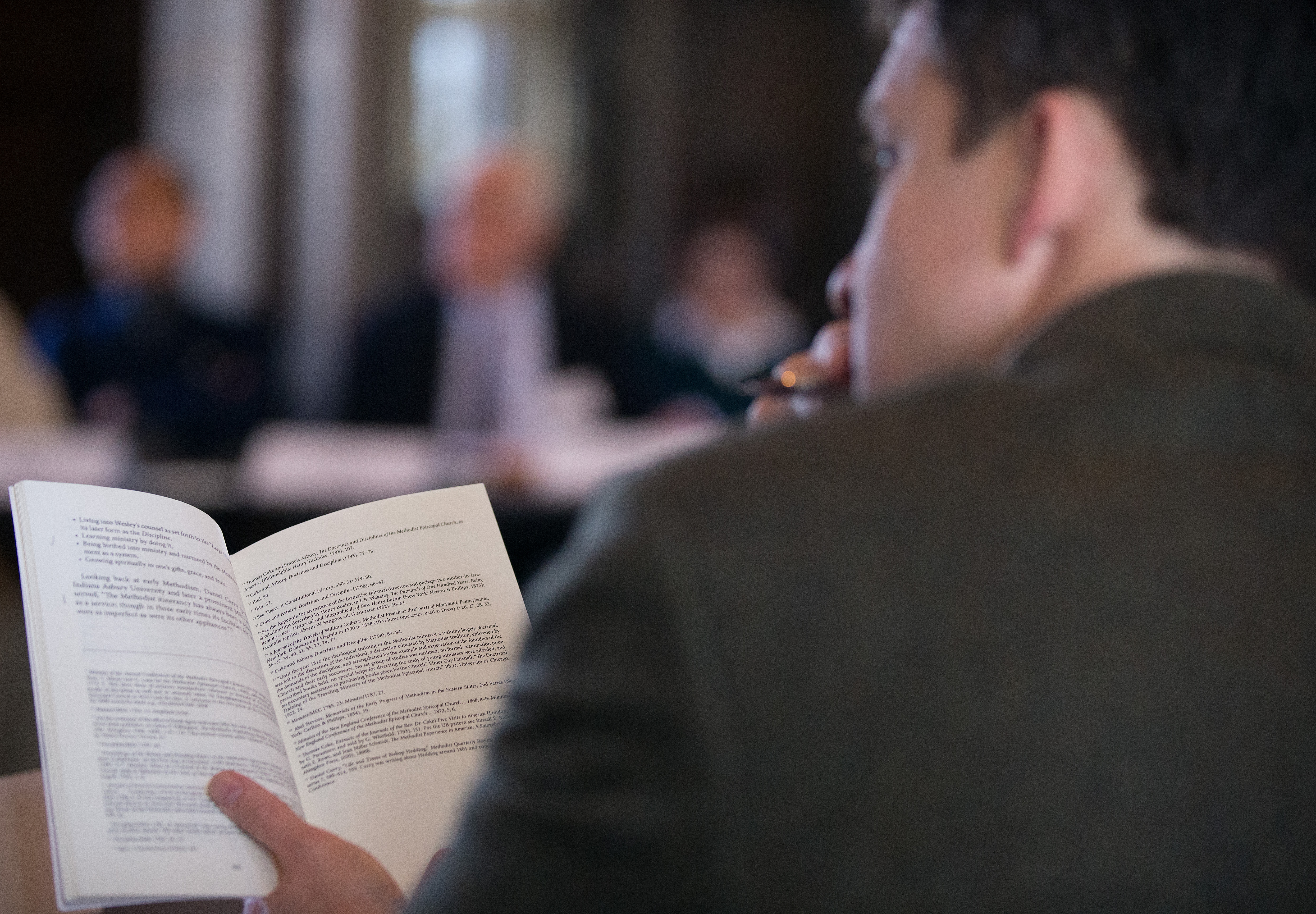 Attendees read from the book "Formation for Ministry in American Methodism," by the Rev. Russell Richey during a panel discussion on theological education at the Scarritt Bennett Center in Nashville, Tenn. Photo by Mike DuBose, UMNS
Too many adjuncts, too few openings
Meeks spoke to an intergenerational group that included long-tenured professors and recent Ph.D. recipients struggling to make a living as theological instructors.
Their experiences show that the pipeline for United Methodist professors has some serious clogs.
Some of the younger scholars juggle multiple courses as adjunct instructors at universities while also teaching courses of study for licensed local pastors. Others serve in a local church and take whatever additional teaching posts they can find.
Almost all labor with massive student-loan debtaccumulated after years of required postgraduate study.
One conference participant, the Rev. Sean Hayden, also does carpentry to make ends meet.
“I’ve worn about a thousand hats in the last five years in the struggle to find — we won’t use the word gainful, we’ll just say stable — employment in the profession for which I’ve been trained,” said Hayden, the father of three.
A big part of the problem, Meeks and other conference speakers said, is that over the years, universities have responded to financial downturns by reducing the number of full-timefaculty positions.
Universities increasingly rely on far less expensive adjuncts — who work on contract with no health orretirement benefits — to fill the breach.
More than half of all U.S. faculty members now hold part-time, contingent appointments, reports the Chronicle of Higher Education.
An adjunct’s heavy course load — sometimes at multiple institutions — leaves little time to completethe sort of original, unremunerated research that could open doors to a tenure-track, financially stable position.
Also there is often a mismatch between scholars’ theological specialties and the kind of professor a seminary is seeking, the Rev. Russell E. Richey told United Methodist News Service. Doctoral students, for instance, may be encouraged to focus on the Old Testament. But by the time they graduate, the only openings are for specialists in the New Testament.
UNITED METHODIST THEOLOGICAL EDUCATION
To learn more about United Methodist theological education, visit the United Methodist Board of Higher Education and Ministry’s website.
Richey is a visiting professor at Duke Divinity School and former dean of Emory University’s Candler School of Theology.
“If you go several years without landing something, you sort of get blemished,” he said. “It’s just hard to coordinate the entry of graduate students and their maturation five years later with openings.”
Impact on young scholars
“What does United Methodist theological education look like for those who are beginning as scholars? Disorienting and exhausting,” said the Rev. Tim Eberhart, now an assistant professor of theology and ecology at Garrett-Evangelical Theological Seminary and Methodist Theological School in Ohio.
He said younger scholars need to be “adaptive, entrepreneurial and innovative” in where and how they teach. For example, he found success with a course that combined both face-to-face and online interactions and was both for clergy candidates and community lay members.
Aspiring scholars also face challenges distinctive to the United Methodist system. Presian Burroughs, an assistant professor at United Theological Seminary, noted that some conference boards of ordained ministry don’t know what to do with elder candidates who feel called to the academy rather than local church ministry and so put up roadblocks.
The Rev. Carolyn Davis serves as a full-time policy analyst for the progressive think tank Center for American Progress and as an adjunct faculty member at Wesley Theological Seminary. She told UMNS the statistics show most scholars her age and younger will not go on to full-time, tenured academic careers.
However, she suggested, theologians can find different ways to follow God’s call. She pointed out that aspects of the work — research, teaching, writing and service — also exist outside the academy in ways that still allow for service to the next generation of church leaders.
She has found her current position lets her use her research expertise and work toward equipping religious communities for social justice. It also supports her continued contributions to United Methodist theological education such as her visit to the conference, she said.
“Sometimes you have to give up the dream to find the vocation,” she said.
Next steps
Meeks and other conference participants aren’t ready to give up on the basic framework of United Methodist seminary education just yet. But they said it may be time to rethink some aspects of the system.
The scholars are working on a paper about their discussions to be presented to United Methodist bishops and agency executives. They also are working with the United Methodist Board of Higher Education and Ministry to form an association of U.S. United Methodist scholars that can collaborate and exchange ideas. The denomination already has similar associations in Africa and Asia, Meeks noted.
Other ideas for theological education could come from United Methodists in Africa and the Philippines, who face their own challenges, or from Methodism’s past.
Richey pointed out that clergy training has evolved multiple times since Methodism's arrival on American shores more than 200 years ago.
He gave an overview of his new book “Formation for Ministry in American Methodism: Twenty-first Century Challenges and Two Centuries of Problem-Solving.” Methodist clergy, he said, were at first largely self-taught in the works of John Wesley, and then they underwent apprenticeships under a more senior pastor. But as time went on, the Methodist movement required more formal education, eventually developing the seminary program expected of elders today.
Each change came after what Richey called “negative pressures.”
“It seems that at almost every stage, there was some really pressing problem the church sensed it needed to solve,” Richey said. “But at each stage, the church also saw fresh opportunities.”
Hahn is a multimedia news reporter for United Methodist News Service. Contact her at (615) 742-5470 or newsdesk@umcom.org.
Correction: The story now correctly spells the name of the Rev. Tim Eberhart, an assistant professor at Garrett-Evangelical Theological Seminary and Methodist Theological School in Ohio.
Photo by Mike DuBose, UMNS
The Rev. M. Douglas Meeks speaks during a panel discussion on theological education at the Scarritt Bennett Center in Nashville, Tenn.PreviousNextDoes U.S. theological education have a future? by Heather Hahn
NASHVILLE, Tenn. (UMNS)
United Methodist theological education in the United States is in crisis, and a longtime scholar says if trends persist the modern way of training pastors could disappear altogether.
The Rev. M. Douglas Meeks sounded that alarm at a meeting of nearly 40 theology professors and United Methodist scholars to discuss the future of theological education Feb. 26-28 at the Scarritt Bennett Center in Nashville.
“There is a great shortage of people who will be the teacher of the teachers,” said Meeks, Cal Turner Chancellor Professor of Theology and Wesleyan Studies at Vanderbilt University Divinity School. He was one of the organizers of the conference.
“Whenever we have a search for a president, a dean or a faculty member in our theological schools, the lists are miserably short,” he told the gathering.
The event brought together representatives from most of the denomination’s 13 U.S. seminaries as well as Vanderbilt, Asbury Theological Seminary and Hood Theological Seminary, an African Methodist Episcopal Zion school in Salisbury, North Carolina. Also on hand were staff members from the United Methodist Publishing House and the denomination’s Board of Higher Education and Ministry.
Meeks said he fears U.S. United Methodists could end up like the Methodist Church in Britain, which no longer has any theological schools to call its own and must depend largely on ecumenical relationships for clergy training.
“I think the situation is so severe that we are going to have to do some imaginative thinking about what the future can be for theological education,” Meeks said.
Too many adjuncts, too few openings
Meeks spoke to an intergenerational group that included long-tenured professors and recent Ph.D. recipients struggling to make a living as theological instructors.
Their experiences show that the pipeline for United Methodist professors has some serious clogs.
Some of the younger scholars juggle multiple courses as adjunct instructors at universities while also teaching courses of study for licensed local pastors. Others serve in a local church and take whatever additional teaching posts they can find.
Almost all labor with massive student-loan debtaccumulated after years of required postgraduate study.
One conference participant, the Rev. Sean Hayden, also does carpentry to make ends meet.
“I’ve worn about a thousand hats in the last five years in the struggle to find — we won’t use the word gainful, we’ll just say stable — employment in the profession for which I’ve been trained,” said Hayden, the father of three.
A big part of the problem, Meeks and other conference speakers said, is that over the years, universities have responded to financial downturns by reducing the number of full-timefaculty positions.
Universities increasingly rely on far less expensive adjuncts — who work on contract with no health orretirement benefits — to fill the breach.
More than half of all U.S. faculty members now hold part-time, contingent appointments, reports the Chronicle of Higher Education.
An adjunct’s heavy course load — sometimes at multiple institutions — leaves little time to completethe sort of original, unremunerated research that could open doors to a tenure-track, financially stable position.
Also there is often a mismatch between scholars’ theological specialties and the kind of professor a seminary is seeking, the Rev. Russell E. Richey told United Methodist News Service. Doctoral students, for instance, may be encouraged to focus on the Old Testament. But by the time they graduate, the only openings are for specialists in the New Testament.
UNITED METHODIST THEOLOGICAL EDUCATION
To learn more about United Methodist theological education, visit the United Methodist Board of Higher Education and Ministry’s website.
Richey is a visiting professor at Duke Divinity School and former dean of Emory University’s Candler School of Theology.
“If you go several years without landing something, you sort of get blemished,” he said. “It’s just hard to coordinate the entry of graduate students and their maturation five years later with openings.”
Impact on young scholars
“What does United Methodist theological education look like for those who are beginning as scholars? Disorienting and exhausting,” said the Rev. Tim Eberhart, now an assistant professor of theology and ecology at Garrett-Evangelical Theological Seminary and Methodist Theological School in Ohio.
He said younger scholars need to be “adaptive, entrepreneurial and innovative” in where and how they teach. For example, he found success with a course that combined both face-to-face and online interactions and was both for clergy candidates and community lay members.
Aspiring scholars also face challenges distinctive to the United Methodist system. Presian Burroughs, an assistant professor at United Theological Seminary, noted that some conference boards of ordained ministry don’t know what to do with elder candidates who feel called to the academy rather than local church ministry and so put up roadblocks.
The Rev. Carolyn Davis serves as a full-time policy analyst for the progressive think tank Center for American Progress and as an adjunct faculty member at Wesley Theological Seminary. She told UMNS the statistics show most scholars her age and younger will not go on to full-time, tenured academic careers.
However, she suggested, theologians can find different ways to follow God’s call. She pointed out that aspects of the work — research, teaching, writing and service — also exist outside the academy in ways that still allow for service to the next generation of church leaders.
She has found her current position lets her use her research expertise and work toward equipping religious communities for social justice. It also supports her continued contributions to United Methodist theological education such as her visit to the conference, she said.
“Sometimes you have to give up the dream to find the vocation,” she said.
Next steps
Meeks and other conference participants aren’t ready to give up on the basic framework of United Methodist seminary education just yet. But they said it may be time to rethink some aspects of the system.
The scholars are working on a paper about their discussions to be presented to United Methodist bishops and agency executives. They also are working with the United Methodist Board of Higher Education and Ministry to form an association of U.S. United Methodist scholars that can collaborate and exchange ideas. The denomination already has similar associations in Africa and Asia, Meeks noted.
Other ideas for theological education could come from United Methodists in Africa and the Philippines, who face their own challenges, or from Methodism’s past.
Richey pointed out that clergy training has evolved multiple times since Methodism's arrival on American shores more than 200 years ago.
He gave an overview of his new book “Formation for Ministry in American Methodism: Twenty-first Century Challenges and Two Centuries of Problem-Solving.” Methodist clergy, he said, were at first largely self-taught in the works of John Wesley, and then they underwent apprenticeships under a more senior pastor. But as time went on, the Methodist movement required more formal education, eventually developing the seminary program expected of elders today.
Each change came after what Richey called “negative pressures.”
“It seems that at almost every stage, there was some really pressing problem the church sensed it needed to solve,” Richey said. “But at each stage, the church also saw fresh opportunities.”
Hahn is a multimedia news reporter for United Methodist News Service. Contact her at (615) 742-5470 or newsdesk@umcom.org.
Correction: The story now correctly spells the name of the Rev. Tim Eberhart, an assistant professor at Garrett-Evangelical Theological Seminary and Methodist Theological School in Ohio.
Mission teams glad to be back in Juárez
CIUDAD JUÁREZ, Mexico (UMNS) — In 2007, United Methodist mission teams helped build about 200 homes for the poor at Proyecto Abrigo (Project Shelter) in Ciudad Juárez. But drug-cartel related violence in the border city halted those trips for nearly three years. Now the violence is way down, and some mission teams are returning. Sam Hodges reports.


Mission teams glad to be back in Juárez by Sam Hodges
CIUDAD JUÁREZ, Mexico (UMNS)
The mission team women who came here last month from Suncreek United Methodist Churchdubbed themselves “The Delicate Flowers,” an ironic nod to three hard days of building a cinder-block home for a needy family.
The name caught on with the Rev. Martin Lechuga, the Mexican crew team leader who oversaw their grunt labor.
“Delicate Flowers, bring your shovels!” he called out at one point.
They did. Indeed, on Feb. 19 – first day of the blitz build – the five women rarely put their shovels down, using them to dig a foundation and turn heavy sand piles for mixing mortar.
Any short-term groans yielded to overall satisfaction.
“This is my happy place,” said Rita Thomas, a veteran of scores of home-building trips with Proyecto Abrigo (Project Shelter), a mission group in Juárez. “I get here and something peaceful comes over me.”
From 2011 to 2013, United Methodists who had made many trips to Juárez, across the border from El Paso, Texas, found themselves unable to come because of drug cartel-related violence.
But Juárez is quieter now, and groups like this one from Suncreek United Methodist – in Allen, Texas, near Dallas – are finding their way back.
“It’s coming along,” said the Rev. Jose Luis Portillo, a Christian and Missionary Alliance pastor and Proyecto Abrigo’s executive director. “We hope to raise about 20 homes this year.”
Proyecto Abrigo operates a medical clinic and community center, but its focus is replacing the cardboard and wood-pallet shacks occupied by poor families with cinder-block homes. They’re small and spartan – 12 ft. x 24 ft.; no running water – but represent a big step up in shelter.
As recently as 2007, Proyecto Abrigo was building 200 such homes a year, with United Methodists providing nearly all the financial support and volunteer labor.
Portillo expanded Proyecto Abrigo’s dorms to accommodate all the mission teams, but not fast enough.
“We even had to cancel teams because we did not have space,” Portillo said.
Murder capital
But beginning in 2007, violence and kidnappings escalated sharply in Juárez, due to a war between drug cartels. By 2010, Juárez became known as the world’s murder capital, with eight homicides a day.
With news coverage of the violence, the number of visiting mission teams dropped precipitously. But a few United Methodist churches, such as Suncreek, kept coming.
“You’d see trucks just full of the federal police,” said Janet Hunt, director of community ministries at Suncreek and board chair of Proyecto Abrigo. “They had built bunkers and trenches. They were all along the road, pointing machine guns.”
Suncreek had a trip scheduled for January 2011, but a few days before departure Portillo called it off. He’d heard gunfire coming from a store near the dormitories, an episode he later learned had claimed the lives of three bystanders.
So the hiatus for mission groups began. Suncreek continued to send money for home building by local crews, but the veteran volunteers longed to return.
“It was hard,” Hunt said. “We kept calling, saying, `Are you sure it’s not OK?’”
But Proyecto Abrigo would lose one of its own to homicide, beloved crew team member Ernesto Alonso León Soto, in what Portillo described as a classic “wrong place at the wrong time” scenario.
`90 percent safer’
By 2013, news organizations were reporting a sharp drop in violence in Juárez. Theories about why that happened include a sorting out of the conflict between drug cartels, and more effective local policing. Portillo believes withdrawal of federal troops – which had their own reputation for violence and corruption – was key.
Whatever the reason, the drop in violence gave mission leaders confidence.
“We did begin again last summer to take mission teams back to Juárez,” said Rich Mackey, director of Arrow Outreach, a Texas nonprofit that does construction projects with volunteers. “Things calmed very much to pre-2008 levels.”
Portillo began inviting teams back in 2013, with Suncreek accepting right away. The mission built nine homes that year, and 14 in 2014.
But while Portillo believes Juárez is “90 percent safer,” he acknowledges its reputation lingers, posing an obstacle for pastors who would send teams, and for family members and friends of volunteers.
That was confirmed by Dawn Moneyheffer, an Indiana resident who came on the trip last month with close friend Lori Wagner, a former Suncreek staff member.
“My sister, she’s just freaked out because of the word `Juárez,’” Moneyheffer said.
The radio game
Of the six-member Suncreek group, Moneyheffer was the only rookie. The others – four women and a man – had been at least once, most of them multiple times.
Suncreek covered, through fundraisers, the $3,200 cost for construction materials and skilled labor. The volunteers paid for their plane tickets and the $25 per day room and board at Proyecto Abrigo.
For this, they got to do manual labor several hours a day, in a trash-strewn landscape, with the wind blowing so hard at times that they lowered bandanas over their mouths.
But they also got to know the eight-member Quinoñes family, which would be moving into the cinder-block home. It’s developing a relationship with the family, and knowing they’re going to have a better life, that forms the commitment to this kind of volunteering, according to veteran mission team members.
“My way of looking at it is, you do this one family at a time,” said Christine Scott, a Suncreek member who first came to Proyecto Abrigo in 2003.
It wasn’t all work. The trip included a nightly devotional, nightly card games, and designated times for shopping and eating out.
There also was laughter on van rides to and from the work site, with the seasoned volunteers playing a favorite game – trying to guess whether the Spanish song playing on the radio was happy or sad.
At the site, The Delicate Flowers joked about their own fitness, or lack thereof, for construction. Their male colleague wasn’t buying it.
“These ladies bust their rear ends,” said Ken Kiser. “Actually, they put me to shame.”
*Hodges, a United Methodist News Service writer, lives in Dallas. Contact him at (615) 742-5470 or newsdesk@umcom.org
Category: Top News, Archives, Regional News, Latin America/Caribbean
Tags: Hispanic Ministries, Mission Outreach, Proyecto Abrigo, Suncreek United MethodistDefining women's progress on the grassroots level
Photo by Sam Hodges, UMNS
Mission team members from Suncreek United Methodist Church sift out rocks as part of the mortar-making process. They spent three days building a cinder-block home for the Quinoñes family of Ciudad Juárez, Mexico.PreviousNextMission teams glad to be back in Juárez by Sam Hodges
CIUDAD JUÁREZ, Mexico (UMNS)
The mission team women who came here last month from Suncreek United Methodist Churchdubbed themselves “The Delicate Flowers,” an ironic nod to three hard days of building a cinder-block home for a needy family.
The name caught on with the Rev. Martin Lechuga, the Mexican crew team leader who oversaw their grunt labor.
“Delicate Flowers, bring your shovels!” he called out at one point.
They did. Indeed, on Feb. 19 – first day of the blitz build – the five women rarely put their shovels down, using them to dig a foundation and turn heavy sand piles for mixing mortar.
Any short-term groans yielded to overall satisfaction.
“This is my happy place,” said Rita Thomas, a veteran of scores of home-building trips with Proyecto Abrigo (Project Shelter), a mission group in Juárez. “I get here and something peaceful comes over me.”
From 2011 to 2013, United Methodists who had made many trips to Juárez, across the border from El Paso, Texas, found themselves unable to come because of drug cartel-related violence.
But Juárez is quieter now, and groups like this one from Suncreek United Methodist – in Allen, Texas, near Dallas – are finding their way back.
“It’s coming along,” said the Rev. Jose Luis Portillo, a Christian and Missionary Alliance pastor and Proyecto Abrigo’s executive director. “We hope to raise about 20 homes this year.”
Proyecto Abrigo operates a medical clinic and community center, but its focus is replacing the cardboard and wood-pallet shacks occupied by poor families with cinder-block homes. They’re small and spartan – 12 ft. x 24 ft.; no running water – but represent a big step up in shelter.
As recently as 2007, Proyecto Abrigo was building 200 such homes a year, with United Methodists providing nearly all the financial support and volunteer labor.
Portillo expanded Proyecto Abrigo’s dorms to accommodate all the mission teams, but not fast enough.
“We even had to cancel teams because we did not have space,” Portillo said.
Murder capital
But beginning in 2007, violence and kidnappings escalated sharply in Juárez, due to a war between drug cartels. By 2010, Juárez became known as the world’s murder capital, with eight homicides a day.
With news coverage of the violence, the number of visiting mission teams dropped precipitously. But a few United Methodist churches, such as Suncreek, kept coming.
“You’d see trucks just full of the federal police,” said Janet Hunt, director of community ministries at Suncreek and board chair of Proyecto Abrigo. “They had built bunkers and trenches. They were all along the road, pointing machine guns.”
Suncreek had a trip scheduled for January 2011, but a few days before departure Portillo called it off. He’d heard gunfire coming from a store near the dormitories, an episode he later learned had claimed the lives of three bystanders.
So the hiatus for mission groups began. Suncreek continued to send money for home building by local crews, but the veteran volunteers longed to return.
“It was hard,” Hunt said. “We kept calling, saying, `Are you sure it’s not OK?’”
But Proyecto Abrigo would lose one of its own to homicide, beloved crew team member Ernesto Alonso León Soto, in what Portillo described as a classic “wrong place at the wrong time” scenario.
`90 percent safer’
By 2013, news organizations were reporting a sharp drop in violence in Juárez. Theories about why that happened include a sorting out of the conflict between drug cartels, and more effective local policing. Portillo believes withdrawal of federal troops – which had their own reputation for violence and corruption – was key.
Whatever the reason, the drop in violence gave mission leaders confidence.
“We did begin again last summer to take mission teams back to Juárez,” said Rich Mackey, director of Arrow Outreach, a Texas nonprofit that does construction projects with volunteers. “Things calmed very much to pre-2008 levels.”
Portillo began inviting teams back in 2013, with Suncreek accepting right away. The mission built nine homes that year, and 14 in 2014.
But while Portillo believes Juárez is “90 percent safer,” he acknowledges its reputation lingers, posing an obstacle for pastors who would send teams, and for family members and friends of volunteers.
That was confirmed by Dawn Moneyheffer, an Indiana resident who came on the trip last month with close friend Lori Wagner, a former Suncreek staff member.
“My sister, she’s just freaked out because of the word `Juárez,’” Moneyheffer said.
The radio game
Of the six-member Suncreek group, Moneyheffer was the only rookie. The others – four women and a man – had been at least once, most of them multiple times.
Suncreek covered, through fundraisers, the $3,200 cost for construction materials and skilled labor. The volunteers paid for their plane tickets and the $25 per day room and board at Proyecto Abrigo.
For this, they got to do manual labor several hours a day, in a trash-strewn landscape, with the wind blowing so hard at times that they lowered bandanas over their mouths.
But they also got to know the eight-member Quinoñes family, which would be moving into the cinder-block home. It’s developing a relationship with the family, and knowing they’re going to have a better life, that forms the commitment to this kind of volunteering, according to veteran mission team members.
“My way of looking at it is, you do this one family at a time,” said Christine Scott, a Suncreek member who first came to Proyecto Abrigo in 2003.
It wasn’t all work. The trip included a nightly devotional, nightly card games, and designated times for shopping and eating out.
There also was laughter on van rides to and from the work site, with the seasoned volunteers playing a favorite game – trying to guess whether the Spanish song playing on the radio was happy or sad.
At the site, The Delicate Flowers joked about their own fitness, or lack thereof, for construction. Their male colleague wasn’t buying it.
“These ladies bust their rear ends,” said Ken Kiser. “Actually, they put me to shame.”
*Hodges, a United Methodist News Service writer, lives in Dallas. Contact him at (615) 742-5470 or newsdesk@umcom.org
Category: Top News, Archives, Regional News, Latin America/Caribbean
Tags: Hispanic Ministries, Mission Outreach, Proyecto Abrigo, Suncreek United MethodistDefining women's progress on the grassroots level
NEW YORK (UMNS) — In some ethnic cultures in Cameroon, a woman whose husband dies is isolated in a dark room for three days, with only other widows for company. Justine Kwachu Kumche and Women in Alternative Action had to find just the right way to intervene in what it viewed as a harmful cultural practice, she said during a U.N.-related panel discussion March 11 co-sponsored by United Methodist Women. Linda Bloom has the story.


Defining women’s progress on the grassroots level by Linda Bloom
NEW YORK (UMNS)
In some ethnic cultures in Cameroon, a woman whose husband dies is isolated in a dark room for three days, with only the presence of other widows for company.
Justine Kwachu Kumche and Women in Alternative Action wanted to change that custom, but her organization had to find just the right way to intervene in what it viewed as a cultural practice harmful to women.
.png)
Part of a 24-member delegation sponsored by United Methodist Women, Kumche was a panelist for “Participatory Development: Learning from Grassroots Women Leaders,” a parallel event at the Church Center for the United Nations sponsored by UMW and the Huairou Commission.
Women are doing important work in their communities, noted Tatiana Dwyer, the UMW executive who organized and introduced the panel. “To move to the next level, they need global and national policies that are supportive and that are inclusive,” she said.
“Because they know local vulnerabilities and local problems better than anyone else, working with grassroots will help identify these problems and design relevant community interventions,” Dwyer told the gathering. “It will help us move from rhetoric to genuine people-centered development.”
Women in Alternative Action knew it had to engage the grassroots to deal with cultural issues such as the mistreatment of widows, genital mutilation and the early marriage of girls, Kumche said.
UMW DELEGATION
United Methodist Women is sponsoring a delegation of 24 women — 10 from the U.S. and 14 international — who are participating in the 59th session of the Commission on the Status of Women at the United Nations and related venues this week.
UMW provided a two-day orientation March 5-6, followed by an Ecumenical Women orientation session March 7.
For Justine Kwachu Kumche, a delegatefrom Cameroon, the orientation, daily check-in meetings and other ways to connect give the delegation a “family” feel. “United Methodist Women gives me an added value,” she said.
The purpose of bringing a delegation in, explained Tatiana Dwyer, an executive based in UMW’s office at the Church Center for the United Nations, is not only for networking, “but also to learn how global policy affects them.”
“In Cameroon, the wives of traditional leaders, when they speak to community women, they are respected,” she explained. “In 2012, we organized the first national forum, bringing together 100 of these wives of traditional leaders.”
The forum left the women feeling empowered, but the organization did not stop there, conducting “gender sensitization” training for the traditional leaders themselves. In feedback after the trainings, the male leaders expressed their willingness, she said, to involve women in their local administrations.
Another strategy is to identify some of theprogressive traditional leaders as champions of women’s empowerment. As a result, she said, one leader in northwest Cameroon made a law “that any person who would not allow the girl child to go to school will have some punishment within the community.”
Acknowledging role of grassroots groups
Among the recommendations in the statement submitted earlier by UMW to the 59th session of the Commission on the Status of Women is to “acknowledge the key role that women’s civil society and grassroots organizations play in the implementation, monitoring and evaluation of the Beijing Platform for Action and involve them at all levels.”
For Esperanza Cardona, coordinator of the National Women’s Commission of La Via Campesina in Honduras, grassroots refers to the peasant women who are trying to claim their rights. The organization represents two million women in the countryside, of which, she said, 70 percent are in poverty and 49 percent in extreme poverty.
“We peasant women have launched campaigns against violence and also campaigns to harvest justice for the women of the countryside to demand our right to land,” she declared through a translator during the panel presentation. The women have organized forums, sit-ins and marches.
“Let’s talk about food sovereignty,” said Cardona, also a member of the UMW delegation. “Food sovereignty for us peasant women is to have our rights respected. Those rights are the rights to land, the right to credit, to the market, to housing, to health care and education.”
Governments have a different definition of food sovereignty, she noted. “They think that food sovereignty can include importing food from other countries.” Honduras, for example, recently imported beans from Ethiopia. “This is absurd when we peasant women in Honduras could produce these foods, grow these beans, as well as corn and rice,” Cardona said.
Other members of the UMW delegation also stressed the importance of leadership and connection at the grassroots level. Jennifer Ferariza Meneses, executive secretary for the United Methodist Board of Women’s Work in the Philippines, believes that all international statements and documents “should be grounded on the people’s experiences.”
For churchwomen in her country, grassroots interaction has been a guiding principle on how to do work with women, youth and children. “It’s the women on the ground, it’s the people on the ground, who can really tell the authentic reality of women,” she explained.
Nichea Ver Veer Guy, a member of UMW’s board of directors and chair of finance on the executive committee, agreed that it is vital to hear those voices to get the bigger picture. “You can’t have a decision-making body not in touch with the grassroots women,” she said.
Bloom is a United Methodist News Service multimedia reporter based in New York. Follow her athttps://twitter.com/umcscribe or contact her at (646) 369-3759 or newsdesk@umcom.org
Photo by Linda Bloom, UMNS
Justine Kwachu Kumche of Cameron, left, speaks at a March 11 panel discussion on grassroots leadership, co-sponsored by United Methodist Women, during the 59th session of the U.N. Commission on the Status of Women. Other panelists, to her left, are Lana Finikin, Jamaica; Esperanza Cardona, Honduras, and Ruth Serech, Guatemala.PreviousNextDefining women’s progress on the grassroots level by Linda Bloom
NEW YORK (UMNS)
In some ethnic cultures in Cameroon, a woman whose husband dies is isolated in a dark room for three days, with only the presence of other widows for company.
Justine Kwachu Kumche and Women in Alternative Action wanted to change that custom, but her organization had to find just the right way to intervene in what it viewed as a cultural practice harmful to women.
Courtesy of U.N. Women.
Kumche shared their solution before a packed room of women who had come from around the globe to exchange information during the U.N. Commission on the Status of Women. Those involved in the March 9-20 commission meeting, in an official capacity or as nongovernmental activists, are assessing progress made since the 1995Beijing Declaration and Platform for Action, still considered the foundational document on women’s rights.Part of a 24-member delegation sponsored by United Methodist Women, Kumche was a panelist for “Participatory Development: Learning from Grassroots Women Leaders,” a parallel event at the Church Center for the United Nations sponsored by UMW and the Huairou Commission.
Women are doing important work in their communities, noted Tatiana Dwyer, the UMW executive who organized and introduced the panel. “To move to the next level, they need global and national policies that are supportive and that are inclusive,” she said.
“Because they know local vulnerabilities and local problems better than anyone else, working with grassroots will help identify these problems and design relevant community interventions,” Dwyer told the gathering. “It will help us move from rhetoric to genuine people-centered development.”
Women in Alternative Action knew it had to engage the grassroots to deal with cultural issues such as the mistreatment of widows, genital mutilation and the early marriage of girls, Kumche said.
UMW DELEGATION
United Methodist Women is sponsoring a delegation of 24 women — 10 from the U.S. and 14 international — who are participating in the 59th session of the Commission on the Status of Women at the United Nations and related venues this week.
UMW provided a two-day orientation March 5-6, followed by an Ecumenical Women orientation session March 7.
For Justine Kwachu Kumche, a delegatefrom Cameroon, the orientation, daily check-in meetings and other ways to connect give the delegation a “family” feel. “United Methodist Women gives me an added value,” she said.
The purpose of bringing a delegation in, explained Tatiana Dwyer, an executive based in UMW’s office at the Church Center for the United Nations, is not only for networking, “but also to learn how global policy affects them.”
“In Cameroon, the wives of traditional leaders, when they speak to community women, they are respected,” she explained. “In 2012, we organized the first national forum, bringing together 100 of these wives of traditional leaders.”
The forum left the women feeling empowered, but the organization did not stop there, conducting “gender sensitization” training for the traditional leaders themselves. In feedback after the trainings, the male leaders expressed their willingness, she said, to involve women in their local administrations.
Another strategy is to identify some of theprogressive traditional leaders as champions of women’s empowerment. As a result, she said, one leader in northwest Cameroon made a law “that any person who would not allow the girl child to go to school will have some punishment within the community.”
Acknowledging role of grassroots groups
Among the recommendations in the statement submitted earlier by UMW to the 59th session of the Commission on the Status of Women is to “acknowledge the key role that women’s civil society and grassroots organizations play in the implementation, monitoring and evaluation of the Beijing Platform for Action and involve them at all levels.”
For Esperanza Cardona, coordinator of the National Women’s Commission of La Via Campesina in Honduras, grassroots refers to the peasant women who are trying to claim their rights. The organization represents two million women in the countryside, of which, she said, 70 percent are in poverty and 49 percent in extreme poverty.
“We peasant women have launched campaigns against violence and also campaigns to harvest justice for the women of the countryside to demand our right to land,” she declared through a translator during the panel presentation. The women have organized forums, sit-ins and marches.
“Let’s talk about food sovereignty,” said Cardona, also a member of the UMW delegation. “Food sovereignty for us peasant women is to have our rights respected. Those rights are the rights to land, the right to credit, to the market, to housing, to health care and education.”
Governments have a different definition of food sovereignty, she noted. “They think that food sovereignty can include importing food from other countries.” Honduras, for example, recently imported beans from Ethiopia. “This is absurd when we peasant women in Honduras could produce these foods, grow these beans, as well as corn and rice,” Cardona said.
Other members of the UMW delegation also stressed the importance of leadership and connection at the grassroots level. Jennifer Ferariza Meneses, executive secretary for the United Methodist Board of Women’s Work in the Philippines, believes that all international statements and documents “should be grounded on the people’s experiences.”
For churchwomen in her country, grassroots interaction has been a guiding principle on how to do work with women, youth and children. “It’s the women on the ground, it’s the people on the ground, who can really tell the authentic reality of women,” she explained.
Nichea Ver Veer Guy, a member of UMW’s board of directors and chair of finance on the executive committee, agreed that it is vital to hear those voices to get the bigger picture. “You can’t have a decision-making body not in touch with the grassroots women,” she said.
Bloom is a United Methodist News Service multimedia reporter based in New York. Follow her athttps://twitter.com/umcscribe or contact her at (646) 369-3759 or newsdesk@umcom.org
2 clergy face suspensions for performing same-sex weddings
GLEN ALLEN, Va. (UMNS) — Two Virginia United Methodist clergy will face suspensions for officiating at same-sex weddings under resolutions reached in each complaint, Virginia Area Bishop Young Jin Cho announced March 6. Heather Hahn reports.
Read story and post a comment
Netball, others sports are win-win for Zimbabwean womenCHITUNGWIZA, Zimbabwe (UMNS) — The St. Peter's United Methodist Church netball team for women has proved something of a prodigy, despite challenges with the playing field and transportation. Eveline Chikwanah reports for the Zimbabwe East Conference.


Netball, others sports are win-win for Zimbabwean women by Eveline Chikwanah
CHITUNGWIZA, Zimbabwe (UMNS)
On a hot sunny Thursday afternoon, women gather on a makeshift ball field. To the untrained eye, the faint white markings on the sandy ground may not mean much, but for the players dressed in an array of clothing, the lines define the training area for the St. Peter’s United Methodist Church netball team.
The coach, 38-year-old Tabitha Ruzvidzo, has no background in how to guide her players. But she’s proud of their current performance.
“We have excelled in the sport since it was introduced in 2011 at the annual conference of the (Zimbabwe East Conference) women’s union,” she says.
Netball, popular in Europe and many other places outside the United States, is an offshoot of basketball.
St. Peter’s initially played netball against local United Methodist church teams but later ventured out to play against other denominations.
“After seeing our winning performance at the United Methodist Church Chitungwiza-Marondera district sports gala, our district worker, Annah Hlahla, suggested the idea of us joining the country’s netball league,” said Ruzvidzo.
Her team scooped up the top prize, a shield which adorns the office of the Rev. Godfrey Gaga, pastor of St. Peter’s United Methodist Church.
“We are now playing in Division Two of the Zimbabwe Netball Association league and we are very excited because the league comprises of some of the best teams in the country. The top eight teams in the log at the end of the season play in a national tournament and stand to win cash prizes,” said Ruzvidzo.
Weight loss and church growth
Participation in the sport has not only encouraged United Methodist women here to stay fit and healthy, but has also contributed to growth in the St. Peter’s congregation.
“We have many women who repented and joined our church after seeing us play, but unfortunately we have not kept a record of the numbers,” Ruzvidzo said.
The introduction of sports such as soccer, netball and volleyball created a lot of excitement in the Zimbabwe East Conference women’s union.
The women’s union president, Mrs. Greater Nhiwatiwa, said her organization introduced sports and other forms of recreation to promote good health and a culture of exercise among women.
“This helps to prevent conditions such as high blood pressure that comes with women having too much weight, and stress,” said Nhiwatiwa.
The organization has taken a leaf from the camaraderie witnessed on and off the soccer field when the men’s national team is playing. Nhiwatiwa, wife of the resident bishop of the Zimbabwe Episcopal Area, Bishop Eben Nhiwatiwa, said: “Sport brings fellowshipping and getting to know each other better when women meet away from the formal church environment.”
Mrs. Nhiwatiwa, 64, said she exercises daily before going to work, usually walking on a treadmill or outdoors. “I am ready to play netball, a game that I used to play when I was younger,” she said.
Before the 2011 annual conference, it was rare for the female congregants to participate in any games. Young women aged 22–38 years have since shown a keen interest in sports. But in the city of Chitungwiza, netball has dominated the limited choices available.
“Initially we played soccer but we realized the same people were turning out for both soccer and netball and so they could not participate meaningfully in both disciplines. A decision was made to drop soccer and concentrate on netball,” Ruzvidzo said.
The St. Peter’s UMC netball team prowls the cities of Harare and Chitungwiza in search of other competitive clubs. This has resulted in matches against clubs run by finance institutions, local social clubs and even United Methodist teams in the neighboring Zimbabwe West Conference.
Home-made uniforms
Ruzvidzo, though enthusiastic about the sport and excited about the strides her team has made, said challenges are plentiful.
“We have not received any funding from the church so team members had to pay for their uniforms comprising netball bibs, socks andsuitable shoes. The uniforms were sewn by a church member,” she said.
Transport is another headache as the 18-member team has to hire minibuses using their own financial resources. Ruzvidzo paid tribute to Michael Dengwani, of St. Peters United Methodist Church, who has assisted in meeting her team’s travel expenses.
St. Peter’s netball team uses a makeshift field located on vacant council land. It is on this sandy patch, which becomes overgrown with weeds during the rainy season, that the team has honed its game. However, the area is not fenced and this poses a security risk for the goal posts.
“We bring the goal posts and erect them before each game but have to remove them when we leave because this is an open area and we fear the posts may be stolen,” said Ruzvidzo.
Sport activities, including sack races and bottle races, for women over 50 were introduced by the UMC women’s union, Rukwadzano Rwe Wadzimai. However, the group’s chairperson for the Zimbabwe East Conference, Esther Mumvuma, said the concept initially encountered resistance especially from elderly congregants.
“The members have now embraced the idea and we are expecting all seven districts in our annual conference to participate at the sports gala this year. As a church, we can take sport to great heights while ensuring that our members stay fit and healthy,” said Mumvuma.
This year, participation in the various sporting disciplines will culminate in inter-district competitions, set for July 25th.
Chikwanah is a communicator of the Zimbabwe East Annual Conference.
News media contact: Vicki Brown, news editor, newsdesk@umcom.org or 615-742-5469.
Read story and post a comment
Netball, others sports are win-win for Zimbabwean womenCHITUNGWIZA, Zimbabwe (UMNS) — The St. Peter's United Methodist Church netball team for women has proved something of a prodigy, despite challenges with the playing field and transportation. Eveline Chikwanah reports for the Zimbabwe East Conference.
Photo by Eveline Chikwanah, UMNS
The netball team of St. Peter’s United Methodist Church in Chitungwiza, Zimbabwe, practice for upcoming competition while promoting good health through exercise.PreviousNextNetball, others sports are win-win for Zimbabwean women by Eveline Chikwanah
CHITUNGWIZA, Zimbabwe (UMNS)
On a hot sunny Thursday afternoon, women gather on a makeshift ball field. To the untrained eye, the faint white markings on the sandy ground may not mean much, but for the players dressed in an array of clothing, the lines define the training area for the St. Peter’s United Methodist Church netball team.
The coach, 38-year-old Tabitha Ruzvidzo, has no background in how to guide her players. But she’s proud of their current performance.
“We have excelled in the sport since it was introduced in 2011 at the annual conference of the (Zimbabwe East Conference) women’s union,” she says.
Netball, popular in Europe and many other places outside the United States, is an offshoot of basketball.
St. Peter’s initially played netball against local United Methodist church teams but later ventured out to play against other denominations.
“After seeing our winning performance at the United Methodist Church Chitungwiza-Marondera district sports gala, our district worker, Annah Hlahla, suggested the idea of us joining the country’s netball league,” said Ruzvidzo.
Her team scooped up the top prize, a shield which adorns the office of the Rev. Godfrey Gaga, pastor of St. Peter’s United Methodist Church.
“We are now playing in Division Two of the Zimbabwe Netball Association league and we are very excited because the league comprises of some of the best teams in the country. The top eight teams in the log at the end of the season play in a national tournament and stand to win cash prizes,” said Ruzvidzo.
Weight loss and church growth
Participation in the sport has not only encouraged United Methodist women here to stay fit and healthy, but has also contributed to growth in the St. Peter’s congregation.
“We have many women who repented and joined our church after seeing us play, but unfortunately we have not kept a record of the numbers,” Ruzvidzo said.
The introduction of sports such as soccer, netball and volleyball created a lot of excitement in the Zimbabwe East Conference women’s union.
The women’s union president, Mrs. Greater Nhiwatiwa, said her organization introduced sports and other forms of recreation to promote good health and a culture of exercise among women.
“This helps to prevent conditions such as high blood pressure that comes with women having too much weight, and stress,” said Nhiwatiwa.
The organization has taken a leaf from the camaraderie witnessed on and off the soccer field when the men’s national team is playing. Nhiwatiwa, wife of the resident bishop of the Zimbabwe Episcopal Area, Bishop Eben Nhiwatiwa, said: “Sport brings fellowshipping and getting to know each other better when women meet away from the formal church environment.”
Mrs. Nhiwatiwa, 64, said she exercises daily before going to work, usually walking on a treadmill or outdoors. “I am ready to play netball, a game that I used to play when I was younger,” she said.
Before the 2011 annual conference, it was rare for the female congregants to participate in any games. Young women aged 22–38 years have since shown a keen interest in sports. But in the city of Chitungwiza, netball has dominated the limited choices available.
“Initially we played soccer but we realized the same people were turning out for both soccer and netball and so they could not participate meaningfully in both disciplines. A decision was made to drop soccer and concentrate on netball,” Ruzvidzo said.
The St. Peter’s UMC netball team prowls the cities of Harare and Chitungwiza in search of other competitive clubs. This has resulted in matches against clubs run by finance institutions, local social clubs and even United Methodist teams in the neighboring Zimbabwe West Conference.
Home-made uniforms
Ruzvidzo, though enthusiastic about the sport and excited about the strides her team has made, said challenges are plentiful.
“We have not received any funding from the church so team members had to pay for their uniforms comprising netball bibs, socks andsuitable shoes. The uniforms were sewn by a church member,” she said.
Transport is another headache as the 18-member team has to hire minibuses using their own financial resources. Ruzvidzo paid tribute to Michael Dengwani, of St. Peters United Methodist Church, who has assisted in meeting her team’s travel expenses.
St. Peter’s netball team uses a makeshift field located on vacant council land. It is on this sandy patch, which becomes overgrown with weeds during the rainy season, that the team has honed its game. However, the area is not fenced and this poses a security risk for the goal posts.
“We bring the goal posts and erect them before each game but have to remove them when we leave because this is an open area and we fear the posts may be stolen,” said Ruzvidzo.
Sport activities, including sack races and bottle races, for women over 50 were introduced by the UMC women’s union, Rukwadzano Rwe Wadzimai. However, the group’s chairperson for the Zimbabwe East Conference, Esther Mumvuma, said the concept initially encountered resistance especially from elderly congregants.
“The members have now embraced the idea and we are expecting all seven districts in our annual conference to participate at the sports gala this year. As a church, we can take sport to great heights while ensuring that our members stay fit and healthy,” said Mumvuma.
This year, participation in the various sporting disciplines will culminate in inter-district competitions, set for July 25th.
Chikwanah is a communicator of the Zimbabwe East Annual Conference.
News media contact: Vicki Brown, news editor, newsdesk@umcom.org or 615-742-5469.
Religious leaders train for post-Ebola support
FREETOWN, Sierra Leone (UMNS) — Faith leaders in Sierra Leone, both Christian and Muslim, are hoping to become a major voice in healing the country in the aftermath of Ebola, assisted by a new training tool. Phileas Jusu has the story.


Religious leaders train for post-Ebola support by Phileas Jusu
FREETOWN, Sierra Leone (UMNS)
Faith leaders in Sierra Leone are hoping to become a major voice in healing the country in the aftermath of Ebola.
One of the tools assisting them toward that goal is Channels of Hope, a program launched recently by World Vision, the Catholic Agency for Overseas Development and Catholic Relief Services.
The first training for Christian and Muslim religious leaders in Bo was held Feb. 23-28. The Channels of Hope partnership anticipates a significant role for the Religious Leaders Task Force on Ebola, headed by United Methodist Bishop John Yambasu in the country’s post-Ebola recovery.
That task force was organized last July through the United Methodist Church Ebola Response Initiative, which is funded by the United Methodist Committee on Relief.
Originally developed to address the HIV/ AIDS pandemic in eastern and southern Africa, Channels of Hope has been adapted to meet the growing needs posed by Ebola, said Leslie Scott, World Vision’s Sierra Leone director.
“It is a tool that can address issues like food security, health, education, water and sanitation. Religious leaders are expected to use the tool to get communities to understand and become participatory in issues that affect their daily lives,” Scott said.
United Methodist text messages
Scott thanked Yambasu for the messages of hope and education that members of his staff have been receiving from The United Methodist Church.
“You could be down; you could be stressed, Then you receive a very short quotation from the Bible or some words of wisdom,” he said. The words are encouraging and help you remember “God is still on the throne – God is bigger than Ebola.”
Text messaging was one of the educational strategies on Ebola employed by the denomination, which also organized regional trainings on Ebola awareness and education for religious leaders and workers of faith-related health facilities.
United Methodists are envisioning a three-year post-Ebola response in Sierra Leone, focusing on prevention, advocacy, restoration and care.
During the February training, Mattia Koi Dimoh, World Vision’s operations director, said a message he received from the United Methodist bishop that morning was appropriate for the Channels of Hope launching: “God our healer, teach us to focus on hope.”
Ebola has created despair and a deep sense of loss for many. “Helping families and communities find hope in the midst of all this brokenness is one of the valuable contributions religious leaders can make at this point in time,” Dimoh pointed out.
Faith leaders need to be able to carry the message to their churches and mosques in a way “that is constructive, engaging and systematic enough before we can take it out to the districts and eventually out to their members of the community,” he said.
The 35 Muslims and Christians who took part in the weeklong training were graded at its conclusion.Successful participants will get another level of training in order to qualify to conduct trainings for communities.
Playing a critical role
Kayode Akintola, the Catholic Agency for Overseas Development’s Sierra Leone director, said the Ebola fight would have been even more difficult without faith leaders.
“Until the faith leaders stepped into the game, we were all groping in the dark,” he explained. “As faith leaders, you hold a very critical and central role not just because of Ebola but generally in the context of development in Africa and particularly for a country like Sierra Leone.”
Alhaji UNS Jah, the national chairman for Islamic Action Group and founding member of the Inter-Religious Council of Sierra Leone, said that religious leaders are challenged to make their impact felt at the national level and work as a team to build up their own resources and resource base.
“Religion in the 21st century has to be redefined as not only limited to prayers and funeral services. It is a way of life in which we have to be involved in all facets of life that were hitherto not focused upon – nutrition, child survival, governance issues,” Jah said.
He cited the role religious leaders in Sierra Leone played in 1986 when the country was besieged with the problem of poor participation in the nationwide immunization for measles.
“When the religious leaders came on board at the time, the success rate changed from 24 percent to 75 percent,” he said.
‘Speak the truth with love’
The Rev. Christiana Sutton Koroma of St. Paul’s Congregational Evangelical Mission said the most thrilling part of the training was that it gave participants a different perspective and more understanding of the problems of those hurt by Ebola.
Survivors who narrated their experiences with Ebola talked about being stigmatized and lonely.
“We must stand for justice, speak the truth with love, restore the dignity and honor of people affected and infected, and teach others how to treat them,” she said.
About 175 pastors and imams are expected to train their own communities. The goal is to have 7,000 people trained by the end of April.
Yambasu encouraged World Vision to keep its word on continuing training at the community level, too, as that would allow Channels of Hope to have significant impact in the Ebola recovery.
Training people without empowering them to reach out to communities would be “a waste of resources,” the bishop said, because the communities that badly need the knowledge about Ebola would not receive it.
*Jusu is director of communications for The United Methodist Church in Sierra Leone.
News media contact: Vicki Brown at (615) 742-5470 or newsdesk@umcom.org.
Category: Top News, Archives, Regional News, Africa, Ebola stories
Tags: Ebola, Sierra Leone
Photo by Phileas Jusu
The Rev. Christiana Sutton Koroma of St. Paul’s Congregational Evangelical Mission voices her opinion on the role of faith groups in post-Ebola Sierra Leone during the launch of Channels of Hope in Freetown.PreviousNextReligious leaders train for post-Ebola support by Phileas Jusu
FREETOWN, Sierra Leone (UMNS)
Faith leaders in Sierra Leone are hoping to become a major voice in healing the country in the aftermath of Ebola.
One of the tools assisting them toward that goal is Channels of Hope, a program launched recently by World Vision, the Catholic Agency for Overseas Development and Catholic Relief Services.
The first training for Christian and Muslim religious leaders in Bo was held Feb. 23-28. The Channels of Hope partnership anticipates a significant role for the Religious Leaders Task Force on Ebola, headed by United Methodist Bishop John Yambasu in the country’s post-Ebola recovery.
That task force was organized last July through the United Methodist Church Ebola Response Initiative, which is funded by the United Methodist Committee on Relief.
Originally developed to address the HIV/ AIDS pandemic in eastern and southern Africa, Channels of Hope has been adapted to meet the growing needs posed by Ebola, said Leslie Scott, World Vision’s Sierra Leone director.
“It is a tool that can address issues like food security, health, education, water and sanitation. Religious leaders are expected to use the tool to get communities to understand and become participatory in issues that affect their daily lives,” Scott said.
United Methodist text messages
Scott thanked Yambasu for the messages of hope and education that members of his staff have been receiving from The United Methodist Church.
“You could be down; you could be stressed, Then you receive a very short quotation from the Bible or some words of wisdom,” he said. The words are encouraging and help you remember “God is still on the throne – God is bigger than Ebola.”
Text messaging was one of the educational strategies on Ebola employed by the denomination, which also organized regional trainings on Ebola awareness and education for religious leaders and workers of faith-related health facilities.
United Methodists are envisioning a three-year post-Ebola response in Sierra Leone, focusing on prevention, advocacy, restoration and care.
During the February training, Mattia Koi Dimoh, World Vision’s operations director, said a message he received from the United Methodist bishop that morning was appropriate for the Channels of Hope launching: “God our healer, teach us to focus on hope.”
Ebola has created despair and a deep sense of loss for many. “Helping families and communities find hope in the midst of all this brokenness is one of the valuable contributions religious leaders can make at this point in time,” Dimoh pointed out.
Faith leaders need to be able to carry the message to their churches and mosques in a way “that is constructive, engaging and systematic enough before we can take it out to the districts and eventually out to their members of the community,” he said.
The 35 Muslims and Christians who took part in the weeklong training were graded at its conclusion.Successful participants will get another level of training in order to qualify to conduct trainings for communities.
Playing a critical role
Kayode Akintola, the Catholic Agency for Overseas Development’s Sierra Leone director, said the Ebola fight would have been even more difficult without faith leaders.
“Until the faith leaders stepped into the game, we were all groping in the dark,” he explained. “As faith leaders, you hold a very critical and central role not just because of Ebola but generally in the context of development in Africa and particularly for a country like Sierra Leone.”
Alhaji UNS Jah, the national chairman for Islamic Action Group and founding member of the Inter-Religious Council of Sierra Leone, said that religious leaders are challenged to make their impact felt at the national level and work as a team to build up their own resources and resource base.
“Religion in the 21st century has to be redefined as not only limited to prayers and funeral services. It is a way of life in which we have to be involved in all facets of life that were hitherto not focused upon – nutrition, child survival, governance issues,” Jah said.
He cited the role religious leaders in Sierra Leone played in 1986 when the country was besieged with the problem of poor participation in the nationwide immunization for measles.
“When the religious leaders came on board at the time, the success rate changed from 24 percent to 75 percent,” he said.
‘Speak the truth with love’
The Rev. Christiana Sutton Koroma of St. Paul’s Congregational Evangelical Mission said the most thrilling part of the training was that it gave participants a different perspective and more understanding of the problems of those hurt by Ebola.
Survivors who narrated their experiences with Ebola talked about being stigmatized and lonely.
“We must stand for justice, speak the truth with love, restore the dignity and honor of people affected and infected, and teach others how to treat them,” she said.
About 175 pastors and imams are expected to train their own communities. The goal is to have 7,000 people trained by the end of April.
Yambasu encouraged World Vision to keep its word on continuing training at the community level, too, as that would allow Channels of Hope to have significant impact in the Ebola recovery.
Training people without empowering them to reach out to communities would be “a waste of resources,” the bishop said, because the communities that badly need the knowledge about Ebola would not receive it.
*Jusu is director of communications for The United Methodist Church in Sierra Leone.
News media contact: Vicki Brown at (615) 742-5470 or newsdesk@umcom.org.
Category: Top News, Archives, Regional News, Africa, Ebola stories
Tags: Ebola, Sierra Leone
UMTV: Finding God on the Natchez Trace
FRANKLIN, Tenn. (UMTV) — United Methodist Troy Waugh said he was surprised to find God calling him to take a long journey from Mississippi to Tennessee, yet he learned that God gives the faithful strength beyond their own. He used the walk to support a United Methodist ministry.
View on YouTube | Download Video
Finding God and Goodness on Natchez Trace Walk
The Bible is full of stories of God testing the faith of ordinary people. A Tennessee man says he was surprised to find God calling him to take a long journey yet he learned that God gives the faithful strength beyond their own.
Script:
In July of 2014, Troy Waugh took a walk. A walk that covered nearly 20 miles a day for more than a month.
His route was along the nearly 450 miles from Natchez, Mississippi to his home near Nashville, Tennessee.
Troy Waugh, Hillsboro United Methodist Church: “I wasn’t that aware of what the Natchez Trace was. I wasn’t really an endurance walker or an endurance athlete of any sort, but over a period of several days God continued to knock on my door and say, ‘You need to walk the Natchez Trace.’”
He had doubts but the idea kept coming.
Troy Waugh: “I took about 2 weeks before I even told my wife about it. And when I finally told her she wanted to have me psychiatrically evaluated.”
Getting his feet ready for such a feat was not easy, but God was there with every step.
Troy Waugh: “There were little things, like a breath of cool air when I was just exhausted, I would say ‘Thank you, God.’”
The last day of training tested whether Troy would be able to cover 17 miles in 5 hours, the pace he would have to keep to meet his goal to finish in 35 days.
Troy Waugh: “Five minutes to go, I still had a half mile to go. And so I began to talk to God, Well, God, what am I supposed to do here? God all of a sudden overwhelmed me with this enormous power. And I took off running. And in 17 miles, 5 hours, God said, ‘It’s my power.”
For added motivation, Troy accepted pledges from friends to benefit a program he believes in, United Methodist Community Care Fellowship in Nashville, Tennessee.
(Troy talking to men at table) “What’s your name?” Client: “Al.” Troy: “That’s my middle name.”
Troy and members of his church, Hillsboro United Methodist, volunteer here regularly.
Troy Waugh: “They serve breakfast and lunch, they do tutoring in the afternoon, they also provide all kinds of help for people to get back on their feet.”
Church friends and supporters helped Troy raise 10,000 dollars for Community Care Fellowship. More importantly, they encouraged him.
Rev. Betty Proctor-Bjorgo, Hillsboro United Methodist Church: “Somebody might be called to start afood pantry or someone might be called to come here to CCF and serve periodically, which we are. So, I’ve witnessed other calls but the Natchez Trace certainly is unique.
Troy: “Every day, I would start my day with a prayer for Community Care Fellowship and the men, women and children who come here.
(Troy walking, bike passes) “Hey.”
When he looks back on it now, Troy recalls signs of God everywhere.
Troy Waugh: “I just was blown away by the beauty of the mornings on the Natchez Trace.”
Troy Waugh: “We met some wonderful people and we got to meet people in various places, some of whom stayed in touch with me, some of whom texted me every day with prayers.”
Troy believes God gave him what he needed to complete his journey, including a break from the heat and humidity of summer in The South.
Troy Waugh: “The humans didn’t know that we were going to have a polar vortex coming down from Canada, dipping right into the Natchez Trace. There were days that I started walking, it was 51 degrees and I had to walk for a mile or two to get warmed up. I just knew every day God was with me.”
The gifts and miracles that Troy Waugh experienced on the trace have stayed with him.
Troy Waugh: “God wanted me to take a pause in life. God's direction was important. I think that’s important for everybody. It may not be a walk. It probably won’t be a walk. But it will be something that God is asking each one of us to do to be obedient to him in our own way and in his way. And he gave me exactly what I needed.”
Tag:
Troy Waugh shares his story to inspire others and to raise money for Community Care Fellowship.
He is an active member at Hillsboro United Methodist Church in Franklin, Tennessee.
Media contact is Fran Walsh, at 615-742-5458.
This video was posted on March 4, 2015.
Finding God and Goodness on Natchez Trace Walk
The Bible is full of stories of God testing the faith of ordinary people. A Tennessee man says he was surprised to find God calling him to take a long journey yet he learned that God gives the faithful strength beyond their own.
Script:
In July of 2014, Troy Waugh took a walk. A walk that covered nearly 20 miles a day for more than a month.
His route was along the nearly 450 miles from Natchez, Mississippi to his home near Nashville, Tennessee.
Troy Waugh, Hillsboro United Methodist Church: “I wasn’t that aware of what the Natchez Trace was. I wasn’t really an endurance walker or an endurance athlete of any sort, but over a period of several days God continued to knock on my door and say, ‘You need to walk the Natchez Trace.’”
He had doubts but the idea kept coming.
Troy Waugh: “I took about 2 weeks before I even told my wife about it. And when I finally told her she wanted to have me psychiatrically evaluated.”
Getting his feet ready for such a feat was not easy, but God was there with every step.
Troy Waugh: “There were little things, like a breath of cool air when I was just exhausted, I would say ‘Thank you, God.’”
The last day of training tested whether Troy would be able to cover 17 miles in 5 hours, the pace he would have to keep to meet his goal to finish in 35 days.
Troy Waugh: “Five minutes to go, I still had a half mile to go. And so I began to talk to God, Well, God, what am I supposed to do here? God all of a sudden overwhelmed me with this enormous power. And I took off running. And in 17 miles, 5 hours, God said, ‘It’s my power.”
For added motivation, Troy accepted pledges from friends to benefit a program he believes in, United Methodist Community Care Fellowship in Nashville, Tennessee.
(Troy talking to men at table) “What’s your name?” Client: “Al.” Troy: “That’s my middle name.”
Troy and members of his church, Hillsboro United Methodist, volunteer here regularly.
Troy Waugh: “They serve breakfast and lunch, they do tutoring in the afternoon, they also provide all kinds of help for people to get back on their feet.”
Church friends and supporters helped Troy raise 10,000 dollars for Community Care Fellowship. More importantly, they encouraged him.
Rev. Betty Proctor-Bjorgo, Hillsboro United Methodist Church: “Somebody might be called to start afood pantry or someone might be called to come here to CCF and serve periodically, which we are. So, I’ve witnessed other calls but the Natchez Trace certainly is unique.
Troy: “Every day, I would start my day with a prayer for Community Care Fellowship and the men, women and children who come here.
(Troy walking, bike passes) “Hey.”
When he looks back on it now, Troy recalls signs of God everywhere.
Troy Waugh: “I just was blown away by the beauty of the mornings on the Natchez Trace.”
Troy Waugh: “We met some wonderful people and we got to meet people in various places, some of whom stayed in touch with me, some of whom texted me every day with prayers.”
Troy believes God gave him what he needed to complete his journey, including a break from the heat and humidity of summer in The South.
Troy Waugh: “The humans didn’t know that we were going to have a polar vortex coming down from Canada, dipping right into the Natchez Trace. There were days that I started walking, it was 51 degrees and I had to walk for a mile or two to get warmed up. I just knew every day God was with me.”
The gifts and miracles that Troy Waugh experienced on the trace have stayed with him.
Troy Waugh: “God wanted me to take a pause in life. God's direction was important. I think that’s important for everybody. It may not be a walk. It probably won’t be a walk. But it will be something that God is asking each one of us to do to be obedient to him in our own way and in his way. And he gave me exactly what I needed.”
Tag:
Troy Waugh shares his story to inspire others and to raise money for Community Care Fellowship.
He is an active member at Hillsboro United Methodist Church in Franklin, Tennessee.
Media contact is Fran Walsh, at 615-742-5458.
This video was posted on March 4, 2015.
Schools reopen as Ebola cases decline
MONROVIA, Liberia (UMNS) — Students are glad to be back in class at United Methodist schools, but Ebola still casts a shadow over education in Liberia. Nyamah Dunbar reports, with help from Julu Swen.


Photo by Nyamah Dunbar, UMNS
Students at J.J. Roberts United Methodist School in Liberia use one of the large hand-washing stations. School open in March after being closed for months due to EbolaPreviousNext
Schools reopen as Ebola cases decline by Nyamah Dunbar
MONROVIA, Liberia (UMNS) –
Students at J.J. Roberts United Methodist School, one of 60 schools the denomination operates in Liberia, were eager to return to classes after schools closed in late July because of Ebola.
“When you sit home for too long, catching up with courses can be very difficult, therefore it was important for schools to reopen because we were at home for seven months,” said Alfred Morris, a 10th grader, after students returned to school on March 2.
Ebola still casts a shadow over schools, where students worry about physical contact and principals struggle to meet government mandates about hand-washing and safety.
“At times, when a person is coming close to you, you’re a bit afraid [because] Ebola is still around. We don’t have as much fun or physical contact with friends,” said Womi Kennedy, 15.
Maria Shaffi, 15, said Ebola makes it even more important to move forward with education.
“It is actually education that will help us with safety [measures] and a better future to fight crises like Ebola rather than sitting at home.”
HOW YOU CAN HELP
Donate through UMCOR
Donate to the emergency communications response
"Ebola: A Poem for Living" animated video for use in West Africa to dispel myths about Ebola
Ebola checklist for pastors
and church leaders
Read full coverage of Ebola.
Last known Ebola patient released
While the last known Ebola patient in Liberiahas been released from treatment, the World Health Organization warns that fresh outbreaks could occur. Ebola has claimed nearly 10,000 lives, mostly in Liberia, Sierra Leone and Guinea, and as of March 5, nearly 24,000 cases of the disease have been reported in those countries.
Many questioned if schools could be opened safely, since both private and public schools are often in deplorable condition, with poorly constructed buildings, overcrowded classrooms, and limited or no access to water and bathrooms. That means carrying water in for multiple hand-washing stations.
Helen Roberts, a United Methodist Board of Global Ministries missionary who serves as director of the denomination’s Department of General Education and Ministry, talked about some of the concerns. Liberia has about 5,200 schools.
“The important thing is that we open safe schools – meaning that schools receive and adhere to the various protocols put in place by the Ministry of Education,” said Roberts, the liaison between the Liberia Conference’s education department and the government’s Ministry of Education.
Protocols include schools providing a room for “safe sitting” for students showing high fever or suspected symptoms of Ebola. Schools must have a health staffer, although not a nurse or doctor.
International organizations such as UNICEF and USAID have targeted resources toward helping schools re-open and are leading trainings on safeguarding students and staff.
Standards hard to meet
J.J. Roberts United Methodist School is in Sinkor, a Monrovia neighborhood. The majority of about 900 students here have parents who are professionals and well off by Liberian standards.
Vice Principal James Gwee said the protocols on hand-washing and other Ebola safety measures were not too hard for his school, since it already has standard health and safety measures in place. “It was only a matter of augmenting those procedures,” he said.
But the eight-month idle period was damaging. “The teachers had to maintain themselves without salary and students were simply sitting at home,” he said.
Lamin Kamara, who has a 9-year-old child at J.J. Roberts, agrees with Gwee that the majority of parents were concerned about students not learning. But he also had concerns about the schools reopening.
“I had initial apprehension. . . . particularly with the various branches of government debating the dates when schools should actually reopen,” he said.
When he saw the elaborate precautions in place, Kamara said he felt it was safe for his son to return.
Principal both apprehensive and hopeful
C.W Duncan United Methodist School, located in Clara Town, a crowded and bustling portion of downtown Monrovia, had a tougher time getting ready to open.
Principal S. Emmanuel Kempeh said a few days before the school opened on March 2 that he was both apprehensive and hopeful.
The school, in a former private residence, has 386 students in makeshift classrooms. With poor ventilation and no water source visible, Kempeh worries how he and his administrative team will handle all of the safety protocols.
Although the ministry and international partners provided supplies (including the hand-washing stations, chlorine and Ebola awareness materials) for the reopening of some schools, C.W. Duncan did not receive any. So Kempeh and his team must stretch already meager resources.
“To be frank, the standards of safety measures put in place are not realistic, given the current school conditions [such as] over crowdedness and poverty,” Kempeh said.
A third-grade teacher, Martha S. Smith, said her young students must be repeatedly told not to wash hands and to refrain from touching each other.
Students with high temperatures
At the College of West Africa, a United Methodist high school in Monrovia, Richard Wiah, president or principal, said students whose temperature reads high are encouraged to rest. Then the temperature is taken again to make sure the first reading was not influenced by other factors.
“Once your temperature reads 38.5 (Celsius) and above, we call your parents to come and pick you up,” Wiah said.
Dunbar, founder of Sankofa Inc. Agribusiness and former program manager in West Africa for United Methodist Committee on Relief, is based in Liberia. Julu Swen, editor and publisher of West African Writers, an online publication about United Methodist happenings in West Africa, contributed to this story.
News media contact: Vicki Brown, news editor, newsdesk@umcom.org or 615-742-5470.
MONROVIA, Liberia (UMNS) –
Students at J.J. Roberts United Methodist School, one of 60 schools the denomination operates in Liberia, were eager to return to classes after schools closed in late July because of Ebola.
“When you sit home for too long, catching up with courses can be very difficult, therefore it was important for schools to reopen because we were at home for seven months,” said Alfred Morris, a 10th grader, after students returned to school on March 2.
Ebola still casts a shadow over schools, where students worry about physical contact and principals struggle to meet government mandates about hand-washing and safety.
“At times, when a person is coming close to you, you’re a bit afraid [because] Ebola is still around. We don’t have as much fun or physical contact with friends,” said Womi Kennedy, 15.
Maria Shaffi, 15, said Ebola makes it even more important to move forward with education.
“It is actually education that will help us with safety [measures] and a better future to fight crises like Ebola rather than sitting at home.”
HOW YOU CAN HELP
Donate through UMCOR
Donate to the emergency communications response
"Ebola: A Poem for Living" animated video for use in West Africa to dispel myths about Ebola
Ebola checklist for pastors
and church leaders
Read full coverage of Ebola.
Last known Ebola patient released
While the last known Ebola patient in Liberiahas been released from treatment, the World Health Organization warns that fresh outbreaks could occur. Ebola has claimed nearly 10,000 lives, mostly in Liberia, Sierra Leone and Guinea, and as of March 5, nearly 24,000 cases of the disease have been reported in those countries.
Many questioned if schools could be opened safely, since both private and public schools are often in deplorable condition, with poorly constructed buildings, overcrowded classrooms, and limited or no access to water and bathrooms. That means carrying water in for multiple hand-washing stations.
Helen Roberts, a United Methodist Board of Global Ministries missionary who serves as director of the denomination’s Department of General Education and Ministry, talked about some of the concerns. Liberia has about 5,200 schools.
“The important thing is that we open safe schools – meaning that schools receive and adhere to the various protocols put in place by the Ministry of Education,” said Roberts, the liaison between the Liberia Conference’s education department and the government’s Ministry of Education.
Protocols include schools providing a room for “safe sitting” for students showing high fever or suspected symptoms of Ebola. Schools must have a health staffer, although not a nurse or doctor.
International organizations such as UNICEF and USAID have targeted resources toward helping schools re-open and are leading trainings on safeguarding students and staff.
Standards hard to meet
J.J. Roberts United Methodist School is in Sinkor, a Monrovia neighborhood. The majority of about 900 students here have parents who are professionals and well off by Liberian standards.
Vice Principal James Gwee said the protocols on hand-washing and other Ebola safety measures were not too hard for his school, since it already has standard health and safety measures in place. “It was only a matter of augmenting those procedures,” he said.
But the eight-month idle period was damaging. “The teachers had to maintain themselves without salary and students were simply sitting at home,” he said.
Lamin Kamara, who has a 9-year-old child at J.J. Roberts, agrees with Gwee that the majority of parents were concerned about students not learning. But he also had concerns about the schools reopening.
“I had initial apprehension. . . . particularly with the various branches of government debating the dates when schools should actually reopen,” he said.
When he saw the elaborate precautions in place, Kamara said he felt it was safe for his son to return.
Principal both apprehensive and hopeful
C.W Duncan United Methodist School, located in Clara Town, a crowded and bustling portion of downtown Monrovia, had a tougher time getting ready to open.
Principal S. Emmanuel Kempeh said a few days before the school opened on March 2 that he was both apprehensive and hopeful.
The school, in a former private residence, has 386 students in makeshift classrooms. With poor ventilation and no water source visible, Kempeh worries how he and his administrative team will handle all of the safety protocols.
Although the ministry and international partners provided supplies (including the hand-washing stations, chlorine and Ebola awareness materials) for the reopening of some schools, C.W. Duncan did not receive any. So Kempeh and his team must stretch already meager resources.
“To be frank, the standards of safety measures put in place are not realistic, given the current school conditions [such as] over crowdedness and poverty,” Kempeh said.
A third-grade teacher, Martha S. Smith, said her young students must be repeatedly told not to wash hands and to refrain from touching each other.
Students with high temperatures
At the College of West Africa, a United Methodist high school in Monrovia, Richard Wiah, president or principal, said students whose temperature reads high are encouraged to rest. Then the temperature is taken again to make sure the first reading was not influenced by other factors.
“Once your temperature reads 38.5 (Celsius) and above, we call your parents to come and pick you up,” Wiah said.
Dunbar, founder of Sankofa Inc. Agribusiness and former program manager in West Africa for United Methodist Committee on Relief, is based in Liberia. Julu Swen, editor and publisher of West African Writers, an online publication about United Methodist happenings in West Africa, contributed to this story.
News media contact: Vicki Brown, news editor, newsdesk@umcom.org or 615-742-5470.
History of Hymns: 'Come, We that Love the Lord'
DALLAS (UMNS) — Isaac Watts, known as the "Father of English Hymnody," composed this hymn that was a favorite of John Wesley's. Taylor Vancil, a Master of Sacred Music student at Southern Methodist University's Perkins School of Theology, traces the hymn's origins to its inclusion in today's United Methodist Hymnal.
History of Hymns: “Come, We That Love the Lord”by Taylor Vancil, guest writer
"Come, We That Love the Lord"
by Isaac Watts;
The United Methodist Hymnal, Nos. 732 and 733

Isaac Watts
Come we that love the Lord,
and let our joys be known;
join in a song with sweet accord,
and thus surround the throne.
Scholars often ascribe the title “Father of English hymnody” to Isaac Watts (1674-1738). Though this title is exceptional, it is not undeserved. Watts was raised in the Independent Congregational Church, part of the dissenters tolerated under the official Church of England (Anglican). From an early age, he showed his dissatisfaction for the established common practice of metrical psalms, the strict poetic versification of the psalms for congregational singing in worship. He pioneered a newer approach by composing hymns that “Christianized” the texts of the Psalter. Even though “Come, we that love the Lord” is not based on a psalm, it still follows Watts’ practice of adapting Scripture for use as devotional poetry.

Robert Lowry
The original hymn, “Come, we that love the Lord,” can be found in Watts’ Hymns and Spiritual Songs, Book II (1707) in ten, four-line stanzas entitled “Heavenly Joy on Earth.” Because he loved it so much, John Wesley later used it as a part of hisPsalms and Hymns, ‘Charlestown’ Collection (1737) – the first hymnal published in America during the Wesleys’ trip to the colony – with a revised structure of eight-line stanzas, omitting stanzas two and nine. Since then, many alternations have been made according to current editorial needs, culminating with most modern hymnals using a four-line, four-stanza version, as well as a further altered setting by gospel song writer Robert Lowry (1826-1899) with an added refrain. It is important to note the change from ‘Ye’ (original) to ‘We’ (modern) in the first line of the hymn. This was a revision made first in the 1983 British Methodist hymnal Hymns and Psalms to modernize the text, making it more applicable to a new generation.
The United Methodist Hymnal, along with several others, pairs this hymn with two tunes. Welsh composer Aaron Williams (1731-1776) wrote the first tune, ST. THOMAS, in 1763. It reflects a more stately expression of joy that was typical of British hymn tunes of the time. The second tune, MARCHING TO ZION (1867), inspires an energy that fits its American revival context perfectly. Robert Lowry adapted this hymn text and composed an original tune for it. Lowry was a Baptist preacher in the United States ministering and teaching during the critical time of the Civil War, a time coinciding with the rise of revivalism. He is widely recognized for his compositions, and was noted for adding refrains to popular hymns.
The repetitive nature of the text in Lowry’s version reflects the energy of a revival atmosphere, making the text more easily sung in cultural settings where not all present were literate. The refrain of Lowry’s version changed the focus from a reverent recognition of “Heavenly Joy on Earth,” to a proclamation to a community setting out on a journey. The addition of Lowry’s refrain increased the popularity of Watts’ text and enhanced the joyful message of the original text:
We’re marching to Zion,
beautiful, beautiful Zion.
We’re marching upward to Zion,
the beautiful city of God.
According to the hymnologist Ann V. Smith, the Scriptural references for this hymn come from Revelation 14:1-3, 21:21, and 7:17. These passages address the joys of the saints, singing as they “surround the throne.” In stanzas eight and nine of the original poem (omitted in most hymnals today), we hear Watts describe the presence of joy that can be found not just in heaven, but also on earth: The men of grace have found
glory begun below;
celestial fruits on earthly ground
from faith and hope may grow.
The hill of Zion yields
a thousand sacred sweets
before we reach the heav’nly fields,
or walk the golden streets.
From these stanzas, we can see how Watts not only wanted the singer to communicate the joy of what was to come through eternal life in heaven, but also the blessings of God on earth. An allusion to John Bunyan’s popular devotional classic The Pilgrims Progress (1678) is found in the final stanza calling attention to the Christian journey toward Zion and a triumphant entry into “Immanuel’s ground.”
The inclusion of both settings in The United Methodist Hymnal reflects the broad range of piety found in Methodism in the United States, a piety that ranges from the stately solemnity to the revival spirit. Lowry’s refrain actually adds a Wesleyan tone to Watts’ text that may be sung in light of the doctrine of sanctification – “marching” toward perfection that will ultimately culminate in heaven (“Zion”). The hymn found in our hymnals today proclaims a simple, straightforward biblical truth. However, in its original form, “Come, we that love the Lord” delves deeper into an understanding of what God has given us in creation and how we are to rejoice in it. As a community of believers, this hymn gives us the opportunity to express the beauty of the life we are living, as well as looking forward to what is to come.
Guest writer Taylor Vancil is a Master of Sacred Music student at Perkins School of Theology, Southern Methodist University. He studies hymnology with Dr. C. Michael Hawn.
C. Michael Hawn is University Distinguished Professor of Church Music, Perkins School of Theology, SMU.
History of Hymns: “Come, We That Love the Lord”by Taylor Vancil, guest writer
"Come, We That Love the Lord"
by Isaac Watts;
The United Methodist Hymnal, Nos. 732 and 733
Isaac Watts
Come we that love the Lord,
and let our joys be known;
join in a song with sweet accord,
and thus surround the throne.
Scholars often ascribe the title “Father of English hymnody” to Isaac Watts (1674-1738). Though this title is exceptional, it is not undeserved. Watts was raised in the Independent Congregational Church, part of the dissenters tolerated under the official Church of England (Anglican). From an early age, he showed his dissatisfaction for the established common practice of metrical psalms, the strict poetic versification of the psalms for congregational singing in worship. He pioneered a newer approach by composing hymns that “Christianized” the texts of the Psalter. Even though “Come, we that love the Lord” is not based on a psalm, it still follows Watts’ practice of adapting Scripture for use as devotional poetry.
Robert Lowry
The original hymn, “Come, we that love the Lord,” can be found in Watts’ Hymns and Spiritual Songs, Book II (1707) in ten, four-line stanzas entitled “Heavenly Joy on Earth.” Because he loved it so much, John Wesley later used it as a part of hisPsalms and Hymns, ‘Charlestown’ Collection (1737) – the first hymnal published in America during the Wesleys’ trip to the colony – with a revised structure of eight-line stanzas, omitting stanzas two and nine. Since then, many alternations have been made according to current editorial needs, culminating with most modern hymnals using a four-line, four-stanza version, as well as a further altered setting by gospel song writer Robert Lowry (1826-1899) with an added refrain. It is important to note the change from ‘Ye’ (original) to ‘We’ (modern) in the first line of the hymn. This was a revision made first in the 1983 British Methodist hymnal Hymns and Psalms to modernize the text, making it more applicable to a new generation.
The United Methodist Hymnal, along with several others, pairs this hymn with two tunes. Welsh composer Aaron Williams (1731-1776) wrote the first tune, ST. THOMAS, in 1763. It reflects a more stately expression of joy that was typical of British hymn tunes of the time. The second tune, MARCHING TO ZION (1867), inspires an energy that fits its American revival context perfectly. Robert Lowry adapted this hymn text and composed an original tune for it. Lowry was a Baptist preacher in the United States ministering and teaching during the critical time of the Civil War, a time coinciding with the rise of revivalism. He is widely recognized for his compositions, and was noted for adding refrains to popular hymns.
The repetitive nature of the text in Lowry’s version reflects the energy of a revival atmosphere, making the text more easily sung in cultural settings where not all present were literate. The refrain of Lowry’s version changed the focus from a reverent recognition of “Heavenly Joy on Earth,” to a proclamation to a community setting out on a journey. The addition of Lowry’s refrain increased the popularity of Watts’ text and enhanced the joyful message of the original text:
We’re marching to Zion,
beautiful, beautiful Zion.
We’re marching upward to Zion,
the beautiful city of God.
According to the hymnologist Ann V. Smith, the Scriptural references for this hymn come from Revelation 14:1-3, 21:21, and 7:17. These passages address the joys of the saints, singing as they “surround the throne.” In stanzas eight and nine of the original poem (omitted in most hymnals today), we hear Watts describe the presence of joy that can be found not just in heaven, but also on earth: The men of grace have found
glory begun below;
celestial fruits on earthly ground
from faith and hope may grow.
The hill of Zion yields
a thousand sacred sweets
before we reach the heav’nly fields,
or walk the golden streets.
From these stanzas, we can see how Watts not only wanted the singer to communicate the joy of what was to come through eternal life in heaven, but also the blessings of God on earth. An allusion to John Bunyan’s popular devotional classic The Pilgrims Progress (1678) is found in the final stanza calling attention to the Christian journey toward Zion and a triumphant entry into “Immanuel’s ground.”
The inclusion of both settings in The United Methodist Hymnal reflects the broad range of piety found in Methodism in the United States, a piety that ranges from the stately solemnity to the revival spirit. Lowry’s refrain actually adds a Wesleyan tone to Watts’ text that may be sung in light of the doctrine of sanctification – “marching” toward perfection that will ultimately culminate in heaven (“Zion”). The hymn found in our hymnals today proclaims a simple, straightforward biblical truth. However, in its original form, “Come, we that love the Lord” delves deeper into an understanding of what God has given us in creation and how we are to rejoice in it. As a community of believers, this hymn gives us the opportunity to express the beauty of the life we are living, as well as looking forward to what is to come.
Guest writer Taylor Vancil is a Master of Sacred Music student at Perkins School of Theology, Southern Methodist University. He studies hymnology with Dr. C. Michael Hawn.
C. Michael Hawn is University Distinguished Professor of Church Music, Perkins School of Theology, SMU.
2015-2016 Dempster Scholars named
NASHVILLE, Tenn. (UMNS) — Ten students have been selected by the United Methodist Board of Higher Education and Ministry as Dempster Scholars. The graduate fellowship supports doctoral students who plan to serve the church by becoming professors who will educate the next generation of the denomination's pastors.
GBHEM names 2015-2016 Dempster scholars
GBHEM
Ten students have been selected by the General Board of Higher Education and Ministry as the next class of Dempster Scholars. The Dempster Graduate Fellowship supports doctoral students who are committed to serving the church by becoming professors who will educate the next generation of United Methodist pastors.
The fellowships are funded by the Ministerial Education Fund through the Division of Ordained Ministry of GBHEM.
“The future of the church depends on its leadership, and we are elated for intellectual gifts that these scholars are bringing to the UMC for the theological formation of new generation leaders,” said Dr. HiRho Park, Director of Clergy Lifelong Learning at GBHEM.
The award is named for the Rev. John Dempster, a pioneer in United Methodist theological education. Converted at a Methodist camp meeting in 1812, he preached in New York, served as a missionary in Argentina, and founded Boston University School of Theology and Garrett Biblical Institute (Garrett-Evangelical Seminary) in Evanston, Ill.
The 2015-2016 Dempster Scholars are young women and men with diverse racial-ethnic backgrounds—Asian American, African, African American, Hispanic/Latino, and Caucasian—attending, Boston University, Claremont School of Theology, Drew University, Duke University, Emory University, Garrett-Evangelical Theological Seminary and Southern Methodist University.
Faculty representatives from four of the UMC’s 13 theological schools serve as members of the selection committee each year on a rotating basis. This year’s selection committee was composed of faculty from Claremont School of Theology, Duke Divinity School, Gammon Theological Seminary and United Theological Seminary. Scholars’ fields of study range from Biblical studies to Christian ethics, ecclesiology, historical theology, practical theology, Wesleyan theology, and theology and culture studies.
“2015-2016 Dempster scholars are representing the future generation of leaders—diverse with various interests within theological studies,” Park said.
Awards—based on the student’s academic achievement, their commitment to Christian ministry, and their promise as educators—carry a value of up to $10,000 annually, with a maximum of $30,000 over a five-year period.
The 2015-2016 Dempster Graduate Fellowship recipients are:
Diana Abernethy (North Carolina Annual Conference), a graduate of Duke University and Duke Divinity School. She is currently enrolled in her fifth year of a PhD program at Duke Graduate School.
Dustin Benac (North Texas Annual Conference), a graduate of Whitworth University and St. Mary's University. He is a candidate for enrollment in a doctoral program for the fall of 2015.
Natalya Cherry (Susquehanna Annual Conference), a graduate of Georgetown University and Wesley Theological Seminary. She is currently enrolled in her second year of a PhD program at Southern Methodist University.
Justus Hunter (North Texas Annual Conference), a graduate of Asbury College, Asbury Theological Seminary and the University of Dayton. He is currently enrolled in his fourth year of a PhD program at Southern Methodist University.
Christian Kakez-A-Kapend (South Congo/Zambia Annual Conference), a graduate of Université dé Lubumbashi, Africa University and Perkins School of Theology. He is currently enrolled in his third year of a PhD program at Drew University, The Theological School.
Won Chul Shin (North Georgia Annual Conference), a graduate of Yonsei University and Candler School of Theology at Emory University. He is currently enrolled in his first year of a PhD program at Emory University.
Kyle Tau (North Georgia Annual Conference), a graduate of Point Loma Nazarene University and Candler School of Theology at Emory University. He is currently enrolled in his fifth year of a PhD program at Emory University.
Michele Watkins-Branch (Northern Illinois Conference Annual Conference), a graduate of Howard University. She is currently enrolled in her fifth year of a PhD program at Garrett-Evangelical Theological Seminary.
Lisa Beth White (Texas Annual Conference) is a graduate of Sam Houston State University and Southern Methodist University. She is currently enrolled in her sixth year of a PhD program at Boston University School of Theology.
Alex Yoon (New York Annual Conference) is a graduate of University of Wisconsin-LaCrosse, Princeton Theological Seminary, University of Wisconsin-Madison and Drew University, The Theological School. She is currently enrolled in her first year of a PhD program at Claremont School of Theology.
How MLK used the Bible
BIRMINGHAM, Ala. (UMNS) — Preachers often debate whether they should make the Bible relevant to culture or the culture relevant to the Bible. The Rev. Martin Luther King Jr., did not make that distinction, writes the Rev. Dave Barnhart in a commentary for Ministry Matters. The United Methodist pastor suggests ways King's biblical citations might inform Christians today.
HOW MLK USED THE BIBLE

HOW MLK USED THE BIBLE
By Dave Barnhart

These lines have a special poignancy since he would be shot the day after delivering this speech in Memphis on April 3rd. (You can read the whole text of his speech here.)
The fact is, though, Dr. King had never been to Mount Nebo in Jordan. He never visited Israel. How could someone who had never been to Israel say that he had seen the Promised Land?
Obviously, he was speaking metaphorically. He was doing the same thing African-Americans had been doing for centuries as they read the Bible and saw their own struggle for freedom and equal rights reflected in the liberation story of Exodus and the words of the prophets. More than fifty years after his speech, whenever this white preacher reads the story of the Exodus, I can’t help but read it through the lens of the struggle for civil rights and against apartheid all over the world. What is more, I can hardly imagine the mindset of white Christians who had been reading the Bible for 400 years without hearing it.
But they did read it. And they didn’t hear.
Preachers learn the difference between exegesis and eisegesis, between inductive and deductive Bible study. Proof texting, searching out passages that support our own ideas, is anathema. Our goal is to come to the text with open hearts and minds and to let the Word of God transform us. It’s a beautiful idea.
It’s also wrong. The fact is, no reading of Scripture is unbiased, and no one comes to the text without an interpretive lens, a hermeneutic strategy that helps us fit the words on the page into some meaningful construction. We can talk about the intent of the author, the historical situation, the context for the first audience, the theological implications, and finally the “so what,” the application to our lives today. These readings are always political, always loaded with social and personal opinion. Our privilege blinds us to some readings, the way white Christians were blind to the Exodus story for centuries. Our experiences open us to other readings. It’s one reason this collection of 66 books by many different authors continues to speak to us today.
I imagine when Martin Luther King, Jr. spoke those words, someone in the audience thought, “He’s proof-texting.” They may have considered him arrogant for assuming the mantle of Moses — plenty of his critics did. For many white Christians, the Exodus was a historical event, locked into a particular time in a particular place. It was the past. For Christians involved in the struggle for civil rights, it was a lived and present experience.
The fact is, the Bible is mostly silent about slavery and equal rights. There are plenty of passages that seem to contradict the struggle for liberation. Those who supported segregation and apartheid — who at one time were a majority — read the Bible in such a way that any Christian vision of liberation seemed like eisegesis, not exegesis.
Dr. King said, “I may not get there with you.” Would these words of Dr. King’s have such power if he hadn’t been killed the very next day? Would we hear them as prophetically? Does it change the way we read the Bible?
Philosophers of language call it “intertextuality.” It’s the way a text derives meaning from other texts or contexts. It happens all the time, though we are often not aware of it. We can’t read the story of Moses going up Mount Nebo and looking into the promised land without hearing Dr. King’s voice. Perhaps we can’t read the story of creation without thinking about recent news about climate change. We can’t read John 3:16 without seeing it plastered on posters at sporting events. We can’t read about the grapes of wrath in Revelation 14:19 without thinking about Steinbeck’s novel.
It’s vitally important that Christians learn how to read the Bible critically. We should be able to analyze context and pry open the text without fearing we are going to lose our faith when we learn, for example, that a biblical author borrowed a story from a pagan myth. Identifying and naming our interpretive lenses allows us to let the author speak for the author’s own self, instead of becoming a mouthpiece for our own opinions. Keeping that critical distance allows us a measure of intellectual credibility. We are open to alternative readings, although some readings may be better than others.
Yet it is just as important for us to leap into the intertext as well, to hear how God’s ongoing revelation through the church and through history changes how we read Scripture. So many white Christians totally missed the ongoing activity of the Holy Spirit as history played out in front of their faces, as it continues to play out wherever people struggle for liberation and human rights. We miss hearing the struggle for women’s rights and the rejection of slut-shaming in the story of Judah and Tamar in Genesis 38. We miss hearing the struggle for LGBTQ inclusion in the story of the early church’s debate over circumcision in Acts 10-15, or hearing Peter’s prophetic words “God has shown me that I should not call anyone profane or unclean.” We miss hearing prophetic words about how environmental destruction is tied to economic inequality in Ezekiel 34.
Are these proof texts? It depends on where you stand. In discussions of preaching, my colleagues often debate whether we should make the Bible relevant to culture or the culture relevant to the Bible. Dr. King didn’t struggle with this false distinction. For him, the biblical story was his story. May it be so for us.
Dave Barnhart is the pastor of Saint Junia UMC in Birmingham, Ala. He blogs at DaveBarnhart.net.
The Martin Luther King Jr Memorial in Washington DC
“He's allowed me to go up to the mountain,” said Martin Luther King, Jr. “And I've looked over. And I've seen the Promised Land. I may not get there with you. But I want you to know tonight, that we, as a people, will get to the promised land!”These lines have a special poignancy since he would be shot the day after delivering this speech in Memphis on April 3rd. (You can read the whole text of his speech here.)
The fact is, though, Dr. King had never been to Mount Nebo in Jordan. He never visited Israel. How could someone who had never been to Israel say that he had seen the Promised Land?
Obviously, he was speaking metaphorically. He was doing the same thing African-Americans had been doing for centuries as they read the Bible and saw their own struggle for freedom and equal rights reflected in the liberation story of Exodus and the words of the prophets. More than fifty years after his speech, whenever this white preacher reads the story of the Exodus, I can’t help but read it through the lens of the struggle for civil rights and against apartheid all over the world. What is more, I can hardly imagine the mindset of white Christians who had been reading the Bible for 400 years without hearing it.
But they did read it. And they didn’t hear.
Preachers learn the difference between exegesis and eisegesis, between inductive and deductive Bible study. Proof texting, searching out passages that support our own ideas, is anathema. Our goal is to come to the text with open hearts and minds and to let the Word of God transform us. It’s a beautiful idea.
It’s also wrong. The fact is, no reading of Scripture is unbiased, and no one comes to the text without an interpretive lens, a hermeneutic strategy that helps us fit the words on the page into some meaningful construction. We can talk about the intent of the author, the historical situation, the context for the first audience, the theological implications, and finally the “so what,” the application to our lives today. These readings are always political, always loaded with social and personal opinion. Our privilege blinds us to some readings, the way white Christians were blind to the Exodus story for centuries. Our experiences open us to other readings. It’s one reason this collection of 66 books by many different authors continues to speak to us today.
I imagine when Martin Luther King, Jr. spoke those words, someone in the audience thought, “He’s proof-texting.” They may have considered him arrogant for assuming the mantle of Moses — plenty of his critics did. For many white Christians, the Exodus was a historical event, locked into a particular time in a particular place. It was the past. For Christians involved in the struggle for civil rights, it was a lived and present experience.
The fact is, the Bible is mostly silent about slavery and equal rights. There are plenty of passages that seem to contradict the struggle for liberation. Those who supported segregation and apartheid — who at one time were a majority — read the Bible in such a way that any Christian vision of liberation seemed like eisegesis, not exegesis.
Dr. King said, “I may not get there with you.” Would these words of Dr. King’s have such power if he hadn’t been killed the very next day? Would we hear them as prophetically? Does it change the way we read the Bible?
Philosophers of language call it “intertextuality.” It’s the way a text derives meaning from other texts or contexts. It happens all the time, though we are often not aware of it. We can’t read the story of Moses going up Mount Nebo and looking into the promised land without hearing Dr. King’s voice. Perhaps we can’t read the story of creation without thinking about recent news about climate change. We can’t read John 3:16 without seeing it plastered on posters at sporting events. We can’t read about the grapes of wrath in Revelation 14:19 without thinking about Steinbeck’s novel.
It’s vitally important that Christians learn how to read the Bible critically. We should be able to analyze context and pry open the text without fearing we are going to lose our faith when we learn, for example, that a biblical author borrowed a story from a pagan myth. Identifying and naming our interpretive lenses allows us to let the author speak for the author’s own self, instead of becoming a mouthpiece for our own opinions. Keeping that critical distance allows us a measure of intellectual credibility. We are open to alternative readings, although some readings may be better than others.
Yet it is just as important for us to leap into the intertext as well, to hear how God’s ongoing revelation through the church and through history changes how we read Scripture. So many white Christians totally missed the ongoing activity of the Holy Spirit as history played out in front of their faces, as it continues to play out wherever people struggle for liberation and human rights. We miss hearing the struggle for women’s rights and the rejection of slut-shaming in the story of Judah and Tamar in Genesis 38. We miss hearing the struggle for LGBTQ inclusion in the story of the early church’s debate over circumcision in Acts 10-15, or hearing Peter’s prophetic words “God has shown me that I should not call anyone profane or unclean.” We miss hearing prophetic words about how environmental destruction is tied to economic inequality in Ezekiel 34.
Are these proof texts? It depends on where you stand. In discussions of preaching, my colleagues often debate whether we should make the Bible relevant to culture or the culture relevant to the Bible. Dr. King didn’t struggle with this false distinction. For him, the biblical story was his story. May it be so for us.
Dave Barnhart is the pastor of Saint Junia UMC in Birmingham, Ala. He blogs at DaveBarnhart.net.
Are churches really welcoming?
BALTIMORE (UMNS) — The pastor and parishioners might consider themselves open and welcoming, but there are ways — both subtle and unsubtle — that church members can signal to newcomers they aren't welcome. As congregations prepare to welcome Easter visitors, the Lewis Center for Church Leadership shares a column by two Catholic priests on the sort of behavior church regulars should avoid if they want to reach the lost.
All Are (Not) Welcome by Michael White and Tom Corcoran

All Are (Not) Welcome by Michael White and Tom Corcoran
Church people might see themselves as welcoming, because they run promotions claiming, “Our doors are open,” and “Our lights are on,” or maybe they hang banners and sing songs proclaiming, “All Are Welcome.” But is it so? Maybe lost people don’t feel welcome in these churches because sometimes they’re not welcome.
One Easter Sunday morning a “faithful” parishioner arrived for the 10:30 a.m. Mass, as was her custom every week, precisely at 10:25. The only problem was that the church was already full. She was invited to the overflow seating adjacent to the church sanctuary, but that was unacceptable to her. Tearing into a tirade at the top of her voice she screamed, “I’m here every week! This is my church. Who are these people? They never come any other time of the year. Why don’t they leave?” When her arguments failed to win her the seat she demanded, she proceeded to rip her offering envelope into little pieces and toss it into the air before storming out.
It’s the parish secretary who may become even more unfriendly when the confused newcomer isn’t sure of the right questions to ask. It’s the heavy-handed religious education director whose job it is to make sure that “non-parishioners” aren’t trying to pull a fast one when it comes to sacramental procedures. It’s the pastor who can’t resist some kind of passive aggressive comment to the Christmas crowds: “Merry Christmas and Happy Easter, since I know I won’t see most of you again until then.” Essentially, he’s telling regulars, “Don’t worry, we’ll be back to normal next week,” while the message to visitors is, “Don’t forget, you don’t belong to our club.”
Sure, lost people might be shallow and unsure in their faith. They are not going to appreciate our procedures and practices, nor are they contributing members yet. But, at some level, these people are seeking God. And if we don’t help them find him, not only are they lost,we are, too.
Father Michael White is pastor and Tom Corcoran is associate to the pastor of Church of the Nativity in Timonium, Maryland, near Baltimore. This article is excerpted from Rebuilt: Awakening the Faithful, Reaching the Lost, and Making Church Matter by Michael White and Tom Corcoran. Copyright 2013 by Ave Maria Press, Inc., P.O. Box 428, Notre Dame, IN 46556, www.avemariapress.com. Used with permission of the publisher from which the book is available (www.avemariapress.com), as well as from Cokesbury and Amazon
One Easter Sunday morning a “faithful” parishioner arrived for the 10:30 a.m. Mass, as was her custom every week, precisely at 10:25. The only problem was that the church was already full. She was invited to the overflow seating adjacent to the church sanctuary, but that was unacceptable to her. Tearing into a tirade at the top of her voice she screamed, “I’m here every week! This is my church. Who are these people? They never come any other time of the year. Why don’t they leave?” When her arguments failed to win her the seat she demanded, she proceeded to rip her offering envelope into little pieces and toss it into the air before storming out.
It’s the parish secretary who may become even more unfriendly when the confused newcomer isn’t sure of the right questions to ask. It’s the heavy-handed religious education director whose job it is to make sure that “non-parishioners” aren’t trying to pull a fast one when it comes to sacramental procedures. It’s the pastor who can’t resist some kind of passive aggressive comment to the Christmas crowds: “Merry Christmas and Happy Easter, since I know I won’t see most of you again until then.” Essentially, he’s telling regulars, “Don’t worry, we’ll be back to normal next week,” while the message to visitors is, “Don’t forget, you don’t belong to our club.”
Sure, lost people might be shallow and unsure in their faith. They are not going to appreciate our procedures and practices, nor are they contributing members yet. But, at some level, these people are seeking God. And if we don’t help them find him, not only are they lost,we are, too.
Father Michael White is pastor and Tom Corcoran is associate to the pastor of Church of the Nativity in Timonium, Maryland, near Baltimore. This article is excerpted from Rebuilt: Awakening the Faithful, Reaching the Lost, and Making Church Matter by Michael White and Tom Corcoran. Copyright 2013 by Ave Maria Press, Inc., P.O. Box 428, Notre Dame, IN 46556, www.avemariapress.com. Used with permission of the publisher from which the book is available (www.avemariapress.com), as well as from Cokesbury and Amazon
Looking ahead:
Here are some of the activities ahead for United Methodists across the connection. If you have an item to share, email newsdesk@umcom.org and put Digest in the subject line.
Tuesday, March 17
Livestream of "Moving Faith Communities to Fruitful Conversation on Race" panel — 6:30 to 8:30 p.m. EDT. Wesley Theological Seminary's Institute for Community Engagement will have a panel to examine theologically and strategically race relations in the United States. Among the speakers will be Krista Tippett, host of NPR's "On Being;" Michel Martin, NPR, and a student at Wesley; as well as United Methodist clergy. To see list of speakers and to watch livestream.
Webinar "The Generosity Project: A Cross+Generational Approach to Stewardship" — 7 to 8 p.m. EDT. The Generosity Project is based on these beliefs: (1) All generations are to be equipped as stewards of God's abundant grace. (2) Generosity is essential to the daily expression of one's faith and best formed and practiced in households, with the support of the congregation. (3) When values and finances are discussed between people of all ages, trust is built and faith nurtured. (4) The understanding of stewardship needs to be expanded. (5) As Christians, our lives, our identity and daily decisions as consumers are shaped by God's Story in Jesus. Details.
You can see more educational opportunities and other upcoming events in the life of the church here.
United Methodist News Service is a ministry of:
United Methodist Communications
810 12th Avenue South
 ____________________________
Here are some of the activities ahead for United Methodists across the connection. If you have an item to share, email newsdesk@umcom.org and put Digest in the subject line.
Tuesday, March 17
Livestream of "Moving Faith Communities to Fruitful Conversation on Race" panel — 6:30 to 8:30 p.m. EDT. Wesley Theological Seminary's Institute for Community Engagement will have a panel to examine theologically and strategically race relations in the United States. Among the speakers will be Krista Tippett, host of NPR's "On Being;" Michel Martin, NPR, and a student at Wesley; as well as United Methodist clergy. To see list of speakers and to watch livestream.
Webinar "The Generosity Project: A Cross+Generational Approach to Stewardship" — 7 to 8 p.m. EDT. The Generosity Project is based on these beliefs: (1) All generations are to be equipped as stewards of God's abundant grace. (2) Generosity is essential to the daily expression of one's faith and best formed and practiced in households, with the support of the congregation. (3) When values and finances are discussed between people of all ages, trust is built and faith nurtured. (4) The understanding of stewardship needs to be expanded. (5) As Christians, our lives, our identity and daily decisions as consumers are shaped by God's Story in Jesus. Details.
You can see more educational opportunities and other upcoming events in the life of the church here.
United Methodist News Service is a ministry of:
United Methodist Communications
810 12th Avenue South
Nashville, Tennessee 37203-4704 United States
NewsDesk@umcom.org
NewsDesk@umcom.org
Phone: 615.742.5400

No comments:
Post a Comment