
"Church Ethos" by R. Mark King
We were quickly reaching a standstill. The congregation I serve as executive minister had long been famous for the quality of its programming. But the sheer amount of choice we were offering had left our staff drained and taxed our congregants' ability to attend and support our programs. One of our parishioners told me, "I need a night off from church!"
We began to wonder: Why were we doing it all?
Our church had the proverbial mission statement. We were even working on its revision, adding more structure in the form of vision and value statements. In many respects, we really thought we knew who we were as a congregation, and what we were meant to do. We were moving forward full-tilt.
But we had discounted several factors that had a huge bearing on the life and culture of our congregation. Among them: a decade of staff changes, including a cataclysmic transition from a longer tenured senior minister to a new leader.
So we backed up and entered a major period of prayerful discernment and reflection. In so doing, we ascertained that while our stated identity, vision, mission, values and even our priorities for ministry were in a good place, we needed to better understand how these statements would be integrated into and "lived out' through the life of the church. Some will argue that this is what a Strategic Plan is designed to do. Before such an instrument can be developed, I believe that the natural "DNA" of a congregation has to be discovered, and we needed to better understand our culture.
The culture of any organization, including a congregation, is a powerful force. It is built through years of being together, forging hopes and ideals, being guided by personalities, and adapting to both external and internal forces.
R. Mark King: Church Ethos
We were quickly reaching a standstill. The congregation I serve as executive minister had long been famous for the quality of its programming. But the sheer amount of choice we were offering had left our staff drained and taxed our congregants’ ability to attend and support our programs. One of our parishioners told me, “I need a night off from church!”
We began to wonder: Why were we doing it all?
Our church had the proverbial mission statement. We were even working on its revision, adding more structure in the form of vision and value statements. In many respects, we really thought we knew who we were as a congregation, and what we were meant to do. We were moving forward full-tilt.
But we had discounted several factors that had a huge bearing on the life and culture of our congregation. Among them: a decade of staff changes, including a cataclysmic transition from a longer tenured senior minister to a new leader.
So we backed up and entered a major period of prayerful discernment and reflection. In so doing, we ascertained that while our stated identity, vision, mission, values and even our priorities for ministry were in a good place, we needed to better understand how these statements would be integrated into and “lived out’ through the life of the church. Some will argue that this is what a Strategic Plan is designed to do. Before such an instrument can be developed, I believe that the natural “DNA” of a congregation has to be discovered, and we needed to better understand our culture.
The culture of any organization, including a congregation, is a powerful force. It is built through years of being together, forging hopes and ideals, being guided by personalities, and adapting to both external and internal forces. Scholar Edgar Schein identifies the key drivers of the phenomenon of culture as being what a group sees, hears and feels: the “visible products,” “feelable structures,” and “observed behavior.” At the heart of culture are “espoused beliefs and values, ideals, goals, values and aspirations.”[1]
Culture is an abstraction yet the forces that are created in social and organizational situations deriving from culture are powerful. Culture patterns of shared basic assumptions learned, external adaptations and internal integration. It becomes the correct way to perceive thoughts and feelings.[2]
Therefore, a church’s culture or “ethos” will enable priorities, determine intents and drive ministries far more than any other dynamic. In reality, a church culture is most often determined by the people a congregation attracts as well as the history they share together.
At my current placement, Marble Collegiate Church in New York City, we came to realize that we have a remarkable culture that fits well within our understanding of Jesus’ work of forming community from collections of people. Theologically and biblically, our culture is tied to how God established the church through the personhood and ministry of Jesus Christ. It is provocative that Christians follow a person and not an institution or a system. Jesus gathered a close community of followers who walked, lived, ate and worked together in the true sense of Koinoniaand developed community over the years of their being together.
We define Marble’s culture as being a “covenant community.” A covenant community knits a family of diverse individuals, who mutually share experiences of celebration, tribulation, and inspiration, together in deep relationships that are life-transforming. A Christian covenant community is tied to the person and teachings of Jesus Christ and is experienced as a journey toward redemption, wholeness and love for God and all humanity.
A covenant community is by its very nature a relational entity, and even though it is a large congregation, Marble is a very relational church. By that, we mean that relationships are valued over tasks or events. Our community, our faith, is invigorated by our people. Under the ministries of the three most recent senior ministers, Marble Collegiate Church has sought to proclaim and live out a positive, embracing theology that offers hope to everyday life. Our congregational culture seemed to loudly proclaim that Marble is a place where the wounded can find solace with other wounded and can discover acceptance beyond compare. Many a person has testified to me that at Marble they found hope and a place where they are loved. They come to Marble perhaps feeling as if they are missing something in life. Yet, once they are a part of us, I have heard many say they can’t imagine ever living without the fullness our covenant community provides.
Once we were able to define our congregational culture, we became intentional about incorporating this “ethos” in our planning and execution of our vision, mission and values.
Our staff committed to meeting together to plan programming and ministries at a minimum of six months, and ideally a full year, in advance. As executive minister, I became the “gatekeeper” for all calendaring. If and when I saw conflicts or opportunities to foster better collaboration between areas and staff, we would bring groups together.
Our staff became organized around teams. We call them the five “ships” — worship, discipleship, “servantship,” fellowship and stewardship. Our intent was that Marble would “live into” its own culture: what we do would always reflect who we are.
It was invigorating to name and claim our culture — our ethos. At our best, we witness the weaving together of our disparate stories, perspectives, and experiences into the fabric of our “village” as valuable and inspirational. Now, more than ever, we can live into our vision, mission and values. They are more than words on paper. They are the very breath of God.
[1] Edgar H. Schein, Organizational Culture and Leadership, (San Francisco: Jossey Bess Printing, 2010), p. 24.
[2] Ibid., p. 18
Read more »
Dr. R. Mark King is the executive pastor of Marble Collegiate Church in New York, NY. He understands his ministry as one of effectively and efficiently guiding all the resources of the church to make ministry happen.
Monday, June 15, 2015
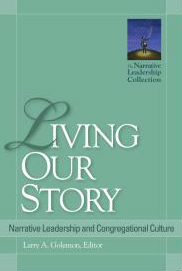
Living Our Story: Narrative Leadership and Congregational Culture explores how good narrative work takes place in ministry. In this collection of essays, authors Larry Golemon, Lee Ramsey, Graham Standish, Tim Shapiro, Carol Johnson, Mike Mather, Niles Elliot Goldstein, and Diana Butler Bass examine how sacred and mundane stories shape congregational life and identity, how storytelling is a means of community-building, and how story-sharing is a practice of hospitality.
Buy the book

Ideas that Impact: Congregational Culture
The Role of Church Culture in Congregational Growth and Decline by Ken Evers-Hood
How much, and in what ways, does congregational culture affect membership and attendance? Using game theory to answer that question, one scholar-pastor finds that, in larger-membership congregations, growth correlated strongly with cooperation, reward and the avoidance of punishment, while in smaller-membership congregations, growth correlated to reward and the imposition of punishment.
CHRISTIAN LEADERSHIP
Ken Evers-Hood: The role of church culture in congregational growth and decline

How can a church leader encourage a cooperative environment that is poised for growth? It depends on the size of the congregation.
Editor’s note: This is the fourth in a series exploring how the field of game theory can help church leaders navigate conflict effectively.
Two churches I know well sit just 5 miles apart. They belong to the same denomination. Their neighborhoods have experienced nearly identical demographic changes. Yet one church grew slightly, while the other lost more than 10 percent of its members.
Explanations for church growth and decline abound. Sociologists such as Mark Chaves, Robert Putnam and Diana Butler Bass offer powerful explanations for North American church decline, highlighting the significance of birth rates, demographic changes and other macro trends like the rise of the nones (which has always sounded to me like an action movie title).
Others such as Jackson Carroll, the author of “God’s Potters,” remind us of the importance of pastoral leadership. While church leaders need to pay attention to all these theories, none of them accounts for the vital role that congregational culture plays in growth and decline.
How much, and in what ways, does congregational culture affect membership and attendance? I used game theory to design a study to try to answer that question. Employing what’s called the “public goods game,” I looked at the level of cooperation in church leadership bodies -- a measure that I believe is reflective of the larger congregation.
Why the public goods game? The prisoner’s dilemma game discussed in the last article can help church leaders navigate conflicted relationships between individuals. Congregations, however, are rich and complicated communities.
To understand communities, game theorists look to the public goods game, a multiplayer version of the prisoner’s dilemma. The public goods game functions like a church potluck.
Church potlucks work best when everybody agrees to bring a dish and sticks around to help clean up. But the reality is that some people defect: they show up empty-handed or leave without pitching in.
When most people cooperate by sharing food and cleaning up, potlucks go well. When enough people defect, however, folk begin to grumble. Game theorists believe that the public goods game can help measure a community’s level of cooperativeness, which correlates with a group’s ability to thrive.
Here’s how it works. In a simple public goods game, players receive a set number of units for every round. Each player can choose to share these units -- sometimes actual dollars, sometimes units representing time or energy -- or to keep them.
With every round, each player must decide how many units to donate to the common pool. After all players have contributed, the units in the pool are multiplied by a small factor, often 1.6, and then divided equally and returned to all players.
For example, let’s say 10 players start with 20 units each and each player donates all 20 of his units. At the end of the round, each player will receive 32 units. When everyone contributes, everyone wins.
And yet it can pay even more to defect. Let’s look at the same group of 10 and imagine that nine players give everything but one player gives nothing. At the end, each of the 10 will receive a return of 29 units, so that the defector winds up with a whopping 49. Because of the defection dynamic, cooperation tends to break down over time in this simple version of the game.
More complex versions of the game allow players to reward and punish other players -- a dynamic that more closely resembles human behavior in community. Game theorists have different ideas about whether punishment encourages or discourages cooperation.
So how, I wondered, does this concept play out in the church? Under the direction of Duke University professors Greg Jones and Dan Ariely, I developed a study to find out.
I conducted a public goods game study of 98 elders (ordained leaders) in 11 PCUSA church sessions (governing bodies). I observed participants playing a simple public goods game, as well as one that allowed the ability to reward and punish.
Would congregational growth and decline correlate with the rate of cooperation, reward and punishment? Would leaders in declining churches be more inclined to punish? Would leaders in growing communities be more likely to cooperate and reward?
When I looked at all the congregations together, I saw a slight but statistically insignificant correlation between growth and cooperation and growth and reward. I found no correlation between growth and punishment.
The results became more interesting -- and more helpful for Christian leaders -- when I separated the results for churches with more than 100 members and churches with fewer than 100 members.
In larger-membership congregations, growth correlated strongly with cooperation, reward and the avoidance of punishment. This suggests that leaders in larger-membership congregations would do well to minimize punishment and work to find creative ways to reward members of the community.
A different picture emerged for smaller-membership congregations, where growth correlated strongly with reward andthe imposition of punishment.
In larger-membership congregations, groups with the lowest punishment percentages, around 10 percent, experienced the most growth. One might surmise that if a low punishment percentage was effective, one approaching 0 percent would be even better. But this doesn’t seem to be the case.
In smaller-membership congregations, the groups experiencing the most growth had about a 10 percent rate of punishment, similar to that of the flourishing larger congregations. But smaller congregations with the worst growth -- those experiencing steep decline -- hardly punished at all. Anything less than a 10 percent punishment rate correlated with significant numerical decline.
In “Give and Take,” business professor Adam Grant cites a study that might help explain this phenomenon. Researchers found that strangers competing against each other in a negotiation game fared surprisingly better at achieving joint profits than did dating couples.
The couples, more concerned about maintaining their relationship than being frank enough with each other to compete well, fared worse than the strangers, who were willing to be more straightforward. In a similar way, I suspect that the concern for maintaining relationships in smaller congregations, where it is hard for leaders to get away from one another, may help account for the lower punishment level in smaller churches experiencing decline.
Another fascinating dynamic that emerged from my study was inequality, or the gap between the players with the highest and lowest scores.
In larger-membership congregations, growth correlated fairly strongly with inequality. In other words, leaders of larger churches were more comfortable with some leaders having much higher scores than others.
Smaller-membership congregations, though, were uncomfortable with inequality; the more growth a smaller congregation experienced, the less comfortable the leaders were with some standing out from the others.
It became clear that in smaller congregations, players began to give and reward in ways that would equalize the points for all. If this play reflects reality, leaders of smaller-membership congregations need to be very thoughtful about how they protect leaders who excel. Smaller-membership congregations may tend to undermine, inadvertently, the leaders they most need.
What is absolutely clear from this study is that leaders should reflect consciously on the ways they reward and punish the people around them. Church leaders’ rewarding behavior is usually pretty obvious -- public thank-yous, for instance. But we may not realize the subtle, unhealthy ways we punish one another -- being slow to respond to emails or voice mails, using “distancing” body language in meetings, sitting apart from people we wish to discourage.
Leaders of larger congregations should exercise the greatest possible caution regarding punitive behavior, which can unravel emergent cooperation. Positive, rewarding behavior marks growing larger-membership congregations.
In smaller-membership congregations, positive, rewarding behavior is just as important as it is in their larger counterparts. But in these smaller contexts, leaders of growing congregations must also be willing to impose healthy discipline on members who are not contributing to the common good, speaking the truth in love when it may be easier, in close quarters, to keep one’s thoughts to oneself.
As important as social trends and pastoral leadership are, game theory underscores that church culture is every bit as important. The church already confesses the priesthood of all believers. The public goods game gives us a way of seeing this scriptural wisdom in action -- that all members of the community contribute to an atmosphere of cooperation.
We are left, then, with a question of newfound significance: What are you bringing to your next church potluck?
CHRISTIAN LEADERSHIP
Ken Evers-Hood: The role of church culture in congregational growth and decline
How can a church leader encourage a cooperative environment that is poised for growth? It depends on the size of the congregation.
Editor’s note: This is the fourth in a series exploring how the field of game theory can help church leaders navigate conflict effectively.
Two churches I know well sit just 5 miles apart. They belong to the same denomination. Their neighborhoods have experienced nearly identical demographic changes. Yet one church grew slightly, while the other lost more than 10 percent of its members.
Explanations for church growth and decline abound. Sociologists such as Mark Chaves, Robert Putnam and Diana Butler Bass offer powerful explanations for North American church decline, highlighting the significance of birth rates, demographic changes and other macro trends like the rise of the nones (which has always sounded to me like an action movie title).
Others such as Jackson Carroll, the author of “God’s Potters,” remind us of the importance of pastoral leadership. While church leaders need to pay attention to all these theories, none of them accounts for the vital role that congregational culture plays in growth and decline.
How much, and in what ways, does congregational culture affect membership and attendance? I used game theory to design a study to try to answer that question. Employing what’s called the “public goods game,” I looked at the level of cooperation in church leadership bodies -- a measure that I believe is reflective of the larger congregation.
Why the public goods game? The prisoner’s dilemma game discussed in the last article can help church leaders navigate conflicted relationships between individuals. Congregations, however, are rich and complicated communities.
To understand communities, game theorists look to the public goods game, a multiplayer version of the prisoner’s dilemma. The public goods game functions like a church potluck.
Church potlucks work best when everybody agrees to bring a dish and sticks around to help clean up. But the reality is that some people defect: they show up empty-handed or leave without pitching in.
When most people cooperate by sharing food and cleaning up, potlucks go well. When enough people defect, however, folk begin to grumble. Game theorists believe that the public goods game can help measure a community’s level of cooperativeness, which correlates with a group’s ability to thrive.
Here’s how it works. In a simple public goods game, players receive a set number of units for every round. Each player can choose to share these units -- sometimes actual dollars, sometimes units representing time or energy -- or to keep them.
With every round, each player must decide how many units to donate to the common pool. After all players have contributed, the units in the pool are multiplied by a small factor, often 1.6, and then divided equally and returned to all players.
For example, let’s say 10 players start with 20 units each and each player donates all 20 of his units. At the end of the round, each player will receive 32 units. When everyone contributes, everyone wins.
And yet it can pay even more to defect. Let’s look at the same group of 10 and imagine that nine players give everything but one player gives nothing. At the end, each of the 10 will receive a return of 29 units, so that the defector winds up with a whopping 49. Because of the defection dynamic, cooperation tends to break down over time in this simple version of the game.
More complex versions of the game allow players to reward and punish other players -- a dynamic that more closely resembles human behavior in community. Game theorists have different ideas about whether punishment encourages or discourages cooperation.
So how, I wondered, does this concept play out in the church? Under the direction of Duke University professors Greg Jones and Dan Ariely, I developed a study to find out.
I conducted a public goods game study of 98 elders (ordained leaders) in 11 PCUSA church sessions (governing bodies). I observed participants playing a simple public goods game, as well as one that allowed the ability to reward and punish.
Would congregational growth and decline correlate with the rate of cooperation, reward and punishment? Would leaders in declining churches be more inclined to punish? Would leaders in growing communities be more likely to cooperate and reward?
When I looked at all the congregations together, I saw a slight but statistically insignificant correlation between growth and cooperation and growth and reward. I found no correlation between growth and punishment.
The results became more interesting -- and more helpful for Christian leaders -- when I separated the results for churches with more than 100 members and churches with fewer than 100 members.
In larger-membership congregations, growth correlated strongly with cooperation, reward and the avoidance of punishment. This suggests that leaders in larger-membership congregations would do well to minimize punishment and work to find creative ways to reward members of the community.
A different picture emerged for smaller-membership congregations, where growth correlated strongly with reward andthe imposition of punishment.
In larger-membership congregations, groups with the lowest punishment percentages, around 10 percent, experienced the most growth. One might surmise that if a low punishment percentage was effective, one approaching 0 percent would be even better. But this doesn’t seem to be the case.
In smaller-membership congregations, the groups experiencing the most growth had about a 10 percent rate of punishment, similar to that of the flourishing larger congregations. But smaller congregations with the worst growth -- those experiencing steep decline -- hardly punished at all. Anything less than a 10 percent punishment rate correlated with significant numerical decline.
In “Give and Take,” business professor Adam Grant cites a study that might help explain this phenomenon. Researchers found that strangers competing against each other in a negotiation game fared surprisingly better at achieving joint profits than did dating couples.
The couples, more concerned about maintaining their relationship than being frank enough with each other to compete well, fared worse than the strangers, who were willing to be more straightforward. In a similar way, I suspect that the concern for maintaining relationships in smaller congregations, where it is hard for leaders to get away from one another, may help account for the lower punishment level in smaller churches experiencing decline.
Another fascinating dynamic that emerged from my study was inequality, or the gap between the players with the highest and lowest scores.
In larger-membership congregations, growth correlated fairly strongly with inequality. In other words, leaders of larger churches were more comfortable with some leaders having much higher scores than others.
Smaller-membership congregations, though, were uncomfortable with inequality; the more growth a smaller congregation experienced, the less comfortable the leaders were with some standing out from the others.
It became clear that in smaller congregations, players began to give and reward in ways that would equalize the points for all. If this play reflects reality, leaders of smaller-membership congregations need to be very thoughtful about how they protect leaders who excel. Smaller-membership congregations may tend to undermine, inadvertently, the leaders they most need.
What is absolutely clear from this study is that leaders should reflect consciously on the ways they reward and punish the people around them. Church leaders’ rewarding behavior is usually pretty obvious -- public thank-yous, for instance. But we may not realize the subtle, unhealthy ways we punish one another -- being slow to respond to emails or voice mails, using “distancing” body language in meetings, sitting apart from people we wish to discourage.
Leaders of larger congregations should exercise the greatest possible caution regarding punitive behavior, which can unravel emergent cooperation. Positive, rewarding behavior marks growing larger-membership congregations.
In smaller-membership congregations, positive, rewarding behavior is just as important as it is in their larger counterparts. But in these smaller contexts, leaders of growing congregations must also be willing to impose healthy discipline on members who are not contributing to the common good, speaking the truth in love when it may be easier, in close quarters, to keep one’s thoughts to oneself.
As important as social trends and pastoral leadership are, game theory underscores that church culture is every bit as important. The church already confesses the priesthood of all believers. The public goods game gives us a way of seeing this scriptural wisdom in action -- that all members of the community contribute to an atmosphere of cooperation.
We are left, then, with a question of newfound significance: What are you bringing to your next church potluck?
Read more »
Myths about Communicating Congregational Identity by Lynne Baab
For decades congregational leaders have been making decisions -- both consciously and unconsciously -- about congregational identity and values and how they are communicated. In this article adapted from Reaching Out in a Networked World, we learn that there are nine myths that influence these choices and their effectiveness.Myths about Communicating Congregational Identity
Conveying a congregation’s identity and values clearly and through a variety of means of communication will help the congregation connect to the community around it. At the same time, clear expressions of values and identity will also have a deep impact on the congregation itself. The people involved in a congregation are shaped by what they hear about that congregation. Their expectations for the life of faith and for their involvement in the community are influenced by the ways in which the congregation talks about itself and its values.
For decades congregational leaders have been making decisions—both consciously and unconsciously—about identity and values and how they are communicated. The nine myths below lay out some of the underlying issues that may influence these choices and their effectiveness.
Myth 1: We’ve got a mission statement, so we’ve figured out who we are.
Mission (or vision) statements can be helpful to congregations in expressing who they are and what they care about. Leaders and members are tempted to believe that once a mission statement is in place, the congregation can get on with doing ministry. A mission statement, however, is simply one small way among many that a congregation can communicate its heart and soul. In fact, everything about a congregation communicates. Its bulletin, newsletter, and website may include its mission statement, but the photos, layout, and additional text also contribute to the reader’s perception of who the congregation is. The actions of a congregation—its worship style, preaching, ministries, and mission activities—speak of its DNA, its story. Because of its power to influence, all of the congregation’s communication needs to be evaluated from time to time to see if it reflects the values and identity of the congregation.
Myth 2: Our identity is rooted in our faith.
Leaders and members are tempted to believe they don’t need to spend time considering the specific identity of their congregation because they assume their faith values provide the DNA for their congregation. And it is absolutely true that in communities of faith, identity comes primarily from the congregation’s faith tradition. Faith communities are not businesses or other organizations that need to create an identity from scratch. However, in the same way that individuals within any faith tradition bring specific gifts in service, so faith communities have particular values and emphases. One might have a strong commitment to justice, another to outreach within the local community, and another to ministry with seniors or teenagers or adoptive families. Sometimes it appears that megachurches can do it all, so congregational leaders might think their congregation should do everything, too. But even megachurches have particular emphases and priorities.
Myth 3: If we focus too much on figuring out our own identity, we may become self-absorbed.
This is another statement with some truth to it, but not the whole truth. Congregational identity is only part of what congregational leaders should be attending to. While focusing on it all the time would definitely cause an imbalance, many congregations are already out of balance in that they focus too little on the way their actions, publications, and use of symbols communicate their priorities and the distinctiveness of who they are. “Who are we and what are we about?” is a key question that needs to be front and center for all congregations.
Myth 4: We don’t need to think any further about the implications of new communication technology because we already use it well.
A number of congregations have mastered necessary skills related to new forms of communication in admirable ways. Many congregations offer podcasted and streaming video sermons on websites, have wonderful teams of people who run the data projectors on Sunday morning, and embrace new communication technologies as they emerge. But that doesn’t mean they are communicating wisely. In some congregations, the message communicated about values differs from one mode of communication to the next because the various forms of communication haven’t been evaluated well. In other congregations, the message is so unified that the congregation’s diversity is not represented well. Focusing on the deeper questions, the issues that lie behind the use of new technologies, is important. Congregational leaders need to consider how everything the congregation does—communication technologies as well as things like programming and the use of physical space in the building—speaks about the congregation’s priorities.
Myth 5: We’re a traditional congregation, and we have chosen not to use most of the new communication technologies. We’ve figured out our identity; it’s the same as it’s always been, so why complicate things?
All congregations need to periodically rethink and explore who they are and what they value. Even if all the people attending a congregation stay the same over a decade, each of those people would undergo personal changes in that time, and those personal changes would change the priorities and emphases of that community of faith. And, of course, no congregation is composed of exactly the same members over a decade or more. The flow of people in and out of a congregation, and in and out of leadership roles, shapes the values of each congregation. And while I do think new communication technologies offer some wonderful opportunities for congregations, I would never suggest that congregations need to use all of them. I do argue, however, that everything congregations say and do contributes to their identity. Therefore paying some attention to the issue is wise, no matter what forms of communication are used.
Myth 6: We avoid the new technologies because we’re leery of the consumer culture, and we don’t want our congregation and even our faith to turn into yet one more consumer item.
I am concerned that communities of faith have become consumer items and that people looking for a congregation are engaged in a form of shopping. However, I see congregational identity as an issue that relates to much more than selling something. Very simply, everything we say and do communicates what we consider to be important, and what congregations communicate about faith values shapes how members act on their faith. Therefore, from time to time, congregations need to stop and evaluate what they are communicating. Congregational leaders will likely choose not to use certain forms of communication that don’t fit the ethos of that congregation.
Myth 7: Our congregational values are being communicated effectively through words. Our pastor and leaders preach the sermons and put a lot of thought into the words used in our newsletter and on our website.
People are increasingly influenced by images as well as by words. According to communication research, the images projected on a screen during worship and the images used in newsletters and on websites often have as much or more impact than the words associated with them. Much of Jewish and Christian tradition is strongly word oriented, emphasizing the significance of words over images. With the move away from a word-based to an image-based culture, leaders of congregations need to do some careful thinking about the role of visual communication in our time.
Myth 8: We’ve got a great Web designer and newsletter editor, and our newsletter and website are terrific.
In many congregations, one person creates most of the publications. Often, congregational leaders supply the text, but the Web designer or newsletter editor decides on the layout, photos, and graphics. In this increasingly visual culture, form
s of visual communication such as layout, photos, and graphics need to be evaluated to see if they communicate the desired message, particularly if one person is choosing most of them. I believe that all the new communication technologies have created the necessity for “critical friends,” people who understand the importance of the new forms of communication for congregations and, at the same time, are willing to look at those forms with a critical eye. These critical friends pay attention to the congregation’s websites, blogs, projection screens, and other forms of communication that have a large visual component to see if the visuals harmonize with the words used and whether the verbal and visual components together communicate important values about the congregation.
Myth 9: If your heart is in the right place, communication takes care of itself.
I agree that the single most important thing for congregations is to worship and follow God in a way that engages hearts and minds. Without faith as the center of its life, a congregation has nothing to offer its members or the world. Faith values cannot be communicated if no faith values are present. But I do not agree that the result of a vibrant faith is that all communication will automatically be okay. Just as individuals with good intentions can benefit from learning listening skills for their personal relationships and speaking skills for their oral communication, so congregations can benefit from considering the implications of the ways they communicate and what they are communicating. In this age of rapidly proliferating communication technologies, this task of evaluation is even more urgent.
_______________________________________
Adapted from Reaching Out in a Networked World: Expressing Your Congregation’s Heart and Soul by Lynne M. Baab, copyright © 2008 by the Alban Institute. All rights reserved.
Copyright © 2008, the Alban Institute. All rights reserved. We encourage you to share articles from the Alban Weekly with your congregation. We gladly allow permission to reprint articles from the Alban Weekly for one-time use by congregations and their leaders when the material is offered free of charge. All we ask is that you write to us at alban@div.duke.edu and let us know how the Alban Weekly is making an impact in your congregation. If you would like to use any other Alban material, or if your intended use of the Alban Weekly does not fall within this scope, please submit our reprint permission request form.
Subscribe to the Alban Weekly.
Archive of past issues of the Alban Weekly.
______________________________________
FEATURED RESOURCES

Myths about Communicating Congregational Identity by Lynne Baab
For decades congregational leaders have been making decisions -- both consciously and unconsciously -- about congregational identity and values and how they are communicated. In this article adapted from Reaching Out in a Networked World, we learn that there are nine myths that influence these choices and their effectiveness.Myths about Communicating Congregational Identity
Conveying a congregation’s identity and values clearly and through a variety of means of communication will help the congregation connect to the community around it. At the same time, clear expressions of values and identity will also have a deep impact on the congregation itself. The people involved in a congregation are shaped by what they hear about that congregation. Their expectations for the life of faith and for their involvement in the community are influenced by the ways in which the congregation talks about itself and its values.
For decades congregational leaders have been making decisions—both consciously and unconsciously—about identity and values and how they are communicated. The nine myths below lay out some of the underlying issues that may influence these choices and their effectiveness.
Myth 1: We’ve got a mission statement, so we’ve figured out who we are.
Mission (or vision) statements can be helpful to congregations in expressing who they are and what they care about. Leaders and members are tempted to believe that once a mission statement is in place, the congregation can get on with doing ministry. A mission statement, however, is simply one small way among many that a congregation can communicate its heart and soul. In fact, everything about a congregation communicates. Its bulletin, newsletter, and website may include its mission statement, but the photos, layout, and additional text also contribute to the reader’s perception of who the congregation is. The actions of a congregation—its worship style, preaching, ministries, and mission activities—speak of its DNA, its story. Because of its power to influence, all of the congregation’s communication needs to be evaluated from time to time to see if it reflects the values and identity of the congregation.
Myth 2: Our identity is rooted in our faith.
Leaders and members are tempted to believe they don’t need to spend time considering the specific identity of their congregation because they assume their faith values provide the DNA for their congregation. And it is absolutely true that in communities of faith, identity comes primarily from the congregation’s faith tradition. Faith communities are not businesses or other organizations that need to create an identity from scratch. However, in the same way that individuals within any faith tradition bring specific gifts in service, so faith communities have particular values and emphases. One might have a strong commitment to justice, another to outreach within the local community, and another to ministry with seniors or teenagers or adoptive families. Sometimes it appears that megachurches can do it all, so congregational leaders might think their congregation should do everything, too. But even megachurches have particular emphases and priorities.
Myth 3: If we focus too much on figuring out our own identity, we may become self-absorbed.
This is another statement with some truth to it, but not the whole truth. Congregational identity is only part of what congregational leaders should be attending to. While focusing on it all the time would definitely cause an imbalance, many congregations are already out of balance in that they focus too little on the way their actions, publications, and use of symbols communicate their priorities and the distinctiveness of who they are. “Who are we and what are we about?” is a key question that needs to be front and center for all congregations.
Myth 4: We don’t need to think any further about the implications of new communication technology because we already use it well.
A number of congregations have mastered necessary skills related to new forms of communication in admirable ways. Many congregations offer podcasted and streaming video sermons on websites, have wonderful teams of people who run the data projectors on Sunday morning, and embrace new communication technologies as they emerge. But that doesn’t mean they are communicating wisely. In some congregations, the message communicated about values differs from one mode of communication to the next because the various forms of communication haven’t been evaluated well. In other congregations, the message is so unified that the congregation’s diversity is not represented well. Focusing on the deeper questions, the issues that lie behind the use of new technologies, is important. Congregational leaders need to consider how everything the congregation does—communication technologies as well as things like programming and the use of physical space in the building—speaks about the congregation’s priorities.
Myth 5: We’re a traditional congregation, and we have chosen not to use most of the new communication technologies. We’ve figured out our identity; it’s the same as it’s always been, so why complicate things?
All congregations need to periodically rethink and explore who they are and what they value. Even if all the people attending a congregation stay the same over a decade, each of those people would undergo personal changes in that time, and those personal changes would change the priorities and emphases of that community of faith. And, of course, no congregation is composed of exactly the same members over a decade or more. The flow of people in and out of a congregation, and in and out of leadership roles, shapes the values of each congregation. And while I do think new communication technologies offer some wonderful opportunities for congregations, I would never suggest that congregations need to use all of them. I do argue, however, that everything congregations say and do contributes to their identity. Therefore paying some attention to the issue is wise, no matter what forms of communication are used.
Myth 6: We avoid the new technologies because we’re leery of the consumer culture, and we don’t want our congregation and even our faith to turn into yet one more consumer item.
I am concerned that communities of faith have become consumer items and that people looking for a congregation are engaged in a form of shopping. However, I see congregational identity as an issue that relates to much more than selling something. Very simply, everything we say and do communicates what we consider to be important, and what congregations communicate about faith values shapes how members act on their faith. Therefore, from time to time, congregations need to stop and evaluate what they are communicating. Congregational leaders will likely choose not to use certain forms of communication that don’t fit the ethos of that congregation.
Myth 7: Our congregational values are being communicated effectively through words. Our pastor and leaders preach the sermons and put a lot of thought into the words used in our newsletter and on our website.
People are increasingly influenced by images as well as by words. According to communication research, the images projected on a screen during worship and the images used in newsletters and on websites often have as much or more impact than the words associated with them. Much of Jewish and Christian tradition is strongly word oriented, emphasizing the significance of words over images. With the move away from a word-based to an image-based culture, leaders of congregations need to do some careful thinking about the role of visual communication in our time.
Myth 8: We’ve got a great Web designer and newsletter editor, and our newsletter and website are terrific.
In many congregations, one person creates most of the publications. Often, congregational leaders supply the text, but the Web designer or newsletter editor decides on the layout, photos, and graphics. In this increasingly visual culture, form
s of visual communication such as layout, photos, and graphics need to be evaluated to see if they communicate the desired message, particularly if one person is choosing most of them. I believe that all the new communication technologies have created the necessity for “critical friends,” people who understand the importance of the new forms of communication for congregations and, at the same time, are willing to look at those forms with a critical eye. These critical friends pay attention to the congregation’s websites, blogs, projection screens, and other forms of communication that have a large visual component to see if the visuals harmonize with the words used and whether the verbal and visual components together communicate important values about the congregation.
Myth 9: If your heart is in the right place, communication takes care of itself.
I agree that the single most important thing for congregations is to worship and follow God in a way that engages hearts and minds. Without faith as the center of its life, a congregation has nothing to offer its members or the world. Faith values cannot be communicated if no faith values are present. But I do not agree that the result of a vibrant faith is that all communication will automatically be okay. Just as individuals with good intentions can benefit from learning listening skills for their personal relationships and speaking skills for their oral communication, so congregations can benefit from considering the implications of the ways they communicate and what they are communicating. In this age of rapidly proliferating communication technologies, this task of evaluation is even more urgent.
_______________________________________
Adapted from Reaching Out in a Networked World: Expressing Your Congregation’s Heart and Soul by Lynne M. Baab, copyright © 2008 by the Alban Institute. All rights reserved.
Copyright © 2008, the Alban Institute. All rights reserved. We encourage you to share articles from the Alban Weekly with your congregation. We gladly allow permission to reprint articles from the Alban Weekly for one-time use by congregations and their leaders when the material is offered free of charge. All we ask is that you write to us at alban@div.duke.edu and let us know how the Alban Weekly is making an impact in your congregation. If you would like to use any other Alban material, or if your intended use of the Alban Weekly does not fall within this scope, please submit our reprint permission request form.
Subscribe to the Alban Weekly.
Archive of past issues of the Alban Weekly.
______________________________________
FEATURED RESOURCES
Reaching Out in a Networked World: Expressing Your Congregation’s Heart and Soul by Lynne M. Baab
A congregation communicates its heart and soul through words, photos, actions, programs, architecture, decor, the arts, and countless other aspects of congregational life. In Reaching Out in a Networked World, communications expert and pastor Lynne Baab examines technologies such as websites, blogs, online communities, and desktop publishing. She demonstrates how a congregation can evaluate these tools and appropriately use them to communicate its heart and soul, to convey its identity and values both within and outside the congregation. When congregations are intentional about communicating who they are and what they value, people in the wider community can get a clear and coherent picture of the congregation and its mission.
A congregation communicates its heart and soul through words, photos, actions, programs, architecture, decor, the arts, and countless other aspects of congregational life. In Reaching Out in a Networked World, communications expert and pastor Lynne Baab examines technologies such as websites, blogs, online communities, and desktop publishing. She demonstrates how a congregation can evaluate these tools and appropriately use them to communicate its heart and soul, to convey its identity and values both within and outside the congregation. When congregations are intentional about communicating who they are and what they value, people in the wider community can get a clear and coherent picture of the congregation and its mission.
Tribal Church: Ministering to the Missing Generation by Carol Howard Merritt
Carol Howard Merritt, a pastor in her mid-thirties, suggests a different way for churches to approach young adults on their own terms. Outlining the financial, social, and familial situations that affect many young adults today, she describes how churches can provide a safe, supportive place for young adults to nurture relationships and foster spiritual growth.

Carol Howard Merritt, a pastor in her mid-thirties, suggests a different way for churches to approach young adults on their own terms. Outlining the financial, social, and familial situations that affect many young adults today, she describes how churches can provide a safe, supportive place for young adults to nurture relationships and foster spiritual growth.
40 Days and 40 Bytes: Making Computers Work for Your Congregation by Aaron Spiegel, Nancy Armstrong, and Brent Bill
40 Days and 40 Bytes will help your congregation explore technology so you can decide, from a ministry and culture standpoint, what you need to do. The goal: godly service—not technological glitz. There’s no question your congregation is going to use computer technology. The only question is, “how?” Spiegel, Armstrong, and Bill will help you design technology that fits your ministry and mission.
40 Days and 40 Bytes will help your congregation explore technology so you can decide, from a ministry and culture standpoint, what you need to do. The goal: godly service—not technological glitz. There’s no question your congregation is going to use computer technology. The only question is, “how?” Spiegel, Armstrong, and Bill will help you design technology that fits your ministry and mission.
In 2001, while researching his book Revitalizing Congregations, William Avery encountered a congregation that was in such a downward cycle with such enormous internal conflict that he doubted whether it would ever be revitalized. Today, the congregation, Gloria Dei Lutheran Church in Huntingdon Valley, Penn., has indeed revitalized itself. An Unexpected Resiliency: How One Church Bounced Back after Hitting Bottom
In 2001, while conducting research for my book Revitalizing Congregations, I encountered a congregation that was in such a downward cycle and had such enormous internal conflict and divisions that I called it “Adrift Lutheran Church” and wondered whether it would ever be revitalized.1 Now, nearly eight years later, I’ve got my answer. This congregation, which is actually Gloria Dei Lutheran Church in Huntingdon Valley, Pennsylvania, has indeed revitalized itself.
“This church may be a lot of things, but we’re no longer adrift,” said one council member when I recently returned to the church to see how it had fared over the years.
Eight years ago a series of crises had left this congregation severely divided, even after a lengthy tenure by an intentional interim minister. Attendance was half what it had been just a few years before, and people continued to leave for other churches—or at least no longer worshiped at Gloria Dei. Its future was uncertain and did not look particularly promising. There are never any guarantees that a congregation in crisis will inevitably be able to reverse its fortunes, and I had my doubts that this church would be able to do so.
I concluded my initial study of the congregation in the fall of 2001, just when the congregation’s first intentional interim minister resigned because he realized that his leadership had become one more focal point of division within this conflicted congregation. After he left, a second interim minister served for more than a year before Gloria Dei finally called Jerrett Hansen, the church’s current senior pastor. In other words, the period during which the congregation was led by interim pastors was almost five years.
Today I conclude that I studied this congregation when it was at or near “rock bottom,” a place from which this congregation was willing to change its entire culture. Some church members seem to believe hitting bottom was an important part of the changes that have taken place since that time. “I think there’s a gift that comes at the bottom,” said one council member, “and this church needed to bottom out if it was going to be transformed. There are things you can only learn when you’re at the bottom.” Members explained that at that period in the congregation’s life, the chaos, unsettledness, infighting, and disagreements that had permeated the church community for so long had led to a state of ennui. But the hopelessness they felt at their situation also made them ready for leadership that would focus on the future rather than on what had been destructive in the past.
While there are many joys and benefits of long pastorates, one of the perils of these long tenures is that a period of congregational turmoil almost inevitably follows them. In the case of Gloria Dei, the five-year interim period was necessary before the congregation was able to turn in a new direction. I cannot minimize the suffering experienced by the small group of members in leadership roles—and that of their families—during these five years. This is evidenced by the fact that during the transition several leadership families left, some permanently and others temporarily, returning only once new pastors were on board.
Matching Gifts with Needs
Pastoral leadership is probably the key factor in the health of a congregation. Gloria Dei’s revitalization serves as an example of this notion. According to the council, a well-chosen call committee was able to match a pastor’s gifts—those of Hansen, a man then in his mid-fifties—with the critical needs of the congregation. Within six months Hansen led the congregation to call an associate pastor, Mary Laymon, whose exceptional gifts for ministry complemented his.
Hansen understood that one key aspect for congregational renewal would be the development of small groups. However, he also understood that he had neither the time nor the aptitude to develop this ministry fully. Thus, soon after he arrived, he led the congregation to call Laymon, a pastor he already knew, because he realized she had gifts he lacked in this area. As one member explained, “In terms of love of God and God’s mission for this church, both pastors are good. They balance one another with quite different specific skills.” He added that Laymon is not interested in administration but “is so loving and caring and just wonderful with small groups. The work she has done with small groups has gotten people to know one another—to band together as a caring community. She has worked wonders.”
One member described the council’s consensus about Hansen’s administrative gifts as follows: “Jerrett is not only a good minister, he is also an excellent administrator and manager, an insightful person.” Another member noted that “while Jerrett has a strong personality, he is willing to listen to people and include people in decision-making processes. Also, he has the ability to delegate and not micromanage. Finally, he has a wonderful sense of timing about when people are ready to change things or try new things, so that change has been well paced.”
Shortly after his arrival, Hansen assembled teams “to work diligently on statements that define our purpose and goals” and to develop a five-year plan for Gloria Dei. The council noted that he did not just choose “yes” people to develop the five-year plan but chose from a broad representation of the congregation. Gloria Dei now lives by proactive planning rather than reactionary response. In fact, a group was recently convened to begin developing long-range plans for the next five years and beyond.
Defining a New Purpose
As a young pastor, Hansen had led in the renewal of parishes he served. Then, prior to the call to Gloria Dei, he honed his skill for revitalizing congregations by serving on the national evangelism staff of the ELCA, working (in the mid-Atlantic region especially) to develop congregational mission starts for the church, and matching pastors with appropriate ministry gifts to these new starts. When Hansen began his ministry at Gloria Dei, he was quite directive. He said the church needed an identity—a purpose for existing—as a discipleship church rather than a membership church.
Luckily, the congregation was ready for this new approach. “By January 2003, when I arrived,” Hansen recalls, “there was a readiness by those who had been through all the conflict, a sense that enough was enough—and an attitude of let’s get on with it. There was a readiness—I would almost say for anything—so that the whole discipleship emphasis was something that the people grabbed onto very quickly because it was purposeful. A lack of purpose for the church was too evident at that point.”
The tool Hansen used to build this purpose was to encourage the entire congregation to study Michael Foss’s Power Surge.2 When I interviewed church members recently, they could readily list Foss’s six marks of discipleship, which they had been using to guide their lives: daily prayer, weekly worship, Bible reading, service, spiritual friendships, and giving. But the congregation’s initial reaction to Hansen’s request hadn’t been one of unbridled enthusiasm. “He wanted us to bring our Bibles to church,” one member recounted. “Imagine that! That’s his job! I’ve come to find that this is why we have to describe ourselves as ‘disciples in training.’” Said another, “What changed in this church was a recommitment to the Bible and a refocusing from ourselves to helping others through the six marks as disciples on a journey.” Not only do many members now try to live in the six marks of discipleship, but many can also give an approximation of the church’s mission statement: “The mission of Gloria Dei is leading people to learn, love, and live God’s Word.”
Restoring Trust
When I first studied Gloria Dei in 2001, one member, when asked what issues were facing the congregation, said, “Trust, vision, leadership, and communication—those jump out.” So, not only did Hansen have to face issues of vision and leadership but also the issue of trust—between pastor and congregation and among congregational members themselves. The first crisis was predictable. “Shortly after Jerrett and Mary arrived and began to take hold of the ministry, there was an attempt to undermine their ministry,” one parishioner reported during my recent visit. “Rumors were e-mailed around, accusing both of them of very poor conduct. The details are meaningless, but it was ugly. Both of them could easily have given up and moved on to another call, but they didn’t. They took charge of the situation and brought it out in the open for all to see and hear. This single incident solidified the majority of the membership with the pastors in trust, leadership, and communication.”
Thus, one leadership quality Hansen and Laymon have brought to Gloria Dei is transparency in all aspects of congregational life. Nowhere has this been more important than in the area of the church’s finances, where Hansen had to deal with the issue of open disclosure. Under the previous permanent pastor, little communication had occurred regarding finances. The pastor and a few key laypersons had controlled the finances. Moreover, the accountant from the independent retirement corporation where the pastor was CEO had kept the books for Gloria Dei. Yet, when that pastor retired, Gloria Dei had an annual budget deficit, a huge debt ($1.5 million), and financial books that Gloria Dei’s leadership could not decipher.
Hansen opened up the whole financial process by inviting every member to attend the monthly Finance Committee meetings. Fifty to sixty people came. Soon Gloria Dei had a stewardship plan to deal with the budget and to pay down the congregation’s debt. “Now we don’t have areas of nondisclosure,” commented one parishioner recently. “Now we have open dialogue between the pastors and lay leaders with the congregation. Nothing is done behind closed doors. Now trust exists knowing that questions will be answered if they are asked.”
Getting People Involved
Hansen has also helped his congregation find ways to explore their gifts for ministry and God’s purpose for their lives. This is being done through a program Gloria Dei calls SHAPE, an acronym for “Spiritual gifts, Heart, Abilities, Personalities, Experience.” It provides a workshop experience where people get to explore and discover who they are, what gifts they possess, what talents lie within them, and how finding purpose can bless their lives.
SHAPE has been one way discipleship groups have been built in the congregation, so that today there are sixty to seventy small groups and teams functioning. In the past, most congregants came on Sunday morning and the staff carried out the ministry, but now a spirit of volunteerism permeates this congregation. The staff is much smaller today than it was a decade ago. Not only has much of the work previously done by paid staff been taken over by volunteers, but the pastors and the lay leadership have also developed an amazing array of hands-on ministries in the Philadelphia area and in the broader U.S. and abroad. For instance, Gloria Dei sponsors a Values through Sports program each Saturday at Iglesia Lutherana Nueva Creacion in Philadelphia, is a vital partner with several others churches and a synagogue in a furniture ministry called One House at a Time, and supports several food programs. The congregation also sponsored mission trips in 2008 to Canada’s Northwest Territories with On Eagles’ Wings; a youth mission trip to Manassas, Virginia and Washington, D.C.; and a youth and adult mission experience in El Salvador. In addition, the church has supported youth who traveled with church and synod groups to Sudan and Tanzania. The church also sent over thirty people—youth and adults—to New Orleans to work with Lutheran Disaster Response during each of the last three years.
Revitalizing Youth
The revitalization of the youth in the congregation has been another hallmark of Gloria Dei’s renewal, shepherded by a talented youth director, Mark Ristine, who was hired three years ago. The youth ministry began its revitalization through a dynamic affirmation program for seventh- and eighth-graders that focuses on faith development and faith formation. Small group gatherings between youth and adult mentors and leaders have developed relationships between adults and youth. The congregation also holds mid-week gatherings for food, study, discussion, and fun.
The effectiveness of Gloria Dei’s youth ministry has been built on relationships at the intersection of life and faith. At the church’s 9:00 a.m. contemporary worship service, the teenagers sit together in the first two or three rows, while their parents sit farther back. Then, on Sunday night, most of these teenagers come back for their own worship experience. Their parents are thrilled. According to one member, “Parents tell their friends, ‘The kids don’t want to leave church. They love being here and see themselves as being as much a part of the congregation as the adults.’” Like the adults, these teenagers not only gather for fellowship and worship but also have their own outreach ministry and mission trips.
Preaching and Teaching
While Hansen and Laymon have led this congregation back to the Bible, to biblically based preaching, and to a journey in discipleship, this congregation hasn’t become biblically conservative or a fundamentalist congregation. Moreover, the leaders can state how Gloria Dei differs from a congregation with a more literalistic biblical stance. “We are a progressive church,” said one member, “an emerging church. We have a belief statement that says we respect the faithfulness of the other paths which also may lead people to an experience of God. We’re inclusive—welcoming gay and lesbian people and all ethnic groups. We try to define neighbors as including even our supposed enemies in the world.”
Hansen takes risks based on the good news of Jesus Christ in his preaching and leadership. In the words of a council member, “We are in the process of teaching the cross. We’re in a process of teaching that we are in collision with the world which Jesus collided with, and learning and living that is a slow process, but it’s a sacred process that we hold dear. We don’t shy from preaching peace in a warring world. We are learning how to take a stand in the world.” An example of Hansen’s bold preaching, as remembered by one member, is that he began one sermon last year by saying, “You know that both McCain and Obama have had minister troubles, so if you think you’re going to run for political office, you may want to leave now.” That day’s sermon was on Jesus loving his enemies.
Finally, as I have discovered in many congregations, as long as faithful ministry is occurring, parishioners are okay with having political differences with their pastor. Said one interviewee about Hansen with a hearty laugh, “I don’t agree with everything. He’s a liberal hippy, and I’m pretty Republican.” But it’s obvious that this difference hasn’t interfered with his positive relationship with his pastor nor his experience of his church.
Defining Identity
In Revitalizing Congregations, I stated that a key issue for Gloria Dei eight years ago was its identity as a Lutheran Church.3 At that time, the bishop was very concerned that Gloria Dei had no significant Lutheran connections in its theology, liturgy, or relationships. What has happened since? The consensus of the council is that Gloria Dei is now Lutheran: “We’re centered in the gospel. We celebrate Communion weekly. We see the importance of [the wider church]. We give our apportioned benevolence to the wider church. We attend synod conventions. Our youth are involved in area and national Lutheran youth gatherings. We have an intern from the closest Lutheran seminary. But we don’t use Lutheran worship material. We create our own. We don’t emphasize the word Lutheran; we’re simply Gloria Dei. Yet you’ll find that the word Lutheran is in our bulletin. We participate at a lot of different levels with the Lutheran church.”
In other words, Gloria Dei members are comfortable being Lutheran, but the label isn’t very important to them; practicing Christian discipleship in the world is. Hansen puts it this way: “We have continued the practice of being secularly focused—it’s the emerging church concept. How do you get into the lives of people who don’t know who you are? The perception still is among us that Lutheran can be a roadblock. So we will be the church reaching for those secularly focused, and our theology is clearly Reformation theology, but the style is different.” Or, as the church’s intern put it, “I do not see anything here that is not Lutheran. I just don’t know if there’s a Lutheran sticker on it.”
Understanding Success
The contrast between Gloria Dei eight years ago and today is extreme. The change borders on the unbelievable to me. Eight years ago this church was not only adrift, it was in severe crisis. Today the church has a purpose—the journey of discipleship in the world—which has changed the spiritual and emotional tone of the members by 180 degrees. Eight years ago the church was split into factions. Today, as one member expressed it, “This community seems very comfortable with each other’s sorrows and joys. Mike’s stroke, someone else’s broken marriage, or whatever happens, is not something we keep under wraps or pretend is not true, but we look at realistically and then we build hope together. Hope is the character-building thing. You go through tragedies, sharing them with one another, and this place is really good at being Christ to one’s neighbor. We show our vulnerability so that grace can abound.”
Eight years ago only a few ran the church; now Gloria Dei wants everybody to be involved and is very good at helping members identify their gifts for ministry. The change was swift and unsettling at first for some, but most adjusted to it and ultimately thrived on it. As one member recalls “Jerrett and Mary brought a unique dynamic in leadership that was totally foreign to us. We were thrown off the dock and into the deep waters. They said, ‘If you want to walk on water, you have to get out of the boat.’ We were empowered to make decisions, but didn’t feel equipped. But it was sink or swim—and the majority of people put in that position rose to the top very quickly. Leadership here is as much from volunteers as from the staff. Now everything is more efficient.”
With this dramatic renewal, some readers may assume that worship attendance has doubled or tripled during these years, but it has not. Instead, Gloria Dei has reversed its spiral of decline and enjoyed modest gains in average attendance. The congregation still deals with the aftermath of its five years of extreme turmoil and the decline it experienced in the decade before that. Another factor limiting growth is that Huntingdon Valley is a mature community with little new population growth. In addition, since the church is just over fifty years old, many early members are now dying off or are too infirm to come to worship. In the last eight years the congregation has averaged thirty funerals a year. These losses have offset the many new families who have joined the church during these years, most of them younger families with children.
But, as is often the case with congregations, the numbers aren’t nearly as important as the renewal of this congregation and its purposeful ministry. Sometimes we hear people say “this church is on fire” when describing a congregation where the enthusiastic and contagious spirit is readily apparent among its members. Usually this statement is not made about mainline Protestant congregations. With Gloria Dei, we find a mainline church on fire with the Spirit! Please visit its website (www.gloriadei.com) to learn more about this dynamic and inspiring congregation.
_______________
NOTES
1. See chapter 3, “Adrift Lutheran Church,” in William O. Avery’s Revitalizing Congregations (Herndon, VA: Alban Institute, 2002), 57–78.
2. Michael Foss, Power Surge, Six Marks of Discipleship for a Changing Church (Minneapolis: Fortress Press, 2000).
3. Avery, Revitalizing Congregations, 74.
__________________________
Questions for Reflection
In 2001, while conducting research for my book Revitalizing Congregations, I encountered a congregation that was in such a downward cycle and had such enormous internal conflict and divisions that I called it “Adrift Lutheran Church” and wondered whether it would ever be revitalized.1 Now, nearly eight years later, I’ve got my answer. This congregation, which is actually Gloria Dei Lutheran Church in Huntingdon Valley, Pennsylvania, has indeed revitalized itself.
“This church may be a lot of things, but we’re no longer adrift,” said one council member when I recently returned to the church to see how it had fared over the years.
Eight years ago a series of crises had left this congregation severely divided, even after a lengthy tenure by an intentional interim minister. Attendance was half what it had been just a few years before, and people continued to leave for other churches—or at least no longer worshiped at Gloria Dei. Its future was uncertain and did not look particularly promising. There are never any guarantees that a congregation in crisis will inevitably be able to reverse its fortunes, and I had my doubts that this church would be able to do so.
I concluded my initial study of the congregation in the fall of 2001, just when the congregation’s first intentional interim minister resigned because he realized that his leadership had become one more focal point of division within this conflicted congregation. After he left, a second interim minister served for more than a year before Gloria Dei finally called Jerrett Hansen, the church’s current senior pastor. In other words, the period during which the congregation was led by interim pastors was almost five years.
Today I conclude that I studied this congregation when it was at or near “rock bottom,” a place from which this congregation was willing to change its entire culture. Some church members seem to believe hitting bottom was an important part of the changes that have taken place since that time. “I think there’s a gift that comes at the bottom,” said one council member, “and this church needed to bottom out if it was going to be transformed. There are things you can only learn when you’re at the bottom.” Members explained that at that period in the congregation’s life, the chaos, unsettledness, infighting, and disagreements that had permeated the church community for so long had led to a state of ennui. But the hopelessness they felt at their situation also made them ready for leadership that would focus on the future rather than on what had been destructive in the past.
While there are many joys and benefits of long pastorates, one of the perils of these long tenures is that a period of congregational turmoil almost inevitably follows them. In the case of Gloria Dei, the five-year interim period was necessary before the congregation was able to turn in a new direction. I cannot minimize the suffering experienced by the small group of members in leadership roles—and that of their families—during these five years. This is evidenced by the fact that during the transition several leadership families left, some permanently and others temporarily, returning only once new pastors were on board.
Matching Gifts with Needs
Pastoral leadership is probably the key factor in the health of a congregation. Gloria Dei’s revitalization serves as an example of this notion. According to the council, a well-chosen call committee was able to match a pastor’s gifts—those of Hansen, a man then in his mid-fifties—with the critical needs of the congregation. Within six months Hansen led the congregation to call an associate pastor, Mary Laymon, whose exceptional gifts for ministry complemented his.
Hansen understood that one key aspect for congregational renewal would be the development of small groups. However, he also understood that he had neither the time nor the aptitude to develop this ministry fully. Thus, soon after he arrived, he led the congregation to call Laymon, a pastor he already knew, because he realized she had gifts he lacked in this area. As one member explained, “In terms of love of God and God’s mission for this church, both pastors are good. They balance one another with quite different specific skills.” He added that Laymon is not interested in administration but “is so loving and caring and just wonderful with small groups. The work she has done with small groups has gotten people to know one another—to band together as a caring community. She has worked wonders.”
One member described the council’s consensus about Hansen’s administrative gifts as follows: “Jerrett is not only a good minister, he is also an excellent administrator and manager, an insightful person.” Another member noted that “while Jerrett has a strong personality, he is willing to listen to people and include people in decision-making processes. Also, he has the ability to delegate and not micromanage. Finally, he has a wonderful sense of timing about when people are ready to change things or try new things, so that change has been well paced.”
Shortly after his arrival, Hansen assembled teams “to work diligently on statements that define our purpose and goals” and to develop a five-year plan for Gloria Dei. The council noted that he did not just choose “yes” people to develop the five-year plan but chose from a broad representation of the congregation. Gloria Dei now lives by proactive planning rather than reactionary response. In fact, a group was recently convened to begin developing long-range plans for the next five years and beyond.
Defining a New Purpose
As a young pastor, Hansen had led in the renewal of parishes he served. Then, prior to the call to Gloria Dei, he honed his skill for revitalizing congregations by serving on the national evangelism staff of the ELCA, working (in the mid-Atlantic region especially) to develop congregational mission starts for the church, and matching pastors with appropriate ministry gifts to these new starts. When Hansen began his ministry at Gloria Dei, he was quite directive. He said the church needed an identity—a purpose for existing—as a discipleship church rather than a membership church.
Luckily, the congregation was ready for this new approach. “By January 2003, when I arrived,” Hansen recalls, “there was a readiness by those who had been through all the conflict, a sense that enough was enough—and an attitude of let’s get on with it. There was a readiness—I would almost say for anything—so that the whole discipleship emphasis was something that the people grabbed onto very quickly because it was purposeful. A lack of purpose for the church was too evident at that point.”
The tool Hansen used to build this purpose was to encourage the entire congregation to study Michael Foss’s Power Surge.2 When I interviewed church members recently, they could readily list Foss’s six marks of discipleship, which they had been using to guide their lives: daily prayer, weekly worship, Bible reading, service, spiritual friendships, and giving. But the congregation’s initial reaction to Hansen’s request hadn’t been one of unbridled enthusiasm. “He wanted us to bring our Bibles to church,” one member recounted. “Imagine that! That’s his job! I’ve come to find that this is why we have to describe ourselves as ‘disciples in training.’” Said another, “What changed in this church was a recommitment to the Bible and a refocusing from ourselves to helping others through the six marks as disciples on a journey.” Not only do many members now try to live in the six marks of discipleship, but many can also give an approximation of the church’s mission statement: “The mission of Gloria Dei is leading people to learn, love, and live God’s Word.”
Restoring Trust
When I first studied Gloria Dei in 2001, one member, when asked what issues were facing the congregation, said, “Trust, vision, leadership, and communication—those jump out.” So, not only did Hansen have to face issues of vision and leadership but also the issue of trust—between pastor and congregation and among congregational members themselves. The first crisis was predictable. “Shortly after Jerrett and Mary arrived and began to take hold of the ministry, there was an attempt to undermine their ministry,” one parishioner reported during my recent visit. “Rumors were e-mailed around, accusing both of them of very poor conduct. The details are meaningless, but it was ugly. Both of them could easily have given up and moved on to another call, but they didn’t. They took charge of the situation and brought it out in the open for all to see and hear. This single incident solidified the majority of the membership with the pastors in trust, leadership, and communication.”
Thus, one leadership quality Hansen and Laymon have brought to Gloria Dei is transparency in all aspects of congregational life. Nowhere has this been more important than in the area of the church’s finances, where Hansen had to deal with the issue of open disclosure. Under the previous permanent pastor, little communication had occurred regarding finances. The pastor and a few key laypersons had controlled the finances. Moreover, the accountant from the independent retirement corporation where the pastor was CEO had kept the books for Gloria Dei. Yet, when that pastor retired, Gloria Dei had an annual budget deficit, a huge debt ($1.5 million), and financial books that Gloria Dei’s leadership could not decipher.
Hansen opened up the whole financial process by inviting every member to attend the monthly Finance Committee meetings. Fifty to sixty people came. Soon Gloria Dei had a stewardship plan to deal with the budget and to pay down the congregation’s debt. “Now we don’t have areas of nondisclosure,” commented one parishioner recently. “Now we have open dialogue between the pastors and lay leaders with the congregation. Nothing is done behind closed doors. Now trust exists knowing that questions will be answered if they are asked.”
Getting People Involved
Hansen has also helped his congregation find ways to explore their gifts for ministry and God’s purpose for their lives. This is being done through a program Gloria Dei calls SHAPE, an acronym for “Spiritual gifts, Heart, Abilities, Personalities, Experience.” It provides a workshop experience where people get to explore and discover who they are, what gifts they possess, what talents lie within them, and how finding purpose can bless their lives.
SHAPE has been one way discipleship groups have been built in the congregation, so that today there are sixty to seventy small groups and teams functioning. In the past, most congregants came on Sunday morning and the staff carried out the ministry, but now a spirit of volunteerism permeates this congregation. The staff is much smaller today than it was a decade ago. Not only has much of the work previously done by paid staff been taken over by volunteers, but the pastors and the lay leadership have also developed an amazing array of hands-on ministries in the Philadelphia area and in the broader U.S. and abroad. For instance, Gloria Dei sponsors a Values through Sports program each Saturday at Iglesia Lutherana Nueva Creacion in Philadelphia, is a vital partner with several others churches and a synagogue in a furniture ministry called One House at a Time, and supports several food programs. The congregation also sponsored mission trips in 2008 to Canada’s Northwest Territories with On Eagles’ Wings; a youth mission trip to Manassas, Virginia and Washington, D.C.; and a youth and adult mission experience in El Salvador. In addition, the church has supported youth who traveled with church and synod groups to Sudan and Tanzania. The church also sent over thirty people—youth and adults—to New Orleans to work with Lutheran Disaster Response during each of the last three years.
Revitalizing Youth
The revitalization of the youth in the congregation has been another hallmark of Gloria Dei’s renewal, shepherded by a talented youth director, Mark Ristine, who was hired three years ago. The youth ministry began its revitalization through a dynamic affirmation program for seventh- and eighth-graders that focuses on faith development and faith formation. Small group gatherings between youth and adult mentors and leaders have developed relationships between adults and youth. The congregation also holds mid-week gatherings for food, study, discussion, and fun.
The effectiveness of Gloria Dei’s youth ministry has been built on relationships at the intersection of life and faith. At the church’s 9:00 a.m. contemporary worship service, the teenagers sit together in the first two or three rows, while their parents sit farther back. Then, on Sunday night, most of these teenagers come back for their own worship experience. Their parents are thrilled. According to one member, “Parents tell their friends, ‘The kids don’t want to leave church. They love being here and see themselves as being as much a part of the congregation as the adults.’” Like the adults, these teenagers not only gather for fellowship and worship but also have their own outreach ministry and mission trips.
Preaching and Teaching
While Hansen and Laymon have led this congregation back to the Bible, to biblically based preaching, and to a journey in discipleship, this congregation hasn’t become biblically conservative or a fundamentalist congregation. Moreover, the leaders can state how Gloria Dei differs from a congregation with a more literalistic biblical stance. “We are a progressive church,” said one member, “an emerging church. We have a belief statement that says we respect the faithfulness of the other paths which also may lead people to an experience of God. We’re inclusive—welcoming gay and lesbian people and all ethnic groups. We try to define neighbors as including even our supposed enemies in the world.”
Hansen takes risks based on the good news of Jesus Christ in his preaching and leadership. In the words of a council member, “We are in the process of teaching the cross. We’re in a process of teaching that we are in collision with the world which Jesus collided with, and learning and living that is a slow process, but it’s a sacred process that we hold dear. We don’t shy from preaching peace in a warring world. We are learning how to take a stand in the world.” An example of Hansen’s bold preaching, as remembered by one member, is that he began one sermon last year by saying, “You know that both McCain and Obama have had minister troubles, so if you think you’re going to run for political office, you may want to leave now.” That day’s sermon was on Jesus loving his enemies.
Finally, as I have discovered in many congregations, as long as faithful ministry is occurring, parishioners are okay with having political differences with their pastor. Said one interviewee about Hansen with a hearty laugh, “I don’t agree with everything. He’s a liberal hippy, and I’m pretty Republican.” But it’s obvious that this difference hasn’t interfered with his positive relationship with his pastor nor his experience of his church.
Defining Identity
In Revitalizing Congregations, I stated that a key issue for Gloria Dei eight years ago was its identity as a Lutheran Church.3 At that time, the bishop was very concerned that Gloria Dei had no significant Lutheran connections in its theology, liturgy, or relationships. What has happened since? The consensus of the council is that Gloria Dei is now Lutheran: “We’re centered in the gospel. We celebrate Communion weekly. We see the importance of [the wider church]. We give our apportioned benevolence to the wider church. We attend synod conventions. Our youth are involved in area and national Lutheran youth gatherings. We have an intern from the closest Lutheran seminary. But we don’t use Lutheran worship material. We create our own. We don’t emphasize the word Lutheran; we’re simply Gloria Dei. Yet you’ll find that the word Lutheran is in our bulletin. We participate at a lot of different levels with the Lutheran church.”
In other words, Gloria Dei members are comfortable being Lutheran, but the label isn’t very important to them; practicing Christian discipleship in the world is. Hansen puts it this way: “We have continued the practice of being secularly focused—it’s the emerging church concept. How do you get into the lives of people who don’t know who you are? The perception still is among us that Lutheran can be a roadblock. So we will be the church reaching for those secularly focused, and our theology is clearly Reformation theology, but the style is different.” Or, as the church’s intern put it, “I do not see anything here that is not Lutheran. I just don’t know if there’s a Lutheran sticker on it.”
Understanding Success
The contrast between Gloria Dei eight years ago and today is extreme. The change borders on the unbelievable to me. Eight years ago this church was not only adrift, it was in severe crisis. Today the church has a purpose—the journey of discipleship in the world—which has changed the spiritual and emotional tone of the members by 180 degrees. Eight years ago the church was split into factions. Today, as one member expressed it, “This community seems very comfortable with each other’s sorrows and joys. Mike’s stroke, someone else’s broken marriage, or whatever happens, is not something we keep under wraps or pretend is not true, but we look at realistically and then we build hope together. Hope is the character-building thing. You go through tragedies, sharing them with one another, and this place is really good at being Christ to one’s neighbor. We show our vulnerability so that grace can abound.”
Eight years ago only a few ran the church; now Gloria Dei wants everybody to be involved and is very good at helping members identify their gifts for ministry. The change was swift and unsettling at first for some, but most adjusted to it and ultimately thrived on it. As one member recalls “Jerrett and Mary brought a unique dynamic in leadership that was totally foreign to us. We were thrown off the dock and into the deep waters. They said, ‘If you want to walk on water, you have to get out of the boat.’ We were empowered to make decisions, but didn’t feel equipped. But it was sink or swim—and the majority of people put in that position rose to the top very quickly. Leadership here is as much from volunteers as from the staff. Now everything is more efficient.”
With this dramatic renewal, some readers may assume that worship attendance has doubled or tripled during these years, but it has not. Instead, Gloria Dei has reversed its spiral of decline and enjoyed modest gains in average attendance. The congregation still deals with the aftermath of its five years of extreme turmoil and the decline it experienced in the decade before that. Another factor limiting growth is that Huntingdon Valley is a mature community with little new population growth. In addition, since the church is just over fifty years old, many early members are now dying off or are too infirm to come to worship. In the last eight years the congregation has averaged thirty funerals a year. These losses have offset the many new families who have joined the church during these years, most of them younger families with children.
But, as is often the case with congregations, the numbers aren’t nearly as important as the renewal of this congregation and its purposeful ministry. Sometimes we hear people say “this church is on fire” when describing a congregation where the enthusiastic and contagious spirit is readily apparent among its members. Usually this statement is not made about mainline Protestant congregations. With Gloria Dei, we find a mainline church on fire with the Spirit! Please visit its website (www.gloriadei.com) to learn more about this dynamic and inspiring congregation.
_______________
NOTES
1. See chapter 3, “Adrift Lutheran Church,” in William O. Avery’s Revitalizing Congregations (Herndon, VA: Alban Institute, 2002), 57–78.
2. Michael Foss, Power Surge, Six Marks of Discipleship for a Changing Church (Minneapolis: Fortress Press, 2000).
3. Avery, Revitalizing Congregations, 74.
__________________________
Questions for Reflection
- Gloria Dei reached “rock bottom” before its culture was radically changed. Can congregational culture be renewed without a church hitting bottom? I think it can. Where and how would you begin this process?
- Gloria Dei’s refocus to become a discipleship church means being a congregation with high expectations from its members. Churches with high expectations tend to be ones that grow. How would you begin to lead your parish to becoming a discipleship church?
- In If This Is the Way the World Works (Alban Institute, 2007), which I co-wrote with Beth Gaede, we argue that collaborative leadership is superior to hierarchical leadership. How might collaborative leadership lead to renewal in your congregation even if you do not have a pastor with Jerrett Hansen’s many gifts, money for a second pastor, or a hired youth director? How would you start to build collaborative leadership?
- Jerrett Hansen and Mary Laymon exhibited the following marks of pastoral leadership: an ability to build trust through transparency in all aspects of congregational life, administrative skills, a willingness to listen, the capacity to trust laity in their gifts, and a keen sense of timing. Do these gifts mark your leadership style? How might you build such gifts?
Read more »
Visit Alban.org
STAY CONNECTED


Alban
Visit Alban.org
STAY CONNECTED
Alban
312 Blackwell Street, Suite 101
Durham, North Carolina 27701 United States
____________________________
____________________________

No comments:
Post a Comment