
"Lord, to whom shall we go? You have the words of eternal life."[John 6:68]
Monday of the Eleventh week in Ordinary Time
Saints of the day:
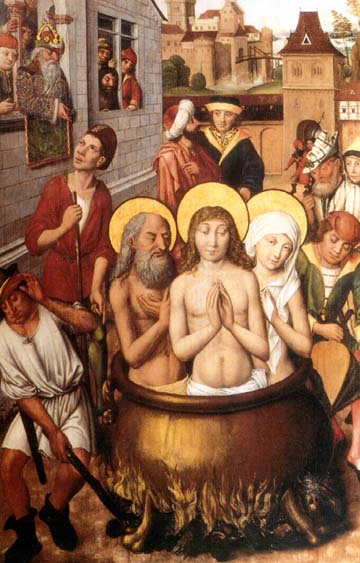
SAINTS VITUS, CRESCENTIA, and MODESTUS
Martyrs
Martyrs
Vitus was a child nobly born, who had the happiness to be instructed in the Faith, and inspired with the most perfect sentiments of his religion, by his Christian nurse, named Crescentia, and her faithful husband , Modestus.
His father, Hylas, was extremely incensed when he discovered the child's invincible aversion to idolatry; and finding him not to be overcome by stripes and such like chastisements, he delivered him up to Valerian , the governor, who in vain tried all his arts to work him into compliance with his father's will and the emperor's edicts. He escaped out of their hands, and, together with Crescentia and Modestus, fled into Italy. They there met with the crown of martyrdom in Lucania, in the persecution of Diocletian.
The heroic spirit of martyrdom which we admire in St. Vitus was owing to the early impressions of piety which he received from the lessons and example of a virtuous nurse. Of such infinite importance is the choice of virtuous preceptors, nurses, and servants about children.
Lives of the Saints, by Alban Butler, Benziger Bros. ed. [1894]
Antiphon
The hairs of your head are all numbered;
do not be afraid,
you are of more value than many sparrows.
do not be afraid,
you are of more value than many sparrows.
Grant to your Church, we beseech you, o Lord, through the intercession of your holy Martyrs, Vitus, Modestus and Crescentia, not to think high-mindedly, but to grow in humility pleasing to you; that, despising what is base, she may with unbounded love diligently do whatever is right.
[The Roman Breviary (1964)]
Saint Aurelian
Feastday: June 16
Death: 551
Saint Germaine Cousin
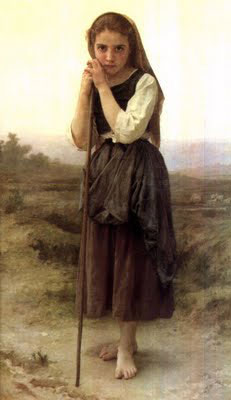
When Hortense decided to marry Laurent Cousin in Pibrac, France, it was not out of love for his infant daughter. Germaine was everything Hortense despised. Weak and ill, the girl had also been born with aright hand that was deformed and paralyzed. Hortense replaced the love that Germaine has lost when her mother died with cruelty and abuse.
Laurent, who had a weak character, pretended not to notice that Germaine had been given so little food that she had learned to crawl in order to get to the dog's dish . He wasn't there to protect her when Hortense left Germaine in a drain while she cared for chickens -- and forgot her for three days. He didn't even interfere when Hortense poured boiling water on Germaine's legs.
With this kind of treatment, it's no surprise that Germaine became even more ill. She came down with a disease known as scrofula, a kind of tuberculosis that causes the neck glands to swell up. Sores began to appear on her neck and in her weakened condition to fell prey to every disease that came along. Instead of awakening Hortense's pity this only made her despise Germaine more for being even uglier in her eyes.
Germaine found no sympathy and love with her siblings. Watching their mother's treatment of their half-sister, they learned how to despise and torment her, putting ashes in her food and pitch in her clothes. Their mother found this very entertaining.
Hortense did finally get concerned about Germaine's sickness -- because she was afraid her own childrenwould catch it. So she made Germaine sleep out in the barn. The only warmth Germaine had on frozen winter nights was the woolly sheep who slept there too. The only food she had were the scraps Hortense might remember to throw her way.
The abuse of Germaine tears at our hearts and causes us to cry for pity and justice. But it was Germaine's response to that abuse and her cruel life that wins our awe and veneration.
Germaine was soon entrusted with the sheep. No one expected her to have any use for education so she spent long days in the field tending the sheep. Instead of being lonely, she found a friend in God. She didn't know any theology and only the basics of the faith that she learned the catechism. But she had arosary made of knots in string and her very simple prayers: "Dear God, please don't let me be too hungry or too thirsty. Help me to please my mother. And help me to please you." Out of that simple faith, grew a profound holiness and a deep trust of God.
And she had the most important prayer of all -- the Mass. Every day, without fail, she would leave her sheep in God's care and go to Mass. Villagers wondered that the sheep weren't attacked by the wolves in the woods when she left but God's protection never failed her. One day when the rains had swollen the river to flood stage, a villager saw the river part so that she could cross to get to the church in time for Mass.
No matter how little Germaine had, she shared it with others. Her scraps of food were given to beggars. Her life of prayer became stories of God that entranced the village children.
But most startling of all was the forgiveness to showed to the woman who deserved her hatred.
Hortense, furious at the stories about her daughter's holiness, waited only to catch her doing wrong. One cold winter day, after throwing out a beggar that Germaine had let sleep in the barn, Hortense caught Germaine carrying something bundled up in her apron. Certain that Germaine had stolen bread to feed the beggar, she began to chase and scream at the child. As she began to beat her, Germaine opened her apron. Out tumbled what she had been hiding in her apron -- bright beautiful flowers that no one had expected to see for months. Where had she found the vibrant blossoms in the middle of the ice and snow? There was only one answer and Germaine gave it herself, when she handed a flower to her mother and said, "Please accept this flower, Mother. God sends it to you in sign of his forgiveness."
As the whole village began to talk about this holy child, even Hortense began to soften her feelings toward her. She even invited Germaine back to the house but Germaine had become used to her straw bed and continued to sleep in it. There she was found dead at the age of 22, overcome by a life of suffering.
With all the evidence of her holiness, her life was too simple and hidden to mean much beyond her tiny village -- until God brought it too light again. When her body was exhumed forty years later, it was found to be undecayed, what is known as incorruptible. As is often the case with incorruptible bodies of saints,God chooses not the outwardly beautiful to preserve but those that others despised as ugly and weak. It's as if God is saying in this miracle that human ideas of beauty are not his. To him, no one was more beautiful than this humble lonely young woman.
After her body was found in this state, the villagers started to speak again of what she had been like and what she had done. Soon miracles were attributed to her intercession and the clamor for her canonization began.
In this way, the most unlikely of saints became recognized by the Church. She didn't found a religious order. She didn't reach a high Church post. She didn't write books or teach at universities. She didn't go to foreign lands as a missionary or convert thousands. What she did was live a life devoted to God and her neighbor no matter what happened to her. And that is all God asks.
In Her Footsteps:
Do you make excuses not to help others because you have so little yourself? Share something this week with those in need that may be painful for you to give up.
Saint Germaine, watch over those children who suffer abuse as you did. Help us to give them the love and protection you only got from God. Give us the courage to speak out against abuse when we know of it. Help us to forgive those who abuse the way you did, without sacrificing the lives of the children who need help. Amen
The Second Letter to the Corinthians 6:1 As God’s fellow-workers we also urge you not to receive his grace and then do nothing with it. 2 For he says,
“At the acceptable time I heard you;
in the day of salvation I helped you.”[a]
3 We try not to put obstacles in anyone’s path, so that no one can find fault with the work we do. 4 On the contrary, we try to commend ourselves in every way as workers for God by continually enduring troubles, hardships, calamities, 5 beatings, imprisonments, riots, overwork, lack of sleep and food. 6 We commend ourselves by our purity, knowledge, patience and kindness; by the Ruach HaKodesh; by genuineness of love 7 and truthfulness of speech; and by God’s power. We commend ourselves through our use of righteous weapons, whether for pressing our cause or defending it; 8 through being honored and dishonored, praised and blamed, considered deceptive and sincere, 9 unknown and famous. And we commend ourselves as God’s workers headed for death, yet look! we’re alive! as punished, yet not killed; 10 as having reason to be sad, yet always filled with joy; as poor, yet making many people rich; as having nothing, yet having everything![Footnotes:
2 Corinthians 6:2 Isaiah 49:8]
Psalm 98:(0) A psalm:
(1) Sing a new song to Adonai,
because he has done wonders.
His right hand, his holy arm
have won him victory.
2 Adonai has made known his victory;
revealed his vindication in full view of the nations,
3 remembered his grace and faithfulness
to the house of Isra’el.
All the ends of the earth have seen
the victory of our God.
4 Shout for joy to Adonai, all the earth!
Break forth, sing for joy, sing praises!
The Holy Gospel of Jesus Christ According to Saint Matthew 5:38 “You have heard that our fathers were told, ‘Eye for eye and tooth for tooth.’[a] 39 But I tell you not to stand up against someone who does you wrong. On the contrary, if someone hits you on the right cheek, let him hit you on the left cheek too! 40 If someone wants to sue you for your shirt, let him have your coat as well! 41 And if a soldier forces you to carry his pack for one mile, carry it for two! 42 When someone asks you for something, give it to him; when someone wants to borrow something from you, lend it to him.[Footnotes:
Matthew 5:38 Exodus 21:24; Leviticus 24:20; Deuteronomy 19:21]
Monday of the Eleventh week in Ordinary Time
Commentary of the day:
Saint Irenaeus of Lyons (c.130-c.208), Bishop, theologian and martyr
Against the Heresies, IV, 13, 3 (cf. SC 100, p.531)
All this is not the deed of someone who abolishes the Law but of someone who fulfils and develops it for us (Mt 5,17). To serve freedom is an even greater service and our liberator puts forward an even deeper submission and devotion towards him. For he has not set us free from the obligations of the old Law to make us independent of himself... but so that, having received his grace yet more abundantly, we might love him all the more and, in loving him all the more, might receive an even greater glory from him when we are for ever in the presence of his Father.
____________________________
No comments:
Post a Comment