
"Lord, to whom shall we go? You have the words of eternal life."[John 6:68]
Thursday of the Twelfth week in Ordinary Time
Saints of the day:
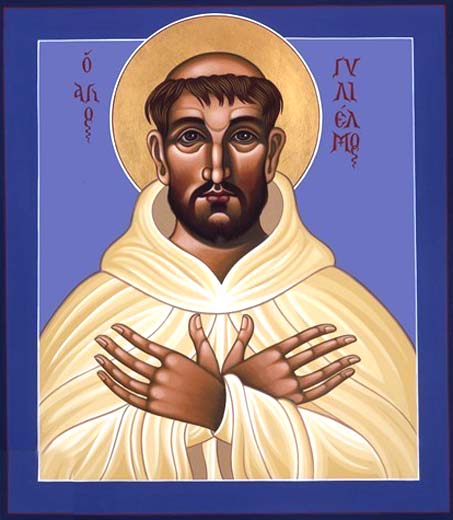
SAINT WILLIAM OF MONTE-VERGINE
Abbot
(+ 1142)
Abbot
(+ 1142)
St. William was born of noble parents at Vercelli. Having lost his father and mother in his infancy, he was brought up by his friends in great sentiments of piety; and at fifteen years of age, out of an earnest desire to lead a penitential life, he left Piedmont, his native country, made an austere pilgrimage to St. James's in Galicia, and afterward retired into the kingdom of Naples, where he chose for his abode a desert mountain, and lived in perpetual contemplation and the exercises of most rigorous penitential austerities.
Finding himself discovered and his contemplation interrupted, he changed his habitation and settled in a place called Monte-Vergine, situated between Nola and Benevento, in the same kingdom; but his reputation followed him, and he was obliged by two neighboring priests to permit certain fervent persons to live with him and to imitate his ascetic practices. Thus, in 1119, was laid the foundation of the religious congregation called de Monte-Vergine.
The Saint died on the 25th of June, 1142.
Lives of the Saints, by Alban Butler, Benziger Bros. ed. [1894]
SAINT PROSPER of AQUITAINE
(5th century)
(5th century)
St. Prosper was born at Aquitaine, in the year 403. His works show that in his youth he had happily applied himself to all the branches both of polite and sacred learning. On account of the purity and sanctity of his manners, he is called by those of his age a holy and venerable man.
Our Saint does not appear to have been any more than a layman; but being of great virtue, and of extraordinary talents and learning , he wrote several works in which he ably refuted the errors of heresy.
St. Leo the Great, being chosen Pope in 440, invited St. Prosper to Rome, made him his secretary, and employed him in the most important affairs of the Church. Our Saint crushed the Pelagian heresy, which began again to raise its head in that capital, and its final overthrow is said to be due to his zeal, learning, and unwearied endeavors.
Lives of the Saints, by Alban Butler, Benziger Bros. ed. [1894]Saints Jason & Sosipater
Saints of the Day: Sts. Jason and Sosipater
Apr 29, 2015
(Welcome to our Saint of the Day series! Each weekday, we present you with an excerpt from Fr. George Poulos' Orthodox Saints series, published by Holy Cross Orthodox Press. Today we commemorate Sts. Jasn and Sosipater, whose account is found in Volume 2 of the series.)
Saints Jason and Sosipater

The island of Kerkyra (Corfu) has attracted down through the ages any number of visitors, ranging from mainland marauders who envied its strategic proximity to the continent to peaceful lovers of nature who admired its great beauty. The island’s prominence was also an attraction to the early Christian missionaries, chief among whom were two men of such stature in the new faith of Jesus Christ that they are addressed by no less than the great St. Paul, who acknowledged their great service to the Savior. The two are Jason and Sosipater, who were assured immortality by mere mention in the New Testament but who offered far greater reason for their being venerated as saints.
In addition to St. Paul’s reference to this holy pair in his Epistle to the Romans which reads, “Jason and Sosipater, my kinsmen, salute you” (Romans 16:21), St. Luke says in reference to Jason in Acts (17:6), “And when they found them not, they drew Jason and certain brethren unto the rulers of the city, crying ‘These that have turned the world upside down are come hither also.’” Sosipater might well have been one of the brethren referred to, although he is not mentioned in this passage by name.
Having served with enthusiasm, both were rewarded by St. Paul with sees, Jason as bishop of Tarsus and Sosipater as bishop of Ikonion where, independent of each other, they implanted Christianity. Jointly serving St. Paul, then separately serving as bishops, they were rejoined in the common cause of bringing the word of Jesus Christ to the island of Corfu. With such a pair of devout preachers, the success of their mission in Corfu was assured, and within a short period of time, Christian converts were attending services in a church dedicated to the memory of the protomartyr St. Stephen.
At first disregarded by King Kerylinos, their spread of Christianity caused sufficient stir in the royal court that the two holy men were questioned by the king himself. Ignoring their case in the name of the Savior, the king ordered their imprisonment for insulting his pagan deity, and the two found themselves sharing the squalor of a dungeon with seven convicted felons. There the two holy men preached the word of Jesus convincingly enough to convert their fellow prisoners. The king greeted this disquieting bit of news with an order that all but the two holy men be put to death, sparing Jason and Sosipater as a matter of expediency in light of their popularity with a fraction on the island now to be reckoned with.
Seeking to disgrace them, the king had Jason and Sosipater dragged through the streets by a horse at a speed calculated to be slow enough to bruise them without killing them, a spectacle which was looked upon by the king’s daughter not as an act of shame but as an act of wretchedness on the part of her father. The daughter, aptly named Kerkyra, visited the hapless pair in their prison cell and was won over by them as a Christian convert, a conversion which was to cost her life. With mounting vengeance the king mounted a campaign against the Christians, even embarking on a voyage to another island to destroy Christians there, but a voyage that was doomed when his ship went down in a howling storm.
The succeeding king, Donatios, deemed it his royal duty to continue the course of persecution, and in an ill-considered decision to flaunt his authority, he ordered that Sosipater be put to death. It was presumed that Jason would follow his comrade in death, but the king decided to question the surviving partner first. A gnawing sense of guilt had precipitated the meeting of Jason and Donatios, after which the repentant monarch was himself converted to Christianity, bringing about official acknowledgement of the truth of Jesus Christ.
The body of Sosipater was entombed within the confines of a church on the island named after St. Andrew.
Not long after this, the twelve-year-old daughter of Donatios was stricken with a fatal illness, but after Jason had knelt in prayer she recovered. Jason continued to work for the Messiah until his death at the age of sixty on April 29, the day on which Sosipater had died for Christ.
Text from Fr. George Poulos' Orthodox Saints. Image from GoArch.org.
Tags: bishop, hcop, jason, martyr, saint of the day, sosipater
Apr 29, 2015
(Welcome to our Saint of the Day series! Each weekday, we present you with an excerpt from Fr. George Poulos' Orthodox Saints series, published by Holy Cross Orthodox Press. Today we commemorate Sts. Jasn and Sosipater, whose account is found in Volume 2 of the series.)
Saints Jason and Sosipater
The island of Kerkyra (Corfu) has attracted down through the ages any number of visitors, ranging from mainland marauders who envied its strategic proximity to the continent to peaceful lovers of nature who admired its great beauty. The island’s prominence was also an attraction to the early Christian missionaries, chief among whom were two men of such stature in the new faith of Jesus Christ that they are addressed by no less than the great St. Paul, who acknowledged their great service to the Savior. The two are Jason and Sosipater, who were assured immortality by mere mention in the New Testament but who offered far greater reason for their being venerated as saints.
In addition to St. Paul’s reference to this holy pair in his Epistle to the Romans which reads, “Jason and Sosipater, my kinsmen, salute you” (Romans 16:21), St. Luke says in reference to Jason in Acts (17:6), “And when they found them not, they drew Jason and certain brethren unto the rulers of the city, crying ‘These that have turned the world upside down are come hither also.’” Sosipater might well have been one of the brethren referred to, although he is not mentioned in this passage by name.
Having served with enthusiasm, both were rewarded by St. Paul with sees, Jason as bishop of Tarsus and Sosipater as bishop of Ikonion where, independent of each other, they implanted Christianity. Jointly serving St. Paul, then separately serving as bishops, they were rejoined in the common cause of bringing the word of Jesus Christ to the island of Corfu. With such a pair of devout preachers, the success of their mission in Corfu was assured, and within a short period of time, Christian converts were attending services in a church dedicated to the memory of the protomartyr St. Stephen.
At first disregarded by King Kerylinos, their spread of Christianity caused sufficient stir in the royal court that the two holy men were questioned by the king himself. Ignoring their case in the name of the Savior, the king ordered their imprisonment for insulting his pagan deity, and the two found themselves sharing the squalor of a dungeon with seven convicted felons. There the two holy men preached the word of Jesus convincingly enough to convert their fellow prisoners. The king greeted this disquieting bit of news with an order that all but the two holy men be put to death, sparing Jason and Sosipater as a matter of expediency in light of their popularity with a fraction on the island now to be reckoned with.
Seeking to disgrace them, the king had Jason and Sosipater dragged through the streets by a horse at a speed calculated to be slow enough to bruise them without killing them, a spectacle which was looked upon by the king’s daughter not as an act of shame but as an act of wretchedness on the part of her father. The daughter, aptly named Kerkyra, visited the hapless pair in their prison cell and was won over by them as a Christian convert, a conversion which was to cost her life. With mounting vengeance the king mounted a campaign against the Christians, even embarking on a voyage to another island to destroy Christians there, but a voyage that was doomed when his ship went down in a howling storm.
The succeeding king, Donatios, deemed it his royal duty to continue the course of persecution, and in an ill-considered decision to flaunt his authority, he ordered that Sosipater be put to death. It was presumed that Jason would follow his comrade in death, but the king decided to question the surviving partner first. A gnawing sense of guilt had precipitated the meeting of Jason and Donatios, after which the repentant monarch was himself converted to Christianity, bringing about official acknowledgement of the truth of Jesus Christ.
The body of Sosipater was entombed within the confines of a church on the island named after St. Andrew.
Not long after this, the twelve-year-old daughter of Donatios was stricken with a fatal illness, but after Jason had knelt in prayer she recovered. Jason continued to work for the Messiah until his death at the age of sixty on April 29, the day on which Sosipater had died for Christ.
Text from Fr. George Poulos' Orthodox Saints. Image from GoArch.org.
Tags: bishop, hcop, jason, martyr, saint of the day, sosipater
Blessed Jutta of Thuringia
June 25Blessed Jutta of Thuringia
(d. 1264?)
Today's patroness of Prussia began her life amidst luxury and power but died the death of a simple servant of the poor.
In truth, virtue and piety were always of prime importance to Jutta and her husband, both of noble rank. The two were set to make a pilgrimage together to the holy places in Jerusalem, but her husband died on the way. The newly widowed Jutta, after taking care to provide for her children, resolved to live in a manner utterly pleasing to God. She disposed of the costly clothes, jewels and furniture befitting one of her rank, and became a Secular Franciscan, taking on the simple garment of a religious.
From that point her life was utterly devoted to others: caring for the sick, particularly lepers; tending to the poor, whom she visited in their hovels; helping the crippled and blind with whom she shared her own home. Many of the townspeople of Thuringia laughed at how the once-distinguished lady now spent all her time. But Jutta saw the face of God in the poor and felt honored to render whatever services she could.
About the year 1260, not long before her death, Jutta lived near the non-Christians in eastern Germany. There she built a small hermitage and prayed unceasingly for their conversion. She has been venerated for centuries as the special patron of Prussia.

Feastday: May 5
Birth: 1200
Death: 1260
Widowed noblewoman of Thuringia, Germany, noted for visions and miracles. She married at fifteen and raised children. When her husband died on a pilgrimage to the Holy Land, Jutta moved to Prussia, becoming a recluse at Kulmsee. She is the patroness of Prussia, in eastern Germany.
Thursday of the Twelfth week in Ordinary Time
Book of Genesis 16:1 Now Sarai Avram’s wife had not borne him a child. But she had an Egyptian slave-girl named Hagar; 2 so Sarai said to Avram, “Here now, Adonai has kept me from having children; so go in and sleep with my slave-girl. Maybe I’ll be able to have children through her.” Avram listened to what Sarai said.
3 It was after Avram had lived ten years in the land of Kena‘an that Sarai Avram’s wife took Hagar the Egyptian, her slave-girl, and gave her to Avram her husband to be his wife. 4 Avram had sexual relations with Hagar, and she conceived. But when she became aware that she was pregnant, she looked on her mistress with contempt. 5 Sarai said to Avram, “This outrage being done to me is your fault! True, I gave my slave-girl to you to sleep with; but when she saw that she was pregnant, she began holding me in contempt. May Adonai decide who is right — I or you!” 6 However, Avram answered Sarai, “Look, she’s your slave-girl. Deal with her as you think fit.” Then Sarai treated her so harshly that she ran away from her.
7 The angel of Adonai found her by a spring in the desert, the spring on the road to Shur, 8 and said, “Hagar! Sarai’s slave-girl! Where have you come from, and where are you going?” She answered, “I’m running away from my mistress Sarai.” 9 The angel of Adonai said to her, “Go back to your mistress, and submit to her authority.” 10 The angel of Adonai said to her, “I will greatly increase your descendants; there will be so many that it will be impossible to count them.” 11 The angel of Adonai said to her, “Look, you are pregnant, and you will give birth to a son. You are to call him Yishma‘el [God pays attention] because Adonai has paid attention to your misery. 12 He will be a wild donkey of a man, with his hand against everyone and everyone’s hand against him, living his life at odds with all his kinsmen.”
15 Hagar bore Avram a son, and Avram called the son whom Hagar had borne Yishma‘el. 16 Avram was 86 years old when Hagar bore Yishma‘el to Avram.
Psalm 106:1 Halleluyah!
Give thanks to Adonai; for he is good,
for his grace continues forever.
2 Who can express Adonai’s mighty doings
or proclaim in full his praise?
3 How happy are those who act justly,
who always do what is right!
4 Remember me, Adonai, when you show favor to your people,
keep me in mind when you save them;
5 so I can see how well things are going
with those whom you have chosen,
so that I can rejoice in your nation’s joy,
and glory in your heritage.
The Holy Gospel of Yeshua the Messiah Accordint to Saint Matthew 7:21 “Not everyone who says to me, ‘Lord, Lord!’ will enter the Kingdom of Heaven, only those who do what my Father in heaven wants. 22 On that Day, many will say to me, ‘Lord, Lord! Didn’t we prophesy in your name? Didn’t we expel demons in your name? Didn’t we perform many miracles in your name?’ 23 Then I will tell them to their faces, ‘I never knew you! Get away from me, you workers of lawlessness!’[Matthew 7:23 Psalm 6:9(8)]
24 “So, everyone who hears these words of mine and acts on them will be like a sensible man who built his house on bedrock. 25 The rain fell, the rivers flooded, the winds blew and beat against that house, but it didn’t collapse, because its foundation was on rock. 26 But everyone who hears these words of mine and does not act on them will be like a stupid man who built his house on sand. 27 The rain fell, the rivers flooded, the wind blew and beat against that house, and it collapsed — and its collapse was horrendous!”
28 When Yeshua had finished saying these things, the crowds were amazed at the way he taught, 29 for he was not instructing them like their Torah-teachers but as one who had authority himself.
Thursday of the Twelfth week in Ordinary Time
Commentary of the day:
Philoxenes of Mabbug (?-c.523), Bishop in Syria
Homily 1, 4-8
But assiduously reading, listening to and meditating on the word of God without putting it into practice is a fault, which the Spirit of God condemned in advance… He even forbade the person with such a disposition to take the holy book into his hands. God says to the wicked: “Why do you recite my statutes, and profess my covenant with your mouth, though you hate discipline and cast my words behind you?” (Ps 50:16-17) … The person who assiduously reads the Scriptures without putting them into practice is accused by his reading; he deserves all the more serious condemnation because every day he despises and scorns what he hears every day. He is like a dead person, a corpse without a soul. You can blow thousands of trumpets and horns next to the ears of a dead person, he won’t hear them. In the same way, the soul that is dead in sin, the heart which has lost the memory of God, does not hear the sound or the cries of the divine words, and the trumpet and the spiritual word make no impression on him. That soul is plunged in the sleep of death…
Thus, God’s disciple must have anchored in his soul the memory of his Master, Jesus Christ, and he must think of him day and night.
____________________________Thus, God’s disciple must have anchored in his soul the memory of his Master, Jesus Christ, and he must think of him day and night.


No comments:
Post a Comment