Editor's Note:
Dear Friend,
Every complete lifetime is lived in three stages—childhood, adolescence and adulthood—and the Torah’s wisdom, from the practical to the esoteric, is an extended guide to how we and our children can most meaningfully navigate through each stage of life.
At its core, childhood is marked by dependence, adolescence by independence, and adulthood by interdependence.
This week we read the story of the spies—twelve elders and leaders who were dispatched to the Land of Canaan and returned with a report that predicted complete failure—a conclusion that led to the rebellion of thousands. At the root of the spies’ complaint was the fact that they really didn’t want to grow up and grow the world. They wanted to continue to live entirely spiritual lives as man-children, where everything was handed to them from Above, where they would not be called on to use their effort and creative intelligence to proactively improve and perfect the world in which they lived.
The subsequent rebellion of the masses against, Moses, Aaron, the Torah's promises, even G‑d Himself, was a model of irrational adolescent behavior, an obstinate, thoughtless rejection of that which they needed and would always need.
It’s a good reminder that a joyous, fulfilled, adult life can only result by happily embracing what we truly need in life—G‑d, the Torah, and each other—so we can interdependently raise up the world.
Yaakov Ort
on behalf of the Chabad.org Editorial Team

The Taller They Are . . .
You might think that divine sparks are meted out by simple protocol: The lowlier the creation, the lowlier the divine spark it holds.
Just the opposite: Only the highest sparks could descend to the lowest places and retain their power to sustain a being.
Those are the sparks remaining to be rescued today.
Likkutei Torah, Tzav 13b and Re’eh 19c. Maamar Beshaah She’alah 5729:6
This Week's Features:
Printable Magazine

Q&A: 35,000 Hospital Visits Later, a Chicago Volunteer’s Continued Dedication
Unassuming visits to the sick influence lives in unexpected ways by Menachem Posner


VIDEO

What Was Written on the 2,700-Year-Old Scroll?
What is our task as Jews?
By Dov Greenberg
 Watch (3:23)
<script language="javascript" type="text/javascript" src="http://embed.chabad.org/multimedia/mediaplayer/embedded/embed.js.asp?aid=2939778&width=auto&height=auto"></script><span style="clear:both;" class="lb" id="lbdiv">Visit <a href="http://www.chabad.org/multimedia/default_cdo/aid/591213/jewish/Video.htm">Jewish.TV</a> for more <a href="http://www.chabad.org/multimedia/default_cdo/aid/591213/jewish/Video.htm">Jewish videos</a>.</span>
More in Video:
• Practical Halachah: Shabbat Candles - The Laws of Shabbat(By Rabbi Yosef Shusterman)
Q&A: 35,000 Hospital Visits Later, a Chicago Volunteer’s Continued Dedication
Unassuming visits to the sick influence lives in unexpected ways by Menachem Posner
Chicago resident Marcy Goldberg has been directing a chapter of LubavitchChabad of Illinois’ hospital visitation program near her home for 26 years now. During the course of a detailed conversation, a great deal about the inspiration of this energetic and deeply compassionate woman came to life.
Q: How did you first get involved in hospital visitation?
A: In 1990, I had a life-changing conversation with the late Rabbi DanielMoscowitz, whom I had known for many years and who had been a profoundly positive influence on me. I said that I knew Chabad has a visitation program onerev Shabbat in some suburban and Chicago hospitals, and that I’d like to visit patients at Northwestern Memorial Hospital, near my home in downtown Chicago.
RELATED
With a twinkle in his eye, he told me “absolutely,” and, by the way, since that hospital did not have a program yet, that I should contact the hospital’s chaplain, set one up, raise the funds and find the volunteers! He also told me where to order challah rolls and individual grape-juice bottles.
I thought I was signing up to make deliveries every Friday or maybe pack gift bags. Instead, I found myself raising money, recruiting volunteers, speaking to chaplains and running the whole program. That’s how Rabbi Moscowitz was. He had this ability to get you to do more than you knew you were capable of.
Goldberg credits the late Rabbi Daniel Moscowitz as being "a profoundly positive influence on me."
I made an announcement in my synagogue asking for volunteers. Some wonderful people came forward; some of whom are still involved to this very day. Mike Cherry—whom I knew from a couples’ class with Rabbi Moscowitz that I hosted and he attended—wrote a check to cover the first few months’ supplies. We prepared pretty bags to hold the challah and juice, and added a ‘Get Well’ card. A young man named Jeff Aeder volunteered to make some deliveries and brought his friend,Menahem Deitcher, to make deliveries, too, and ended up doing much more than that. I remember the time a mental hospital called and asked if we could send someone to conduct a Passover seder for their patients. Jeff had a date for that seder night, so he took her with him to conduct a seder in a mental hospital. Today, married with teens, he is still an integral part of funding the program—not only by writing a check, but also by getting others to do thatmitzvah as well.
Many of the other volunteers have also been a blessing in my life. How can I not be inspired by Lena Mendelsohn, then in her 80s, who used to come every week with her walker to pack bags? Of course, Rabbi Moscowitz, and now his son, Rabbi Meir Moscowitz, have been supportive in a number of ways throughout the decades.
Q: What’s it like visiting people, some of whom are very ill, before Shabbat? What kind of response do you receive?
A: Every visit is different. One of the very first weeks, I remember walking into a room and seeing a woman who was very close to death. I introduced myself and told her I was with Lubavitch Chabad, wishing her a ‘Shabbat Shalom.’ She just threw her arms around me. When you are in a hospital, there are so many people coming into the room for so many reasons—tests, shots, medicines and other things—but we are just coming to visit them. You connect on a very primal human level.
A hospital visit by Lubavitch Chabad volunteers back in the 1980s in Highland Park, on the North Shore of the Chicago metropolitan area.
Another time, I came into a room in the Rehabilitation Institute of Chicago and saw a man wearing akipah. I soon realized that he was a stroke victim, and was probably not able to speak or eat the food I brought. I spoke to him for a few minutes and was out the door. When I was down the hall, I heard him say “thank you.” It took him that long to get the words out. Of course, I went back to his room to tell him, “You’re welcome.”
There was another woman whom I would see every week. One week, she responded in kind to my “Shabbat Shalom.” I was then told that it was the first thing she had said in months. You just never know …
People often relish the Jewish connection and discuss whatever Jewish ideas associations they may have with me. I once visited a woman who was in the hospital with her husband. We chatted, and she told me how much she just wished she could have some poached salmon. I told her I had just made some at home, and that she had nothing to worry about since Rabbi Moscowitz had koshered my kitchen. Sure enough, I brought her some fresh poached salmon. She was just thrilled.
For the most part, it’s simply a matter of telling people that we are there, we recognize them and what they are going through, and that we care about them as a part of the extended Jewish family.
The truth is that I myself did not realize how special it was until my father was ill in Detroit and Rabbi Moscowitz arranged for Rabbi Herschel Finman, a colleague from Chabad in Michigan, to visit me there. It was such a nice feeling, and Rabbi Finman became a person close to our family, officiating at funerals and simchas [happy occasions].
Q: Looking back, how many visits do you think you and your volunteers have made?
Jessica Schwartz, who volunteers as part of Goldberg’s group, gives challah to a hospital patient.
A: It’s really impossible to know, but we estimate that we’ve made as many as 35,000 visits. Every week is different, but we may average two dozen bags a week. Also, we’ve gone to a number of different hospitals and facilities through the years. For example, right now, the Rehabilitation Institute of Chicago asks us to supply them with packages but arranges for their own volunteers to do the visiting. Through the years, our volunteers have visited other hospitals weekly, such as Mitchell Hospital at the University of Chicago and at Columbus Hospital.
Q: Our conversation began with you offering to Rabbi Moscowitz to help with hospital visits. How did you meet him, and what got you interested in this kind of volunteering?
A: I grew up in Detroit in a home that I’d describe as Reform. I went to Sunday school through confirmation, but I cannot say it was very inspiring.
In 1963, when it came time for college, my parents drove me to Evanston, north of Chicago, where I was to attend Northwestern University. It was the morning before Rosh Hashanah, and I promised my mother that I’d attend services that evening. Well, I went to Hillel, and there was nowhere to sit, no spare books; I could not even get into the room where services were being held, and I was hot and uncomfortable in my holiday clothing. I closed my eyes and told G‑d, “I believe in You, but I will no longer attend synagogue services that I find meaningless.” I walked out thinking I would never attend synagogue again.
But then, you know the Yiddish saying: “Man plans and G‑d laughs.”
I got married in 1968 and before I knew it, we needed a place to send our daughter, Rachel, for preschool. I was—and still am—in the life-insurance business, where I met a fine couple, Cantor William and Judy Silber, who have been involved with the Chabad community for a long time. Judy suggested that I send her to a traditional Jewish preschool. I told her, “But I don’t light candles or do anything like that.” She told me it was no problem, and that I should send her anyway; Rachel would learn about the holidays, a few songs, maybe even a little Hebrew.
Schwartz with another patient. The note on the challah bag says: “A get well wish from Chabad.”
Whenever my daughter learned about a new mitzvah or holiday at school, I learned as well. I remember thinking, “I hated Hebrew school, and now my daughter is loving her Jewish education.” We kept her in all the way through high school.
At the same time, my husband and I were becoming more and more involved in Jewish leadership and developed a relationship with a very young rabbi named Daniel Moscowitz, who actually led a couples’ group in our home. At one point, I asked myself: “How can I be a leader of the Jewish community and yet every Jew cannot eat in my home?” It was then that we decided to kasher our home; it was also a way to have our child remember, at least three times a day, that she was Jewish. With intermarriage rates at 58 percent, we realized how important it was, while Rachel lived at home with us, to emphasize a Jewish lifestyle.
Rabbi Moscowitz came over with a group of guys to kosher the kitchen. Then, on the way out, almost as an afterthought, he said: “You know, in order to keep your kitchen kosher, you need to make sure not to cook in these pots and pans on Shabbat or holidays.” That was that. We’ve kept kosher and Shabbat ever since. And our 10-year-old daughter loved it; she invited friends to sleep over every Shabbat and commented: “It’s like a having a birthday party once a week—something special to celebrate!”
In fact, Shabbat was a major influence in my life in the most unexpected way.
Around 13 years ago, I began tutoring a first-grader named Jeremiah from the crime-ridden Cabrini-Green housing project. At the end of the year, he was going to flunk because he was absent so much. I spoke to school administrators and told them I would tutor him in the summer and help him get up to grade level so that they could pass him.
Goldberg with Sha’La, whom she's been caring for and wants to see graduate from medical school.
Progress was slow, and I asked his mother if Jeremiah could stay over at my house on Friday nights since I couldn’t drive to the project where he lived to tutor him on Shabbat. Since age 6, Jeremiah has spent every Shabbat of his life at my dinner table. I became very involved in his life and in the lives of his three siblings. At one point, they moved to the South Side of Chicago. I did my research and found that one public school there was testing in the 43rd percentile in reading and math in Illinois achievement tests, and the other school’s students were testing in the 17th percentile. Of course, their address was closer to the school in the 17th percentile. I drove over to South Shore on a Friday afternoon, just hours before Shabbat, to try to get the kids into the better school. I ended up renting a one-bedroom apartment in the district with the better school—and it worked. By Monday morning, I had the lease papers, and the kids were enrolled.
When Jeremiah was 12, he and two of his siblings moved into my house for seven years. At that time, his father was in prison and his mother, who was morbidly obese, was in bed a lot of the time.
One day when I was visiting my daughter—who’s been living in Israel with her husband and children for the past seven years—I received a call from the siblings to tell me that Jeremiah’s 13-year-old brother was a father. The mother was 15. Their little girl, named Sha’La, began coming for Shabbat with her dad. When she was around 3, I noticed that whenever I read to her, her attention span disappeared, and I sensed that it was because she spent many hours watching videos while her grandmother slept. The last three years she has been living with me, doing beautifully in school and has made lots of friends. I say that having a little girl at home at my age is keeping me young and making me old all at once!
Jeremiah and his siblings all got their education and have steady jobs—something that no one would have predicted years ago.
I thought I would be living in Israel by now, but I feel I need to stay here until Sha’La, who’s 6, at least finishes medical school. G‑d works in mysterious ways.
Marcy Goldberg in a family photo with her daughter, Rachel, center right, her son-in-law JonathanPolin and grandchildren Hersh, 14; Leebie, 12; and Orly, 9. In front is 6-year-old Sha’La, who lives with Goldberg.
Tribute to Rabbi Binyomin Klein, Longtime Aide to the Rebbe
| ||||||||||||||||||||||||||||||||
Rabbi Yerachmiel Binyomin Halevi Klein, who discreetly served as a longtime personal aide to the Lubavitcher Rebbe—Rabbi Menachem M. Schneerson, of righteous memory—and as a liaison to Israeli political, social and security leadership, passed away early Friday morning in New York. He was 79 years old.
The rabbi was born in Jerusalem in 1935. His father, Rabbi Menachem Klein, was a respected Torah scholar; his mother, Rachel, died shortly after giving birth—similar to Rachel, the wife of Jacob, he would say. He was named Yerachmiel after his mother, and Binyomin, like Rachel’s son. As a young man, he excelled in his studies at Torat Emet, the Chabad yeshivah in Jerusalem. As early as 1951, he remembers eagerly asking a visitor from Brooklyn, N.Y., about the Rebbe and being told: “Lubavitch is royalty.” In 1956, he left Israel for the Crown Heights neighborhood of Brooklyn to study at the Central Chabad Yeshivah, and once there, developed what would become a lifelong bond with the Rebbe. When he arrived, the Rebbe sent a group of students to greet him at the airport. The following Shabbat at the weekly farbrengen, the Rebbe shared food at his table with him, a rare distinction. Literature, Inspiration and ConnectionRabbi Klein threw himself into organizing Chabad’s fledgling educational activities, including Mesibos Shabbos, which gathered young people together on Saturday afternoons for an hour or two of Jewish education, inspiration and entertainment. He traveled extensively as part of the Merkos Shlichus “Roving Rabbis” program, sweeping through many Western states, in addition to Cuba, South America and other locales, bringing Jewish literature, inspiration and a connection to Jewish life to many isolated Jewish communities and individuals.In some instances, the Rebbe was intimately involved in planning the itineraries and other details of these trips. 
Leading communal prayers at 770 Eastern Parkway in the Crown Heights neighborhood of Brooklyn, N.Y., near the Rebbe—Rabbi Menachem M. Schneerson, of righteous memory.
The young couple was subsequently dispatched by the Rebbe to Melbourne, Australia, where the rabbi was among the founders of the Yeshivah Gedolah of Australia and New Zealand. Shortly afterwards, in 1963, he returned to New York. At the Rebbe’s suggestion, he joined the Rebbe’s secretariat as an aide to Rabbi Chaim Mordechai Aizik Hodakov, the Rebbe’s chief of staff. His duties included ushering visitors in and out of the Rebbe’s study on certain nights. On a daily basis, Rabbi Klein would bring people’s queries and communications to the Rebbe and then reply with the Rebbe’s responses. There were also designated times when he would serve as the Rebbe’s driver. A native Hebrew speaker, Rabbi Klein developed close connections over the years with leaders of every branch of Israel’s political, military and security leadership, who regularly sought the Rebbe’s counsel. Even decades later, he was famously tight-lipped about the Rebbe’s extensive dealings with them. He was once asked why he never kept a diary detailing the many events he was privy to in the Rebbe’s court. “When bringing people’s life questions to the Rebbe,” the rabbi replied, “one needs to come with a completely blank slate, with nothing else in mind.” In his quiet and unassuming manner, he also helped people financially, without them knowing, and offered wise advice to many. The Klein home—just a few doors down from 770—was open to visitors from all streams of life. Spiritual seekers, social leaders and people hungry for a hot meal and a warm word of comfort knew they were welcome there. Even after the Rebbe’s passing in 1994, Rabbi Klein continued to spend many hours his office at Lubavitch World Headquarters and visited the Ohel every day, except for Shabbat and holidays. 
Rabbi Klein with the Rebbe in Brooklyn, N.Y.
He served as a board member of Machne Israel—the social-services arm of the Chabad-Lubavitch movement—and for many years led Kollel Menachem, the institution for advanced Torah study for married men in Crown Heights. The rabbi passed away in his sleep on Friday morning. In addition to his wife, he is survived by his children, all of whom are Chabad-Lubavitch emissaries: Rochel Gordon (London); Faige Sudak (London); Chanie Garelik (Brooklyn, N.Y.); Shternie Krinsky (Manchester, N.H.); Rabbi Levi Klein (Memphis, Tenn.); Esther Hadassah Ciment (Little Rock, Ark.); Rivka Grossbaum (Minnetonka, Minn.); Devora Schmerling (Queens, N.Y.); Miriam Moscowitz (Northbrook, Ill.); and Rabbi Yaakov Klein (Moscow). The funeral is scheduled for Friday afternoon at 3 p.m. at Shomrei Hadas Chapel, 3803 14th Ave. in Brooklyn. The procession will pass by Lubavitch World Headquarters at 770 Eastern Parkway at 4 p.m. Rabbi Klein will be laid to rest near the Rebbe at the Old Montefiore cemetery in Queens, N.Y. 
Rabbi Klein, center, joined the Rebbe's secretariat as an aide to Rabbi Chaim Mordechai Aizik Hodakov, left, the Rebbe's chief of staff.

At an early farbrengen with the Rebbe.

Handing over a bag of gifts and momentos people had given to the Rebbe during Sunday "dollars distribution."

Rabbi Klein is in the background, center right, at an early Mesibos Shabbos rally.
© Copyright 2015, all rights reserved.
| ||||||||||||||||||||||||||||||||
Tribute to Rabbi Binyomin Klein, Longtime Aide to the Rebbe
My relationship with Rabbi Binyomin Klein | ||||||||||||||||||||||||||||||||
I was a junior in college when I decided to spend my year in Israel studying abroad. It was an intense time on many levels. A major disagreement with my parents had resulted in almost a year with no contact. I was financially independent and struggled to support myself. I was working 40 hours a week in a hostile environment while taking a full load of courses. And I was seriously exploring, for the first time in my life, who I was, where I came from and where I wanted to go.
During my search, I had started to learn and connect with chassidic philosophy, and had been introduced to the teachings of the Lubavitcher Rebbe, Rabbi Menachem Mendel Schneerson. As a student of literature, I was astounded by the depth of meaning and symbolism that his teachings offered, and the way foundational and conceptual ideas in Jewish philosophy had such profound relevance to my 20-year-old self. I was filled with questions. Pained by turbulence in my relationships. And overall in need of guidance and direction. I had hit a crossroads. I desperately wanted to stay in Israel and continue my Jewish exploration. But I had only one year left to graduate. As short as a year is, at the time it seemed like an eternity, and I didn’t necessarily trust myself in an environment that had created more confusion and questions than stability. It was suggested that I write to the Rebbe for advice. I had never met the Rebbe, but felt a very strong connection. I knew he knew me. I knew he would understand and give me guidance that I desperately needed. And so I wrote my first letter. I don’t remember all the details, but I explained my situation and asked for advice. My main question was whether I should stay in yeshivah at that point and continue my Jewish learning, or return to college and attain my degree. While I was visiting Crown Heights, I handed my letter to Rabbi Binyomin Klein, one of the Rebbe’s secretaries. The second I saw him, I liked him. He had these warm brown eyes, and his smile was welcoming with an “I totally get you” type feeling. I gave him my letter, and was told that he would be in contact after the Rebbe responded. A few weeks went by. I wasn’t exactly sure how the process worked, but I was worried that maybe my letter had been forgotten. So I went to 770 to find Rabbi Klein and follow up. When he saw me, he started excitedly saying that he had been looking all over for me and couldn’t find me. Then, in his humorous way, he reminded me that when I wrote the Rebbe I never included my personal information, such as my name or phone number. He was laughing as he gently reminded me: “The Rebbe knows who you are! But you need to include your details for me. I don’t know who you are!” Now, by the time I came for my response, my circumstances had greatly changed. There were a few months before my second quarter started at college, and my plan was to return to California and live with the family of the Chabad emissaries near my parents’ home. However, by the time I came to meet with Rabbi Klein, I had discovered that the only way I could return for my second quarter was if I agreed to live at home. As we had not been on speaking terms for so long, and I knew my parents were less than thrilled with my interest in living an observantly Jewish life, I did not think living at home was a wise move. To put it lightly. Rabbi Klein, however, did not know that there was this update, and immediately began to tell me that the Rebbe was adamant that I return back to California and get my college degree. As he put it, I was to “finish what I started.” Now, half of my dilemma was solved with this advice, as having that guidance and support to return to college was exactly what I needed to believe it was the right move. However, being that this plan required moving back home first, that was the part that I didn’t know how to handle. I started to explain that I couldn’t go back home. I needed Rabbi Klein to ask the Rebbe again with my new circumstances explained. There was simply no way the Rebbe would send me back to California knowing what I now knew to be the situation. But Rabbi Klein was insistent. He said he had never seen the Rebbe so clear in a response. There was no question in his mind that the Rebbe wanted me to return. I tried again to say that it wasn’t so simple. Now, generally I can be fairly calm and eloquent when trying to make a point. But for whatever reason, before I knew it, I was on the verge of sobbing. I started to say that I really needed him to ask again, when out of nowhere the wellsprings opened and I was full-on bawling. Not crying. But completely shaking and hyperventilating, with tears pouring down my face. I was a mess. Literally. Poor Rabbi Klein had not signed up for this. We stood in his office, and he wasn’t exactly sure what to do with this hysterical girl. At first he tried to console me with words, but it wasn’t working. I recall other rabbis entering his office, only for him to shoo them away to give me the privacy I needed. He then grabbed a box of tissues and handed me one after another while I tried to gain some sense of composure. This was not a quick breakdown. I kept going for quite some time before I could even catch my breath to use my words again. Rabbi Klein did not know me. I certainly did not come across as terribly stable in this incident, and yet he stood there, giving me all the time I needed, handing me tissues and telling me things would be okay, as if nothing else was on the calendar of one of the busiest men in Crown Heights, none other than the personal secretary of the Rebbe. When I eventually calmed down, Rabbi Klein assured me that the only reason he didn’t feel the need to ask the Rebbe again was because he was confident that the Rebbe’s advice still applied. But then he gave me his contact information. He told me that if for any reason I found myself in California and crying like this, I was to give him a call, and he would personally pay for my plane ticket back to Crown Heights. He made it clear that he would take care of me. And take care of me he did. I returned to California. I moved back in with my parents, and while challenging, it was an important part of the much-needed reconciliation. Then I returned to college at UCSD, a few hours south of my parents’ home in Los Angeles. It was a few weeks later when it became pretty apparent why the Rebbe was insistent that I return back to California. While an entire story in itself, the brief version is that because I was returning to school, my family decided to spend the first long weekend of my return with me in the gorgeous area of La Jolla near my campus. It was the end of January 1994, and they were staying at a hotel when the earth shook violently. We soon discovered that one of the largest earthquakes to ever hit California had just taken place in Northridge. Northridge, the town where my parents lived. Their very intersection was the epicenter of this quake. Weeks later, when it was finally safe to return and survey the damage, it became clear that had my family been home at the time, they might not have survived the quake. Our house was totaled. The damage was unbelievable. And yet everyone was safe and sound. Because they were visiting me in college. Because I had returned back to college from New York. Because the Rebbe had guided me to. And when I hadn’t wanted to listen, Rabbi Klein insisted. Because he told me it would be okay. He was right. Soon after graduation I moved to Crown Heights, this time to dedicate myself full-time to my Jewish studies. Rabbi Klein’s home became a second home to me. I would spend many a Shabbat meal there, and soon became very close with one of his daughters as well. It was actually in her home, a few years later, that I met my husband. Every time Rabbi Klein would see me he would smile and ask if I was okay and if I needed a tissue. He was always joking, and yet through his humor could get to the deepest part of an issue or concern. My Hebrew birthday is the second day of Sukkot, and he would always insist that I come by to celebrate. One year there was even a cake waiting when I entered his sukkah. Rabbi Klein and his wife, Laya, always made me feel like I was their most important guest. They were so excited when I entered, and treated me with such love, care and focus. When I moved to Israel soon after getting married, they called me up when they were visiting and had me come see them in Jerusalem. Even when years would go by and we wouldn’t see each other, if I called they would know me by my voice, before I could even introduce myself. Sure enough, it was Rabbi Klein who then didn’t need my name to know who I was. It has been just over 21 years from my first meeting with Rabbi Klein. Last year I was fortunate enough to spend a Shabbat with the Kleins, and stayed in their home. This past Sunday I was in Crown Heights for just a few hours before taking a train back to our home in Vermont. I didn’t have any time to visit people, and no one knew I was there. But I did make sure to stop by the Kleins. I was immediately welcomed by Mrs. Klein, who is always so calm, composed and positive. She joked about how she still quotes something I told her right after I got married 18 years ago. She asked about my kids, our move to Vermont, and as always was uplifting and supportive. I asked how Rabbi Klein was doing. She answered, “yom, yom,” day by day. It wasn’t the answer I was hoping to hear, but I didn’t want to pry. I had heard rumors that he hadn’t been well, but did not know too many details. I asked her to please send him my warmest regards. And I left. It is now less than a week later. I am once again on the same train, this time back to New York City. I just opened a news site when I saw the article. There was his picture. And above it the words Baruch Dayan Ha-Emet, “Blessed is the True Judge.” I had to stop myself from screaming “NOOOOO!” on the train. So I sit here and type and cry. The world has lost such an unbelievable soul. He has left behind so many children, grandchildren and great-grandchildren, and a generation that he has impacted and uplifted. And yet, as devastated as I am, through my tears I also smile. Because when I close my eyes I see his face, with the warmest, most loving smile, and hear his voice as he asks: “Nu, do you need a tissue?”
Sara Esther Crispe, a writer,
© Copyright 2015, all rights reserved.
| ||||||||||||||||||||||||||||||||
Your Questions
| ||||||||||||||||||||||||||||||||
 Question:Can you shed some light on the custom of covering mirrors in a house of mourning? I was told that after the funeral of an immediate relative, we cover all mirrors in the home for the seven days of mourning. I have heard that the reason is that we are not supposed to adorn ourselves while in mourning, but I am looking for a deeper explanation.Answer:The Kabbalists give a more spooky reason for covering mirrors in a house of mourning. They write that all types of evil spirits and demons come to visit a family in mourning. When a soul leaves this world, it leaves a void, an emptiness that is prone to be filled by dark forces. This is because wherever there is a vacuum, negativity can creep in. And so the house of mourning, the place where the loss is felt the most, is a magnet for evil spirits.These demons cannot be seen by the naked eye. But when looking in a mirror, you may catch a glimpse of their reflection in the background. And so we cover the mirrors in a house of mourning because we don’t want to be alarmed by seeing these demonic visitors. Before we dismiss this idea as mythical nonsense, let’s try to understand it in terms we can relate to. Perhaps the idea of evil spirits can be interpreted on a psychological level: evil spirits can be thought of as inner demons. The ghosts that visit a mourner are regret, guilt and anger. When people who are grieving take a hard look at themselves in the mirror, they often feel that they didn’t do enough for the departed, or that they didn’t say all they wanted to say, or that there are some loose ends, some unfinished business. Even if this is not really the case, even if they were exemplary sons or daughters, parents or spouses or siblings, our minds tend to play tricks, and we agonize over what could have been. These thoughts are the evil spirits that haunt the grieving, giving them no rest. So we cover the mirrors. We don’t want to look at those dark figures lurking behind us in the mirror. At a time of such raw emotion, when the loss is fresh and the heart is volatile, there is no room for harsh self-judgment. If there are unresolved issues, there will be time to deal with them later. But in the week immediately following the loss, we focus on the loss itself. The grieving process takes us on a bumpy journey of many mixed emotions. Every emotion needs its time to be felt. But in the midst of that bumpy ride, we are not in a position to judge ourselves fairly. Taking a long hard look at ourselves in the mirror is often a valuable exercise. But it has to be done when there are no ghosts lurking in the background.1
Aron Moss is rabbi of the Nefesh Community in Sydney, Australia, and is a frequent contributor to Chabad.org.
© Copyright 2015, all rights reserved.
| ||||||||||||||||||||||||||||||||
Your Questions
| ||||||||||||||||||||||||||||||||

The simplest answer is that the verse states, “You shall make yourself twisted threads, on the four corners of your garment with which you cover yourself.”1
But why four? Tallit and the ExodusImmediately following the commandment of the tallit, the Torah states, “I am the L‑rd, your G‑d, who took you out of the land of Egypt to be your G‑d . . . ,”2thereby linking this mitzvah to the Exodus.Rabbi Shlomo Yitzchaki (Rashi) quotes a teaching3 that the corners of the tallit are alluded to in a verse describing the Exodus: “I carried you on the wings (כַּנְפֵי) of eagles.”4 The word kanaf, “wing,” can also mean “corner.” As for why there are specifically four corners, Rashi goes on to explain that they correspond to the four expressions of redemption associated with the Exodus: “I will take you out . . . I will save you . . . I will redeem you . . . I will take you . . .”5 But what does the tallit have to do with the Exodus? Tallit Equal to All the MitzvahsThe Torah tells us that the purpose of the tallit is to remind us of all the mitzvahs.6 The Midrash shares a fascinating insight into why this is so. Each letter in the Hebrew alphabet has a corresponding numerical value. The numerical values of the five letters that comprise the Hebrew word tzitzit (the tassels on the corners of the tallit) add up to 600:09 = צ 01 = י 09 = צ 01 = י 004 = ת Add the eight strings and five knots of each tassel, and the total is 613, the exact number of mitzvahs there are in the Torah.7 Additionally, our sages tell us that affixing and wearing tzitzit on the tallit is equal, in a certain sense, to all of the mitzvahs of the Torah (similar to what is said regarding idolatry and Shabbat).8 G‑d introduced the Ten Commandments (and by extension, all of the commandments) with the words "I am the L‑rd, your G‑d, who took you out of the land of Egypt.”9 G‑d is not some distant creator of the universe who is giving us commands. Rather, He gives us the mitzvahs as our personal and caring G‑d, the G‑d who took us out of Egyptian bondage and claimed us as His nation.10Furthermore, G‑d is telling us that our bond is a supra-natural bond, forged by the miracles He performed for us in Egypt.11 It is for this reason that a tallit must have four corners, corresponding to the four promises of Exodus. As a representative of the 613 mitzvahs, the tallit is inherently connected to the Exodus that gave birth to all the mitzvahs. Tallit and the Supernal ChariotOn a more mystical plane, Tikkunei Zohar explains at length that the four tassels of the tallit correspond to the four “beasts” that carry the supernal chariot described by the prophet Ezekiel.12 By fulfilling this mitzvah, we are building a throne for G‑d, as it were.13Tallit and the Final RedemptionThe four corners of the tallit don’t connect us just to our past redemption, but to our future redemption as well. In the messianic era G‑d will gather us from the “four corners (kanfot) of the world,”14corresponding to the four corners of the tallit.15May this be speedily in our days!
Rabbi Yehuda Shurpin responds to questions for Chabad.org's Ask the Rabbi service.
© Copyright 2015, all rights reserved.
| ||||||||||||||||||||||||||||||||
Your Questions
| ||||||||||||||||||||||||||||||||

Dear Rachel,
I am a terrible cook. Most of the time I don’t even try, but when I do, it’s a disaster! My children have learned to cook for survival, and they’re quite good at it. My kitchen appliances hate me and refuse to work as they’re meant to. The Jewish woman is so connected to her kitchen, and there are so many mitzvahs connected to food preparation—not to mention baking challah, which I could never do. And doesn’t inviting guests, another mitzvah, mean cooking a big spread? I feel so inadequate, like I’m letting down the whole chain of Jewish women before me, back to Sinai, by my lack of culinary talent. Is my goose cooked? Please help! Undercooked Dear Culinarily Challenged, Ayin tovah—the ability to look at things in a positive light—is extolled in Ethics of Our Fathers as a great virtue. So here are a few ways to put this issue into perspective: 1. Focus on your talents I’m sure there are many things you do well apart from cooking. We can’t all be good at everything. (I myself am no Betty Crocker when it comes to food preparation. My creative talents lie more in the written word. There’s a reason the phrase “starving artist” exists.) Think about how you can use your talents to help others, and don’t feel bad about the areas in which you are not as proficient. Remember, there’s food for the body, food for the soul and food for thought. Only you as the mother can nourish your children’s hearts, minds and souls. They can get a snack anywhere. 2. Look for the silver lining There are advantages to not being able to do something well; as you mentioned, your kids are good cooks (maybe it skips a generation). I bet many mothers wish their kids were as independent and self-sufficient! 3. Give yourself some credit I’m sure your children weren’t born with a spatula in their hands, and at least for the first few years you were able to nourish and nurture them. The harder the mitzvah, the greater the reward, so since this is a difficult area for you, you deserve a lot of credit. For every meal you’ve fed your children, even if it was just opening a can of soup and heating it up, you fulfilled the mitzvahs of raising your children and feeding the hungry. 4. Cut yourself some slack Trying to improve yourself in any area is laudable; beating yourself up for not being Julia Child is an extreme measure. (Excuse the pun!) I’m sure you would like to be a more accomplished cook, but there is no halachic requirement to be a gourmet. Perhaps in past generations Jewish mothers focused on food because during times of persecution (i.e., most of the time) it was in short supply. But the Jewish woman definitely does not have to define herself by how she cooks. If you want to host an event, you can always make it a potluck, or if you have the means, have it catered. 5. Remember to use the secret ingredient I recommend buying a simple cookbook with very easy recipes, so you can get a few basic dishes under your belt—such as roast chicken and potatoes, cholent (throw everything into a pot and let it cook), chicken soup and tzimmes. Even if you can’t cook a gourmet meal, there is something more important than taste—and that is the love with which the food is prepared. 6. Don’t overdo it “This is the way of Torah: Eat bread with salt, drink water in small measure.”1 Although the Torah doesn’t advocate asceticism, and on Shabbat we are supposed to enjoy feasts of delicacies, there is no need to overdo it. In general, we in the developed countries eat too much, and our focus on food is excessive. Don’t pressure yourself to make a four-course meal for your guests. 7. Host a challah-baking party Invite some friends over for a challah-baking party. Have a friend or local rebbetzin come to explain the significance of the mitzvah and do it with you. It’s a very popular activity, and you will more than fulfill this mitzvah by hosting such an evening. I wish you success in the kitchen, but more than that, I wish you continued success in your hearth and home. Rachel
Rosally Saltsman is a freelance writer originally from Montreal living in Israel.
© Copyright 2015, all rights reserved.
| ||||||||||||||||||||||||||||||||

What Was Written on the 2,700-Year-Old Scroll?
What is our task as Jews?
By Dov Greenberg
Watch (3:23)<script language="javascript" type="text/javascript" src="http://embed.chabad.org/multimedia/mediaplayer/embedded/embed.js.asp?aid=2939778&width=auto&height=auto"></script><span style="clear:both;" class="lb" id="lbdiv">Visit <a href="http://www.chabad.org/multimedia/default_cdo/aid/591213/jewish/Video.htm">Jewish.TV</a> for more <a href="http://www.chabad.org/multimedia/default_cdo/aid/591213/jewish/Video.htm">Jewish videos</a>.</span>
More in Video:
• Practical Halachah: Shabbat Candles - The Laws of Shabbat(By Rabbi Yosef Shusterman)
<script language="javascript" type="text/javascript" src="http://embed.chabad.org/multimedia/mediaplayer/embedded/embed.js.asp?aid=2956433&width=auto&height=auto"></script><span style="clear:both;" class="lb" id="lbdiv">Visit <a href="http://www.chabad.org/multimedia/default_cdo/aid/591213/jewish/Video.htm">Jewish.TV</a> for more <a href="http://www.chabad.org/multimedia/default_cdo/aid/591213/jewish/Video.htm">Jewish videos</a>.</span>
• What Was the Greatness of Aaron? (By Moishe New)
<script language="javascript" type="text/javascript" src="http://embed.chabad.org/multimedia/mediaplayer/embedded/embed.js.asp?aid=1879108&width=auto&height=auto"></script><span style="clear:both;" class="lb" id="lbdiv">Visit <a href="http://www.chabad.org/multimedia/default_cdo/aid/591213/jewish/Video.htm">Jewish.TV</a> for more <a href="http://www.chabad.org/multimedia/default_cdo/aid/591213/jewish/Video.htm">Jewish videos</a>.</span>
• What Was the Greatness of Aaron? (By Moishe New)
<script language="javascript" type="text/javascript" src="http://embed.chabad.org/multimedia/mediaplayer/embedded/embed.js.asp?aid=1879108&width=auto&height=auto"></script><span style="clear:both;" class="lb" id="lbdiv">Visit <a href="http://www.chabad.org/multimedia/default_cdo/aid/591213/jewish/Video.htm">Jewish.TV</a> for more <a href="http://www.chabad.org/multimedia/default_cdo/aid/591213/jewish/Video.htm">Jewish videos</a>.</span>
Parshah
| ||||||||||||||||||

I love words, but they are at times such an obstacle to communication.
One word can mean so many different things to so many different people. Here’s a prime example: The word challah has a variety of meanings. Google’s translation tool defines it simply as a “loaf”—a rather pedestrian word. But ask for a challah at a kosher bakery, and you will get braided bread. But be sure to make this request in the days before Shabbat or a Jewish holiday—asking for a challah on Wednesday is akin to requesting latkes for Purim. Then there is the challah in halachic parlance, a reference to the portion of every batch of dough that one gifts to a kohen(priest)—this meaning of the word is based on the biblical wording in Numbers 15:20. (In our current state of dispersion and exile, Is the rest of the time, money, and resources “mine, all mine!” to do with as I please?and the spiritual impurity that this has wrought, common practice is for thekohen not to eat this consecrated food; instead, we burn this blessed clump of dough.) Okay, so what underlying thread binds together all these definitions—and, of course, what is the lesson here? Here’s a thought: From all that we own, we are required to share. We are expected to contribute to charity with our wealth; to allocate time for prayer, study and communal work; and in general, to generously give from the bounty that G‑d has bestowed upon us. But what of the remainder? After the tithing, after the 30 hours volunteered at the community center, after Shabbat (the 15% of my week dedicated to G‑d), now what? Is the rest of the time, money, and resources “mine, all mine!” to do with as I please? Here is a challah lesson. When we designate some, or even a lot, of any asset for a holy purpose, we acknowledge and honor the sanctity of that part. That part is made special. Now the leftover may be seen mistakenly as mundane. Imagine, however, having the same reverence for the dough we keep as for the mass we give to the kohen; how different would our dinner tables look then? When we do good, lots of good, we may be lured into a sense of entitlement. I gave 20% to charity; I can now buy whatever I want with the rest, without regard for social responsibility. I volunteered at the school for two hours; I am now entitled to laze around for the rest of the week. I called Aunt Miriam; Uncle David can now find his own way to the grocery store. I gave at the office, so leave me alone. The challah we eat can be as holy as the challah we donate. The six days of the week are as opportune as Shabbat. The money in my pocket must be treated with as much awe as the bills in the charity box. It is all G‑d’s, and we are entrusted with it: part to give away and part to utilize appropriately. We expect charitable organizations to handle the monies entrusted to them with reverence and responsibility. No less is demanded from us and from what G‑d has entrusted to us.
Rabbi Baruch Epstein is a Chabad-Lubavitch emissary to Illinois, and serves as the rabbi of Congregation Bais Menachem. He and his wife Chaya are the proud parents of three daughters.
© Copyright 2015, all rights reserved.
| ||||||||||||||||||
Parshah
| ||||||||||||||||||
This week’s Torah reading contains the episode of the spies sent by Moses to scout out the land of Canaan.
Ten of the twelve spies returned with disparaging reports about the Land, and instilled fear and discouragement in the heart of the nation. The Jewish people’s reaction was despair and faithlessness in G‑d, which was punished by a decree to remain in the desert for forty years. The generation who did not want to enter the Promised Land would die in the wilderness. The nation’s cry of despair occurred on the ninth day of Av. G‑d said, “They are weeping now for nothing, but I will fix this day as an occasion for weeping for generations.”1 The effect of their sin reverberates throughout Jewish history, as this day has repeatedly been marked as a day of mourning, sadness and destruction. Two of the spies, Caleb and Joshua (“Yehoshua” in Hebrew), did not join in the negative report of their fellow spies, but attempted to encourage the nation not to lose heart. Before sending off his close disciple, Moses added the Hebrew letter yud to his name, changing it from Hoshea to Yehoshua. “Moses called Hoshea the son of Nun, Yehoshua.” (Numbers 13:16)“Yehoshua” is compounded of the Hebrew words for “May G‑d save you,” and by changing his name, Moses was thus praying on his behalf that “G‑d should save you from the counsel of the spies.”2A person’s Hebrew name has immense spiritual significance and power A person’s Hebrew name has immense spiritual significance and power. That is why, when someone is seriously ill, it is customary to give him or her an additional name—such as Chaim (meaning “life”), Refael (“G‑d shall heal”), or some other name suggesting longevity or blessing. By adding a name, we hope to add a new channel of spiritual, lifegiving energy. Moses, too, was hoping to supply Yehoshua with additional spiritual powers to withstand the counsel of the spies.The spies’ negative report influenced virtually the entire male population The Talmud explains that the yud added to Yehoshua’s name originated in the name of our matriarch Sarah, and was thus representative of her spiritual powers. In Genesis 17 we read how G‑d changed Sarah’s name from Sarai to Sarah by replacing the letter yud at the end of her name with the letter hei. Theyud that was taken from Sarah’s name fulfilled its function generations later, in providing Yehoshua with the courage to refrain from sinning with the spies.3 What aspect of Sarah’s special powers assisted Yehoshua in his challenge? The Midrash tells us that while the spies’ negative report influenced virtually the entire male population, the women retained their faith in G‑d and His promise, and did not participate in the sin of rejecting the Land.4 The twelve spies sent by Moses were all, by the Torah’s attestation, “men of distinction” and “princes of each tribe,” specially selected by Moses for this task. How could these great men provide such a slanderous report of the land of Israel and be so fearful of conquering its fortified cities, especially when they were constantly surrounded by G‑d’s protective miracles? What were the calculations of these great men of distinction, princes of their tribes, which caused them to err so profoundly, and which Moses feared would be powerful enough to sway his faithful disciple Yehoshua? And what did the women of Israel intuitively understand that kept their love for the Land so strong and steadfast? Chassidic teaching5 explains that the spies were animated by their fear of spiritual defeat. In the wilderness, the nation’s needs were provided miraculously by G‑d. There were “clouds of glory” that protected them from the rough elements, the manna provided physical sustenance, the “well of Miriam” traveled with them as a constant source of water, and their clothes did not even need repair. The nation’s time was spent in the spiritual pursuit of Torah study. Once they entered the Land of Israel, however, they would face an entirely new existence; the miracles would be replaced by physical labor. The spies feared that being occupied by working the land would leave them with little time and energy for their divine service. “It is a land that eats up its inhabitants”6 was the spies’ fearful cry. They meant that their preoccupation with the materialistic world would “eat up” and consume all their energy for G‑dly endeavors. In their mind, spirituality could flourish only with the protection and withdrawal from the needs of our physical world. The spies were mistaken in their approach. G‑d desires a relationship with us here within the physical world, not removed from it. G‑d is not outside of our world, but found within the dimensions of our world.Sarah transformed her physical home into a spiritual sanctuary The women, whose role is specifically to work from within physical reality to find the divine, intuitively grasped this. This knowledge was a part of their spiritual heritage, passed down from mother to daughter, derived from our matriarch Sarah’s example. Throughout Sarah’s life, three miracles took place in her home: a protective cloud hovered over the entrance of her tent, her Shabbat candles would burn from one Shabbat to the next, and a blessing was present in her dough.7 Sarah transformed her physical home into a spiritual sanctuary, by using it to positively influence her surroundings. The clouds represented G‑d’s presence and demonstrated how she had infused the physical reality with an awareness of G‑d. Her Shabbat candles burned brightly for an entire week, demonstrating how she brought a glow of spirituality into the darkness and mundanity of the weekday. The blessing of satiation in her dough represented how even (and especially) within physical needs she brought a spiritual recognition and sensitivity. The message radiating from Sarah’s tent was the unlimited potential of the Jewish home. Her descendants, the women of the generation of the wilderness, absorbed her message and were eager to put it into practice in the lives that they would establish in their own land. They eagerly awaited the moment when they, too, could transform their physical abodes into spiritual sanctuaries infused with G‑dliness, spreading holiness throughout the world. Unlike the spies, the women recognized that spirituality is not self-contained, but that our responsibility is to change and elevate our world. Mitzvot use physical, natural reality to make our world a dwelling place for G‑d. This was the spiritual heritage that the women of Israel received from Sarah—and which she imparted to Yehoshua by gifting him a letter from her name. Perhaps the Torah is reinforcing this with the mitzvah of challah commanded at the end of this week’s Torah portion, in the wake of the incident of the spies. “From the first of your kneading bowl, you shall lift up a dough-offering (challah) to G‑d.” (Numbers 15:20)The mitzvah of challah is to separate a portion of dough each time we mix flour and water to make bread. In the time of the Temple, this dough would be given to one of the priests. Today this small portion is burnt, and may not be eaten by anyone. Although both men and women may perform the mitzvah of taking challah, women have traditionally been responsible for carrying out this mitzvah, and it is considered one of their special mitzvot because they are so intuitively connected to its underlying message. By “lifting up a dough-offering to G‑d” we direct our physical foods, needs and urges to a spiritual purpose. The very dough takes on a new “life”—one that becomes consecrated for holiness, directed and hallowed for a greater purpose. We are thereby accomplishing a merger of the physical with the spiritual.The mitzvah of challah teaches that Judaism does not confine G‑d to the realm of spirit The mitzvah of challah teaches that Judaism does not confine G‑d to the realm of spirit. Mitzvot involving physical activities make G‑dliness the focal point of our lives. Challah reminds us that even within the world of the material, even while kneading together the most basic bread of physical life, we must suffuse creation with its G‑dly mission of making our physical world into G‑d’s divine home. By separating the small piece of raw dough, we negate the basis of the spies’ mistake and we are reminded of the message of Sarah’s life, attesting that there is no corner of earth devoid of G‑d’s presence.
Chana Weisberg is the editor of TheJewishWoman.org. She lectures internationally on issues relating to women, relationships, meaning, self-esteem and the Jewish soul. She is the author of five popular books.
Ahuva Klein is an artist and teacher living in Israel. Her artwork, which is primarily Biblical and Judaic, has been exhibited in Israel and abroad.
© Copyright 2015, all rights reserved.
| ||||||||||||||||||
Parshah
| ||||||||||||||||||
 RitualI’m often asked how to make ritual exciting. It’s sad but true that many Jewish children are raised with a ritualistic form of Judaism that lacks spirit. It is difficult to be inspired by repetitive rituals that feel meaningless and redundant. My answer is always the same. Ritual is the key to G‑dly living. Spirituality and meditation are exciting, but there is nothing as real as boots on the ground.WarHere is what I mean. For millennia, wars were fought by two armies that closed ranks on the battlefield. The stronger and larger army usually won. In the modern age, there is a whole new way to wage war. We have gone from boots on the ground to aerial and naval warfare. Wars are played out from such a distance that those with their finger on the trigger never even see the enemy they destroy.Today we have graduated to even more sophisticated forms of warfare: electronic and cyber war. You don’t even need to cross a nation’s boundaries to bring it to its knees. Cyber warfare and economic embargoes are sophisticated ways to wound, and yet boots on the ground are still vital. The only way to win is to marry modern sophistication to ancient art. Put boots on the ground; but fortify, buttress and support them with the entire array of sophisticated weaponry. SpiritualityLiving a life of dedicated spirituality is exciting to many. The mountains of Tibet are dotted with places where, divorced from the distractions of reality, worshippers devote themselves to meditation, serenity and the pursuit of spirituality.On the other hand, there are millions across the world who rely on organized religion for stability and direction. The rituals ground them, the sanctuaries uplift them and the traditions revive them. There is no question that it is deeply fulfilling to find spiritual wellness and emotional healing while probing life’s deepest questions. It is much more fulfilling than living on the merry-go-round of life, working every day just to survive. But just as you cannot replace boots on the ground with sophisticated technology in warfare, so too it is not possible to replace ritual practice with meditation. We must marry spirit to ritual to find meaning. G‑d designed human beings to be social creatures, to form societies. G‑d wants us to live in the world even as we avoid being of the world, to be simultaneously engaged with it and at a distance from it. He wants us to demonstrate that we can live wholly G‑dly lives while we reside in the hustle and bustle of a large unsheltered world. He wants us to demonstrate that we can live among caprice and avarice and remain honest and humble. This is what I mean by boots on the ground. You can live a higher spiritual lifestyle when you are living in serenity, away from temptation and social challenges, but how do you know how you might respond when challenged? You can’t test your mettle unless you live in an environment that tries you. Yet it is true that dogma and ritual alone no longer suffice to fortify us spiritually against the challenges of the modern age. To succeed in today’s world, to transform the workplaces, social clubs and watering holes of the modern world into holy sanctuaries where G‑d is welcome, we must marry ritual and tradition with spirituality and meditation. When ritual is an expression of our throbbing love for G‑d, when our traditions are the outpouring of our spiritual connection to G‑d, the intangible finds a real home in the tangible world, and the ritual is given meaning. This is how ritual becomes exciting. When eating matzah and sounding the shofar are merely physical actions, they can become meaningless. When they are expressions of our deep yearning for G‑d, and celebrations of our sincere gratitude, they are charged with meaning and vibrant excitement. Ancient DilemmaI have presented this tension between spirituality and ritual as a modern dilemma, but in truth there is nothing new under the sun. Everything that we debate today was debated in the past, and the solutions we chance upon today were thought of before.As our ancestors traveled through the desert, they were split into two camps. Everyone realized that the destination of their journey was Israel, but many Jews fell in love with the journey and didn’t want it to end. In the desert, G‑d had created a cocoon in which Jews were divorced from the real world. They lived an ascetic lifestyle, devoted to experiencing divine revelation and prophetic transmissions, miraculous phenomena and intense Torah study. You can’t get more serene and ascetic than that. When Moses shook things up by sending spies to Israel, many Jews responded with horror. You want us to give up this ideal for the real world? How will we maintain an unadulterated connection with G‑d while we irrigate land, dig ditches, build cities and fight wars? This isn’t a Jewish way of life! And yet, Moses was firm in his response and explained that this was precisely the way Jews should live. Go to Israel and drain the swamps, make the deserts bloom and build a country, but do it G‑d’s way. Do it in accordance with G‑d’s instructions and according to His will. Marrying the building of a Jewish land to the spirituality of G‑d’s mandate is the apex of spiritual pursuit.1
Rabbi Lazer Gurkow is spiritual leader of Congregation Beth Tefilah in London, Ontario, and a frequent contributor to The Judaism Website—Chabad.org. He has lectured extensively on a variety of Jewish topics, and his articles have appeared in many
© Copyright 2015, all rights reserved.
| ||||||||||||||||||
Editor's Pick
| ||||||||||||||||||
As the summer approaches and school ends, a world of seemingly limitless possibilities for enrichment, education and entertainment present themselves for our children. Unique among the options, however, are the opportunities afforded by attending a Jewish summer camp.
In recent years, countless studies have shown that the informal, experiential education provided by summer camp is critical to forming lasting Jewish bonds and beacons of Jewish identity for young children. Join us as we list 12 reasons Jewish summer camp is so great: 1. Because they serve gefilte fish Well, that’s not entirely true. We’ve personally attended many Jewish summer camps that never served succulent loaves of gefilte fish on their tables. Shocking, we know. Fish aside, a good Jewish summer camp will be sure to serve kosher food for your child, nourishing your child’s body and soul. 2. Because a proud Jew is a healthy Jew.
Credit: Chabad of Northeast Queens—Mini Gan Izzy
And you want your children to have the greatest spiritual health. When children attend a Jewish summer camp, they are able to stretch their Jewish “muscles,” grow, and explore their place among our people. 3. Because it’s time to get physical . . .
Credit: Chabad of South Africa / Jewish.tv
Even the greatest soul needs a strong body, as Maimonides writes: “The health and wellbeing of the body is part of one’s service of G‑d.” 4. . . . and spiritual A real Jewish camp will be based on educating campers about the Torah, mitzvot, and history of the Jewish people. Critical year round, but for children who don’t attend Jewish school during the year, camp is a unique chance to learn about Judaism. 5. Because no matter where you are in the world, there’s a Jewish camp nearby. Jewish camps are often at the heart of communities around the world. For example, Chabad’s network of Gan Israel camps can be found in some seventy countries. That means that no matter where in the world you are, a chance for an exciting summer of Jewish learning and exploration is accessible. 6. Because what’s a summer without tons of fun?
Credit: Chabad of Northeast Queens—Mini Gan Izzy
There’s never a dull moment at Jewish summer camps: activities, sing-alongs, camping, hiking, color war and more. The spark in their eyes will tell you how much they enjoyed their time. 7. Because, let’s admit it, you also need a break . . . You’re a great parent. We know that. Your kids know it. But even the greatest parents deserve some time off. A Jewish summer camp will be a great place for your children to be while you recharge. 8. Because they learn about the holidays . . .
Credit: The Friendship Circle
Rosh Hashanah isn’t only apples and honey, Passover isn’t only matzah ball soup. Let your children discover a world full of fun Jewish holidays. 9. Because there will be plenty of camp plays
Credit: Gan Yisrael, Melbourne
I mean, who doesn’t love a good sing-along? 10. Because the camp counselors are amazing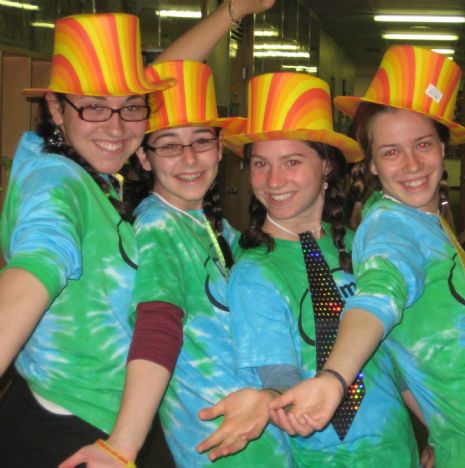
Credit: Camp Gan Israel, Milwaukee
Professional and courteous, each counselor is dedicated to giving your child a meaningful and powerful learning experience in safe and warm environment. 11. Because they will come home happy!
Credit: Chabad of Ulyanovsk, Russia
In Judaism, happiness is a great thing, and Jewish camps do everything in their power to make your child happy. 12. And immediately begin counting down for next year.
Credit: Beth Loubavitch, Charenton
So send your child to a Jewish summer camp—you will be happy you did! Look for a Jewish summer camp in your area today! You can also click here to search hundreds of camps that are part of the Gan Israel Chabad camp network.
© Copyright 2015, all rights reserved.
| ||||||||||||||||||
Editor's Pick
| ||||||||||||||||||

Have you ever felt totally eclipsed by someone else? Maybe there’s something you’re good at, but someone in your life—a sister, a friend, a classmate, a coworker—is even better. What’s more, that person is also good at many other things that you can’t do at all. Around this person, your self-esteem crumbles.
When the one who outshines you is a distant celebrity, you may be content to worship from a distance. Around this person, your self-esteem crumblesBut when the star is someone close to you, it can be quite debilitating to live life in that person’s shadow. Your inner dialogue may sound something like this: “I thought I had a special gift, something unique to contribute to this world. But whatever I do, that person can do it better. Why do I even bother?” Ethics of Our Fathers quotes Rabbi Chanina, deputy of the priests: “Pray for the welfare of the kingdom, for if not for the fear of it, people would swallow each other alive.”1 On the surface, this sounds like a straightforward comment on the importance of government. Without it, there would be anarchy. People would be robbing each other in the streets. Maybe even eating each other alive. But Ethics of Our Fathers is a book of ethics, of character building, of going “beyond the letter of the law,” not a political treatise. The Lubavitcher Rebbe explains that Rabbi Chanina meant this statement in a more figurative sense. It can sometimes happen that you “swallow up” another person. It’s not that you belittle them exactly, or make light of their accomplishments. But in your eyes their standing is minuscule, their contributions inessential. You don’t hear what they have to say, and indeed find it hard to imagine that they have anything worthwhile to say at all. So what is the protection against swallowing up (or being swallowed) alive? The answer is, “Pray for the welfare of the kingdom.” Our sages say, “The earthly kingdom is like the heavenly one.” The power of an earthly king comes from the King of all kings. When we “pray for the welfare of the kingdom,” what we actually pray for is that the divine kingship be expressed in this world. Before G‑d, all of us are equal. Before Him, there is no swallowing up or being swallowed. He created each of us with our own unique role and potential. Each of us has something to contribute that nobody else can. Why does Rabbi Chanina direct us to “pray” for the welfare of the kingdom? Why not say “recognize” or “ponder” or “contemplate”? Because we can’t do it on our own. Living in a world of inequality, where some people seem so much smarter or more gifted or more capable than others, it’s very difficult to hold on to the recognition that G‑d desires our particular contribution. We must pray to G‑d for strength to overcome our feelings of inadequacy, to feel comfortable in the presence of people who outshine us, and to continue to do our part. And we must pray to G‑d for humility, so that we don’t become the ones who swallow up others. We pray to sincerely recognize the qualities of every person we encounter, and to be as invested in the success of others as we are in our own. I can think of no better embodiment of this passage than the Lubavitcher Rebbe himself. In his presence, we were all thoroughly humbledIn his presence, we were all thoroughly humbled. Yet nobody felt swallowed up. The Rebbe devoted his entire life to bringing out the maximum potential of each of his chassidim and of every person he came into contact with. The Rebbe never said, “Leave it up to me.” On the contrary, he said, “It’s all up to you.” He set high expectations for all of us, and never let us forget them. Today, I pray for the welfare of the kingdom. I pray that G‑d give each of us the strength to do our part—our individual, indispensable part—to light up our surroundings, until the day that G‑d’s kingship will be fully revealed in our world. (Based on a talk of the Lubavitcher Rebbe, Beurim le-Pirkei Avot, p. 110.)
Chaya Shuchat is the author of A Diamond a Day, an adaptation of the chassidic classic Hayom Yom for children, as well as many articles on the interface between Chassidism and contemporary life. She is a pediatric nurse practitioner with a master’s
© Copyright 2015, all rights reserved.
| ||||||||||||||||||
Story
| ||||||||||||||||||

It was a wintry Friday night in Brooklyn. A roomful of Jewish college kids in the ’60s, challenging the young rabbi chairing the roundtable: How can you believe in G‑d when science has proven . . . ? Why keep kosher in an age of government inspection and refrigeration? Isn’t it racist to speak of the chosen people? The rabbi was doing his best.
Sitting in the audience was an elderly rabbi, long black coat, elegant white beard. He rose to speak. “The questions you are asking are good questions, but for this you don’t need to come to Chabad. Anyone who has learned Torah can tell you these answers. But you came to Chabad; now let me tell you why you came.” Everyone there was surprised he could speak English. The rabbi with the immaculate black coat and long white beard began his story. A little boy was walking with his father down a steep hill in the heat of the day. They saw a man coming up the hill towards them, sweating, with a heavy sack on his shoulders weighing him down. When the man reached them, the little boy asked what he had in his sack, why he was going up the hill, why he was working so hard. The man told the little boy that his oven had broken, and he had to come down to the valley to get more stones to build himself an oven. “Why not get more stones,” asked the little boy, “and build a bigger oven that will keep you warmer, and you can have more food? There must be more stones still in the valley.” “Oh, you little boy,” said the man, “you don’t yet know what it means to have to work, how hard it is to schlep.” He put his free hand on the little boy’s shoulder. “When you’ll be big like me, you’ll be happy with a little oven too.” The little boy and his father continued down the hill. They saw another man coming up the hill towards them. Same size man, same size sack, but this man didn’t seem so weighed down. “What have you in the sack,” the little boy wanted to know. “Is it stones? Are you going to build yourself a small oven?” “Oh no,” the man smiled broadly, “no oven building for me! See, I was down in the valley digging for turnips, and I hit a treasure. Diamonds! Rubies! Pearls! I have two daughters, two weddings to make. I’m going to open a store and stop peddling from town to town, build myself a house with wooden floors and . . .” “Why not get more diamonds?” interrupted the boy. “There must be more left in the valley.” “Son,” said the old man, putting his free hand on the little boy’s shoulder, “believe me, I searched the valley clean. I don’t think there is another diamond down there.” The little boy and his father continued down the hill. “You see,” said the little boy’s father, “when you’re carrying diamonds, they’re never too heavy. The first guy may have had diamonds too, but he didn’t know what they were.”The old rabbi with the long white beard looked at the college kids. “You see what the father was telling the boy? A mitzvah is a diamond. Every mitzvah that we do is a precious, precious thing. This is why you come to Chabad: not just to learn a mitzvah, but to learn that it is a diamond. When you know they are diamonds, then most of your questions will be answered.” I heard this story on a wintry Friday night in Brooklyn. A roomful of Jewish college kids in the early ’80s, challenging the rabbi chairing the roundtable. The questions had shifted with the times: why do we need mitzvahs when we can meditate instead? A man got up and told this story that he had heard twenty years earlier on a cold wintry night a few blocks from where they were now. He told the story well, and ended with the words, “It’s been twenty years since Rabbi Kazarnovsky stood up that night to tell that story. I could tell you dozens of experiences I’ve had since then, but to you it would be meaningless.” I jolted. It was just four weeks since my grandfather died. Rabbi Kazarnovsky was my grandfather. I type the story with pride and awe. Pride, because he was my grandfather; awed, because he was my grandfather. Passion, demands the Torah. You can’t be Jewish out of a sense of duty. An observant Jew? An unsatisfying label. Like an obedient child, a dutiful husband, a law-abiding citizen, an “observant Jew” accepts obligations—yet keeps on trudging. I know we’re the Chosen People, moans Tevye, but isn’t it time You chose someone else? Duty and diligence are not calculated to inspire; they’re heavy rocks. But when duty and diligence are born of passion, they are tough as steel and as brilliant diamonds. A heavy load? Maybe, on the scales; but not on my back. “You have to be a rabbi,” a friend told me when I was seventeen, “it’s expected of you. It’s even in your genes.” A duty, he was saying. And I thank a rabbi with an immaculate, long black coat and an elegant, long white beard for showing me it’s a diamond.
© Copyright 2015, all rights reserved.
| ||||||||||||||||||
Jewish News
| ||||||||||||||||||
MARIUPOL, UKRAINE—The southeastern Ukrainian city of Mariupol has been on edge for more than a year now, with the thud of Grad rockets falling in the distance a part of daily life.
“During Shavuot, we heard them all day long,” says Rabbi Aron Kaganovski, 30, who assists the city’s chief rabbi and Chabad-Lubavitch emissary Rabbi Mendel Cohen. “It’s strange if you don’t hear them.” The Chabad Jewish center—nestled amid tall buildings in the center of Mariupol, with its population of more than 450,000—contains the city’s only synagogue and caters to Mariupol’s 3,000-strong Jewish community. On May 9, 2014, following Russia’s annexation of Crimea, pro-Russian separatists took control of the city. The Ukrainian government has since taken it back, but the war—which has left 6,000 dead and displaced 1 million people, including some 25,000 Jews—remains within earshot, mere kilometers away. A great number of Jewish families and individuals have fled altogether—some to other parts of Ukraine or Russia, and many to Israel. Many of those who remain are elderly. Today, Chabad institutions on the ground in the east—26 in all, including synagogues, schools and community centers—provide emergency food plans and medical aid to more than 15,000 Jewish community members, much of it in the devastated Donetsk and Lugansk regions controlled by pro-Russian separatists. Kaganovski describes how two burly men claiming to represent the separatists paid a visit to the synagogue when the conflict first began. “They looked around and said, ‘You look like you need protection.’ “I told them we don’t need any protection; we’ve always been fine,” recounts the rabbi, who then pointed to the aron kodesh, the holy ark containing the Torah scrolls. “There, that’s all we have of value,” he told them. “We have G‑d.” If any city in Ukraine can symbolize the fear and uncertainty felt by much of the country, it’s Mariupol. Photographer Jonathan Alpeyrie recently traveled there to capture life in this frontline city. Faces on the Frontlines
(Photo: Jonathan Alpeyrie for Chabad.org)

(Photo: Jonathan Alpeyrie for Chabad.org)

(Photo: Jonathan Alpeyrie for Chabad.org)

(Photo: Jonathan Alpeyrie for Chabad.org)

(Photo: Jonathan Alpeyrie for Chabad.org)

(Photo: Jonathan Alpeyrie for Chabad.org)

(Photo: Jonathan Alpeyrie for Chabad.org)

(Photo: Jonathan Alpeyrie for Chabad.org)

(Photo: Jonathan Alpeyrie for Chabad.org)

(Photo: Jonathan Alpeyrie for Chabad.org)

(Photo: Jonathan Alpeyrie for Chabad.org)

(Photo: Jonathan Alpeyrie for Chabad.org)

(Photo: Jonathan Alpeyrie for Chabad.org)

(Photo: Jonathan Alpeyrie for Chabad.org)

(Photo: Jonathan Alpeyrie for Chabad.org)
© Copyright 2015, all rights reserved.
| ||||||||||||||||||
Jewish News
| ||||||||||||||||||
The American Jewish Press Association has announced that Chabad.org and writer Dovid Margolin have won the first-place Simon Rockower Award for Excellence in News Reporting for work done in 2014.
The award was given for New Pentagon Directive Opens Door for More Jewish Chaplains, an in-depth article on recent decisions within the U.S. military to allow bearded rabbis to serve as chaplains and the resulting impact this new development will likely have on Jewish life in the U.S. armed services. As stated in the story, which was published in the news section of Chabad.org: “With a sorely felt shortage of Jewish chaplains throughout the military, the rule change is expected to pave the way for the enlistment of bearded rabbis as military chaplains, a near impossible goal under the previously strict grooming code.” Now in its 34th year, the Rockowers are seen as the gold standard of journalism in the Jewish world. Chabad.org—with more than 43 million unique visitors in 2014 and dedicated to the educational vision of the Lubavitcher Rebbe, Rabbi Menachem M. Schneerson, of righteous memory—is the premier provider of Jewish content on the web. The site has received prominent acclaim from numerous national and international media outlets, including The New York Times, The Washington Post, USA TODAY, UPI, The Village Voice, Time,Wired, ABC (“Good Morning America”), CBS, CNN, Fox Network and PBS. “We strive to maintain the highest professional standards in our news section, as we do on the entire site as a whole,” says senior editor Yaakov Ort, who directs www.Chabad.org/News. “We’re grateful for the recognition of journalistic excellence that the award highlights.” The awards—one to Chabad.org and one to Margolin—will be presented at a special ceremony during the Jewish Federation’s annual General Assembly, to be held this year from Nov. 8-10 in Washington, D.C.
© Copyright 2015, all rights reserved.
| ||||||||||||||||||
Jewish News
| ||||||||||||||||||
Chicago resident Marcy Goldberg has been directing a chapter of Lubavitch Chabad of Illinois’ hospital visitation program near her home for 26 years now. During the course of a detailed conversation, a great deal about the inspiration of this energetic and deeply compassionate woman came to life.
Q: How did you first get involved in hospital visitation? A: In 1990, I had a life-changing conversation with the late Rabbi Daniel Moscowitz, whom I had known for many years and who had been a profoundly positive influence on me. I said that I knew Chabad has a visitation program on erev Shabbat in some suburban and Chicago hospitals, and that I’d like to visit patients at Northwestern Memorial Hospital, near my home in downtown Chicago. With a twinkle in his eye, he told me “absolutely,” and, by the way, since that hospital did not have a program yet, that I should contact the hospital’s chaplain, set one up, raise the funds and find the volunteers! He also told me where to order challah rolls and individual grape-juice bottles. I thought I was signing up to make deliveries every Friday or maybe pack gift bags. Instead, I found myself raising money, recruiting volunteers, speaking to chaplains and running the whole program. That’s how Rabbi Moscowitz was. He had this ability to get you to do more than you knew you were capable of.
Goldberg credits the late Rabbi Daniel Moscowitz as being "a profoundly positive influence on me."
Many of the other volunteers have also been a blessing in my life. How can I not be inspired by Lena Mendelsohn, then in her 80s, who used to come every week with her walker to pack bags? Of course, Rabbi Moscowitz, and now his son, Rabbi Meir Moscowitz, have been supportive in a number of ways throughout the decades. Q: What’s it like visiting people, some of whom are very ill, before Shabbat? What kind of response do you receive? A: Every visit is different. One of the very first weeks, I remember walking into a room and seeing a woman who was very close to death. I introduced myself and told her I was with Lubavitch Chabad, wishing her a ‘Shabbat Shalom.’ She just threw her arms around me. When you are in a hospital, there are so many people coming into the room for so many reasons—tests, shots, medicines and other things—but we are just coming to visit them. You connect on a very primal human level.
A hospital visit by Lubavitch Chabad volunteers back in the 1980s in Highland Park, on the North Shore of the Chicago metropolitan area.
There was another woman whom I would see every week. One week, she responded in kind to my “Shabbat Shalom.” I was then told that it was the first thing she had said in months. You just never know … People often relish the Jewish connection and discuss whatever Jewish ideas associations they may have with me. I once visited a woman who was in the hospital with her husband. We chatted, and she told me how much she just wished she could have some poached salmon. I told her I had just made some at home, and that she had nothing to worry about since Rabbi Moscowitz had koshered my kitchen. Sure enough, I brought her some fresh poached salmon. She was just thrilled. For the most part, it’s simply a matter of telling people that we are there, we recognize them and what they are going through, and that we care about them as a part of the extended Jewish family. The truth is that I myself did not realize how special it was until my father was ill in Detroit and Rabbi Moscowitz arranged for Rabbi Herschel Finman, a colleague from Chabad in Michigan, to visit me there. It was such a nice feeling, and Rabbi Finman became a person close to our family, officiating at funerals and simchas [happy occasions]. Q: Looking back, how many visits do you think you and your volunteers have made?
Jessica Schwartz, who volunteers as part of Goldberg’s group, gives challah to a hospital patient.
Q: Our conversation began with you offering to Rabbi Moscowitz to help with hospital visits. How did you meet him, and what got you interested in this kind of volunteering? A: I grew up in Detroit in a home that I’d describe as Reform. I went to Sunday school through confirmation, but I cannot say it was very inspiring. In 1963, when it came time for college, my parents drove me to Evanston, north of Chicago, where I was to attend Northwestern University. It was the morning before Rosh Hashanah, and I promised my mother that I’d attend services that evening. Well, I went to Hillel, and there was nowhere to sit, no spare books; I could not even get into the room where services were being held, and I was hot and uncomfortable in my holiday clothing. I closed my eyes and told G‑d, “I believe in You, but I will no longer attend synagogue services that I find meaningless.” I walked out thinking I would never attend synagogue again. But then, you know the Yiddish saying: “Man plans and G‑d laughs.” I got married in 1968 and before I knew it, we needed a place to send our daughter, Rachel, for preschool. I was—and still am—in the life-insurance business, where I met a fine couple, Cantor William and Judy Silber, who have been involved with the Chabad community for a long time. Judy suggested that I send her to a traditional Jewish preschool. I told her, “But I don’t light candles or do anything like that.” She told me it was no problem, and that I should send her anyway; Rachel would learn about the holidays, a few songs, maybe even a little Hebrew.
Schwartz with another patient. The note on the challah bag says: “A get well wish from Chabad.”
At the same time, my husband and I were becoming more and more involved in Jewish leadership and developed a relationship with a very young rabbi named Daniel Moscowitz, who actually led a couples’ group in our home. At one point, I asked myself: “How can I be a leader of the Jewish community and yet every Jew cannot eat in my home?” It was then that we decided to kasher our home; it was also a way to have our child remember, at least three times a day, that she was Jewish. With intermarriage rates at 58 percent, we realized how important it was, while Rachel lived at home with us, to emphasize a Jewish lifestyle. Rabbi Moscowitz came over with a group of guys to kosher the kitchen. Then, on the way out, almost as an afterthought, he said: “You know, in order to keep your kitchen kosher, you need to make sure not to cook in these pots and pans on Shabbat or holidays.” That was that. We’ve kept kosher and Shabbat ever since. And our 10-year-old daughter loved it; she invited friends to sleep over every Shabbat and commented: “It’s like a having a birthday party once a week—something special to celebrate!” In fact, Shabbat was a major influence in my life in the most unexpected way. Around 13 years ago, I began tutoring a first-grader named Jeremiah from the crime-ridden Cabrini-Green housing project. At the end of the year, he was going to flunk because he was absent so much. I spoke to school administrators and told them I would tutor him in the summer and help him get up to grade level so that they could pass him.
Goldberg with Sha’La, whom she's been caring for and wants to see graduate from medical school.
When Jeremiah was 12, he and two of his siblings moved into my house for seven years. At that time, his father was in prison and his mother, who was morbidly obese, was in bed a lot of the time. One day when I was visiting my daughter—who’s been living in Israel with her husband and children for the past seven years—I received a call from the siblings to tell me that Jeremiah’s 13-year-old brother was a father. The mother was 15. Their little girl, named Sha’La, began coming for Shabbat with her dad. When she was around 3, I noticed that whenever I read to her, her attention span disappeared, and I sensed that it was because she spent many hours watching videos while her grandmother slept. The last three years she has been living with me, doing beautifully in school and has made lots of friends. I say that having a little girl at home at my age is keeping me young and making me old all at once! Jeremiah and his siblings all got their education and have steady jobs—something that no one would have predicted years ago. I thought I would be living in Israel by now, but I feel I need to stay here until Sha’La, who’s 6, at least finishes medical school. G‑d works in mysterious ways.
Marcy Goldberg in a family photo with her daughter, Rachel, center right, her son-in-law Jonathan Polin and grandchildren Hersh, 14; Leebie, 12; and Orly, 9. In front is 6-year-old Sha’La, who lives with Goldberg.
© Copyright 2015, all rights reserved.
| ||||||||||||||||||


Chabad.org Magazine - Editor: Yanki Tauber
____________________________
No comments:
Post a Comment