


Wednesday, September 6, 2017

 The Case of a Small Church in an Oversized Building by Lewis A. Parks
Lewis A. Parks, author of Small on Purpose, describes how smaller congregations can easily squander their last resources for ministry attempting to keep up with the mounting demands of an aging facility. He says such churches must decide for the People of God rather than their present building, before it's too late.
I came to Calvary United Methodist, Lemoyne, Pennsylvania, in my favorite pastoral role, as one who rescues. Calvary was once a vibrant 700-member church with two full-time ordained pastors, a staff of eight, and an average weekly worship attendance of 338 (1963). Calvary was “big church” and had the building to prove it — a 20,500 square-foot Romanesque Revival fortress with a replacement value of $5,280,000.
Through the decades of mainline decline, Calvary declined, too, but at a gentle rate. Leaders and members made necessary adjustments. They learned to live within their means. Yet at the same time the 110-year-old building continued to exert its claims at a rate that was becoming irritating and eventually alarming.
At one point in year four I tried to take us on the offensive. I convinced the leadership to hire an architect and draw up plans for a welcome center. The renovated restrooms, infant care room, and coffee serving area would be near the entrance of the sanctuary. It would surely give us the $64,000 makeover we needed to hold the younger visitors. The congregation was cautiously positive. Some, but not enough, pledged financial support. In the end, I was the one to pull the plug. I could not in good conscience put them in a debt that would likely hasten death.
So here we are: loving our tabernacle, temple, synagogue, house church, but not able to afford it. We cannot improve items of décor, comfort, or convenience. We are waiting for the next large ticket item that will empty our savings or drastically change our lifestyle, such as giving up the organ for the piano or closing off part of the building.
It is an unfinished story with a probable finish. And the finish is that Calvary church will do what dozens of formerly large churches have done in the city where we are located and thousands have done across the country. They will gather on the deck of the Titanic to sing “Nearer my God to Thee” as it goes down. That is, they will exhaust their last spiritual gifts for ministry, their last impulses to form surrogate family, their last bit of confidence that they have a message the community needs, exhaust them for the lesser cause of keeping their building open as their numbers dwindle. Last one out, turn off the lights!
As their pastoral leader, my strong desire is that Calvary would avoid that probable finish. They deserve better than the pall of fatalism that settles over a disappearing congregation in an oversized building. To that end, I have asked the leaders and congregation to join me in three actions:
Accept that we are a healthy small church rather than a sick larger church. This is not easy for anyone who remembers the glory days nor for the pastor who wants to be the hero who brings them back; but it is the critical first step to survival. If we seek new constituents to breathe life into a larger church, our efforts will be desperate and will come across that way. Come fill our seats, our offering plate, our fading programs! On the other hand, if we rest in our strengths as a small church — and there are many —– our invitations can be spontaneous. We are not recruiting; we have something good to give away to those who may be receptive.
Face the reality of an oversized building. Sometimes the elephant in the room is the room! We need to keep talking about the mounting and impossible demands of the building. For nearly 50 years in ministry I have been waiting for the anonymous widow to surprise everyone by leaving the church a million dollars at her death. It hasn’t happened yet! I count the rich widow’s gift among the many fantasies that distract God’s people from taking necessary action. Frank talk about limiting and even dangerous conditions in the building forces the congregation to ask after its core identity.
Before it’s too late, decide for the people of God over the present building. We’re not there yet at Calvary. If we abandon 700 Market Street now, we lose precious worship ambience and the capacity for two vital ministries. But that day may be coming. I try to remember that any given congregation has outlived at least two buildings, sometime nearly a dozen. Every church knows what it is to pick up stakes and move on. Calvary was started as a prayer meeting in a lawyer’s office across the street from its present location. It is not that buildings don’t matter; they do for all the reasons specified above. But when it comes down to choosing between a vital congregation in dynamic equilibrium or squandering the resources of that congregation to maintain an oversized building, the God of Abraham (Gen 12:1-3) should win out every time.
This article is excerpted from Small on Purpose: Life in a Significant Church (Abingdon Press, 2017) by Lewis A. Parks. Used by Permission. The book is available at Cokesbury and Amazon.
Related Resources
Through the decades of mainline decline, Calvary declined, too, but at a gentle rate. Leaders and members made necessary adjustments. They learned to live within their means. Yet at the same time the 110-year-old building continued to exert its claims at a rate that was becoming irritating and eventually alarming.
Sometimes the elephant in the room is the room! We need to keep talking about the mounting and impossible demands of the building.
In my first year at Calvary we had to address two critical risk recommendations from a recent insurance inspection: jersey barriers for a parking lot near the nursery school ($3,000) and a ventilation hood for the 20-burner gas oven ($21,000). Year two the air conditioning unit gave out ($20,000) and the dreary lighted sign in front demanded replacement ($5,000). Year three we filled and patched the sinkholes in the parking lot ($11,000) but held off on the resurfacing ($30,000) that would have completed the job. In year four we rescued the red cross on the State Street tower ($6,000) and replaced some of the very old gas pipes that were beginning to leak ($4,000) in the boiler room. One of the trustees reminded me the boiler pipes and cast-iron radiators have lasted much longer than we have a right to ask (estimated cost $42,000). The organist reminded me that the “leaking expression shades” need repair soon ($29,000) and a hole in the “blower reservoir” needs repair now ($4,000). “Should I start playing hymns on the piano?”At one point in year four I tried to take us on the offensive. I convinced the leadership to hire an architect and draw up plans for a welcome center. The renovated restrooms, infant care room, and coffee serving area would be near the entrance of the sanctuary. It would surely give us the $64,000 makeover we needed to hold the younger visitors. The congregation was cautiously positive. Some, but not enough, pledged financial support. In the end, I was the one to pull the plug. I could not in good conscience put them in a debt that would likely hasten death.
So here we are: loving our tabernacle, temple, synagogue, house church, but not able to afford it. We cannot improve items of décor, comfort, or convenience. We are waiting for the next large ticket item that will empty our savings or drastically change our lifestyle, such as giving up the organ for the piano or closing off part of the building.
It is an unfinished story with a probable finish. And the finish is that Calvary church will do what dozens of formerly large churches have done in the city where we are located and thousands have done across the country. They will gather on the deck of the Titanic to sing “Nearer my God to Thee” as it goes down. That is, they will exhaust their last spiritual gifts for ministry, their last impulses to form surrogate family, their last bit of confidence that they have a message the community needs, exhaust them for the lesser cause of keeping their building open as their numbers dwindle. Last one out, turn off the lights!
As their pastoral leader, my strong desire is that Calvary would avoid that probable finish. They deserve better than the pall of fatalism that settles over a disappearing congregation in an oversized building. To that end, I have asked the leaders and congregation to join me in three actions:
Accept that we are a healthy small church rather than a sick larger church. This is not easy for anyone who remembers the glory days nor for the pastor who wants to be the hero who brings them back; but it is the critical first step to survival. If we seek new constituents to breathe life into a larger church, our efforts will be desperate and will come across that way. Come fill our seats, our offering plate, our fading programs! On the other hand, if we rest in our strengths as a small church — and there are many —– our invitations can be spontaneous. We are not recruiting; we have something good to give away to those who may be receptive.
Face the reality of an oversized building. Sometimes the elephant in the room is the room! We need to keep talking about the mounting and impossible demands of the building. For nearly 50 years in ministry I have been waiting for the anonymous widow to surprise everyone by leaving the church a million dollars at her death. It hasn’t happened yet! I count the rich widow’s gift among the many fantasies that distract God’s people from taking necessary action. Frank talk about limiting and even dangerous conditions in the building forces the congregation to ask after its core identity.
Before it’s too late, decide for the people of God over the present building. We’re not there yet at Calvary. If we abandon 700 Market Street now, we lose precious worship ambience and the capacity for two vital ministries. But that day may be coming. I try to remember that any given congregation has outlived at least two buildings, sometime nearly a dozen. Every church knows what it is to pick up stakes and move on. Calvary was started as a prayer meeting in a lawyer’s office across the street from its present location. It is not that buildings don’t matter; they do for all the reasons specified above. But when it comes down to choosing between a vital congregation in dynamic equilibrium or squandering the resources of that congregation to maintain an oversized building, the God of Abraham (Gen 12:1-3) should win out every time.
This article is excerpted from Small on Purpose: Life in a Significant Church (Abingdon Press, 2017) by Lewis A. Parks. Used by Permission. The book is available at Cokesbury and Amazon.
Related Resources
- Eleven Characteristics of Effective Smaller Churches by David R. Ray
- A New Way to View Vitality in Smaller Congregations by Lewis A. Parks
- Small Church as Surrogate Family by Lewis A. Parks
 Does Your Church Need an Online Campus? by Jim Tomberlin
Multisite ministry expert Jim Tomberlin says having an internet campus involves more than just offering a video sermon online. It involves offering a full, virtual experience of church. He anticipates an explosion of internet campuses in the coming years.Called by many names — internet campus, iCampus, cyber church, digital church, virtual church, church in the cloud — an online campus is an interactive church experience in the virtual world of the internet. While the skeptics are busy questioning if this can really be a church, lives are being transformed through an online church experience.
What is an online campus?
Here’s how online church pioneer Brian Vasil at Potential Church in Florida describes these internet campuses: An online campus is a community of people who are learning about, connecting with, and growing closer to God in a virtual environment. The goals of an online campus are similar to that of its brick-and-mortar counterpart, that is, to use whatever tools are available to help people enter into a saving relationship with Jesus Christ, equip them to serve their communities, and go into the world (both physically and online) to share the Gospel.
The largest neighborhood in the world is at your fingertips. Millions who live there need a church like yours.
Online campuses are more than just a live-streaming video of a church service. People log in to their computers or smartphones, engage in worship and watch the sermon, interact with others, pray together, respond to invitations and challenges, give tithes and offerings, and are cared for by an internet campus pastor — all in real time. These churches are not restricted by walls and can reach literally every inch of the globe.I remember having the conversation over a decade ago when I was on staff at Willow Creek in Chicago whether to put our weekend service online or not. Some were concerned that this would decrease our weekend attendance; others were concerned about protecting our brand and that our message could be distorted and misrepresented. We eventually decided to make our messages available online and discovered that our attendance did not go down and that thousands of people around the world were benefiting from our teaching online.
A full worship experience
Today hundreds of churches offer their sermons online and many of them call it an internet campus. Yet what makes an internet campus is not just offering a video sermon online, but offering the full worship experience, live online interaction with others, growth steps, and a dedicated internet campus pastor. Not many churches have true internet campuses online, but their numbers are growing. The latest survey from Leadership Network indicated that 28 percent of all megachurches have an online campus.
Online campuses are interactive virtual church experiences. With globalization through the internet and the explosion of social media, online campuses are becoming fully integrated into the life and strategy of local churches. No longer a techie experiment, online campuses function more like a multisite campus with a dedicated campus pastor with multiple experiences throughout the week in addition to lots of volunteers.
Four features of an online campus
1. An introduction to your church. Your website is the front door to your church. A live online worship service allows people seeking a church home to experience and decide whether your church is a place to visit in-person.
2. An outreach of your church. People are coming to faith through online worship services in the same way millions did through watching evangelist Billy Graham in the privacy of their homes. For many people seeking God and faith, attending a church is too threatening. Visiting church online can be a safe first step towards coming to your church
3. A lifeline for your church family. Sports tournaments, sick kids, vacations, business trips, and other reasons can interfere with regular church attendance. Church families can stay connected and in community spiritually, emotionally and financially through an online campus. I am grateful that my son was able to stay connected online with his home church while deployed in Afghanistan.
4. A church multiplication strategy for your church. Thousands of people are logging on to internet campuses from around the world, but also from your local region. Your online campus congregation can reveal where to launch a multisite campus or a church plant.
Social media church expert, Nils Smith, reports that “Facebook now has almost 2 billion monthly active users and any church of any size can now launch a global online campus using Facebook Live for worship and Facebook groups for small group Bible study at no cost. The barrier to entry is small and the ministry impact is seemingly limitless!” We will see an explosion of online campuses in the next decade. The largest neighborhood in the world is at your fingertips. Millions who live there need a church like yours. Won’t you reach out to them?
This article was originally published in Multisite Solutions Newsletter. Used by permission.
Related Resources
- Key Questions When Starting a Live Stream of Worship Online by Andrew Conard
- Moving Beyond Geographic Boundaries by Jim Downing
- Mission-driven Church Mergers by Ann A. Michel
The Right Question
Leaders do not need answers. Leaders must have the right questions.
Shawn Lovejoy suggests some splendid all-purpose questions for leaders to use regularly.
- Where are we going now?
- Where do we want to go?
- How do we take everyone there?
 Register Now for "More Church Leaders | Stronger Church Leaders" Conference and Live Stream
Saturday, November 4, 10 a.m.-1 p.m. Eastern
Churches with vital, growing ministries learn to leverage leadership potential within their congregations. At More Church Leaders | Stronger Church Leaders you will learn strategies to identify and support new leaders and build and maintain effective ministry teams. Clergy and lay leaders, in churches both large and small, will discover a more synergistic and fruitful way of being in ministry together.
Learn more and register now.
 50 Ways to Improve Your Annual Stewardship Campaign
This free resource in our popular 50 Ways series provides effective strategies for improving your stewardship campaign. Topics include: plan carefully; structure your campaign to acknowledge unique giving patterns; know what motivates people to give; ask in effective ways; follow-up; and more.

50 Ways to Improve Your Annual Stewardship Campaign
Church members who make pledges give substantially more than those who do not, and congregations that seek annual financial commitments have significantly higher levels of overall giving. These 50 tips will help you maximize giving by improving your annual financial campaign.By Lewis Center On March 18, 201650 Ways
Church members who make pledges give substantially more than those who do not, and congregations that seek annual financial commitments have significantly higher levels of overall giving. These 50 tips will help you maximize giving by improving your annual financial campaign.
Engage your leaders and members
- Choose a time of year when the congregation can focus its attention on stewardship and when there is a high probability of connecting with the most people. The annual financial campaign should be on the calendar a year in advance and planned with as much attention to detail as Easter Sunday and Christmas Eve.
- Pick a new theme every year for your stewardship campaign. Taking the time to be creative and innovative may encourage your members to take the time to reflect on their giving.
- Be strategic in building a leadership team. Involve a large group of people to build their sense of responsibility for the outcome. Include persons from different age groups and different ministry areas. A faithful giver (preferably someone who tithes) should head your annual stewardship campaign.
- Be sure that the generous givers of the congregation are well represented on the stewardship team and other groups related to the church’s funding, just as you would be sure to include those most active in other ministry areas as you plan for those ministries.
- Do not hesitate to ask church leaders to make their pledges first as a sign of their commitment and as an encouragement to the larger congregation.
- Orchestrate a comprehensive communication strategy to focus attention on stewardship during your campaign. Use every available means — sermons, music, testimony, newsletter articles, study programs, bulletin boards, banners, etc.
Plan carefully
- Remember — and communicate — that the annual budget is about ministry and mission, not dollars. Prepare the budget with great care, being sensitive to giving trends. Set ambitious but realistic goals.
- Define your purpose and set goals. Set priorities and sequence activities in appropriate ways. Be efficient and realistic in making assignments. Be logical about how you allocate your time and efforts in relation to expected outcomes.
- Establish a realistic timeline. In larger churches, planning and implementing the annual commitment campaign can take six months or more. Use benchmark dates to keep on track.
- Avoid the temptation to rush to the final steps without spending adequate time and attention on the foundational steps that normally determine success or failure.
- Know that developing a congregation of faithful givers does not happen only through a stewardship drive. Develop a year-round approach to stewardship education.
- Appreciate that fund raising is incremental. The most important determinant of how much you can raise this year is what you raised last year.
Approach solicitation with a healthy frame of mind
- Never be apologetic or feel guilty about stewardship appeals. Campaign leaders are not asking for themselves. Their willingness to approach others about giving is an expression of their deep commitment to the church. The vast majority of those being asked will respond in ways that honor that commitment.
- Remember that there is a great deal of “money looking for mission” and that many people are seeking ways to use their resources to advance their values and do God’s will.
- Remember that people give to many things, so do not assume that people will give all their charitable giving to the church. You need to make your case.
- Emphasize that stewardship is about faithfulness to God, not obligation to the church. Stress the giver’s joy in giving rather than the church’s need to receive.
Structure your campaign to acknowledge unique giving patterns
- Know that every church has a “giving pyramid” with a small percentage of donors contributing a large proportion of what is given; for not all people have the same resources to give, and not all people are at the same level of spiritual maturity. Most money will come from larger gifts.
- Analyze giving histories and membership data in your congregation to determine where your people are on your pyramid.
- Track pledges and giving by age “decades” (younger than 20s, 20s, 30s, 40s, etc.) so you can assess giving patterns across age groups.
- Determine what percentage of giving comes from those aged 70 and above. You may be vulnerable if this percentage is high and getting higher each year.
- Focus on those currently giving. Most of the giving, including increases, will come from those already giving.
- Be realistic in your expectations from those who are not currently giving. New donors are much more difficult to reach, are less likely to respond, and will give less than those already giving.
- Know that one approach will not fit everyone in the church. What is appropriate for the spiritually mature member who demonstrates faithfulness may not be appropriate for a newer or relatively inactive member who has never given. Think of relating to people “as they have lifted their hands.”
- Think in terms of “concentric circles” with your committed core (active members who are strong givers) in the center.
- Expand the circles, then, to includes actives who are likely to move up in giving because of their income, level of engagement, and current giving; new members since last year; those who attend or participate but do not give; and inactives who do not participate or give.
- Have multiple goals with these realities in mind — a comprehensive effort that invites everyone to give along with a focused effort on the relatively few likely to give the most. Seek to increase the number of pledgers and to increase the giving of those who already give.
- Set giving targets to help people get a figure in mind. People normally do not give more than they are asked. Set different giving ranges for different categories of givers.
- Provide a “Step Up” plan to encourage everyone to grow in giving.
- Make each part of the plan as personal as possible and appropriate.
Know what motivates people to give
- Know that people give from a mixture of motives. Few give out of a clear spiritual rationale. Most do not have a well-planned or consistent approach to giving.
- People will “protect themselves.” You do not need to guard them against over-giving!
- Appreciate that people want care in the use of their money, but procedures and documentation do not tend to be motivators for giving except in the negative.
- Remember that people are likely to continue giving once they begin.
- Nurture relationships. People give based more on credibility and relationships than on the merits of the cause.
Ask in effective ways
- Take the initiative. If you want money, you must ask for it. Many never give because they were never asked nor given compelling reasons to do so.
- Use the most personal approach possible. A personalized letter is better than a form letter, a hand-written note better than a letter, a phone call better than a note. A one-on-one visit is best of all! If you cannot visit everyone, start at the top of your pyramid.
- Be positive in everything you communicate about giving. Eliminate negative references.
- Never divide the budget by the number of church families or members and say, “If everyone gave just …” Those who give little will not give more, but some who give more may give less
- Most people do not give to support budgets. They give to support people and programs.
- Build your message around mission. Relate everything to the church’s vision and purpose.
- Prepare a “Ministry Impact Budget” to use in your campaign. Rather than presenting “line items,” this budget should interpret ministry and mission in ways that are meaningful to your membership (worship ministries, educational ministries, outreach ministries, etc.).
- Always, however, make the accounting version available to anyone requesting it.
- Use groups in your church to reinforce your campaign efforts. Prepare group study materials related to your campaign theme. Ask group leaders to help in contacting their members.
- Know that congregations that seek annual pledges have a higher level of giving than congregations that do not ask for annual commitments.
- Make giving by automatic withdrawal simple to choose when people make their pledges.
- In all pledge requests, acknowledge that some may be in a “financial jam.” Ask them to commit what they can and not to let their inability to give more keep them from church.
Follow-up
- Do not think of a Commitment Sunday as the end of the campaign. It is an important celebration and punctuation point, but much work needs to happen after that day to reach those who have not responded.
- Follow every successful solicitation with a meaningful gesture of appreciation.
- Do not forget to seek commitments between campaign periods, especially from new members.
- Be sensitive to members’ desire and need to make year-end gifts. Communicate any deadlines for year-end giving positively, focusing on all the ways a person can give in a hectic time of the year. Do not make it hard for people to give.
 Download a PDF of this page to share with others.
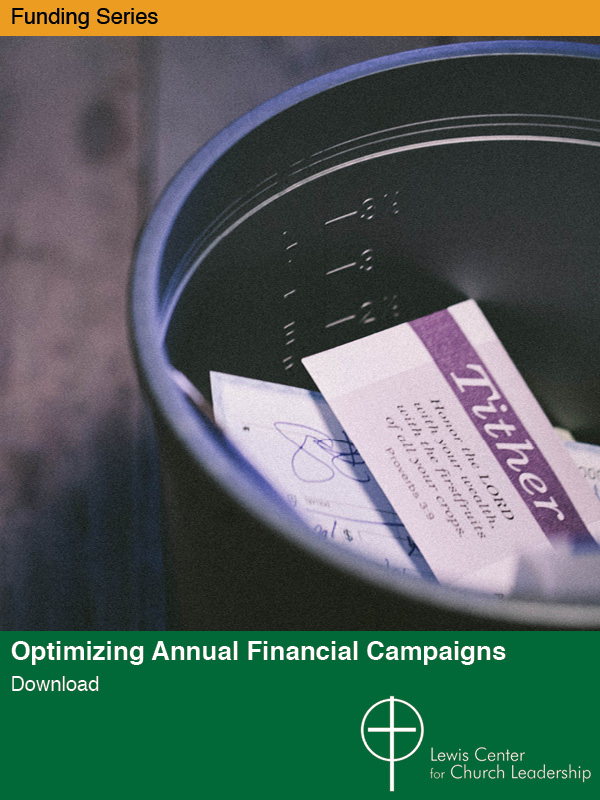
Learn How to Make Your Annual Financial Campaign More Effective
Church members who pledge give 30 percent more than those who do not, and congregations that seek annual financial commitments have significantly higher levels of overall giving. With Optimizing Annual Financial Campaignsyou will learn to reap the harvest of generosity through best practices to make your annual financial campaign more effective. The resource includes engaging video presentations, written materials, and supplemental materials. Learn more now.
Read now and download free.
Quotable Leadership
There are a vast number of things we could do; there are many things we should do; but there are a critical few things we must do. [Daniel Burrus]
 Learn to Optimize Your Annual Financial Campaigns
Church members who pledge give 30 percent more than those who do not, and congregations that seek annual financial commitments have significantly higher levels of overall giving. With the Optimizing Annual Financial Campaigns Video Tool Kit you will learn to reap the harvest of generosity through best practices to make your annual financial campaign more effective.
Learn more now.
 Apply Today for Doctor of Ministry in Church Leadership at Wesley
Wesley Theological Seminary and the Lewis Center together offer a Doctor of Ministry in Church Leadership Excellence. With this track, clergy will receive the enhanced knowledge, skills, and motivation to increase congregational and denominational service, vitality, and growth. The next cohort begins in May 2018 in Washington, DC.
Learn more and apply today.
Editor: Dr. Ann A. Michel
Copyright © 2004-2017 Lewis Center for Church Leadership of Wesley Theological Seminary
Connect with the Lewis Center:


Lewis Center for Church Leadership
Wesley Theological Seminary
4500 Massachusetts Avenue North West
Washington, D.C. 20016, United States
-------
No comments:
Post a Comment