

Dear Reader,
The moment all you oenophiles long for has arrived. Check our homepage for our 2015 kosher wine guide! Whether you prefer red, white, sweet or Israeli, we can tell you what's worth buying, just in time for Passover's four requisite cups.
WHAT TO DRINK 2015
Kosher Wine Guide

Is The Kosher Label A 'Golden' Handcuff? The Terrain In Spain; The French Fight Back; The Top 18 Lists; Whites $18 & Over; Reds Under $25; Sweet Wines; Israeli Wines And More

Kosher Wine Guide
Is The Kosher Label A 'Golden' Handcuff? The Terrain In Spain; The French Fight Back; The Top 18 Lists; Whites $18 & Over; Reds Under $25;Sweet Wines; Israeli Wines And More
Wednesday, March 11, 2015
INSIDE THIS SPECIAL SECTION
A World Of Kosher Wine
Is The Kosher Label A ‘Golden Handcuff?’
The Terrain In Spain
Out Of Egypt
The French Fight Back
Ingredients For A ‘Spirited’ Passover
The Shmittah Effect
The Tastemakers
All Top Wines
Top Israeli Wines
Top Red Wines
Top Red Wines $25 and over
Top Red Wines Under $25
Top Sweet Wines
Top White Wines $18 and Over
Top White Wines
Top White Wines Under $18
On a more sober note, staff writer Amy Clark has the story on a watchdog group that's moving to sue the state and the city over the deficiencies of the Haredi educational system. Boys allegedly get hardly any secular education.
NEW YORK
Bid For Better Secular Ed In Yeshivas Heading Toward Court
After ed officials ignore requests for oversight nonprofit looks for plaintiffs, puts up new billboard.
Amy Sara Clark
Staff Writer

Yaffed's current billboard, in the heart of Williamsburg. Courtesy of Yaffed
RELATED ARTICLES: Bid For Better Secular Ed For Yeshivas Heats Up
Failing to get a response from city and state officials, an organization pushing for better secular education in charedi yeshivas is gearing up to bring the issue to court.
In a Dec. 8 letter veteran civil rightsattorney Norman Siegel, writing on behalf of the nonprofit Yaffed, asked officials to investigate complaints of charedi and black-hat yeshivas providing boys with barely any secular education.
“We wrote to the governor, the attorney general, the mayor and the chancellor. I do that periodically ... and this is the first time I’ve never gotten a single response,” said Siegel, who was director of the New York Civil Liberties Union from 1985 through 2000.
State officials didn’t respond to multiple emails from The Jewish Week asking for comment. Department of Education officials reiterated what they told The Jewish Week in December: that they needed complaints about a specific school before they could investigate. They didn’t address why they haven’t responded to Siegel’s request for a meeting, or respond to a question as to whether they would investigate should Siegal name specific schools, something Siegel said he expected to do at a meeting, but didn’t want to broadcast in a public letter.
“The only thing I can conclude at this point is that this is a radioactive issue” he said, that “none of them necessarily wants to touch.”
“It’s known that this is a community that very often votes monolithically,” he said. “All this just gets me very angry, because that’s not the way it should be. It should be that elected officials look at these issues on the merits and if there’s a problem here they should do something. They’re legally obligated to do something. Then you have to figure out how to hold them accountable.”

Holding them accountable will likely mean going to court, so last month Siegel and Yaffed founder Naftuli Moster met with other Yaffed activists to discuss how to find plaintiffs willing to sign their name to a complaint. The case would ask the court to force state and city officials to enforce a state law requiring that private schools provide instruction “substantially equivalent” to what’s mandated for public schools. While public schools are required to provide at least five hours of education per day, Yaffed asserts that many yeshivas only provide 90 minutes of secular education per day to boys, and no secular education to them at all after the age of about 13.
Moster said that even during those 90 minutes instruction is poor to nil, because the teachers, who usually have gone through the same education system as their students, are not qualified to teach and do not have the authority to maintain order, leading to 90 minutes of supervised recess for all but a handful of interested students who gather around the teacher’s desk to learn what they can. Yaffed is focusing on boys’ education to start because girls, who don’t study Talmud, get better — though still lacking — secular education.
Gearing Up For Court
While Yaffed awaits a response from the government, it is looking for parents of current students and current teachers to serve as plaintiffs for the lawsuit — not a small order in the insular charedi communities of Crown Heights, Williamsburg and Borough Park where doing so could lead to retaliation or social ostracism.
“To be honest, most people at the moment tell me that I’m out of my mind. They’ll tell me that you’ll never have any parents coming forward,” said Moster. He said he hopes the second part of Yaffed’s strategy, changing parents mindset, will make parents comfortable advocating for their kids. He stresses that the lawsuit is against city and state officials for not enforcing the law, not against yeshiva leadership.
“It should have been the state who steps in and says: ‘I get it, you’re not equipped [to teach secular subjects]. We’re going to provide you with the tools and the training and the capability of doing so.’ But the state has basically not done any of that. They’re turned a blind eye and ignored it completely,” he said.
Change From Within
On the hearts and minds front, last month Yaffed put up its second billboard, in the heart of Williamsburg. On the left side, marked 1988, a child with a math book in front of him complaining in Yiddish that “English” aka “secular” subjects are profane. The other side, marked “Today” shows the boy grown up, with a pile of unpaid bills before him, saying in English, “Oy, what was I thinking?”
Yaffed’s first billboard, which went up in 2013 next to Brooklyn’s Prospect Expressway, showed a picture of a chasidic boy reading a math textbook with the message in Yiddish and English: “It’s your mitzvah. It’s the law.”
Moster says the billboards serve to give people who already agree with Yaffed’s mission an opening to voice their opinion when someone brings up the ad. “But if you don’t have that stimulant, then there’s no discussion whatsoever,” he said. “And if there’s no discussion there’s no action.”
So far private donors have paid for the billboards, but just last month, Yaffed started an online crowdsourcing fundraiser on the site Jewcer. The goal is to raise $3,000 for a third billboard in Borough Park to go up later this month. As of Tuesday afternoon, halfway into the monthlong campaign, 18 people had contributed $1,088.
Moster said he hopes the campaign will not only raise money, but also get more people involved. “For a $36 or $72 donation they feel like they have a chip in the game,” he said. “They want to follow it more closely.”
Currently, most of Yaffed’s hundred or so supporters are former charedi yeshiva students. But Moster hopes to get more people behind the effort, both inside and outside the charedi community.
Help From Outside?
He sees a broad umbrella organization, such as the UJA-Federation of New York as a potential partner. “To me the UJA, I always see them strategizing,” he said. “They’re involving all different groups: intermarried families and the LGBTQ community. But he says involving those groups isn’t going to stop the demographic trend in which Orthodoxy Jewry is on the rise and non-Orthodox Jewish communities are declining.
“I think they’re just not doing enough to recognize [the problem] — they can’t just be on their own side and let Judaism be taken over by what will eventually be a group of largely uneducated individuals, relatively extremist individuals,” he said.
Deborah Joselow, UJA-Federation of New York’s managing director of the Commission on Jewish Identity and Renewal, said charedi day school teachers and principals participate in many of their professional development programs and they have one program specifically for educators in Torah Umesorah-affiliated schools. The two-year-long program has trained 120 principals from both boys and girls yeshivas.
Joselow said the UJA is focused on working with educators who come to them, rather than intervening in schools uninvited, but said her organization also works directly with parents and students when schools are unreceptive.
“We’re going to lift people up wherever they are. When the hand is stretched out it’s easier to help, but we don’t give up on anybody,” she said.
Asked whether she thinks there is a problem with the quality of secular education in some charedi schools, she said: “I can’t condemn any one particular school or one particular sector but obviously we wouldn’t be invested in educational excellence if we didn’t believe there was a challenge there, for lots and lots of schools.
“Sometimes schools are very hunkered down, just in taking care of their kids and using minimal resources to get maximal results,” she said.
All three major charedi umbrella organizations, Chabad, Agudath Israel and the United Jewish Organizations of Williamsburg have declined to comment for this story, but in December, Rabbi David Zwiebel, executive vice president of Agudath Israel of America, said the amount of secular education provided by chasidic schools varied greatly but that most yeshivas offer a very good education that gives children “strong reading and textual skills.”
“I think that Naftali Moster’s experience is the exception to the rule,” he said.
But the yeshiva graduates who support Yaffed disagree.
'Such A Waste'
One supporter, who requested that his name not be used for fear of backlash against his family, graduated from the prominent Yeshiva Machzikei Hadas Belz in Borough Park two decades ago and now sends his three children, two teenage boys and a 4-year-old girl, to the school, which is also Moster’s alma mater.
His sons stopped learning secular subjects at 13. Before that, they got 90 minutes a day of English and math. The kids had mastered their times tables and division and had learned “maybe a little fractions” when they began learning only religious subjects during their 12-hour school day.
“The teachers are very unqualified — people from the community with hardly any English knowledge,” he said.
The father of three said his education was slightly better: he learned a little history in addition to basic English and math, something he hasn’t seen his kids study.
Now, at almost 40, he’s a cab driver, unable to get a better job because of his poor English and struggling to pay his bills.
When he was younger, he spent a year taking ESL and GED classes through a government funded program aimed at charedi yeshiva graduates. But he was unable to keep up and flunked out.
“I was married, I had to pay rent. I had to pay electric bills. I was working at a bakery where they needed me full-time,” he said. “The basics we should have been taught in yeshiva, when you have no overhead, no bills to pay.”
He wants better for his children, but is unable to move them to another school. He’s no longer religious, but his wife is and approves of the education they’re getting.
“My kids are really top-notch students. Each one of their tests, all their marks are top marks and it’s such a waste that they don’t get any [secular] education,” he said. He’s considered trying to educate them at home, but has no idea where to start or even what books to buy, he said.
He’s hoping Yaffed’s efforts will be successful, both in getting the state to intervene and in encouraging people in the charedi community to stand up for better secular education. He thinks many parents want this, but are afraid.
“People talk about the problem,” he said, but nobody was really, really open to coming out so strongly about this issue until now. ... Hopefully something will come out of all of this,” he said.
Yeshiva Machzikei Hadas Belz, in fact, tried instituting more secular education a few years back, but quickly gave up the effort after students protested. But this father of three wishes the principal would try again. (Belz officials did not return a phone call seeking comment.)
“The principal knows my position. I’ve actually approached him three times on this,” he said. “My kids are at his school, so it’s like me and him are colliding on who is going to have more influence on my kids. And it seems like he’s pushing his agenda and I’m pushing mine. And it feels like he’s winning.”
amyclark@jewishweek.org
This week's JW staff editorial is getting a lot of reads on our website. It scolds Hillel International's leader, Eric Fingerhut, for pulling out of a recent JStreet conference and missing the opportunity to connect with his constituency: students.
EDITORIAL
Hillel's Missed Opportunity
In pulling out of the JStreet Conference, the campus organization's leader forfeited a chance to inspire our next generation.

Eric Fingerhut. Via hillel.org
The organized Jewish community’s ongoing debate over if, when and how to deal with J Street is in the news again. On the eve of the controversial left-wing lobby’s national convention, set for March 21-24 in Washington, D.C., Eric Fingerhut, the international president and CEO of Hillel International, has announced his withdrawal as a featured speaker. His statement said that “after reviewing the full list of speakers,” he concluded “any benefit that might have come from this opportunity would be overshadowed by concerns regarding my participation amongst other speakers who have made highly inflammatory statements against the Jewish state.”
David Edel, Hillel’schief administrative officer, told JTA that Saeb Erekat, the chief Palestinian negotiator with the U.S. and Israel — and a featured speaker at the J Street conference — has made such statements against Israel.
So, for that matter, has former James (“F--- the Jews”) Baker, another featured J Street speaker this year, who angrily clashed with Israel during his tenure as secretary of state.
It is true that Erekat’s condemnatory declarations about Israel and its alleged lack of willingness to engage in peace talks are often infuriating and unfair. Ironically, though, Jerusalem and Washington have been dealing with him on an almost daily basis for two decades.
Fingerhut had an opportunity to speak at a student-only session with 1,000 college students. His planned topics were BDS (the Boycott, capitalize and Sanctions movement) and anti-Semitism on college campuses, and we are certain he had an important message to convey. How unfortunate that he chose to give up a chance to educate and inspire our next generation. What audience is more important to reach than our sons and daughters?
We would imagine there are influential Hillel donors who see J Street as far from the “pro-Israel” label it uses to describe its work, and we appreciate those concerns. But the culture of the college campus is one of openness, placing the highest value on free speech. And Hillel does such important work in promoting Jewish life on campus, with an emphasis on pluralism, diversity and dialogue. We hope this incident will not tarnish its image.
editor@jewishweek.org
Have a great weekend, everybody,
Helen Chernikoff
Web Director
SHORT TAKES
Orthodox Drag Queens Proudly Jew It Up
Doing drag while staying frum is a growing phenomenon in NYC's LGBTQ scene.
Amy Sara Clark
Staff Writer

In fact, there’s a burgeoning and proudly Orthodox drag scene, writes Rachel Delia Benaim in The Guardian, where 28-year-old Yudi K, an interior designer performs as Silvia Sparklestein, “a 39-year-old big blond Jewish mama from Queens” who parodiesJewish holidays in songs like “All I want for Christmas is Jew” and excels at Jewish guilt — “think Woody Allen meets Bubbe,” as Benaim puts it.
 There’s also drag newbie Lady SinAGaGa, who in real life is 22-year-old Moshiel, a day school graduate from Woodmere who spent two years at a Jerusalem yeshiva before becoming a student at the School of Visual Arts and hitting the drag queen stage.
Jayson Littman, who founded Hebro, a community of gay Jews who celebrate both parts of their identities, tells The Guardian that the growth of Jewish drag culture “shows that our community has come so far that not only have we dealt with many of our issues surrounding coming out, but now we can proudly put on a drag performance with Jewish identities to showcase our alternate Jewishly exaggerated personalities.”
Read the full article here.
Moster said that even during those 90 minutes instruction is poor to nil, because the teachers, who usually have gone through the same education system as their students, are not qualified to teach and do not have the authority to maintain order, leading to 90 minutes of supervised recess for all but a handful of interested students who gather around the teacher’s desk to learn what they can. Yaffed is focusing on boys’ education to start because girls, who don’t study Talmud, get better — though still lacking — secular education.
Gearing Up For Court
While Yaffed awaits a response from the government, it is looking for parents of current students and current teachers to serve as plaintiffs for the lawsuit — not a small order in the insular charedi communities of Crown Heights, Williamsburg and Borough Park where doing so could lead to retaliation or social ostracism.
“To be honest, most people at the moment tell me that I’m out of my mind. They’ll tell me that you’ll never have any parents coming forward,” said Moster. He said he hopes the second part of Yaffed’s strategy, changing parents mindset, will make parents comfortable advocating for their kids. He stresses that the lawsuit is against city and state officials for not enforcing the law, not against yeshiva leadership.
“It should have been the state who steps in and says: ‘I get it, you’re not equipped [to teach secular subjects]. We’re going to provide you with the tools and the training and the capability of doing so.’ But the state has basically not done any of that. They’re turned a blind eye and ignored it completely,” he said.
Change From Within
On the hearts and minds front, last month Yaffed put up its second billboard, in the heart of Williamsburg. On the left side, marked 1988, a child with a math book in front of him complaining in Yiddish that “English” aka “secular” subjects are profane. The other side, marked “Today” shows the boy grown up, with a pile of unpaid bills before him, saying in English, “Oy, what was I thinking?”
Yaffed’s first billboard, which went up in 2013 next to Brooklyn’s Prospect Expressway, showed a picture of a chasidic boy reading a math textbook with the message in Yiddish and English: “It’s your mitzvah. It’s the law.”
Moster says the billboards serve to give people who already agree with Yaffed’s mission an opening to voice their opinion when someone brings up the ad. “But if you don’t have that stimulant, then there’s no discussion whatsoever,” he said. “And if there’s no discussion there’s no action.”
So far private donors have paid for the billboards, but just last month, Yaffed started an online crowdsourcing fundraiser on the site Jewcer. The goal is to raise $3,000 for a third billboard in Borough Park to go up later this month. As of Tuesday afternoon, halfway into the monthlong campaign, 18 people had contributed $1,088.
Moster said he hopes the campaign will not only raise money, but also get more people involved. “For a $36 or $72 donation they feel like they have a chip in the game,” he said. “They want to follow it more closely.”
Currently, most of Yaffed’s hundred or so supporters are former charedi yeshiva students. But Moster hopes to get more people behind the effort, both inside and outside the charedi community.
Help From Outside?
He sees a broad umbrella organization, such as the UJA-Federation of New York as a potential partner. “To me the UJA, I always see them strategizing,” he said. “They’re involving all different groups: intermarried families and the LGBTQ community. But he says involving those groups isn’t going to stop the demographic trend in which Orthodoxy Jewry is on the rise and non-Orthodox Jewish communities are declining.
“I think they’re just not doing enough to recognize [the problem] — they can’t just be on their own side and let Judaism be taken over by what will eventually be a group of largely uneducated individuals, relatively extremist individuals,” he said.
Deborah Joselow, UJA-Federation of New York’s managing director of the Commission on Jewish Identity and Renewal, said charedi day school teachers and principals participate in many of their professional development programs and they have one program specifically for educators in Torah Umesorah-affiliated schools. The two-year-long program has trained 120 principals from both boys and girls yeshivas.
Joselow said the UJA is focused on working with educators who come to them, rather than intervening in schools uninvited, but said her organization also works directly with parents and students when schools are unreceptive.
“We’re going to lift people up wherever they are. When the hand is stretched out it’s easier to help, but we don’t give up on anybody,” she said.
Asked whether she thinks there is a problem with the quality of secular education in some charedi schools, she said: “I can’t condemn any one particular school or one particular sector but obviously we wouldn’t be invested in educational excellence if we didn’t believe there was a challenge there, for lots and lots of schools.
“Sometimes schools are very hunkered down, just in taking care of their kids and using minimal resources to get maximal results,” she said.
All three major charedi umbrella organizations, Chabad, Agudath Israel and the United Jewish Organizations of Williamsburg have declined to comment for this story, but in December, Rabbi David Zwiebel, executive vice president of Agudath Israel of America, said the amount of secular education provided by chasidic schools varied greatly but that most yeshivas offer a very good education that gives children “strong reading and textual skills.”
“I think that Naftali Moster’s experience is the exception to the rule,” he said.
But the yeshiva graduates who support Yaffed disagree.
'Such A Waste'
One supporter, who requested that his name not be used for fear of backlash against his family, graduated from the prominent Yeshiva Machzikei Hadas Belz in Borough Park two decades ago and now sends his three children, two teenage boys and a 4-year-old girl, to the school, which is also Moster’s alma mater.
His sons stopped learning secular subjects at 13. Before that, they got 90 minutes a day of English and math. The kids had mastered their times tables and division and had learned “maybe a little fractions” when they began learning only religious subjects during their 12-hour school day.
“The teachers are very unqualified — people from the community with hardly any English knowledge,” he said.
The father of three said his education was slightly better: he learned a little history in addition to basic English and math, something he hasn’t seen his kids study.
Now, at almost 40, he’s a cab driver, unable to get a better job because of his poor English and struggling to pay his bills.
When he was younger, he spent a year taking ESL and GED classes through a government funded program aimed at charedi yeshiva graduates. But he was unable to keep up and flunked out.
“I was married, I had to pay rent. I had to pay electric bills. I was working at a bakery where they needed me full-time,” he said. “The basics we should have been taught in yeshiva, when you have no overhead, no bills to pay.”
He wants better for his children, but is unable to move them to another school. He’s no longer religious, but his wife is and approves of the education they’re getting.
“My kids are really top-notch students. Each one of their tests, all their marks are top marks and it’s such a waste that they don’t get any [secular] education,” he said. He’s considered trying to educate them at home, but has no idea where to start or even what books to buy, he said.
He’s hoping Yaffed’s efforts will be successful, both in getting the state to intervene and in encouraging people in the charedi community to stand up for better secular education. He thinks many parents want this, but are afraid.
“People talk about the problem,” he said, but nobody was really, really open to coming out so strongly about this issue until now. ... Hopefully something will come out of all of this,” he said.
Yeshiva Machzikei Hadas Belz, in fact, tried instituting more secular education a few years back, but quickly gave up the effort after students protested. But this father of three wishes the principal would try again. (Belz officials did not return a phone call seeking comment.)
“The principal knows my position. I’ve actually approached him three times on this,” he said. “My kids are at his school, so it’s like me and him are colliding on who is going to have more influence on my kids. And it seems like he’s pushing his agenda and I’m pushing mine. And it feels like he’s winning.”
amyclark@jewishweek.org
This week's JW staff editorial is getting a lot of reads on our website. It scolds Hillel International's leader, Eric Fingerhut, for pulling out of a recent JStreet conference and missing the opportunity to connect with his constituency: students.
EDITORIAL
Hillel's Missed Opportunity
In pulling out of the JStreet Conference, the campus organization's leader forfeited a chance to inspire our next generation.
Eric Fingerhut. Via hillel.org
The organized Jewish community’s ongoing debate over if, when and how to deal with J Street is in the news again. On the eve of the controversial left-wing lobby’s national convention, set for March 21-24 in Washington, D.C., Eric Fingerhut, the international president and CEO of Hillel International, has announced his withdrawal as a featured speaker. His statement said that “after reviewing the full list of speakers,” he concluded “any benefit that might have come from this opportunity would be overshadowed by concerns regarding my participation amongst other speakers who have made highly inflammatory statements against the Jewish state.”
David Edel, Hillel’schief administrative officer, told JTA that Saeb Erekat, the chief Palestinian negotiator with the U.S. and Israel — and a featured speaker at the J Street conference — has made such statements against Israel.
So, for that matter, has former James (“F--- the Jews”) Baker, another featured J Street speaker this year, who angrily clashed with Israel during his tenure as secretary of state.
It is true that Erekat’s condemnatory declarations about Israel and its alleged lack of willingness to engage in peace talks are often infuriating and unfair. Ironically, though, Jerusalem and Washington have been dealing with him on an almost daily basis for two decades.
Fingerhut had an opportunity to speak at a student-only session with 1,000 college students. His planned topics were BDS (the Boycott, capitalize and Sanctions movement) and anti-Semitism on college campuses, and we are certain he had an important message to convey. How unfortunate that he chose to give up a chance to educate and inspire our next generation. What audience is more important to reach than our sons and daughters?
We would imagine there are influential Hillel donors who see J Street as far from the “pro-Israel” label it uses to describe its work, and we appreciate those concerns. But the culture of the college campus is one of openness, placing the highest value on free speech. And Hillel does such important work in promoting Jewish life on campus, with an emphasis on pluralism, diversity and dialogue. We hope this incident will not tarnish its image.
editor@jewishweek.org
Have a great weekend, everybody,
Helen Chernikoff
Web Director
SHORT TAKES
Orthodox Drag Queens Proudly Jew It Up
Doing drag while staying frum is a growing phenomenon in NYC's LGBTQ scene.
Amy Sara Clark
Staff Writer
Silvia Sparklestein, left, with Hebro founder Jason Littman and another Jewish drag queen, Lady Havokk. Courtesy of Hebro
Jewish drag is on the rise as more and more observant Jews come out of the cross-dressing closet.In fact, there’s a burgeoning and proudly Orthodox drag scene, writes Rachel Delia Benaim in The Guardian, where 28-year-old Yudi K, an interior designer performs as Silvia Sparklestein, “a 39-year-old big blond Jewish mama from Queens” who parodiesJewish holidays in songs like “All I want for Christmas is Jew” and excels at Jewish guilt — “think Woody Allen meets Bubbe,” as Benaim puts it.
Jayson Littman, who founded Hebro, a community of gay Jews who celebrate both parts of their identities, tells The Guardian that the growth of Jewish drag culture “shows that our community has come so far that not only have we dealt with many of our issues surrounding coming out, but now we can proudly put on a drag performance with Jewish identities to showcase our alternate Jewishly exaggerated personalities.”
Read the full article here.
Orthodox Jewish drag queens: joyfully putting the sin in synagogue
They identify with a religion that tells them their sexuality and their lifestyle are forbidden, but these men base much of their drag personas on their Jewish roots. Still, reconciling these two halves of themselves is an ongoing struggle

They identify with a religion that tells them their sexuality and their lifestyle are forbidden, but these men base much of their drag personas on their Jewish roots. Still, reconciling these two halves of themselves is an ongoing struggle
'Being a character in drag is all about creating a big, exaggerated personality’. Photograph: cc Rachel Delia Benaim
This March, one of New York’s up-and-coming drag queens, Lady SinAGAGA, made her debut at Tina Burner’s Invasion, at the historic Stonewall Inn. She began the night in an elegant silk robe, then took it off to reveal a rather sexy bodysuit coupled with knee-high boots. The crowd cheered for her as she sang her soulful rendition of Out Tonight from Rent, her favorite musical.
Lady SinAGaga, as you may have guessed, is a Jewish drag queen (in case you missed it: SinAGaga sounds like synagogue). Her real-life alter ego, Moshiel, 22, was raised Orthodox and came out just over a year ago. He grew up attending Jewish day schools on Long Island, and spent two years studying at a Jerusalem yeshiva, a religious school, before he started at the School of Visual Arts.
Lady SinAGaga is relatively new on the Jewish drag scene, having only debuted at a High Homo Days party (a Jewish gay party hosted by Hebro, anorganization working to celebrate the gay Jewish community).
Jewish drag is an entirely new manifestation of the cultural phenomenon; the men who do it have come out and base large parts, if not all, of their drag personas on their Jewish upbringing.
As a new performer on the scene, Lady SinAGaga was nervous. Silvia Sparklestein, a veteran Jewish drag queen, recalls Lady SinAGaga reaching out to her for advice— and some makeup. “I have a pretty extensive makeup collection,” Silvia says. “My first few batches were borrowed and from CVS, but then a friend of mine who used to work for MAC gave me some tips and some products.” She now uses top-of-the-line beauty products. Silvia also has a selection of heels, wigs and outfits; she lends them out to newbies, which is how Lady SinAGaga found her.
In everyday life, Silvia Sparklestein is Yudi K, a 28-year-old interior designer. Yudi grew up as an Orthodox Jew in Staten Island, and still lives an Orthodox lifestyle in Manhattan.
His persona is a 39-year-old big blonde Jewish mama from Queens, New York. She likes to make you feel guilty – think Woody Allen meets Bubbe. She celebrates all the Jewish holidays, often with a new original parody song (most recently, All I Want for Christmas Is Jew). She cooks gefilte fish, kugel and challah. She loves plaid, sequins, tweed and faux fur. As Yudi K sums it up: “Silvia is just very, very Jewish!”
This March, one of New York’s up-and-coming drag queens, Lady SinAGAGA, made her debut at Tina Burner’s Invasion, at the historic Stonewall Inn. She began the night in an elegant silk robe, then took it off to reveal a rather sexy bodysuit coupled with knee-high boots. The crowd cheered for her as she sang her soulful rendition of Out Tonight from Rent, her favorite musical.
Lady SinAGaga, as you may have guessed, is a Jewish drag queen (in case you missed it: SinAGaga sounds like synagogue). Her real-life alter ego, Moshiel, 22, was raised Orthodox and came out just over a year ago. He grew up attending Jewish day schools on Long Island, and spent two years studying at a Jerusalem yeshiva, a religious school, before he started at the School of Visual Arts.
Lady SinAGaga is relatively new on the Jewish drag scene, having only debuted at a High Homo Days party (a Jewish gay party hosted by Hebro, anorganization working to celebrate the gay Jewish community).
Jewish drag is an entirely new manifestation of the cultural phenomenon; the men who do it have come out and base large parts, if not all, of their drag personas on their Jewish upbringing.
As a new performer on the scene, Lady SinAGaga was nervous. Silvia Sparklestein, a veteran Jewish drag queen, recalls Lady SinAGaga reaching out to her for advice— and some makeup. “I have a pretty extensive makeup collection,” Silvia says. “My first few batches were borrowed and from CVS, but then a friend of mine who used to work for MAC gave me some tips and some products.” She now uses top-of-the-line beauty products. Silvia also has a selection of heels, wigs and outfits; she lends them out to newbies, which is how Lady SinAGaga found her.
In everyday life, Silvia Sparklestein is Yudi K, a 28-year-old interior designer. Yudi grew up as an Orthodox Jew in Staten Island, and still lives an Orthodox lifestyle in Manhattan.
His persona is a 39-year-old big blonde Jewish mama from Queens, New York. She likes to make you feel guilty – think Woody Allen meets Bubbe. She celebrates all the Jewish holidays, often with a new original parody song (most recently, All I Want for Christmas Is Jew). She cooks gefilte fish, kugel and challah. She loves plaid, sequins, tweed and faux fur. As Yudi K sums it up: “Silvia is just very, very Jewish!”
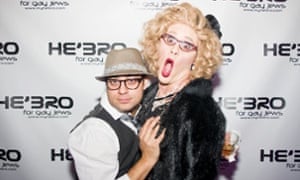
Silvia Sparklestein acts scandalized as she poses and is groped by a Hebro party goer. Photograph: Richard Burrowes/Hebro
Silvia was born in 2010, when a friend of Yudi K’s hosted a garden party and encouraged all of the guests to “come in their mom’s Sunday best”. Yudi went all out: he borrowed a tweed jacket, got a blonde wig and put on a big pearl necklace.
When Lady SinAGAGA called her for help back in September, she was happy to oblige in any way she could. After all, though there are quite a few Jewish drag queens on the scene, they are still few enough in number that they all support one another.
This support comes in forms other than just makeup advice and fashion tips. Lady SinAGAGA isn’t fully out of the drag closet, and Moshiel’s parents don’t know about her yet. Hebro’s founder, Jayson Littman, explains it thus: “Imagine coming out to your Jewish parents as gay, and then having to tell them, ‘By the way, my nightlife name is Lady SinAGaga.’”
It’s no secret that Orthodox Judaism condemns homosexuality and that many men, like their counterparts from other religious communities that don’t look favorably on homosexuality, struggle to reconcile their religious identity and their sexuality.
Back in 2011, conversations erupted in the Orthodox Jewish community about orthodoxy and homosexuality. The issue caused some major rifts between liberal and conservative Orthodox leaders.
Drag is all about creating a big, exaggerated personality, and most gay Jews have the perfect role model: our mothers.
All Orthodox rabbis emphasize the need to be empathetic to the emotional needs and struggles of LGBT people who wish to remain in the religious community, but ultimately none support same-sex marriage, per the biblical tradition.
The real distinction is whether Judaism recognizes that homosexuality could be a real sexual orientation and, as a related point, whether a rabbi could endorse conversion therapy.
The more rightwing Orthodox ideology, as outlined in what is known as the Torah Declaration, outlaws homosexuality in any form. Its proponents claim that, according to the Torah, “homosexuality is not an acceptable lifestyle or a legitimate identity.” Further, the Declaration claims that “same-sex attraction can be modified and healed.”
The Declaration has 223 signatories spanning prominent ultra-Orthodox rabbis, modern Orthodox rabbis and even some mental health professionals – Arthur Goldberg, the co-director of the Jonah Institute of Gender Affirmation, a conversion therapy clinic in New Jersey, signed the document.
Silvia was born in 2010, when a friend of Yudi K’s hosted a garden party and encouraged all of the guests to “come in their mom’s Sunday best”. Yudi went all out: he borrowed a tweed jacket, got a blonde wig and put on a big pearl necklace.
When Lady SinAGAGA called her for help back in September, she was happy to oblige in any way she could. After all, though there are quite a few Jewish drag queens on the scene, they are still few enough in number that they all support one another.
This support comes in forms other than just makeup advice and fashion tips. Lady SinAGAGA isn’t fully out of the drag closet, and Moshiel’s parents don’t know about her yet. Hebro’s founder, Jayson Littman, explains it thus: “Imagine coming out to your Jewish parents as gay, and then having to tell them, ‘By the way, my nightlife name is Lady SinAGaga.’”
It’s no secret that Orthodox Judaism condemns homosexuality and that many men, like their counterparts from other religious communities that don’t look favorably on homosexuality, struggle to reconcile their religious identity and their sexuality.
Back in 2011, conversations erupted in the Orthodox Jewish community about orthodoxy and homosexuality. The issue caused some major rifts between liberal and conservative Orthodox leaders.
Drag is all about creating a big, exaggerated personality, and most gay Jews have the perfect role model: our mothers.
All Orthodox rabbis emphasize the need to be empathetic to the emotional needs and struggles of LGBT people who wish to remain in the religious community, but ultimately none support same-sex marriage, per the biblical tradition.
The real distinction is whether Judaism recognizes that homosexuality could be a real sexual orientation and, as a related point, whether a rabbi could endorse conversion therapy.
The more rightwing Orthodox ideology, as outlined in what is known as the Torah Declaration, outlaws homosexuality in any form. Its proponents claim that, according to the Torah, “homosexuality is not an acceptable lifestyle or a legitimate identity.” Further, the Declaration claims that “same-sex attraction can be modified and healed.”
The Declaration has 223 signatories spanning prominent ultra-Orthodox rabbis, modern Orthodox rabbis and even some mental health professionals – Arthur Goldberg, the co-director of the Jonah Institute of Gender Affirmation, a conversion therapy clinic in New Jersey, signed the document.

Signatories of this document include prominent Jewish leaders such as the rabbi emeritus of Congregation Shearith Israel, the oldest Jewish congregation in the US. There are no ultra-Orthodox signatories to the Statement.
When it comes to how to deal with LGBT Jews who wish to remain in the Orthodox community, Jewish law is ambiguous at best. Oftentimes gay men have to choose one over the other: either they will leave their religious community to lead openly gay lives, or they will stifle their sexuality.
A lesser-known fact is that Orthodox Jews also condemn cross-dressing, per the commandment in Deuteronomy 22:5. This issue too is discussed within ancient and modern rabbinic circles, though not nearly to the same extent as the question of homosexuality. This conversation arises in the Talmud and in other sources, pondering whether men are allowed to dress up as women on Purim, the Jewish dress-up holiday – since it seems like the prohibition of cross-dressing is based on the premise of men not being confused and marrying other men, thinking they are women.
And so just like the frum – a Yiddish term for observant – there are also frumdrags, who are more extreme than observant gay people because they also cross-dress.
Yudi K fits both of these bills. Though he doesn’t observe Jewish ritual law with the same stringency that he did when he was a child, he still identifies with Orthodox Judaism. He does drag – and he does it as a proud Jew. “The best thing about being a Jewish drag queen,” he says, “is that I can pull from my upbringing and experiences.” In his community, if a topic was uncomfortable, it was usually passed over in silence. “It was like, nothing needed to be said, even if it desperately needed to be,” he says. That is not uncommon in the Orthodox community, where there are many taboos and stigmas. “Being a drag queen frees you up to say whatever the fuck you want.”
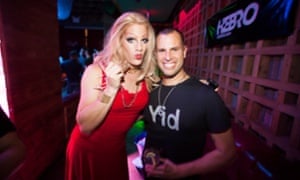
Lady SinAGaga posing with Jayson Littman, founder of Hebro, after her costume change at the High Homo Days party. Photograph: Santiago Felipe/Hebro
Yudi K isn’t alone. The winner of season five of RuPaul’s Drag Race was a Jewish drag queen named Jinkx Monsoon, aka Jerick Hoffer of Portland, Oregon. Hoffer was raised Catholic but when he was 18 found out he was of Russian Jewish descent and became increasingly interested in Judaism.Hebro’s Littman, who has been described as the mayor of the Jewish gay party scene, remarks: “Drag is very much part of gay culture, and so is Judaism. Some of the gayest parts of LGBT culture are Jewish: Broadway, Barbra Streisand and big hair. Because Judaism is so intertwined with theater and entertainment, professions highly sought out by the gay community, they go together quite well.
“Being a character in drag is all about creating a big, exaggerated personality, and most gay Jews have the perfect role model to imitate for that: our mothers.”
Sherry Vine, Keith Levy’s drag persona, embodies this sentiment. Levy was not raised Orthodox, nor does he identify as such now, but he has a strong Jewish identity. “My dad is a Jewish atheist, and my mom’s side of the family is Baptist,” he says. He always celebrated holidays with his extended family, though, and the Jewish bits of those celebrations “have always been a part of Sherry Vine”. In her Jewish Brooklyn accent, performing full time in clubs and cruise ships around the world, she does a lot of parodies about being Jewish – like her Jappy parody of Pharrell Williams’ Happy.
The blossoming Jewish drag culture, as Littman put it, “shows that our community has come so far that not only have we dealt with many of our issues surrounding coming out, but now we can proudly put on a drag performance with Jewish identities to showcase our alternate Jewishly exaggerated personalities”.
Both Yudi K and Moshiel asked that their last names be withheld because they are still not out as drag queens to their respective Orthodox communities.
• This article was amended on 11 March 2015. A photo was removed to protect the privacy of an individual.
FOOD & WINE
The French Fight Back
Gamliel Kronemer
Special To The Jewish WeekThe French Fight Back
 While Israeli wines may dominate the kosher market, French wines are starting to make a comeback.
Gamliel Kronemer
Special To The Jewish Week
Almost 20 years ago, in the summer of 1995, I walked out of a liquor store with an $11 purchase that was going to change my life. It was a bottle of Georges Duboeuf’s 1994 kosher Beaujolais Villages (the only French kosher vintage ever exported to the U.S.), and it was a perfect entry-level red. It was the wine that convinced me that there was more to kosher wine than Cream Concord, and it was French.
Mine is hardly a unique story. The modern kosher wine industry was really starting to take shape in the 1990s, with dozens of quality kosher table wines, most of them produced in France or California, becoming available to U.S. consumers. “The kosher wine industry copies the general wine industry,” explains Nathan Herzog, the executive vice president of sales and marketing at kosher wine giant Royal Wine Corp., which started importing kosher French wines in 1983. “When French wine is popular, kosher French wine is popular ... [and] in the late ’80s and early ’90s the French were king.”
But, Herzog explained, there is an important “caveat” when it comes to understanding the kosher wine market — “and that is Israeli wines. When Israel really started producing [quality kosher] wines, about 20 years ago, people would say, ‘Why do I need French wines ... when there are great Israeli wines.’”
By the mid-2000s, when, due to the Iraq war, French products generally became unpopular in the U.S. (the days when French fries had been redubbed “Freedom Fries”), Israeli wine had come to dominate the kosher wine market; this is a fact that USDA import statistics seemingly confirm — by 2005 the U.S. imported 1.3 million liters of Israeli wine, up from only 377,100 liters in 1995. (In 2014, the best year on record yet for Israeli wine imports, the U.S. imported 2.2 million liters.)
Yet in the last few years, after having largely disappeared from the market, the number of French kosher wines available in the U.S. is again on the rise.
“Wine is like fashion,” says Herzog, “and fashion changes. We’ve seen in the last three or four years a nice resurgence in interest in French [kosher] wines.” Royal Wine Corp. released three new kosher French wines in January, with more new French wines on the way later this year and next year.
Nor is Royal the only importer that has seen an increase in demand for kosher French wines.
William Mendel, the U.S. portfolio brand manager for the French-based Victor Kosher Wines, whosecurrent portfolio contains 26 kosher French products, including two Champagnes and three Cognacs, is very excited about the current level of interest in his French imports. “We have a rosé, a Margaux, and a [Lalande de] Pomerol that we can’t keep on the shelves,” he says.
One of the newest importers of kosher French wines is Brooklyn’s Red Garden Inc., which in the last few years has started importing a number of kosher small production wines that had been produced for France’s domestic market. French imports have grown to represent approximately 20 percent of its portfolio.
Red Garden’s Mendel Unger suggests that, in part, the upsurge in kosher French wine sales happened because “people got a little bored with Israeli wines. They are always looking for something new ... and today drinking French wine makes them feel more sophisticated.”
It’s not just the kosher wine companies that are betting on increased demand for kosher French wines. Last year, Champagne giant Vranken-Pommery Monopole reintroduced to the U.S. market its kosher Pommery Brut Royal Champagne, and for the first time is distributing itself through its U.S. subsidiary, Vranken-Pommery USA.
Due to a strong Israeli wine presence, French wines are not likely to dominate the kosher market again anytime soon. However, cheap oil (reducing transport prices) and the weak Euro, are likely to keep prices for French kosher wine prices reasonable. So with increased demand, it seems likely we’ll be seeing a lot more kosher French wine in the future. Who knows, maybe Georges Duboeuf will even start making kosher Beaujolais again.
The following are five new and noteworthy kosher French Wines:
Pommery, Brut Royal, Champagne, Kosher Edition, non-vintage: Recently reintroduced to the U.S. market, this dark straw-colored blend of one-third Chardonnay, one-third Pinot Noir and one-third Pinot Meunier, has a full body and a rich mousse of large, active bubbles. The lush bouquet is redolent of peaches, cream and toasted challah, with a whiff of wildflowers in the background. Look for flavors of toast, peaches, and cream in the front of the palate, straw and raspberries mid-palate, a long finish of Meyer lemons, and a lovely layer of chalky-earthiness running throughout.
Score A ($29.99. Available at Garnet Wines & Liquors, 929 Lexington Ave., Manhattan, [212] 772-3212)
Les Lauriers, Des Domaines Edmond de Rothschild Montagne-Saint Emilion, Bordeaux, Kosher Edition, 2013: With a bright-garnet color, and a medium to full body, this very approachable Bordeaux has a nose of cassis and plums, with a hint of brier. Look for flavors of cherries, cassis, plumbs and crème de framboise, with a smoky, spicy note on the finish. With silky smooth tannins, this wine is drinking well now, and should continue to do so for another five years.
Score B+ ($26.99. Available at Beacon wine and Spirits, 2120 Broadway, Manhattan, [212] 877-0028)
Pavillon de Léoville Poyferré, Saint Julien, Bordeaux, Kosher Edition, 2012: This second label of Léoville Poyferré is a dark garnet-colored, full-bodied wine, which has an earthy nose with elements of cassis, cranberries, spice, smoke and pencil shavings. Cranberries and cassis dominate the flavor with a nice mineral-rich earthiness mid palate, and a note of tobacco smoke on the finish. This wine could use another year or so to show its best, and then should be able to cellar until the end of the decade.
Score B+ ($53.99. Available online from Kosherwine.com, [866] 567-4370)
Giersberger, Pinot Gris, Alsace, Kosher Edition, 2012: Made from the same grape variety that the Italians call Pinot Grigio, this dark-straw colored, light-to-medium bodied white wine, has a fruity nose redolent of pineapple, quince, apricots and lychees. Off-dry, but crisp, the wine is well structured with flavors of apricots, lychees and citrus, and a hint of spice. Drink within the next year.
Score B+ ($22.00. Available at FillerUp Kosher Wines, 174 W. Englewood Ave., Teaneck, N.J., [201] 862-1700)
Chateau du Rocher, Bordeaux, Kosher Edition, 2010: One of the least expensive wines in my tastings for this article, this wine is everything a budget Bordeaux should be. Garnet colored, with a medium to full body, the wine has a bouquet of cherries and cassis, with just a whiff of chocolate and tobacco smoke. Look for flavors of cherries and cassis, with hints of blackberries and crème de cassis. While not overly complex, this wine is well structured, with just a modicum of powdery tannins. Drink now-2018.
Score B+ ($18.99. Available at Suhag Wines & Liquor, 69-30 Main St., Flushing, [718] 793-6629)
Wines are scored on an “A”–”F” scale where “A” is excellent, “B” is good, “C” is flawed, “D” is very flawed, and “F” is undrinkable. Prices listed reflect the price at the retailer mentioned.
The French Fight Back
Gamliel Kronemer
Special To The Jewish WeekThe French Fight Back
Gamliel Kronemer
Special To The Jewish Week
Almost 20 years ago, in the summer of 1995, I walked out of a liquor store with an $11 purchase that was going to change my life. It was a bottle of Georges Duboeuf’s 1994 kosher Beaujolais Villages (the only French kosher vintage ever exported to the U.S.), and it was a perfect entry-level red. It was the wine that convinced me that there was more to kosher wine than Cream Concord, and it was French.
Mine is hardly a unique story. The modern kosher wine industry was really starting to take shape in the 1990s, with dozens of quality kosher table wines, most of them produced in France or California, becoming available to U.S. consumers. “The kosher wine industry copies the general wine industry,” explains Nathan Herzog, the executive vice president of sales and marketing at kosher wine giant Royal Wine Corp., which started importing kosher French wines in 1983. “When French wine is popular, kosher French wine is popular ... [and] in the late ’80s and early ’90s the French were king.”
But, Herzog explained, there is an important “caveat” when it comes to understanding the kosher wine market — “and that is Israeli wines. When Israel really started producing [quality kosher] wines, about 20 years ago, people would say, ‘Why do I need French wines ... when there are great Israeli wines.’”
By the mid-2000s, when, due to the Iraq war, French products generally became unpopular in the U.S. (the days when French fries had been redubbed “Freedom Fries”), Israeli wine had come to dominate the kosher wine market; this is a fact that USDA import statistics seemingly confirm — by 2005 the U.S. imported 1.3 million liters of Israeli wine, up from only 377,100 liters in 1995. (In 2014, the best year on record yet for Israeli wine imports, the U.S. imported 2.2 million liters.)
Yet in the last few years, after having largely disappeared from the market, the number of French kosher wines available in the U.S. is again on the rise.
“Wine is like fashion,” says Herzog, “and fashion changes. We’ve seen in the last three or four years a nice resurgence in interest in French [kosher] wines.” Royal Wine Corp. released three new kosher French wines in January, with more new French wines on the way later this year and next year.
Nor is Royal the only importer that has seen an increase in demand for kosher French wines.
William Mendel, the U.S. portfolio brand manager for the French-based Victor Kosher Wines, whosecurrent portfolio contains 26 kosher French products, including two Champagnes and three Cognacs, is very excited about the current level of interest in his French imports. “We have a rosé, a Margaux, and a [Lalande de] Pomerol that we can’t keep on the shelves,” he says.
One of the newest importers of kosher French wines is Brooklyn’s Red Garden Inc., which in the last few years has started importing a number of kosher small production wines that had been produced for France’s domestic market. French imports have grown to represent approximately 20 percent of its portfolio.
Red Garden’s Mendel Unger suggests that, in part, the upsurge in kosher French wine sales happened because “people got a little bored with Israeli wines. They are always looking for something new ... and today drinking French wine makes them feel more sophisticated.”
It’s not just the kosher wine companies that are betting on increased demand for kosher French wines. Last year, Champagne giant Vranken-Pommery Monopole reintroduced to the U.S. market its kosher Pommery Brut Royal Champagne, and for the first time is distributing itself through its U.S. subsidiary, Vranken-Pommery USA.
Due to a strong Israeli wine presence, French wines are not likely to dominate the kosher market again anytime soon. However, cheap oil (reducing transport prices) and the weak Euro, are likely to keep prices for French kosher wine prices reasonable. So with increased demand, it seems likely we’ll be seeing a lot more kosher French wine in the future. Who knows, maybe Georges Duboeuf will even start making kosher Beaujolais again.
The following are five new and noteworthy kosher French Wines:
Pommery, Brut Royal, Champagne, Kosher Edition, non-vintage: Recently reintroduced to the U.S. market, this dark straw-colored blend of one-third Chardonnay, one-third Pinot Noir and one-third Pinot Meunier, has a full body and a rich mousse of large, active bubbles. The lush bouquet is redolent of peaches, cream and toasted challah, with a whiff of wildflowers in the background. Look for flavors of toast, peaches, and cream in the front of the palate, straw and raspberries mid-palate, a long finish of Meyer lemons, and a lovely layer of chalky-earthiness running throughout.
Score A ($29.99. Available at Garnet Wines & Liquors, 929 Lexington Ave., Manhattan, [212] 772-3212)
Les Lauriers, Des Domaines Edmond de Rothschild Montagne-Saint Emilion, Bordeaux, Kosher Edition, 2013: With a bright-garnet color, and a medium to full body, this very approachable Bordeaux has a nose of cassis and plums, with a hint of brier. Look for flavors of cherries, cassis, plumbs and crème de framboise, with a smoky, spicy note on the finish. With silky smooth tannins, this wine is drinking well now, and should continue to do so for another five years.
Score B+ ($26.99. Available at Beacon wine and Spirits, 2120 Broadway, Manhattan, [212] 877-0028)
Pavillon de Léoville Poyferré, Saint Julien, Bordeaux, Kosher Edition, 2012: This second label of Léoville Poyferré is a dark garnet-colored, full-bodied wine, which has an earthy nose with elements of cassis, cranberries, spice, smoke and pencil shavings. Cranberries and cassis dominate the flavor with a nice mineral-rich earthiness mid palate, and a note of tobacco smoke on the finish. This wine could use another year or so to show its best, and then should be able to cellar until the end of the decade.
Score B+ ($53.99. Available online from Kosherwine.com, [866] 567-4370)
Giersberger, Pinot Gris, Alsace, Kosher Edition, 2012: Made from the same grape variety that the Italians call Pinot Grigio, this dark-straw colored, light-to-medium bodied white wine, has a fruity nose redolent of pineapple, quince, apricots and lychees. Off-dry, but crisp, the wine is well structured with flavors of apricots, lychees and citrus, and a hint of spice. Drink within the next year.
Score B+ ($22.00. Available at FillerUp Kosher Wines, 174 W. Englewood Ave., Teaneck, N.J., [201] 862-1700)
Chateau du Rocher, Bordeaux, Kosher Edition, 2010: One of the least expensive wines in my tastings for this article, this wine is everything a budget Bordeaux should be. Garnet colored, with a medium to full body, the wine has a bouquet of cherries and cassis, with just a whiff of chocolate and tobacco smoke. Look for flavors of cherries and cassis, with hints of blackberries and crème de cassis. While not overly complex, this wine is well structured, with just a modicum of powdery tannins. Drink now-2018.
Score B+ ($18.99. Available at Suhag Wines & Liquor, 69-30 Main St., Flushing, [718] 793-6629)
Wines are scored on an “A”–”F” scale where “A” is excellent, “B” is good, “C” is flawed, “D” is very flawed, and “F” is undrinkable. Prices listed reflect the price at the retailer mentioned.
POLITICAL INSIDER
'Israel Wants Change'
Douglas Bloomfield
Special To The Jewish Week
A'Israel Wants Change'
 NEW YORK
Rebels Within The Fold
The unlikely journey of the frummy alt-rock duo Bulletproof Stockings destined for first stop on the Upper West Side.
Hannah Dreyfus
Staff Writer

When keyboard player Perl Wolf and drummer Dalia Shusterman, collectively the cheekily named Bulletproof Stockings, cross the river to play their first gig on the Upper West Side on March 22, they’ll be breaking the mold for chasidic women, and perhaps even “pushing it over the ledge,” as the song also suggests.
With one foot in the world of Orthodox Brooklyn and the other dipping a toe into the wider musical world, the Bulletproof Stockings are used to the idea of testing boundaries, or at least pushing against expectations. But all the while staying within the fold, so to speak. As followers of Chabad, the musicians play only in front of other women and often get charged up before a show by reciting Psalms.
With “Mind Clear” due out this month (it’s a preview of the group’s first full-length CD, set for release in September), a just-launched Kickstarter campaign and the Upper West Side gig, the group seems poised for bigger things.
With the BPS fresh off sold-out gigs in Baltimore and Atlanta — the first time they’ve ever performed outside of New York with their full band — Wolfe told The Jewish Week in a recent interview in the Crown Heights basement apartment where they live and practice, “People are finally seeing our vision.” She described the fast-moving trip from obscurity to album as “surreal.”
“We believed we could take over the world this whole time,” Wolfe said, sounding like a strutting rock and roller, “but now others are believing we can too.”
The duo’s unlikely musical journey began in 2011 when Wolfe, who grew up Chabad in Chicago, moved to New York after two divorces left her searching for her identity. Finding Shusterman in Crown Heights was “all divine providence,” she said.
Since their start in December 2011, the BPS have attracted a slew of mainstreammedia attention — more for their against-the-grain lifestyle than for their music — including a segment on the Oxygen Network’s reality TV series “Living Different.”
Still, the journey has been far from smooth. Since their teenage years, Wolfe and Shusterman struggled with being labeled the “bad girls.”
“I was the one girl in our Orthodox shul who had pink hair,” said Shusterman, who grew up in Modern Orthodox home in suburban Washington, D.C. She left Orthodoxy at age 14 only to return in her late 20s. During that time, she worked as a bartender and street performer in New Orleans to support occasional music gigs. “Being a rocker didn’t exactly mesh with the spiritual life,” she said.
“I was definitely considered the bad girl all through high school,” said Wolfe, who recalled being sent to the principal’s office every day to remove her heavy eyeliner. Wolfe left Orthodoxy during her early adult years, though she returned to Chabad in her early 20s. She shed religious observance once again after her second divorce, only to return again in 2011.
“The crazy part was that I wasn’t doing anything bad — I never did drugs, I barely drank and waited [to have sex] until marriage,” she said. Still, the label “rebel” stuck. “People were always saying, ‘Where’s Perl going to end up?’” she said, “No one thought it was anywhere good.”
All of it, Shusterman said, is reflected in the lyrics of “Mind Clear.” One passage says, “Don’t dance near the ledge / They told me / Might not make it back in tact / But curiosity got the best of me.”
“There was a point when I was divorced from everything,” she said, though returning to Orthodoxy remained her goal. “The song’s about exploring — rediscovering what was lost.”
Though their personal journeys remain a point of fascination, the two rockers are eager for the spotlight to shift to their sound, which they say has been influenced by classic rock (Jimi Hendrix and the Doors) as well as by alt acts like Jane’s Addiction and the Pixies. The band is augmented by guitar, violin and cello.
“People are so distracted by how we dress and our background that they forget we’re actually good!” said Shusterman, 41, who is wearing a fitted black dress, green dangling earring, high heels and bright red lipstick. Both she and Wolfe wear long luxurious wigs barely detectable to the untrained eye, a tradition among married Orthodox women. (The band’s name refers to the thick, opaque stockings favored by frum women; for the record the two wear stockings, though not of the bulletproof variety.)
In order to clear their minds, Wolfe and Shusterman pray and recite Psalms before every show. “It gets us in the zone,” the drummer said.
Though much of their music is inspired by Jewish texts and chasidic teachings, its real focus is everyday life.
“We’re not proselytizing,” said Wolfe. “People can interpret our music however they want — whatever speaks most to their own experiences. Art doesn’t belong to any one person.”
Still, getting mainstream media outlets to shift focus from their unique backgrounds to their music isn’t easy. Shusterman described how one of the cameramen for Oxygen was shocked by the quality of their music. “He was like, ‘You guys are so modest, I never would have guessed you’re actually talented!’”
Modesty is one of the key reasons Wolfe and Shusterman decided to limit their shows to female audiences only. Though Wolfe was careful to explain that the Jewish law of kol isha restricts a man from listening to a woman, and not a woman from performing in front of a man, the two have decided to be sensitive to their community’s expectations.
“The press always gets it wrong — they say Jewish law says women can’t sing. The truth is, we can play in front of whoever we want,” said Wolfe. “But we’ve just decided to make this into an all-girls party. It’s been a boy’s club mentality for so long; it’s time to just let ladies do their thing.”
Even women with no previous exposure to Jewish law began to “see the value of women having space to themselves,” Shusterman added. “Women are totally digging it.”
And they are. During their recent sold-out tour, over 200 women turned out for their concert in Baltimore, and their sold-out show in Atlanta drew a crowd of over 150.
Shusterman, who is the single mother of four young boys (her husband died suddenly in 2011), says her sons love what she does.
“When people in school ask ‘What does your mom do?’ I’m not sure they really know how to answer,” she said, laughing. “But I know they think it’s cool. I hear them singing our music, trying to figure out the chords on the keyboard. They’re proud of me.”
Though the two stop short of calling themselves feminists (“We’re not on any political bandwagon” said Shusterman), empowering women is what gets them out of bed every day.
“When girls and young women come up to us and say, ‘Your music made me want to pick up an instrument and play,’ it’s all worth it,” said Shusterman.
And if those girls and young women attend the March 22 gig at Ohab Zedek on the Upper West Side, they’ll likely hear that message loud and clear: “Took me for a ride / I know better now / Give up this artificial way / Go out and face the crowd,” Wolfe and Shusterman sing in the chorus of “Mind Clear.”
“I made up my mind, dear / I got my mind clear.” editor@jewishweek.org
THE JW Q&A
‘Jewish Public Square’ Undergoing Changes
Stephen Hazan Arnoff is the new CEO of the JCC Association, an umbrella organization in New York.
Steve Lipman
Staff Writer

Q: Your JCC background is largely at the micro level, especially at the 14th Street Y here, where you instituted many programming changes. How hard is the adjustment to your new, macro national responsibilities?
A: There really is no micro versus macro in a JCC. We are both local and part of a larger movement. The Jewish community has always been focused on the local and immediate — the synagogue, the mikvah, the school — while grappling with something transcendent — carrying hearts and minds beyond the walls that hold those institutions or services.
For many Jewish Americans, especially generations of immigrants, the local Jewish Community Center was often the first and strongest contact point with the Jewish community. How has the mission of demands on the JCC changed over the years?
JCC’s change with the needs of our communities. We are the Jewish public square. We help our JCCs engage the community by providing support and programming in core services from early childhood education, camp, arts and culture, fitness and wellness and more. We’re a vast network of laboratories seeking what’s next in the Jewish world.
Do today’s Jewish immigrants have the same needs from a JCC that earlier generations did?
Maybe once we focused more systemically on language or other life skills, but today we still help people find a communal voice and place wherever they are in their journey. We also know that for today’s immigrant communities – Russian-speakers, Israelis, Ethiopians – maintaining cultural gifts from the place of origin is deeply valued. In many cases, JCCs are at the forefront of actually both preserving immigrant culture while also using it to enrich the rest of the JCC community.
How do JCCs reach a balance between “religious” members who insist that a JCC be closed on Shabbat, and secular members who see a JCC as a seven-days a week institution?
There is no perfect answer to that question, but JCCs are a place where the Shabbat conversation takes place. JCCs around the country are doing exciting, creative work that has helped reinvent the Shabbat experience for participants and members for whom a traditional Shabbat doesn’t resonate.
With a declining membership base in the Jewish community, many JCCs have reached out to the wider community, especially through the draw of their athletic facilities. How has this changed the Jewish nature of the institution?
The story is not one of decline; it’s about opportunity. Research has shown that the “J” in “JCC” is an added value, to Jews and non-Jews, and is equated with the high standards.
What do you consider the most successful programs you started at 14th Street, and why were they successful?
We tripled the number of people who participated in programs during my tenure. That meant three times as many children and families in early childhood programs, in camp, using the gym. There were many hubs of interest – LABA: A Laboratory for Jewish Culture is one I am particularly proud of; becoming a greening and composting hub in the East Village was another.
The Theater J at the Washington DC JCC made a controversial decision last year to fire its director for staging what some people considered an “anti-Israel” play. Is the role of a JCC to sponsor possibly divisive activities, especially concerning Israel, or to reach a safe consensus?
The JCC created this incredible arts program with a world-class theater that is going to continue offering challenging, creative, and exciting work for years to come. Arts and culture are essential to the JCC movement, and each JCC has our support to choose what’s right for its community.steve@jewishweek.org
'Israel Wants Change'
Douglas Bloomfield
Special To The Jewish Week
A'Israel Wants Change'
Douglas Bloomfield
As many as 35,000 Israelis turned out for a rally in Tel Aviv's Rabin Square Saturday night for an anti-Bibi rally themed "Israel Wants Change."
Meir Dagan, the former Mossad chief, said all Israelis agree on the need to keep Iran from getting a nuclear weapon "but going to war with the U.S. is not the way to stop it."
He had earlier said Netanyahu's speech to the Congress on March 3 was "bullshit."
The premier had nothing new to say in Washington about Iran, despite his promise to reveal new information, and he had nothing at all to say about a very urgent problem facing his country but one he persistently tries to avoid: peace with the Palestinians.
Other speakers at the rally pointed out that in his obsession with Iran, Netanyahu has ignored the occupation, the economy and the housing crisis, and has done great damage to relations with the United States.
Ephriam Sneh, the retired general, former West Bank commander and senior cabinet minister, said Netanyahu has "made the security of Israel hostage to the settlers." "Bibi sacrificed good relations with the US to keep the status quo on the Palestinians" and "to appease right-wingers."
Dagan said that in his six years as prime minister Netanyahu "has not led a single genuine process of change." Instead, he found endless excuses to avoid serious peace negotiations.
Netanyahu has repeatedly said "there is no partner for peace," and there may be a lot of truth to that, but Mahmoud Abbas could say the same thing and be equally accurate.
Bibi's obsession with Iran is not just because of its nuclear ambitions but also because he sees it as an excuse not to deal with the Palestinian issue. He likes to say he can't deal with Palestinian statehood until the Iran issue is resolved. And even then, he already has another excuse. Islamic extremism.
Give them a state and it will soon be taken over by Islamic extremists who will use it as a launching base for driving Israel into the sea.
He has been boasting about his triumphal visit to Washington ever since he landed back at Ben Gurion Airport. He got a lot of applause and a lot of attention, but he didn't change anyone's mind – at least not in Washington; it remains to be seen if he changed the minds of any voters at home.
President Obama said he heard nothing new from Netanyahu, no practical proposals for dealing with the nuclear threat, just the same old rhetoric. The Jerusalem Post reported Bibi didn't get a bounce in the polls from the campaign trip financed by Israeli taxpayers. With a week to go before the voting polls show his Likud party is just one mandate behind the Zionist Union ticket, but it's really too close to call.
If Netanyahu forms the next government, his greatest challenge won't be Iranian nukes or the Palestinian unrest but the urgent need to rebuild the relationship with the Obama administration that he has done so much to trash and crash. His first move will have to be replacing the political hack at his embassy with a competent and professional ambassador who will be taken seriously by the Executive Branch.
On American television Sunday Netanyahu lectured Obama to "remember who your ally is and who your enemy is." The prime minister would do well to take his own advice. He repeated what he said to Congress, "I respect President Obama," but he has a perverse way of showing it.
If Netanyahu is reelected his first job will be repairing the damage he has done to the US-Israel relationship. The word from the White House for Bibi is, "You broke it, you fix it." Rebels Within The Fold
The unlikely journey of the frummy alt-rock duo Bulletproof Stockings destined for first stop on the Upper West Side.
Hannah Dreyfus
Staff Writer
Good girls, bad girls: Perl Wolf and Dalia Shusterman. Hannah Dreyfus/JW
‘Break the mold / from the crown you make it gold,” the all-women alt-rock duo from Crown Heights sings in its new single, “Mind Clear.”When keyboard player Perl Wolf and drummer Dalia Shusterman, collectively the cheekily named Bulletproof Stockings, cross the river to play their first gig on the Upper West Side on March 22, they’ll be breaking the mold for chasidic women, and perhaps even “pushing it over the ledge,” as the song also suggests.
With one foot in the world of Orthodox Brooklyn and the other dipping a toe into the wider musical world, the Bulletproof Stockings are used to the idea of testing boundaries, or at least pushing against expectations. But all the while staying within the fold, so to speak. As followers of Chabad, the musicians play only in front of other women and often get charged up before a show by reciting Psalms.
With “Mind Clear” due out this month (it’s a preview of the group’s first full-length CD, set for release in September), a just-launched Kickstarter campaign and the Upper West Side gig, the group seems poised for bigger things.
With the BPS fresh off sold-out gigs in Baltimore and Atlanta — the first time they’ve ever performed outside of New York with their full band — Wolfe told The Jewish Week in a recent interview in the Crown Heights basement apartment where they live and practice, “People are finally seeing our vision.” She described the fast-moving trip from obscurity to album as “surreal.”
“We believed we could take over the world this whole time,” Wolfe said, sounding like a strutting rock and roller, “but now others are believing we can too.”
The duo’s unlikely musical journey began in 2011 when Wolfe, who grew up Chabad in Chicago, moved to New York after two divorces left her searching for her identity. Finding Shusterman in Crown Heights was “all divine providence,” she said.
Since their start in December 2011, the BPS have attracted a slew of mainstreammedia attention — more for their against-the-grain lifestyle than for their music — including a segment on the Oxygen Network’s reality TV series “Living Different.”
Still, the journey has been far from smooth. Since their teenage years, Wolfe and Shusterman struggled with being labeled the “bad girls.”
“I was the one girl in our Orthodox shul who had pink hair,” said Shusterman, who grew up in Modern Orthodox home in suburban Washington, D.C. She left Orthodoxy at age 14 only to return in her late 20s. During that time, she worked as a bartender and street performer in New Orleans to support occasional music gigs. “Being a rocker didn’t exactly mesh with the spiritual life,” she said.
“I was definitely considered the bad girl all through high school,” said Wolfe, who recalled being sent to the principal’s office every day to remove her heavy eyeliner. Wolfe left Orthodoxy during her early adult years, though she returned to Chabad in her early 20s. She shed religious observance once again after her second divorce, only to return again in 2011.
“The crazy part was that I wasn’t doing anything bad — I never did drugs, I barely drank and waited [to have sex] until marriage,” she said. Still, the label “rebel” stuck. “People were always saying, ‘Where’s Perl going to end up?’” she said, “No one thought it was anywhere good.”
All of it, Shusterman said, is reflected in the lyrics of “Mind Clear.” One passage says, “Don’t dance near the ledge / They told me / Might not make it back in tact / But curiosity got the best of me.”
“There was a point when I was divorced from everything,” she said, though returning to Orthodoxy remained her goal. “The song’s about exploring — rediscovering what was lost.”
Though their personal journeys remain a point of fascination, the two rockers are eager for the spotlight to shift to their sound, which they say has been influenced by classic rock (Jimi Hendrix and the Doors) as well as by alt acts like Jane’s Addiction and the Pixies. The band is augmented by guitar, violin and cello.
“People are so distracted by how we dress and our background that they forget we’re actually good!” said Shusterman, 41, who is wearing a fitted black dress, green dangling earring, high heels and bright red lipstick. Both she and Wolfe wear long luxurious wigs barely detectable to the untrained eye, a tradition among married Orthodox women. (The band’s name refers to the thick, opaque stockings favored by frum women; for the record the two wear stockings, though not of the bulletproof variety.)
In order to clear their minds, Wolfe and Shusterman pray and recite Psalms before every show. “It gets us in the zone,” the drummer said.
Though much of their music is inspired by Jewish texts and chasidic teachings, its real focus is everyday life.
“We’re not proselytizing,” said Wolfe. “People can interpret our music however they want — whatever speaks most to their own experiences. Art doesn’t belong to any one person.”
Still, getting mainstream media outlets to shift focus from their unique backgrounds to their music isn’t easy. Shusterman described how one of the cameramen for Oxygen was shocked by the quality of their music. “He was like, ‘You guys are so modest, I never would have guessed you’re actually talented!’”
Modesty is one of the key reasons Wolfe and Shusterman decided to limit their shows to female audiences only. Though Wolfe was careful to explain that the Jewish law of kol isha restricts a man from listening to a woman, and not a woman from performing in front of a man, the two have decided to be sensitive to their community’s expectations.
“The press always gets it wrong — they say Jewish law says women can’t sing. The truth is, we can play in front of whoever we want,” said Wolfe. “But we’ve just decided to make this into an all-girls party. It’s been a boy’s club mentality for so long; it’s time to just let ladies do their thing.”
Even women with no previous exposure to Jewish law began to “see the value of women having space to themselves,” Shusterman added. “Women are totally digging it.”
And they are. During their recent sold-out tour, over 200 women turned out for their concert in Baltimore, and their sold-out show in Atlanta drew a crowd of over 150.
Shusterman, who is the single mother of four young boys (her husband died suddenly in 2011), says her sons love what she does.
“When people in school ask ‘What does your mom do?’ I’m not sure they really know how to answer,” she said, laughing. “But I know they think it’s cool. I hear them singing our music, trying to figure out the chords on the keyboard. They’re proud of me.”
Though the two stop short of calling themselves feminists (“We’re not on any political bandwagon” said Shusterman), empowering women is what gets them out of bed every day.
“When girls and young women come up to us and say, ‘Your music made me want to pick up an instrument and play,’ it’s all worth it,” said Shusterman.
And if those girls and young women attend the March 22 gig at Ohab Zedek on the Upper West Side, they’ll likely hear that message loud and clear: “Took me for a ride / I know better now / Give up this artificial way / Go out and face the crowd,” Wolfe and Shusterman sing in the chorus of “Mind Clear.”
“I made up my mind, dear / I got my mind clear.” editor@jewishweek.org
THE JW Q&A
‘Jewish Public Square’ Undergoing Changes
Stephen Hazan Arnoff is the new CEO of the JCC Association, an umbrella organization in New York.
Steve Lipman
Staff Writer
New JCC Association CEO Stephen Hazan Arnoff: JCCs are a laboratory for “what’s next in the Jewish world.”
Stephen Hazan Arnoff, former executive director of the 14th Street Y in Manhattan, was recently named the CEO of the JCC Association, the New York-based umbrella organization for more than more than 350 JCCs, YM-YWHAs, and campsites in the U.S. and Canada. He succeeds Allan Finkelstein, who served two decades in that post. Arnoff was also the first director of the Office of Culture, Community and Society at Shalem College in Jerusalem. The Jewish Week interviewed Arnoff by email. This is an edited transcript.Q: Your JCC background is largely at the micro level, especially at the 14th Street Y here, where you instituted many programming changes. How hard is the adjustment to your new, macro national responsibilities?
A: There really is no micro versus macro in a JCC. We are both local and part of a larger movement. The Jewish community has always been focused on the local and immediate — the synagogue, the mikvah, the school — while grappling with something transcendent — carrying hearts and minds beyond the walls that hold those institutions or services.
For many Jewish Americans, especially generations of immigrants, the local Jewish Community Center was often the first and strongest contact point with the Jewish community. How has the mission of demands on the JCC changed over the years?
JCC’s change with the needs of our communities. We are the Jewish public square. We help our JCCs engage the community by providing support and programming in core services from early childhood education, camp, arts and culture, fitness and wellness and more. We’re a vast network of laboratories seeking what’s next in the Jewish world.
Do today’s Jewish immigrants have the same needs from a JCC that earlier generations did?
Maybe once we focused more systemically on language or other life skills, but today we still help people find a communal voice and place wherever they are in their journey. We also know that for today’s immigrant communities – Russian-speakers, Israelis, Ethiopians – maintaining cultural gifts from the place of origin is deeply valued. In many cases, JCCs are at the forefront of actually both preserving immigrant culture while also using it to enrich the rest of the JCC community.
How do JCCs reach a balance between “religious” members who insist that a JCC be closed on Shabbat, and secular members who see a JCC as a seven-days a week institution?
There is no perfect answer to that question, but JCCs are a place where the Shabbat conversation takes place. JCCs around the country are doing exciting, creative work that has helped reinvent the Shabbat experience for participants and members for whom a traditional Shabbat doesn’t resonate.
With a declining membership base in the Jewish community, many JCCs have reached out to the wider community, especially through the draw of their athletic facilities. How has this changed the Jewish nature of the institution?
The story is not one of decline; it’s about opportunity. Research has shown that the “J” in “JCC” is an added value, to Jews and non-Jews, and is equated with the high standards.
What do you consider the most successful programs you started at 14th Street, and why were they successful?
We tripled the number of people who participated in programs during my tenure. That meant three times as many children and families in early childhood programs, in camp, using the gym. There were many hubs of interest – LABA: A Laboratory for Jewish Culture is one I am particularly proud of; becoming a greening and composting hub in the East Village was another.
The Theater J at the Washington DC JCC made a controversial decision last year to fire its director for staging what some people considered an “anti-Israel” play. Is the role of a JCC to sponsor possibly divisive activities, especially concerning Israel, or to reach a safe consensus?
The JCC created this incredible arts program with a world-class theater that is going to continue offering challenging, creative, and exciting work for years to come. Arts and culture are essential to the JCC movement, and each JCC has our support to choose what’s right for its community.steve@jewishweek.org
TIM BOXER
Dr. Spock, Z''L: Live Long And Prosper
Tim Boxer
Jewish Week Online Columnist
 A polaroid of Spock in civilian dress. Tim Boxer/JW
In 1986 Leonard Nimoy interrupted an extremely hectic day of post-production of the latest Trekkie epic, “Star Trek IV: The Voyage Home,” to welcome me to the Paramount lot in Los Angeles. Besides continuing his role as Dr. Spock, he was also director of the film. On his desk I noticed a book, “Hannah Senesh: Her Life and Diary,” with an introduction by Abba Eban.
He kept his proud Jewish identity strong over the years. “I feel very good being connected with it, with the culture and education. I have tried, whenever possible, to work in projects that have some sense of Jewish identity.”
The year before I met him, Nimoy, a heavy smoker in his younger years, broke the habit. “I wasn’t happy about being a smoker,” he said. “I was short of breath. I decided it was time to quit.”
Yet his smoking led to chronic obstructive pulmonary disease, an incurable malady that ultimately struck him down at age 83 on Feb. 27, when he died at home in the Bel-Air section of Los Angeles.
Nimoy found huge success in Hollywood, but he told me the biggest mistake in his career was going to the West Coast instead of Broadway after leaving Boston Collegeat age 18. He accepted an offer to work at the Pasadena Playhouse.
“It was not a good idea,” he said. “The Pasadena Playhouse was on its last legs when I got there in 1949. I wasn’t very happy with the place.”
He felt that all those lean years of his career could have been avoided had he gone straight to New York for a richer theatrical grounding. But the palm trees swaying on the sunny boulevards enticed him to stay in L.A. After years of struggle, he finally rocketed to the top of the Hollywood galaxy on the Starship Enterprise.
This surge in his career came in 1966-69 when two Jewish boys, Nimoy and William Shatner, dominated on NBC’s “Star Trek” series. While it was the producer’s decision that Nimoy’s half-alien/half-human character, Dr. Spock, should be greenish, with bangs and pointy ears, it was Nimoy’s choice to reach back into Jewish tradition to create the unique Vulcan greeting. He raised his hand, fingers stretched apart, in the manner of Kohanim when they offer the priestly blessings during holiday services. His motto was “Live long and prosper.”
He was born and bred in a kosher home in Boston. His father Max, a barber, and mother Dora came from Zaslav, a small Ukrainian town on the Polish border. He and brother Melvin went to Hebrew school every day after public school. “I was very much attached to the social and cultural aspects of Judaism,” he said, “but not terribly attached to the religious aspects.” He was a member of the B’nai B’rith Youth Organization (BBYO), AZA and later the Benjamin Cardozo chapter of B’nai B’rith.
In 1953, he appeared with Yiddish actor Maurice Schwartz in the English language adaptation of Sholom Aleichem’s “Hard To Be A Jew” at the now-defunct Hollywood Civic Playhouse. That’s where he met his first wife. A replacement was needed for the ingénue. A beautiful, intelligent woman named Sandra Zober came to audition. She came from Cordova, Alaska, the only Jewish family there. She failed the test but gained a husband. Leonard and Sandi married 1954 and divorced in 1987.
He also appeared in a 1971 production of “Fiddler on the Roof” in Hyannis, Mass.
Nimoy said doing “A Woman Called Golda” was “a very good experience for me.” He played Golda Meir’s husband in that 1982 TV movie. He made two trips to Israel for the filming. Nine years later, he played a Holocaust survivor who waged a courtroom battle against Holocaust deniers in the TV movie "Never Forget."
Unlike most Jews in Hollywood, Nimoy wouldn’t work on Rosh Hashanah and Yom Kippur. “Not as a rule, not if I can help it,” he said.
Nimoy’s second wife, Susan Bay, whom he married in 1989, survives him. She is a cousin of prominent film director Michael Bay (“Armageddon,” “Transformers”) who was raised Jewish by adoptive parents.
Tim Boxer was a columnist at the New York Post for two decades. At the same time he has been a columnist for The New York Jewish Week for 35 years, and editor of 15MinutesMagazine.com for 16 years. He is the author of Jewish Celebrity Hall of Fame, interviews of Hollywood stars about their Jewish roots.FIRST PERSON
The Jewish Week
Dr. Spock, Z''L: Live Long And Prosper
Tim Boxer
Jewish Week Online Columnist
In 1986 Leonard Nimoy interrupted an extremely hectic day of post-production of the latest Trekkie epic, “Star Trek IV: The Voyage Home,” to welcome me to the Paramount lot in Los Angeles. Besides continuing his role as Dr. Spock, he was also director of the film. On his desk I noticed a book, “Hannah Senesh: Her Life and Diary,” with an introduction by Abba Eban.
He kept his proud Jewish identity strong over the years. “I feel very good being connected with it, with the culture and education. I have tried, whenever possible, to work in projects that have some sense of Jewish identity.”
The year before I met him, Nimoy, a heavy smoker in his younger years, broke the habit. “I wasn’t happy about being a smoker,” he said. “I was short of breath. I decided it was time to quit.”
Yet his smoking led to chronic obstructive pulmonary disease, an incurable malady that ultimately struck him down at age 83 on Feb. 27, when he died at home in the Bel-Air section of Los Angeles.
Nimoy found huge success in Hollywood, but he told me the biggest mistake in his career was going to the West Coast instead of Broadway after leaving Boston Collegeat age 18. He accepted an offer to work at the Pasadena Playhouse.
“It was not a good idea,” he said. “The Pasadena Playhouse was on its last legs when I got there in 1949. I wasn’t very happy with the place.”
He felt that all those lean years of his career could have been avoided had he gone straight to New York for a richer theatrical grounding. But the palm trees swaying on the sunny boulevards enticed him to stay in L.A. After years of struggle, he finally rocketed to the top of the Hollywood galaxy on the Starship Enterprise.
This surge in his career came in 1966-69 when two Jewish boys, Nimoy and William Shatner, dominated on NBC’s “Star Trek” series. While it was the producer’s decision that Nimoy’s half-alien/half-human character, Dr. Spock, should be greenish, with bangs and pointy ears, it was Nimoy’s choice to reach back into Jewish tradition to create the unique Vulcan greeting. He raised his hand, fingers stretched apart, in the manner of Kohanim when they offer the priestly blessings during holiday services. His motto was “Live long and prosper.”
He was born and bred in a kosher home in Boston. His father Max, a barber, and mother Dora came from Zaslav, a small Ukrainian town on the Polish border. He and brother Melvin went to Hebrew school every day after public school. “I was very much attached to the social and cultural aspects of Judaism,” he said, “but not terribly attached to the religious aspects.” He was a member of the B’nai B’rith Youth Organization (BBYO), AZA and later the Benjamin Cardozo chapter of B’nai B’rith.
In 1953, he appeared with Yiddish actor Maurice Schwartz in the English language adaptation of Sholom Aleichem’s “Hard To Be A Jew” at the now-defunct Hollywood Civic Playhouse. That’s where he met his first wife. A replacement was needed for the ingénue. A beautiful, intelligent woman named Sandra Zober came to audition. She came from Cordova, Alaska, the only Jewish family there. She failed the test but gained a husband. Leonard and Sandi married 1954 and divorced in 1987.
He also appeared in a 1971 production of “Fiddler on the Roof” in Hyannis, Mass.
Nimoy said doing “A Woman Called Golda” was “a very good experience for me.” He played Golda Meir’s husband in that 1982 TV movie. He made two trips to Israel for the filming. Nine years later, he played a Holocaust survivor who waged a courtroom battle against Holocaust deniers in the TV movie "Never Forget."
Unlike most Jews in Hollywood, Nimoy wouldn’t work on Rosh Hashanah and Yom Kippur. “Not as a rule, not if I can help it,” he said.
Nimoy’s second wife, Susan Bay, whom he married in 1989, survives him. She is a cousin of prominent film director Michael Bay (“Armageddon,” “Transformers”) who was raised Jewish by adoptive parents.
Tim Boxer was a columnist at the New York Post for two decades. At the same time he has been a columnist for The New York Jewish Week for 35 years, and editor of 15MinutesMagazine.com for 16 years. He is the author of Jewish Celebrity Hall of Fame, interviews of Hollywood stars about their Jewish roots.FIRST PERSON
FIRST PERSON
Friday Night In Cuba
Gerald Eskenazi
Special To The Jewish Week

Just by coincidence, 72 hours after President Obama announced a coming easing of tensions between the United States and Cuba, I arrived in Havana. I was traveling with a group from the Latour travel agency (latour.com) called “Shalom Cuba” (you still need some reason, religious or arts or human rights, for example, to travel here).
The surroundings were simple, and yet so familiar.
There were 17 of us on the tour — enough for a minyan. In fact there were more of us with the tour group than congregants. And as part of the current, bizarre rules governing Americans traveling to Cuba, the tour had to have religious components. For me, these turned out to be the most interesting part of our weeklong trip. For Havana isn’t like those glamorous scenes in “Godfather II,” nor is it the pulsating Caribbean resort Americans flocked to in the 1950s, before Las Vegas became Las Vegas and Fidel Castro ended the laughter and broughtCommunism to the island.
So my wife and I looked forward to the Friday night services, and the evening turned into a highlight.
The unexpected synagogue, Am Shalom, was in Santa Clara, a colonial city 170 miles from Havana, a good 3 ½-hour serpentine ride (Ernesto, the knowledgeable bus driver, knew where all the highway potholes were).
The synagogue is really more like a cottage, behind a gate. It was built only a few years ago largely with American donations along with contributions from Santa Clara’s community of 18 Jews. I was momentarily surprised at how visible it was from the street, with its Star of David. But while organized religion was given the back of its hand early in the Castro regime, synagogues were usually left alone (and in fact, Havana’s one kosher butcher was allowed to remain in private hands).
We were greeted very warmly at the door, which opened to a wide, white room, by several congregants. There were no permanent rows of seats, but about 40 chairs were set up facing the cabinet where the Torahs were housed. A Cuban and an Israeli flag flanked the ark. The room was bare, except for some faux-stained-glasswindows. And the 12 congregants, which included two teenage boys, were smiling, as was the black man at the keyboard who wore a yarmulke, and the leader, 64-year-old David Tacher.
I was the only man wearing a jacket. Men and women and boys were dressed casually, but respectfully.
Music accompanied us as we sat down. Tacher, who is not a rabbi (there isn’t one in Cuba), told of us his country’s 1,500 Jews (virtually all of them in Havana) and how this synagogue depended on the donations of visitors to keep going. He distributed theprayer books. As I leafed through the transliterations, I was stumped by a word I didn’t recognize — “baraj.” Then I realized — it was how the word “baruch” would be written in Spanish lettering.
Other than that, the services were so similar to what I’m used to, a sort of mixture of Orthodox and Conservative (but with that keyboard). It was exuberant, and I still couldn’t get over my surprise at seeing people, who I had imagined would be so culturally different, saying the same things I’ve said my whole life, in the same way.
When the services ended, one of the boys said Kiddush, and David passed around bread that, I tried to imagine, tasted like challah. Then we all went to the roof for Friday night dinner.
As if on cue, salsa music greeted us on a starlit night. It was music coming from a nearby apartment, not part of the evening services. Our keyboardist did join us, though, and we sat down to dinner as he played “Ebb Tide.” There is a fascinating wall on one side of the roof made up of tiles depicting Jerusalem.
And who was cooking our dinner? Not any of the temple members, but a local restaurant. But the tables were bare. There had been a blackout — not uncommon in Cuba — and the restaurant was late in serving.
We sat together and ate together when the food arrived, and mostly we laughed. They spoke some English. Our guide helped both of us along when there were snags in the conversation. My wife is fluent in Spanish (her father spent half a dozen years in Cuba back in the late 1920s and early 1930s).
It wasn’t the Friday night meal I’d grown up with — no gefilte fish, chicken soup, brisket, or even challah. There was fish and beans and a sweet dessert. And it may have been the most memorable Friday night meal of my life.Gerald Eskenazi is a former New York Times sportswriter.
Friday Night In Cuba
Gerald Eskenazi
Special To The Jewish Week
Gerald Eskenazi
Havana, Cuba — I had never seen a keyboard played at a Friday night service before. Then again, I had never been in Cuba before.Just by coincidence, 72 hours after President Obama announced a coming easing of tensions between the United States and Cuba, I arrived in Havana. I was traveling with a group from the Latour travel agency (latour.com) called “Shalom Cuba” (you still need some reason, religious or arts or human rights, for example, to travel here).
The surroundings were simple, and yet so familiar.
There were 17 of us on the tour — enough for a minyan. In fact there were more of us with the tour group than congregants. And as part of the current, bizarre rules governing Americans traveling to Cuba, the tour had to have religious components. For me, these turned out to be the most interesting part of our weeklong trip. For Havana isn’t like those glamorous scenes in “Godfather II,” nor is it the pulsating Caribbean resort Americans flocked to in the 1950s, before Las Vegas became Las Vegas and Fidel Castro ended the laughter and broughtCommunism to the island.
So my wife and I looked forward to the Friday night services, and the evening turned into a highlight.
The unexpected synagogue, Am Shalom, was in Santa Clara, a colonial city 170 miles from Havana, a good 3 ½-hour serpentine ride (Ernesto, the knowledgeable bus driver, knew where all the highway potholes were).
The synagogue is really more like a cottage, behind a gate. It was built only a few years ago largely with American donations along with contributions from Santa Clara’s community of 18 Jews. I was momentarily surprised at how visible it was from the street, with its Star of David. But while organized religion was given the back of its hand early in the Castro regime, synagogues were usually left alone (and in fact, Havana’s one kosher butcher was allowed to remain in private hands).
We were greeted very warmly at the door, which opened to a wide, white room, by several congregants. There were no permanent rows of seats, but about 40 chairs were set up facing the cabinet where the Torahs were housed. A Cuban and an Israeli flag flanked the ark. The room was bare, except for some faux-stained-glasswindows. And the 12 congregants, which included two teenage boys, were smiling, as was the black man at the keyboard who wore a yarmulke, and the leader, 64-year-old David Tacher.
I was the only man wearing a jacket. Men and women and boys were dressed casually, but respectfully.
Music accompanied us as we sat down. Tacher, who is not a rabbi (there isn’t one in Cuba), told of us his country’s 1,500 Jews (virtually all of them in Havana) and how this synagogue depended on the donations of visitors to keep going. He distributed theprayer books. As I leafed through the transliterations, I was stumped by a word I didn’t recognize — “baraj.” Then I realized — it was how the word “baruch” would be written in Spanish lettering.
Other than that, the services were so similar to what I’m used to, a sort of mixture of Orthodox and Conservative (but with that keyboard). It was exuberant, and I still couldn’t get over my surprise at seeing people, who I had imagined would be so culturally different, saying the same things I’ve said my whole life, in the same way.
When the services ended, one of the boys said Kiddush, and David passed around bread that, I tried to imagine, tasted like challah. Then we all went to the roof for Friday night dinner.
As if on cue, salsa music greeted us on a starlit night. It was music coming from a nearby apartment, not part of the evening services. Our keyboardist did join us, though, and we sat down to dinner as he played “Ebb Tide.” There is a fascinating wall on one side of the roof made up of tiles depicting Jerusalem.
And who was cooking our dinner? Not any of the temple members, but a local restaurant. But the tables were bare. There had been a blackout — not uncommon in Cuba — and the restaurant was late in serving.
We sat together and ate together when the food arrived, and mostly we laughed. They spoke some English. Our guide helped both of us along when there were snags in the conversation. My wife is fluent in Spanish (her father spent half a dozen years in Cuba back in the late 1920s and early 1930s).
It wasn’t the Friday night meal I’d grown up with — no gefilte fish, chicken soup, brisket, or even challah. There was fish and beans and a sweet dessert. And it may have been the most memorable Friday night meal of my life.Gerald Eskenazi is a former New York Times sportswriter.
1501 Broadway, Suite 505
New York, New York 10036 United States
____________________________
____________________________

No comments:
Post a Comment