
"Making Choices" by the Rev. Dr. David L. Odom
Determining a strategy is all about making choices. That idea sounds simple, but it challenges the notion that strategy is all about coming up with cool ideas.
In Playing to Win: How Strategy Really Works, business theorist Roger Martin and Proctor & Gamble CEO A.G. Lafley argue that strategy is making disciplined choices in response to key questions.
Church is not about winning, selling soap or making money. Books written by sports, military or business strategists can be difficult to interpret for our context. After teaching from Martin and Lafley's work for a few years, I have come to translate their questions as follows:
- Why? What is the deepest aspiration?
- Where and with whom are we serving/transforming?
- How will we serve? What activities are needed?
- What capacities do we need to do "it"?
- What management systems are required to ensure the capacities are in place?
Yet "why" does not tell us where to serve. "Why" does not give much direction in terms of staying or going from a particular place or institution. "Where" may have more impact on how we work than "why," yet both are important. Management systems and capacities are in service to "how" and must align with "why."
The various organizations I have served could often answer one of these questions but not the others. For example, the hospital had outstanding management systems. The budget was closely monitored, and we had good cash balances. Managers were expected to comply with every regulation. Internal auditors reviewed our files to ensure that we were documenting that compliance. But most managers did not care about "why," "where" or "how" I worked. If those questions arose, the response was to hire a consultant to help answer those questions.
My disposition is to move quickly through questions about "why" and "where" and settle in on "how" concerns. I am most comfortable engaging practical questions. I greatly benefit from being in a team of folks who have dispositions to ask each of the five questions. We push each other in a way that the entire enterprise is stronger. Navigating such tension requires respect, but can be very fruitful.
Effective strategy is not a beautifully written plan or "cool" ideas. It is ongoing engagement of all of Martin and Lafley's questions. Writing plans can help clarify thinking and create structures of accountability, but the strategy is in engaging the questions and connecting all of the responses.
What questions do you most often ask? Where can you find colleagues and friends keenly interested in other questions? How and when will you continue to answer the five questions?
---------------------
Monday, November 9, 2015
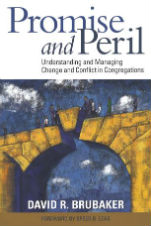
In Promise and Peril: Understanding and Managing Change and Conflict in Congregations, David Brubaker brings the tools of organizational theory and research to the task of understanding the deeper dynamics of congregational conflict. With a doctorate in sociology and more than twenty years working with congregational conflicts, Brubaker helps to explore the causes and effects of conflicts on a wide range of congregations. This book will help congregations avoid the pitfalls of conflict and instead head toward a healthy relationship between and among church staff and members.
Buy the book »


Continue Your Learning with The Church Network
Upcoming Webinar: Politics and the Church
A webinar presentation by Mike Batts
November 12 at 2:30 p.m. EDT
As the political season comes into full swing, this highly relevant session will address the following questions:
What are churches permitted to do -- and prohibited from doing -- in the political realm under current federal tax law?
What about the "gray" areas, such as endorsements by our pastor in an individual capacity, sermons that feature the moral issues highlighted in current political campaigns, or the distribution of voter guides?
How do so many churches seem to "get away" with violating the law?
What federal tax policy changes would be helpful in this area?
In Promise and Peril: Understanding and Managing Change and Conflict in Congregations, David Brubaker brings the tools of organizational theory and research to the task of understanding the deeper dynamics of congregational conflict. With a doctorate in sociology and more than twenty years working with congregational conflicts, Brubaker helps to explore the causes and effects of conflicts on a wide range of congregations. This book will help congregations avoid the pitfalls of conflict and instead head toward a healthy relationship between and among church staff and members.
Buy the book »
Continue Your Learning with The Church Network
Upcoming Webinar: Politics and the Church
A webinar presentation by Mike Batts
November 12 at 2:30 p.m. EDT
As the political season comes into full swing, this highly relevant session will address the following questions:
What are churches permitted to do -- and prohibited from doing -- in the political realm under current federal tax law?
What about the "gray" areas, such as endorsements by our pastor in an individual capacity, sermons that feature the moral issues highlighted in current political campaigns, or the distribution of voter guides?
How do so many churches seem to "get away" with violating the law?
What federal tax policy changes would be helpful in this area?
Learn more and register »
--------------
Ideas that Impact: Congregational Conflict
"Finding the Optimal Level of Conflict" by David Brubaker
Every congregation experiences conflict, even though each one does so in unique ways. The sources of conflict may vary from the micro to the macro -- from intrapersonal pathologies to personality differences to globalization forces -- but over time they are inescapable. Read more »
How Do We Transform the Communities in which we Live?
A Faith & Leadership Interview with Jan LoveThe dean of Emory University's Candler School of Theology talks about conflict transformation and how people can learn to live faithfully in times of disagreement.
Read more »
 The dean of Emory University’s Candler School of Theology talks about conflict transformation and how people can learn to live with conflict.
"Is Conflict a Good Thing?" by Dan Hotchkiss"Conflict is not bad" has been a consistent teaching of Alban and many others in the conflict field for years. It's a natural, inevitable consequence of having more than one idea in the room at the same time.
Read more »
Visit Alban.org
STAY CONNECTED


Alban
--------------
Ideas that Impact: Congregational Conflict
"Finding the Optimal Level of Conflict" by David Brubaker
Every congregation experiences conflict, even though each one does so in unique ways. The sources of conflict may vary from the micro to the macro -- from intrapersonal pathologies to personality differences to globalization forces -- but over time they are inescapable. Read more »
Every congregation experiences conflict, even though each one does so in unique ways. The sources of conflict may vary from the micro to the macro—from intrapersonal pathologies to personality differences to globalization forces—but over time they are inescapable. Various studies have shown that organizational leaders and managers spend up to 25 percent of their time managing conflict. Experienced pastors know that during times of crisis, conflict management duties can become all-consuming.
Although many members assume that all congregational conflicts emerge from personality differences or communication problems, other significant sources are often at work within the system itself. These include the structure, culture, and leadership of the organization. However, conflict can result not just from changes in the structure, culture, and environment but also from other systemic realities within those three areas.
Conflict can arise out of the congregational structure from one of several causes. First, conflict results when power is overly centralized and those with less power attempt to shift the power imbalance. Second, roles can be so poorly defined that overlapping and thus contested responsibilities lead to tension and conflict. Third, the formal and the informal social structure can be so divergent that conflict emerges from differing perceptions of who really has authority. Leaders who notice patterns in the interpersonal conflicts in their congregation will want to consider these possible structural causes.
An organization’s culture can be another underlying source of conflict, particularly its most visible expression—the worship service. The most common conflict arises when newer congregational members encounter an entrenched organizational culture that they do not share. The conflicts that result tend to be framed by both groups in terms of right and wrong behavior, as culture supplies the values and norms that help us determine what behavior is appropriate or inappropriate. If a pastor or other staff person hired from outside the congregation is perceived to be acting in ways that are counter to the congregation’s cultural values, conflict is particularly likely and tends to be acute. And when an outside leader and an inside culture clash, culture normally wins.Finally, the multiple environments in which a congregation is nested also provide the potential for multiple sources of conflict. This is the reason why “town/gown” conflicts (between communities and the colleges or universities they host) are so common; academic cultures that value debate and progressive thinking are likely to be in tension with environments that value harmony and traditional values.
Although conflict is inevitable, many scholars and practitioners believe that any organization may have an optimal level of conflict. Some disagreement and conflict provides energy and generates ideas, but too much conflict becomes destructive. When an organization has too little conflict, it may need to be encouraged, and when an organization has too much conflict, it may need to be reduced. In the middle of this curve, however, lies an optimal level of conflict where most organizations seem to thrive. Stirring the conflict pot may be needed in some situations, but when the pot starts to boil over, a conflict reduction strategy may be needed.
Diagnosing the level of conflict and seeking outside assistance at higher levels constitutes the intervention end of the conflict management spectrum. At the prevention end lie opportunities for congregational leaders to create a conflict-healthy system where disagreement is welcomed and destructive conflict doesn’t take root. A conflict-healthy system includes both individual behaviors and congregational mechanisms to manage conflict. It begins with the recognition that leaders set the tone regarding conflict management in their congregations, along with many other behavioral norms.
An organization’s culture matters more than its structure. Therefore, while congregational leaders may be able to create a mediation program or an open-door policy, the greater challenge will likely be changing the conflict culture sufficiently so that congregational members will naturally seek out and use interest-based methods of conflict resolution rather than only choosing flight or fight.
Culture changes when behaviors and assumptions change, and leaders’ behaviors and assumptions matter most of all. Therefore, leaders who learn to know the system, build a supporting coalition, and model the desired changes are affecting the culture of their congregations. The culture may at first resist, but leaders’ persistence in modeling the desired assumptions and behaviors will over time change the conflict culture—the norms and behaviors around conflict in your congregation. Managing conflict starts with managing oneself. Consider the conflict culture that you would like to have in your congregation, then start behaving as if that culture has already arrived. Culture change is never easy, and it is often painful. But it is possible.
A compelling example of leaders’ turning conflict into opportunity for structural and cultural change is found in the first seven verses of Acts 6. The idyllic description of the first Christian community, recorded in Acts 2:42–47 and Acts 4:32–37 is soon marred by incidents of deception in Acts 5:1–11 and internal conflict in Acts 6:1–7. While the sudden deaths of Ananias and Sapphira—who attempted to deceive the apostles about the extent of their generosity—are shocking, the conflict recorded in Acts 6 sounds more familiar to our ears. One group murmured (or complained) against another group, and leaders intervened to resolve the conflict.
The complaints came from the Hellenistic or Greek-speaking Jews and were directed against the Aramaic-speaking Jews. Most scholars agree that the Aramaic-speaking Jews were in the majority of the early Christian movement and included Jesus’s disciples—now called apostles. The identified issue for the minority group was that their “widows were being overlooked in the daily distribution of food” (Acts 6:1)—a compelling allegation in a society where care for widows and orphans was part of the Mosaic Law.
The twelve apostles could have ignored these allegations, ordered the minority group to stop griping, or issued a decree that all widows would henceforth be fed equal portions. Instead, they convened a meeting of all the disciples and self-defined by clarifying their primary role in the community. “It would not be right for us to neglect the ministry of the word of God in order to wait on tables” (Acts 6:2). They then gave the problem back to the group that originally complained, suggesting that they choose seven individuals “full of the Spirit and wisdom” to care for the feeding of widows (v. 3). Fortunately, the proposal “pleased the whole group” (v. 5), and they chose seven men, all of whom had Greek names–and thus were likely from the group that originally brought the complaint.
It is instructive to note that this passage begins and ends with church growth. The first verse of chapter 6 records that “in those days . . . the number of disciples was increasing,” while the last verse of this section concludes that “the word of God spread” and “a large number of [Jewish] priests became obedient to the faith” (v. 7). This is thus a story about a conflict, nested in a story about growth and change. This fascinating, if brief, account of the first recorded church conflict offers at least three significant learnings.
First, leaders need to move toward conflict, not away from it. Leaders who learn to move toward conflict discover that they have opportunities to resolve issues when those issues are small, rather than attempting to fight fires when they are nearly out of control.
Second, the identified issue is almost never the real issue. The allegation from the Greek-speaking minority that their “widows were being overlooked” in the daily food distribution was indeed a compelling one, but it likely was a proxy for a deeper feeling of powerlessness and alienation among the Hellenist members of the early church. All the significant leadership positions (apostles) were held by the Aramaic-speaking majority, and the minority did not know how to exercise their voice other than through “murmuring.”
Third, involve the “complainers” in solving their identified problems. Note that the apostles did not agree to take care of the problem that had been identified. Rather, they recruited members of the murmuring minority to address the problem. This outcome actually created a new role in the church—that of deacon.
Conflict is often a crisis, but it is also an opportunity. Much depends on our attitude toward conflict. If we expect it to be destructive and awful, it probably will be. But if we anticipate that the conflict may instead be an opportunity for genuine change, we may experience transformation. As Ron Kraybill, the founding director of Mennonite Conciliation Service, has said, conflict may be “an arena of revelation,” a time when we hear God’s voice as we never have before.
________________________________________
Adapted from Promise and Peril: Understanding and Managing Change and Conflict in Congregations by David R. Brubaker, copyright © 2009 by the Alban Institute. All rights reserved.
---------------------How Do We Transform the Communities in which we Live?
A Faith & Leadership Interview with Jan LoveThe dean of Emory University's Candler School of Theology talks about conflict transformation and how people can learn to live faithfully in times of disagreement.
Read more »
The dean of Emory University’s Candler School of Theology talks about conflict transformation and how people can learn to live with conflict.
Conflict is inevitable, and trying to end it impossible. That’s why managing, handling and transforming conflict should be a goal, said Jan Love, dean of the Candler School of Theology at Emory University and professor of Christianity and world politics.
“Conflict transformation doesn’t presume an inactive or non-active engagement with the world, and it doesn’t presume a nonconfrontational stance with the world,” she said. “But it does presume that we don’t have to stay in destructive conflicts, that they can be transformed to be creative and positive.”
Love, a political scientist and former chief executive of the Women’s Division of the United Methodist Board of Global Ministries, took over as dean of Candler in 2007, becoming the first woman to lead the United Methodist seminary.
Love holds a doctorate in political science and international relations from Ohio State University and spent much of her academic career at the University of South Carolina.
In addition, she served on the Central Committee of the World Council of Churches from 1975 to 1998 and was a director of the United Methodist Commission on Christian Unity and Interreligious Concerns from 2000 to 2004.
Love was at Duke University to give a plenary talk at the Center for Reconciliation’sSummer Institute. She spoke with Faith & Leadership about conflict transformation, Candler’s new global strategy and why she has amassed a collection of art during her tenure at Candler.
Q: What is conflict transformation?
Conflict transformation is an acknowledgement that conflict is endemic to all aspects of life and human community, and even community outside of human community. So if you take a perspective of the whole of creation, it’s unavoidable and it’s often uncomfortable -- conflict is -- but it can be handled and managed in a way that it gets you to new creative outcomes rather than having a destructive influence in your life.
A lot of the literature in international relationships and political science has for almost a couple of generations now talked about conflict “resolution,” conflict “management” and those kinds of words.
But I would say in the last decade, maybe a little bit less, the literature started talking about conflict transformation, that is, comprehending that we’re never going to resolve all conflicts, and we’re certainly not going to get to some perfected state of human condition where conflict goes away.
So how do we transform the communities in which we live, the relationships in which we live, into ever more productive communities and relationships, and positively productive ones, by the creative use of conflict?
Conflict transformation doesn’t presume an inactive or non-active engagement with the world, and it doesn’t presume a nonconfrontational stance with the world. But it does presume that we don’t have to stay in destructive conflicts, that they can be transformed to be creative and positive.
Q: So is this something that you employ in your work as dean, or is it more of a theoretical issue?
It’s a daily exercise and experience. Good managers, I think, are good at transforming conflicts. They may not call it that, but one of the techniques is always just to shift the nature of the discussion, if you’re locked in battle over some concept or some idea or some relationship or some inability to get a particular issue tackled.
If you can step back from it, shift the nature of the discussion for a little while, you can often envision an outcome that involves a third or a fourth or a fifth way of imagining what’s going on here and then transform whatever [issue] is at root.
Mediation is often an important part of conflict transformation, getting help from somebody else to get parties to a conflict to see themselves in a new light, to see a way forward in a new light, things like that.
There are a lot of techniques. I make jokes, now that I’ve been managing people for a long time, that some part of managing people is not unlike dealing with 2-year-olds. I think any parent who’s been engaged in raising children knows something about conflict transformation, knows something about helping people find ways through tough issues and difficult processes that moves them beyond themselves into good places.
Q: This seems to overlap with your various areas of expertise, including global issues and conflicts. I know that at Candler you’ve been globalizing, or internationalizing. What is your strategy?
We are involved in internationalizing our curriculum in a very deliberate way, and we’re just beginning on that journey.
In some respects, any academic discipline has always been international -- I mean, to read the New Testament in Greek is an international experience, for example, or to read the Old Testament in Hebrew is an international experience.
But what we’re keenly interested in now is having long-term, sustained and sustainable -- from a financial point of view -- relationships with seminaries in other parts of the world that simultaneously put us into deeper relationships with similar if not almost identical communities in the metropolitan area of Atlanta.
So that Latino immigrants, of which there are many in Atlanta, could well teach us as much about relating to Latin communities in South America if we would bother to go be immersed with them for as long as it would take to do a mission trip to Argentina or Chile or Brazil or any of those areas.
And we intend to do both, so that Candler students get the positive and very powerfully productive experience of dislocation in other countries, which is one of the most educationally useful parts of travel, but they also get to comprehend that that same community, if we opened our eyes and our ears and our hearts to them, are literally sometimes down the street.
And the United Methodist Church, certainly, needs more leaders who can navigate the worlds, the variety of worlds, that are now coming together. In almost every locale where we are, people from various parts of the world are congregating.
I think part of the quality of good leadership in the 21st century is being able to deal with the real world around you, of many peoples who come from many different places and look differently, speak differently, think differently sometimes, but they occupy an approximate geography.
And we can’t spend all of our lives traveling abroad. But we can be faithful leaders in God’s mission in this world to find those places that need the good news close to home, and that can be across the room, across the street, across town, across the state.
Q: To shift the conversation to another topic -- I understand you have been collecting the work of artist John August Swanson at the school. Why is it important for an institution to have art, and why this particular artist?
We had a new, five-story building with lots of wall space and a new opportunity to display art. I went to meet Swanson in the summer of 2007 and was very taken with him as an artist, and with his stories, and with his art. I discovered that it has a very powerful theological impact.
So I started purchasing from him his art that deals with Bible stories, because my vision was that students would be able to read the Bible by walking the halls of Candler and see Bible stories in a way that perhaps had not occurred to them before.
And so I began collecting it, and we now have 58 pieces. When he realized that we had so much space and we had such keen interest, he just started sending us stuff, too. So we now have the largest collection of Swanson pieces.
I kind of inadvertently made Candler into a place that is very special for Swanson art, and we’re thrilled about that.
But the intention from the get-go was to get a few pieces that would just open the world up to each of us as followers of Christ through media other than reading, writing and talking, or singing or worshipping.
I can’t imagine my faith journey without singing, for example, and without worship. Those are absolutely key in my life. But it’s also clear to me that we can have insights about the tradition, fresh insights, very old and ancient insights, as well as our own faith journey through artistic expression, and so it’s been a real joy to be able to bring that to Candler.
Q: The way you describe it, it’s almost a new version of the original purpose of stained glass in churches.
Right. The academy, of course, features in reading and writing, and necessarily so, but to get beyond that and to deeply moving artistic expressions can be very moving.
John Swanson’s mother was Mexican, and his father was Swedish. They spent a lot of time in Europe, so there’s a lot of influence of iconography in his art, and there’s enough androgyny in most of the figures that he portrays that I find them really engaging and invitational.
And he has a philosophy about his art that he wants to invite you into the story. What a wonderful way to think about the Bible, that we’re invited into this story of God’s work.
It has been a fun project, and more. It’s growing.
Q: And why do you think it has been successful? Do faculty and students respond to it? Or does it become just the background?
I think both. We have faculty who use it in teaching. We’ve used it in worship. And so we pull it out very intentionally on occasion and use it, but it’s also just the halls that people walk, all of that.
One of the pieces that I love to talk about most I’ve put on the fifth floor, which is where the executive leadership of the school is.
It’s a [serigraph] portrayal of John’s passage of the night of the Last Supper, and Jesus is washing feet, and there are 14 people in it. So students say, “Is he confused? Can’t he count?”
So when we asked him that question, he said, “Are there 14 people in there? You mean Jesus and 12, and then there’s an extra one? Well, that must be you.” So he does want to invite you in.
The other portrayal actually is a whole crowd of people. It’s 20-some-odd people, and so you can really imagine the community of Christians offering each other the radical hospitality of washing the feet in the spirit in which Jesus did that among the disciples.
So there’s just endless ways to pull on it for theological discussion, biblical discussion, personal insight and all of that.
---------------------"Is Conflict a Good Thing?" by Dan Hotchkiss"Conflict is not bad" has been a consistent teaching of Alban and many others in the conflict field for years. It's a natural, inevitable consequence of having more than one idea in the room at the same time.
Read more »
“Conflict is not bad” has been a consistent teaching of Alban and many others in the conflict field for years. It’s a natural, inevitable consequence of having more than one idea in the room at the same time. The goal of conflict management is not to eliminate conflict, but to increase tolerance for it, so the congregation can stay in relationship as people hold and exchange diverse ideas. We don’t need to resolve conflict, we need to manage it. But what if that’s wrong? Or what if—as so often happens with important truths—there is an anti-truth, an equal but opposite idea that is also true?
I started thinking about this recently when Linda Rich, a relatively new Alban consultant, observed that people who score as “Thinking” types on the Myers-Briggs Type Indicator (MBTI), often respond to conflict positively. Thinking types analyze information in an objective, detached way, giving more weight to impersonal facts. So when viewpoints start to clash, they’re comfortable staking out a position, seeing disagreement as being about issues and principles, not having to do with personal relationships. If they are well-trained conflict managers, Thinkers also listen—seeking areas of agreement, opportunities for mutual benefit, and even places where they might adjust or compromise their own positions in order to create an outcome that attracts wider support.
But for others—including many MBTI “Feeling” types—conflict has a very different meaning. Feelers make decisions based on the impact on people and relationships, so their first response to conflict often is to ask, “Who’s being hurt, and how can we protect them?” Telling a Feeling type that conflict is a good thing is tantamount to telling them that hurting people is a good thing: it makes no sense at all.
Linda’s comment made me wonder: has Alban taught, in effect, that Thinking types are right and Feeling types are wrong? Faced with this challenge to the Alban Institute tradition, I am trying to remain calm and not react defensively!
As a Thinking type myself, I tend to fall into the “conflict is a good thing” camp. These days, I rarely enter a consultation where conflict is the primary issue, but I do spend a lot of time with congregations on strategic planning, where the usual result of success is to increase conflict at least slightly.
I’m aware that whenever conflict rears its head, some perk up and others run for cover. Just when it seems we’re making progress, someone says, “I can’t stand this anymore. I didn’t come to church to fight.”
As helpful as type can be, Susan Nienaber, Alban senior consultant and conflict specialist, sees a shift “away from classifying people as a ‘type’ and into talking more about what behaviors contribute to constructive resolution of conflict and what behaviors make things worse.”
Nienaber points to newer instruments like the Conflict Dynamics Profile (www.conflictdynamics.org) developed by Craig Runde at Eckerd College, which focus on behavior rather than fixed personality traits.
According to Nienaber, “When folks are using constructive responses, conflict is not only good; it is exhilarating and produces much growth in the congregation and in the lives of individuals. It can also actually strengthen one’s faith.
“On the other hand, when folks are bunkering in for the fight; displaying anger in ways that frighten or intimidate others; demeaning others; blaming, retaliating and trying to win at all costs, it is very damaging to relationships, people are deeply wounded and traumatized. It can do long-term damage to the congregation and its mission.”
The advantage of focusing on behavior, Nienaber says, is that while “behaviors can be changed, your personality type generally cannot. All of us have the potential to do better in conflicted situations.”
Conflict is a necessary part of life in any healthy group. On the other hand, a congregation run entirely by those who thrive on conflict would be a harsh place. Feeling types—even confirmed conflict avoiders—play an important role in keeping personal relationships alive during a conflict, and in healing the community afterward.
Congregations used to straddle lots of fences in the name of harmony, and some still do. But some fences are hard to straddle in this time: whether to hold to old strictness about sexuality or welcome everyone; whether to adopt an inward or an outward focus; whether to install a pipe organ or a drum set in the sanctuary. On these issues among others, the congregation-shopping public wants to know where a congregation stands. That means that congregations do need to accept conflict as a necessary step toward clarity and purpose.
Each of us has a different threshold of tolerance for conflict. When the pot begins to boil, some people clam up. The higher the temperature, the more people drop out of the conversation. Conflict-friendly leaders sometimes write the dropouts off—saying, in effect, that anyone who doesn’t show up voluntarily surrenders his or her right to influence the outcome—but the loss of any voice reduces the collective wisdom of the group, and the silent ones can sometimes undermine the outcome after the fact.
To hold the whole congregation together for hard conversations, leaders need both courage and compassion: courage to face conflict squarely, and compassion to sidestep it at times, or slow it down, so everyone can stay involved. Each voice—whether it is conflict-friendly or conflict-averse—has wisdom to contribute. Wise leaders create safe space for all.
_______________________________________
“Is Conflict a Bad Thing?” originally appeared as the Unconventional Wisdom column in the first 2012 issue of Congregations magazine. Copyright © 2012 by the Alban Institute. All rights reserved.
---------------------Visit Alban.org
STAY CONNECTED
Alban
312 Blackwell Street, Suite 101
Durham, North Carolina 27701 United States
_____________________________
_____________________________

No comments:
Post a Comment