Editor's Note:
This Shabbat we commemorate the birthday and yahrtzeit of the second Lubavitcher Rebbe, Rabbi Dovber, known as the “Mitteler Rebbe.”
One of his distinguishing traits was his ability to elaborate at great lengths on topics of chassidic philosophy. He penned many voluminous manuscripts, and would deliver long talks, with listeners spellbound by his every word.
It was said about him that were his finger to be cut, instead of blood would come a gush of Chassidism. It was the very essence of his being.
At the recent International Conference of Chabad-Lubavitch Emissaries (Kinus Hashluchim), keynote speaker Rabbi Shlomie Chein applied this metaphor in personal terms.
He said that a shliach—an emissary of the Rebbe sent out to rejuvenate and establish Jewish communities around the world—should be the same way. When his finger is cut, his commitment to his mission is what should run forth. His devotion must take over his entire being.
So be sure to take advantage of these dedicated men and women, whose primary goal is to serve the communities they have been sent to in nearly every part of the world.
And if you live somewhere that does not (yet) have a shliach, then we at Chabad.org will gladly serve as your virtual emissary.
Please stay in touch!
Eliezer Zalmanov,
on behalf of the Chabad.org Editorial Team

Love & Trust
Trust is the child of love, for where love showers down, trust will grow.
And since it is a child, the reciprocal is also true: As the child’s call awakens a parent from deep sleep, so trust awakens the love that gave birth to it.
Provide love; trust will be born from it.
Demonstrate your trust, and it will awaken love.
So it is with a child and a parent. So it is with two good friends. So it is with any marriage. Your love may hibernate in deep sleep, but you have trust that the other holds love inside, and in that trust, love awakens once more.
So it is with the love affair between your soul and her Beloved above. Trust that He is in love with you, and your love will awaken.This Week's Features:
Your Questions

Why Eat Kugel on Shabbat?
I’m a bit of a picky eater. So, I’d like to know: is there a deeper reason for me to be eating this stuff?
I’m a bit of a picky eater. So, I’d like to know: is there a deeper reason for me to be eating this stuff?

Explain My Wife to Me
She complained last night that I’m not helpful around the house. She claims that yesterday I came home and plonked myself on the couch to relax, leaving her to look after the kids and dinner and everything else. When I pointed out to her that I actually offered to help, she says it wasn’t sincere. I’m at a loss. What more can I do? Is it my fault if she ignores my offer to help?
She complained last night that I’m not helpful around the house. She claims that yesterday I came home and plonked myself on the couch to relax, leaving her to look after the kids and dinner and everything else. When I pointed out to her that I actually offered to help, she says it wasn’t sincere. I’m at a loss. What more can I do? Is it my fault if she ignores my offer to help?

11 Ways to Cope with a Miserable Coworker
This woman’s presence just dominates the workplace like an insidious cloud. I literally feel that she is a threat to my emotional and spiritual wellbeing!
This woman’s presence just dominates the workplace like an insidious cloud. I literally feel that she is a threat to my emotional and spiritual wellbeing!
Essay

G-d’s Ego
Philosophers and mystics are fond of pondering G-d’s oneness, perfectness, goodness, omniscience and amazingness. War, disease, school classrooms and the view from the New Jersey Turnpike get blamed on us.
Philosophers and mystics are fond of pondering G-d’s oneness, perfectness, goodness, omniscience and amazingness. War, disease, school classrooms and the view from the New Jersey Turnpike get blamed on us.
Parshah

How the Light Gets In
We are defined for all time as the descendants of Jacob, the children of Israel. Hence the force of the question: Why Jacob?
We are defined for all time as the descendants of Jacob, the children of Israel. Hence the force of the question: Why Jacob?

Aleph-Bet Before Alphabet
Sociologists would surely have predicted that Jacob would rear confused children who would grow up with a deep hatred toward the “archaic,” “burdensome” values of their ancestors.
Sociologists would surely have predicted that Jacob would rear confused children who would grow up with a deep hatred toward the “archaic,” “burdensome” values of their ancestors.

Why Jacob Loved Rachel
Leah’s soul stemmed from the world of thought; Rachel’s, from the world of speech. Leah was introspective, a master of meditation. Rachel was a communicator, charismatic and appealing.
Leah’s soul stemmed from the world of thought; Rachel’s, from the world of speech. Leah was introspective, a master of meditation. Rachel was a communicator, charismatic and appealing.
Story

Selfless to a Fault
A chassidic businessman came to my grandfather. This was a man who always kept Gates of Light and The Gate of Faith in his breast pocket, and was fluent in both.
A chassidic businessman came to my grandfather. This was a man who always kept Gates of Light and The Gate of Faith in his breast pocket, and was fluent in both.

The Arrest and Liberation of Rabbi DovBer of Lubavitch
Careful note was taken of all written materials, and anything else they considered suspicious. Additional investigators measured the rebbe’s study hall; the astonished chassidim could not figure out what they were trying to find . . .
Careful note was taken of all written materials, and anything else they considered suspicious. Additional investigators measured the rebbe’s study hall; the astonished chassidim could not figure out what they were trying to find . . .
Women

How One Small Mitzvah Turned My Life Around
Although Jessica was clear about the direction she was headed, behind the scenes G‑d was preparing a detour with a totally different destination in mind.
Although Jessica was clear about the direction she was headed, behind the scenes G‑d was preparing a detour with a totally different destination in mind.
Lifestyle

Miriam’s Legendary Chanukah Party Surprise Cake
Make sure you don’t tell anyone what’s inside until they cut it open . . .
Make sure you don’t tell anyone what’s inside until they cut it open . . .

Jewish News

Hundreds Mourn Father and Son Murdered on Way to Pre-Wedding Celebration
Family and friends had to physically support an inconsolable young bride-to-be at the funeral of her father and brother. They were slain by terrorists while traveling to attend a pre-wedding celebration with her future husband.
Family and friends had to physically support an inconsolable young bride-to-be at the funeral of her father and brother. They were slain by terrorists while traveling to attend a pre-wedding celebration with her future husband.

‘A Profound Inner Reaction’ Needed in These Dark Days, Stresses Paris Rabbi
The French Jewish community must go about their work and lives with confidence in G-d.
The French Jewish community must go about their work and lives with confidence in G-d.

A Kosher Rescue Mission for El Al Travelers Stuck in Montana
Plane makes an emergency landing, and emissaries make an emergency delivery.
Plane makes an emergency landing, and emissaries make an emergency delivery.

Bat Mitzvah Clubs International: Where Girls Learn What It Means to Be a Jewish Woman
A Sunday program prepares girls for bat mitzvah, imparting history, life lessons and self-confidence.
A Sunday program prepares girls for bat mitzvah, imparting history, life lessons and self-confidence.
Chabad.org Magazine - Editor: Yanki Tauber
© Copyright 2015, all rights reserved.

G-d’s Ego by Tzvi Freeman
 There’s a dark side to G‑d. No one wants to talk about it.
Philosophers and mystics alike are fond of pondering G‑d’s oneness, perfectness, goodness, omniscience, amazingness, and all around sweetness and wonderfulness. War, disease, school classrooms and the view from the New Jersey Turnpike get blamed on us human beings and the corruptive quality of dumb matter. There’s something here we are deliberately avoiding.
I began to wonder: Who made dumb matter to begin with? Who crafted the human ego? Does G‑d have a dirty little secret He’s attempting to hide?
One thing G‑d’s got going for Him is that He’s always available for personal interviews. I took Him up on that. He may be mighty and awesome beyond imagination, but I knew I could approach Him without hesitation. As long as you speak clearly and use the appropriate titles and etiquette, the door is always open.
The Dialogue
me: “Ummm . . . excuse me . . . G‑d, um . . . sir . . . ”
Him: Yes?
I knew the protocol: Begin with praise, acknowledging His greatness, and only then put in your request. I did my best.
me: “G‑d, You are great.”
Him: You must have a request.
Next step: I must be discreet, tactful and respectful in my question. Artful, crafted words of prose finely articulating my quandary would do best here.
“G‑d, what’s with the dirty little secret?”
Whose dirty little secret?
“You know: war, evil dictatorships, corporate irresponsibility to ethical and environmental concerns, the Pulaski Skyway. The ache in my suboccipitals . . .”
Human arrogance.
“My neck pain, too?”
If you would walk in a less presumptuous posture . . .
“Okay, let’s not go there now. What about natural calamities? Landslides wiping out entire villages in China. Tsunamis washing away innocent surfers and fishing towns. Rainstorms washing out golf courses the day of my major tournament. What’s up with all that?”
Well, the course of natural events . . .
“There you go! And who is responsible for natural events?”
You want the contact number for that department?
“You can text it to me.”
No need. You’re standing right before it.
“Yes! Just as I thought! Natural events are nothing more than You pretending it’s not You.”
Along with the department for dumb matter.
“I knew it! It’s Your darker side—Your otherness thing. Otherness begets otherness.”
And arrogant human beings who can’t even ask a question discreetly.
“I was just trying to better understand . . .”
It’s okay. I really don’t mind. As long as the question is good.
The Question
“Yes, well, that was the question: Why did You have to give us human beings such unbounded egos that incite us to the evils we perpetrate upon this lovely planet You created? Our egos separate us from Your perfect oneness. It makes us sound stupid when we try to talk to you with any sincerity. Ego is total darkness. If You are all about Infinite Light and Benelovence, what is ego doing in Your universe?”
Don’t be so hard on ego. I have one Myself.
“You too?”
A boundless ego.
“So that is Your dark secret?”
It’s no secret. It’s well known that I am the only reality there is. SeeMaimonides, Laws of the Foundations of Torah, chapter 1, halachah 4: “. . . aside from Him, there is no true existence.”
“But that’s exactly the point! By endowing us creature beings with ego, you allow us to delude ourselves that there really is something else besides You—namely us.”
You don’t mean “us”—you mean “me.” Each one of you feels “there is nothing else but me.”
“Exactly. So what are You out to accomplish with all that?”
Why should I be the only one who is all that exists?
“Because You are! Isn’t that the whole purpose of creating a universe—as it says in the Zohar and Eitz Chaim: That the created beings will recognize Your attributes that know no bounds, how You create creatures without limit, sustain each one in its own way with life and with its very existence. And now, with this whole ego trip thing, You’ve sabotaged Your own plan!”
Explain to Me: How exactly are these created beings going to have any sense of My boundless creativity if they themselves are not creative?
“So You’ll give them creativity. Like arts and crafts, sim-universe, composing crazy dialogues with G‑d . . .”
And how will they know My boundless benevolence, My kindness I pour out upon all worlds unlimited?
“You’ll have them do nice things for the hungry, the homeless and the downtrodden. They’ll experience G‑dliness through action.”
And how will they fathom My attribute of infinite wisdom if they themselves have no such wisdom?
“So You’ll give them Your infinite wisdom in a neat package they can unravel within their world. Which is exactly what You did by giving them Torah.”
And how will they ever know of the Me that transcends all creativity and all wisdom, that which just is in an isness beyond being and not-being?
“That sounds cool. “Isness beyond being and not-being.” Nobody will have a clue, but it will sound so Zen-Chassidic. Can I use that line in my next blog?”
Go ahead, use it. But the only one who will understand is the human being with a real ego. Because that is the sense of egoness that I put in your lowly-but-totally-amazing world.
“Whoa, hold on a minute. You are saying that ego is a way of getting to know You?”
That’s right. Not just My infinite greatness or My boundless goodness or My fathomless wisdom or any of those modalities by which I interact with My universe—but to know Me Myself. To know the unknowable essence.
“Like, Your darker side.”
Absolute darkness, because it is beyond knowing. No thought can grasp it; it can be grasped only in the experience of absolute being.
“Sounds great. In theory. But tell me, when is the last time you had any success with this strategy? It looks to me like it’s been totally hijacked. All they’re doing with it down here is punching holes in the planet and spilling guck all over it. They think they’ve got the whole place figured out in purely material terms, and even claim they don’t need You to render existence in the first place. Looks to me like you’ve really outdone Yourself with this ego thing. Like King David sang, ‘You are so awesome, G‑d, that Your opponents deny You exist!’”
The strategy works beautifully as soon as someone does a mitzvah.
“Mitzvahs are the opposite of ego.”
True. And they are also entirely wrapped up with ego.
“Say wha?”
You can’t do a mitzvah if you don’t have an ego. Children, fools and angels—they don’t have enough ego, so they can’t do mitzvahs. To do a mitzvah, You have to represent Me, and I am the Ultimate Ego.
“I’m losing You. Give me a for-instance.”
Let’s say someone comes to Me and says, “Hey G‑d! They’re spilling guck all over Your planet! Given the process of eutrophication, You’ve got another hundred Dead Seas on Your hands if You don’t do something about it fast!
“So You do something about it fast.”
So I say, “That sounds really awful. Could you do something about it for Me, please. And real fast.”
“But how are human beings going to clean up such catastrophic breakdowns of Your ecological system?”
If they can believe they can mess it up, they can believe they can fix it up. It’s all an ego thing. Taking ownership and growing up.
“Is that with every mitzvah?”
Every one. Healing the sick. Feeding the hungry. Liberating the oppressed. Creating Shabbat light. Wrapping strange leather boxes on yourself . . . All are a matter of taking charge and saying, “If I don’t do it, who will?” As though all there is only you.
“But you do it because there is purpose, because there is a G‑d. And you do it with total surrender, and with compassion for others.”
Isn’t that a neat paradox? Total being and total not-being at once.
“So that’s You, in that paradox. What was the phrase again . . . “the isness of being and not-being.”
Nothing is true, nothing is real, until you do a mitzvah with it. A mitzvah makes you real as I am real.
“So is this dialogue real?”
Depends. What do you plan to do with it?
BY TZVI FREEMAN

Rabbi Tzvi Freeman, a senior editor at Chabad.org, also heads our Ask The Rabbi team. He is the author of Bringing Heaven Down to Earth. To subscribe to regular updates of Rabbi Freeman's writing, visit Freeman Files subscription.More from Tzvi Freeman | RSS
© Copyright, all rights reserved. If you enjoyed this article, we encourage you to distribute it further, provided that you comply with Chabad.org's copyright policy.
VIDEO

How Jews Respond to Terror
A talk following the horrific attacks in Paris on November 13, 2015. by Yosef Y. Jacobson
 Watch (32:02)
<script language="javascript" type="text/javascript" src="http://embed.chabad.org/multimedia/mediaplayer/embedded/embed.js.asp?aid=3131241&width=auto&height=auto"></script><span style="clear:both;" class="lb" id="lbdiv">Visit <a href="http://www.chabad.org/multimedia/default_cdo/aid/591213/jewish/Video.htm">Jewish.TV</a> for more <a href="http://www.chabad.org/multimedia/default_cdo/aid/591213/jewish/Video.htm">Jewish videos</a>.</span>
More in Video:
• Why It’s Better to Be Quiet (By Aryeh Weinstein)
<script language="javascript" type="text/javascript" src="http://embed.chabad.org/multimedia/mediaplayer/embedded/embed.js.asp?aid=3101546&width=auto&height=auto"></script><span style="clear:both;" class="lb" id="lbdiv">Visit <a href="http://www.chabad.org/multimedia/default_cdo/aid/591213/jewish/Video.htm">Jewish.TV</a> for more <a href="http://www.chabad.org/multimedia/default_cdo/aid/591213/jewish/Video.htm">Jewish videos</a>.</span>
• Doña Gracia Nasi (By Adin Even-Israel (Steinsaltz))
• Doña Gracia Nasi (By Adin Even-Israel (Steinsaltz))
<script language="javascript" type="text/javascript" src="http://embed.chabad.org/multimedia/mediaplayer/embedded/embed.js.asp?aid=3103081&width=auto&height=auto"></script><span style="clear:both;" class="lb" id="lbdiv">Visit <a href="http://www.chabad.org/multimedia/default_cdo/aid/591213/jewish/Video.htm">Jewish.TV</a> for more <a href="http://www.chabad.org/multimedia/default_cdo/aid/591213/jewish/Video.htm">Jewish videos</a>.</span>
• Divine Desire - A chassidic exploration of our relationship with G-d and why our mitzvot matter (By Elchonon Friedman)
<script language="javascript" type="text/javascript" src="http://embed.chabad.org/multimedia/mediaplayer/embedded/embed.js.asp?aid=3112165&width=auto&height=auto"></script><span style="clear:both;" class="lb" id="lbdiv">Visit <a href="http://www.chabad.org/multimedia/default_cdo/aid/591213/jewish/Video.htm">Jewish.TV</a> for more <a href="http://www.chabad.org/multimedia/default_cdo/aid/591213/jewish/Video.htm">Jewish videos</a>.</span>
---------------------
• Divine Desire - A chassidic exploration of our relationship with G-d and why our mitzvot matter (By Elchonon Friedman)
<script language="javascript" type="text/javascript" src="http://embed.chabad.org/multimedia/mediaplayer/embedded/embed.js.asp?aid=3112165&width=auto&height=auto"></script><span style="clear:both;" class="lb" id="lbdiv">Visit <a href="http://www.chabad.org/multimedia/default_cdo/aid/591213/jewish/Video.htm">Jewish.TV</a> for more <a href="http://www.chabad.org/multimedia/default_cdo/aid/591213/jewish/Video.htm">Jewish videos</a>.</span>
Your Questions
| ||||||||||||||||||||||||
 Question:At first I thought it was just a coincidence, but I see now that almost every home that I’m invited to for a Shabbat meal serves of some form of kugel: potato kugel, zucchini kugel, noodle kugel, even challah kugel.I’m a bit of a picky eater, and not a big fan of certain varieties of kugel. So, I’d like to know: is there a deeper reason for me to be eating kugel on Shabbat? Answer:Before getting into the specifics of kugel consumption, it’s important to note that the the reason we celebrate Shabbat with various foods is because the scriptures tell us to “call the Shabbat a day of delight.” The sages of the Talmud explain that special foods and drinks are a major component of this “delight.” So if you do not find a specific Shabbat food “delightful,” don’t eat it, since it would defeat the whole purpose.1Now let’s dig into the kugel a bit. Classic Reason for KugelAs early as Talmudic times, reference is made to a kugel-like food that early commentators call pashtida.2 It consisted of two layers of dough with a filling (usually of meat).Rabbi Yaakov ben Moshe (Moelin) ha-Levi, known as the Maharil (1365–1427), explains that pashtida is a Shabbat classic because it resembles the manna, which fell from heaven to nourish the Jews during their 40-year sojourn in the desert. The pashtida crust that encases the filling symbolizes the dew that fell before and after the manna, creating a sandwich of dew with a filling of manna.3 What is the connection between manna and Shabbat? We read in Exodus that the manna fell every day of the week besides Shabbat. Every Friday an extra portion would descend, heralding the coming of the holy day of Shabbat. Additionally, on Shabbat the manna would be especially flavorful. In other words, it was through the manna that Saturday was sanctified as Shabbat.4 While contemporary kugels no longer have those two layers of dough, it is explained that the kugel’s well-done, crusty outer layer does the trick.5 More ReasonsA Unique Jewish FoodWhen Moses blessed the tribe of Zebulun before his passing, he stated, “They will call peoples to the mountain; there they will offer up righteous sacrifices . . .”6 The Midrash explains that through Zebulun’s commerce, gentile merchants would come to Zebulun’s land. Once there, the merchants would say, “Since we have taken so much trouble to reach here, let us go to Jerusalem and see what the G‑d of this nation is like and what they do.” In Jerusalem, the merchants would see all of Israel worshipping one G‑d and eating one kind of food.7 Although the common understanding of this Midrash is that the “one kind of food” refers to the kosher dietary laws, some see it as a hint to the importance of eating uniquely Jewish cuisine, such as kugel.8 Names and Numbers In Jewish numerology, gematria (where each letter of the alphabet corresponds to a number), there is a method of counting called mispar katan, which literally means “small count.” In mispar katan, a letter’s value is calculated disregarding the zeros. For example, in regular gematria, the letter aleph is 1 and the letter kuf is 100; but in mispar katan, both are reckoned as 1. When we look at many of the traditional foods of Shabbat, the seventh day of the week, we find that they all equal the number seven. For example, the Hebrew word for “fish” (דג) is 4 + 3 = 7. “Meat” (בשר) is 2 + 3{00} + 2{00} = 7. “Soup” (מרק) is 4{00} + 2{00} + 1{00} = 7. “Wine” (יין) is 5{0} + 1{0} + 1{0} = 7. On this note, if we just use the audible letters, without the vowels, the word “kugel,” קגל, also equals seven: 1{00} + 3 + 3{0} = 7. Taking this track, there is also deeper significance to the word pashtida. In the mispar katan method, פשטידא equals 26 (8{0} + 3{00} + 9 + 1{0} + 4 + 1 = 26), which is the numerical value of G‑d’s name. Manna in the Messianic Era Our sages tells us that Shabbat is “a taste of the world to come.” Just as the six-day workweek culminates in Shabbat, so too will the six millennia of our work to make the world a home for G‑d culminate in the messianic era—“the day that is wholly Shabbat and tranquility, for life everlasting.”9 It is for this reason that some of the things done on Shabbat are less about the past and more about the future. Accordingly, our Shabbat kugel is a foretaste of the manna that we will once again have in the messianic era.10 Shabbat contains and bridges our past and future. Thus, we have two remembrances of the manna during the Shabbat meal. One is the two loaves of challah that correspond to the double portion of manna we received on Fridays during our sojourn in the desert, and the other is the kugel, which corresponds to the manna we will eat after Moshiach comes.11 May it be speedily in our days!
Rabbi Yehuda Shurpin responds to questions for Chabad.org's Ask the Rabbi service.
© Copyright 2015, all rights reserved.
| ||||||||||||||||||||||||
Your Questions
| ||||||||||||||||||||||||
 Question:I’m wondering if you can explain my wife to me. She complained last night that I’m not helpful around the house. She claims that yesterday I came home and plonked myself on the couch to relax, leaving her to look after the kids and dinner and everything else. When I pointed out to her that I actually offered to help, she says it wasn’t sincere. I’m at a loss. What more can I do? Is it my fault if she ignores my offer to help?Answer:You think you’re being sincere. And you probably are. But sometimes what you say and what your wife hears are miles apart. You need to appreciate how your words come across.So when you said, “If you need any help, I’m happy to help you,” you thought that was being nice. But your wife heard, You think you’re being sincere“I am going to the couch to chill. If you really, desperately need me, then you’ll have to come and disturb my peace, and I will reluctantly come and cut up a few vegetables like a martyr.” Not a very convincing offer. Even though you didn’t say those words, between the lines you implied a willingness to help, but not an eagerness. You are not presenting yourself as being at her service, but rather as not opposed to doing your bit if absolutely necessary. Your wife does not feel supported by this offer, because it is passive. You are making her feel as if you are doing her a favor, and she should be forever indebted to you for your heroic gesture of bothering to get off the couch to cut up a salad. No wonder she doesn’t feel you are sincerely offering to help her. Here’s a different way of saying it: “I’m here for you. Tell me what I can do to help.” The words are only slightly different. But the meaning is worlds apart. Here you are making yourself available, putting yourself at her service. There is no “if.” You are not requiring her to interrupt you; you are there for her, at her beck and call, ready for instructions. When you offer help in this way, the offer is received graciously because it was presented sincerely. Let’s call it an active offer, rather than a passive one. We Actively offer your helplearn the idea of active offering from an event that happened over 3000 years ago—the Jewish people’s acceptance of the Torah at Mt. Sinai. G‑d wanted to give them His laws, but before they even heard the first commandment, the Israelites committed themselves to fulfilling His will. They said, “naaseh v’nishma”—“Without knowing what You are about to ask of us, the answer is already yes, we will do it. Now let’s hear what it is that You want.” I have no doubt that you truly want to support your wife. So try expressing it in a way that she’ll hear. Actively offer your help, so she feels you are not just there for the salad, you are there for her.
Aron Moss is rabbi of the Nefesh Community in Sydney, Australia, and is a frequent contributor to Chabad.org.
© Copyright 2015, all rights reserved.
| ||||||||||||||||||||||||
Your Questions
| ||||||||||||||||||||||||

Dear Rachel,
One of my coworkers is driving me crazy! She’s narcissistic, loud, bossy and two-faced. She speaks badly about people behind their backs and tries to flatter everyone whom she’s not insulting, and she doesn’t pick up on the signals that no one likes her behavior. And she brings out the worst in me! I just got told off by my boss for losing it with her. The office I work in is very hesitant to fire people. I would quit, but the rest of my job is okay. Also, I’m on the older side, and it would be hard for me to get another job. But this woman’s presence just dominates the workplace like an insidious cloud. I literally feel that she is a threat to my emotional and spiritual wellbeing. Please help! Desperate Dear Desperate, I hear how distraught you are. Difficult people are put in our lives for a reason—so that we can become better, stronger people. Here are 11 different ways you can cope with—and grow from—this situation: 1. View her with compassion. If this woman is disliked by everyone around her, possesses little or no social skills, and has to slander others to make herself feel important or safe at her job, then she doesn’t have very much going for her. Perhaps she has psychological problems? Perhaps she had a very troubled childhood? Ask yourself: if she were your sister or other family member, how would you deal with it? 2. Don’t feed the narcissist. Melanie Tonia Evans, an expert on narcissistic behavior, writes that narcissists are energy vampires. They feed on the emotional energy that you supply them with. Focus on getting rid of the anger, pain, anxiety and dread related to this person, and remove all thought of the angst she is causing in your life. Act like she has no power over you and your life, and she won’t. 3. Limit your interactions. Stay as far away from her as possible in the course of your workday. Keep any necessary interactions as short, civil and to the point as possible. Refuse categorically to hear anything bad she has to say about anyone, even if it means physically moving away. You need to protect your own wellbeing. 4. Focus on your own behavior. You can’t change other people, only yourself. So stay true to your inner G‑dliness. Don’t slander her or insult her. When she provokes you, ignore her, take your mind to another place, take deep breaths—anything to keep from reacting the wrong way. 5. Grow from the experience. The Baal Shem Tov, the founder of the chassidic movement, said that we are mirrors of each other—we recognize in others only what we have in ourselves, even if it’s only to a small extent. Ask yourself if there is anything, even the slightest smidgen of her negativity, that is present in you. And work to eliminate it. 6. Focus on the positive. Try to find something good about this woman that you can appreciate. And if you truly cannot appreciate anything about her, focus on other positive aspects of your job. Don’t let this woman monopolize all your attention. And don’t give up on an apple-pie job because of one bad apple. 7. Transform your office culture. As the Baal Shem Tov said, “A little bit of light can dispel a great deal of darkness.” Become more conscientious about humility and not gossiping, the two areas she seems to be darkening your office with her lack of. Find ways to make the energy in the office more positive by smiling and paying compliments. Do your own work conscientiously, and try to get along with your other coworkers. 8. Remind yourself that this is a test from G‑d. G‑d custom-designs every situation in our lives for our personal growth. When this woman aggravates you, remember that she is only a tool in G‑d’s hand, there for you to grow. Repeat to yourself, “This is a test, this is a test.” 9. Pray. Since G‑d is the one who gave you this test, ask Him for help in passing it and guiding you to the right solution. 10. Give yourself credit. When you’re able to contain yourself or follow any of the other above suggestions, reward yourself—perhaps with an iced coffee or that stylish pair of shoes you’ve had your eye on. The more you focus on staying in control and positive, the easier it will become. 11. If all else fails, consider leaving your job. Although you say you have limited job opportunities, perhaps this adversarial colleague was put into your life to give you motivation to find a better job. So explore your options; it’ll help you feel more in control of the situation if you’re doing something proactive. And who knows, you may find a better opportunity. Wishing you success, peace of mind, and loads of positivity! Rachel
Rosally Saltsman is a freelance writer originally from Montreal living in Israel.
© Copyright 2015, all rights reserved.
| ||||||||||||||||||||||||
Essay
| ||||||||||||||||||||||||

There’s a dark side to G‑d. No one wants to talk about it.
Philosophers and mystics alike are fond of pondering G‑d’s oneness, perfectness, goodness, omniscience, amazingness, and all around sweetness and wonderfulness. War, disease, school classrooms and the view from the New Jersey Turnpike get blamed on us human beings and the corruptive quality of dumb matter. There’s something here we are deliberately avoiding. I began to wonder: Who made dumb matter to begin with? Who crafted the human ego? Does G‑d have a dirty little secret He’s attempting to hide? One thing G‑d’s got going for Him is that He’s always available for personal interviews. I took Him up on that. He may be mighty and awesome beyond imagination, but I knew I could approach Him without hesitation. As long as you speak clearly and use the appropriate titles and etiquette, the door is always open. The Dialogueme: “Ummm . . . excuse me . . . G‑d, um . . . sir . . . ”Him: Yes? I knew the protocol: Begin with praise, acknowledging His greatness, and only then put in your request. I did my best. me: “G‑d, You are great.” Him: You must have a request. Next step: I must be discreet, tactful and respectful in my question. Artful, crafted words of prose finely articulating my quandary would do best here. “G‑d, what’s with the dirty little secret?” Whose dirty little secret? “You know: war, evil dictatorships, corporate irresponsibility to ethical and environmental concerns, the Pulaski Skyway. The ache in my suboccipitals . . .” Human arrogance. “My neck pain, too?” If you would walk in a less presumptuous posture . . . “Okay, let’s not go there now. What about natural calamities? Landslides wiping out entire villages in China. Tsunamis washing away innocent surfers and fishing towns. Rainstorms washing out golf courses the day of my major tournament. What’s up with all that?” Well, the course of natural events . . . “There you go! And who is responsible for natural events?” You want the contact number for that department? “You can text it to me.” No need. You’re standing right before it. “Yes! Just as I thought! Natural events are nothing more than You pretending it’s not You.” Along with the department for dumb matter. “I knew it! It’s Your darker side—Your otherness thing. Otherness begets otherness.” And arrogant human beings who can’t even ask a question discreetly. “I was just trying to better understand . . .” It’s okay. I really don’t mind. As long as the question is good. The Question“Yes, well, that was the question: Why did You have to give us human beings such unbounded egos that incite us to the evils we perpetrate upon this lovely planet You created? Our egos separate us from Your perfect oneness. It makes us sound stupid when we try to talk to you with any sincerity. Ego is total darkness. If You are all about Infinite Light and Benelovence, what is ego doing in Your universe?”Don’t be so hard on ego. I have one Myself. “You too?” A boundless ego. “So that is Your dark secret?” It’s no secret. It’s well known that I am the only reality there is. See Maimonides, Laws of the Foundations of Torah, chapter 1, halachah 4: “. . . aside from Him, there is no true existence.” “But that’s exactly the point! By endowing us creature beings with ego, you allow us to delude ourselves that there really is something else besides You—namely us.” You don’t mean “us”—you mean “me.” Each one of you feels “there is nothing else but me.” “Exactly. So what are You out to accomplish with all that?” Why should I be the only one who is all that exists? “Because You are! Isn’t that the whole purpose of creating a universe—as it says in the Zohar and Eitz Chaim: That the created beings will recognize Your attributes that know no bounds, how You create creatures without limit, sustain each one in its own way with life and with its very existence. And now, with this whole ego trip thing, You’ve sabotaged Your own plan!” Explain to Me: How exactly are these created beings going to have any sense of My boundless creativity if they themselves are not creative? “So You’ll give them creativity. Like arts and crafts, sim-universe, composing crazy dialogues with G‑d . . .” And how will they know My boundless benevolence, My kindness I pour out upon all worlds unlimited? “You’ll have them do nice things for the hungry, the homeless and the downtrodden. They’ll experience G‑dliness through action.” And how will they fathom My attribute of infinite wisdom if they themselves have no such wisdom? “So You’ll give them Your infinite wisdom in a neat package they can unravel within their world. Which is exactly what You did by giving them Torah.” And how will they ever know of the Me that transcends all creativity and all wisdom, that which just is in an isness beyond being and not-being? “That sounds cool. “Isness beyond being and not-being.” Nobody will have a clue, but it will sound so Zen-Chassidic. Can I use that line in my next blog?” Go ahead, use it. But the only one who will understand is the human being with a real ego. Because that is the sense of egoness that I put in your lowly-but-totally-amazing world. “Whoa, hold on a minute. You are saying that ego is a way of getting to know You?” That’s right. Not just My infinite greatness or My boundless goodness or My fathomless wisdom or any of those modalities by which I interact with My universe—but to know Me Myself. To know the unknowable essence. “Like, Your darker side.” Absolute darkness, because it is beyond knowing. No thought can grasp it; it can be grasped only in the experience of absolute being. “Sounds great. In theory. But tell me, when is the last time you had any success with this strategy? It looks to me like it’s been totally hijacked. All they’re doing with it down here is punching holes in the planet and spilling guck all over it. They think they’ve got the whole place figured out in purely material terms, and even claim they don’t need You to render existence in the first place. Looks to me like you’ve really outdone Yourself with this ego thing. Like King David sang, ‘You are so awesome, G‑d, that Your opponents deny You exist!’” The strategy works beautifully as soon as someone does a mitzvah. “Mitzvahs are the opposite of ego.” True. And they are also entirely wrapped up with ego. “Say wha?” You can’t do a mitzvah if you don’t have an ego. Children, fools and angels—they don’t have enough ego, so they can’t do mitzvahs. To do a mitzvah, You have to represent Me, and I am the Ultimate Ego. “I’m losing You. Give me a for-instance.” Let’s say someone comes to Me and says, “Hey G‑d! They’re spilling guck all over Your planet! Given the process of eutrophication, You’ve got another hundred Dead Seas on Your hands if You don’t do something about it fast! “So You do something about it fast.” So I say, “That sounds really awful. Could you do something about it for Me, please. And real fast.” “But how are human beings going to clean up such catastrophic breakdowns of Your ecological system?” If they can believe they can mess it up, they can believe they can fix it up. It’s all an ego thing. Taking ownership and growing up. “Is that with every mitzvah?” Every one. Healing the sick. Feeding the hungry. Liberating the oppressed. Creating Shabbat light. Wrapping strange leather boxes on yourself . . . All are a matter of taking charge and saying, “If I don’t do it, who will?” As though all there is only you. “But you do it because there is purpose, because there is a G‑d. And you do it with total surrender, and with compassion for others.” Isn’t that a neat paradox? Total being and total not-being at once. “So that’s You, in that paradox. What was the phrase again . . . “the isness of being and not-being.” Nothing is true, nothing is real, until you do a mitzvah with it. A mitzvah makes you real as I am real. “So is this dialogue real?” Depends. What do you plan to do with it?
Rabbi Tzvi Freeman, a senior editor at Chabad.org, also heads our Ask The Rabbi team. He is the author of Bringing Heaven Down to Earth. To subscribe to regular updates of Rabbi Freeman's writing, visitFreeman Files subscription.
© Copyright 2015, all rights reserved.
| ||||||||||||||||||||||||
Parshah
| ||||||||||||||||||||||||

Why Jacob? That is the question we find ourselves asking repeatedly as we read the narratives of Genesis. Jacob is not what Noah was: righteous, perfect in his generations, one who walked with G‑d. He did not, like Abraham, leave his land, his birthplace and his father’s house in response to a divine call. He did not, like Isaac, offer himself up as a sacrifice. Nor did he have the burning sense Why Jacob?of justice and willingness to intervene that we see in the vignettes of Moses’ early life. Yet we are defined for all time as the descendants of Jacob, the children of Israel. Hence the force of the question: Why Jacob?
The answer, it seems to me, is intimated in the beginning of this week’s Parshah. Jacob was in the middle of a journey from one danger to another. He had left home because Esau had vowed to kill him when Isaac died. He was about to enter the household of his uncle Laban, which would itself present other dangers. Far from home, alone, he was at a point of maximum vulnerability. The sun set. Night fell. Jacob lay down to sleep, and then saw this majestic vision: He dreamed and, look, there was a ladder set on the earth, with its top reaching heaven; and, look, angels of G‑d were ascending and descending on it. And, look, the L‑rd stood beside him and said, “I am the L‑rd, the G‑d of Abraham your father and the G‑d of Isaac. The land on which you lie I will give to you and to your offspring. Your offspring shall be like the dust of the earth, and you shall spread forth to the west and to the east and to the north and to the south; and all the families of the earth shall be blessed through you and through your offspring. And look, I am with you, and will keep you wherever you go, and will bring you back to this land; for I will not leave you until I have done what I have promised you.” Then Jacob woke from his sleep and said, “Surely the L‑rd is in this place—and I did not know it!” And he was afraid, and said, “How awesome is this place! This is none other than the house of G‑d, and this is the gate of heaven.”1Note the fourfold “and look,” in Hebrew ve-hinei, an expression of surprise. Nothing has prepared Jacob for this encounter, a point emphasized in his own words when he says, “The L‑rd is in this place—and I did not know it.” The very verb used at the beginning of the passage, “He came upon a place,” in Hebrew vayifga ba-makom, also means an unexpected encounter. Later, in rabbinic Hebrew, the word ha-Makom, “the Place,” came to mean “G‑d.” Hence in a poetic way the phrase vayifga ba-makomcould be read as “Jacob happened on, had an unexpected encounter with, G‑d.” Add to this Jacob’s nighttime wrestling match with the angel in next week’s Parshah, and we have an answer to our question. Jacob is the man who has his deepest spiritual experiences alone, at night, in the face of danger and far from home. He is the man who meets G‑d when he least expects to, when his mind is on other things, when he is in a state of fear and possibly on the brink of despair. Jacob is the man who, in liminal space, in the middle of the journey, discovers that “surely the L‑rd is in this place—and I did not know it!” Jacob thus became the father of the people who had their closest encounter with G‑d in what Moses was later to describe as “the howling wasteland of a wilderness.”2 Uniquely, Jews survived a whole series of exiles, and though at first they said, “How can we sing the L‑rd’s song in a strange land?” they discovered that the Shechinah, the Divine Presence, was still with them. Though they had lost everything else, they had not lost contact with G‑d. They could still discover that “the L‑rd is in this place—and I did not know it!” Abraham gave Jews the courage to challenge the idols of the age. They had not lost contact with G-dIsaac gave them the capacity for self-sacrifice. Moses taught them to be passionate fighters for justice. But Jacob gave them the knowledge that precisely when you feel most alone, G‑d is still with you, giving you the courage to hope and the strength to dream. The man who gave the most profound poetic expression to this was undoubtedly David in the book of Psalms. Time and again he calls to G‑d from the heart of darkness, afflicted, alone, pained, afraid: Save me, O G‑d, From the depths, O L‑rd,Sometimes our deepest spiritual experiences come when we least expect them, when we are closest to despair. It is then that the masks we wear are stripped away. We are at our point of maximum vulnerability—and it is when we are most fully open to G‑d that G‑d is most fully open to us. “The L‑rd is close to the brokenhearted, and saves those who are crushed in spirit.”5 “The sacrifices of G‑d are a broken spirit; a broken and contrite heart You, G‑d, will not despise.”6 G‑d “heals the brokenhearted, and binds up their wounds.”7 Rabbi Nachman of Bratslav used to say, “A person needs to cry to his Father in heaven with a powerful voice from the depths of his heart. Then G‑d will listen to his voice and turn to his cry. And it may be that from this act itself, all doubts and obstacles that are keeping him back from true service of Hashem will fall from him and be completely nullified.”8 We find G‑d not only in holy or familiar places, but also in the midst of a journey, alone at night. “Though I walk through the valley of the shadow of death, I will fear no evil, for You are with me.” The most profound of all spiritual experiences, the base of all others, is the knowledge that we are not alone. G‑d is holding us by the hand, sheltering us, lifting us when we fall, forgiving us when we fail, healing the wounds in our soul through the power of His love. My late father, of blessed memory, was not a learned Jew. G-d is sheltering usHe did not have the chance to become one. He came to Britain as a child and a refugee. He had to leave school young, and besides, the possibilities of Jewish education in those days were limited. Merely surviving took up most of the family’s time. But I saw him walk tall as a Jew, unafraid, even defiant at times, because when he prayed or read the Psalms he felt intensely that G‑d was with him. That simple faith gave him immense dignity and strength of mind. That was his heritage from Jacob, as it is ours. Though we may fall, we fall into the arms of G‑d. Though others may lose faith in us, and though we may even lose faith in ourselves, G‑d never loses faith in us. And though we may feel utterly alone, we are not. G‑d is there, beside us, within us, urging us to stand and move on, for there is a task to do that we have not yet done and that we were created to fulfill. A singer of our time wrote, “There is a crack in everything. That’s how the light gets in.” The broken heart lets in the light of G‑d, and becomes the gate of heaven.
Rabbi Jonathan Sacks is the former Chief Rabbi of Great Britain and the British Commonwealth. To read more writings and teachings by Lord Rabbi Jonathan Sacks, or to join his e‑mail list, please visitwww.rabbisacks.org.
© Copyright 2015, all rights reserved.
| ||||||||||||||||||||||||
Parshah
| ||||||||||||||||||||||||

In this week’s Torah portion, Jacob leaves (or, more accurately, flees) his home in southern Israel and travels to his mother’s hometown, Charan. The Midrash tells us that while in transit he was robbed of all his possessions by his own nephew, Eliphaz son of Esau.
After a fourteen-year stopover in the great Yeshivah Academy of his time, which was under the leadership of Noah’s great-great-grandson Eber, he finally arrived in Charan. There, his uncle Laban, a shrewd and sly character, scammed and cheated him at every opportunity, even greeting him with warm kisses to check if he might be hiding precious stones in his mouth. He One man, alone in an extremely hostile environment, cheated and hated by his own father-in-law . . .married Laban’s two daughters, and remained at his father-in-law’s place for twenty years (an admirable feat even under the most normal of circumstances . . .). There he raised eleven of the twelve tribes, and a daughter, in the ways and legacy of his grandfather Abraham and father Isaac, until he finally returned to Israel. One man, alone in an extremely hostile environment, cheated and hated by his own father-in-law, working all day and night to support his family, away from his holy parents and homeland for more than three decades. To top it all off, he had that little memory stick in his brain reminding him that if his twin brother Esau were to lay hands on him, he would murder him in cold blood for stealing his blessings. He could have easily succumbed to the circumstances and pressure, and built an unhealthy home and raised a dysfunctional family. Where the children would hear more “Don’t you dare or I’ll kill you!” than “I love you.” Where the children would know they were different, but couldn’t appreciate why they are different. Sociologists would surely have predicted that he would rear confused children who would grow up with a deep hatred toward the “archaic,” “burdensome” values of their ancestors. Yet that was not the case: each and every child remained loyal to his heritage, honoring Jacob and assuring the continuity of the Jewish nation. How admirable for a man to remain strong in his convictions and maintain an indomitable character in the face of opposition and hostility! My own grandparents, both maternal and paternal, grew up in Communist Russia, where they saw millions of their Jewish brothers and sisters fall for the utopian dreams of Karl Marx and Comrade Lenin. While their neighbors and friends—and for one of my grandparents, his siblings as well—fell for the attractive nonsense, my brave antecedents (and many others) weathered the storm, at great risk to their lives. Today, their descendants, who number deep into the three-digit mark, continue their legacy. From where did they draw the strength and determination?You don’t get a backbone of values from learning how to split the atom or from studying 4/5+4-000=__ Jacob’s story provides the answer. Where did he develop this backbone? It was the fourteen years during which he immersed himself in Torah study and prayer. Fourteen years of pristine holiness. Only afterwards did he enter the world of business—in which, by the way, he did phenomenally well. Similarly, the strength derived from the yeshivahs in which my grandparents studied paid back dividends. You don’t get a backbone of values from learning how to split the atom or from studying 4/5+4-000=__. Yes, knowledge is vital, but young and impressionable children must, first and foremost, be immersed in the study of values and faith—the Torah. Teach your child the aleph-bet before the alphabet. And in just a few years (time flies . . .), when your Jewish grandchildren will come sing “I Have a Little Dreidel” on your lap, you will be grateful that you did.
Rabbi Levi Avtzon lives in Johannesburg, South Africa, with his wife Chaya and their children. He is associate rabbi and director of outreach at the Linksfield Senderwood Hebrew Congregation and a teacher at the Torah Academy boys’ high school.
Painting by Chassidic artist Hendel Lieberman.
© Copyright 2015, all rights reserved.
| ||||||||||||||||||||||||
Parshah
| ||||||||||||||||||||||||

The Torah describes Rachel as having beautiful features and a beautiful complexion, and Leah as having tender eyes.1
It’s unusual for the Torah to spill ink illustrating the people or places mentioned. It is also unusual that Leah is (seemingly) publicly disparaged. On principle, the Torah goes out of its way to avoid unnecessary critical descriptions, and yet it openly contrasts Rachel’s beauty to Leah’s tender eyes. In light of this principle, the biblical commentator Rashi deduces that Leah’s tender eyes allude to her incessant weeping: her eyes were red and soft from the many tears she shed. She wept in prayer, entreating G‑d to shift the course of her destiny. She had been destined to marry Esau, coarse and corrupt as he was, and she prayed earnestly that her fate be changed. So potent were her prayers that she married Jacob instead of Esau. Leah’s prayers, like a perfectly poised arrow, reach straight to heaven, and her fate shiftsThe Talmud displays Leah as the paradigm of effective prayer, because her communication with G‑d actually rewrote her life’s script. She is identified by the Torah with her tears, an expression of the fresh enthusiasm and tender sincerity of her compelling prayers. Day in and day out she lifted her voice to heaven, and her words never became stale from repetition. Later, when Leah was expecting her seventh child, she prayed to G‑d that it not be a baby boy, lest she appropriate so many of the twelve sons destined to Jacob that her sister Rachel would be left to contribute just one. Miraculously, the male fetus in her womb flipped genders and became a female baby—Dinah. Once again, Leah’s prayers, like a perfectly poised arrow, reach straight to heaven, and her fate shifts. The great rebbe and Kabbalist Rabbi Schneur Zalman of Liadi explains that Leah’s soul stemmed from the world of thought, while Rachel’s soul was from the world of speech. Leah was introspective, a master of meditation and internal communication, plumbing the depths of her soul and always emerging with a newfound appreciation of G‑d. She was a paradigm of humility and innocence, her eyes tender from an outpouring of fresh emotion. Rachel was different. She was a communicator, charismatic and appealing to others. She commanded a sphere of influence. Her beautiful complexion alludes to the shining of her countenance. Her Hebrew name, Rochel, is numerically equivalence to the phrase vayehi ohr, “and there was light,” both equaling 238. With Rachel there was light; the environment was illuminated with her presence. This explains Jacob’s unusually dramatic reaction to Rachel. Moments after meeting her, “Jacob kissed Rachel, and he raised his voice and wept.”2 Jacob realized that he was destined to breed a family that would become the chosen nation, the nation that would be a light unto the world. His twelve children would have to uphold the torch of morality and spirituality in a world that would often resist this message. And here was Rachel, a character perfectly suited for the job. She could mother and groom a family of effective communicators. Why then did Jacob raise his voice and weep? Here too Rashi explains, based on the Midrash. Jacob saw in Rachel the perfect spouse and the perfect mother; but what troubled him was the knowledge that Rachel would not be buried with him. He understood that their lack of posthumous unity reflected a lack of perfection in their united mission. This perplexed and saddened Jacob, and he wept. What Jacob did not realize was that the missing component in the construction of his family and of the Jewish nation was Leah. The missing component in the construction of his family and of the Jewish nation was LeahRachel may have been able to contribute to the Jewish PR department, but Leah was needed to add the element of introspection and genuine prayer. Rachel’s quality of communication and influence would be needed most when her children were in galut, exile, an unsupportive environment outside of Israel. Leah’s qualities would be needed when the Jews would be safe and supported, left only to further develop their relationship with their Creator. Jacob thought of his time in galut, and saw Rachel as perfection. But no sooner did his family leave Charan—their personal galut—and travel towards the holy land of Israel did Rachel die, her mission complete. She left Joseph, a son who inherited her capacity to create a dynamic sphere of influence. He would lead an entire country towards prosperity. Leah’s sons, by contrast, spent their time as shepherds, meditating in the pastures as they walked beside their flock. Even in Egypt, they lived an insulated life in the city of Goshen. Both Rachel and Leah mothered the Jewish nation. Rachel instilled within us the strength to exude a powerful and far-reaching aura of influence. Leah gifted us with the strength to tug at our soul strings and talk to G‑d with integrity.3
Rochel is a mother of four children and the co-director of Chabad of Las Olas, Fla., serving the community of young professionals. She is a high-school teacher and a freelance writer—and a frequent contributor to Chabad.org. She lectures extensively on topics of Kabbalah and feminism, and their application to everyday life. Rochel holds an MS in Brain Research from Nova SE University.
© Copyright 2015, all rights reserved.
| ||||||||||||||||||||||||
Story
| ||||||||||||||||||||||||

But when will I do something for my own self? (30:30)
Rabbi Yosef Yitzchak of Lubavitch once told:There was a time when they used to say the truth. And it worked. Once a chassidic businessman came to my grandfather [the fourth Rebbe of Chabad-Lubavitch, Rabbi Shmuel, 1834–1882]. This was a man who always kept Gates of Light and The Gate of Faith1 in his breast pocket, and was fluent in both. During his private audience with the rebbe, the latter inquired as to his daily schedule. “What do you do before the morning prayers?” asked the rebbe. The chassid replied that he studies the G‑dly concepts which are expounded upon in the teachings of Chassidism, and then meditates upon them during his prayers and afterwards. The rebbe continued to go through the chassid’s entire day: every available minute or thought was likewise occupied in the pursuit of the divine. “And what of the reading of the Shema before sleep2?” the rebbe finished. Then, too, the chassid “thought Chassidus.” “So you are forever thinking of G‑d,” said the rebbe, “but when do you think of yourself?” The chassid fell in a dead faint. The rebbe summoned the servant Reb Pinyeh Leib to carry the chassid out of the room and revive him. “One needn’t faint,” the Rebbe remarked, “one should do . . .”
Yanki Tauber is content editor of Chabad.org.
© Copyright 2015, all rights reserved.
| ||||||||||||||||||||||||
Story
| ||||||||||||||||||||||||

Rabbi Pinchas Reizes was a chassid of the second Rebbe of Chabad-Lubavitch, Rabbi DovBer (known as the “Mittler Rebbe”). When Rabbi Pinchas passed away, his only heir was a nephew, who opposed the chassidic ways.
Among the items that came into the nephew’s possession was a letter written by the rebbe to his uncle, asking Rabbi Pinchas to serve on a special committee to disburse funds for charity. The sum cited in the letter was 4,000 rubles. The nephew showed the letter to a cousin of the Mittler Rebbe, whose last name was Lipman. Lipman, who unfortunately was a complete scoundrel, saw this as a golden opportunity to blackmail the rebbe. If the rebbe did not give him money, he threatened, he would go to the authorities and tell them that Rabbi DovBer was collecting funds for clandestine, illegal purposes. But the rebbe was immune to his intimidations. “Not one penny will you get from me,” he told him. “Do whatever you want, for I have done nothing wrong and am not afraid of your slander.” Incensed by the rebbe’s response, Lipman carried out his threat. With the help of some unsavory associates, he altered the original letter to make it appear as if the rebbe had 104,000 rubles instead of 4,000—a veritable fortune in those days. The rebbe was accused of various criminal activities, such as trying to bribe the Turkish sultan, and it was also alleged that the rebbe’s study hall had been built to the exact specifications of the Holy Temple in Jerusalem, indicating his pretensions to the throne. On Saturday night, 28 Tishrei 5587 (1826), investigators showed up at Rabbi DovBer’s house. They conducted a thorough search of the premises. Careful note was taken of all written materials, and anything else they considered suspicious. At the same time, a separate group of investigators measured the rebbe’s study hall; the astonished chassidim could not figure out what they were trying to find. By that time a large crowd had gathered in front of the rebbe’s house, and everyone could hear the tearful pleading of the rebbe’s family with the police. The only one who seemed to be taking everything in stride was Rabbi DovBer. As if nothing unusual were going on, he withdrew to his room to write a chassidic discourse. A while later he announced that he would receive people for private audiences, which he did. The following morning, the rebbe was ordered to accompany the police to their headquarters in Vitebsk. Word of the rebbe’s arrest quickly spread, and in every town and village along the way, hundreds of Jews came out to greet him. Thanks to the efforts of several influential Jews, it was agreed that the long journey would be made in stages, with numerous stops to allow the rebbe to rest. When the carriage arrived in Dobromysl, the rebbe asked to be allowed to pray the afternoon service in the local synagogue. Afterwards, to everyone’s surprise, he delivered a chassidic discourse on the verse from Song of Songs, “Many waters cannot quench love.” The allusion to his present situation was clear. The rebbe was subsequently imprisoned in the city of Vitebsk and placed under tight security. Some time later it was learned that the formal charge against him was rebellion against the government. The rebbe was jailed for one month and ten days, but even from the beginning he was granted certain privileges. Three people were permitted to stay with him, and three times a day twenty Jews were allowed into his room to pray with him. The rebbe was also permitted to deliver a chassidic discourse twice a week in front of fifty people, after his doctor testified that it was crucial for his health. In the meantime, efforts to secure the rebbe’s release were being made behind the scenes. Several high-ranking government officials who had heard about the rebbe and held him in great esteem tried to exert their influence. The rebbe was interrogated numerous times, during which he proved that not only were his connections to the Turkish sultan completely fabricated, but his designs on the czar’s throne were equally fictitious. At the end of several weeks, the results of the investigation were turned over to the Minister of the Interior. The minister was very impressed by the rebbe’s responses to all the questions, and decided that a direct confrontation between Rabbi DovBer and his accuser was in order. On the designated day, the rebbe dressed in his white Shabbat finery. When he walked into the minister’s office, the official was so disconcerted by his angelic appearance that he ordered his servants to bring the rebbe a chair. The informer began to heap his invectives upon the rebbe, but one by one the rebbe dismissed the accusations entirely. At one point in the proceedings Lipman addressed Rabbi DovBer as “Rebbe,” prompting the rebbe to turn to the minister and remark, “Did you see that? First he calls me a charlatan and a revolutionary, and in the next breath he calls me ‘Rebbe’!” From that point on, Lipman’s allegations became increasingly illogical. The minister was so irritated by his behavior that he ordered him to “stop barking,” and he was led away in humiliation. The rebbe was escorted back to his room with great deference, and informed that he would soon be released. Rabbi DovBer was liberated on the 10th of Kislev, having been informed of the government’s decision while reciting the verse from Psalms 55, “He has saved my soul in peace.” Ever since, the event has been celebrated on that date by the Chabad-Lubavitch community.
A master storyteller with hundreds of published stories to his credit, Rabbi Yerachmiel Tilles is co-founder of Ascent of Safed, and managing editor of the Ascent and Kabbalah Online websites.
© Copyright 2015, all rights reserved.
| ||||||||||||||||||||||||
Women
| ||||||||||||||||||||||||

Encased in a silicone cover, the small mezuzah on the doorway to our apartment winks at me, and I smile in wonder and gratitude. G‑d, we are in the process of coming closer, and You are holding us in Your embrace as we struggle to persevere. Our journey, long, convoluted, and not yet complete, shines with fresh promise and hope where before there was only darkness. Yes, little mezuzah, if you could speak, what a story you would tell . . .
As a single mother, my life has not been easy. But raising my daughter Jessica was like walking through a sun-drenched park; she was blessed with many gifts. Brilliant, beautiful, athletic, a talented dancer, Jess was destined to achieve great things in life. She had two goals: joining the U.S. Marine Corps and As a single mother, life has not been easyhospitality management. Filled with a sense of patriotism and a desire to paint the world in bright, vibrant colors, Jessica set out to make her mark. She attended Texas A&M University, began formal Marine Corps training, and joined the Hillel. Her second year at Texas A&M, Chabad arrived. Appreciating their more traditional approach, Jessica joined them and began practicing Judaism in a way she never had while growing up. Although we hadn’t lived an observant lifestyle, I had succeeded in transmitting a pride in our Jewish identity. Although Jessica was clear about the direction she was headed, behind the scenes G‑d was preparing a detour with a totally different destination in mind. Along the way, He sowed another seed of kindness by forging a close bond between Jessica and the Chabad rebbetzin, a bond that would give her tremendous strength in her time of need. On the heels of Hurricane Rita (only one month after Hurricane Katrina), a different storm blew into our lives when Jessica suddenly needed emergency gallbladder surgery. Her recuperation proceeded smoothly, and the tempest calmed, until spring breezed in and Jessica caught a bug, never clearly diagnosed. She felt “flu-like.” Our tragedy is that she never recovered. Debilitating fatigue evolved into devastating pain attacks. Eventually the pain ebbed and flowed and sometimes attacked viciously, but never went away. My blossoming daughter, nourishing rich dreams and goals at the cusp of adulthood, transitioned from independence to dependence, from highly intelligent to confused and sometimes mentally paralyzed, from joyful anticipation of her interactions with people and the world to fearful isolation, afraid of fainting or having a severe pain attack in public. Within two years of the onset of her illness, she had lost two inches of height, shrinking from 5′3″ to 5′1″. After enduring the gamut of medical tests, Jessica was finally diagnosed with CFIDS/ME (Chronic Fatigue Immune Deficiency Syndrome/Myalgic Encephalomyelitis), disabling fibromyalgia, and POTS (Postural Orthostatic Tachycardia Syndrome), yet the only test that showed a significant abnormal result was the tilt table test, revealing major anomalies in her blood pressure. As anyone who suffers from these types of illnesses that are not neatly documented (known as ICIs, Invisible Chronic Illnesses) knows, the medical world can be condescending and sometimes cruel. “It’s all in your head” and “You don’t look sick” were oft-repeated refrains, exacerbating the actual suffering from the disease. Jessica’s blood work came back normal, so the doctors shrugged and insisted that she see a psychologist or psychiatrist, even suggesting that she might be bipolar. I railed at the injustice. My independent, competent, energetic daughter was fading, and I was helpless to fix the situation for her. Over a period of eight years our lives became more difficult, isolated and depressing, her pain relentlessly worsening. To top off an abysmal situation, I went bankrupt while caring for her, and I myself became sick due to the stress in our life. Each morning when I awoke, my first thought was, “How many days before my daughter and I are homeless on the streets?” Jessica She kept trying to return to schoolkept trying to return to school, and wound up dropping out four times. She would take a semester off and then rally, attempting to return to her full schedule. “I don’t want to live this way,” she cried to me. “I don’t want to be a burden.” This was one of my lowest moments. I couldn’t stand watching my child suffer like this. But the next day, she rebounded. “I don’t want to die, but it seems like my life has no purpose,” she lamented. I held her close, our tears mingling together in a warm stream. A year later, she helped save the life of a young female athlete. While she was working with kids who were training to be long-distance runners, she immediately recognized signs of dehydration in one of them. “She’ll be fine,” the other trainers said. “She just needs to sit for a few minutes.” “No,” Jessica insisted, taking in Amanda’s pasty complexion and irregular breathing. “She needs to be hospitalized immediately.” The doctors told Jess that Amanda was dangerously dehydrated, and that her quick response had saved Amanda’s life. Jess confided to me later, “Perhaps it’s so that Amanda will be able to do what I cannot, that I became ill.” That young woman will graduate from the U.S. Naval Academy next year. There was always a vibrant Jewish spark in Jessica. As a teenager, she sometimes attended synagogue together with some friends and said that “being a Jew defines her.” Since she was forced to relocate back to New York, and knowing how she missed the spiritual support she had gotten from Chabad in Texas, I helped Jessica get to Shofar in the Park, an event where hundreds or even thousands show up in a park on the first day of Rosh Hashanah to hear the shofar’s call. Jews of every stripe converge for this annual experience, and we found it very uplifting. “Would you join us for a holiday meal?” asked a smiling rabbi who had been answering some questions we had. This was one of the rabbis of Chabad of the Upper West Side, and we began joining his family and other guests several Friday nights a month. What a blessing! Here was the sense of family and community we had been missing. And within weeks, I had a mezuzah for the first time with which to adorn the door of my home. Rabbi Alevsky assured me that good things were in store for us. And then, little by little, things started to improve. Jessica started receiving her disability check, for which we had fought in court. This gave us some financial breathing room, and I was able to enroll in a coaching program, which reminded me of my strengths and helped me professionally and psychologically. I felt G‑d smiling at me and encouraging me in this endeavor. Casting my eyes heavenward, I saw the thick clouds part, allowing shafts of light to penetrate our lives. As fall became winter, work began to pick up. And, miracle of miracles, 40 years after graduating college, I became a New York-certified teacher, including a certification for teaching children with disabilities. In the words of my master coach, “It is entirely fashionable to reinvent yourself close to retirement age.” Fashionable? How beautiful! Convinced throughout my life that I was a financial failure, I learned to reframe my situation in a way that boosted and encouraged my spirit. With the warming return of the spring, an old client offered to send me to California to do computer training in their office. At the same time, a friend told me about a small clinic that provides treatment for systemic metabolic disorders. So Jessica and I flew off to California together. She had an almost miraculous response to the treatment, so she stayed in California to continue the regimen, and an ember of hope ignited. Several miracles blazed into our lives. A friend gave us the money for Jessica’s initial round of treatments in California. She had an almost miraculous response to the treatmentAnother old friend offered us the use of her apartment and gave me cash to help cover some of the cost of trip. And on my return to New York, I obtained enough work so that I now had enough money to pay for her treatments not covered by insurance. Lifting a hand to touch my mezuzah every time I enter or leave my apartment, I am reminded that the dots are connected by a great, heavenly hand that is always there if we only open our hearts to sense its presence. I have grown through walking this journey, learning that there is meaning and purpose in everything, even if it’s veiled and we can’t comprehend the significance. My cries of despair have made way for rekindled hope. Jessica may yet recover, and yearns to give of the knowledge and experience that she has gleaned throughout her illness. She is nurturing dreams again, hoping to help veterans with PTSD and at-risk children. Often, once we unlock our hearts to entreat G‑d and the doorway has opened, the vehicle for blessing is actualized. Little mezuzah, you have witnessed the story that happened within these walls. A story of faith, courage and reliance on the One above.
As a freelance writer and author of several children's books, Rachel Stein has a passionate love for G-d's gift of the written word. In addition, she is blessed to be a wife, mother, and grandmother, and a coordinator for the Atlanta Bikur Cholim.
© Copyright 2015, all rights reserved.
| ||||||||||||||||||||||||
Lifestyle
| ||||||||||||||||||||||||
Have any Chanukah parties on the agenda? If you do, you’ll definitely need one Chanukah Party Surprise Cake. Serve it at your own party, or bring it along to a friend’s. But make sure you don’t tell anyone what’s inside until they cut it open and see for themselves!
 Use this recipe, or any other cake recipe—even a boxed mix will do. What makes this cake exciting is the surprise element, not the actual recipe. Then again, if it tastes like sawdust, that’s not great either. Ingredients:
 You’ll need at least three layers; I used four. Size is up to you. I used 10″ round pans, and the cake was huge—enough for 25–30 people. Unless, of course, this cake is the only thing you’re serving. Then you’ll need more. Tip: You know how sometimes cakes come out looking like mountains, much higher in the center than around the edges? For layer cakes, you want to avoid that. Bake the cakes at a lower temperature (like 325° F) for slightly longer, and the cakes will bake more evenly. Remove the cakes from the oven, and set the pans on cooling racks. When the cakes are fully cooled, gently ease them out of the pans, cut off the tops so they are flat on both sides, and freeze for several hours (freezing allows for easier construction).  Prepare the frosting. This is the recipe I used, but again—feel free to use any great recipe you have, or canned frosting for convenience. Ingredients:
Take the layers out of the freezer, unwrap the first cake and spread frosting around its perimeter, like this:  Unwrap the second layer and cut a hole in the center. Place it on the base—the frosting will make it stick.  Unwrap the third layer and cut a hole in its center, like with the previous layer. Frost and stack. It doesn’t matter if the holes don’t match up perfectly. Note: If you’re making a smaller cake and want to skip one layer, this is the one to pass. Now, close your eyes . . . it’s time for the surprise! Actually, don’t close your eyes, or you won’t know how to make it, and then there will be no surprise at all—just a poor, forlorn, unfinished cake, ignored in favor of the doughnuts and ice cream. (No, ice cream is not specifically a traditional Chanukah food, but a party without ice cream loses its status as a party in my books.) You’ll need chocolate coins. Lots of them. I used an entire box. Open the little net baggies they come in, and fill the center of the cake with shiny golden bounty.  Quickly, before anyone sees, frost and stack the final cake. Look—no one would ever know what’s hiding inside this dark, chocolatey mass. Shhh . . . I hear it saying something. What’s that? Oh, right: “Your secret’s safe with me . . .”  Leave the cake as is, or frost the outside. Make it as plain or fancy as you like. This cake is also fun to make with kids. If you’re going to a Chanukah party, make it with your kids and let them enjoy the surprise everyone else gets when you cut it open. Because look what will happen . . .  Treasure! Gold! Eureka! Oh, and there’s some chocolate cake too.  Invite your friends, play some dreidel, eat good food and have a party. Happy Chanukah!  Update: Check out this picture I got from a happy reader. Her kids decorated the cake with sprinkles and they shared it at a neighborhood party. Everyone was delighted when those shiny coins came piling out.
Miriam Szokovski is the author of the historical novel Exiled Down Under, and a member of the Chabad.org editorial team. She enjoys tinkering with recipes, and teaches cooking classes to young children. Miriam shares her love of cooking, baking and food photography on Chabad.org’s food blog, Cook It Kosher, and in the N’shei Chabad Newsletter.
© Copyright 2015, all rights reserved.
| ||||||||||||||||||||||||
Lifestyle
| ||||||||||||||||||||||||

And he arrived at the place and lodged there because the sun had set, and he lay down in that place…and behold! a ladder set up on the ground and its top reached to heaven; and behold, angels of G-d were ascending and descending upon it. (Genesis 28: 11-12)
Jacob's dream of the ladder, with angels going up down, is the first dream recorded in the bible. In Judaism, dreams are a way in which G-d communicates with man. The painting reflects the midrash that describes how the angels in Jacob's dream were dancing, leaping and arguing above his sleeping body. The swirling strokes of color on the ladder are suggestive of angels ascending and then coming down to imbue the world with luminosity and vitality. Classically, this dream is interpreted as the elevation of the angels that accompanied Jacob in the land of Israel and the descent of the angels that would accompany him on his journeys outside of Israel. Painted on two canvases, the ladder descends, moving onto the lower canvas, suggesting the upper realms coming down to earth. There is a play between the vertical movement of the ladder and the horizontal body of Jacob, which looks like it is one with the earth on which he lies. Jacob's serene blue face seems to be ascending up into the heavenly sphere in which the ladder can also be seen as a symbol of movement of prayer, from below to above. In his dream, Jacob transcends both space and time, to have a direct encounter with G-d. The painting is filled with the aura of this sublime experience.
Yoram Raanan takes inspiration from living in Israel, where he can fully explore and express his Jewish consciousness. The light, the air, the spirit of the people and the land energize and inspire him. His paintings include modern Jewish expressionism with a wide range of subjects ranging from abstract to landscape, biblical and Judaic.
© Copyright 2015, all rights reserved.
| ||||||||||||||||||||||||
Jewish News
| ||||||||||||||||||||||||
JERUSALEM—Family and friends had to physically support an inconsolable young bride-to-be at the funeral of her father and brother,which was attended by hundreds of people in Jerusalem on Saturday night. They were slain by terrorists while traveling Friday to attend a pre-wedding celebration with her future husband.
Rabbi Yaakov Litman, 40, and his son Netanel, 18, were shot outside of Otniel in Judea, near Hebron. Five family members who were with them in their car suffered minor wounds, including Litman’s wife; three daughters aged 5, 9 and 11; and a 16-year-old son. The family, residents of Kiryat Arba, was driving to Meitar to celebrate the aufruf (pre-wedding aliyah to the Torah) of Ariel Biegel, the groom-to-be. Litman’s daughter, Sarah Techiya, who had stayed behind in Kiryat Arba for her own Shabbat Kallah (pre-wedding celebration), cried out at the funeral: “I wanted you at my wedding. Who will escort me to thechuppah? You were such a good father, why did you leave me?” On Sunday, authorities announced the arrest of a terrorist near Hebron in a joint security operation between the Shin Bet security forces and the Israel Defense Forces Duvdevan counter-terrorism unit, and seized what they believe is the murder weapon, as well as the vehicle used in the attack. They said that the terrorist implicated himself in the attack during interrogation. A search continues for possible accomplices. A Teacher of Young Children“We were very close with the Litman family,” said Rabbi Yosef Nachshon, program director of Chabad of Kiryat Arba. “It is a small community here, and everyone knows everyone, but Yaakov Litman taught first- and second-graders in our Gan Chabad for the past six years, so he was an especially good friend. He was a man who always had a smile on his face and was very warm in nature. The children loved him.”Malachi Levinger, the mayor of Kiryat Arba, said that “Rabbi Yaakov was one of the dedicated teachers in our city. A teacher who gave the children of Kiryat Arba/Hebron Torah and knowledge on various subjects and, above all, did everything warmly and with a constant smile that inspired a lot of good in wherever he was. Netanel was of the precious boys of Hebron who volunteered at MDA [Magen Dovid Adom ambulance service] and had a great future.” 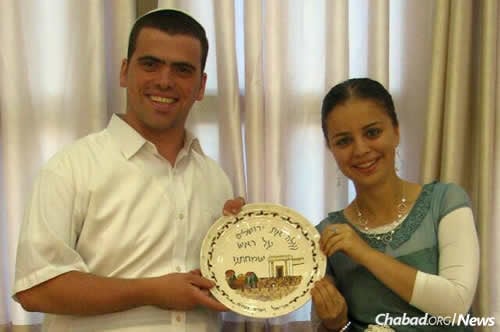
Ariel Biegel and Sarah Yechiya Litman at their recent engagement party
“I do not distinguish between terrorism and terrorism. No terrorism is justifiable. There is no terrorism that is more justified or less justified,” said Rivlin. “The scenes of death and bloodshed we have witnessed in Paris, throughout the Middle East and here in our country should serve as a warning to us all. Whether in Paris or Hebron, Jerusalem or New York, we must fight a bitter and stubborn struggle against those who massacre innocent people—against those who murder in cold blood.” 
Rabbi Yaakov Litman, 40, right, and his son Netanel, 18
© Copyright 2015, all rights reserved.
| ||||||||||||||||||||||||
Jewish News
| ||||||||||||||||||||||||
Even as the victims of Friday’s terrorist attacks in Paris were still being identified, thousands of people poured onto the streets on Sunday in an impromptu show of solidarity during a day of mourning throughout France. Hundreds also gathered at Synagogue de la Victoire in Paris in the evening for a memorial service, including the country’s Chief Rabbi Chaim Korsia and local government officials.
“Everybody was profoundly moved by the gathering and the speeches,” reports Rabbi Chaim Shneur Nisenbaum of the Complexe Scolaire Beth Haya Moushka school system in Paris. “The speech from chief rabbi in France was very strong, stressing that we are all united and that terrorists cannot win.” Before the sun set, Chabad rabbis and laymen offered men and boys over 13 the chance to wrap tefillin. Rabbi Moshe Cohen, co-director of Beth Loubavitch Paris 11, whose synagogue is not far from where one of the multiple attacks took place, “went to the Bataclan and recited Tehillim [Psalms]” for the departed and for the safety of all French citizens. “As a shaliach, an emissary of the Lubavitcher Rebbe [Rabbi Menachem M. Schneerson, of righteous memory], I felt that it was important to demonstrate that we are with the people.” The Bataclan theater was one of six sites throughout Paris attacked Friday night by ISIS terrorists. Other targets included the Stade de France—the national soccer stadium—and several restaurants. According to French officials, at least seven terrorists working in small groups used assault rifles and homemade bombs to kill nearly 130 people and injure hundreds more. 
Rabbi Moshe Cohen helps a man don tefillin in January, after the Hyper Cacher kosher supermarket attack. Chabad representatives offered tefillin to Jewish men who filled the streets Sunday as well.
“Everyone is just so sad. This wasn’t an attack on a certain community; it affected all of the French people,” says Cohen. ‘Faithful to Our Observance’Nisenbaum reports that schools throughout the country will reopen Monday and observe a moment of silence, including the Chabad-run schools.Additionally, he says, teachers will be talking with the students about the attacks—letting the youngsters express their fears and concerns—and helping to reassure them that they are safe and protected both at school and around the city, where the military are now out on the streets in force. “Parents are asking about security at the schools. This is something we take very seriously, and something that must be done,” he says. “But as Jews, we have to be confident in G-d.” “G-d will be with us,” assures the rabbi. “We have to go to work, and we have to go to Jewish shops—we must not stop because otherwise we aren’t really living. G-d is the only one in whom we can be truly confident and with whom we can have hope.” 
Rabbi Chaim Shneur Nisenbaum at Complexe Scolaire Beth Haya Moushka in Paris (File Photo)
To do otherwise, he said, would be to grant the terrorists a victory. “Tragic events occurred this Shabbat that will remain deep in our memories,” he said in the posting. “This, though, is not the most important thing. We need to know how to react to these kinds of events. Certainly, we need security measures ... but we also need something else—a profound inner reaction from each one of us.” The goal of the “barbarians,” Nisenbaum continued, “is to impress us. To tell us that they have power over our conscience. We need to give them the right answer; they have no power over us. We are free ... and we are proud.” Speaking later, he added that “these terrorists want to destroy our way of life in Europe and in other countries. That’s why we have to be strong and firm and confident—and not change our way of life. “As Jews, we must remain faithful to our observance of the Torah,” he said. “For the French at large, we must remain faithful to ourselves and our beliefs. This will show our enemies that terror is not something that will make us change.”
© Copyright 2015, all rights reserved.
| ||||||||||||||||||||||||
Jewish News
| ||||||||||||||||||||||||
They were stuck in a Montana airport with no end in sight to their wait and no kosher food to eat. That’s what happened today to some 300 passengers on an El Al airlines flight Tel Aviv to Los Angeles. The Boeing 777 made an emergency landing in Billings, Mont., when a reported fire in one of the engines made it unsafe to continue.
Passengers disembarked the plane and were bused to a terminal, where they waited for another plane to take them to their final destination—Los Angeles International Airport. There they sat as the hours ticked away and the food supplies—in particular, the kosher food—dwindled. Hillel Fuld of Beit Shemesh, Israel, says that somehow, Rabbi Chaim and Chavie Bruk—co-directors of Chabad-Lubavitch of Montana in Bozeman—got news of the situation and set about immediately to offer assistance. With her three young children in tow, Chavie Bruk drove a car full of kosher food 150 miles to Billings Logan International Airport, where passengers had been waiting for nearly 10 hours. “She showed up and instantly put a smile on hundreds of faces. She did it with utter grace and never stopped smiling for a second,” says Fuld, 37, who works in technology. “Based on the constant smile on her face, she is happier to be here than we are to have her here. “It was a tremendous kiddush Hashem—amazing and inspiring!” Fuld, who is traveling with his wife and 11-year-old son to Los Angeles, enjoyed kosher bagels, cold cuts, chips and cake. Heaps of hummus, fresh fruit and other goods were also available. Rabbi Chaim Bruk recounts that the rabbi at El Al in Israel called him this morning and apprised him of the plane trouble. Bruk himself was on a flight to Minneapolis, but his wife snapped into action. She gathered as much ready-to-eat food as she could—they had just received a kosher shipment the night before—piled her children into the car and drove two hours to the airport. “She was welcomed like a heroine,” says the rabbi. Meanwhile, the group of tired (but not hungry) passengers remain in the airport two hours later—a half-day now—waiting for the next leg of their journey. 
Chavie Bruk, co-director of Chabad-Lubavitch of Montana in Bozeman with her husband, Rabbi Chaim Bruk, drove a car full of kosher food to Billings Logan International Airport for stranded passengers of an El Al flight to Los Angeles that had to make an emergency landing. (Photo: Hillel Fuld)

Hundreds of people enjoyed bagels, cold meats, hummus, fresh fruit, chips and more as they lingered in the terminal. (Photo: Hillel Fuld)

A welcome respite from a long and hungry wait. (Photo: Hillel Fuld)

Fuld, his wife and their 11-year-old son in Tel Aviv at the start of their trip. (Photo: Hillel Fuld)
© Copyright 2015, all rights reserved.
| ||||||||||||||||||||||||
Jewish News
| ||||||||||||||||||||||||
Fay Newman’s 11-year-old twins, Danielle and Jessica, just started attending the Bat Mitzvah Club in Cherry Hill, N.J. Part of a group of a dozen other girls their age, they meet twice a month on Sunday afternoons at Chabad Lubavitch of Camden County to discuss what it means to officially be approaching womanhood.
The girls receive journals and club kits as they prepare to embark on a school year’s worth of cooking, art projects, volunteer projects and learning together. Each child also gets an apron from Bat Mitzvah Clubs International, which connects some 500 chapters of the girl-focused pre-teen group in 30 countries. They’ll use them when they are elbow-deep in crafting and cooking. This is Newman’s second time round with the program, she says, explaining that it was a positive experience for her now 15-year-old daughter, Hannah. She says Chabad embraced Hannah, who has special needs, and welcomed her at all the activities. “She just loved it. They explain everything on different levels—you learn about Shabbat and growing to be a Jewish woman,” recounts Newman. “Hannah graduated from the club and had a bat mitzvah, and she wanted to light the candles every Friday night, so we did.” Now that her younger daughters are the right age for the program, she says she wanted them to get involved. As far as the girls are concerned, having watched their sister go through it, they wanted to be a part of it, too. 
Eden Lev displays her Bat Mitzvah Clubs International certificate. This year, she will participate in the Beyond Bat Mitzvah Club.
‘Just the Beginning’Chabad-Lubavitch emissary Shterna Kaminker—who co-directs the Israeli Chabad Center in Voorhees, N.J., with her husband, Rabbi Menachem Kaminker—has coordinated the Bat Mitzvah Club for five years now, though it started about eight years ago at the Cherry Hill Chabad, which is co-directed by Rabbi Mendel and Dinie Mangel. She also runs the Beyond Bat Mitzvah Club, which is a year of continued learning. That group focuses on the Jewish woman, examining role models from biblical times onward, from the Jewish matriarchs through modern history and into the girls’ own families. Participants receive a scrapbook to chronicle their journeys.The two programs, which run from after the High Holidays until late spring, attract some 20 girls annually between them. Girls tend to find out about the Bat Mitzvah Club by word of mouth, and attend before they’re 12, though it’s open to girls up until age 13. “I try to impart to the girls the unique role of the Jewish woman in Judaism,” says Kaminker. For the Bat Mitzvah Club, Kaminker explains that they start off focusing on the changes girls go through when becoming a bat mitzvah and what that signifies. They also talk through the practical aspects of preteen and teenage development, and seek to give the girls the confidence to make sound choices and do the right thing even when it’s not always comfortable or popular to do so. The girls also participate in mitzvah projects based on their interests, such as volunteering to pack food at a local pantry, sending care packages to Israeli soldiers and other ideas they offer. “I hope that they approach their bat mitzvah and their celebration and everything about it in a more meaningful way, with more depth and understanding about what a bat mitzvah really is,” she says. “And that they realize this is just a little taste—that it’s just the beginning, and that they should continue learning and deepening their relationship with G-d.” 
A group of girls from a prior club year. Hannah Newman, second from right, now 15, enjoyed the experience; her younger twin sisters have started taking part in it. To her left is Shterna Kaminker, coordinator of the club and co-director of the Israeli Chabad Center in Voorhees, N.J.
‘Nice to Keep Learning’Vadim Kligman’s daughter, Bella, joined the Bat Mitzvah Club in 2013-14 and came back the next year for the Beyond Bat Mitzvah program. He was involved with Chabad in the Soviet Union and sought it out locally when he moved with his family to Cherry Hill in 2005.“She learned about being a Jewish girl and a Jewish woman,” says Kligman. “These are things neither me nor my wife could really give her because we grew up agnostic to a large degree. She spent time with Jewish girls her age and learned a lot about being a Jewish woman.” He and his wife, Stella, say they were glad that their daughter could come home from the meetings with a deeper knowledge of her tradition. “This is something we find to be very important in our lives; this is one of the reasons we left the former Soviet Union,” he explains. “We certainly want our child to understand who she is and to value who she is, and we figured this was a good way to do it.” Eden Lev, 12, was in the Bat Mitzvah Club last year, and this year will participate in the Beyond Bat Mitzvah Club. “It’s nice to keep learning about Judaism on Sundays because I don’t go to a Hebrew school or Jewish private school,” she says. She recalls a great year in the Bat Mitzvah Club filled with projects and discoveries related to Judaism, including a particularly memorable one where they customized candles and lit them, observing how the flame still goes up even if the candle is turned upside-down. “Our neshamah [soul],” she reports, “always goes straight towards G-d.” While she doesn’t know what’s in store for the year ahead, she’s looking forward to being part of whatever is offered: “I’m excited because Shterna always has a cool new project every week.” 
A "getting to know you" game that the New Jersey girls played during the first meeting of the year.
In fact, she recalls, she had an “aha” moment: “I happened to stumble across some amazing Chassidic insight into what actually happens inside of a person when he or she becomes bar/bat mitzvah and turned that moment into building a select club just for girls on the growing-up journey—on the ‘coming of age’ bat mitzvah path.” The concept took off and has since snowballed into clubs worldwide that are offered in French, German, Spanish, English and Portuguese, with Russian next. “The meaningfulness is what propelled the creation of this program and continues to propel it,” she says. Frimerman notes that young girls acquire so much during the club year. “My goal was, and is, for girls to discover that there’s more to them than what they think, there’s more to them than what they see in the mirror, there’s more to them than what they know. There’s a G-dly soul that is at their core that makes them who they are.” For more information on the clubs, go to: www.batmitzvahclub.com. 
The member's kit contains necessary information and materials, including the hardcover journal given to each participating bat mitzvah girl.
© Copyright 2015, all rights reserved.
| ||||||||||||||||||||||||



Chabad.org Magazine - Editor: Yanki Tauber

No comments:
Post a Comment