
Click here for the Nov. 18 printable version of GPconnect.
In this edition of GPconnect:
ANNOUNCEMENTS
- Help show love, transform the world on #GivingTuesday
- Great Plains aims to help Oklahoma Indian Missionary Conference
- Shock, solidarity after Paris attacks
- Connect with General Conference through redesigned app
- Micah Corps interns create several youth activities
- Montana camp seeks chaplains for summer 2016
- Focusing less on race, more on love
- Registration open for Orders and Fellowship clergy event
- Perkins School of Theology to offer Spanish-language Th.M. degree
MERCY AND JUSTICE
OTHER NEWS Help show love, transform the world on #GivingTuesday

United Methodists will once again come together Dec. 1 to support the work of Advance projects and missionaries on UMC #GivingTuesday. And once again, every gift made online through The Advance atwww.umcmission.org/give on Dec. 1 will be matched up to $1 million.
This year, consider creating your own team to support a project that is working in an area you care about, such as hunger and poverty, education, or social justice. For a complete list of projects you and your team can support, visit The Advance.
Share the creative ways in which you are raising awareness and money for mission — especially what you are planning for UMC #GivingTuesday. Should you have any questions about UMC #GivingTuesday, please contact advance@umcmission.org.
Find UMC #Giving Tuesday Banners/Ads, FAQs, impact stories, and links to videos and other resources to help you participate in the campaign.
Register your team and access ideas on how to execute your campaign.
You also can make a donation Dec. 1. Please note that donations made between midnight and 11:59 p.m. Central Time (CT) could receive matching funds. Global Ministries will allocate matching funds dollar for dollar up to the first $1 million in gifts to Advance projects received online on Dec. 1 between those times. A maximum of $2,500 per individual gift to a project will be dispersed as matching funds. A project may receive a maximum of $25,000 in matching funds.
Several institutions in the Great Plains Conference will be participating in #GivingTuesday, one being Youthville, which wants to provide 450 foster kids with a Christmas stocking. It will take $90,000 to accomplish this. The $90,000 will provide a Christmas stocking with respite care, one package of socks, one package of underwear and one set of pajamas for one child for three months. Respite care provides foster families temporary time apart in which they can rest and recharge. For each person who gives $50, one child can receive a stocking. You don’t have to be a world leader or a billionaire to give back. #GivingTuesday is about ordinary people coming together doing extraordinary things.

Great Plains to help Oklahoma Indian Missionary Conference

The tradition of blending the rich Native American culture with Wesleyan theology is thriving today in the Oklahoma Indian Missionary Conference (OIMC). The vast majority of congregations are located in Oklahoma, but worshippers also gather throughout Kansas and parts of Texas and Missouri. But the OIMC’s pastors are the lowest paid in the entire South Central Jurisdiction.
The Great Plains Conference, in its 2015 annual conference session in June, voted to raise $100,000 each for three cross-cultural mission partnerships – the OIMC, the Lydia Patterson Institute and the Zimbabwe East Conference. The money for the OIMC is designated to assist with an endowment to bolster salaries for pastors serving within that conference.
Read the first installment of a series spotlighting these three partnerships.
Great Plains partners with Oklahoma Indian Missionary Conference
The “Trail of Tears” – the forced relocation of Native Americans from the eastern United States to what is now Oklahoma – will forever be a stain on our nation’s history. But one positive impact came from the Indian Removal Act of 1830: When natives of the North American continent moved westward, they brought with them Christian beliefs.
In fact, they brought with them Wesleyan theology in what was at the time the fast-growing Methodist tradition. Not too many years later – 1844, to be exact – the General Conference of the then-Methodist Episcopal Church created the Indian Mission to serve native people who had been transplanted in the central part of the United States.
Editor's Note: This is the first in a three-part series on cross-cultural mission partnerships being supported by the Great Plains Conference in the South Central Jurisdiction and around the world. This installment focuses on the Oklahoma Indian Missionary Conference.
Today, that tradition of blending the rich Native American culture with Wesleyan theology continues with the Oklahoma Indian Missionary Conference (OIMC). The vast majority of congregations are located in Oklahoma, but worshippers also gather throughout Kansas and parts of Texas and Missouri.
“Most people don’t realize that the church we serve, the denomination we hold dear, United Methodism, had its roots (in the Midwest) from Native Americans who came along the Trail of Tears,” said Bishop Robert Hayes of the Oklahoma Conference. “The seed of Methodism was planted in the east before the Trail of Tears and brought to eastern Oklahoma.”
Those seeds have blossomed in many ways, with the OIMC now serving as home to more than 6,000 members in 84 churches.
The Rev. Patrick Freeman served in the OIMC as well as churches in Kansas prior to retiring as a United Methodist pastor. He credits the ministry and service he both witnessed and took part in as key parts of his own foundation as a pastor. He said it’s important for people to understand the history of the OIMC and its reach to native people in Oklahoma and beyond.
“It goes way back to North Carolina and Tennessee,” Freeman said. “Over the years, as they brought the church, it was a Methodist-connected church, but not as organized as it is today.”
The connection through the United Methodist Church provides support to the OIMC, with some of those resources coming from the Great Plains Conference. The Great Plains, in its 2015 annual conference session in June, voted to raise $100,000 each for three cross-cultural mission partnerships – the OIMC, the Lydia Patterson Institute and the Zimbabwe East Conference. The money for the OIMC is designated to assist with an endowment to bolster salaries for pastors serving within that conference.
https://www.flickr.com/photos/greatplainsumc/21923658460/in/album-72157657418637994
The Rev. David Wilson, superintendent of the OIMC, said the assistance from the Great Plains is appreciated because of the need to raise salaries in his conference. The OIMC provides a base salary that is dependent on a pastor’s education.
“For instance, a pastor with a master’s of divinity degree will start out making “$27,800,” Wilson said. “That’s the base salary. It doesn’t mean you have the opportunity to go to a larger church that pays a larger salary because it doesn’t exist. If you think about that salary, it puts many of our pastors right at the poverty level.“So it really is about a person’s commitment – commitment to Christ and commitment to wanting to serve a Native American congregation.”
One way the OIMC tried this year to maintain and actually bolster salaries was to conduct a gala in October in Oklahoma City. The event featured a silent auction and dinner, the expense of which was donated by the Chickasaw Nation, with all of the proceeds going to the OIMC salary endowment.
With some money still coming in, Wilson reported in mid-November that the gala raised about $85,000 for the endowment, a $14,000 improvement over the previous gala.
“We were very pleased with the amount of people that attended the gala,” Wilson said. “We had close to 300 persons present from Oklahoma, Kansas and Texas. The presence of so many showed us their concern for the future of OIMC and it also showed that they believe in who we are and what we are doing.”
The Great Plains Conference, which sent a contingent of approximately 10 people to the event to show support, received recognition during the gala. In particular, a gift was presented to Copeland United Methodist Church from the Dodge City District. This church, with attendance of approximately 24 per week, made a donation of $10,000 to the Great Plains Conference’s fund-raising drive to help the pastors’ salary endowment. Penney Schwab, a member of the church, said a special gift to the church helped make the size of the donation possible. Because some of the church’s members are Chickasaw and because Copeland United Methodist Church’s members understand the difficulties that small churches often face, the church’s Missions Committee voted to make what is meant to be a “kick-off” gift for the fund-raising campaign.
"It was wonderful to be part of such a culturally rich event to raise money for pastors who are doing the work that God is blessing,” said Courtney Fowler, Great Plains Conference lay leader and a member of the delegation that attended the gala. “I'm so proud of the Mission Committee at Copeland United Methodist Church. They are truly an example that size is not a barrier to mission, and they gave generously for a cause they believed in."
Bishop Hayes spoke attendees at the gala and expressed his optimism for the future of the OIMC.
“This is not about us trying to be separate or distinct. It’s about us being in union together with one another, trying to accomplish the goal of making disciples of Jesus Christ,” he said.
He continued to express his hope that the OIMC would remain a leader in the effort to spread the gospel of Christ to Native Americans while preserving their culture.
"I believe that OIMC will raise up a new nation of gifted, qualified leaders that will change the course of how ministry is done among native people," Bishop Hayes said. "I believe that OIMC will be a leader in re-establishing native languages among its people and tribes. I believe that in our lifetime, the support of our pastors will be competitive and fundamentally sound so that we can attract younger and gifted pastors."
Learn more about the fund-raising efforts for these cross-cultural capital campaigns.
Shock, solidarity after Paris attacks

United Methodists and other religious leaders are expressing shock over the Nov. 13 terrorist attacks in Paris and feelings of solidarity with the French people. They also caution against condemnations of Muslims or a dangerous escalation of military action. Equally disturbing attacks are occurring elsewhere, including Beirut, Lebanon. Linda Bloom has the story.
Read a full story from United Methodist News Service.

Photo by John Seigenthaler, Aljazeera AmericaCandles and flowers were placed outside the Le Carillon café in tribute to those killed in the Nov. 13 Paris attacks. At least 129 people died in various locations and more than 350 were injured.
Shock, solidarity after Paris attacks by Linda Bloom
NEW YORK (UMNS)
United Methodists and other religious leaders are expressing shock over the Nov. 13 terrorist attacks in Paris and feelings of solidarity with the French people but cautioning against condemnations of Muslims or a dangerous escalation of military action.
And the World Council of Churches and others have pointed out that equally disturbing attacks are occurring elsewhere, including the Nov. 12 bombings in a Beirut, Lebanon, shopping area that claimed 41 lives.
Bishop Patrick Streiff, who oversees the small number of United Methodist congregations in France as the episcopal leader of central and southern Europe, pointed to his horror over “the depth of violence despising human lives” and to his conviction of the need to follow the model of Christ as peacemakers.
“We are people who believe in Christ. Our life shall witness that Christ is the Prince of Peace. He has blessed those who make peace. This shall model our answer to the terrible attacks in Paris,” he saidin a statement.
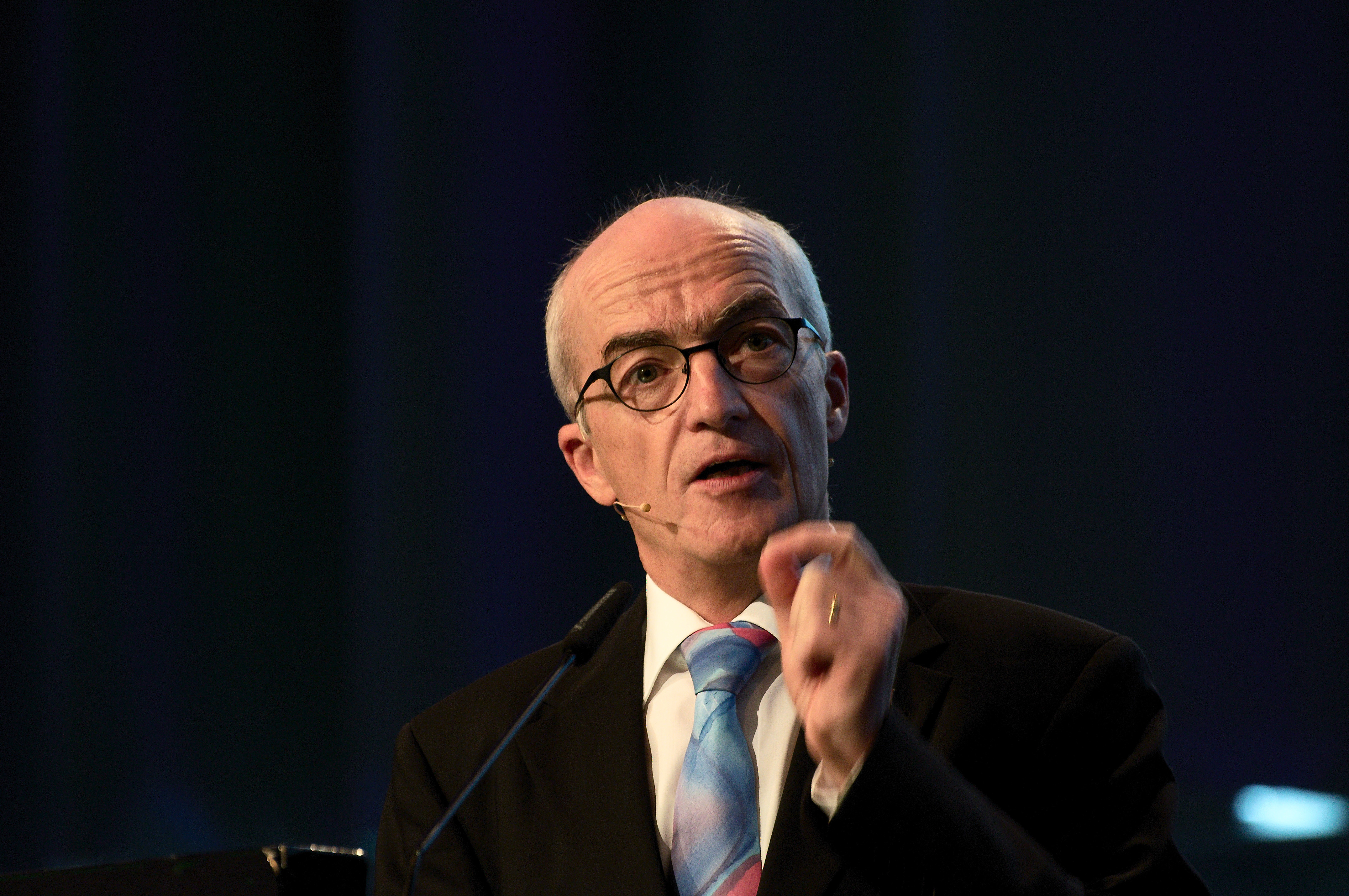
Bishop Patrick Streiff urged United Methodists to follow the model of Christ as peacemakers in the wake of the Paris attacks. Photo by the Rev. Sigmar Friedrich, Switzerland-France-North Africa Annual Conference.“As Christians, we serve the Prince of Peace,” noted the Rev. Susan Henry-Crowe, United Methodist Board of Church and Society, as she expressed deep sympathy for the French people. “May His message of love and hope transcend the terror our world has felt today."
Moment of silence in Europe
In Paris, London, Berlin and elsewhere in Europe, people gathered publicly Nov. 16 to observe a moment of silence in honor of the victims at noon Paris time.
The attacks, at six different locations, began at 9:20 p.m. Friday at the Germany-France soccer match and ended at 12:20 a.m. Saturday when police stormed the concert hall where 89 people were killed. In the end, the death toll stood at 129, with 352 wounded, 99 critically.
The Islamic State, also known as ISIS or ISIL, has claimed responsibility for the attacks, which seemed designed to strike fear into people’s everyday lives. Besides the stadium and concert hall, gunmen with automatic weapons targeted restaurants in one of the most densely populated parts of Paris, full of young people. “It was a hit at the soul of Paris,” a 38-year-old woman dining in the area told the New York Times.
François Clavairoly, president of the Protestant Federation of France, spoke of the need to witness “to a hope that can never be vanquished” in his statement on the attacks. “It is the values of the Republic and democracy that have been targeted, just as human fraternity is being put to the test by such unjustifiable acts guided by evil,” he declared.
OTHER REACTIONS FROM UNITED METHODIST LEADERS
Bishop Warner H. Brown Jr., president, United Methodist Council of Bishops:
“Let us be in prayer for Paris and the people of France. These events have impacted them in the way September 11, 2001, grieved the U.S. Also, please pray for communities around our world that will not make the news, but cringe under the threat of violence.”
The Rev. John McCullough, Church World Service:
“The 37 member communions of Church World Service stand alongside our interfaith partners as we condemn the continued violence perpetrated by ISIS. Hatred and violence have no religion, nationality or belonging in any community.”
World Methodist Council
“World Methodist Council General Secretary Bishop Ivan Abrahams extends the condolences of the WMC to the next of kin of those killed and to the French nation…. May God help us work toward and realize a day when violence no longer exists.”
Jim Winkler, National Council of Churches:
“The National Council of Churches condemns the Nov. 13 attacks in Paris, Beirut, and Baghdad. We stand in solidarity with peace-loving people everywhere and urge these acts of horrific violence not be mistaken as part of a war between Christianity and Islam.”
Impact on refugees
The executive committee of the United Methodist Germany Central Conference, which was meeting when the attacks occurred, sent a letter of prayer and solidarity to the Protestant Federation and United Methodist congregations in France.
“We talked as well about the question how to respond to the changes in Europe because of the refugees that arrive here,” German Bishop Rosemarie Wenner told United Methodist News Service.
“Although we were blessed by the many positive reports of how United Methodist congregations welcome strangers, we are also worried because of an increase of hostility and Islamophobia which might even become bigger after the terrorist attacks.”
A similar discussion on walking “hand in hand with places of woundedness in the world” was taking place among members of the World Council of Churches executive committee as they began a first day of meetings on Nov. 13 in Bogis-Bossey, Switzerland, reported United Methodist Bishop Mary Ann Swenson, co-vice moderator for the WCC’s Central Committee.
“Little did we know that we would wake … to discover Paris to become one of those places,” she wrote to UMNS.
The WCC executive committee’s statementalso touched on its concern about the impact on Europe’s refugee crisis. “Let us not allow these events to diminish our care and hospitality to those fleeing violence and oppression,” the committee cautioned.
Experiencing the same horror
United Methodists have come to know some of those refugees personally through their relief work, said Thomas Kemper, top executive, United Methodist Board of Global Ministries. He pointed out that the Beirut bombings invoked the same horror and anguish as Paris.
“The events of Paris may encourage border restrictions in the name of security and prohibit the entrance of Syrian and Iraqi refugees who have endured terrorism for years,” Kemper said in a Nov. 16 statement. “We pray that governments and people may resist anti-refugee sentiment and continue to offer sanctuary to those in need.”
Governments also must resist implementing counterterror responses that could lead to what they are trying to avoid – weapons of mass destruction and a world at war, said the Rev. Stephen J. Sidorak Jr., ecumenical staff officer of The United Methodist Church.
“Any consideration of the evil of terrorist violence requires analysis of the possible evil implicit in the counterterror response,” he wrote in a statement.
“Each religious community must be poised to critique and rebuke its own membership,” Sidorak added. “In particular, today, Christians and Muslims alike must muster arguments against radical fundamentalists and violent extremists in their midst, morally rebuking their own religious apostates who incite to evil. We cannot allow extremist fringe elements within our traditions to define what our faiths stand for, and what they stand against.”
Bloom is a United Methodist News Service multimedia reporter based in New York. Follow her athttps://twitter.com/umcscribe or contact
Read a response from Great Plains Bishop Scott Jones.
We must recognize we are engaged in cultural war

Bishop Scott Jones
We are all horrified by the terrible violence committed in Paris the evening of Nov. 13. We should be praying for the victims and their families and for the people of France who suffered this evil action.
We are all horrified by the terrible violence committed in Paris the evening of Nov. 13. We should be praying for the victims and their families and for the people of France who suffered this evil action.

Candles and flowers were placed outside the Le Carillon café in tribute to those killed in the Nov. 13 Paris attacks. At least 129 people died in various locations and more than 350 were injured. Photo by John Seigenthaler, Aljazeera America
At the same time, we must pay attention to the larger context in which this attack occurred. We are engaged in cultural warfare. The Sept. 11, 2001, attacks on America, the bombings in Beirut, the beheadings of Christians in North Africa and now the Paris attacks are all part of a new kind of warfare being waged against Western civilization and mainstream Islam by a small group of jihadists.
In this battle, the vast majority of Muslims are our allies. We must carefully distinguish our enemies — the jihadists of Dayesh (which calls itself the Islamic State), Al-Qaeda, and the Taliban are the enemy. They believe themselves to be the only true Muslims, and most of their victims have been other Muslims.
Americans need to understand that all Muslims are not alike and that this is first and foremost a battle within the Muslim community. Since the fall of the Ottoman Empire, Muslims have been in a deep quandary. The Quran and its interpreters call for a political and religious leader to unite all Muslims in a unity of religion and state. The leader for this entity has been called a “caliph.” There has been no caliph since the end of World War I and the rise of modern Turkey. Without a caliph, Muslims have no way to make binding decisions about how to adjust their 7th century Scripture and doctrine to the 21st century. The issue is how to live faithfully as a Muslim today, and Muslims lack the governing body to answer their question.
Christians should remember we went through similar and even bloodier changes in the wars of religion from the early 1500s to 1648. During that time, the nation state was invented, and ideas of religious tolerance were developed. At that time Christians were organized into churches with decision-making bodies that could work out how to adapt to the new form of civilization. We had the great advantage that our Lord never sought political power, and the New Testament presumes we are living under pagan authorities. As Christianity developed, other relationships to government developed. There were many years when Christianity was tied to the power of the government, but those days are mostly gone now.
The culture war against jihadist Islam will not be won by military action, though such action is necessary to resist its expansion and to fight against terrorist actions. But we need vigilance and care. The war will be won by our ideas and our behavior in living the kinds of lives that represent diversity, religious freedom and mutual respect.
That is why we must welcome as many Syrian refugees as possible to America and demonstrate to Muslims all over the world the kind of hospitality and mutual respect that is America at its best. We Christians must take the lead in welcoming Muslim refugees, because it is what Scripture commands us (Matthew 25, Leviticus 19, Hebrews 13).
But there is a tactical reason to welcome them. When Western countries mistreat and reject Muslims, it becomes a recruiting tool and propaganda weapon for our enemies. I am deeply disappointed that so many governors (including those of Kansas and Nebraska where I serve) have rejected the idea of receiving refugees. They are pandering to our worst fears and failing to lead us to be our best selves as a nation. They are making a strategic mistake and giving aid to our enemies. This culture war will be won by the Christian values of love, tolerance, mutual respect and hospitality. As a nation and as states, we need to welcome the stranger among us.
Bishop Scott Jones serves the Great Plains Conference, which is comprised of all of Kansas and Nebraska.Connect with General Conference through redesigned app

General Conference, in the palm of your hand — a redesigned 2016 General Conference app — is now available. A helpful way to stay connected and learn more about all aspects of the conference, the app will feature news, photo and social media feeds, video and audio archives, live streaming of worship and plenary, the DCA and ADCA, and petition tracking.
For delegates and others at the conference on May 10-20, there are also some features to make the experience easier: legislative committee assignments, conference schedule with the option to build a personalized calendar, a delegate discussion board, a daily devotional and an interactive map of the convention center and Portland, Oregon.
“United Methodist Communications seeks to provide useful tools that connect the church and make it quick and easy to get information, whether it’s from your computer or your smartphone,” said Dan Krause, chief executive of the denomination’s communications agency.
The app is free to download and is available for Android and Apple devices. You can search for “United Methodist General Conference” in your app store or visit the general conference app website for a link.
“While we know not everyone has a smartphone or readily available Internet access, this app is one of many channels United Methodist Communications is developing for members to access information leading up to and during General Conference," said Krause.
Micah Corps interns create several youth activities

Creating change in the world — youth activities focus on poverty, environment, food security, peace/nonviolence and immigration.
The 2015 Micah Corps interns have created activities for youth groups that offer a series of discussions, videos and activities which will teach youth how the issues connect to their faith and challenge and inspire the youth to use their power to change the world. These activities are formatted under five four-part units where through the activities, Scripture and discussion students will learn concrete ways to be accepting, be aware and create change in their society.
Download the activities.
Throughout the next few months, we’ll highlight a different topic. This week, we focus on poverty.
Poverty — “One in Body and One in Spirit"
Poverty is an issue that affects every community across the US. Help be part of the solution by learning more about poverty, the cliff effect, food security and advocacy. These lessons help facilitate discussion and education on a difficult and very personal topic. Only when we all raise our voices can the problem of systemic poverty change for the better.
Download poster for poverty lesson.
Read more about the activities. You can learn more about the Micah Corps interns at greatplainsumc.org/micahcorps.
Montana camp seeks chaplains for summer 2016
Camp on the Boulder in Montana has openings for clergy members to serve as chaplains during the summer season.
Last year, three clergy members from the Great Plains Conference took advantage of this opportunity to serve while enjoying the beautiful scenery that the camp has to offer. Registration is now open for 2016 for this no-cost, two-week renewal opportunity.
Here is more information.
Focusing less on race, more on love

Several religious leaders in the Wichita, Kansas, area have embarked on an effort to move beyond racial differences to focus on a similarity that should weigh far more heavily than any other factor: our relationship, thanks to God, as brothers and sisters in Christ.
Two of Wichita’s largest churches – First United Methodist Church, a predominantly white congregation, and Saint Mark United Methodist Church, a predominantly African-American congregation – traded pastorsOct. 25 and Nov. 15 during a six-week sermon series for both congregations titled “Love. Period.”
Also, University UMC and others have partnered with other churches to take part in that area’s “Beyond Tolerance” community event.
Read about these efforts to encourage love among all people, regardless of differences.
Registration open for Orders and Fellowship clergy event

Clergy members of the Great Plains Annual Conference have responded to a “call to ministry.” Our annual clergy Orders and Fellowship meeting, scheduled for Feb. 17-18, will focus on “Following God’s Call” – both as a reaffirmation of their own “call” as well as learning how clergy can promote a “culture of call” in the churches and communities they serve.
What better way for clergy colleagues to extend their ministry heritage than to empower avenues by which Christian women and men can hear and respond to a call to ministry as clergy in our Great Plains Conference.
Orders and Fellowship will be conducted at St. Mark’s United Methodist Church, 8550 Pioneers Blvd., Lincoln, Nebraska. Click here to register now!
View more information, including speaker information, theme, schedule, childcare and lodging.
For any questions contact Dana Reinhardt atdreinhardt@greatplainsumc.org or call 402-464-5994 ext. 105, or the Rev. Nancy Lambert at nlambert@greatplainsumc.org.
Perkins School of Theology to offer Spanish-language Th.M. degree
Perkins School of Theology-Southern Methodist University, in Dallas will offer a Spanish-language master's of theology (Th.M.) degree beginning in fall 2017.
This advanced master’s degree, the first of its kind among the 13 United Methodist-related schools of theology, will be a non-residential program designed for experienced full-time pastors or church/academic leaders. Pending approval by appropriate accrediting and regulatory agencies, it is anticipated that the intensive cohort-based courses will be held in Dallas and onsite in Latin America, and also will include online class contact and mentorship.
The Spanish-language Th.M. degree will be a two-year, 24-hour program designed for those in Latin American settings who want to enhance the practice of ministry through advanced study of a particular theological or pastoral discipline; undertake scholarly examination of a specific aspect of the Christian religion/traditions or function of Christian ministry; or prepare for more advanced study at the doctoral level.
Read full announcement.
FOR IMMEDIATE RELEASE
November 12, 2015
SMU - PERKINS: SCHOOL OF THEOLOGY
For more information: Rev. Connie Nelson, Director of Public Affairs and Alumni Relations214-768-2335, clnelson@smu.edu
Matt Jacob, Associate Director of Public Affairs and Alumni Relations
214-768-1393, mjacob@smu.edu
Perkins School of Theology-SMU to Offer Spanish-Language Th.M. Degree
Landmark program to welcome first students in Fall 2017
DALLAS (SMU) – Perkins School of Theology-Southern Methodist University will
offer a Spanish-language Master of Theology (Th.M.) degree beginning in Fall 2017.
This advanced Master’s degree, the first of its kind among the 13 United Methodist related schools of theology, will be a non-residential program designed for experienced full-time pastors or Church/academic leaders. Pending approval by appropriate accrediting and regulatory agencies, it is anticipated that the intensive
cohort-based courses will be held in Dallas and onsite in Latin America, and also will include online class contact and mentorship.
The Spanish-language Th.M. degree will be a two-year, 24-hour program designed for those in Latin American settings who want to enhance the practice of ministry through advanced study of a particular theological or pastoral discipline; undertake scholarly examination of a specific aspect of the Christian religion/traditions or function of Christian ministry; or prepare
for more advanced study at the doctoral level.
The Hispanic population of the United States is increasing rapidly, and it is anticipated that the non-Hispanic white population of the United States will be a minority by 2040. One of the fastest-growing segments of the Protestant Church in America is made up of
denominations with Spanish-speaking ministries, and the Protestant Church is expanding exponentially in Latin America.
Although there are many Hispanic and Latino/a pastors and church leaders who have Master of Divinity degrees, further advanced training is rare. The Spanish-language Th.M. degree will be built on completion of either the M.Div. degree (U.S. and Canada) or the
Licenciatura en Teologica degree (Latin America).
“The need for trained theological leadership in Spanish-speaking churches and communities has never been greater,” said Perkins Dean William B. Lawrence.
“We have the resources and the faculty to host this important initiative, which will prepare recipients of the Spanish language Th.M. for the professorial, decanal (dean), and presidential
positions in theological education that are essential in preparing faithful leaders in Christian ministry within the Hispanic and Latino/a constituencies,” he said.
According to Dr. Hugo Magallanes, director of the Center for the Study of Latino/a Christianity and Religions, Perkins is “ideally suited” for a Spanish language Th.M. degree.
“Perkins School of Theology is uniquely positioned to begin this program,” he said.
“Although a number of other seminaries have degrees or certificates taught in Spanish, Perkins — with our location in Texas, which has a large Spanish-speaking population and also has one of the busiest airports in the United States (DFW) with many connections to
Latin America — is ideally suited for this task.”
Five full-time Perkins faculty members are Hispanic, and three administrators are bilingual in English and Spanish. In addition, a significant collection of Spanish language biblical and
theological materials are included in the world-class collection at Bridwell Library.
The new degree program will be open to Hispanic or non-Hispanic students who are living and ministering in Spanish-language settings and who have fluency in Spanish. Six students in the initial cohort will receive funding as part of a three-year, $500,000 grant made recently to The Center for the Study of Latino/a Christianity and Religions at Perkins School of Theology by The Henry Luce Foundation’s Theology program.
Applications for the Spanish language Th.M. degree will be accepted starting August 1, 2016.
###
Perkins School of Theology, founded in 1911, is one of five official University-related schools of theology of The United Methodist Church. Degree programs include the Master of Divinity, Master of Sacred Music, Master of Theological Studies, Master of Arts in Ministry, Master of Theology, Doctor of Ministry, and Doctor of Pastoral Music (June 2016) as well as the Ph.D., in cooperation with The Graduate Program in Religious Studies at SMU’s Dedman College of Humanities and Sciences.
Young adults urged to apply now for summer internships

Have you dreamed about how God might use you to change the world this summer? The Great Plains Conference may have some opportunities for you to make a difference, explore leadership, and spend a “summer of service” that you will remember for a lifetime!
Apply now for our internship program, which provides opportunities to lead Vacation Bible School at small churches across Kansas and Nebraska, participate in mercy and justice ministries as part of our Micah Corps, learn about church planting, youth ministry or Hispanic ministry, or you can gain skills in pastoral leadership. We also have lots of opportunities for you to have fun while gaining leadership skills at one of our Great Plains camps!
Fill out the online application.
Learn more about pastoral care

Lay Servant Ministries opportunities, such as four classes offered Nov. 13-14 at Havelock United Methodist Church (participants pictured above), provide a chance to learn about the church, theology and more. A class on pastoral care is being planned for March of 2016.
Learn more about pastoral care with an educational opportunity planned for March 13 and 14 in Lincoln, NE. This course is appropriate for clergy, Lay Servants and laity interested in honing their pastoral care skills.
The presenter will be Pastor Dusty Sprague, who will share his extensive experience with the Stephen Ministries. Continuing education credit for clergy is being pursued and credit as an advance course will be offered to Lay Servants.
This event will be sponsored by the Lay Servant Ministries Committee of the Blue River District of the Great Plains Conference. The cost is underwritten by a grant from the Nebraska United Methodist Foundation.
Watch for more details in future editions of GPconnect and on the Lay Servant Ministries web page.
The call to end the death penalty

The executive director of the National Coalition to Abolish the Death Penalty, Diann Rust-Tierney, spoke at the Southeast campus of St. Mark UMC, in Wichita, Kansas, on Sunday Nov. 8. Diann shared with St. Mark UMC about the application of the death penalty. She noted that abolishing the death penalty is a part of the bigger criminal justice reform conversation that is taking place nationally. The death penalty, according to Diann, is the key component of the pyramid in the criminal justice reform dialogue that seems to gain traction from both sides of the aisle in the US congress. She mentioned she is optimistic that the booming conversations about racial disparity in the criminal justice system will bring about positive change nationally.
The position of the United Methodist Church
The United Methodist Church is deeply concerned about crime throughout the world and the value of any life taken by a murder or homicide. We believe all human life is sacred and created by God and therefore, we must see all human life as significant and valuable. When governments implement the death penalty (capital punishment), then the life of the convicted person is devalued and all possibility of change in that person’s life ends. We believe in the resurrection of Jesus Christ and that the possibility of reconciliation with Christ comes through repentance. This gift of reconciliation is offered to all individuals without exception and gives all life new dignity and sacredness. For this reason, we oppose the death penalty (capital punishment) and urge its elimination from all criminal codes (¶164G. The Death Penalty, (2012 Book of Discipline).
Diann reminded the congregation that there are more than 158 people who have been exonerated from the death row since 1973. Besides the risk of executing an innocent person and its arbitrary application, she framed the death penalty as a broken government institution. Many experts decry the economic implications of keeping the death penalty in Kansas. Millions of tax payers’ dollars are spent in Kansas on a dysfunctional system that has not been used for half a century. This fund, according to experts, could be redirected to important public programs such as expanding access to mental health facilities and education.
As faithful follower of Jesus Christ, Diann also expressed her belief that Christian teachings advocate for the redemption and transformation of the offenders. She urged the community to be politically involved and contact their state legislators when the death penalty repeal bill comes to the floor in 2016 legislative session. She underlined the importance for Christian believers to be politically active citizens in bringing about the transformation of our world.
The state of Kansas has not executed an inmate since 1965. In 2014, more than 400 Kansas faith leaders from different faith groups signed petitions to urge law makers to repeal the death penalty. Like in the state of Nebraska, there is a growing strong support to abolish the death penalty in Kansas.
EAD 2016: Lift Every Voice! – Racism, Class and Power
Editor’s note: The following was submitted by Andrea Paret, Peace with Justice coordinator, Great Plains Conference.
As we mourn the deaths and devastation caused by terrorist attacks in Beirut, Baghdad, Paris as well as violence in all corners of the world, we see a wide variety of reactions. On the one end, persons, event those who lost loved ones, are calling us to spread love and forgiveness. Others are promoting hatred, exclusion, and the blaming and punishment of whole groups of people for acts of some individuals. Racism is showing its ugly head. It will be important for us to join with others to pray, learn, and act to dismantle racism. The Ecumenical Advocacy Days (EAD), April 15 – 18, will give us this opportunity.
The EAD planning committee explains: In a major U.S. election year when lives, votes and the global economy are at stake, followers of Christ ask, “Who has a voice?” The response is, “Everyone!”
…As Christians, we believe that leaders and policy makers are called to act and to govern in fairness and with justice for all! Like the persistent widow who demands that the judge hear her plea (Luke 18:1-8), at EAD 2016, we will bring our petitions for justice to Capitol Hill. Like the persistent widow, we will not be silenced.
Come to “Lift Every Voice” on April 15-18, 2016 ….Through prayer, worship, advocacy training, networking and mobilization with other Christians, we will face the reality of racism, class and power impacting politics and policies and advocate for the liberty of “Every Voice!” – all culminating with EAD’s Congressional Lobby Day on Capitol Hill.
EAD is co-sponsored by many denominations and organizations, among them the General Board of Church and Society and United Methodist Women. Besides scholarships being offered for young adults through EAD, Peace with Justice Ministries of the Great Plains Conference is making several scholarships available for representatives of our conference to attend and bring back information and action steps to share. If you are interested, please contact Andrea Paret atamparet08@yahoo.com.
View more information and brochure.
Paris, Beirut and Baghdad: NJFON issues statement on recent attacks

Rob Rutland-Brown, executive director at National Justice for Our Neighbors (NJFON), shares the following statement:
“National Justice for Our Neighbors (NJFON) is deeply saddened by the terrorist attacks in Paris, Beirut, and Baghdad. We mourn the victims of these tragedies and pray for their loved ones.During this time of fear and heightened caution, NJFON urges the U.S. to continue to welcome refugees who flee such recurring violence on a daily basis. Let us remember that refugees admitted to the United States must undergo extensive security screenings and background checks before they are accepted into our country.
Now, in this moment of tragedy, let us stand with our neighbors seeking escape from violence rather than closing our doors on them. The welcoming mission of Justice for Our Neighbors requires us to show love not just when it is easy, but also when it may be most difficult, for that is when our brothers and sisters around the globe need our compassion the most.”
Justice For Our Neighbors-Nebraska (JFON-NE) is part of the National JFON network of 13 sites that support approximately 35 legal clinics serving more than 3,500 clients annually.
Learn more about JFON-NE, one of our Great Plains Conference mission agencies.
Learn more about National JFON.
Newsletters
- General Board of Global Ministries: connectNmission
- General Board of Church and Society: Faith in Action
- Ministry Matters: Nov. 11, 2015
- South Central Jurisdiction VIM & Disaster Response: Woven Together
- Lewis Center for Church Leadership: Leading Ideas
- UMC Development Center: Spiritual Giving
- Nebraska UM Foundation: Stewardship Matters
- United Methodist Committee on Relief: Hotline
- Table cross, candle holders and offering plates available to church in need
- Organist/piano accompanist sought at Calvary UMC
- To view these and other classifieds, go to greatplainsumc.org/classifieds.
- Congregations across the Great Plains Conference are making the news in their local newspapers. View our newspaper clipping reports to see if there are stories, ideas and ministry happenings you can learn from to use in your own congregation. Press clips can be found at greatplainsumc.org/inthenews. You can see education partnership ideas atgreatplainsumc.org/education.
To submit a letter to the editor, send it to info@greatplainsumc.org.

Want More?






Episcopal Office: 9440 E Boston Suite 160 Wichita, KS 67207 316-686-0600
Topeka Office: 4201 SW 15th Street PO Box 4187 Topeka, KS 66604 785-272-9111
Wichita Office: 9440 E Boston Suite 110 Wichita, KS 67207 316-684-0266
Lincoln Office: 3333 Landmark Circle Lincoln, NE 68504-4760 402-464-5994
---------------------

No comments:
Post a Comment