Editor's Note:
It is well into autumn outside my window. The trees and bushes are already bare, but one solitary flower still blooms amongst the brambles.
In the Torah portion of Chayei Sarah we learn about our matriarch Rivkah, who despite all odds—growing up surrounded by swindlers and thieves—remained righteous and pure. Our sages applied to her the verse (Song of Songs 2:2), “Like a rose among the thorns, so is my beloved among the daughters.” From her we inherited our ability not only to survive our negative surroundings, but to thrive and attain the greatest heights despite negative environments, to bloom amidst the brambles.
The lone wildflower has a poetic beauty. But if you want a beautiful garden, you cannot afford to just sit around and wait for the flowers to bloom. There is work to be done. Appropriately, this week, thousands of Chabad emissaries—who, together with their wives, do so much to water, feed and nurture our nation’s garden—gather for the International Shluchim Conference. But it’s not just the rabbis. Each and every one of us has been tasked and empowered to tend to G‑d’s garden, helping each flower blossom, toiling until the day when G‑d will finally proclaim (Song of Songs 5:2), “I have come into My garden, My sister, My bride.”
Yehuda Shurpin,
on behalf of the Chabad.org Editorial Team
P.S.: Experience the energy of 5,600 Chabad emissaries and their guests on Sunday evening as welivestream the banquet from Brooklyn, New York.

Birth of a Parent
Snuggled in his father’s arms, he is secure, unafraid, because there is a father.
Looking into the small eyes gazing up from within his arms, feeling the tight clutching of tiny hands, the father awakens to something he may never have known before: He is a father.
As a child makes a man into a father, so our trust in the One Above makes Him into our G‑d.
This Week's Features:
Printable Magazine

Thousands of Chabad Emissaries Are on Their Way to Annual Conference in New York
Join us for a live broadcast on Sunday evening by Faygie Levy Holt
Some 5,200 Chabad-Lubavitch emissaries and guests will attend the annual International Conference of Chabad-Lubavitch Emissaries (Kinus Hashluchim) in New York, which takes place from Nov. 4 to Nov. 9. (Photo: Itzik Roytman, Kinus.com)
Imagine having to coordinate a sit-down dinner for thousands of people all eating at the same time. Not only do you have to find a venue large enough to fit everyone, you have to find a caterer who can handle cooking for that large a crowd. These are some of the many welcome challenges faced by organizers of annual International Conference of Chabad-Lubavitch Emissaries (Kinus Hashluchim) in New York, which takes place from Nov. 4 to Nov. 9.
The nearly week-long event, which begins tomorrow, will be held at the Bedford-Union Armory in Brooklyn, N.Y., and bring together more than 5,200 emissaries and guests from 86 different countries. Workshops will cover a variety of topics—education for youth, fundraising, adult-learning programs,Israel—and be offered in various languages, including English, Hebrew, French and Russian and Yiddish.
This year’s conference carries added significance as Jewish communities worldwide celebrate the year of Hakhel, a time to promote Jewish unity and learning. Throughout the year, Jewish synagogues and organizations will host communal gatherings for men, women and children dedicated to encouraging the observance and study of Torah.
On Thursday, thousands of men will march down the streets of the Crown Heights neighborhood, joyously parading the Seventh Unity Torah Scroll that belongs, literally, to hundreds of thousands of Jewish people all over the globe.
On Shabbat, the emissaries will spend time praying in the Crown Heights neighborhood of Brooklyn, which is the worldwide headquarters of the Chabad-Lubavitch movement. They will also participate infarbrengens (informal Chassidic gatherings), where they will sing and share Torah thoughts and stories.
A focal point of their time in New York will be when participants and guests will visit the Ohel, the resting place of the Lubavitcher Rebbe—Rabbi Menachem M. Schneerson, of righteous memory—and his father-in-law, the Previous Rebbe, Rabbi Yosef Yitzchak Schneersohn, of righteous memory.
The Benefits Ripple Worldwide

The Kinus represents an opportunity forshluchim to come together from all over the world to recharge and reinvigorate themselves. (Photo: Itzik Roytman, Kinus.com)
The Kinus represents an opportunity for shluchim to come together from all corners of the world—to inspire and reinvigorate one another.
“Every part of the Kinus is exciting,” says Rabbi Shneur Nejar, the Kinus office coordinator at the Merkos L’Inyonei Chinuch, the educational arm of the Chabad-Lubavitch movement. “The shluchim are so happy to be here. They come to recharge their batteries and when they leave, they are ready to go back out to their communities with new energy, enthusiasm and ideas.”
According to Rabbi Mendy Kotlarsky, executive director of Merkos Suite 302, which oversees educational programming for the Kinus, planning for this year’s conference began almost as soon as last year’s ended. To help ensure its success, organizers sent participants a survey afterwards to gain their feedback. The goal is to make sure that each year’s programming is better and more substantial than the year before.
The culmination of the activity-filled weekend is a Sunday-night gala dinner at the South Brooklyn Marine Terminal, which becomes completely transformed for the evening: Organizers “redesign” the warehouse space with elegant lighting, carpeting, tables, chairs and more.

One tradition is the annual group photo taken in the Crown Heights neighborhood of Brooklyn, N.Y. Last year, that was accomplished using the help of a drone. (Photo: Itzik Roytman, Kinus.com)
A particular emphasis at the annual celebration will be on Chabad on Campus centers. While Chabad’s activities on university settings date back to the 1940s, the vast majority of the nearly 230 centers that serve Jewish students at 500 schools around the world were established in the last 15 years.
As such, the keynote speaker will be Rabbi Shlomie Chein, co-director of the Rohr Chabad Student Center in Santa Cruz, Calif., and the conference itself will explore ways of expanding the services, classes, programs and other opportunities offered to young Jewish men and women. It will also address concerns that students face in university settings, specifically regarding matters having to do with Israel.
According to Rabbi Moshe Kotlarsky, vice chairman of Merkos L’Inyonei Chinuch and chairman of the conference, “Chabad currently spearheads the development of Jewish life worldwide through continuous activity with children, youths and adults. In many places, Chabad shluchim are the sole Jewish voice in their region, and this makes them ambassadors of Judaism in the face of the recent awakening of anti-Semitism and hostility to Israel.

A meeting with local law enforcement was held last week to review schedules and logistics. (Photo: Bentzi Sasson, Kinus.com)
“Chabad emissaries see importance in instilling Jewish pride, along with the providing of information to students and the general Jewish public, to strengthen their ability to withstand the attacks against them.”
The rabbi will address the audience at the Kinus, as will Rabbi Yehuda Krinsky, chairman of Merkos L’Inyonei Chinuch.
Nine-year-old Moshe Holtzberg, who will be participating in simultaneous children’s programming during the Kinus, will lead the recitation of Tehillim(Psalms). The only child of Rabbi Gavriel and Rivka Holtzberg—murdered in a 2008 terrorist attack at their Chabad House in Mumbai, India—Moshe lives in Israel with relatives. The seventh anniversary of the attack on the “Nariman House,” as the Chabad House was known locally, will be marked on Nov. 26.
Local dignitaries, communal and lay leaders, Chabad supporters and other guests will join the thousands of emissaries at the gala dinner. Inviting these partners gives community members—whether they are from Brooklyn or Buenos Aires, Kansas City to Kiev—the chance to see their local shaliach as part of a broader global effort and to reconfirm that the benefits of a strong Jewish people ripple worldwide.
And that, in turn, gives the emissaries the strength to go back home—back to small enclaves, remote locations or metropolitan centers, whether in the United States or abroad—and know they are helping to spread the Rebbe’s message of the beauty and importance of Torah.

Tzedakah boxes ready to be put to use. (Photo: Itzik Roytman, Kinus.com)

Getting electronics, including phones, organized in bulk. (Photo: Itzik Roytman, Kinus.com)

The Union-Bedford Armory— the venue for the Kinus workshops, general sessions and Shabbat meal—gets transformed into an elegantly designed conference center, as does the South Brooklyn Marine Terminal, the site of the Sunday-night gala dinner. (Photo: Mendel Benhamou. Kinus.com)

Setting up for the dinner program on Sunday night. (Photo: Bentzi Sasson, Kinus.com)

The joyous crowd gathered at last year's gala event. (Photo: Baruch Ezagui, Kinus.com)


How to Be a Bold Jew
A Jew must live boldly. We can either continue seeking acceptance from others, or begin accepting ourselves. To accept oneself is to live boldly. This boldness should not be with anger or with arrogance, but simply standing firmly in the place G-d has set out for us. by Aryeh Weinstein
 Watch (24:11)
<script language="javascript" type="text/javascript" src="http://embed.chabad.org/multimedia/mediaplayer/embedded/embed.js.asp?aid=3101666&width=auto&height=auto"></script><span style="clear:both;" class="lb" id="lbdiv">Visit <a href="http://www.chabad.org/multimedia/default_cdo/aid/591213/jewish/Video.htm">Jewish.TV</a> for more <a href="http://www.chabad.org/multimedia/default_cdo/aid/591213/jewish/Video.htm">Jewish videos</a>.</span>
More in Video:
• A Match Made in Heaven—and on Earth
Thousands of Chabad Emissaries Are on Their Way to Annual Conference in New York
Join us for a live broadcast on Sunday evening by Faygie Levy Holt
Some 5,200 Chabad-Lubavitch emissaries and guests will attend the annual International Conference of Chabad-Lubavitch Emissaries (Kinus Hashluchim) in New York, which takes place from Nov. 4 to Nov. 9. (Photo: Itzik Roytman, Kinus.com)
Imagine having to coordinate a sit-down dinner for thousands of people all eating at the same time. Not only do you have to find a venue large enough to fit everyone, you have to find a caterer who can handle cooking for that large a crowd. These are some of the many welcome challenges faced by organizers of annual International Conference of Chabad-Lubavitch Emissaries (Kinus Hashluchim) in New York, which takes place from Nov. 4 to Nov. 9.
The nearly week-long event, which begins tomorrow, will be held at the Bedford-Union Armory in Brooklyn, N.Y., and bring together more than 5,200 emissaries and guests from 86 different countries. Workshops will cover a variety of topics—education for youth, fundraising, adult-learning programs,Israel—and be offered in various languages, including English, Hebrew, French and Russian and Yiddish.
This year’s conference carries added significance as Jewish communities worldwide celebrate the year of Hakhel, a time to promote Jewish unity and learning. Throughout the year, Jewish synagogues and organizations will host communal gatherings for men, women and children dedicated to encouraging the observance and study of Torah.
On Thursday, thousands of men will march down the streets of the Crown Heights neighborhood, joyously parading the Seventh Unity Torah Scroll that belongs, literally, to hundreds of thousands of Jewish people all over the globe.
On Shabbat, the emissaries will spend time praying in the Crown Heights neighborhood of Brooklyn, which is the worldwide headquarters of the Chabad-Lubavitch movement. They will also participate infarbrengens (informal Chassidic gatherings), where they will sing and share Torah thoughts and stories.
A focal point of their time in New York will be when participants and guests will visit the Ohel, the resting place of the Lubavitcher Rebbe—Rabbi Menachem M. Schneerson, of righteous memory—and his father-in-law, the Previous Rebbe, Rabbi Yosef Yitzchak Schneersohn, of righteous memory.
The Benefits Ripple Worldwide
The Kinus represents an opportunity forshluchim to come together from all over the world to recharge and reinvigorate themselves. (Photo: Itzik Roytman, Kinus.com)
The Kinus represents an opportunity for shluchim to come together from all corners of the world—to inspire and reinvigorate one another.
“Every part of the Kinus is exciting,” says Rabbi Shneur Nejar, the Kinus office coordinator at the Merkos L’Inyonei Chinuch, the educational arm of the Chabad-Lubavitch movement. “The shluchim are so happy to be here. They come to recharge their batteries and when they leave, they are ready to go back out to their communities with new energy, enthusiasm and ideas.”
According to Rabbi Mendy Kotlarsky, executive director of Merkos Suite 302, which oversees educational programming for the Kinus, planning for this year’s conference began almost as soon as last year’s ended. To help ensure its success, organizers sent participants a survey afterwards to gain their feedback. The goal is to make sure that each year’s programming is better and more substantial than the year before.
The culmination of the activity-filled weekend is a Sunday-night gala dinner at the South Brooklyn Marine Terminal, which becomes completely transformed for the evening: Organizers “redesign” the warehouse space with elegant lighting, carpeting, tables, chairs and more.
One tradition is the annual group photo taken in the Crown Heights neighborhood of Brooklyn, N.Y. Last year, that was accomplished using the help of a drone. (Photo: Itzik Roytman, Kinus.com)
A particular emphasis at the annual celebration will be on Chabad on Campus centers. While Chabad’s activities on university settings date back to the 1940s, the vast majority of the nearly 230 centers that serve Jewish students at 500 schools around the world were established in the last 15 years.
As such, the keynote speaker will be Rabbi Shlomie Chein, co-director of the Rohr Chabad Student Center in Santa Cruz, Calif., and the conference itself will explore ways of expanding the services, classes, programs and other opportunities offered to young Jewish men and women. It will also address concerns that students face in university settings, specifically regarding matters having to do with Israel.
According to Rabbi Moshe Kotlarsky, vice chairman of Merkos L’Inyonei Chinuch and chairman of the conference, “Chabad currently spearheads the development of Jewish life worldwide through continuous activity with children, youths and adults. In many places, Chabad shluchim are the sole Jewish voice in their region, and this makes them ambassadors of Judaism in the face of the recent awakening of anti-Semitism and hostility to Israel.
A meeting with local law enforcement was held last week to review schedules and logistics. (Photo: Bentzi Sasson, Kinus.com)
“Chabad emissaries see importance in instilling Jewish pride, along with the providing of information to students and the general Jewish public, to strengthen their ability to withstand the attacks against them.”
The rabbi will address the audience at the Kinus, as will Rabbi Yehuda Krinsky, chairman of Merkos L’Inyonei Chinuch.
Nine-year-old Moshe Holtzberg, who will be participating in simultaneous children’s programming during the Kinus, will lead the recitation of Tehillim(Psalms). The only child of Rabbi Gavriel and Rivka Holtzberg—murdered in a 2008 terrorist attack at their Chabad House in Mumbai, India—Moshe lives in Israel with relatives. The seventh anniversary of the attack on the “Nariman House,” as the Chabad House was known locally, will be marked on Nov. 26.
Local dignitaries, communal and lay leaders, Chabad supporters and other guests will join the thousands of emissaries at the gala dinner. Inviting these partners gives community members—whether they are from Brooklyn or Buenos Aires, Kansas City to Kiev—the chance to see their local shaliach as part of a broader global effort and to reconfirm that the benefits of a strong Jewish people ripple worldwide.
And that, in turn, gives the emissaries the strength to go back home—back to small enclaves, remote locations or metropolitan centers, whether in the United States or abroad—and know they are helping to spread the Rebbe’s message of the beauty and importance of Torah.
Tzedakah boxes ready to be put to use. (Photo: Itzik Roytman, Kinus.com)
Getting electronics, including phones, organized in bulk. (Photo: Itzik Roytman, Kinus.com)
The Union-Bedford Armory— the venue for the Kinus workshops, general sessions and Shabbat meal—gets transformed into an elegantly designed conference center, as does the South Brooklyn Marine Terminal, the site of the Sunday-night gala dinner. (Photo: Mendel Benhamou. Kinus.com)
Setting up for the dinner program on Sunday night. (Photo: Bentzi Sasson, Kinus.com)
The joyous crowd gathered at last year's gala event. (Photo: Baruch Ezagui, Kinus.com)
Your Questions
Why Do My Parents Care If I Marry Out?
My question is: my parents aren’t religious; we never kept kosher or any of the festivals. Why all of a sudden are they so Jewish when it comes to whom I marry?
My question is: my parents aren’t religious; we never kept kosher or any of the festivals. Why all of a sudden are they so Jewish when it comes to whom I marry?
Why Do Sephardim Keep Their Torahs in Cylindrical Cases?
I recently had occasion to pray in a Sephardic synagogue, and they kept the Torahs in some kind of ornamental cylindrical case with the scroll in the upright position. Then, when it came time to read the Torah, they simply set it on a flat table and cracked open the case.
I recently had occasion to pray in a Sephardic synagogue, and they kept the Torahs in some kind of ornamental cylindrical case with the scroll in the upright position. Then, when it came time to read the Torah, they simply set it on a flat table and cracked open the case.
Essay
What Is Time?
The very substance of the cosmos continually oscillates between a state of being and not-being. This oscillation, say the chassidic masters, is the primal source of Time.
The very substance of the cosmos continually oscillates between a state of being and not-being. This oscillation, say the chassidic masters, is the primal source of Time.
Parshah
Esau’s Autobiography
A cautionary tale of violence and villainy.
A cautionary tale of violence and villainy.
Heart and Mind: Esau and Jacob
Which do you follow, the analytic mind or the passionate heart?
Which do you follow, the analytic mind or the passionate heart?

Story
Bread and Butter for Starving Children
In those days of famine there wasn’t much, and you could barely discern the little dabs of butter in the cracks of the dark bread, but for our malnourished bodies, beginning the day with some buttered bread was revitalizing.
In those days of famine there wasn’t much, and you could barely discern the little dabs of butter in the cracks of the dark bread, but for our malnourished bodies, beginning the day with some buttered bread was revitalizing.
Not Even the Baal Shem Tov
The Baal Shem Tov realized that if he was drawn to this particular passage, it was no coincidence.
The Baal Shem Tov realized that if he was drawn to this particular passage, it was no coincidence.
Who's the Thief?
"One of us is a thief! My lord, I’d like for you to have each of us swear that he didn’t steal the money. That way we’ll find out which of us is the thief!"
"One of us is a thief! My lord, I’d like for you to have each of us swear that he didn’t steal the money. That way we’ll find out which of us is the thief!"
Women
How I Found My Path After My Father's Death
I rang the bell, and my big brother opened it. “Daddy’s dead.” I screamed, “You’re lying, you’re lying!”
I rang the bell, and my big brother opened it. “Daddy’s dead.” I screamed, “You’re lying, you’re lying!”
Lifestyle
Maple Pumpkin Pie Ice Cream With Pecan Crunch Topping
It’s that time of year again… the blogosphere has erupted with fall-inspired dishes, with a heavy propensity towards pumpkin. Pumpkin pie, pumpkin brownies, pumpkin milkshake, pumpkin bread, pumpkin everything!
It’s that time of year again… the blogosphere has erupted with fall-inspired dishes, with a heavy propensity towards pumpkin. Pumpkin pie, pumpkin brownies, pumpkin milkshake, pumpkin bread, pumpkin everything!

Chabad.org Magazine - Editor: Yanki Tauber
© Copyright 2015, all rights reserved.
VIDEOHow to Be a Bold Jew
A Jew must live boldly. We can either continue seeking acceptance from others, or begin accepting ourselves. To accept oneself is to live boldly. This boldness should not be with anger or with arrogance, but simply standing firmly in the place G-d has set out for us. by Aryeh Weinstein
Watch (24:11)<script language="javascript" type="text/javascript" src="http://embed.chabad.org/multimedia/mediaplayer/embedded/embed.js.asp?aid=3101666&width=auto&height=auto"></script><span style="clear:both;" class="lb" id="lbdiv">Visit <a href="http://www.chabad.org/multimedia/default_cdo/aid/591213/jewish/Video.htm">Jewish.TV</a> for more <a href="http://www.chabad.org/multimedia/default_cdo/aid/591213/jewish/Video.htm">Jewish videos</a>.</span>
More in Video:
• A Match Made in Heaven—and on Earth
http://www.chabad.org/therebbe/livingtorah/player_cdo/aid/759720/jewish/A-Match-Made-in-Heavenand-on-Earth.htm
http://www.chabad.org/759720
• Tracking David Reubeni (By Adin Even-Israel (Steinsaltz))
<script language="javascript" type="text/javascript" src="http://embed.chabad.org/multimedia/mediaplayer/embedded/embed.js.asp?aid=3103073&width=auto&height=auto"></script><span style="clear:both;" class="lb" id="lbdiv">Visit <a href="http://www.chabad.org/multimedia/default_cdo/aid/591213/jewish/Video.htm">Jewish.TV</a> for more <a href="http://www.chabad.org/multimedia/default_cdo/aid/591213/jewish/Video.htm">Jewish videos</a>.</span>
Chabad.org Magazine - Editor: Yanki Tauber
• Tracking David Reubeni (By Adin Even-Israel (Steinsaltz))
<script language="javascript" type="text/javascript" src="http://embed.chabad.org/multimedia/mediaplayer/embedded/embed.js.asp?aid=3103073&width=auto&height=auto"></script><span style="clear:both;" class="lb" id="lbdiv">Visit <a href="http://www.chabad.org/multimedia/default_cdo/aid/591213/jewish/Video.htm">Jewish.TV</a> for more <a href="http://www.chabad.org/multimedia/default_cdo/aid/591213/jewish/Video.htm">Jewish videos</a>.</span>
Your Questions
| ||||||||||||||||||||||||||||||||||||||||||||||||||||||||||||||||||||||||||||||||||||||||||||||||||||||||||||||||||||||||||||||||||||||||||||||||||||||
 Question:Rabbi, I am not asking for a sermon—I get enough of them from my parents. I am asking for an explanation.I am seriously dating a girl who is everything I ever dreamed of. She is smart, pretty, funny . . . definitely marriage material. But—you guessed it—she isn’t Jewish. My parents have refused to even meet her, and have told me that if we get married, they won’t come to the wedding. My grandmother is beside herself. My question is: my parents aren’t religious; we never kept kosher or any of the festivals. There was nothing very Jewish about our home. Why all of a sudden are they so Jewish when it comes to whom I marry? Isn’t that totally hypocritical? When I ask them this, they just answer, “This is different,” but that makes no sense to me. Why is this different? Answer:That is not just the question of the week; that’s the question of the generation. Why does intermarriage touch a nerve in so many people more than any other Jewish issue?Your frustration is well-founded. It is unreasonable of your parents to expect Judaism to be important to you if it never seemed important to them. What’s more, they can’t explain to you why they feel the way they do. They probably can’t even explain it to themselves. But I have a theory. There is a profound truth that somehow our parents learnt subconsciously from their parents, and that is: Jewishness is who you are, not what you do. There is no such thing as one Jew who is more Jewish than another. Whether you practice Jewish customs or not, keep the festivals or not, live in Israel or not, eat chopped liver or not, a Jew is a Jew is a Jew. Jewishness is an irreversible status that is not defined by how you live your life. A Jew may be sitting in a church eating bacon on Yom Kippur dressed up as Santa Claus, but he’s still 100% Jewish. Is he a good Jew? A faithful Jew? A proud Jew? G‑d knows. But a Jew he remains. Because Jewishness isn’t something you do; it’s something you are. Nothing you do can affect who you are. Nothing, that is, with one exception: whom you marry. The person you marry becomes a part of who you are. Getting married is not a hobby or a career move; it is making someone else a part of your identity, and becoming a part of theirs. Your spouse fills a void in your very being, and you fill the void in them. So marriage, like Jewishness, is not something you do; it is something you are. There is nothing wrong with non-Jews. But they aren’t Jewish. If you marry a non-Jew, you’re still 100% Jewish, but a part of you—your other half—is not. You can be happy together. You can be in love with each other. But there is a part of you that you will never share. Maybe this is the challenge of our generation: to face the questions of what it means to be in love, what it means to marry, and what it means to be Jewish. And—unlike any generation before us—to come up with real answers.
Aron Moss is rabbi of the Nefesh Community in Sydney, Australia, and is a frequent contributor to Chabad.org.
© Copyright 2015, all rights reserved.
| ||||||||||||||||||||||||||||||||||||||||||||||||||||||||||||||||||||||||||||||||||||||||||||||||||||||||||||||||||||||||||||||||||||||||||||||||||||||
Your Questions
| ||||||||||||||||||||||||||||||||||||||||||||||||||||||||||||||||||||||||||||||||||||||||||||||||||||||||||||||||||||||||||||||||||||||||||||||||||||||
Question:I recently had occasion to pray in a Sephardic synagogue, and they kept the Torahs in some kind of ornamental cylindrical case with the scroll in the upright position. Then, when it came time to read the Torah, they simply set it on a flat table and cracked open the case.As you know, Rabbi, we Ashkenazim generally keep our Torahs in soft velvet covers and lay them on a slanted bimah to read them. What gives? Answer:On the surface, one might think that this difference is primarily a cultural one. Just like people in different lands dress differently, they also developed different styles for “dressing” the Torah.However, there actually is important halachic significance to the fact that the Sephardim keep their Torahs in cylinders that hold them upright, while the Ashkenazi Torah scrolls need to be propped up on a slant. In order to understand this, let’s take a look at the mezuzah. Since you are an Ashkenazi, you probably have positioned your mezuzah in a slanted position. Sephardim, on the other hand, tend to place theirs upright. How come? The Talmud states that if one positions the mezuzah like a nagar (bolt), it is invalid. Now, what is the position of a bolt? The great commentator Rashi (Rabbi Shlomo Yitzchaki) explains that a nagar is a bolt that lies horizontally. Thus, he learns that a mezuzah needs to be attached vertically.1 Rashi’s grandson, Rabbeinu Tam (Rabbi Yaakov ben Meir), disagrees, saying that the nagar in question is not a horizontal door bolt, but a vertical tent pin, like the pins used to keep the Tabernacle walls in place. Accordingly, he says that a vertical mezuzah is invalid. Interestingly, he finds a parallel for his horizontal requirement in the fact that the dead must be buried lying down, and in the historical precedent that the Tablets were positioned on their sides in the Holy Ark.2 Now, if the Tablets and mezuzahs are not allowed to stand upright, it follows that Rabbeinu Tam would also forbid having a Torah stand vertically. What This Means to Us
An Ashkenazi mezuzah is slanted inwards.
Thus, Sephardic Jewry generally affix their mezuzot in the vertical position, and extend this to the Torah scrolls, which they store and read while the scrolls are standing in their cases. Ashkenazic custom, however, generally follows the opinion of the Rema (Rabbi Moses Isserles) in his glosses to the Code of Jewish Law. He writes that although thehalachah follows Rashi’s opinion, one should take Rabbeinu Tam’s opinion (that a vertical mezuzah is invalid) into consideration. Therefore, he suggests that the best way to affix the mezuzah is diagonally (with the top facing inward). Since the mezuzah is neither vertical nor horizontal, it is valid according to both opinions.5 And now you can also see why Ashkenazim read the Torah on a slanted bimah and are particular to store the scrolls on a (slight) slant as well.6 A Position of RespectLet’s remember that, no matter what your custom, everyone is doing his utmost to honor the Torah. After all, beyond any divisions or disagreements that there may be, it is the Torah that unites us all.
Rabbi Yehuda Shurpin responds to questions for Chabad.org's Ask the Rabbi service.
© Copyright 2015, all rights reserved.
| ||||||||||||||||||||||||||||||||||||||||||||||||||||||||||||||||||||||||||||||||||||||||||||||||||||||||||||||||||||||||||||||||||||||||||||||||||||||
Essay
An elucidation of the Lubavitcher Rebbe’s comments on the topic | ||||||||||||||||||||||||||||||||||||||||||||||||||||||||||||||||||||||||||||||||||||||||||||||||||||||||||||||||||||||||||||||||||||||||||||||||||||||
 
Author’s Note: In a few cryptic lines from a letter written in 1947,1 the Lubavitcher Rebbe discusses the essential quality of Time. Along the way, Einstein’s relativity is dealt with in critical terms. Unfortunately, due to the cryptic style of the letter and the assumptions of knowledge it makes, the letter has been misunderstood or misinterpreted more than once. What follows is an attempt to clarify, in simple and concise terms, what this author believes to be the intent of this letter after review of the referenced material. Also provided are descriptions and elaborations of related comments of the Rebbe in other works. (For an annotated translation of the letter’s text, click here.)
1) Time as movementGenerally, when Time is discussed in philosophy or in science—including the works of classical Jewish philosophers—it is understood as movement, or change. The movement of the planets, the ticking of a clock—as long as these things occur, there is Time. If they cease, Time also ceases. In other words, Time is no more than the occurrence of physical events.In this paradigm, once we accept the creation of heaven and earth ex nihilo, it is a simple conclusion that Time began then as well—since Time is no more than the events of the cosmos. The fact that we cannot fathom an absence of Time is irrelevant. After all, neither can we fathom an absence of heaven and earth—in other words, of space and matter. In this way Maimonides and most of the classic Jewish philosophers determine, contrary to the opinion of Aristotle, that Time is a creation with a beginning. 2) Time as a parameter of existenceThere is, however, a deeper understanding of Time, mentioned only vaguely by some of the classic Jewish philosophers: the essence of Time—generally known as “immeasurable time.”All science deals with the measurement of things.2 Indeed, it is a wondrous aspect of our universe that by measuring its phenomena we are able to calculate with some accuracy their outcomes. But there are several limitations to this ability of ours. Of course, there are the subjective limitations: the precision of the tools of measurement, the form of measurement chosen, and even the consciousness of the subject who is measuring. Measurement is not really telling us directly about the phenomena we are measuring, but about the tools of measurement and our own relationship to them. But, most profoundly, even once we have all the measurements of any particular object, we still have not grasped that object itself. In other words, we can absorb and process information about the object, but our knowledge and the actual object remain distinct entities.3 Our measurements provide us with a working model to make limited predictions, but the only true model is the thing itself. The only true knowledge, then, is the knowledge of the Creator, who knows the object from its inside out, since the object is entirely one with Him. This is the knowledge that is contained in the Torah.4 Just as any object is not known in its essence by its measurement, so too with Time. Knowledge of change, movements, events—these are all measurements of Time. We could go even further: they are measurements of how things behave within Time. Time itself—Essential Time—is the parameter in which those events occur. In this paradigm, Time is not dependent upon the existence of space and matter, but the converse: any event presumes the existence of a continuum of Time in which that event occurs. In fact, we can even extend this to the primal event, the initial emergence of space and matter: to say that before there was nothing, and then there was, already implies the existence of Time. Thus, Creation presumes Time, and not the other way around.5 3) Is Time Eternal?The question can then arise: Is Time of G‑d’s essence? In other words: is Time an absolute given, like G‑d Himself, in which a universe occurs? Or is Time just another creation, as are space and matter?Concerning this, there is some discussion amongst the classical Jewish philosophers. In his Sefer ha-Ikkarim, Rabbi Yosef Albo interprets Maimonides in his Moreh Nevuchim as implying that this “essential continuum of Time” may be eternal and without beginning. The resolution of Kabbalah and Chassidism is that even this essential aspect of Time was created out of the void at the initial point of Creation.6 The implications of this view are profound. In general, when the Jewish medieval philosophers wish to logically demonstrate that the universe began, they point to its essentially temporal nature. Everything is decaying, all systems work towards their own demise—therefore all things must have a beginning, or else they would have met their demise in the infinite past. This is similar to our concept of entropy and the current models of a temporally finite universe. But in this paradigm, there is a question left over: What about those things that do not wither with time? Has the Pythagorean Theorem lost veracity since Pythagoras? Do Newton’s Laws of Motion weaken over time? Is the accumulative principle that 1 + 1 = 2 gradually decaying through use? If the answer is no, then the question arises: are these things eternal? Are they the necessary “ground of reality” like G‑d Himself? Once we acknowledge that Time itself—the very essence of Time—is a creation, it becomes clear that all these things are also originated. Mathematics, logic—even Time and order—never had to be. Even once created, they could have been in entirely different forms. One plus one could have been three, or thirteen, for that matter. In the inimitable words of George Burns (playing G‑d), “Mathematics! Another one of My mistakes!” 4) Time as OrderBut just what is this “Essential Continuum of Time”?As we stated above, Torah, being neither an empirical science nor an intuitive philosophy, but rather a received tradition of divine wisdom, is able to discuss the essences of things. The field of Torah known as the Kabbalah provides insight into the essence of our physical universe by discussing how it exists in a far more abstract form in a hierarchy of higher worlds. Each higher plane of world has an increased affinity to the initial point of Creation, and so things exist there in a more essential form. Time, as well, begins not as we know it in the physical world, but as an abstraction in the higher worlds. Essentially, it is “Order” (or “Sequence” or “Hierarchy”—in Hebrew, seder)—the concept that one thing comes in consequence of another. This is the form of Time to which Rabbi Yehudah ben Rabbi Simon refers when he asserts that “temporal order (seder zemanim) existed before Creation.”7 The many worlds that Rabbi Abbahu says were “created and destroyed” before ours8 existed in this form of Time—an entirely abstract form, which does not infringe even to a nanosecond upon physical time. It’s worth emphasizing that although we say that this form of Time preceded creation of the physical world, its precedent is not in terms of physical time that has any form of measurement—just as we have no form of measurement of any of the higher worlds or the phenomena within them. Furthermore, this form of Time is also a creation, just as is all else within the higher cosmos. It precedes the creation of the physical world, but is not primal in an absolute sense. That is to say, the very concept of precedent and antecedent is a creation. Time is also described in Chassidism as the flux of ratzo v’shov—a continual positive/negative oscillation of creative energy that drives all phenomena of the cosmos. Just as hearts beat, lungs inhale and exhale, energy pulsates in waves, particles vacillate between negative and positive states, so too the very substance of the cosmos continually oscillates between a state of being and not-being. This oscillation, as well, “precedes” Time as we know it. The essential continuum of Time in our world is the eventual manifestation of this higher form. Why does creation necessitate ratzo v’shov? The standard explanation in Chassidism goes as follows: For anything to exist, two opposite processes are necessary. On the one hand, the object must be sustained by the will of its Creator. On the other, it must feel itself as a detached and distinct entity of its own. Ratzo v’shov is the artifact of this dynamic of conflict. In this way it is the glue, or intermediary, between the creative force and the created being. In the words of Rabbi Menachem Mendel of Lubavitch (the “Tzemach Tzedek,” 1789–1866), Time is the intermediary between the cosmic soul and space. Time is the process of being, as opposed to the content of being. Going yet deeper, Time must be understood not as the order of things, or as the flux of creative energy that generates a world, but as the basic concept that renders this possible. In other words: the order of things and the rhythm of existence is possible because there is such a concept as Time. They happen within Time, but they are not of its essence. What is that essence? Like any essence, it can be described only by the events that occur within it, but cannot be known directly. This leads to a fascinating and important point: When we say that Time begins, we do not mean that it is preceded by its absence. The absence of Time also implies a concept of Time (and perhaps this is what is meant by “Immeasurable Time”). Rather, we mean that both Time and the possibility (at least conceptually) of its absence originated in the six days of Creation. To couch this in theological terms: We do not say that for G‑d there is no time. Rather, we say that for G‑d, Time and Non-Time are parallel fictions, both of His making (just like existence and nonexistence). They are two sides of a single expression. What is significant is that this leaves room for the possibility of a convergence of the two: If Time were a necessary concept and not a creation, Time and Not-Time would be impossibly conflicted—you have only one or the other. Now that we see that they are no more than two modalities of a single Creator, as far as that Creator is concerned, there is no reason they cannot coincide.9 The Rebbe demonstrates that within the realm of halachah, (Torah law) such a convergence does exist.10 Shabbat, for example, is a day (time) of rest (cessation of time). In essence, the entire 25 hours of Shabbat are a single, indivisible point.11 A point is understood as an absence of any process, or time. This may help us to understand the Talmudic presentation of the seventh millennium as a “day which is entirely Shabbat (lit., cessation),” while also stating that “the world has six millennia and one desolate.” That millennium can be seen as a “period of time beyond time.” The time of Yom Kippur is also a single point: one who becomes obligated in the performance of mitzvot in the middle of Yom Kippur does not have a biblical obligation to fast. According to several authorities, the entire 49-day period of Sefirat HaOmer is considered a single point.12 These are all examples of a nexus of time and an absence of time, possible within the context of a divine Author who originates them both. Examples of some of the supernatural (and supra-rational) events mentioned in Torah may also be relevant in this regard.13 5) Time and RelativityAs stated above, science is limited by its inherent reliance on measurement. The Rebbe points out that this limitation has real impact upon the accuracy of its theoretical conclusions, resulting in error and confusion. This is what the Rebbe writes in the above-cited letter concerning “those who work in the field of relativity.” They deal only with the first aspect of Time—the measurement of Time—“and consequently err, resulting in very strange conclusions.” What is significant about this statement is that it asserts that our phenomenological study of nature is complemented by our “inside knowledge.” Even more so, that inside knowledge is vital in resolving the data.Quite likely, one such “strange conclusion” to which the Rebbe refers is the well known “twin paradox.” In this mind experiment, one twin ends up older than the other because one is standing still and the other is moving at a speed approaching that of light. The question commonly asked is: since all motion is relative—and therefore there is no way to determine which twin is moving and which is standing still—which twin will be older than which? Common logic would dictate that they cannot each be older than the other.14 According to what the Rebbe writes in this letter, the paradox is easily dismissed. Events may be (relatively) accelerated by motion, and this would affect our measurement of time, that is, subjective time. But not Time itself. Within the essential continuum of Time itself, both twins would age at an equivalent rate. In fact, the concept of Time as a universal constant is fundamental to the modern field of science known as cosmology. This field is based on the assumption that both space and time do not change regardless of the vantage point of the observer. That this appears inconsistent with Einstein’s Special Relativity is a well-known point of contention. In a later letter15, the Rebbe elucidates further the limitations of knowledge through measurement, this time casting aspersions on some of the most basic assumptions of relativity, including the absolute value of the velocity of light. To resolve the observations of “Michelson and others,” the Rebbe suggests the Lorenz-Fitzgerald contraction hypothesis is sufficient to explain this data with a minimum of assumptions.16 A similar approach could be applied to current confusion concerning the time of the six days of Creation: Certainly, measured Time would be different at the outset of Creation. Aside from the lack of a human observer to make these measurements, until the entire physical universe is in place, the cosmos would not operate in a form similar to today. However, the duration of those days are equal to our days in terms of Absolute Time, which begins at the outset of Creation. SummaryThis discussion on relative time and absolute time provides an excellent venue for discussion of a much larger issue: the necessity for an interface between physics and metaphysics.The Rebbe has demonstrated that science faces an impasse in developing a cosmology when relying on material empiricism alone. There is a need for “inside knowledge”—essentially, for the soul of the cosmos to speak for itself and reveal its true identity to Man. This is precisely our understanding of Torah, and most specifically, its esoteric teachings. On the other hand, revelation is also in need of rigorous science in order to provide tangible knowledge within the realm of common human experience. Without that tangibility, the mundane physical world and the world of the spirit remain alien to one another. In order to reach the times when “all flesh shall see” and the physical world itself will reveal its Maker, there must be a convergence of the received and empirical forms of knowledge. (For an annotated translation of the letter on which this essay is based, click here.)
Rabbi Tzvi Freeman, a senior editor at Chabad.org, also heads our Ask The Rabbi team. He is the author of Bringing Heaven Down to Earth. To subscribe to regular updates of Rabbi Freeman's writing, visitFreeman Files subscription.
© Copyright 2015, all rights reserved.
| ||||||||||||||||||||||||||||||||||||||||||||||||||||||||||||||||||||||||||||||||||||||||||||||||||||||||||||||||||||||||||||||||||||||||||||||||||||||
Parshah
| ||||||||||||||||||||||||||||||||||||||||||||||||||||||||||||||||||||||||||||||||||||||||||||||||||||||||||||||||||||||||||||||||||||||||||||||||||||||

Hi, my name is Esav. (Some English-speakers pronounce it Esau—mangling it to rhyme with “see-saw,” but I prefer my proper Hebrew name, ending with a “v.”) You may have heard some things about me, but you’re probably missing most of the details. I want to present my story, my life, the way I see it, and I hope you can use it to learn a lesson or two as well.
My BirthMy career as a troublemaker started when I was but a mere fetus in my mother’s womb. Legend has it that my mother had a difficult pregnancy,1 and that it was me who was to blame.This won’t make sense to most of you, but I’ll try describe it anyway. You know that crazy adrenaline rush you have every time you see something that really excites you? Well, I had this thing about idolatry. Every time my mother would walk past a statue or a house of worship, my heart would beat like crazy, and I would literally kick to get out of her stomach. My twin brother Yaakov (or Jacob, as I sometimes see it spelled), his thing was Torah study, and he’d get pretty aggressive about that as well.2 We spent a lot of time in religious debate inside there; he thought Saturday should be the day of rest, and I thought it should be Sunday;3 he thought the World to Come was where it was at, and I thought it was this world.4 With all the kicking going on, I can almost forgive my mother for wondering why she was so desparate for kids in the first place.5 Mum was pretty distraught about all of this, so she sought the advice of her mentor, Shem.6 He delivered the good news: There’s not one child inside your belly but two.7 And they’re both going to be great. And rich.8 And world superpowers.9 Oh, and if you think this kicking is bad, the two of them are going to be fighting forever. Very comforting news. We had gotten used to fighting already, and the day that we were born was no exception. Isaac was adamant that he deserved to come out first, something to do with him being the first to be conceived.10 I threatened to kill our mother if he would not let me out, and he finally acquiesced.11 It wasn’t without a struggle, though, and he ended up grabbing onto my heel on my way out.12 Dad found that amusing, I guess, and so he named him Yaakov, “heel.”13 I was an unusual baby. I was born fully developed, with a full head of hair,14 a full set of teeth and even some facial hair!15 My skin was a strange tinge of red—something that got my father really concerned. He wouldn’t even have me circumcised because he was scared I was unhealthy.16 Just in case anyone might forget how odd of a newborn I was, they decided to call me Esav, “the developed one.”17 Talk about parental sensitivity. Growing UpI was a good kid growing up, and I pretty much stayed out of trouble. Come my 13th birthday, however, I got fed up with the whole religion thing and decided to drop it all.18 Hunting became by primary pastime, and I became known as the most ruthless and cunning guy out there.19The Torah describes me as being “a man who understood hunting,”20 but let me tell you, it wasn’t just animals that I knew how to trap; I had my father pretty baited as well.21 I put on this whole religious facade for him, and, surprisingly enough, he bought it—hook, line and sinker. I used to ask him all of these ridiculous legal questions regarding the intricacies of the laws of tithing, and he took me for some Torah scholar.22Funnily enough, I got him to like me that way, and he even preferred me over my more placid twin, Jacob.23 Birthright SaleEveryone knows that Esav sold his birthright to his twin Jacob. Well, here’s the story with all the details.I’m assuming you’ve all heard of Nimrod. He was a big hotshot back then and pretty much ruled over most of modern civilization.24 He had this little hunting trick he liked to use: Any animal that came within his sight was drawn towards him and would fall dead at his feet.25 Naturally, the fools in those days thought he had G‑d-like powers and so treated him as some sort of deity. What they didn’t know was that these were not G‑d-like powers at all; they were the powers of a special cloak that he had. He had somehow gotten his hands on the clothing G‑d made for Adam and Eve, which had this miraculous effect on animals.26 I knew his secret, and I made it my business to get that cloak, no matter what. I’ll spare all the gory details, but suffice it to say that by the end of that day, Nimrod’s heart was no longer beating.27 And I had his cloak.28 Double victory. Exhausted from the day’s activities,29 I returned home to find my dear brother Jacob cooking lunch. It was some crimson-looking concoction that I didn’t recognize,30 but at that point, it didn’t matter much. I could’ve downed anything. Jacob looked a little downcast, and when I pressed him, he informed me of the sad news: Grandpa Abraham had just passed.31 He was busy cooking lentils for our father, who was mourning. Apparently, lentils are the appropriate food for mourners; their shape represents the circle of life, and they are closed on all sides, just as a mourner who cannot talk in such a state of despair.32 As upsetting as the news was, I could not get my mind off my rumbling stomach, and so I asked Jacob to hand over the food. Thinking he was all smart, he decided to cut me a deal: If I’d sell him my rights to the firstborn, I could have the lentils. Well, that was a no-brainer. What good was the birthright to me anyway?33 I wasn’t going to ever serve in the Temple unless you believe in resurrection, which I most definitely did not.34 As for the potential double inheritance, I was a high-risk insuree at that point: Hunting is not exactly a safe profession,35 and besides, I had a high price on my head after that day’s antics.36 A steaming bowl of lentil soup seemed like the better side of the deal. Life lesson:When you spend that much on a meal, make sure to do it right. I sat back, opened my mouth, and had Jacob pour the entire pot down my throat.37 A birthright well spent! Life Goes OnThat was a defining day in my life. I finally decided to do away with any trace of my upbringing,38 and I firmly denied any belief in G‑d.39 Just to prove my rebellion, I became pretty active in the idol-worshipping community, and I personally founded many of the temples and shrines you see in archeological digs and museums today. I was seen as such a leader in this new world of mine that my portrait was put up in all the bathhouses and brothels around the country.40 I definitely wasn’t going to become this big of a celebrity studying Torah.Although I had grown up, my cunning personality had not changed. In my typical self-righteous nature, I decided to wait until I was 40 to get married.41 Dad didn’t marry until he was 40, so it seemed like a pretty saintly thing to do. Small difference: Dad had been celibate until then while I had found plenty of ways outside of marriage to fulfill my desires—rape and adultery among them.42 Mum and Dad weren’t too fond of my wives.43 I don’t really blame them; my wives were pretty heavy idolaters back then, which got on my parents’ nerves.44 More than that, the incense they offered filled the house with smoke, which ultimately caused Dad to go blind.45 Jacob Steals the BlessingsFor all those who say that my hatred for Jacob is unfounded, you should make sure to read this:Dad was getting older; he had just turned 123, and he was worried that his time was coming.46 Despite my rebellious and sinful life, I was still his favorite, and he decided to give me his blessings before he passed on. His instructions were simple: Go to the field, hunt some game and cook me a meal. He also mentioned that I should make sure not to steal, but I have been known to have selective hearing.47 Dad had made it clear that I was to hunt using my sword and bow,48 so I didn’t take my cloak with me this time.49I used to store it in my parents’ home, so it would be handy whenever I would serve my father.50Besides, I didn’t exactly trust my wives with my possessions, especially something of that value.51 Well, that ended up being quite a mistake. Later, I found out that Jacob had worn my cloak and had fooled my father into thinking he was me.52 I wasn’t used to hunting without my cloak, and things didn’t go as smoothly as they usually did. Strange things kept happening: I would catch a deer and tie it to a tree, but as soon as I turned my back on it, the deer had disappeared. 53It was almost as if the Satan was out to get me! I finally had the food prepared and brought it home to dad. I walked into his office, all excited, and announced my arrival.54 Dad suddenly tensed up, and after a short while, I saw his face come to a slow, painful recognition: “It was Jacob after all,” he murmured. “He stole your blessings”. It didn’t take long for me to figure out what had happened. Outrage, as a description for my feelings at that moment, would have been a shocking understatement. I was outright furious. “That’s the second time he’s tricked me,” I tried explaining to my father. “First, he steals my birthright and now he steals my blessings.”55 Bad idea. I wasn’t supposed to let that slip.The cat’s out of the bag now, and Dad knows that Jacob had legal rights to the firstborn and was actually deserving of the blessings. I noticed him ease up a little after that revelation.56 After much coercion, Dad managed to find some blessings for me as well. His words were bittersweet; He warned me that Jacob would be in control, but that in his moment of weakness, I would be given an opportunity to overcome him.57 Not much of a consolation, if you’re asking me, and it fueled my resentment for Jacob.58 It didn’t take long to make up my mind: Jacob had to go.59 Dad deserved to die as well, I decided, as he was an accessory to the crime. I wouldn’t be able to bring myself to kill my own father, so I planned on bringing Uncle Yishmael into the picture. I’d take care of Isaac, he’d take care of Dad, and together, we’d split the assets. Or at least that’s what I’d tell Yishmael. My plan was to then eliminate Yishmael as well so I could become the sole heir to the dynasty.60 Things didn’t go quite as planned. Jacob managed to slip away somehow; again, apparently, with my mother’s assistance. I tried chasing after him, but he seemed to have G-od on his side. He was splitting rivers and pulling all sorts of tricks,61 so I eventually gave up the chase. His time will come, I comforted myself. His time will come. The Final MeetingMuch time had passed, and I almost forgot about Jacob. You can imagine my surprise when messengers arrive at my door bringing regards from my long lost brother.62 It seems that Jacob had spent years at our cousin Lavan’s place and had done pretty well for himself.63 He was looking to broker a peace deal, but I would hear none of it. His time had come.I came out all guns blazing, with 400 of my supporters following close behind.64 As we approached, we saw what looked like it was his camp on the horizon, and herds of animals spread over a distance that seemed to span for miles and miles.65 Every herd had a shepherd tending it, each delivering the same message: “This is a gift from your brother Jacob.” I must admit—it was quite an impressive sight. The great moment had arrived. I see a man approaching in the distance, and I know he must be Jacob. He’s being followed by what looks like a mini-tribe—a bunch of grown women and a lot of children.66 My heart is racing like never before. The time for retribution is finally here. Strangely enough, I find myself suddenly overcome with emotion. Old memories start surfacing in my mind, and all kinds of unwanted thoughts encompass me. I mean, we are brothers, right? We grew up together. Remember all those good times we had?67 Focus. Remain focused. This is your time. He’s here, prostrating himself by my feet.68 It’s time to move in for the kill. The next thing I know I’ve got my arms wrapped around my brother in what appears to be a hug. My head is resting on his neck, and tears are pouring down my face.69 Big bad Esav has let his emotions get the better of him. I don’t think I’ll ever forgive myself for this missed opportunity. I didn’t see much of Jacob after that incident. He refused to travel with me because his children couldn’t keep up, so we each went on our own way.70 Perhaps we’ll meet again sometime; perhaps we won’t. My PassingThere are two things that made my death so tragic:a. It was a relative of mine that was ultimately responsible; and b. I ended up being buried on the same day as my twin brother. I had gotten word that Jacob had passed, and that his coffin was being brought to Hebron to be buried with our parents and grandparents. There was no way that I was going to let that happen. He had buried his wife Leah there already, so the remaining spot was for me. When I arrived in Hebron, I found a huge crowd gathered with all the top brass of the time present. All the kings and princes of Canaan had hung their crowns on Jacob’s coffin as a sign of respect, and the rumor was going around that the big crown in the middle belonged to the viceroy of Egypt, who just so happened to be my nephew Joseph. To make a long story short, I came and ruined the party. I began protesting against the burial, and a large commotion ensued. They claimed that I had sold my portion in Hebron to Jacob together with my birthright, and they sent my nephew Naphtali down to Egypt to retrieve the sale documents. Let me introduce you to a very dear great-nephew of mine, Chushim. He was the son of Dan, and, to put it frankly, was as deaf as a doorknob. Seeing that I was delaying the burial and not being aware of the debate taking place, he decided to take matters into his own hands and get the show on the road. I think it was a sword that he used to sever my head. Either way, as I was left decapitated, my head rolled into the gravesite and rested by the feet of my father.71 It looks like it was destined that I should be buried there in the end.72 Life LessonsThere are some important lessons that everyone can learn from my life story:Never talk negatively about another person. G‑d didn’t tell my father how rotten I was. Instead, He made him blind, so that Jacob would receive the blessings. G‑d didn’t have a bad word to say even about me.73 Utilize your potential. If you were born a little wild, use it for good. G‑d gives each one of us strengths and weaknesses; it is up to us how we use them. I was born with energy that Isaac didn’t have, and if I would have chosen to use that for good purposes, I could have achieved amazing things.74 Choose your friends wisely. Hang out with the right people. Friends take a person to places they would never go themselves. So spend time with people who will lift you up and not with those who will drag you down.
Shaul Wolf was born and raised in Melbourne, Australia. He studied in Yeshiva Ohr Elchonon in Los Angeles and received his rabbinical ordination from the Central Chabad Yeshivah in Brooklyn, N.Y. He currently lives in Brooklyn where he studies and responds to questions for Ask the Rabbi @ Chabad.org.
© Copyright 2015, all rights reserved.
| ||||||||||||||||||||||||||||||||||||||||||||||||||||||||||||||||||||||||||||||||||||||||||||||||||||||||||||||||||||||||||||||||||||||||||||||||||||||
Parshah
| ||||||||||||||||||||||||||||||||||||||||||||||||||||||||||||||||||||||||||||||||||||||||||||||||||||||||||||||||||||||||||||||||||||||||||||||||||||||

Your mind and heart are opposites.
Your mind breaks everything into small, bite-size pieces, while your heart sweeps everything together as one. Your heart knows no details. If your heart is in love, it is in love completely. If it loves someone, then the totality of that person, with all his or her complexities, are all swept up in that love. If someone tells you, “I love all of you, except for one small detail about you that annoys me,” then you know it is not her heart talking; it’s her mind talking. For the heart is blind to detail—which is precisely why it is so passionate. When you weigh every detail individually, somehow, the magic escapes. Which do you follow?Your mind, on the other hand, is analytical. It breaks an idea into small parts, accepting some, polishing others, and throwing some out. When something exciting happens, your mind’s job is to cool you down. It knows that, indeed, the news is exciting, but it is smart enough to know that “the devil is in the details.” The mind tells you things like “Sure, you love the new job offer, but are you really willing to put up with the extra commute time?” or “Sure, he makes you happy, but is he really right for you?” So which do you follow, the analytic mind or the passionate heart? Today, the trend is to “follow your heart,” to lead a lifestyle that is driven by desire. Chassidic thought says otherwise. Sure, the heart’s passion and drive are powerful forces that can propel you to great heights, but without the mind’s guidance, your passion may propel you to a place you don’t want to be. For the heart is from the world of Tohu, “Chaos,” a world of intense passion but no direction, while the mind is from the world of Tikkun, “Order.” So the next time you’re not sure if what you love is right for you, take out a sheet of paper and list the pros and cons. What you are doing is bridging the heart and mind, leading to a more integrated, holistic life. In Kabbalistic terminology, only the World of Order can elevate the World of Chaos. This, says Chassidic philosophy, explains all you need to know about Esau and Jacob. Only the World of Order can elevate the World of ChaosIsaac loved Esau. Why? Because he saw the energy of chaos. For Judaism to survive, argues Isaac, you need passion, commitment and emotional strength. The intellectual may have the right ideas, but he also has no drive to fight for and protect those ideas. You need an Esau to carry, safeguard and implement your message. Rebecca disagrees. Esau has awesome potential, indeed. But he needs Jacob as his compass. Left to his own devices, Esau may use the blessings to further his base desires rather than to perpetuate his grandfather's legacy. Rebecca therefore convinces a reluctant Jacob to steal the blessings designed for Esau. She understands Esau’s potent quality. But she realizes that Esau’s chaotic power needs direction. It needs Jacob.
Rabbi Menachem Feldman serves as the director of the Lifelong Learning department at the Chabad Lubavitch Center in Greenwich, CT.
© Copyright 2015, all rights reserved.
| ||||||||||||||||||||||||||||||||||||||||||||||||||||||||||||||||||||||||||||||||||||||||||||||||||||||||||||||||||||||||||||||||||||||||||||||||||||||
Parshah
Why and how Esau sold his birthright to Jacob | ||||||||||||||||||||||||||||||||||||||||||||||||||||||||||||||||||||||||||||||||||||||||||||||||||||||||||||||||||||||||||||||||||||||||||||||||||||||
 I trust that I shall never thus sell my birthright for a mess of pottage.Selling something for “a mess1 of pottage” isn’t as common an expression as it used to be, but it is still used to mean giving away something valuable, though perhaps intangible, in exchange for immediate physical gratification. The original “seller for a mess of pottage” was Esau, whose story appears in the Torah portion of Toldot. Let’s see what the Torah and the midrash tell us about this momentous sale. The biblical accountEsau and Jacob were twins. Esau, the firstborn, was a hunter and an outdoorsman; Jacob was “a wholesome man who dwelled in tents.”One day Esau returns fatigued from the hunt and finds Jacob cooking a lentil stew (“pottage,” in older English). “Give me some of this red, red stuff to swallow, because I am exhausted!” Esau demands. Jacob agrees to give him the stew on condition that Esau sells him his birthright. Without hesitation, Esau agrees: “Here I am going to die, so why do I need the birthright?” Esau swears to fulfill his word, and Jacob duly gives his brother bread and the stew. “He ate and drank, got up and left, and Esau mocked the birthright.”2 The commentariesThe rich traditions and explanations of rabbinic literature fill in some gaps in this sparsely-worded story and address the obvious question of why the birthright was so important to Jacob, while Esau thought so little of it that he sold it for a pot of lentils.3
Rabbi Mendy Kaminker is the editor of Beit Chabad, the Hebrew edition of Chabad.org.
© Copyright 2015, all rights reserved.
| ||||||||||||||||||||||||||||||||||||||||||||||||||||||||||||||||||||||||||||||||||||||||||||||||||||||||||||||||||||||||||||||||||||||||||||||||||||||
Story
| ||||||||||||||||||||||||||||||||||||||||||||||||||||||||||||||||||||||||||||||||||||||||||||||||||||||||||||||||||||||||||||||||||||||||||||||||||||||
My parents made great effort, at tremendous personal danger, to give us a proper chassidic upbringing and to set us on the path of religious observance. Aside from learning Torah with us themselves, our parents also took the risk of sending us to a strictly illegal traditional Jewish school, a cheder.
My first teacher, with whom I learned in 1944, was R. Zushe Paz, who was known by all as R. Zushe der shamash, the attendant. He was a short man with a flowing white beard, and he He was a deeply devoted educatorwas tough. He didn’t use a leather strap to hit us as teachers of the previous generation were accustomed to doing, but he would punish students with a slap of his gartel, the soft fabric belt used for prayer. We children were still afraid of him. Even though his tough persona made him come across to us children as a somewhat terrifying figure, it was clear that he was a deeply devoted educator, with a genuine care for his students. I later heard that R. Zushe took no personal remuneration for teaching us: he did his work solely for the sake of heaven. With the money he did receive, he would prepare bread and butter for the boys every morning. In those days of famine there wasn’t much, and you could barely discern the little dabs of butter in the cracks of the dark bread, but for our malnourished bodies, beginning the day with some buttered bread was revitalizing. He was tough, and he cared, and he was a good teacher. He taught his students to pray with a singsong tune, and ensured that every letter received its proper enunciation and emphasis. One time, when I was leading a minyan, R. Chaim Zalman Kozliner was among the crowd present, and he approached me afterwards and said, “From hearing the way you read the words, I think you must have learned to read and pray with R. Zushe der shamash.” When he grew older, Reb Zushe relocated to Moscow. I heard that every Shabbos morning he would walk two hours each way to immerse in the mikvah, so as to properly prepare for his prayers, as is the chassidic custom. For a few months I also learned with a non-chassidic, Lithuanian Jew by the Beginning the day with some buttered bread was revitalizingname of R. Moshe Vinarski, who taught us the weekly Torah reading, along with its Aramaic translation, every Friday. Another teacher we had for a few months was R. Berel Gurevich, and for nearly a year I learned with R. Avrohom Yosef Entin, a former student and secretary of one of the greatest rabbis to come out of Lithuania, Rabbi Yisroel Meir Kagan, popularly referred to as the Chofetz Chaim. R. Avrohom Yosef supplied the Jewish community of Samarkand with yearly Jewish calendars, which he would calculate and write himself, a difficult but vital service. Those were relatively short periods of my life, but with my child’s sense of time, they seemed like a long while.
Excerpted from the upcoming book Samarkand, by Hilel Zaltzman. Hilel is the director of Chamah, an organization which works to share the beauty of Judaism with immigrants from the former USSR. To help bring this book to fruition, please contact the author.
© Copyright 2015, all rights reserved.
| ||||||||||||||||||||||||||||||||||||||||||||||||||||||||||||||||||||||||||||||||||||||||||||||||||||||||||||||||||||||||||||||||||||||||||||||||||||||
Story
| ||||||||||||||||||||||||||||||||||||||||||||||||||||||||||||||||||||||||||||||||||||||||||||||||||||||||||||||||||||||||||||||||||||||||||||||||||||||

A Jew under the burden of a serious problem came to the Baal Shem Tov, seeking relief and aid. He burst into tears and begged the Baal Shem Tov to help him with his mighty prayers.
Was it a matter of health? Offspring? Money? We don’t know. What everyone does know is the extraordinary love and dedication the Baal Shem Tov maintained for every single Jew. He felt so bad for this suffering individual, and was ready to do everything in his power to relieve his plight, but with his spiritual vision he could already see that there was nothing he personally could do to help him. The Baal Shem Tov went over to his bookshelf and pulled out a volume of Talmud. Everyone who received a coin from Job became blessed.It was the tractate called Bava Basra. He leafed through it and his eye caught a passage at the bottom of page 15b, “‘Everyone who received a coin from Iyov (Job) became blessed’—because Iyov was successful in tzedakah, in his charity giving.” He realized that if he was drawn to this particular passage, it was no coincidence. Rather, it was divine intervention. Somehow, this was the key by which this Jew in dire need could be saved. He pondered deeply. What was the message here? Finally, he thought he truly realized Heaven’s intention. He recalled: In the town of Brody lived a Jew named Shabsai Meir, a man who knew how to study Torah and donated generously to worthy causes. In the merit of his always giving altruistically and with a good heart, G‑d had blessed him with great wealth. He, in turn, prayed to the Holy One for “success in tzedakah.” This too was granted him. None of the tzedakah he distributed went to undeserving hands [the first interpretation in that same tractate, 9b], and anyone who received any sort of contribution from him had good things happen to them. Indeed, his requests from G‑d were always fulfilled. Not that he ever asked for anything for himself. He didn’t alter his personal lifestyle at all, and his house was still the same as it was.When the Baal Shem Tov thought of this special individual, he immediately understood why Heaven had put it into his mind to take out a volume of Talmud, and why he had been guided to that particular tractate and passage. It was all so that he would recall to mind Shabsai Meir of Brody! The Baal Shem Tov was well aware of the heavenly court’s decree concerning R. Shabsai Meir and his “success in tzedakah.” Perhaps he could be an instrument of salvation for the unfortunate Jew who was so desperately seeking help. The Baal Shem Tov turned back to the man in front of him, who by now was becoming somewhat uncomfortable at the Baal Shem Tov’s prolonged silence. The Baal Shem Tov told him to travel to Brody, and there to look up a man called Shabsai Meir. “This Shabsai Meir,” the Baal Shem Tov explained, “has a great reputation for hospitality, and surely will invite you for Shabbos. You should accept, and after Shabbos, when the time comes for you to depart from Brody, thank him appropriately for his hospitality, and then ask him to give you a blessing for heavenly salvation in the merit of his great accomplishments in tzedakah.” The Jew went to Brody, of course, and spent Shabbos as one of the many guests of Shabsai Meir. He was deeply impressed by his host, who served each of his guests generously from the best that he had. On Sunday, when he went to take leave of his host, he requested his blessing in the way the Baal Shem Tov had instructed. R. Shabsai Meir blessed him fervently with all his heart. It worked.Shabsai Meir was able to save him through the merit of his many deeds of kindness. Even though the Baal Shem Tov himself with all his powers couldn’t help this Jew directly, R. Shabsai Meir was able to save him through the merit of his many deeds of kindness. Connection to weekly Torah reading: Genesis 26:12–14 and commentaries. Translated-adapted from Ahavat Yisrael #10 (based on a letter from the sixth Lubavitcher Rebbe, R. Yosef Yitzchak Schneersohn).
Biographical note:
Copyright 2003 by KabbalaOnline.org. All rights reserved, including the right to reproduce this work or portions thereof, in any form, unless with permission, in writing, from Kabbalah Online.>Rabbi Yisrael Baal Shem Tov [“Master of the Good Name”], a unique and seminal figure in Jewish history, founded the Chassidic movement, and revealed his own identity as an exceptionally holy person, on his 36th birthday, 18 Elul 1734. He passed away on the festival of Shavuot in 1760. He wrote no books, although many claim to contain his teachings. One available in English is the excellent annotated translation of Tzava’at Harivash, published by Kehot.
Yerachmiel Tilles is the co-founder of Ascent-of-Safed, and was its educational director for 18 years. He is the creator of www.ascentofsafed.com and www.kabbalaonline.org and currently the director of both sites. He is also a well-known storyteller, a columnist for numerous chassidic publications, and a staff rabbi on AskMoses.com, as well as and the author of "Saturday Night, Full Moon": Intriguing Stories of Kabbalah Sages, Chasidic Masters and other Jewish Heroes.
© Copyright 2015, all rights reserved.
| ||||||||||||||||||||||||||||||||||||||||||||||||||||||||||||||||||||||||||||||||||||||||||||||||||||||||||||||||||||||||||||||||||||||||||||||||||||||
Story
| ||||||||||||||||||||||||||||||||||||||||||||||||||||||||||||||||||||||||||||||||||||||||||||||||||||||||||||||||||||||||||||||||||||||||||||||||||||||

Three angry men presented themselves in King Solomon’s court.
“Your Majesty,” said the first, “the three of us are business partners. We went together on a business trip with a large sum of money.” The second picked up the story. “Shortly before Shabbat, we hid the money in a pit we’d dug, planning to dig it up right after Shabbat.” King Solomon listened attentively. “But when we went for it, it was gone!” said the third. “No one knew about it but us. One of us is a thief! My lord, I’d like for you to have each of us swear that he didn’t steal the money. That way we’ll find out which of us is the thief!” It was gone!But King Solomon was in no hurry to do that. He knew that the man who stole the money would also lie and swear falsely. How could he find out which of them was guilty? “Return to me tomorrow,” he told the three. When the partners presented themselves the next day, King Solomon said, “I can see that you three are wise men. Before we discuss your case, I would like your opinion about a different matter.” King Solomon’s flattery worked like magic, and they waited eagerly to hear his problem. “A boy and a girl grew up together, and swore to each other that when they were old enough, they would become husband and wife. At very least, they decided, they’d ask the other’s permission before marrying anyone else. “Years passed. The girl, forgetting her oath, married someone else. Immediately after the wedding, she remembered her earlier commitment, and told her husband about it. He said, ‘We can’t live as husband and wife until we find that boy and ask him to annul the oath that you swore to each other!’ “They took a large sum of money and set out to find her childhood friend. They found him and offered to pay him to annul the oath, but he was a good man, so he wished them a hearty mazal tov and refused the money. “On their way home, the happy new couple was robbed. ‘Please give us back the money,’ the woman pleaded. She told the robber about how good her husband was, being so patient as to let her take care of her oath before they moved in together, and how good the boy she’d grown up with was for refusing to take the money. The robber was touched, and returned the purse.” King Solomon looked at the three men, who couldn’t understand where all this was leading. “My question is, which of the people in this story was the most praiseworthy?” asked the king. (Stop for a moment and think. Reach your own conclusion before you read further.) The second partner said, “Her husband is the most praiseworthy. Although he loved his wife, he left home right after his wedding to find that boy, and only allowed himself to act as a husband to her after she was released from her oath.” "You are the thief!The last partner said, “It’s true, both of them behaved in an exemplary fashion. But the boy was a fool! Why didn’t he take the money when they offered it to him?” “You are the thief!” King Solomon bellowed, pointing to the last partner. “When you talk that way about the boy, you show that you have an appetite for money even if you have no right to it. I’m convinced that you stole the money from your partners.” The last partner admitted his guilt, and the other two went home satisfied and impressed by the wisdom of King Solomon.
Rabbi Mendy Kaminker is the editor of Beit Chabad, the Hebrew edition of Chabad.org.
© Copyright 2015, all rights reserved.
| ||||||||||||||||||||||||||||||||||||||||||||||||||||||||||||||||||||||||||||||||||||||||||||||||||||||||||||||||||||||||||||||||||||||||||||||||||||||
Women
| ||||||||||||||||||||||||||||||||||||||||||||||||||||||||||||||||||||||||||||||||||||||||||||||||||||||||||||||||||||||||||||||||||||||||||||||||||||||

My friend Gaby and I stood at the park gate, prolonging our conversation for a few minutes. We would see each other tomorrow, but no matter. We were nearing the end of our eighth-grade school year, and we had a lot to say. After our final “see you tomorrow,” we pulled apart, and I sauntered to our front door. I rang the bell, and my big brother opened it.
“Daddy’s dead.” I screamed, “You’re lying, you’re lying!” I dashed outside to the back garden and bolted around it, raging to my Maker and demanding that He bring my father back. And then . . . then, somehow, it was later in the day. The bell kept on ringing, as wave after wave of close ones came, comforted—or at least tried to—and left. Much later, the Glasgow family contingent arrived, filling the fridge with their little packages of uneaten snacks, fruits and sandwiches from their twelve-hour-long journey to our house in London. "You're lying, you're lying!" I screamedMy aunts, uncles and the adult cousins—what a treat, how exciting! No, it isn’t exciting, it’s a tragedy. But it’s exciting to see them again! But, Daddy . . . But the hustling, bustling “up” of it all! But tomorrow morning—the funeral . . .” Morning came. I, as an early teen, refused to go. It was so quiet when they all left. I wandered into the garden, and the time dragged until the hard-boiled eggs and the shivah (seven days of mourning). This wasn’t like the warm hug of the night before. My father was a strong, determined man, active in the synagogue management, and he had his share of opponents. Suddenly, though, those very people were singing his praises. Something prevented me from screaming “Hypocrite!” as I flounced out of the room. I didn’t really sit shivah, I flounced it. We started adjusting. My father had been a family doctor, with my mother as his receptionist. We were “the doctor’s family”; our lives revolved around my father’s practice, and patients frequently called our home needing advice or house calls. I was “the doctor’s daughter.” That gave me status. I had knowledge and experience that my peers didn’t have. In my preschool years, I had been heard advising troubled mothers, “Don’t worry; it’s only chickenpox.” I had even worked as the receptionist when my mother couldn’t make it. Now I would have to be just me, and “just me” left a lot to be desired. I had failed the high school selection examination that separated the “academics” from the others. In our family of intellectuals, this was tantamount to a heinous crime: laziness. So, head held low, I was ingesting the bland fare for us second-class students, with the odd spice added when the teacher was brave enough to engage a student with an inquiring mind. The information I gathered held no esteem in our family’s highbrow ponderings. My mother went out to work. When Daddy was alive, “Mummy at work” meant she was with Daddy. The doctor’s office itself was rather like a second home to us. As young children, we often went with Mummy to the baby clinic. During school vacations, the doctor’s office was our babysitter. Now, her workplace was peopled by strangers who ruled her time for many hours of the day. We moved to a fifth-floor apartment. It was the first time in my life that I didn’t have a garden, and I felt uprooted. I used to wander around our garden and ponder the world and all its vagaries, but I could not bare my innermost thoughts in a public thoroughfare. Then went our Jewish observance. We had been a fair-to-middling Orthodox United Synagogue family: we kept kosher, Shabbat and holidays, which meant leaving school early on winter Fridays and staying home from school on holidays. Soon after the shivah, though, our religious lifestyle came to a full stop. My mother didn’t bring treif (unkosher) food into the house, but all semblance of Shabbat observance disappeared. My mother had taken on religious actions for my father’s sake. Now that he was gone, she no longer had to pretend. I was confused. My big brother, who had once carefully observed Shabbat, had dropped Orthodoxy when, as a medical student, he couldn’t “find the soul” in a human body. My eldest sister had married a non-religious man. My older sister, younger brother and I were left in recently fatherless limbo. What was I to do? I was confusedJust before my father passed away, I had started “testing boundaries.” I would occasionally call him by his first name. I stopped going to shul (synagogue) on Saturday mornings. My father wasn’t angry at me, but he did convey an overwhelming, broken-hearted disappointment. I had disappointed him in my exam failure and in my religious observance, and now I couldn’t ever make it up to him. Yet he had given me some sense of direction. I decided I would follow that way no matter what the rest of the family chose. And so I did, seeking out the rules and statutes of my religion from every source I could find (and trying to proselytize my family, which they did not appreciate). I couldn’t understand my mother’s “Yiddishkeit,” which was how she described her innate Jewishness. I was fighting for a black-and-white Orthodoxy, and I scoffed (mentally, at least) at my mother’s rules-free Judaism. I needed structure, boundaries, yes’s and no’s—that felt right at a time when my derailed self was looking for survival. It took many years to let some joy and lightness temper my rigid version of Judaism—many years, many children, many mistakes. Now I can finally appreciate my mother’s path. Perhaps she did not keep all the laws of Judaism, but she had a deep faith in G‑d. She knew “Someone up there” was looking after her. She knew G‑d loved her. She knew it and she relied upon it. She would regale us with one story after another that showed G‑d was always looking out for her: In Germany just after the war, she was driving back to the base where she was volunteering. Alone in her car at night, she was suddenly faced by an unfriendly crowd of Germans. She drove through the crowd untroubled, knowing He would take care of her. Back home in the wilds of London, late at night, her car broke down and a friendly person just “happened” to turn up and rescue her. She noticed such happenings in her daily life and always attributed them to Him. I had to work on myself to notice my “help from heaven” and to build a connection with the “Helper,” but she lived that connection naturally, with laughter and affection. So my father taught me to fulfill the Torah and mitzvahs in the best possible way, and my mother taught me to cultivate a joyful relationship with G‑d. Now I need to take both their lessons and continue finding my way.
Batya Jacobs is a mother of ten, a Narrative Therapist and a writer living in Israel.
© Copyright 2015, all rights reserved.
| ||||||||||||||||||||||||||||||||||||||||||||||||||||||||||||||||||||||||||||||||||||||||||||||||||||||||||||||||||||||||||||||||||||||||||||||||||||||
Lifestyle
| ||||||||||||||||||||||||||||||||||||||||||||||||||||||||||||||||||||||||||||||||||||||||||||||||||||||||||||||||||||||||||||||||||||||||||||||||||||||
It’s that time of year again… the blogosphere has erupted with fall-inspired dishes, with a heavy propensity towards pumpkin. Pumpkin pie, pumpkin brownies, pumpkin milkshake, pumpkin bread, pumpkin everything!
Last year I shared my Pumpkin Pie Black-and-White Chocolate Bark recipe—my first ever post on this blog! If you missed it then, check it out now.  Today, I’m sharing my Maple-Pumpkin Ice Cream Pie with Pecan Crunch Topping. If you love fall flavors, prepare to fall in love with this dessert. You’ve got pumpkin, maple, brown sugar and pecan, with a hint of cinnamon and nutmeg.  It’s quick and easy and presents beautifully—an great way to impress friends and family. For the ice cream, you’ll need heavy cream, pumpkin puree, sugar, maple syrup, pumpkin pie spice and salt.  A couple of things to keep in mind:
 Churn the ice cream until it reaches soft-serve consistency (as pictured).  Scoop the ice cream into the graham cracker pie crust and stick it in the freezer.  Meanwhile, lightly toss the topping ingredients together and spread over a baking pan in a single layer. Bake on 375 for approximately 5 minutes. Remove and allow the crunch to cool completely.  Take the ice cream pie out of the freezer and sprinkle the crunch over the top. Return the pie to the freezer to firm up for several hours before serving.  Ice Cream Ingredients:
Are you a pumpkin fan? What’s your favorite fall dish? Leave a comment and let us know!
Miriam Szokovski is the author of the historical novel Exiled Down Under, and a member of the Chabad.org editorial team. She enjoys tinkering with recipes, and teaches cooking classes to young children. Miriam shares her love of cooking, baking and food photography on Chabad.org’s food blog, Cook It Kosher, and in the N’shei Chabad Newsletter.
© Copyright 2015, all rights reserved.
| ||||||||||||||||||||||||||||||||||||||||||||||||||||||||||||||||||||||||||||||||||||||||||||||||||||||||||||||||||||||||||||||||||||||||||||||||||||||
Lifestyle
| ||||||||||||||||||||||||||||||||||||||||||||||||||||||||||||||||||||||||||||||||||||||||||||||||||||||||||||||||||||||||||||||||||||||||||||||||||||||
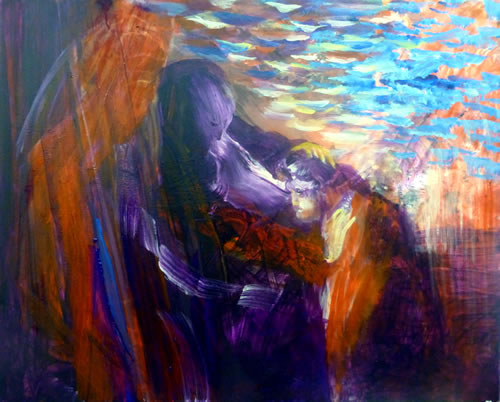
In the painting, Isaac, though old and humble, is a man of stature dressed in royal color. Jacob bows before his father, wearing the goatskins to resemble his brother. With one hand Isaac touches the animal skin clothing, while his other golden hand rests on Jacob's head. The tension and riveting drama that characterizes Isaac blessing Jacob (while thinking he is Esau) is heightened by the red image of Esau looming over his father.
In the background, the blessings flutter like wings, flying in the sky over wine-colored earth, symbolizing the promise of both spiritual realization and physical abundance.
Yoram Raanan takes inspiration from living in Israel, where he can fully explore and express his Jewish consciousness. The light, the air, the spirit of the people and the land energize and inspire him. His paintings include modern Jewish expressionism with a wide range of subjects ranging from abstract to landscape, biblical and Judaic.
© Copyright 2015, all rights reserved.
| ||||||||||||||||||||||||||||||||||||||||||||||||||||||||||||||||||||||||||||||||||||||||||||||||||||||||||||||||||||||||||||||||||||||||||||||||||||||

____________________________

No comments:
Post a Comment