
"Lord, to whom shall we go? You have the words of eternal life."[John 6:68] Tuesday of he 2nd Week of Easter
Saints of the day:

Saint Peter Gonzalez
Dominican Priest
(1190-1246)
Dominican Priest
(1190-1246)
Peter Gonzales, also known as St. Elmo or St. Telmo, was born to a Castilian family of nobility. He was educated by his uncle, the Bishop of Astorga, named canon of the local cathedral, famous for his penances and mortifications, joined the Dominican Order , preached and made chaplain of the court of King St. Ferdinand III.
He converted and influenced the soldiers of his country, evangelized, and died on Easter Sunday. Peter evangelized throughout his country and all along the coast.
He had a special fondness for sailors. He used to visit them aboard their ships, preaching the Gospel and praying for their needs.[From Catholic Online]
SAINT BENEZET, or Little Bennet
(1165-1184)
(1165-1184)
St. Benezet kept his mother's sheep in the country, and as a mere child was devoted to practices of piety. As many persons were drowned in crossing the Rhone, Benezet was inspired by God to build a bridge over that rapid river at Avignon. He obtained the approbation of the bishop, proved his mission by miracles, and began the work in 1177, which he directed during seven years.
He died when the difficulty of the undertaking was over, in 1184.
This is attested by public monuments drawn up at that time and still preserved at Avignon, where the story is in everybody's month. His body was buried upon the bridge itself, which was not completely finished till four years after his decease, the structure whereof was attended with miracles from the first laying of the foundations till it was completed in 1188.
Other miracles wrought after this at his tomb induced the city to build a chapel upon the bridge, in which his body lay nearly five hundred years. But in 1669 a greater part of the bridge falling down through the impetuosity of the waters, the coffin was taken up, and being opened in 1670 in presence of the grand vicar, during the vacancy of the archiepiscopal see, the body was found entire, without the least sign of corruption; even the bowels were perfectly sound, and the color of the eyes lively and sprightly, though, through the dampness of the situation, the iron bars about the coffin were much damaged with rust.
The body was found in the same condition by the Archbishop of Avignon in 1674, when, accompanied by the Bishop of Orange and a great concourse of nobility, he performed the translation of it, with great pomp, into the Church of the Celestines, this Order having obtained of Louis XIV . the honor of being intrusted with the custody of his relics till such time as the bridge and chapel should be rebuilt.
Lives of the Saints, by Alban Butler, Benziger Bros. ed. [1894]
Saints Tiburtius, Valerian & Maximus
Saint Tiburtius
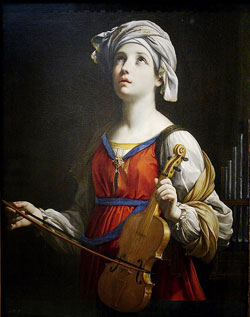
Feastday: April 14
Death: 3rd century
Martyr with Valerian and Maximus, known by their inclusion in the Acts of St. Cecilia . It is generally accepted that the Acts are fiction, but the three perhaps were genuine martyrs, especially as their tombs in the cemetery of Praetextatus were exceedingly popular during the Middle Ages. According to the Acts, Valerian was Cecilia’s husband, Tiburtius her brother, and Maximus a Roman soldier or official who died with them.| Saints Tiburtius, Valerian, and Maximus, Martyrs |
A.D. 229.
THESE holy martyrs have always been held in singular veneration in the church, as appears from the ancient calendar of Fronto, the sacramentary of St. Gregory, St. Jerom’s Martyrology, that of Thomasius, &c. Valerian was espoused to St. Cecily, and converted by her to the faith; and with her he became the instrument of the conversion of his brother Tiburtius. Masimus, the officer appointed to attend their execution, was brought to the faith by the example of their piety, and received with them the crown of martyrdom, in the year 229. The theatre of their triumph seems to have been Rome, though some have imagined they suffered in Sicily. They were interred in the burying place of Prætextatus, which, from them, took the name of Tiburtius. It was contiguous to that of Calixtus. In that place Pope Gregory III. repaired their monument in 740; and Adrian I. built a church under their patronage. But Pope Paschal translated the remains of these martyrs, of St. Cecily, and the popes SS. Urban and Lucius, into the city, where the celebrated church of St. Cecily stands. These relics were found in it in 1599, and visited by the Order of Clement VIII., and approved genuine by the Cardinals Baronius and Sfondrate. The Greeks vie with the Latins in their devotion to these martyrs. | 1 |
| Most agreeable to the holy angels was this pious family, converted to God by the zeal and example of St. Cecily, who frequently assembled to sing together, with heavenly purity and fervour, the divine praises. We shall also draw upon ourselves the protection, constant favour, and tender attention of the heavenly spirits, if we faithfully imitate the same |
Acts of the Apostles 4:32 All the many believers were one in heart and soul, and no one claimed any of his possessions for himself, but everyone shared everything he had. 33 With great power the emissaries continued testifying to the resurrection of the Lord Yeshua, and they were all held in high regard. 34 No one among them was poor, since those who owned lands or houses sold them and turned over the proceeds 35 to the emissaries to distribute to each according to his need. 36 Thus Yosef, whom the emissaries called Bar-Nabba (which means “the Exhorter”), a Levi and a native of Cyprus, 37 sold a field which belonged to him and brought the money to the emissaries.
Psalm 93:1 Adonai is king, robed in majesty;
Adonai is robed, girded with strength;
The world is well established;
it cannot be moved.
2 Your throne was established long ago;
you have existed forever.
5 Your instructions are very sure;
holiness befits your house,
Adonai, for all time to come.
The Holy Gospel According to Saint John 3:7 Stop being amazed at my telling you that you must be born again from above! 8 The wind blows where it wants to, and you hear its sound, but you don’t know where it comes from or where it’s going. That’s how it is with everyone who has been born from the Spirit.”
9 Nakdimon replied, “How can this happen?” 10 Yeshua answered him, “You hold the office of teacher in Isra’el, and you don’t know this? 11 Yes, indeed! I tell you that what we speak about, we know; and what we give evidence of, we have seen; but you people don’t accept our evidence! 12 If you people don’t believe me when I tell you about the things of the world, how will you believe me when I tell you about the things of heaven? 13 No one has gone up into heaven; there is only the one who has come down from heaven, the Son of Man. 14 Just as Moshe lifted up the serpent in the desert, so must the Son of Man be lifted up; 15 so that everyone who trusts in him may have eternal life.
Tuesday of he 2nd Week of Easter
Commentary of the Day:
____________________________
Psalm 93:1 Adonai is king, robed in majesty;
Adonai is robed, girded with strength;
The world is well established;
it cannot be moved.
2 Your throne was established long ago;
you have existed forever.
5 Your instructions are very sure;
holiness befits your house,
Adonai, for all time to come.
The Holy Gospel According to Saint John 3:7 Stop being amazed at my telling you that you must be born again from above! 8 The wind blows where it wants to, and you hear its sound, but you don’t know where it comes from or where it’s going. That’s how it is with everyone who has been born from the Spirit.”
9 Nakdimon replied, “How can this happen?” 10 Yeshua answered him, “You hold the office of teacher in Isra’el, and you don’t know this? 11 Yes, indeed! I tell you that what we speak about, we know; and what we give evidence of, we have seen; but you people don’t accept our evidence! 12 If you people don’t believe me when I tell you about the things of the world, how will you believe me when I tell you about the things of heaven? 13 No one has gone up into heaven; there is only the one who has come down from heaven, the Son of Man. 14 Just as Moshe lifted up the serpent in the desert, so must the Son of Man be lifted up; 15 so that everyone who trusts in him may have eternal life.
Tuesday of he 2nd Week of Easter
Commentary of the Day:
____________________________

No comments:
Post a Comment